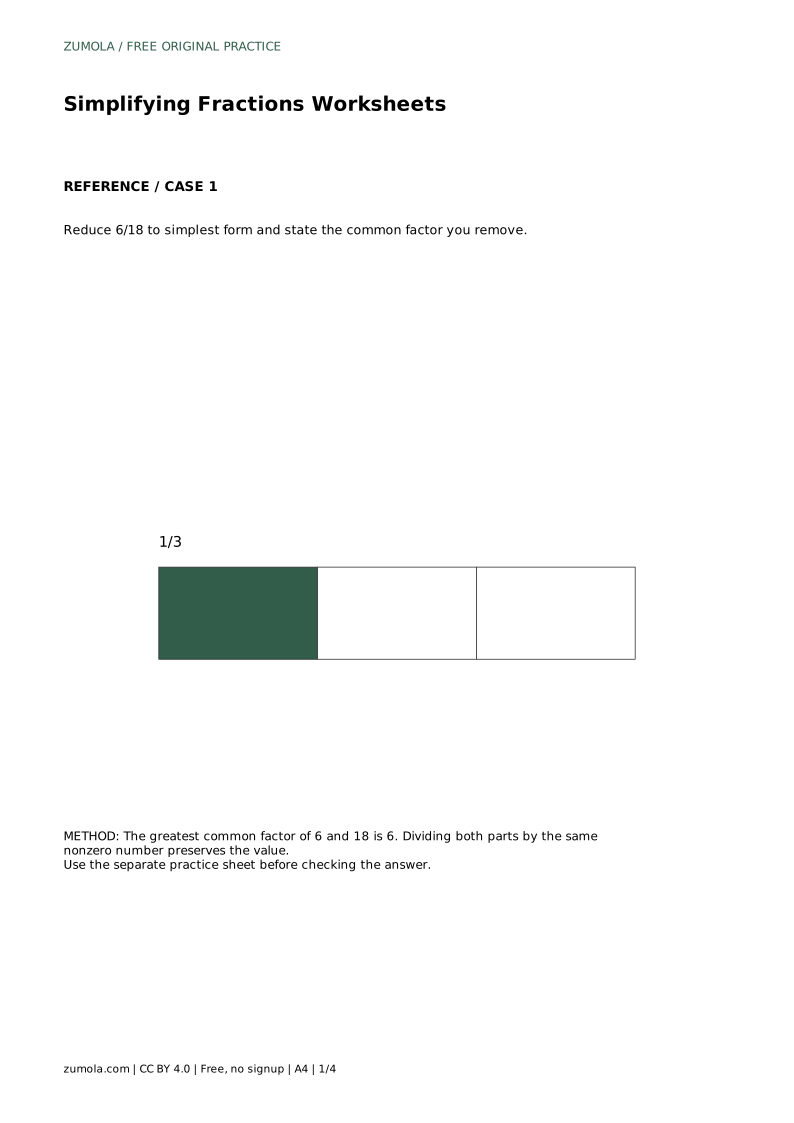
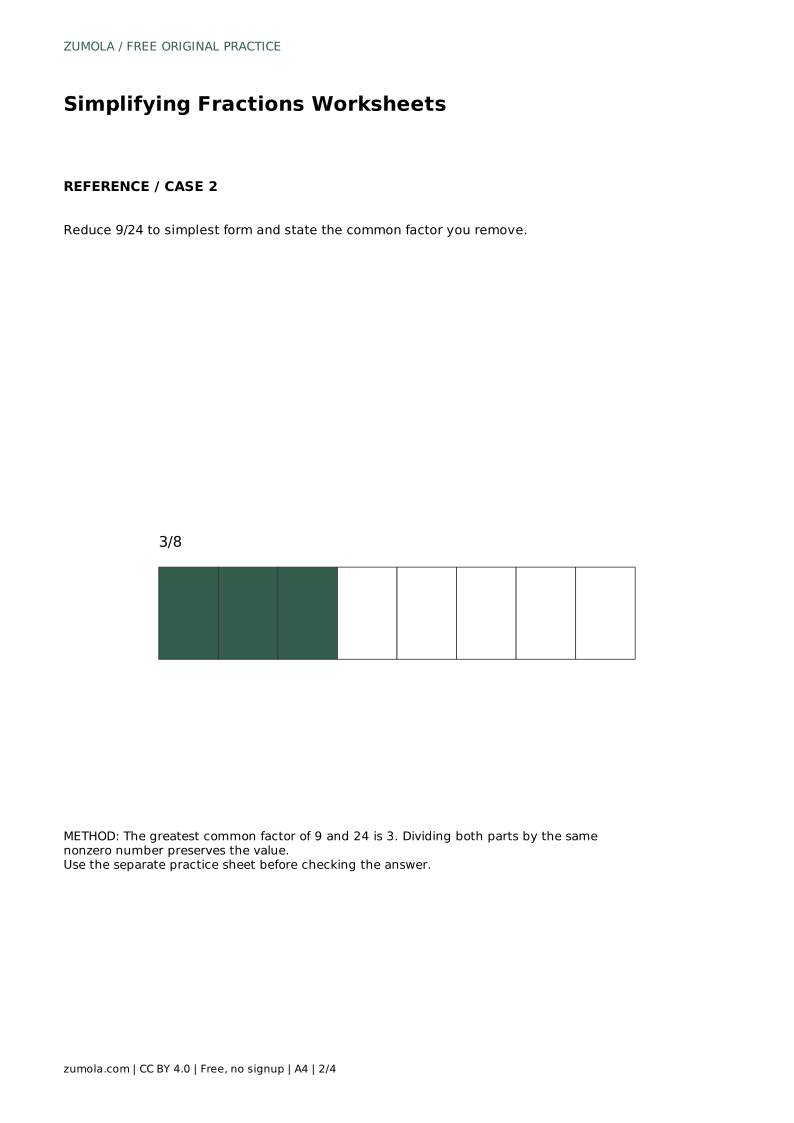
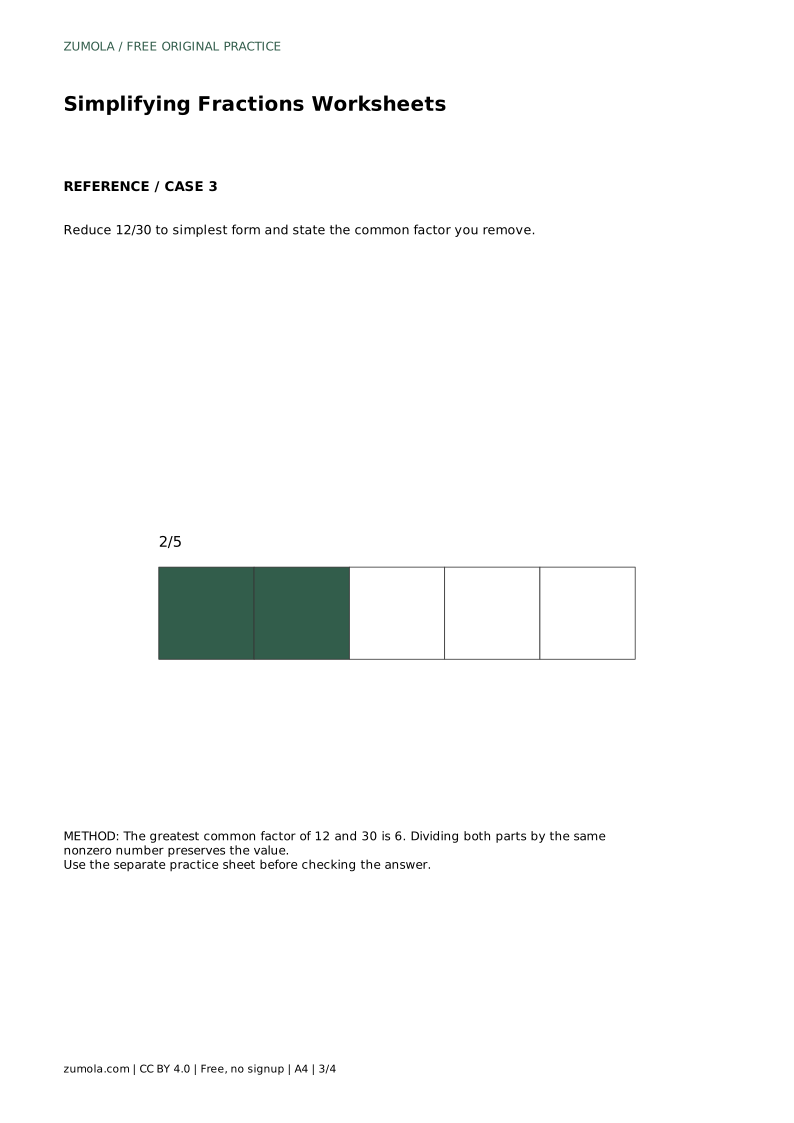
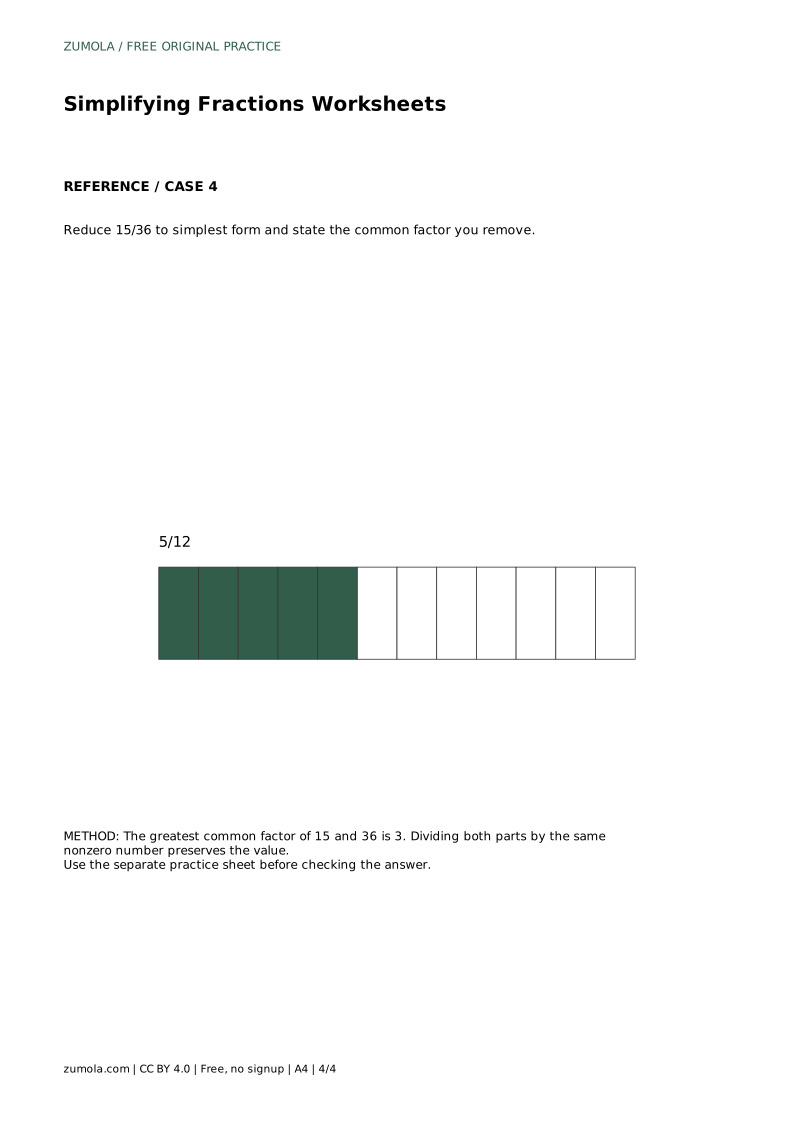
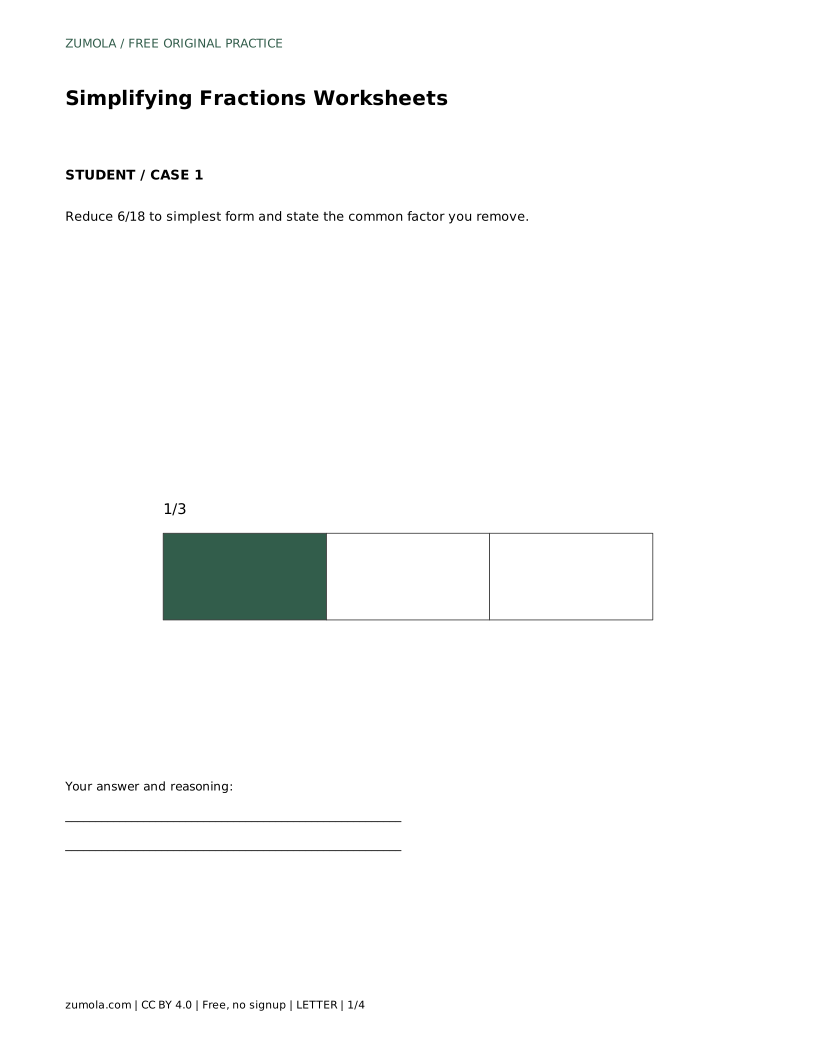
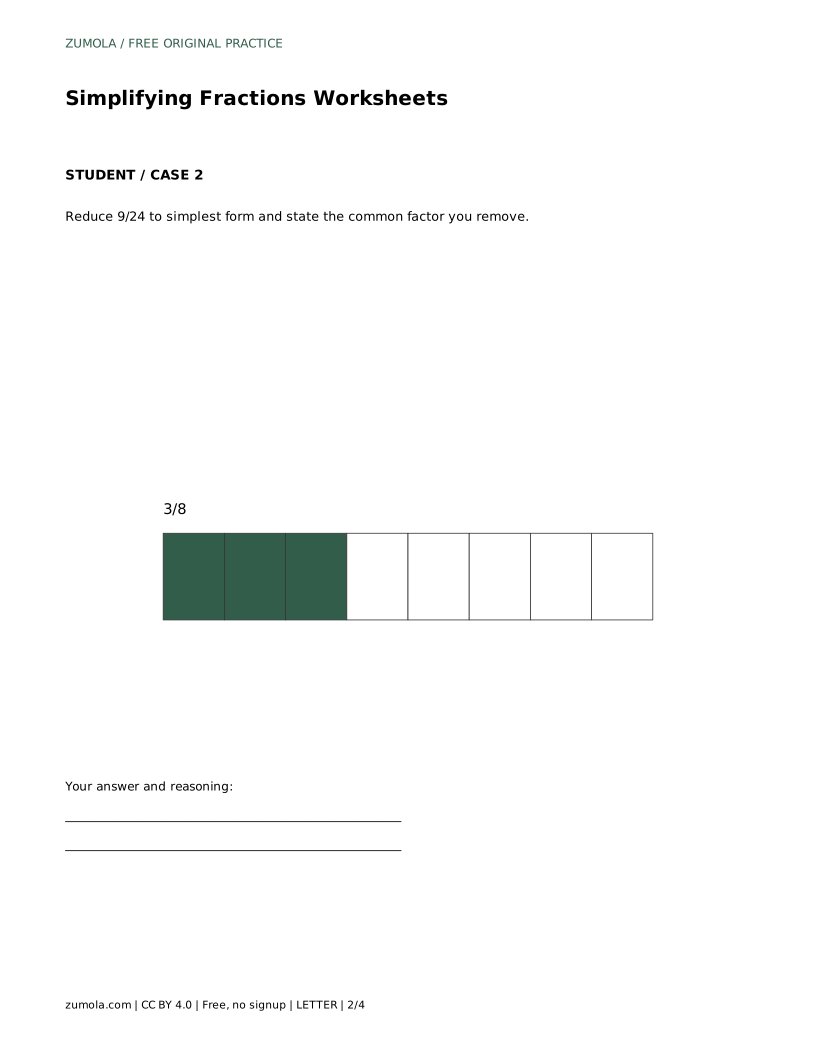
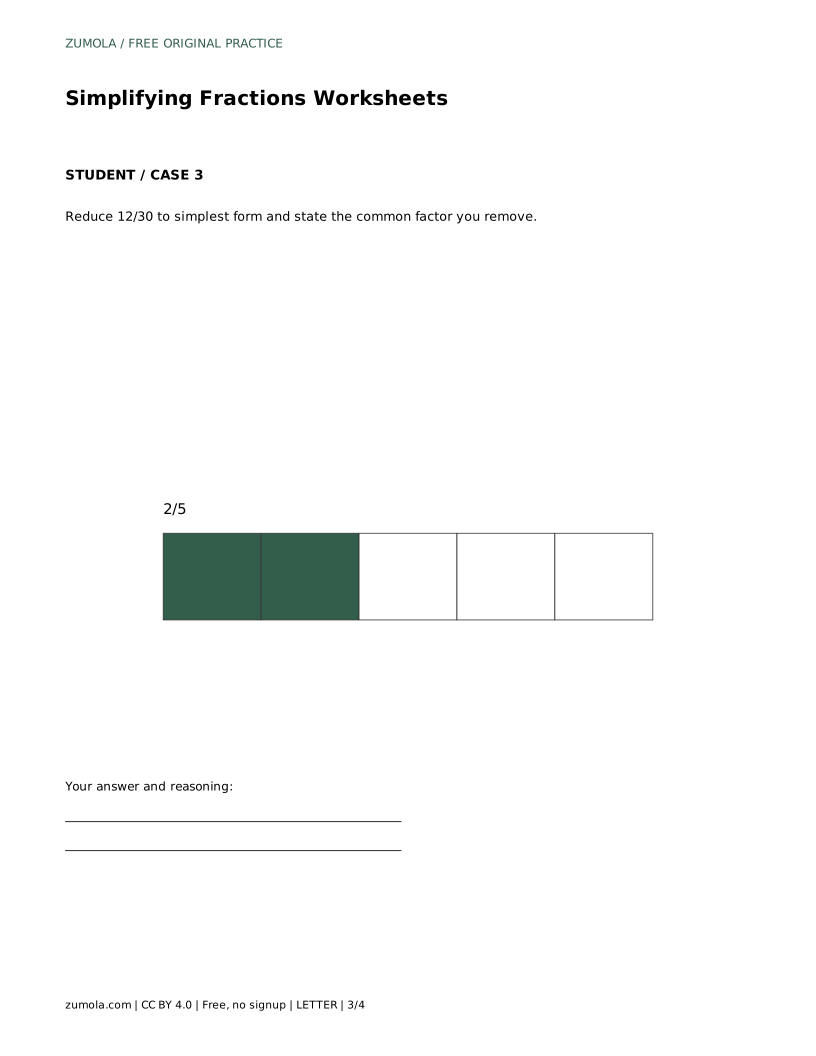
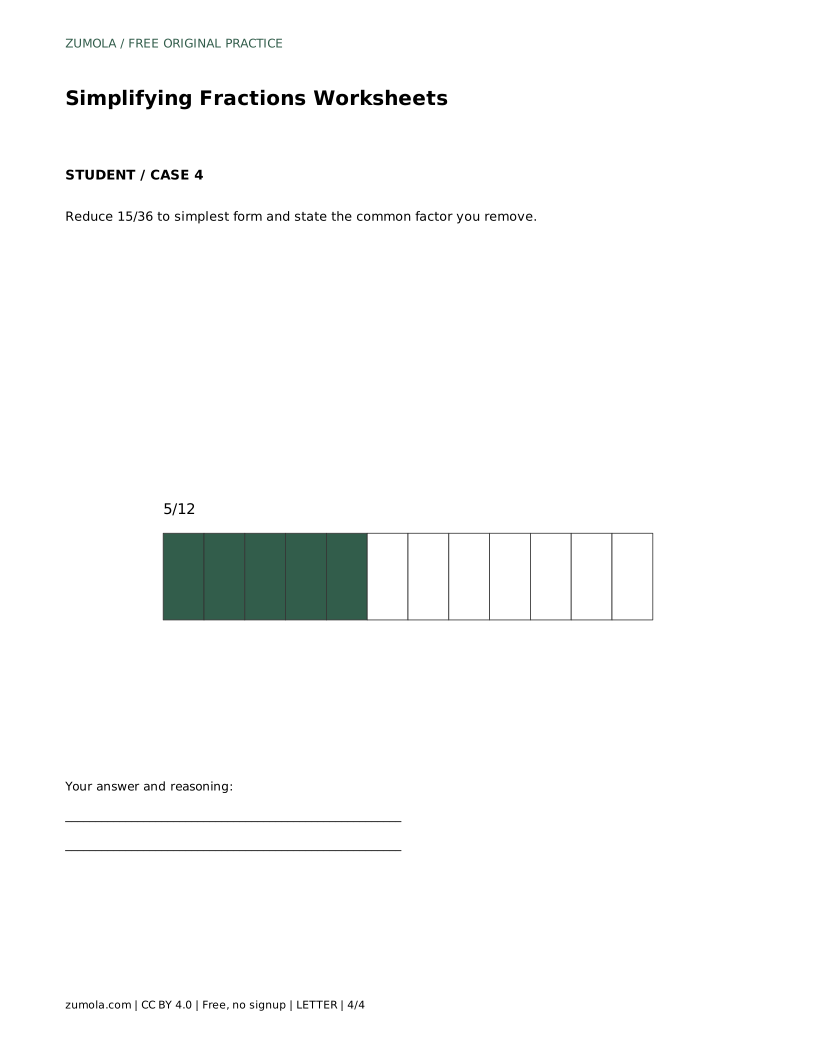
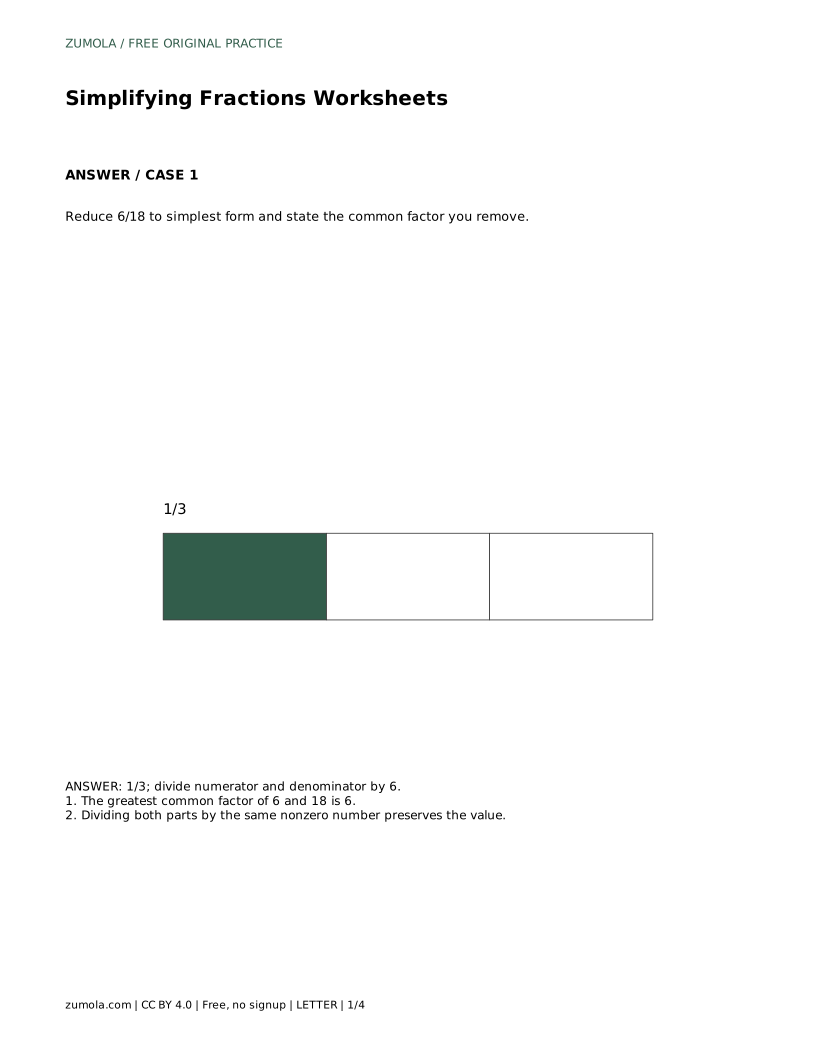
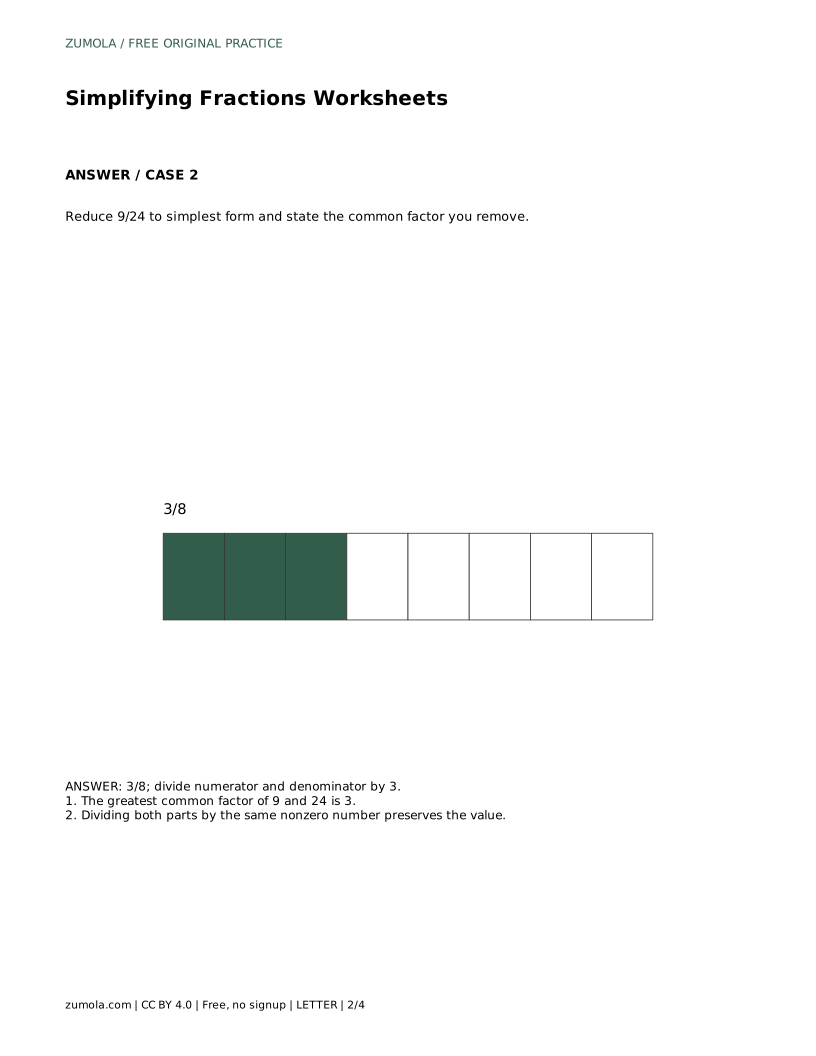
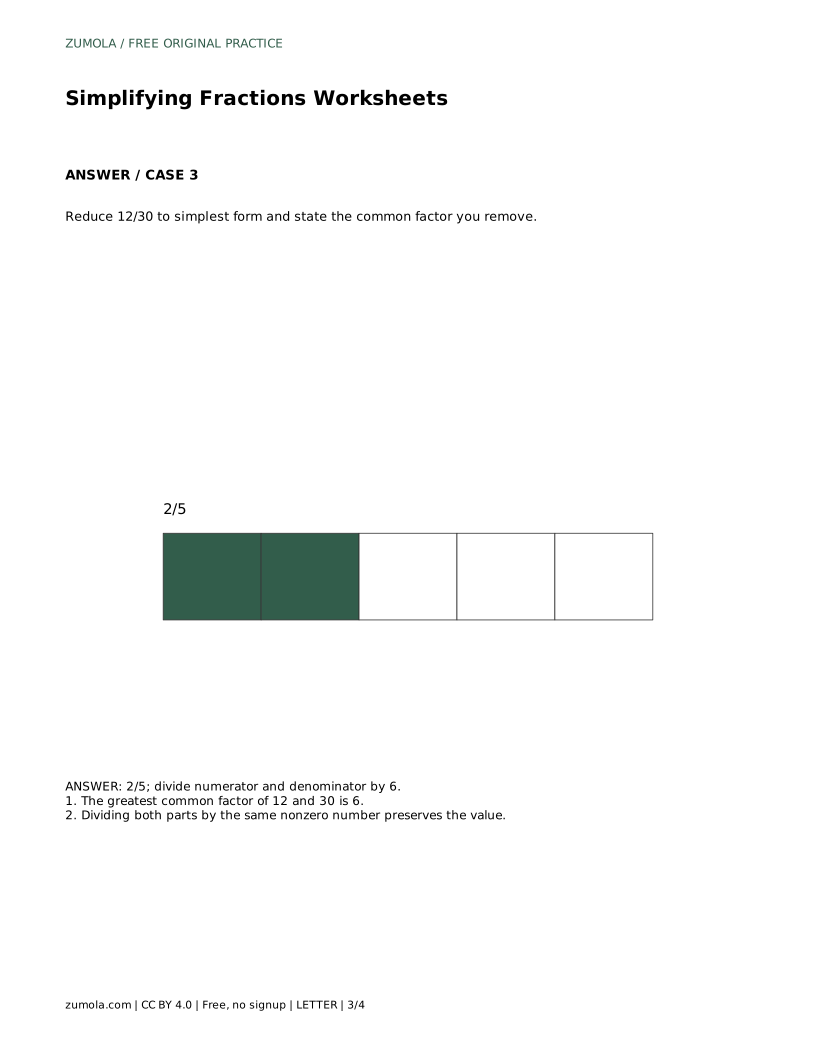
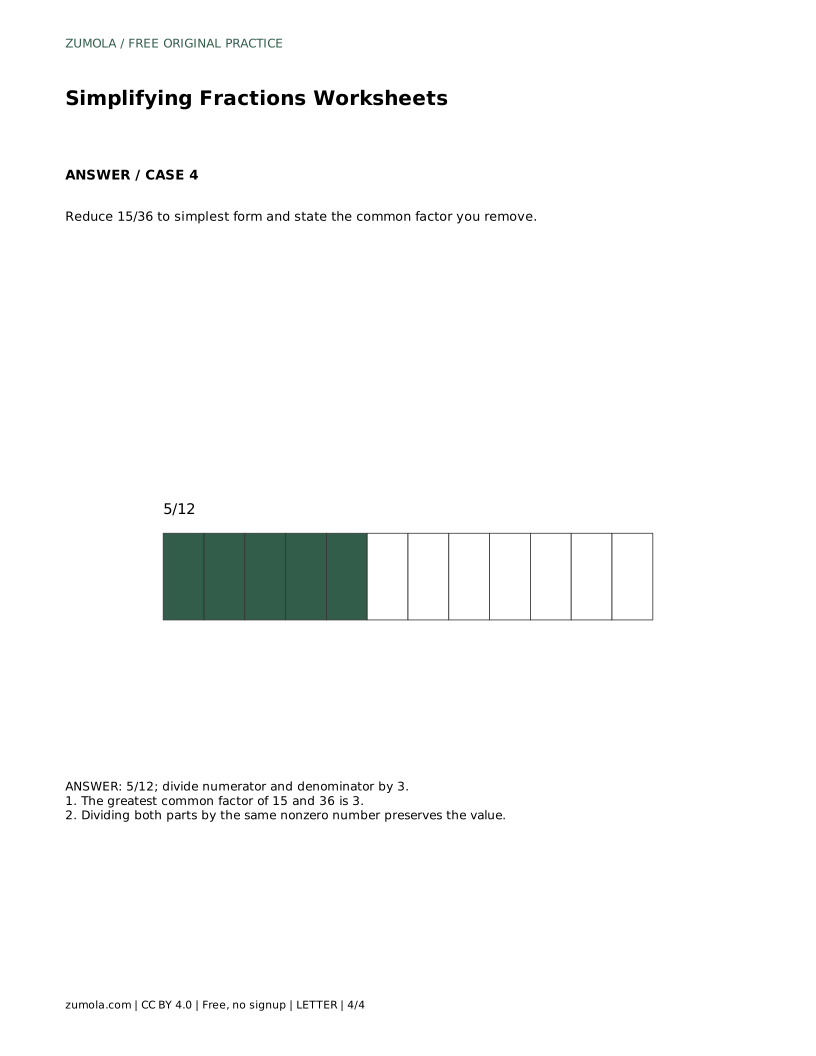
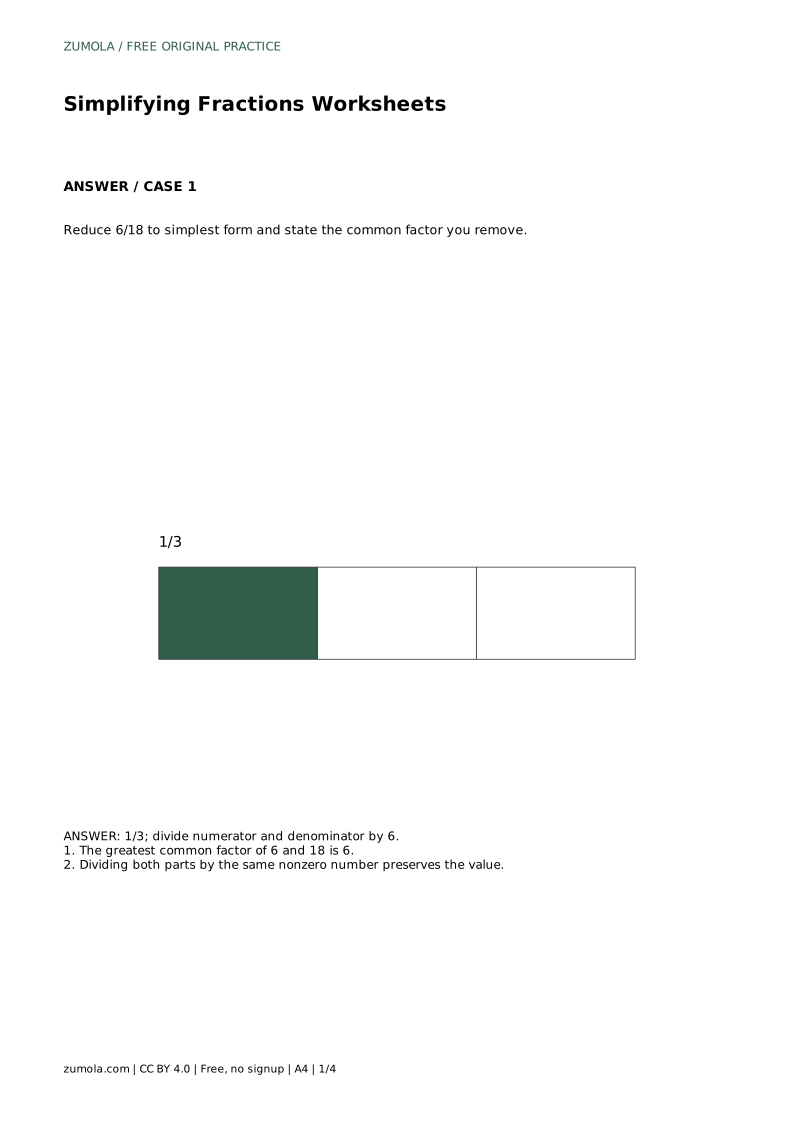
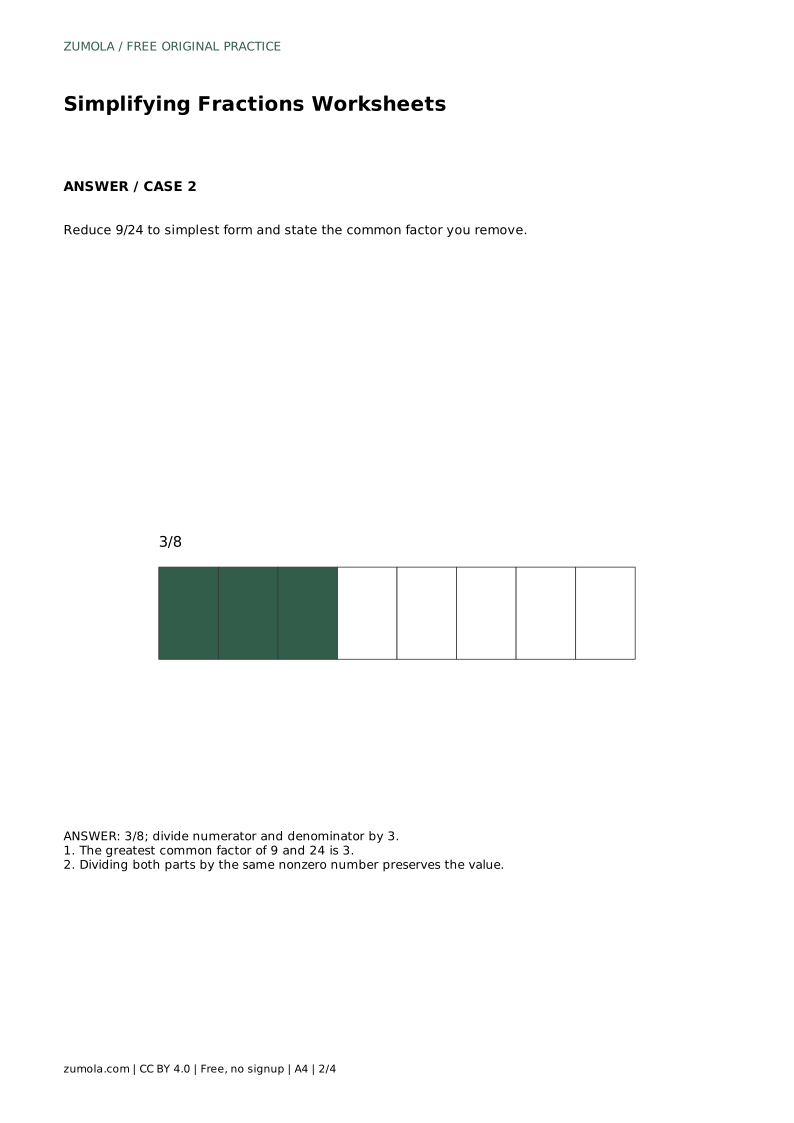
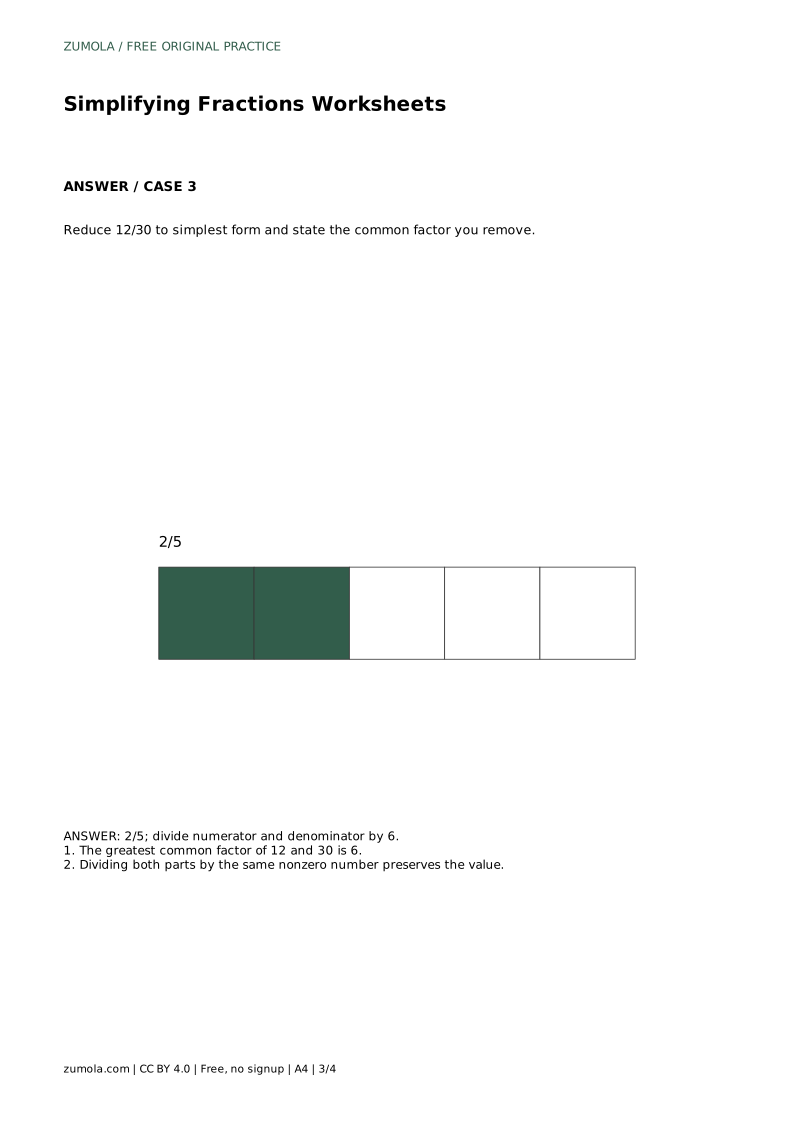
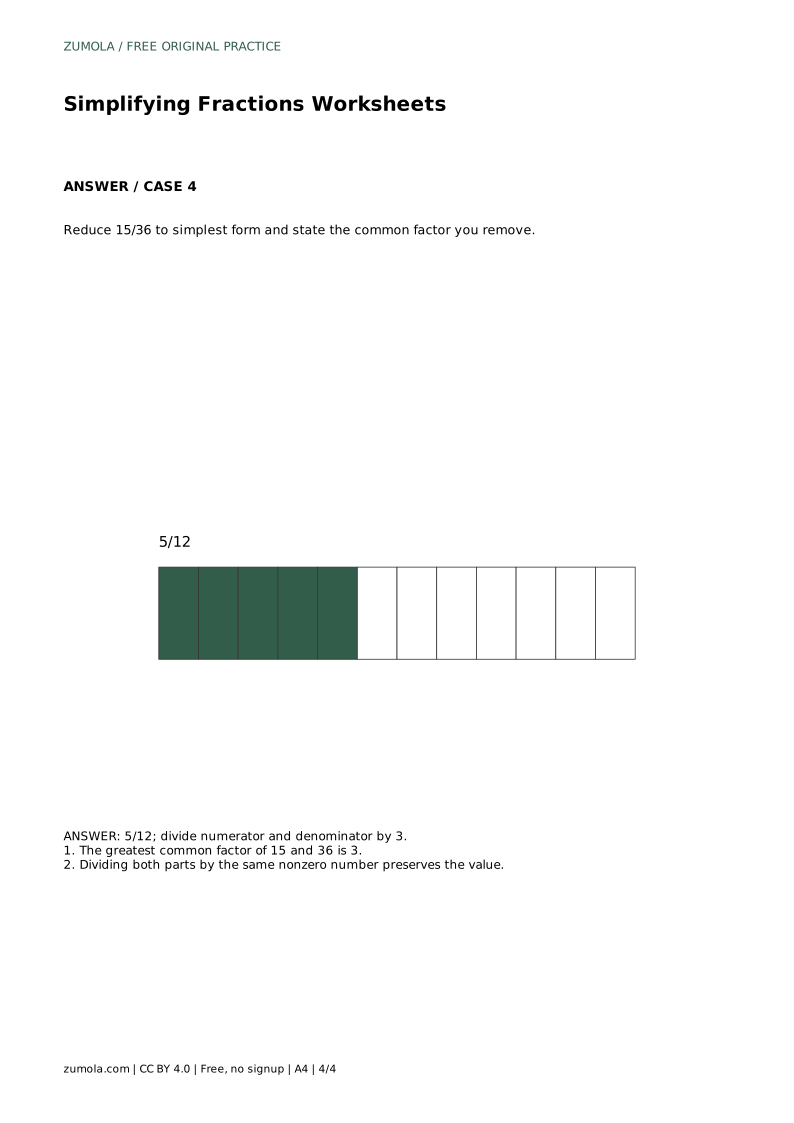
Reference diagrams
LETTER · Download PDF
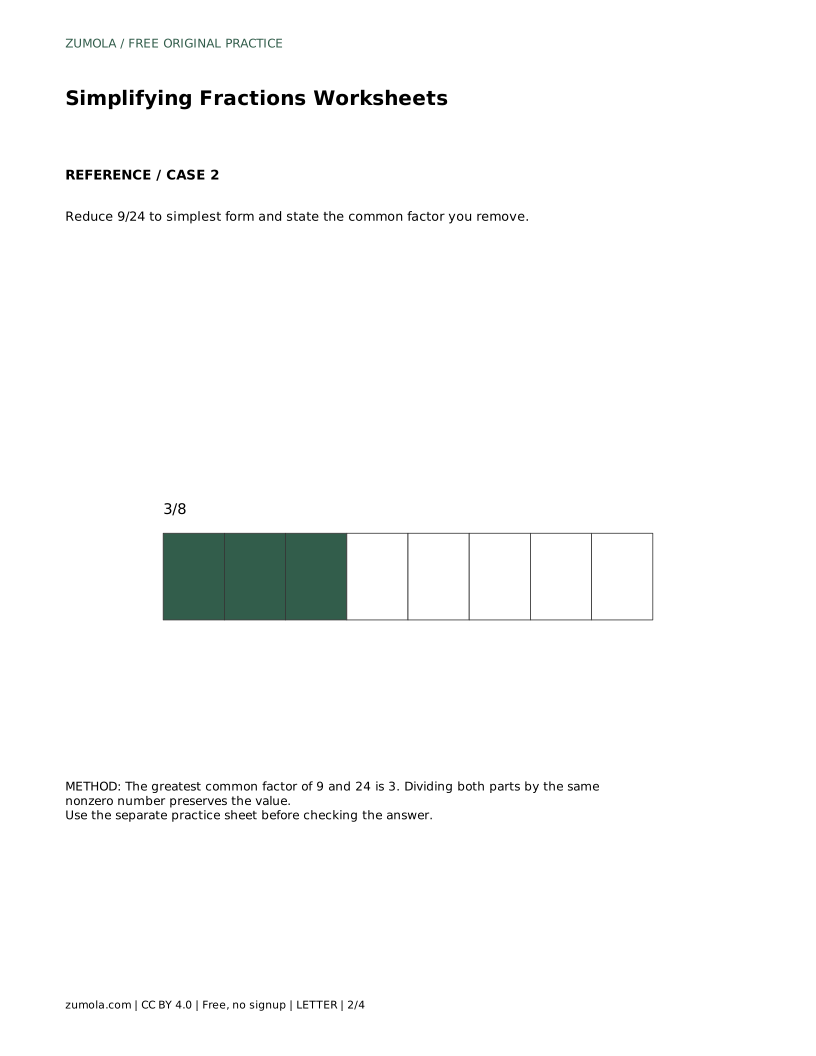
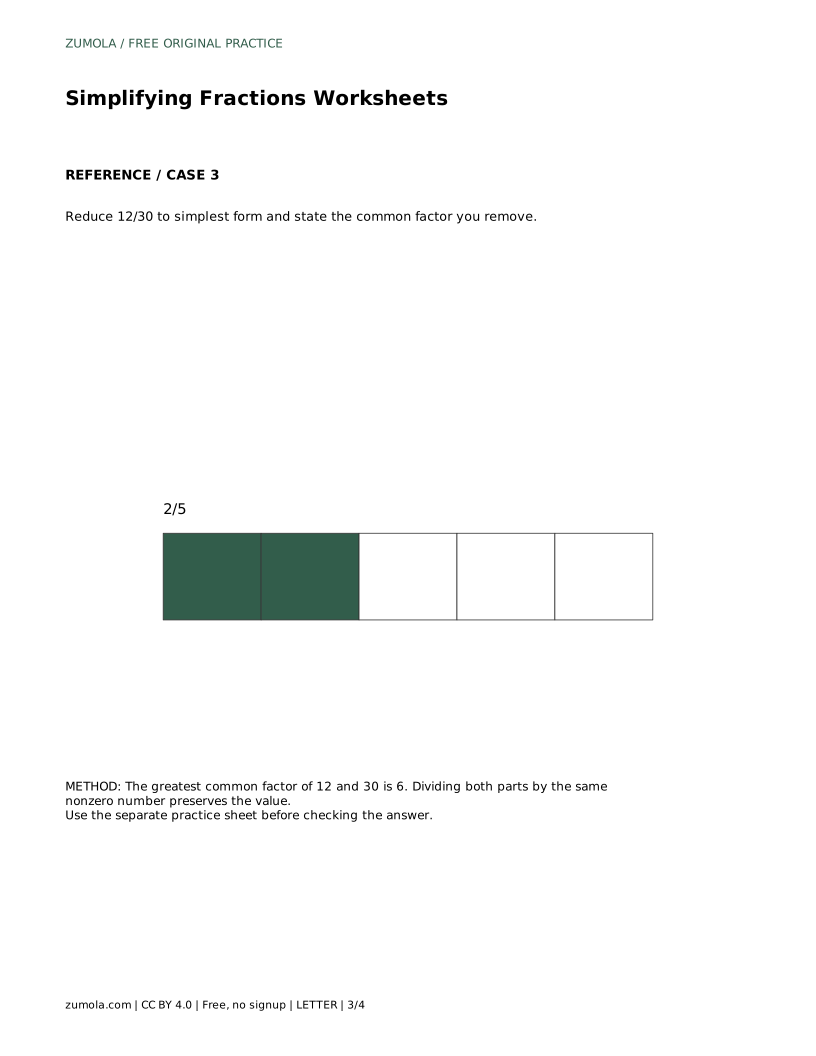
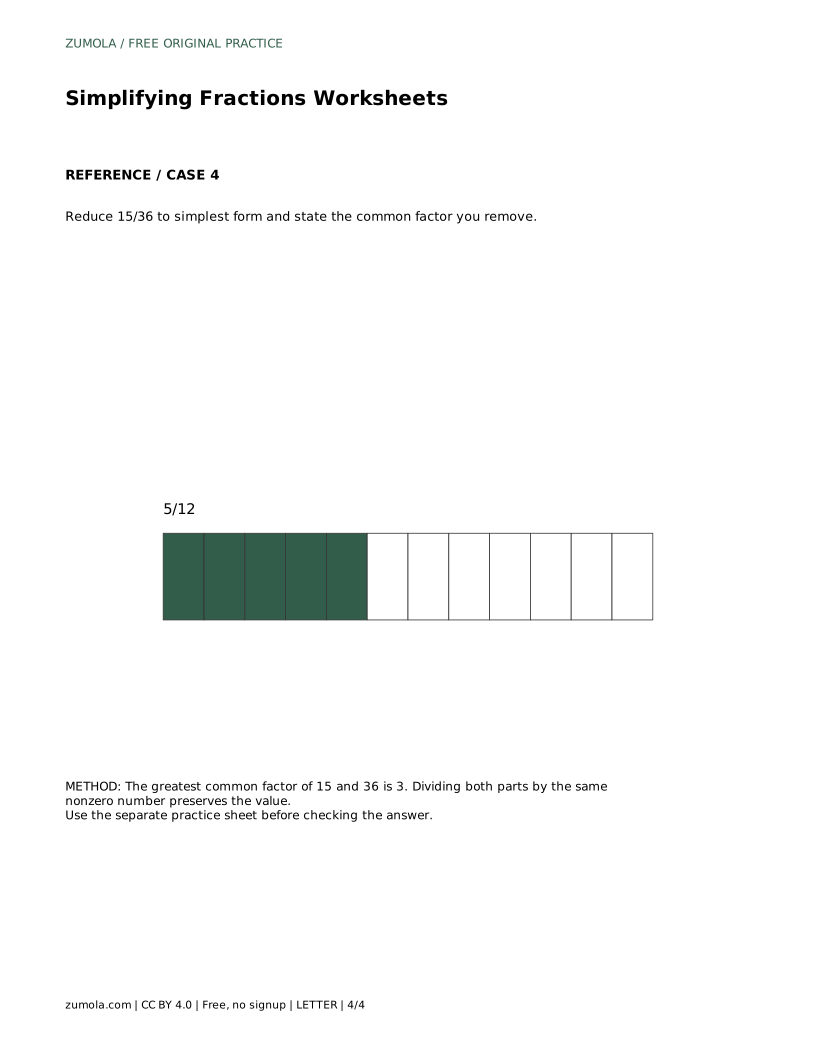
A4 · Download PDF
Free original resources
Practice reducing fractions by dividing numerator and denominator by their greatest common factor, with clear steps, worked reasoning, and a rubric for checking answers.
Four original cases, with reference diagrams, practice sheets and worked answers. Everything is free; no signup required.
LETTER · Download PDF
A4 · Download PDF
LETTER · Download PDF
A4 · Download PDF
LETTER · Download PDF
A4 · Download PDF
Use A4 or US Letter to match your printer. Use the stated values and conditions to solve each exercise; diagrams are not physical measuring rulers.
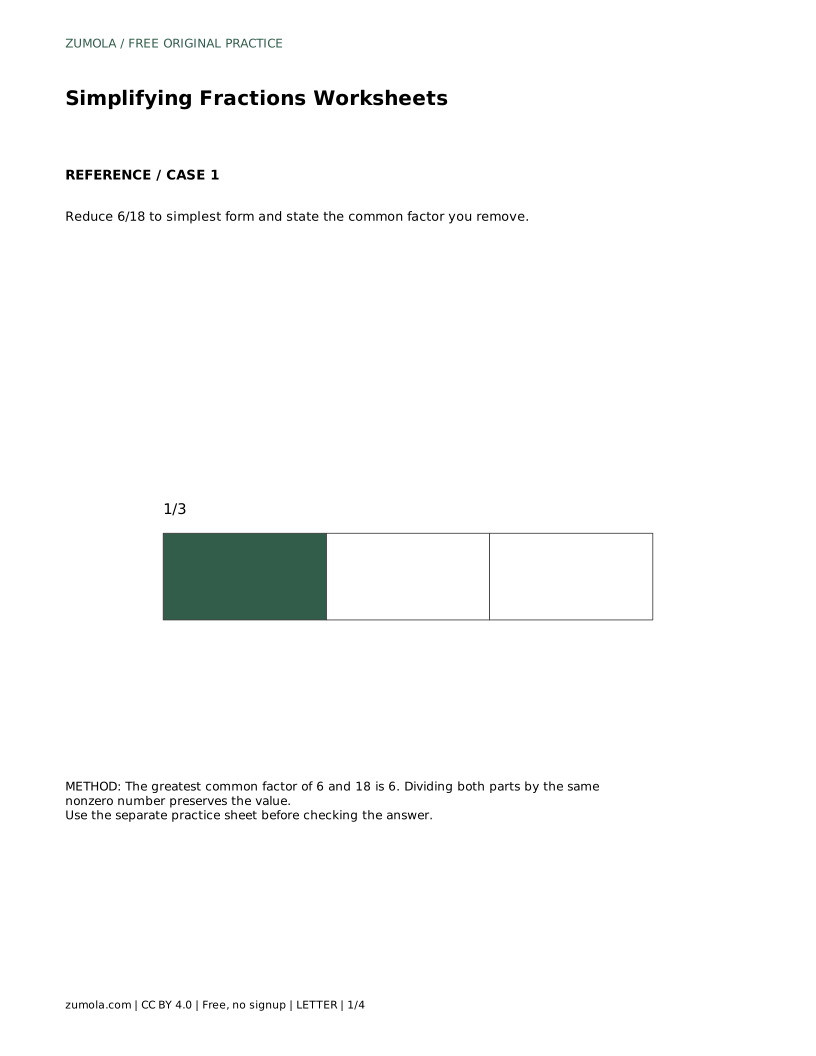
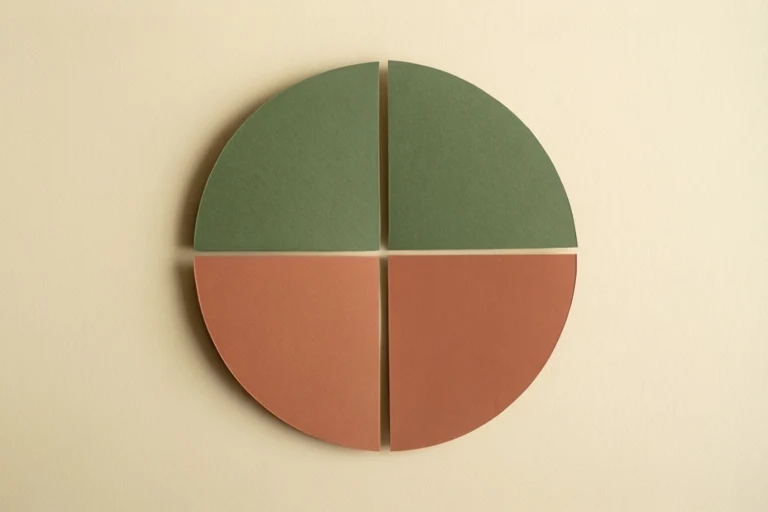
Simplifying a fraction means rewriting it with the smallest whole-number numerator and denominator that keep the same value. The reliable method is to find the greatest common factor of both parts, then divide each by that factor. These worksheets give learners structured practice with that single skill: identifying the common factor, applying it, and checking that the result cannot be reduced further.
A fraction such as 6/18 describes a part of a whole. Its numerator and denominator are both counts, and multiplying or dividing both counts by the same nonzero number produces an equivalent fraction. Simplifying does not change the amount represented; it changes only how that amount is written.
The simplest form is reached when the numerator and denominator share no common factor greater than 1. At that point the fraction is fully reduced. A fraction can be reduced in several stages, but the final result should be the same, so learners can check their work by confirming that no whole number above 1 divides both parts evenly.
The greatest common factor is the largest whole number that divides both the numerator and denominator without a remainder. Dividing by it once reaches simplest form directly, which reduces the chance of stopping too early.
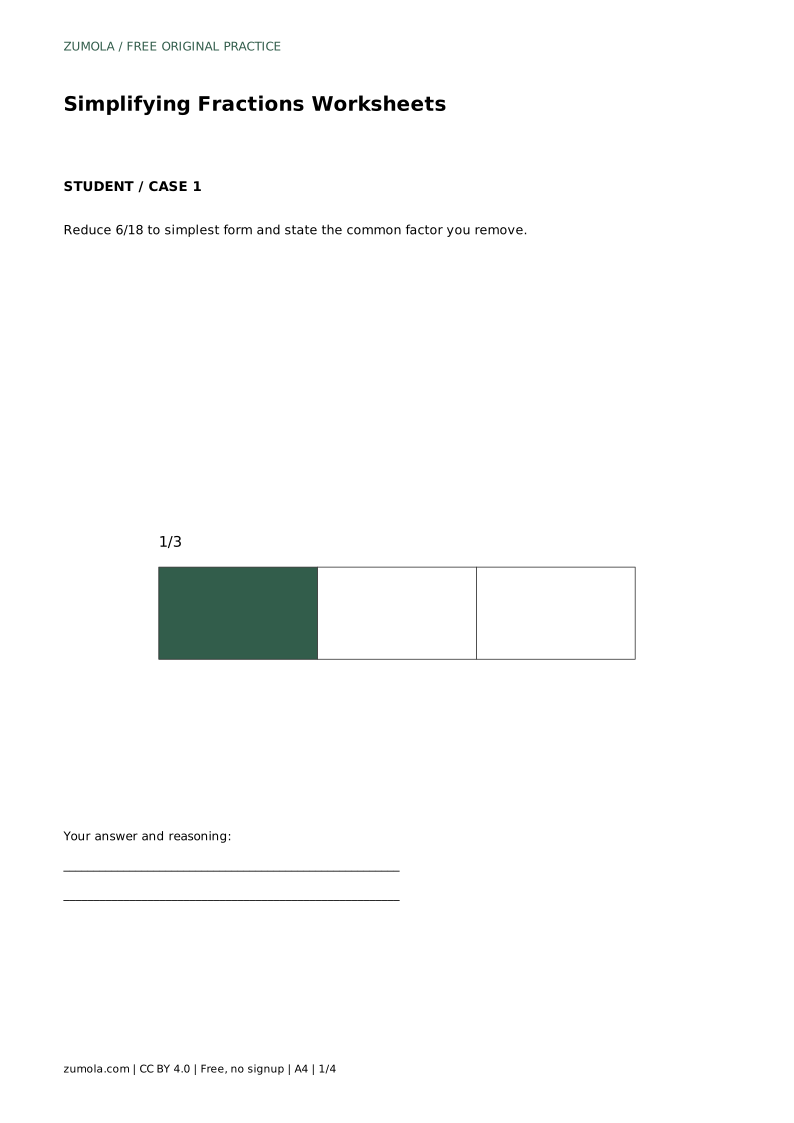
For 6 and 18, the factors of 6 are 1, 2, 3, and 6; the factors of 18 include 1, 2, 3, 6, 9, and 18. The largest shared factor is 6. Dividing both parts by 6 gives 1/3. Because 1 and 3 share no factor greater than 1, the fraction is fully simplified.
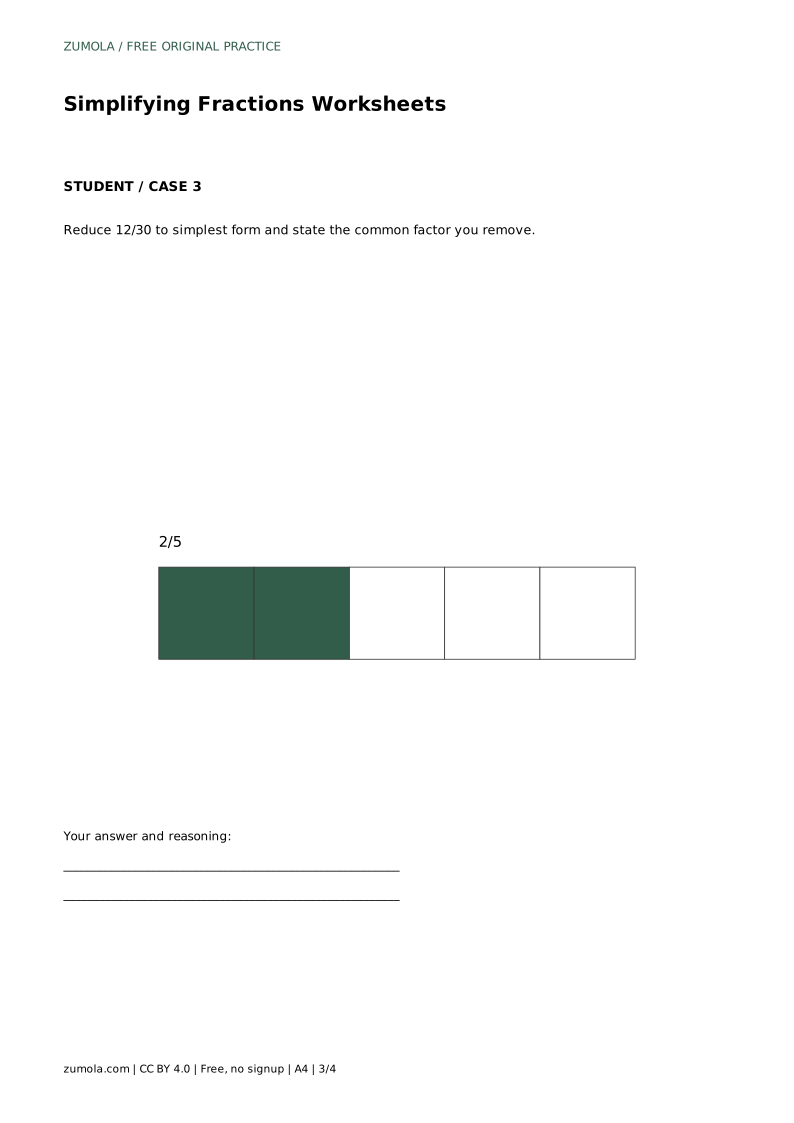
A common error is dividing by a shared factor that is not the greatest one, then assuming the task is finished. For example, dividing 12/30 by 2 gives 6/15, which is equivalent but not simplest because 6 and 15 still share a factor of 3. Dividing by 6 directly gives 2/5.
Learners should treat the final check as part of the method, not an optional extra. If both numbers are even, a factor of 2 remains. If both end in 0 or 5, a factor of 5 remains. If the digit sum of each number is divisible by 3, a factor of 3 remains. These quick tests catch incomplete reductions.
Keep the focus on the simplification method. Each item should ask for the reduced fraction and the common factor removed, which makes the learner's reasoning checkable even when the final answer is correct by accident.
Prompt: Reduce 6/18 to simplest form and state the common factor you remove.
The greatest common factor of 6 and 18 is 6. Dividing both parts by the same nonzero number preserves the value, so 6 divided by 6 is 1 and 18 divided by 6 is 3. The result is 1/3, and the common factor removed is 6.
Can I simplify in more than one step? Yes. Dividing by smaller shared factors works, provided you continue until no common factor above 1 remains.
Does simplifying change the fraction's value? No. Dividing both numerator and denominator by the same nonzero number keeps the value equal.
What if the numerator is 1? A fraction with numerator 1 is already in simplest form because 1 shares no factor greater than 1 with any whole number.
Reduce 6/18 to simplest form and state the common factor you remove.
1/3; divide numerator and denominator by 6. The greatest common factor of 6 and 18 is 6. Dividing both parts by the same nonzero number preserves the value.
The numerator and denominator share no whole-number factor greater than 1. Test for 2, 3, and 5 first, then check larger factors if needed.
Dividing by the greatest common factor reaches simplest form in one step, reducing the chance of stopping before the fraction is fully reduced.
No. Dividing by shared factors in any order gives the same final value, but you must continue until no common factor above 1 remains.
All math worksheets · Free coordinate paper
Original resources · CC BY 4.0 · Free for personal and classroom use with attribution.