Reference diagrams
LETTER · Download PDF
A4 · Download PDF
Free original resources
Teach students to compare and order fractions by drawing equal-whole pictures, then confirm the order with exact fraction reasoning.
Four original cases, with reference diagrams, practice sheets and worked answers. Everything is free; no signup required.
LETTER · Download PDF
A4 · Download PDF
LETTER · Download PDF
A4 · Download PDF
LETTER · Download PDF
A4 · Download PDF
Use A4 or US Letter to match your printer. Use the stated values and conditions to solve each exercise; diagrams are not physical measuring rulers.
Drawing pictures makes fraction size visible, but pictures alone can mislead when wholes are drawn different sizes or partitions are uneven. This page shows how to sketch fractions on matching whole shapes, compare the shaded amounts, and then justify the order with exact fraction comparisons. The method works for positive fractions with the same whole, such as parts of one rectangle or one circle.
Every picture in a comparison must show the same whole. Draw three identical rectangles, each the same length and height, or three identical circles. If one whole is larger, the shaded area no longer represents the same unit and the comparison is invalid.
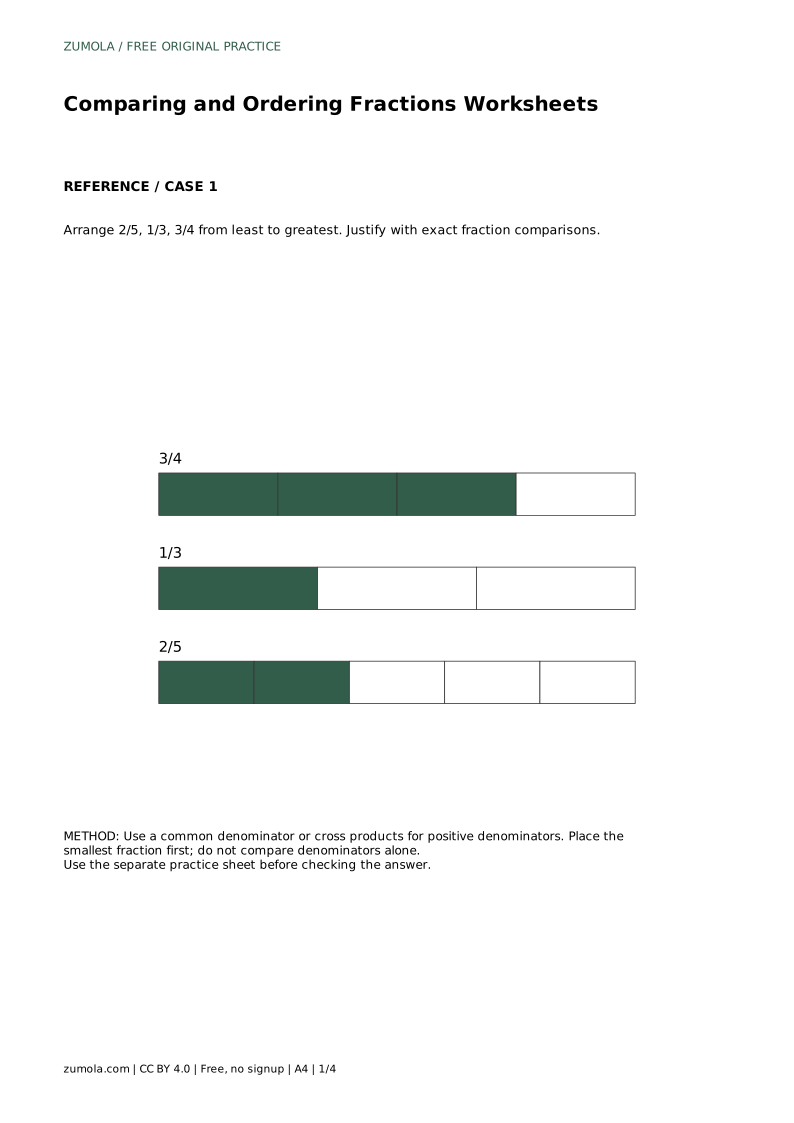
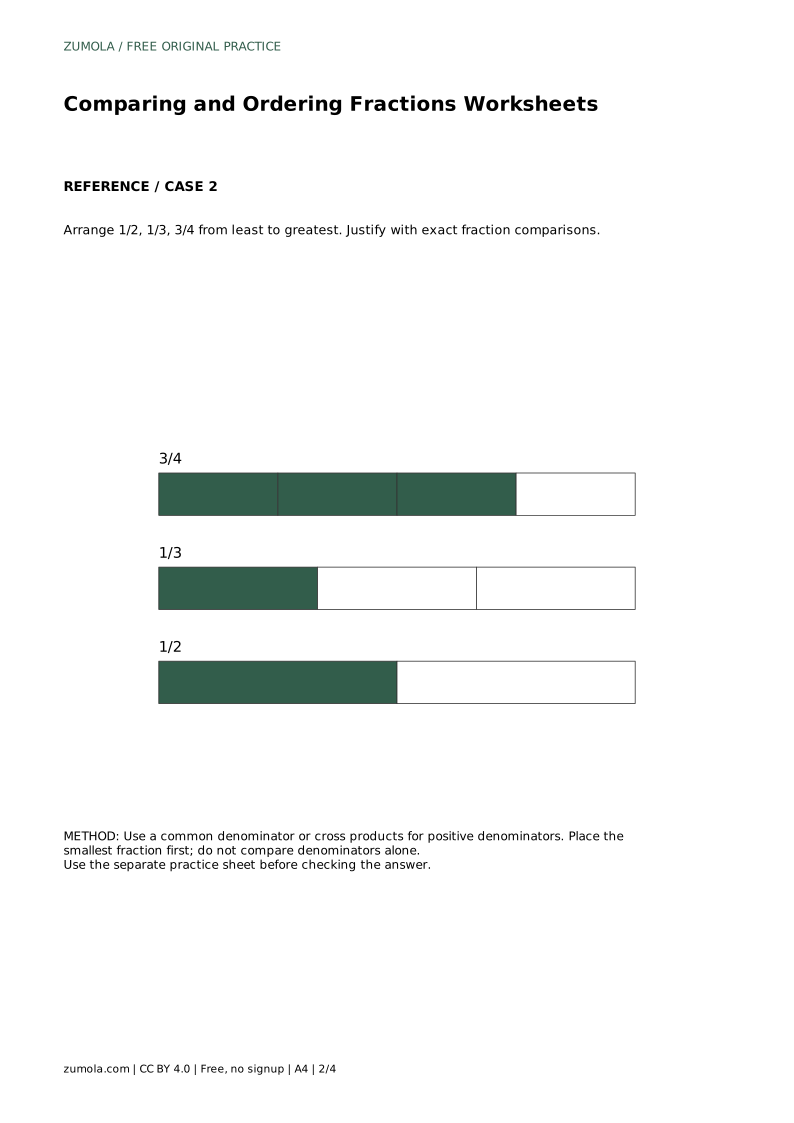
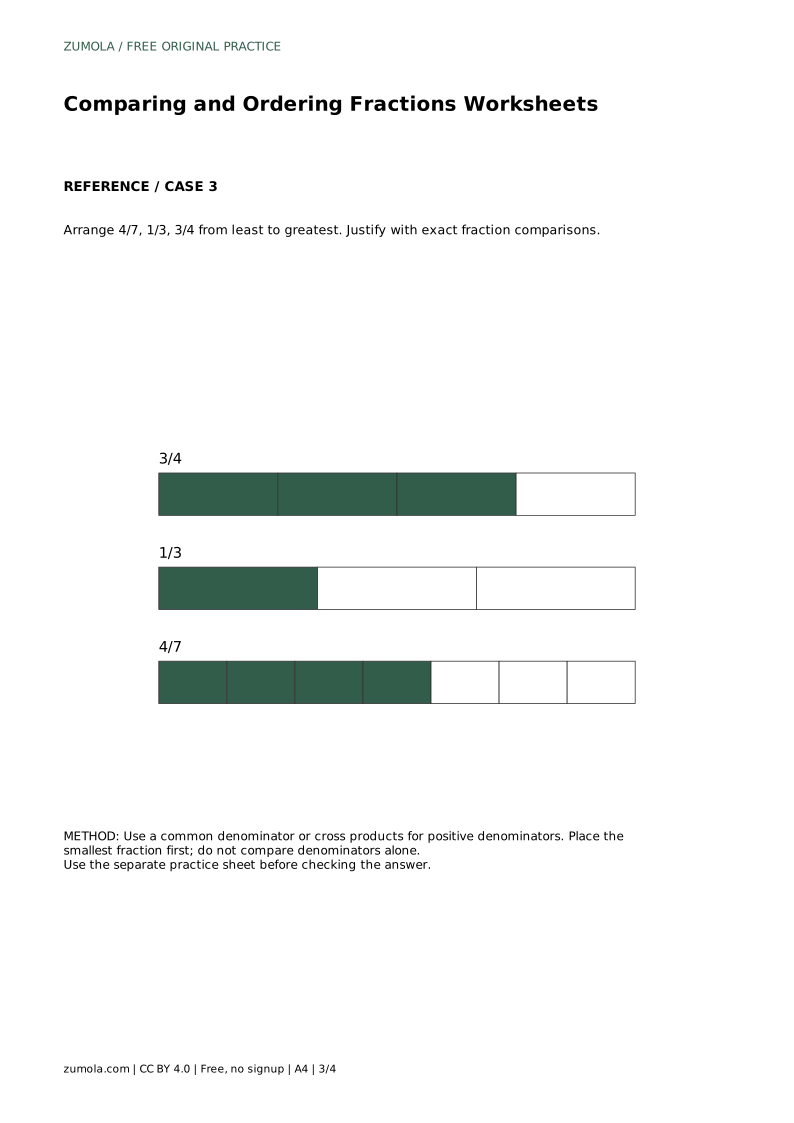
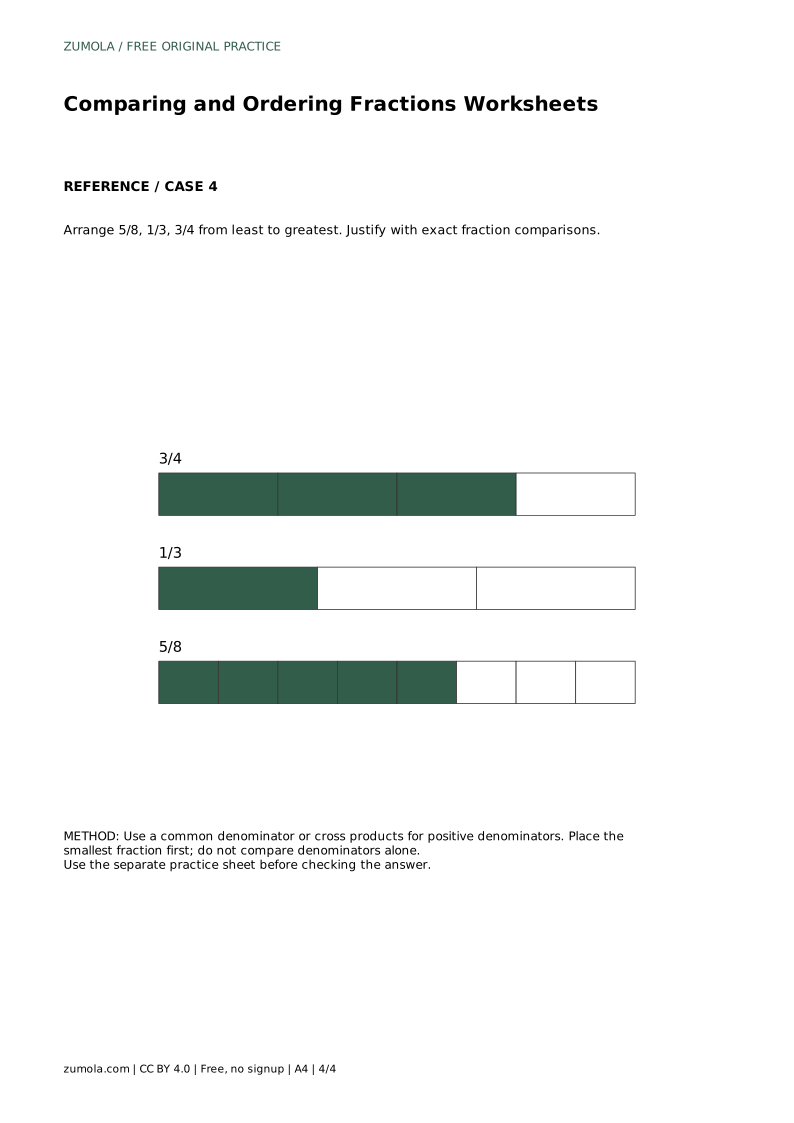
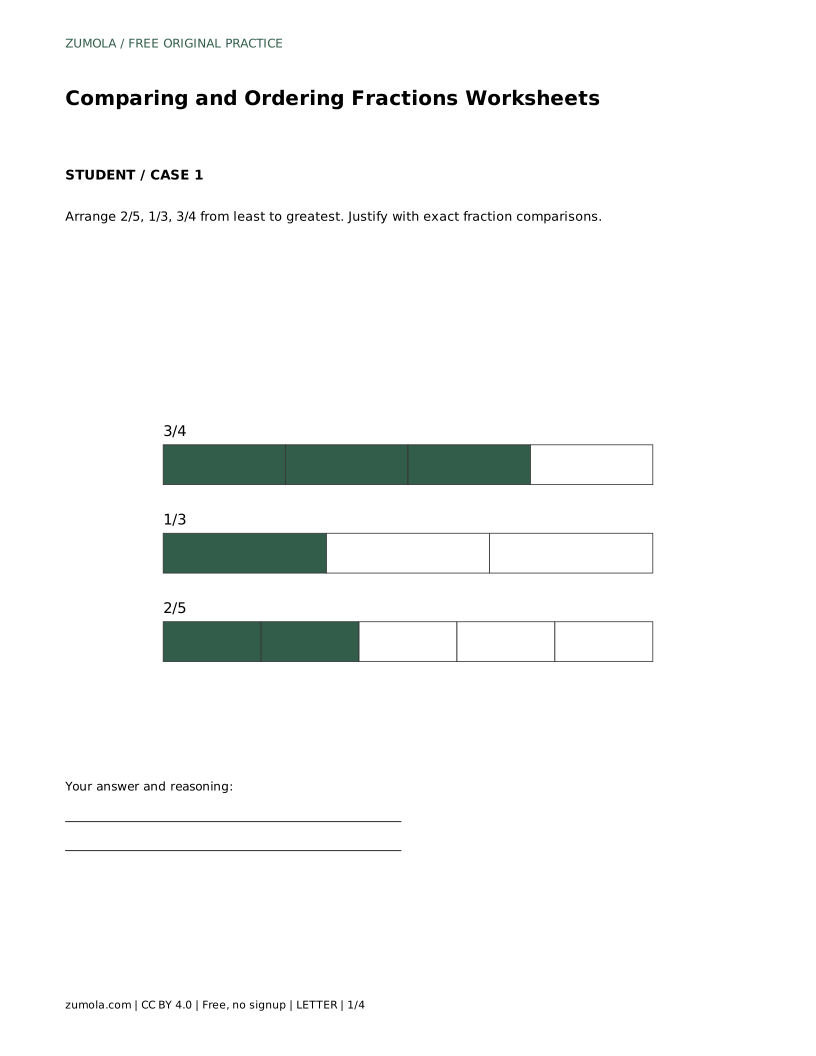
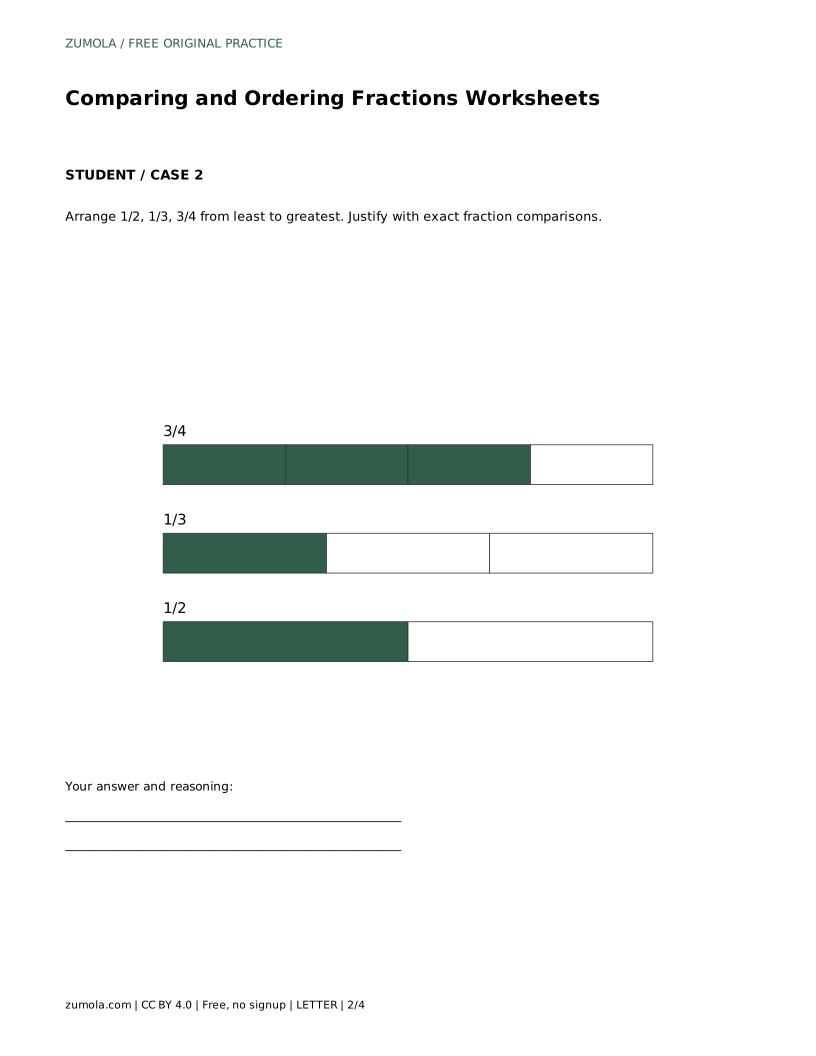
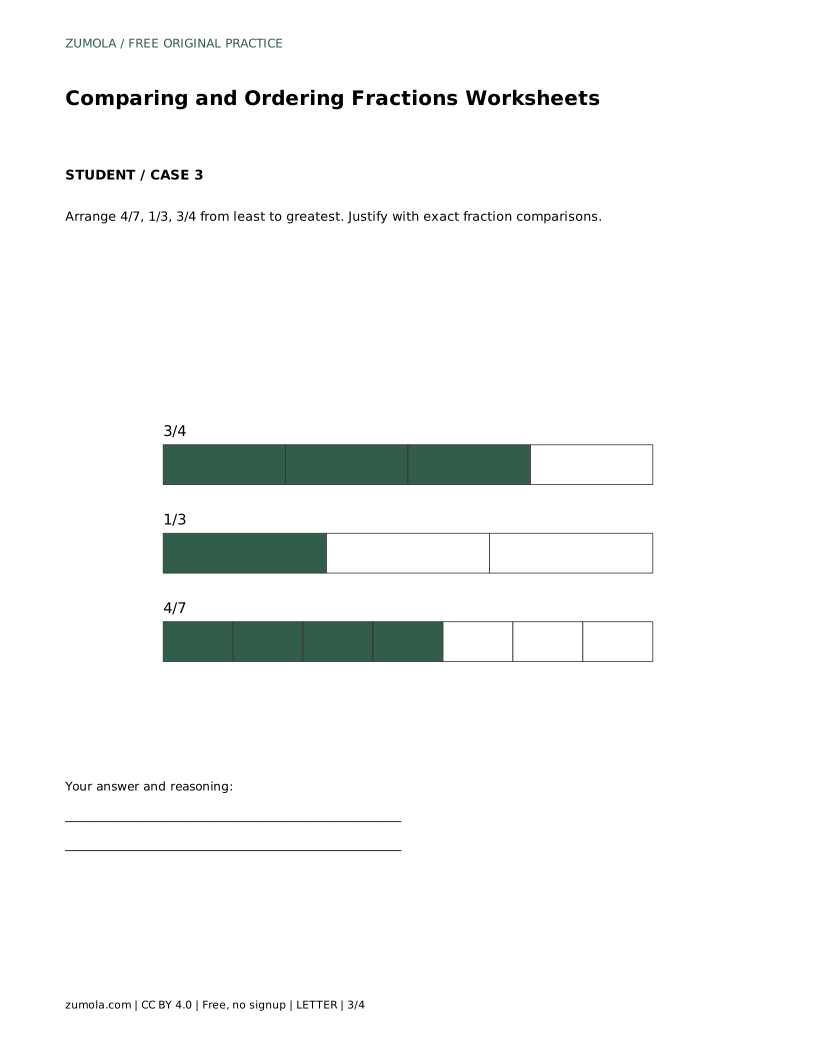
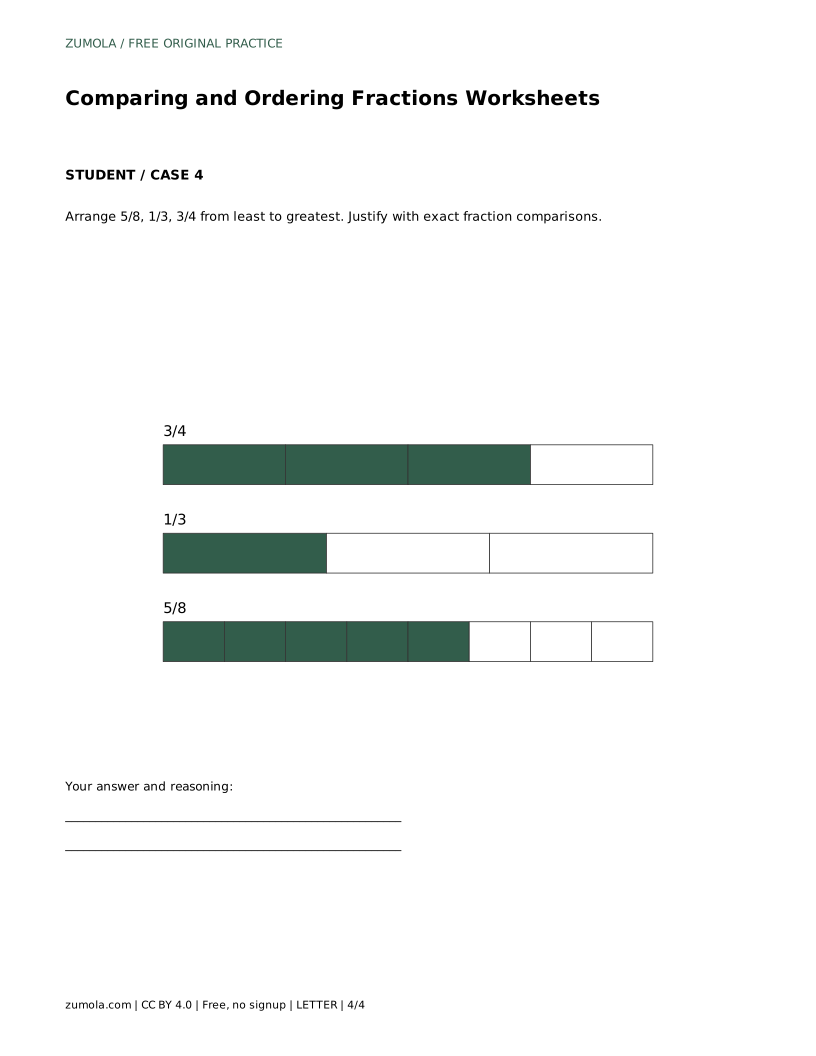
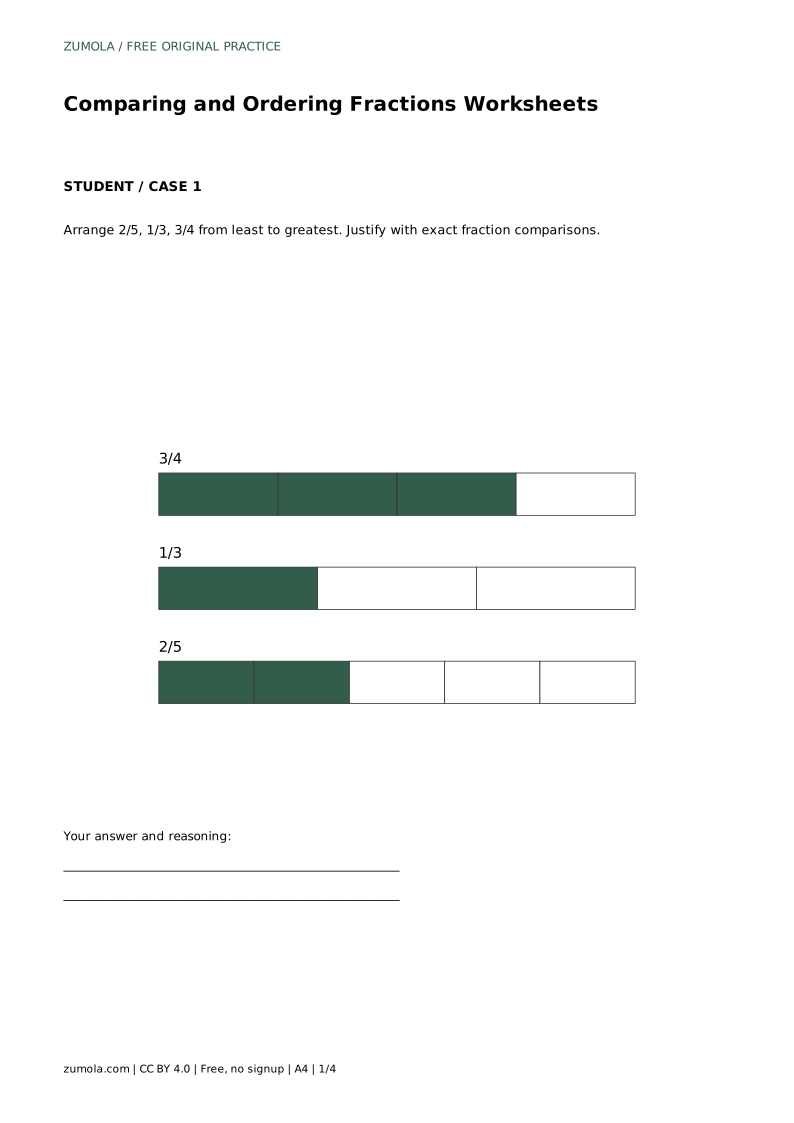
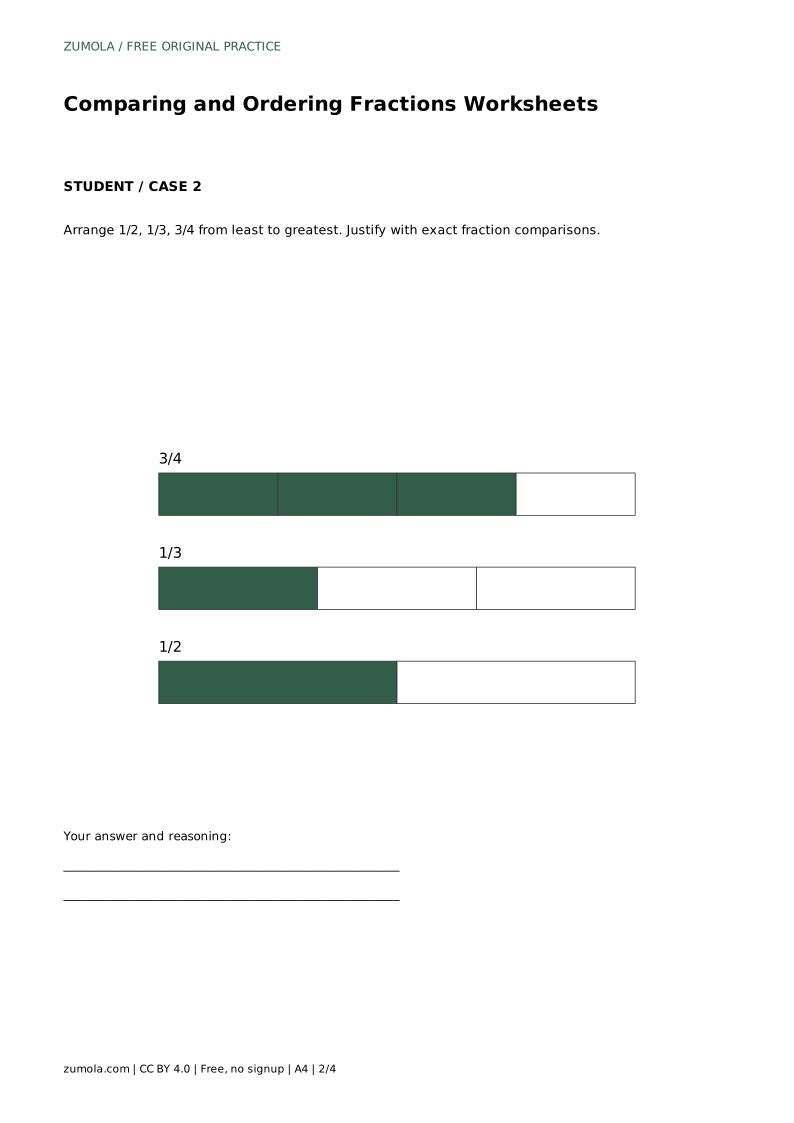
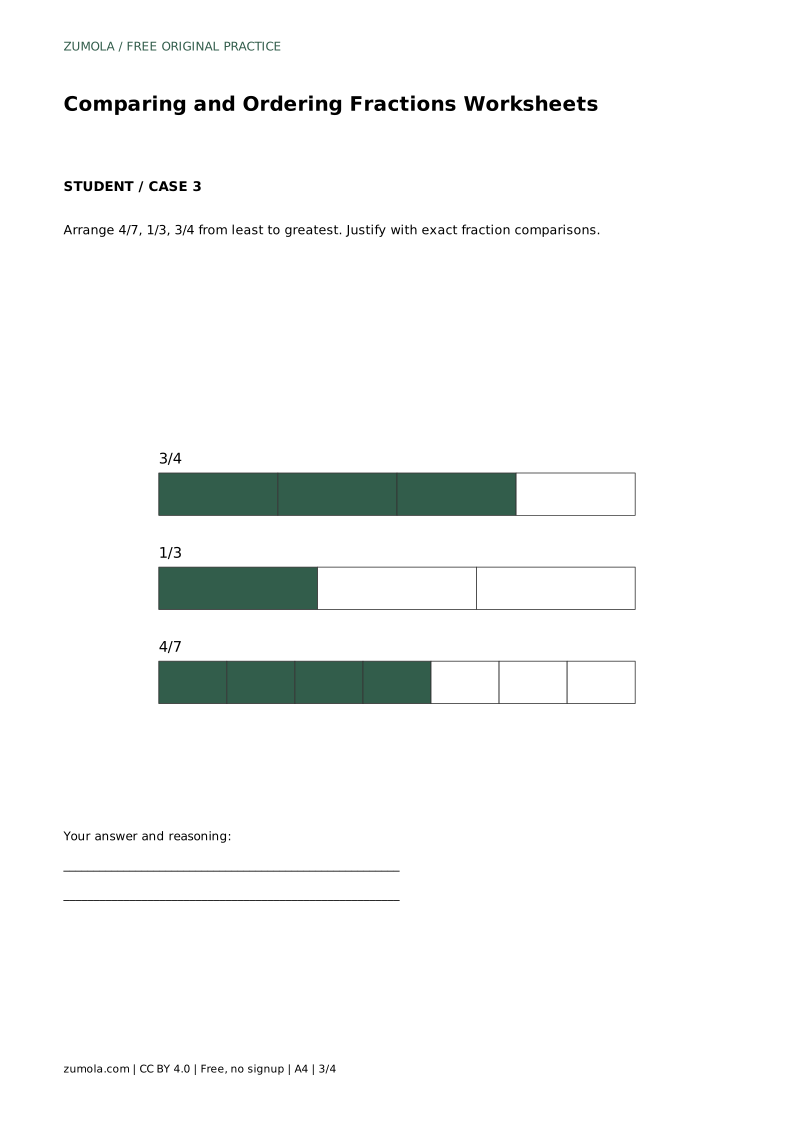
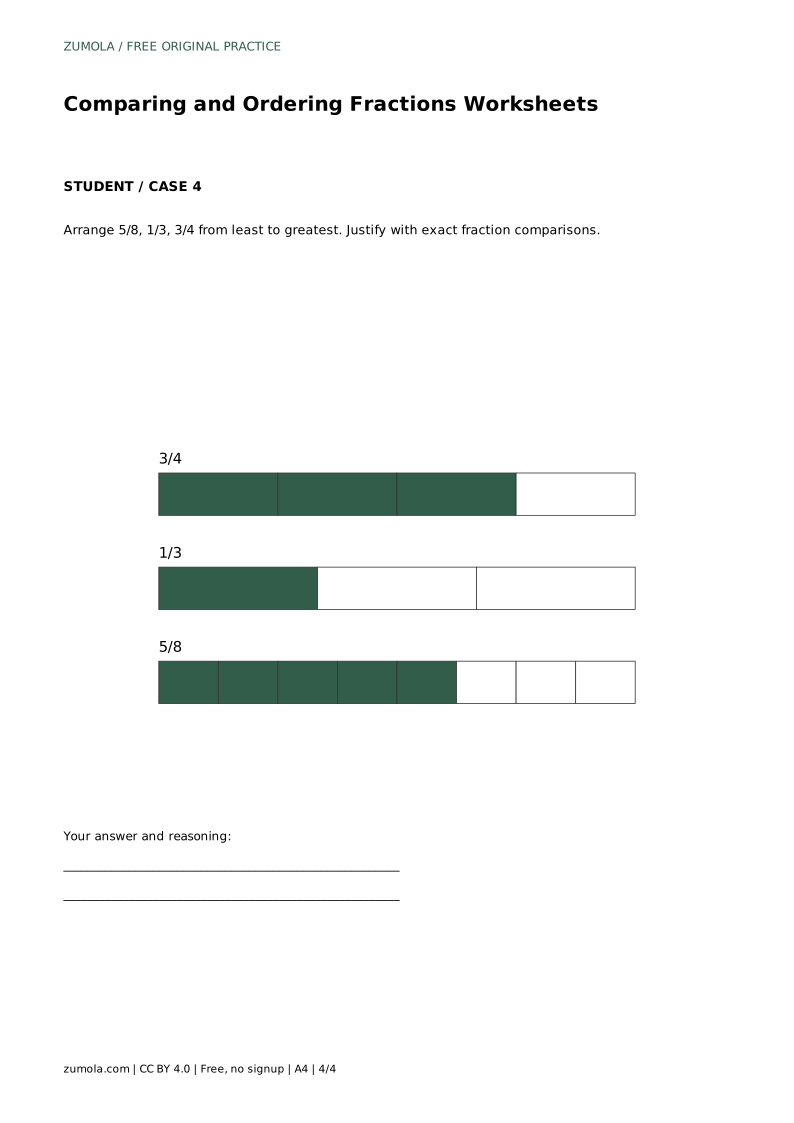
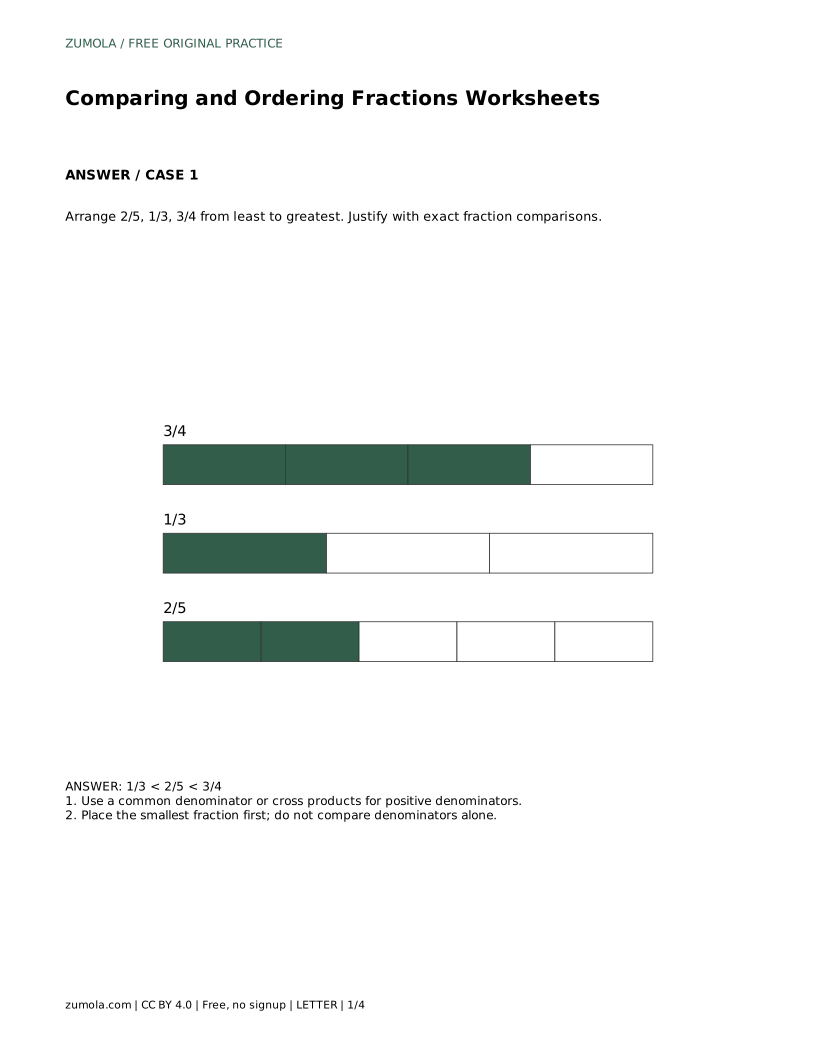
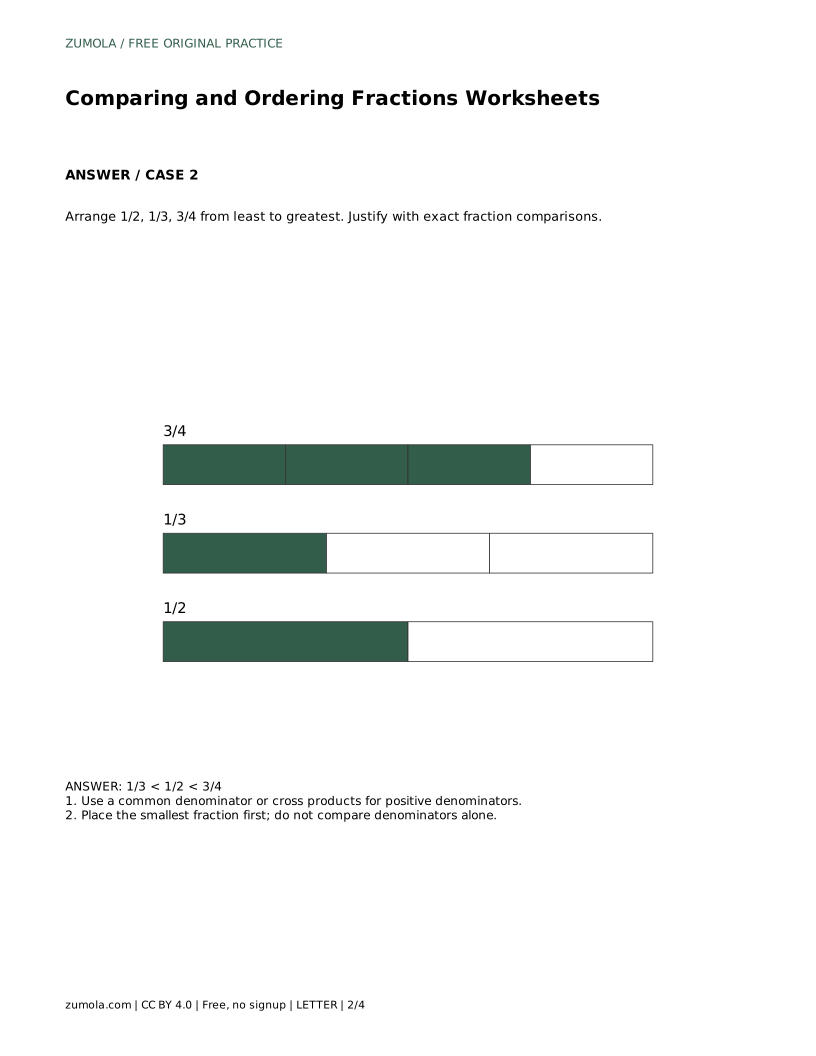
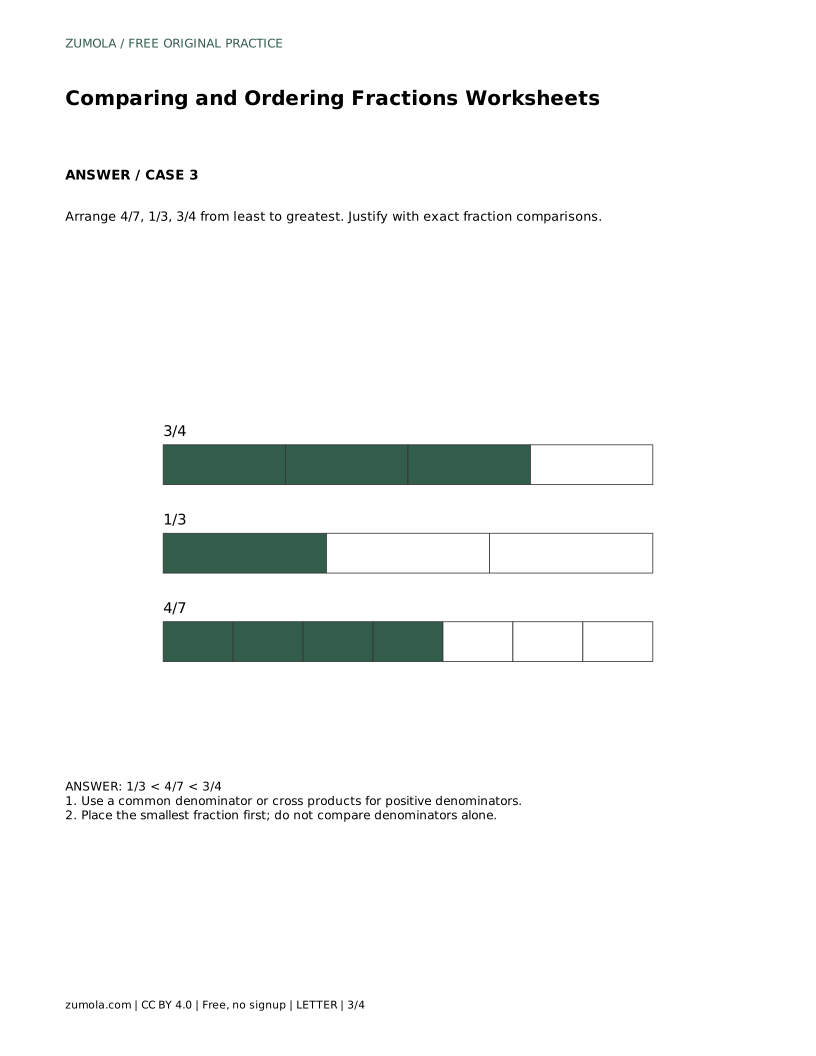
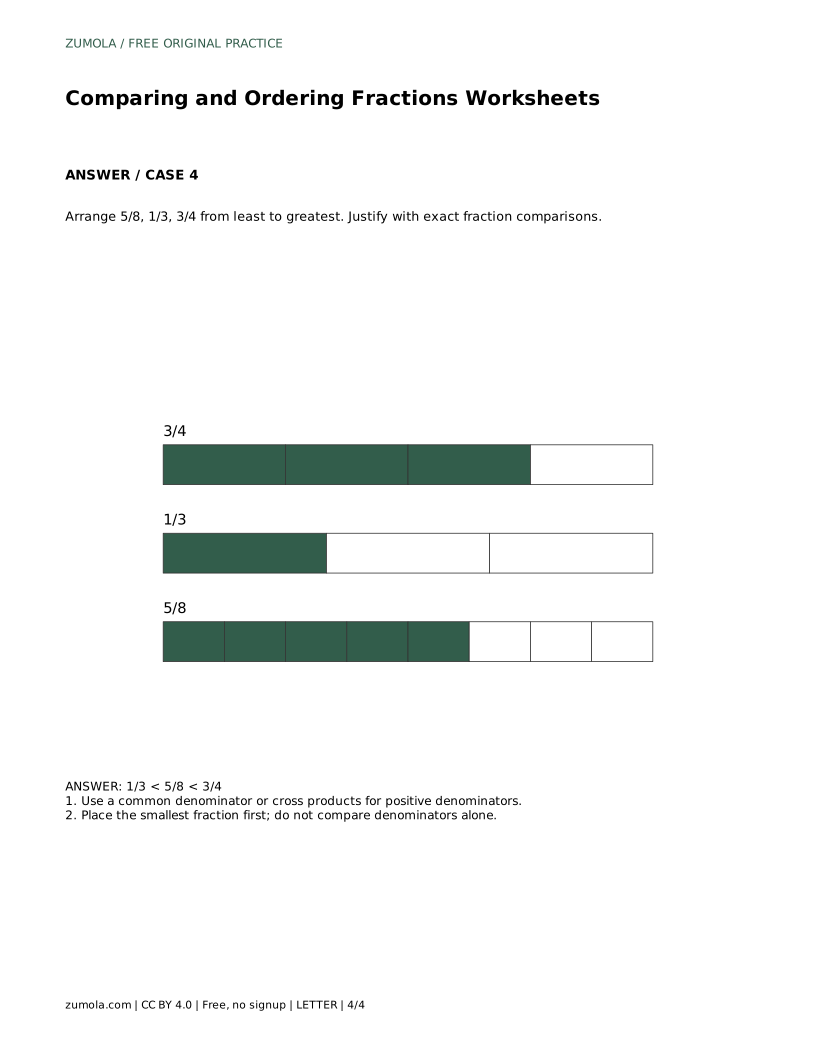
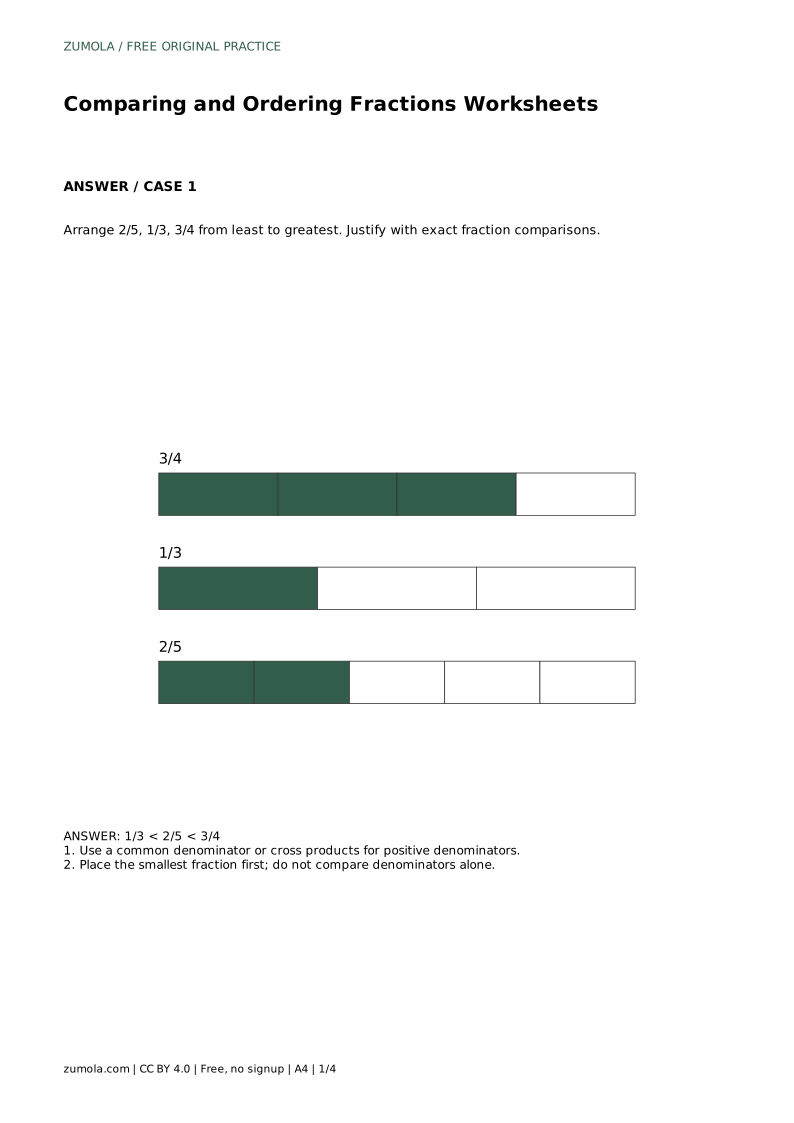
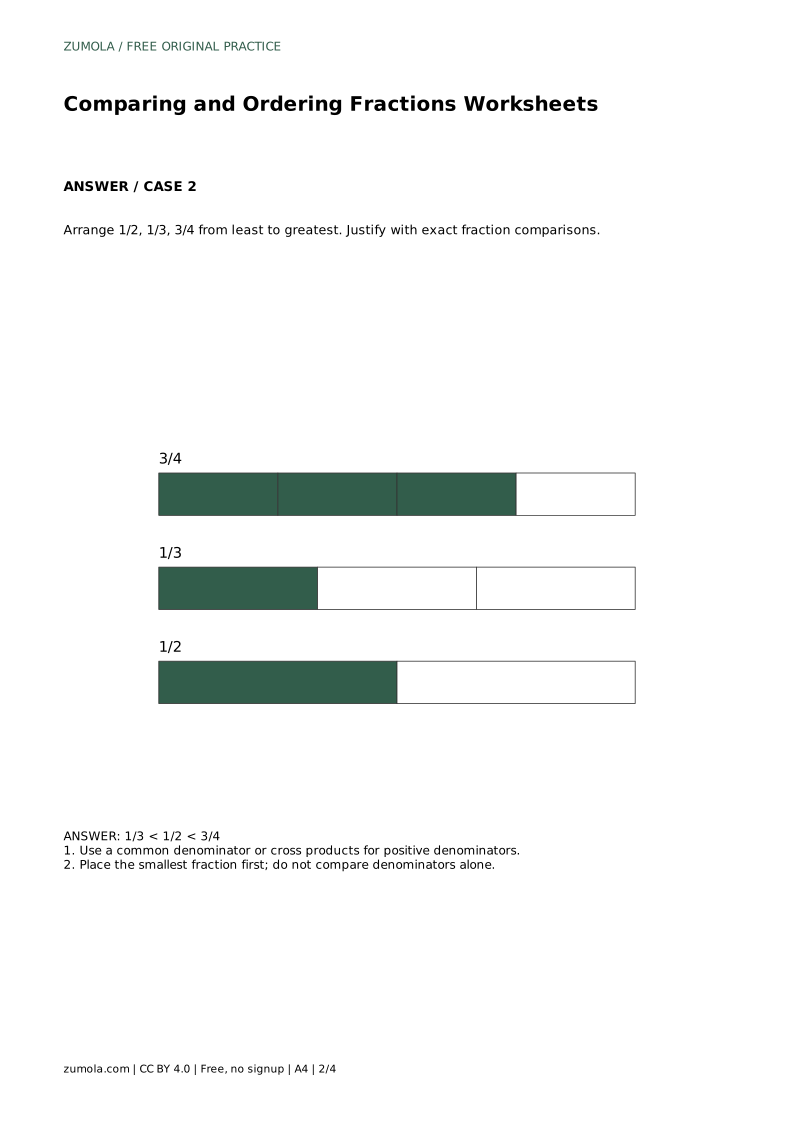
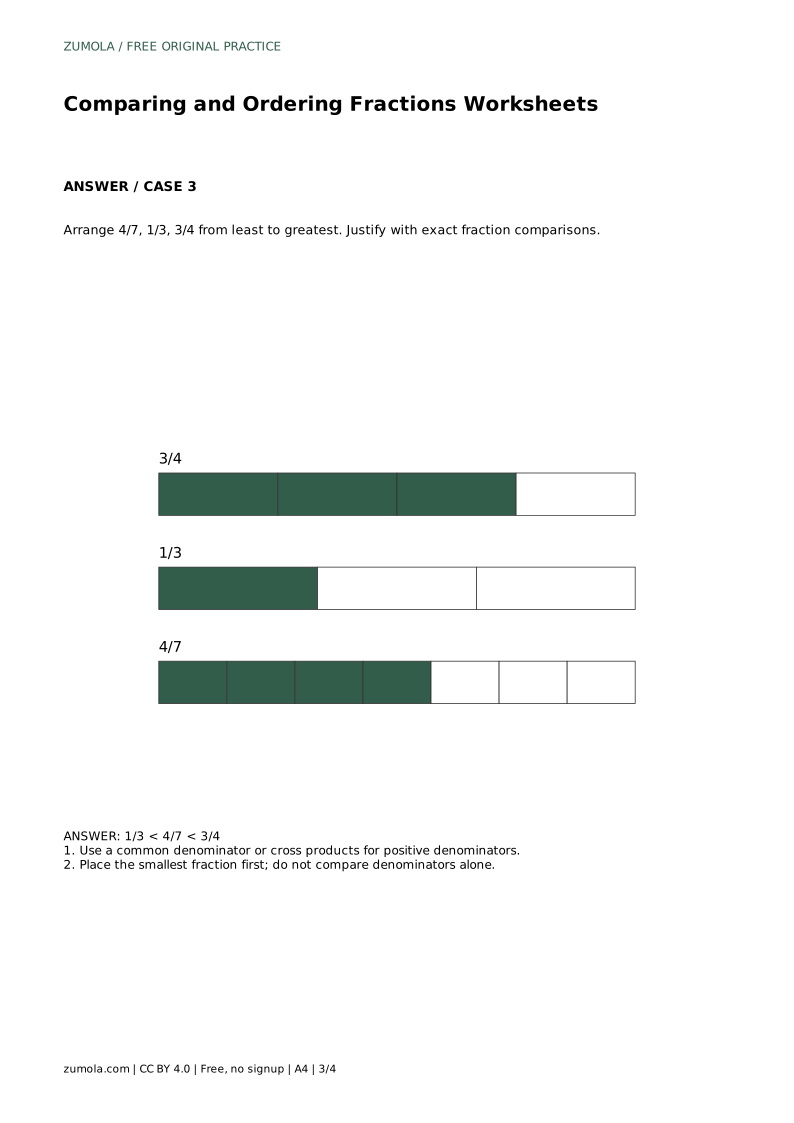
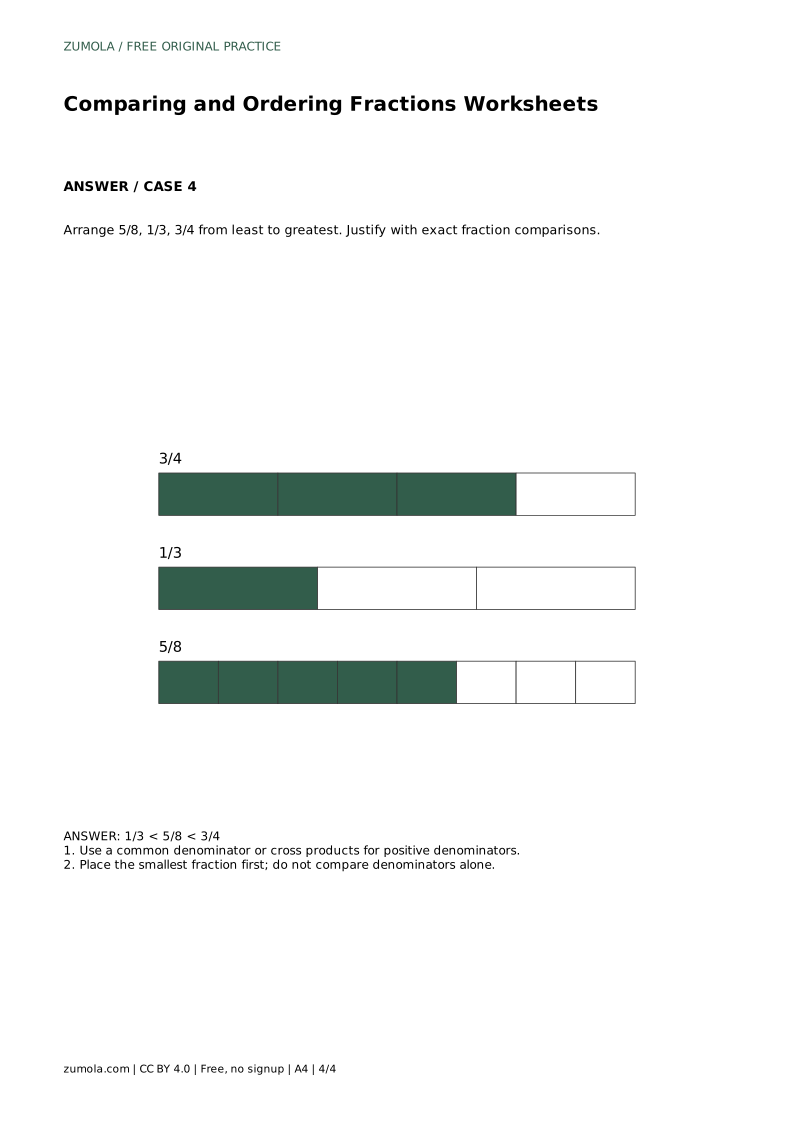
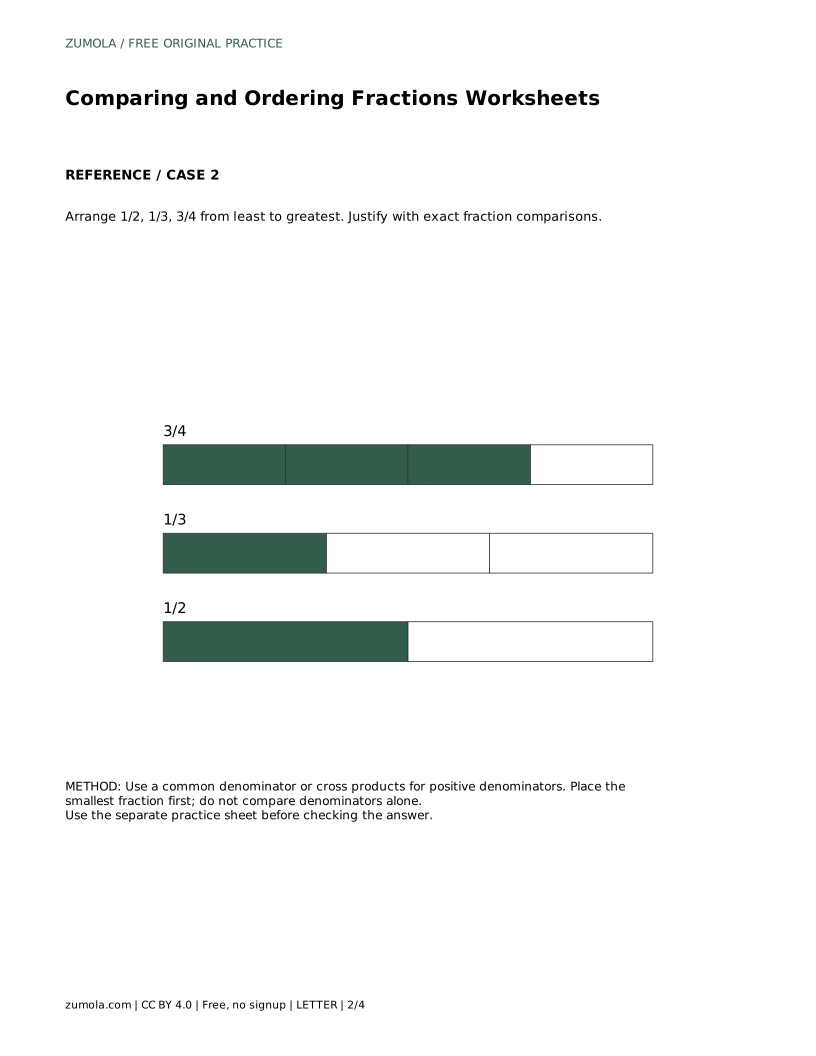
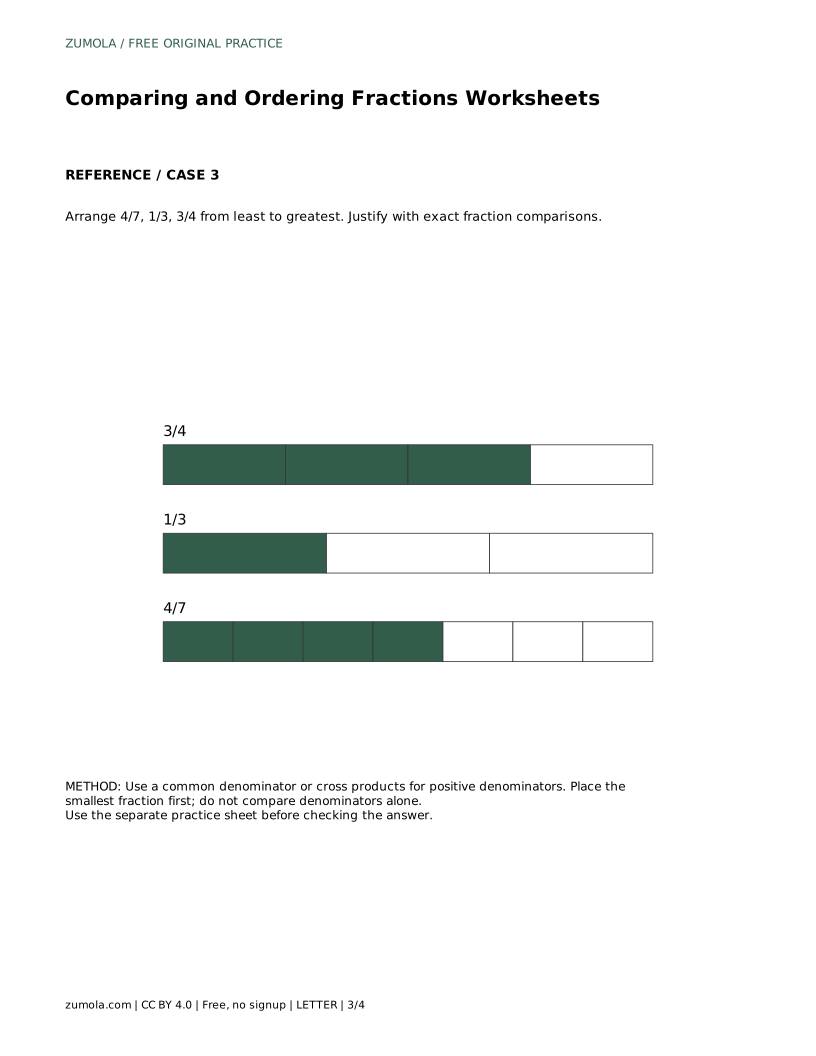
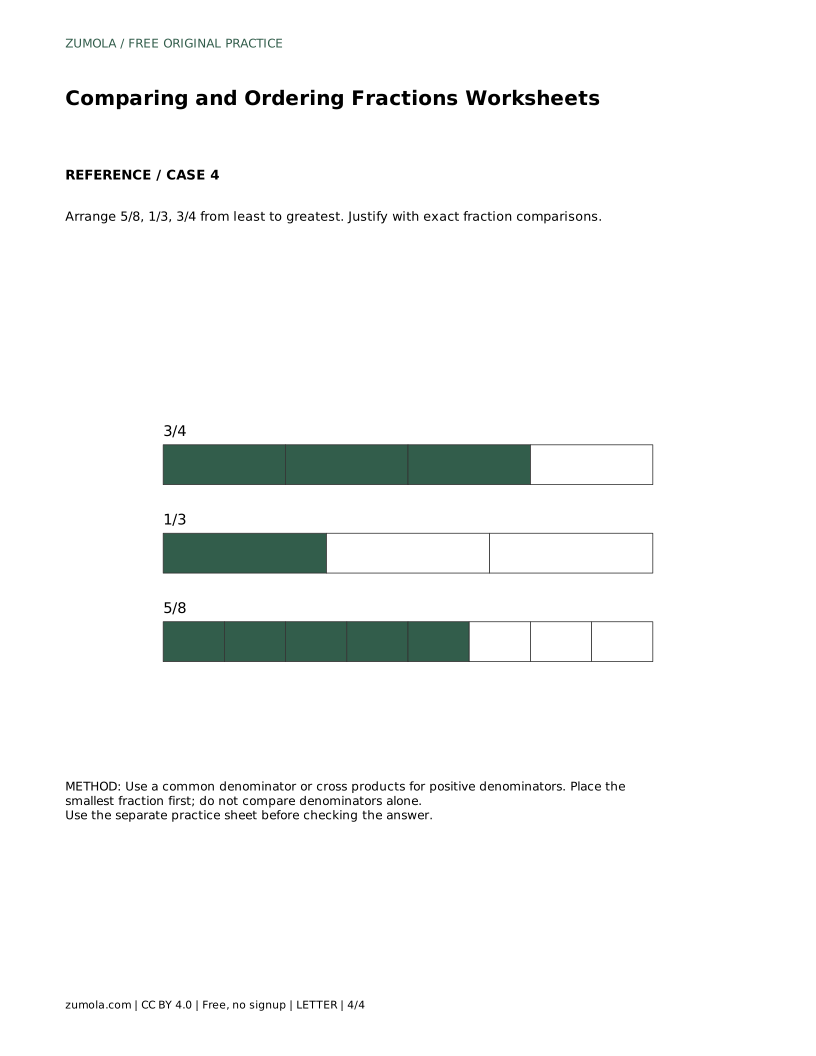
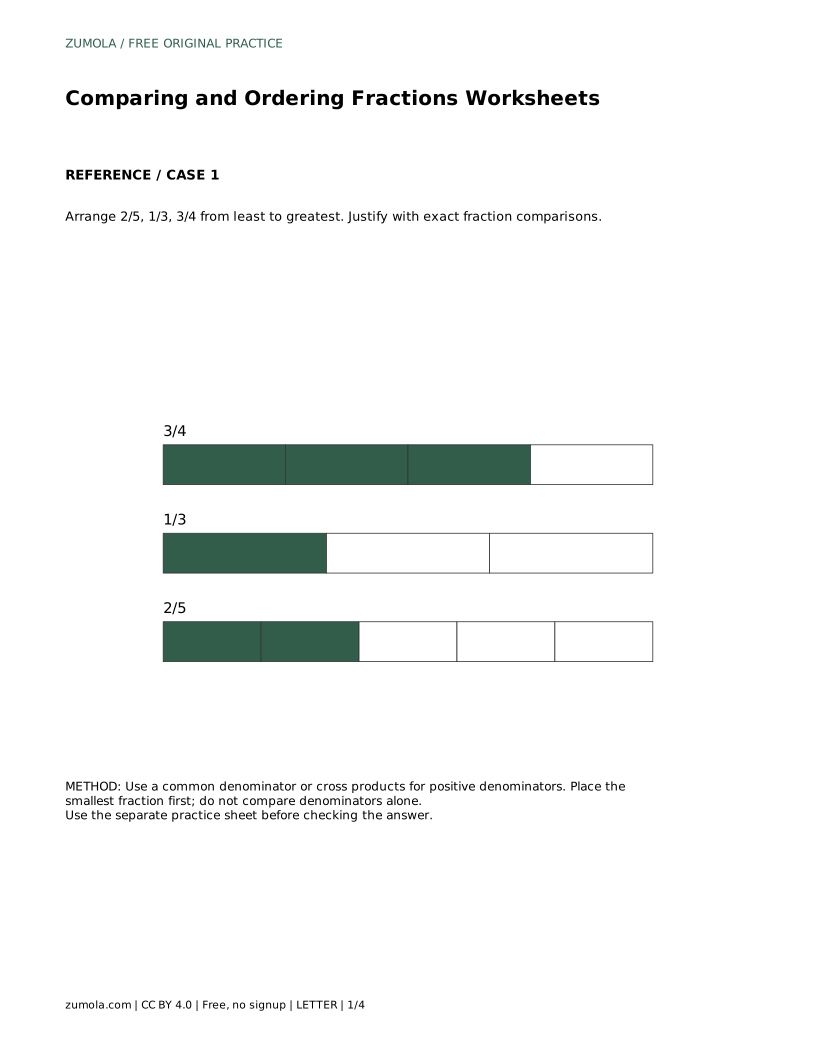
Partition each whole into the denominator's number of equal parts, then shade the numerator's number of parts. For 2/5, split a rectangle into five equal columns and shade two. For 1/3, split an identical rectangle into three equal columns and shade one. For 3/4, split a third identical rectangle into four equal columns and shade three. Equal parts matter: uneven slices make the shaded area meaningless as a fraction of the whole.
Pictures give an estimate; exact comparison gives proof. Two reliable methods work for positive denominators. With a common denominator, rewrite each fraction as an equivalent fraction over the same denominator, then compare numerators. With cross products, compare the numerator of one fraction times the denominator of the other. For 1/3 and 2/5, cross products give 1 × 5 = 5 and 2 × 3 = 6, so 1/3 < 2/5 because 5 < 6.
A common denominator of 15 rewrites 1/3 as 5/15 and 2/5 as 6/15, confirming 1/3 < 2/5. Comparing 2/5 with 3/4: cross products give 2 × 4 = 8 and 3 × 5 = 15, so 2/5 < 3/4. Together these establish 1/3 < 2/5 < 3/4. Note that a larger denominator does not automatically mean a smaller fraction; the numerator matters too.
When ordering several fractions, compare pairs rather than guessing from pictures. Find the least fraction first, then the next, and place the greatest last. Writing each comparison as an inequality keeps the reasoning visible and catches reversals.
After ordering, verify adjacent pairs. If your list is 1/3, 2/5, 3/4, then 1/3 < 2/5 and 2/5 < 3/4 must both hold. A picture check can support the result, but the exact comparisons are the justification. Keep the same whole assumption throughout; if a task changes the whole, the comparison method changes too.
Drawings are most useful after an exact order is found. Sketch the fractions on identical wholes and confirm the shaded amounts increase from left to right. If a picture disagrees with your exact work, recheck the partitioning and the cross products rather than trusting the sketch.
Because drawings are approximate, two close fractions may look similar. Exact comparison resolves ties and near-ties. Keep labels under each picture so the order is readable, and state the common whole in your written justification.
Arrange 2/5, 1/3, 3/4 from least to greatest. Justify with exact fraction comparisons.
1/3 < 2/5 < 3/4 Use a common denominator or cross products for positive denominators. Place the smallest fraction first; do not compare denominators alone.
No. Cross products also work for positive denominators, and pictures can guide estimation. Exact comparison is still required for justification.
A fraction describes parts of one whole. Different-sized wholes represent different units, so shaded areas cannot be compared fairly.
Pictures support estimation but are approximate. Use exact comparisons such as cross products or common denominators to justify the final order.
All math worksheets · Free coordinate paper
Original resources · CC BY 4.0 · Free for personal and classroom use with attribution.