Reference diagrams
LETTER · Download PDF
A4 · Download PDF
Free original resources
Teach fractions of a quantity by splitting counters into equal groups, then taking the numerator's number of groups. Includes worked example, rubric, and fixes.
Four original cases, with reference diagrams, practice sheets and worked answers. Everything is free; no signup required.
LETTER · Download PDF
A4 · Download PDF
LETTER · Download PDF
A4 · Download PDF
LETTER · Download PDF
A4 · Download PDF
Use A4 or US Letter to match your printer. Use the stated values and conditions to solve each exercise; diagrams are not physical measuring rulers.
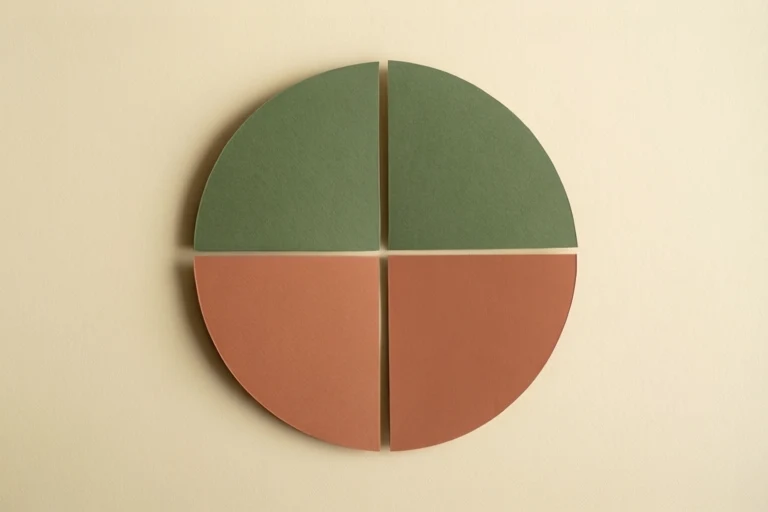
Finding a fraction of a quantity means splitting a whole amount into equal parts and then taking a stated number of those parts. With counters, this becomes visible: the denominator tells how many equal groups to make, and the numerator tells how many groups to take. This page focuses on that grouping method, using whole-number quantities that divide exactly, so learners can check each step by counting rather than relying on a rule they cannot picture.
A fraction such as 3/5 carries two instructions. The denominator, 5, sets the size of each share: the whole quantity is divided into 5 equal groups. The numerator, 3, counts how many of those groups are taken. Keeping these roles separate prevents the common mix-up of dividing by the numerator and multiplying by the denominator.
The grouping model only works cleanly when the quantity divides exactly by the denominator. If it does not, the equal groups contain a remainder or a fractional amount, which is a different problem. For this page, choose quantities where every group has the same whole-number size, and state that condition when setting the task.
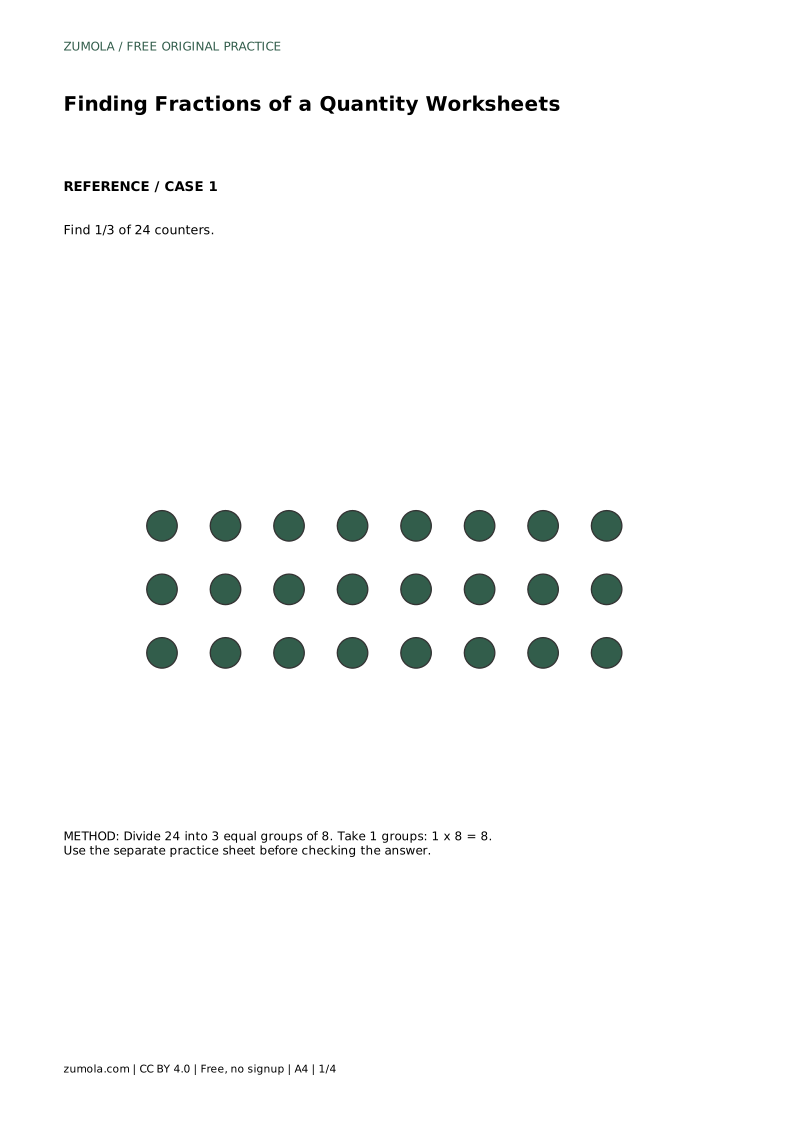
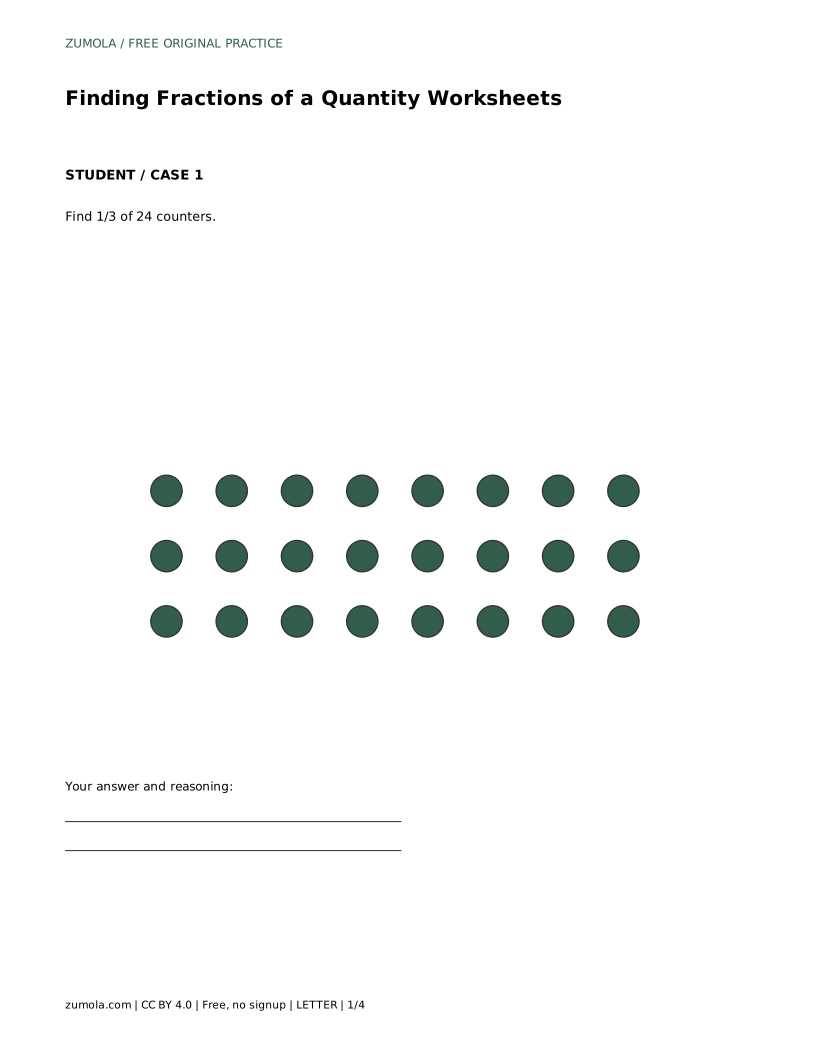
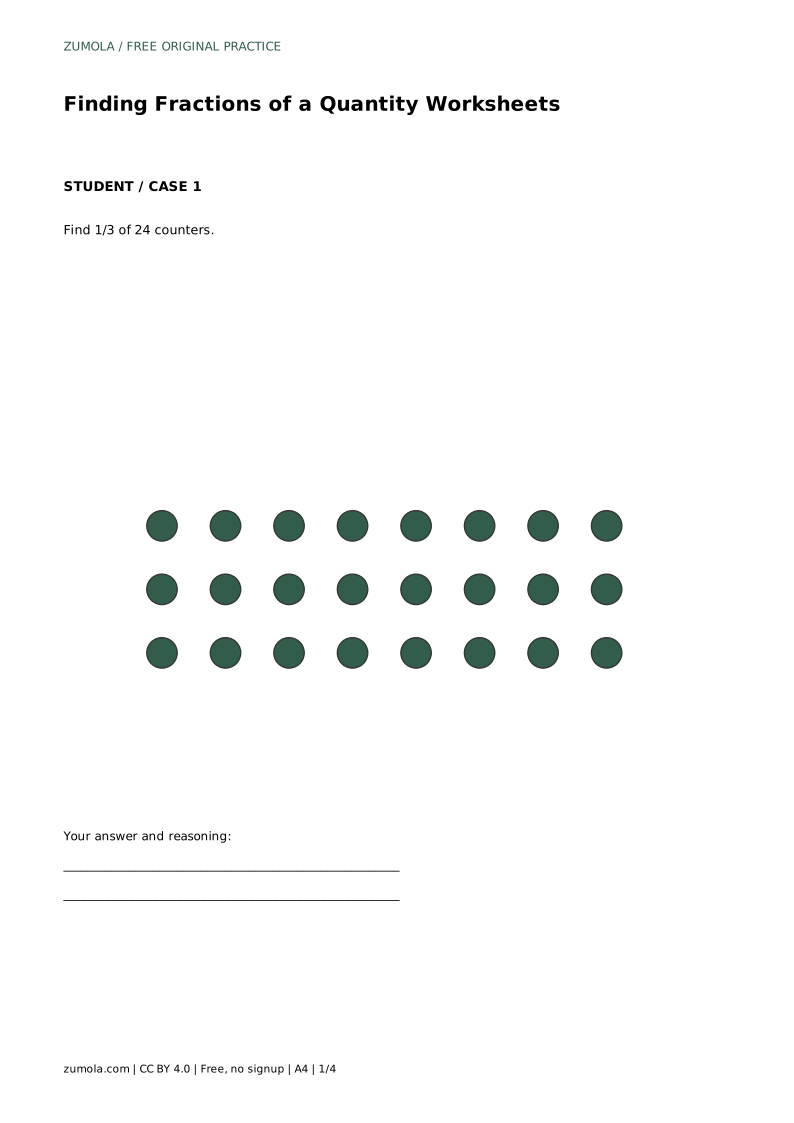
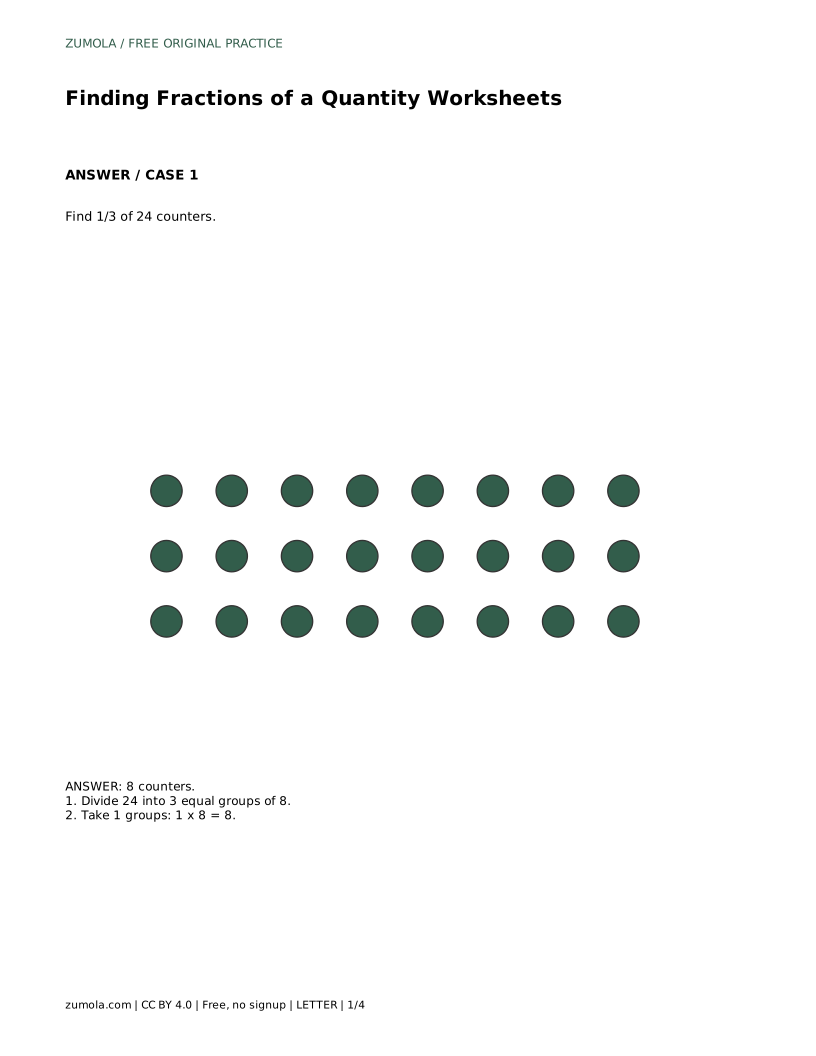
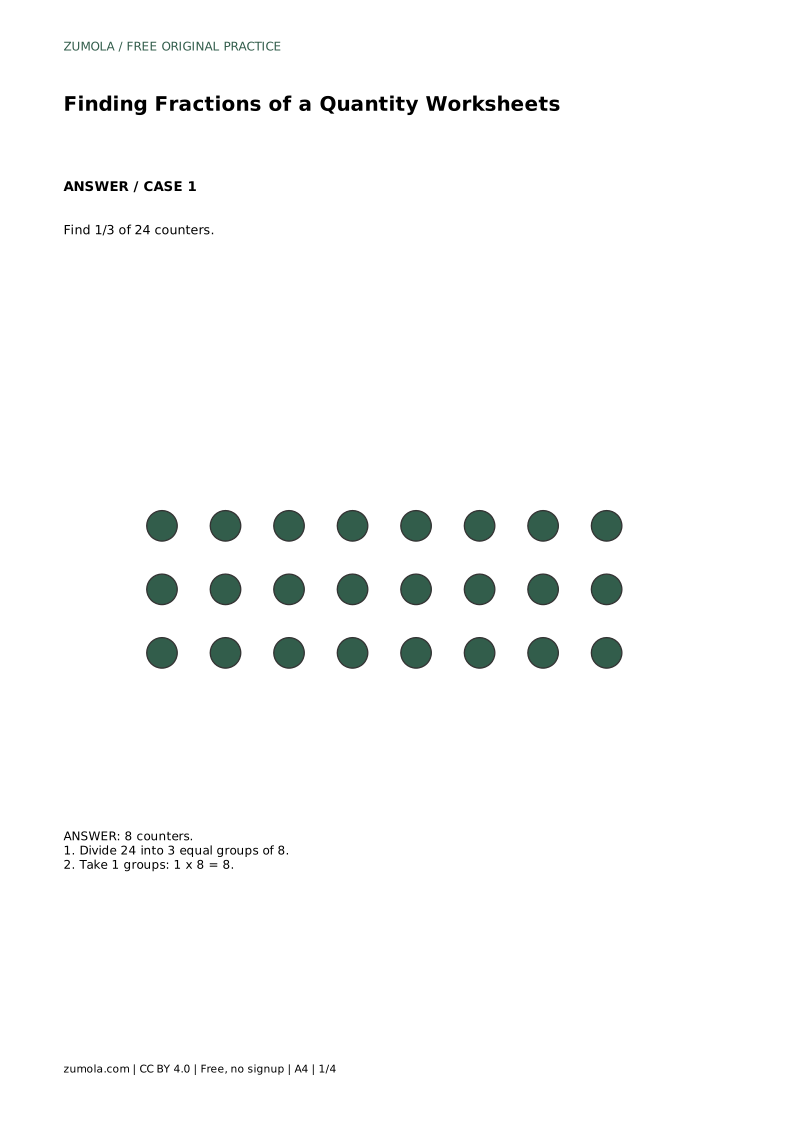
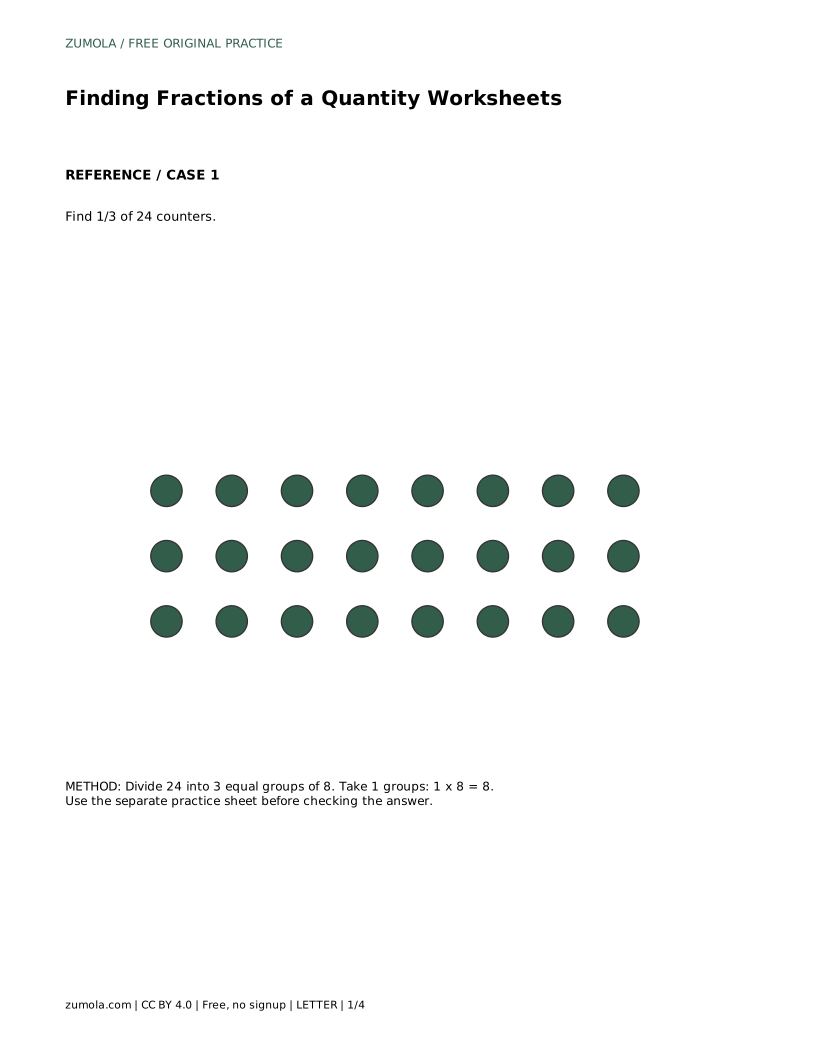
Prompt: Find 1/3 of 24 counters. The denominator is 3, so the 24 counters are shared into 3 equal groups. Each group holds 8 counters. The numerator is 1, so one group is taken: 1 × 8 = 8. The answer is 8 counters.
Check by reversing the thinking: 3 groups of 8 counters make 24 counters, so the split was even and the single group is genuinely one third of the whole. Learners should say the group size aloud before multiplying, because the multiplication is only a shortcut for counting groups.
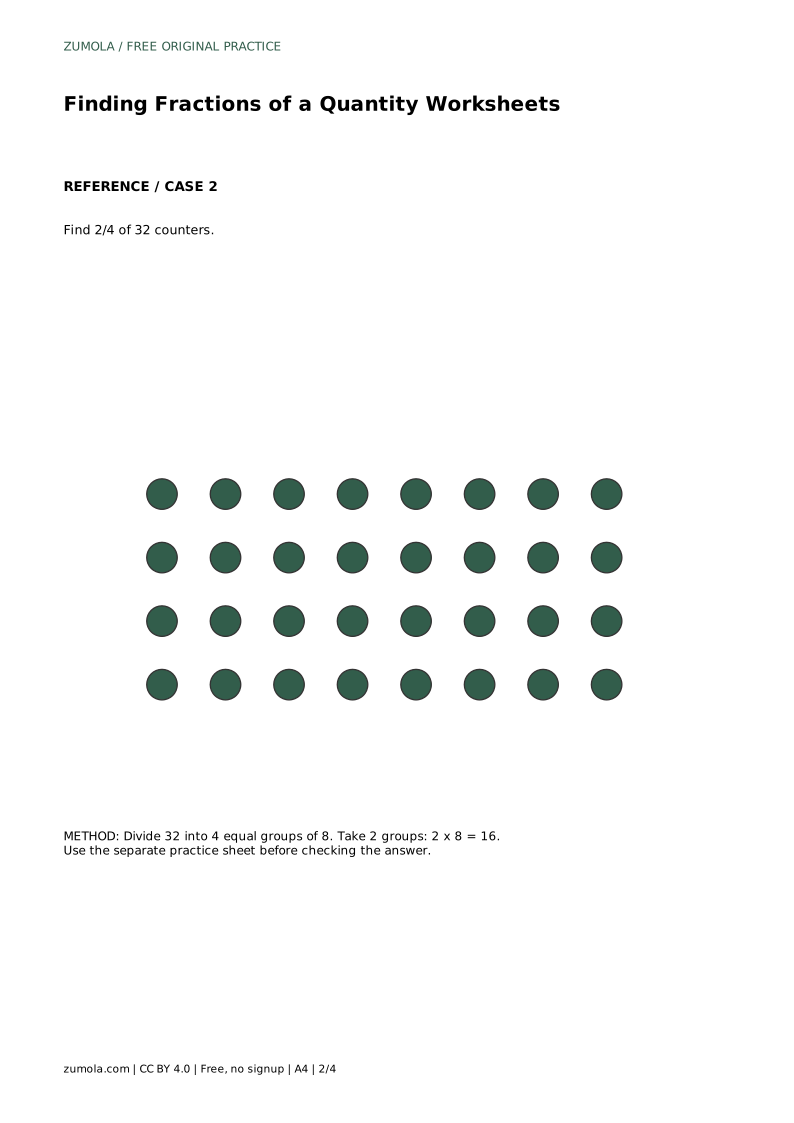
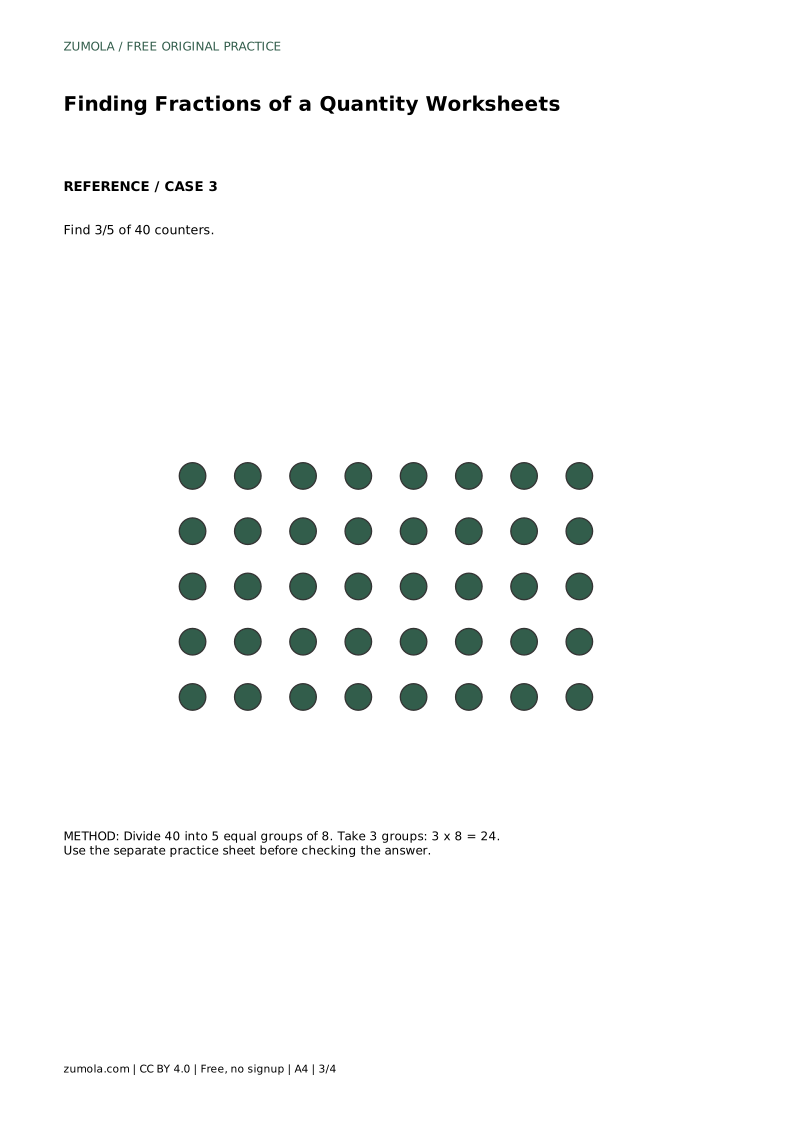
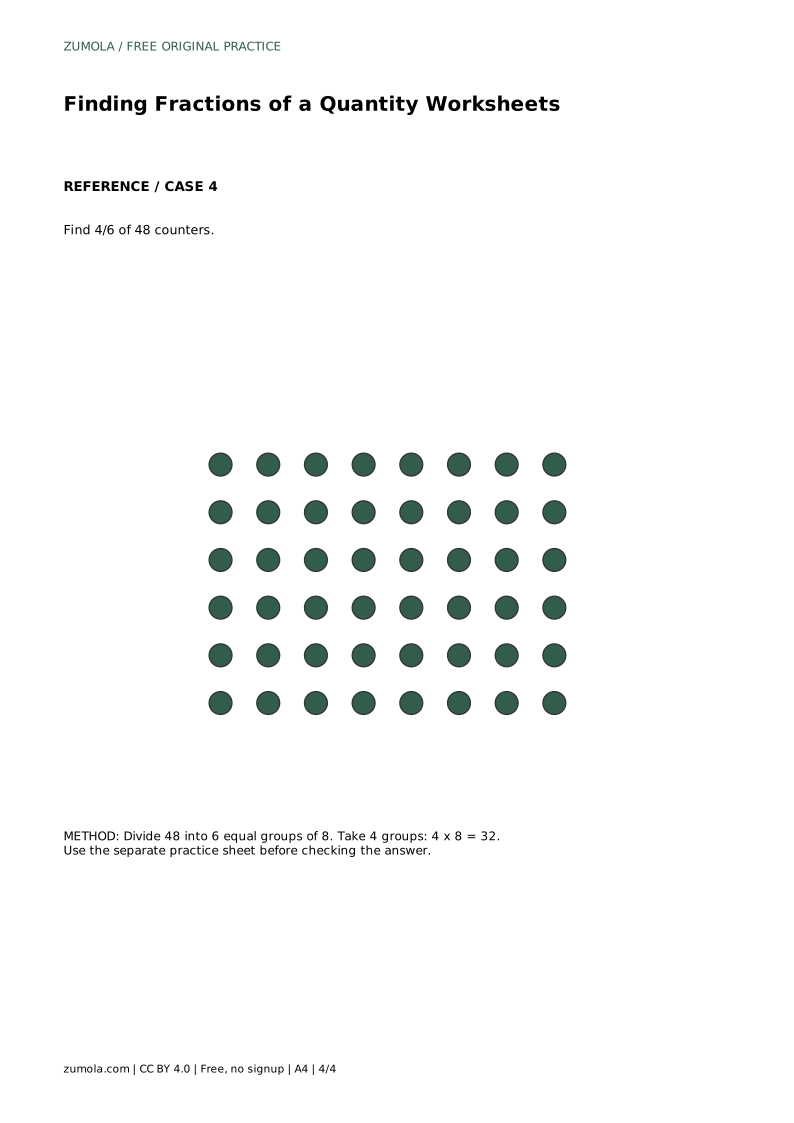
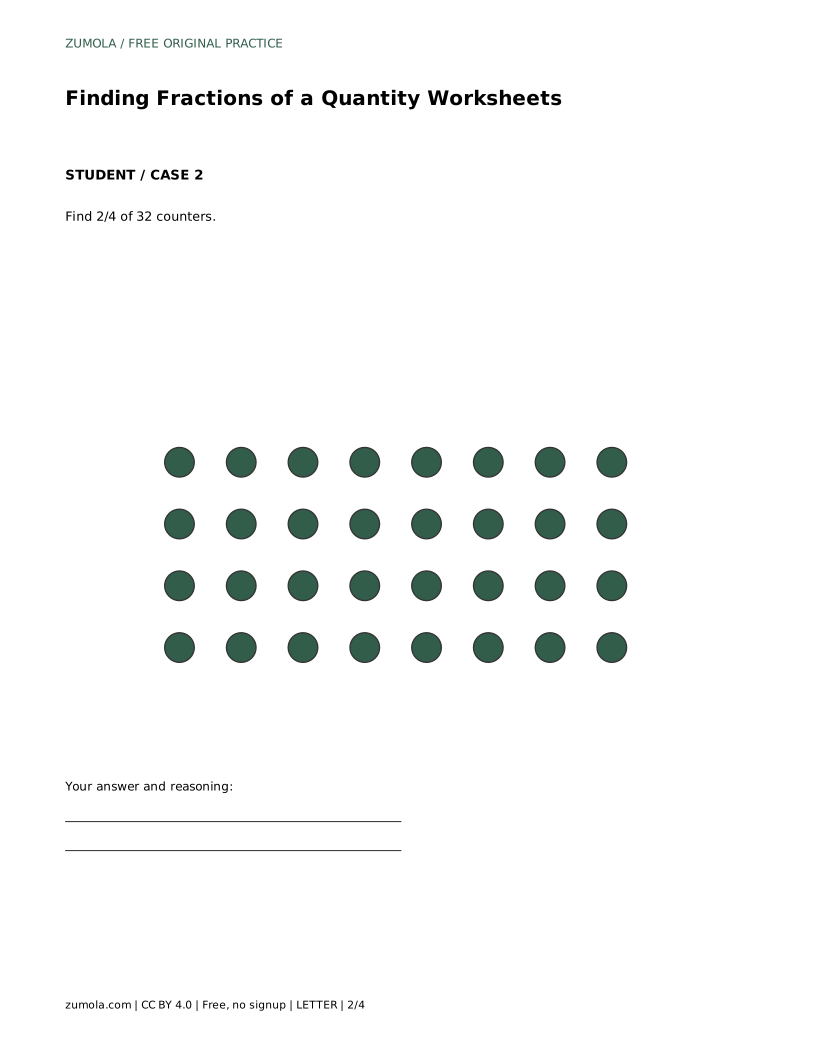
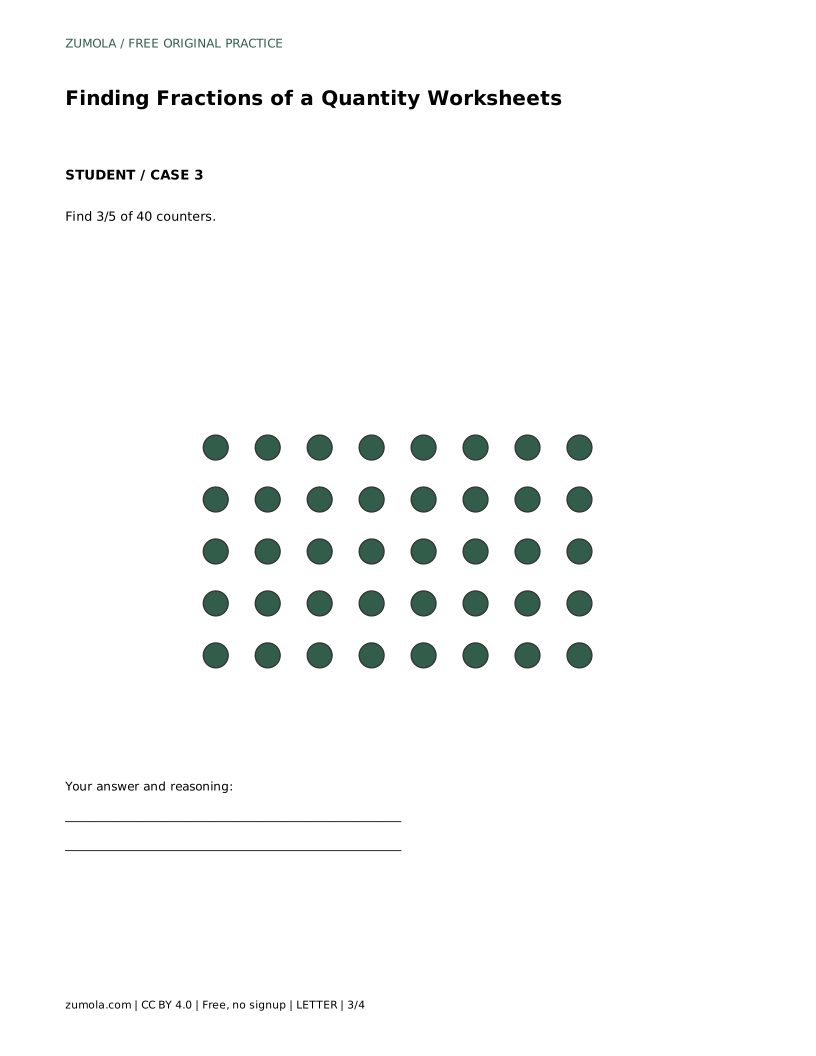
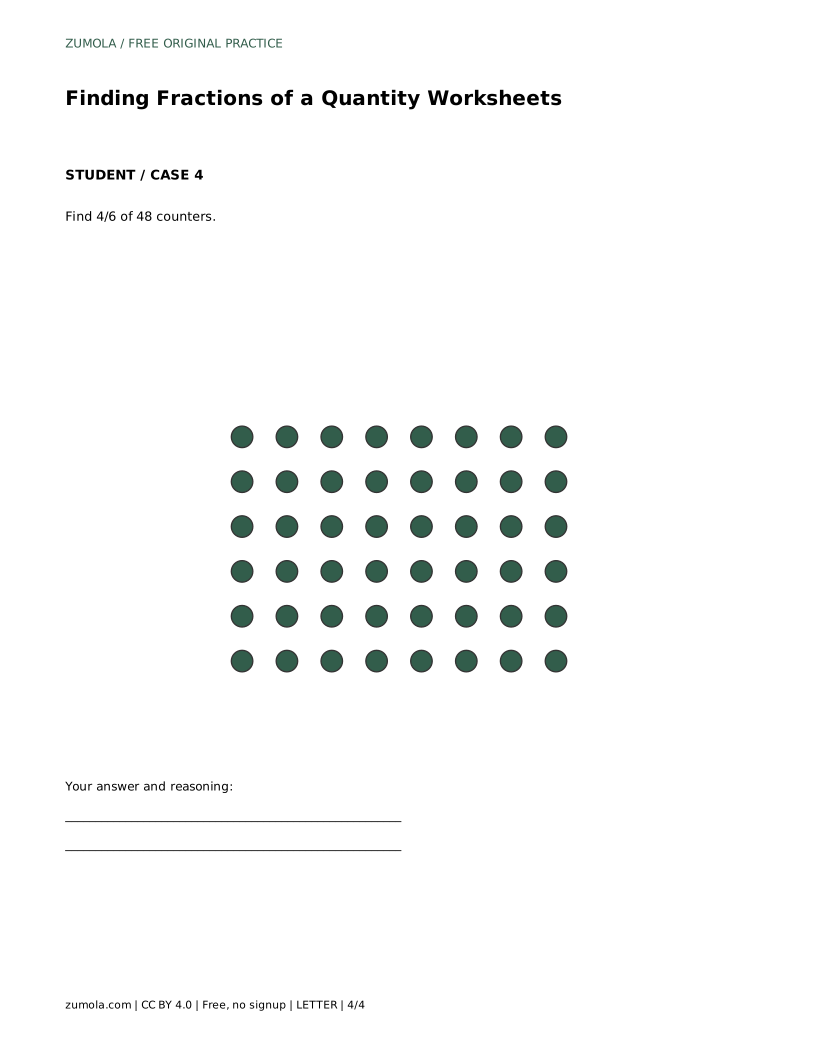
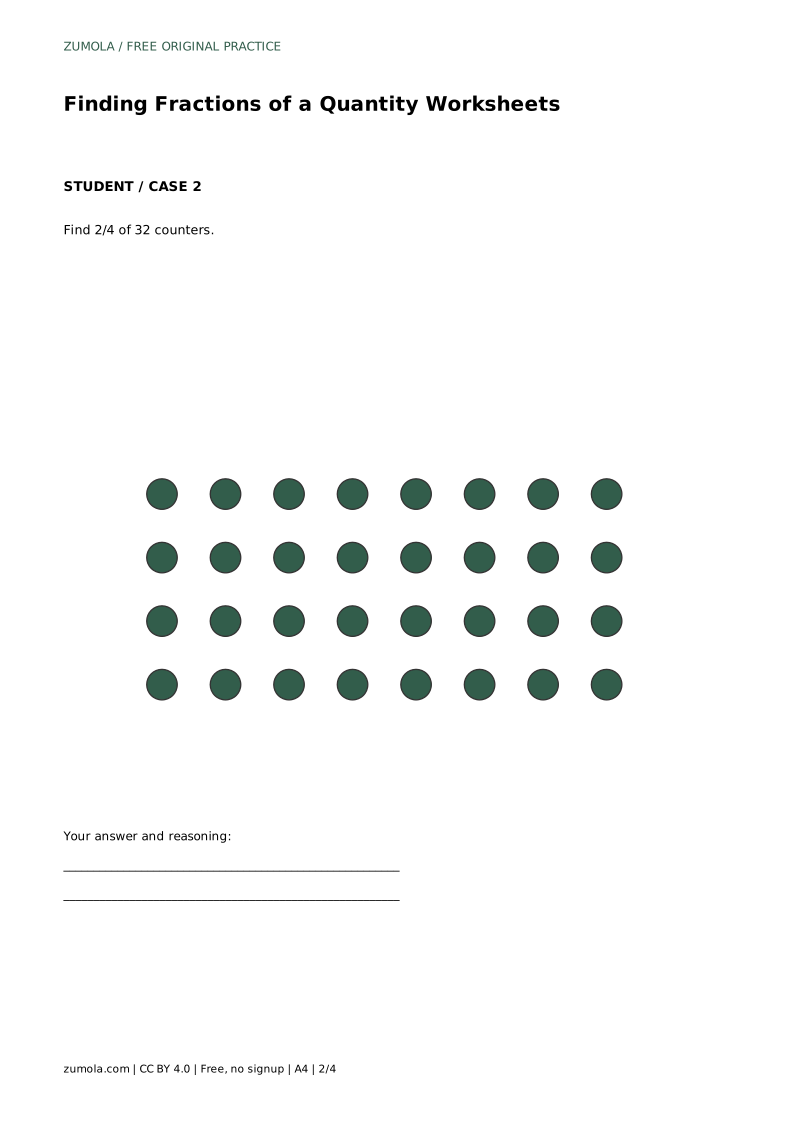
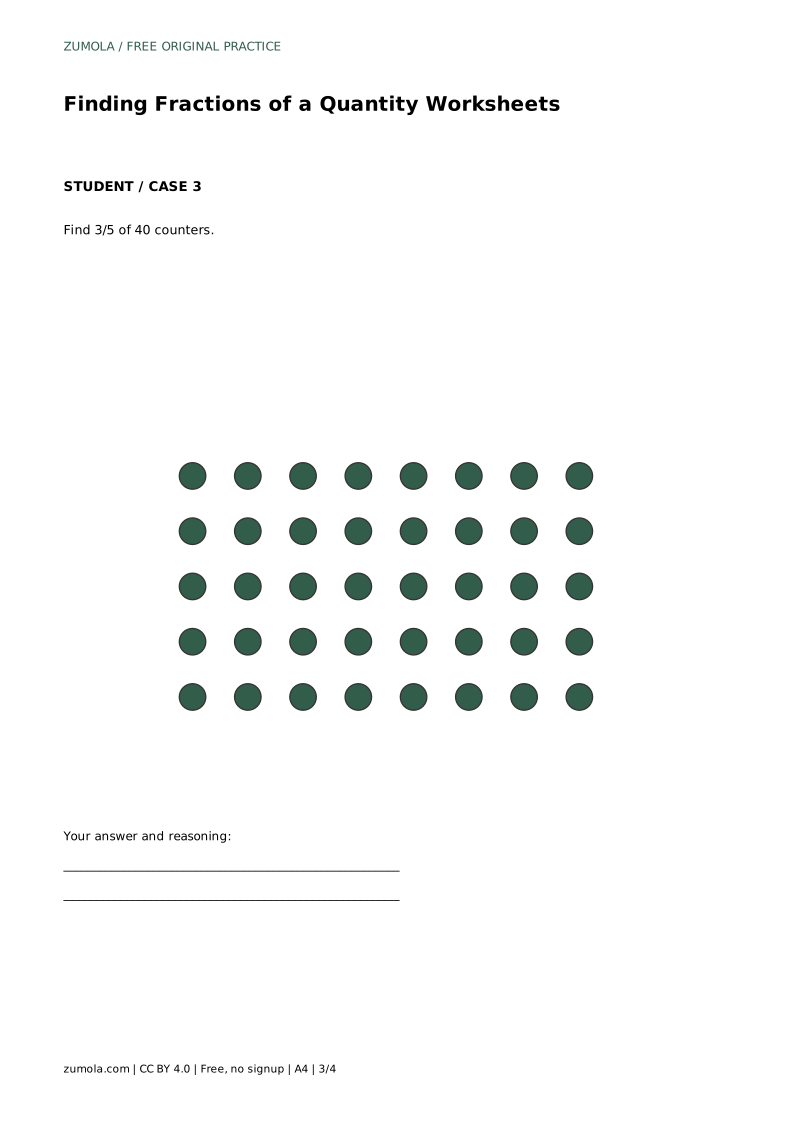
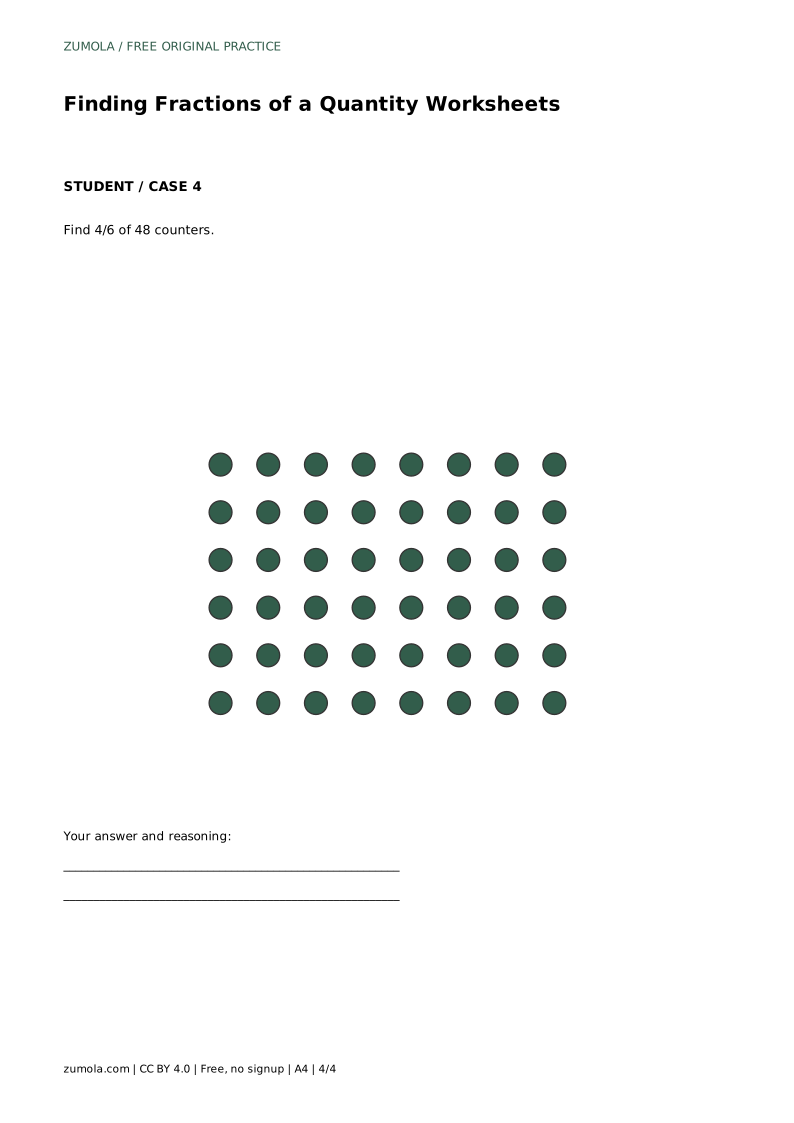
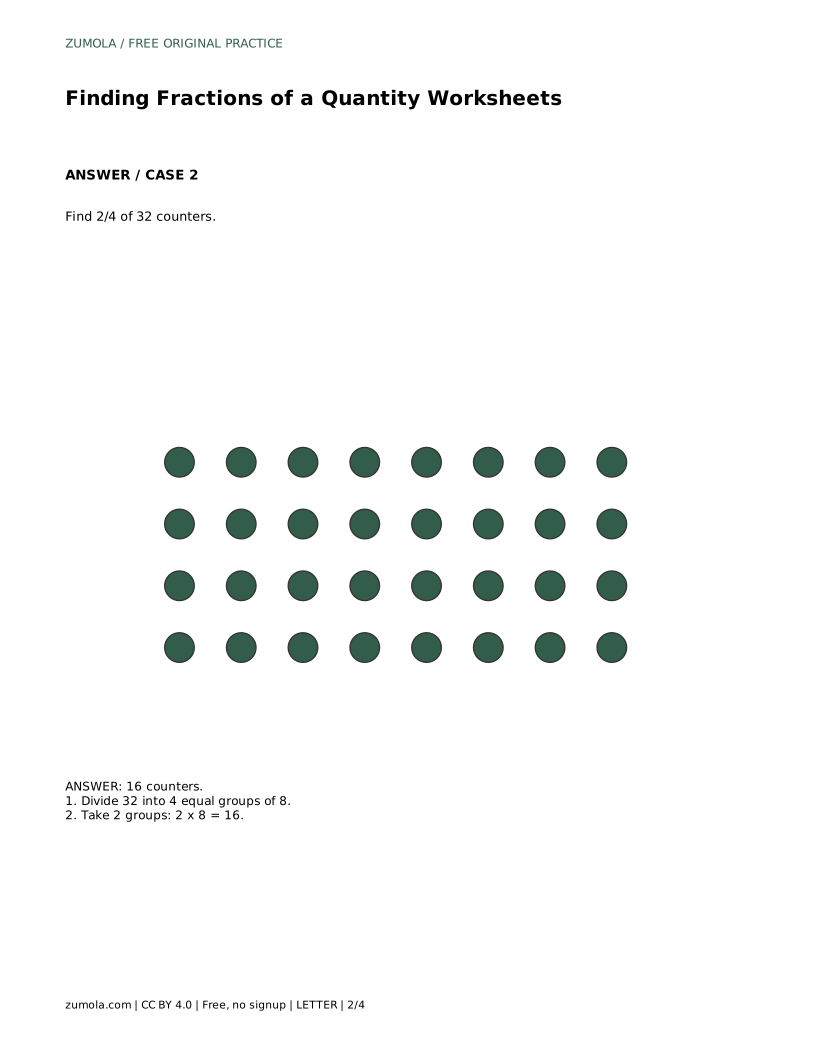
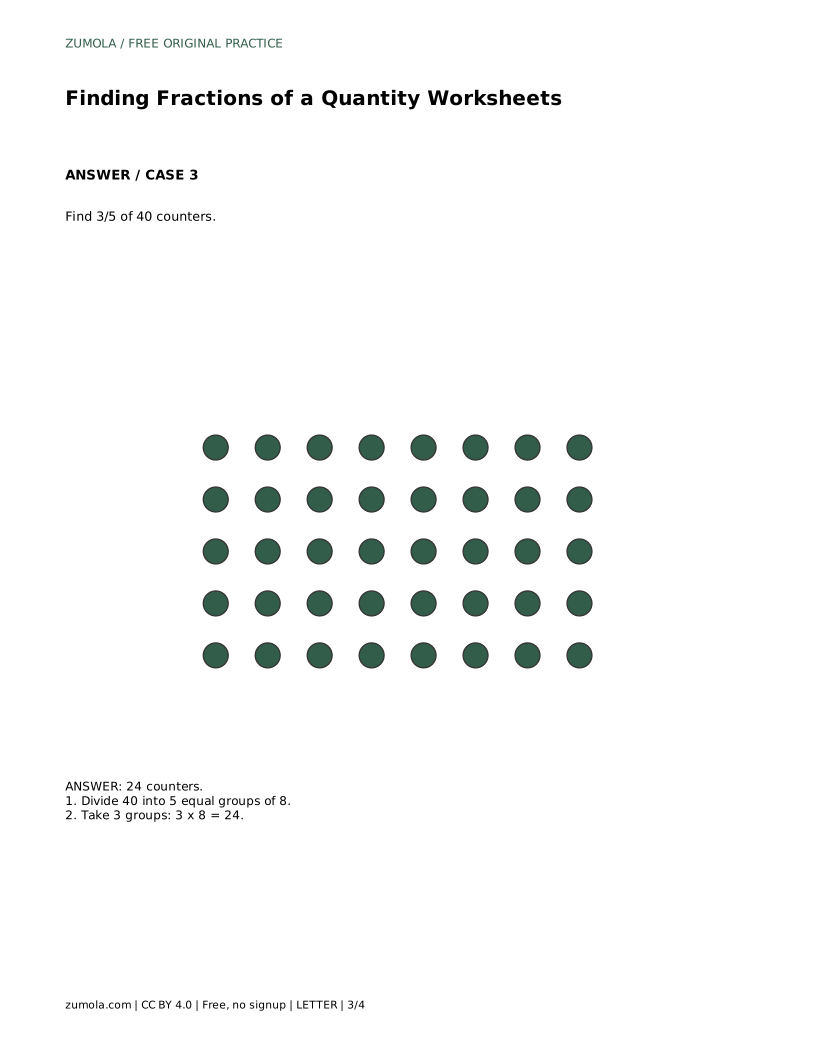
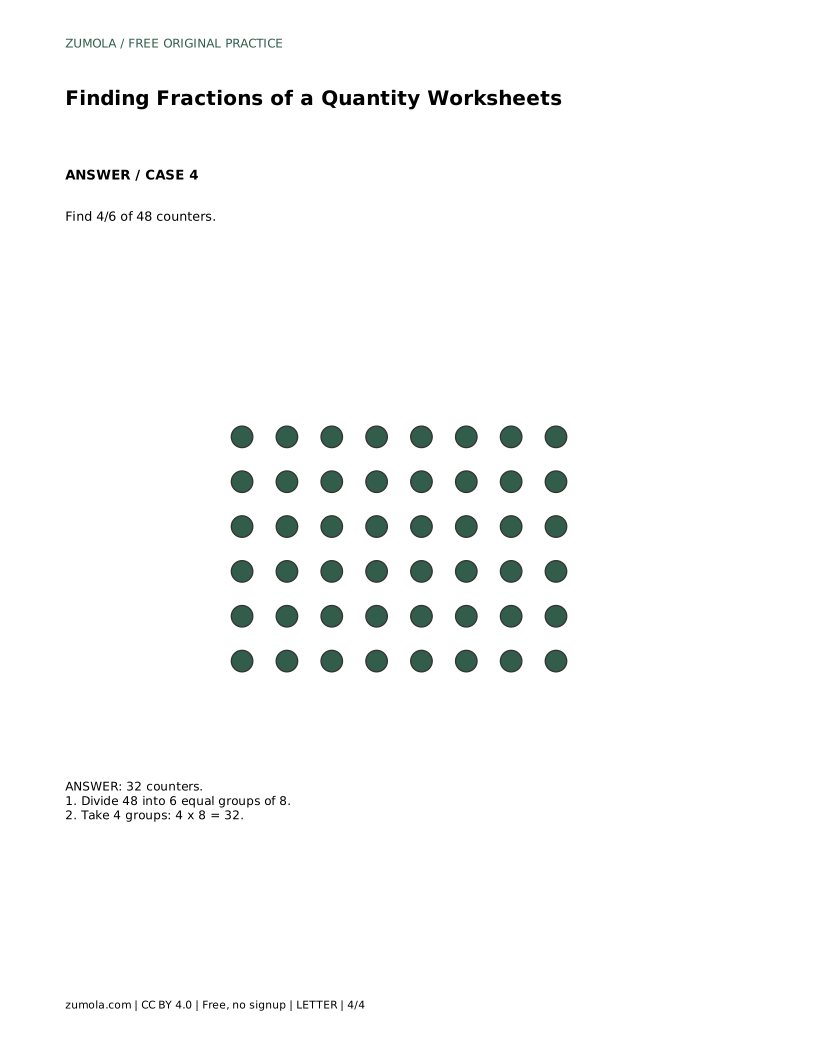
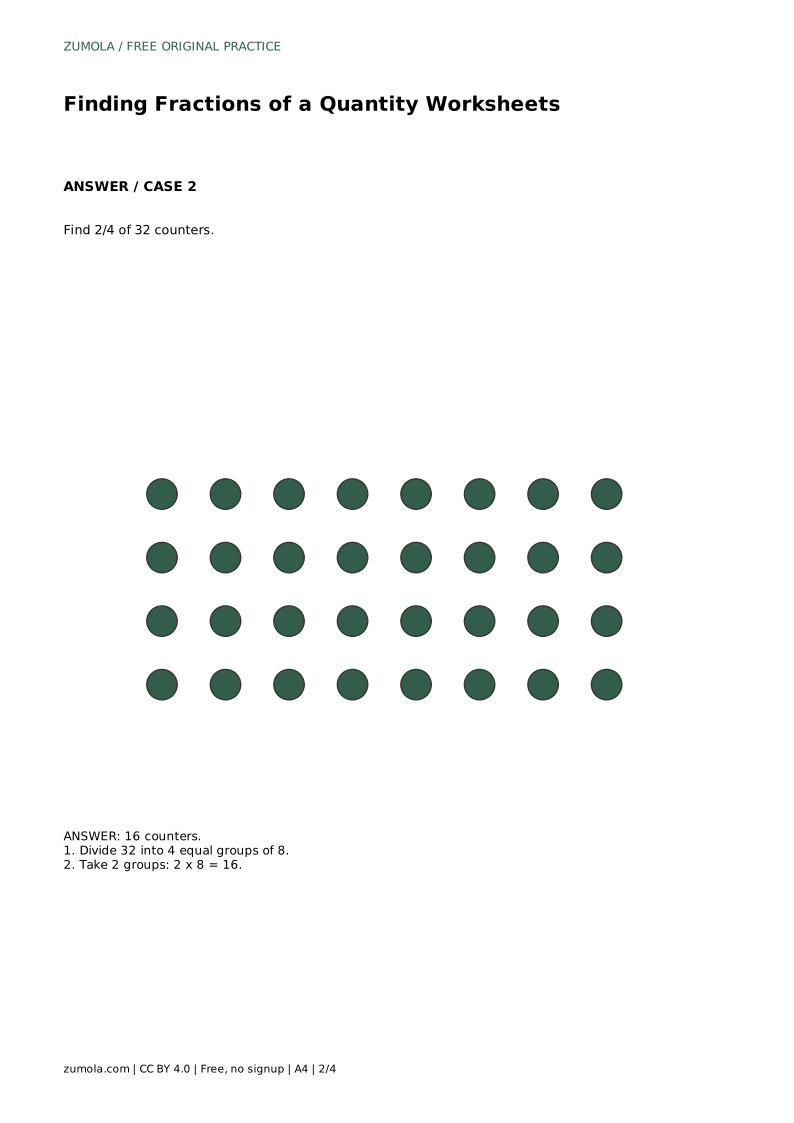
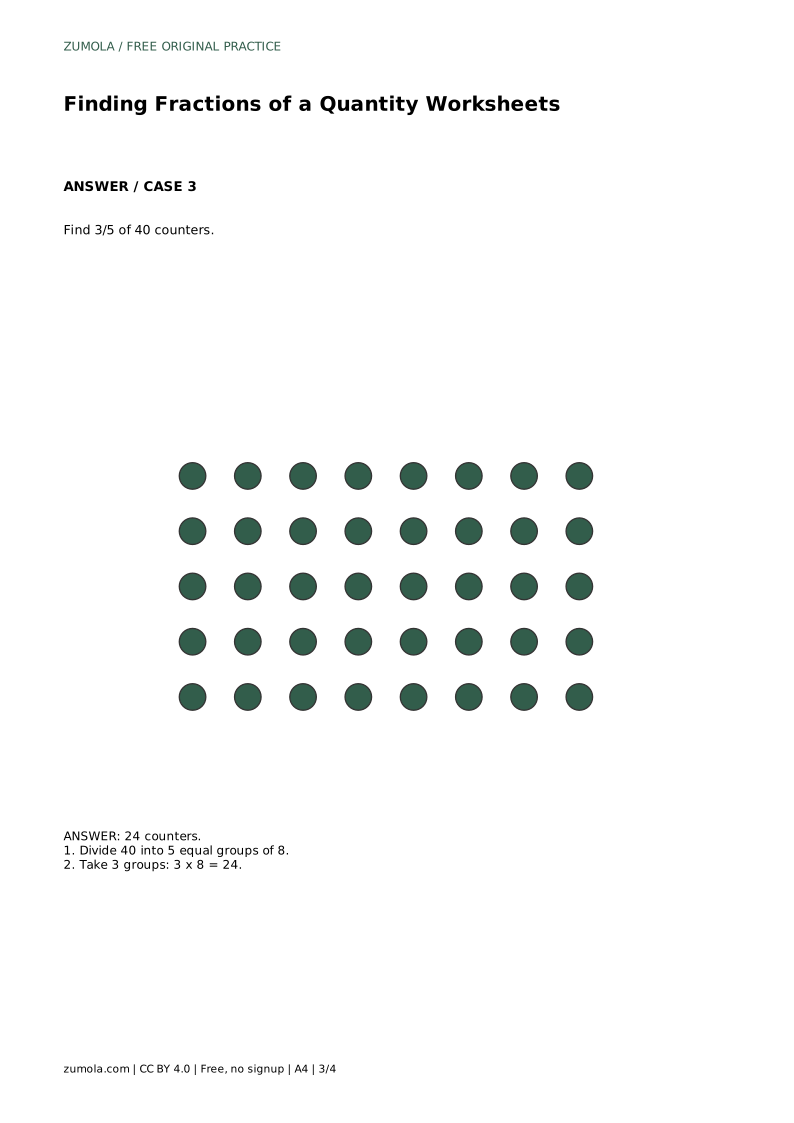
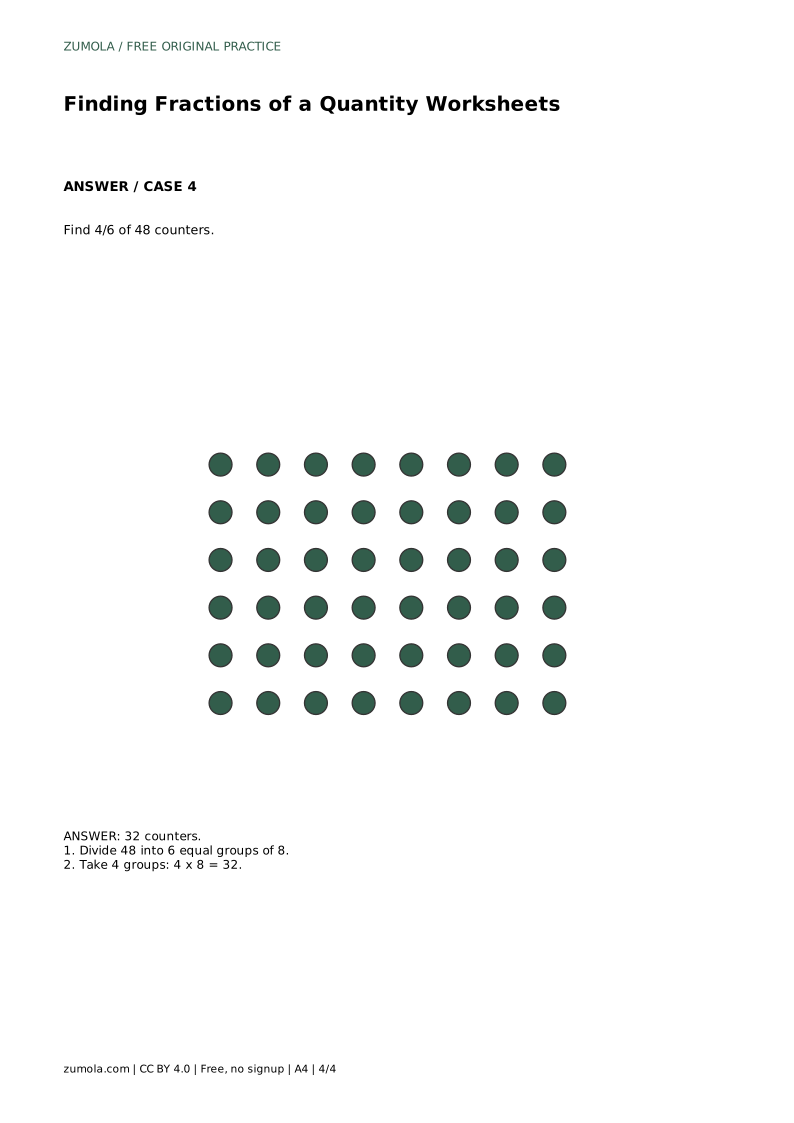
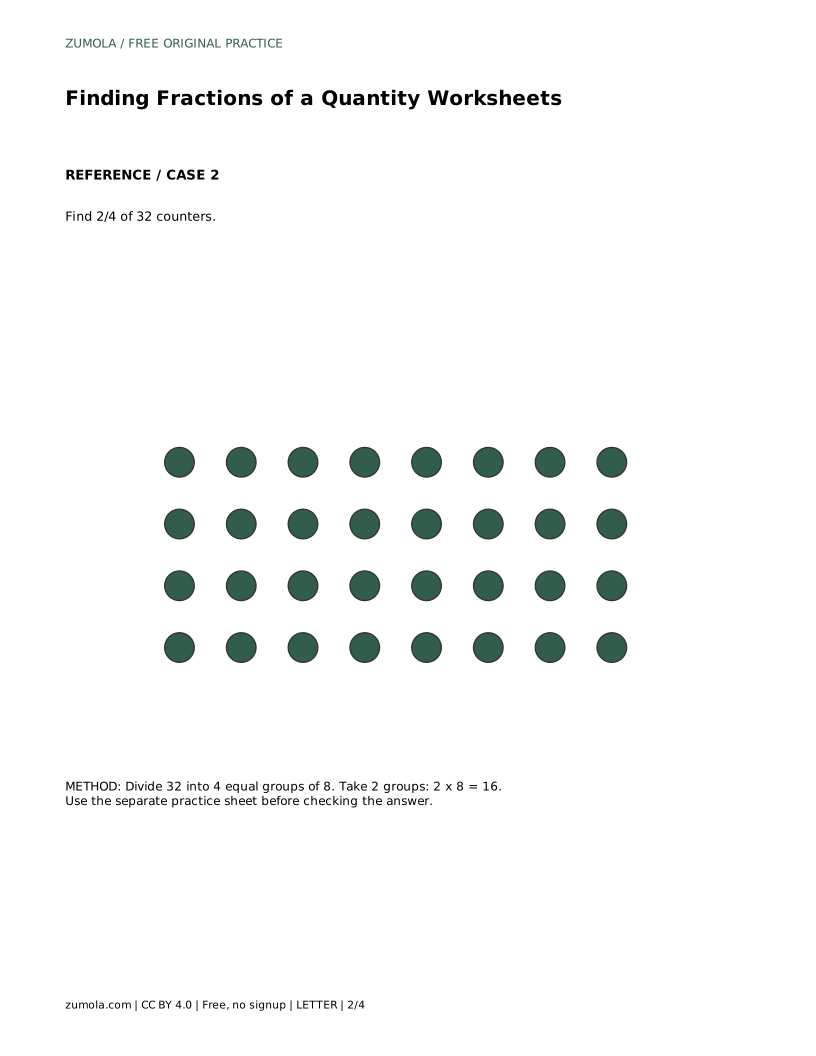
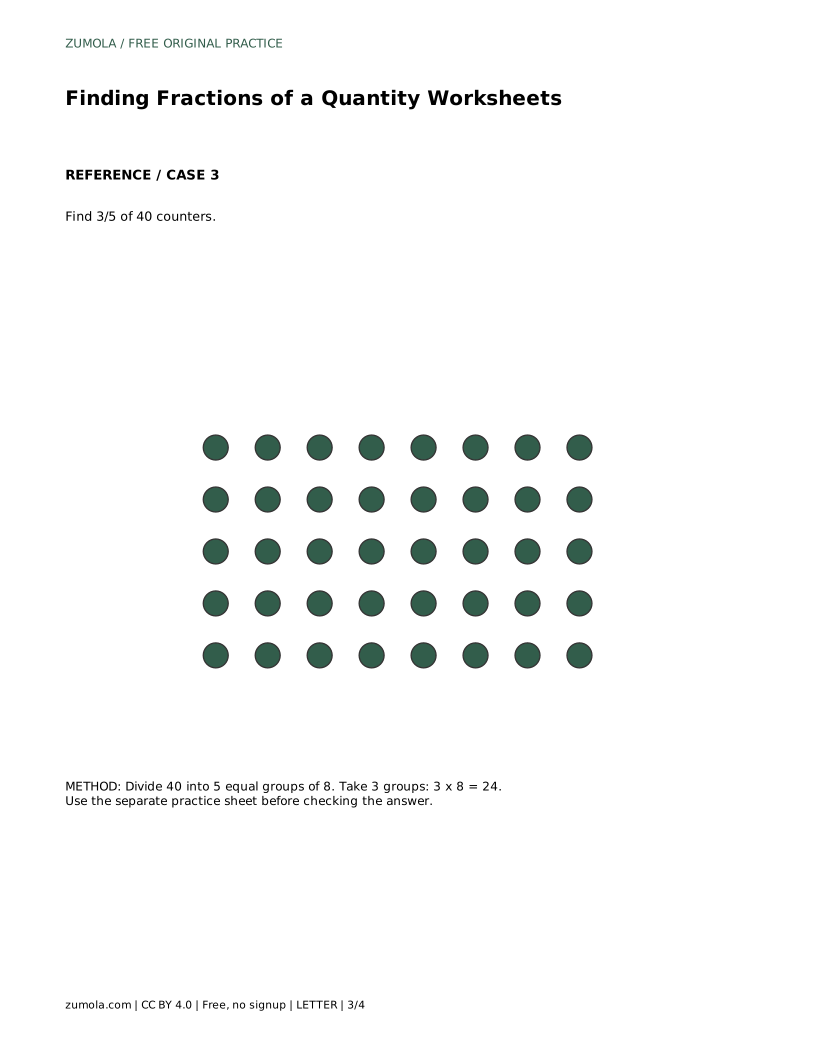
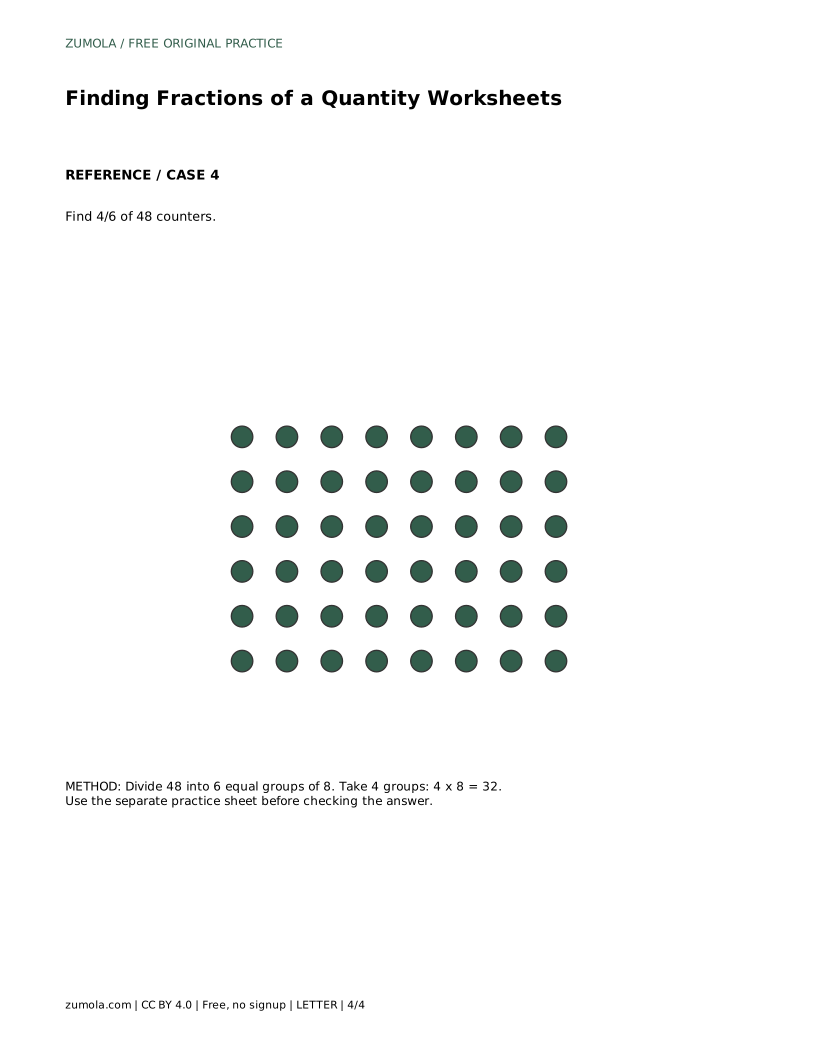
Once one group is known, taking more groups is repeated addition. For 3/5 of 40 counters, the denominator 5 gives 5 equal groups of 8, and the numerator 3 means take 3 groups: 8 + 8 + 8 = 24 counters. The same structure applies to 2/4 of 32 (4 groups of 8, take 2, giving 16) and 4/6 of 48 (6 groups of 8, take 4, giving 32).
Notice that these examples all happen to produce groups of 8. That is a convenience of the chosen numbers, not a rule. Change the quantity and the group size changes; the method stays the same. Ask learners to predict the group size before sharing, then test the prediction by counting.
A reliable check is to rebuild the whole: multiply the group size by the denominator and confirm it returns the original quantity. A second check is to compare the answer with the whole; a proper fraction of a quantity must be less than the whole, and a numerator equal to the denominator would give the whole amount.
When learners move from counters to written questions, keep the two-step structure visible: divide by the denominator, multiply by the numerator. Encourage them to write the group size on the page before the final answer, so errors can be traced to the sharing step or the counting step rather than guessed at.
Find 1/3 of 24 counters.
8 counters. Divide 24 into 3 equal groups of 8. Take 1 groups: 1 x 8 = 8.
Yes. Divide by the denominator first to find one equal group, then multiply by the numerator to take several groups. Multiplying first usually gives a number larger than the quantity and loses the meaning.
Then the equal groups are not whole numbers, and the counters model needs a different treatment. For this method, use quantities that divide exactly so each group has the same whole-number size.
For a proper fraction, the answer must be less than the original quantity. Rebuilding the whole by multiplying group size by the denominator gives a second, stronger check.
All math worksheets · Free coordinate paper
Original resources · CC BY 4.0 · Free for personal and classroom use with attribution.