Reference diagrams
LETTER · Download PDF
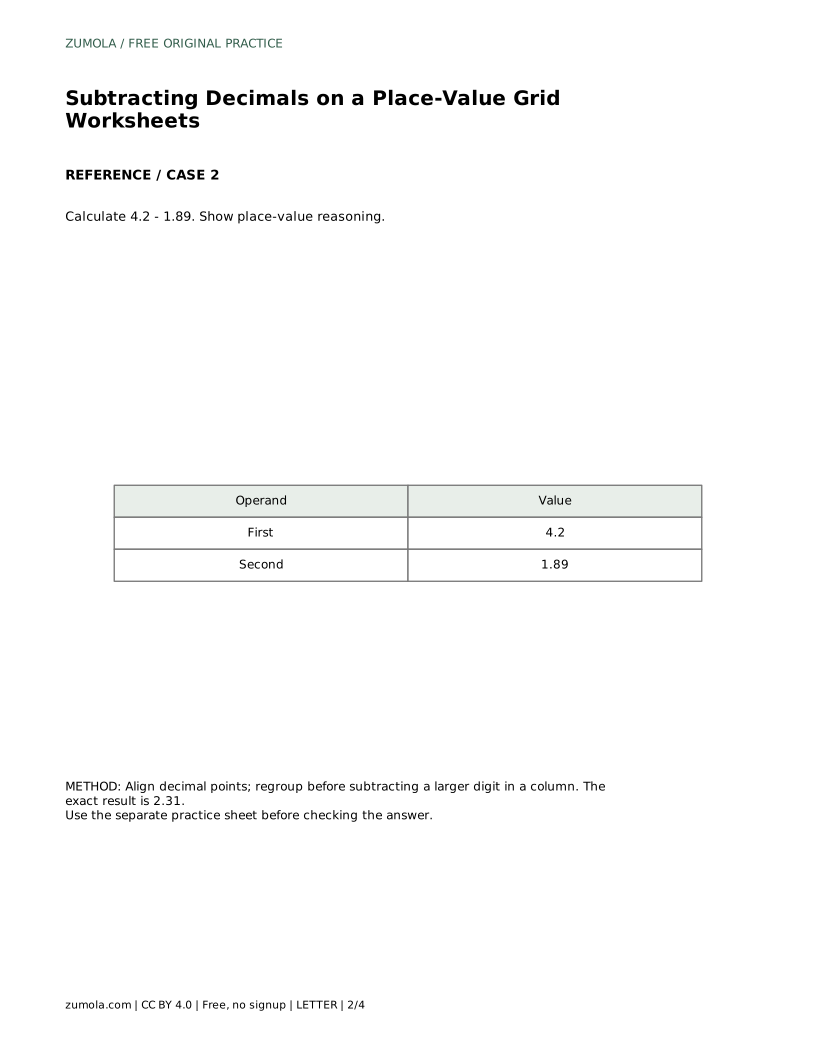
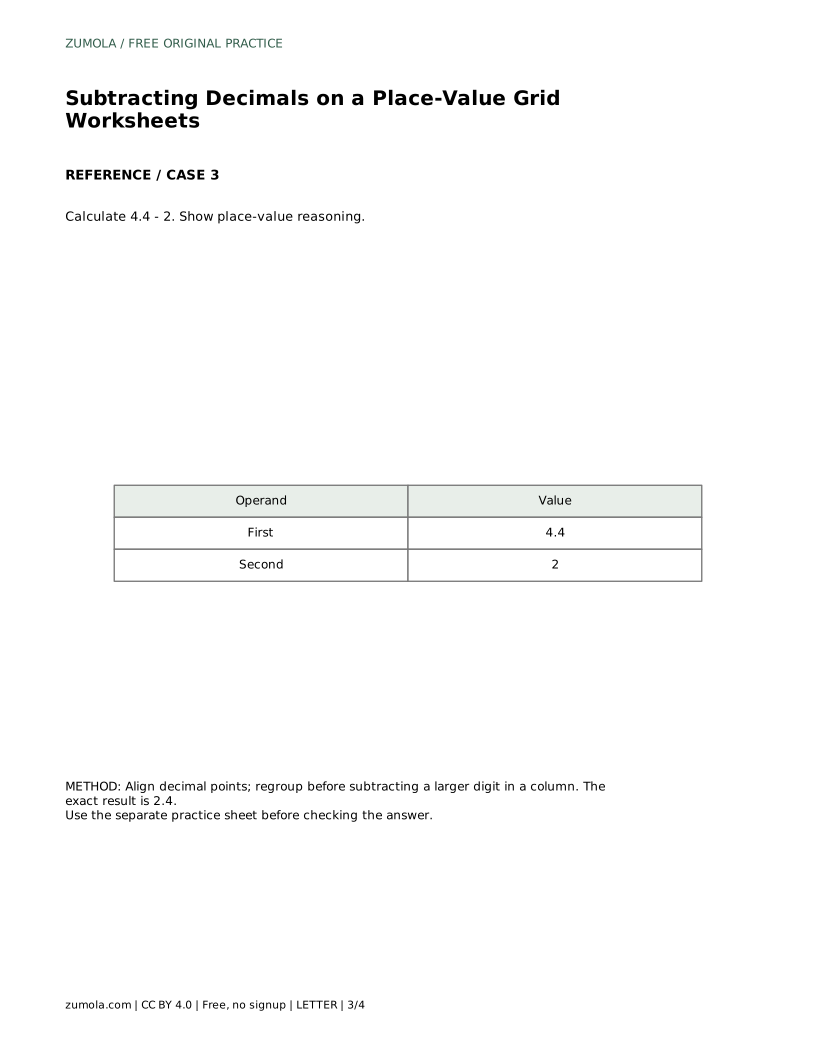
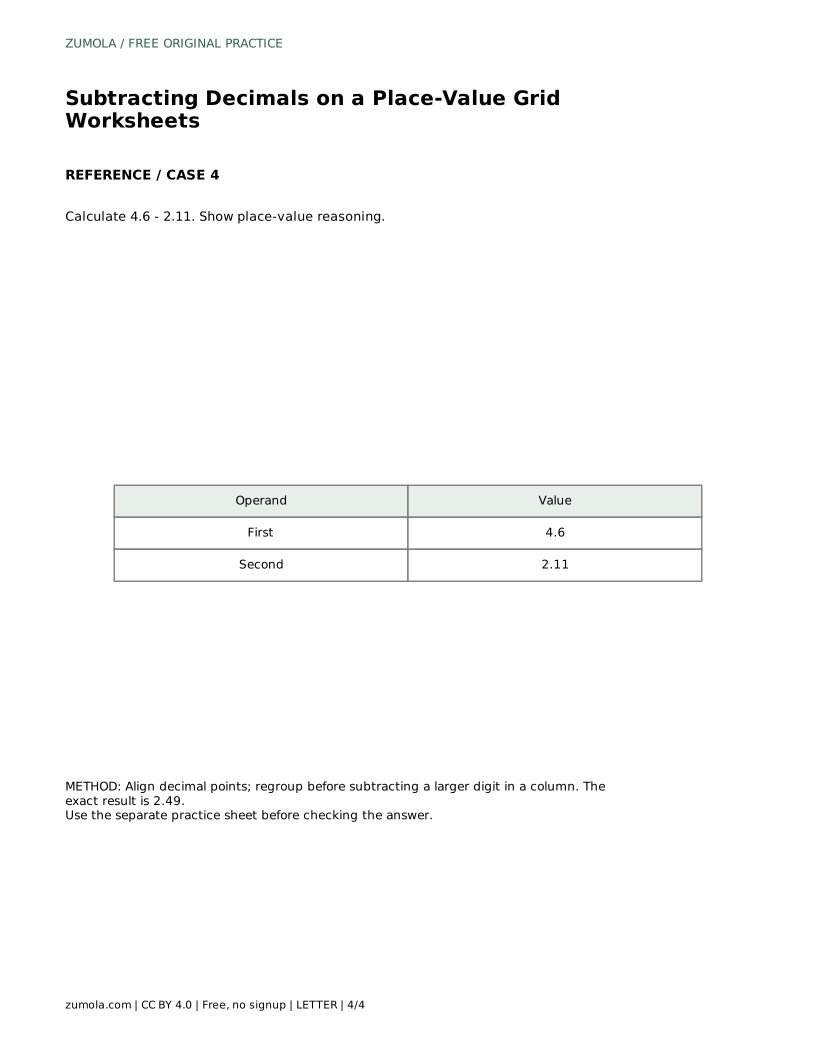
A4 · Download PDF
Free original resources
Teach decimal subtraction with place-value grids: align decimal points, fill empty places with zeros, regroup across columns, and check answers by adding back.
Four original cases, with reference diagrams, practice sheets and worked answers. Everything is free; no signup required.
LETTER · Download PDF
A4 · Download PDF
LETTER · Download PDF
A4 · Download PDF
LETTER · Download PDF
A4 · Download PDF
Use A4 or US Letter to match your printer. Use the stated values and conditions to solve each exercise; diagrams are not physical measuring rulers.
Subtracting decimals becomes clearer when each digit sits in a labeled column. A place-value grid keeps tenths under tenths and hundredths under hundredths, so regrouping is visible rather than guessed. This page explains how to set up subtraction on a grid, when to regroup, and how to check the result. It suits learners who can subtract whole numbers and are ready to extend that column method to decimals with one or two decimal places.
Write the larger number on the top row and the number being subtracted below it. Put the decimal points directly above and below each other, then label columns from left to right: ones, decimal point, tenths, hundredths. If one number has fewer decimal places, write zeros in the empty cells so every column holds a digit. For example, 4 has no tenths or hundredths, so record it as 4.00 on the grid. This does not change its value; it only makes the columns complete.
Keep the decimal point in its own narrow column and bring it straight down into the answer row. The digits to its left are whole numbers; the digits to its right are parts of one whole. Reading the grid aloud, column by column, helps learners see that 4.00 and 4 name the same amount.
Start at the rightmost column and move left. If the top digit is at least the bottom digit, subtract and record the difference. If the top digit is smaller, borrow one unit from the column to its left. That one unit is worth ten in the current column, so add ten to the top digit and reduce the neighbor by one. On a grid, cross out the changed digit and write its new value above it, then write the increased digit in the current column.
Work through every column, including zeros. A zero in the top row often needs regrouping from further left, which is why filling empty places with zeros first prevents confusion. Stop when you reach the ones column, then copy the decimal point down into the answer.
Subtraction can be checked with addition: the difference plus the number subtracted should equal the first number. Line the check up on the same grid so place values still match. If the sum does not match, recheck the column where regrouping happened, since a borrowing error usually shows up there.
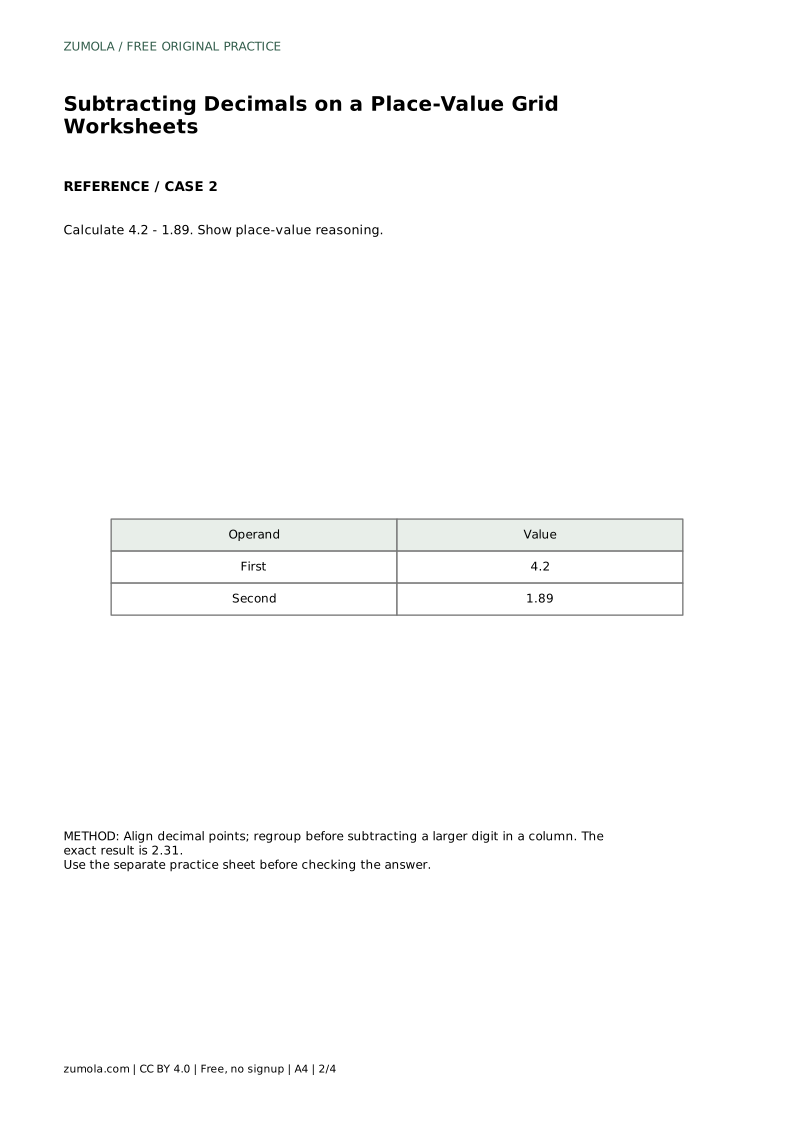
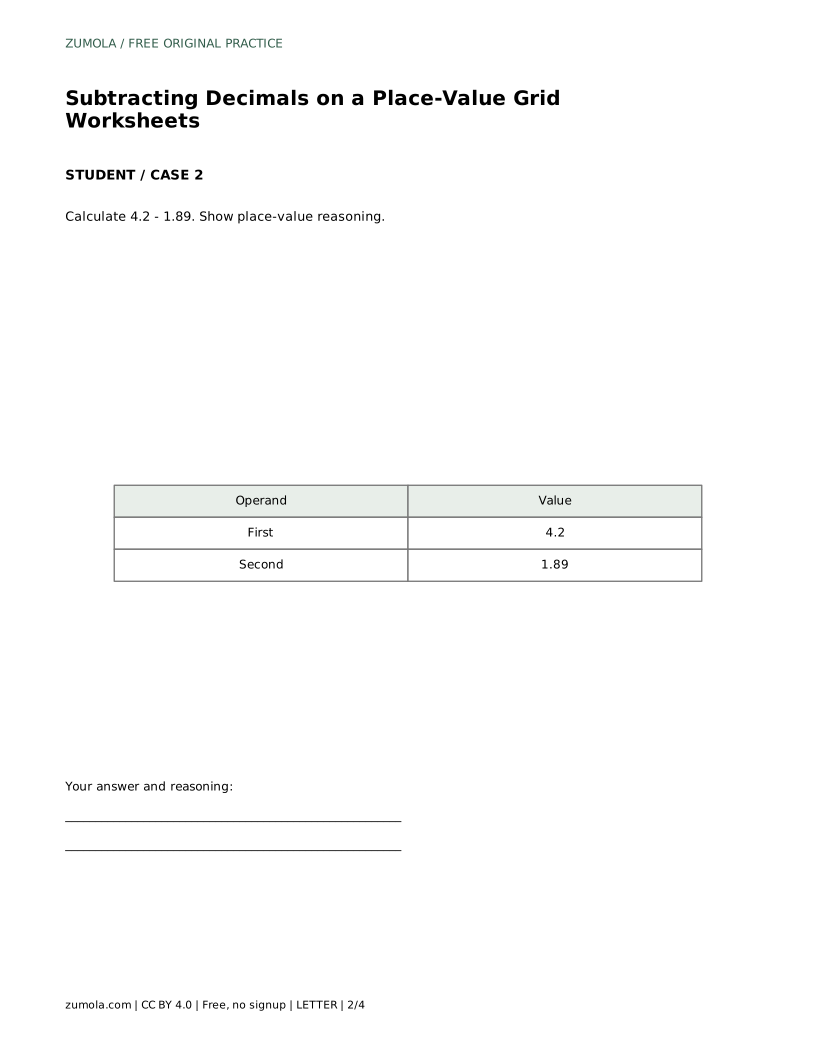
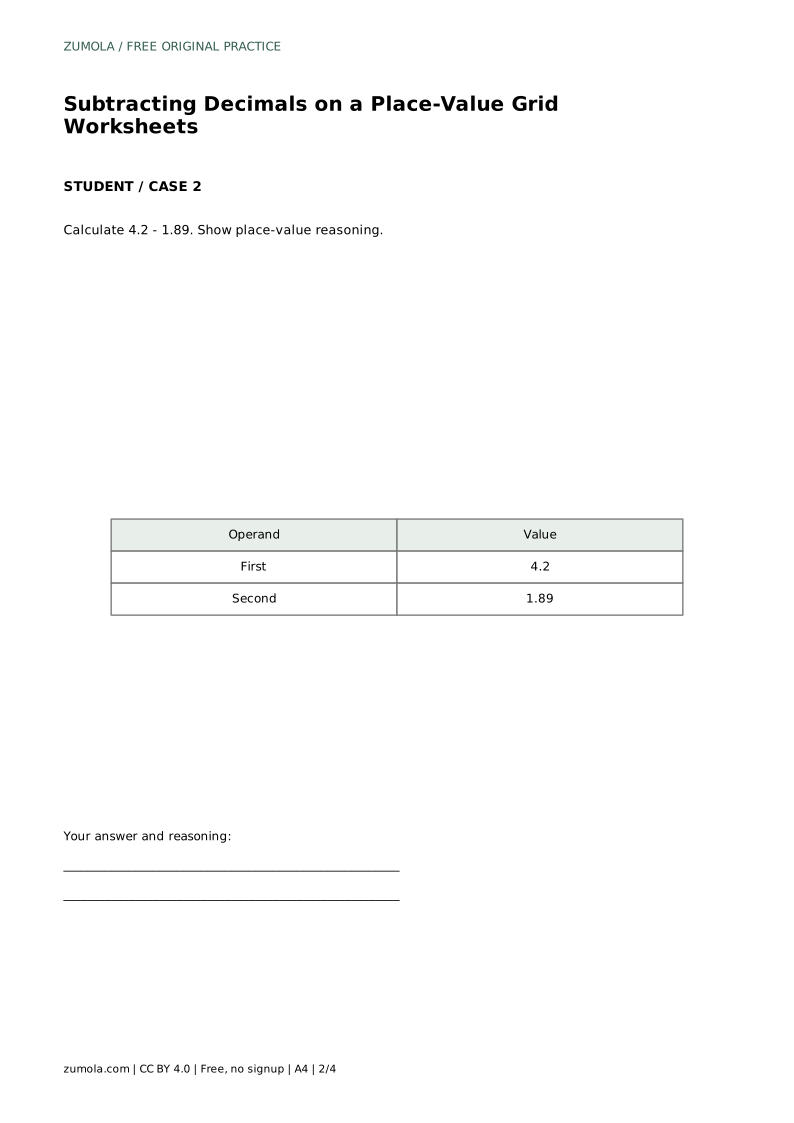
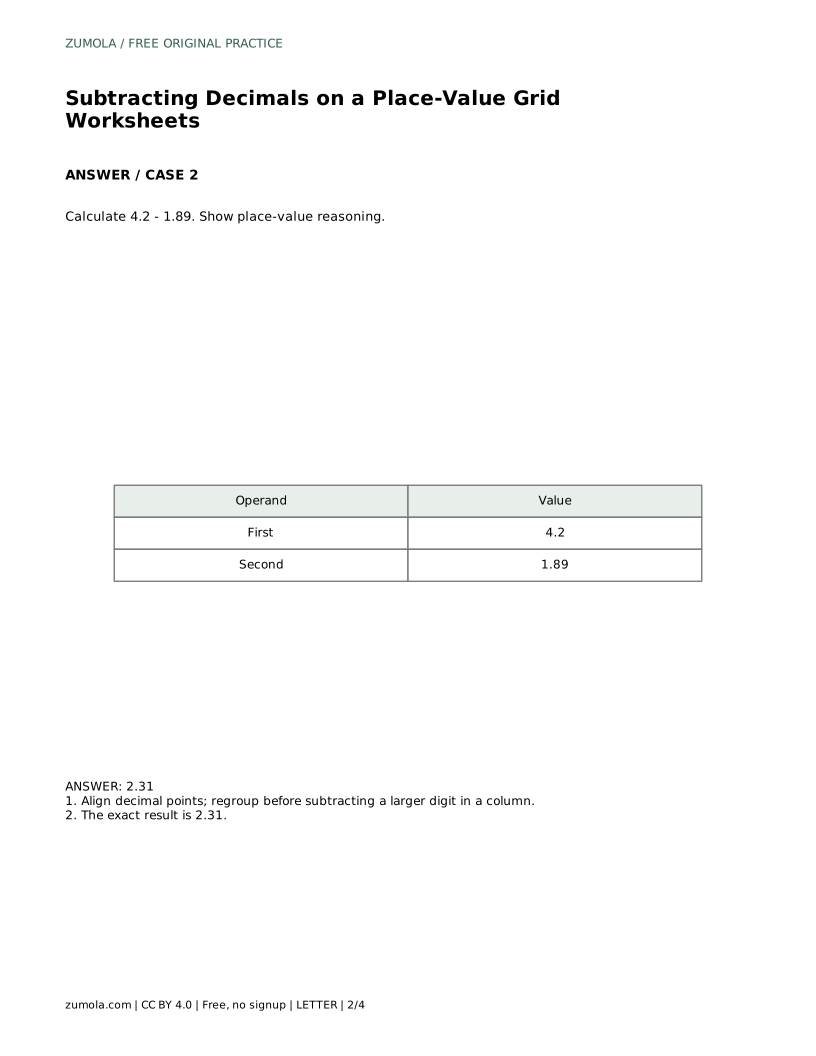
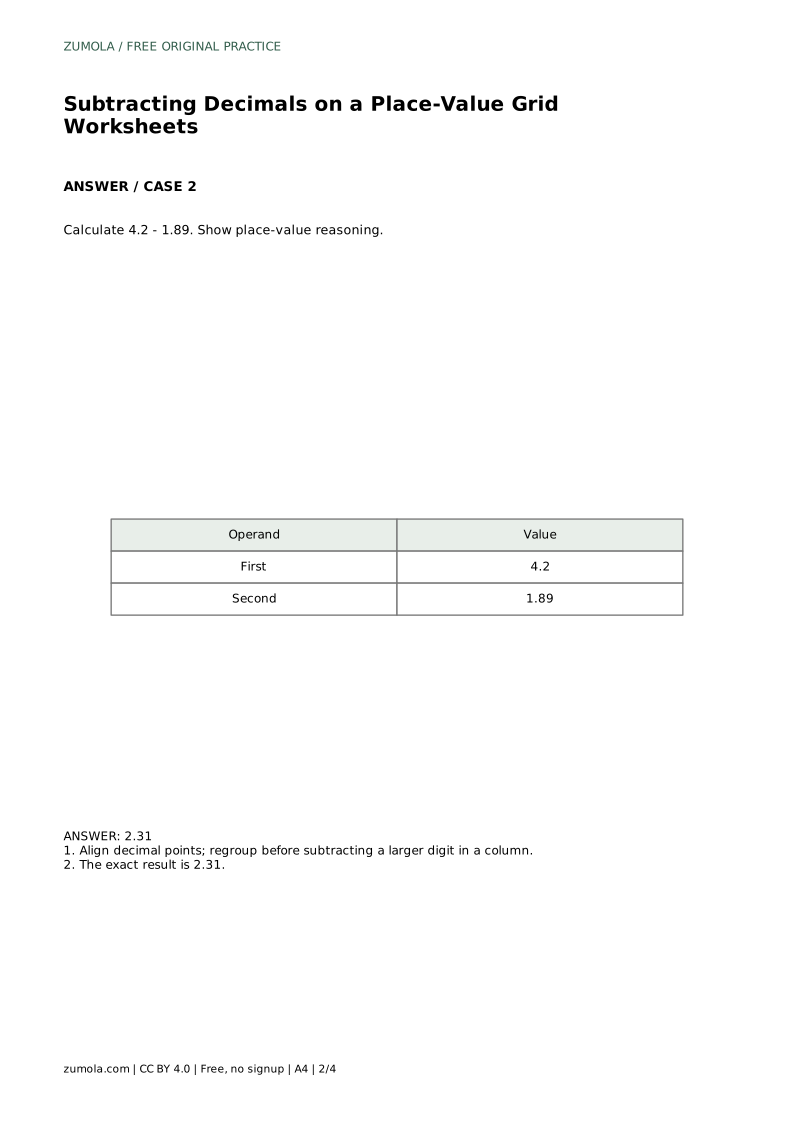
Estimate first as a second check. Round each number to the nearest whole number, subtract mentally, and confirm the exact answer is close. For 4.2 minus 1.89, the estimate is 4 minus 2, or 2, and the exact answer 2.31 is reasonably near it.
Grid work is a reasoning record, so judge the process as well as the answer. A correct answer with no visible regrouping is harder to diagnose than a clear grid with one slip. When marking, note whether columns are aligned, whether zeros were used to complete places, whether borrowing is shown, and whether the decimal point is placed correctly.
Different valid layouts exist: some learners cross out digits above the grid, others rewrite the whole top row after each borrow. Both are acceptable if the values stay consistent and the final difference is correct.
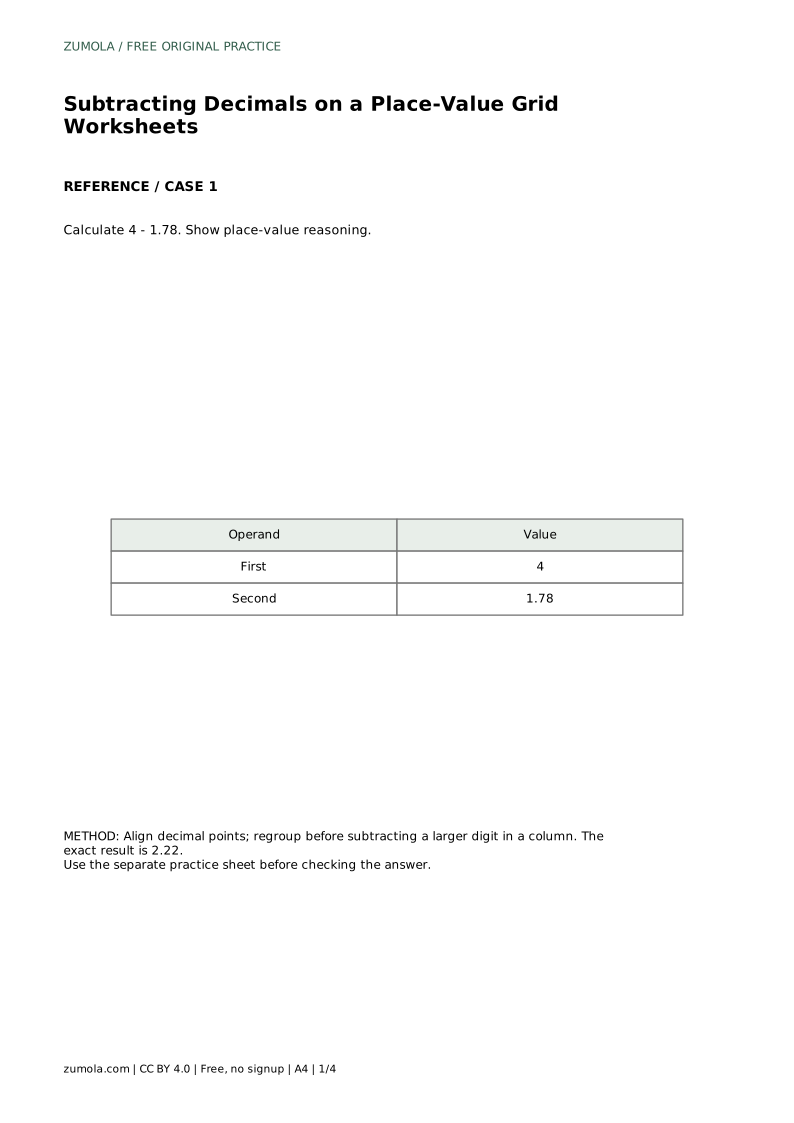
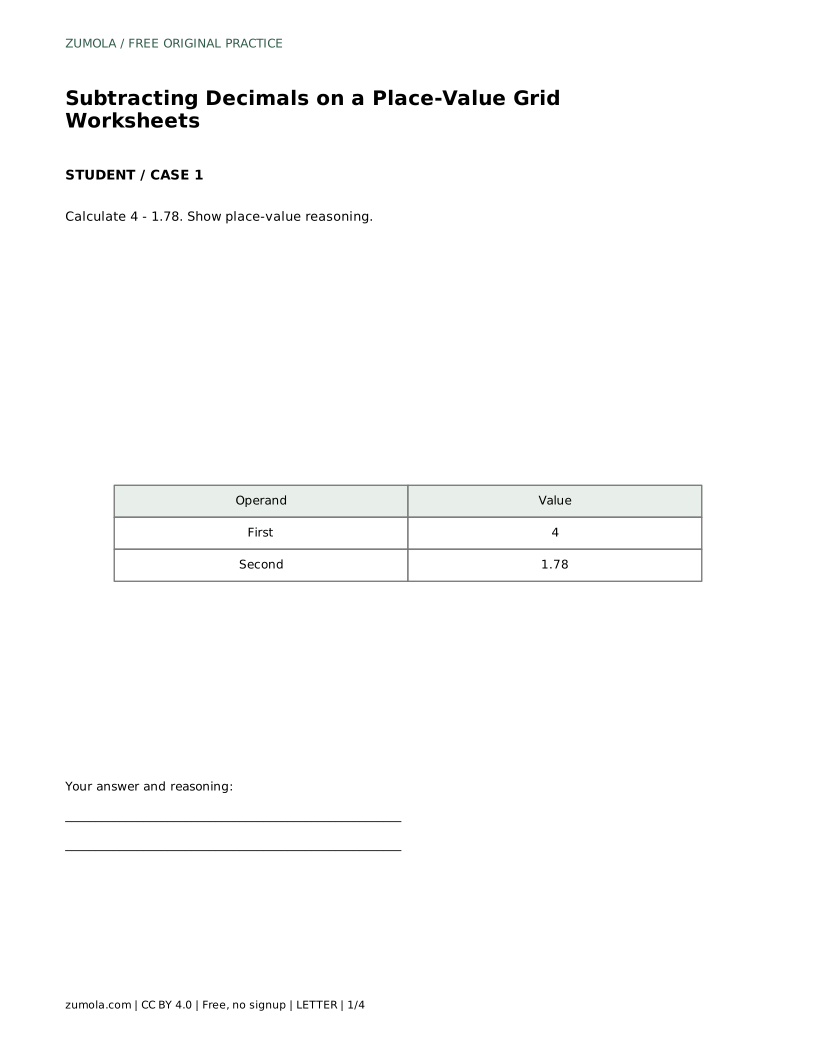
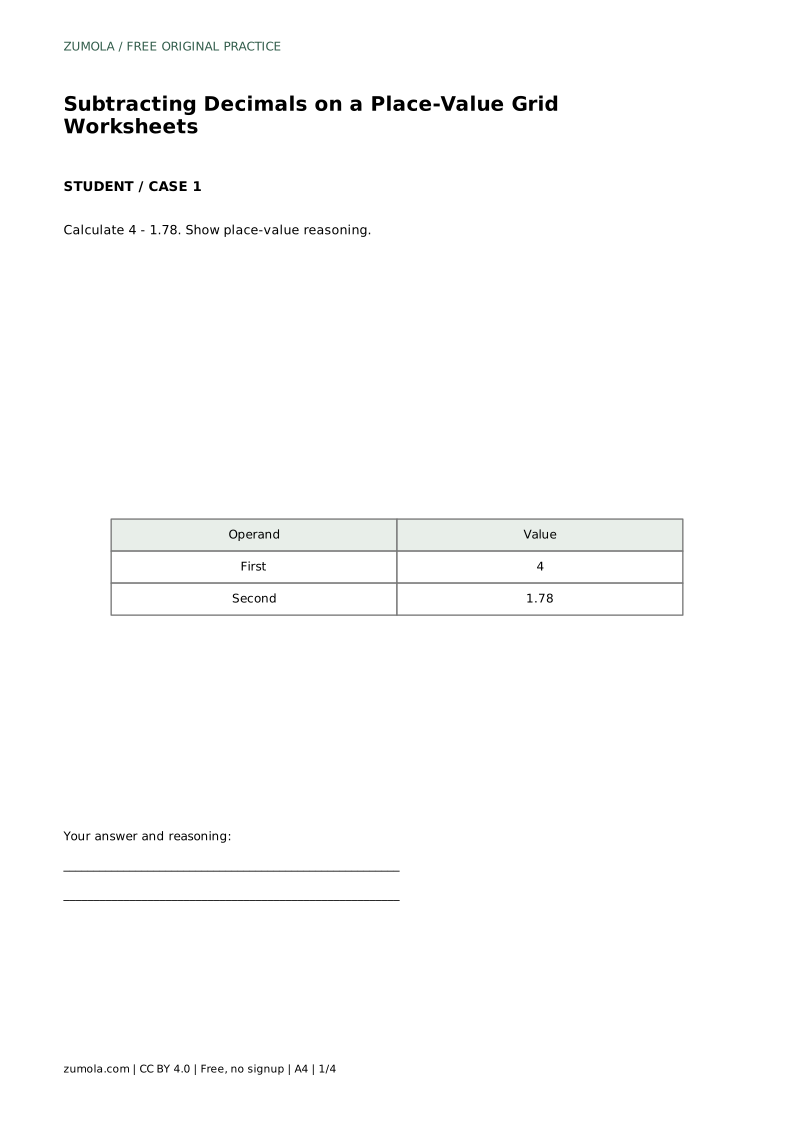
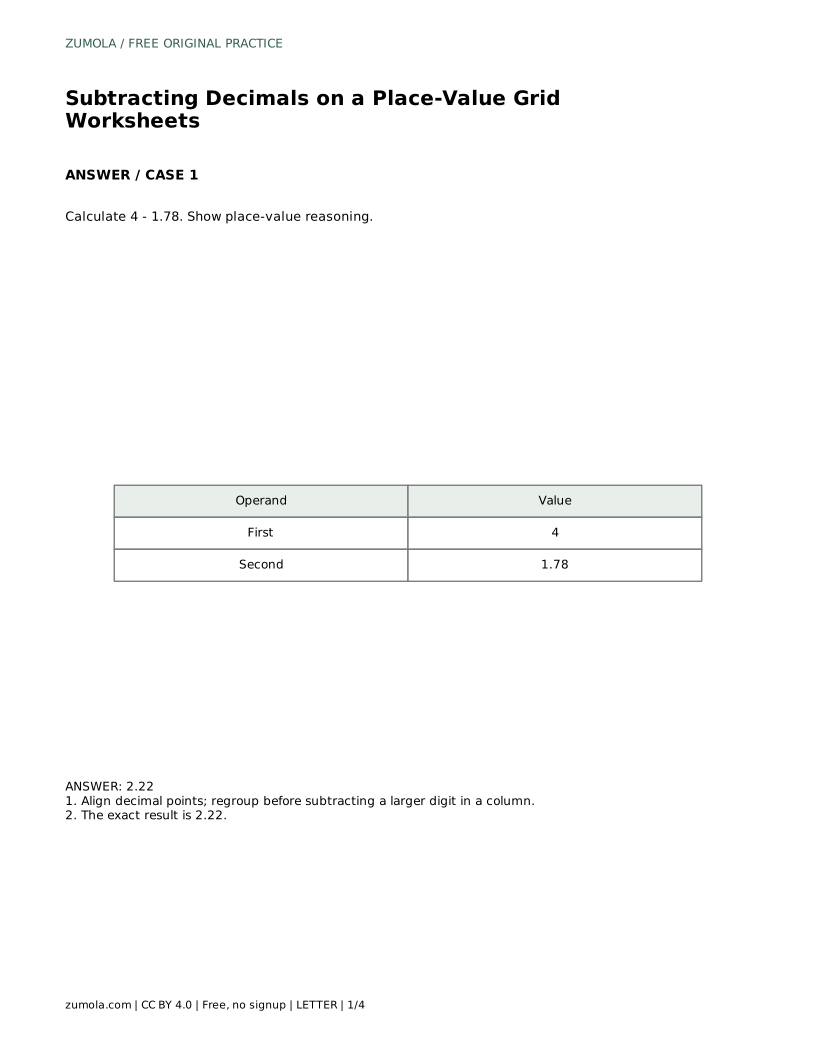
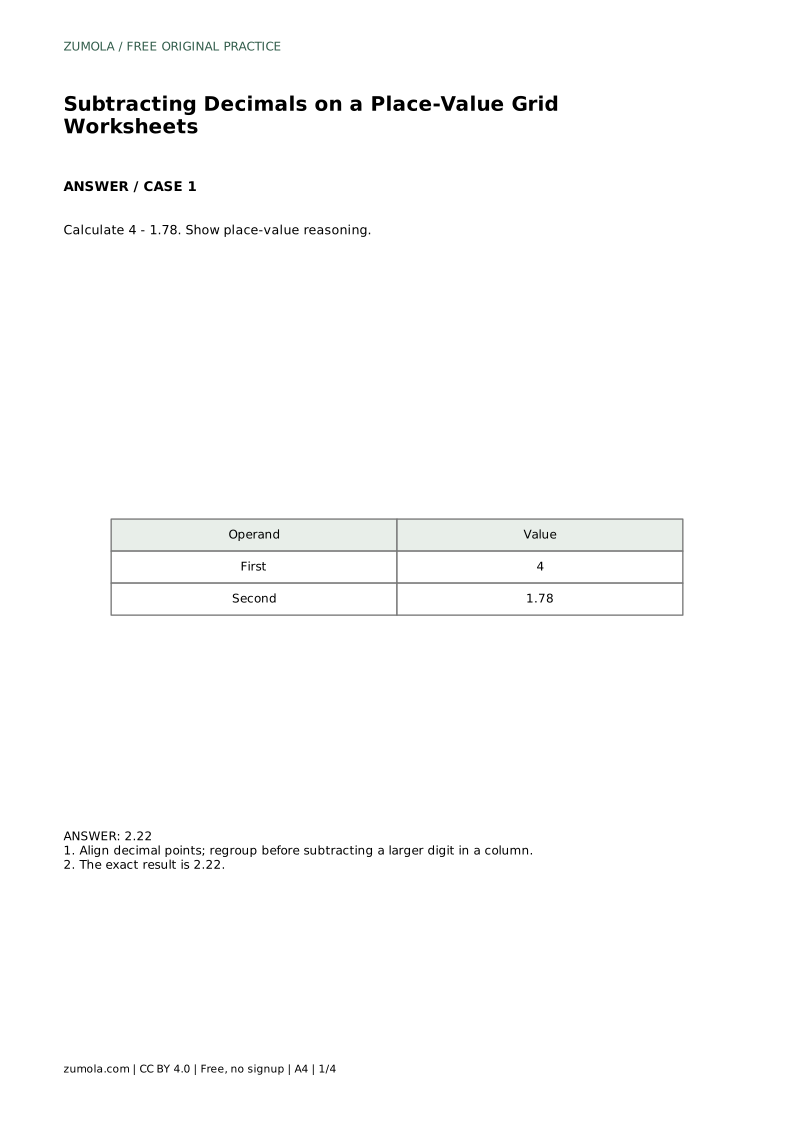
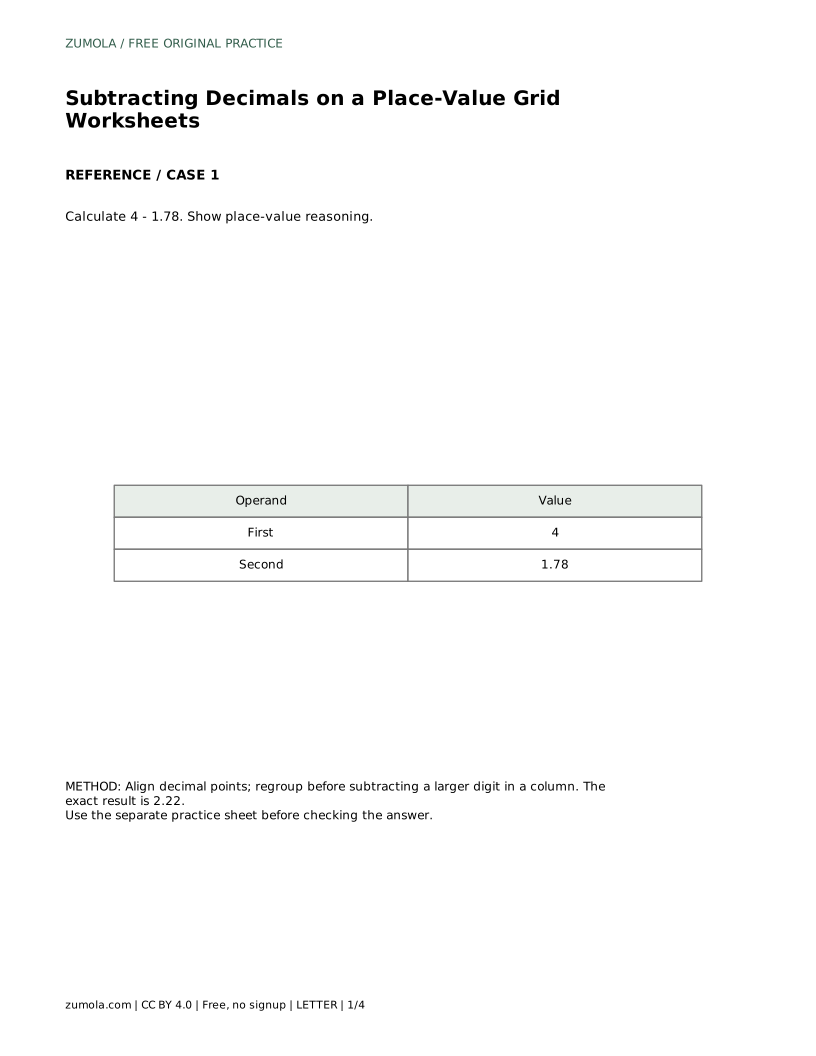
Calculate 4 - 1.78. Show place-value reasoning.
2.22 Align decimal points; regroup before subtracting a larger digit in a column. The exact result is 2.22.
Writing zeros fills the tenths and hundredths columns so every digit has a matching place. The value stays the same; only the written form changes.
Regroup when the top digit in a column is smaller than the bottom digit. Borrow one unit from the column to the left, which is worth ten in the current column.
Add the difference to the number you subtracted. The sum should equal the first number exactly, with decimal points aligned.
All math worksheets · Free coordinate paper
Original resources · CC BY 4.0 · Free for personal and classroom use with attribution.