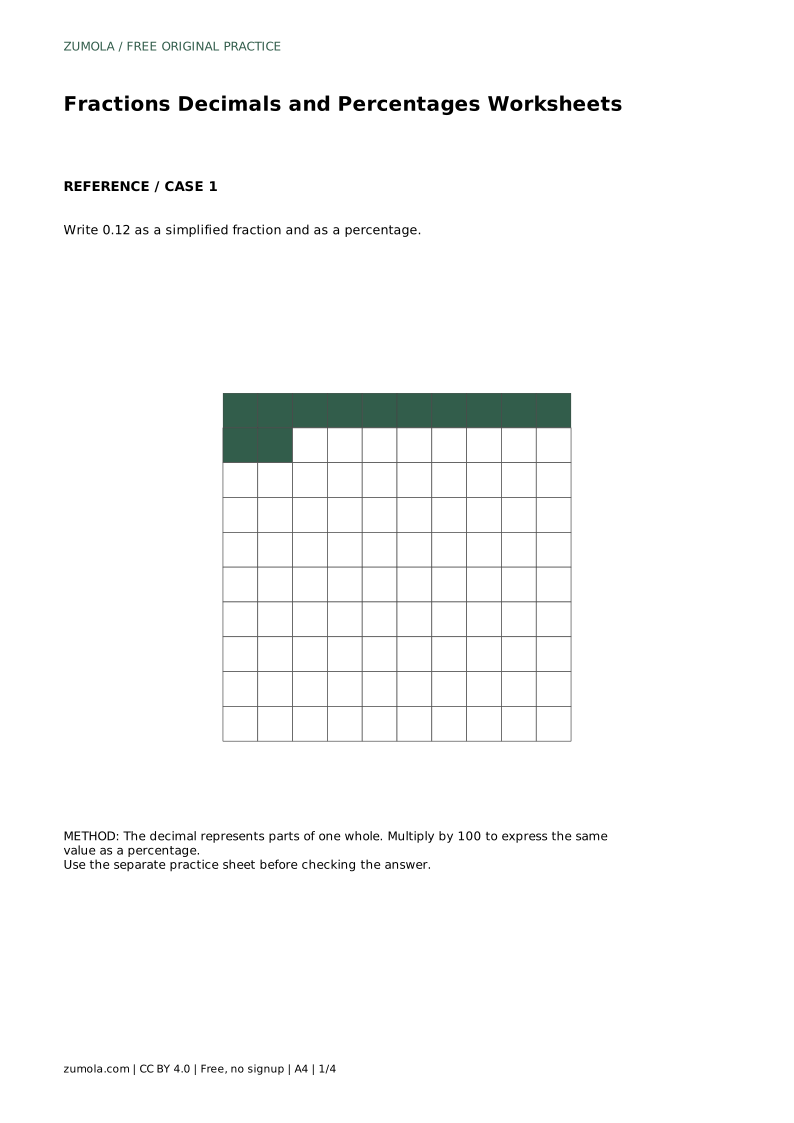
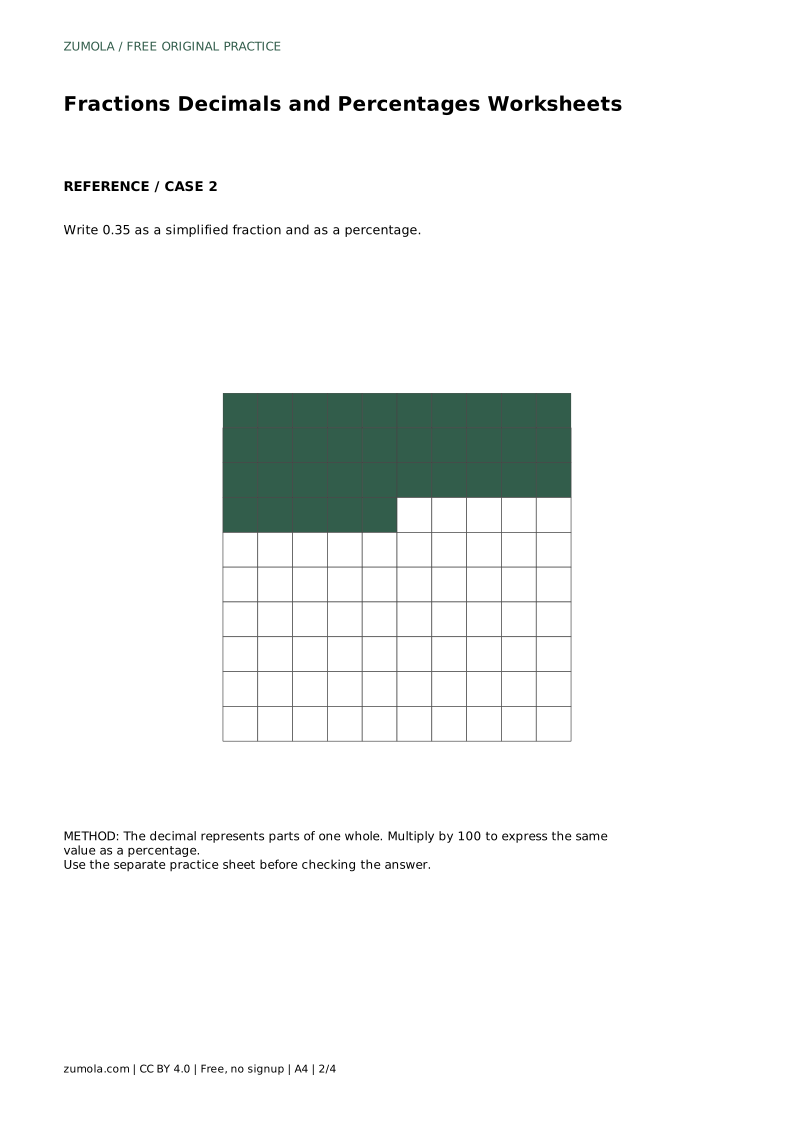
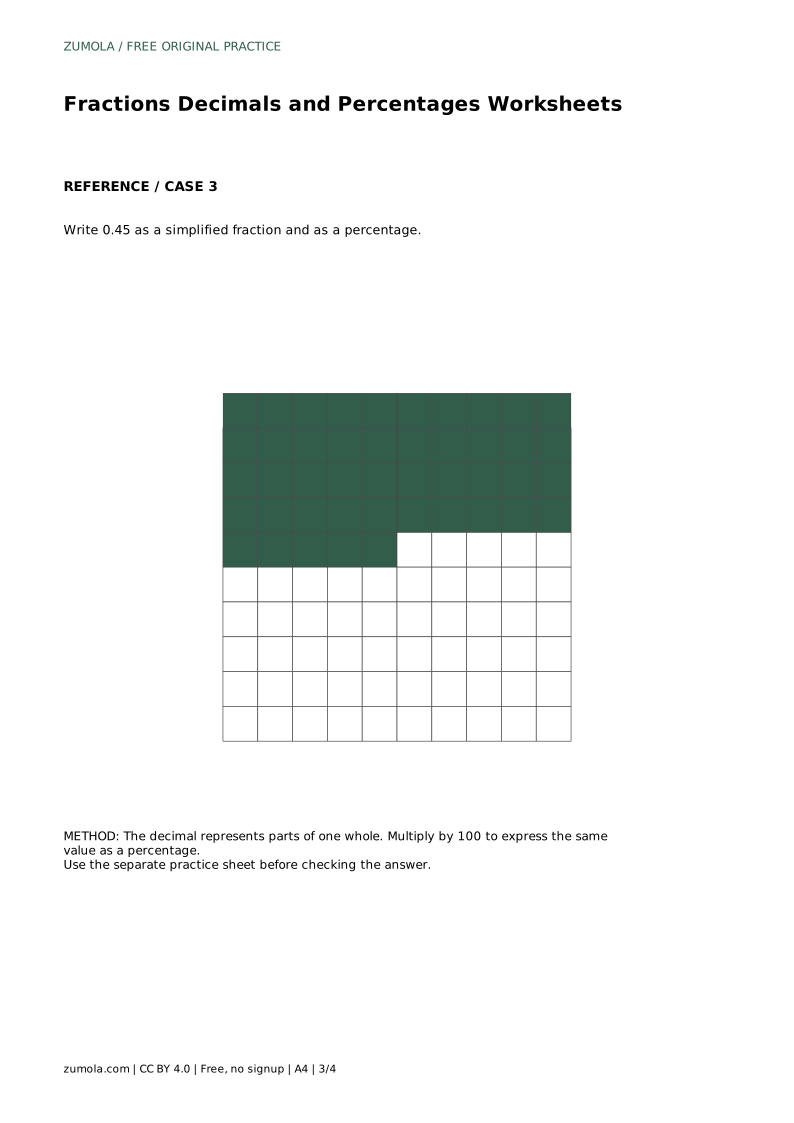
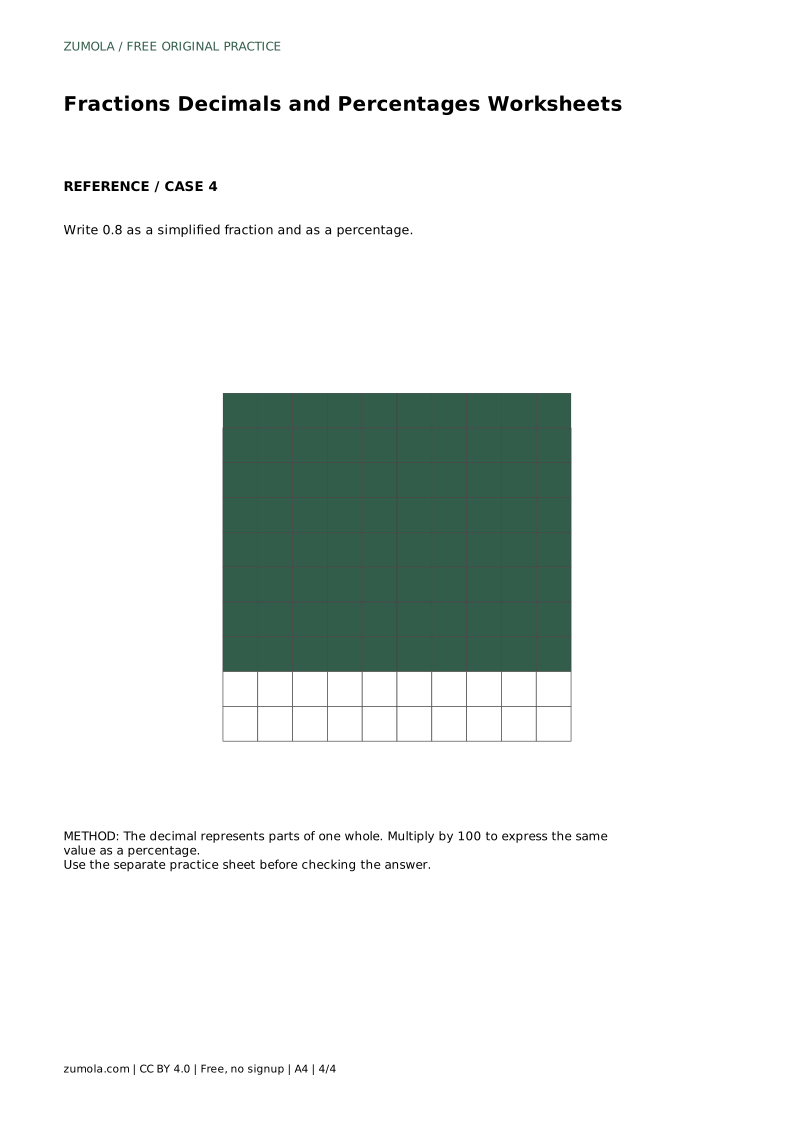
Reference diagrams
LETTER · Download PDF
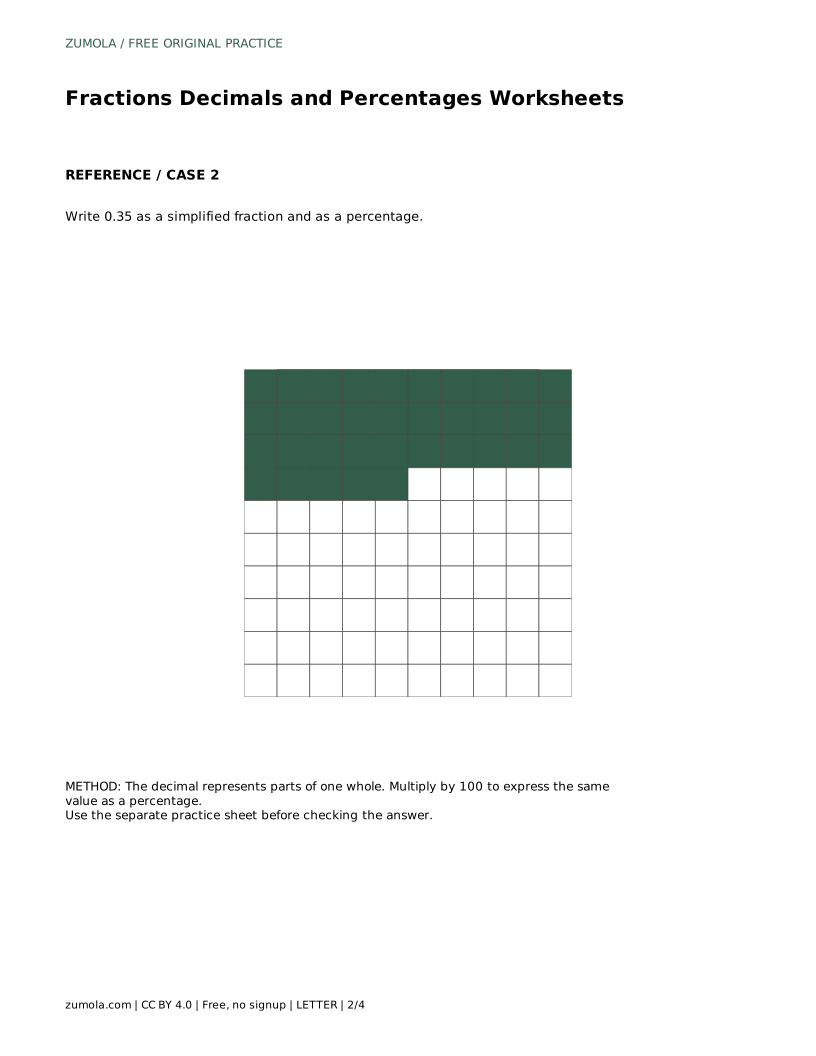
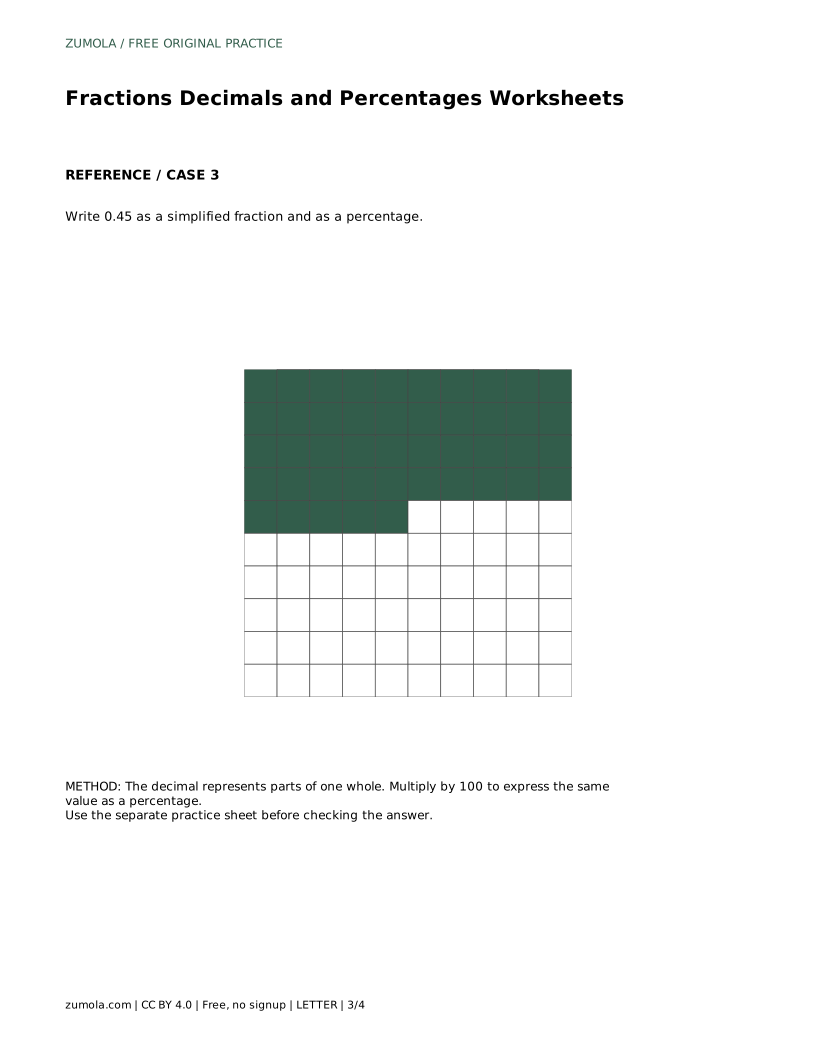
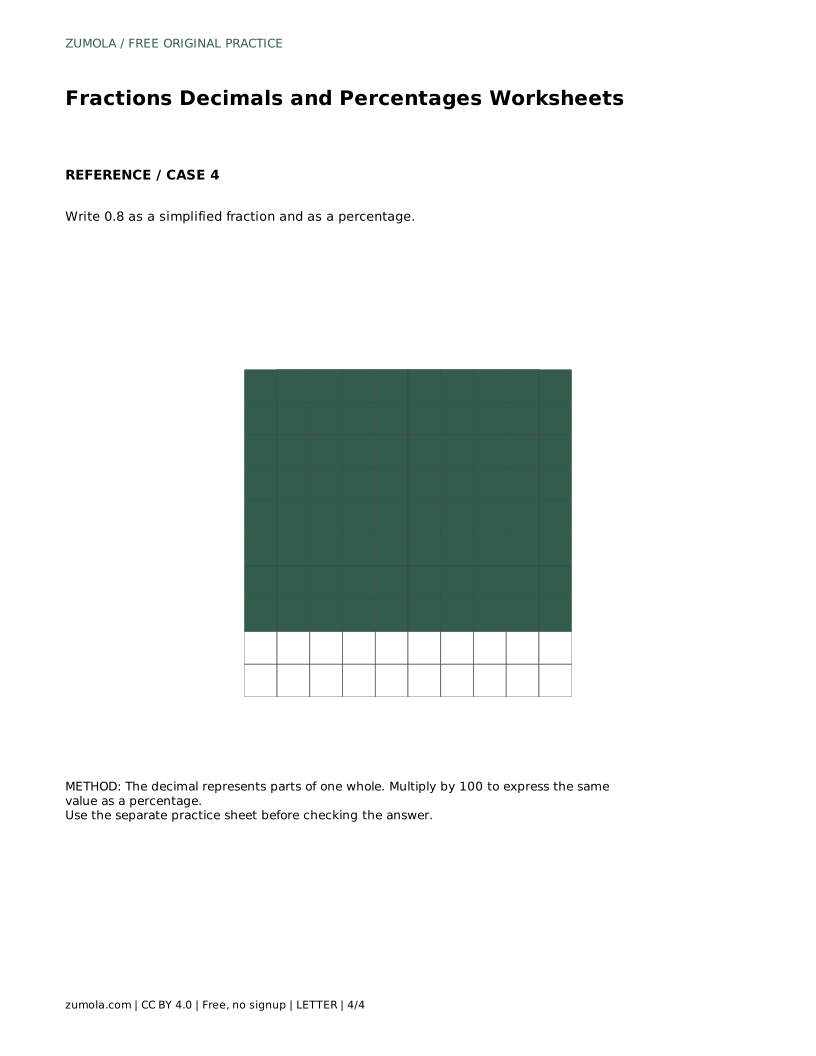
A4 · Download PDF
Free original resources
Practise converting decimals such as 0.12, 0.35, 0.45 and 0.8 into simplified fractions and percentages, with a hundred-square model and a marking rubric.
Four original cases, with reference diagrams, practice sheets and worked answers. Everything is free; no signup required.
LETTER · Download PDF
A4 · Download PDF
LETTER · Download PDF
A4 · Download PDF
LETTER · Download PDF
A4 · Download PDF
Use A4 or US Letter to match your printer. Use the stated values and conditions to solve each exercise; diagrams are not physical measuring rulers.
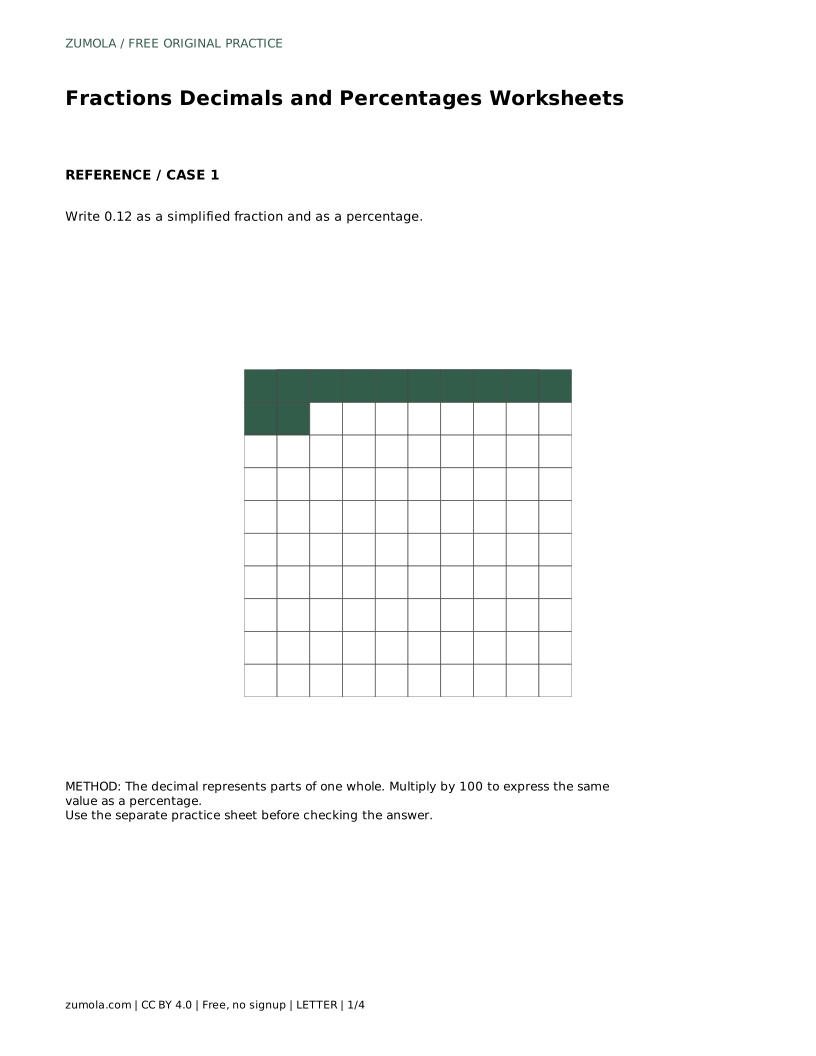
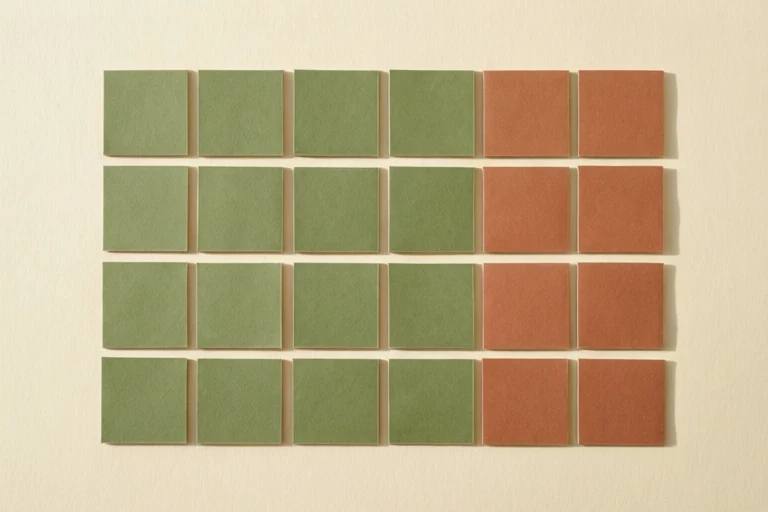
Decimals, fractions and percentages can describe the same part of a whole. This page focuses on one clear task: turning a decimal into a simplified fraction and into a percentage. You will use place value to build the fraction, divide to simplify it, and multiply by 100 to express the same value as a percentage. A hundred-square chart helps you check that the three forms agree.
Every decimal has a place value that tells you the denominator before simplifying. In 0.12, the final digit 2 sits in the hundredths place, so the decimal means 12 hundredths, written 12/100. In 0.35 the final digit is also in the hundredths place, giving 35/100. In 0.8 the final digit 8 is in the tenths place, so the value is 8/10. Reading the place value first keeps the fraction tied to the decimal rather than to a guess.
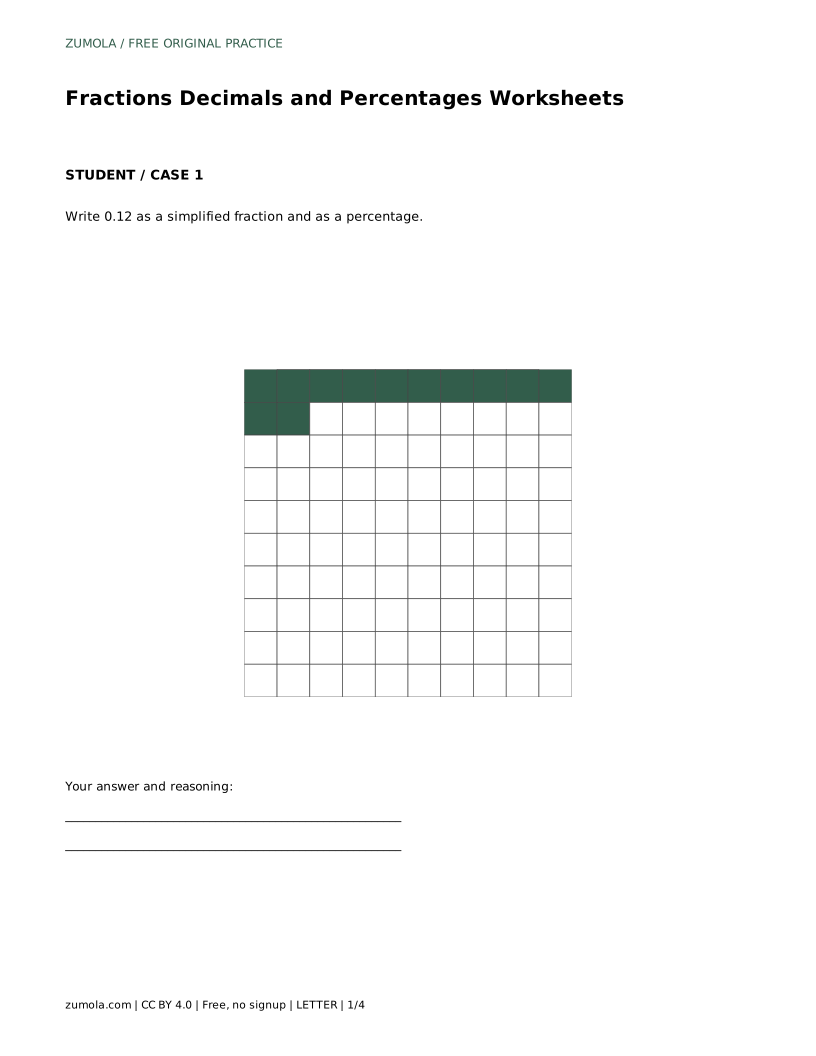
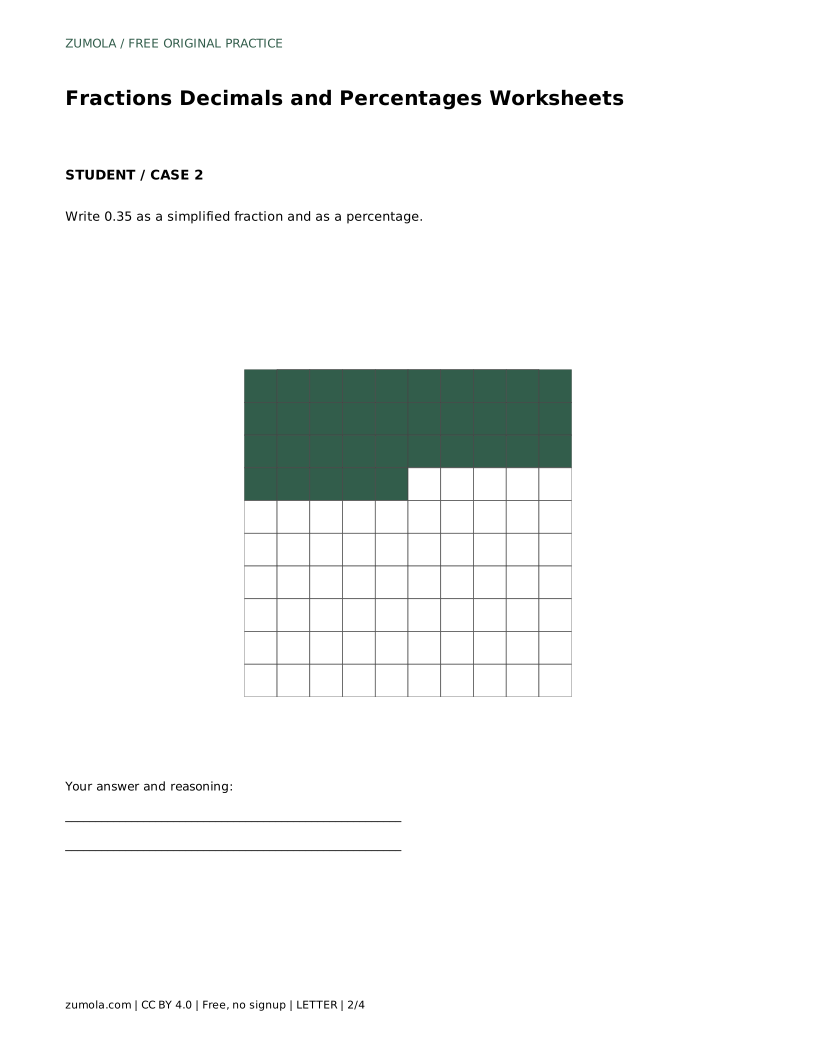
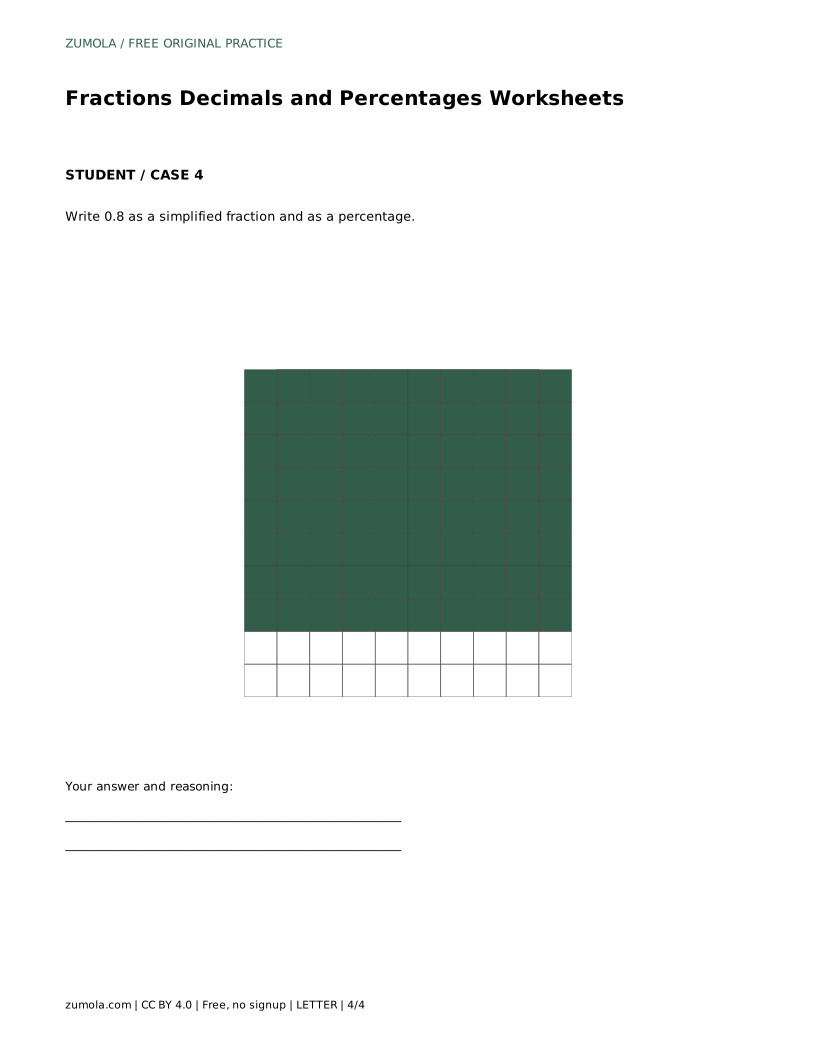
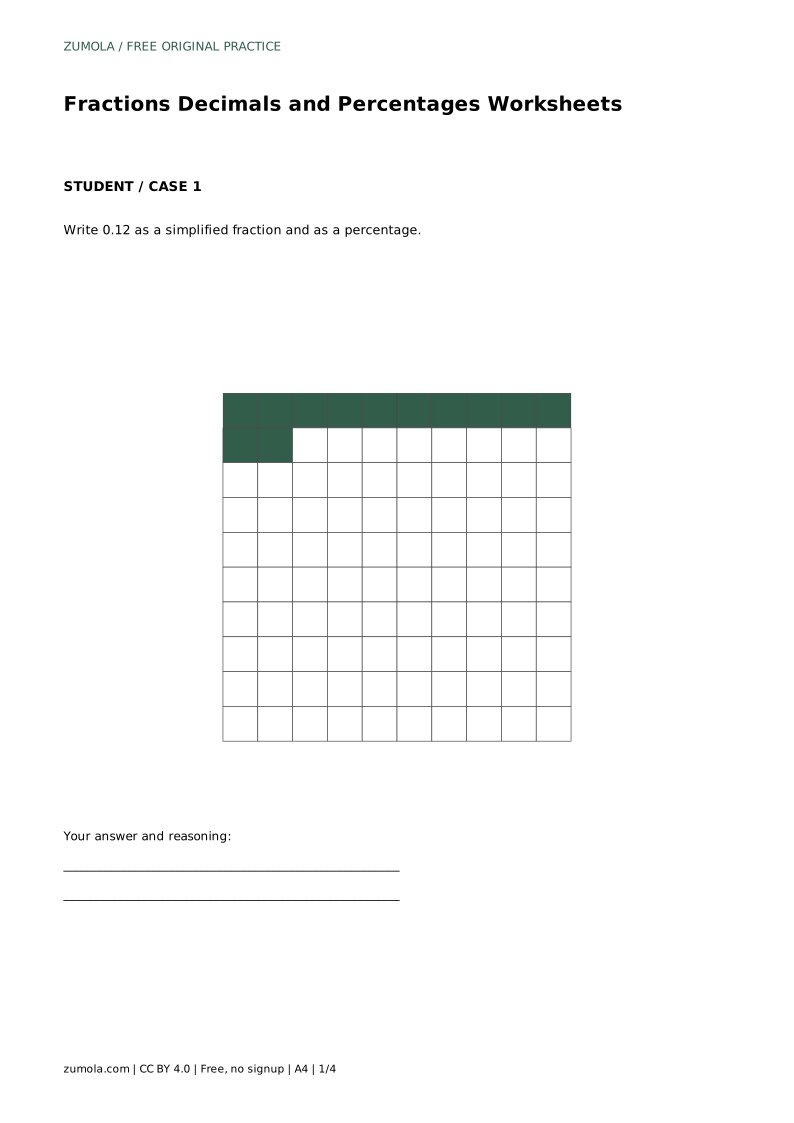
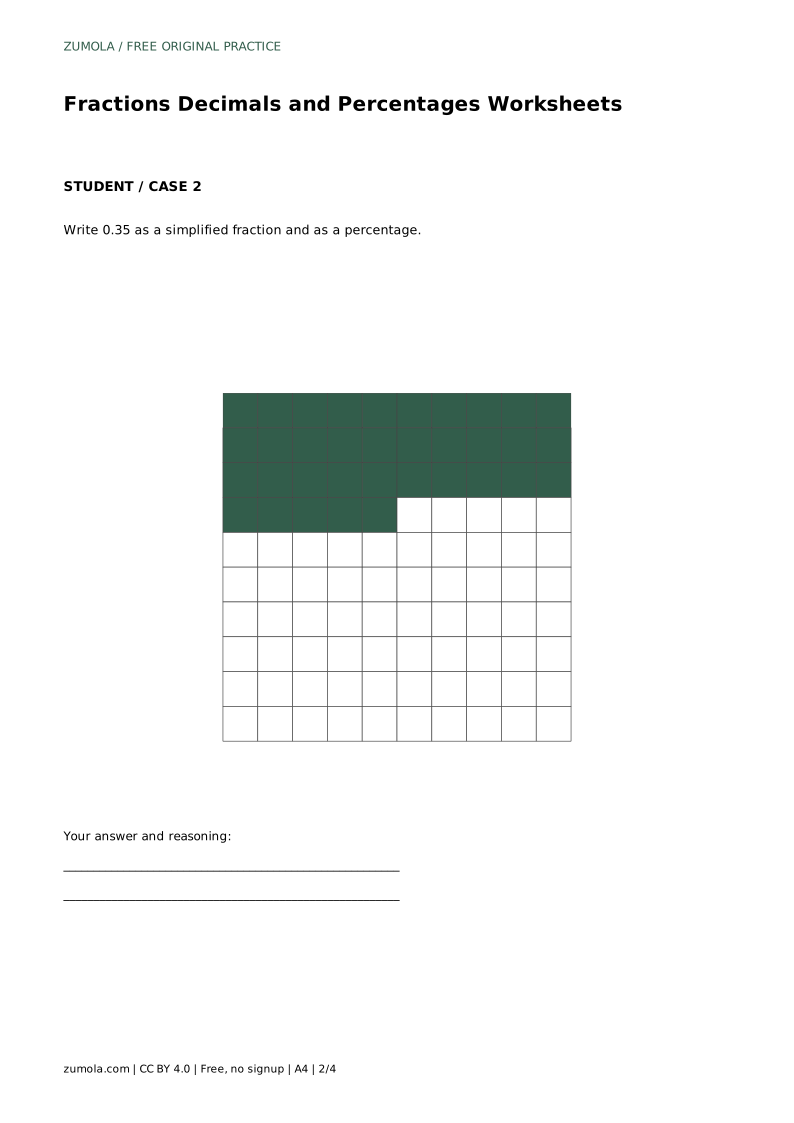
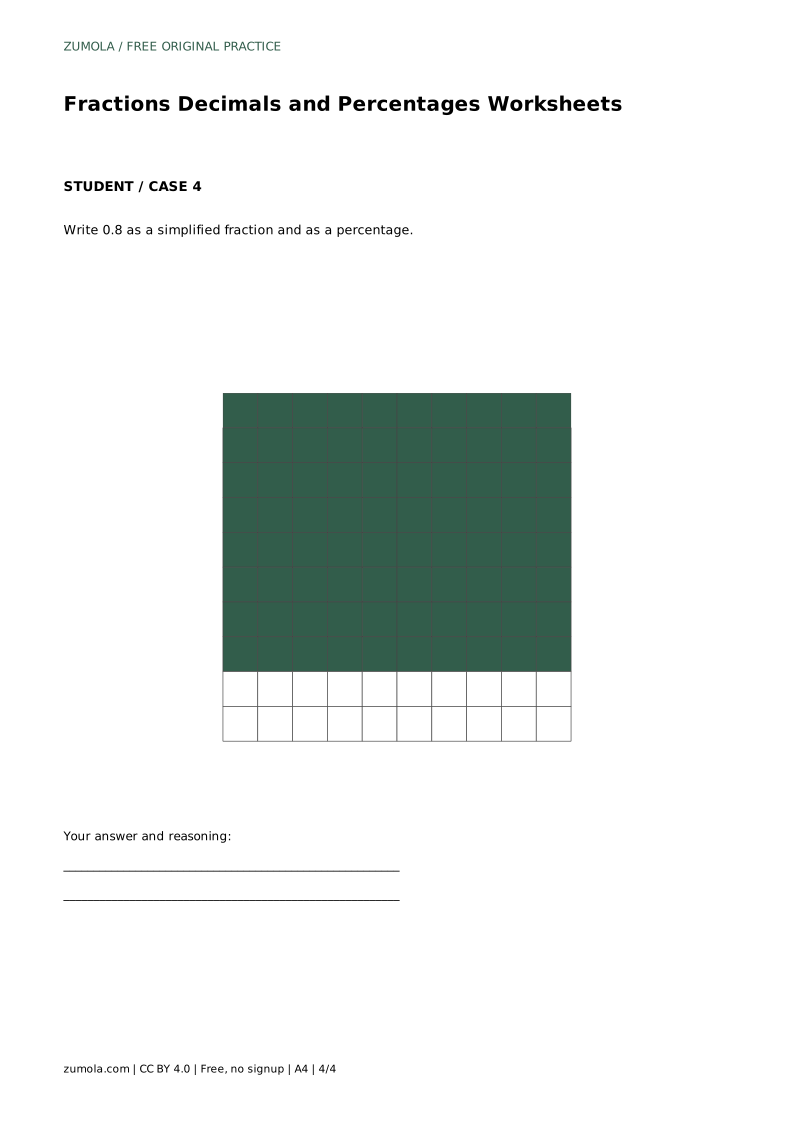
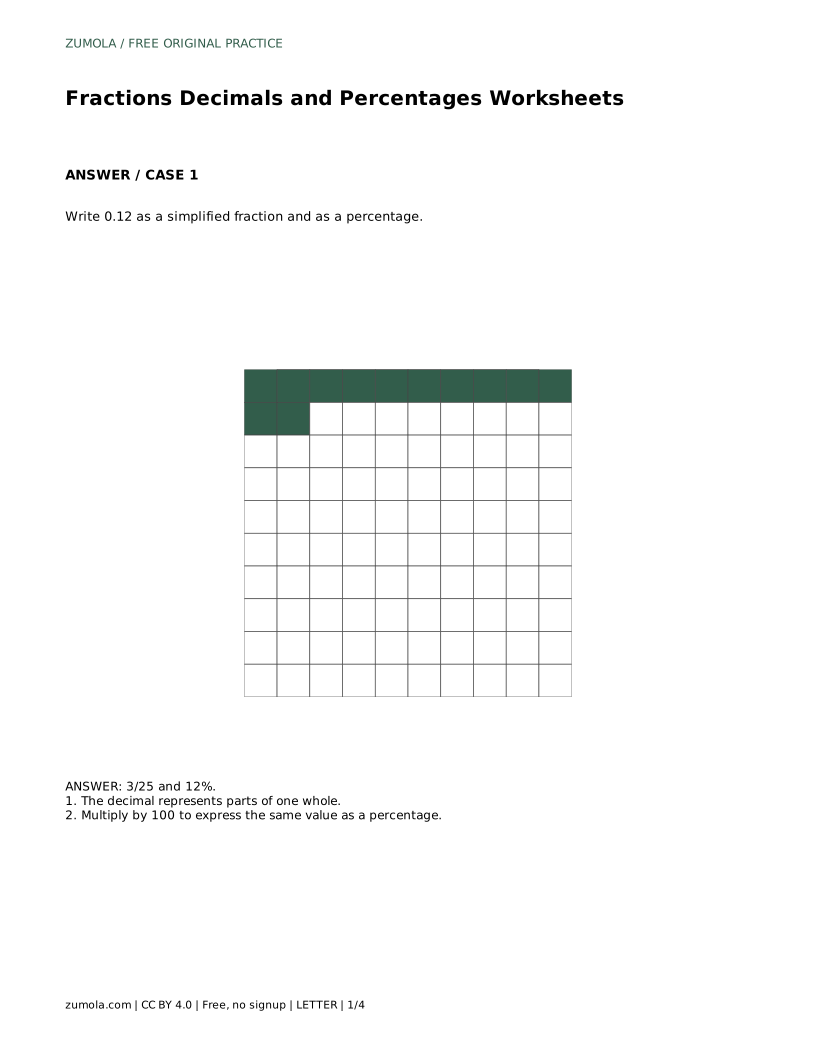
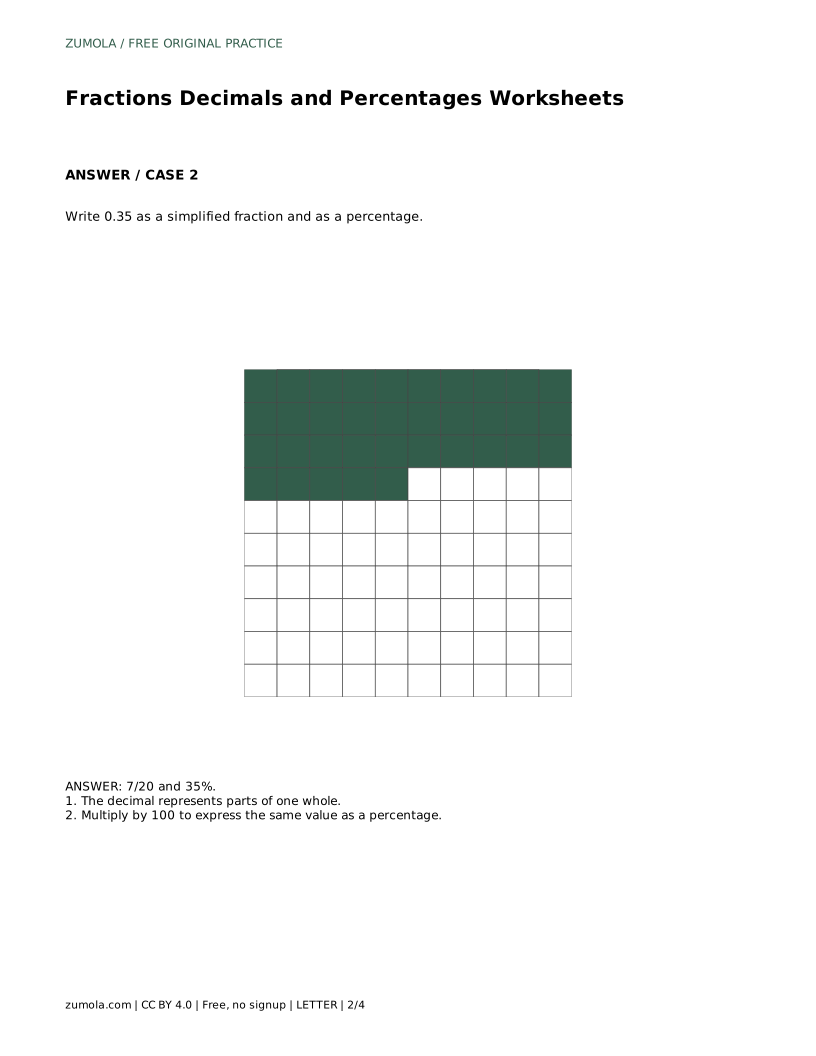
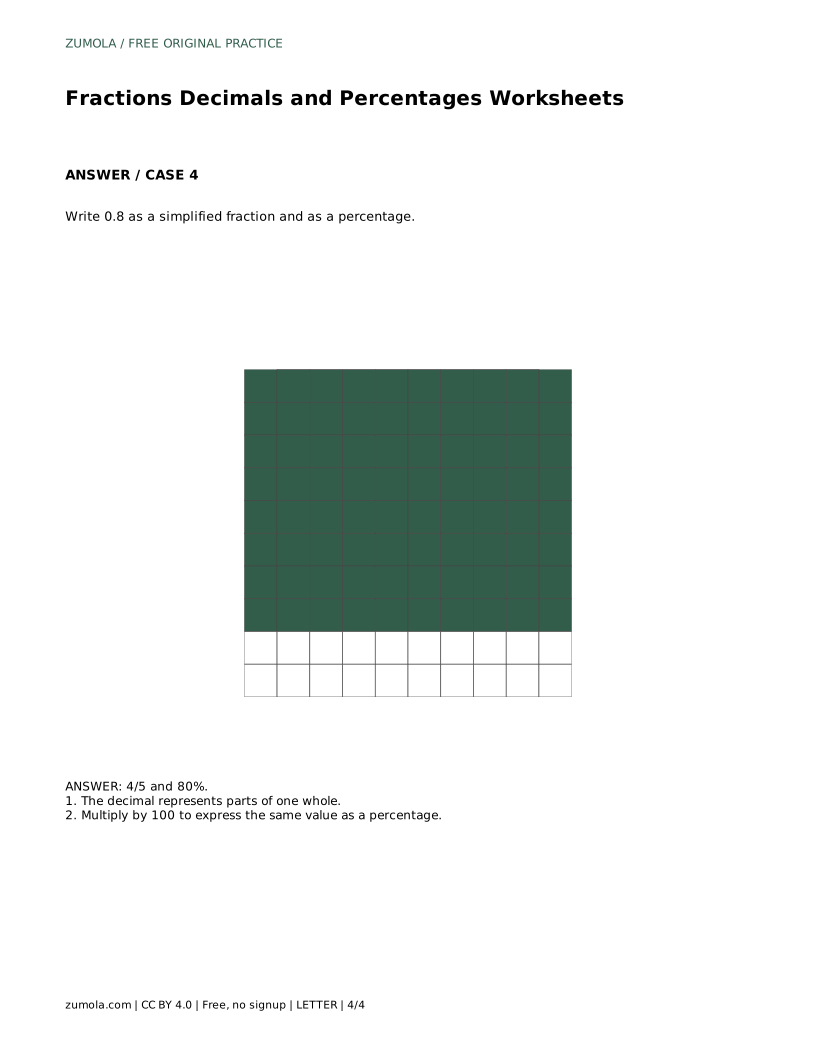
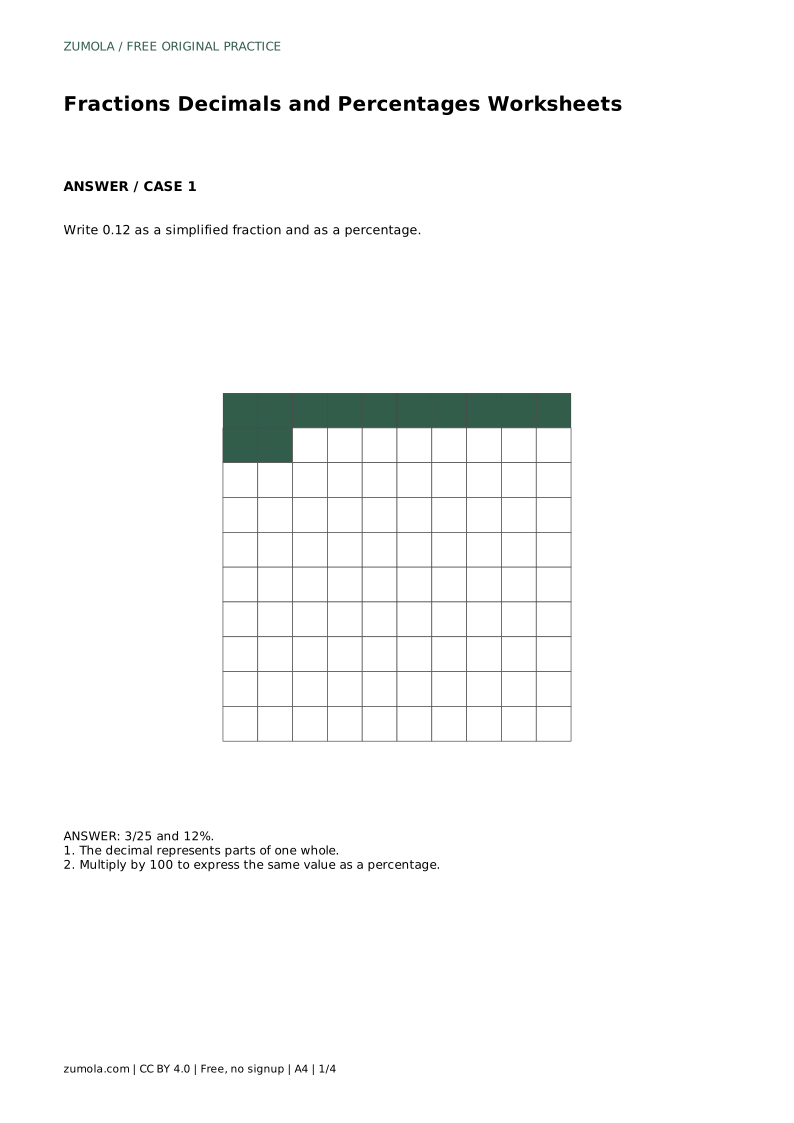
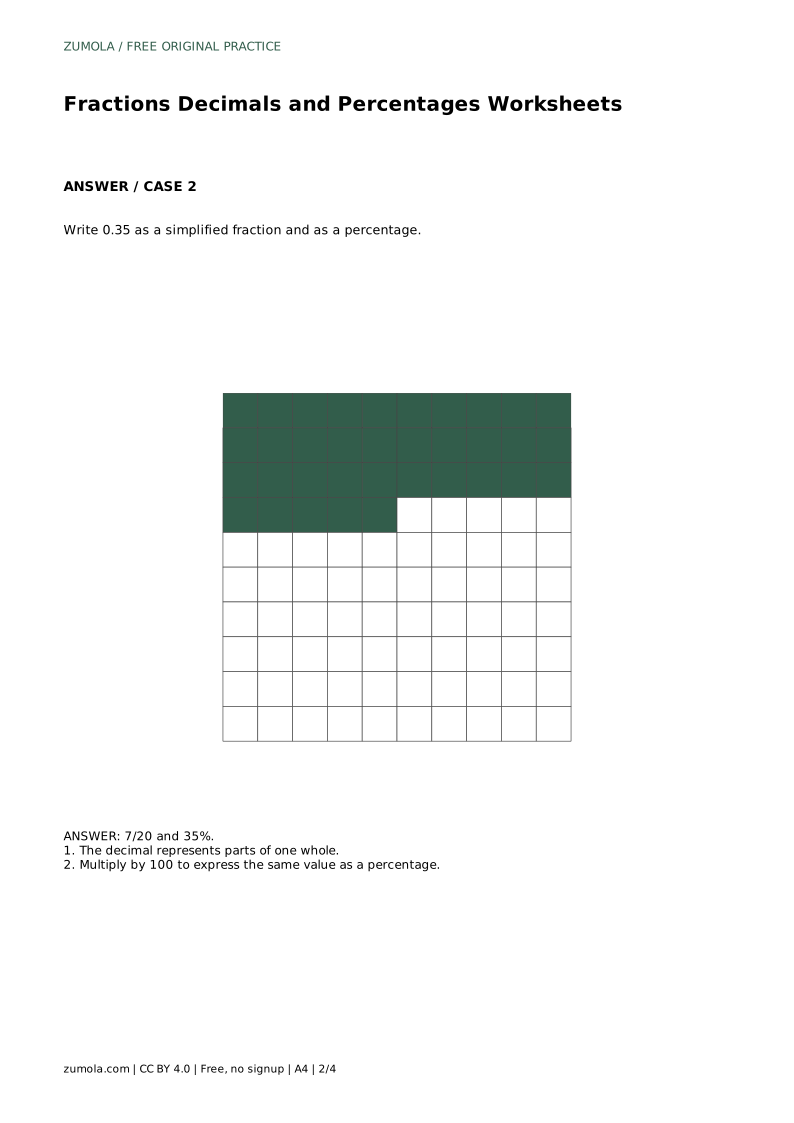
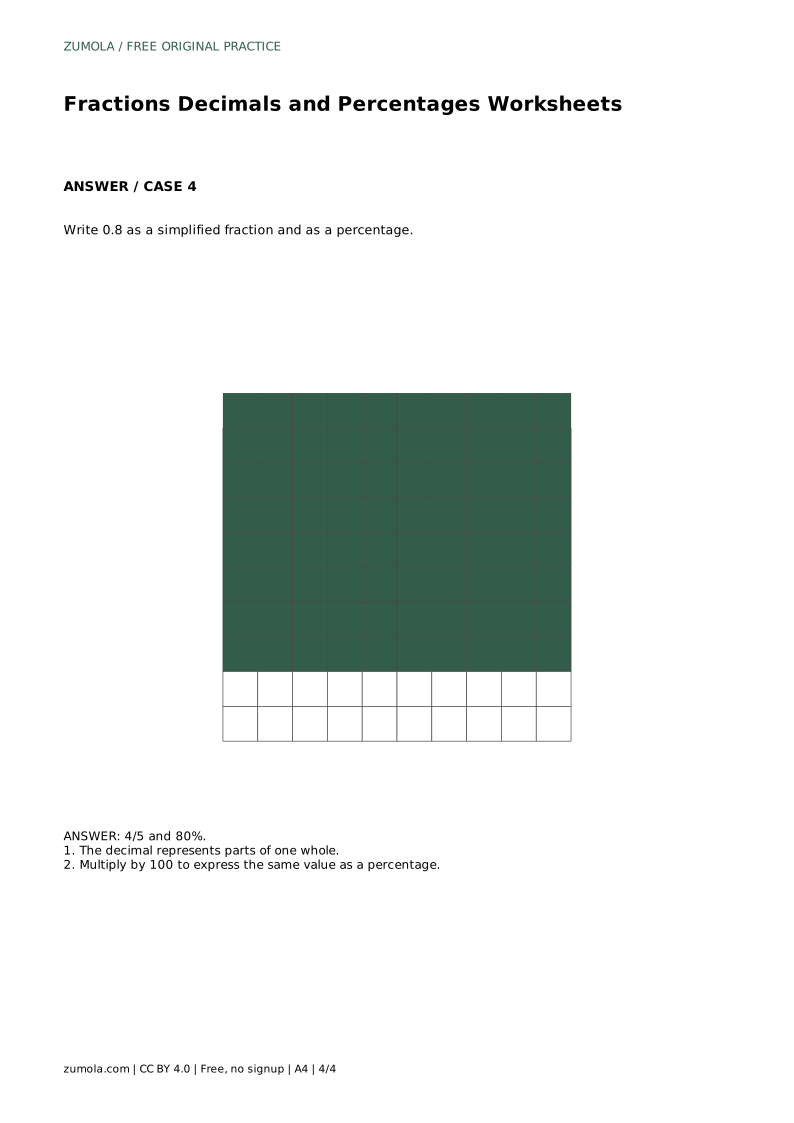
A hundred-square chart shows the same idea visually. If the whole square represents 1, then each small square is 1/100, or 0.01. Filling 12 squares shows 0.12; filling 35 shows 0.35. For 0.8, you would fill 80 of the 100 squares, because 8 tenths equals 80 hundredths. The chart is a check on the value, not a separate method.
Simplifying means dividing the top and bottom of the fraction by the same number until no common factor remains. For 12/100, both numbers divide by 4, giving 3/25. For 35/100, both divide by 5, giving 7/20. For 45/100, both divide by 5, giving 9/20. For 8/10, both divide by 2, giving 4/5. Check that the simplified fraction still equals the original decimal by dividing the numerator by the denominator.
To convert to a percentage, multiply the decimal by 100 and attach the percent sign. Multiplying by 100 shifts the decimal point two places to the right: 0.12 becomes 12, so the percentage is 12%. The same value can be checked from the fraction: 3/25 multiplied by 100 equals 12. Percent means per hundred, so 12% is 12 parts out of 100, matching the 12 filled squares.
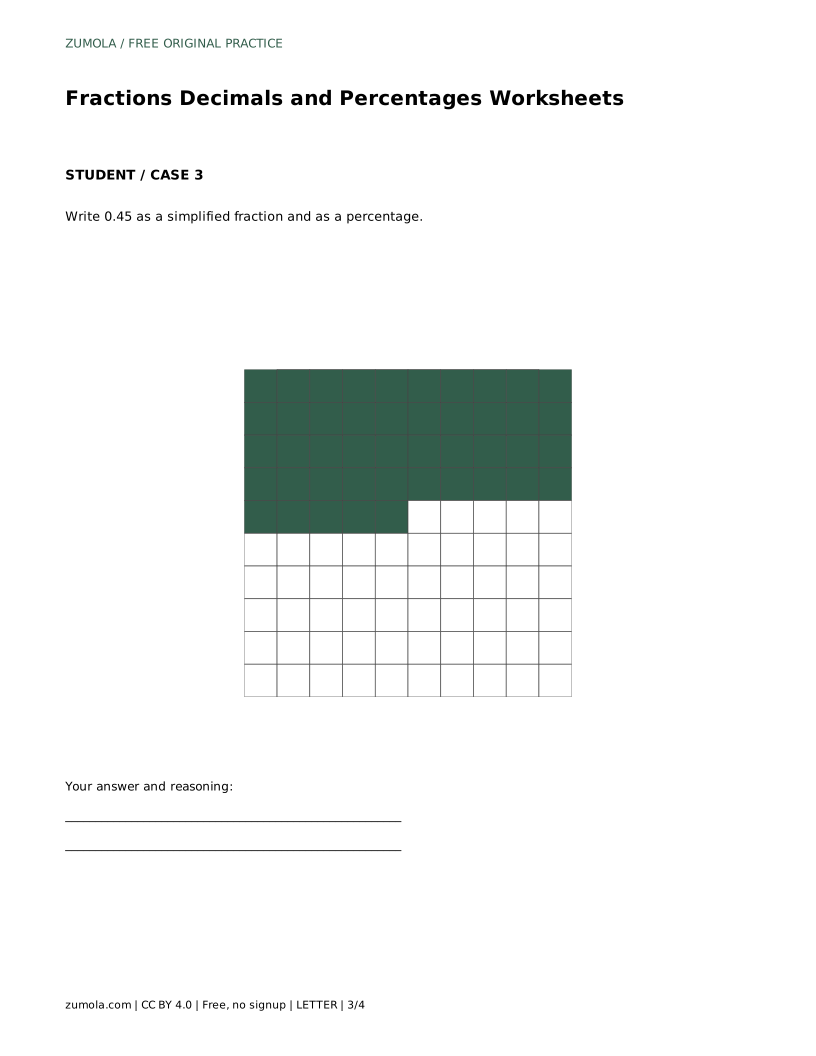
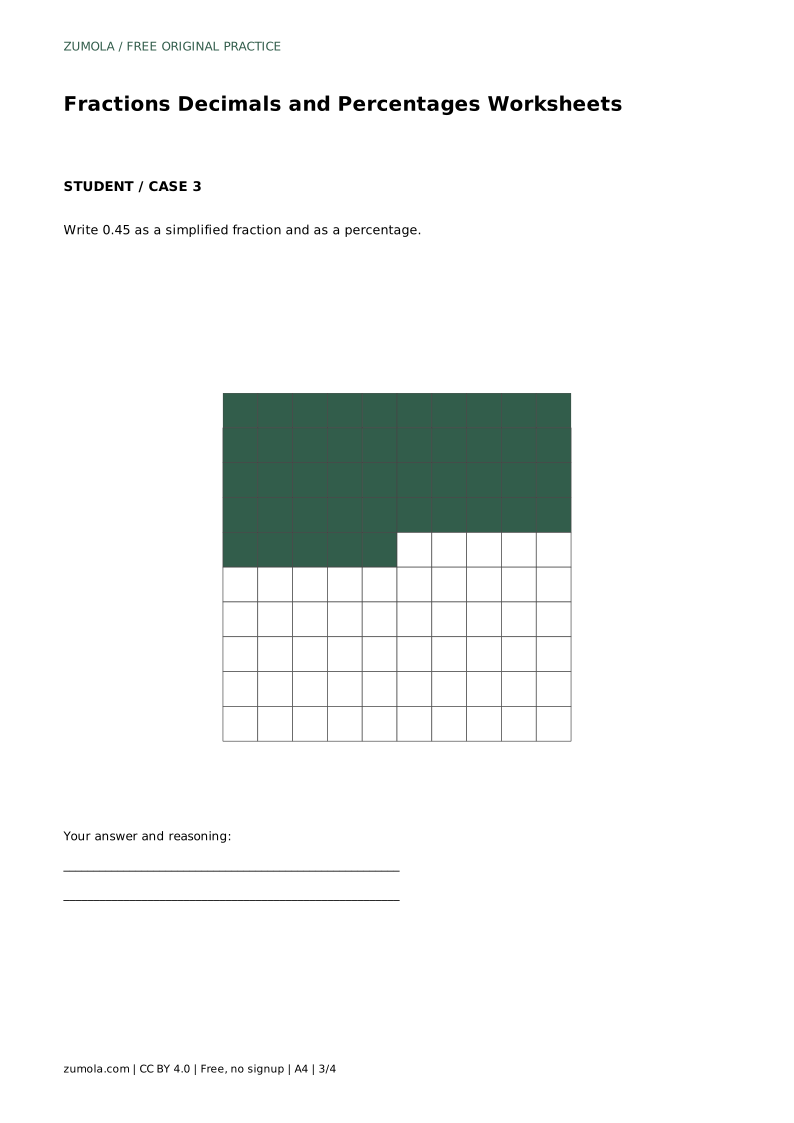
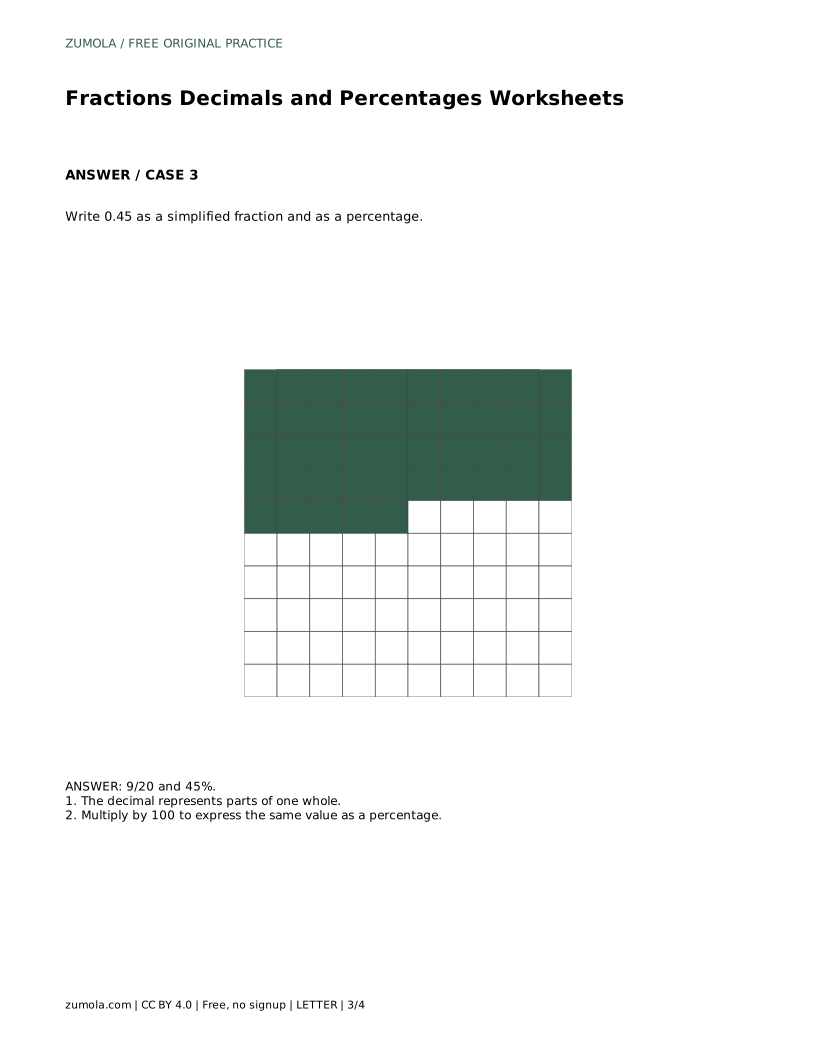
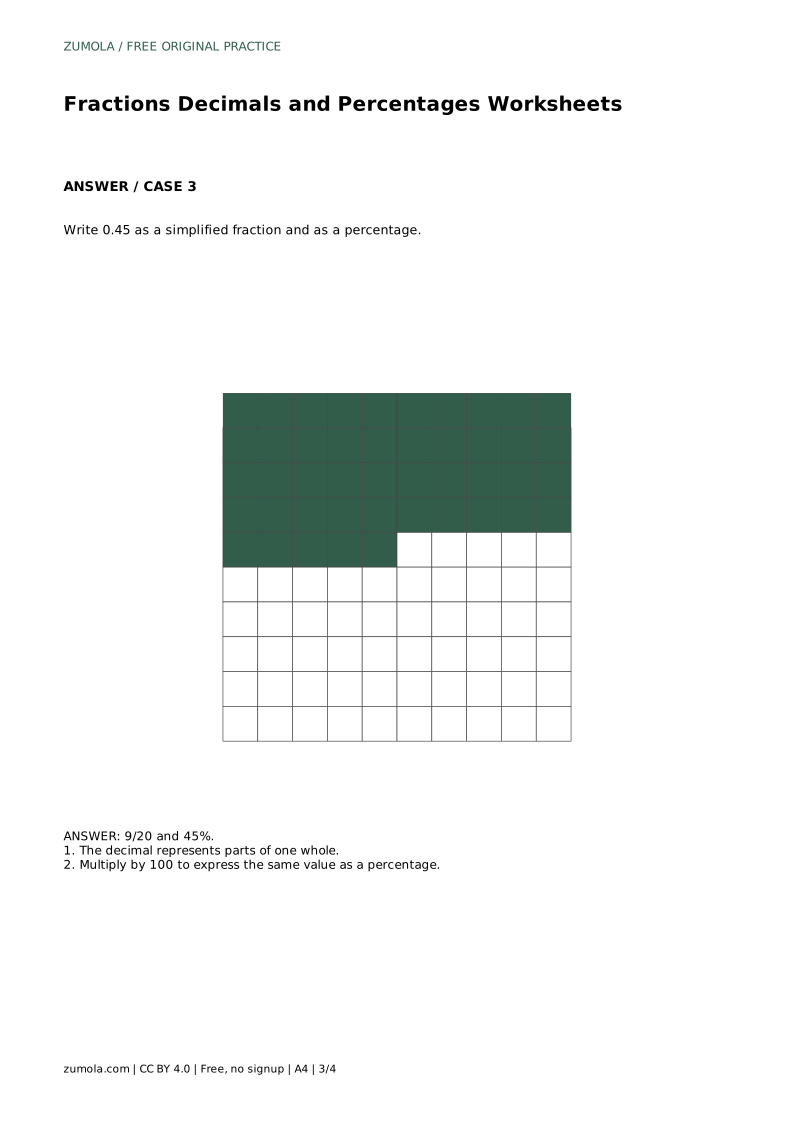
A hundred-square chart is useful because percentages are already counted in hundredths. If a decimal converts to a percentage, the number of filled squares should equal the percentage number. For 0.45, fill 45 squares; the simplified fraction is 9/20 and the percentage is 45%. For 0.8, fill 80 squares; the simplified fraction is 4/5 and the percentage is 80%.
The chart does not replace the arithmetic. It catches mismatches, such as writing 0.8 as 8% instead of 80%. When the chart and the calculation disagree, recheck the place value and the multiplication by 100 before changing either answer.
Write 0.12 as a simplified fraction and as a percentage.
3/25 and 12%. The decimal represents parts of one whole. Multiply by 100 to express the same value as a percentage.
0.12 means 12 hundredths, or 12/100. Dividing both 12 and 100 by 4 gives 3/25, and 3 divided by 25 equals 0.12.
Multiply the decimal by 100 and add the percent sign. For example, 0.35 multiplied by 100 is 35, so the percentage is 35%.
Simplify when the task asks for a simplified fraction. Divide numerator and denominator by their greatest common factor, then check the value by dividing the numerator by the denominator.
All math worksheets · Free coordinate paper
Original resources · CC BY 4.0 · Free for personal and classroom use with attribution.