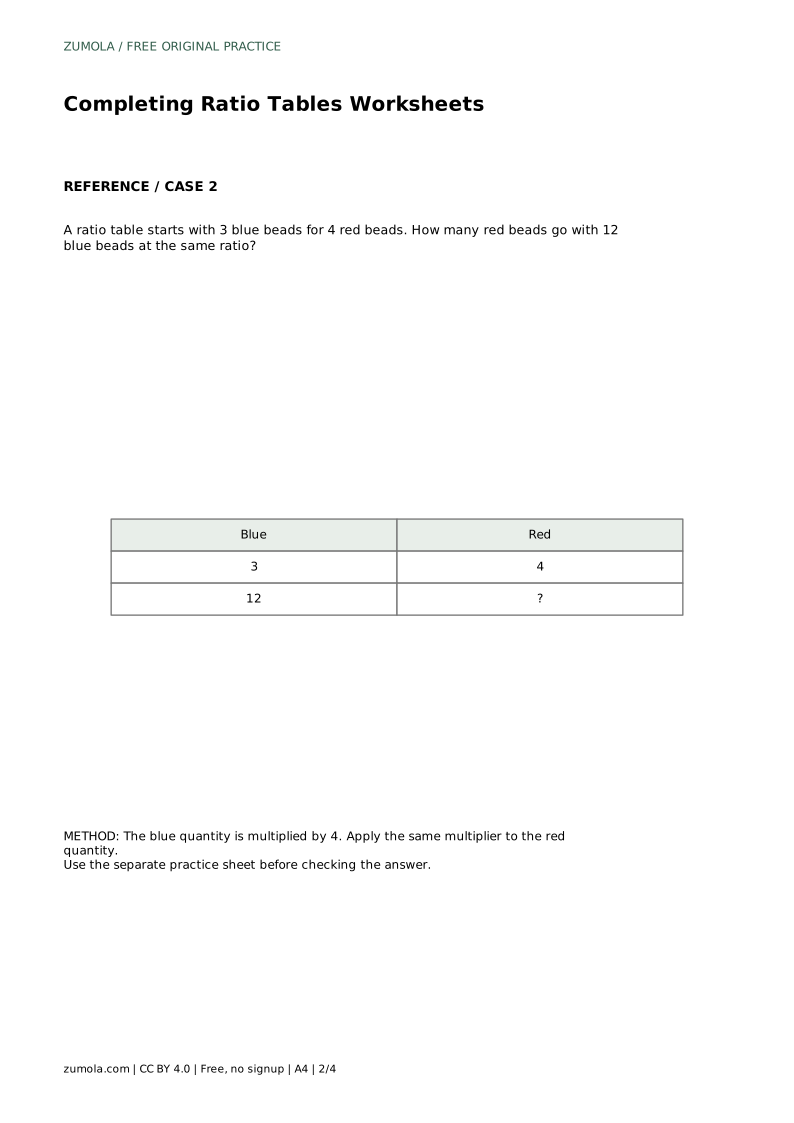
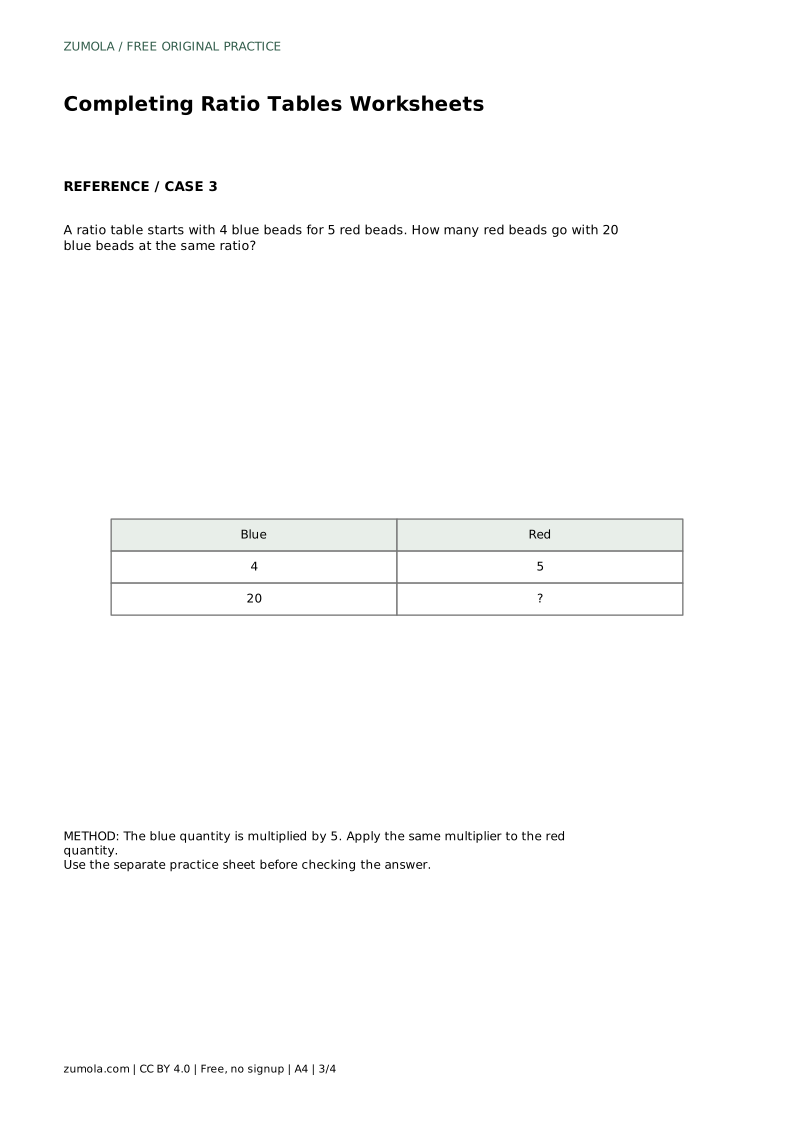
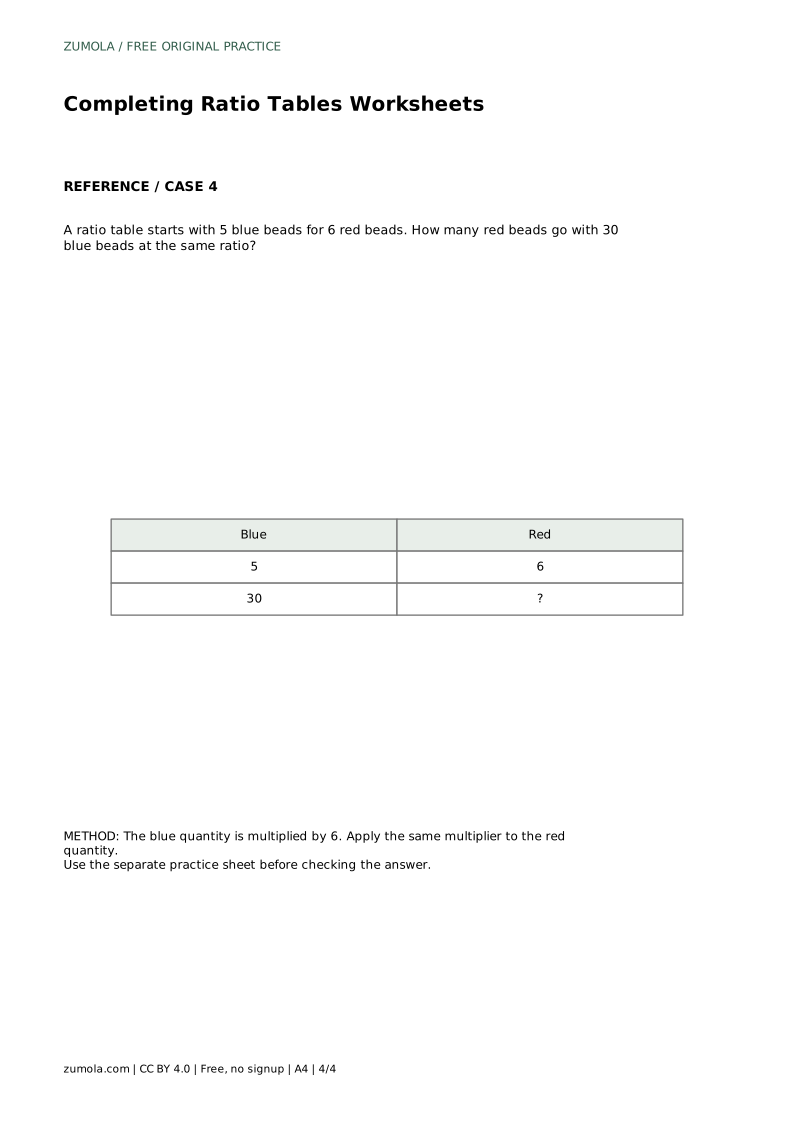
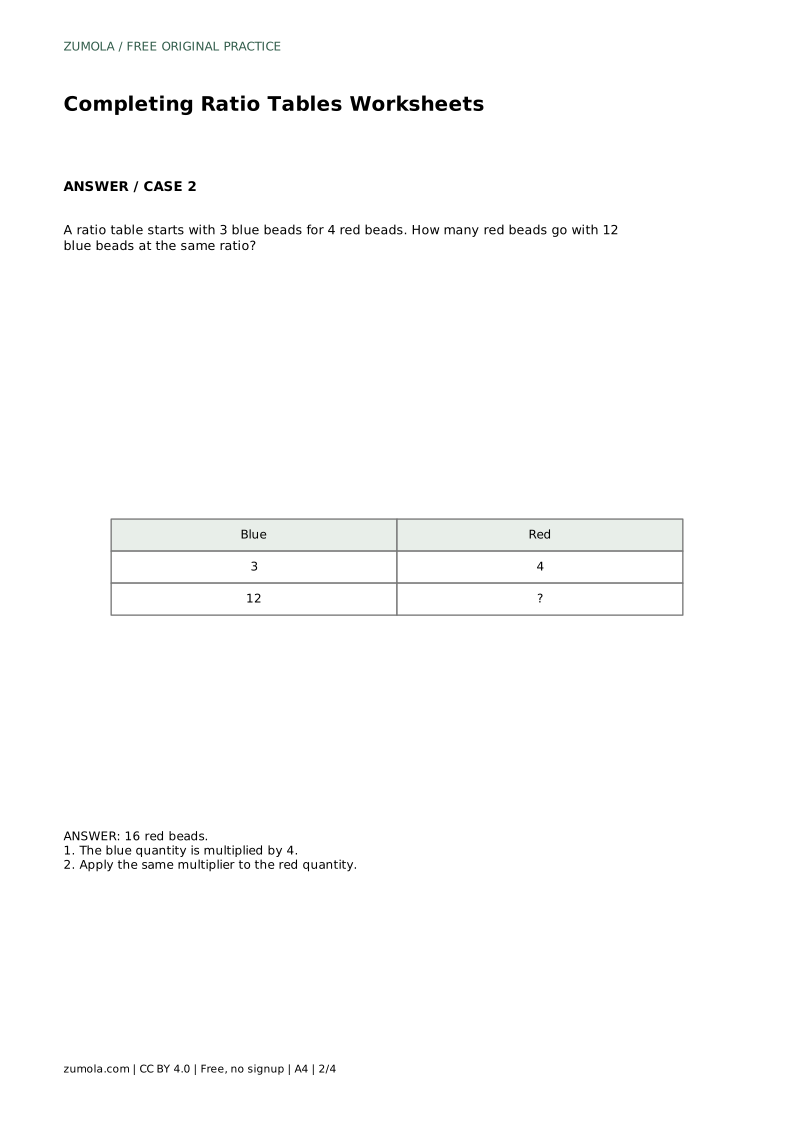
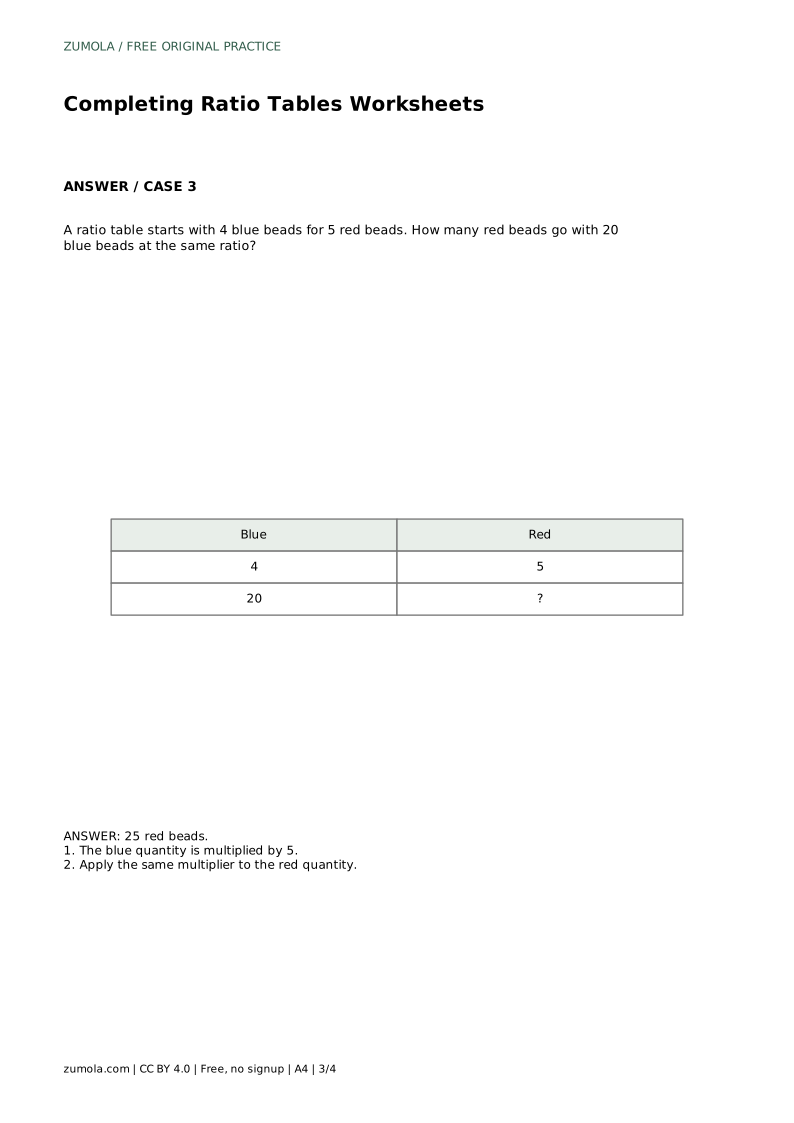
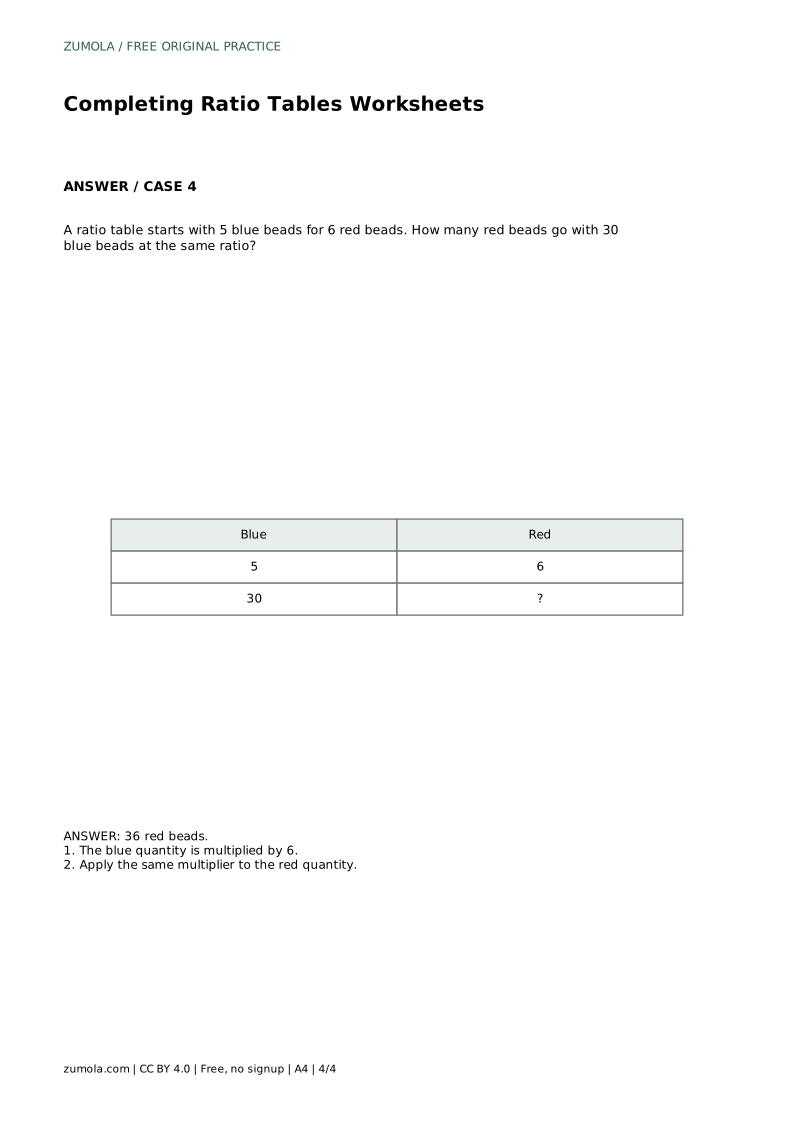
Reference diagrams
LETTER · Download PDF
A4 · Download PDF
Free original resources
Learn to complete ratio tables by finding the multiplier on one quantity and applying it to the other. Includes a worked example, common mistakes, and a marking rubric.
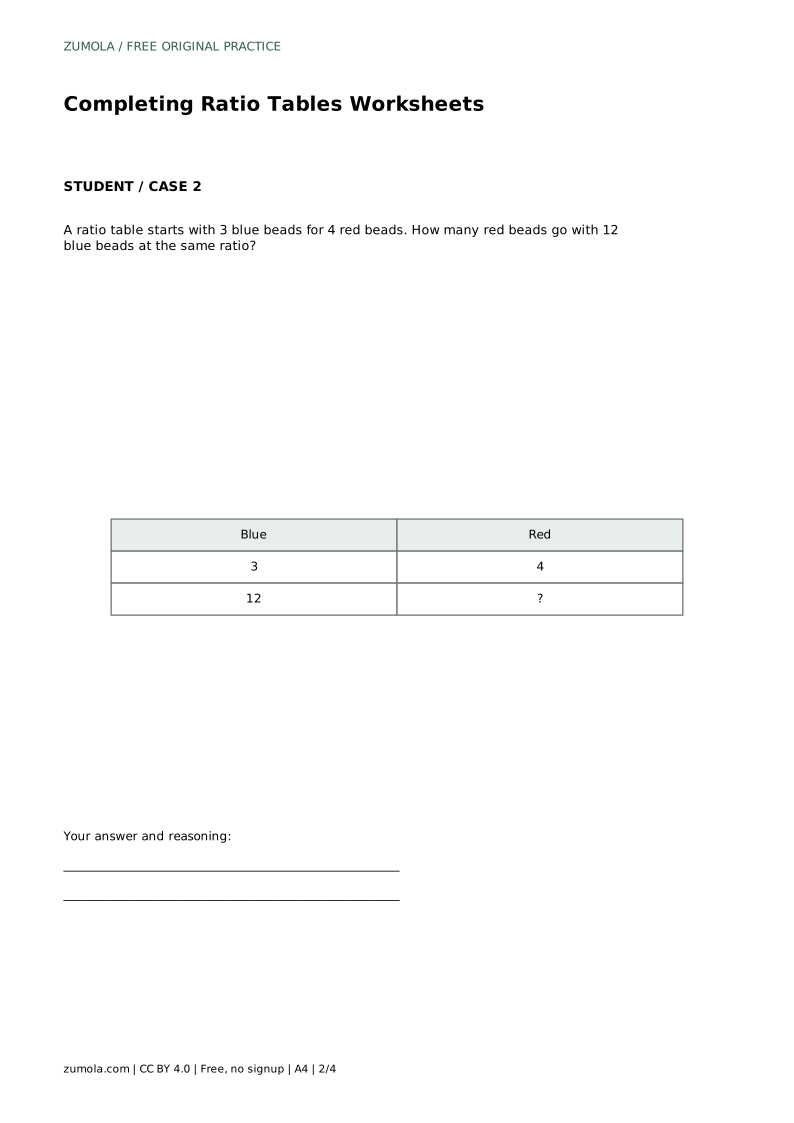
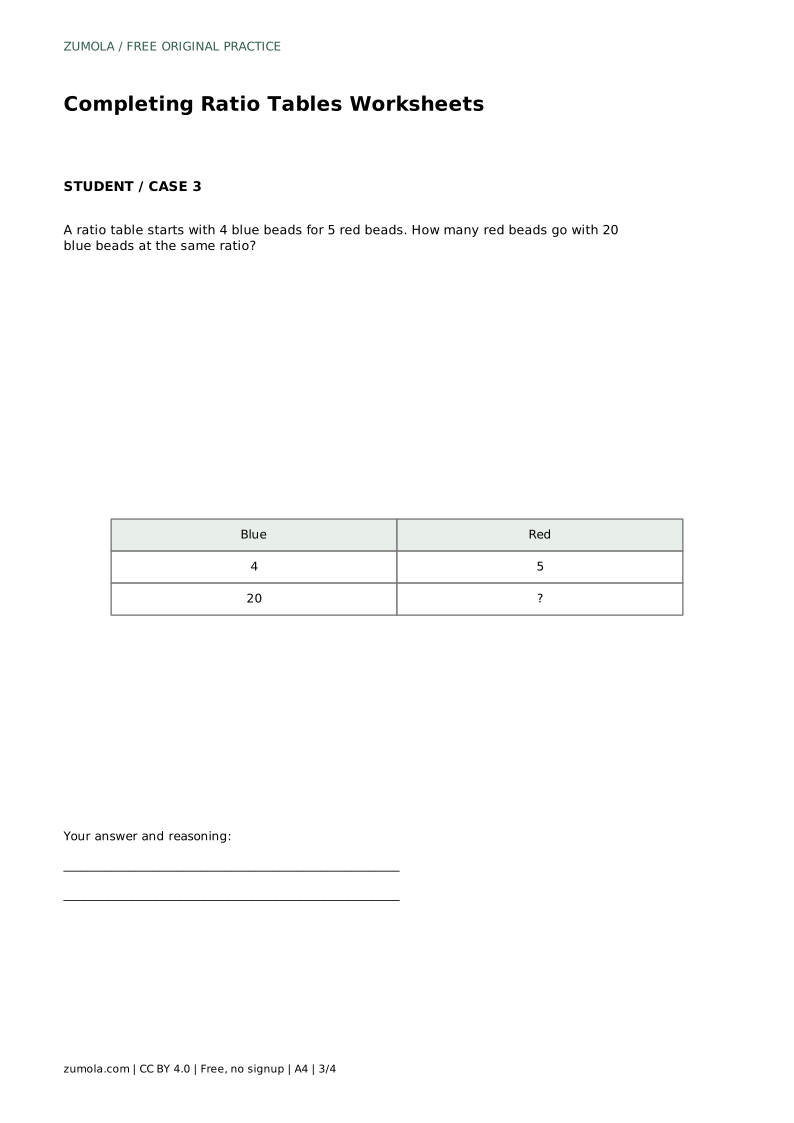
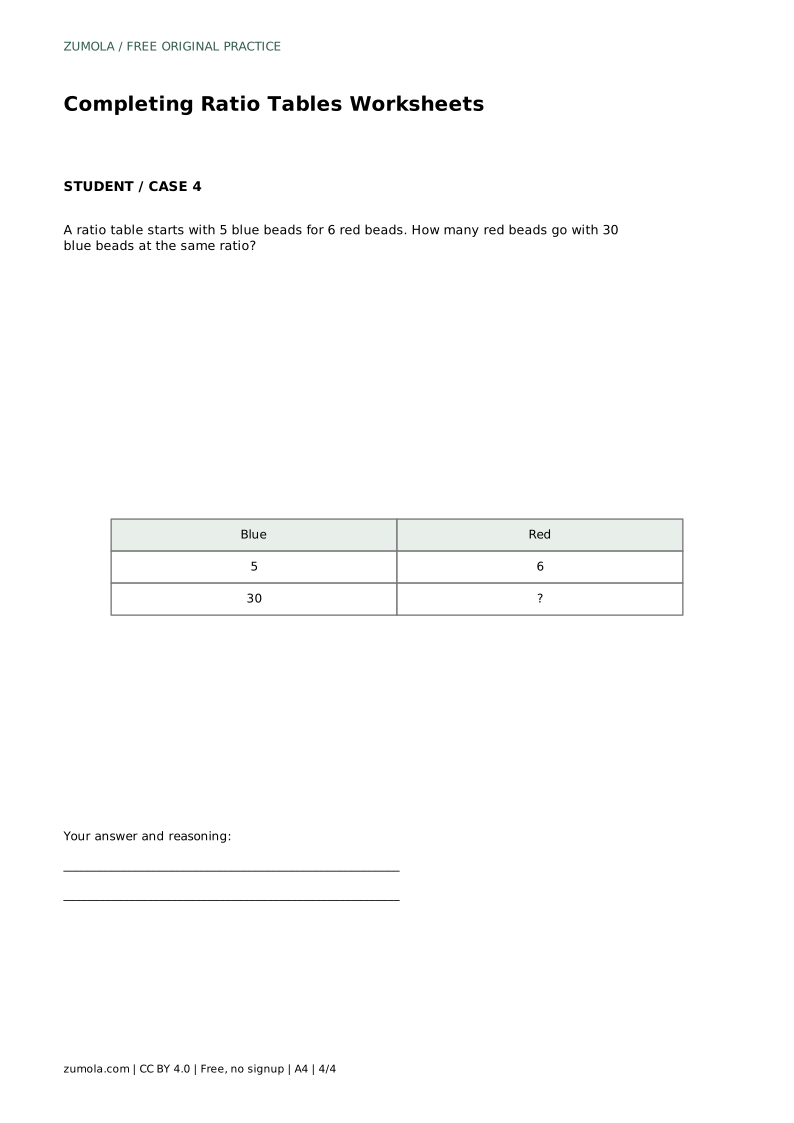
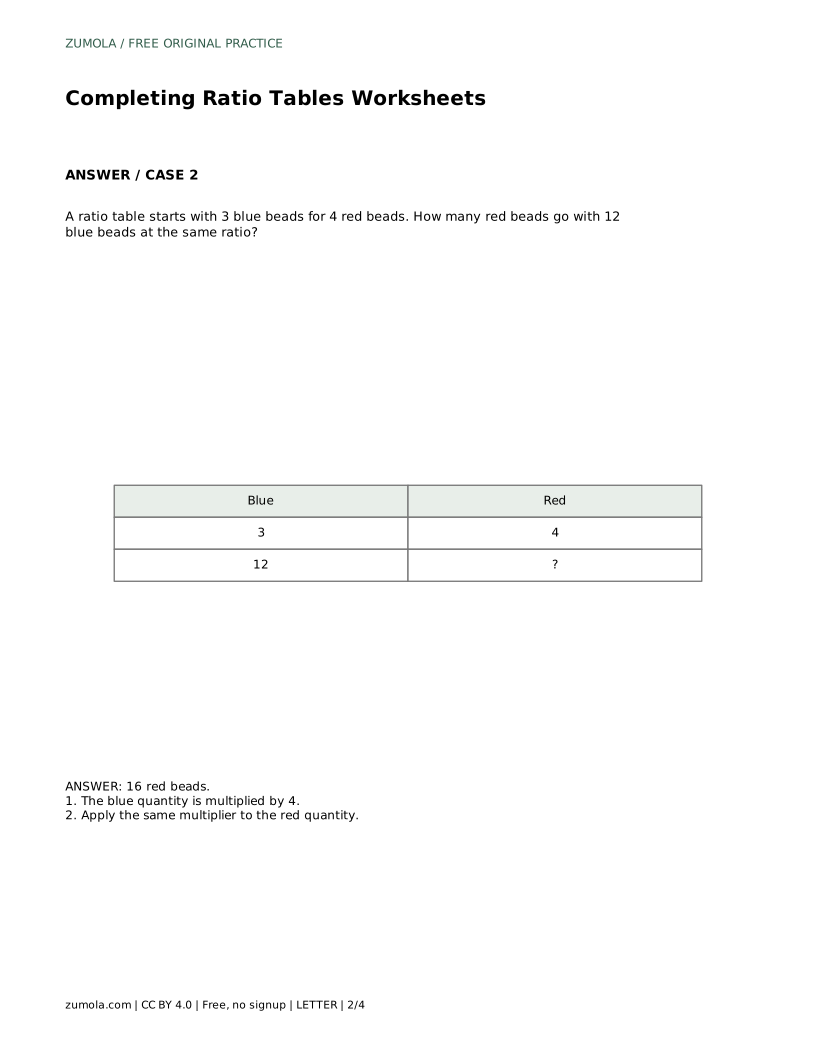
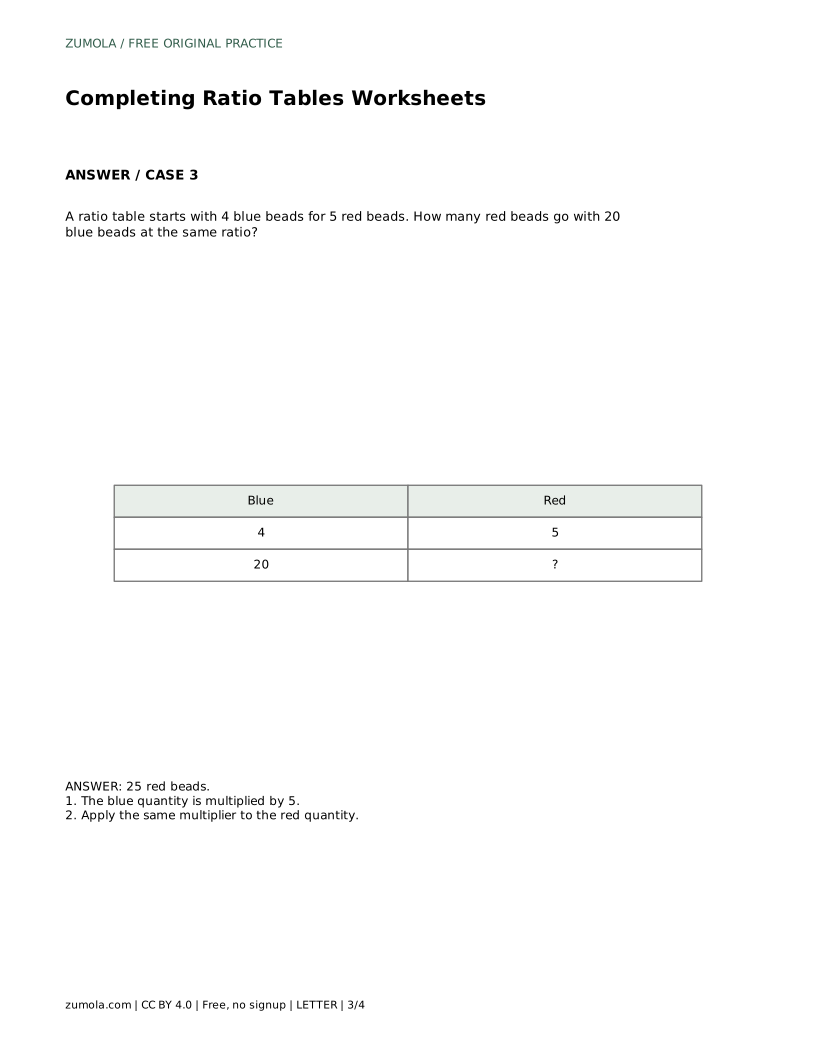
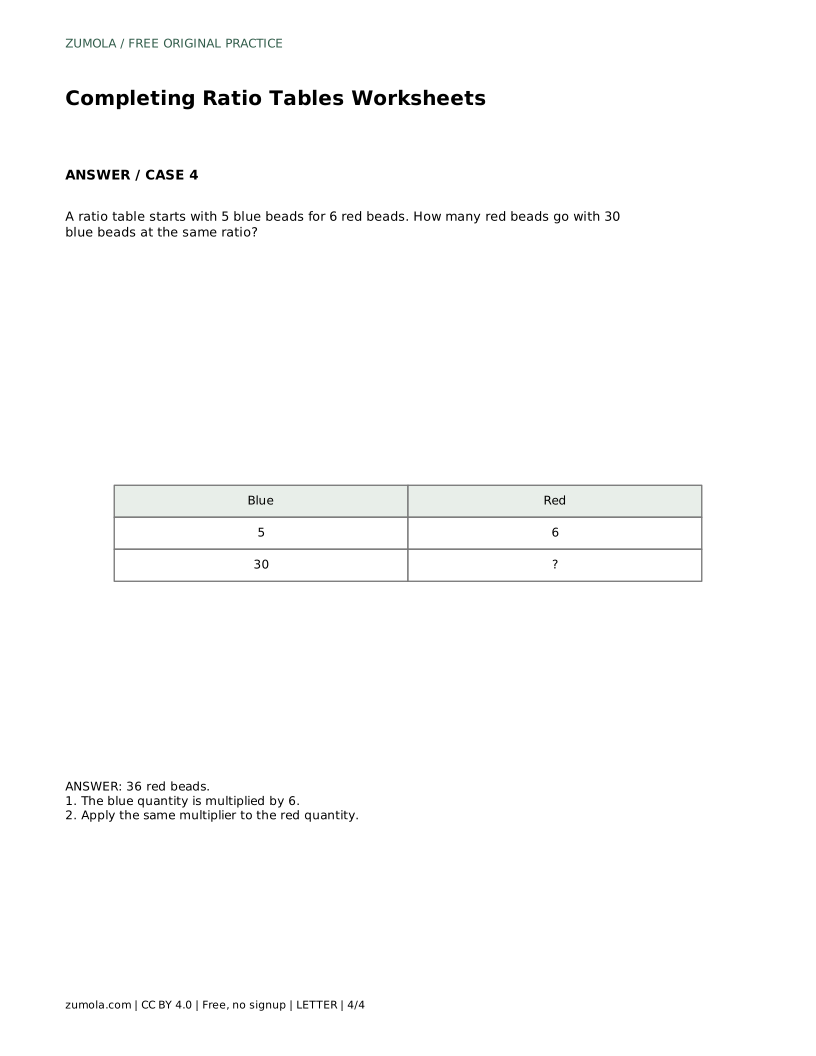
Four original cases, with reference diagrams, practice sheets and worked answers. Everything is free; no signup required.
LETTER · Download PDF
A4 · Download PDF
LETTER · Download PDF
A4 · Download PDF
LETTER · Download PDF
A4 · Download PDF
Use A4 or US Letter to match your printer. Use the stated values and conditions to solve each exercise; diagrams are not physical measuring rulers.
A ratio table keeps two quantities in the same relationship across rows. When one row is complete and another row shows one known quantity, you can find the missing value by scaling. This page teaches that single skill: identify the multiplier applied to the known quantity, then apply the same multiplier to its partner. The method works for bead counts, recipes, and any paired quantities, provided the ratio stays constant.
A ratio table lists paired quantities in columns. Each row is a matched pair, and every row must represent the same ratio. If the first row is 2 blue beads to 3 red beads, then any other row must keep that same 2-to-3 relationship.
The key idea is that both quantities in a row are scaled by the same multiplier. If blue goes from 2 to 6, blue was multiplied by 3. Red must also be multiplied by 3, so red goes from 3 to 9. You are not adding the same amount to each column; you are multiplying each column by the same factor.
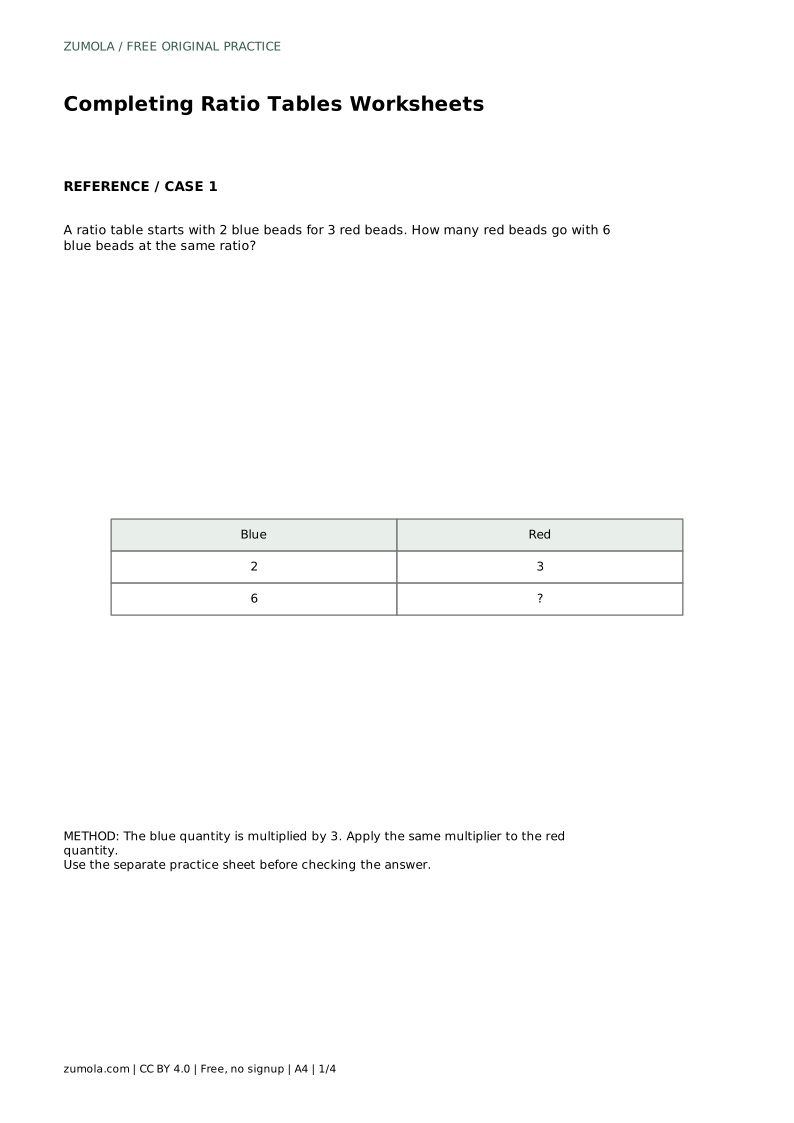
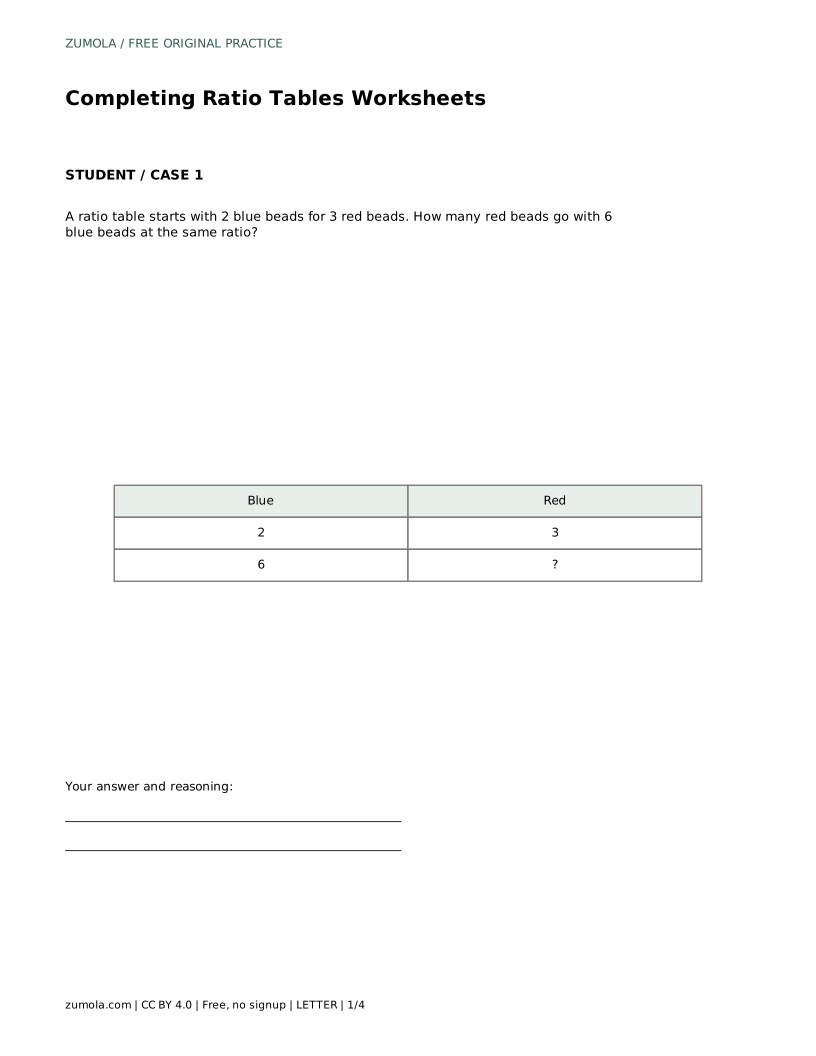
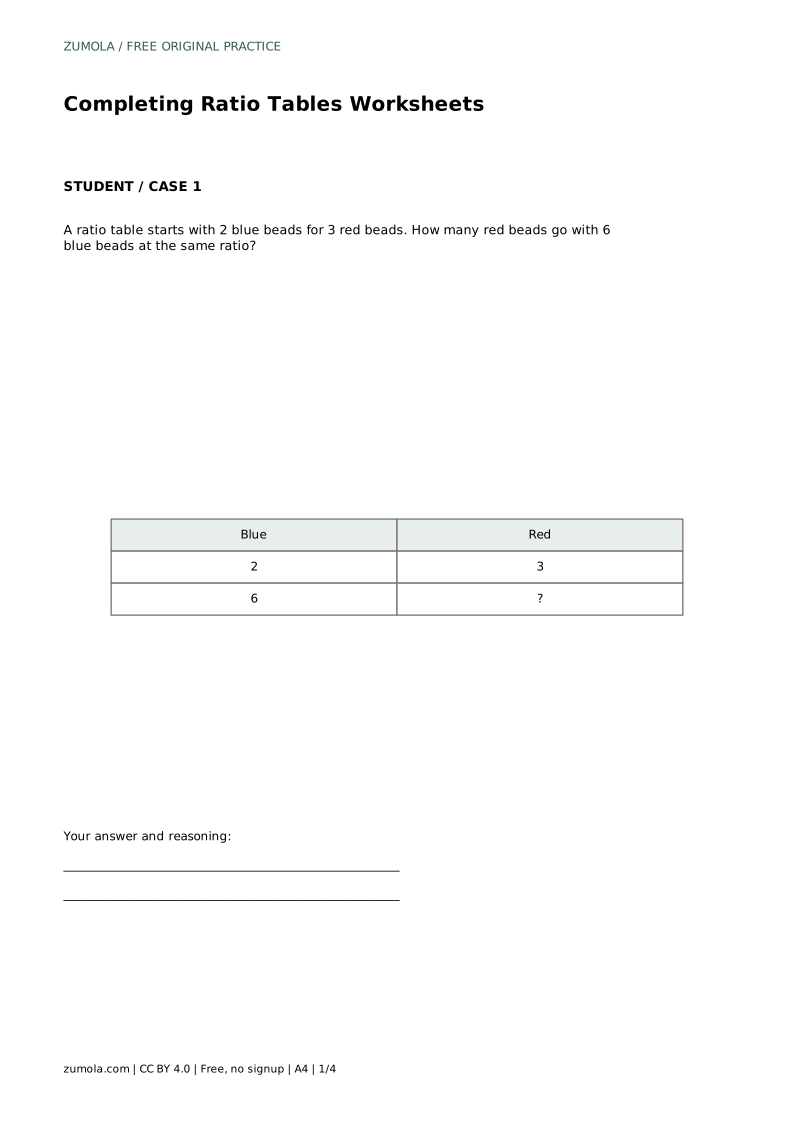
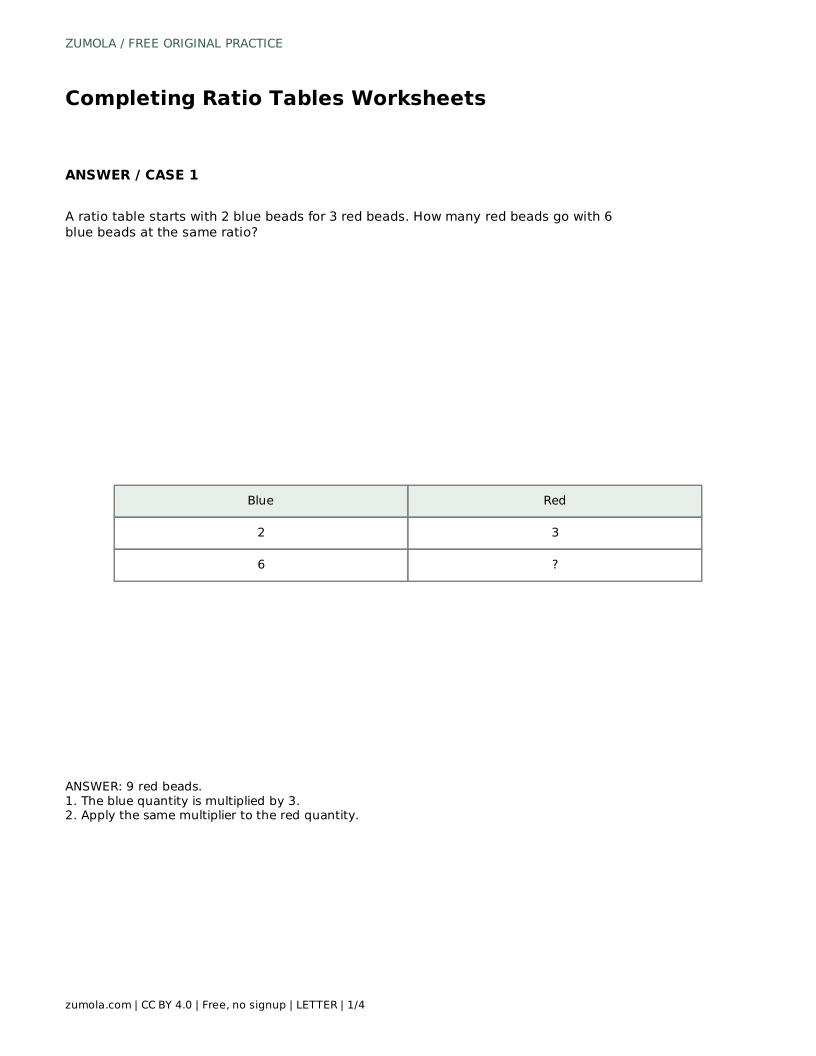
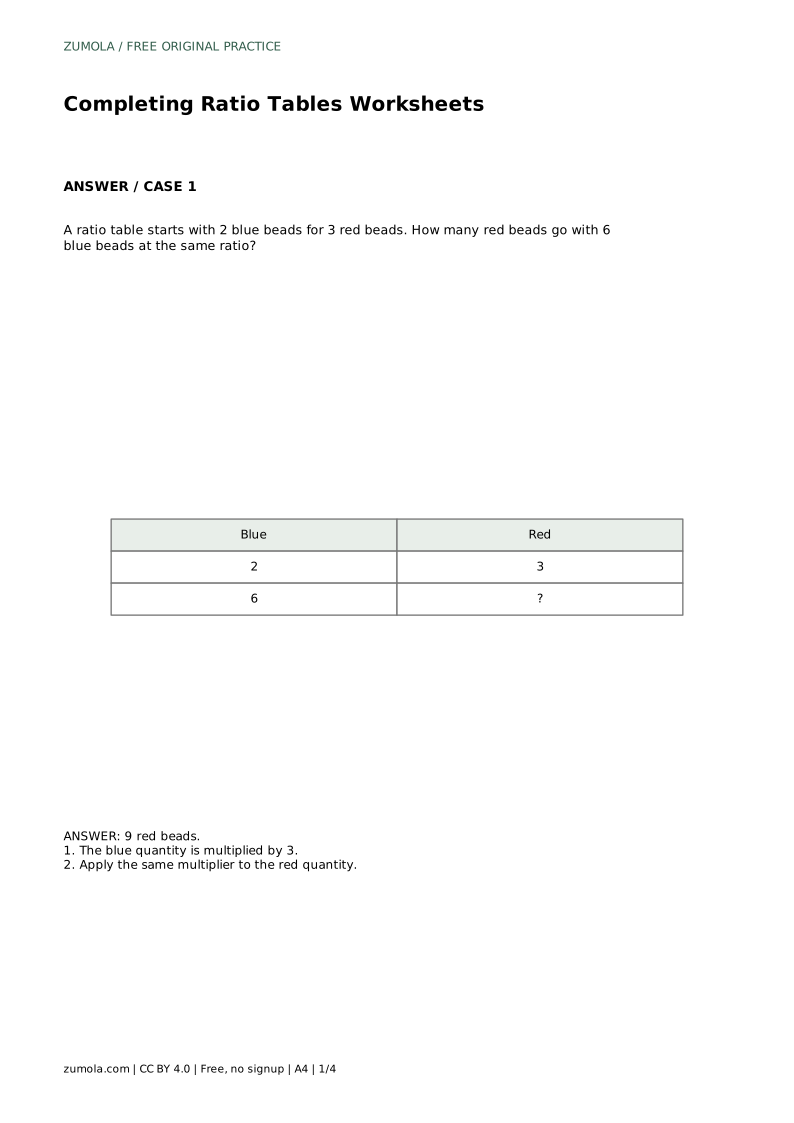
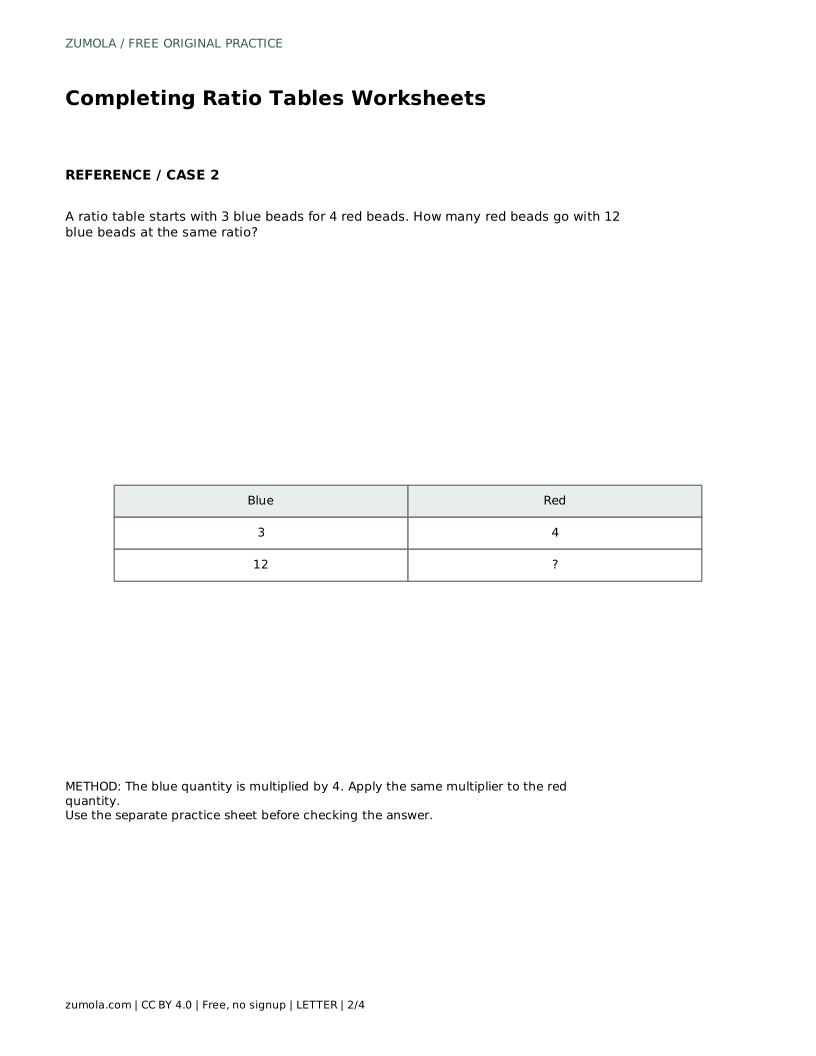
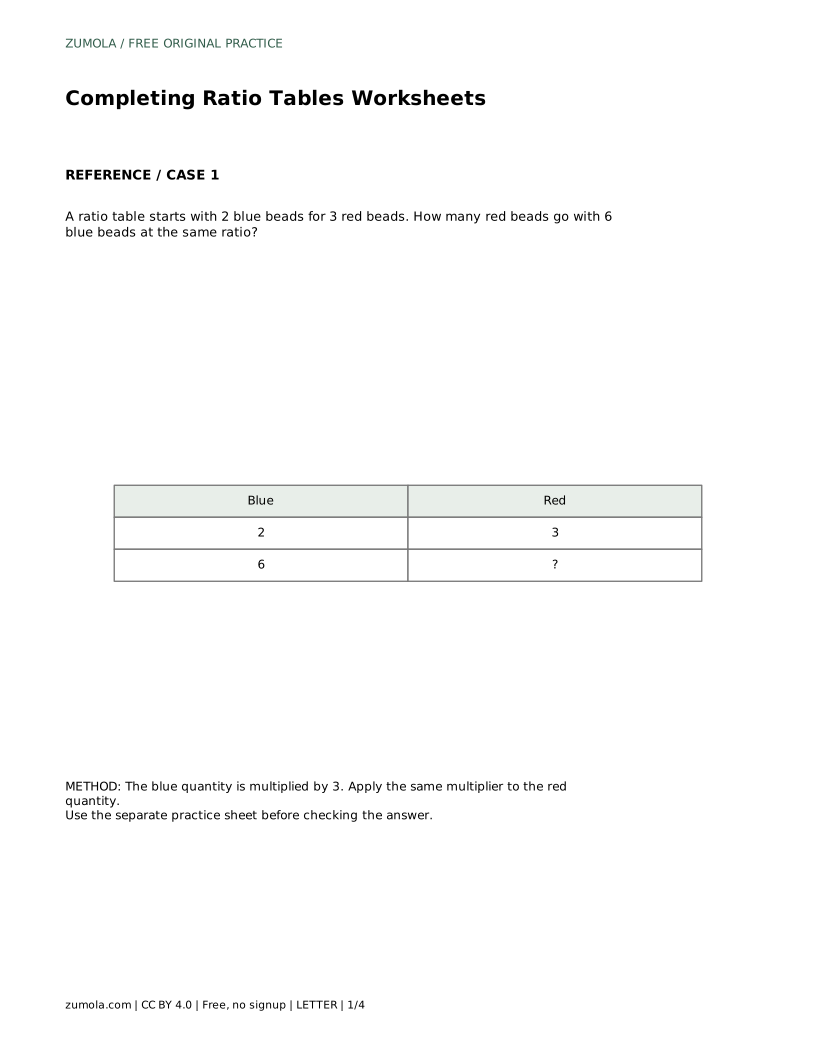
Start with the table showing 2 blue beads and 3 red beads in the first row, and 6 blue beads with a missing red count in the second row. The blue quantity changed from 2 to 6. Since 2 times 3 equals 6, the multiplier is 3.
Apply that multiplier to red: 3 times 3 equals 9. The missing value is 9 red beads. The completed rows are 2:3 and 6:9, and both simplify to the same ratio, so the table is consistent.
A completed ratio table should pass a simple check. Divide each pair by a common factor and confirm both rows reduce to the same ratio. For 2:3 and 6:9, dividing 6 and 9 by 3 gives 2:3, so the rows match.
You can also cross-multiply: 2 times 9 equals 18, and 3 times 6 equals 18. Equal cross-products confirm the ratio is unchanged. If the products differ, recheck which multiplier you used.
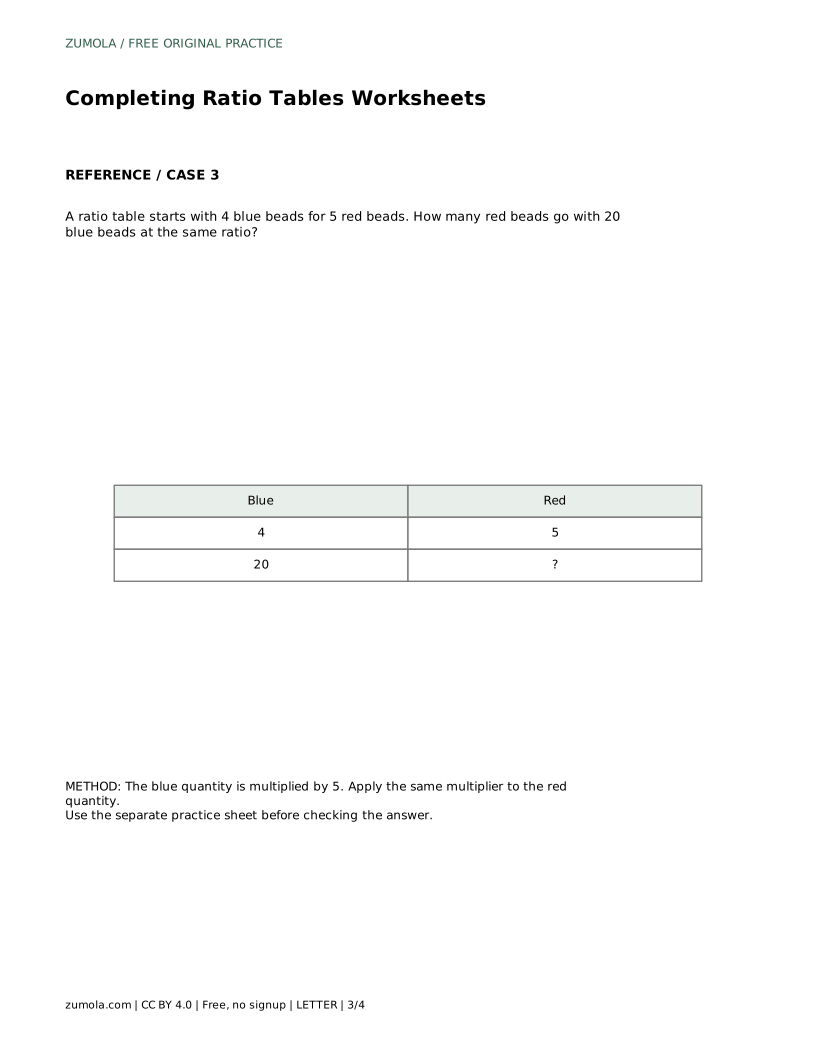
Sometimes the known quantity does not divide evenly. For example, if blue goes from 4 to 10, the multiplier is 2.5. Apply 2.5 to red as well. If red started at 5, the new red value is 12.5, which may not suit a count of physical objects.
In that situation, check whether the problem expects whole-number quantities. If it does, the given numbers may not fit a whole-number scaling, and you should state that the ratio cannot be completed with whole beads. Do not round silently; rounding changes the ratio.
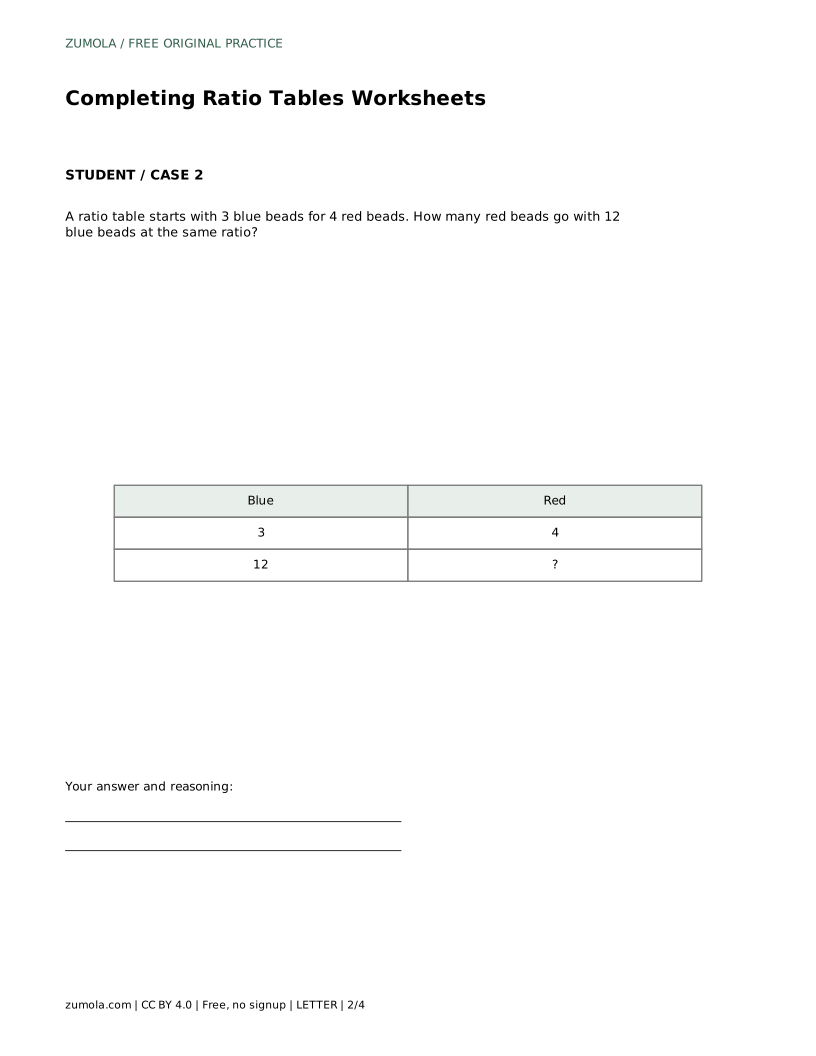
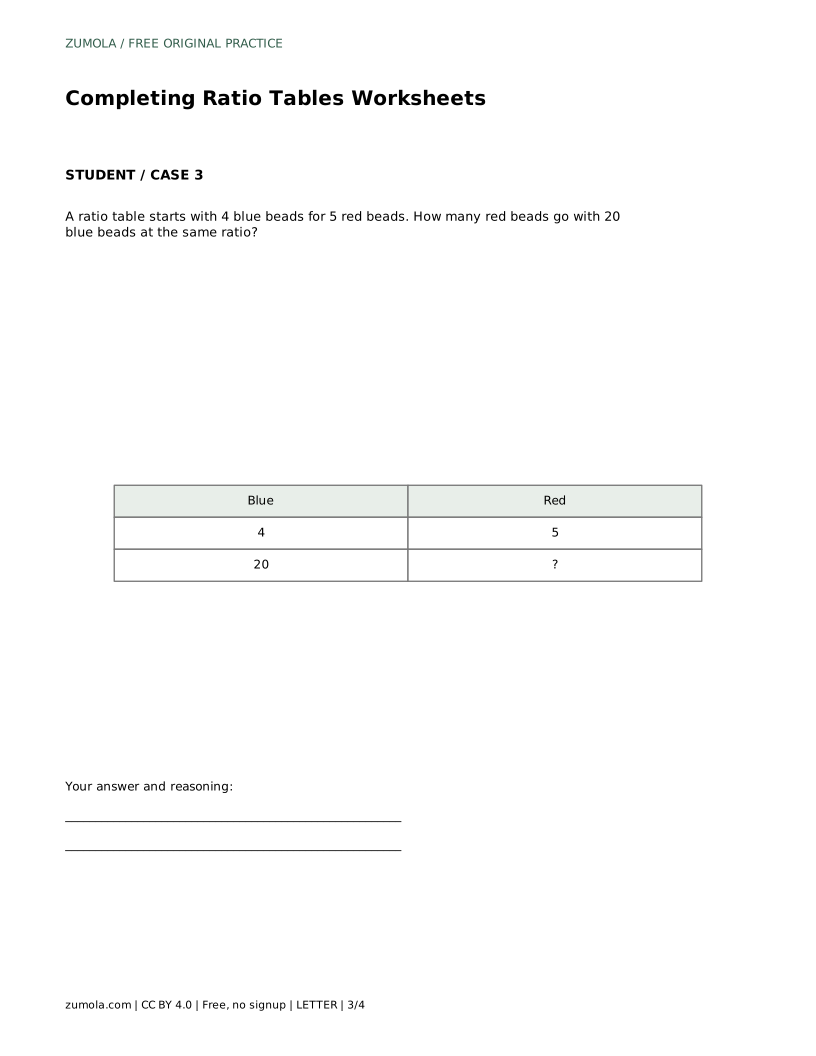
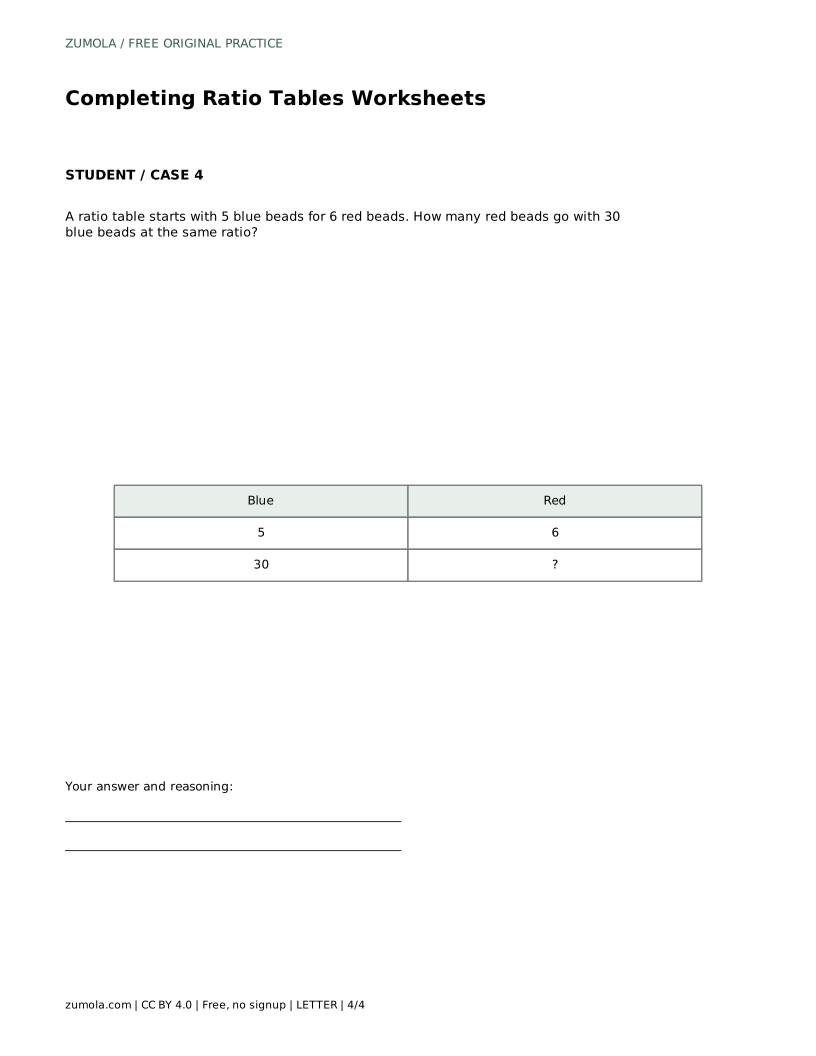
A ratio table starts with 2 blue beads for 3 red beads. How many red beads go with 6 blue beads at the same ratio?
9 red beads. The blue quantity is multiplied by 3. Apply the same multiplier to the red quantity.
It shows pairs of quantities that all share one constant ratio, with each row scaled from the others.
Find the multiplier applied to the known quantity, then multiply its partner by the same multiplier.
Reduce each row to simplest form and confirm they match, or cross-multiply and compare the products.
All math worksheets · Free coordinate paper
Original resources · CC BY 4.0 · Free for personal and classroom use with attribution.