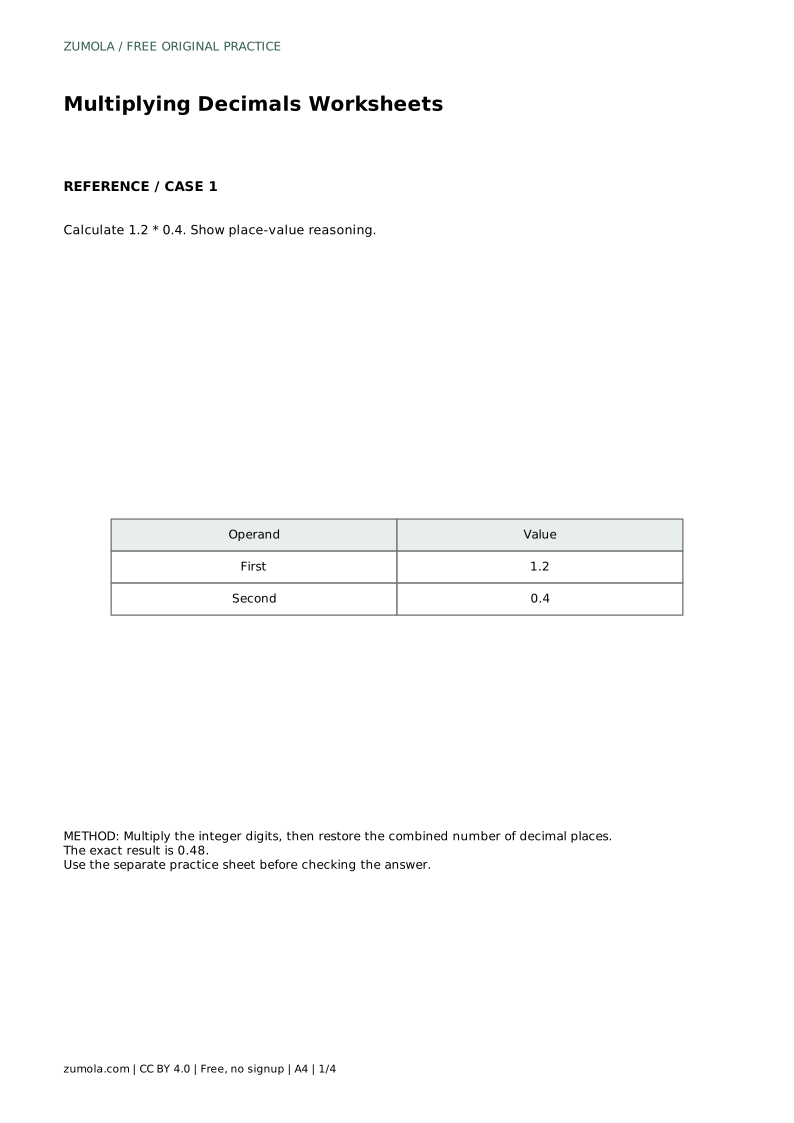
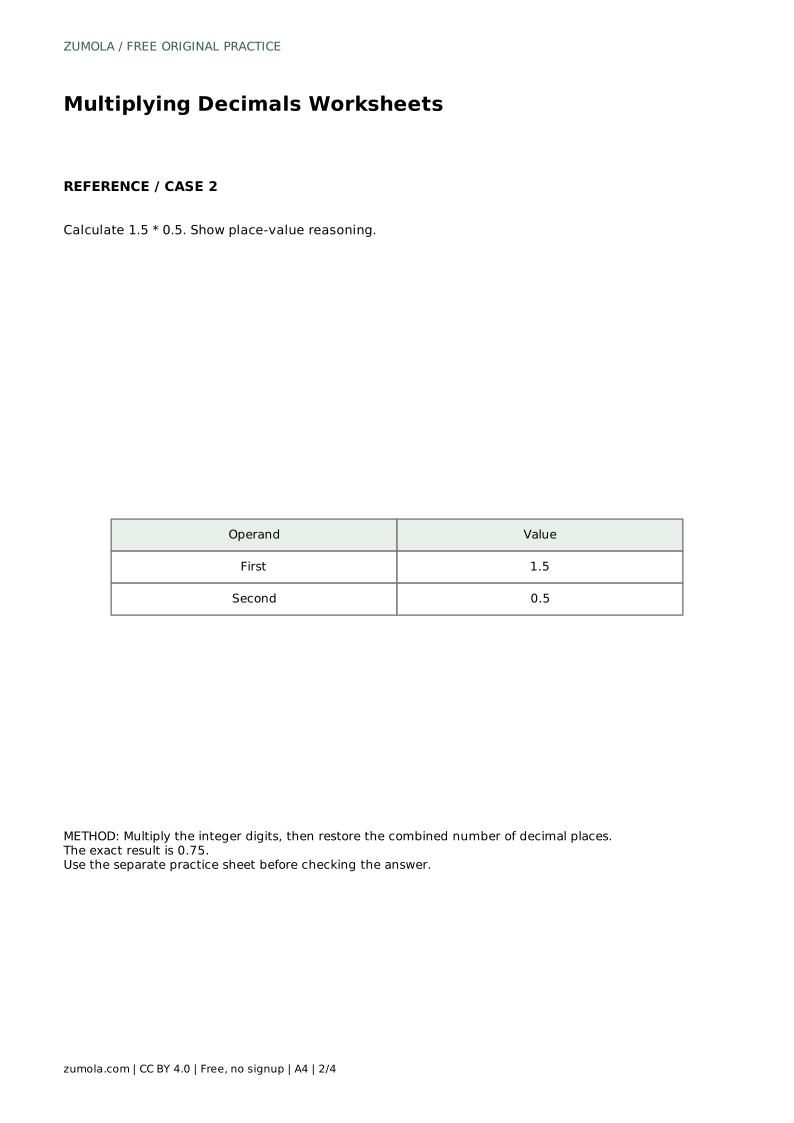
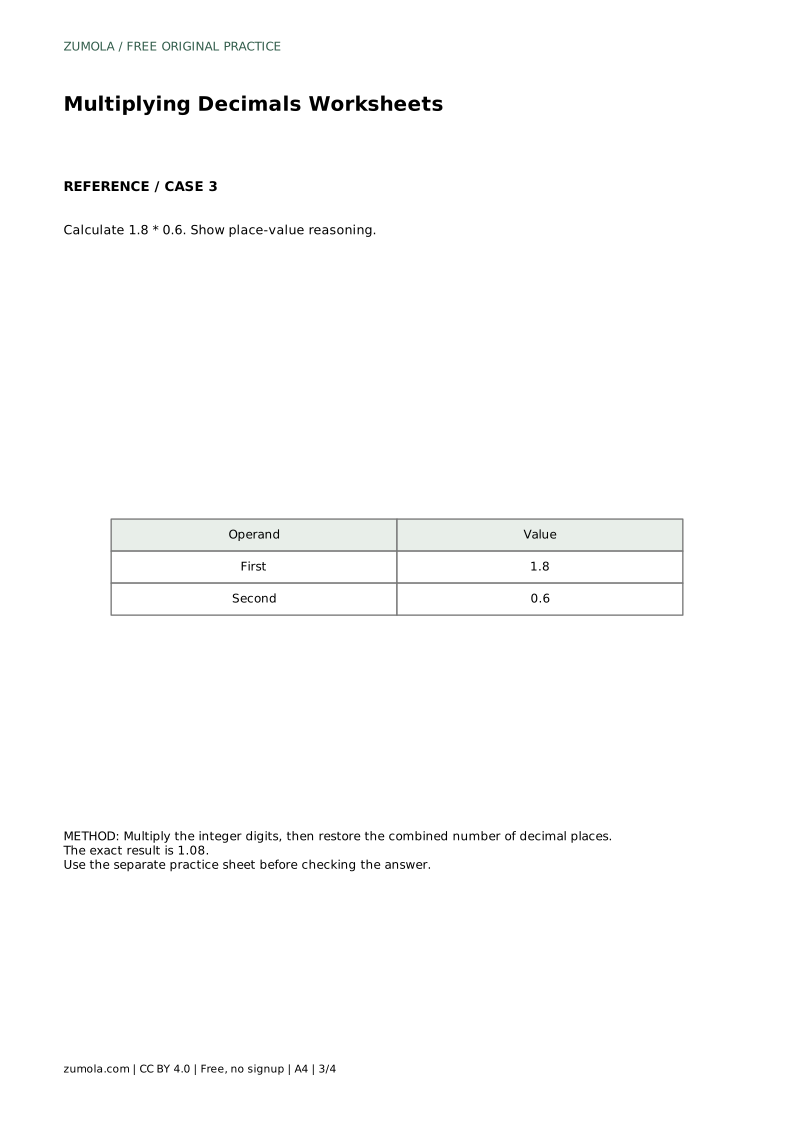
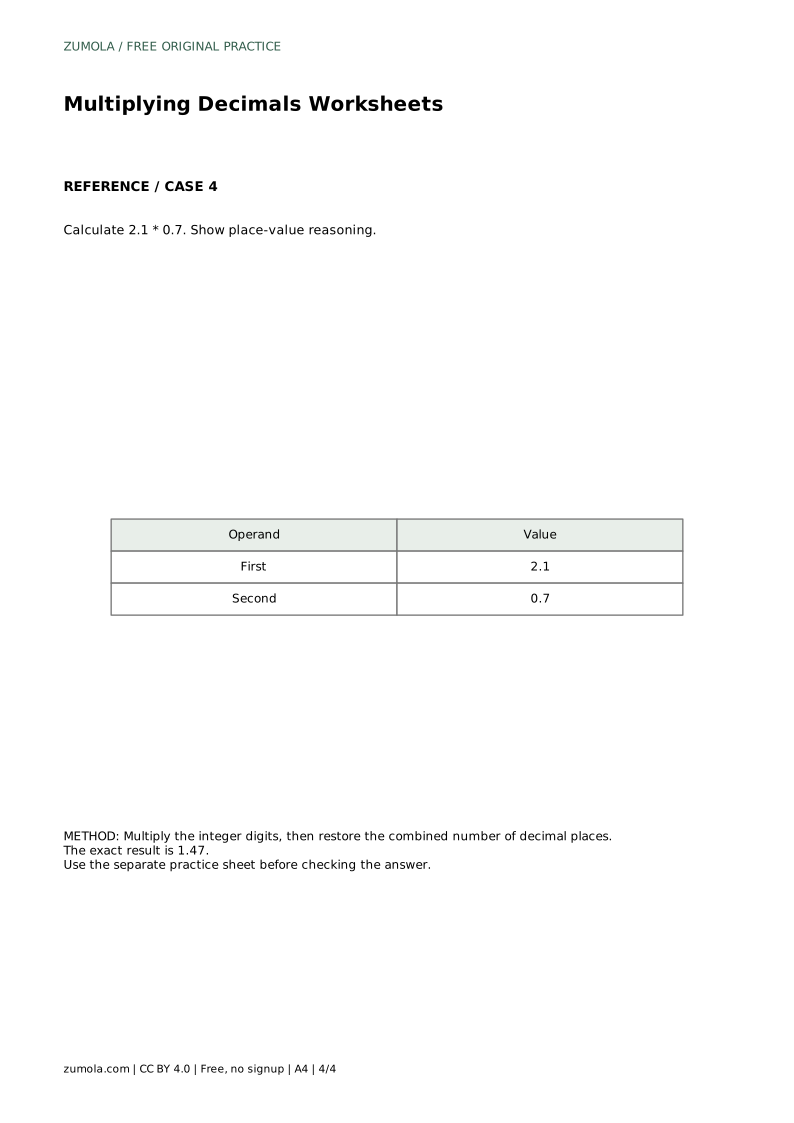
Reference diagrams
LETTER · Download PDF
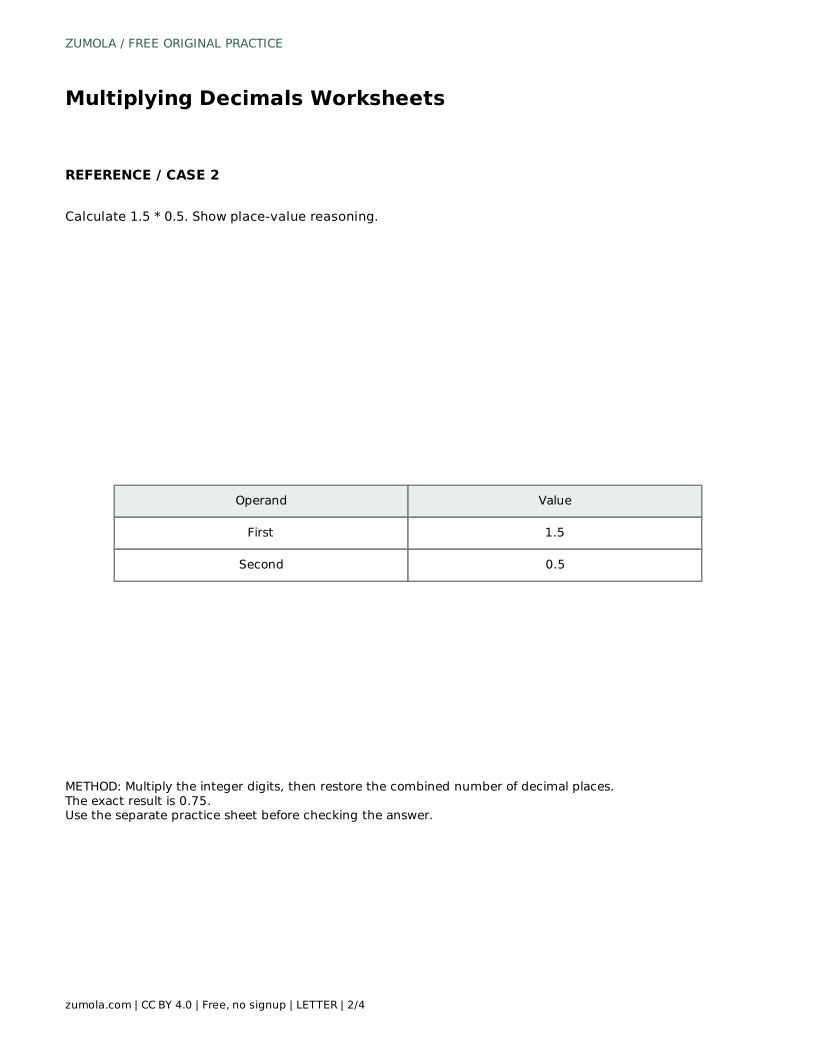
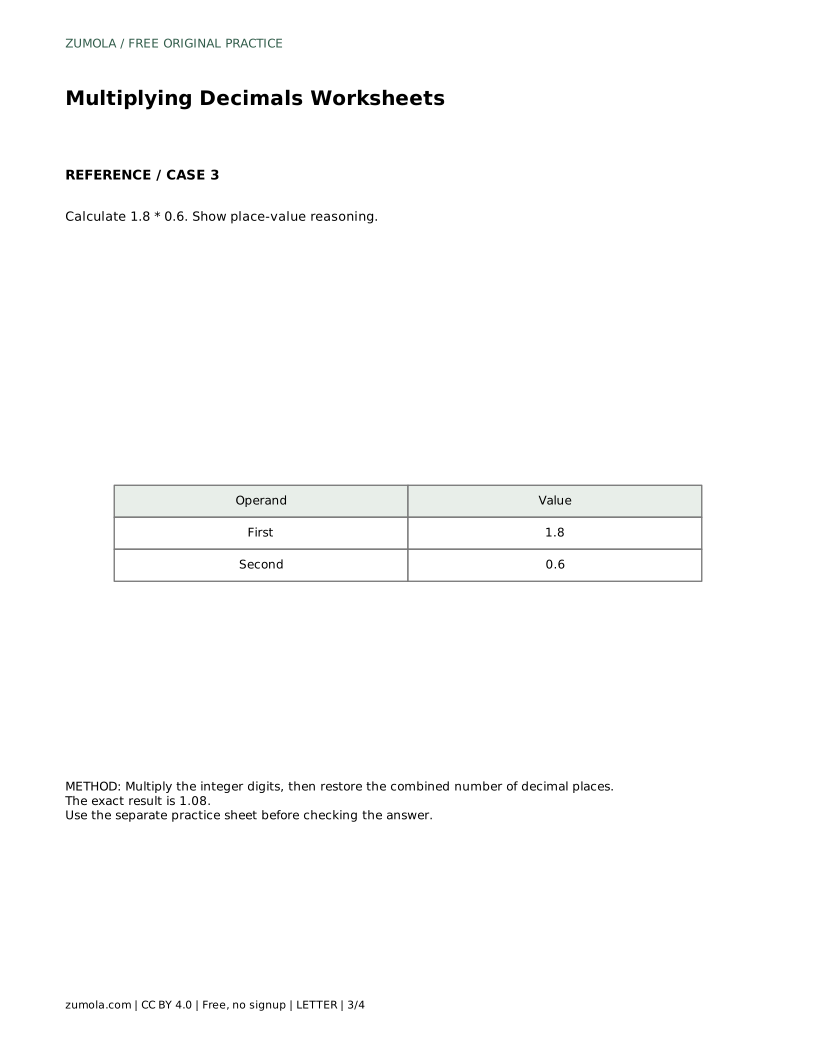
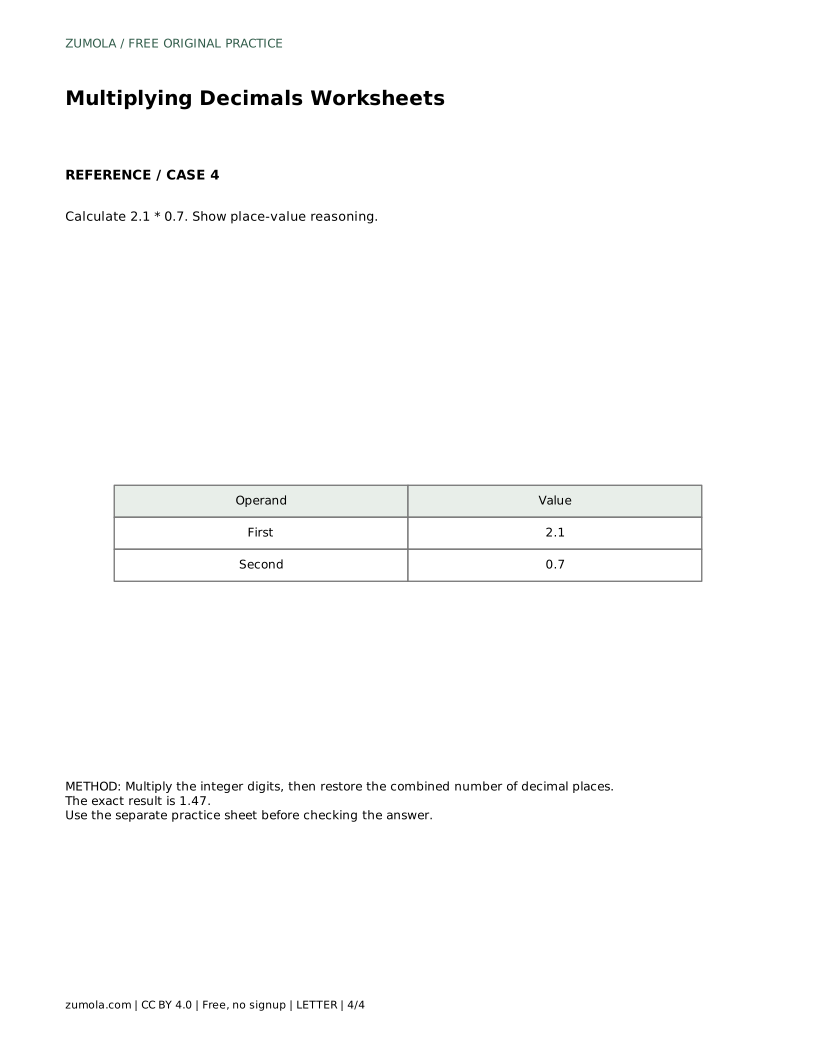
A4 · Download PDF
Free original resources
Teach decimal multiplication with a place-value method: multiply digits as whole numbers, then restore the combined decimal places. Includes practice and a rubric.
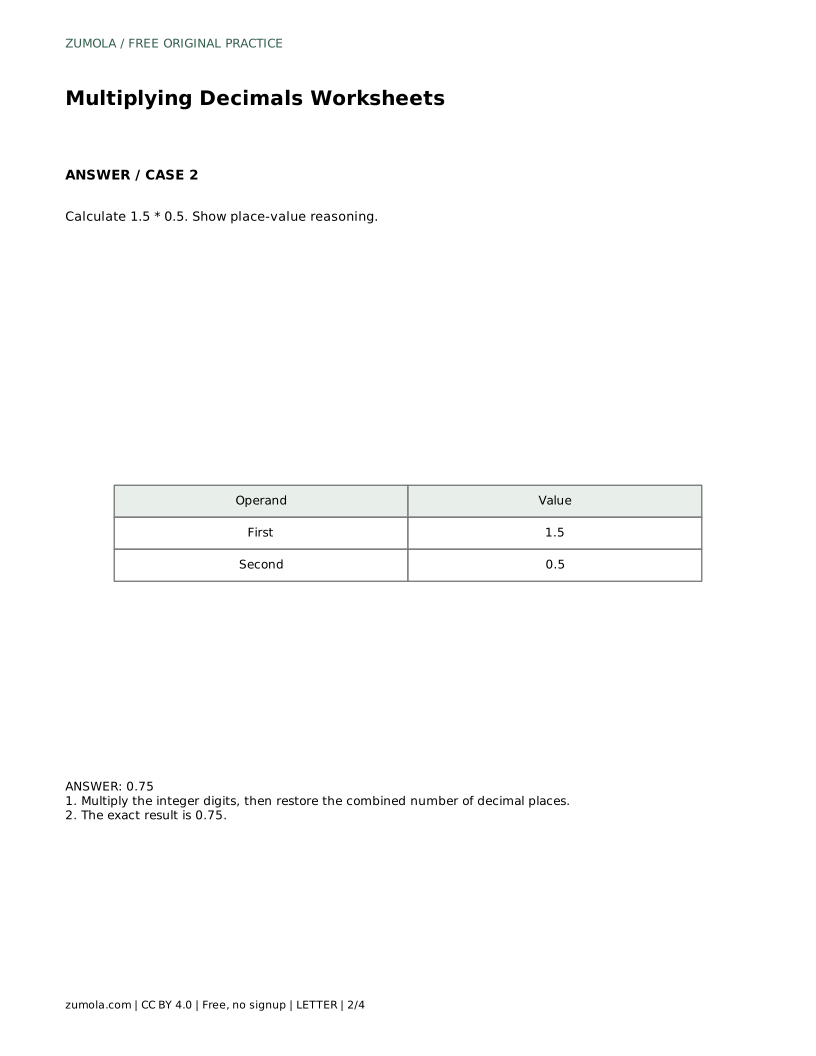
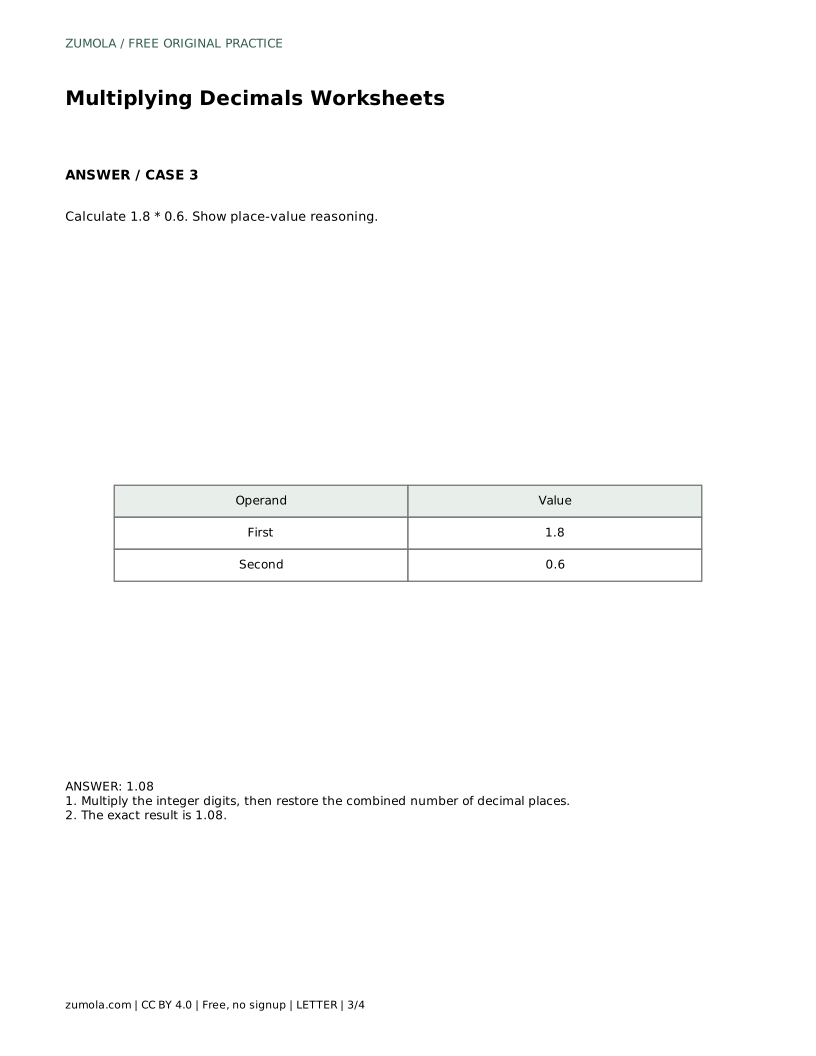
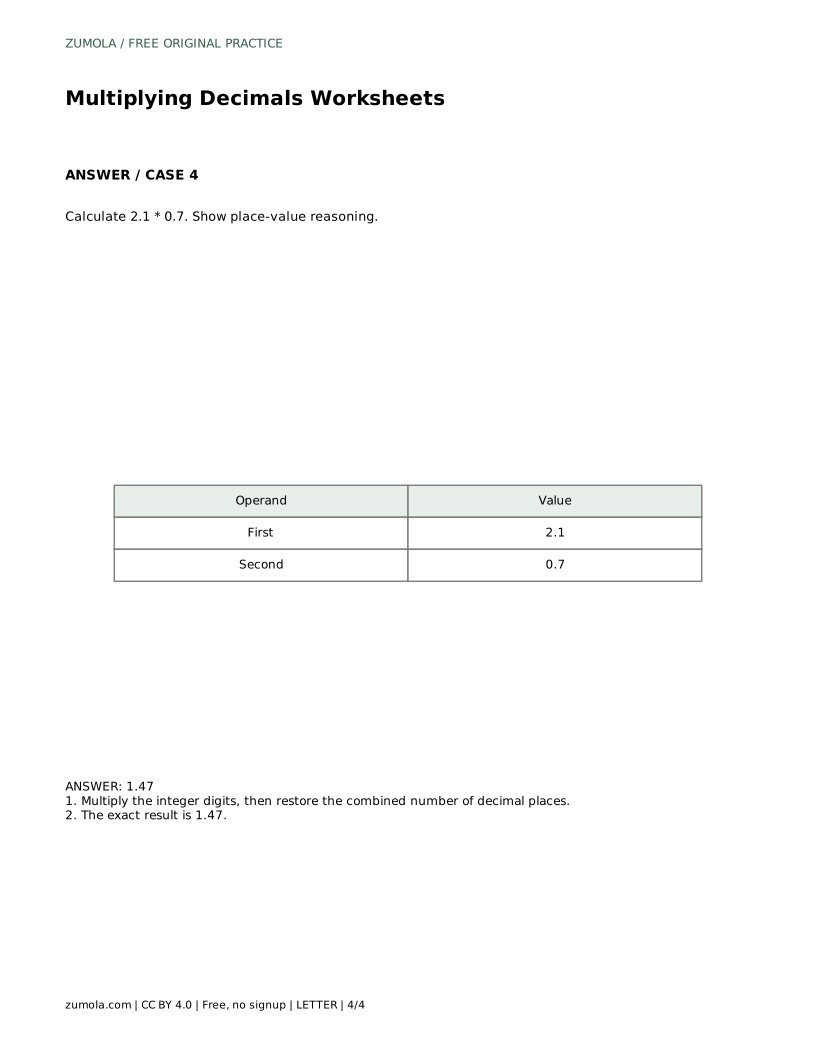
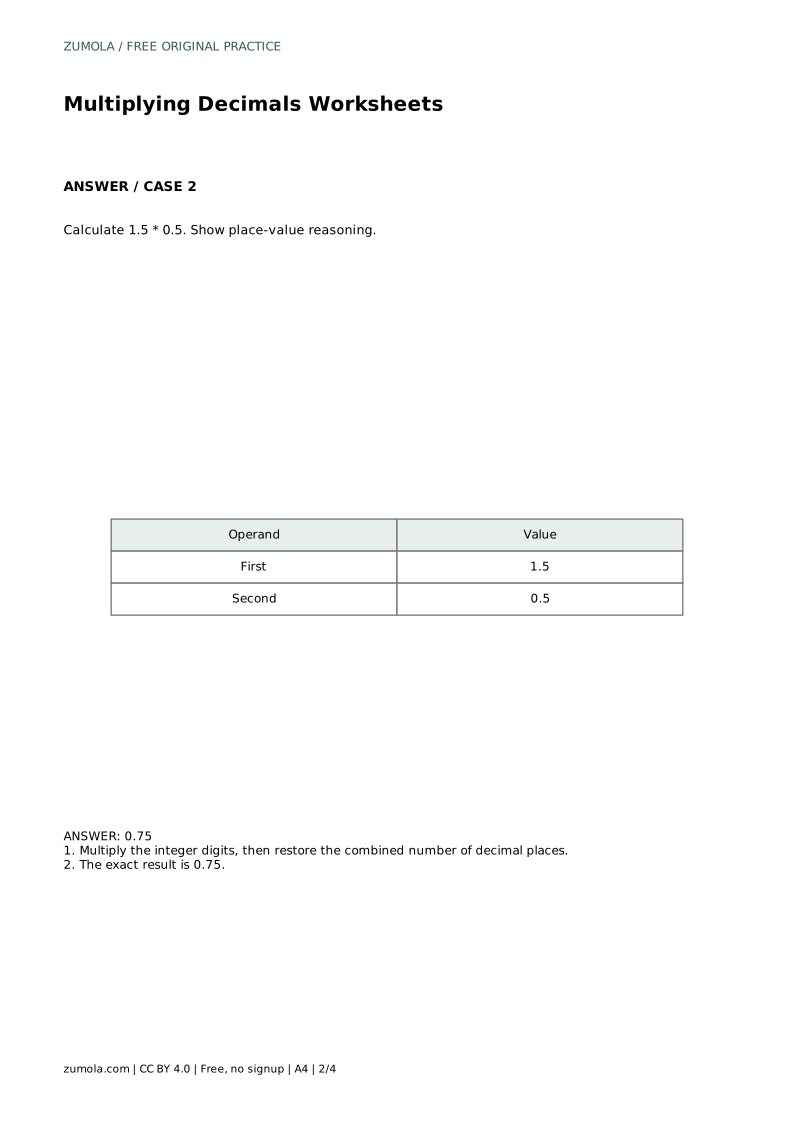
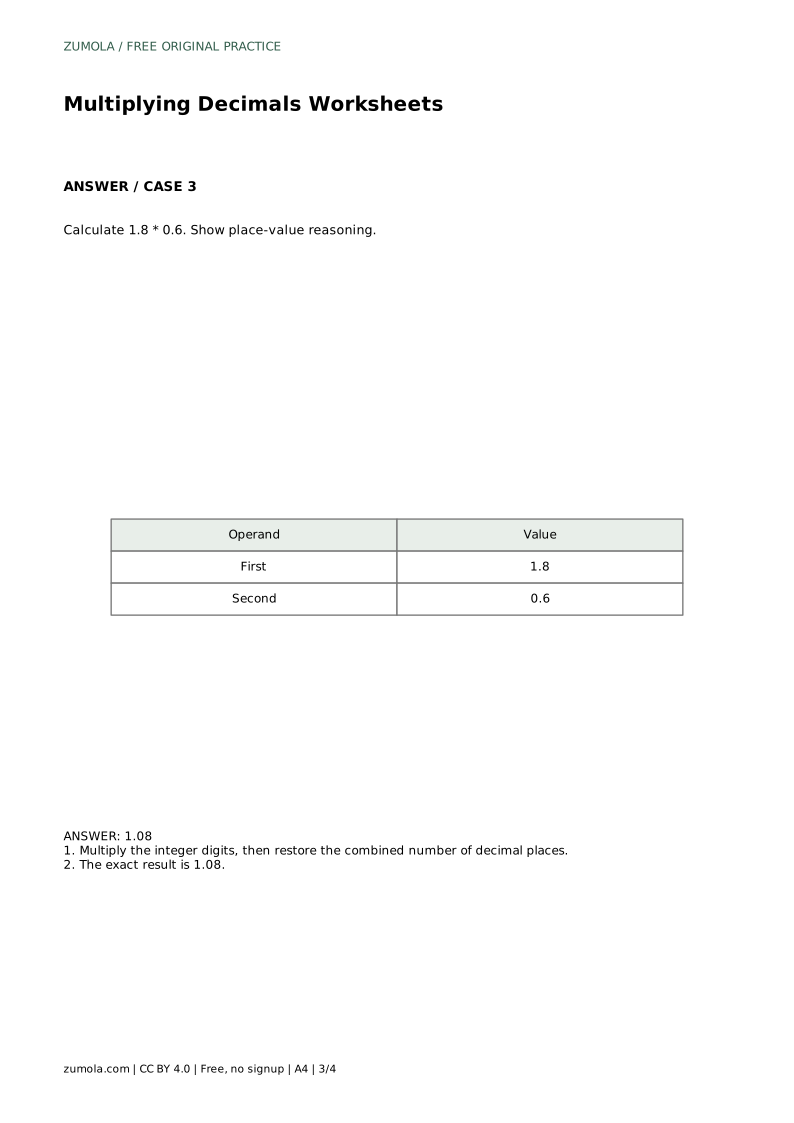
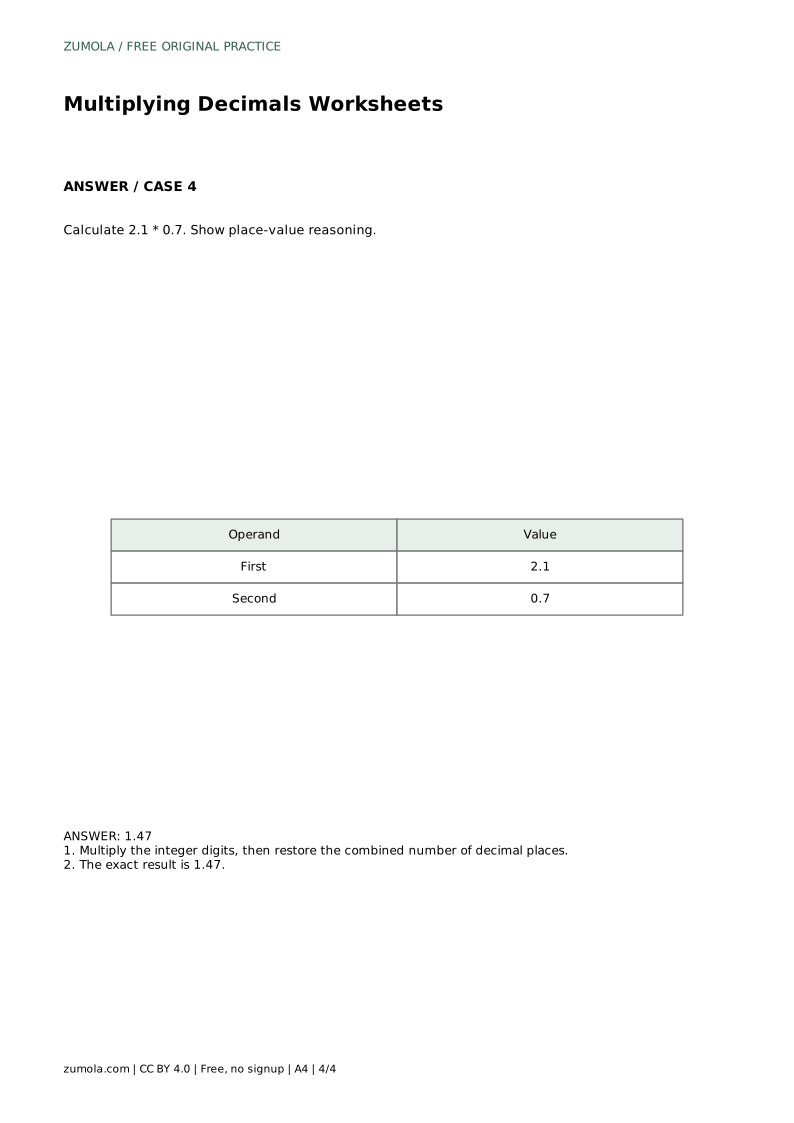
Four original cases, with reference diagrams, practice sheets and worked answers. Everything is free; no signup required.
LETTER · Download PDF
A4 · Download PDF
LETTER · Download PDF
A4 · Download PDF
LETTER · Download PDF
A4 · Download PDF
Use A4 or US Letter to match your printer. Use the stated values and conditions to solve each exercise; diagrams are not physical measuring rulers.
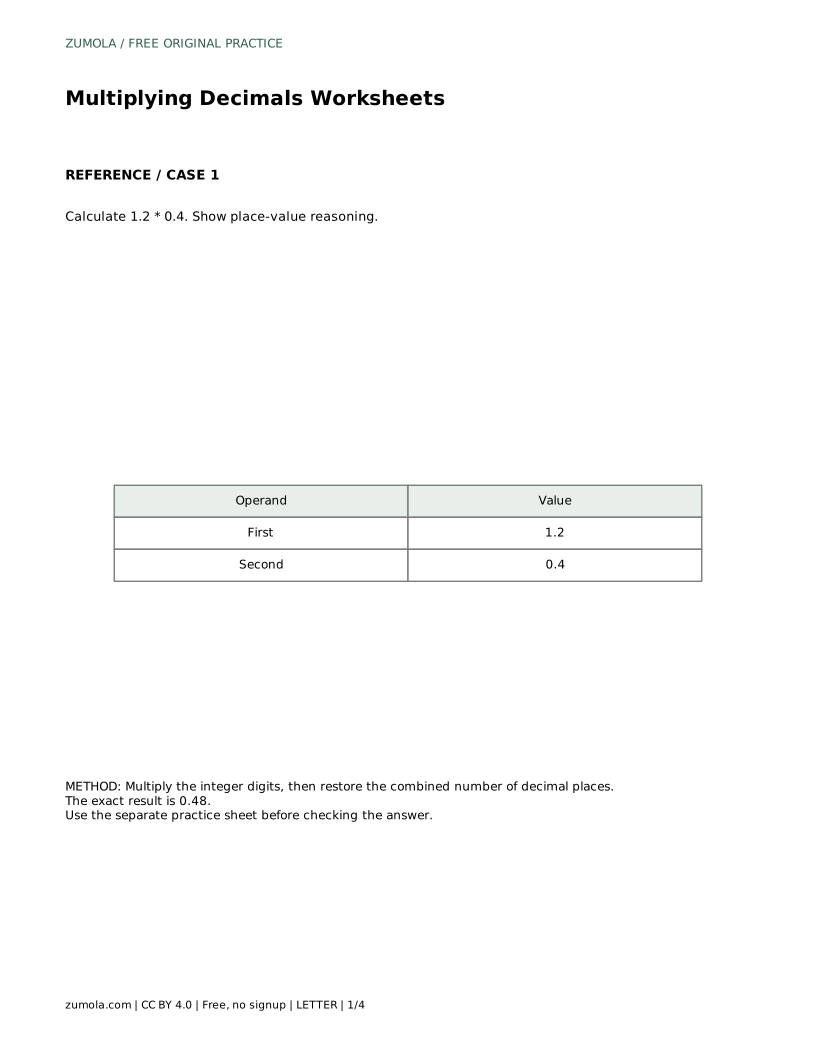
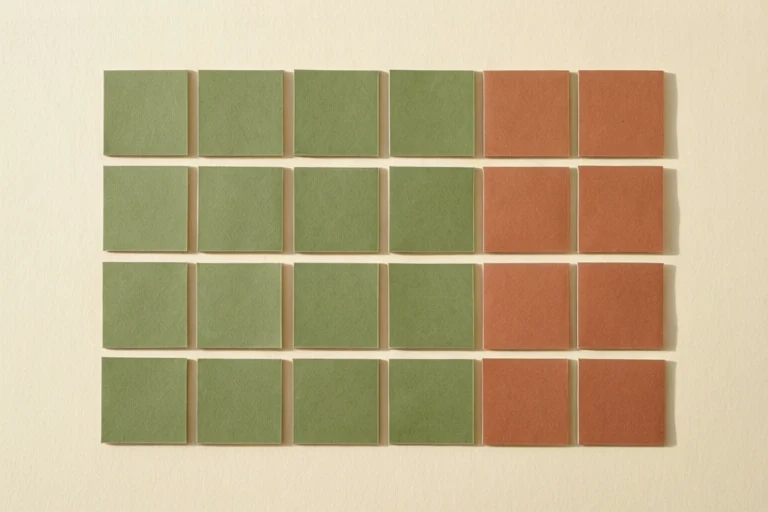
Decimal multiplication becomes clearer when students separate two jobs: multiplying the digits and tracking the decimal places. On these worksheets, learners multiply as if both factors were whole numbers, count the decimal places in each factor, then place the decimal point in the product. The method works for exact terminating decimals and gives a reliable check against estimates. Use the worked example below to model the reasoning before students attempt the practice items.
A decimal such as 1.2 means 12 tenths, or 12/10. A decimal such as 0.4 means 4 tenths, or 4/10. Multiplying 1.2 by 0.4 is therefore the same as multiplying 12/10 by 4/10. The numerators multiply to 48, and the denominators multiply to 100, giving 48/100, which is 0.48.
This fraction view explains the shortcut. The first factor has one decimal place, the second has one decimal place, and the product has two. Each decimal place represents a factor of 10 in the denominator, so the total number of decimal places in the product equals the sum of the decimal places in the factors. Students are not inventing a rule; they are counting factors of ten.
Start with the factors 1.2 and 0.4. Ignoring the decimal points gives 12 and 4. The whole-number product is 12 times 4, which equals 48.
Now count decimal places. The factor 1.2 has one decimal place. The factor 0.4 has one decimal place. Together they have two decimal places, so the product must have two decimal places. Writing 48 with two decimal places gives 0.48.
A fraction check confirms the result: 1.2 is 6/5 and 0.4 is 2/5. Their product is 12/25, which equals 0.48. An estimate also supports it: 1.2 times about 0.4 is a little less than half of 1.2, and 0.48 fits that expectation.
Each practice item should be solved with the same four moves: multiply the digits, count the decimal places, place the point, then check with an estimate or a fraction. Keep the written work visible so the decimal-place count can be inspected, not just the final answer.
When a product has fewer digits than the required decimal places, insert zeros to the left of the digits. For example, a product of 6 that needs two decimal places is written 0.06. This is a placement step, not a change in value.
Estimation is a useful guard against misplaced points. Round each factor to a nearby whole number or simple decimal, multiply mentally, and compare the size of the exact answer with the estimate. A product that is wildly larger or smaller signals a counting error.
Decimal multiplication is an arithmetic procedure, not a claim about measurement precision. Answers here are exact terminating decimals. Do not round unless a task explicitly asks for rounding, and state the rounding place if it does.
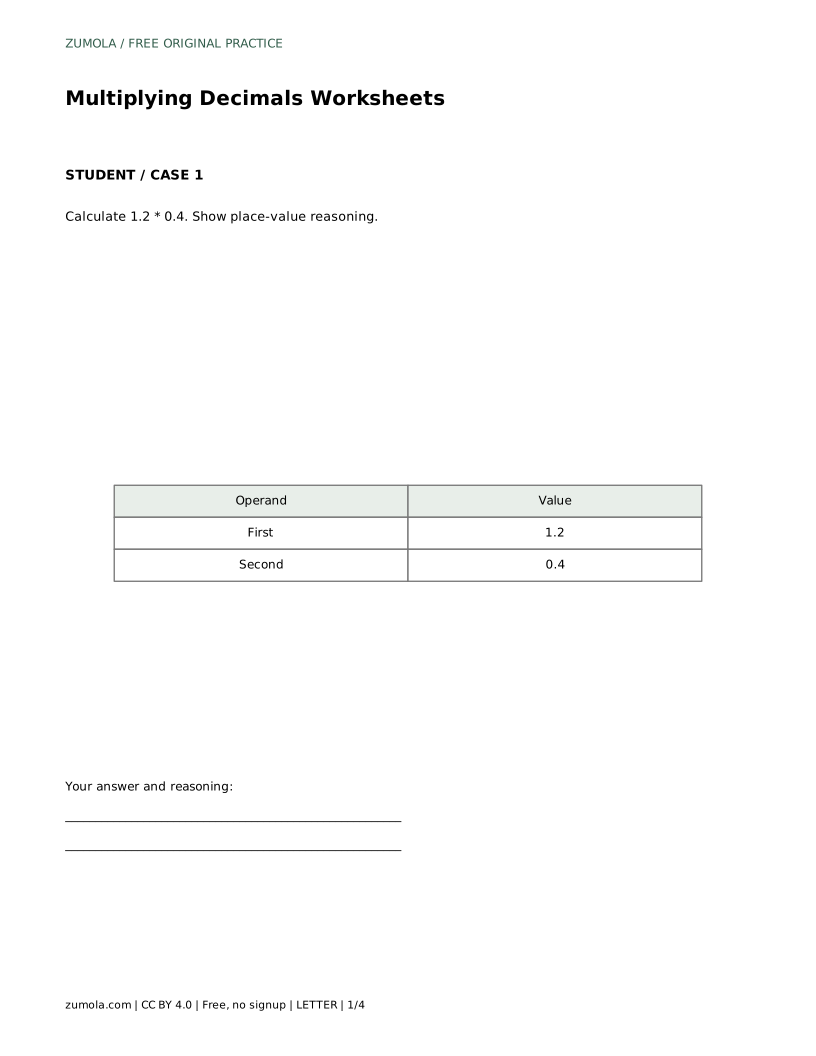
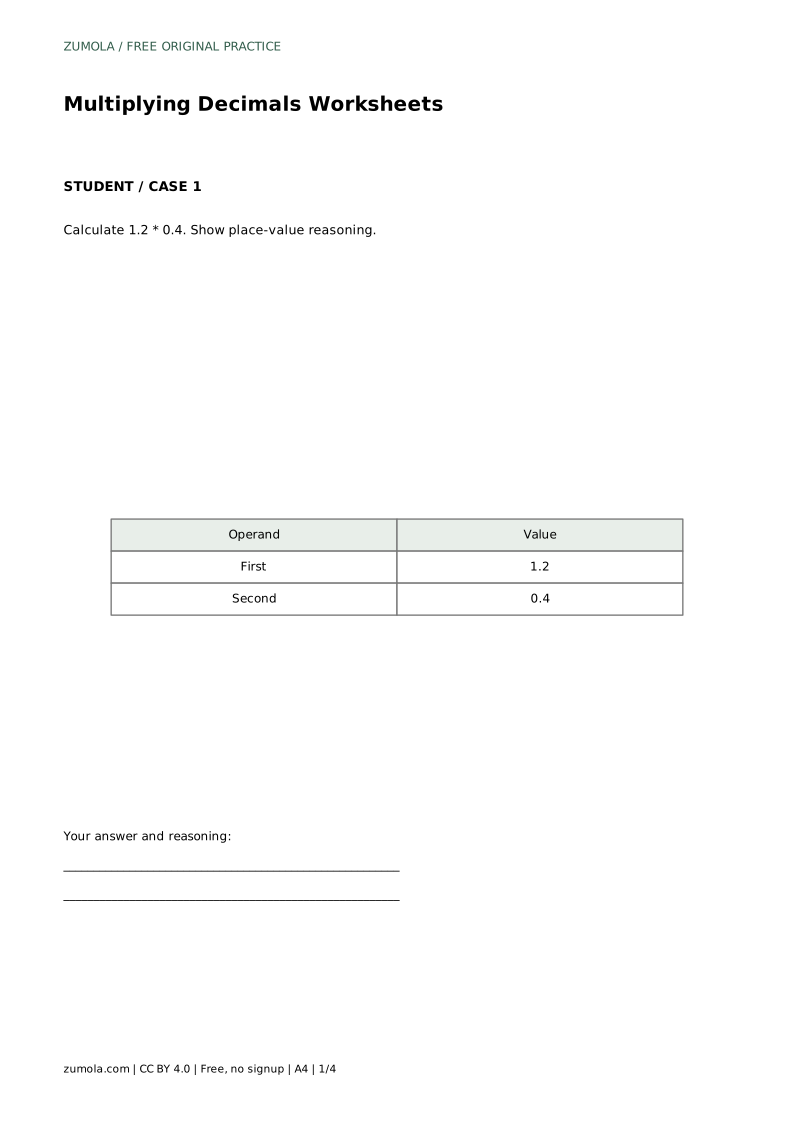
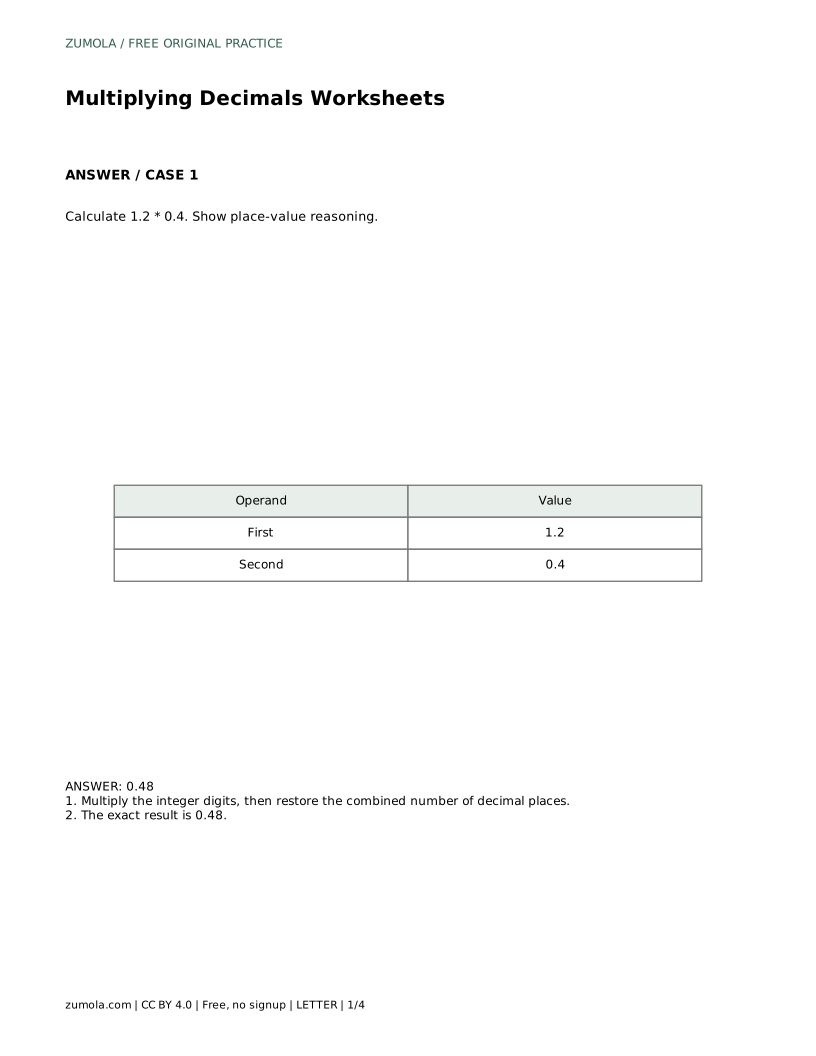
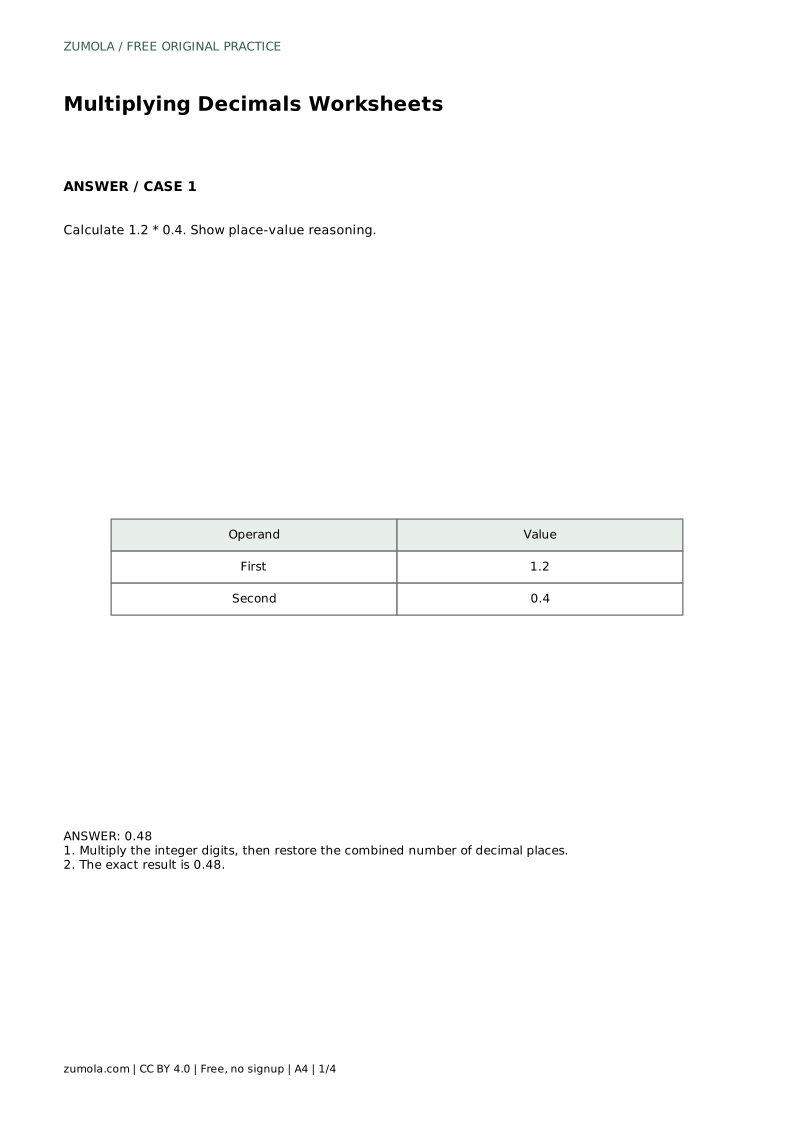
Calculate 1.2 * 0.4. Show place-value reasoning.
0.48 Multiply the integer digits, then restore the combined number of decimal places. The exact result is 0.48.
Add the number of decimal places in the first factor to the number in the second factor. The product has that total number of decimal places.
Write zeros to the left of the digits until the product has the required number of decimal places. For two decimal places, 6 becomes 0.06.
No. Multiplication is commutative, so 1.2 times 0.4 and 0.4 times 1.2 both equal 0.48, and the decimal-place count is the same either way.
All math worksheets · Free coordinate paper
Original resources · CC BY 4.0 · Free for personal and classroom use with attribution.