Reference diagrams
LETTER · Download PDF
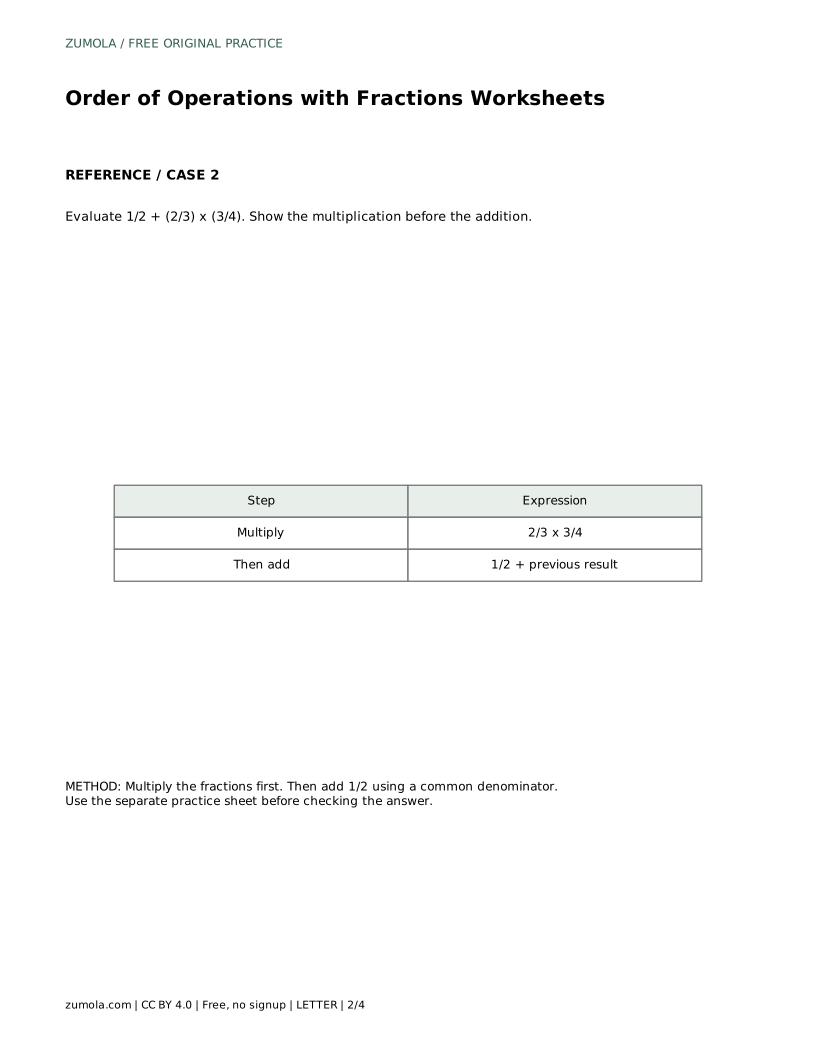
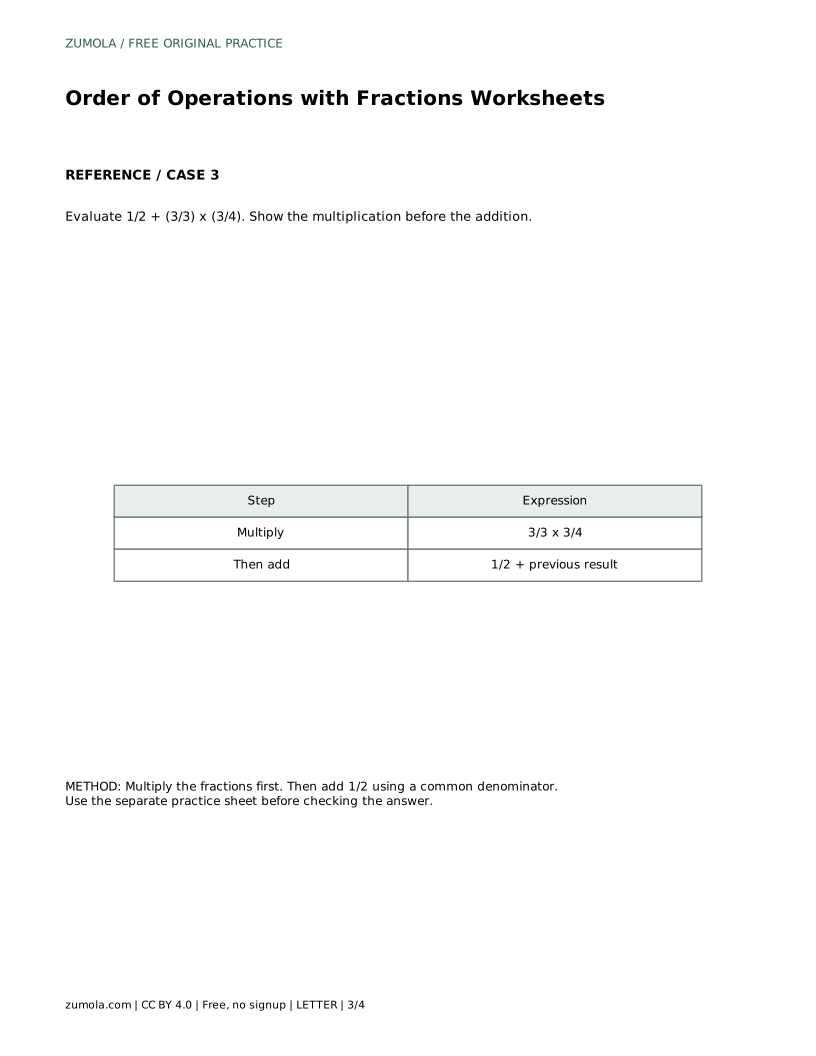
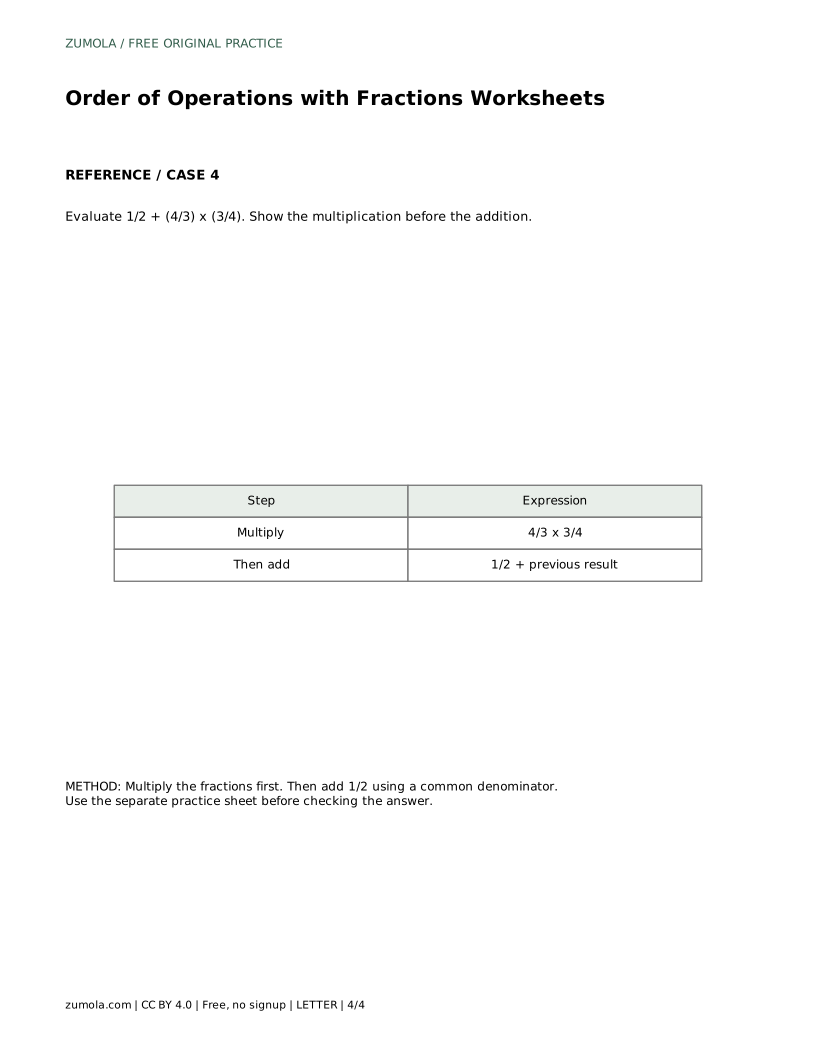
A4 · Download PDF
Free original resources
Practice evaluating fraction expressions with parentheses and multiplication before addition, using common denominators and clear step-by-step reasoning.
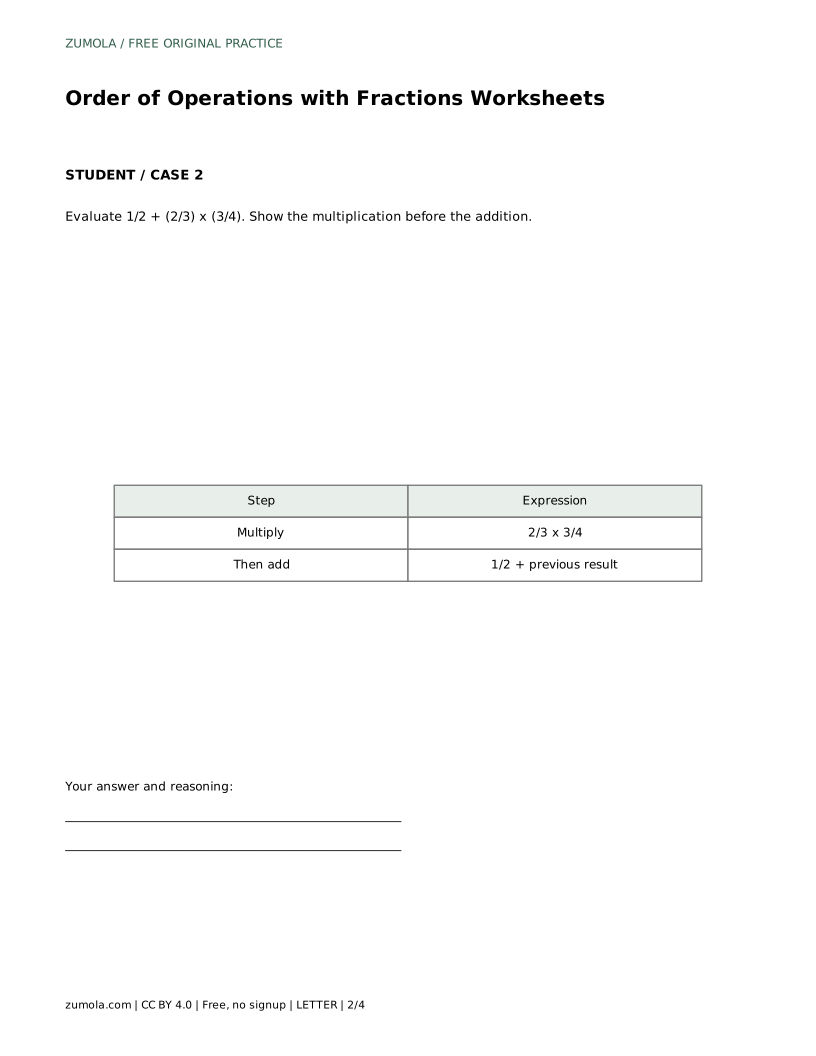
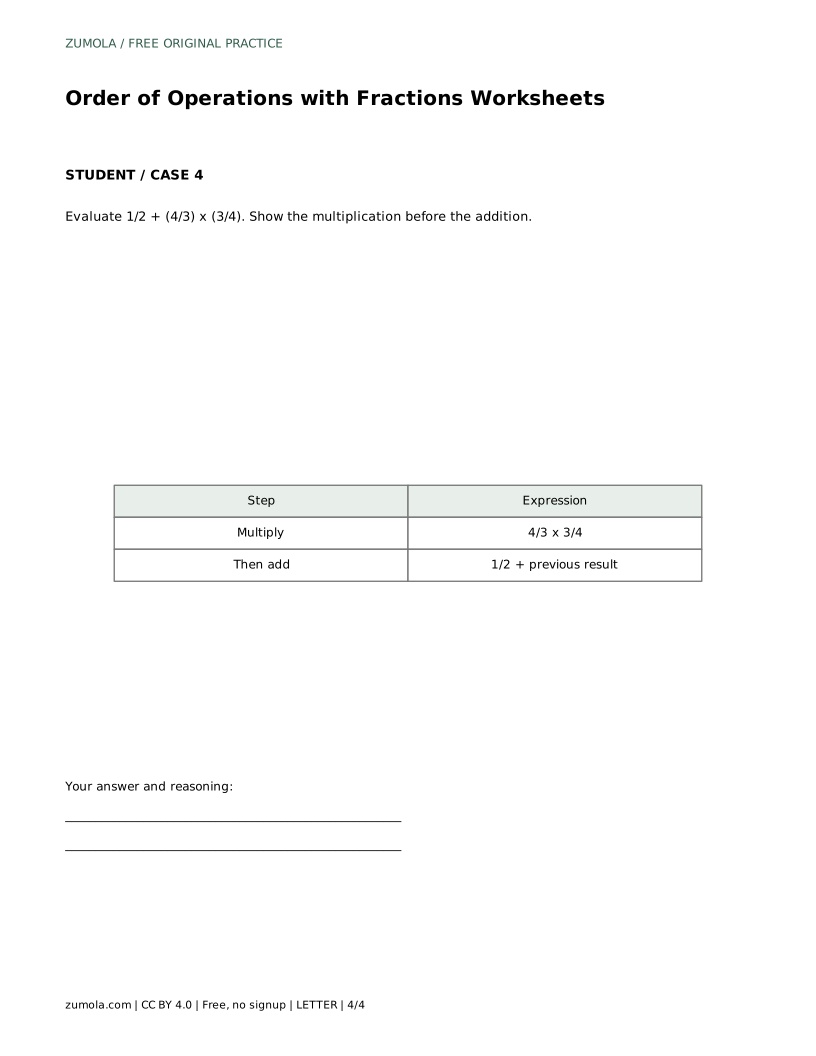
Four original cases, with reference diagrams, practice sheets and worked answers. Everything is free; no signup required.
LETTER · Download PDF
A4 · Download PDF
LETTER · Download PDF
A4 · Download PDF
LETTER · Download PDF
A4 · Download PDF
Use A4 or US Letter to match your printer. Use the stated values and conditions to solve each exercise; diagrams are not physical measuring rulers.
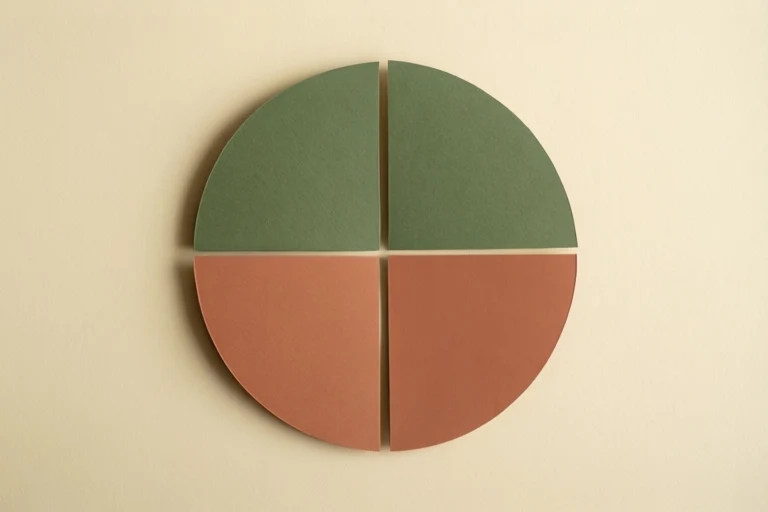
Fractions in an order-of-operations expression can look harder than they are. The rules do not change: work inside parentheses first, then multiplication and division from left to right, then addition and subtraction from left to right. This page focuses on expressions shaped like a fraction plus a product of two fractions. You will multiply first, simplify if possible, then add using a common denominator. Each step is written out so you can check your own work.
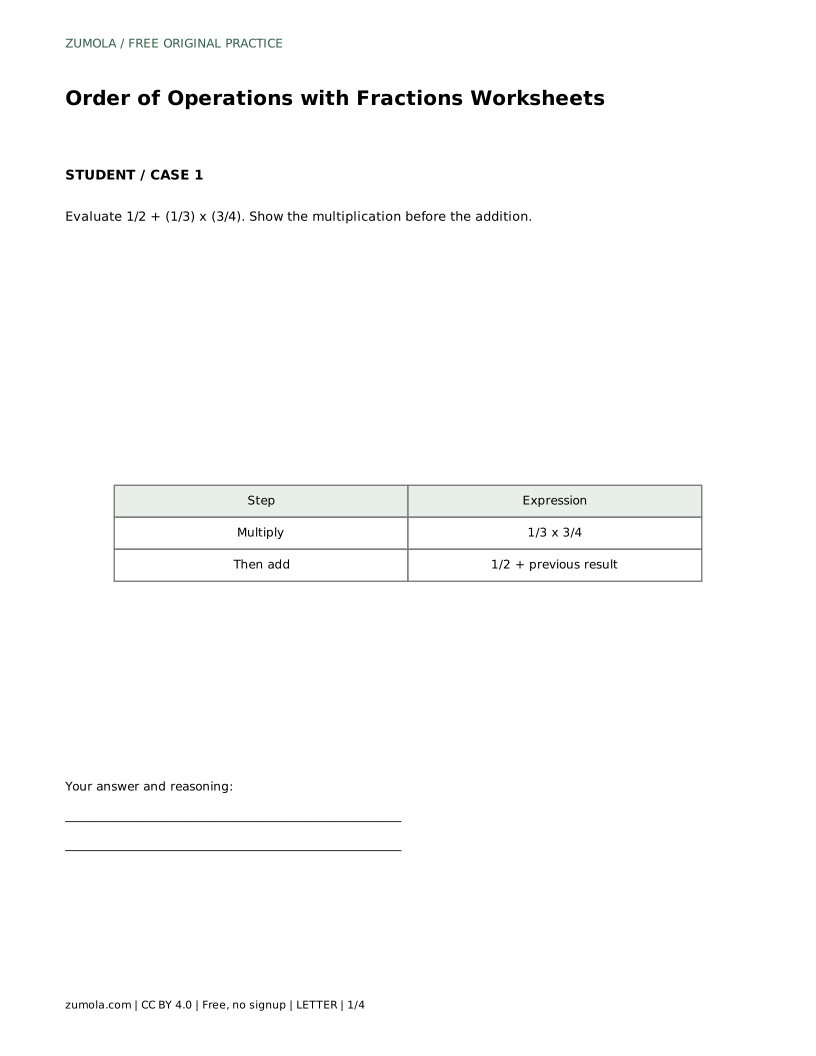
In an expression such as 1/2 + (1/3) x (3/4), the multiplication groups the two factors into a single value before the addition combines it with 1/2. Parentheses around the product make that grouping visible, but the order rule applies even without them. Treat the product as one quantity, then add.
A common error is adding the first two fractions because they appear left to right. Order of operations is not simple left-to-right reading; multiplication and division outrank addition and subtraction. Rewrite the product as a single fraction first, then perform the addition.
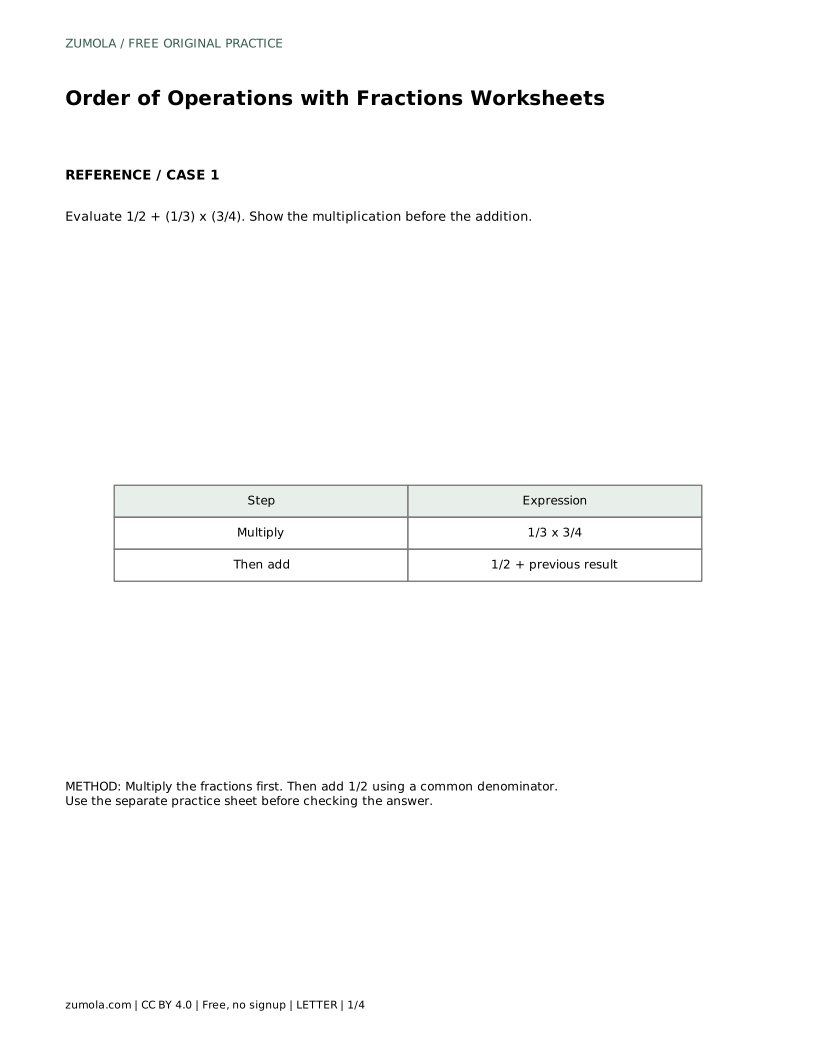
To multiply fractions, multiply numerator by numerator and denominator by denominator. For 1/3 x 3/4, the numerator is 1 x 3 = 3 and the denominator is 3 x 4 = 12, giving 3/12, which simplifies to 1/4. Simplifying before adding keeps the numbers small.
To add fractions, both must share a denominator. For 1/2 + 1/4, rewrite 1/2 as 2/4, then add 2/4 + 1/4 = 3/4. Keep the denominator the same and add only the numerators. If the result is improper, you may leave it as a fraction or rewrite it as a mixed number; both are valid unless a format is specified.
A quick check is to estimate the size of each part. If 1/3 x 3/4 is about one quarter, then 1/2 plus about one quarter should be a little more than one half. An answer far from that estimate signals a slip.
You can also reverse the addition using subtraction: subtract the product from your final answer and see whether you recover the first fraction. This does not prove the multiplication was correct, but it catches addition errors.
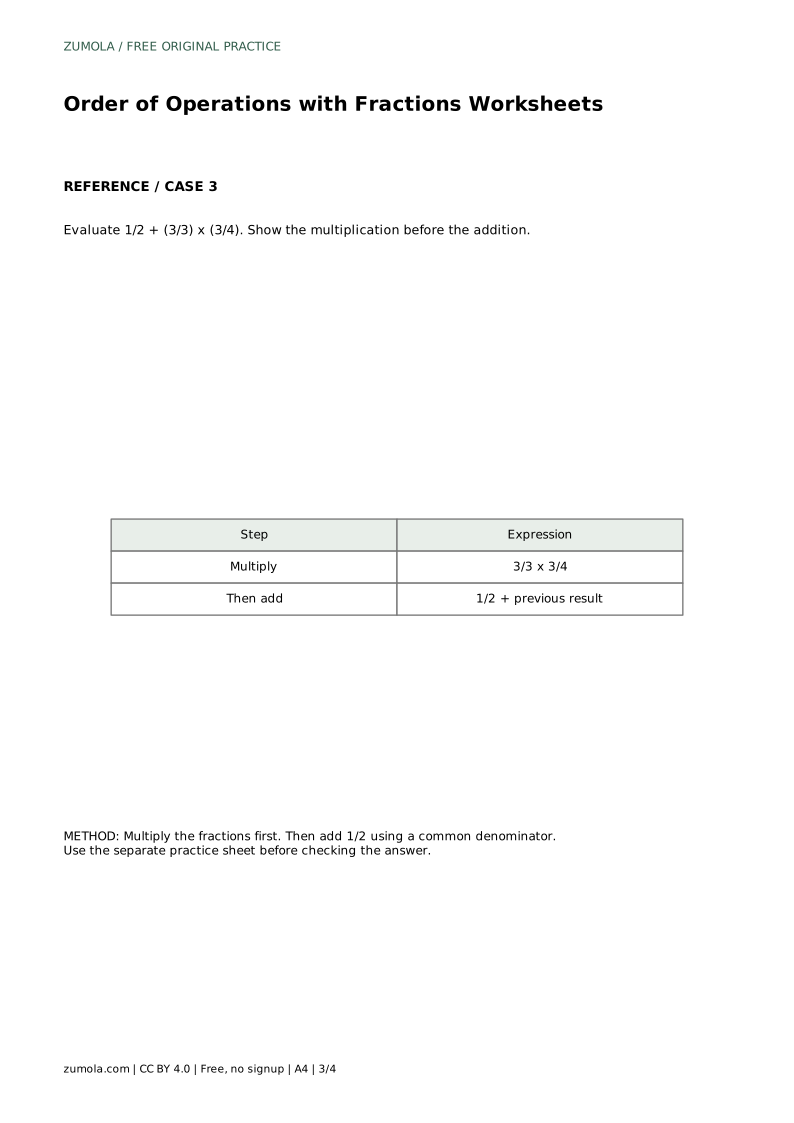
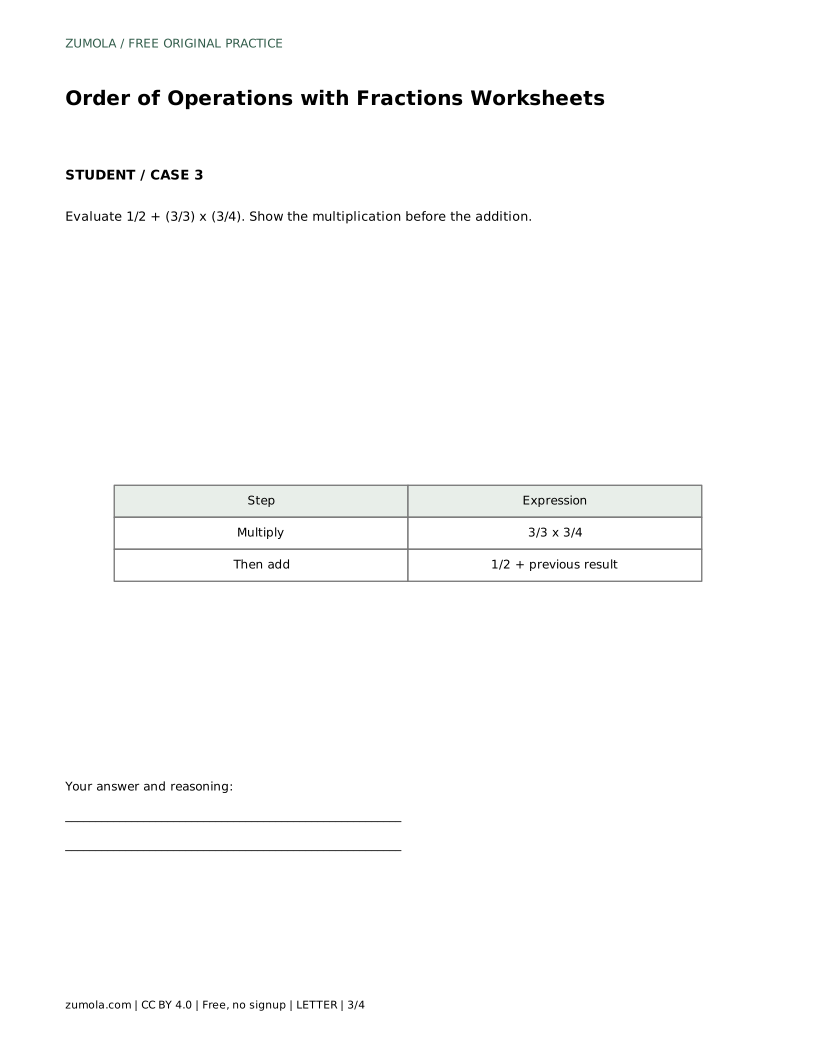
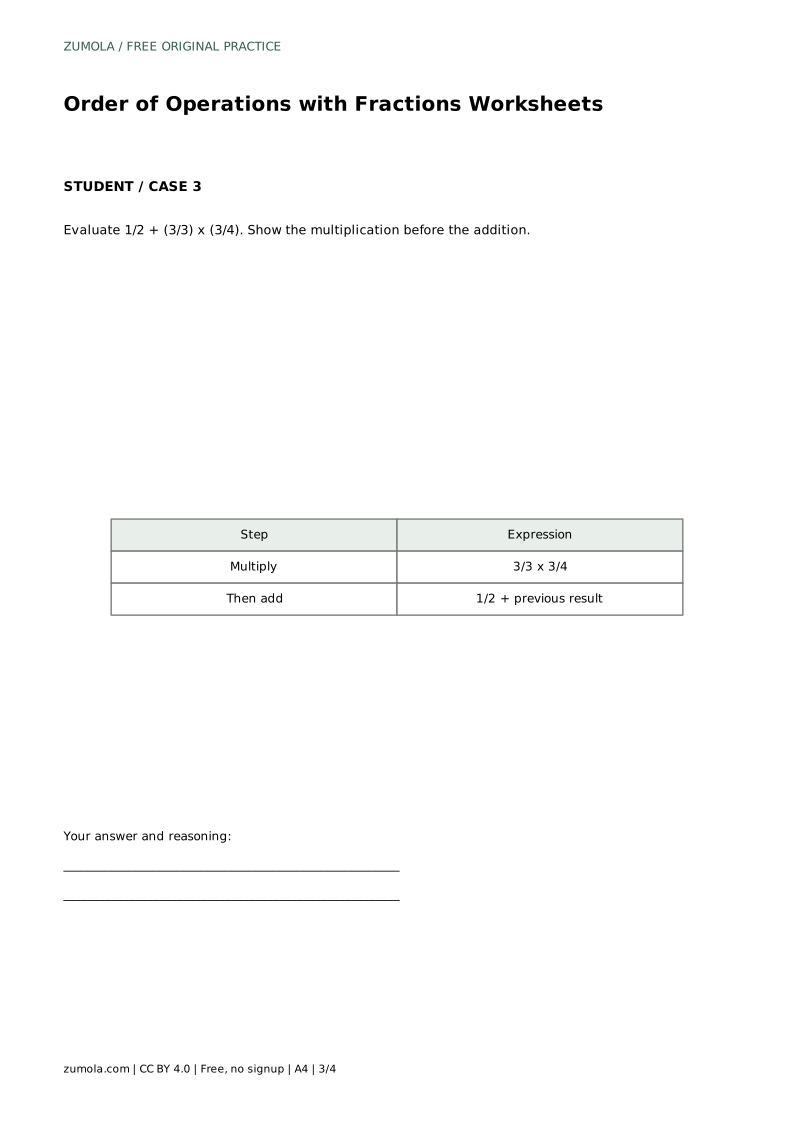
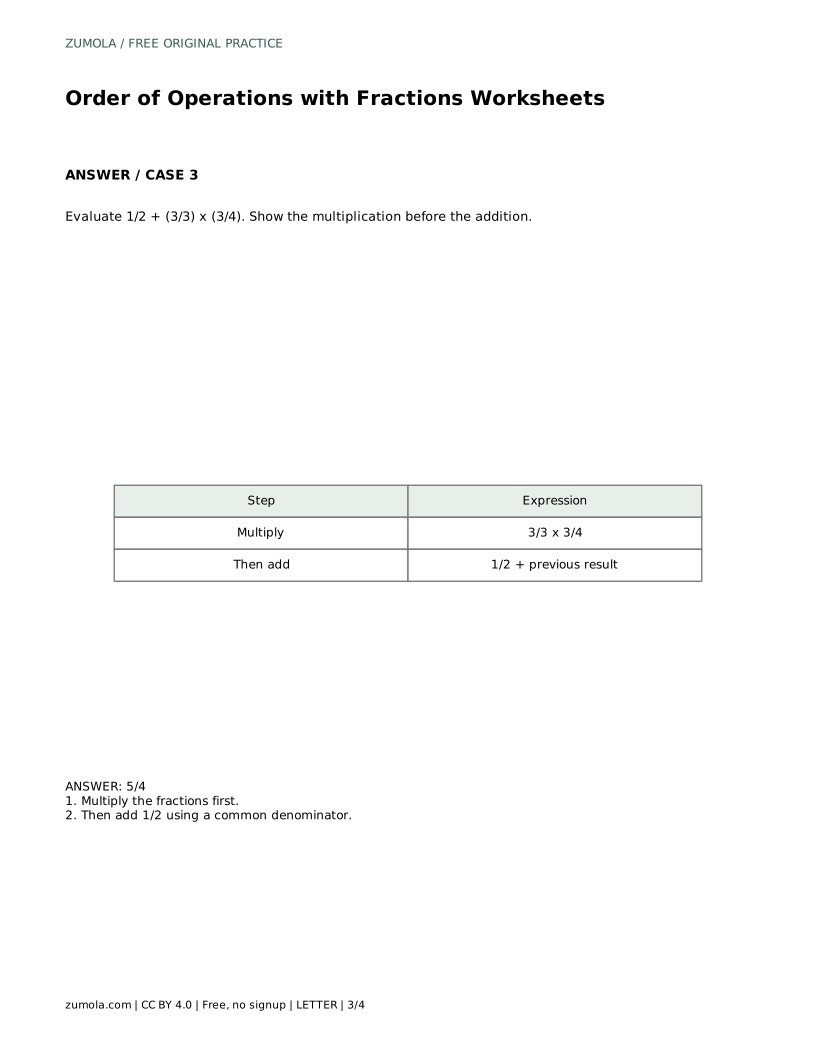
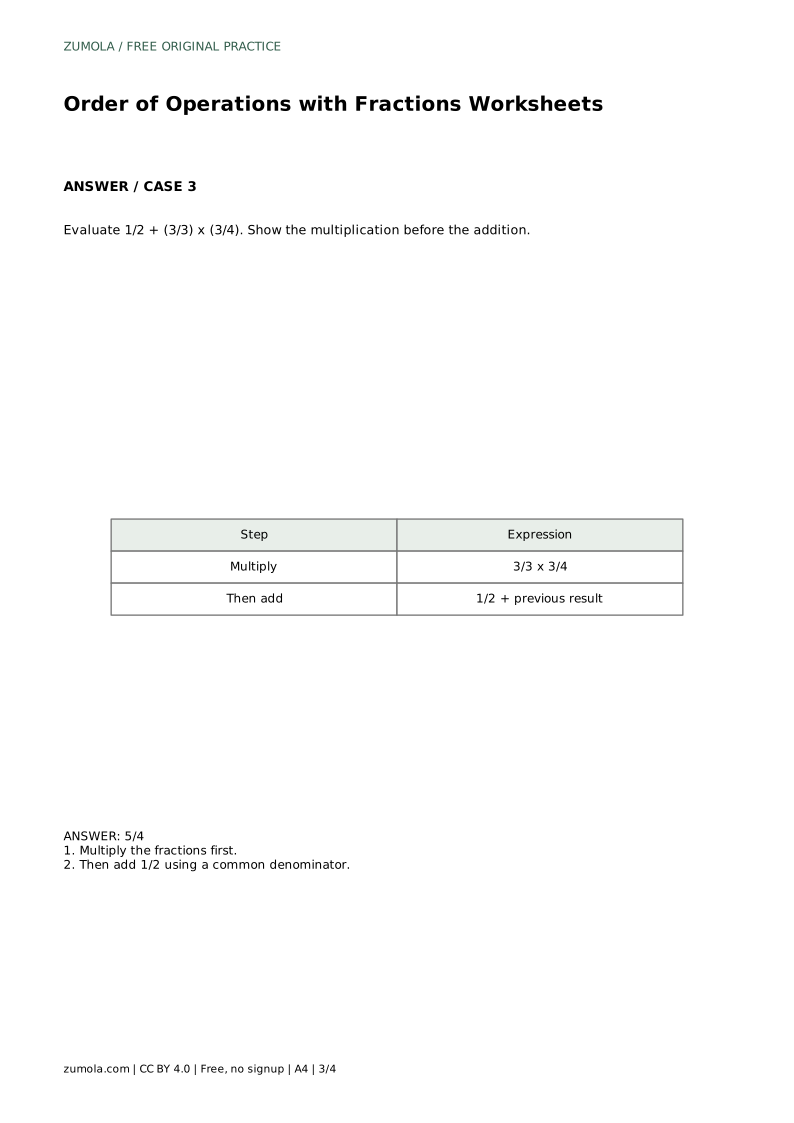
When a product equals a whole number, such as 3/3 x 3/4 = 3/4, the addition is straightforward. When the product is greater than one, expect the final sum to exceed the first fraction by that amount.
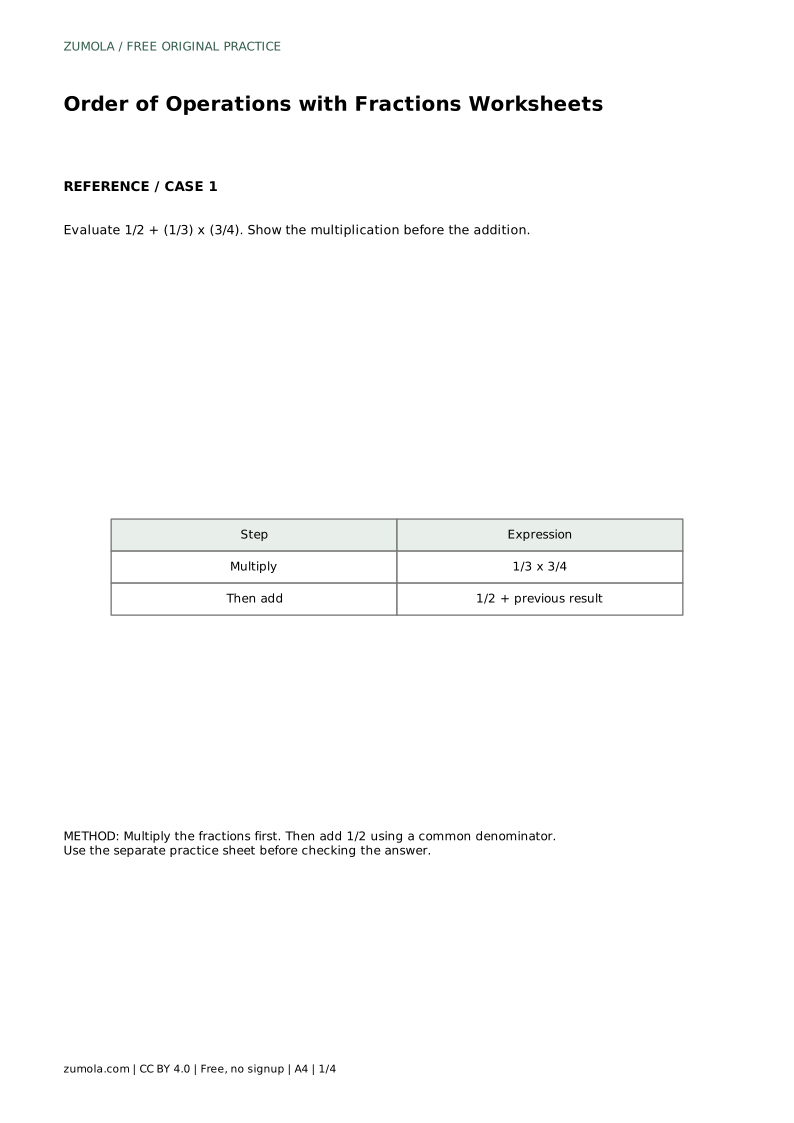
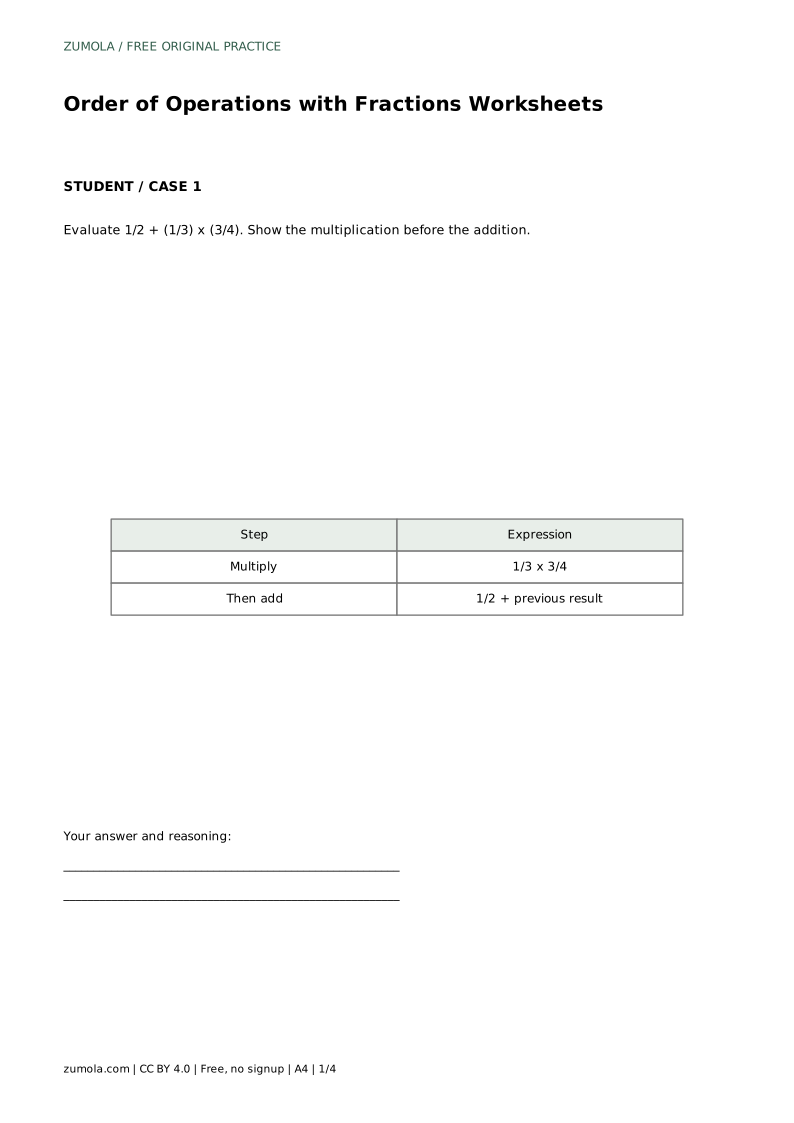
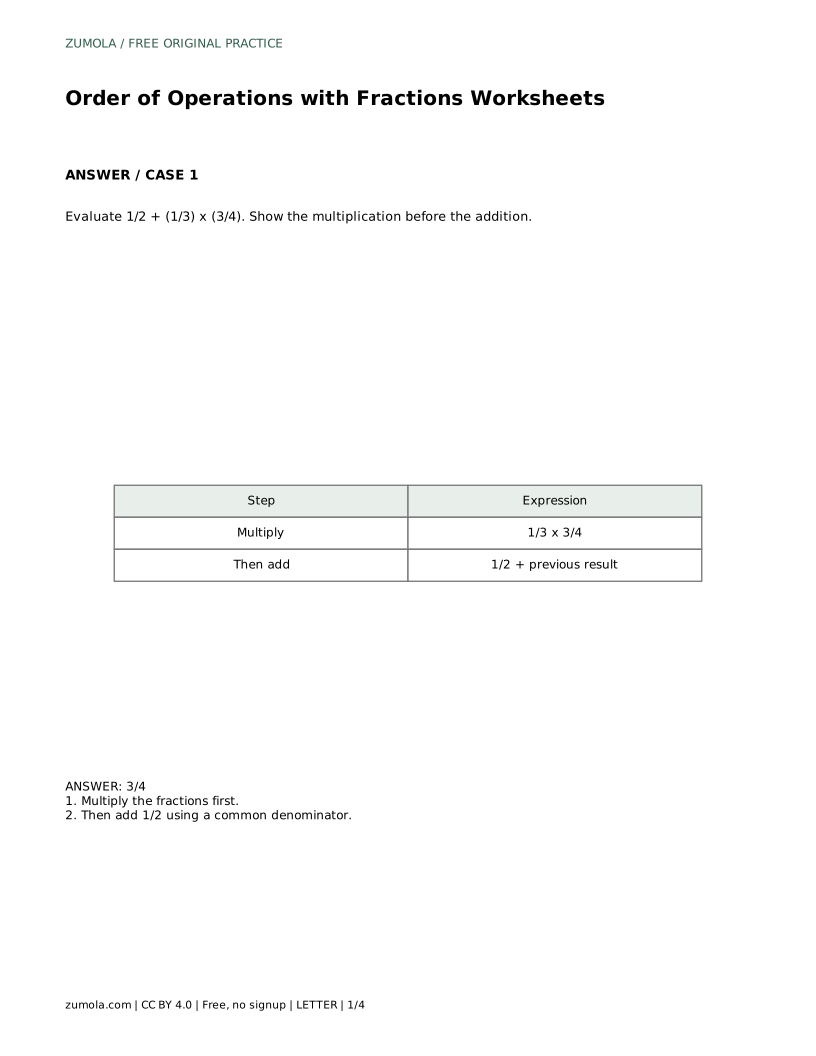
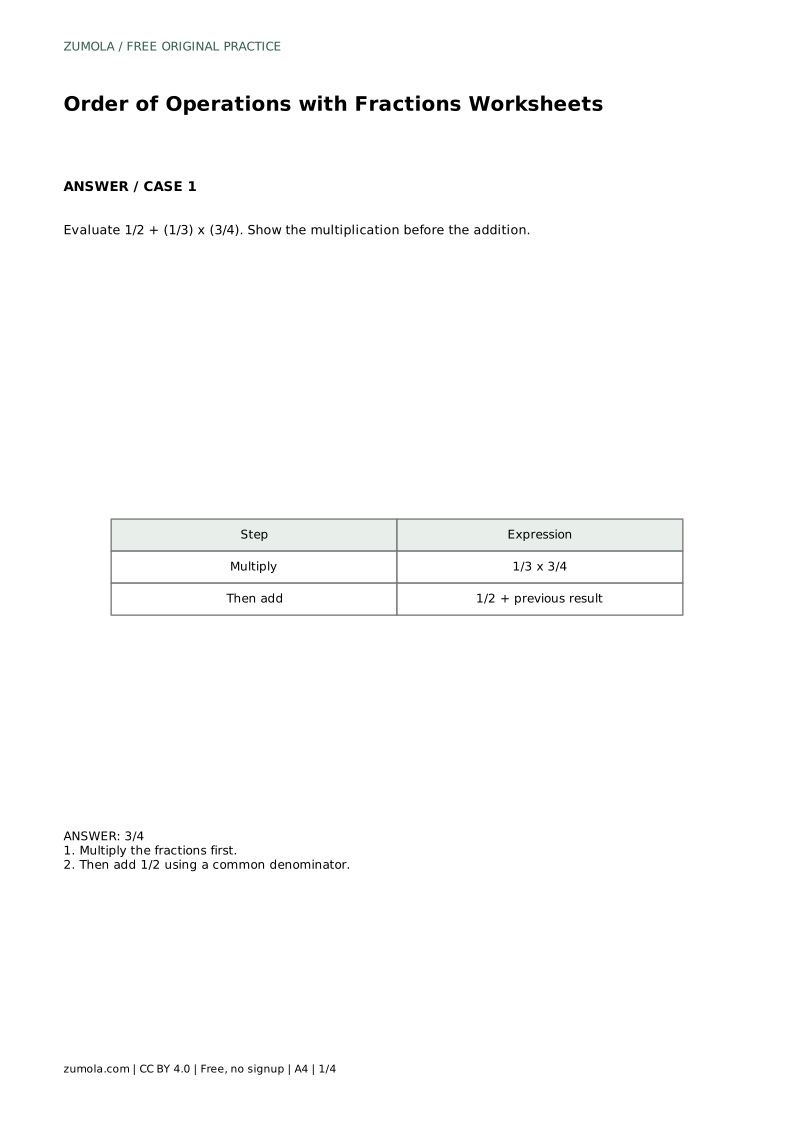
Evaluate 1/2 + (1/3) x (3/4). Show the multiplication before the addition.
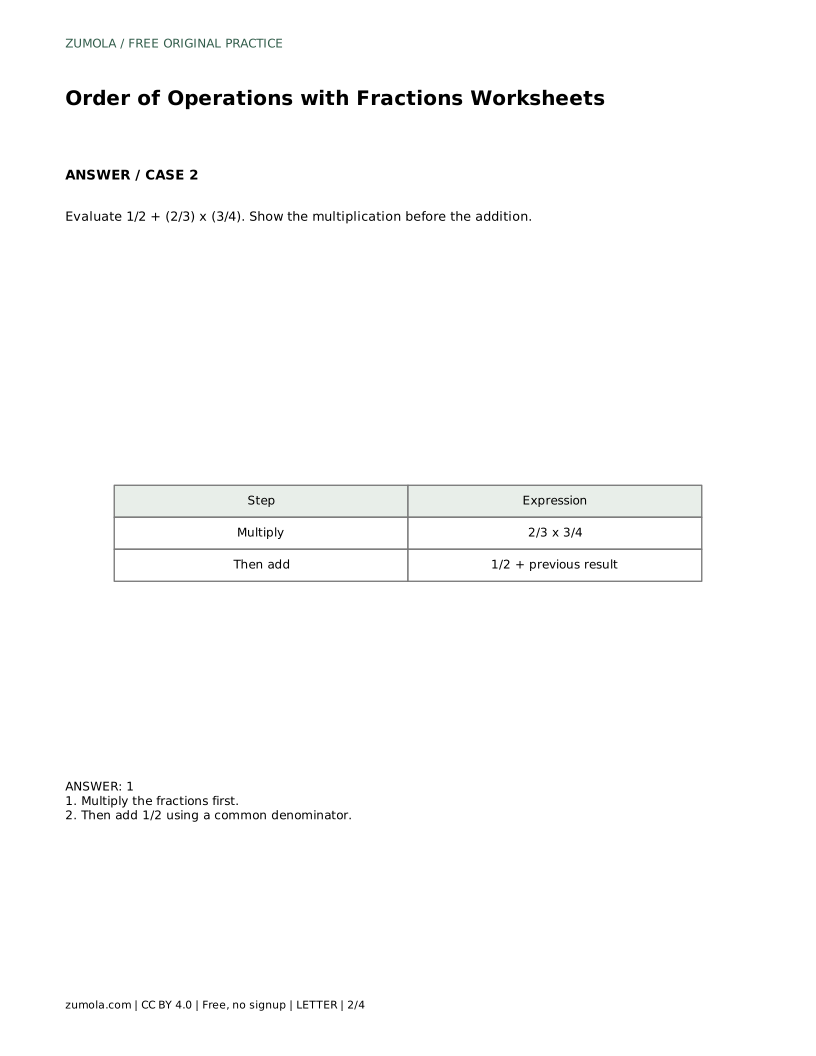
3/4 Multiply the fractions first. Then add 1/2 using a common denominator.
In 1/2 + (1/3) x (3/4), the parentheses reinforce the multiplication grouping. The same order rule applies without them, so the answer is 3/4 either way.
Yes. Cancel common factors between numerators and denominators across the factors, then multiply the reduced values. The result is the same.
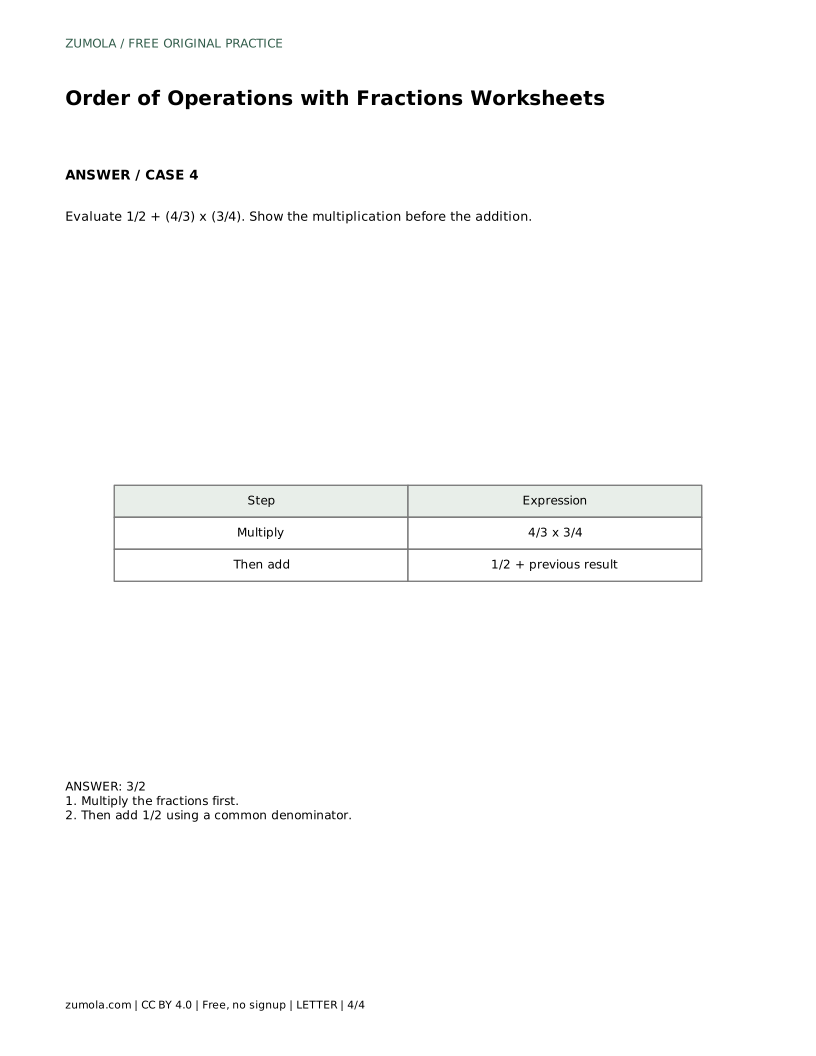
Leave it as an improper fraction or convert it to a mixed number. Both are correct unless the task asks for a specific form.
All math worksheets · Free coordinate paper
Original resources · CC BY 4.0 · Free for personal and classroom use with attribution.