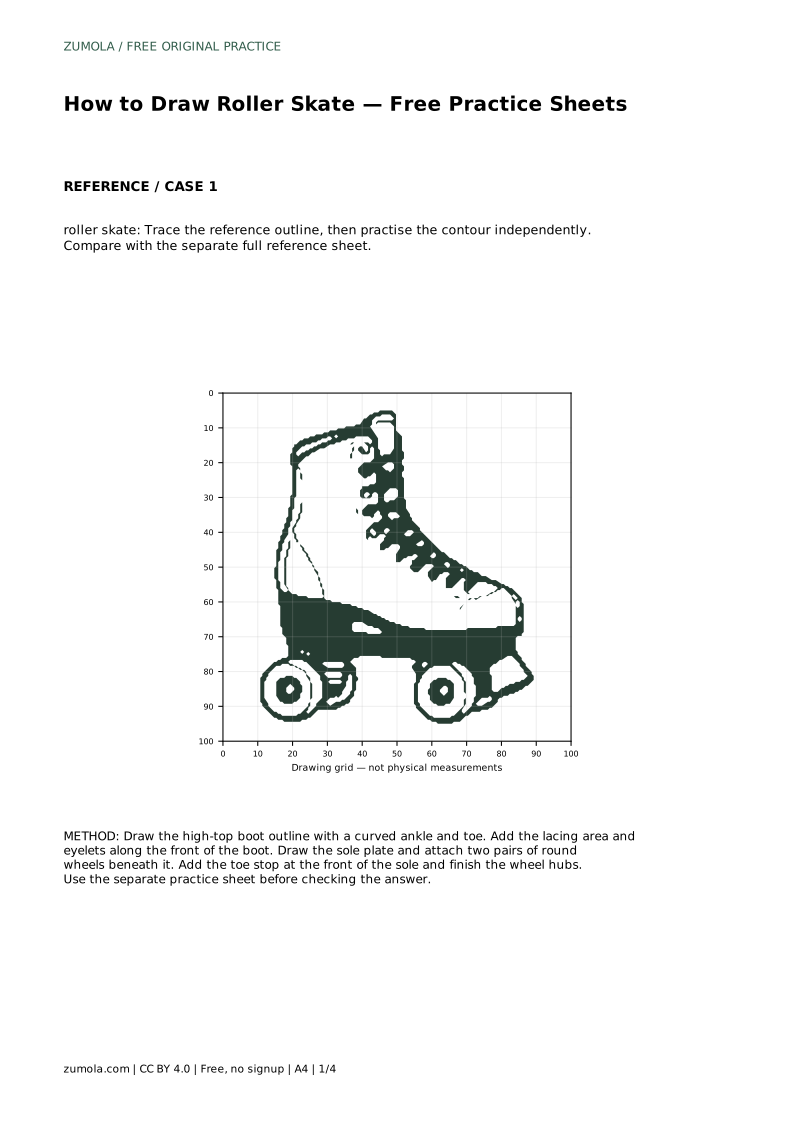
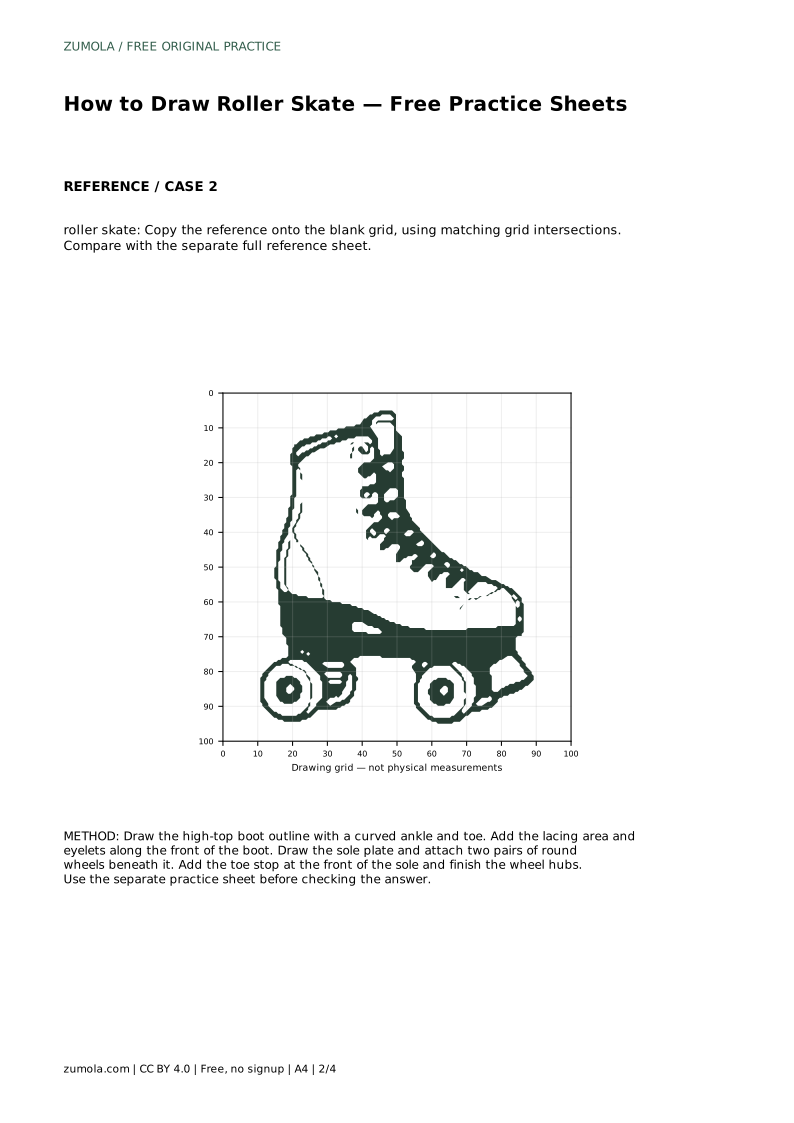
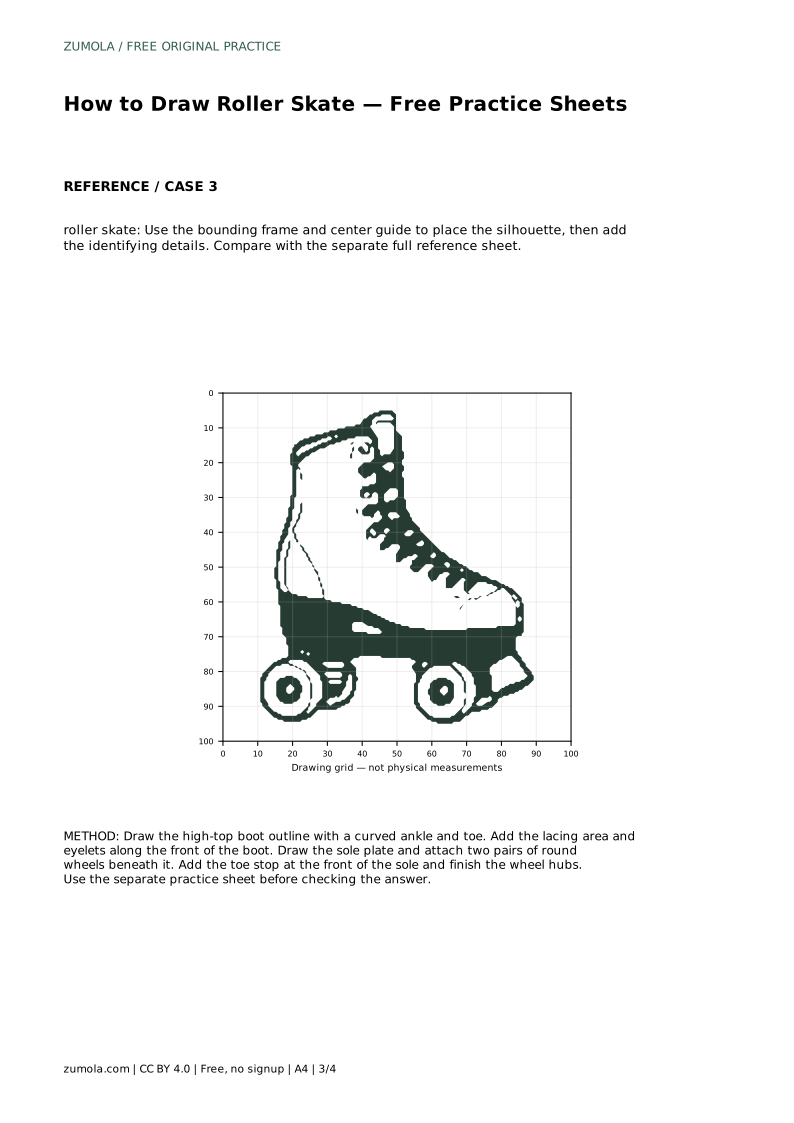
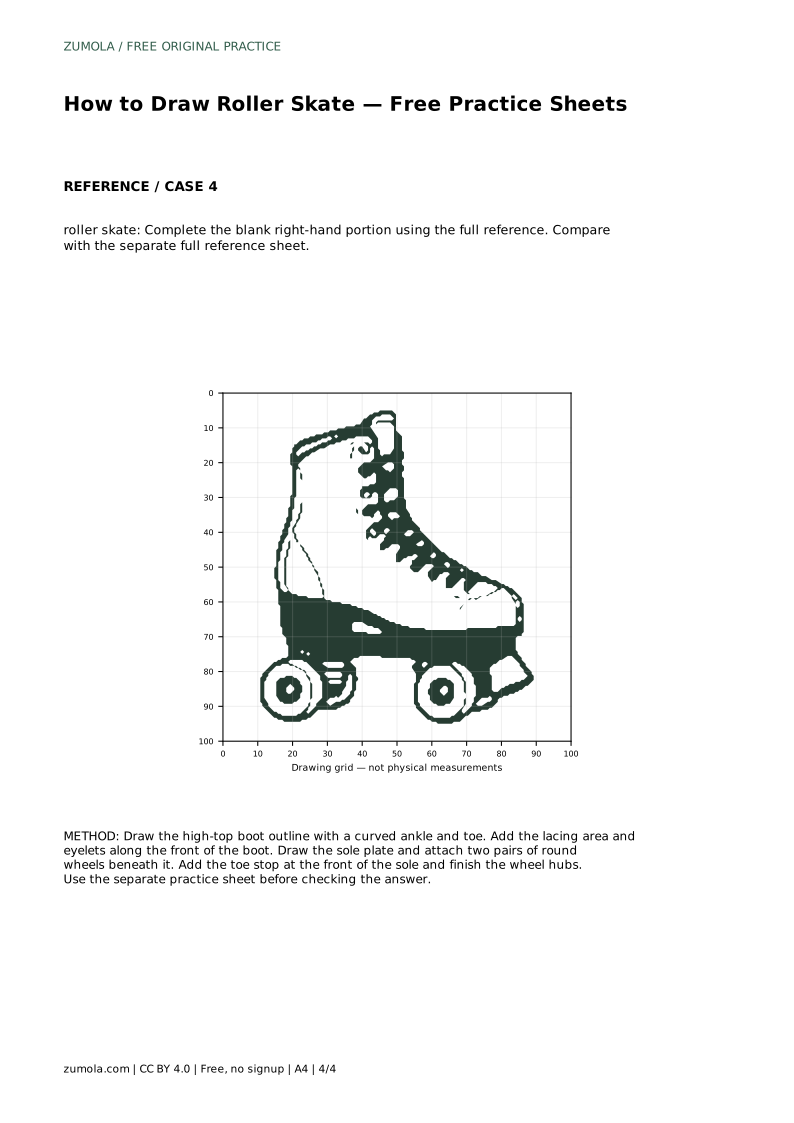
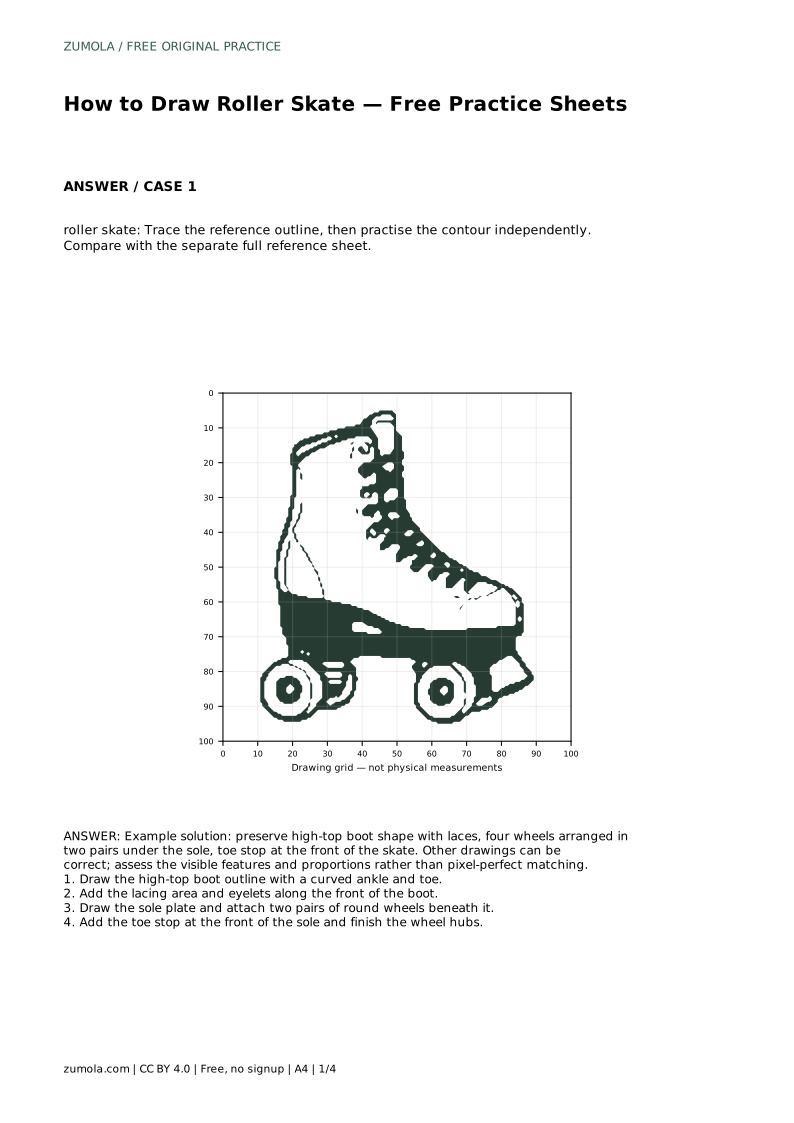
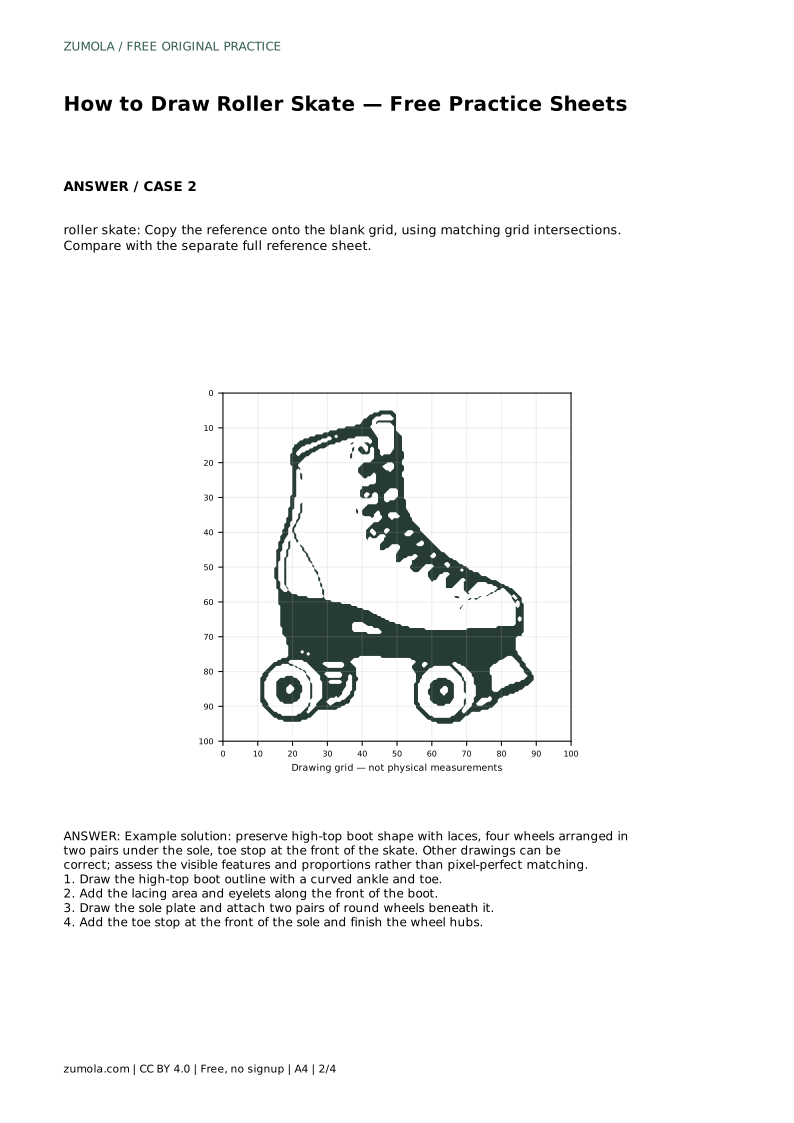
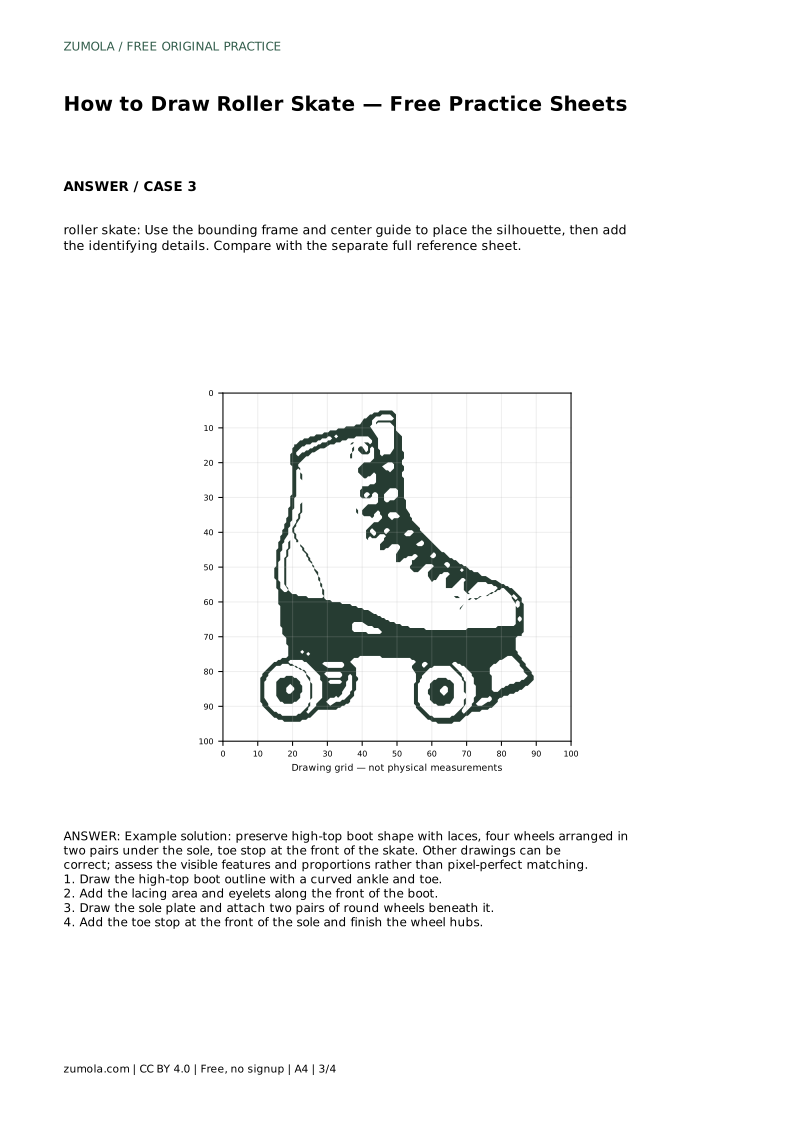
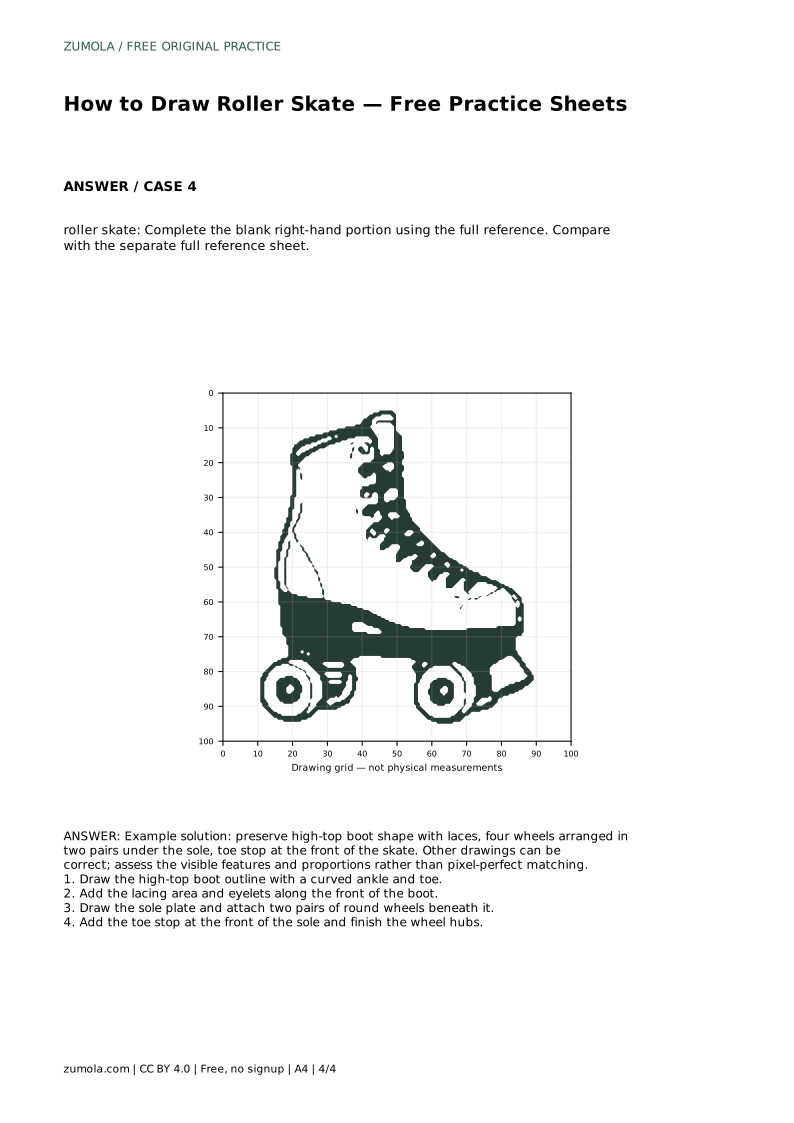
Reference diagrams
LETTER · Download PDF
A4 · Download PDF
Free original resources
Learn to draw a roller skate with a high-top boot, laces, sole plate, two pairs of wheels and a toe stop. Free practice sheets support tracing, grids and guided drawing.
Four original cases, with reference diagrams, practice sheets and worked answers. Everything is free; no signup required.
LETTER · Download PDF
A4 · Download PDF
LETTER · Download PDF
A4 · Download PDF
LETTER · Download PDF
A4 · Download PDF
Use A4 or US Letter to match your printer. Use the stated values and conditions to solve each exercise; diagrams are not physical measuring rulers.
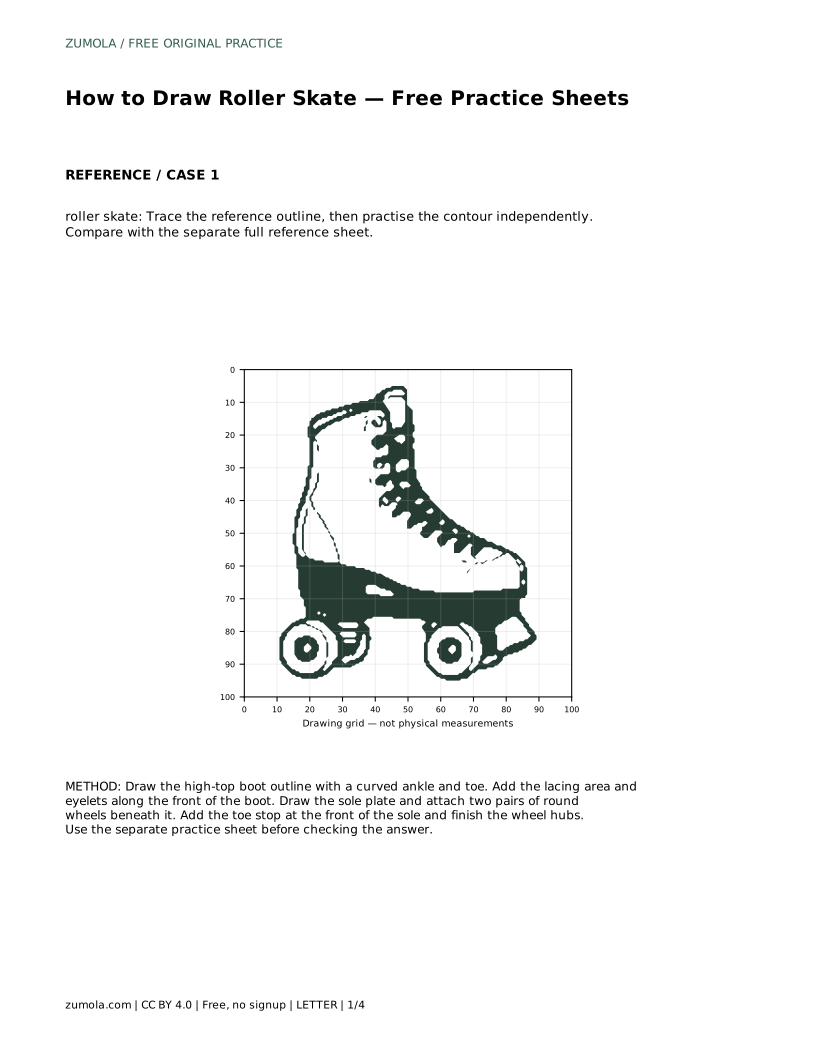
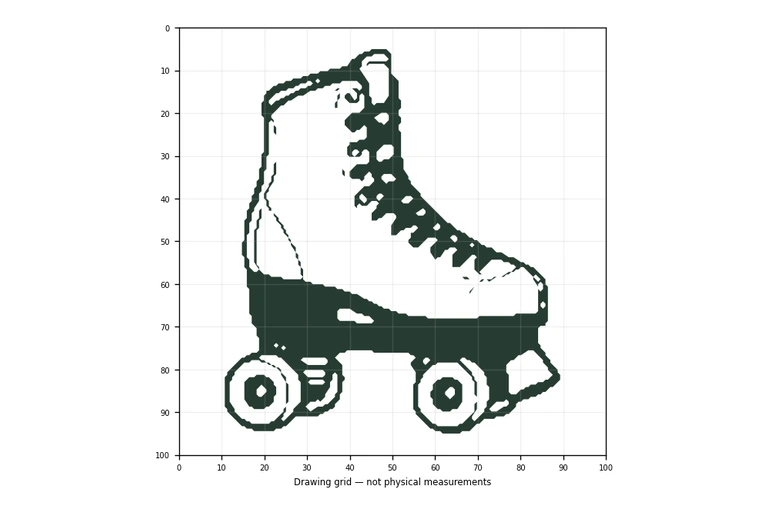
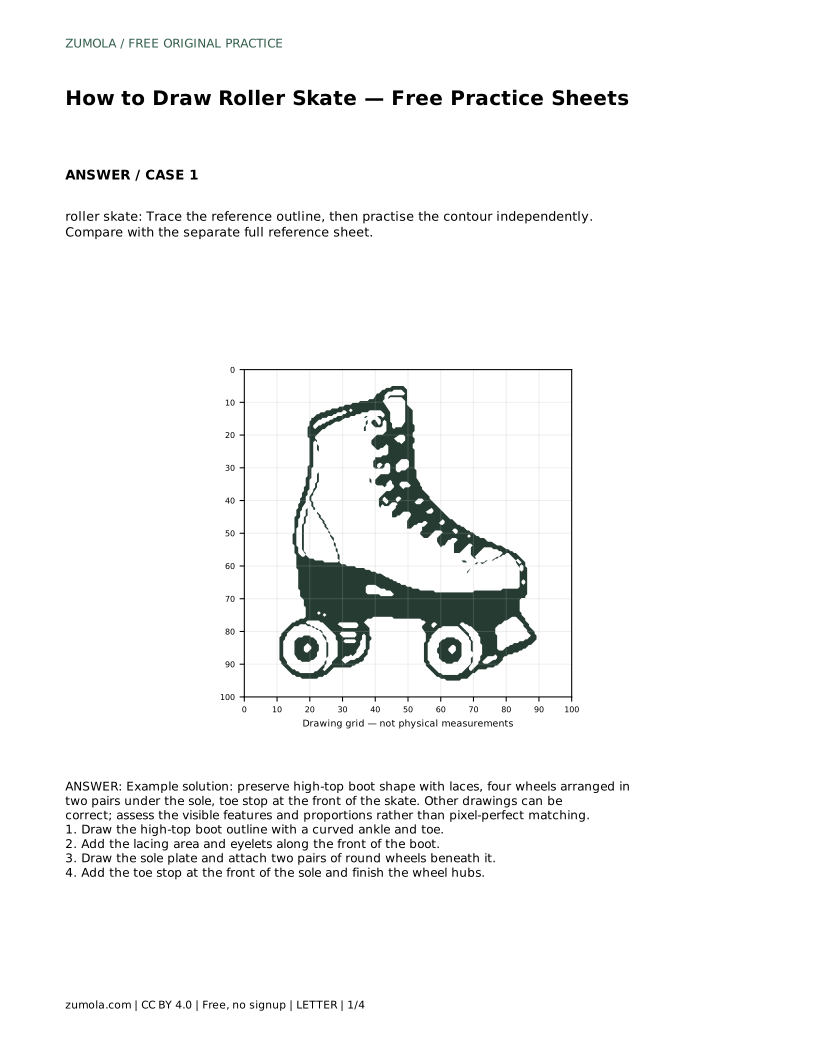
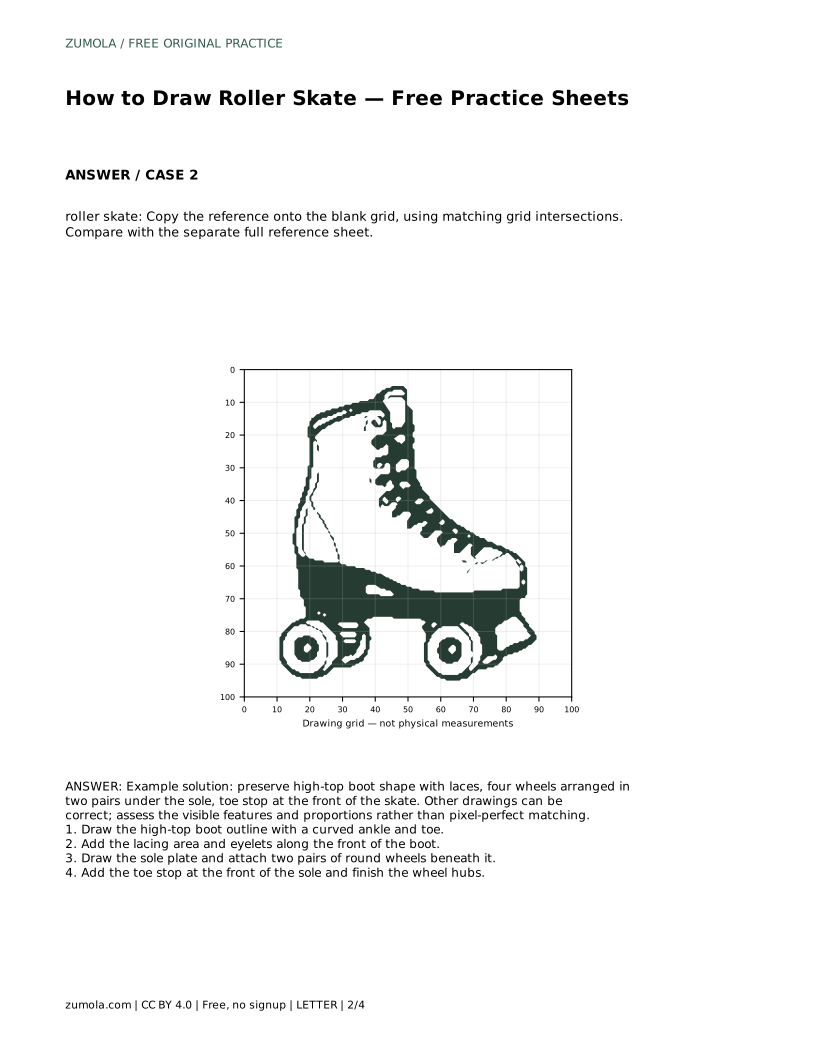
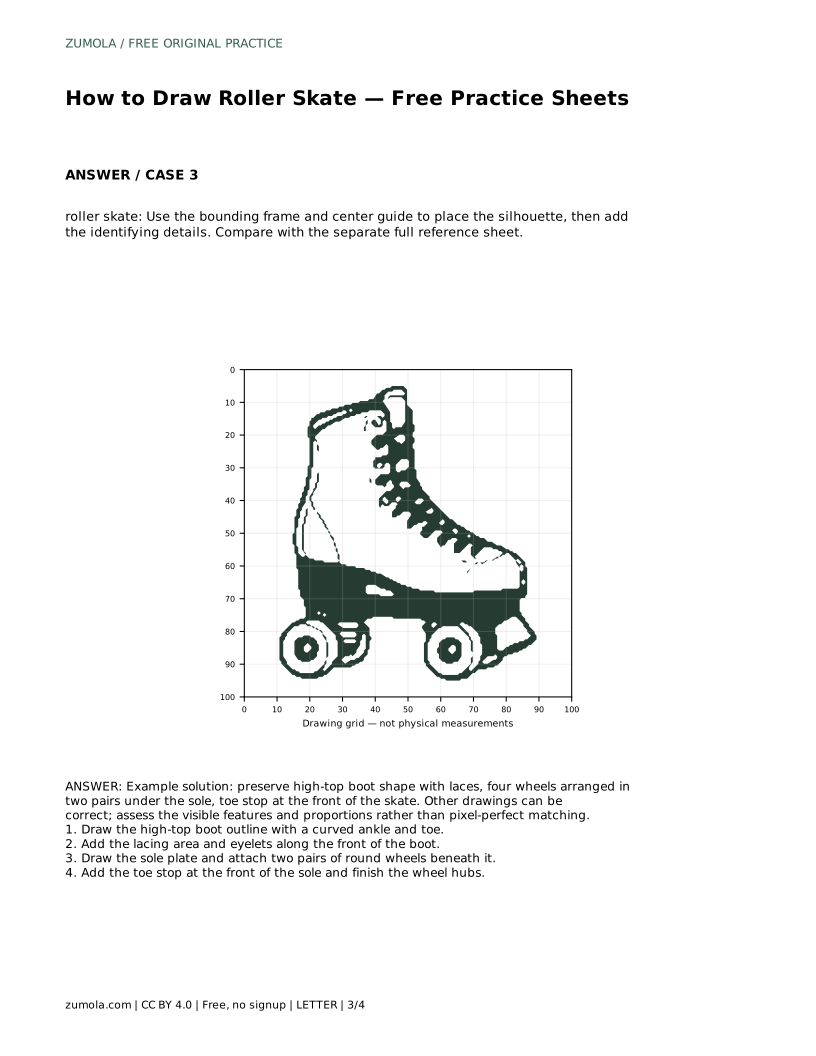
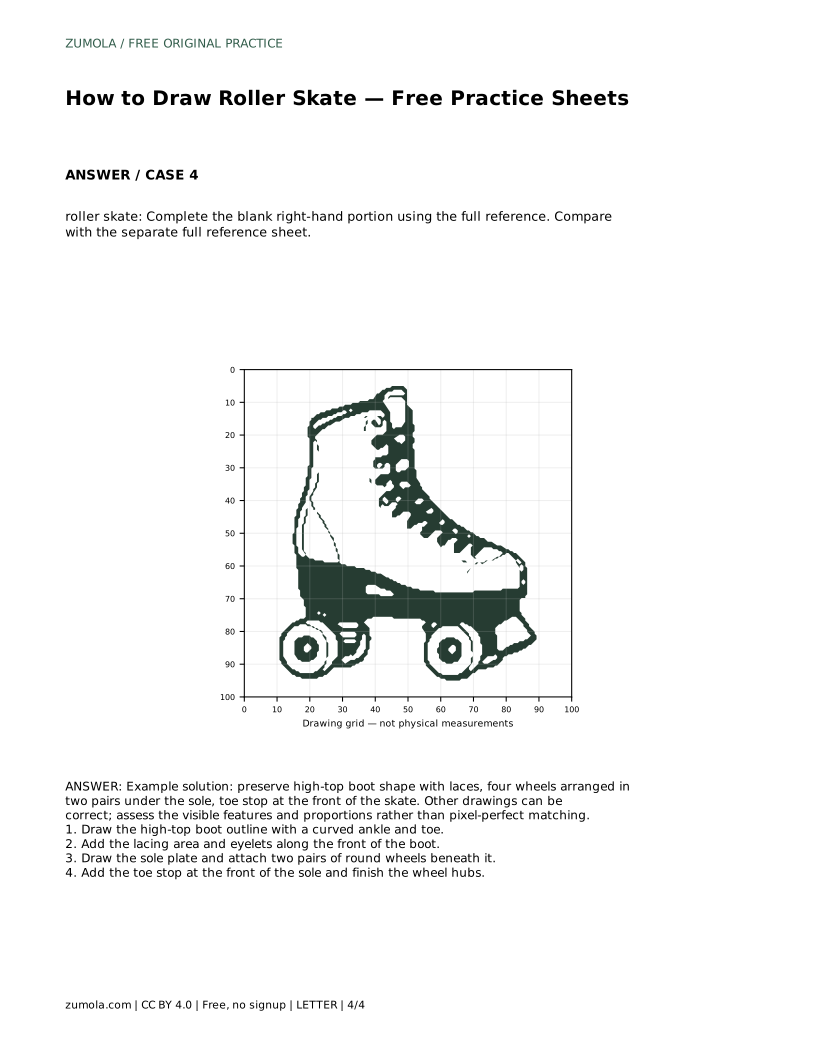
A roller skate is a friendly drawing subject because its parts are easy to name and check: a high-top boot, a laced front, a flat sole plate, four wheels in two pairs, and a toe stop at the front. This page explains how to build those parts in order, then how to use the free practice sheets to trace, copy and complete the same drawing. The goal is a clear, recognizable skate, not a pixel-perfect copy.
Begin with the largest shape: the boot. Draw a high-top outline that rises above the ankle, curves around the heel, and slopes forward to a rounded toe. Keep the opening at the top wide enough to read as a boot rather than a sock. A light center line down the front helps you place the lacing area later.
Check the silhouette before adding details. The boot should look tall at the back and lower at the front, with a smooth curve from ankle to toe. If the shape feels too narrow, widen the toe slightly; if it feels too tall, lower the top edge. Small adjustments now prevent awkward changes once the wheels are attached.
Along the front guide, draw the lacing area as two parallel edges. Add small eyelets on each side and simple crossed lace lines between them. Keep the laces short and evenly spaced so the boot stays readable.
Next, draw the sole plate as a flat band under the boot, following the boot's bottom edge. Beneath the plate, place four round wheels in two pairs: one pair toward the front and one toward the back. Leave a small gap between the pairs. Finish each wheel with a center hub, and add the toe stop as a small rounded block at the front of the sole.
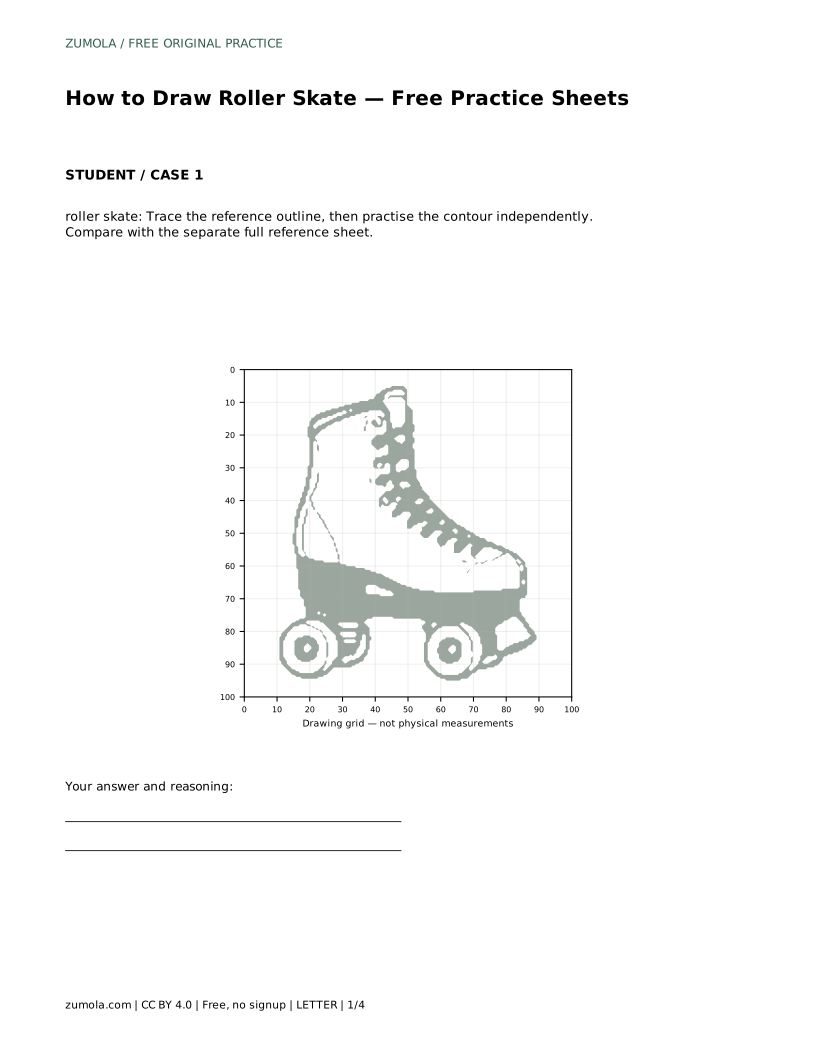
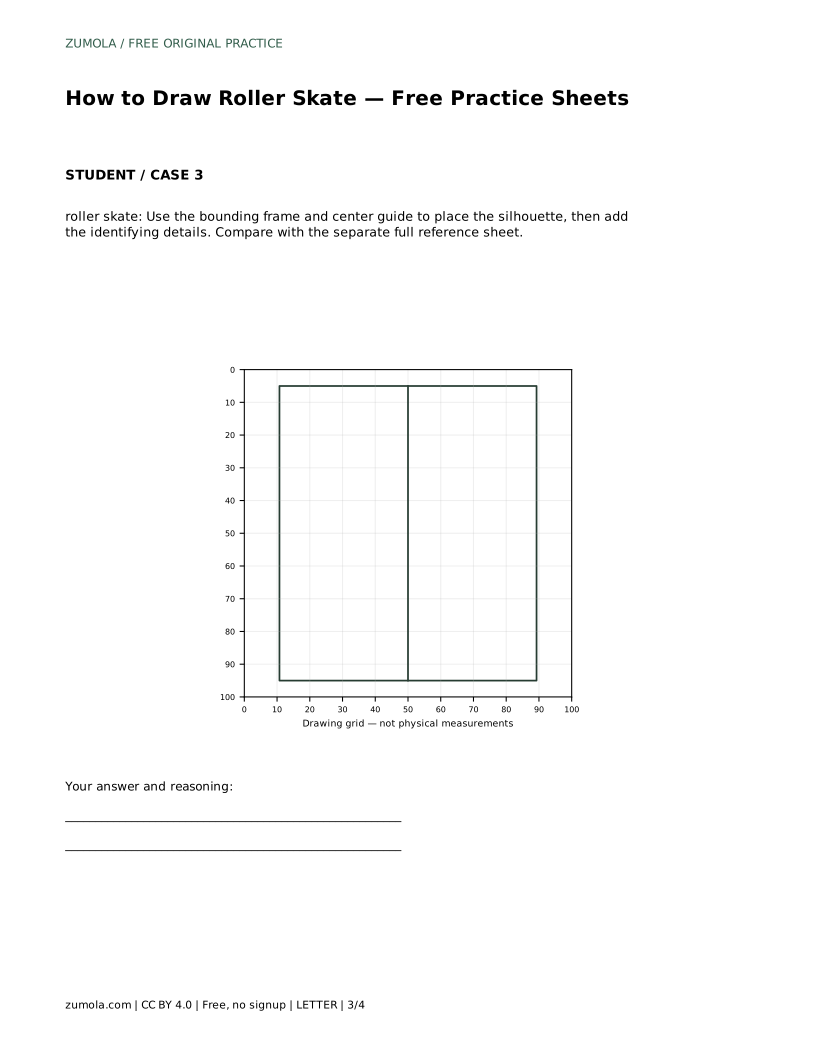
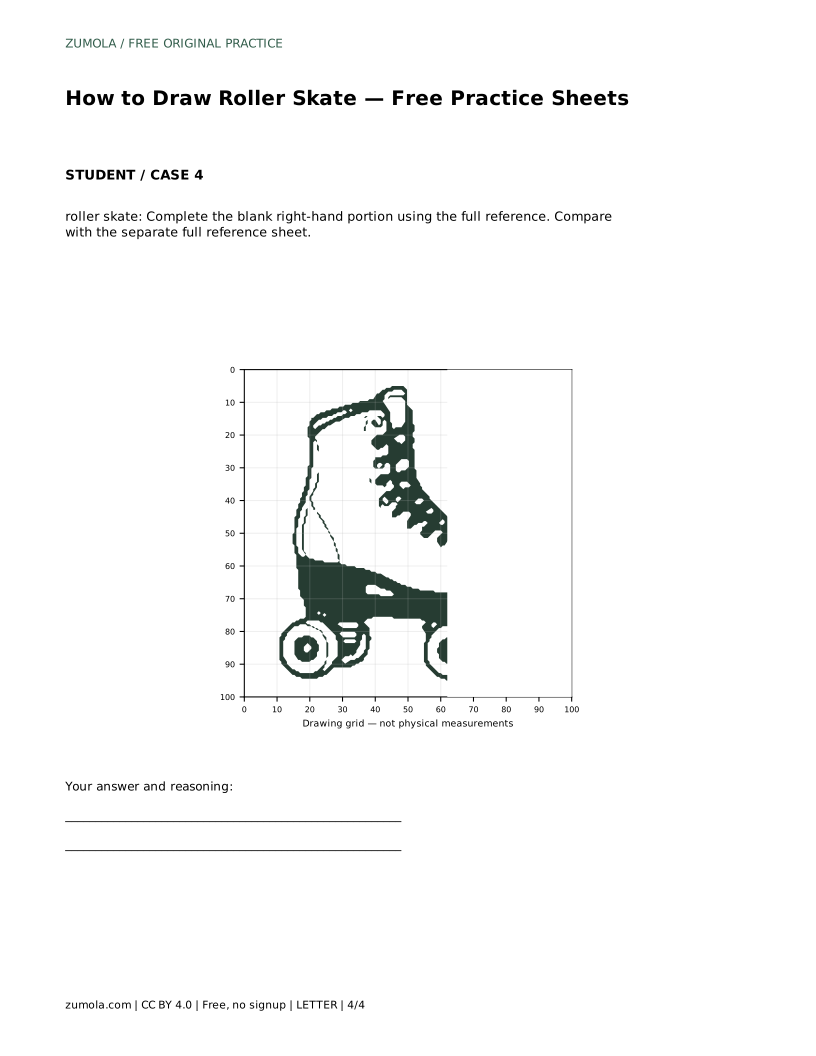
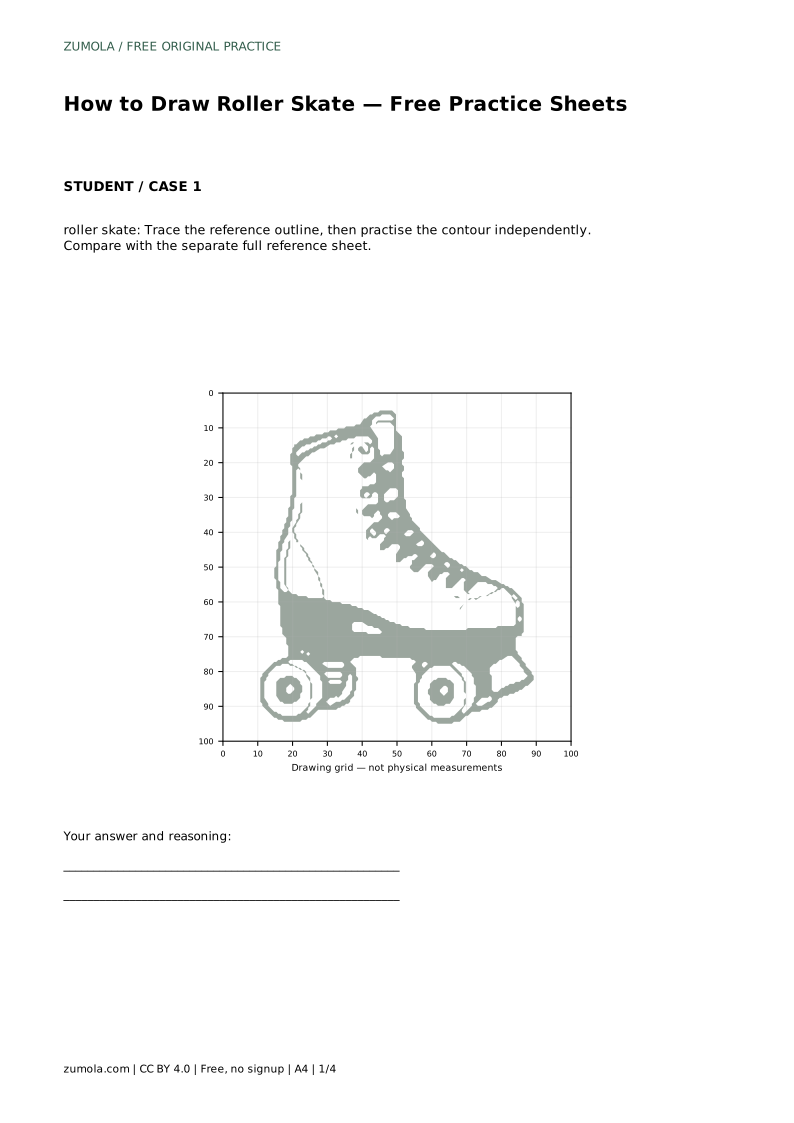
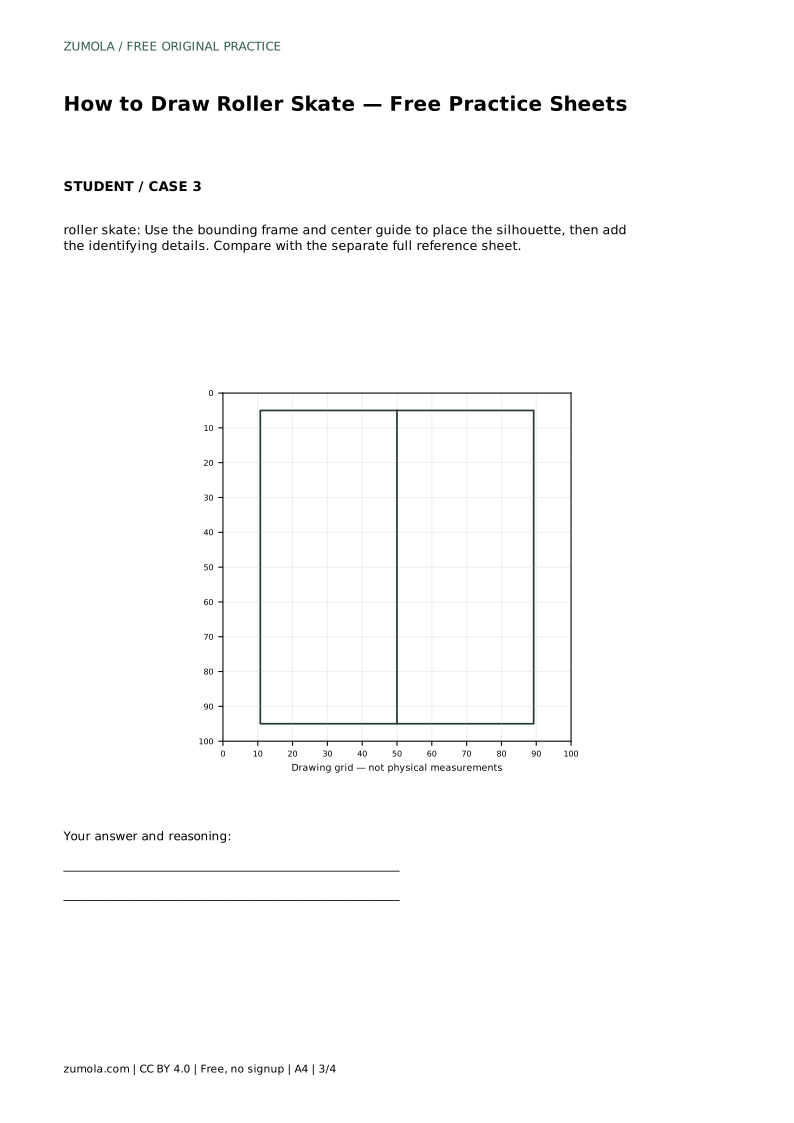
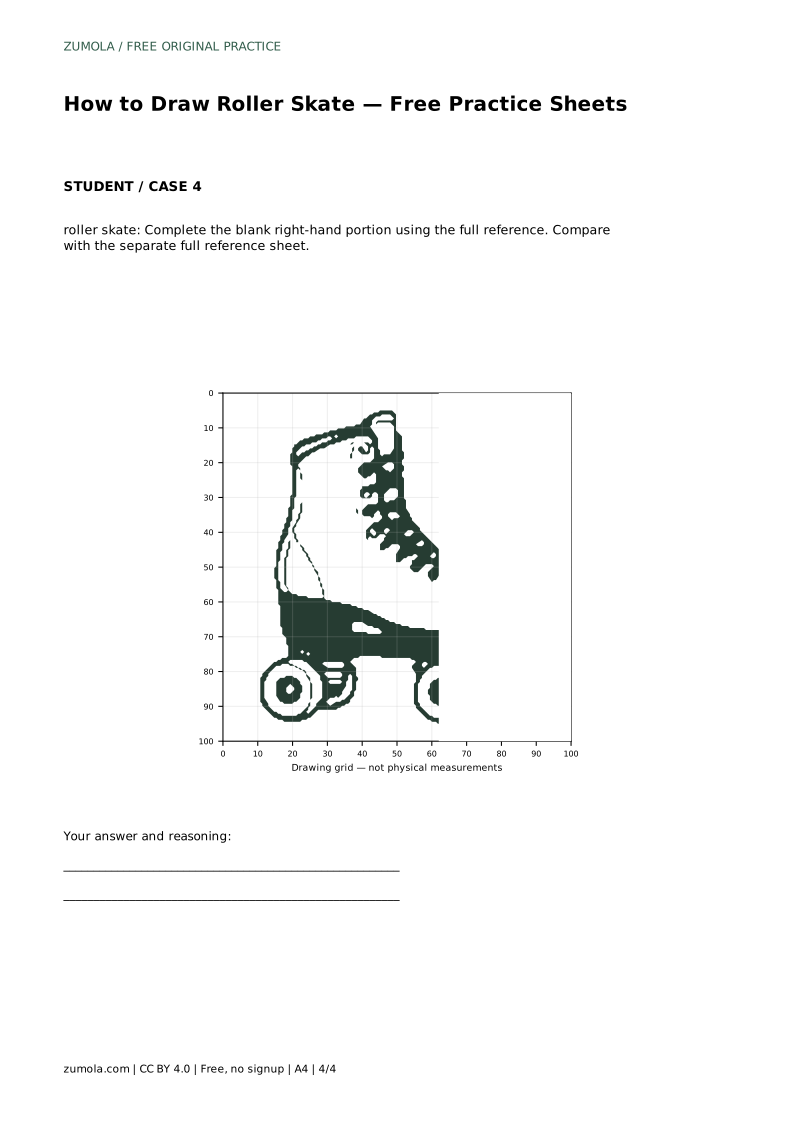
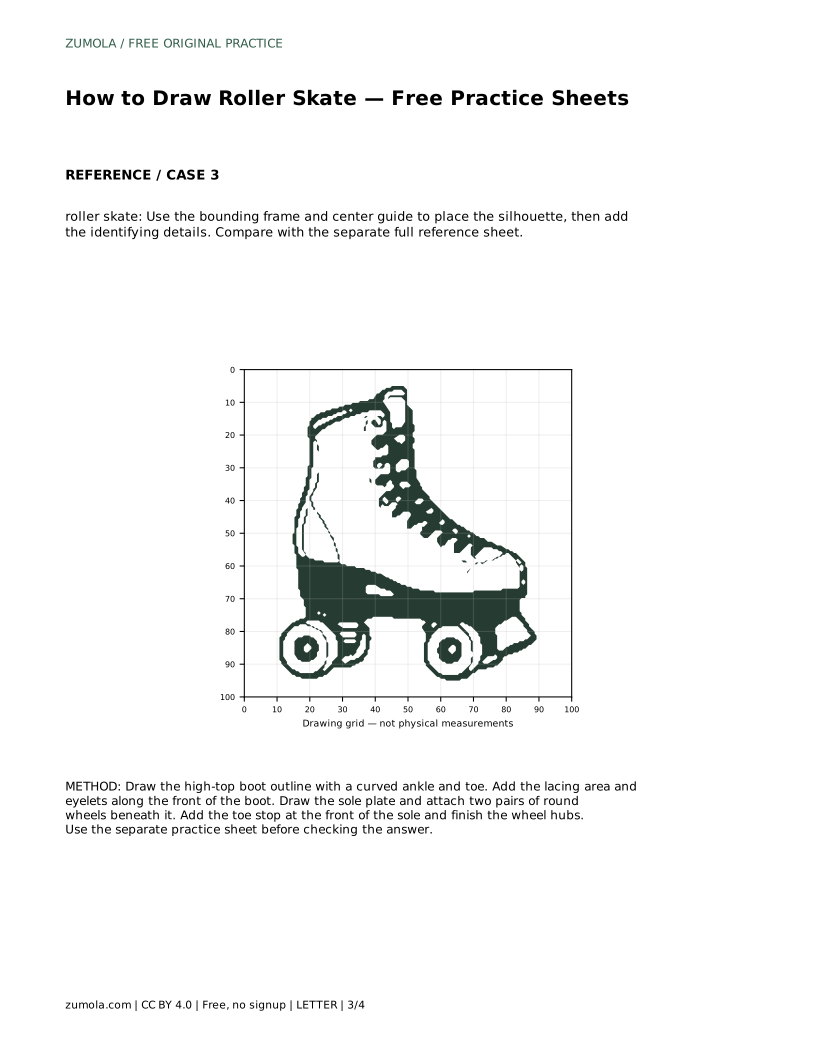
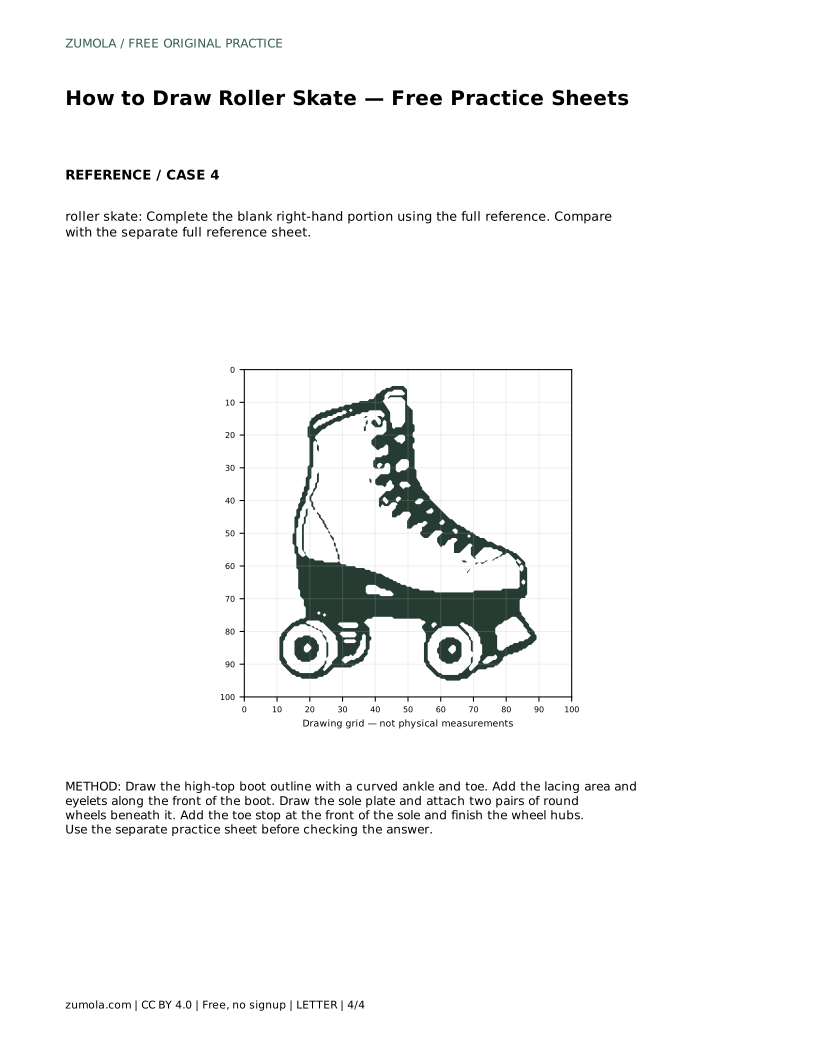
The sheets offer different levels of support. One asks you to trace the reference outline, then practise the contour independently. Another uses a blank grid so you can copy the reference at matching grid intersections. A third provides a bounding frame and center guide to place the silhouette before adding details. A fourth leaves the right-hand portion blank so you complete it from the full reference.
After each attempt, compare your drawing with the separate full reference sheet. Look for the high-top boot shape, the laced front, the sole plate, two pairs of wheels and the toe stop. Different line styles and small proportion changes are fine; what matters is that the identifying features are present and clearly placed.
A common problem is making the wheels too large or too small relative to the boot. As a simple guide, each wheel can be roughly one-quarter the height of the boot, and the two pairs should sit under the middle and back of the sole. The toe stop belongs at the very front, not under the heel.
Another useful check is balance: the boot should sit centered over the wheels, not tipped far forward or back. If the sole plate looks curved, straighten it slightly so the wheels have a clear base. These checks keep the drawing stable and easy to read.
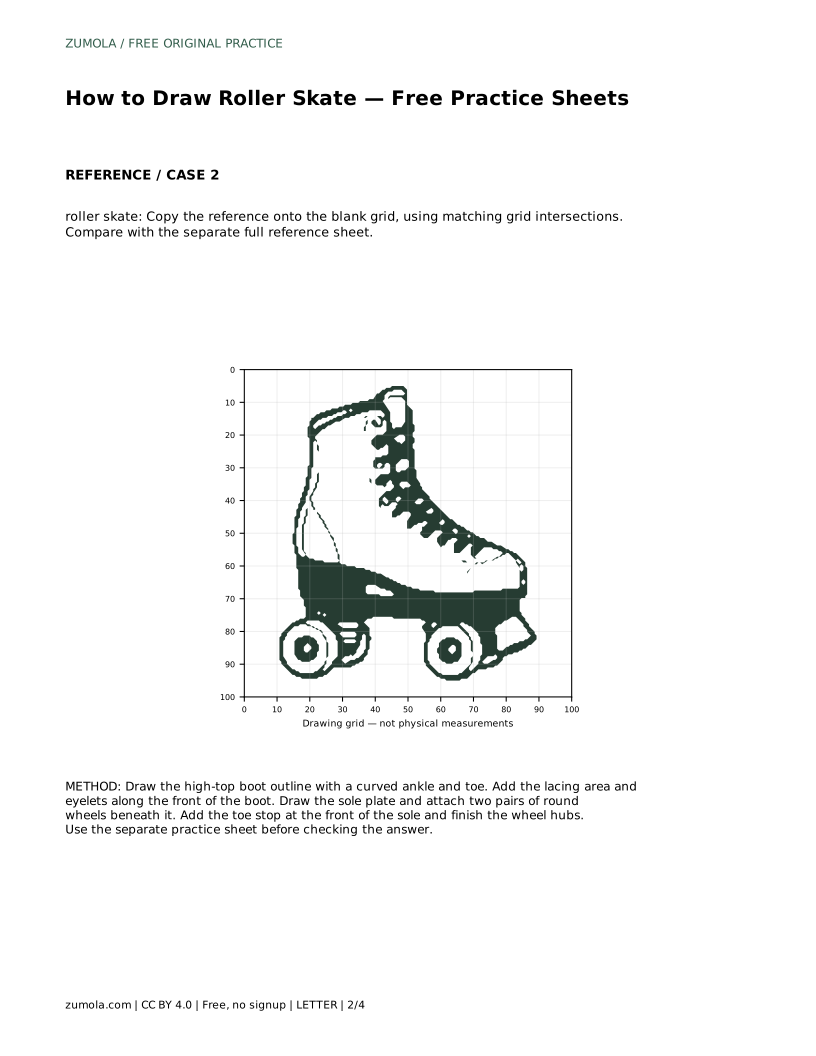
roller skate: Trace the reference outline, then practise the contour independently. Compare with the separate full reference sheet.
Example solution: preserve high-top boot shape with laces, four wheels arranged in two pairs under the sole, toe stop at the front of the skate. Other drawings can be correct; assess the visible features and proportions rather than pixel-perfect matching. Draw the high-top boot outline with a curved ankle and toe. Add the lacing area and eyelets along the front of the boot. Draw the sole plate and attach two pairs of round wheels beneath it. Add the toe stop at the front of the sole and finish the wheel hubs.
No. Use the reference to check the main features and proportions. Small differences in line style and shape are acceptable as long as the skate is recognizable.
Start with the tracing sheet if you are new to the shape. Move to the grid or bounding-frame sheet when you can draw the outline without tracing.
Check the boot silhouette, then the lacing area, sole plate, two wheel pairs and toe stop. Fix the largest shape before adjusting small details.
All drawing practice · Free coordinate paper
Original resources · CC BY 4.0 · Free for personal and classroom use with attribution.