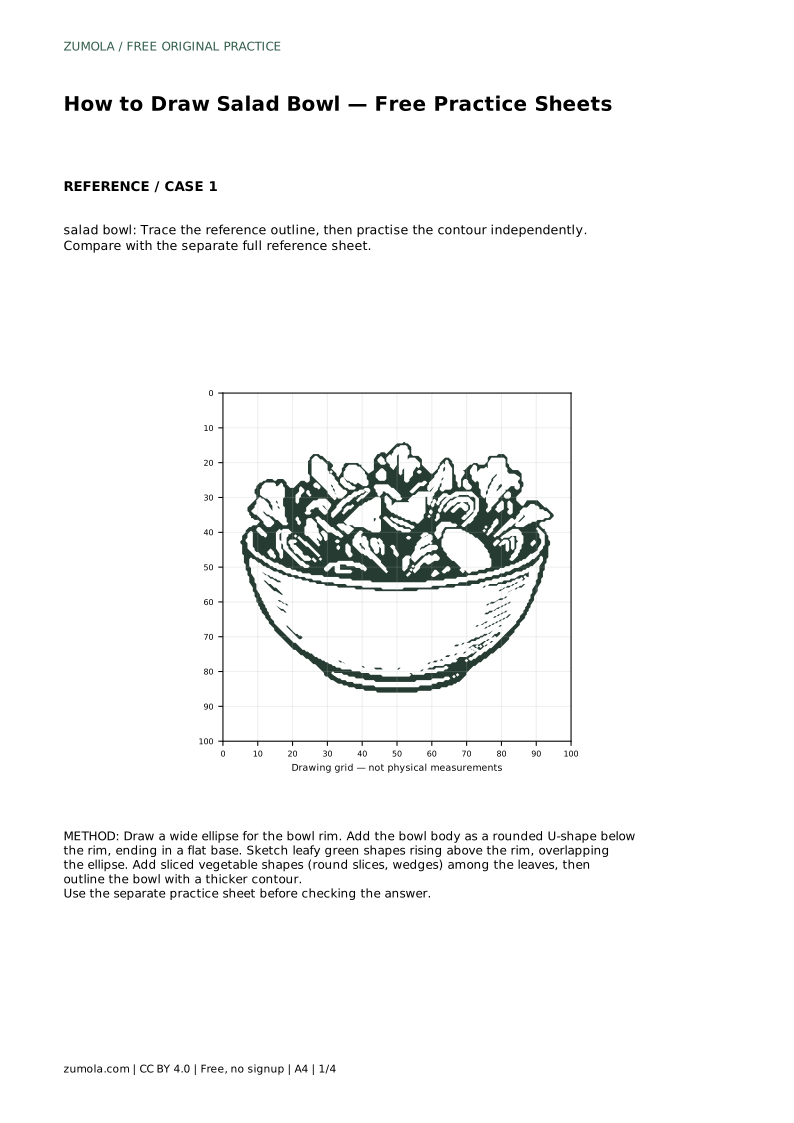
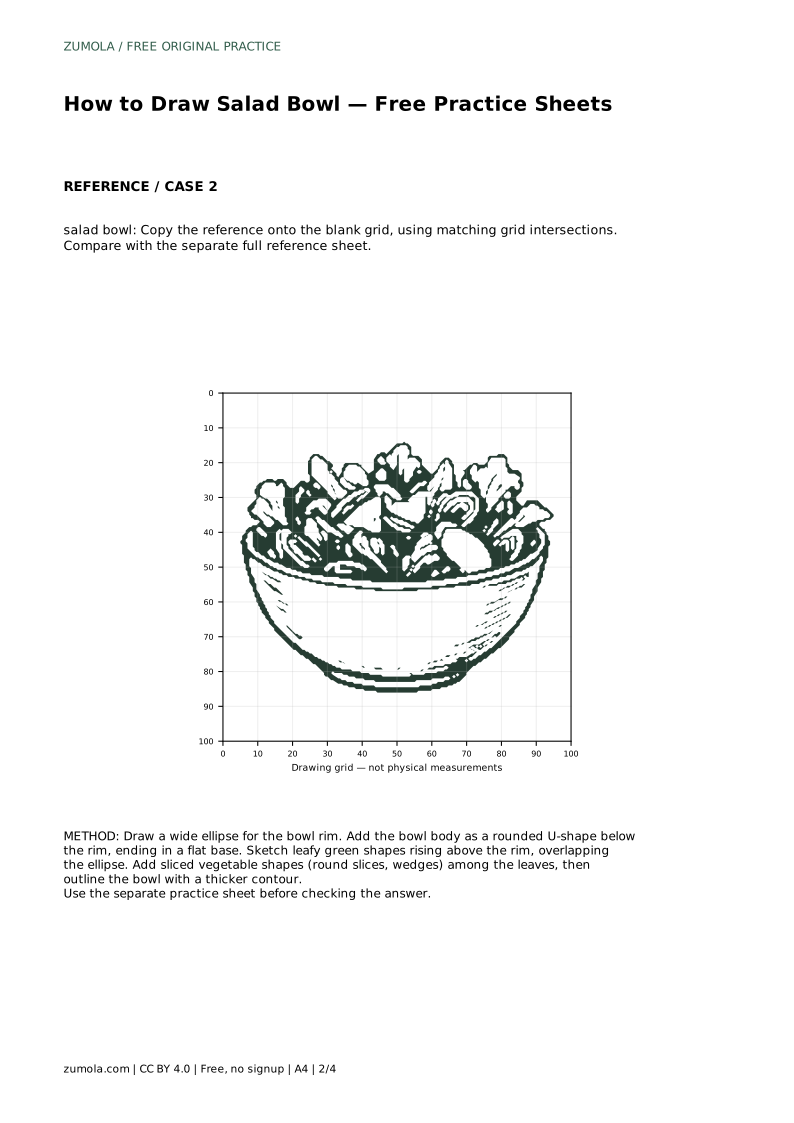
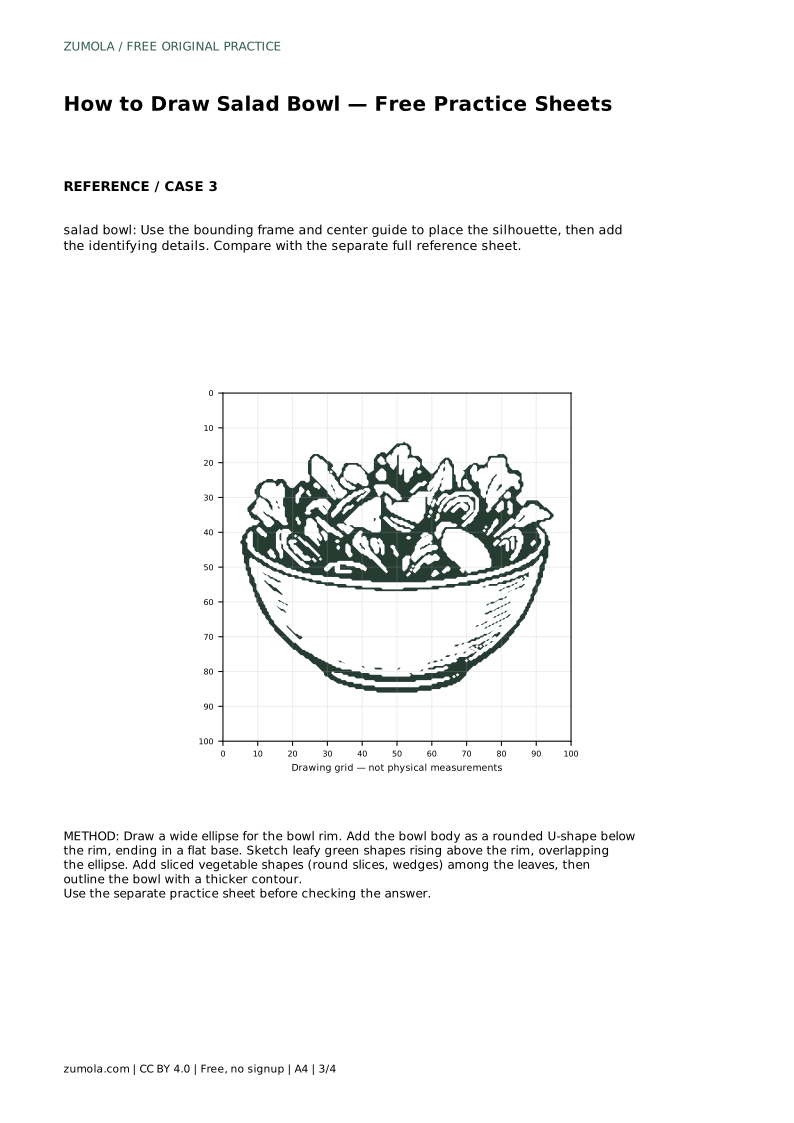
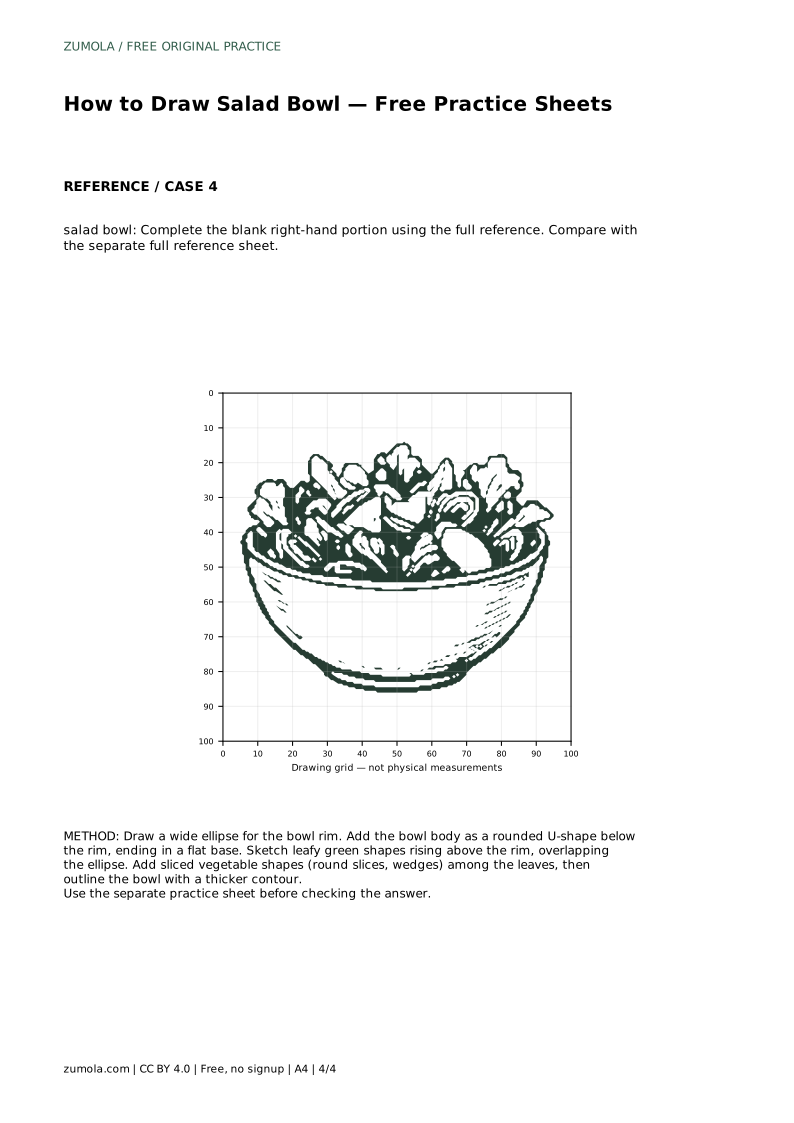
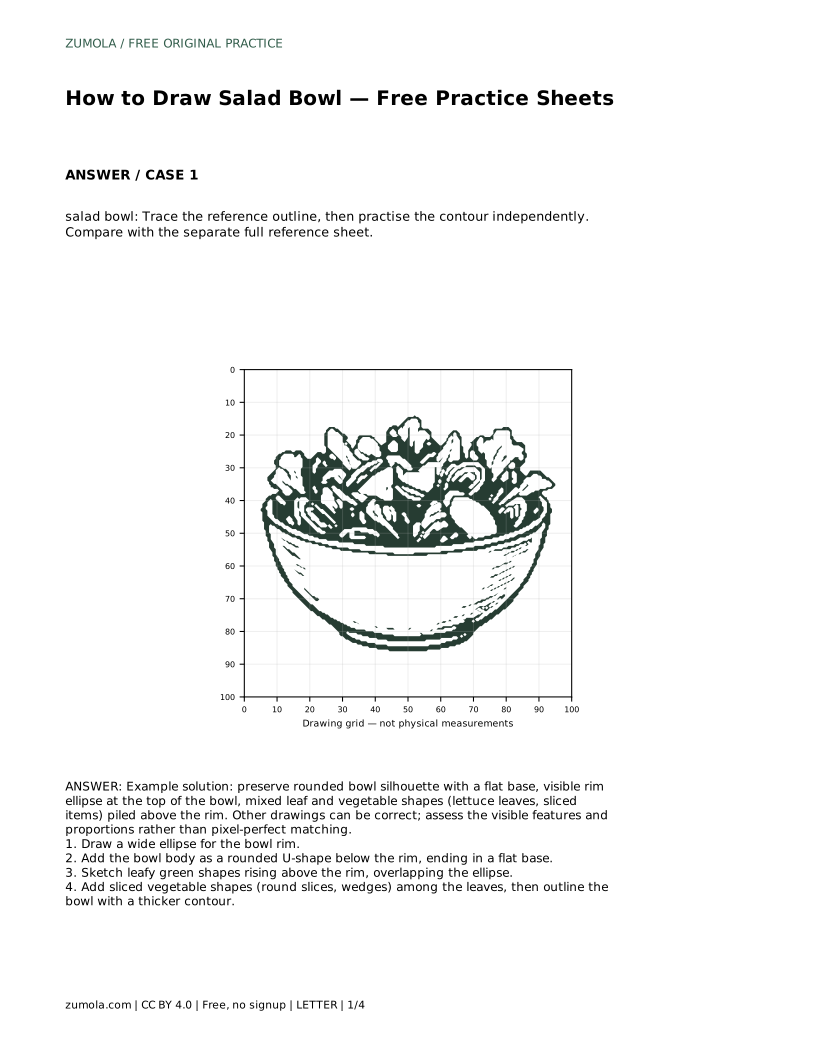
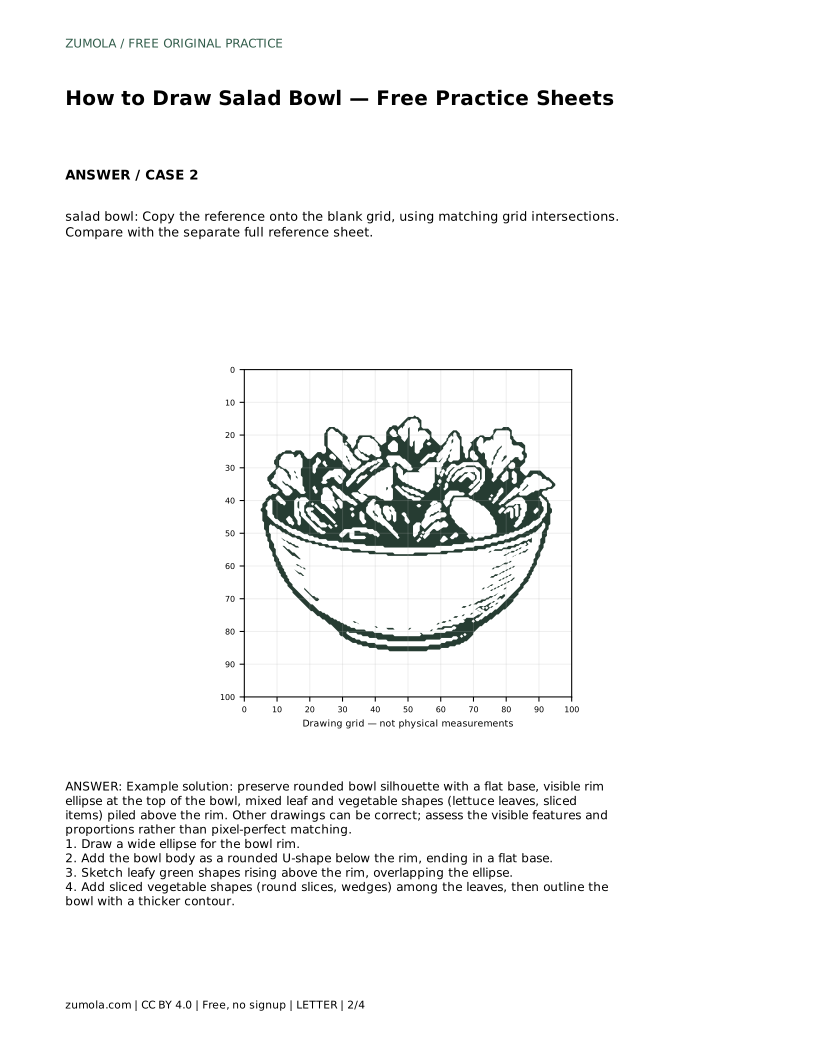
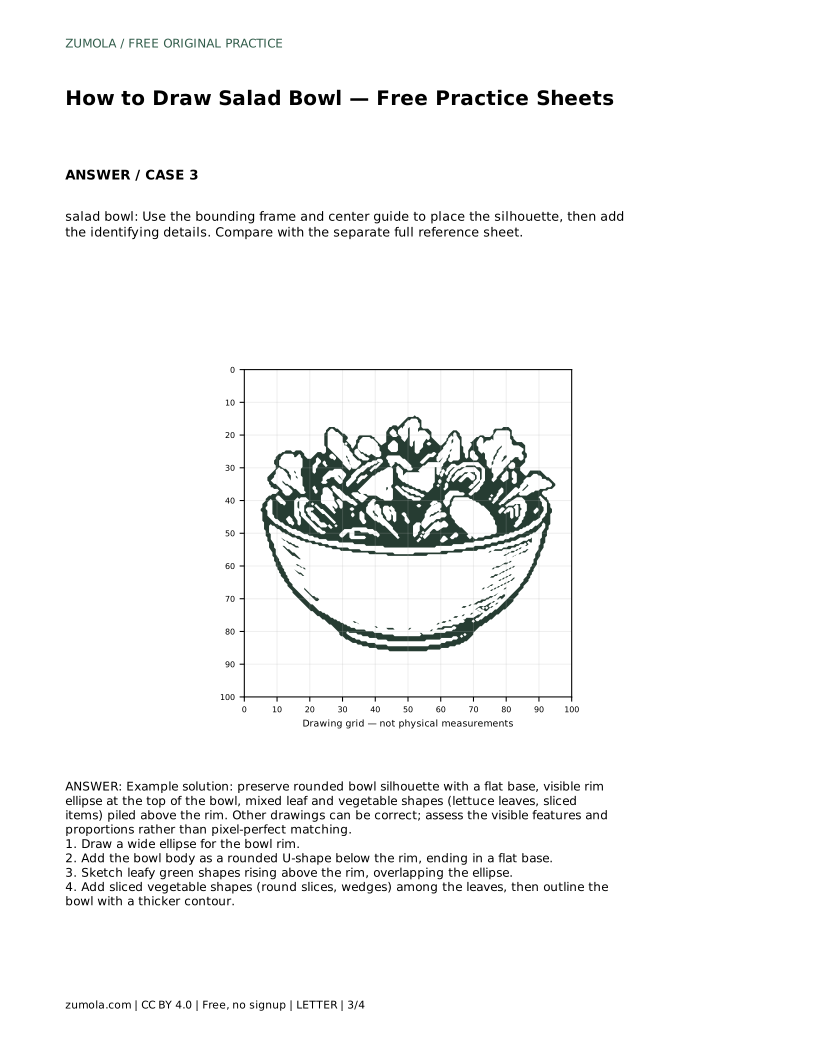
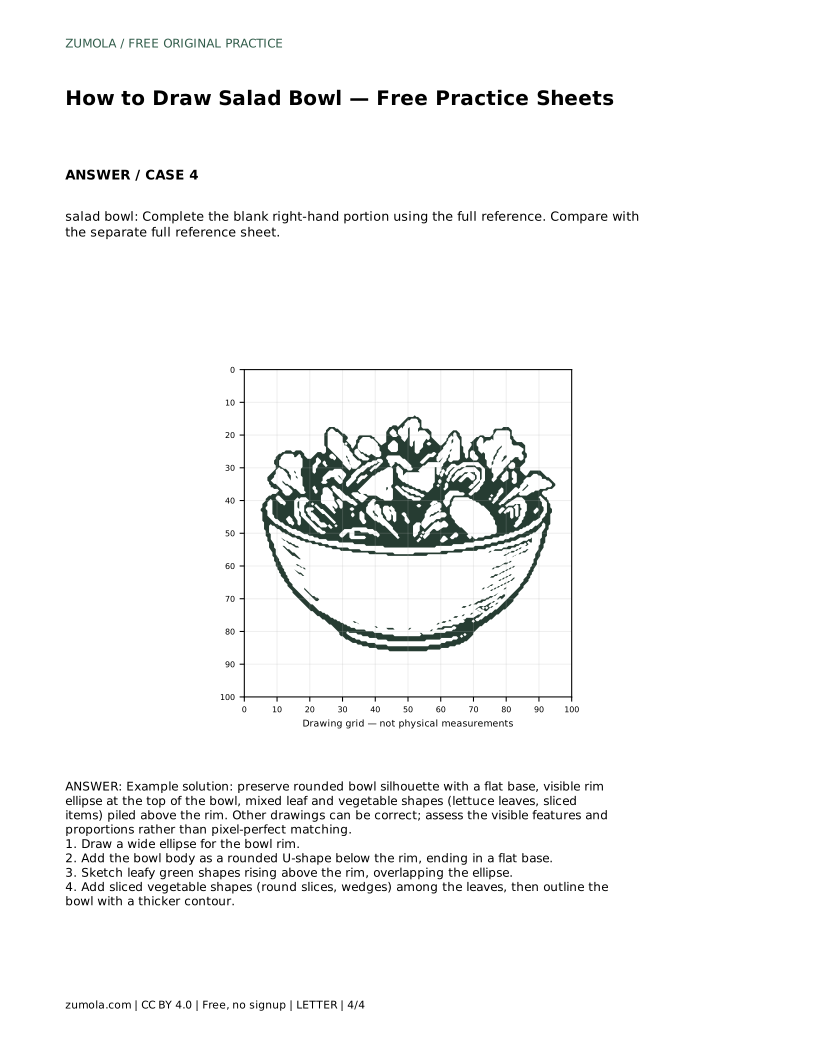
Reference diagrams
LETTER · Download PDF
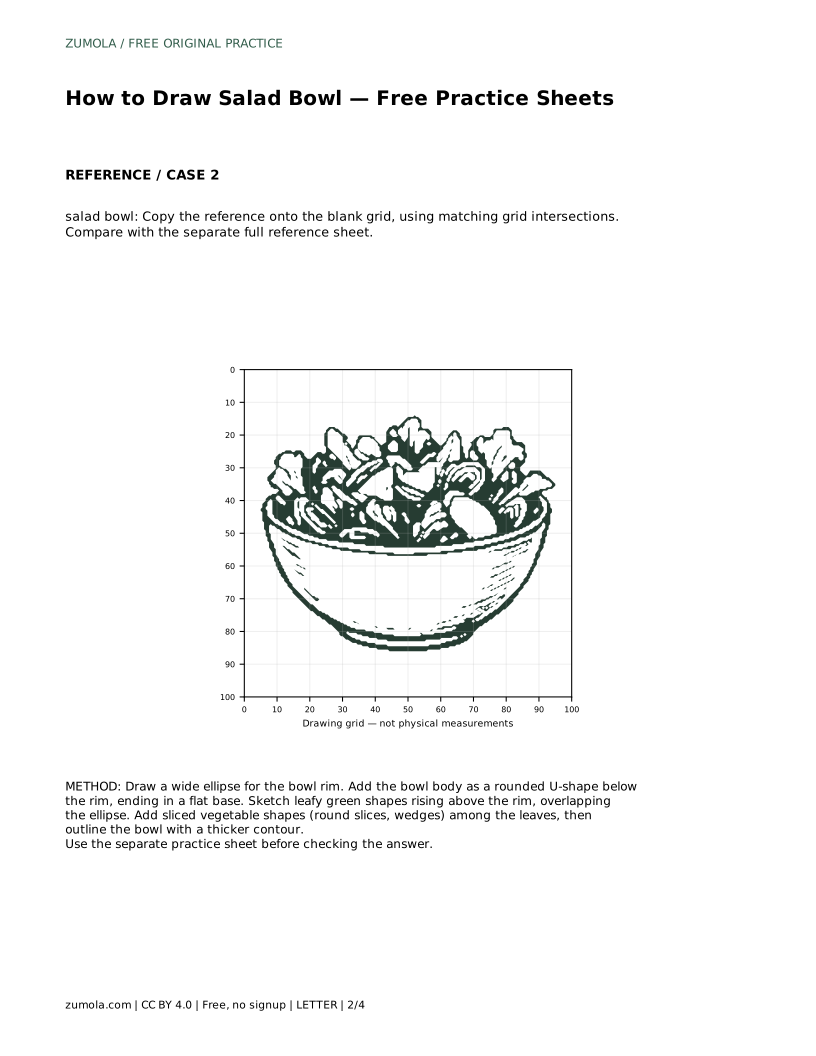
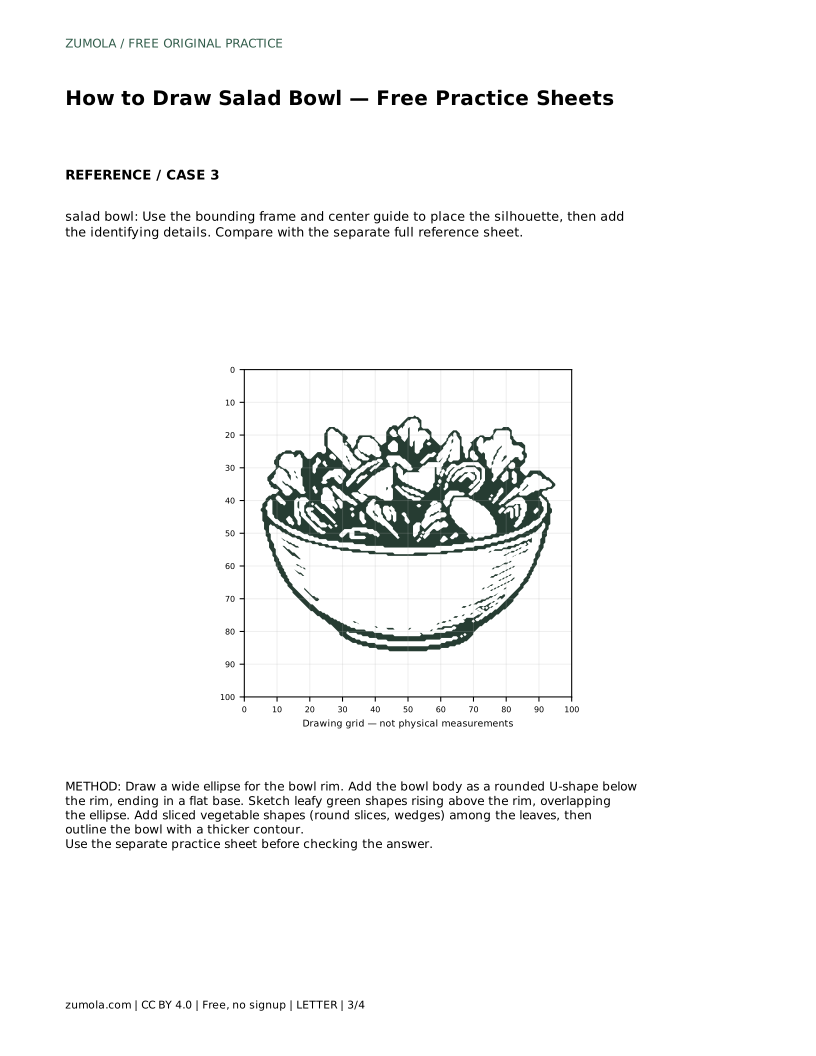
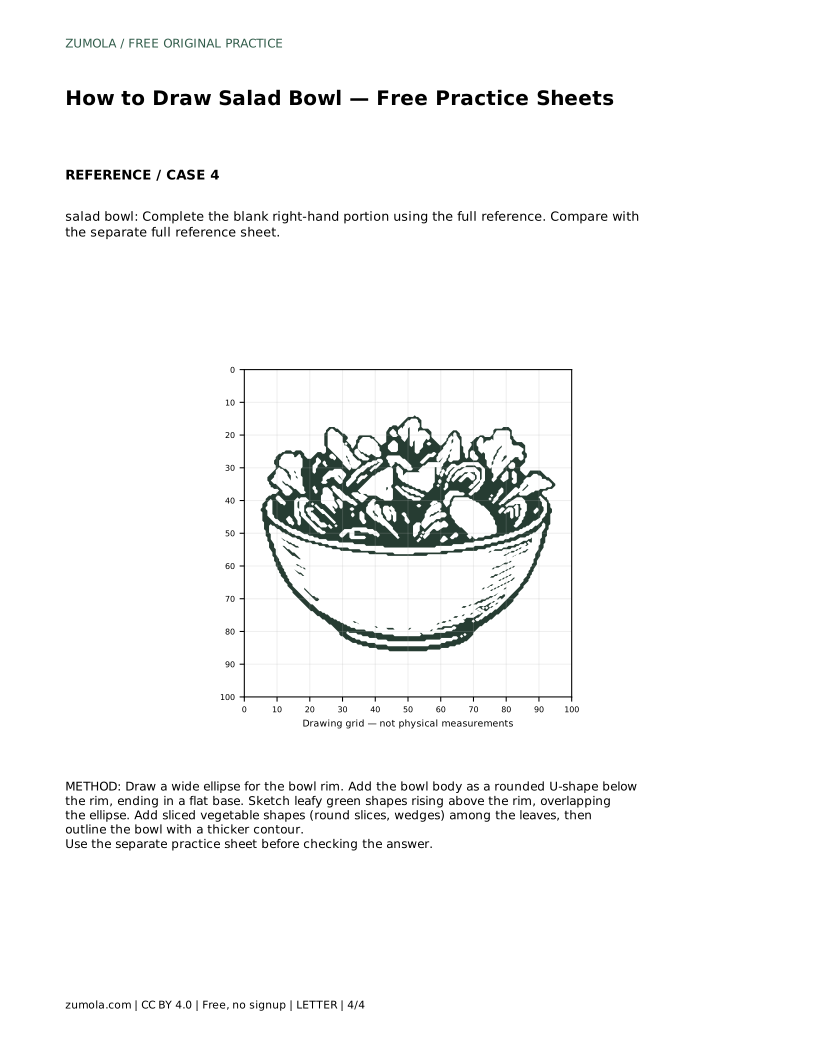
A4 · Download PDF
Free original resources
Learn to draw a salad bowl with a wide rim ellipse, rounded body, flat base, and layered leaves and vegetable slices. Includes practice guidance and a rubric.
Four original cases, with reference diagrams, practice sheets and worked answers. Everything is free; no signup required.
LETTER · Download PDF
A4 · Download PDF
LETTER · Download PDF
A4 · Download PDF
LETTER · Download PDF
A4 · Download PDF
Use A4 or US Letter to match your printer. Use the stated values and conditions to solve each exercise; diagrams are not physical measuring rulers.
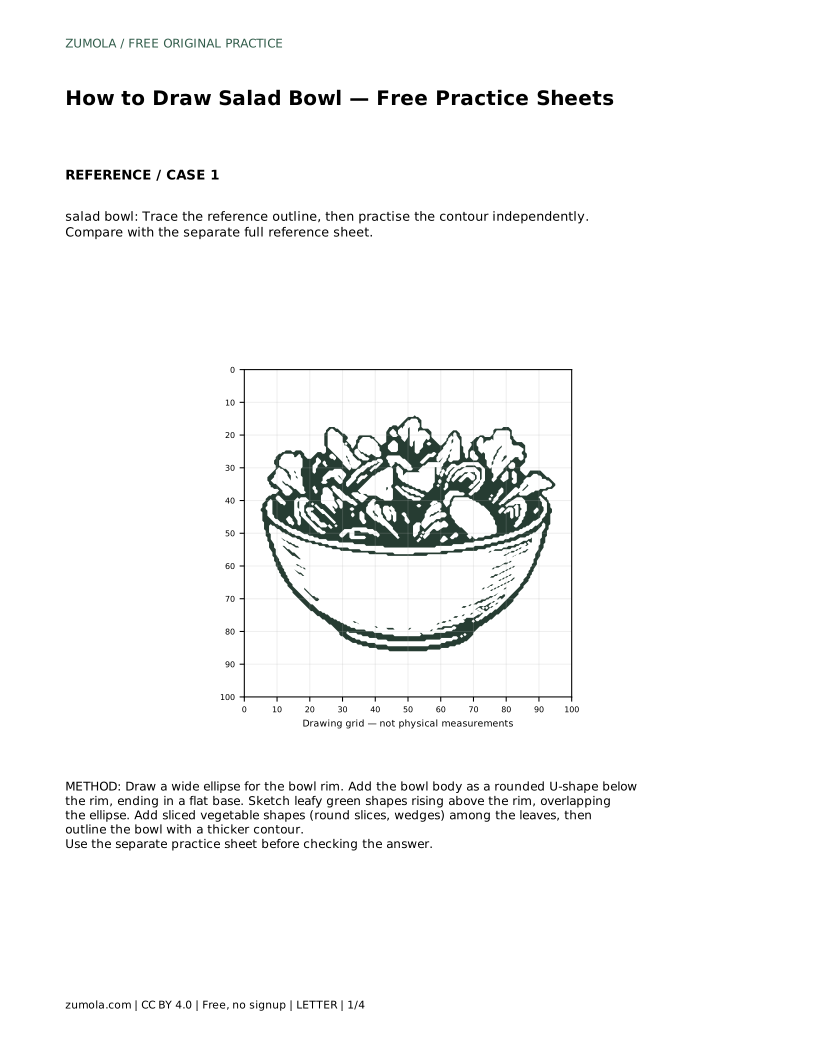
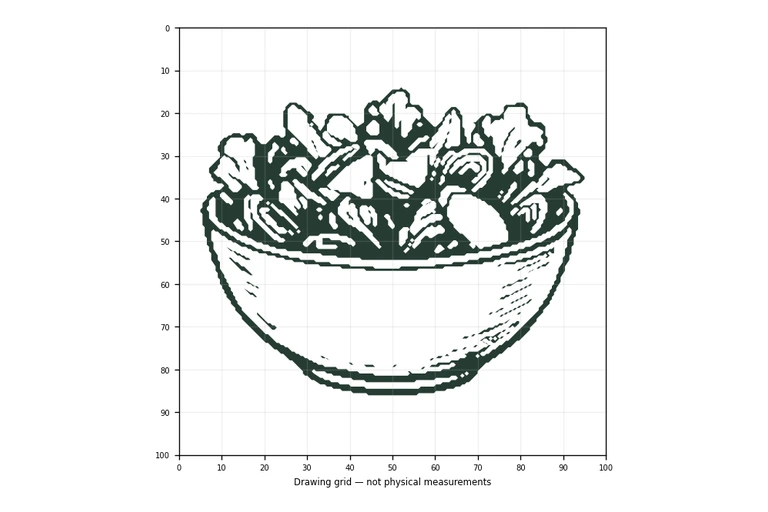
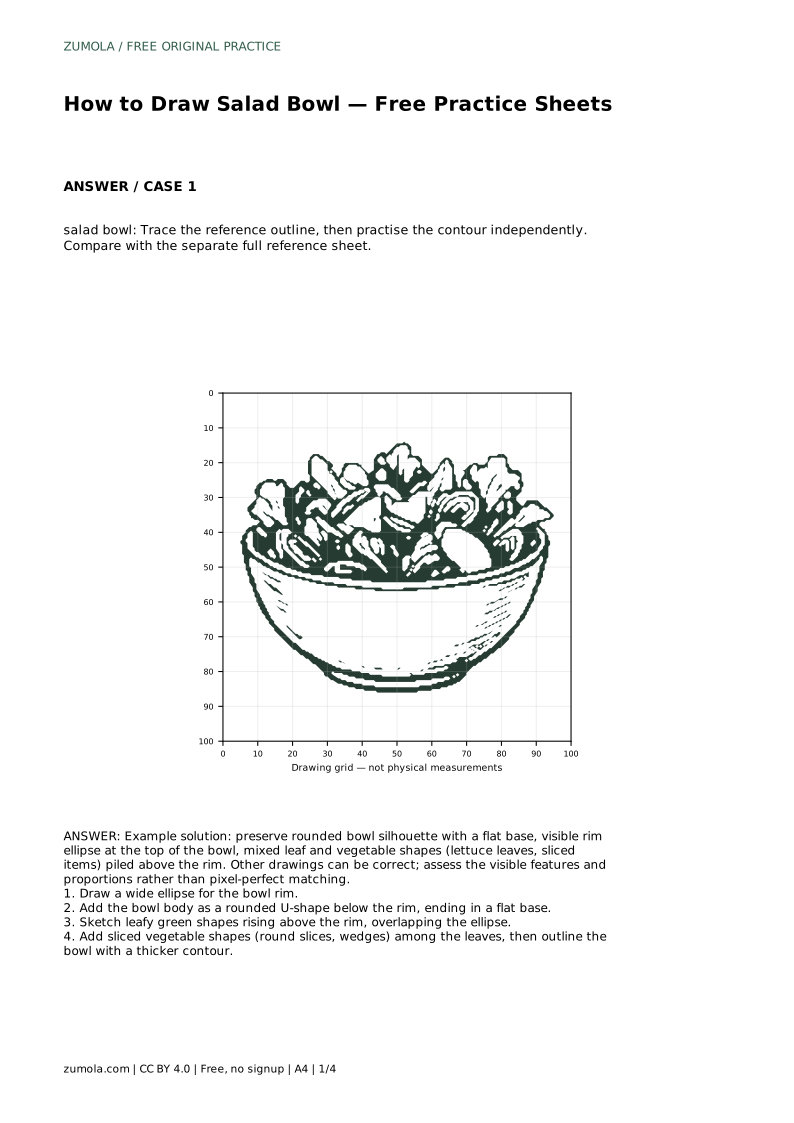
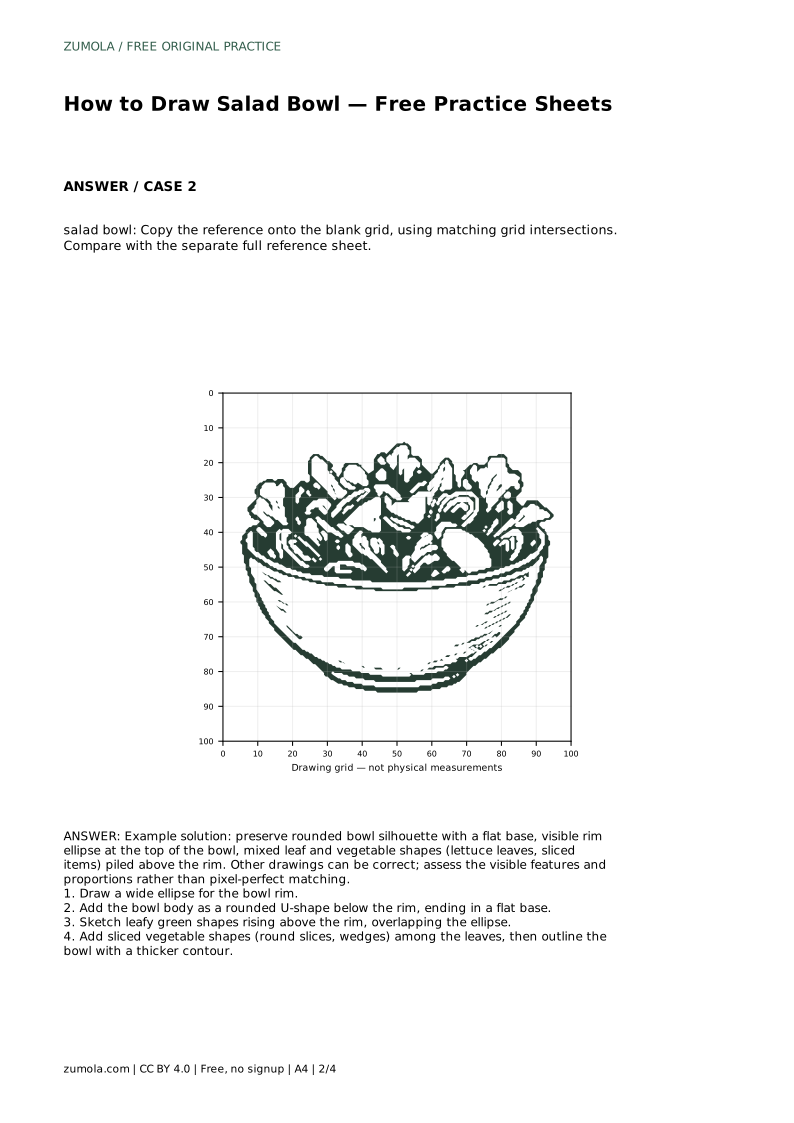
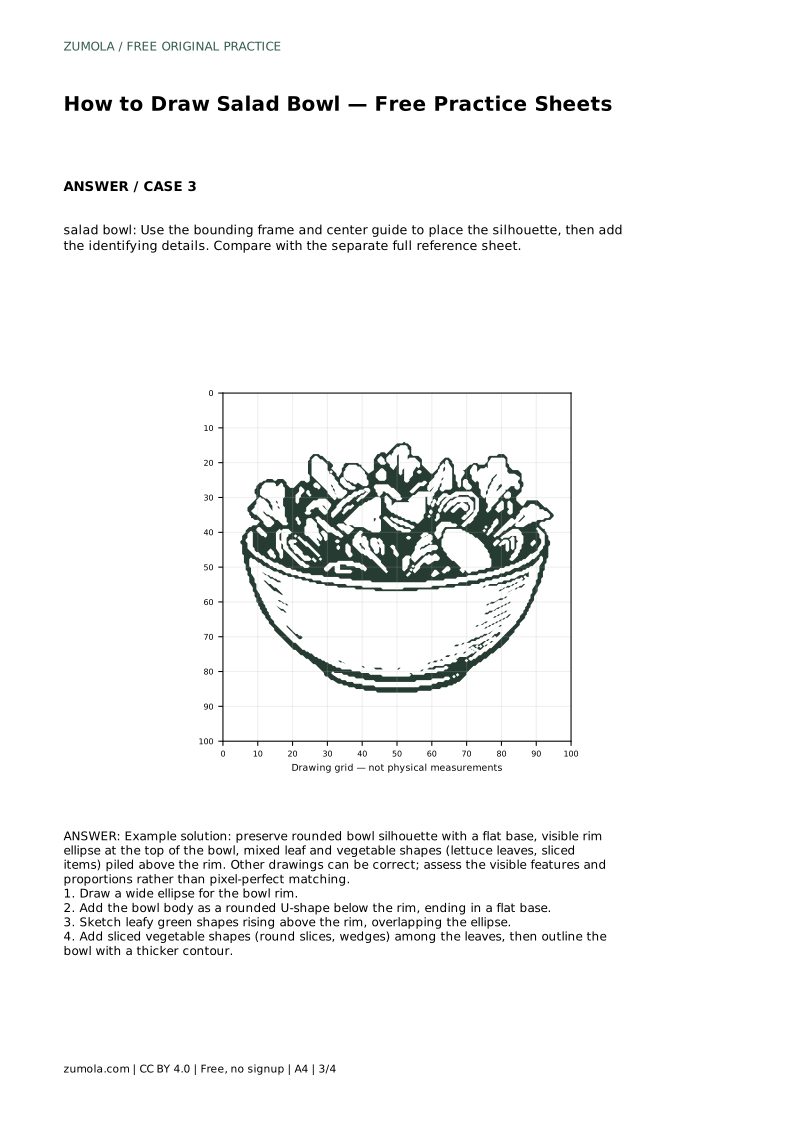
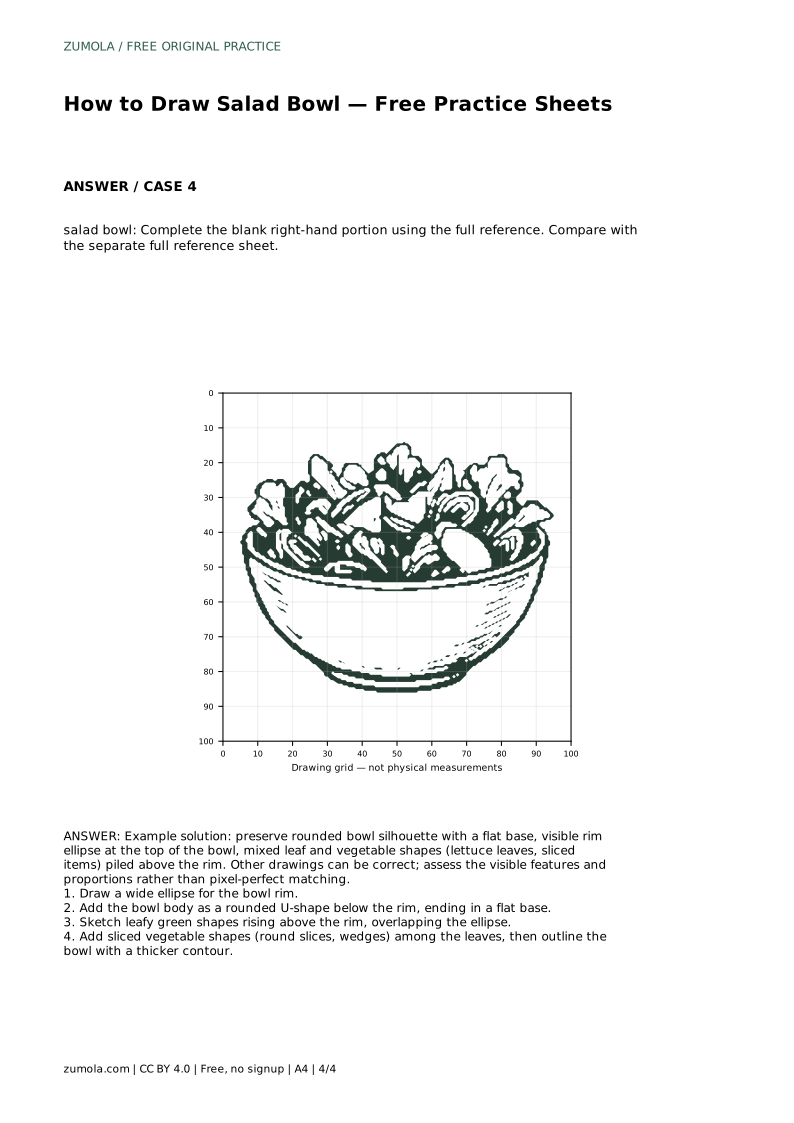
A salad bowl drawing works when the bowl reads as a container and the salad reads as a heap above it. The bowl needs a wide elliptical rim, a rounded body that narrows toward a flat base, and a clear separation between the rim and the food. The salad should rise above the rim with overlapping leaves and a few sliced vegetables. This page explains the order of construction, how to judge proportions, and how to use the practice sheets without expecting a single correct picture.
Start with the rim, because it controls the width of everything below it. Draw a wide ellipse rather than a circle; an ellipse shows the bowl seen slightly from above, which is the usual view for a salad bowl. Keep the ellipse shallow enough that the bowl does not look like a plate.
From the ends of the ellipse, bring two curved sides downward and inward, then close them with a flat base. The body should look like a rounded U or a shallow bucket, not a half-circle. A flat base makes the bowl sit on a surface and prevents the drawing from looking like a floating dome.
Check the bowl alone before adding food. The rim should be the widest part, the base narrower, and the two sides roughly balanced. If the bowl looks unstable, widen the base slightly or reduce the outward curve near the bottom.
Salad should overlap the front edge of the rim, not sit behind it. Sketch leafy shapes that rise from inside the ellipse and cross over its front curve. Vary the leaf outlines: some broad and rounded, some with soft jagged edges. Overlap them so the pile has depth rather than reading as a single flat shape.
Place sliced vegetables among the leaves. Round slices, half-round slices, and wedge shapes are easy to recognize and give the pile variety. Keep slices partly hidden by leaves so the salad looks mixed. Avoid spacing them evenly; a few clustered slices look more natural than a row.
Finish by strengthening the bowl outline with a thicker contour and leaving the leaf edges lighter. This separates the solid container from the softer food and keeps the drawing readable.
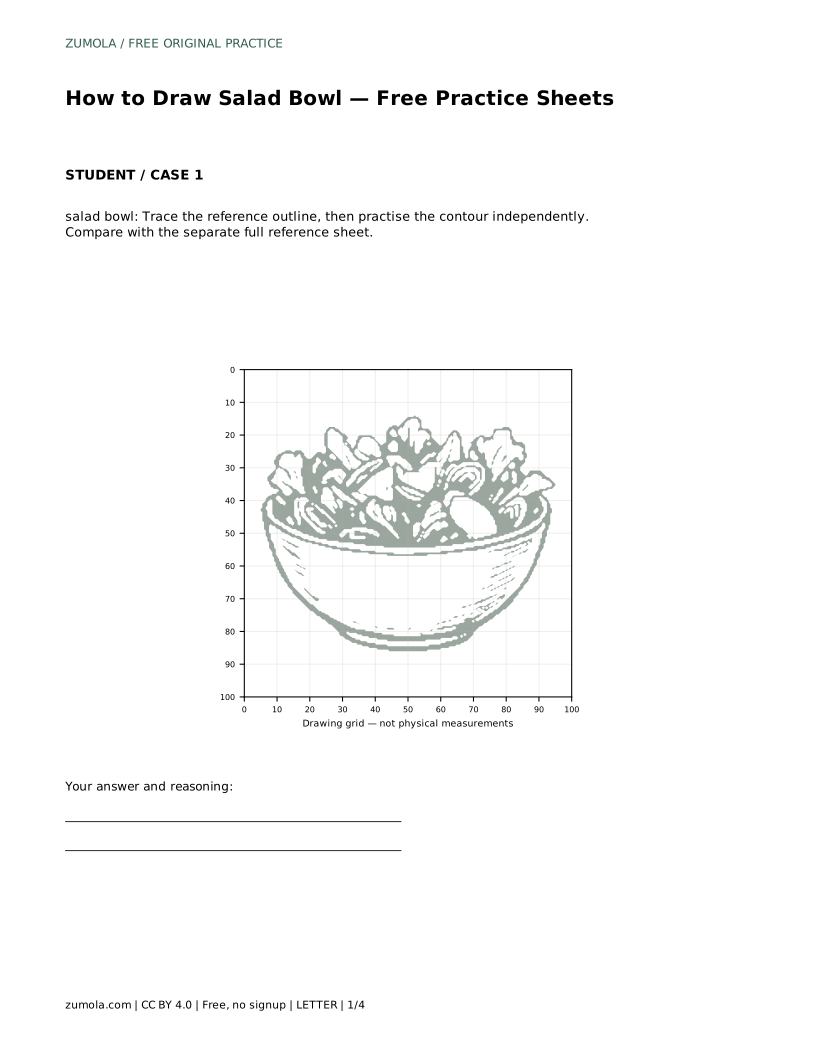
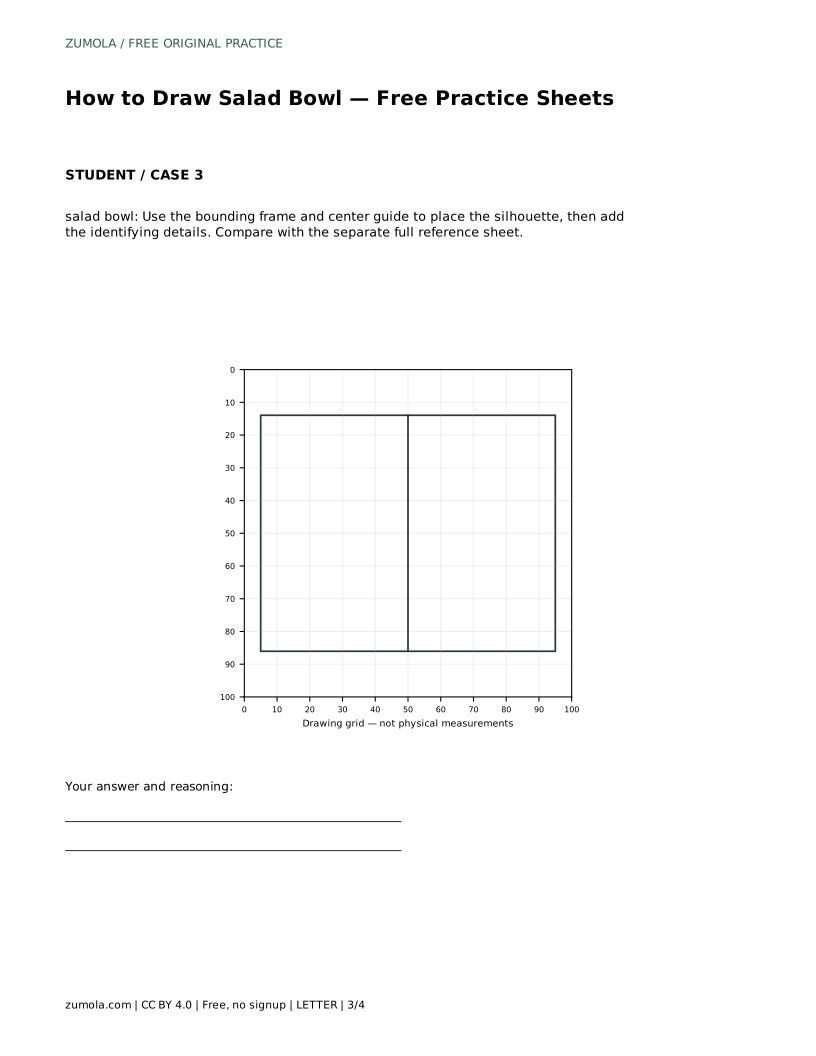
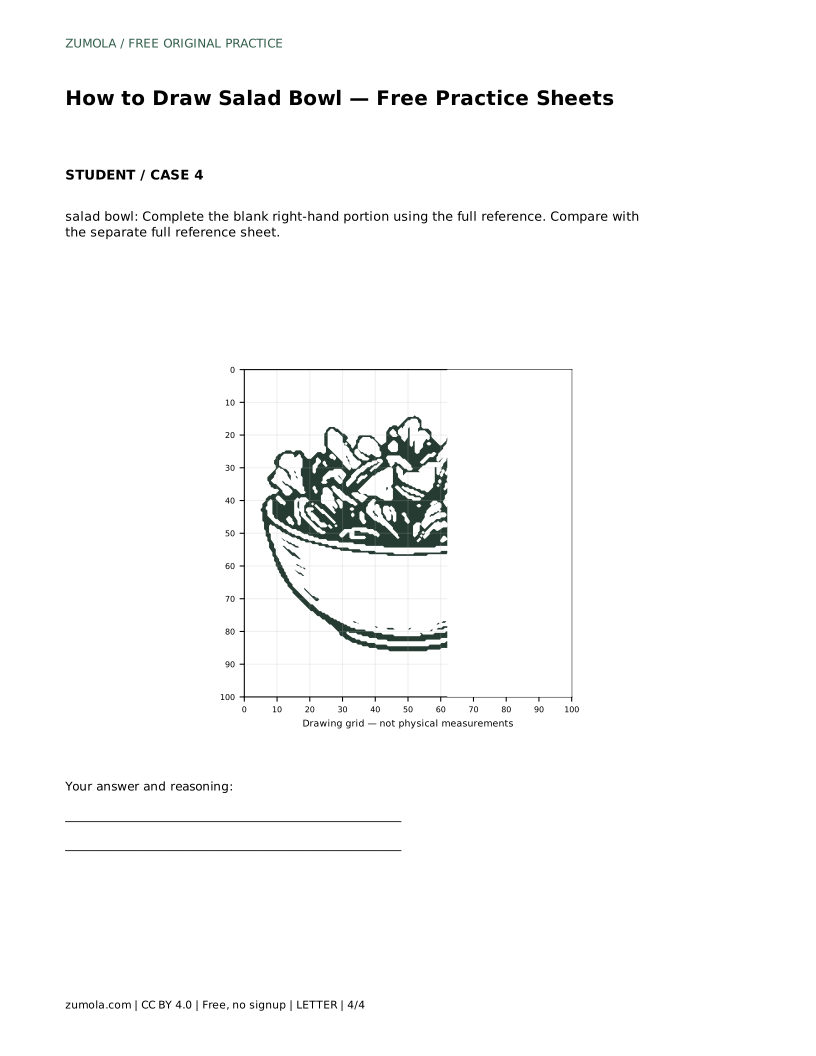
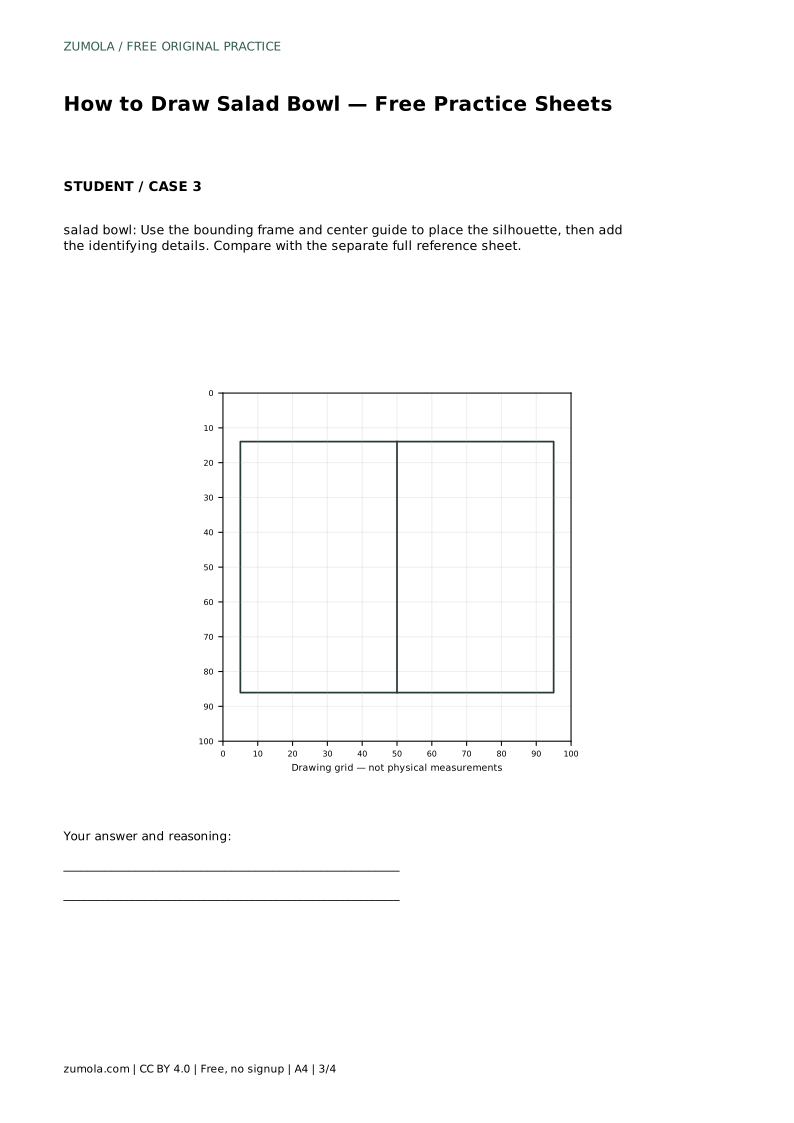
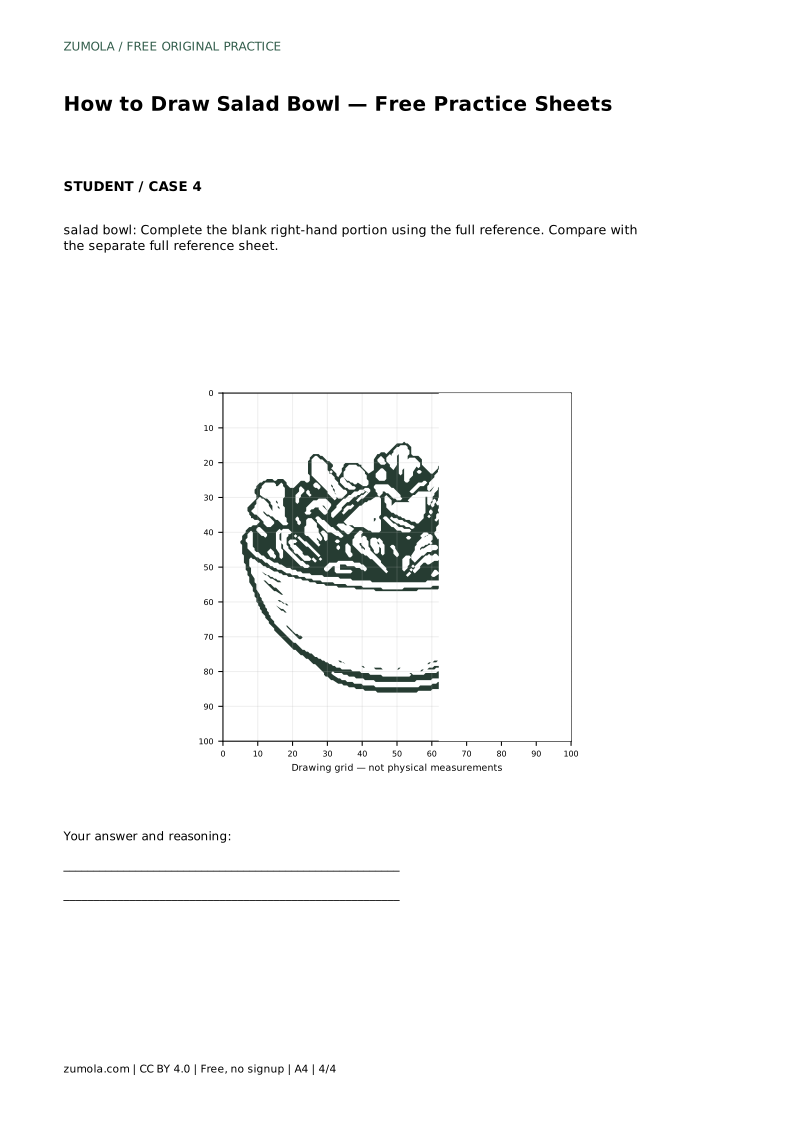
The tracing sheet asks you to follow the reference outline first, then repeat the contour on your own. The grid sheet asks you to copy the reference onto a blank grid using matching intersections. The frame-and-center sheet asks you to place the silhouette using the bounding frame and center guide before adding details. The partial sheet gives you the left side and asks you to complete the right.
Each sheet has a separate full reference for comparison. Compare features and proportions rather than matching every line. Two drawings can both be correct if each shows a rounded bowl, a flat base, a visible rim ellipse, and a mixed pile of leaves and sliced vegetables above the rim.
Use visible features as your guide. A successful drawing keeps the bowl recognizable, the rim readable as an ellipse, the base flat, and the salad clearly above and overlapping the rim. Proportions matter more than exact leaf shapes. If the bowl looks too deep, too narrow, or the salad floats without touching the rim, adjust those relationships first.
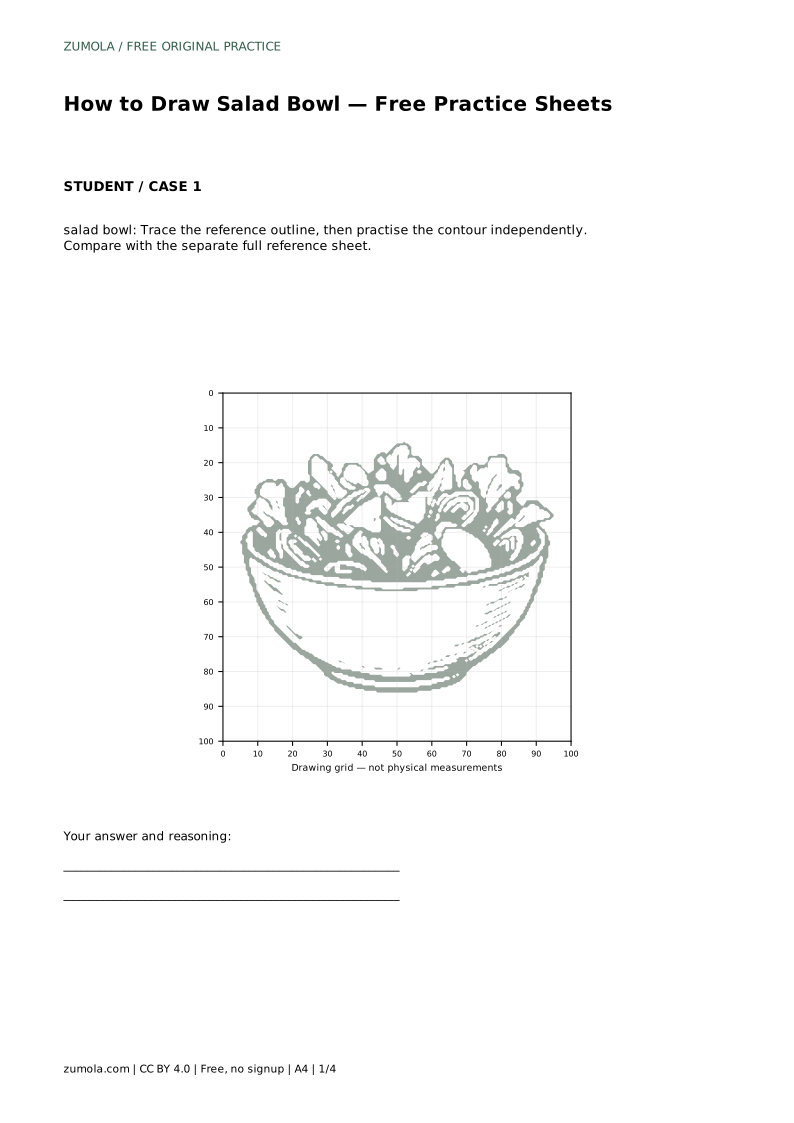
salad bowl: Trace the reference outline, then practise the contour independently. Compare with the separate full reference sheet.
Example solution: preserve rounded bowl silhouette with a flat base, visible rim ellipse at the top of the bowl, mixed leaf and vegetable shapes (lettuce leaves, sliced items) piled above the rim. Other drawings can be correct; assess the visible features and proportions rather than pixel-perfect matching. Draw a wide ellipse for the bowl rim. Add the bowl body as a rounded U-shape below the rim, ending in a flat base. Sketch leafy green shapes rising above the rim, overlapping the ellipse. Add sliced vegetable shapes (round slices, wedges) among the leaves, then outline the bowl with a thicker contour.
Yes. Leaves should overlap the front edge so the food looks inside the bowl rather than floating above it.
There is no fixed number. Add a few round slices or wedges among the leaves, partly hidden, so the pile looks mixed.
That can still be correct. Judge the bowl silhouette, flat base, rim ellipse, and overlapping salad rather than exact line matching.
All drawing practice · Free coordinate paper
Original resources · CC BY 4.0 · Free for personal and classroom use with attribution.