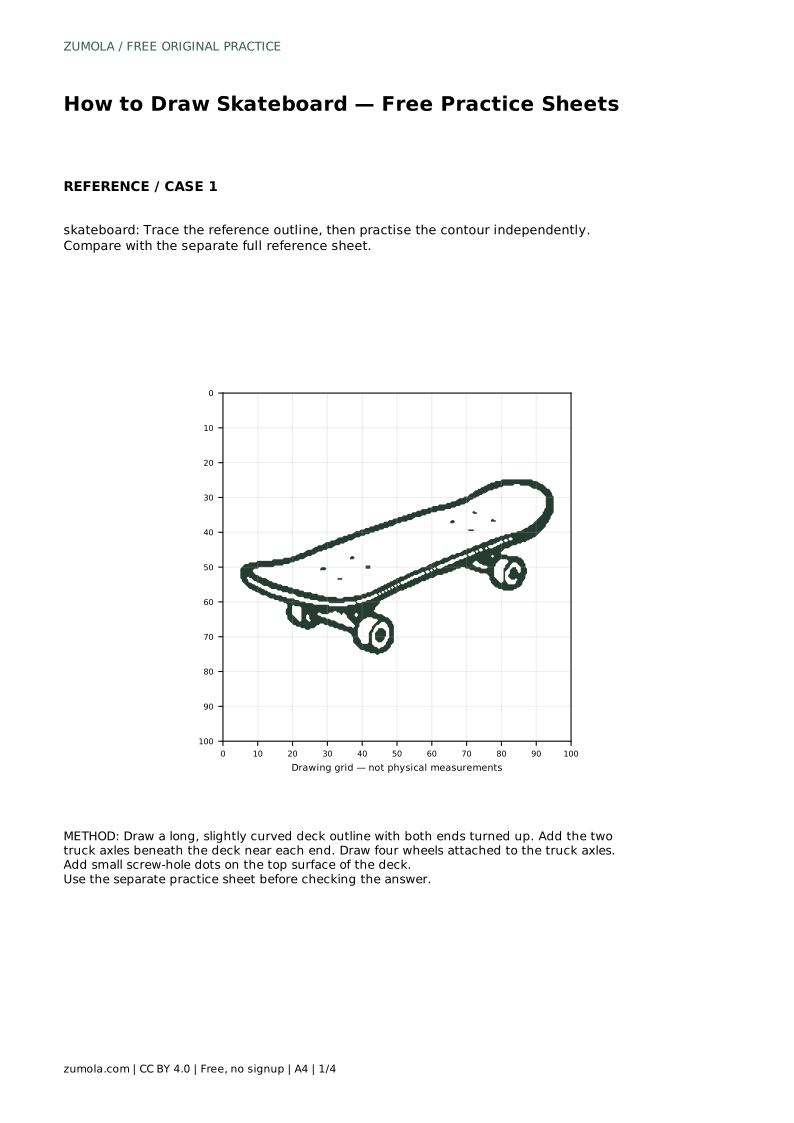
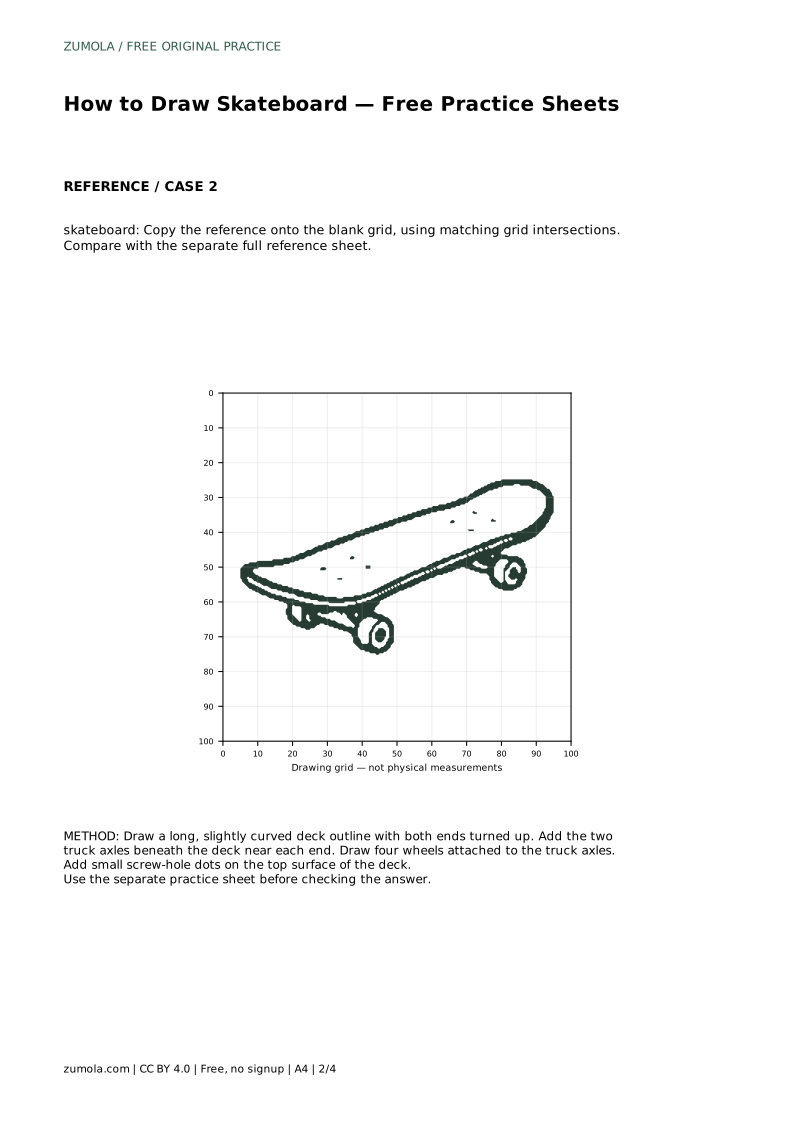
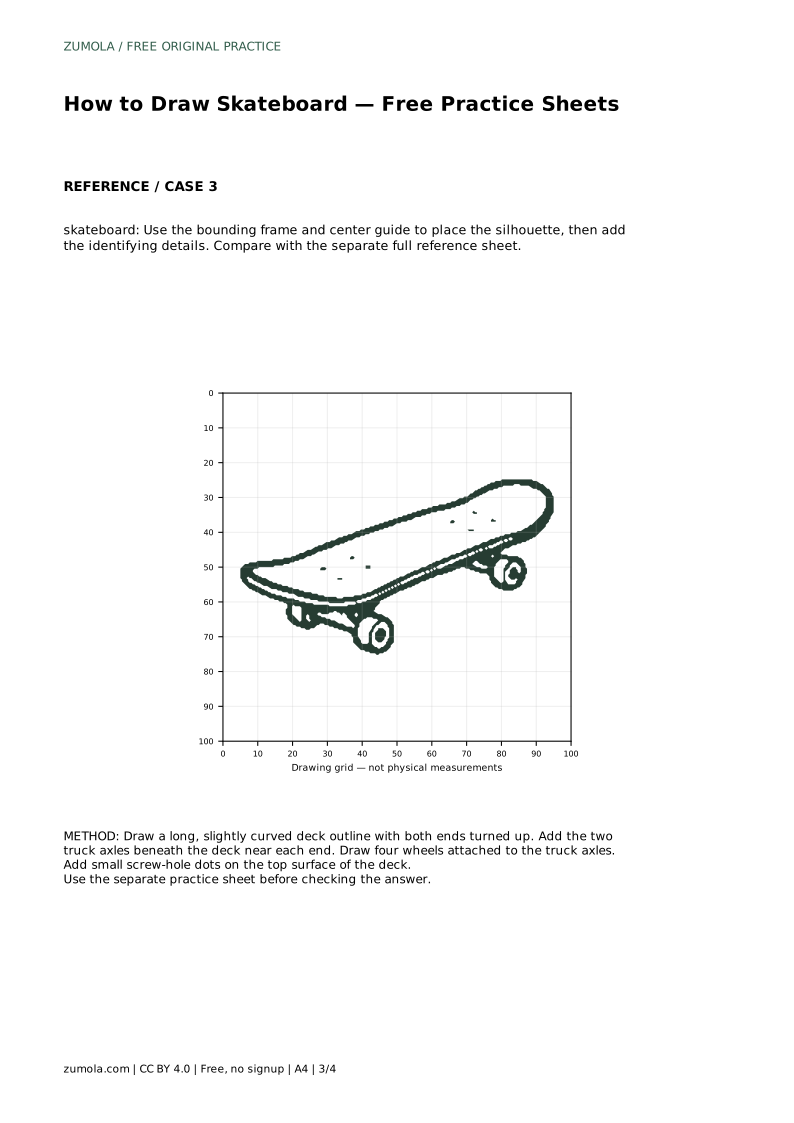
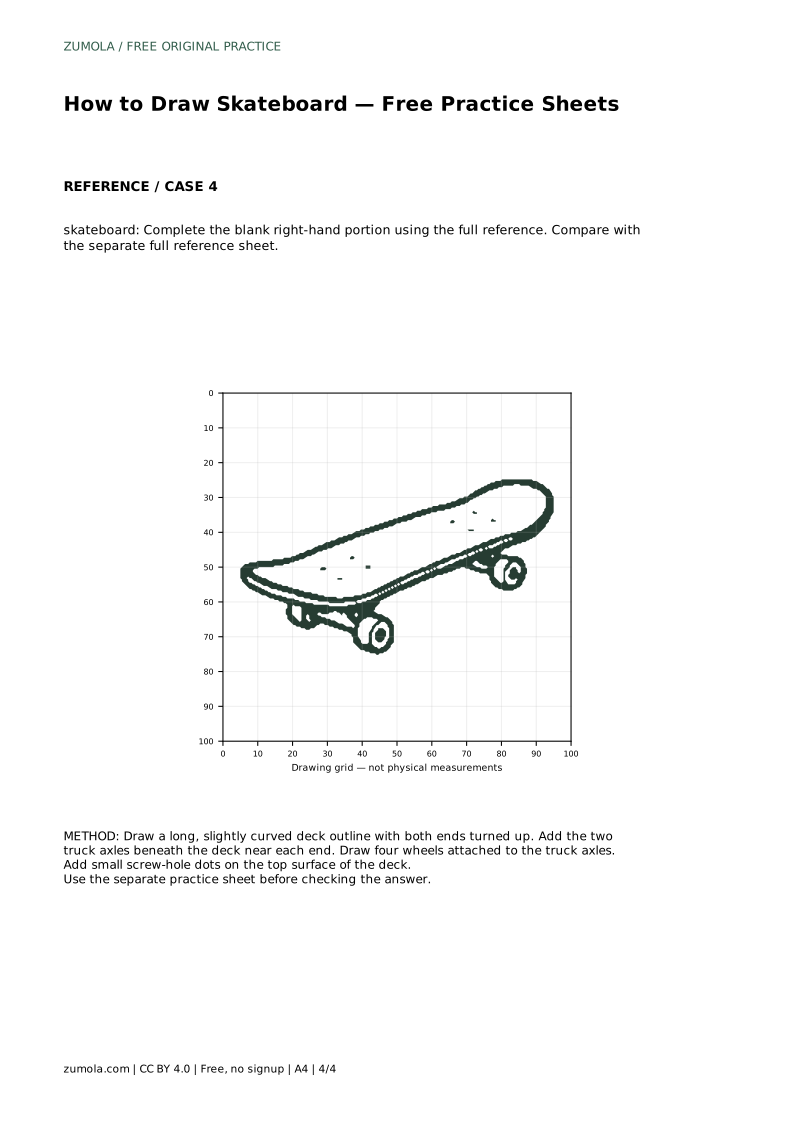
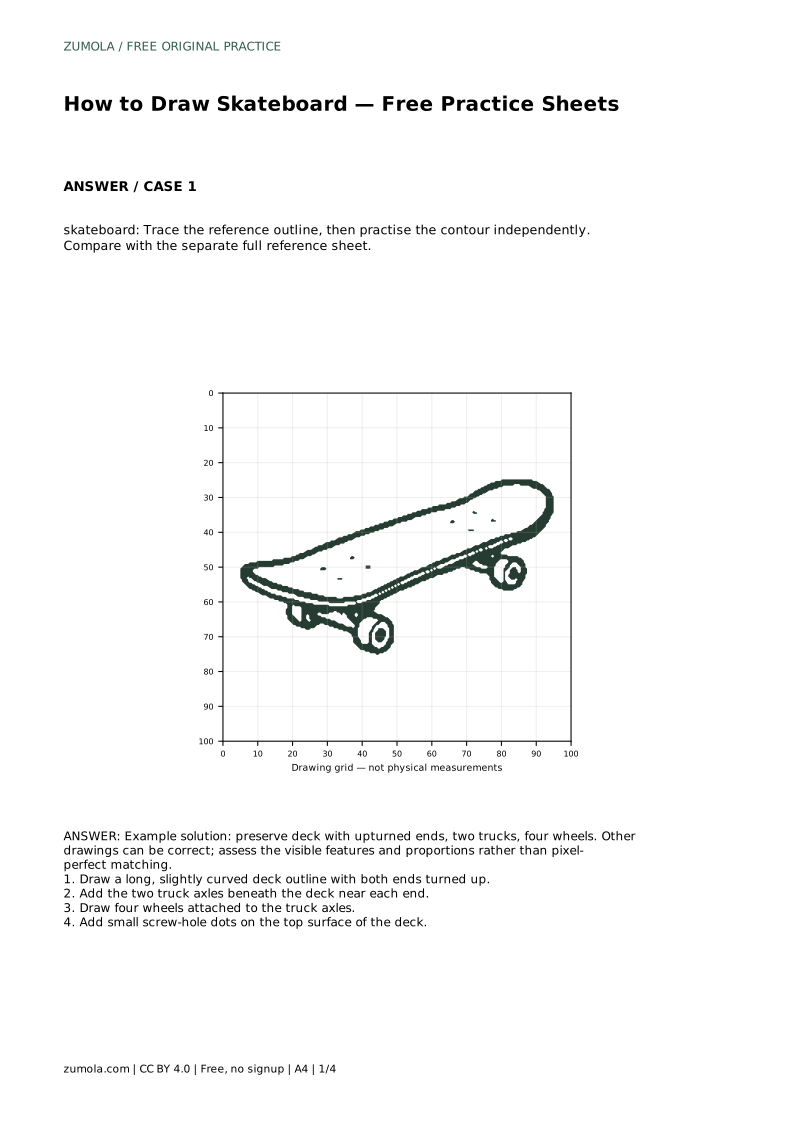
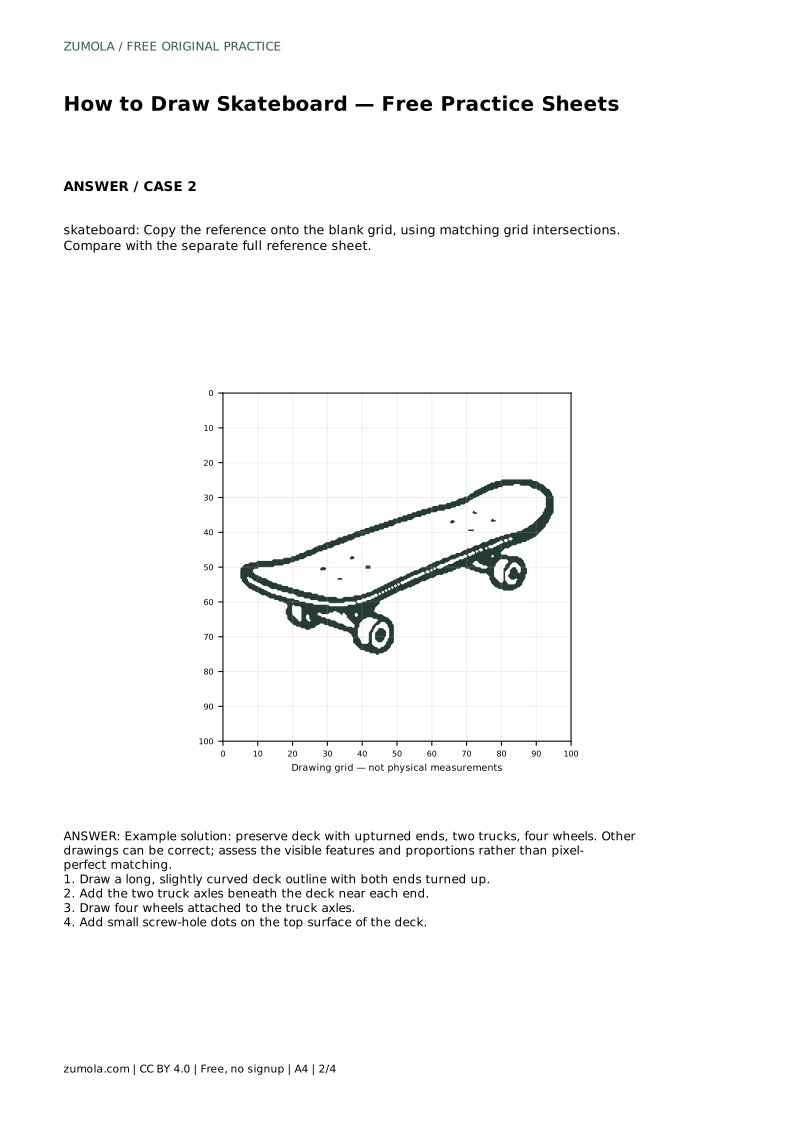
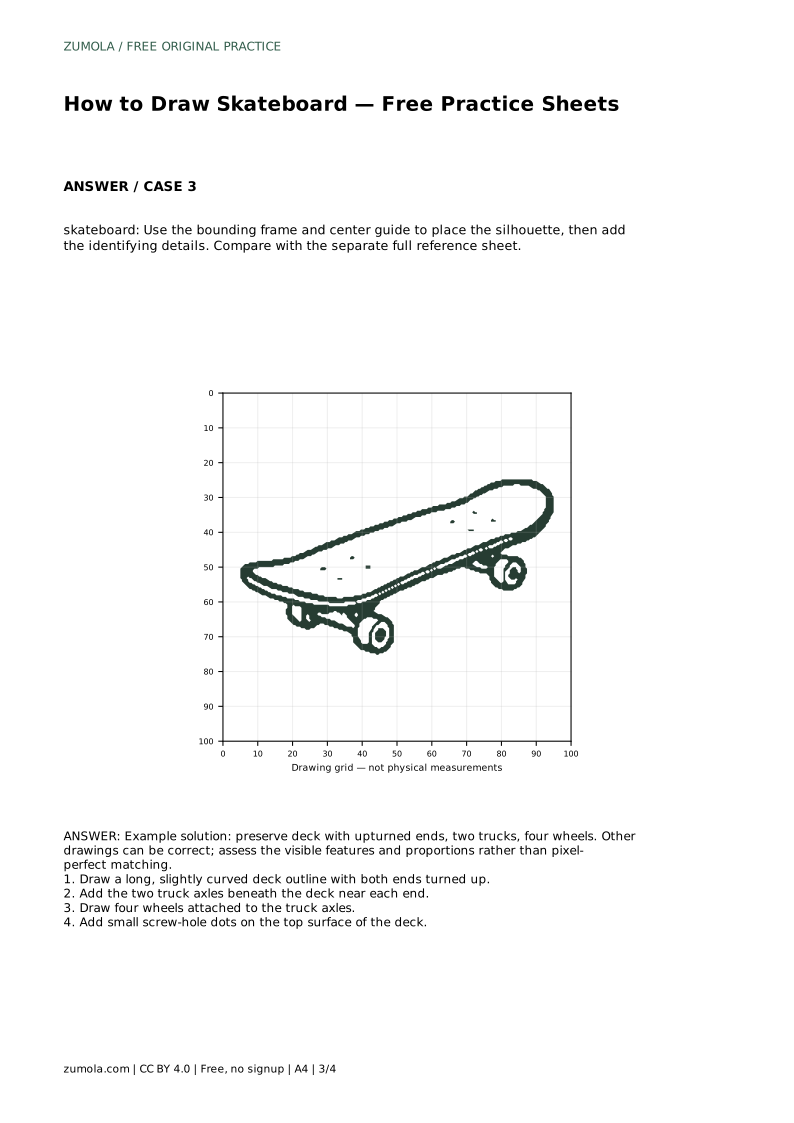
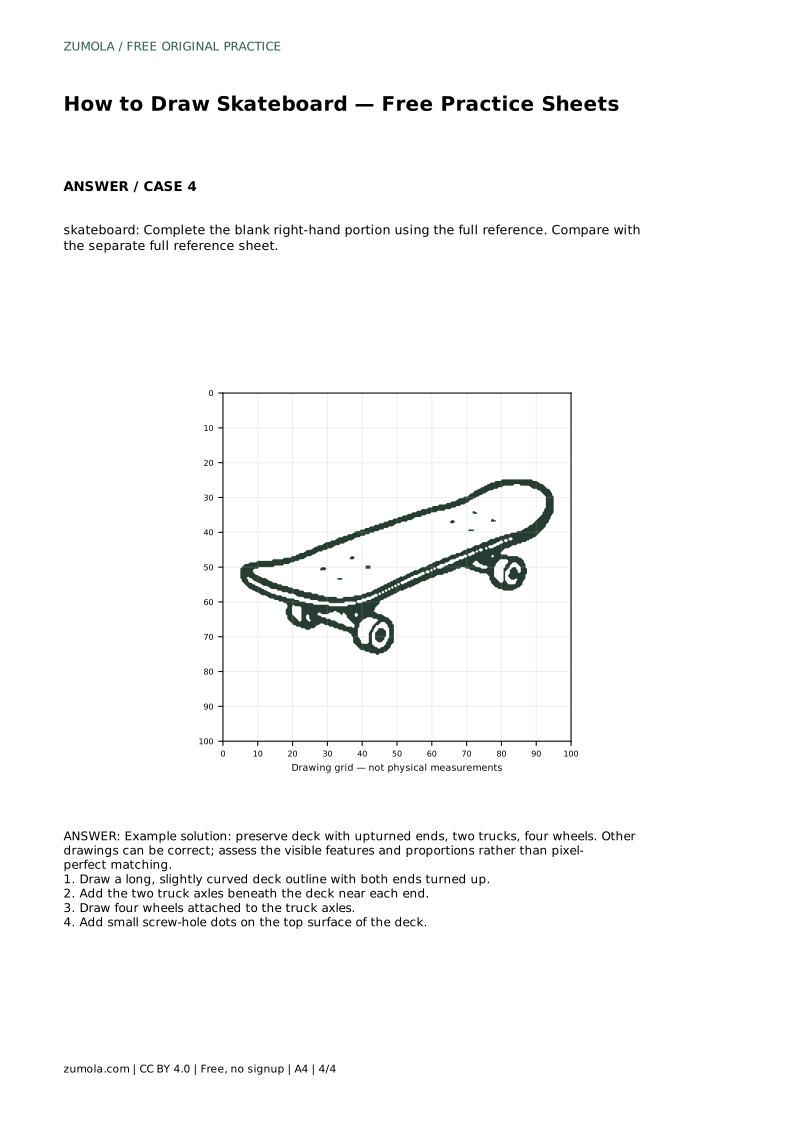
Reference diagrams
LETTER · Download PDF
A4 · Download PDF
Free original resources
Learn to draw a skateboard with a curved deck, two trucks, and four wheels. Free printable practice sheets help you trace, grid-copy, and complete the outline.
Four original cases, with reference diagrams, practice sheets and worked answers. Everything is free; no signup required.
LETTER · Download PDF
A4 · Download PDF
LETTER · Download PDF
A4 · Download PDF
LETTER · Download PDF
A4 · Download PDF
Use A4 or US Letter to match your printer. Use the stated values and conditions to solve each exercise; diagrams are not physical measuring rulers.
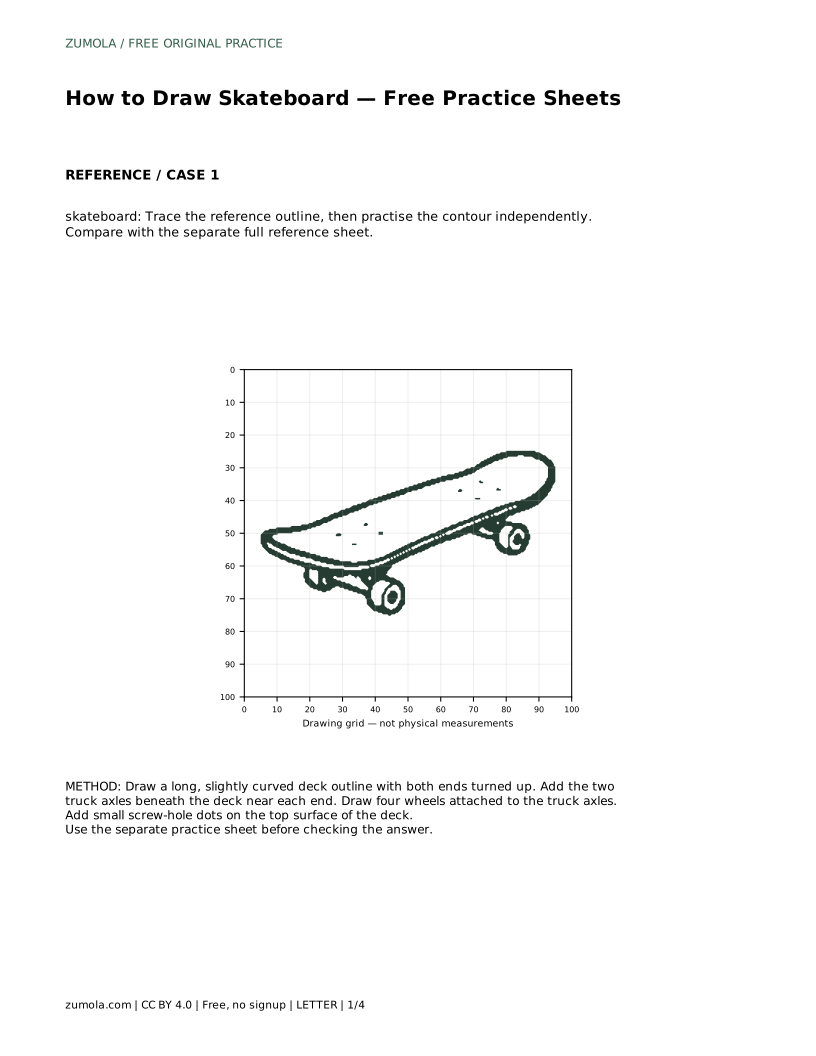
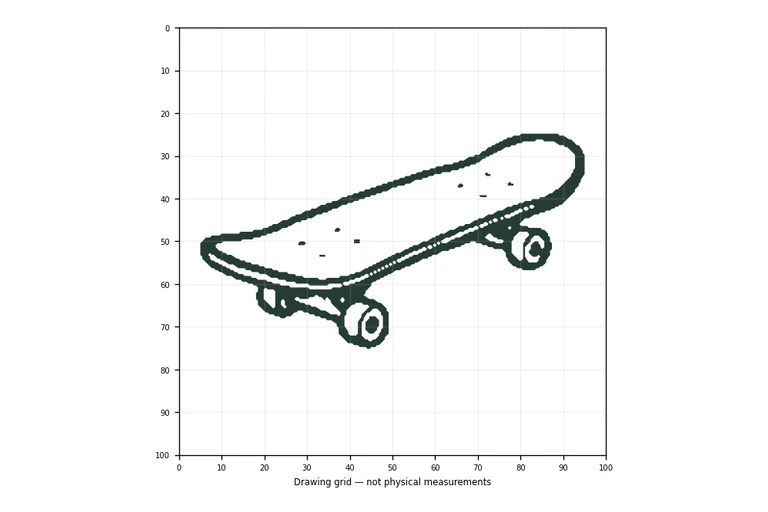
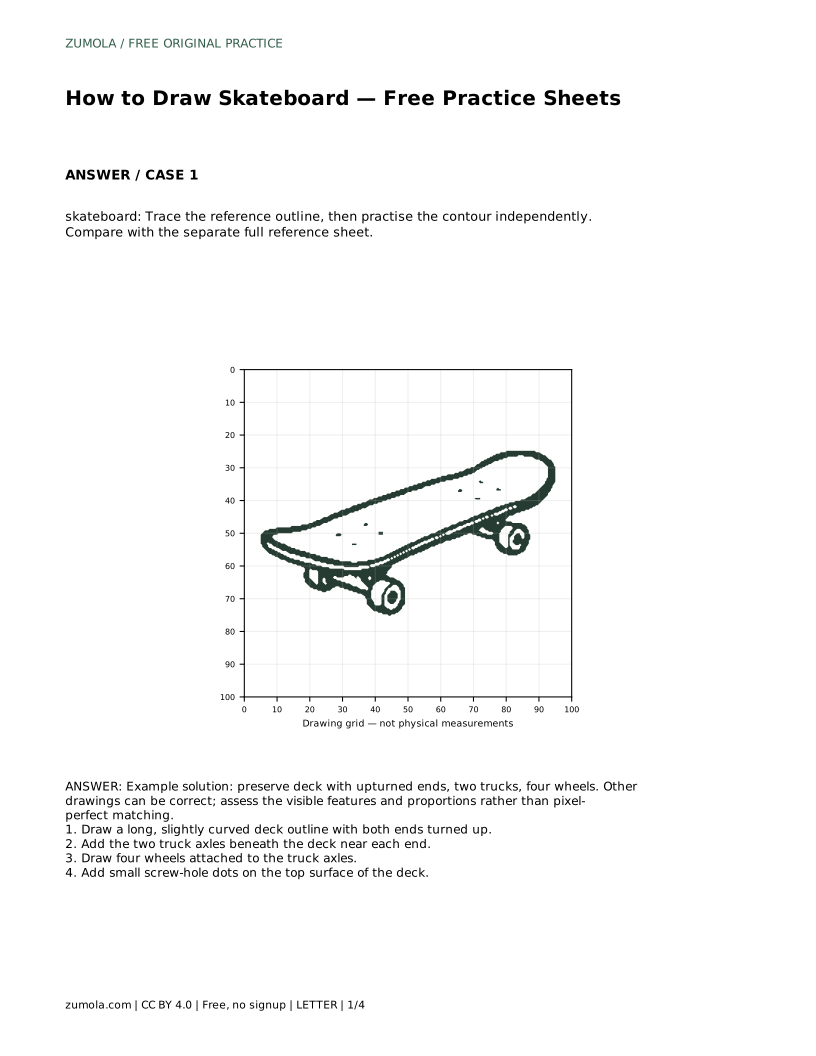
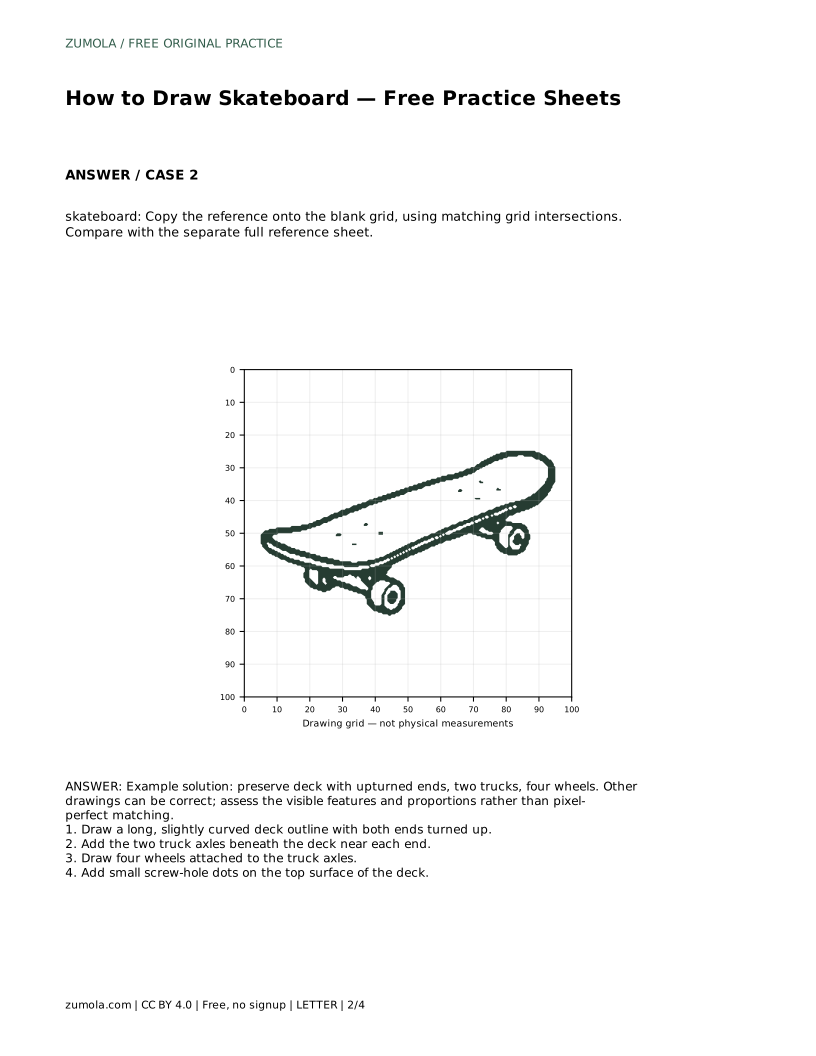
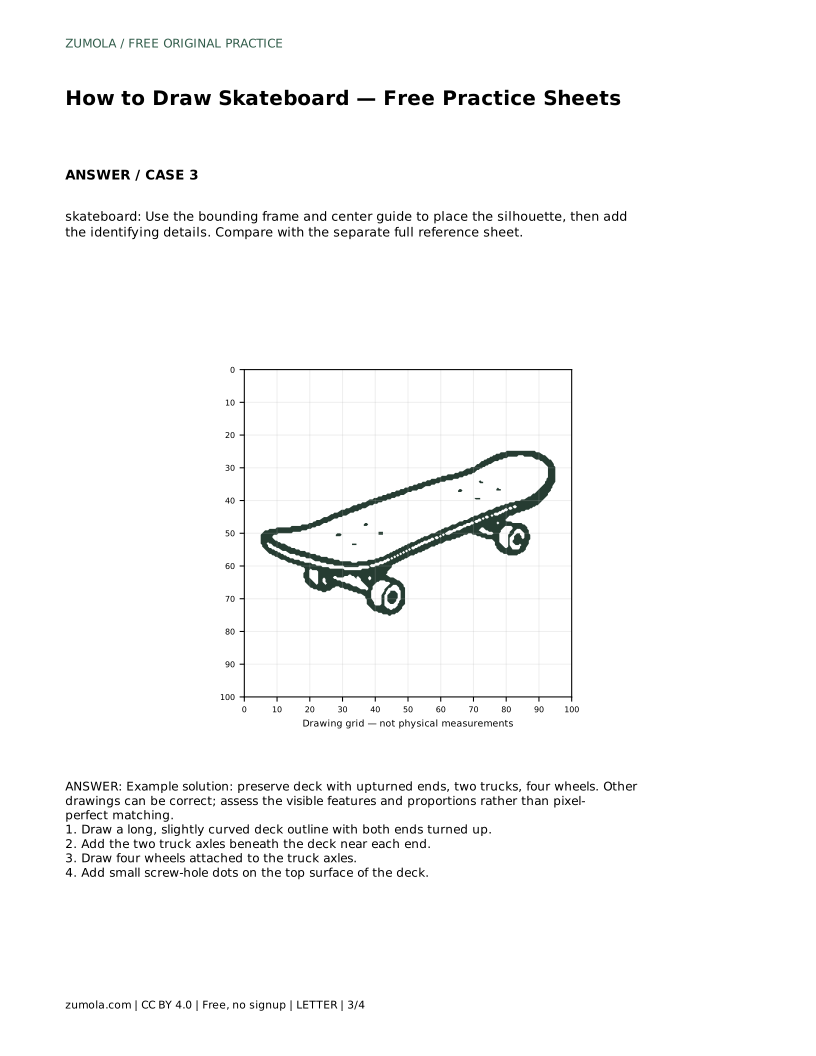
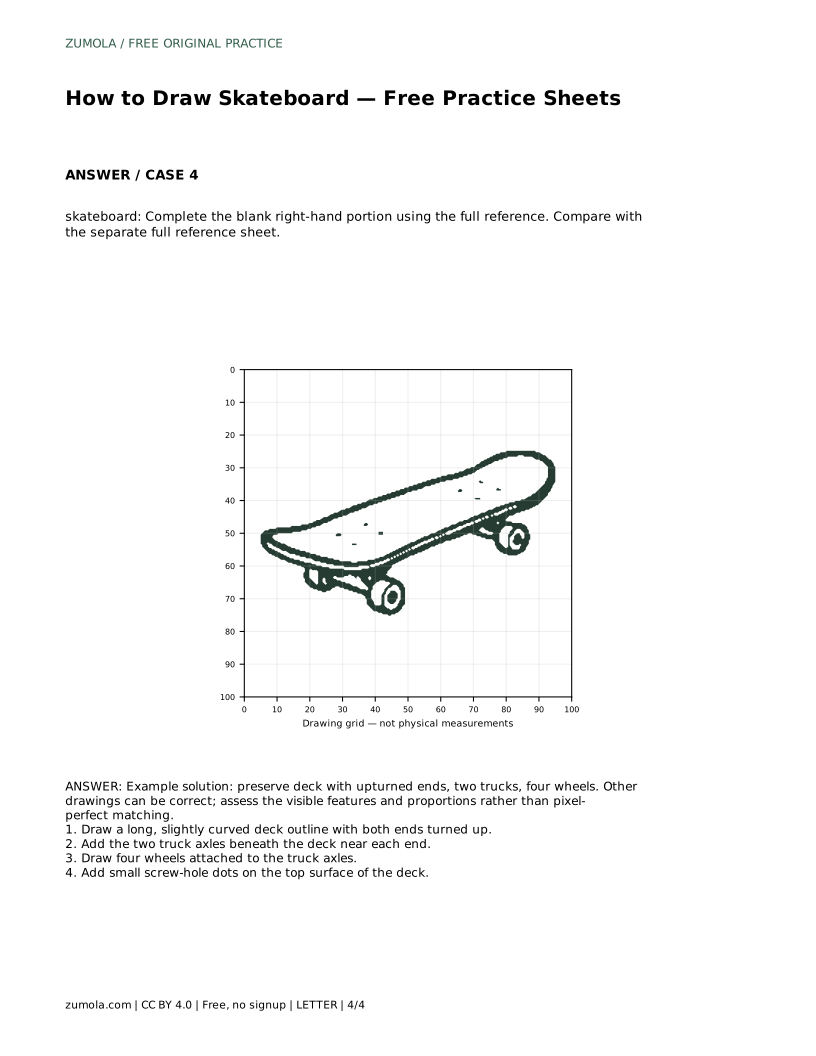
Drawing a skateboard is mostly about getting a few connected parts in the right places. The deck is long and slightly curved, with both ends turned up. Underneath, two trucks hold four wheels. Once you can place those parts clearly, the drawing reads as a skateboard even when your lines are loose. These free printable practice sheets let you trace a reference outline, copy it onto a grid, use a bounding frame and center guide, or complete a partly drawn version.
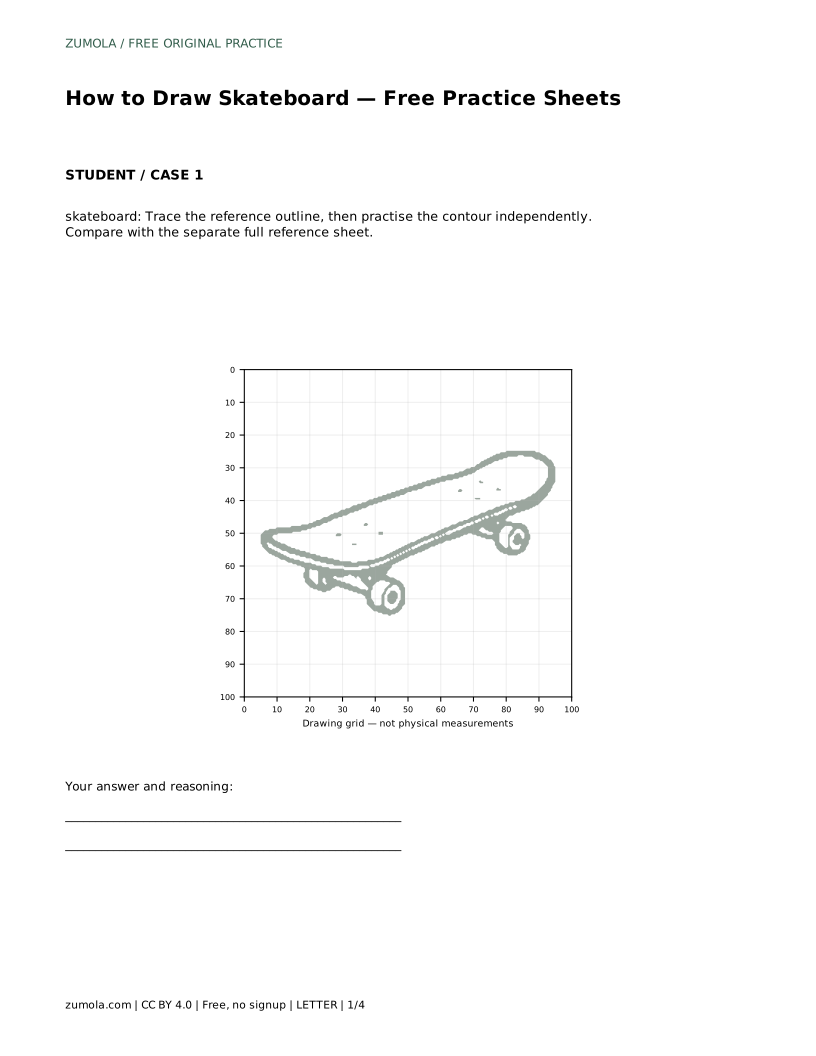
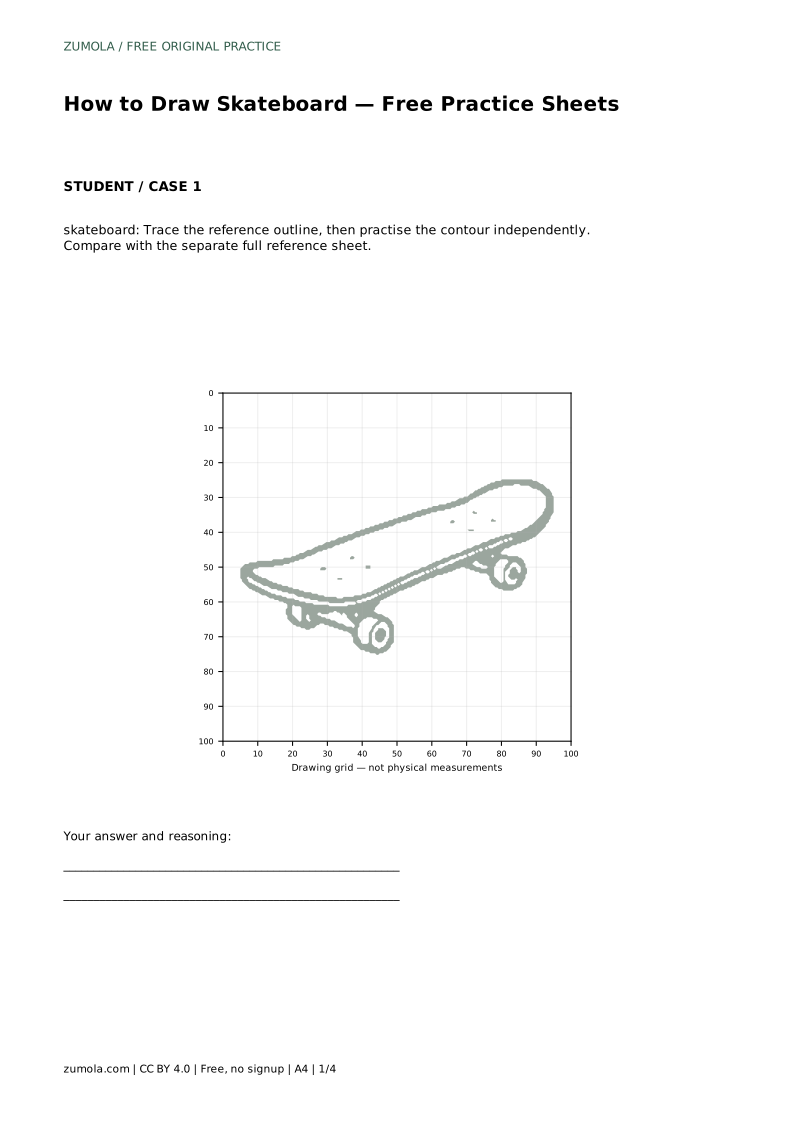
Before drawing, look at the reference and name the parts in order: deck, trucks, wheels, and screw holes. The deck is the long board you stand on. Its middle is fairly flat, and both ends curve upward. The trucks are the metal assemblies under the deck, one near the front and one near the back. Each truck carries two wheels, so a complete skateboard shows four wheels in total. Small dots on the top surface stand for the screws that fasten the trucks to the deck.
Treat the deck as the anchor. If the deck is too short, too wide, or missing its upturned ends, the drawing stops looking like a skateboard. Draw the deck first, then hang the trucks and wheels beneath it. Keep the two trucks roughly the same distance from the center so the board looks balanced.
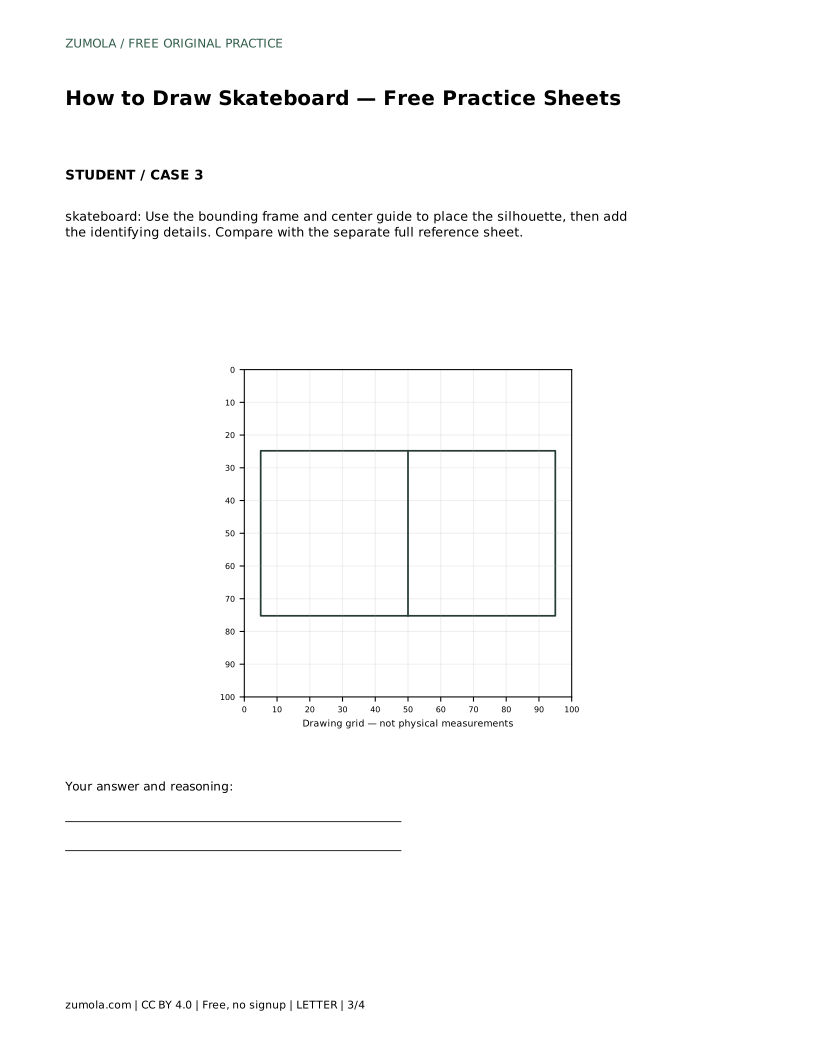
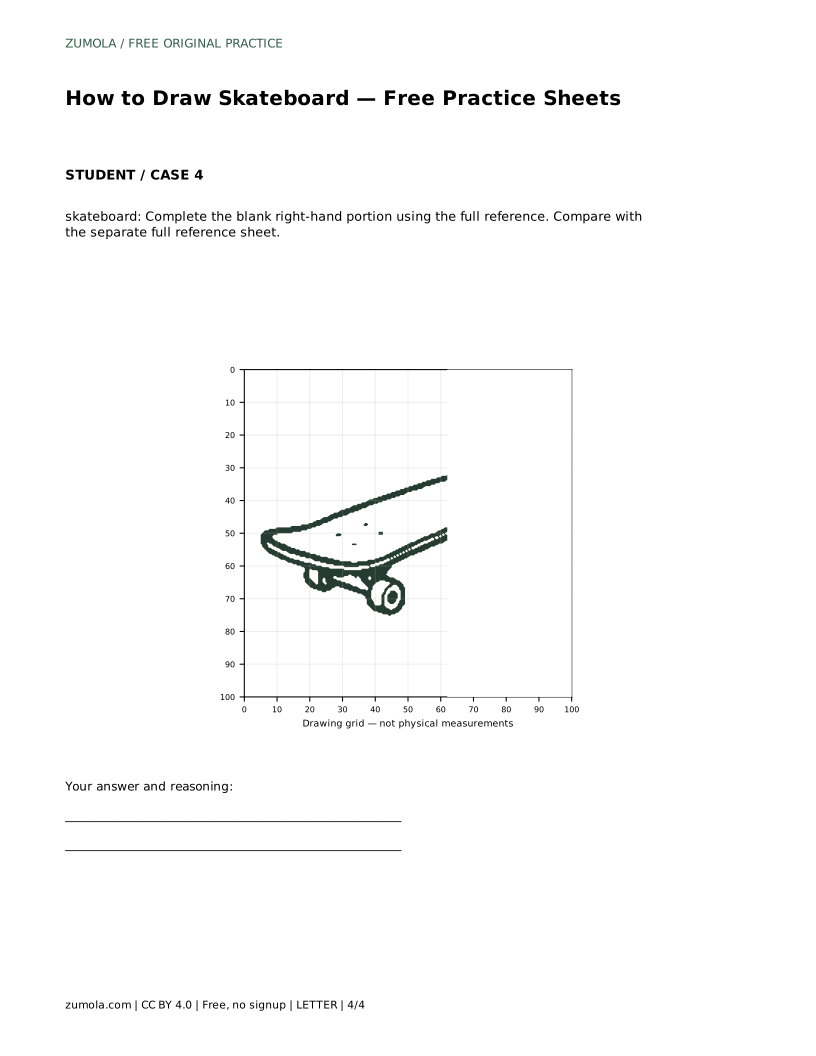
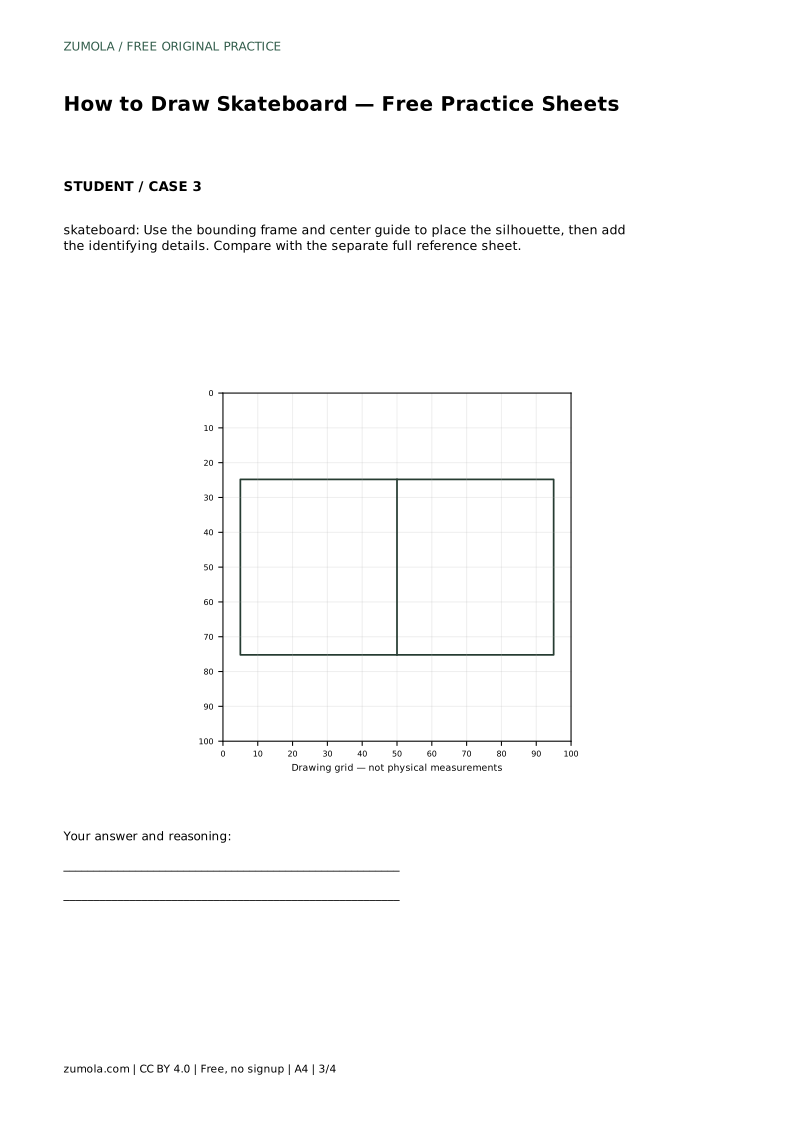
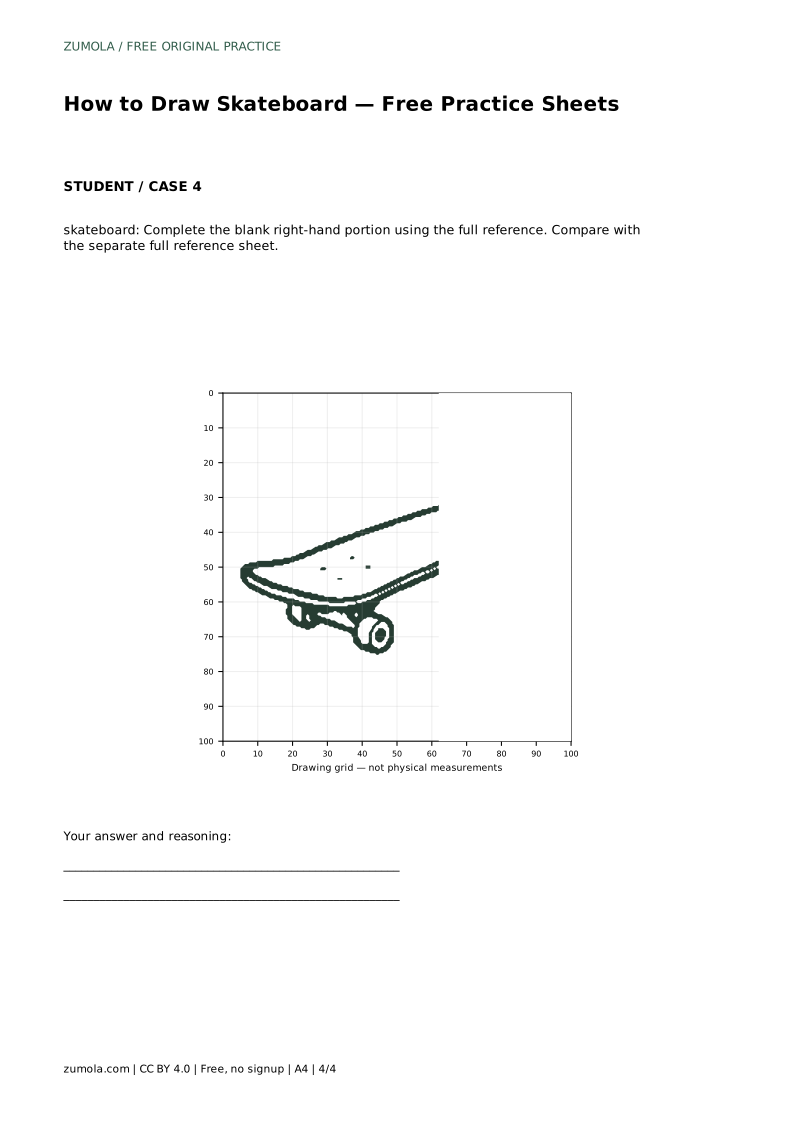
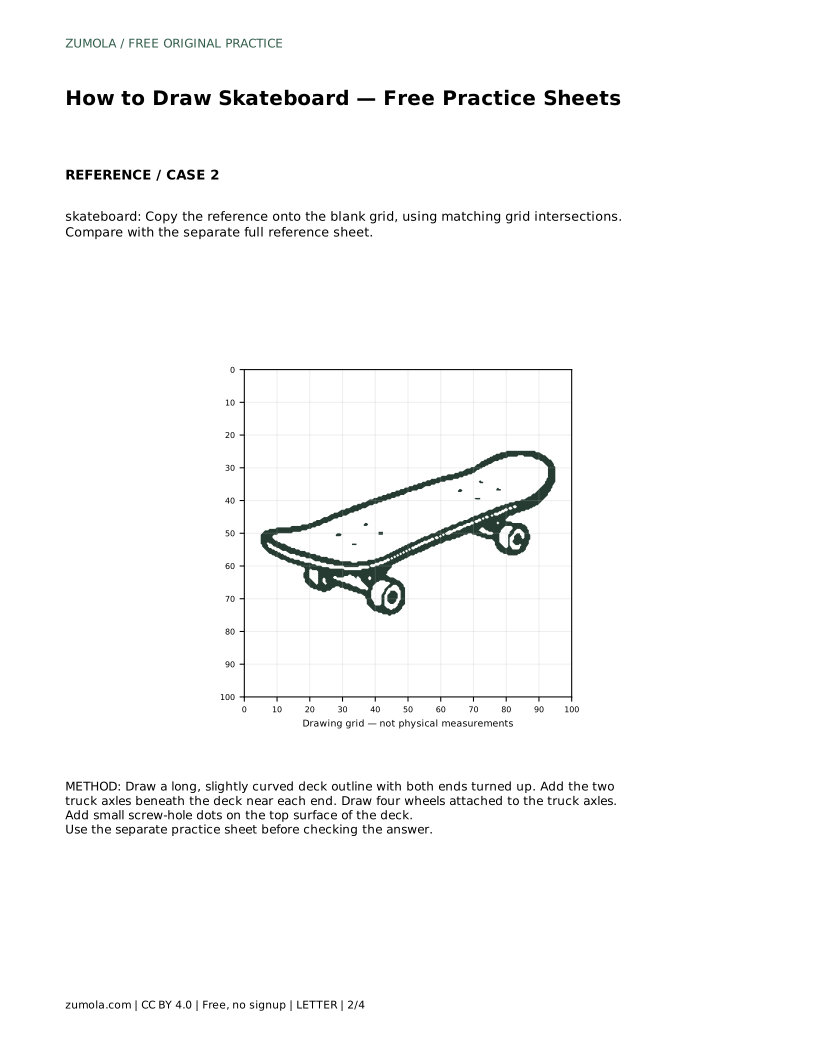
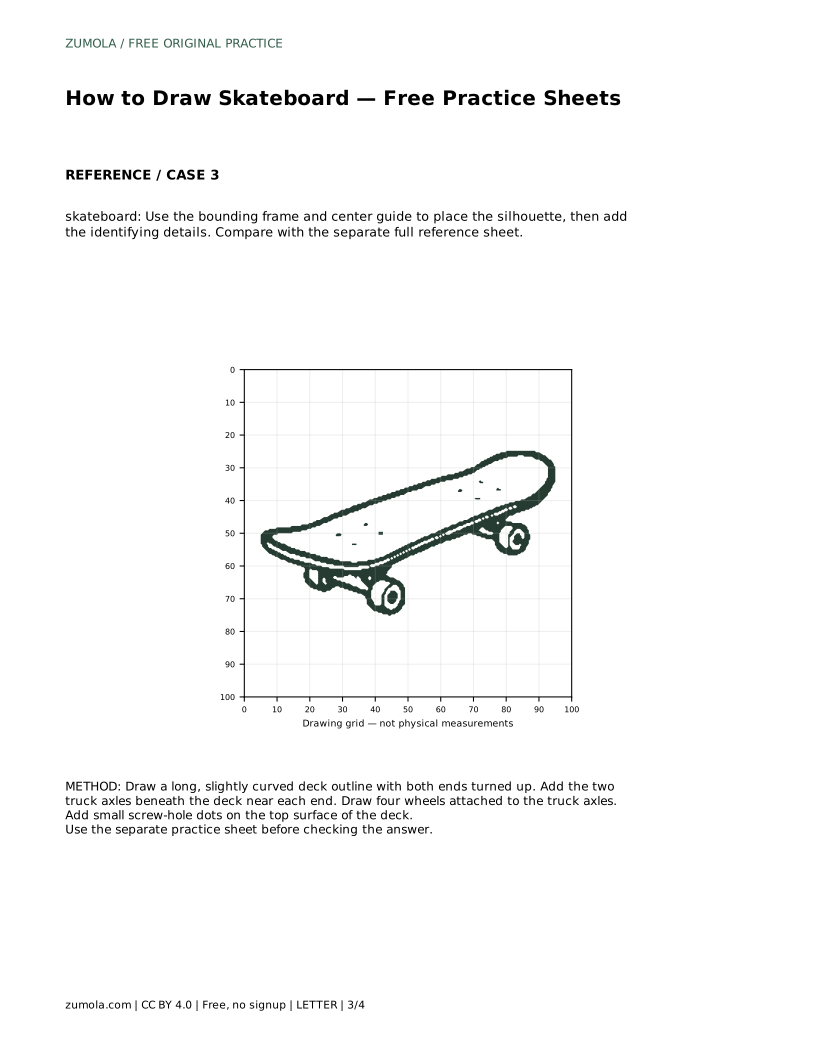
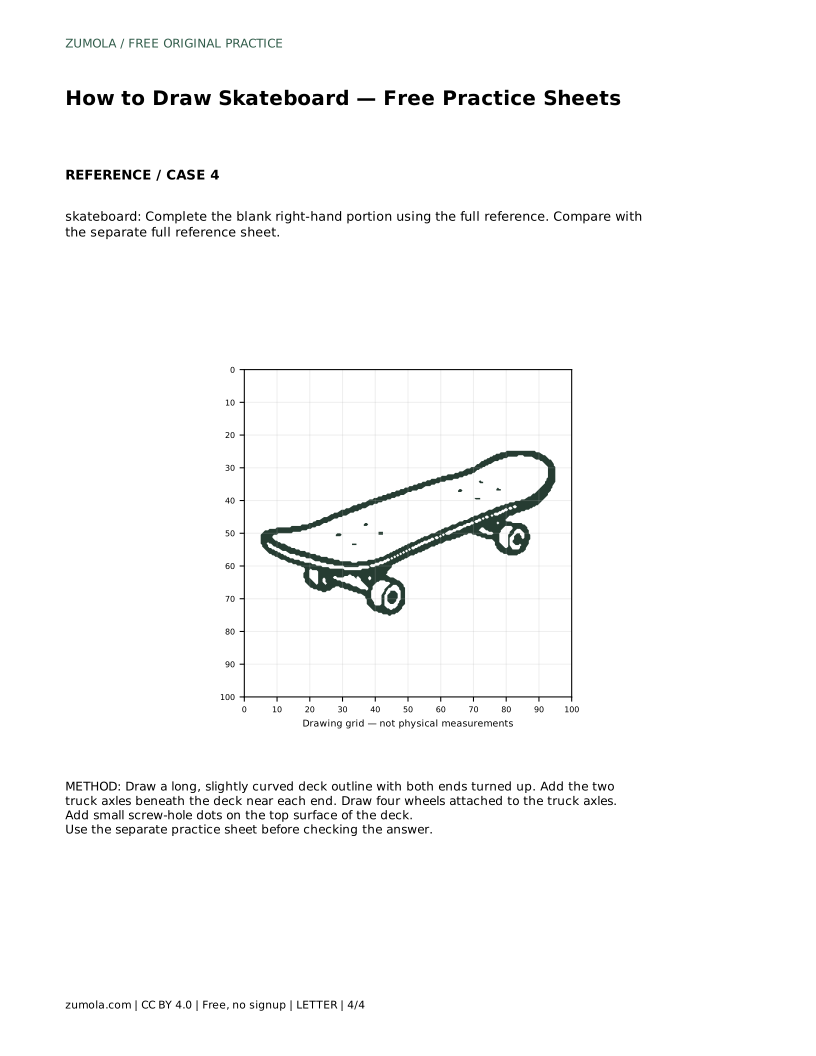
The trace sheet is the gentlest start. Follow the reference outline with your pencil, then try the same contour on blank paper without tracing. The grid sheet asks you to copy the reference onto a blank grid, matching where lines cross grid intersections. The bounding-frame sheet gives you an outer frame and a center guide so you can place the silhouette before adding details. The partial sheet shows the left side of the drawing and leaves the right side blank for you to complete from the full reference.
Each sheet has a separate full reference page, so you can compare your finished drawing with the original rather than guessing. Comparison is a check on features and proportions, not a demand for an identical line.
A useful check is relative size. The deck should be clearly longer than it is wide, and the wheels should look small compared with the deck. The trucks sit close to the ends, not bunched in the middle. Both ends of the deck should turn up in the same direction, away from the wheels.
Different drawings can be correct. A wider deck, rounder wheels, or a steeper kicktail can still read as a skateboard if the deck, two trucks, and four wheels are visible and sensibly placed. Judge the drawing by those features and by overall balance rather than by pixel-perfect matching.
Draw the same skateboard three times in one sitting: once by tracing, once from the grid, and once from memory. Each pass trains your hand to repeat the curved deck and the paired wheels. Keep your pencil light at first so you can adjust the deck curve before committing to darker lines.
When a drawing goes wrong, find the first part that drifted. Usually it is the deck length or the truck spacing. Redraw from that point rather than starting over, and compare again with the full reference.
skateboard: Trace the reference outline, then practise the contour independently. Compare with the separate full reference sheet.
Example solution: preserve deck with upturned ends, two trucks, four wheels. Other drawings can be correct; assess the visible features and proportions rather than pixel-perfect matching. Draw a long, slightly curved deck outline with both ends turned up. Add the two truck axles beneath the deck near each end. Draw four wheels attached to the truck axles. Add small screw-hole dots on the top surface of the deck.
They are small details, but adding a few dots on the top surface helps the drawing read as a real deck. Keep them simple and evenly spaced.
Yes. Other drawings can be correct. Check that the deck has upturned ends, two trucks sit beneath it, and four wheels are attached.
Start with the trace sheet if you are new to the shape. Move to the grid or bounding-frame sheet once you can draw the deck contour without tracing.
All drawing practice · Free coordinate paper
Original resources · CC BY 4.0 · Free for personal and classroom use with attribution.