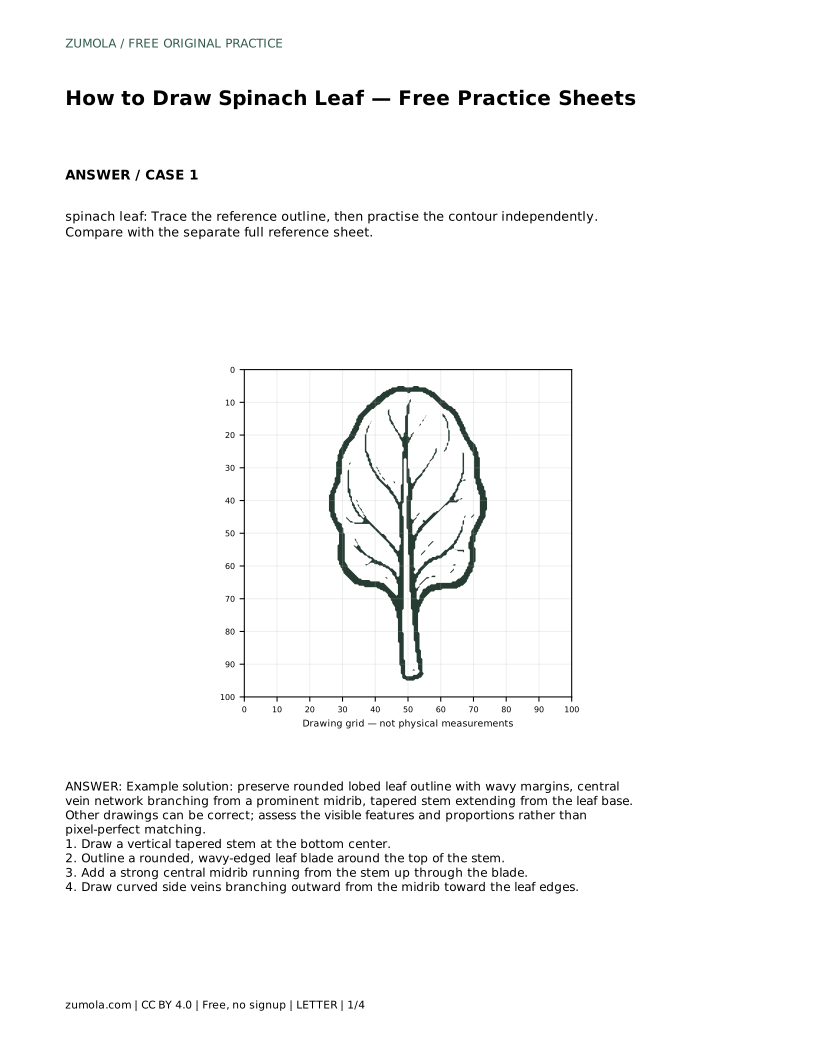
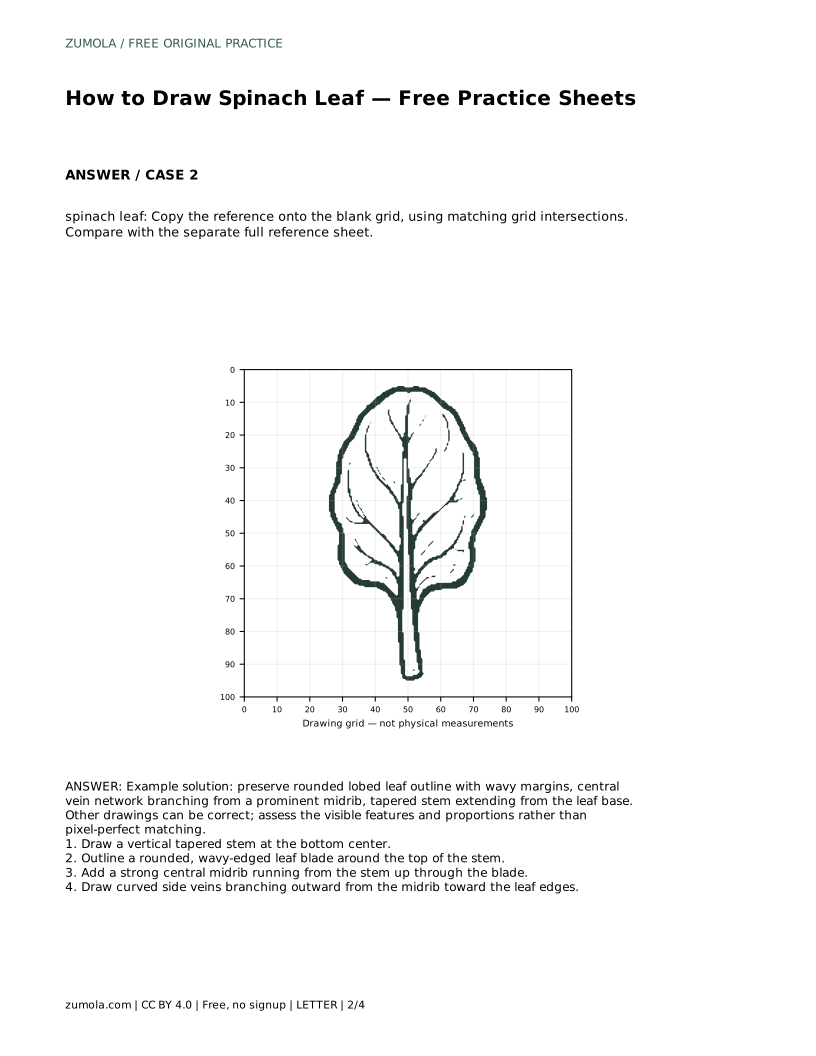
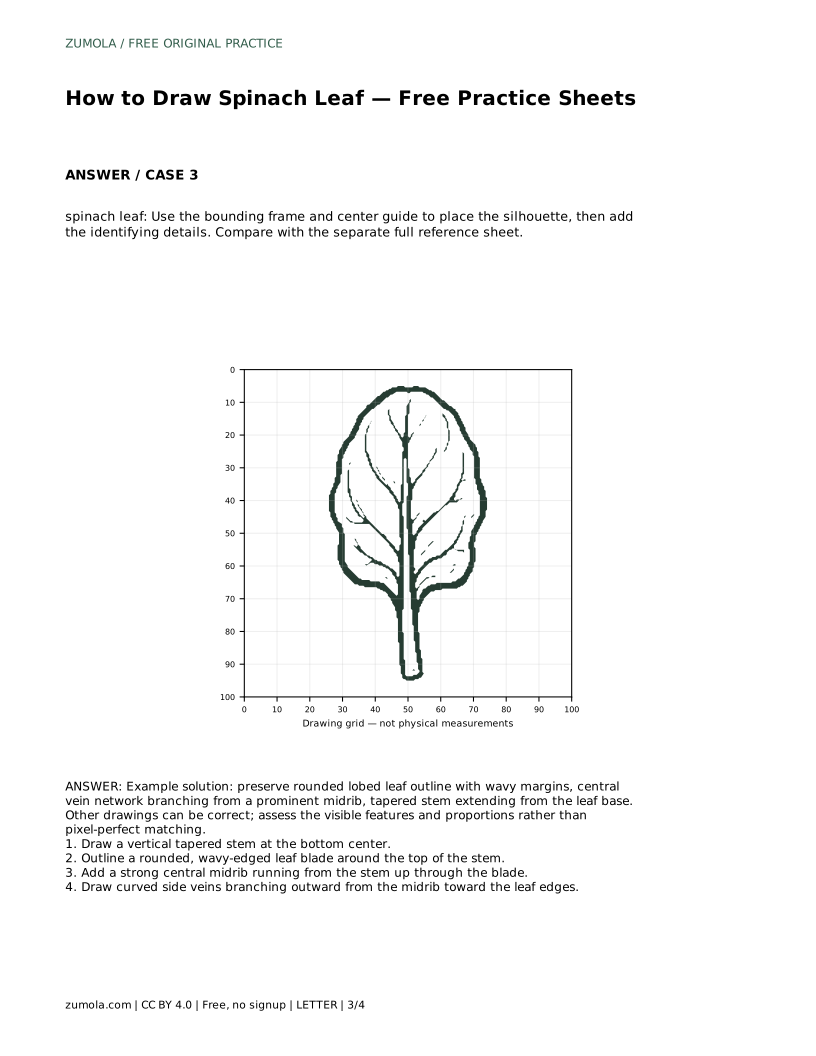
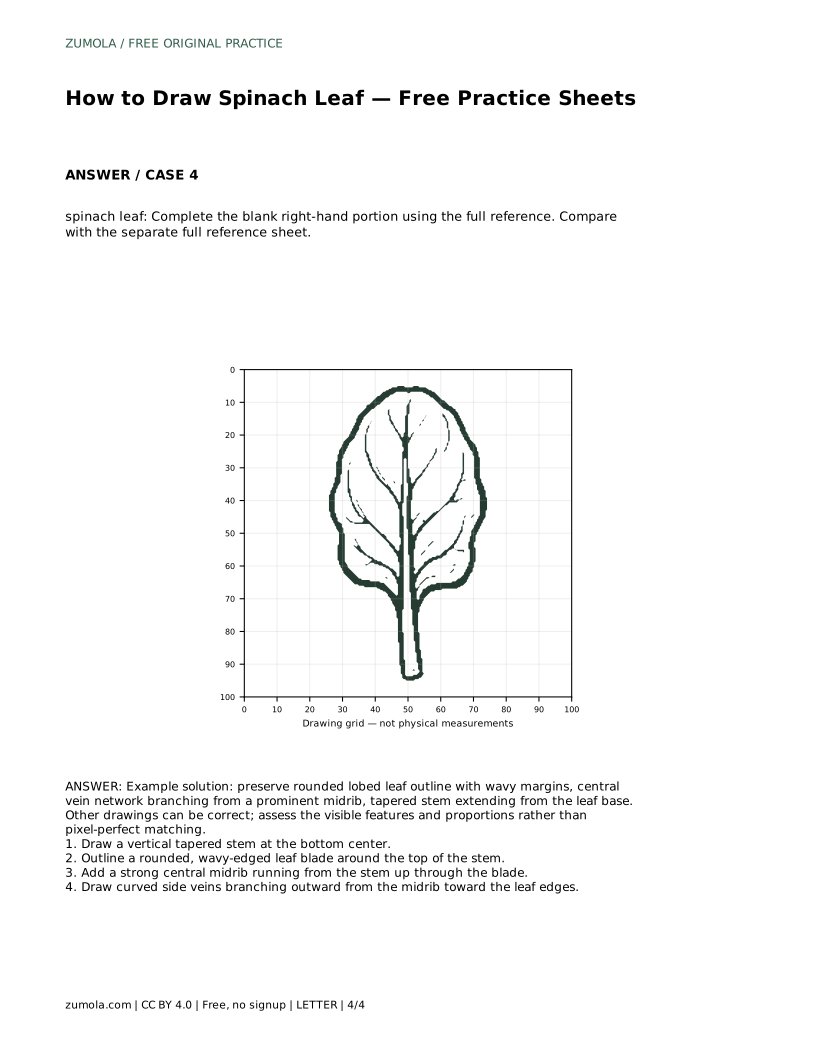
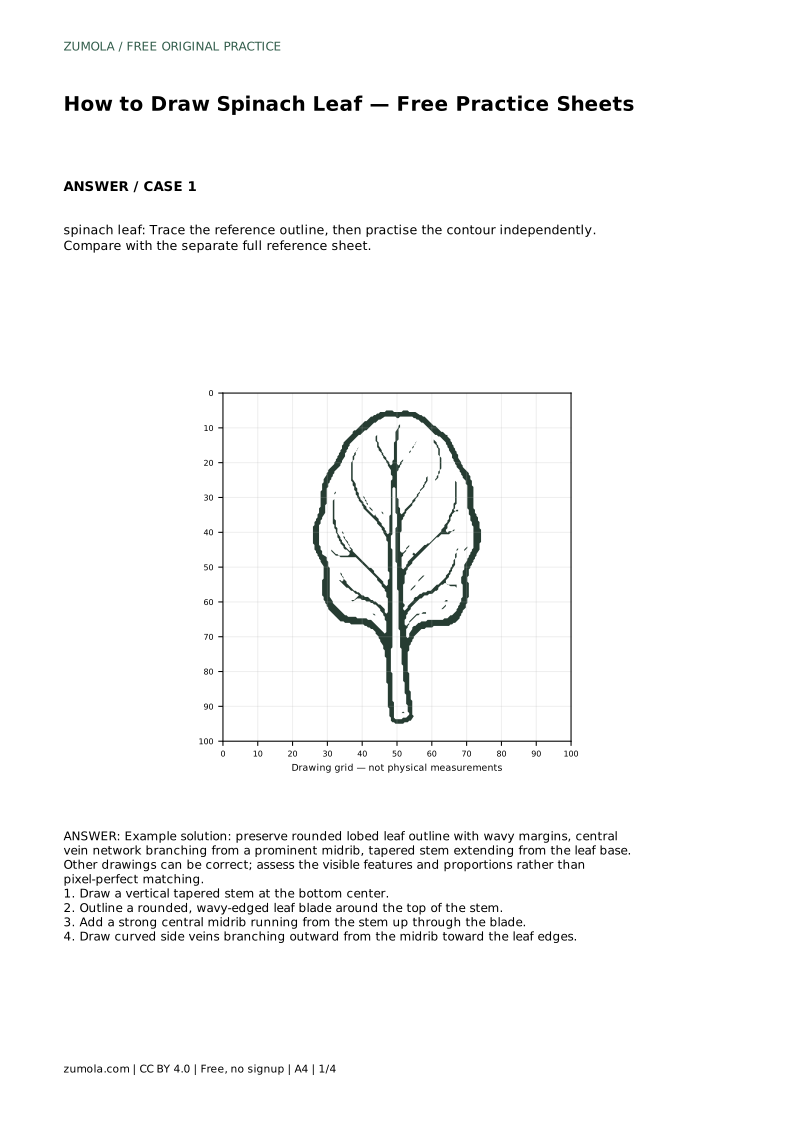
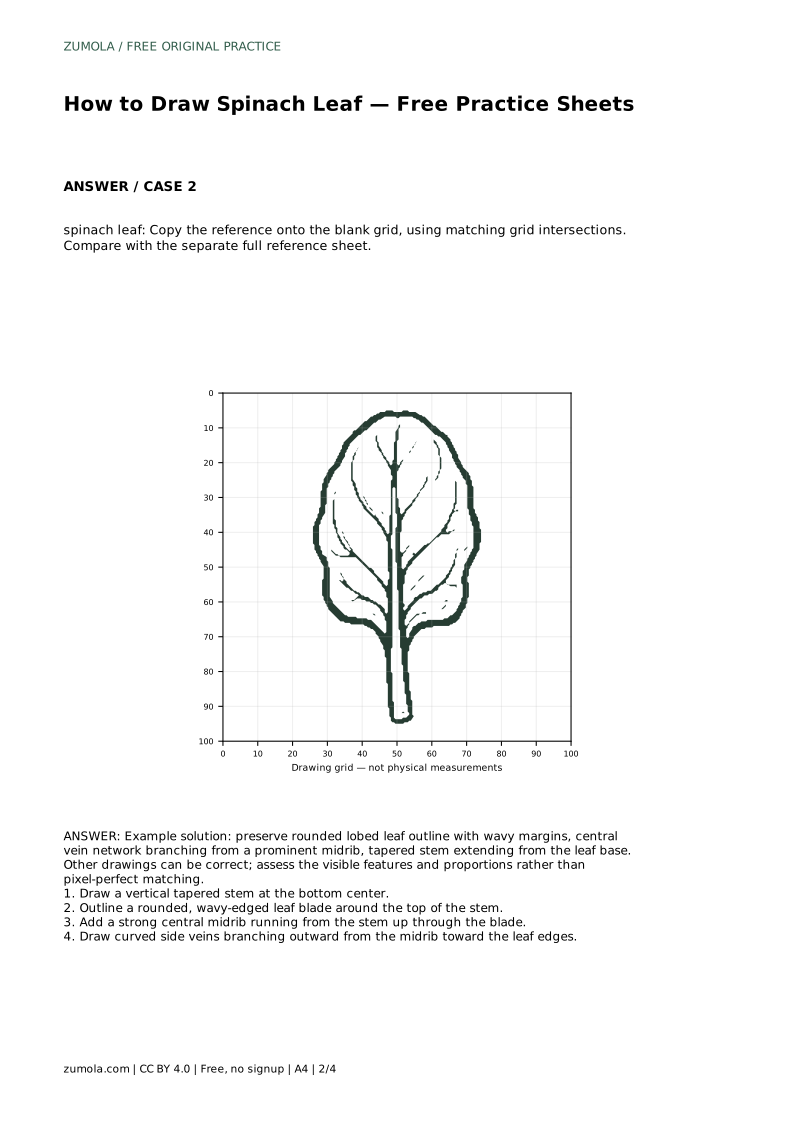
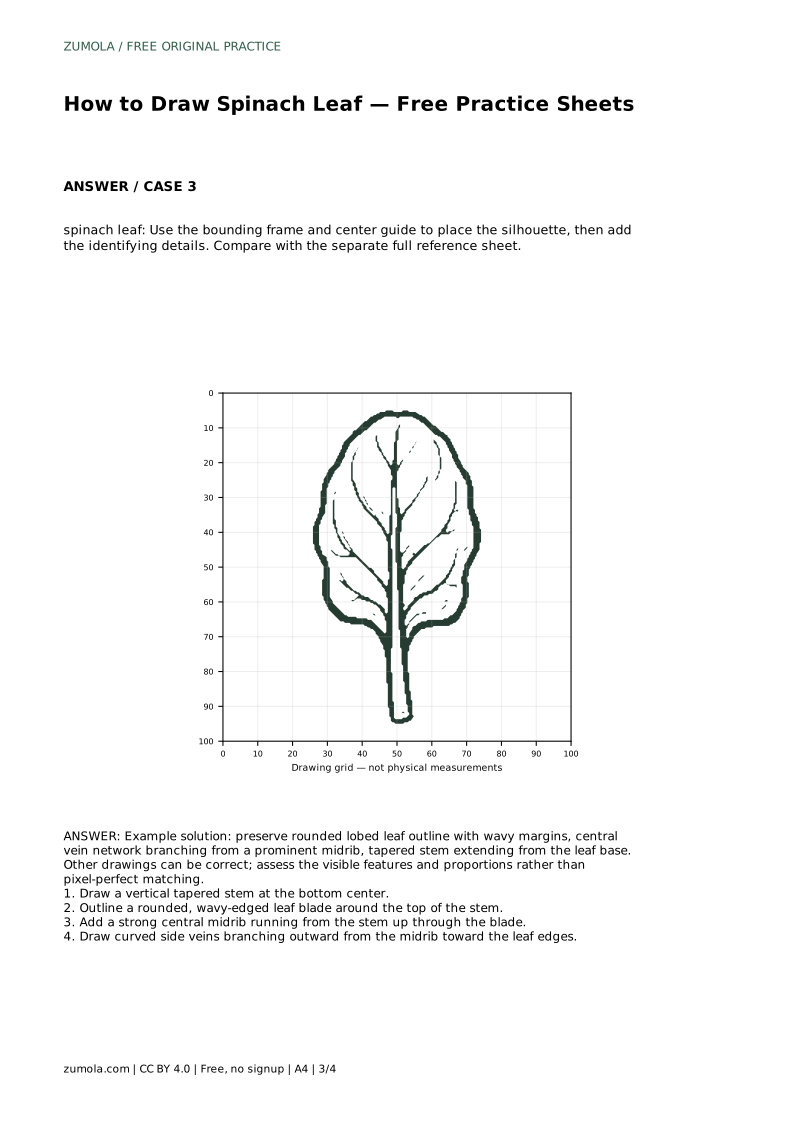
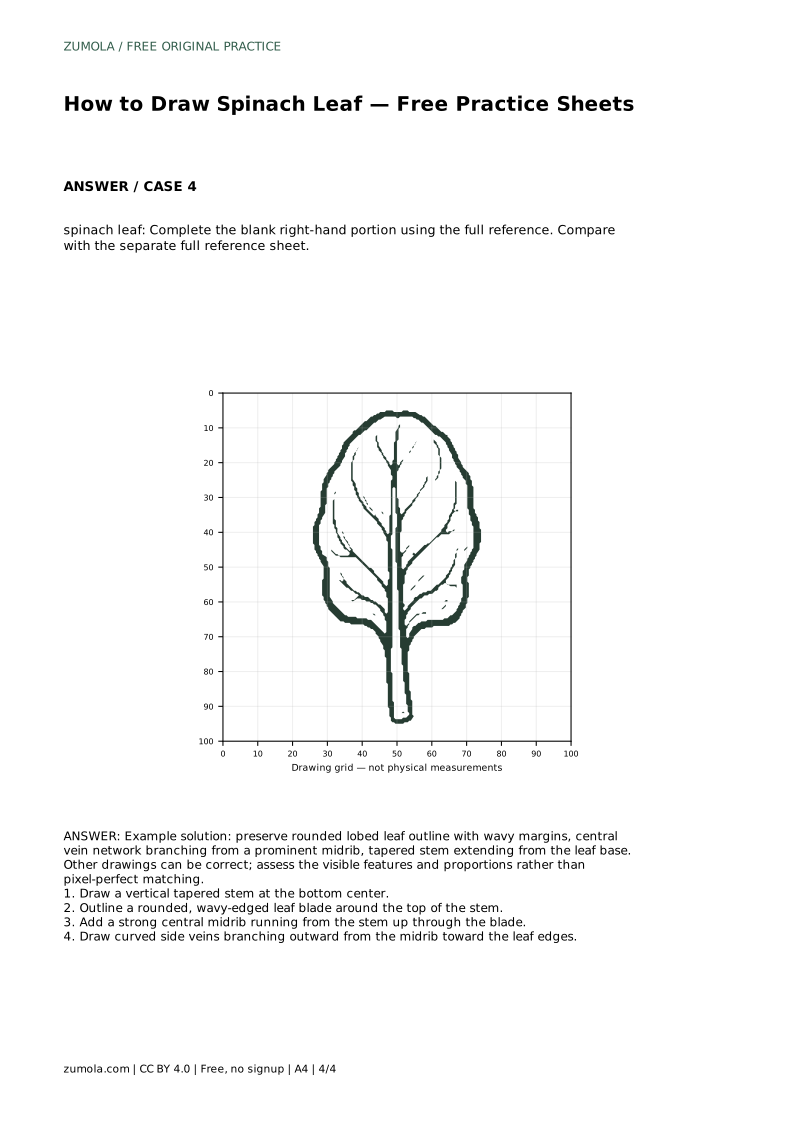
Reference diagrams
LETTER · Download PDF
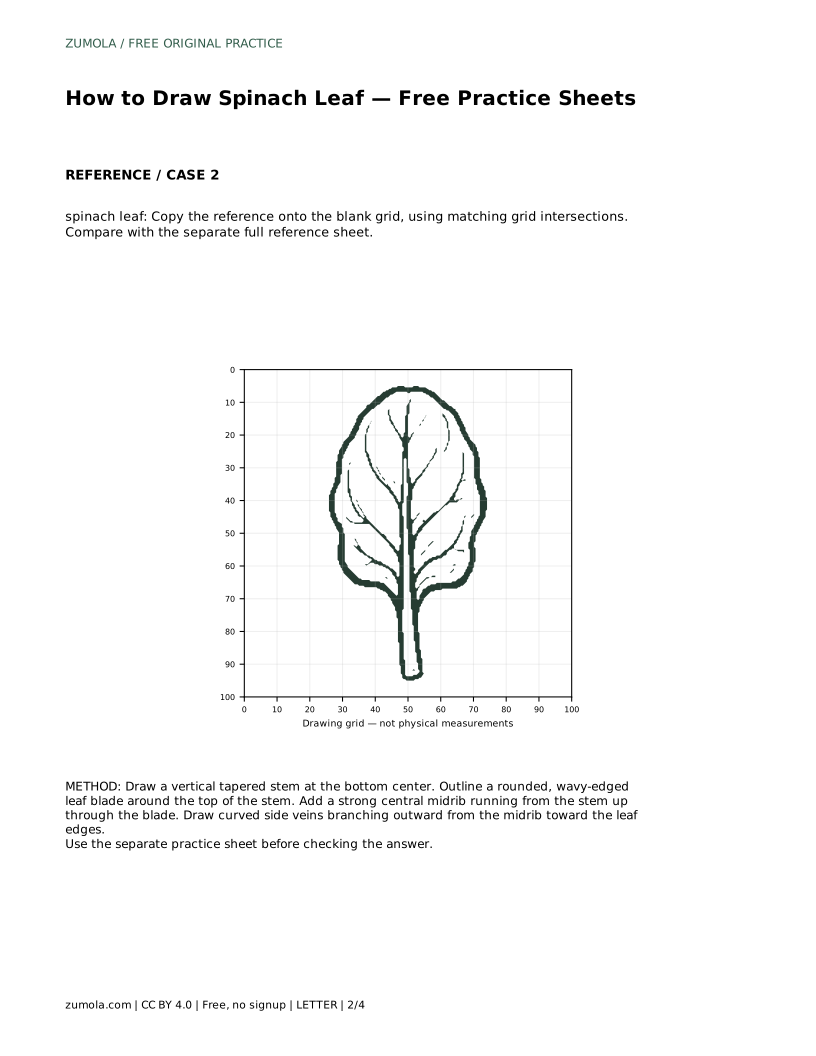
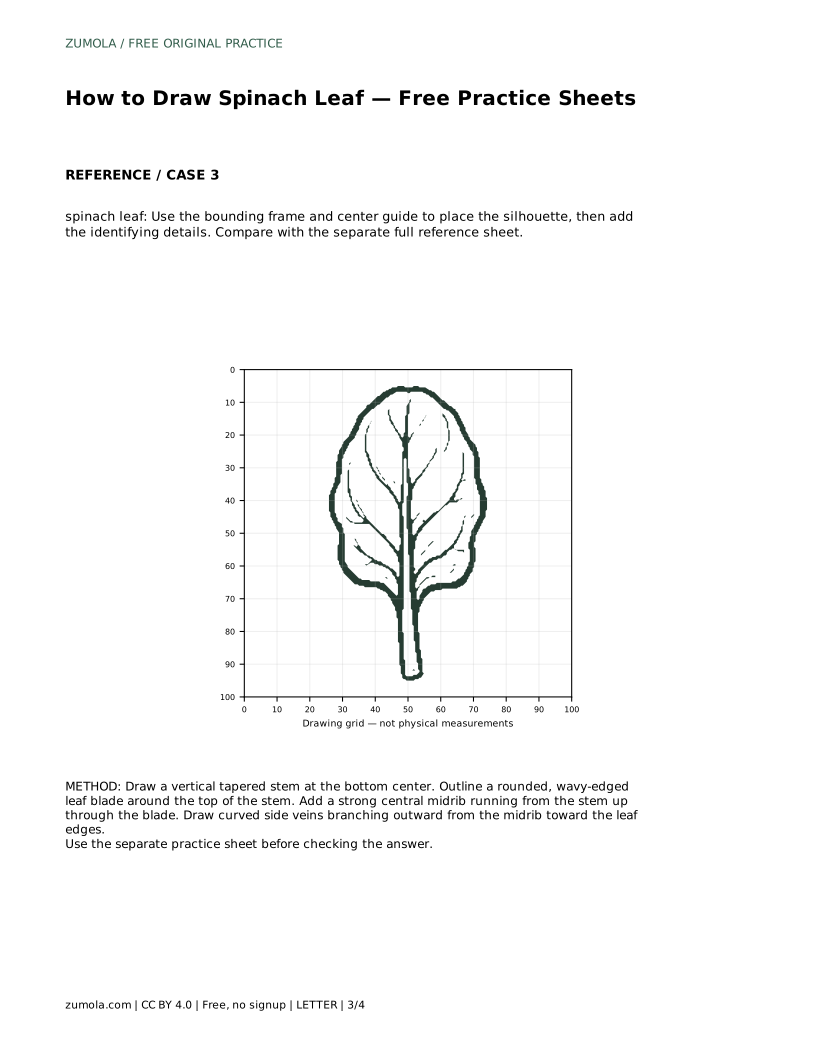
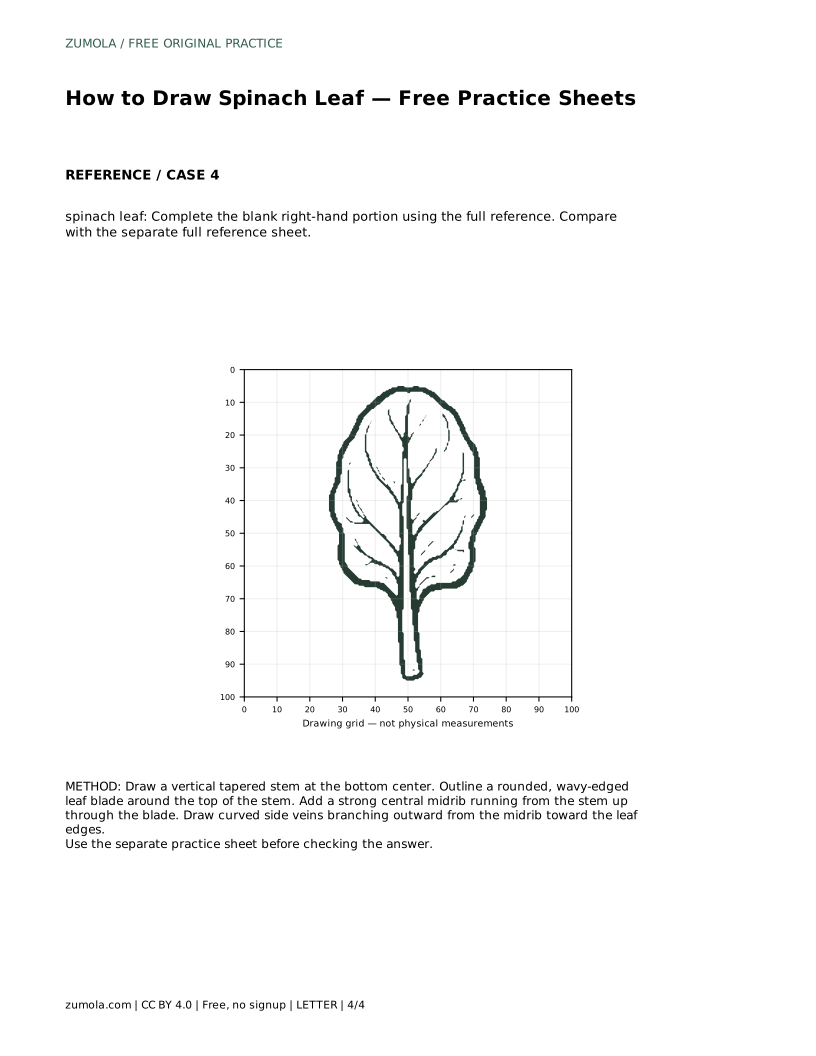
A4 · Download PDF
Free original resources
Learn to draw a spinach leaf with a tapered stem, rounded wavy blade, and branching veins. Trace, grid, and complete-the-drawing practice explained step by step.
Four original cases, with reference diagrams, practice sheets and worked answers. Everything is free; no signup required.
LETTER · Download PDF
A4 · Download PDF
LETTER · Download PDF
A4 · Download PDF
LETTER · Download PDF
A4 · Download PDF
Use A4 or US Letter to match your printer. Use the stated values and conditions to solve each exercise; diagrams are not physical measuring rulers.
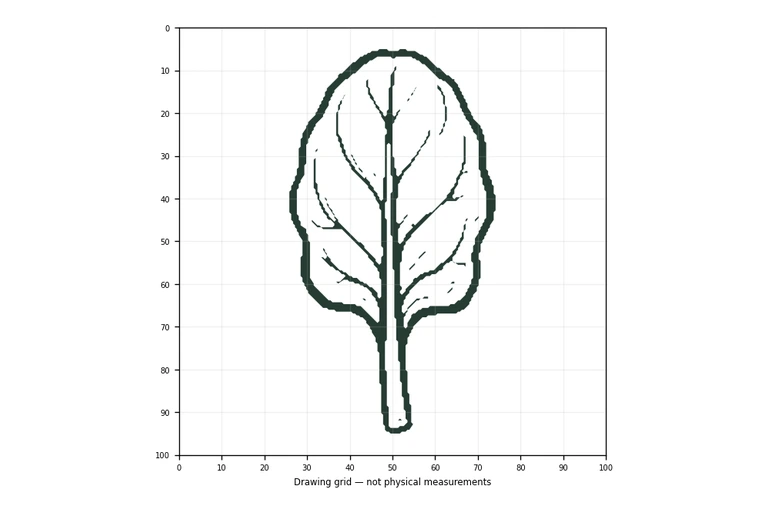
A spinach leaf is a forgiving subject for beginners because its shape is simple but its veins give you plenty to observe. This guide explains how to build the leaf from the stem upward, how to place the wavy outline, and how to draw a midrib and side veins that look natural rather than mechanical. You can use these steps with tracing, grid, or partial-outline practice sheets, and you can judge your result by visible features rather than an exact match.
Begin at the bottom center of your page. Draw a short, vertical stem that tapers slightly as it rises. Spinach stems are narrow at the base and widen gently where they meet the leaf, so keep the line smooth and avoid a stiff rectangle.
From the top of the stem, outline the leaf blade. Spinach leaves are broadly rounded with softly wavy or lobed margins, not sharp points. Work around the blade in one continuous pass, letting the edge rise and dip in gentle curves. Keep the left and right sides roughly balanced in size, though small differences are normal and look natural.
A spinach leaf reads clearly when the vein pattern is visible. Draw a strong central midrib running from the stem up through the middle of the blade, ending before the top edge. This line should be slightly thicker than the outline so it stands out.
Next, add curved side veins branching outward from the midrib toward the leaf edges. Space them unevenly and vary their length; real leaves do not repeat a perfect pattern. Let each side vein curve gently toward the margin rather than running straight across. A few shorter veins near the top and bottom complete the network without crowding the blade.
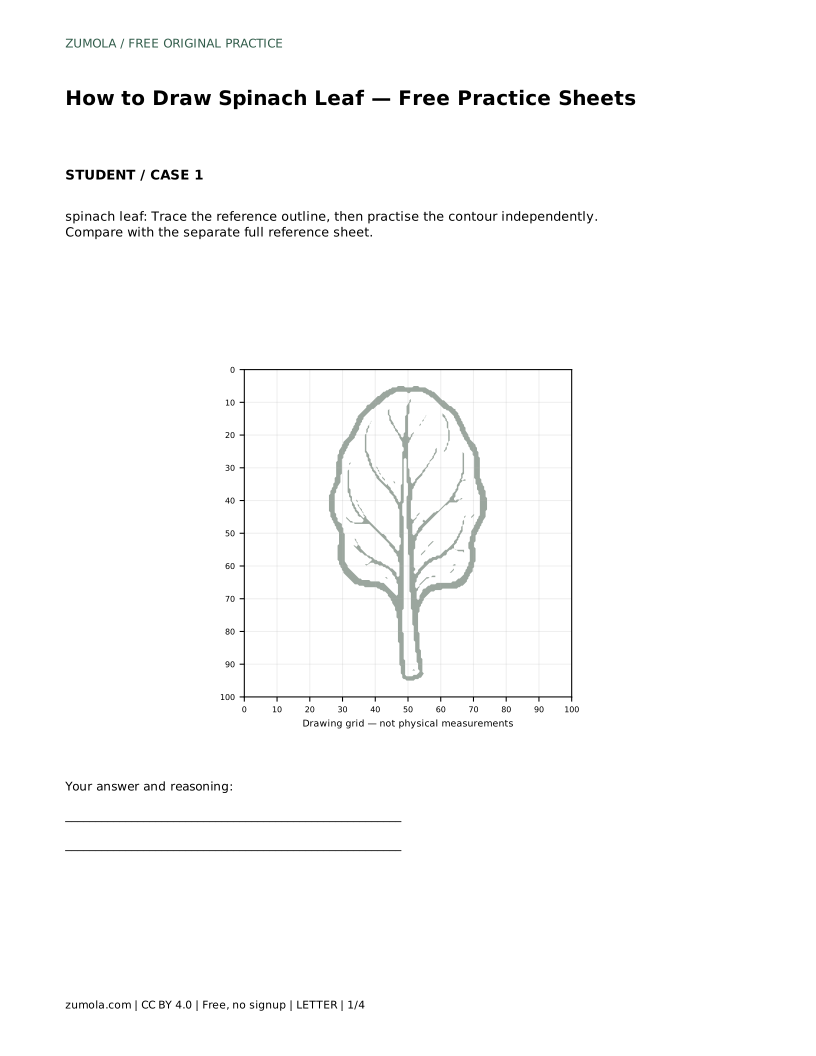
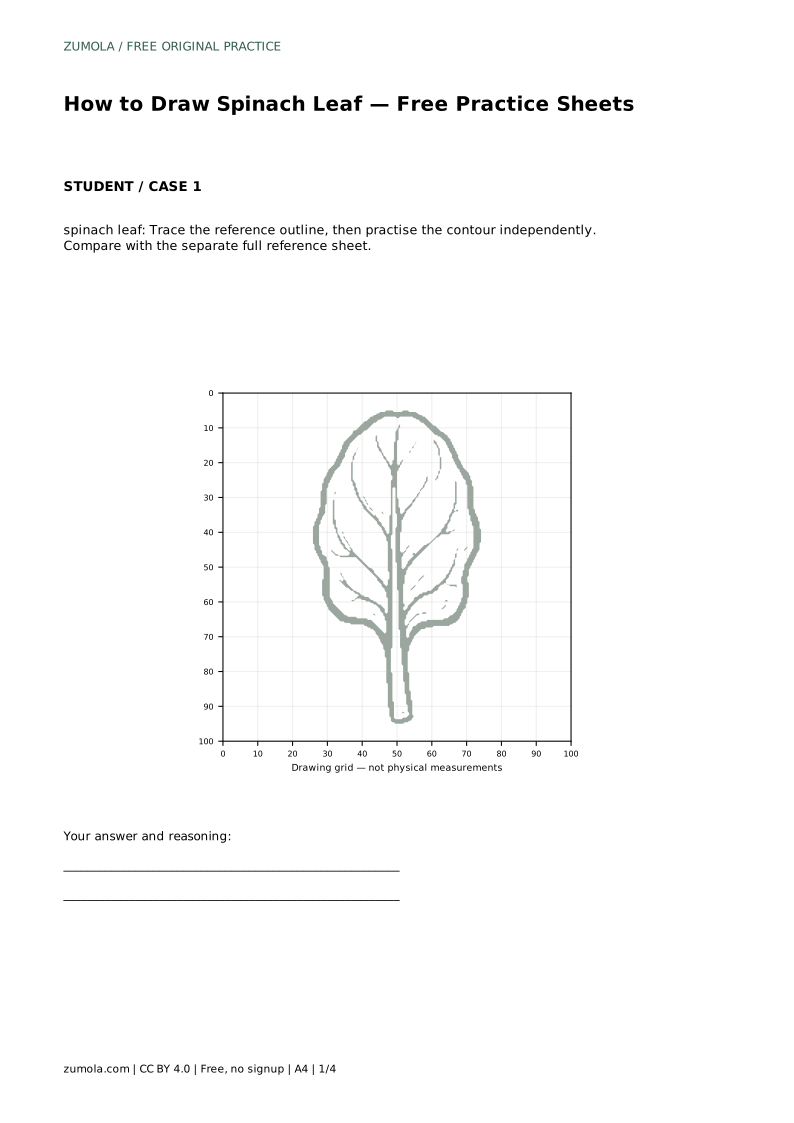
Tracing helps you learn the contour before drawing it freehand. Place the reference outline in front of you, follow it once, then cover it and redraw the leaf from memory. Compare your freehand attempt with the separate full reference sheet and note which features drifted.
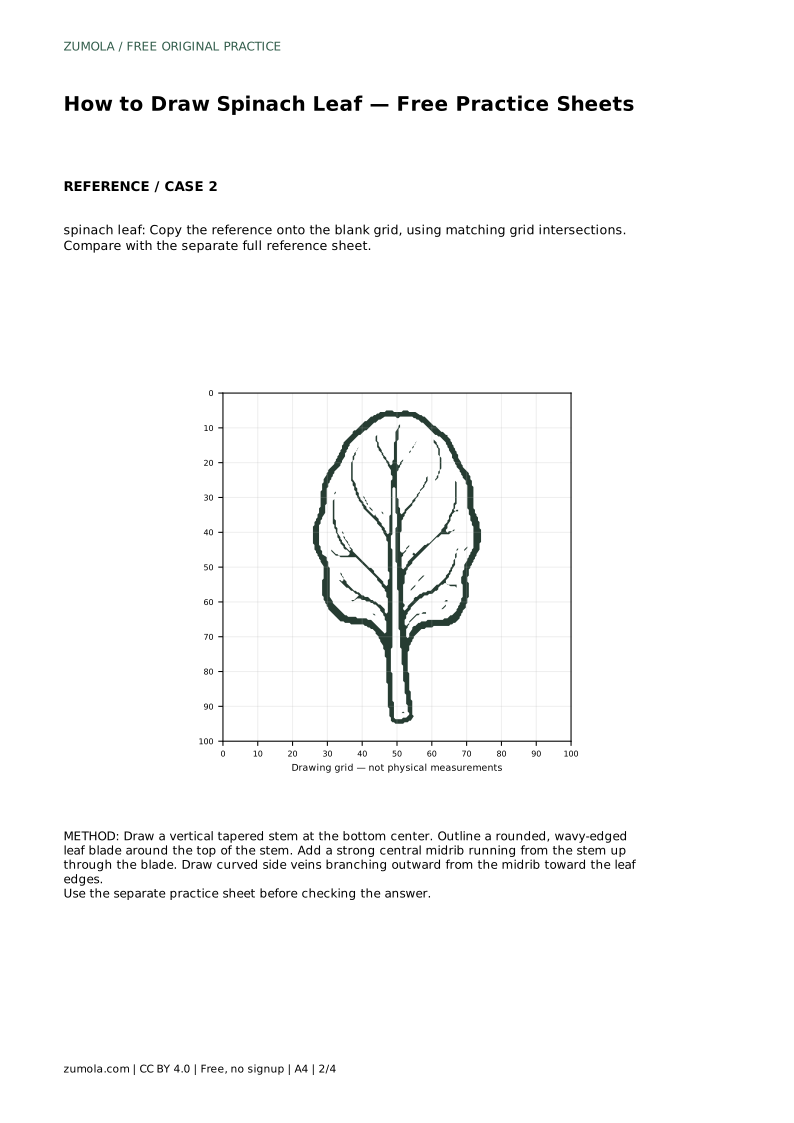
Grid practice builds proportion. Copy the leaf onto the blank grid by matching where the outline crosses each grid intersection. The grid does not need to be perfectly reproduced; use it to keep the stem centered and the blade width consistent.
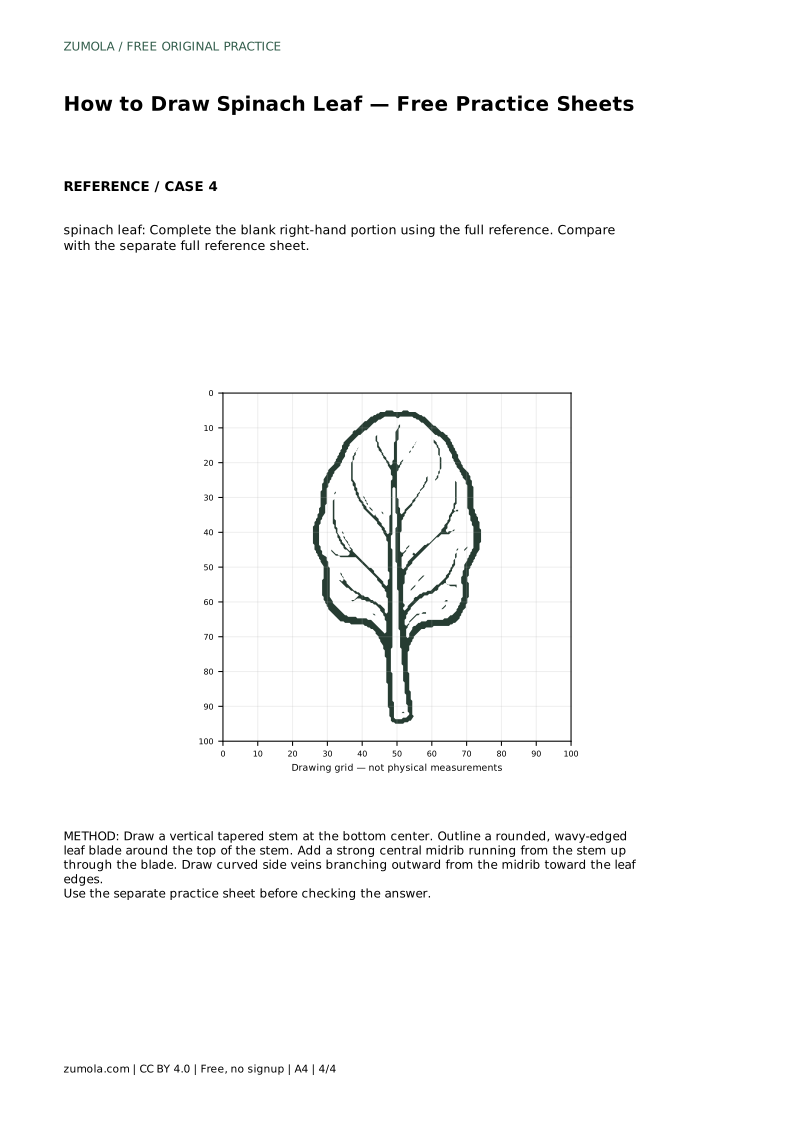
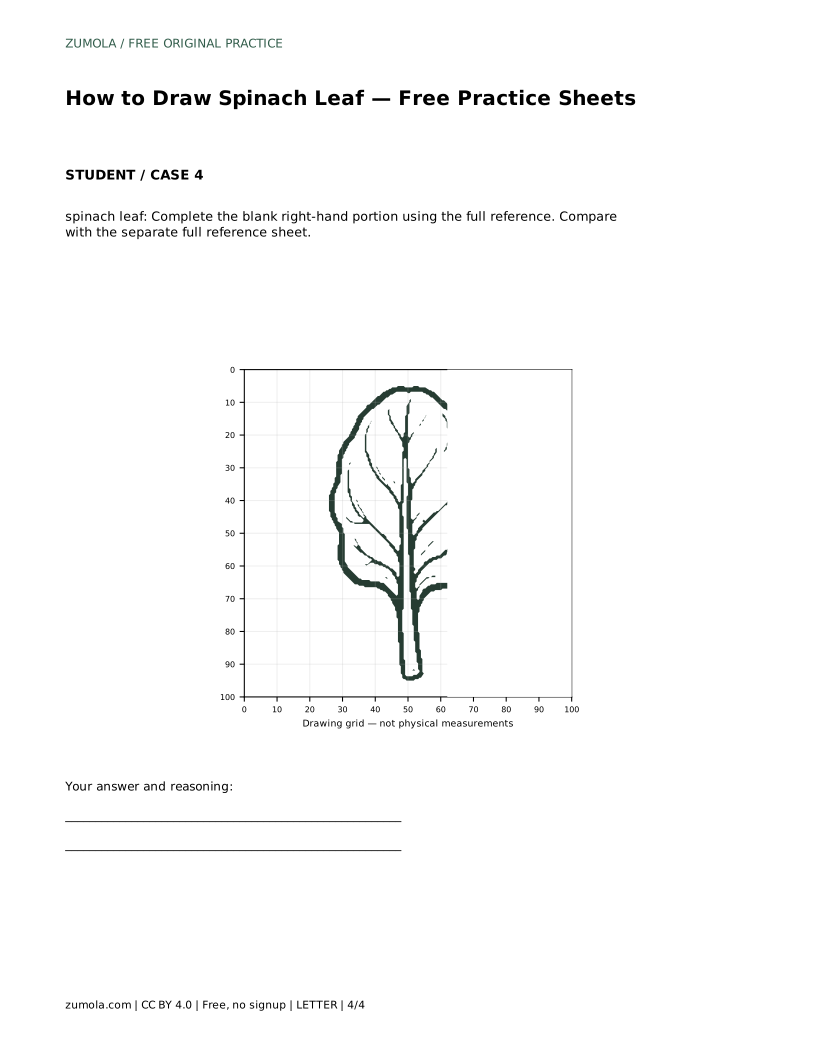
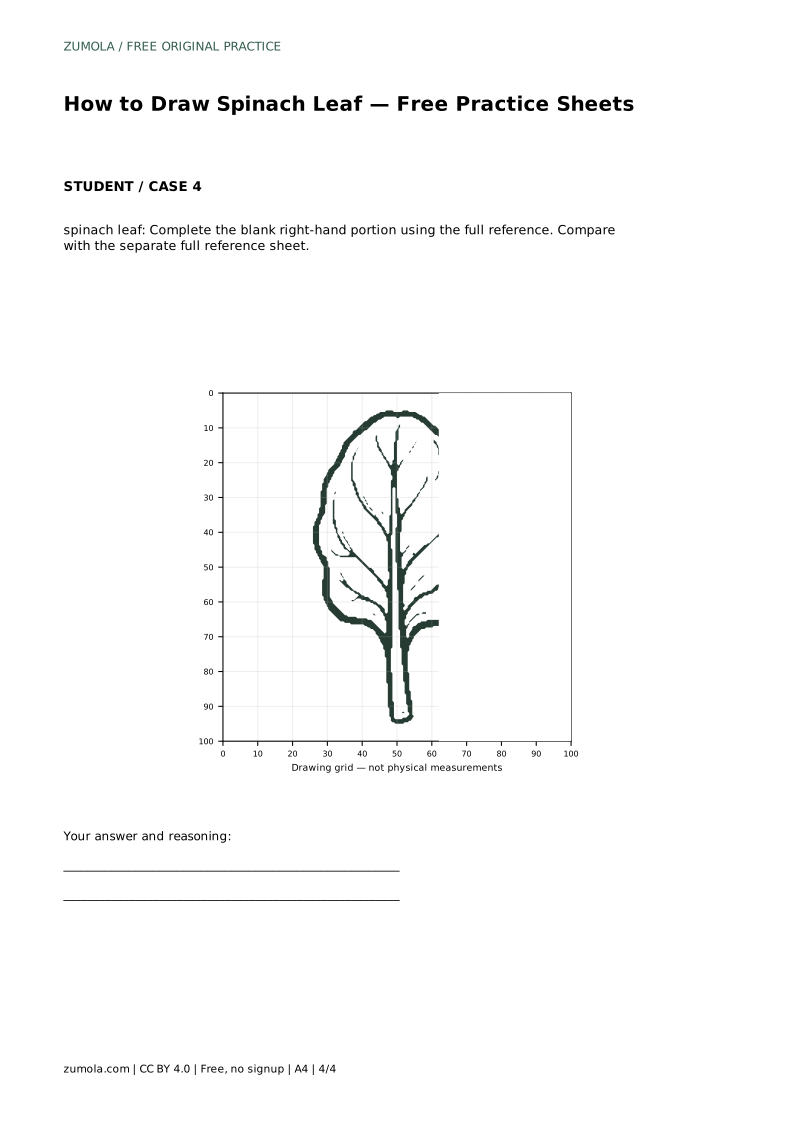
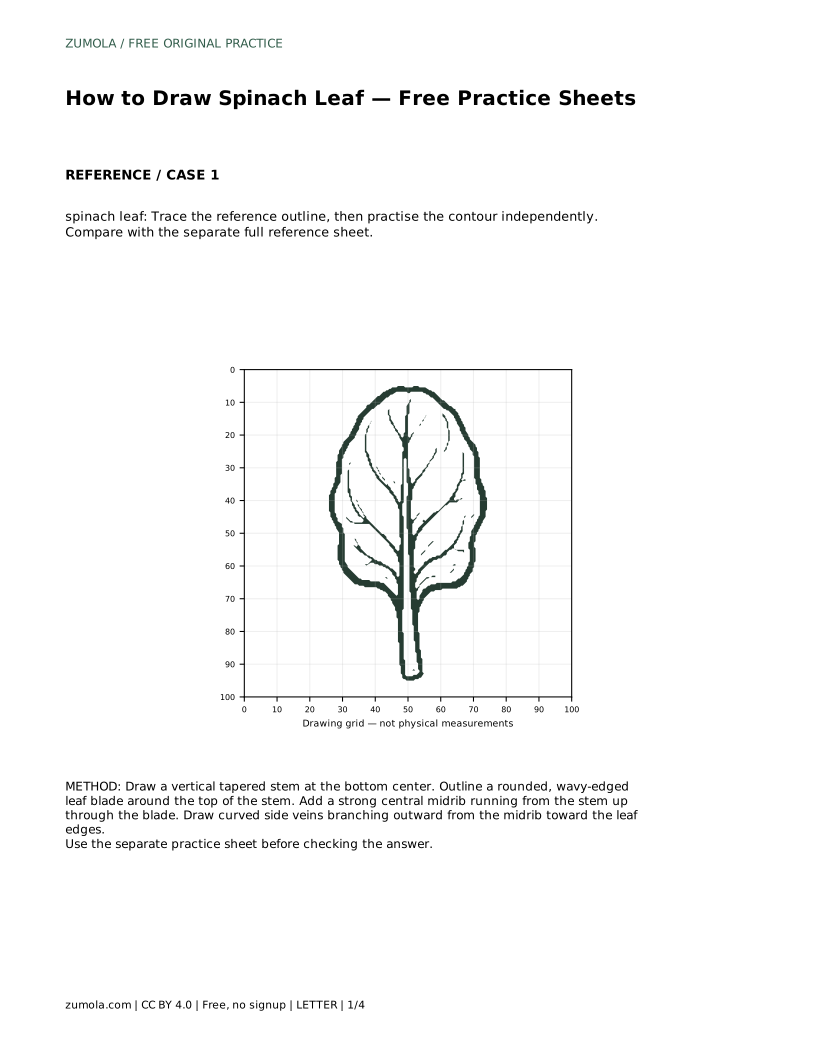
Partial-outline sheets give you half the leaf and ask you to complete the rest. Use the full reference to judge the missing side, then check that the wavy margin, midrib, and side veins continue logically from the drawn half.
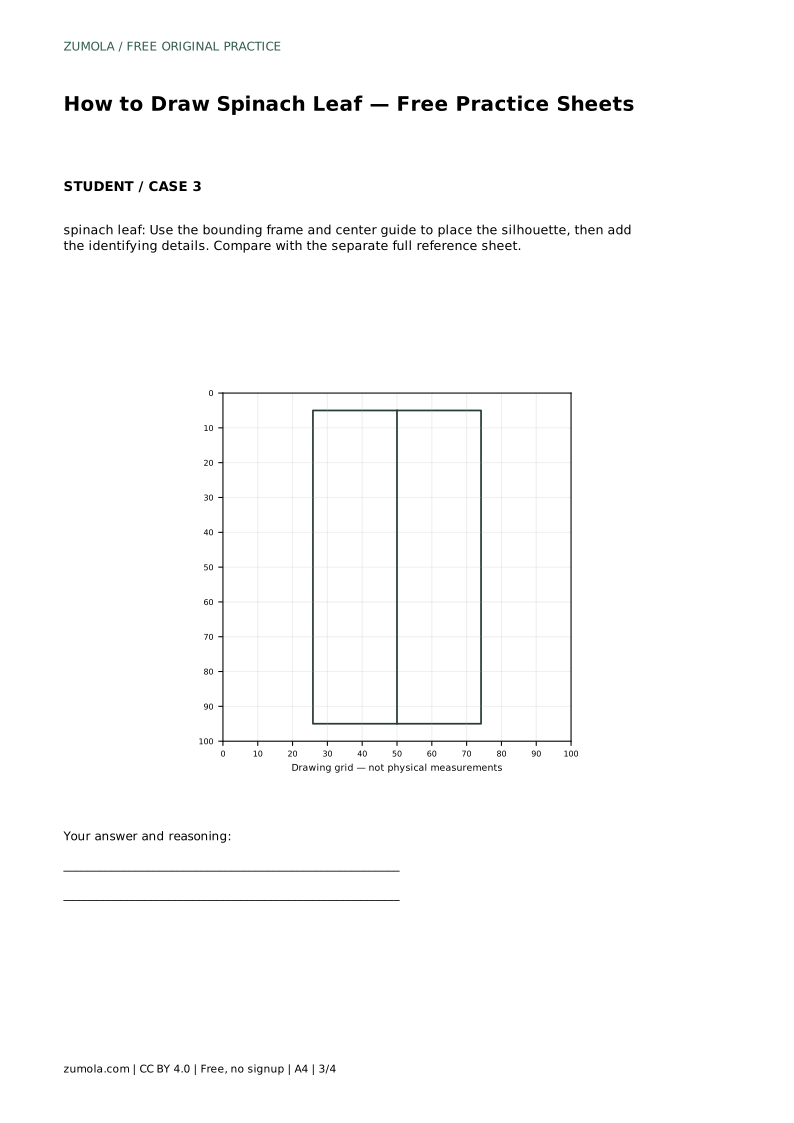
There is no single correct spinach leaf drawing. Two sketches can both be accurate if they show the same identifying features: a tapered stem, a rounded blade with wavy margins, a prominent midrib, and side veins branching outward. Use a rubric to check those features and their proportions instead of chasing a pixel-perfect copy.
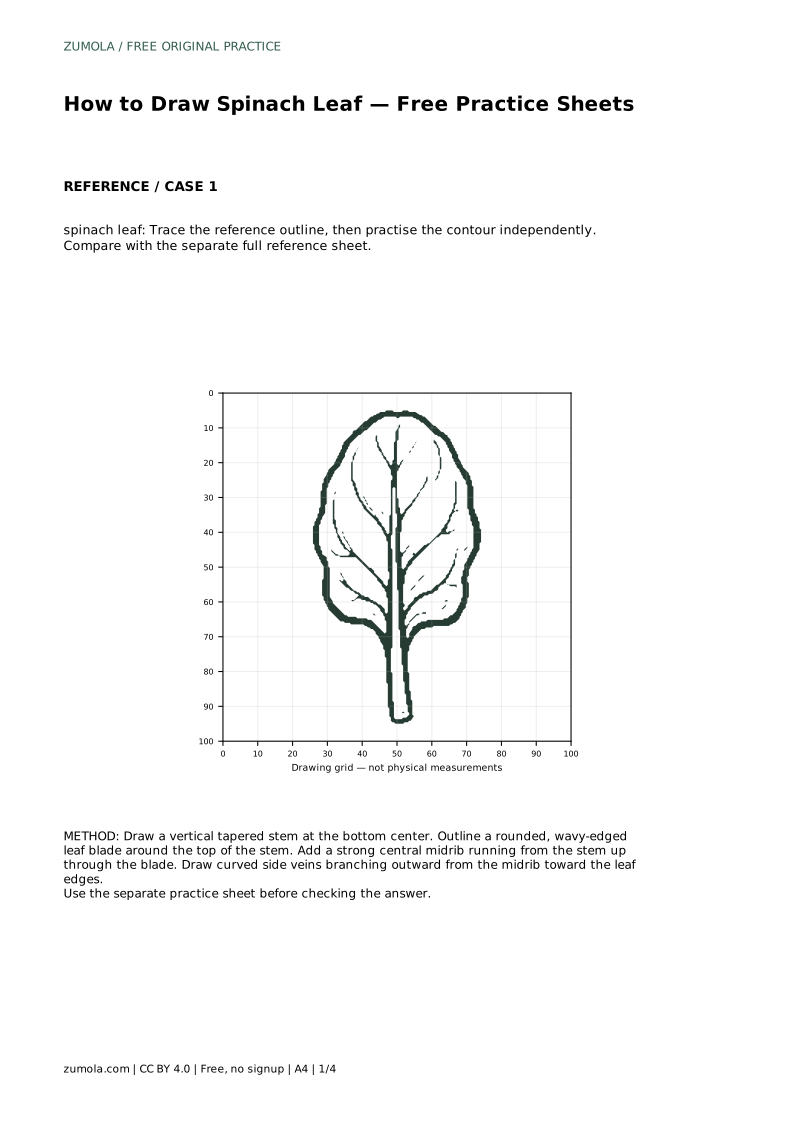
spinach leaf: Trace the reference outline, then practise the contour independently. Compare with the separate full reference sheet.
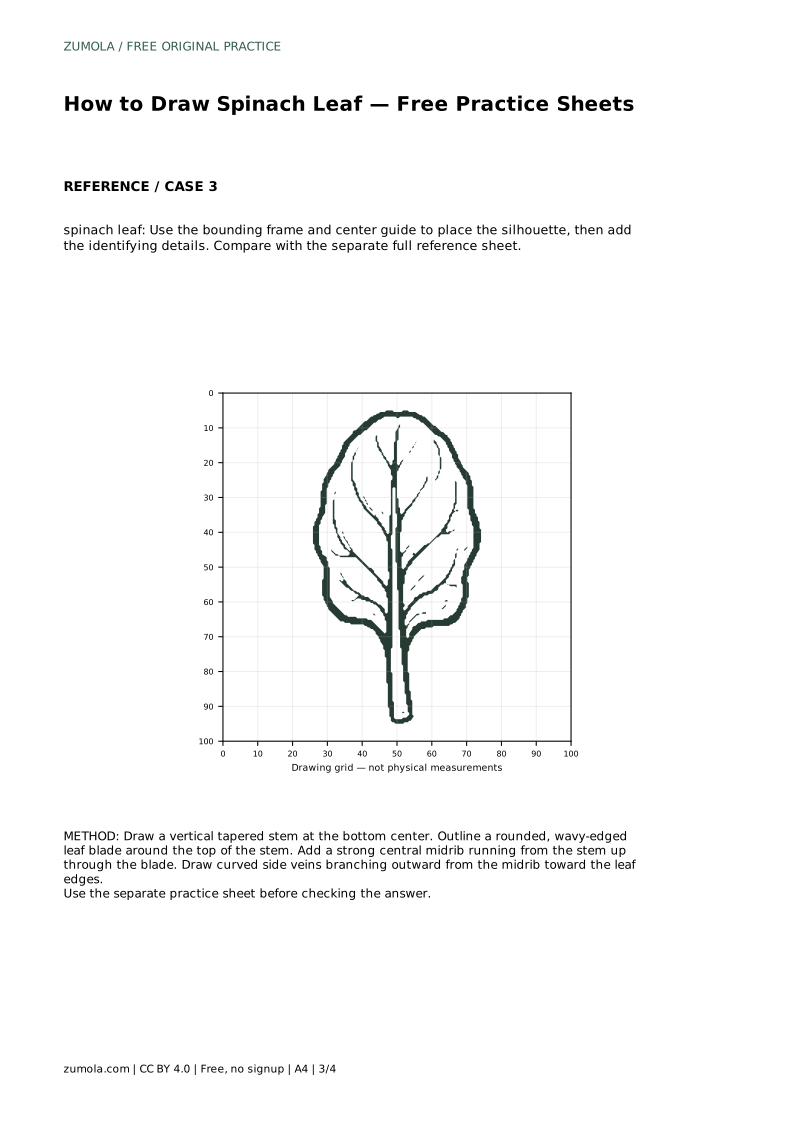
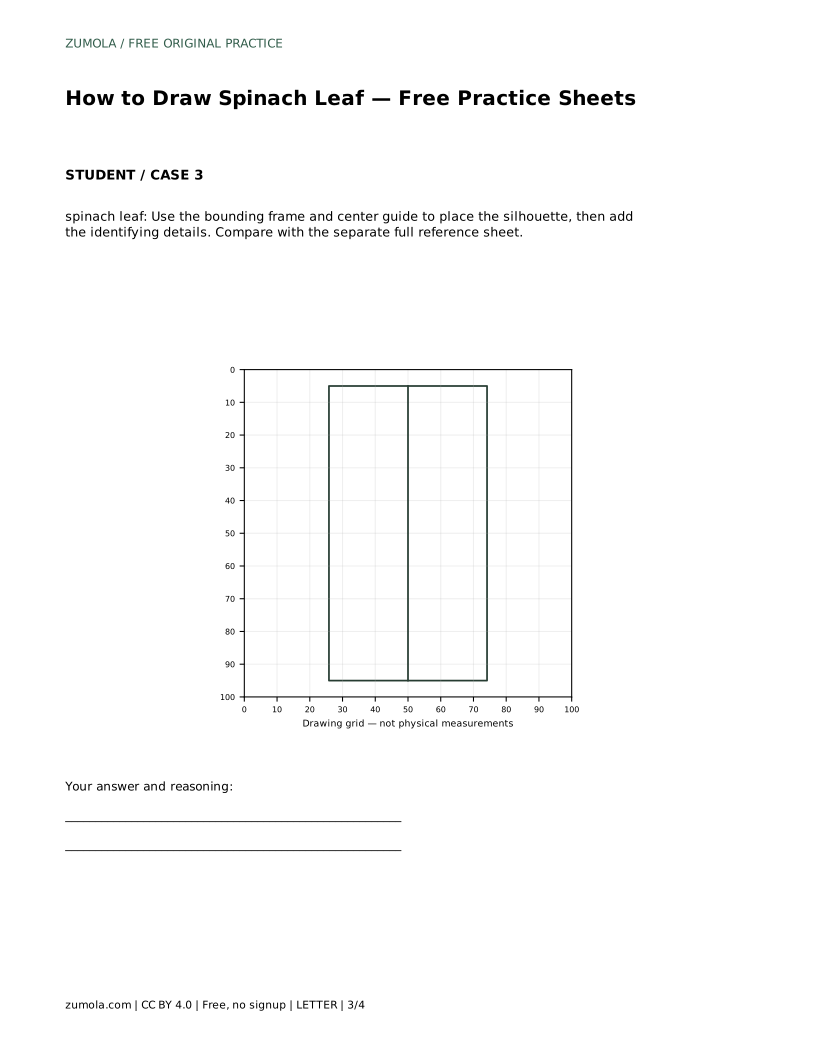
Example solution: preserve rounded lobed leaf outline with wavy margins, central vein network branching from a prominent midrib, tapered stem extending from the leaf base. Other drawings can be correct; assess the visible features and proportions rather than pixel-perfect matching. Draw a vertical tapered stem at the bottom center. Outline a rounded, wavy-edged leaf blade around the top of the stem. Add a strong central midrib running from the stem up through the blade. Draw curved side veins branching outward from the midrib toward the leaf edges.
No. A clear midrib and a handful of curved side veins are enough to identify the leaf. Too many lines can make the blade look cluttered.
No. Slight differences between the left and right sides look natural. Aim for balanced proportions rather than mirror-image symmetry.
Check for the tapered stem, rounded wavy blade, prominent midrib, and branching side veins. If those features are present and reasonably placed, the drawing is successful.
All drawing practice · Free coordinate paper
Original resources · CC BY 4.0 · Free for personal and classroom use with attribution.