Free original resources
Drawing Prompt Generator: Build Focused Practice Tasks
Learn how to turn object, composition, and tonal requirements into a clear drawing practice task, with a worked example, common mistakes, and a fair rubric.
Free resources
Letter & A4
PDF & SVG
Letter & A4
PDF & SVG
Make it yours.
Free · no signup · calculated in your browser
Your free printable kit.
Original reference, student practice and separate worked answers. No account or payment.
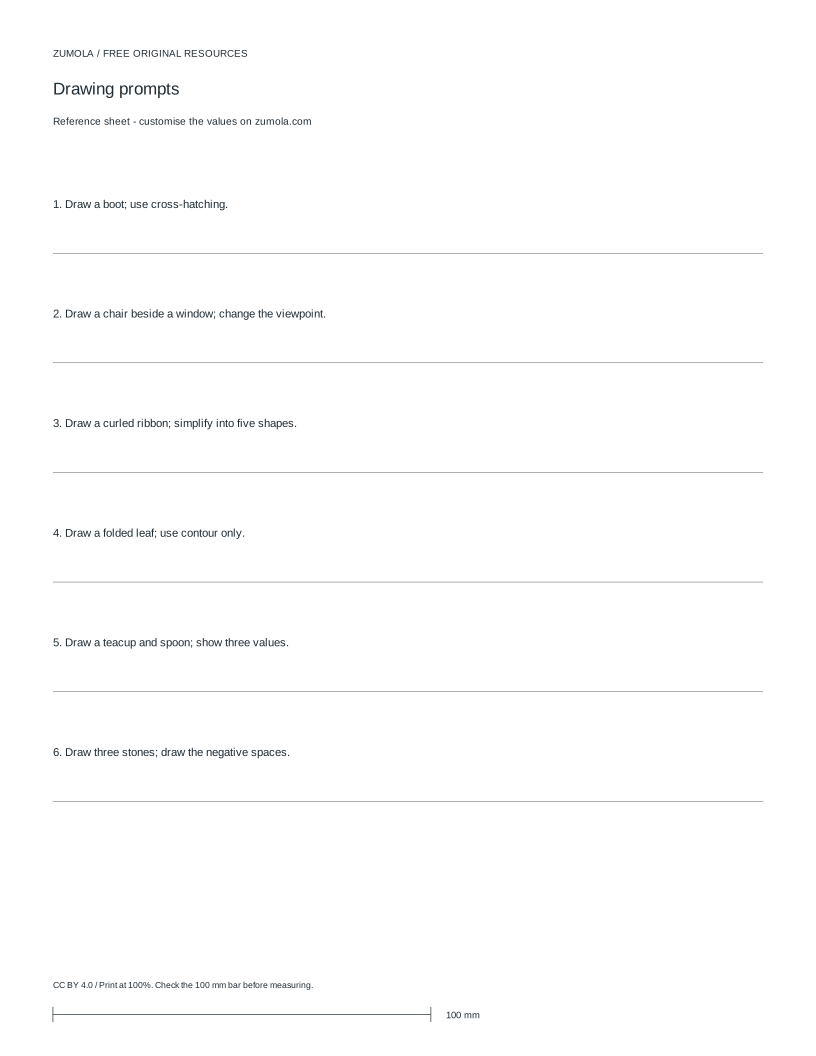
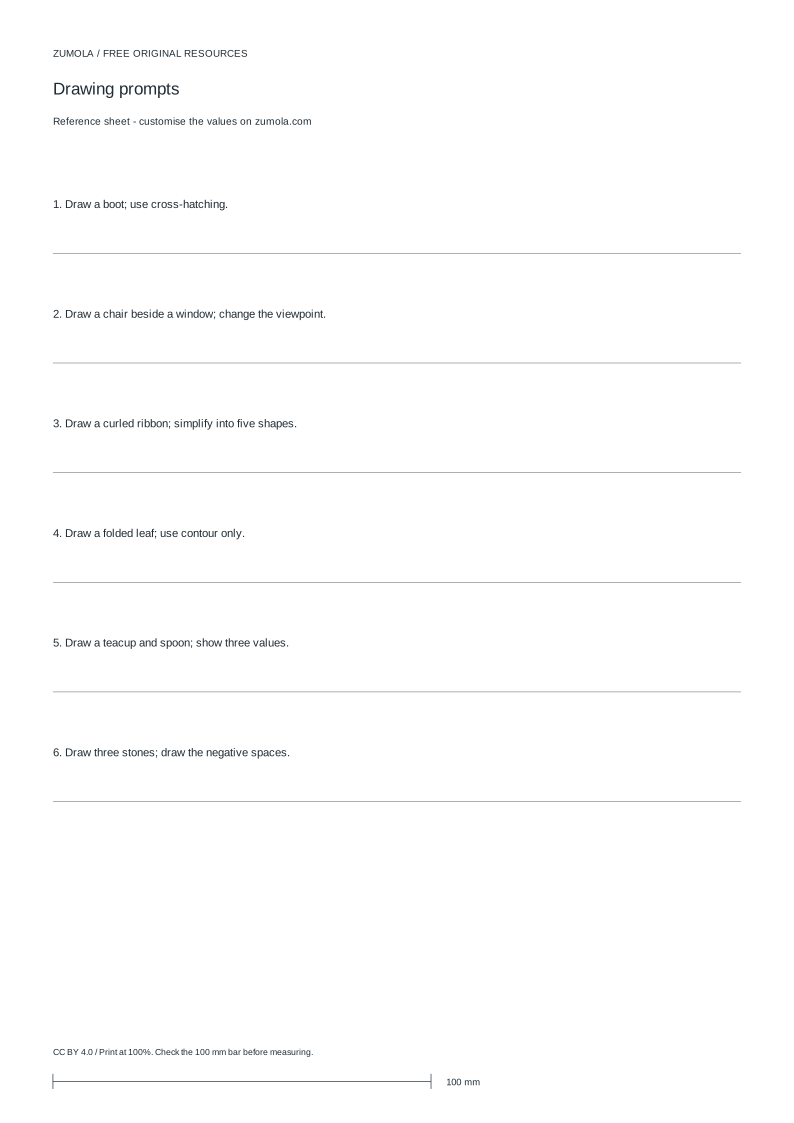
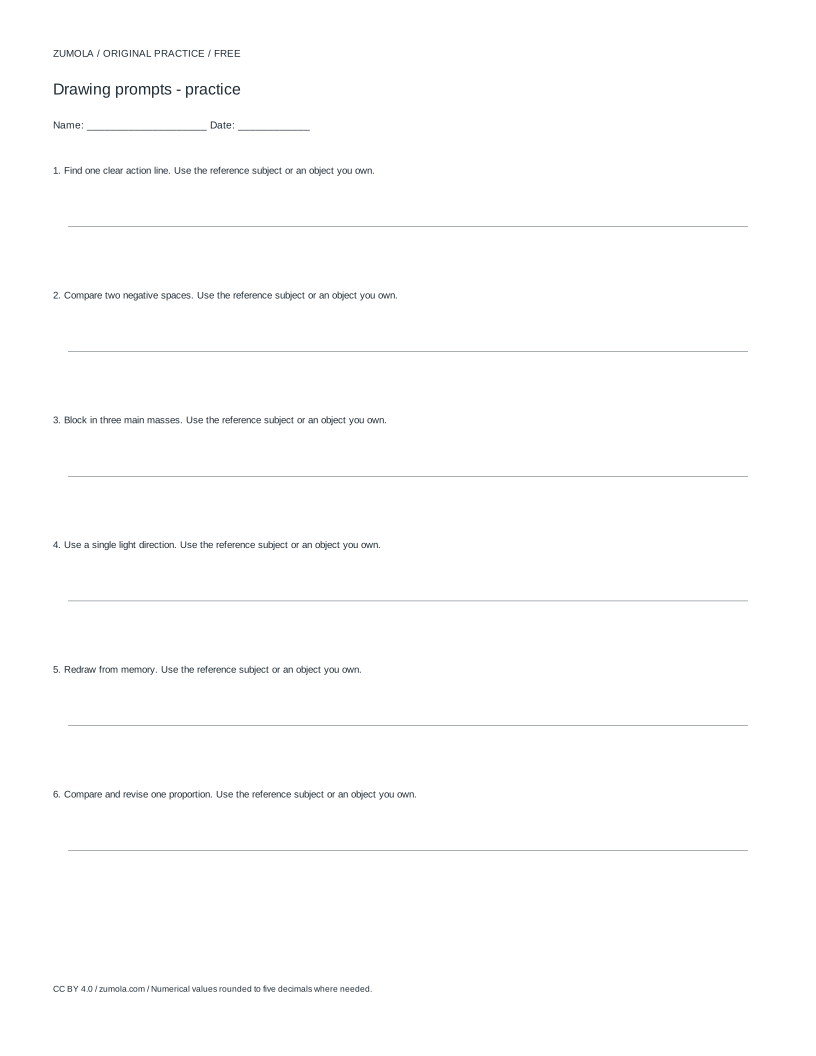
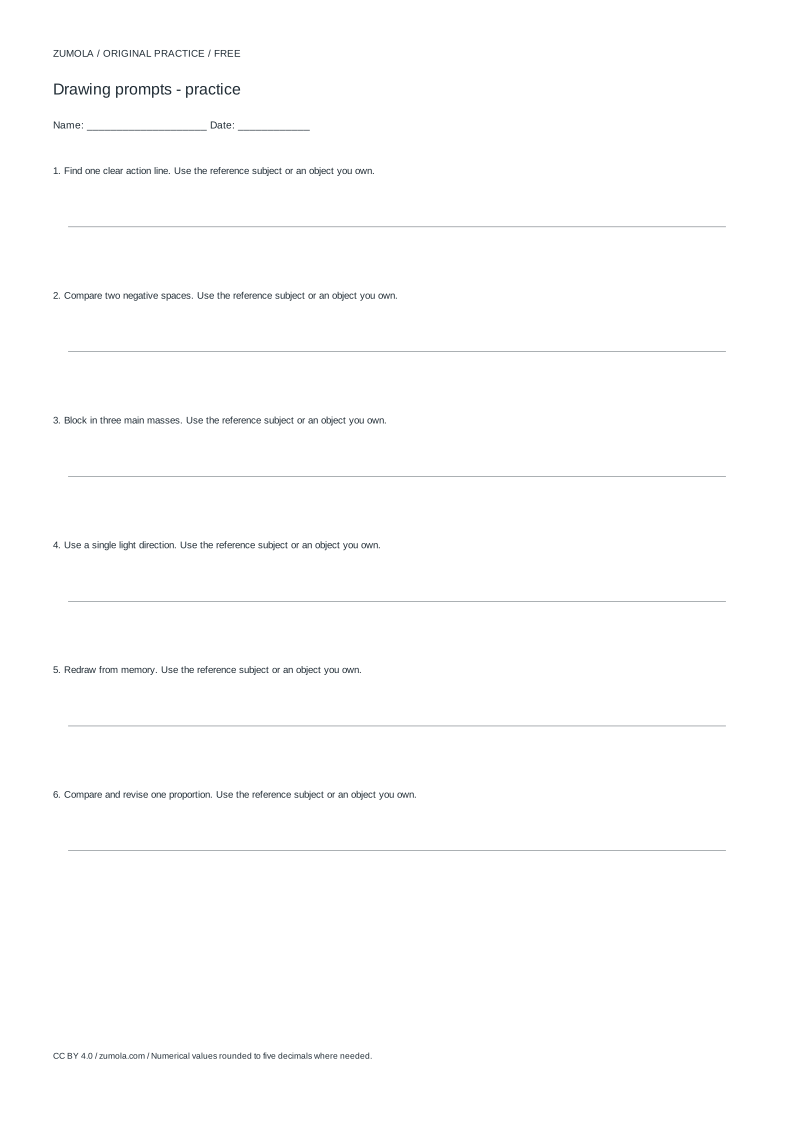
Practice worksheet
Worked answers / rubric
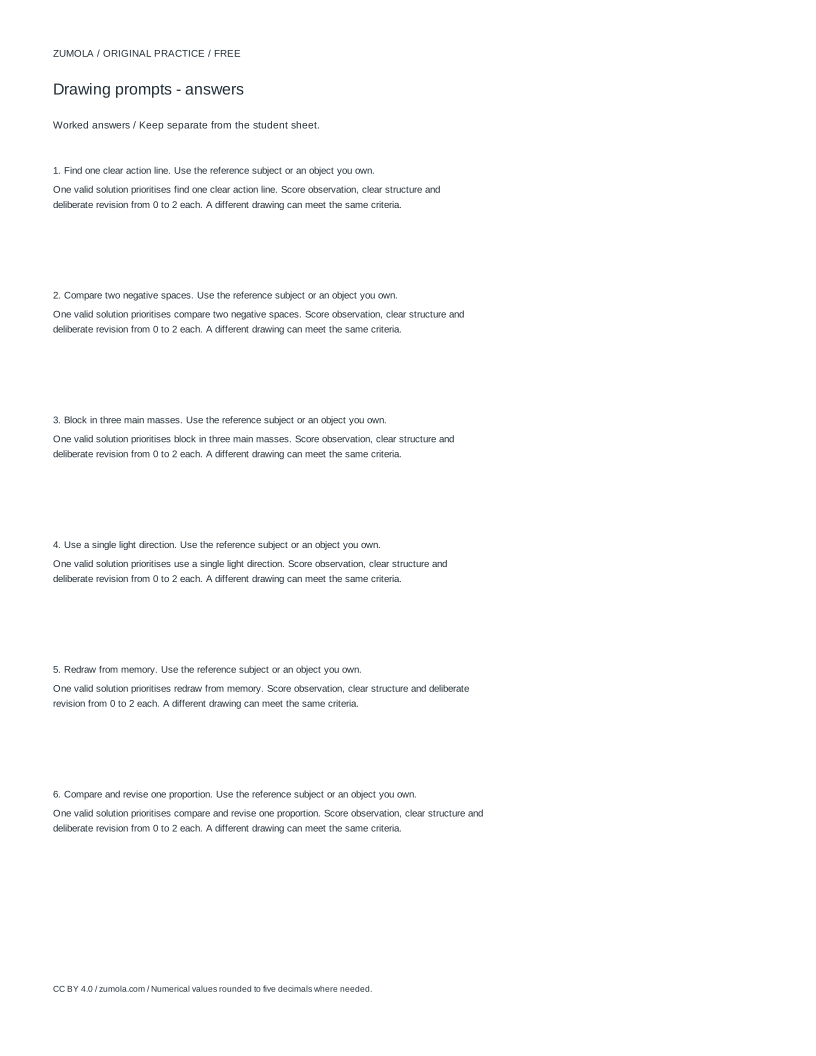
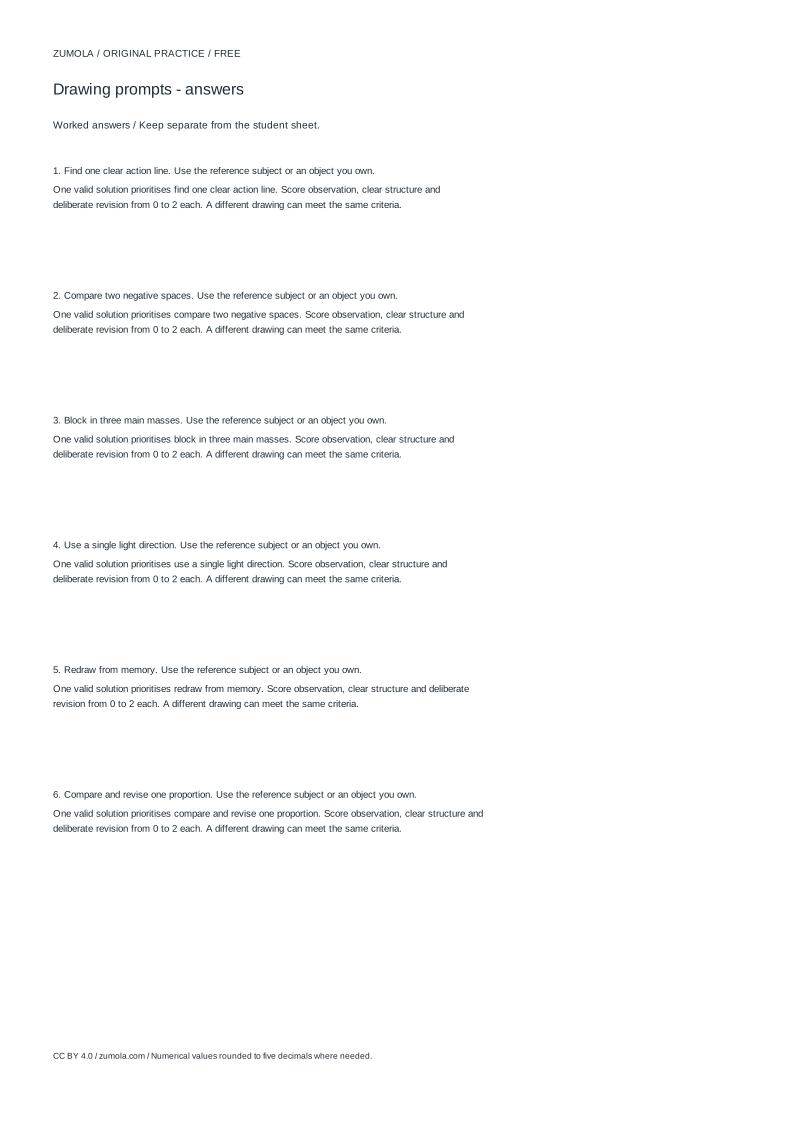
Print at Actual size / 100%. Check the calibration bar before using physical dimensions.
A useful drawing prompt does more than name a subject. It sets an object to draw, a composition rule to follow, and a tonal or mark-making requirement to practise. This page explains the method behind building such prompts so you can create your own focused exercises or judge whether a generated task is actually drawable. The aim is deliberate practice: one clear observation target, one composition constraint, and one technique to apply, judged against a rubric rather than a single correct picture.
What makes a prompt executable
An executable prompt names three things: the object or scene, the composition arrangement, and the tonal or technique requirement. Without all three, the task drifts. 'Draw a chair' gives no observation focus. 'Draw a chair seen from a low angle, with the seat filling the lower third of the page, using only three tonal values' is specific enough to start and specific enough to review.
Keep each part concrete. The object should be drawable from life or memory without special equipment. The composition rule should be checkable, such as placement, cropping, or viewpoint. The tonal requirement should name a limited range, for example light, mid, and dark, or a single direction of hatching. State the drawing surface and any time limit in plain terms if you set one.
- Choose one object you can observe directly or recall clearly.
- Add one composition constraint: viewpoint, placement, or cropping.
- Add one tonal or mark requirement: value count, hatching direction, or contrast limit.
- Write the task as a single sentence and check that each part is visible in the finished drawing.
Balancing difficulty and observation
A prompt should stretch one skill without overloading the others. If the composition is unusual, keep the tonal requirement simple. If the tonal requirement is demanding, choose a familiar object. This keeps attention on the intended learning point.
Observation prompts work best when they point to something checkable: the angle of a shadow edge, the gap between two shapes, or the direction of a fold. Avoid vague instructions like 'draw expressively' unless you also define what expressive means for this task, such as 'use only curved lines' or 'leave one area unshaded'.
- Decide the single skill being practised.
- Set the other two requirements at a comfortable level.
- Write one observation cue the drawer can verify by looking.
- Re-read the prompt and remove any requirement that cannot be seen in the result.
Reviewing with a rubric
Because drawing has many valid outcomes, judge the work against criteria rather than a reference image. A simple rubric covers completion, observation, and clear use of the requested technique. Completion asks whether every part of the prompt was attempted. Observation asks whether the drawing reflects what was actually seen. Technique asks whether the tonal or mark requirement was applied consistently.
Score each criterion separately. A drawing can be technically limited but observant, and that should be recognised. The rubric is a conversation tool, not a pass or fail gate.
- Check completion against each clause of the prompt.
- Compare observation cues with the source or memory.
- Check the tonal requirement across the whole drawing.
- Note one strength and one next step.
Using a seed for repeatable practice
A fixed seed lets you regenerate the same prompt set, which is useful when you want to repeat an exercise or compare two attempts fairly. Treat the seed as a label for a set of choices, not as a guarantee of quality. If a generated prompt is unclear, rewrite it using the three-part structure above before drawing.
When working in millimetres, state dimensions explicitly, for example a 150 mm by 200 mm drawing area. Numbers in schematic charts are abstract coordinate units and should not be read as physical measurements.
- Record the seed alongside your drawing.
- Rewrite any unclear clause into object, composition, and tone.
- Repeat the same prompt later to compare progress.
- Keep dimensions in millimetres and label them clearly.
A worked example
Prompt: draw a mug on a table, viewed slightly from above, with the mug placed left of centre and its handle pointing right. Use only three tonal values and keep the table edge visible. This gives an object, a composition rule, and a tonal limit. The drawer can check placement, handle direction, value count, and the table edge in the finished work.
- Sketch the table edge first to fix the composition.
- Place the mug left of centre and check the handle direction.
- Limit shading to light, mid, and dark.
- Review against the rubric.
Try this example
Draw a mug on a table, viewed slightly from above, placed left of centre with the handle pointing right, using only three tonal values and keeping the table edge visible.
Show the worked explanation
The prompt has three checkable parts. Object: a mug on a table. Composition: slightly from above, left of centre, handle right, table edge visible. Tone: exactly three values. A finished drawing can be reviewed by checking placement, handle direction, the visible table edge, and whether shading uses only light, mid, and dark. Any arrangement that meets these constraints is valid.
Common mistakes
- Writing a prompt that names only an object. Add one composition rule and one tonal or mark requirement so the task can be reviewed.
- Stacking several hard constraints at once. Keep one demanding requirement and simplify the other two.
- Judging the drawing against a single expected image. Use a rubric covering completion, observation, and technique instead.
Check your work
- Every clause of the prompt is attempted.
- Composition rule is clearly visible in the drawing.
- Observation cues match the source or stated memory.
- Tonal or mark requirement is applied consistently.
- Dimensions, if given, are stated in millimetres.
Questions before you start
Can a drawing prompt have more than one correct result?
Yes. Prompts set constraints, not a single answer. Many compositions and tonal solutions can satisfy the same prompt, so review with a rubric.
How specific should a prompt be?
Specific enough that each requirement can be checked in the finished drawing: object, composition, and tone, each stated plainly.
What does a seed do?
A seed labels a repeatable set of prompt choices. It helps you regenerate the same exercise, but it does not guarantee the prompt is clear or well balanced.
Keep exploring
Line Drawing Exercises: Free Line Control Practice SheetsEllipse Drawing Exercises and Practice SheetsFree Drawing Practice Sheets: Choose a SkillDrawing Warm-Up Exercises: A 10-Minute Printable RoutineShading Practice Worksheets: Value Scales and Simple FormsHatching and Cross-Hatching Practice Sheets