Free graphing resources · Original practice
Graphing from standard form.
Find both intercepts first.
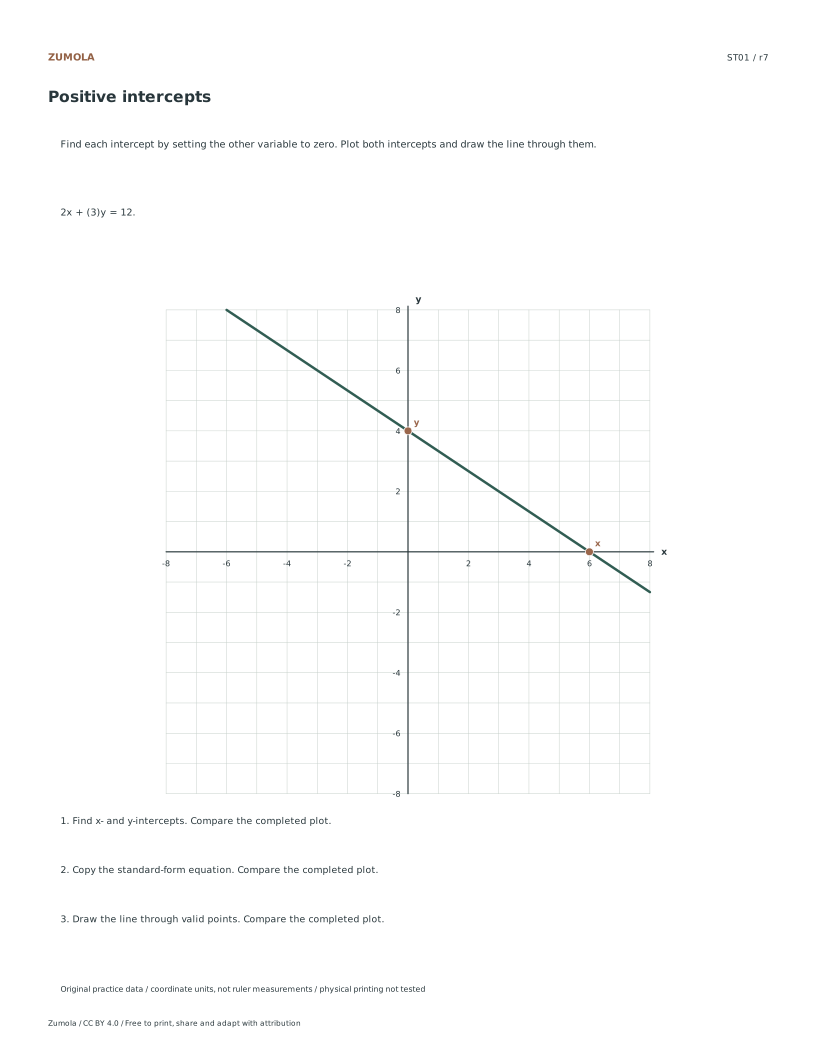
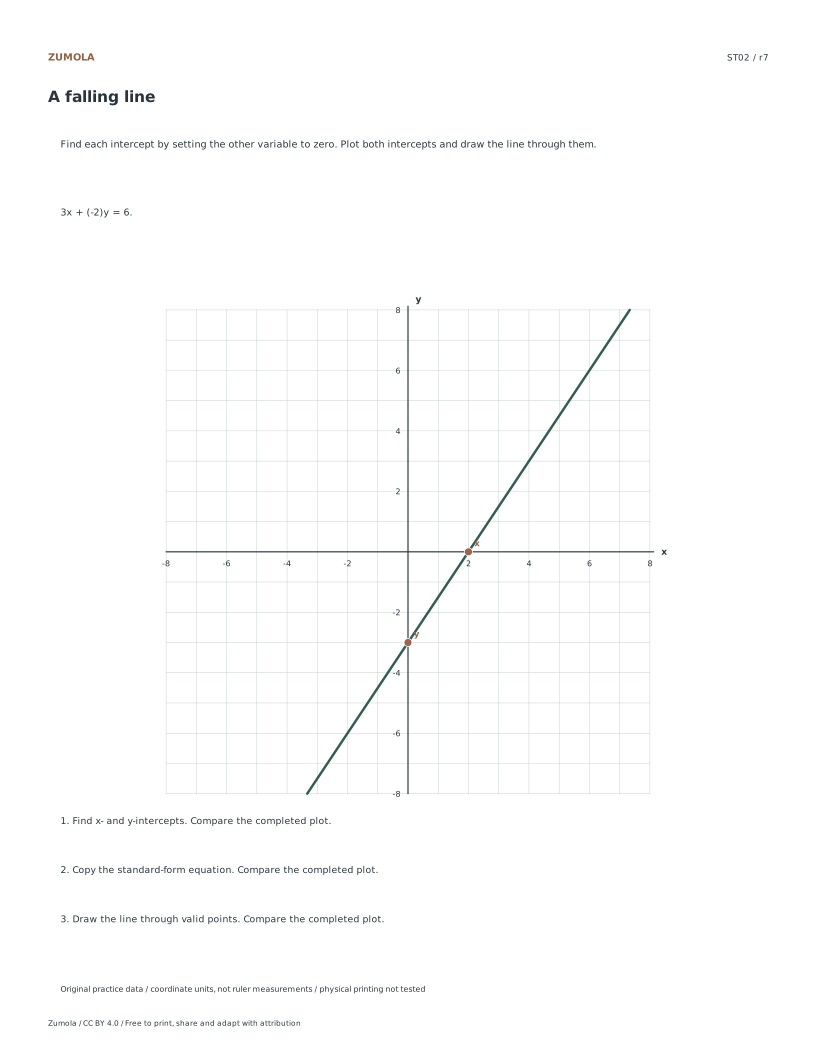
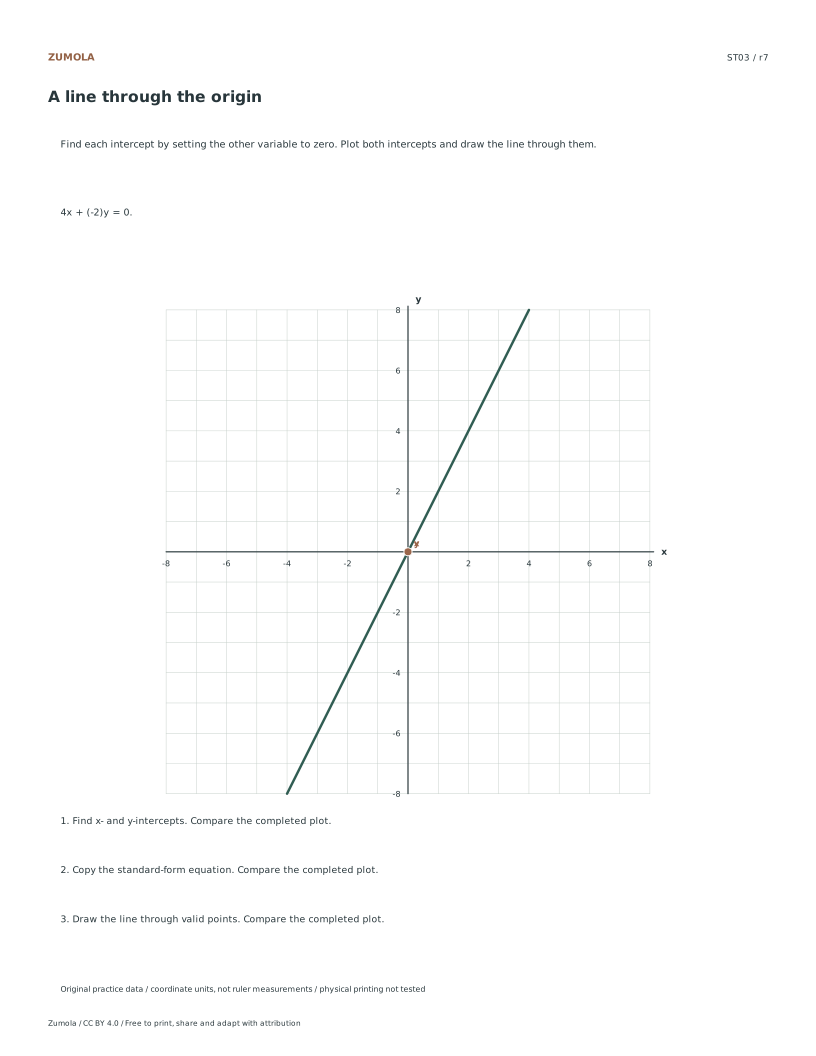
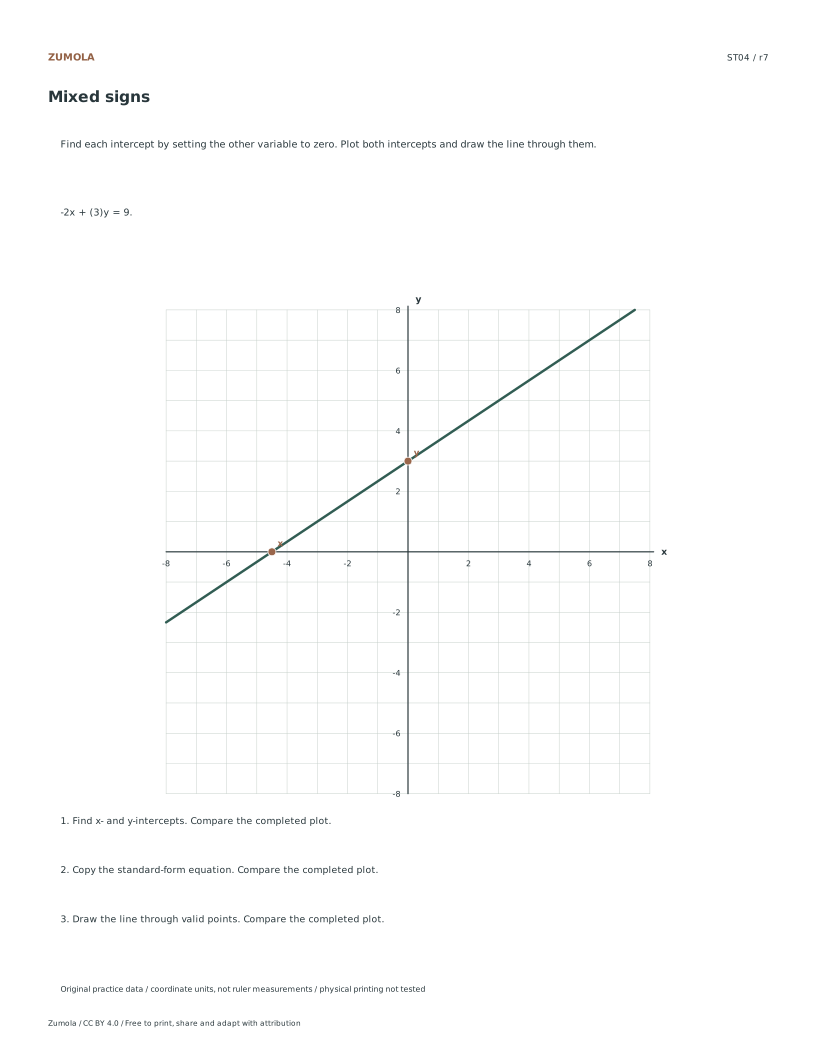
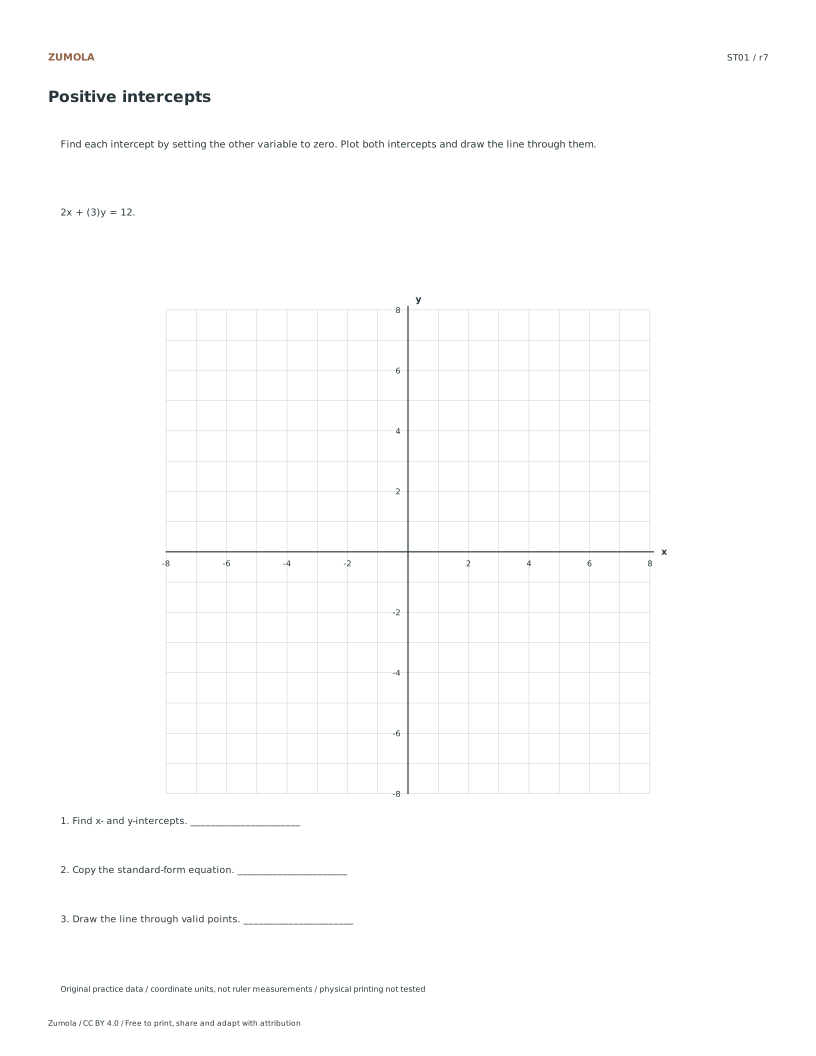
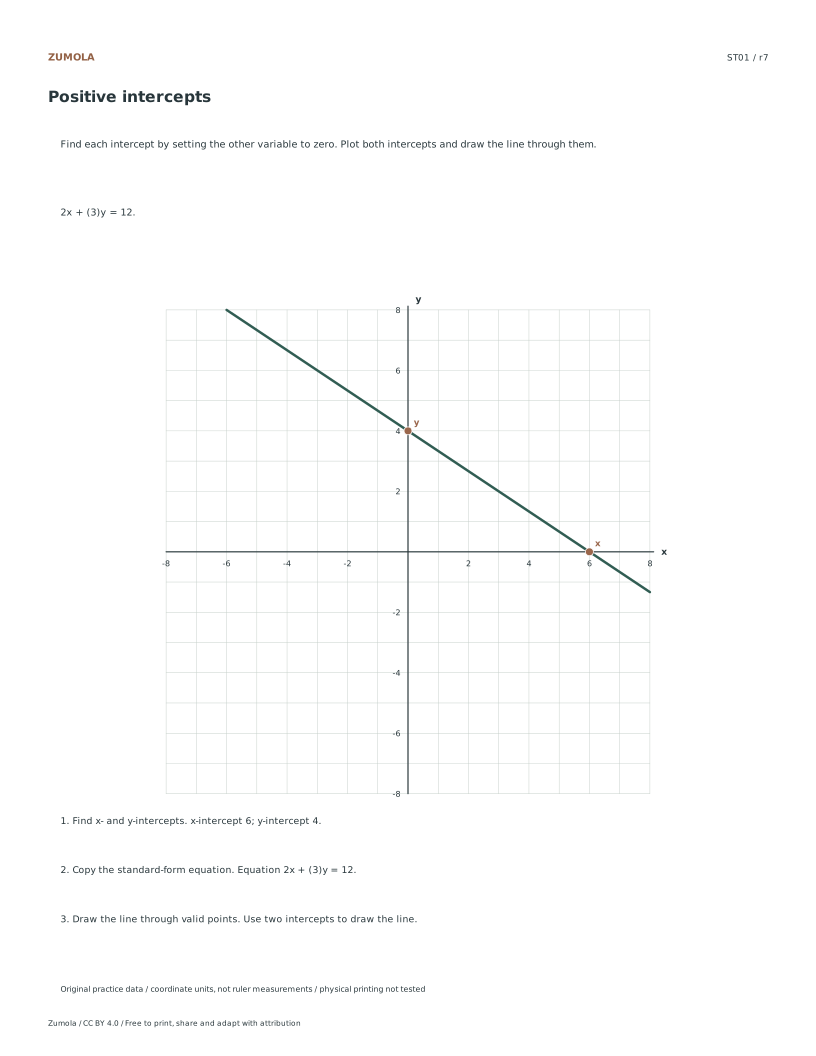
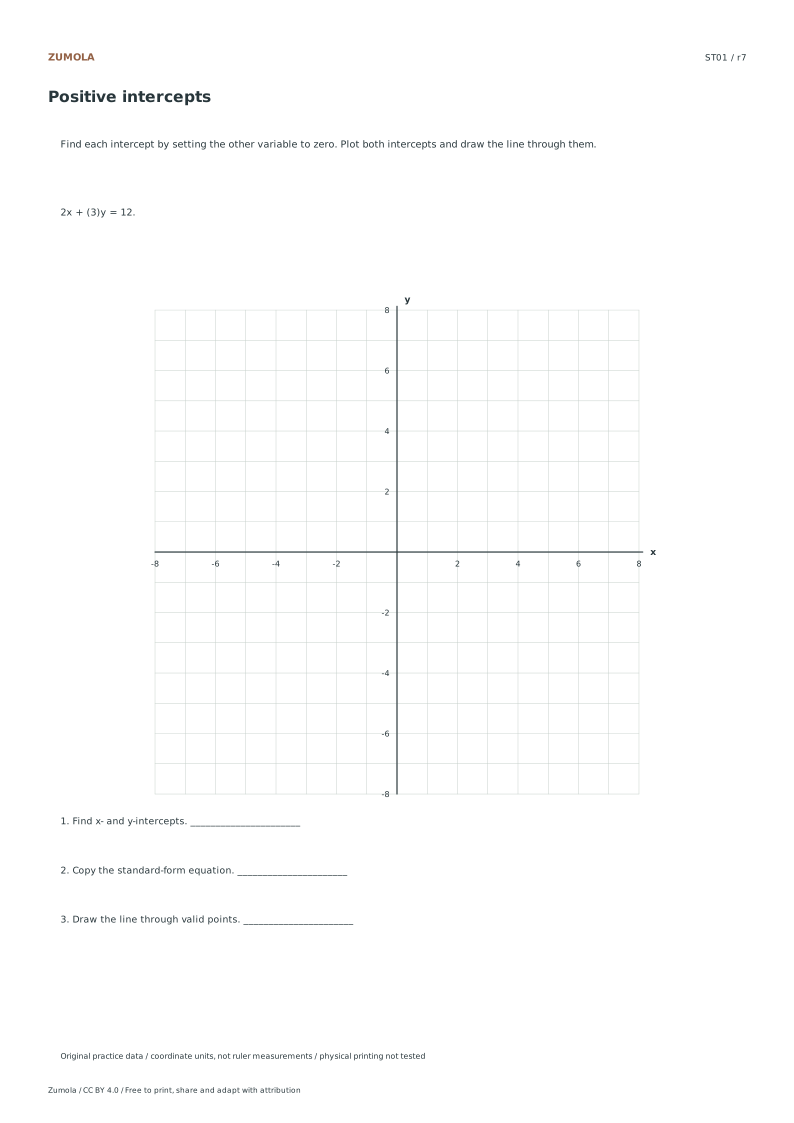
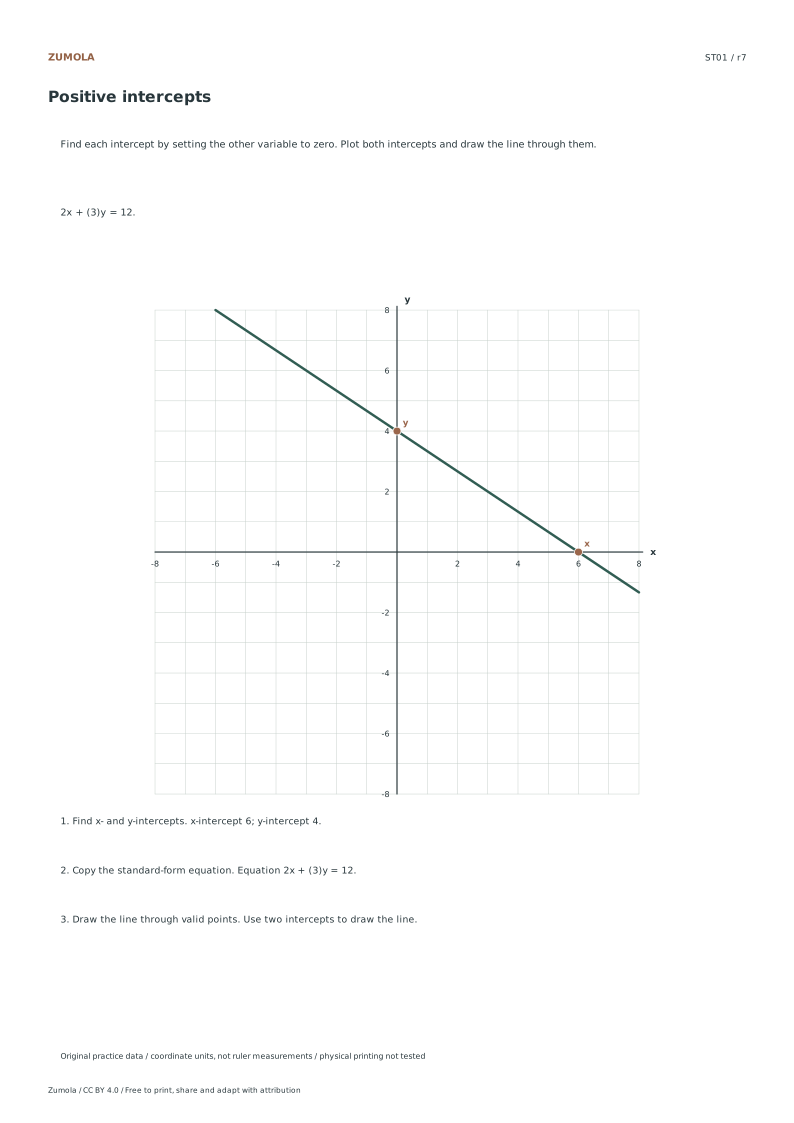
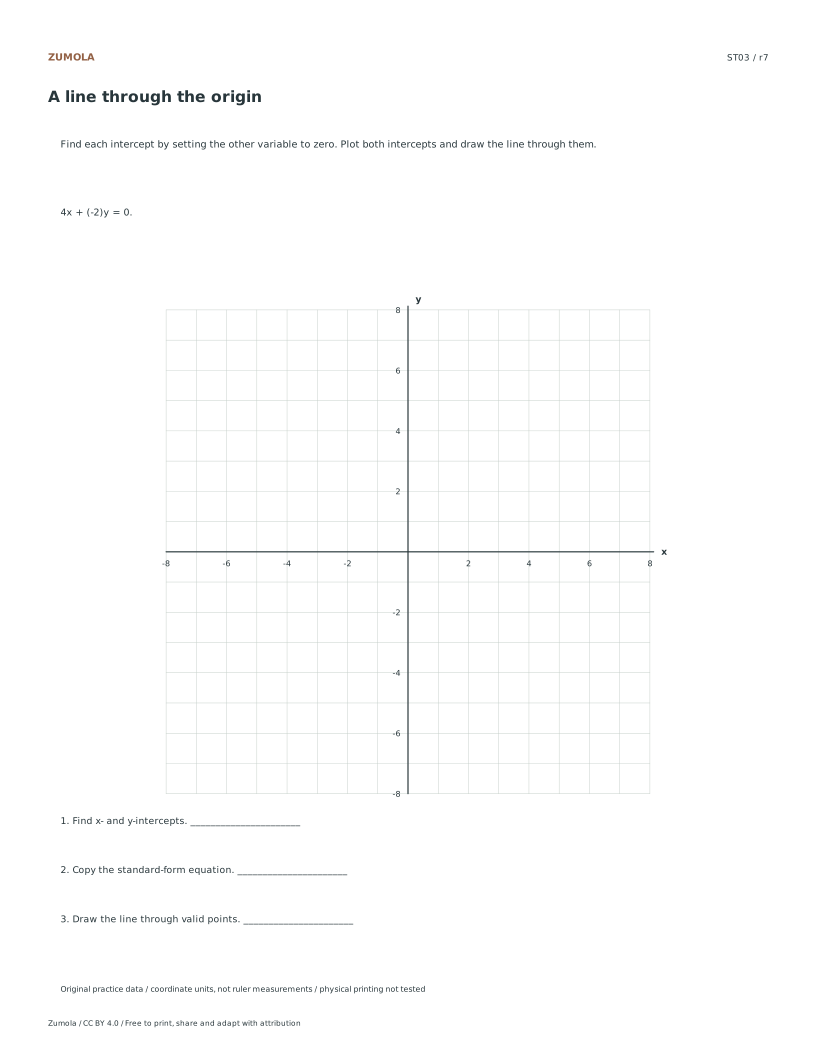
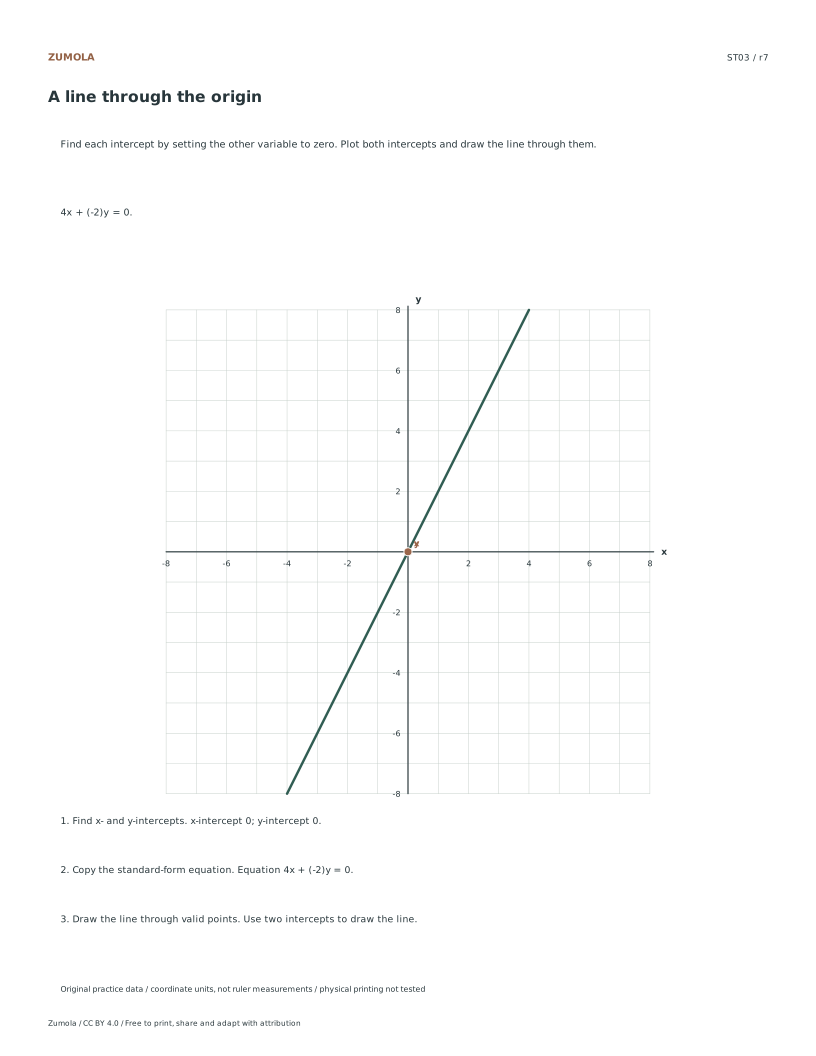
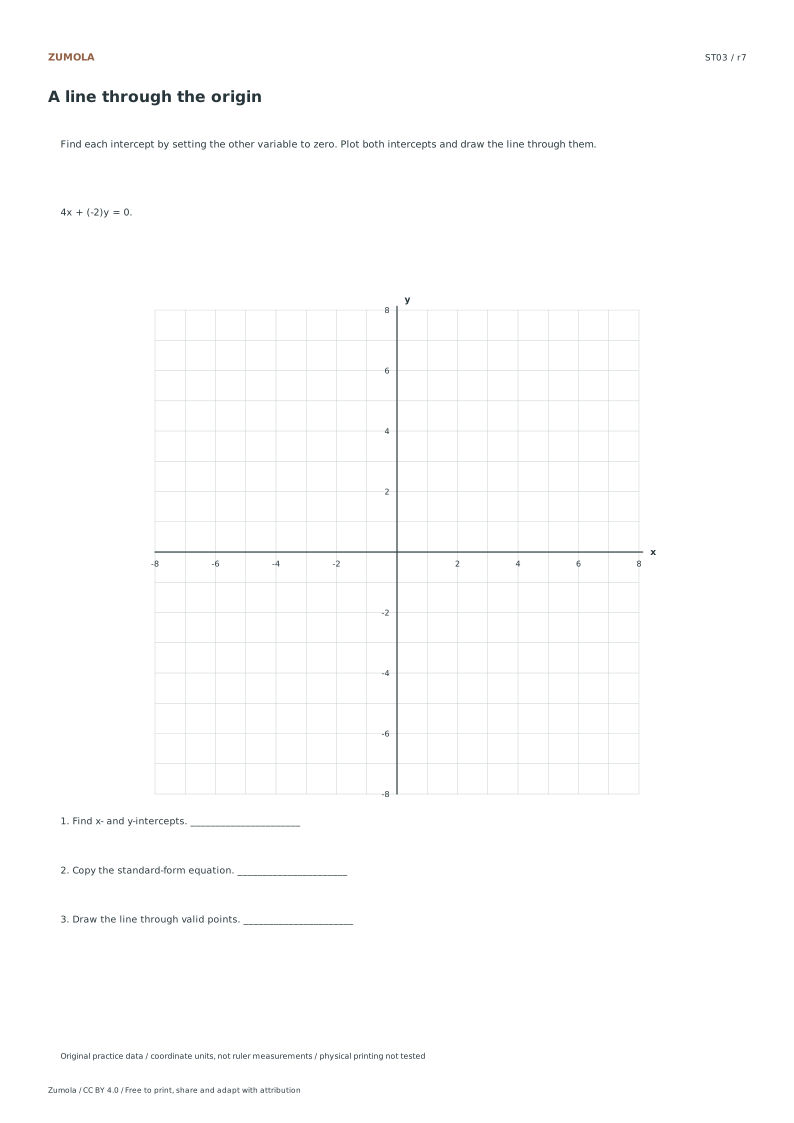
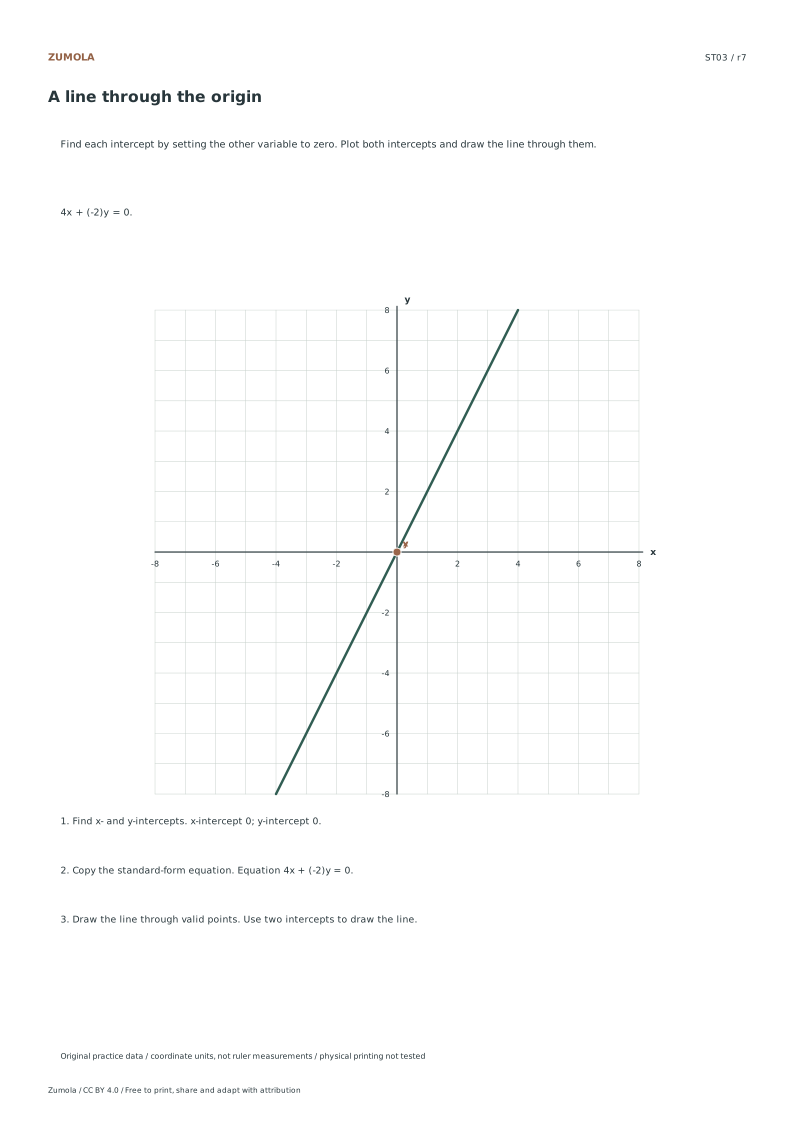
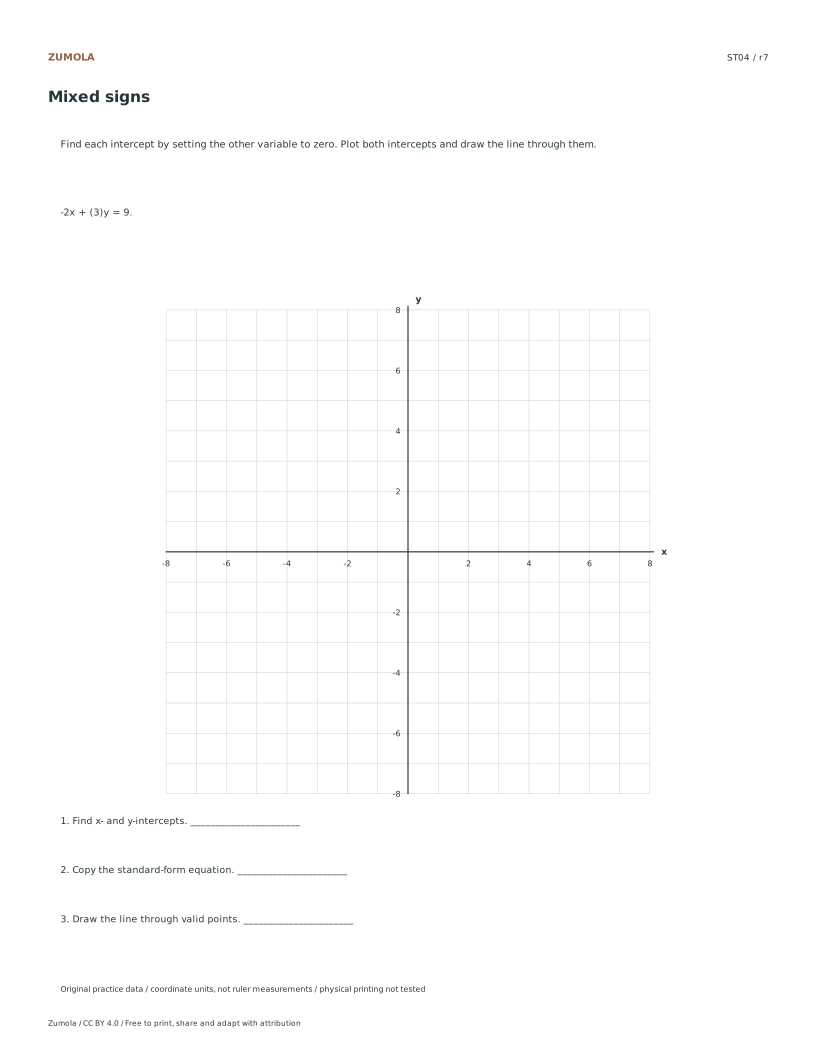
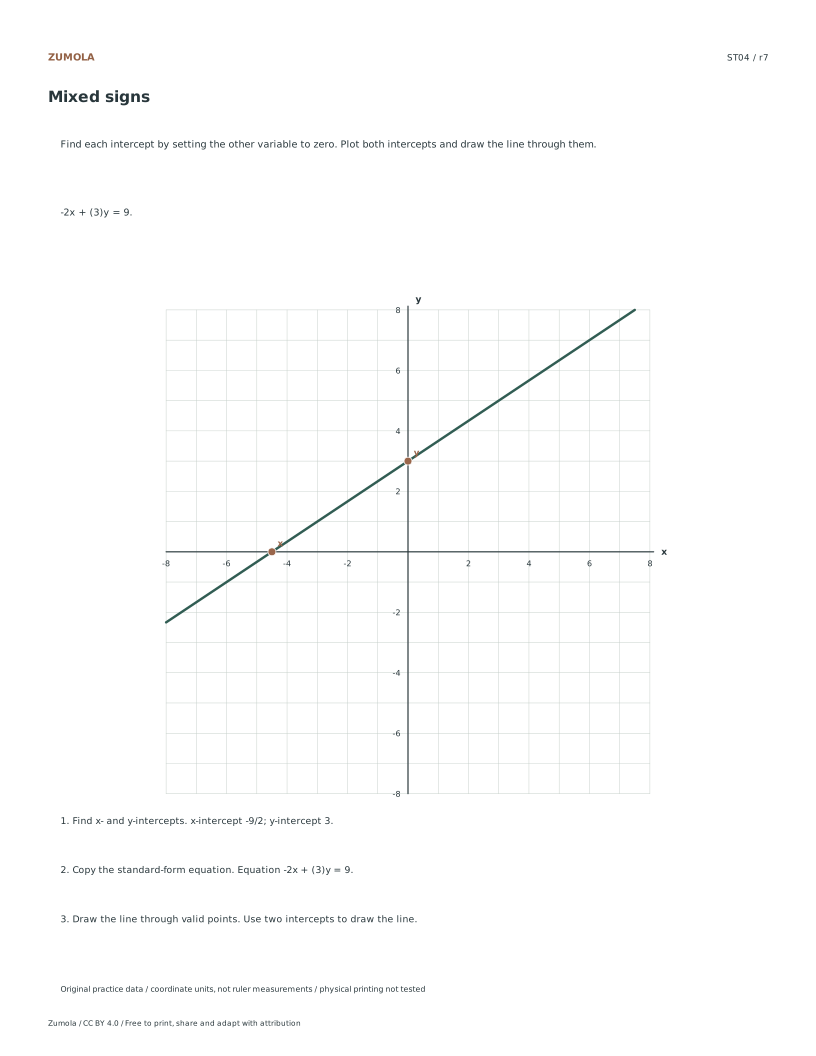
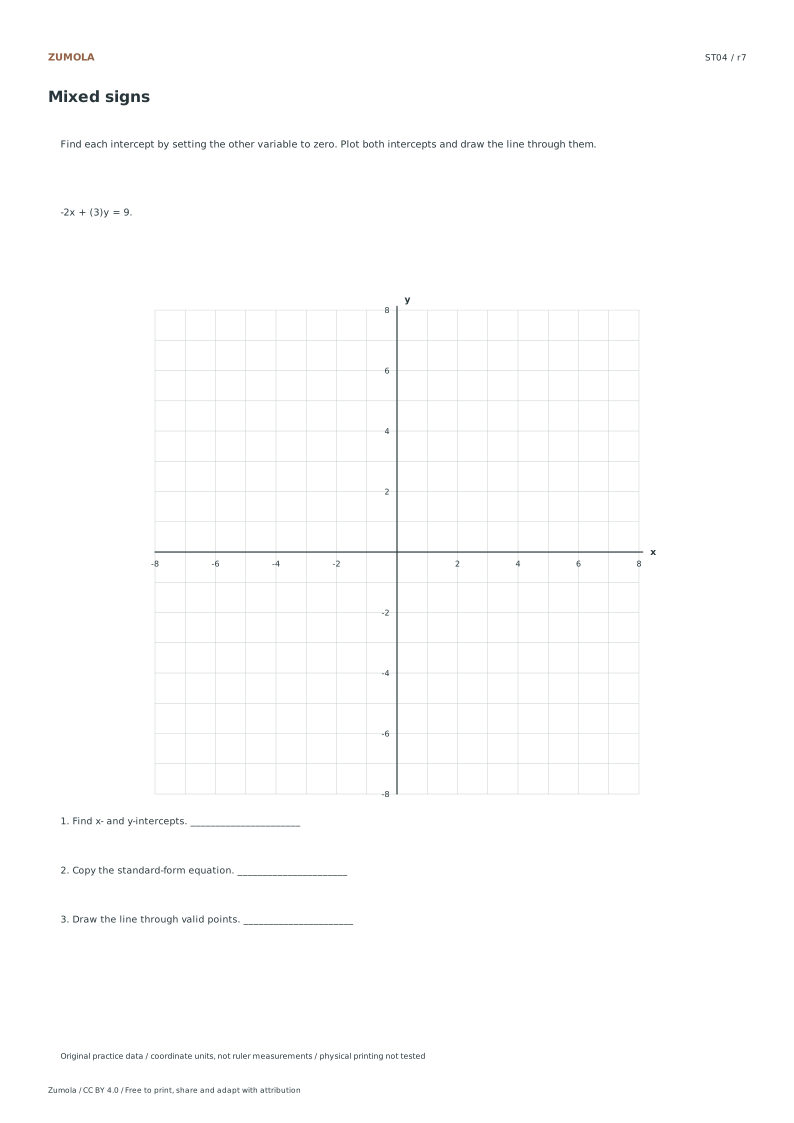
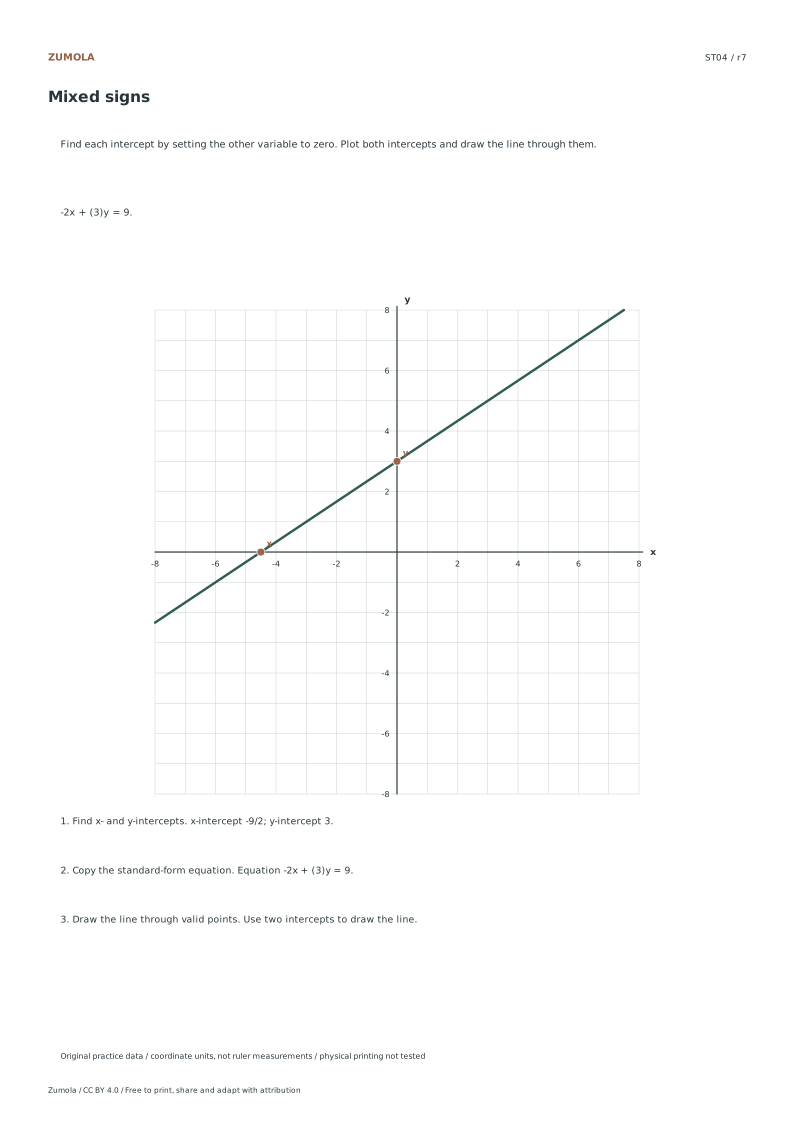
Graph four lines from standard-form equations by finding x- and y-intercepts. Keep zero and negative intercepts as valid coordinates.
4 standard-form lines.
Intercepts + graphs.
More ways to practice
A new case with a negative coefficient
Take 3x - 4y = 12. To find the x-intercept, set y = 0: 3x = 12, so x = 4. The point is (4, 0). To find the y-intercept, set x = 0: -4y = 12, so y = -3. The point is (0, -3). Plot both points and draw the line through them.
The slope follows from the intercepts: from (0, -3) to (4, 0), the rise is 3 and the run is 4, so the slope is 3/4. Because the coefficient of x is positive and the coefficient of y is negative, the line rises from left to right. A quick sign check like this catches many plotting errors before they spread.
- Set y = 0 and solve for x to get the x-intercept.
- Set x = 0 and solve for y to get the y-intercept.
- Plot both intercepts and draw one straight line through them.
- Choose a third value, such as x = 8, and compute y = 3 to get (8, 3).
- Substitute all three points into 3x - 4y = 12 to confirm each equals 12.
Diagnostic checks after plotting
Check each intercept by substitution rather than by eye. For (4, 0): 3(4) - 4(0) = 12. For (0, -3): 3(0) - 4(-3) = 12. If either result differs, the intercept is wrong even if the line looks plausible.
Check the third point against the drawn line. If (8, 3) does not lie on your line, either the line is misplaced or the arithmetic is wrong. Recompute before redrawing. Also confirm that the line extends beyond both intercepts and that the axes are labelled with equal spacing, since unequal spacing distorts slope.
- Substitute each intercept into the original equation.
- Confirm the third point lies on the drawn line.
- Check that the slope sign matches the equation's coefficients.
- Verify axis spacing is equal in both directions.
Variations worth practicing
Try equations where one intercept is zero, such as 2x + y = 0. Here the x-intercept is (0, 0) and the y-intercept is also (0, 0), so a second point is required: choose x = 1, giving y = -2, and plot (1, -2). A single intercept is not enough to define a line through the origin.
Try an equation with both coefficients negative, such as -2x - 3y = 6. The x-intercept is (-3, 0) and the y-intercept is (0, -2). The line falls from left to right. Comparing this with the previous case helps you see how coefficient signs control direction without memorising rules.
- For a line through the origin, compute a second point from a chosen x value.
- For negative coefficients, verify both intercepts are negative.
- Compare slope direction across cases to confirm sign reasoning.
Try this example
Graph 3x - 4y = 12 and verify the line with a third point.
Show the worked explanation
Set y = 0: 3x = 12, so x = 4, giving (4, 0). Set x = 0: -4y = 12, so y = -3, giving (0, -3). Choose x = 8: 24 - 4y = 12, so -4y = -12 and y = 3, giving (8, 3). Substituting: 3(4) - 4(0) = 12, 3(0) - 4(-3) = 12, and 3(8) - 4(3) = 12. All three points lie on one line with slope 3/4.
Common mistakes
- Treating a zero intercept as no intercept and skipping the point. Plot (0, 0) or the zero coordinate explicitly, then find a second point to define the line.
- Drawing a line through only one intercept when both intercepts coincide at the origin. Compute a third point from a chosen x value and use it as the second plotted point.
- Assuming a positive x coefficient always means a rising line without checking the y coefficient. Solve for y or compare intercepts to determine slope direction from the actual coefficients.
Check your work
- Both intercepts are computed by setting the other variable to zero.
- Zero and negative intercepts are plotted as valid coordinates.
- A third point is computed and shown to satisfy the original equation.
- The drawn line passes through all plotted points and extends beyond them.
- Axes are labelled with equal spacing so slope is not distorted.
Questions before you start
Why does 3x - 4y = 12 rise from left to right?
Solving for y gives y = (3/4)x - 3, so the slope is positive 3/4 and the line rises as x increases.
What if both intercepts are the same point?
That happens when the line passes through the origin. Choose another x value, compute y, and plot that second point before drawing.
How can I check a plotted line without an answer key?
Substitute the intercepts and one extra point into the original equation. All three must satisfy it exactly.