Free original resources
Blank Guitar and Bass Tab Paper: 4, 5, and 6-String Layouts
Plan blank tab paper for 4, 5, or 6 strings. Learn string spacing, staff margins, cue and summary zones, and how to check a printed sheet at 100%.
Free resources
Letter & A4
PDF & SVG
Letter & A4
PDF & SVG
Make it yours.
Free · no signup · calculated in your browser
Your free printable kit.
Original reference, student practice and separate worked answers. No account or payment.
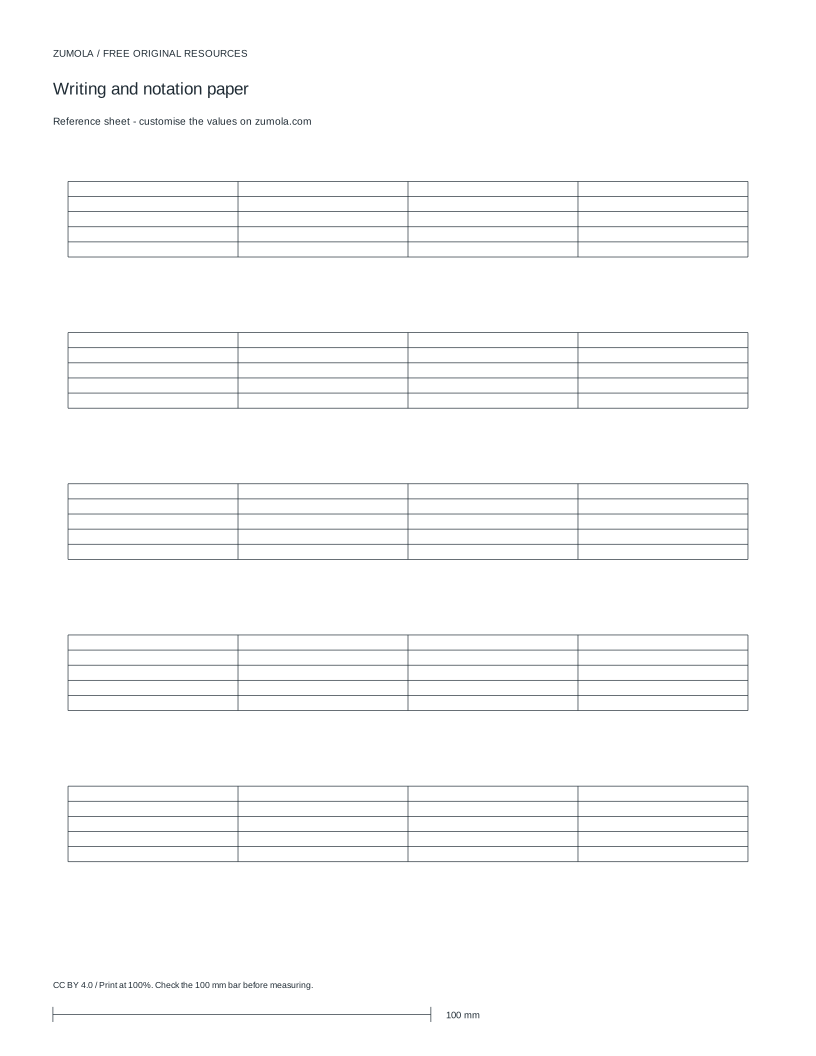
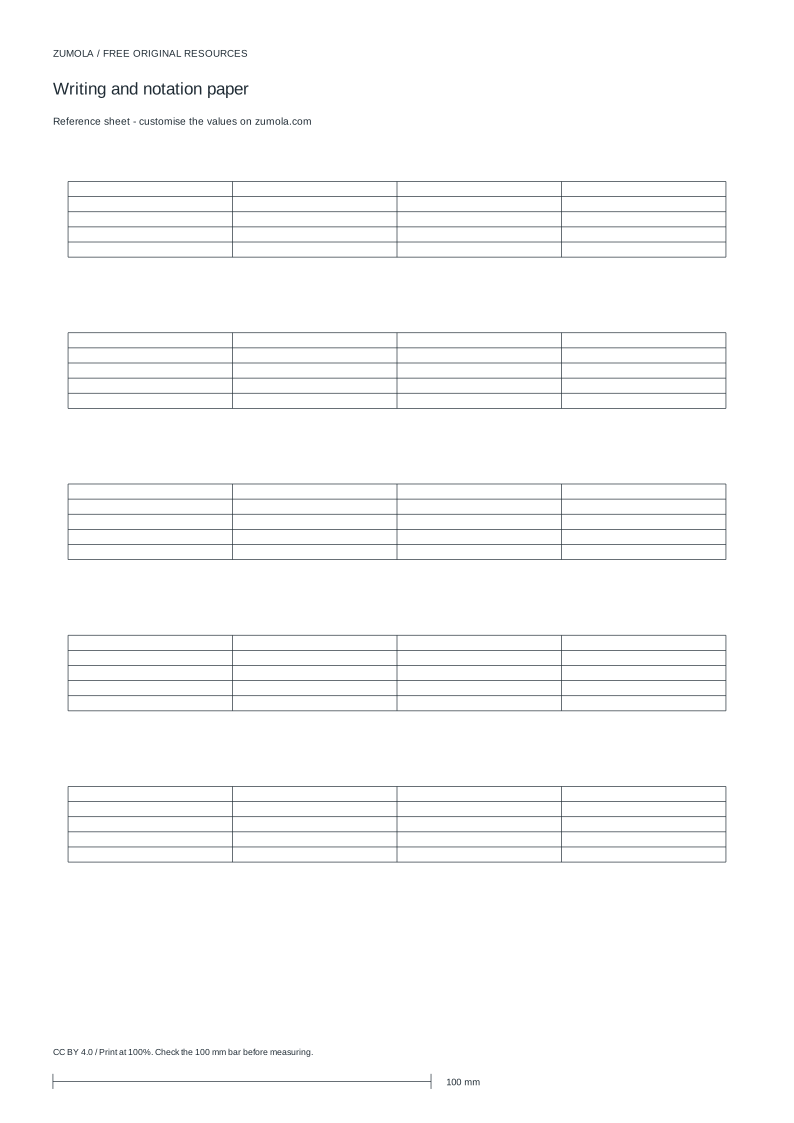
Practice worksheet
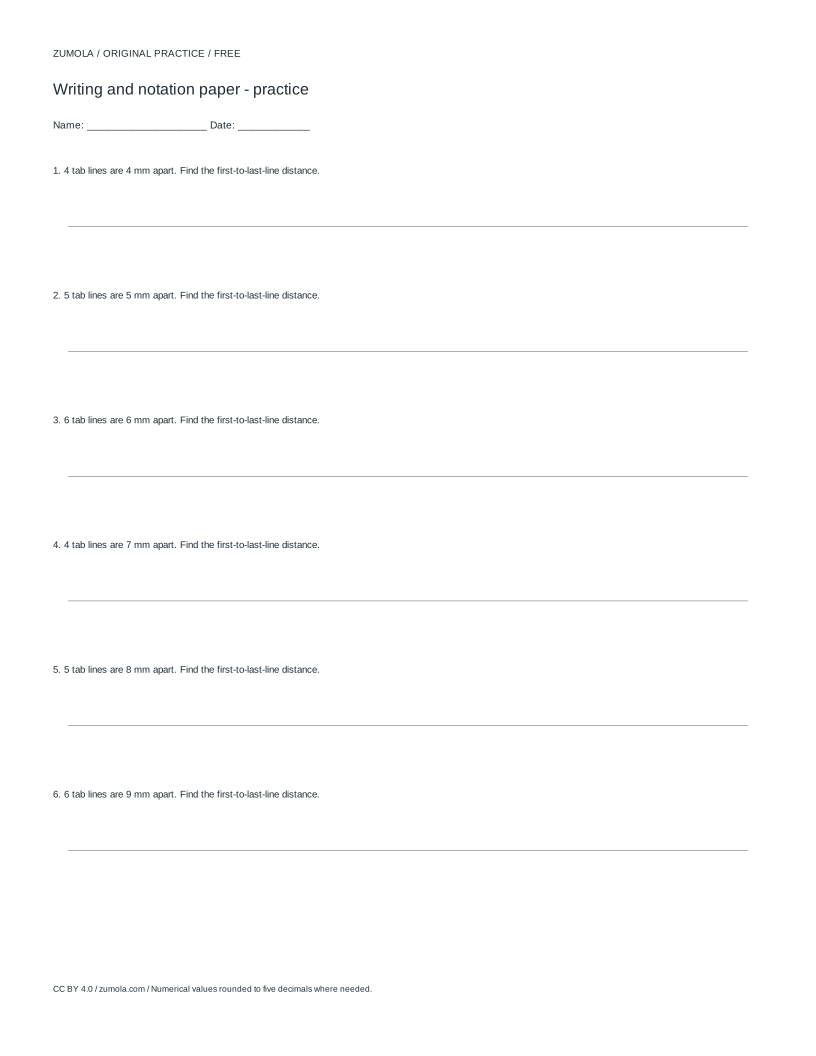
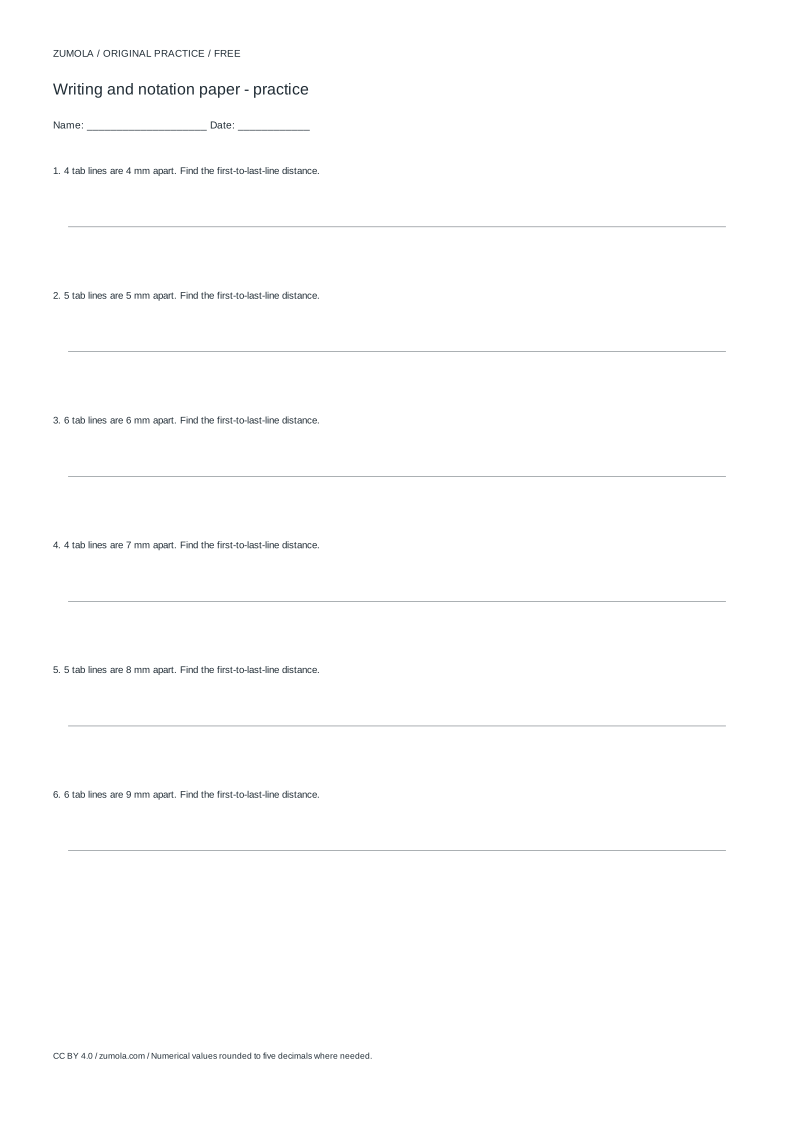
Worked answers / rubric
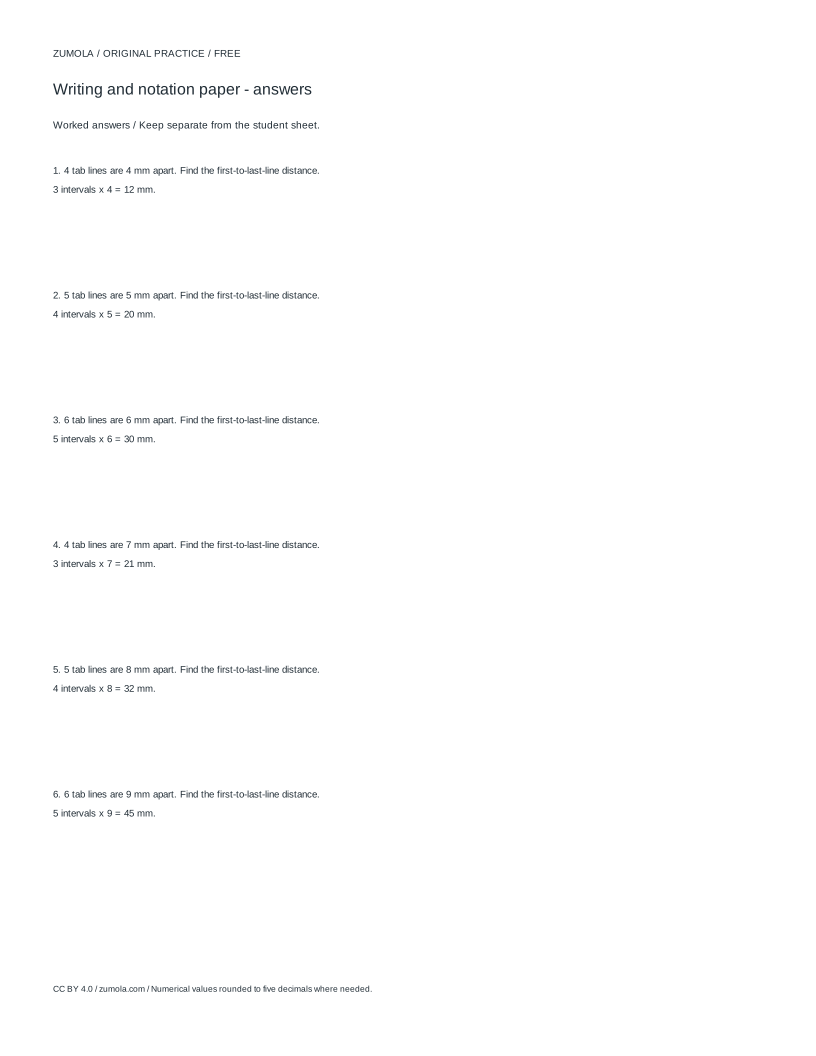
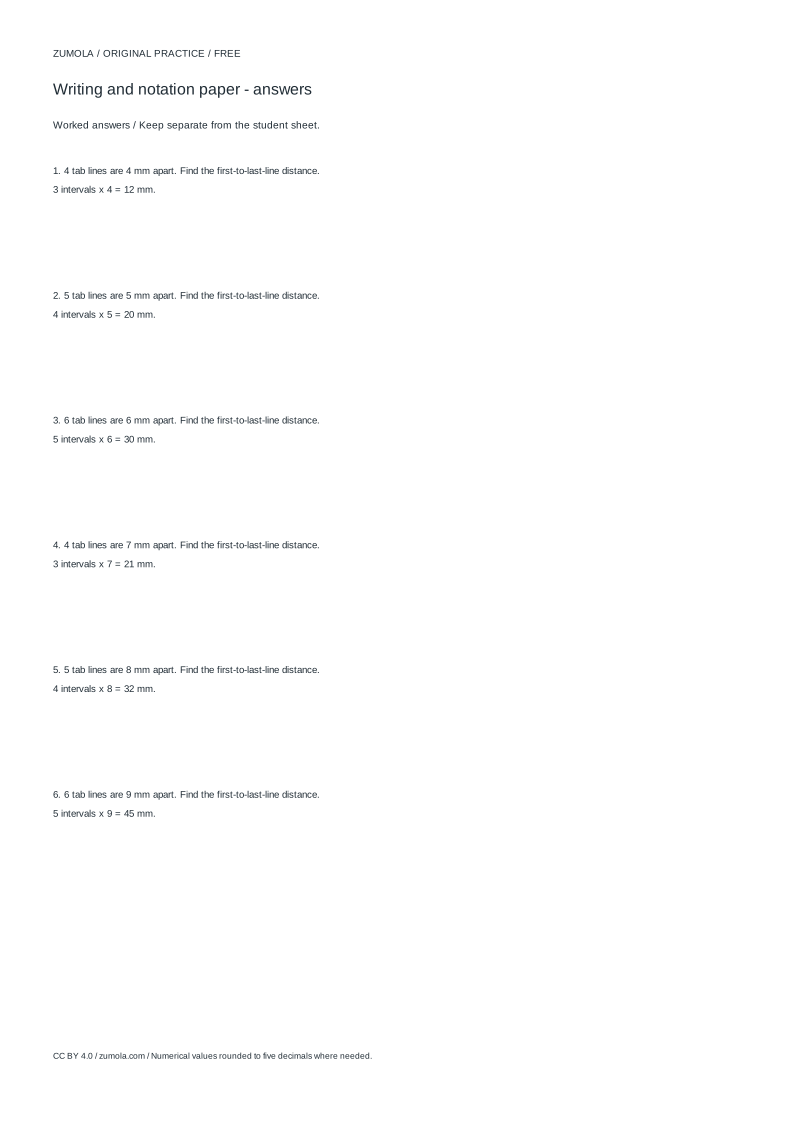
Print at Actual size / 100%. Check the calibration bar before using physical dimensions.
Tab paper is a grid of horizontal lines, one per string, with fret numbers written on the lines. This page explains how to lay out blank tab for 4-string bass, 5-string bass, and 6-string guitar, how to keep spacing and margins consistent, and how to check a printed sheet before writing on it. It also covers a simple notation exercise you can set up yourself using the same blank layout.
How a tab staff is built
A tab staff is a set of parallel horizontal lines. Each line represents one string, and the number written on a line is the fret to press on that string. The order matters: for standard guitar tab the top line is the highest-pitched string and the bottom line is the lowest. For bass, the same top-to-bottom convention applies, so a 4-string bass staff has four lines and a 5-string bass staff has five.
Three measurements control the layout. String spacing is the distance between adjacent lines; the brief uses 8 mm as the working value. Margin is the clear space at the page edge, given as 18 mm. The cue zone is a narrow band at the left of each staff where you can write a clef, tuning note, or bar number, and the summary zone is a wider band for section labels or chord names. Keeping these zones the same width on every staff makes a page easy to read across.
The slant value, 55 in the brief, is an abstract coordinate used when drawing the staff ends or the cue band; it is not a physical measurement in millimetres. Treat schematic numbers as layout coordinates, not as printer settings.
- Decide the string count first: 4 for standard bass, 5 for extended-range bass, 6 for guitar.
- Set string spacing to 8 mm and keep it identical on every staff.
- Reserve an 18 mm page margin so lines never run to the edge.
- Mark a cue zone at the left of each staff for clef or tuning notes.
- Leave a summary zone for section labels, then repeat the staff down the page.
Choosing 4, 5, or 6 strings
The string count changes the staff height, not the spacing. Four lines at 8 mm spacing occupy 24 mm between the outer lines; five lines occupy 32 mm; six lines occupy 40 mm. Add the margin and any gap between staves to find how many staves fit on a page. Because the spacing stays fixed, a 6-string staff is taller and fewer staves fit per page than a 4-string staff.
Match the staff to the instrument you are writing for. A 4-line staff suits standard bass tuning (E, A, D, G). A 5-line staff suits basses with a low B string. A 6-line staff suits guitar in standard tuning (E, A, D, G, B, E). If you write for both guitar and bass on one sheet, keep each staff's line count labelled so a reader never has to guess which string is which.
Do not mix string counts within a single staff. A staff with five lines but a six-string label is ambiguous and will be misread.
- Count the strings on the instrument before choosing a staff.
- Label each staff with its tuning, for example E A D G for 4-string bass.
- Keep one string count per staff; start a new staff if the instrument changes.
- Check total staff height: 4 lines = 24 mm, 5 lines = 32 mm, 6 lines = 40 mm at 8 mm spacing.
Checking a printed sheet
Print at 100% scale, not fit-to-page, because scaling changes the 8 mm spacing and the 18 mm margin. Before writing music, print one test page and measure a calibration bar: a short printed line of known length. If the measured length matches the intended length, the scale is correct. If it is short or long, adjust the printer scale setting rather than the layout.
Then check three things on the test page. First, confirm the outer lines of each staff sit inside the margin. Second, confirm adjacent staves do not touch. Third, confirm the cue and summary zones are wide enough for handwriting. Only after these checks should you print a full set.
- Print a single test page at 100% scale.
- Measure the calibration bar and compare it with its stated length.
- Confirm every staff sits inside the 18 mm margin.
- Confirm staves are separated and zones are legible.
- Print the full set only after the test page passes.
A basic notation exercise
You can use blank tab to practise reading and writing fret positions. Write a short pattern on one staff, then copy it onto a second blank staff from memory. Because tab shows fret numbers rather than pitch names, the exercise tests position recall, not ear training.
Keep the exercise small: four bars, one note per beat, on a single string first, then across two strings. This keeps the spacing and line count easy to verify by eye.
- Choose a 6-line staff for guitar or a 4-line staff for bass.
- Write a four-bar pattern using frets 0 to 5 on one string.
- Copy the pattern onto a fresh blank staff without looking.
- Compare the two staves line by line and note any mismatch.
Try this example
A page has an 18 mm top margin and 8 mm string spacing. How tall is a 6-string staff between its outer lines, and how much vertical space remains if the printable height is 250 mm?
Show the worked explanation
Six lines have five gaps, so the staff height is 5 x 8 = 40 mm. Subtract the 18 mm margin: 250 - 18 = 232 mm of usable height. One staff uses 40 mm, leaving 232 - 40 = 192 mm for further staves and gaps. A 4-string staff would be 3 x 8 = 24 mm, leaving 208 mm.
Common mistakes
- Printing with fit-to-page scaling, which shrinks the 8 mm spacing and 18 mm margin. Set the printer to 100% scale and verify with a calibration bar before printing a full set.
- Using a 5-line staff for a 6-string guitar, leaving one string unrepresented. Match the line count to the instrument: 4 lines for standard bass, 5 for low-B bass, 6 for guitar.
- Treating the slant value of 55 as a millimetre measurement. Read slant as an abstract layout coordinate; use millimetres only for spacing (8 mm) and margin (18 mm).
Check your work
- String count matches the instrument and is labelled with its tuning.
- String spacing is 8 mm and identical on every staff.
- Every staff sits inside the 18 mm margin.
- Cue and summary zones are wide enough for handwriting.
- A calibration bar is checked at 100% scale before full printing.
- Slant is treated as a layout coordinate, not a millimetre value.
Questions before you start
How many lines does bass tab paper need?
Four lines for standard bass tuning (E, A, D, G) and five lines if the bass has a low B string. Keep the string count consistent within each staff.
What does the 8 mm spacing mean in practice?
It is the distance between adjacent string lines. At 8 mm, a 4-line staff spans 24 mm, a 5-line staff 32 mm, and a 6-line staff 40 mm between the outer lines.
Why check a calibration bar before printing?
Scaling can change spacing and margins. A calibration bar of known length confirms the sheet printed at true size, so the 8 mm spacing and 18 mm margin are accurate.