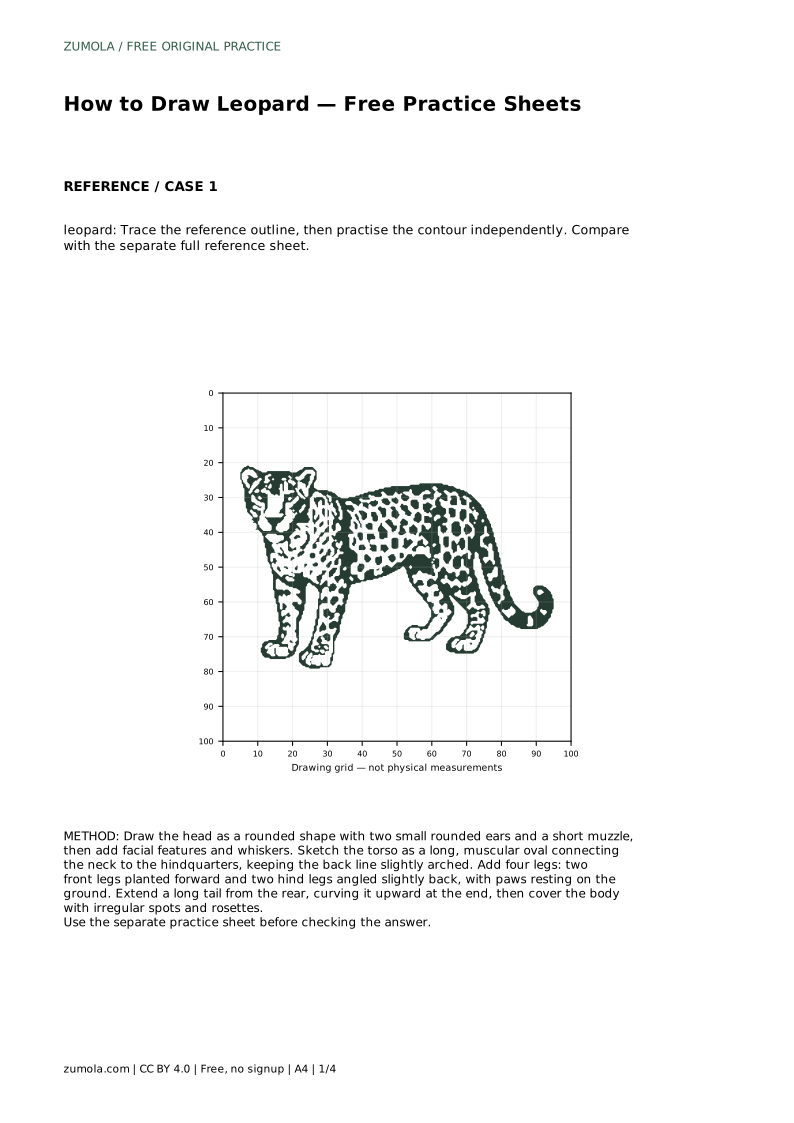
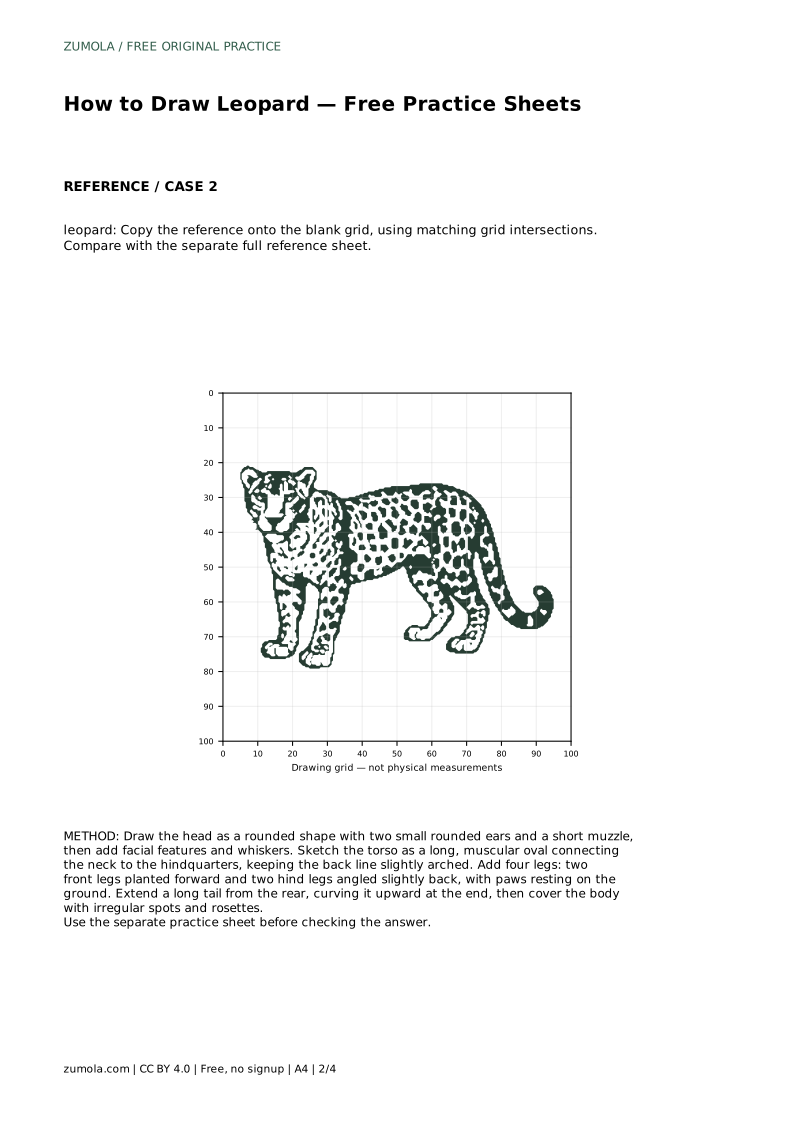
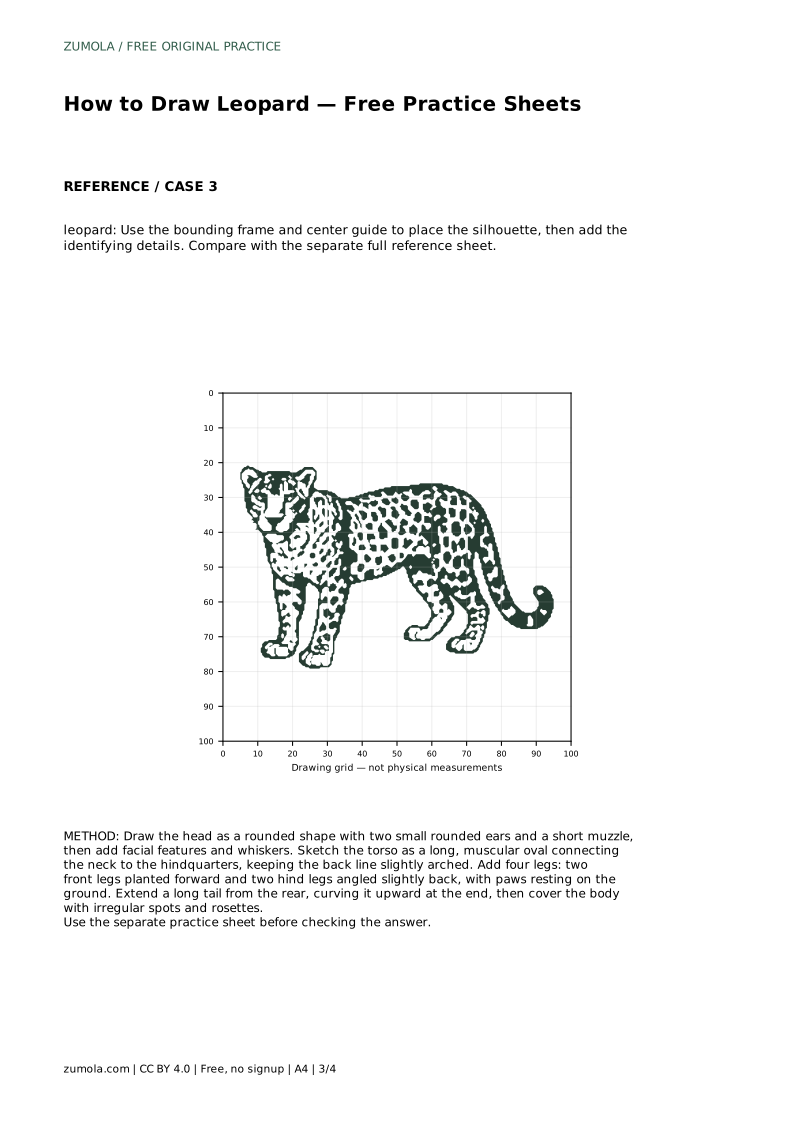
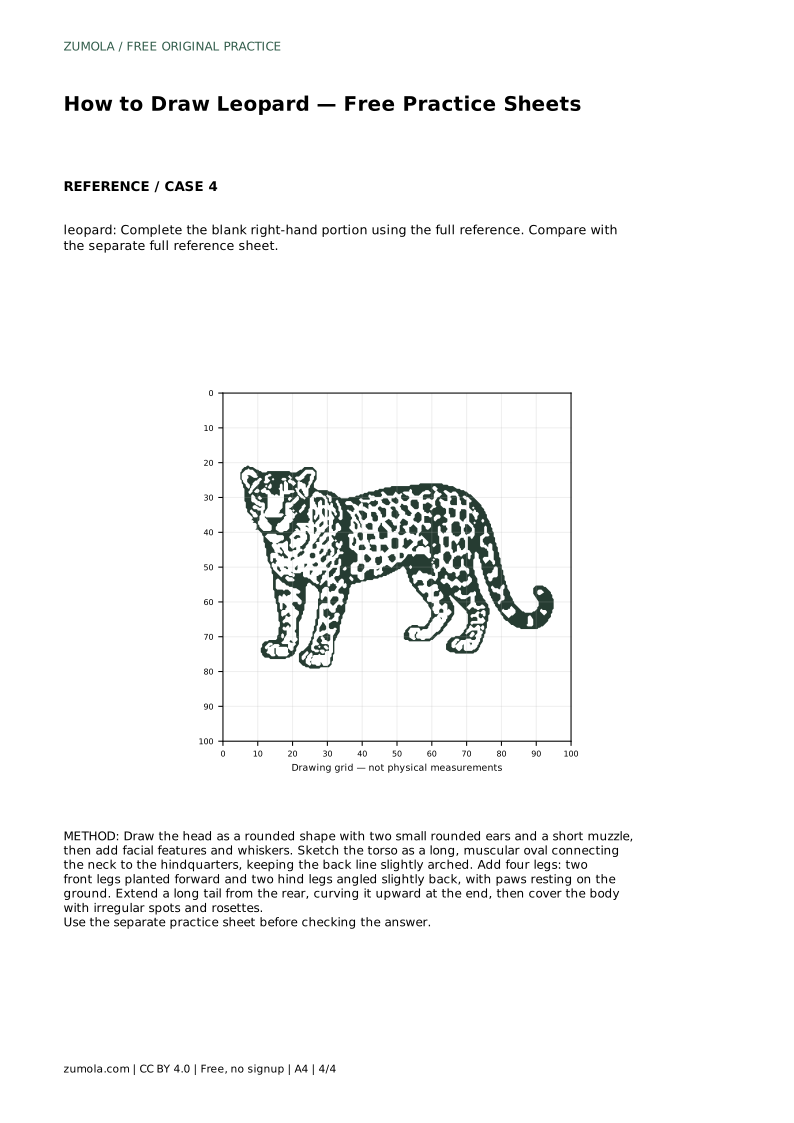
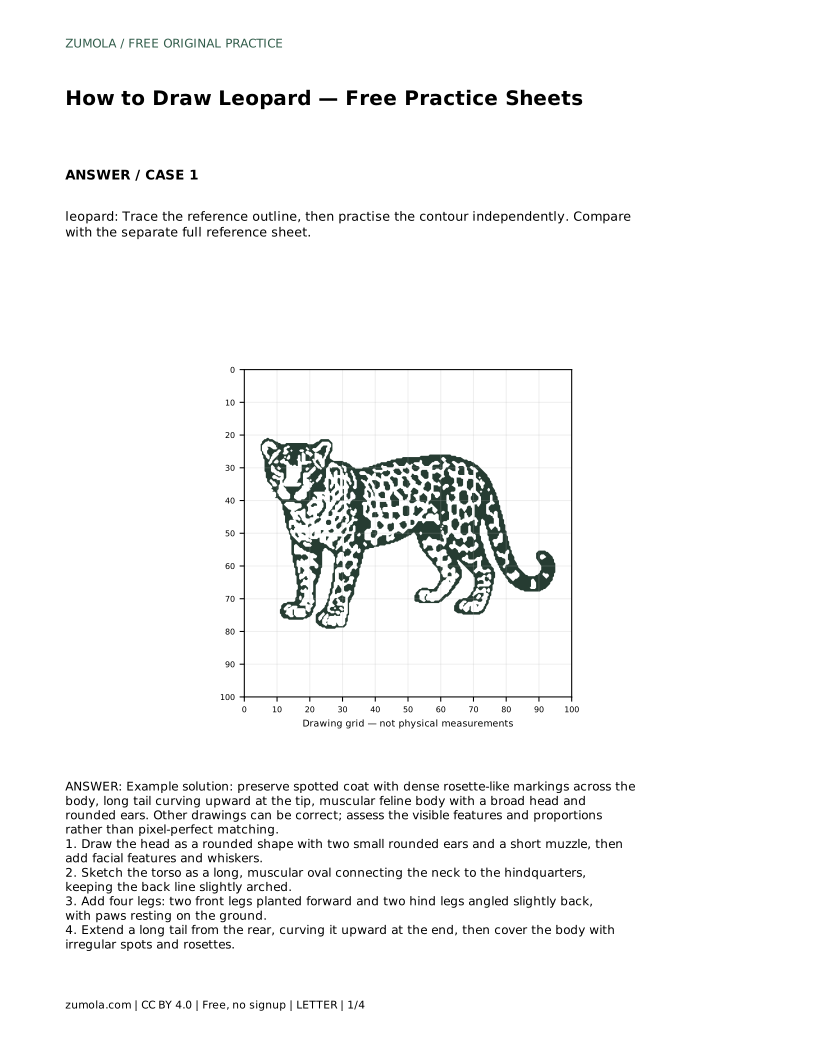
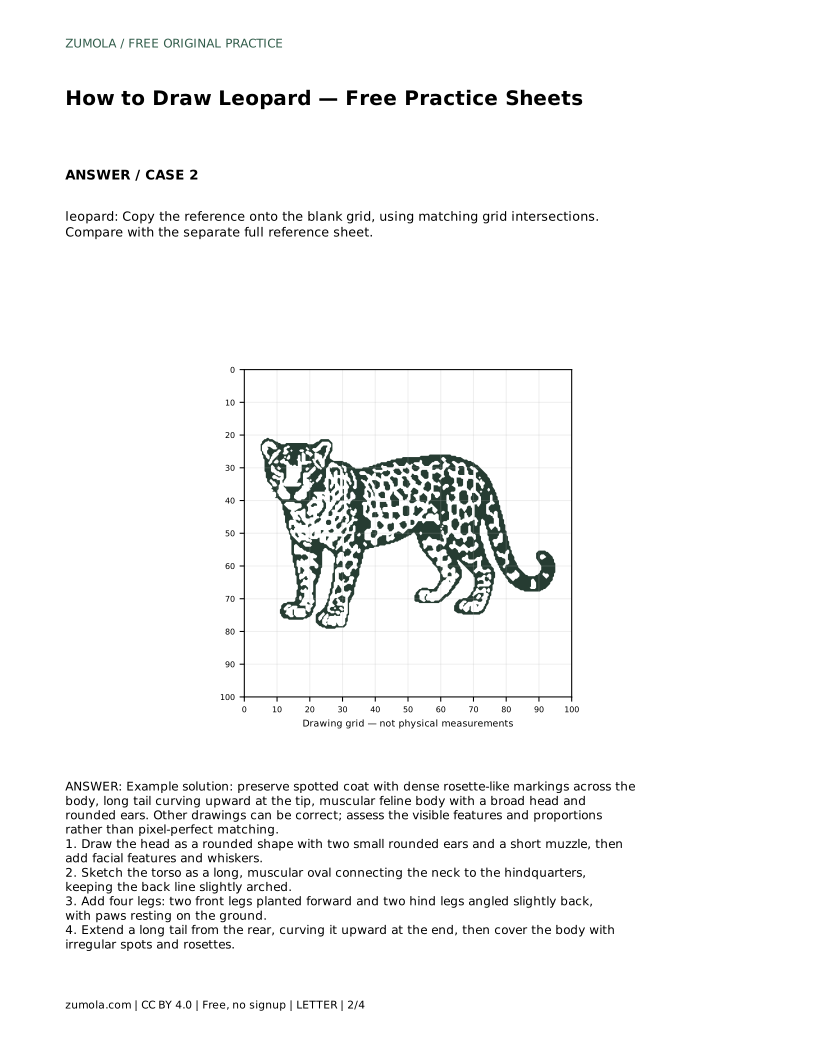
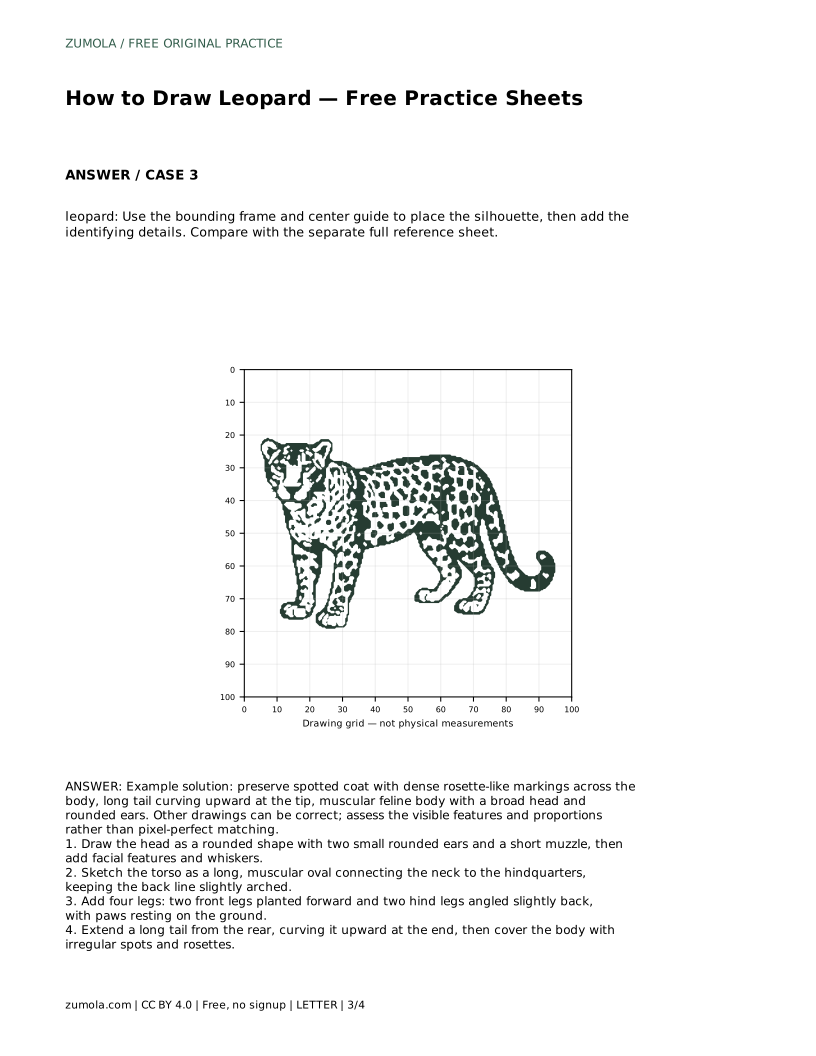
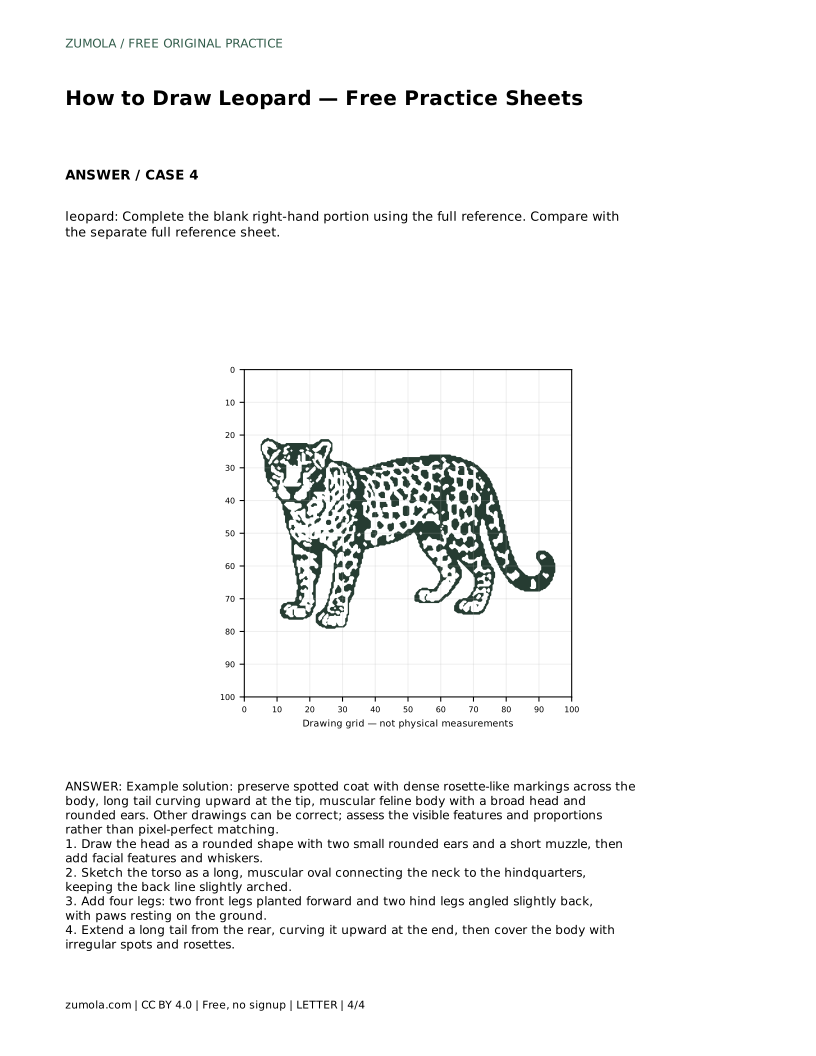
Reference diagrams
LETTER · Download PDF
A4 · Download PDF
Free original resources
Learn to draw a realistic leopard with a rounded head, arched back, long curved tail, and rosette markings. Free printable practice sheets support each step.
Four original cases, with reference diagrams, practice sheets and worked answers. Everything is free; no signup required.
LETTER · Download PDF
A4 · Download PDF
LETTER · Download PDF
A4 · Download PDF
LETTER · Download PDF
A4 · Download PDF
Use A4 or US Letter to match your printer. Use the stated values and conditions to solve each exercise; diagrams are not physical measuring rulers.
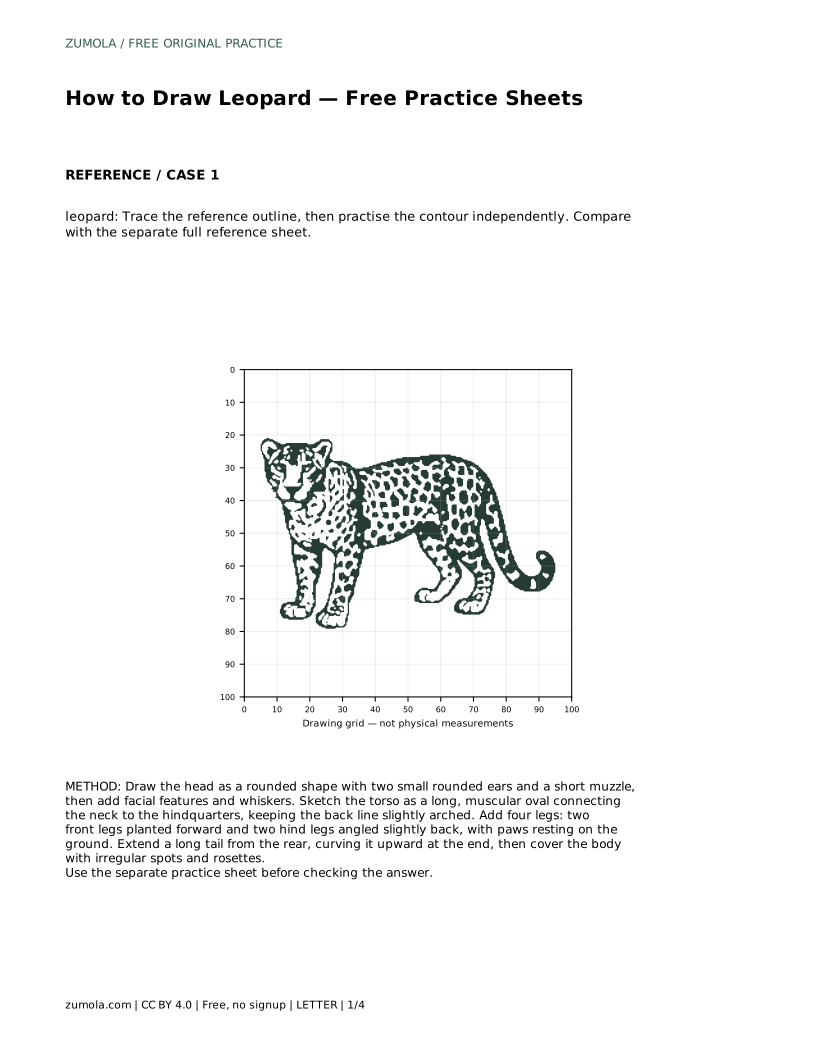
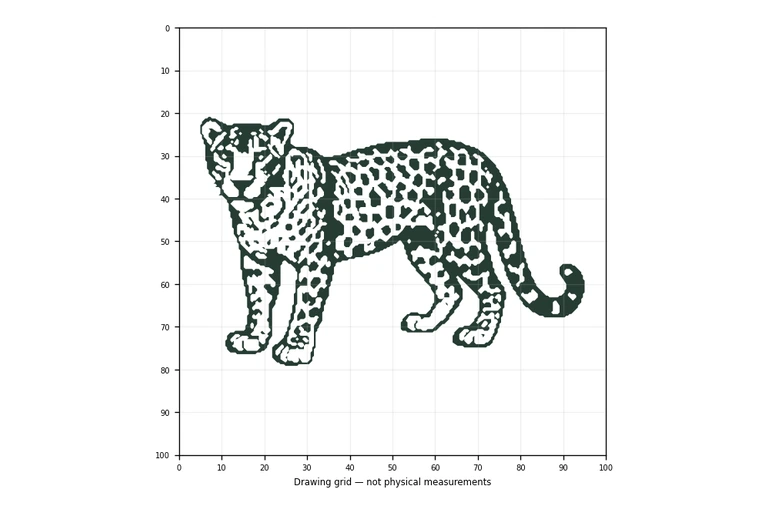
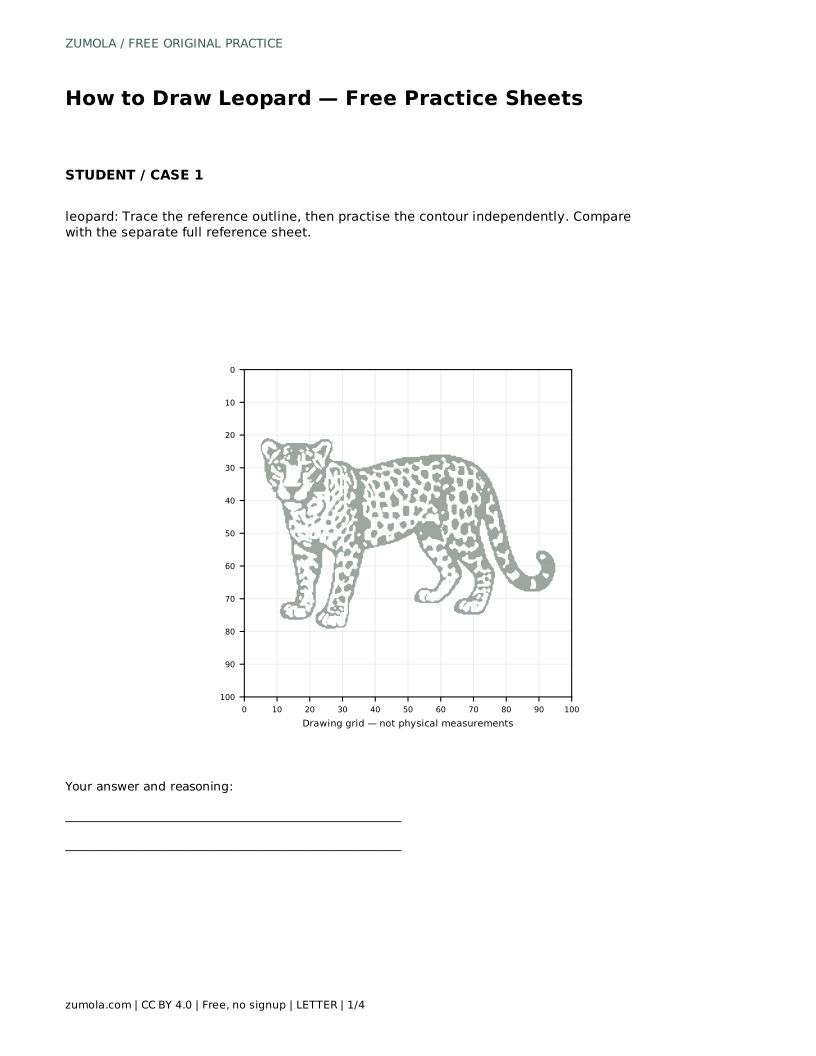
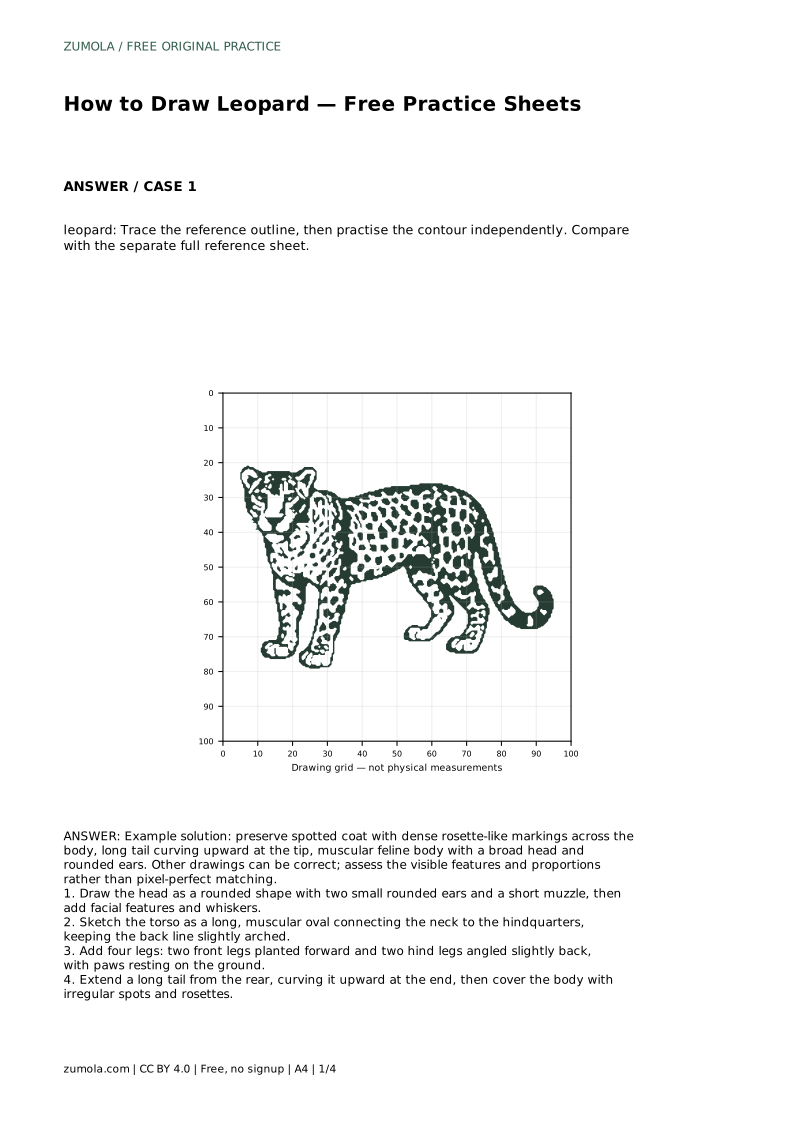
Drawing a realistic leopard means capturing its spotted coat, muscular feline body, broad head, and long tail that curves upward at the tip. This page explains how to build the animal from simple shapes, place identifying features, and use the free practice sheets to compare your work with a full reference. The goal is not pixel-perfect copying but preserving visible features and proportions. Each sheet offers a different way to practise: tracing, grid copying, using a bounding frame, or completing a blank portion.
Begin by drawing the head as a rounded shape with two small rounded ears and a short muzzle. Add facial features and whiskers after the head outline is clear. Then sketch the torso as a long, muscular oval connecting the neck to the hindquarters, keeping the back line slightly arched. This oval should feel longer than a domestic cat's body, because a leopard's torso is elongated and powerful.
Next, add four legs: two front legs planted forward and two hind legs angled slightly back, with paws resting on the ground. Check that the legs support the body without looking too thin or too straight. Finally, extend a long tail from the rear and curve it upward at the end. The tail should look flexible and thick enough to balance the body.
A leopard's coat is covered with dense rosette-like markings across the body. Rosettes are irregular rings of dark spots with a lighter centre, and they vary in size and spacing. Do not arrange them in a perfect grid; instead, let them follow the curve of the torso, legs, and tail. Smaller solid spots often appear on the head, paws, and lower legs.
Keep the markings dense but not overcrowded. Leave some lighter fur visible between rosettes so the coat reads as spotted rather than solid. On the tail, spots may form bands or irregular rings toward the tip. The face has smaller spots and short lines, not large rosettes.
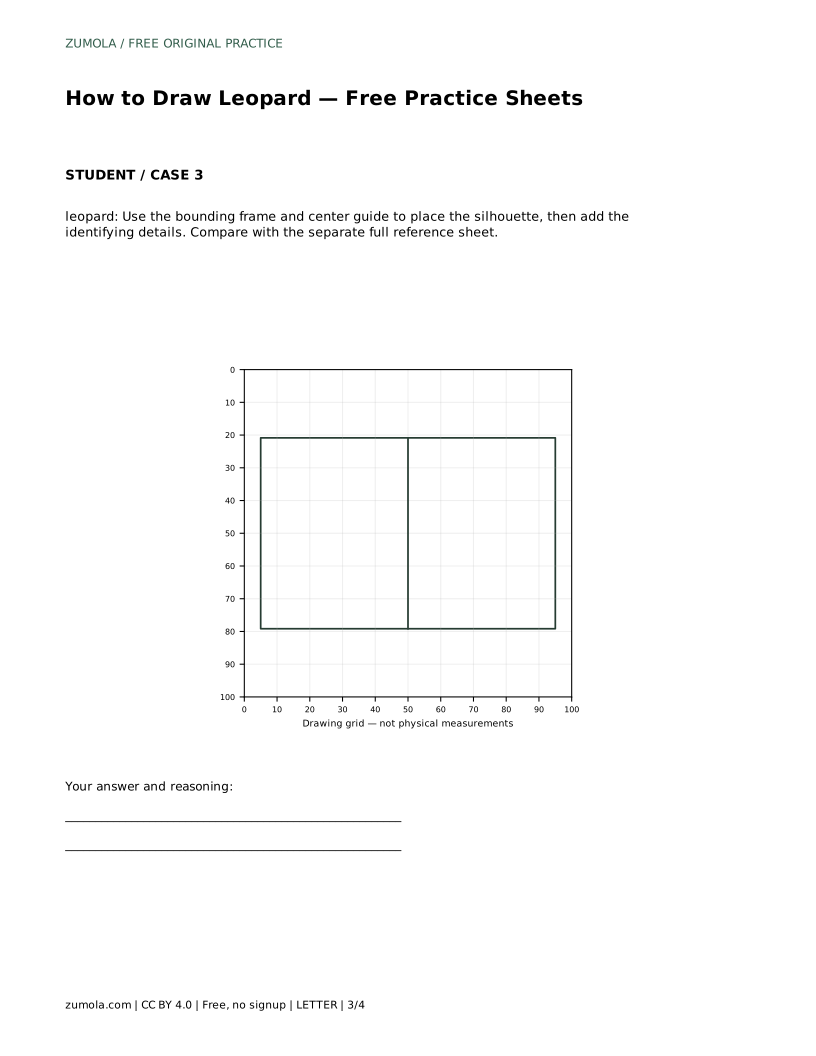
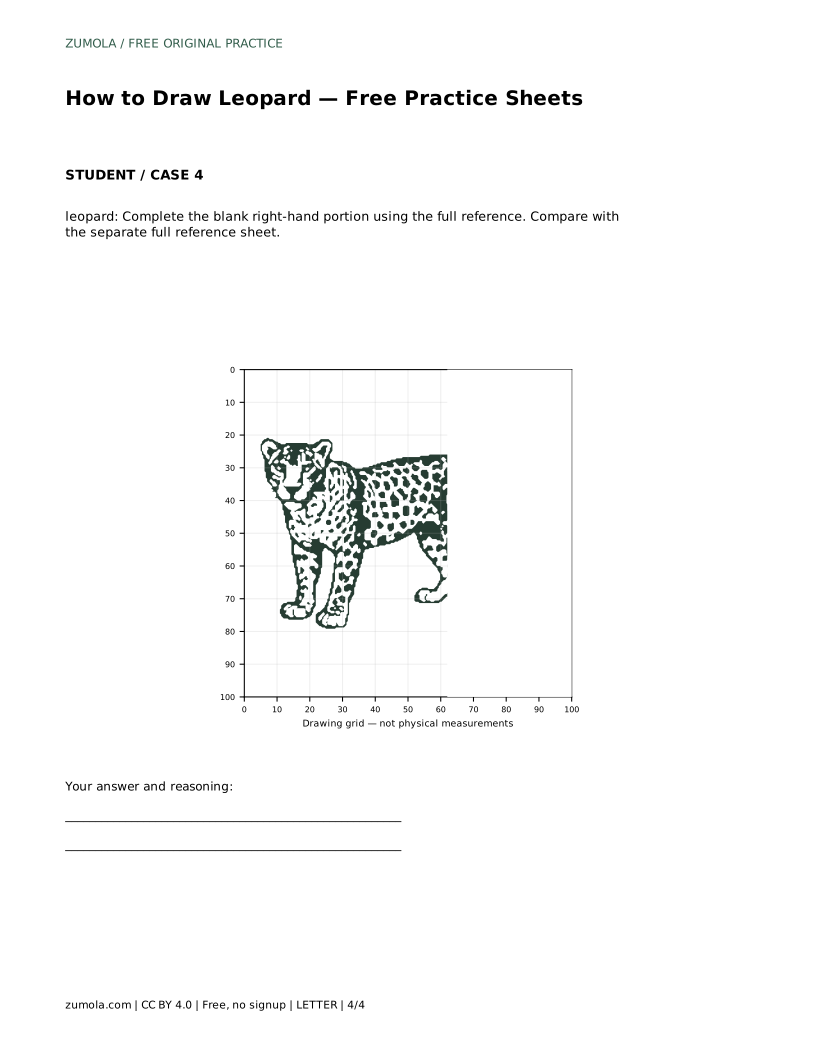
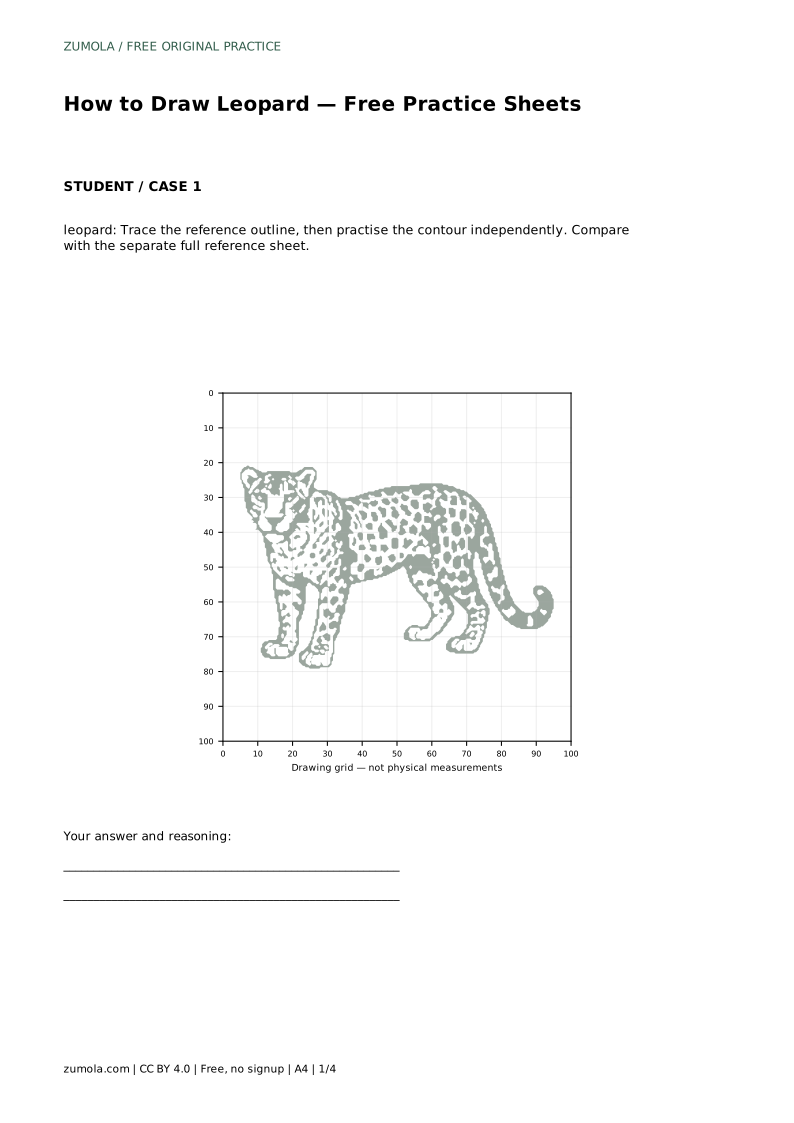
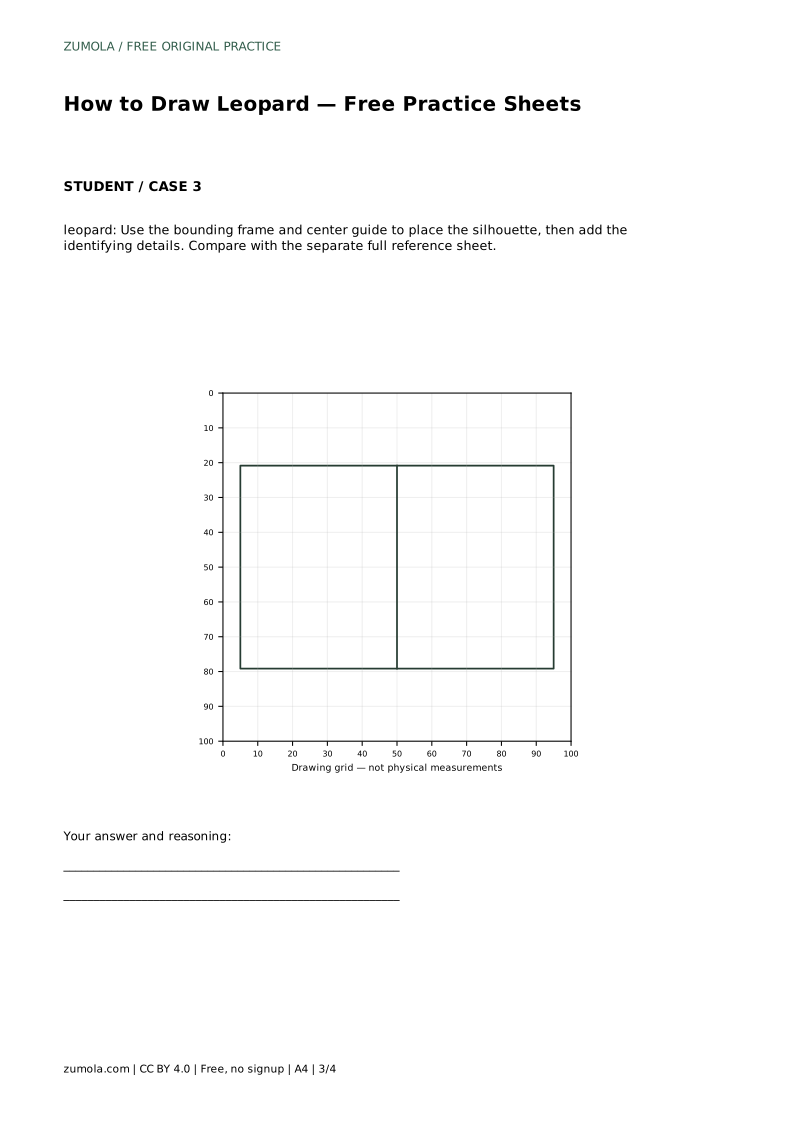
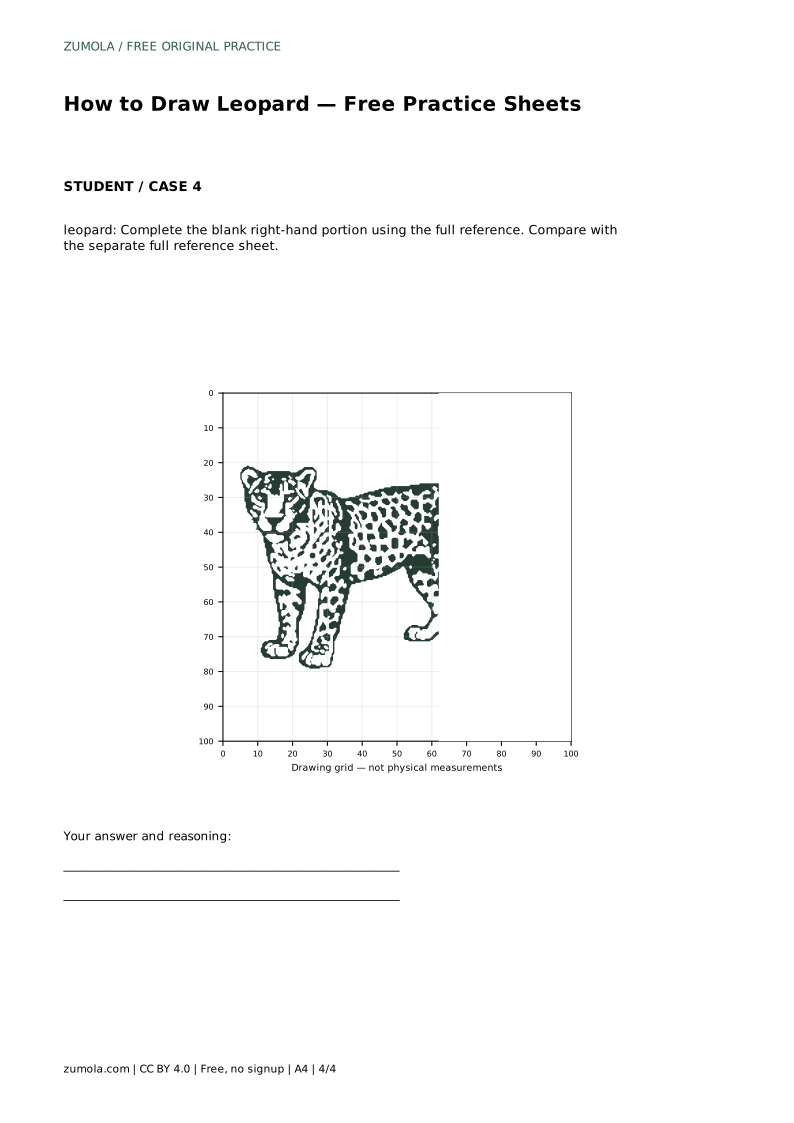
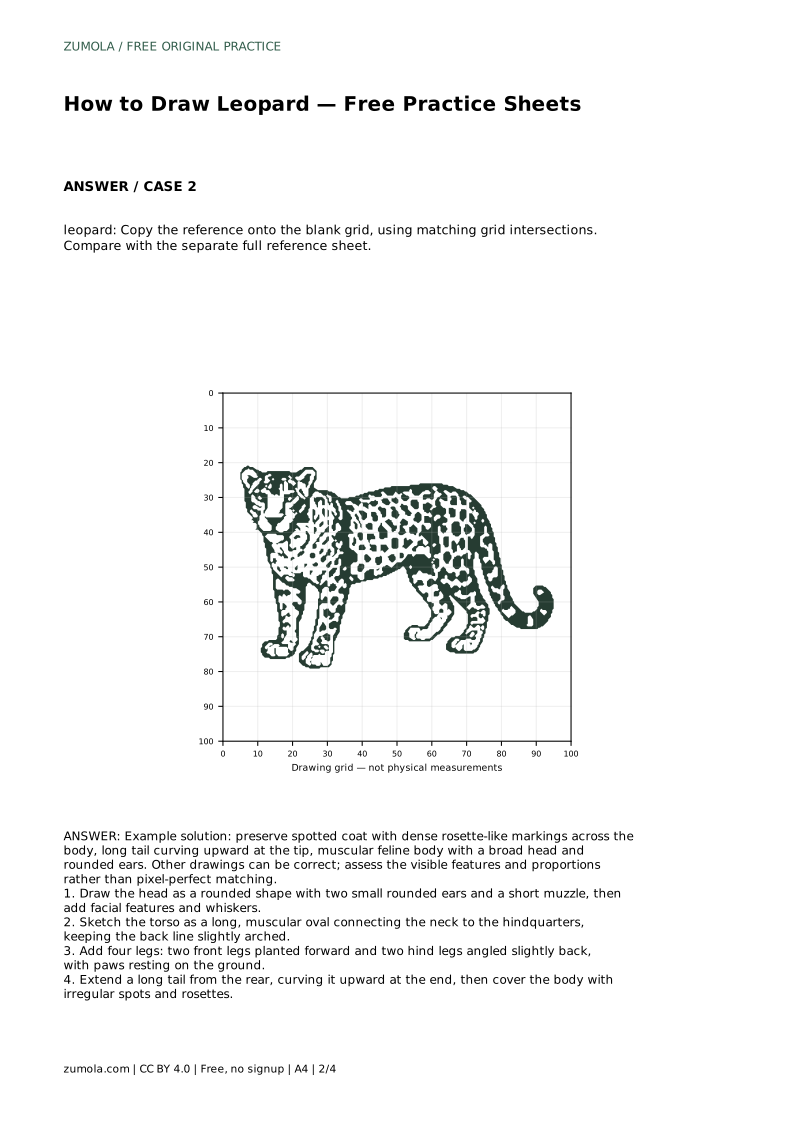
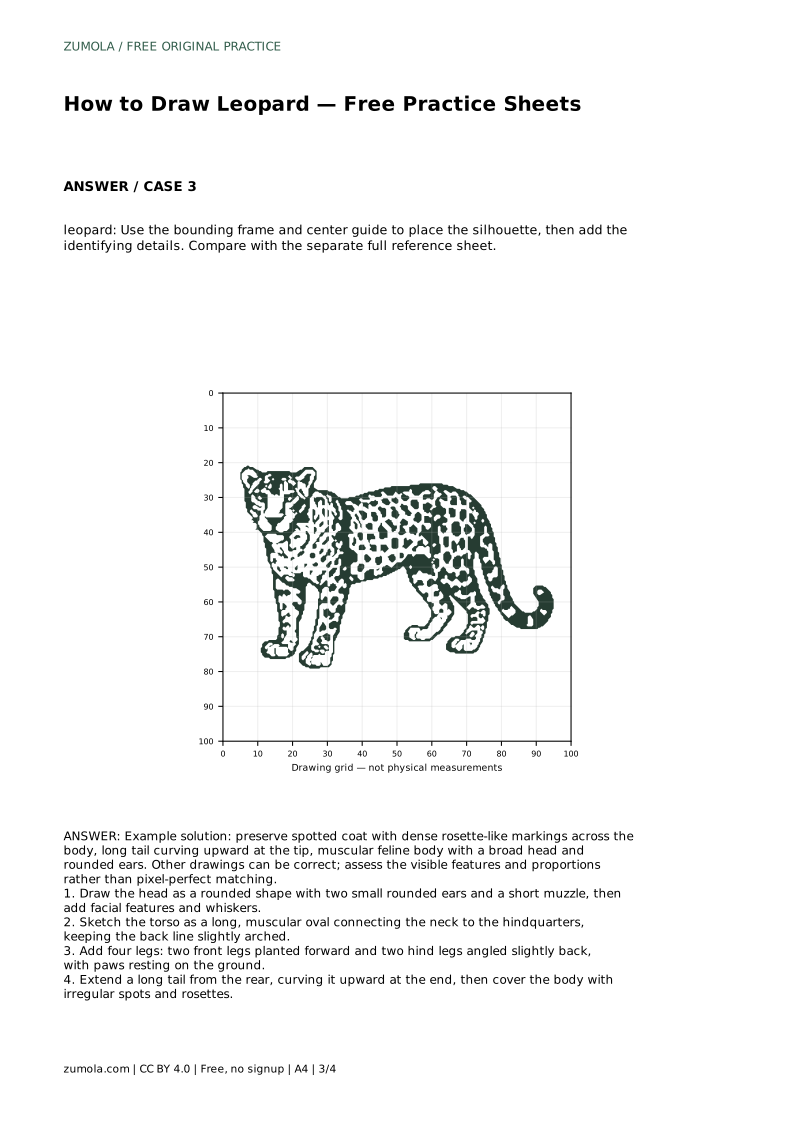
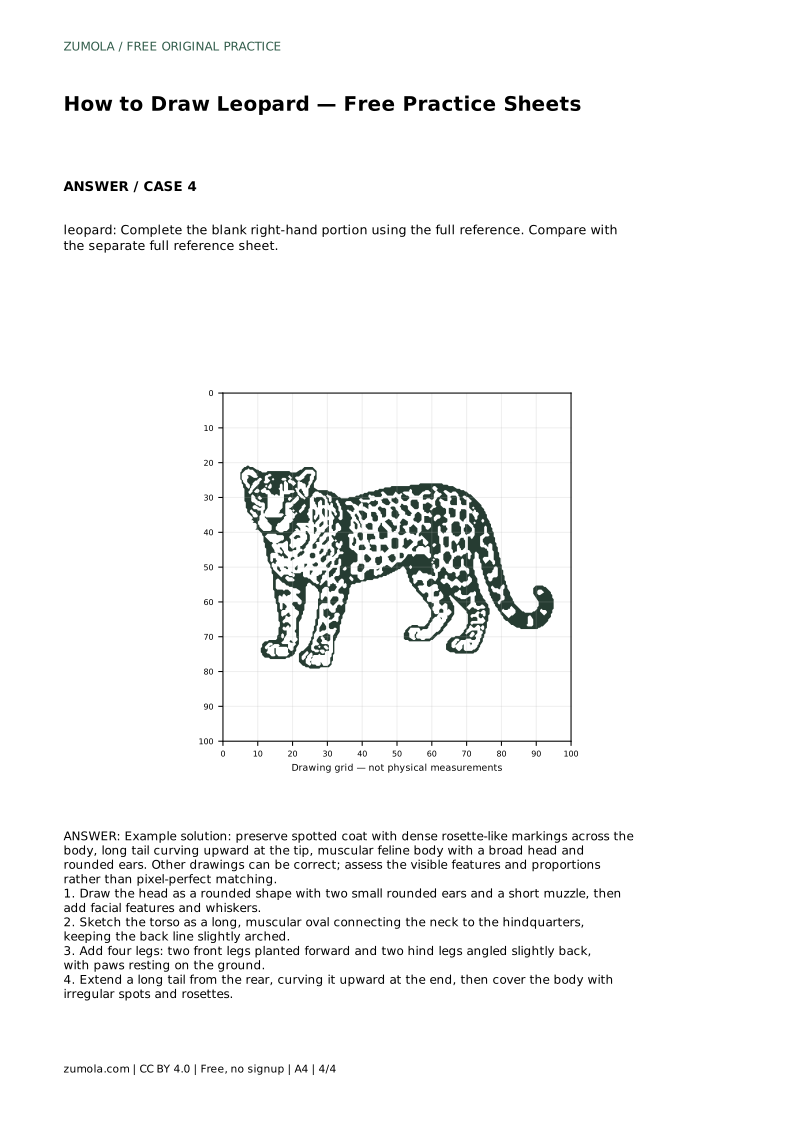
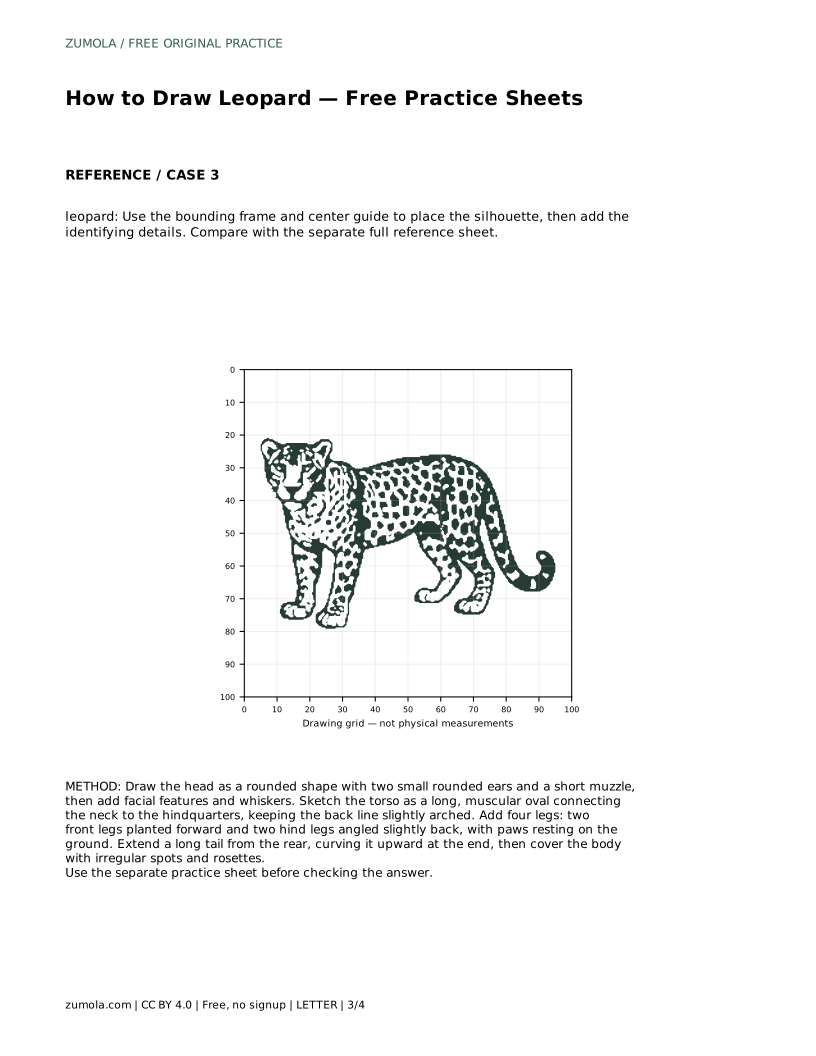
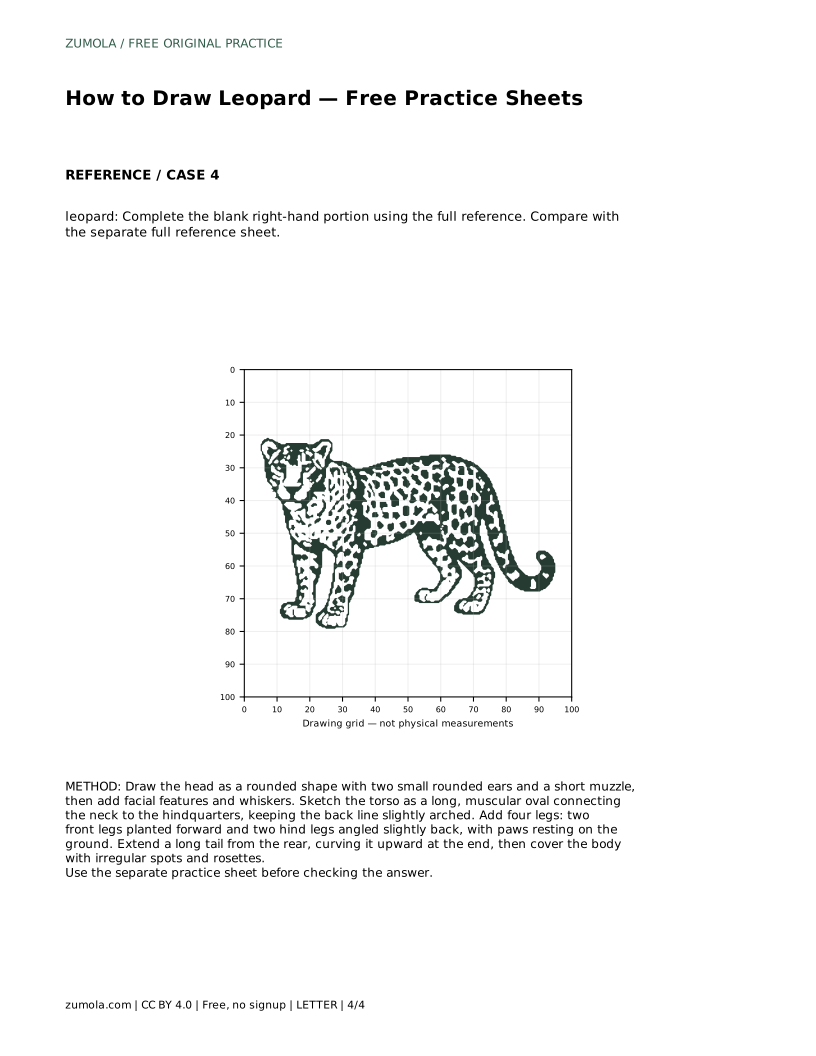
The free practice sheets give you different ways to build the same leopard. One sheet asks you to trace the reference outline, then practise the contour independently. Another uses a blank grid so you can copy the reference onto matching grid intersections. A third provides a bounding frame and centre guide to place the silhouette before adding details. A fourth leaves the right-hand portion blank so you complete it from the full reference.
After each attempt, compare your drawing with the separate full reference sheet. Look for the broad head, rounded ears, arched back, four grounded legs, long upward-curving tail, and dense rosette-like markings. Other drawings can be correct; assess the visible features and proportions rather than pixel-perfect matching.
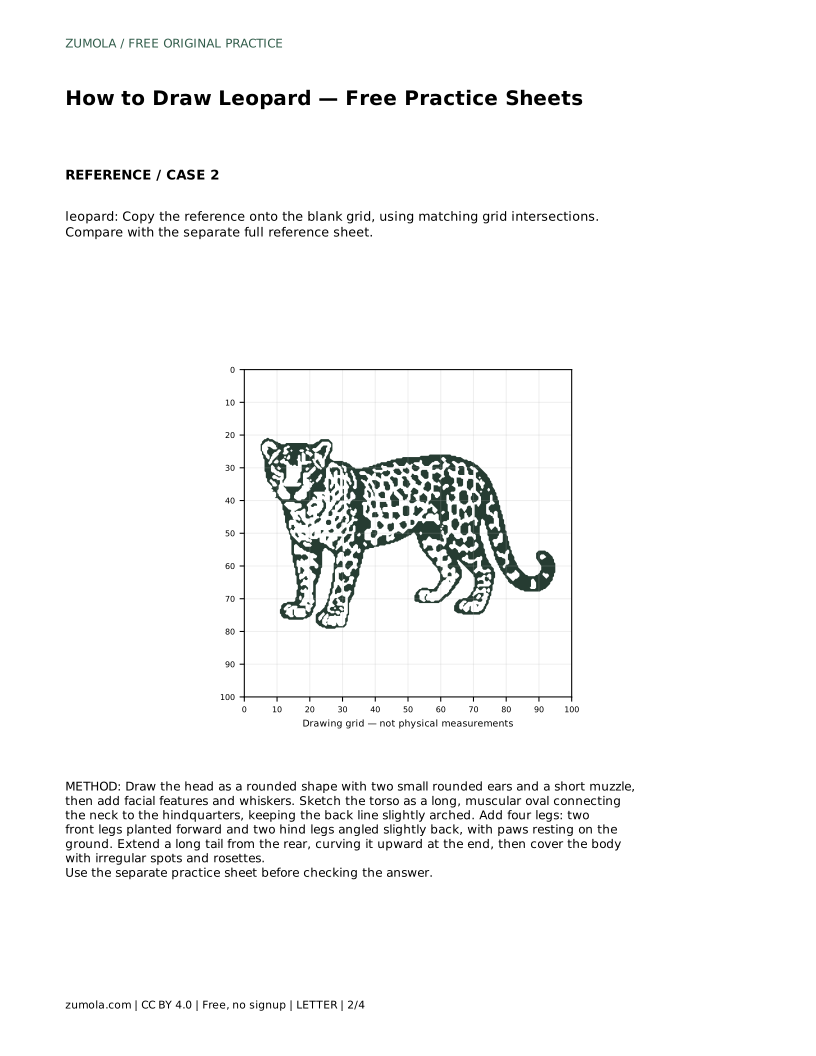
leopard: Trace the reference outline, then practise the contour independently. Compare with the separate full reference sheet.
Example solution: preserve spotted coat with dense rosette-like markings across the body, long tail curving upward at the tip, muscular feline body with a broad head and rounded ears. Other drawings can be correct; assess the visible features and proportions rather than pixel-perfect matching. Draw the head as a rounded shape with two small rounded ears and a short muzzle, then add facial features and whiskers. Sketch the torso as a long, muscular oval connecting the neck to the hindquarters, keeping the back line slightly arched. Add four legs: two front legs planted forward and two hind legs angled slightly back, with paws resting on the ground. Extend a long tail from the rear, curving it upward at the end, then cover the body with irregular spots and rosettes.
No. Use the reference to check visible features and proportions. Other drawings can be correct if the head, body, legs, tail, and rosette markings are preserved.
Place dense, irregular rosettes across the torso, following its curves. Use smaller solid spots on the head, paws, and lower legs, and let tail markings curve with the tail.
Compare with the full reference sheet: broad head, rounded ears, arched back, four grounded legs, long upward-curving tail, and dense rosette-like markings.
All drawing practice · Free coordinate paper
Original resources · CC BY 4.0 · Free for personal and classroom use with attribution.