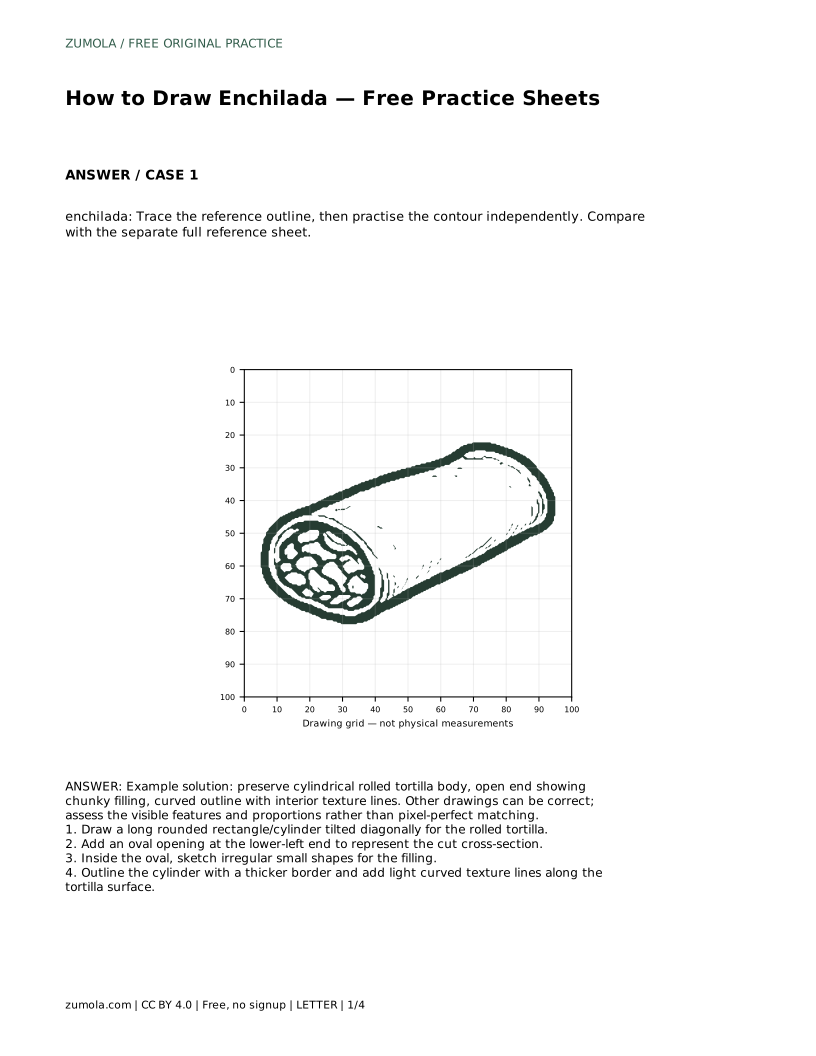
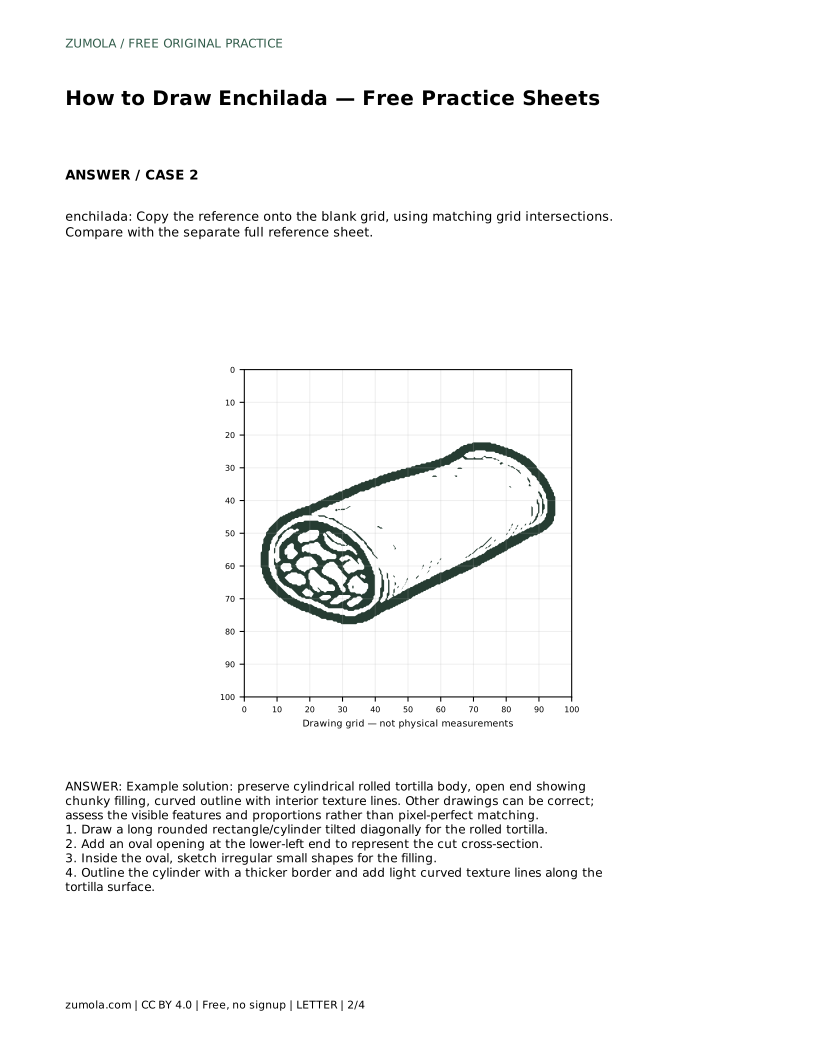
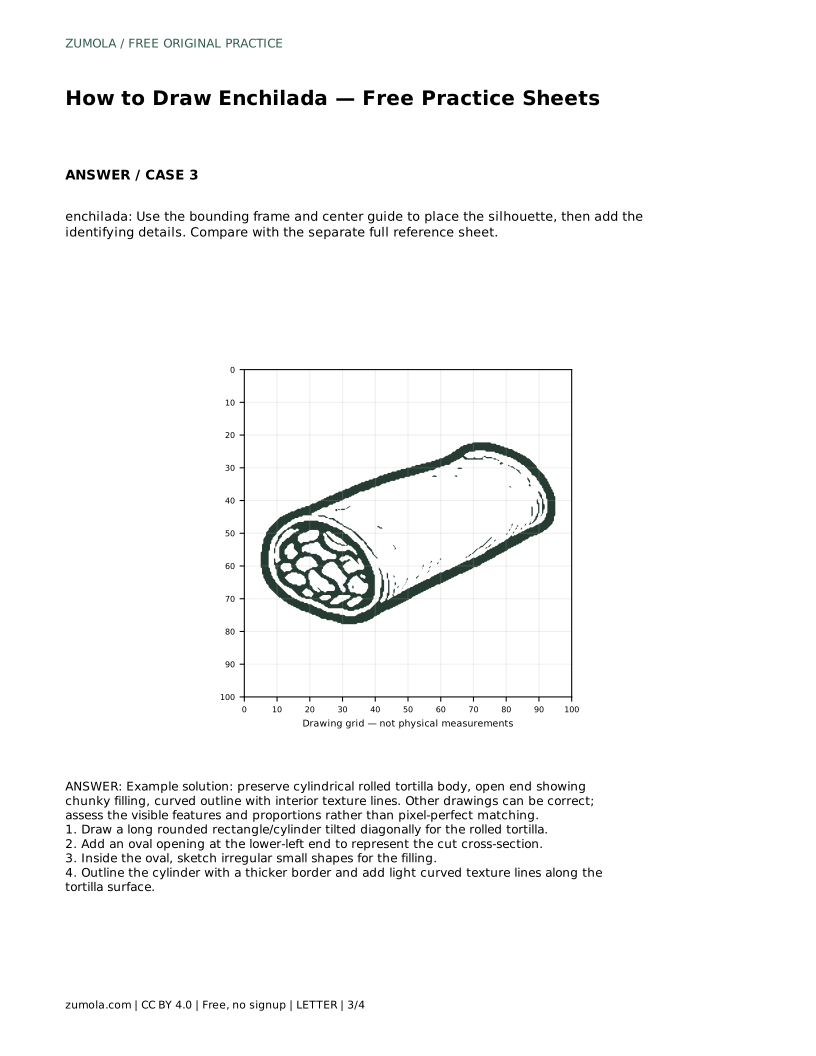
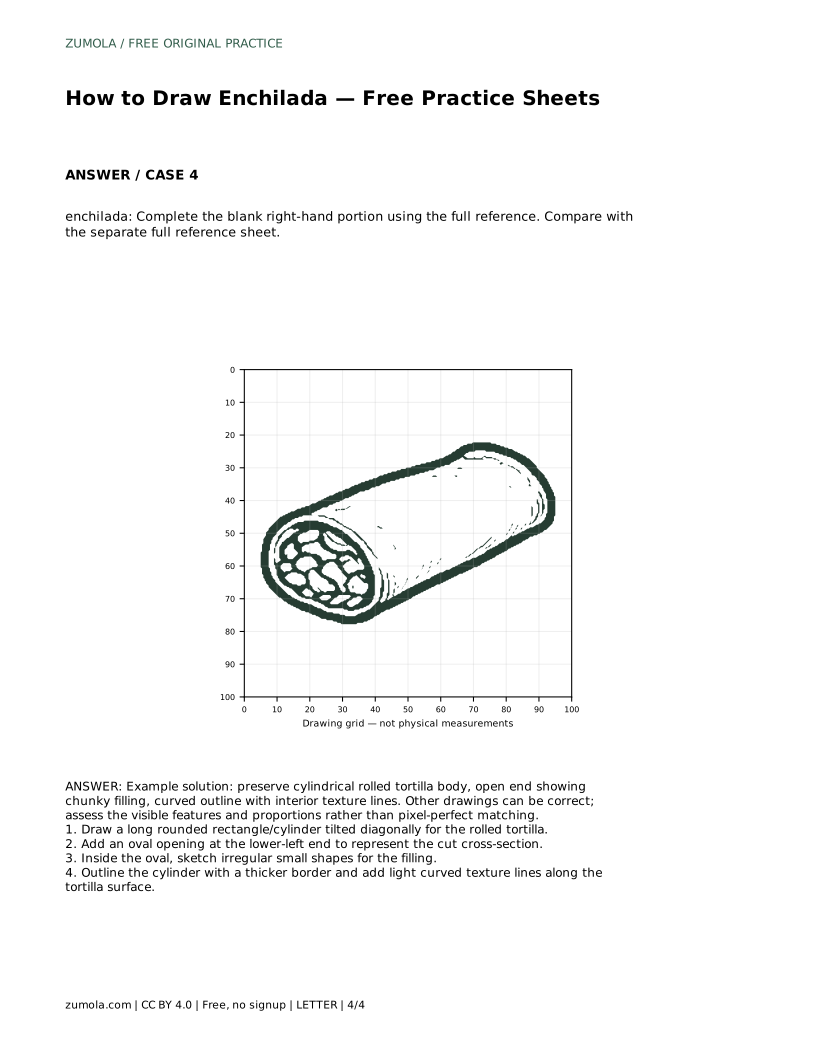
Reference diagrams
LETTER · Download PDF
A4 · Download PDF
Free original resources
Learn to draw a rolled enchilada by building a tilted cylinder, an open filling end, and surface texture lines. Free printable practice sheets support each step.
Four original cases, with reference diagrams, practice sheets and worked answers. Everything is free; no signup required.
LETTER · Download PDF
A4 · Download PDF
LETTER · Download PDF
A4 · Download PDF
LETTER · Download PDF
A4 · Download PDF
Use A4 or US Letter to match your printer. Use the stated values and conditions to solve each exercise; diagrams are not physical measuring rulers.
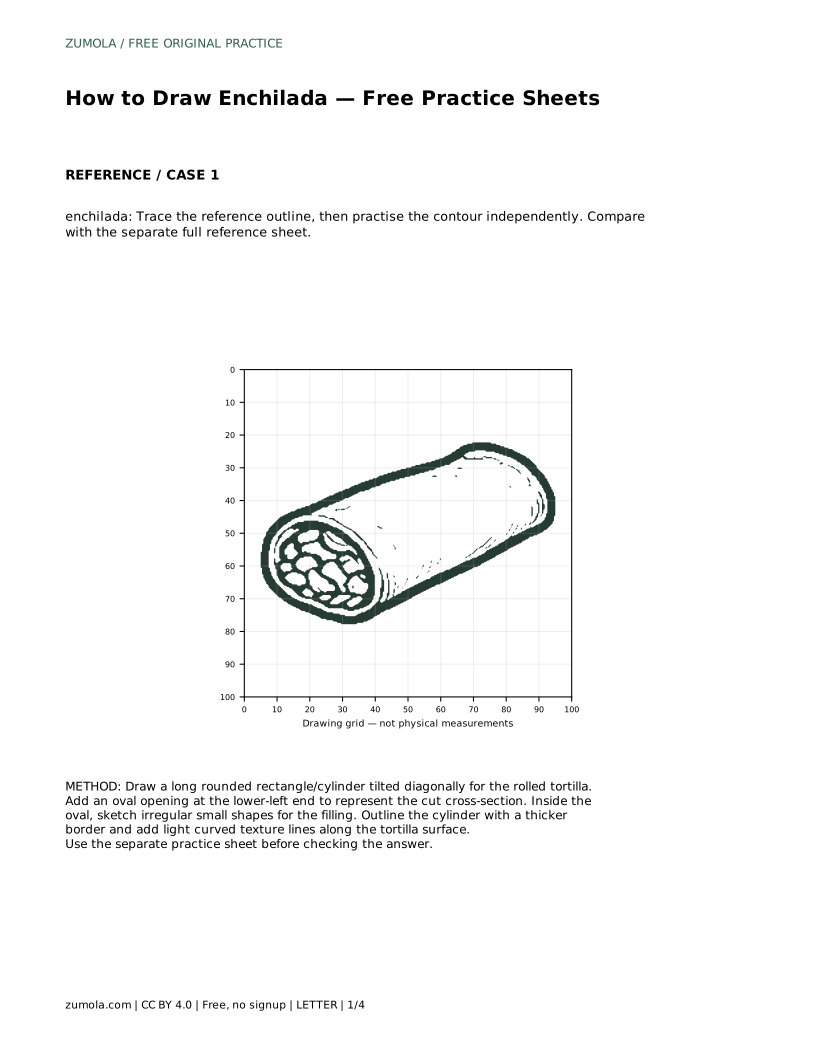
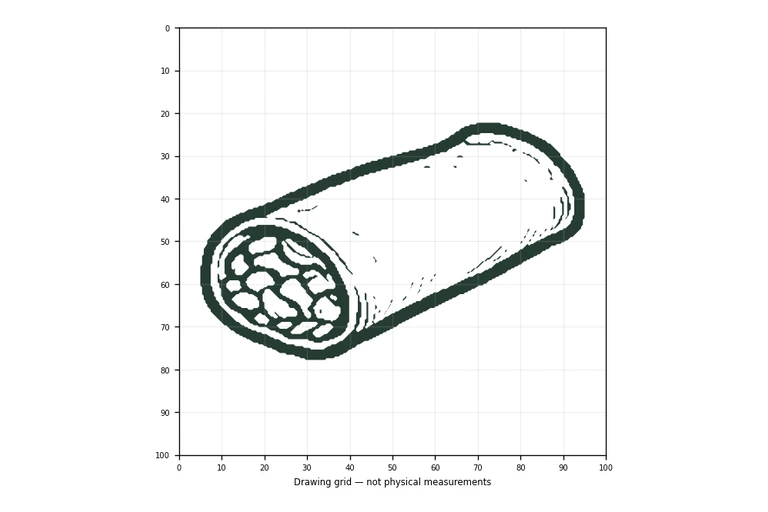
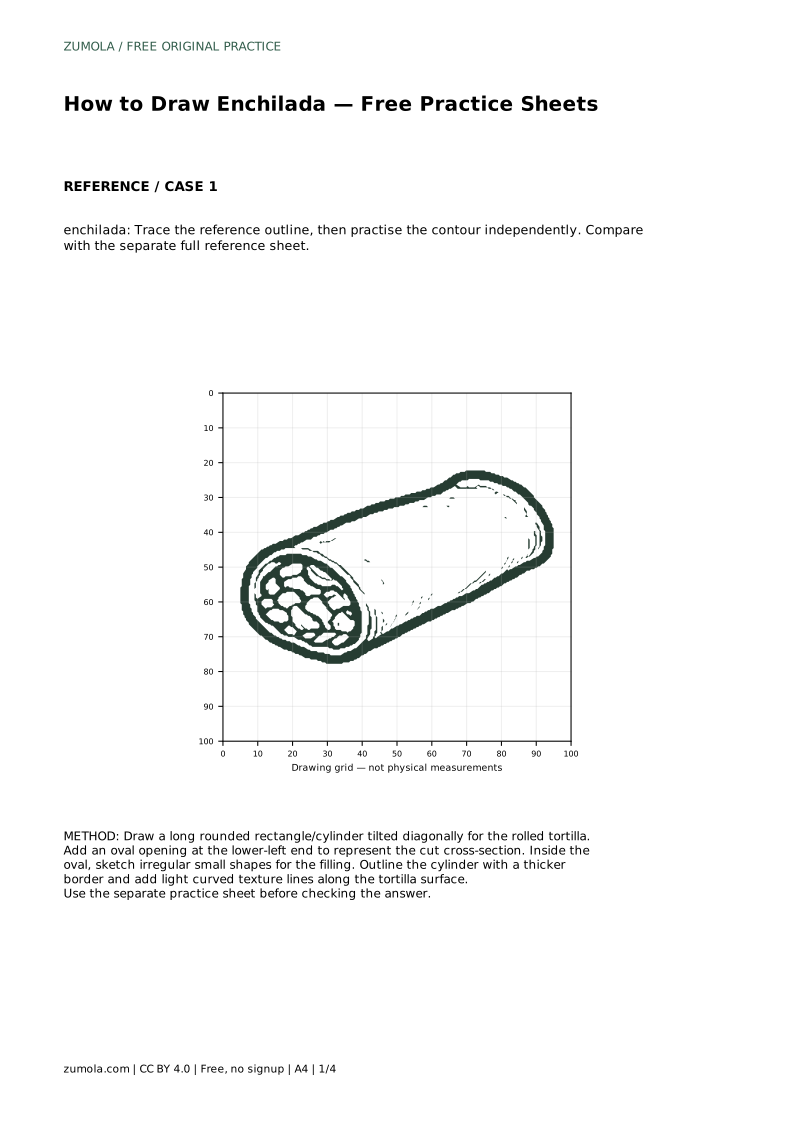
An enchilada drawing is mostly a study in simple form: a rolled tortilla reads as a long cylinder, and the cut end shows the filling inside. This page explains how to construct that shape deliberately, then how to use tracing, grid, frame, and partial-reference practice sheets to strengthen your control. The goal is not a pixel-perfect copy. Different drawings can all be correct when the rolled body, the open end, and the interior texture remain clear and well proportioned.
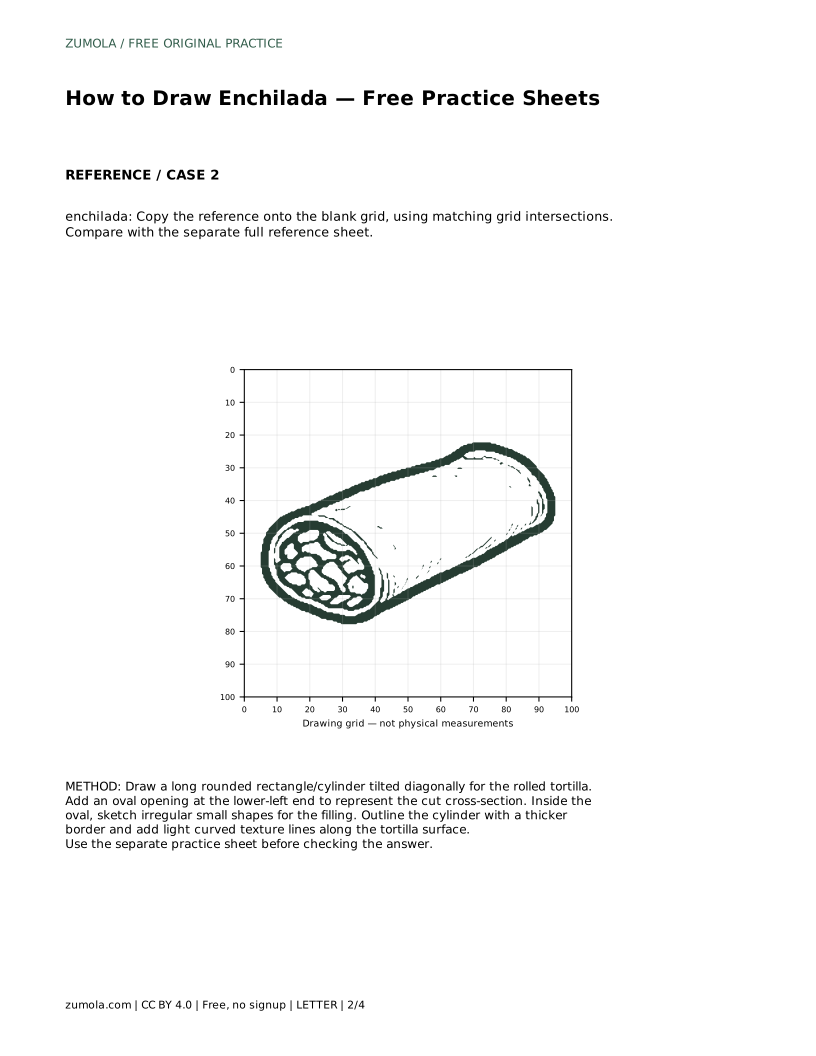
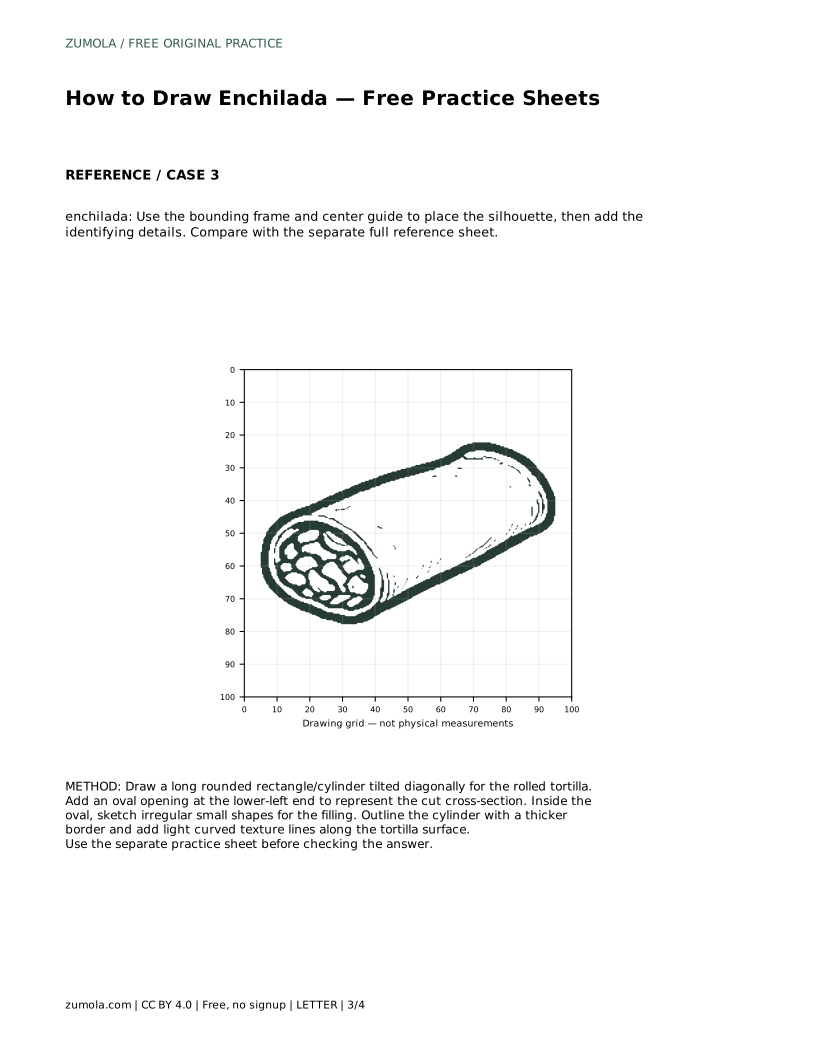
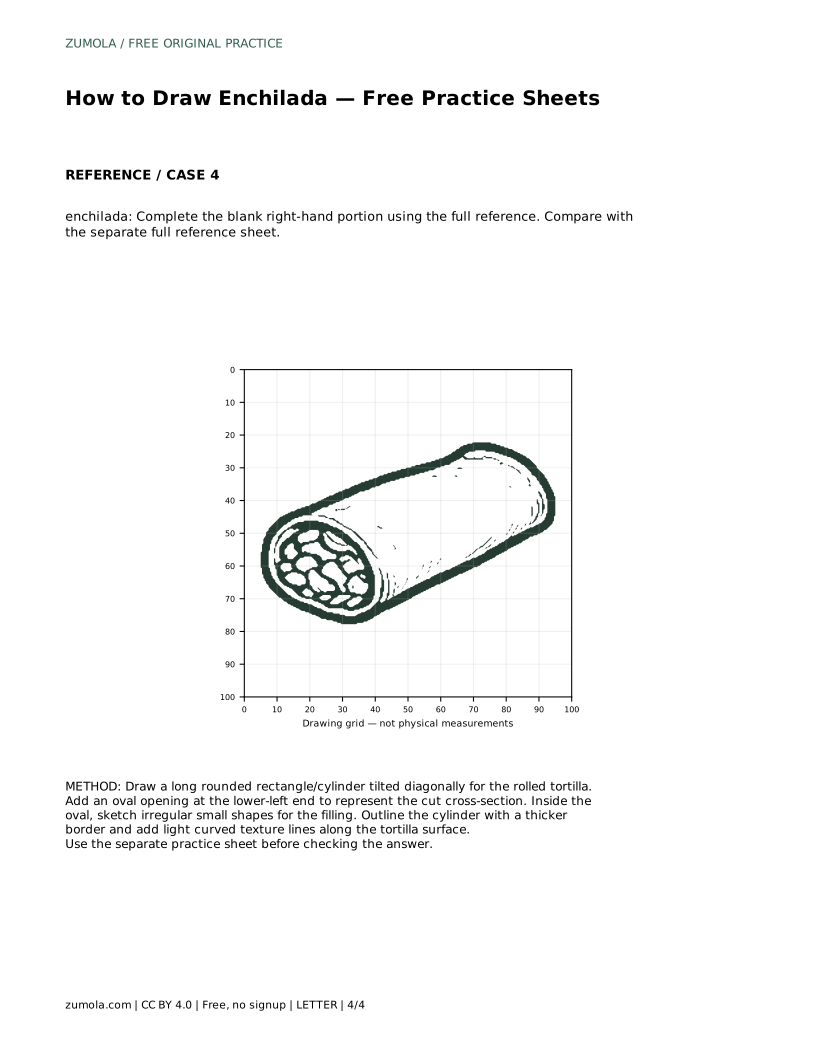
Start with the largest shape and leave details until the structure is stable. A rolled enchilada is a cylinder seen at a slight angle, so draw it as a long rounded rectangle tilted diagonally across the page. Keep the two long sides roughly parallel and give both ends soft curves rather than sharp corners. Decide the tilt early, because every later line depends on it.
Once the body is placed, check that it is long enough to read as a roll rather than a stub. Light construction lines are fine here; you will thicken the final outline later.
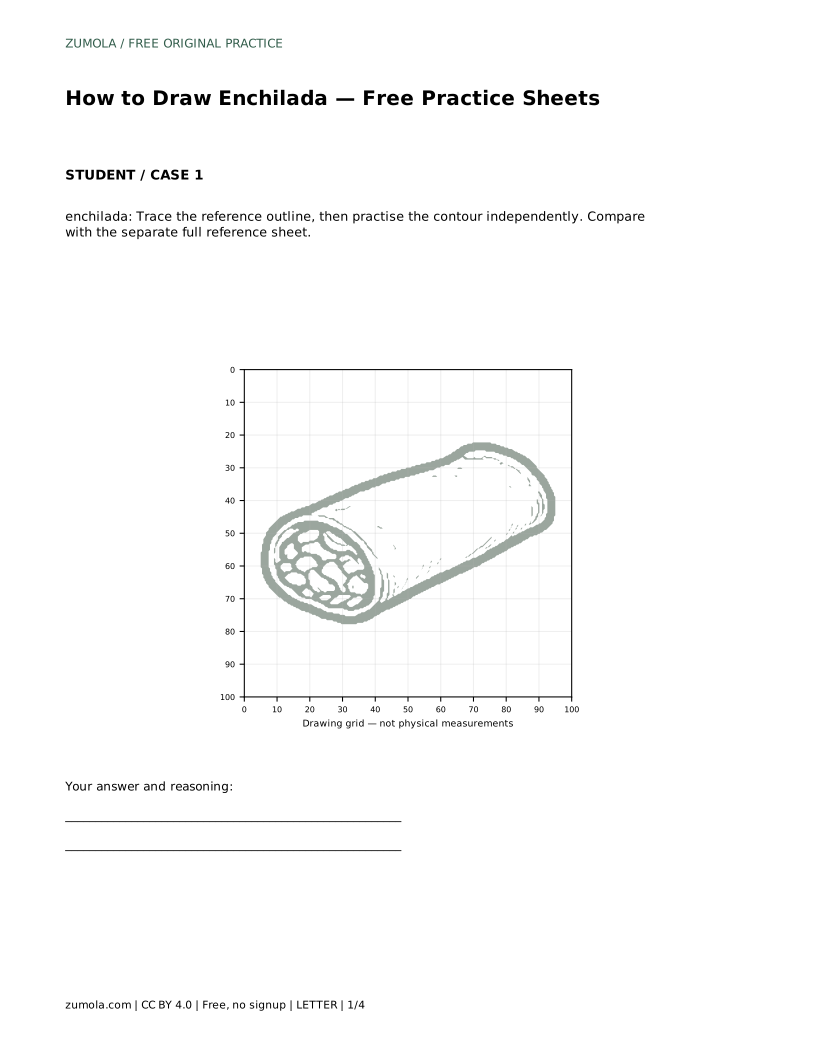
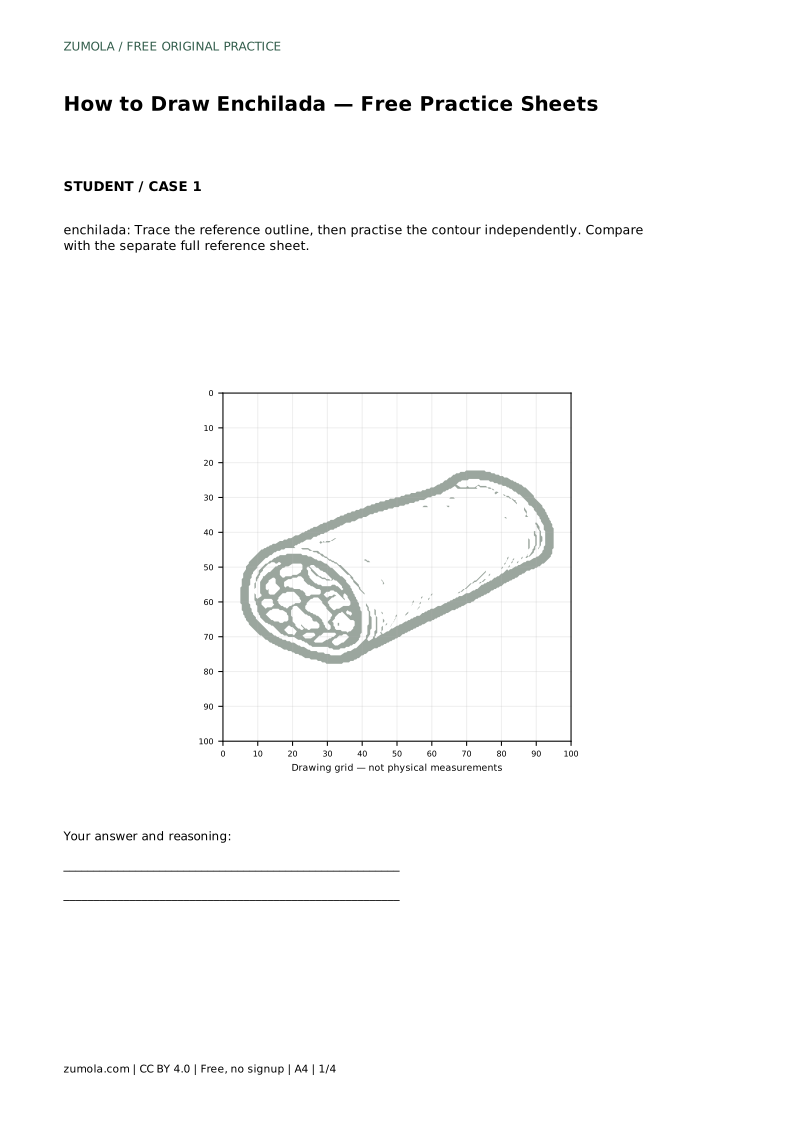
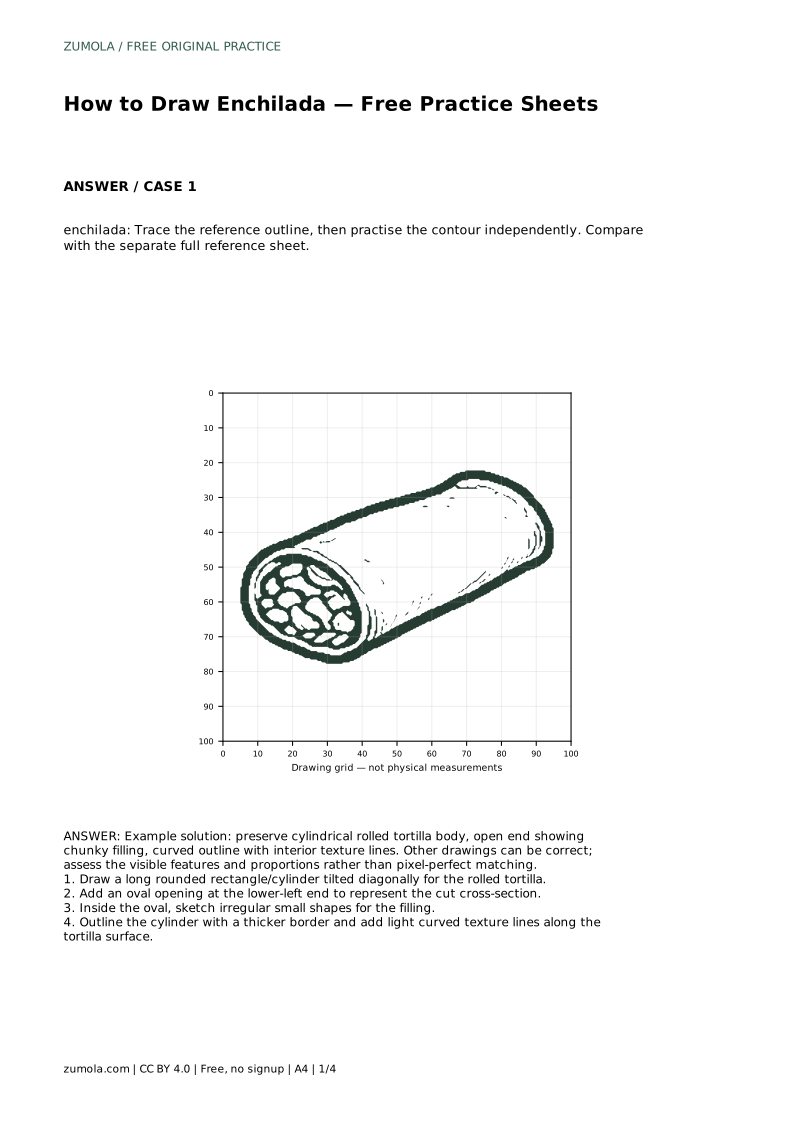
The cut cross-section is what tells the viewer this is a filled roll. At the lower-left end, add an oval opening that sits inside the rounded end of the cylinder. The oval should feel like a slice through the roll, so its curve follows the end of the body rather than floating beside it.
Inside the oval, sketch irregular small shapes for the filling. Chunky, uneven forms read better than tidy circles because filling is not uniform. Leave a little space between the filling shapes and the oval edge so the tortilla wall stays visible.
Outline the cylinder with a thicker border, then add light curved texture lines along the tortilla surface. These lines should follow the roll's direction, curving gently around the body rather than cutting straight across it. A few lines are enough; too many can flatten the cylinder instead of describing it.
Compare your drawing with the separate full reference sheet. Look at the overall silhouette first, then the position of the oval, then the density of texture lines. Adjust what is noticeably off rather than chasing small differences.
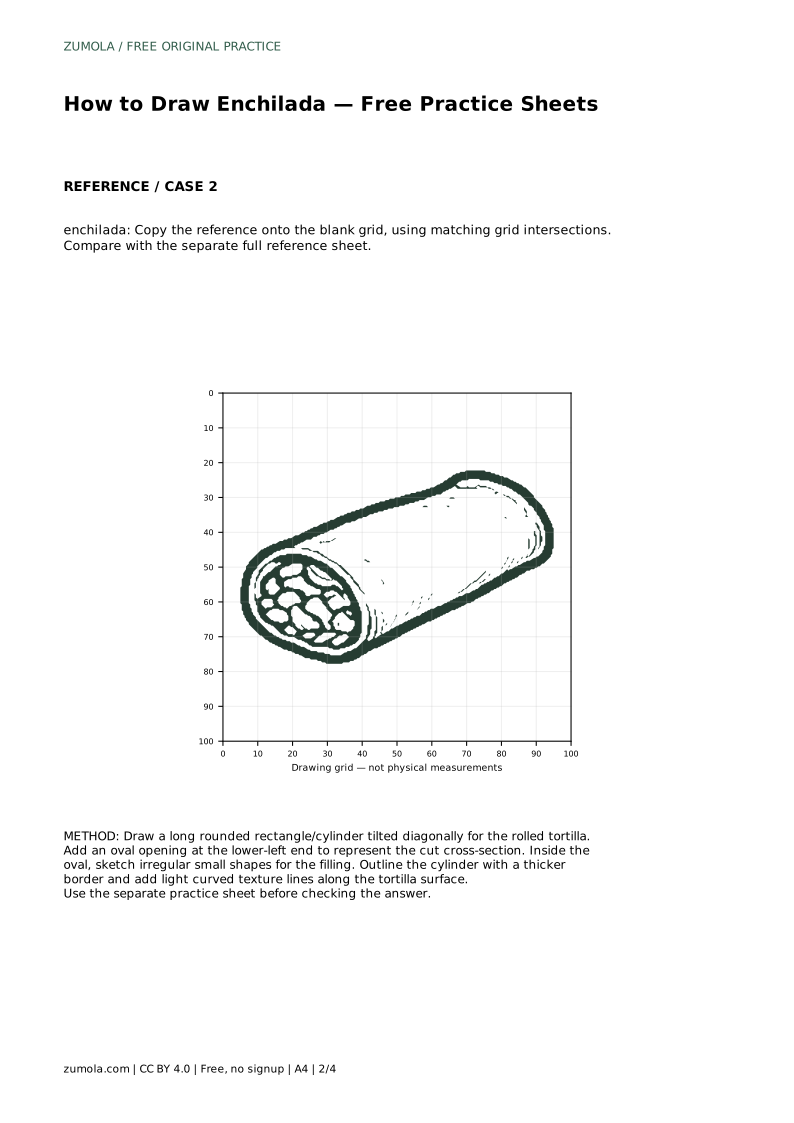
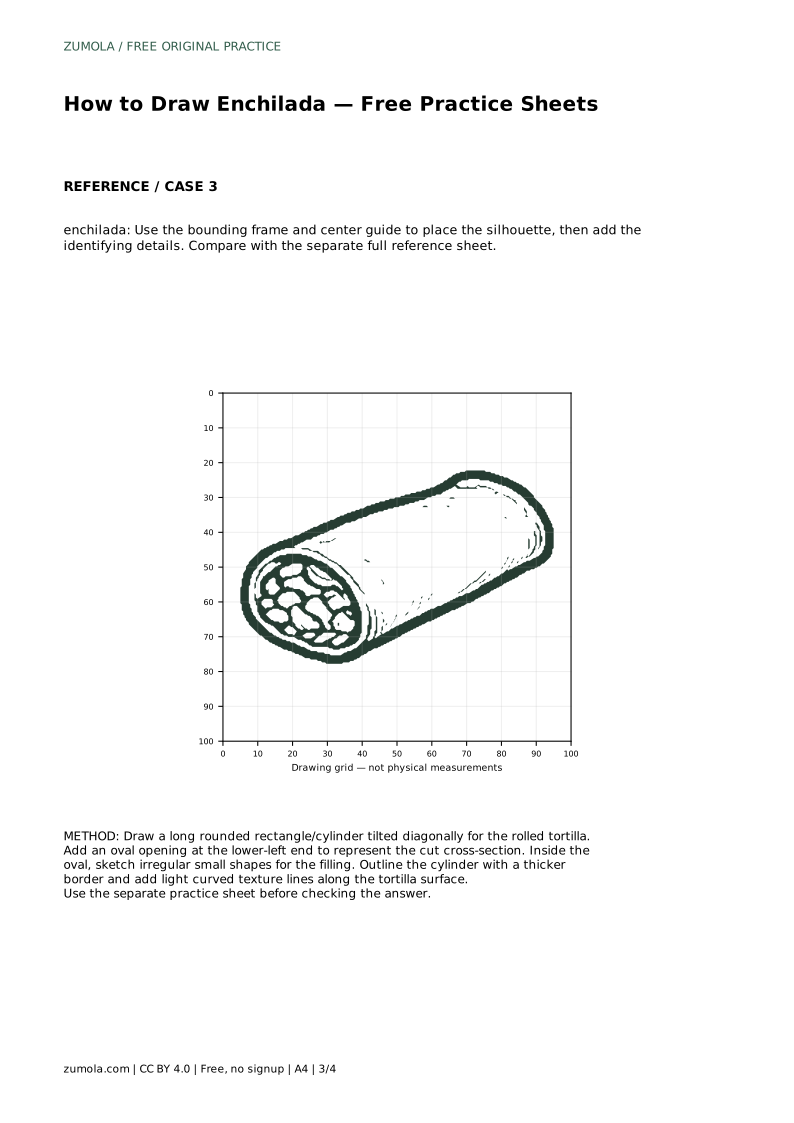
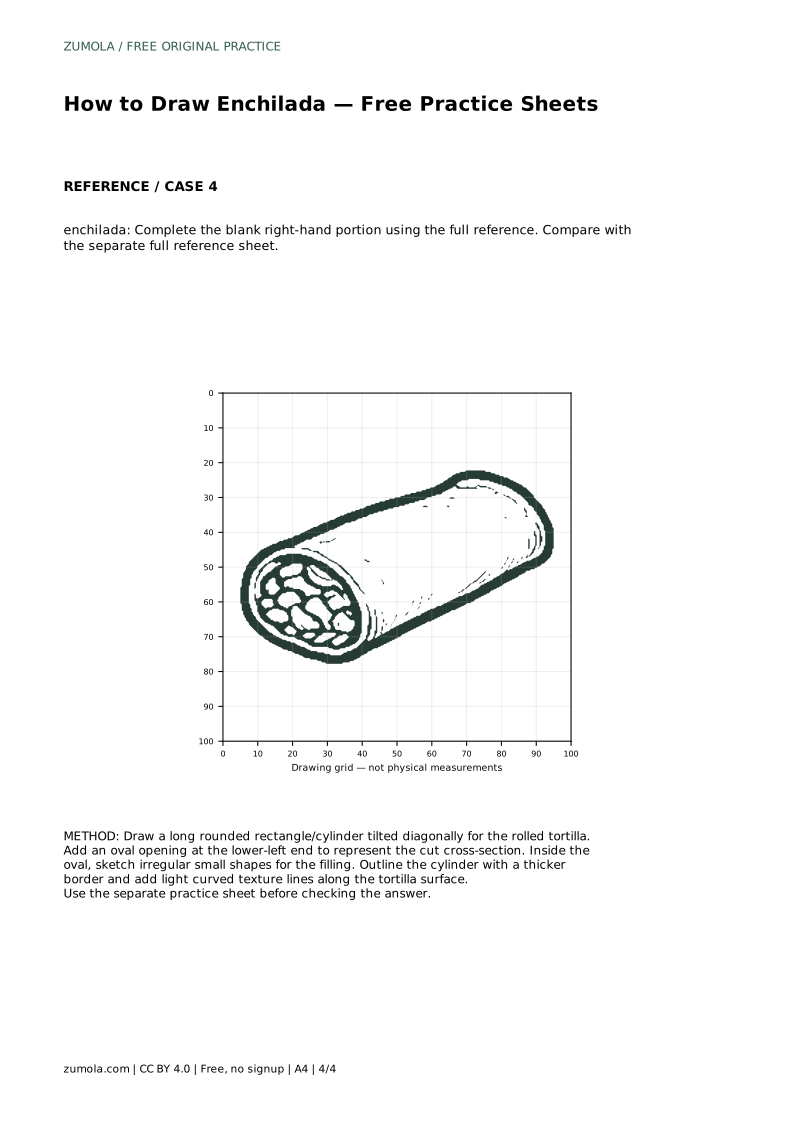
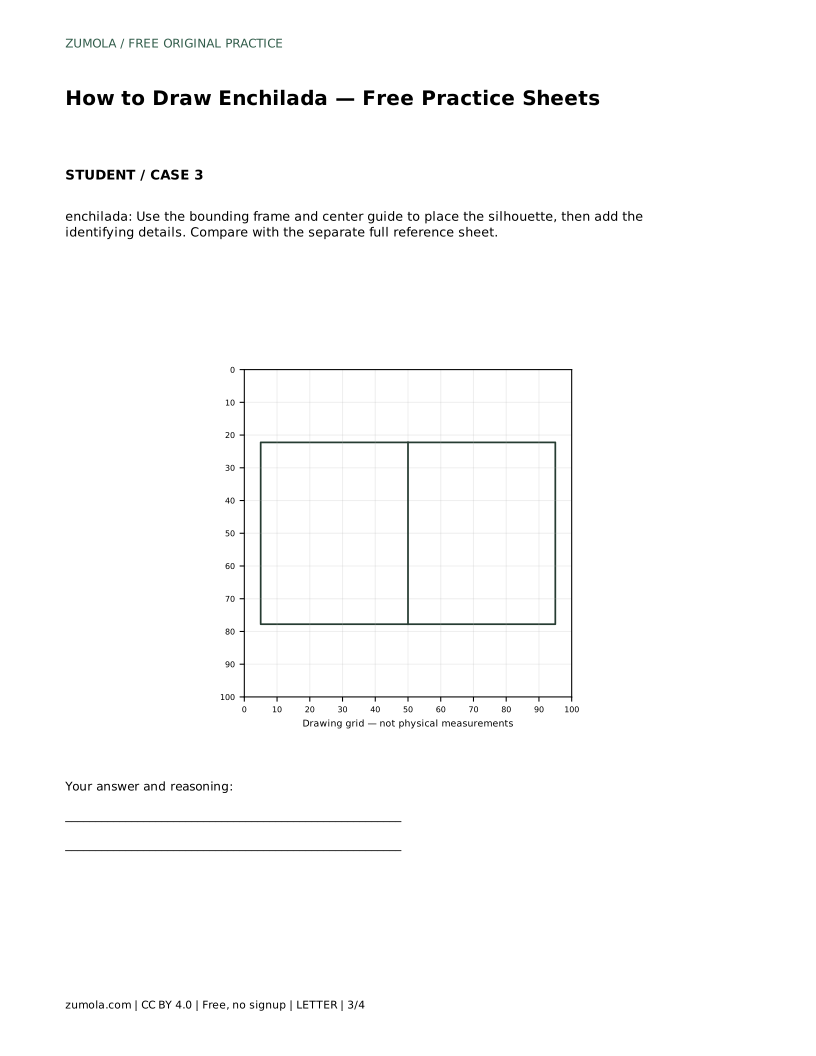
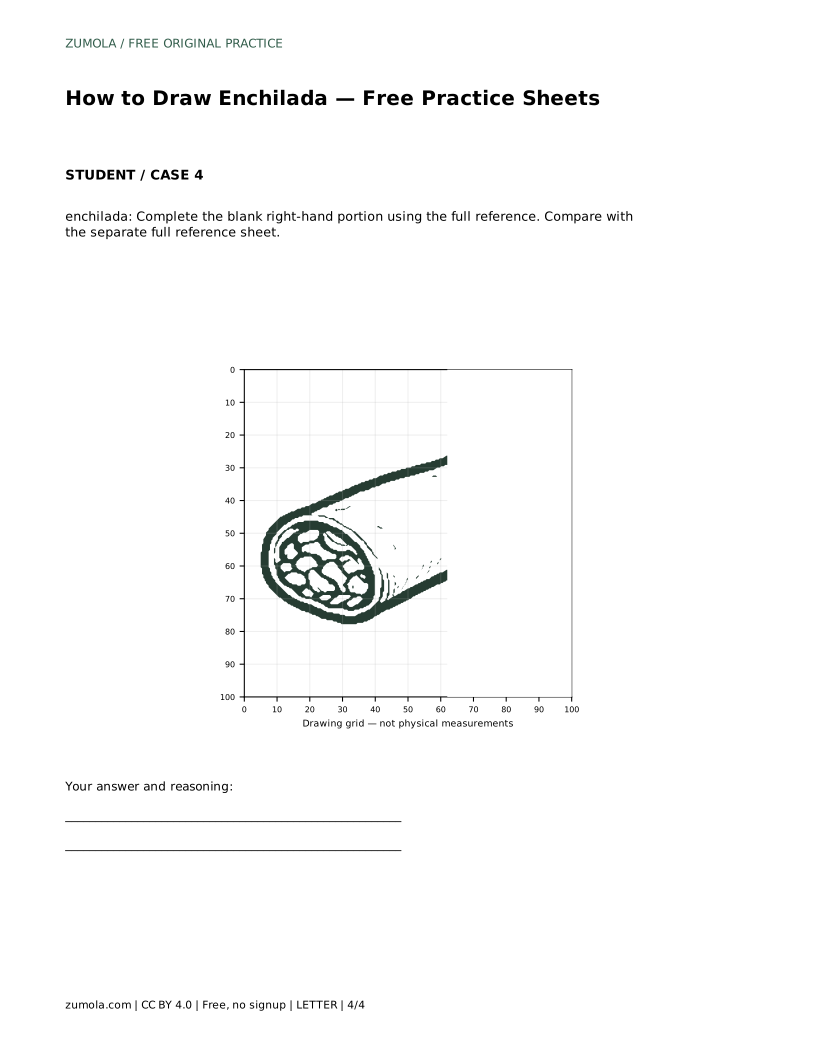
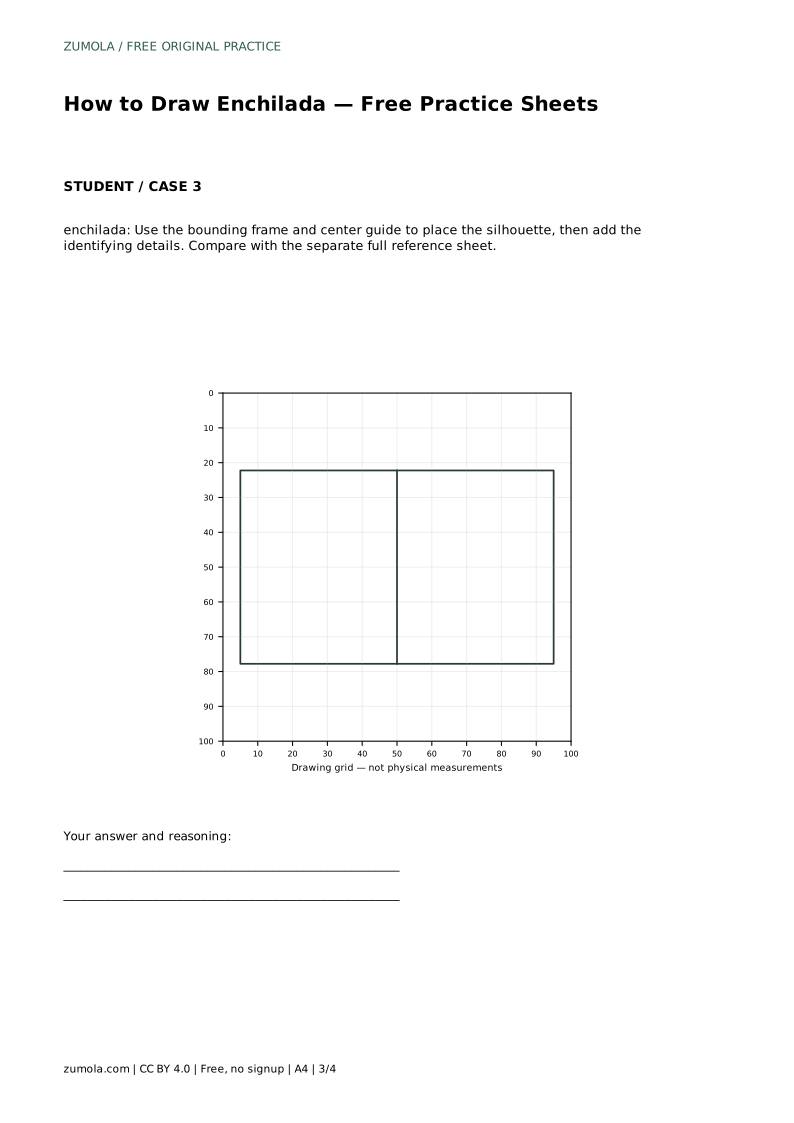
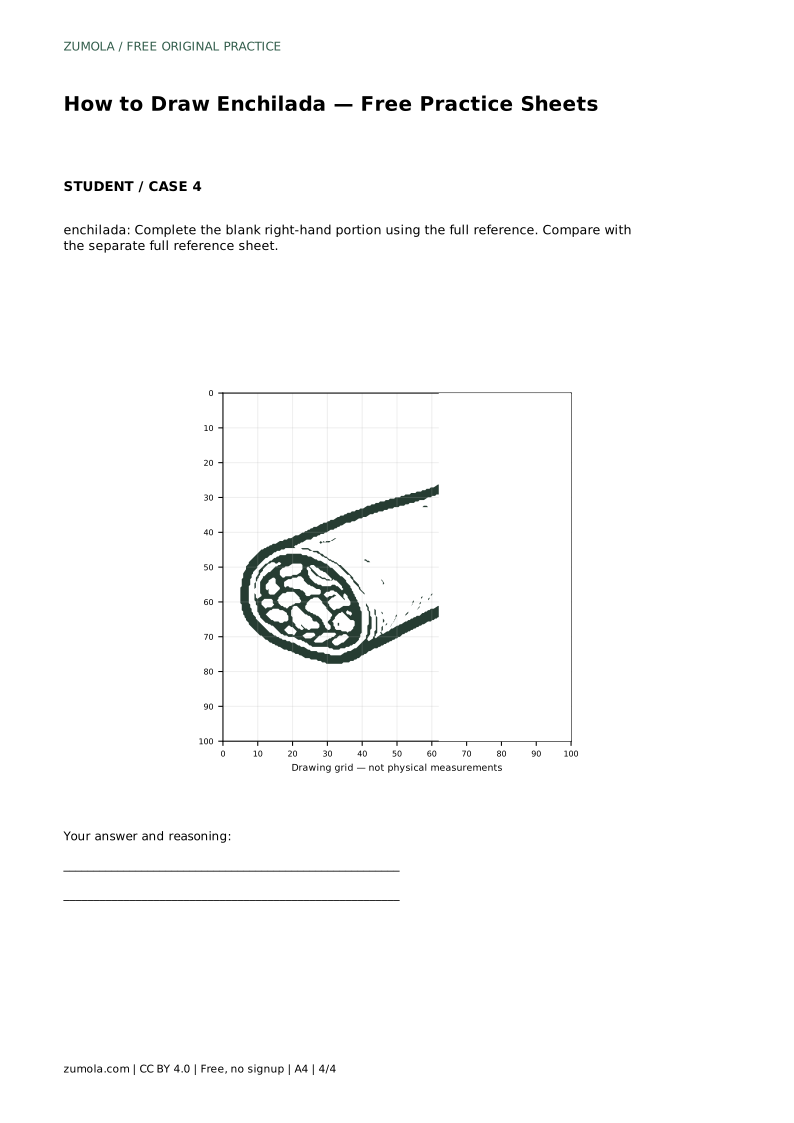
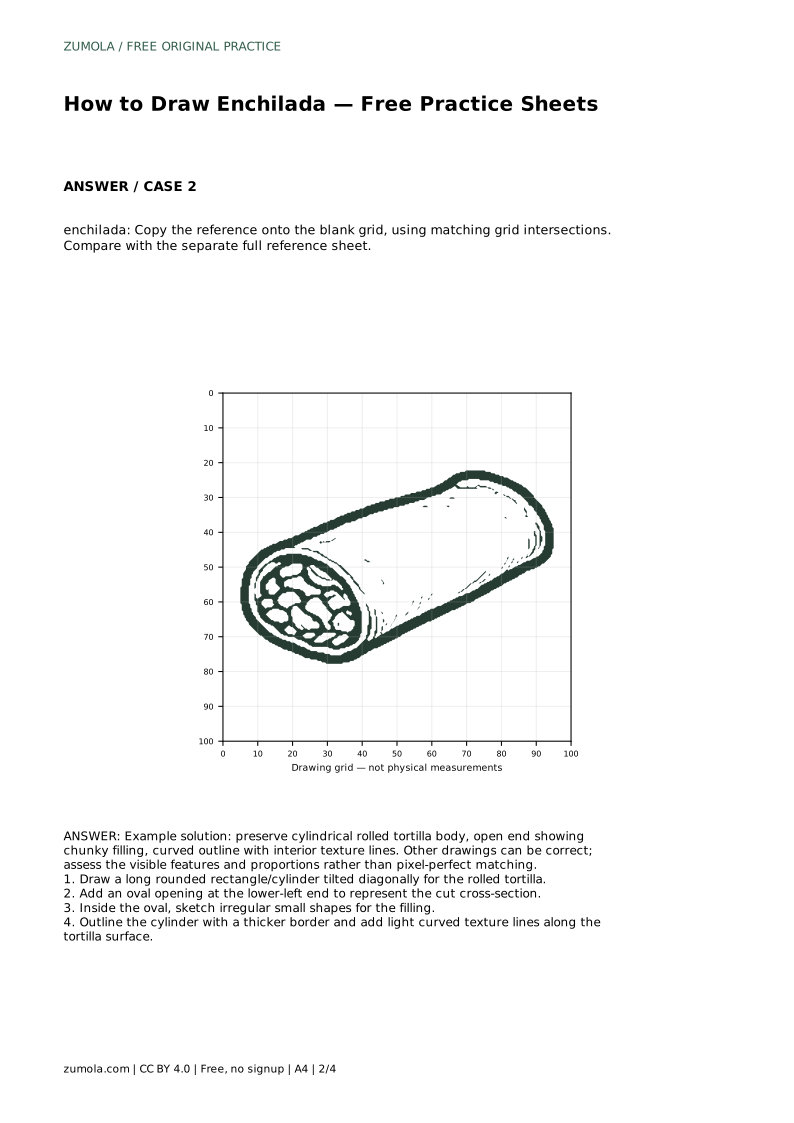
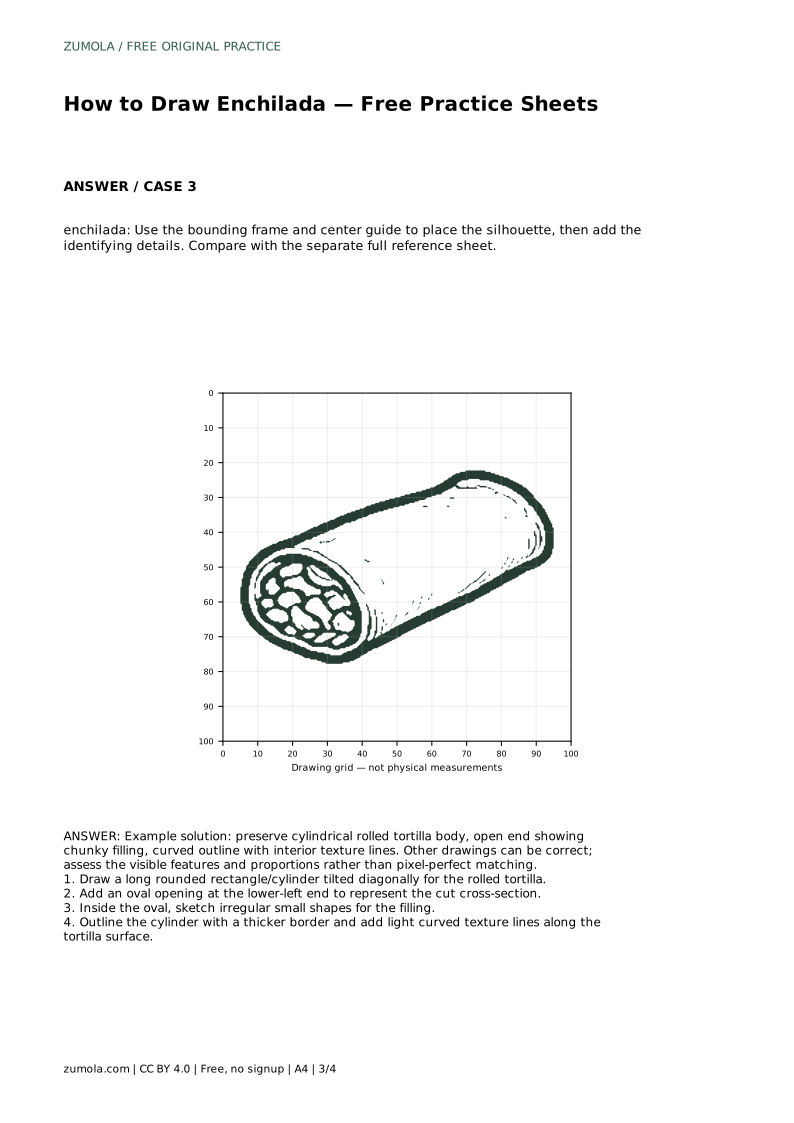
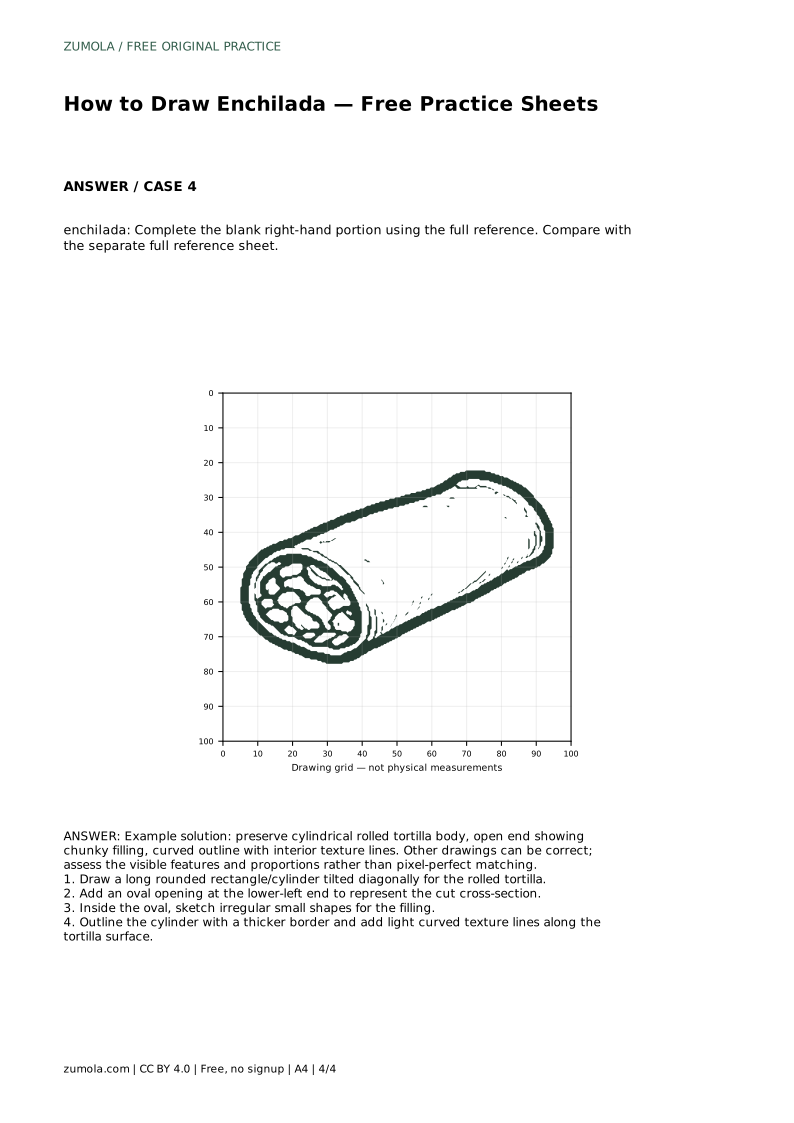
Each sheet isolates a different drawing skill. Tracing the reference outline builds familiarity with the contour before you practise it independently. Copying onto a blank grid trains you to judge position using matching grid intersections. The bounding frame and center guide help you place the silhouette before adding identifying details. The partial sheet asks you to complete the blank right-hand portion using the full reference.
Treat each format as a separate exercise. The first case, tracing, is about contour control; the grid case is about placement; the frame case is about proportion within a boundary; the partial case is about completing from reference. Do not assume one sheet's conditions carry over unchanged to another.
enchilada: Trace the reference outline, then practise the contour independently. Compare with the separate full reference sheet.
Example solution: preserve cylindrical rolled tortilla body, open end showing chunky filling, curved outline with interior texture lines. Other drawings can be correct; assess the visible features and proportions rather than pixel-perfect matching. Draw a long rounded rectangle/cylinder tilted diagonally for the rolled tortilla. Add an oval opening at the lower-left end to represent the cut cross-section. Inside the oval, sketch irregular small shapes for the filling. Outline the cylinder with a thicker border and add light curved texture lines along the tortilla surface.
No. Other drawings can be correct. Assess the visible features and proportions, such as the rolled body, open end, and interior texture, rather than pixel-perfect matching.
In the described example it sits at the lower-left end of the tilted cylinder. Keep the oval inside the rounded end so it reads as a cut cross-section.
Only a few light curved lines. Enough to suggest the tortilla surface without flattening the cylinder.
All drawing practice · Free coordinate paper
Original resources · CC BY 4.0 · Free for personal and classroom use with attribution.