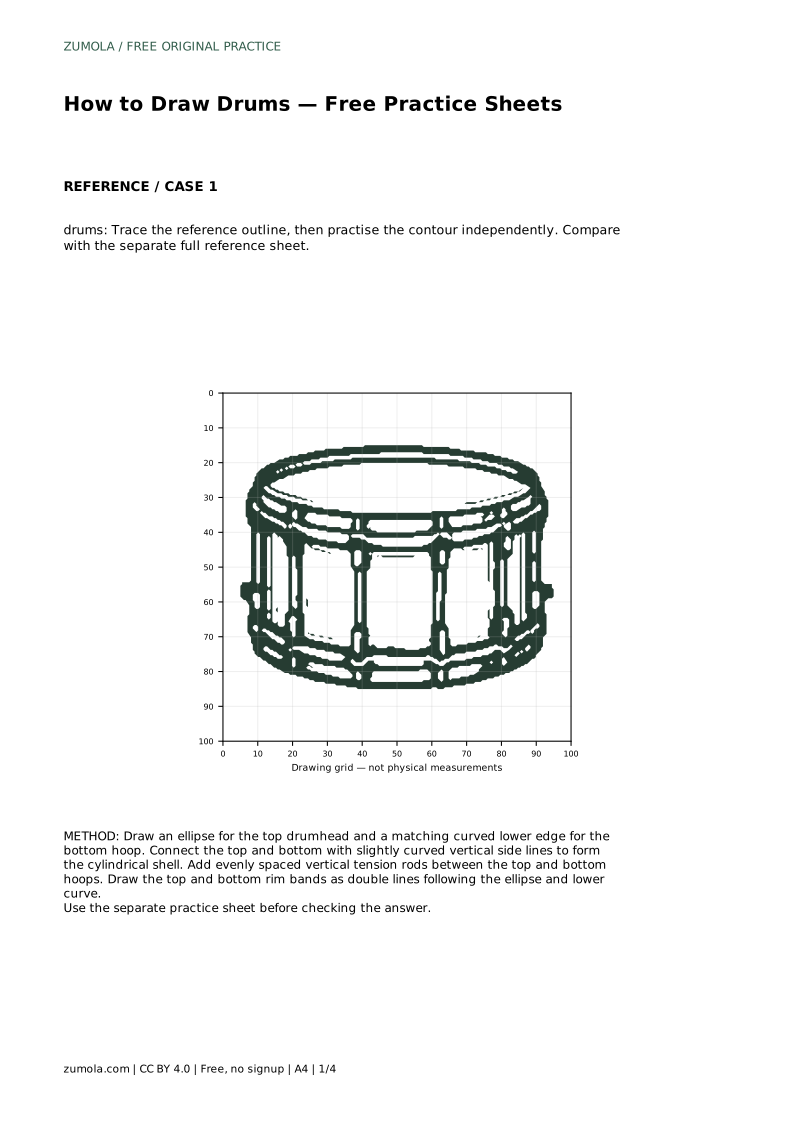
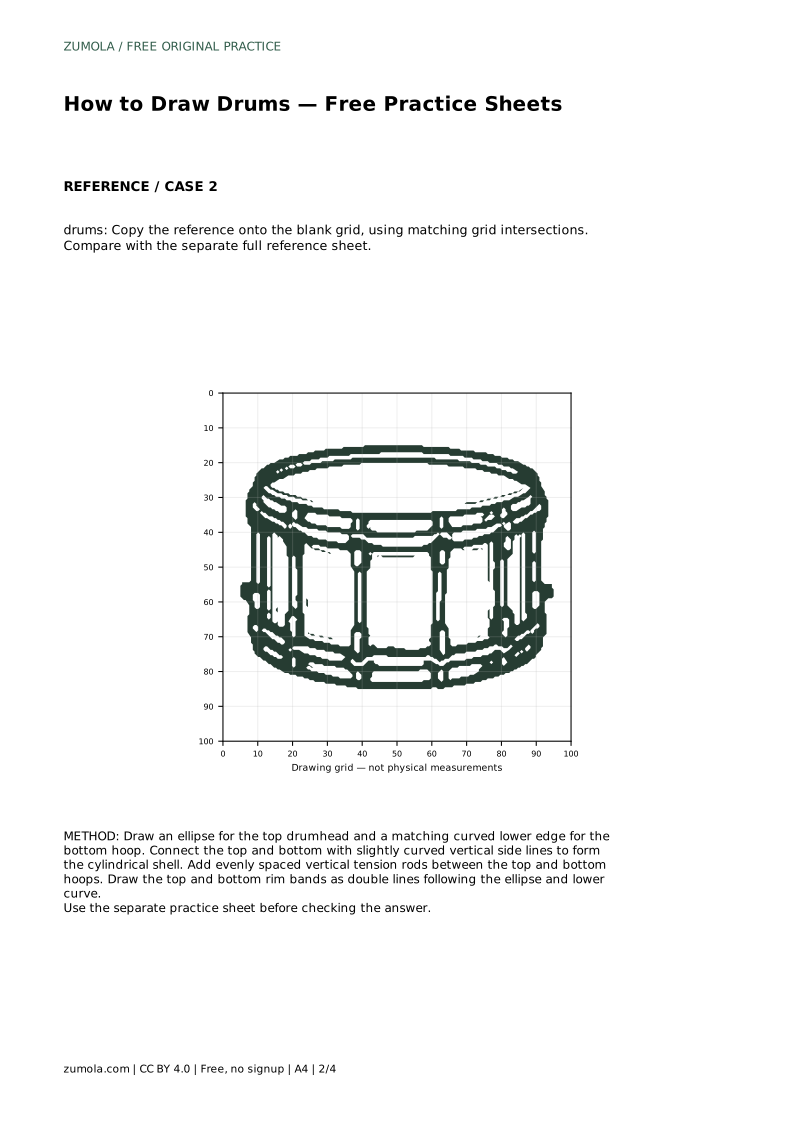
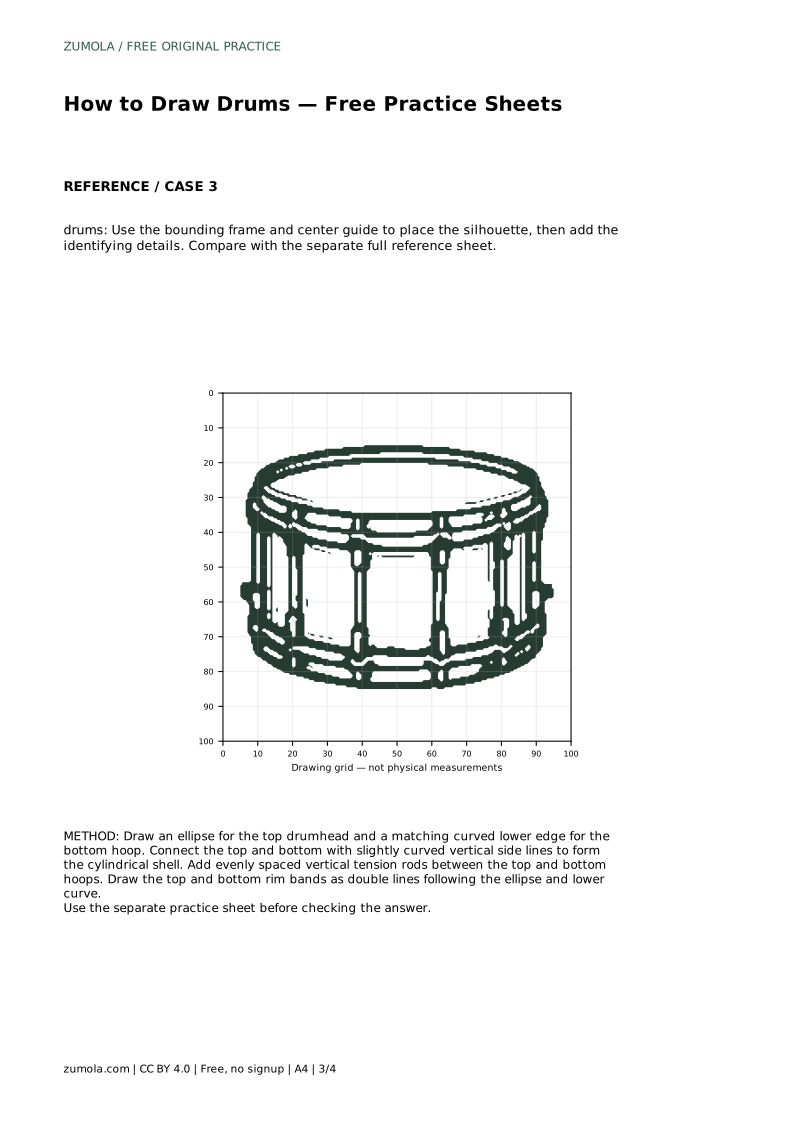
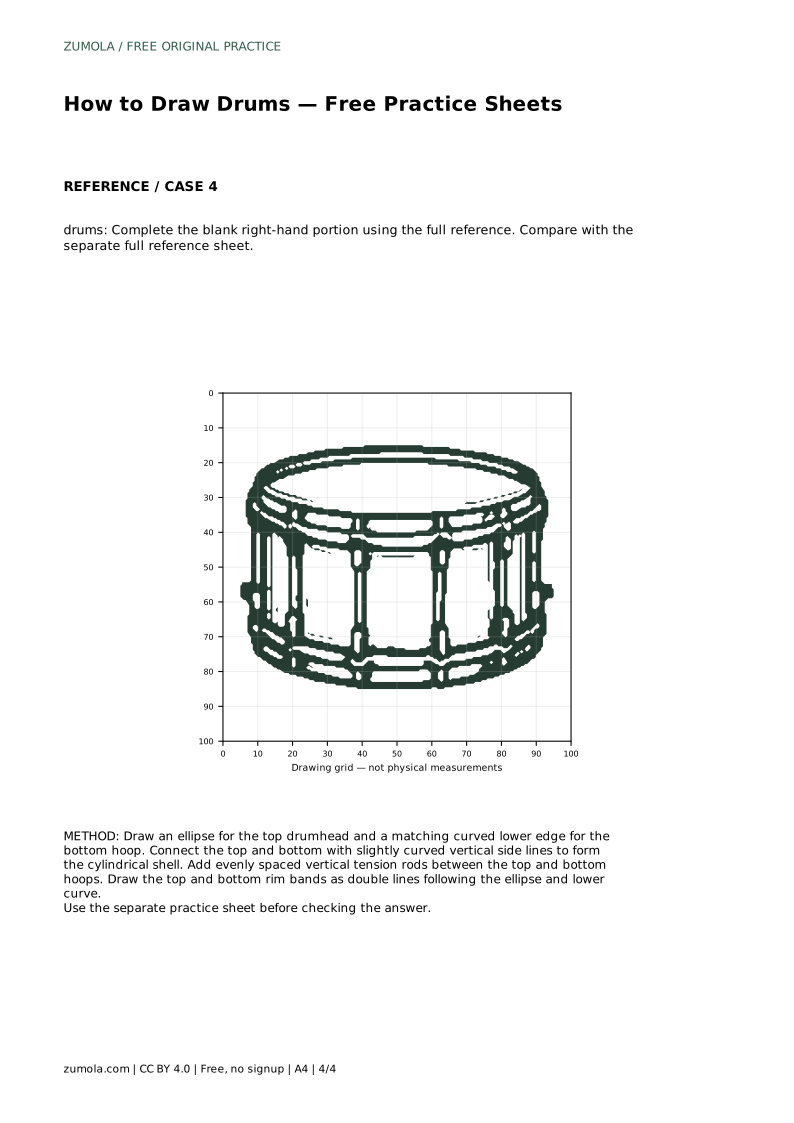
Reference diagrams
LETTER · Download PDF
A4 · Download PDF
Free original resources
Learn to draw a drum by building a cylindrical shell, elliptical drumhead, curved hoops and evenly spaced tension rods, with free practice sheets.
Four original cases, with reference diagrams, practice sheets and worked answers. Everything is free; no signup required.
LETTER · Download PDF
A4 · Download PDF
LETTER · Download PDF
A4 · Download PDF
LETTER · Download PDF
A4 · Download PDF
Use A4 or US Letter to match your printer. Use the stated values and conditions to solve each exercise; diagrams are not physical measuring rulers.
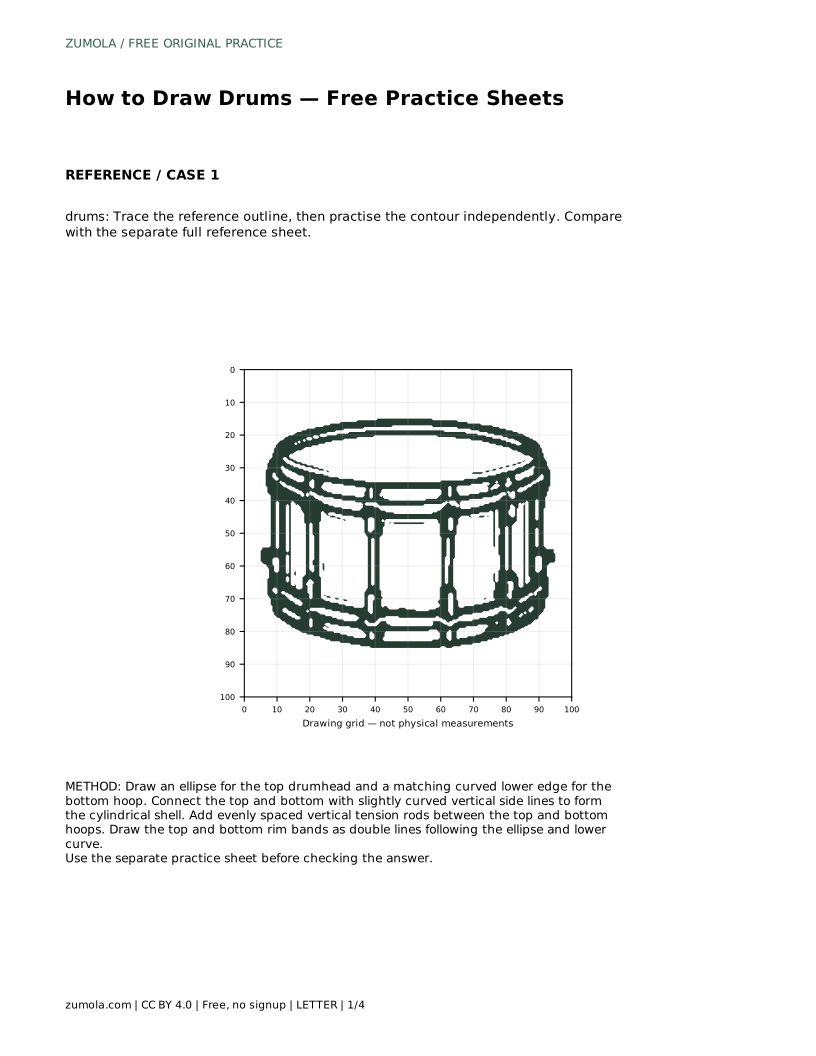
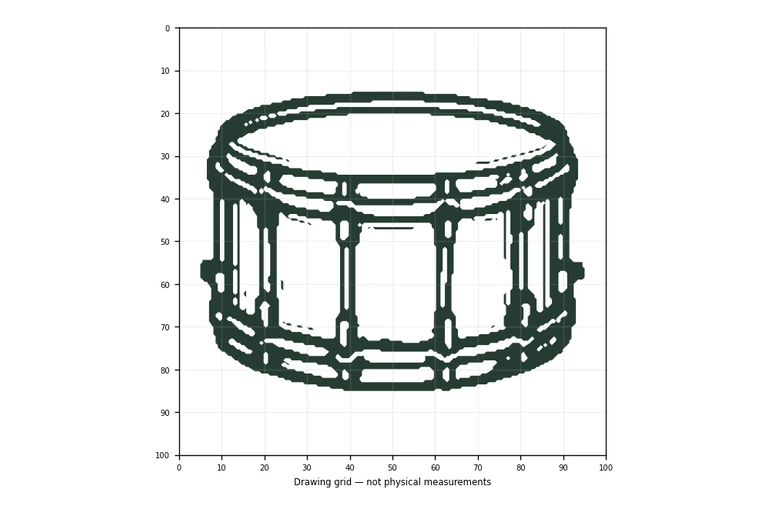
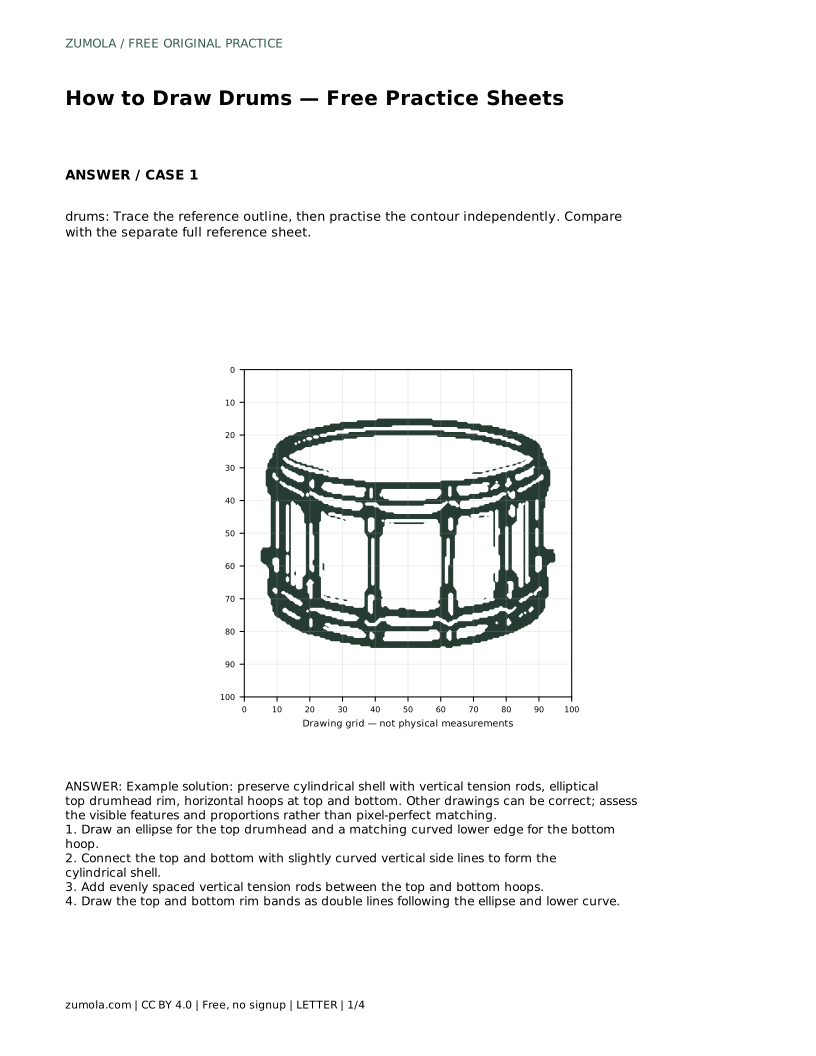
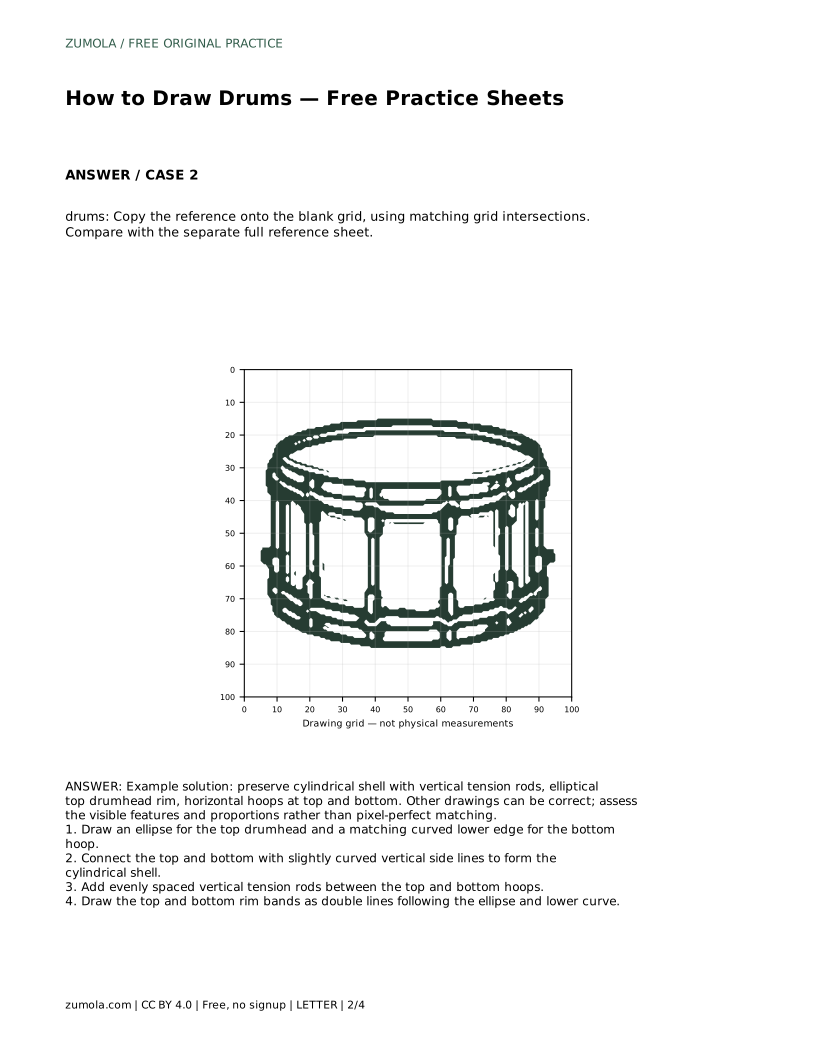
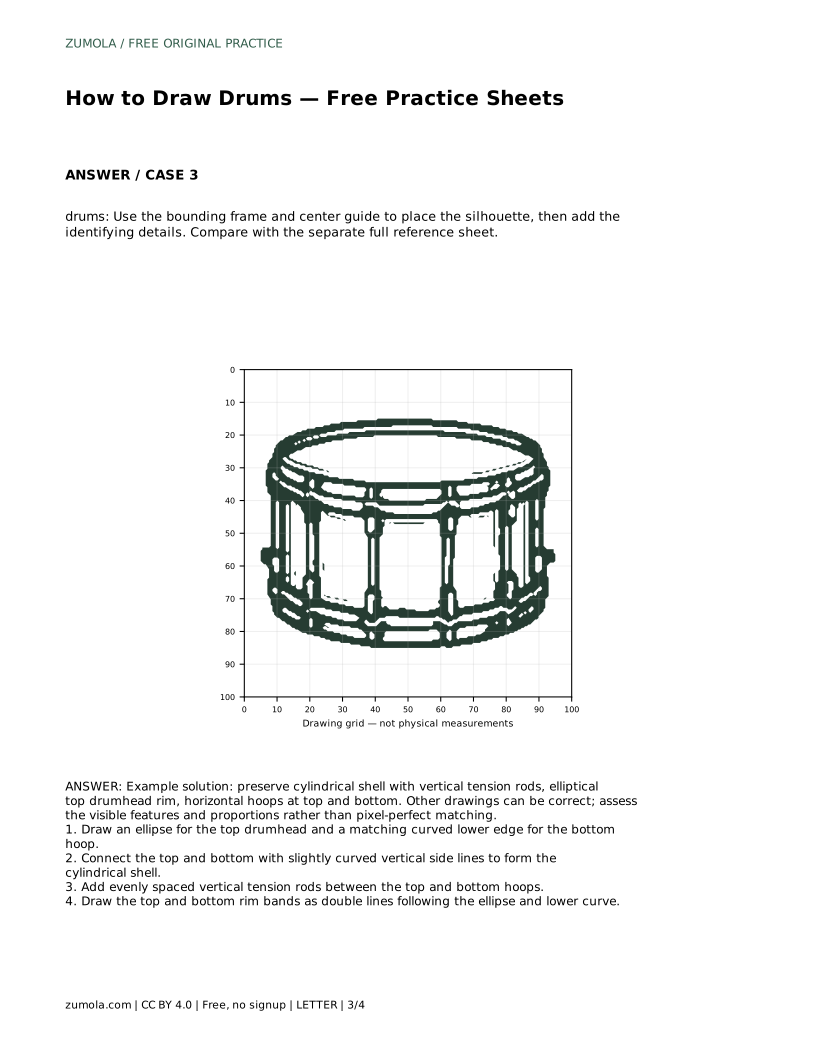
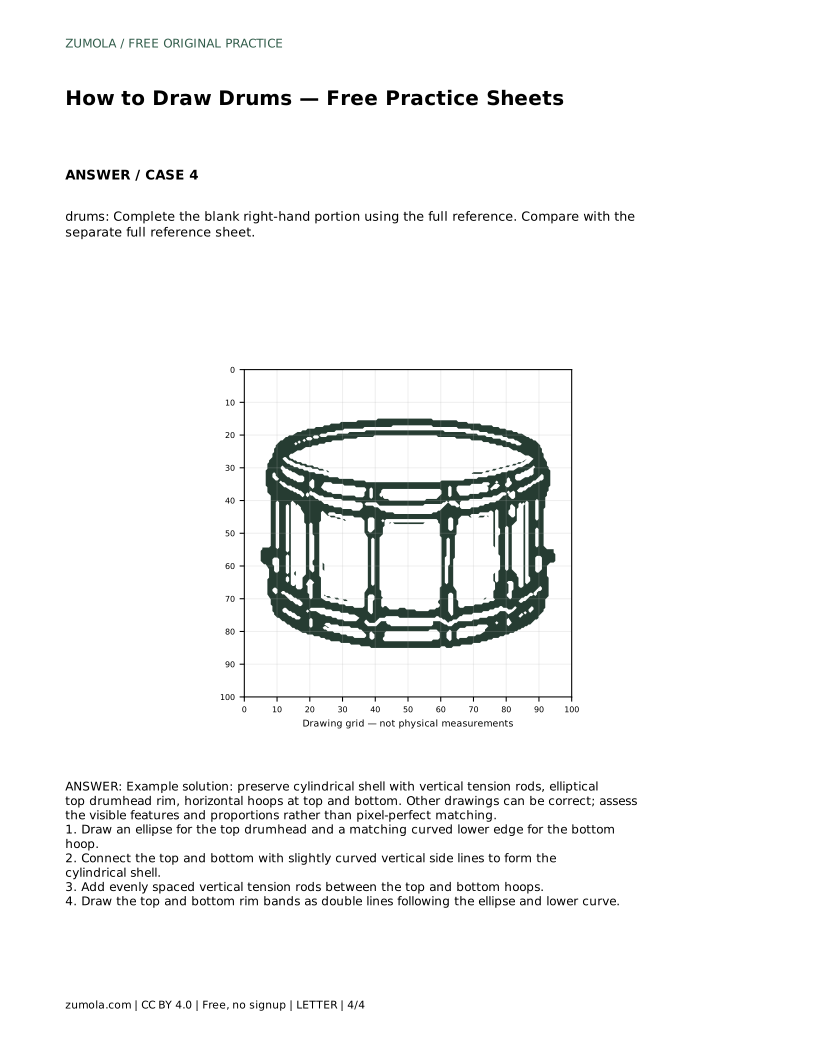
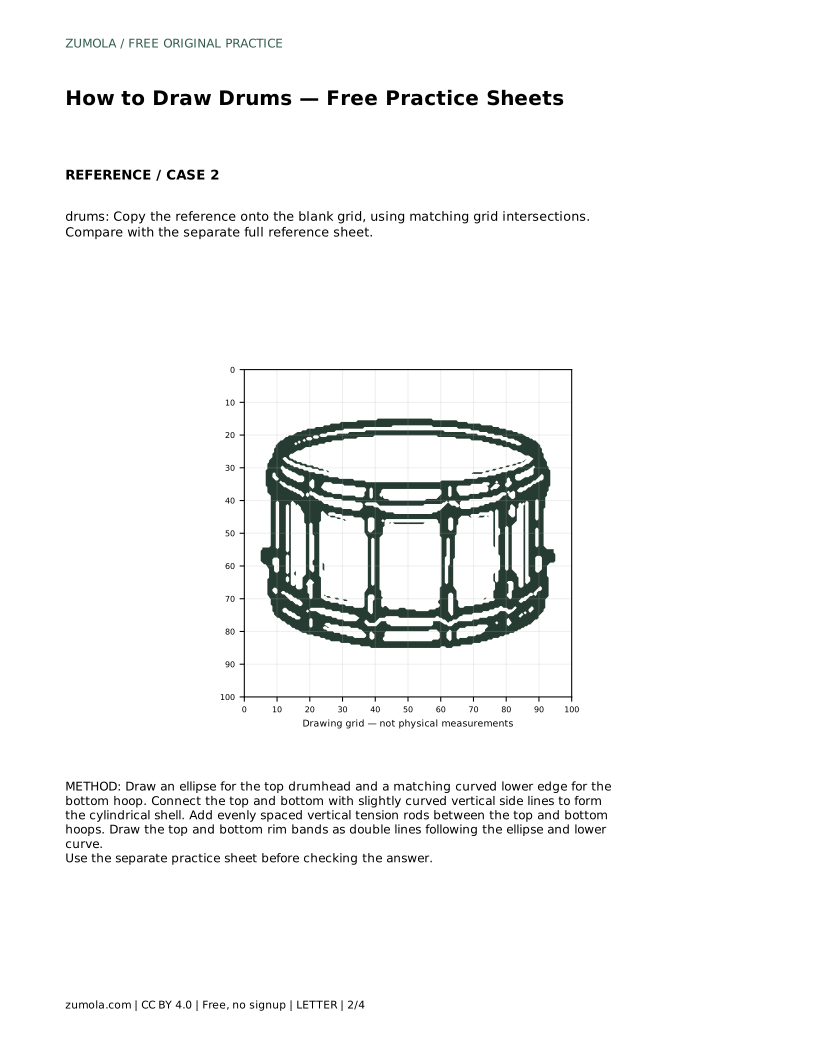
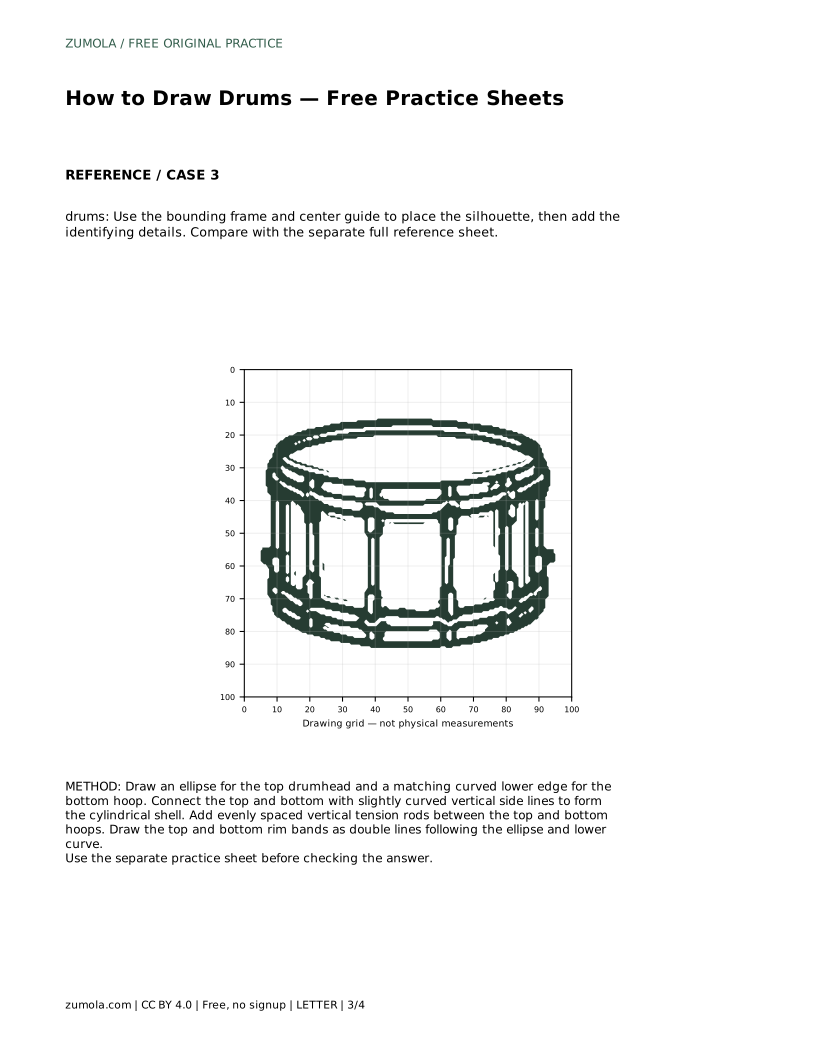
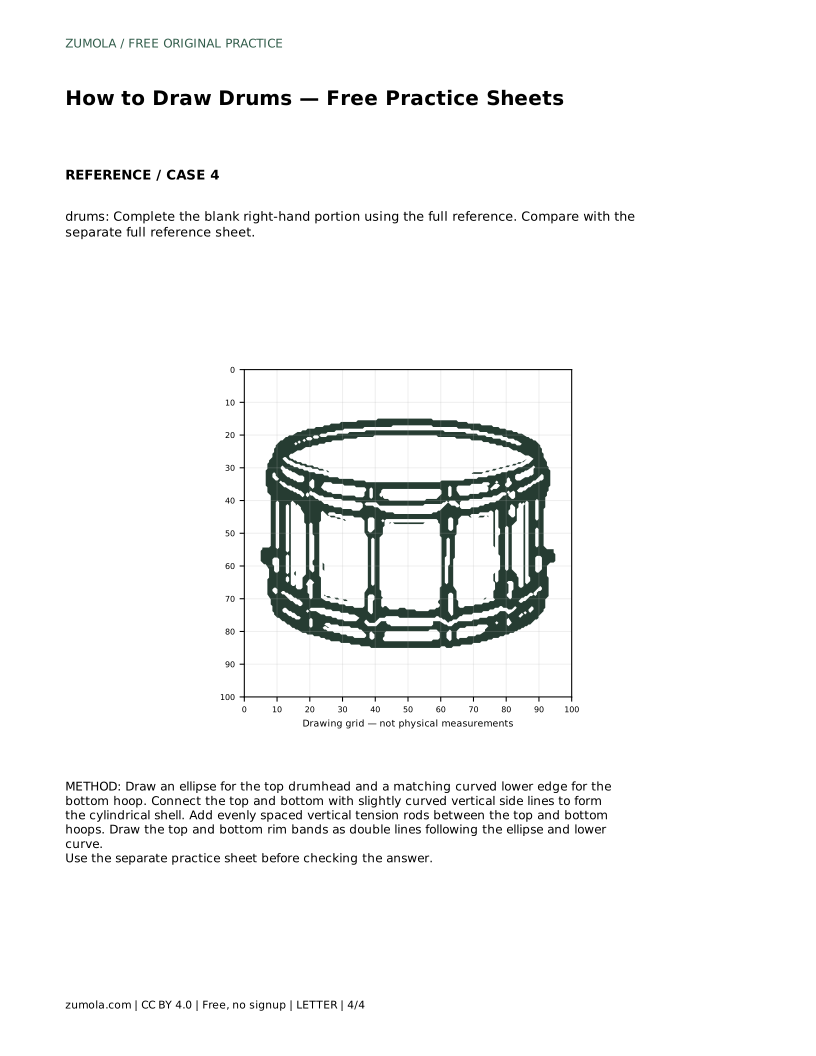
A drum looks simple until the parts stop lining up. The shell is a cylinder seen at an angle, so its top is an ellipse and its bottom edge curves the same way. Hoops wrap those edges, and tension rods run vertically between them. This guide teaches that structure step by step, then shows how to use tracing, grid, frame and partial-completion practice sheets to build the same drawing independently.
Begin by deciding how much of the top you can see. A drum viewed from slightly above shows an open ellipse for the drumhead; viewed almost level, that ellipse becomes very flat. Draw the top ellipse first, then a matching curved lower edge for the bottom hoop. The two curves should share the same width and the same amount of curvature, because they describe the same circular shape at different heights.
Connect the top and bottom with slightly curved vertical side lines. Straight lines make the shell look like a box; a gentle outward bow suggests the round body. Keep the left and right sides roughly symmetrical unless the reference clearly shows a turned or tilted drum.
Hoops are bands, not single lines. Draw each rim as a double line that follows the ellipse above and the lower curve below, keeping a consistent gap between the two lines. This gap is what makes the hoop read as a metal band rather than a drawn outline.
Tension rods sit between the hoops and should be spaced evenly around the visible front of the shell. Their spacing follows the curve of the drum: rods near the center appear farther apart, while rods near the left and right edges crowd together slightly. Keep each rod vertical and stop it at the hoop bands rather than letting it run past them.
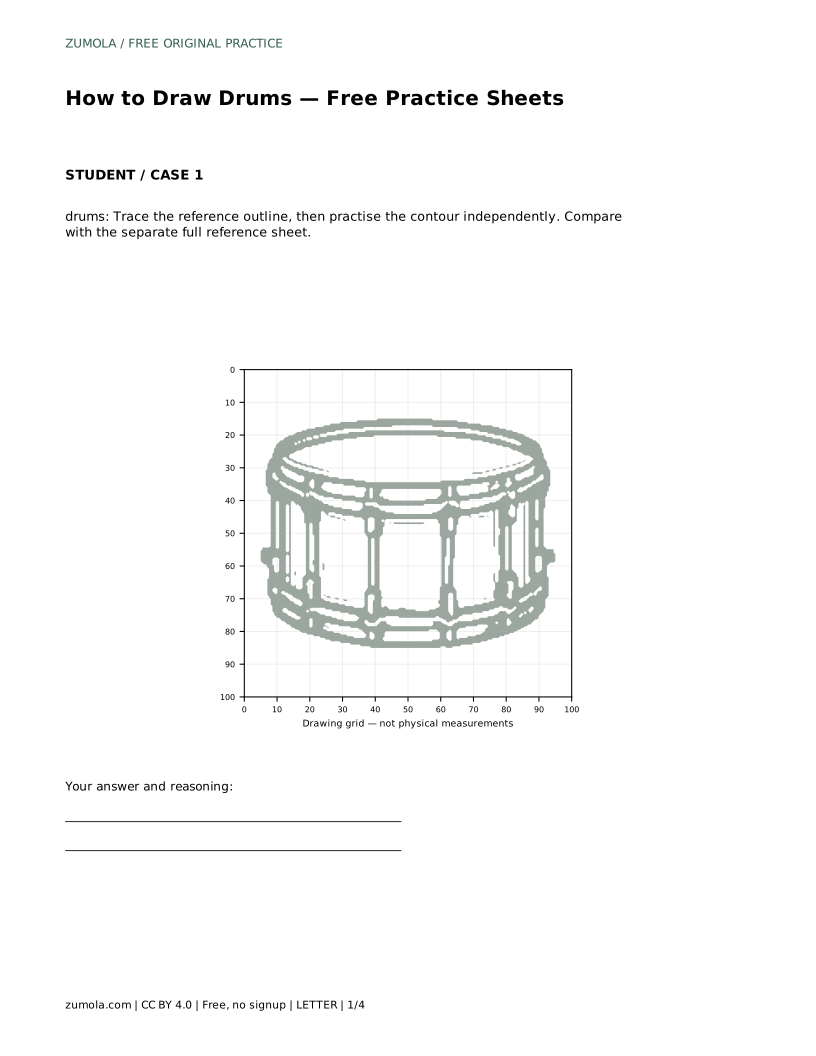
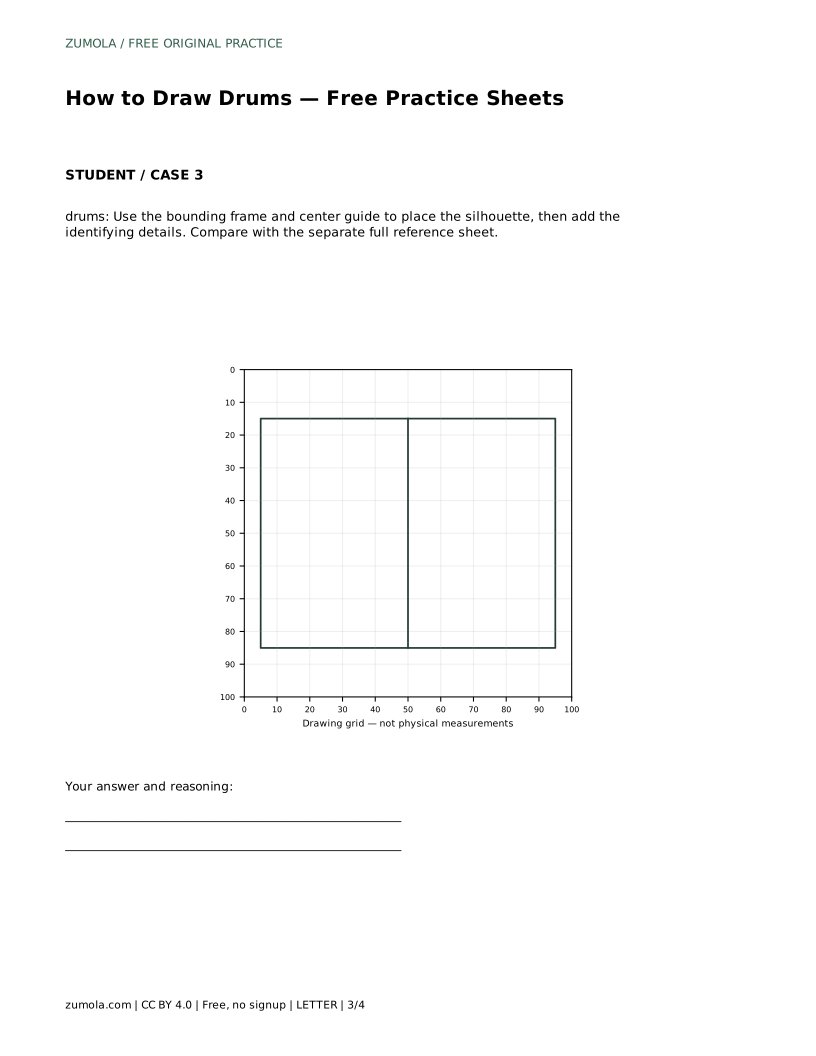
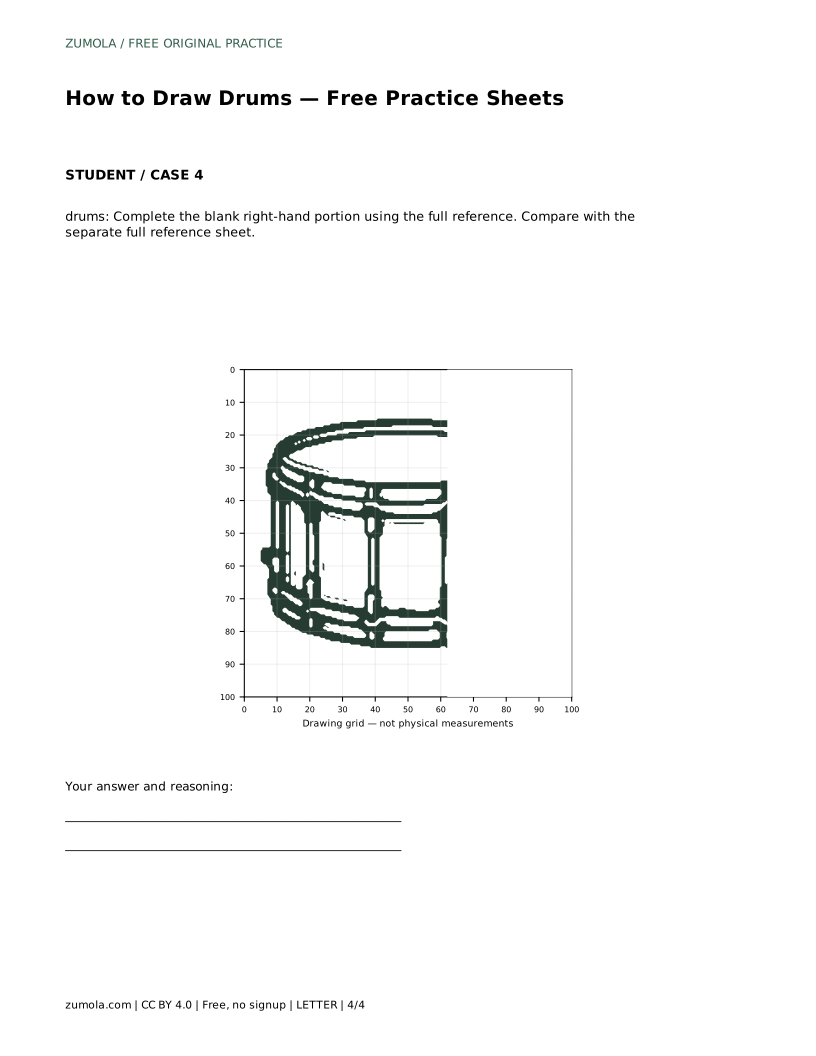
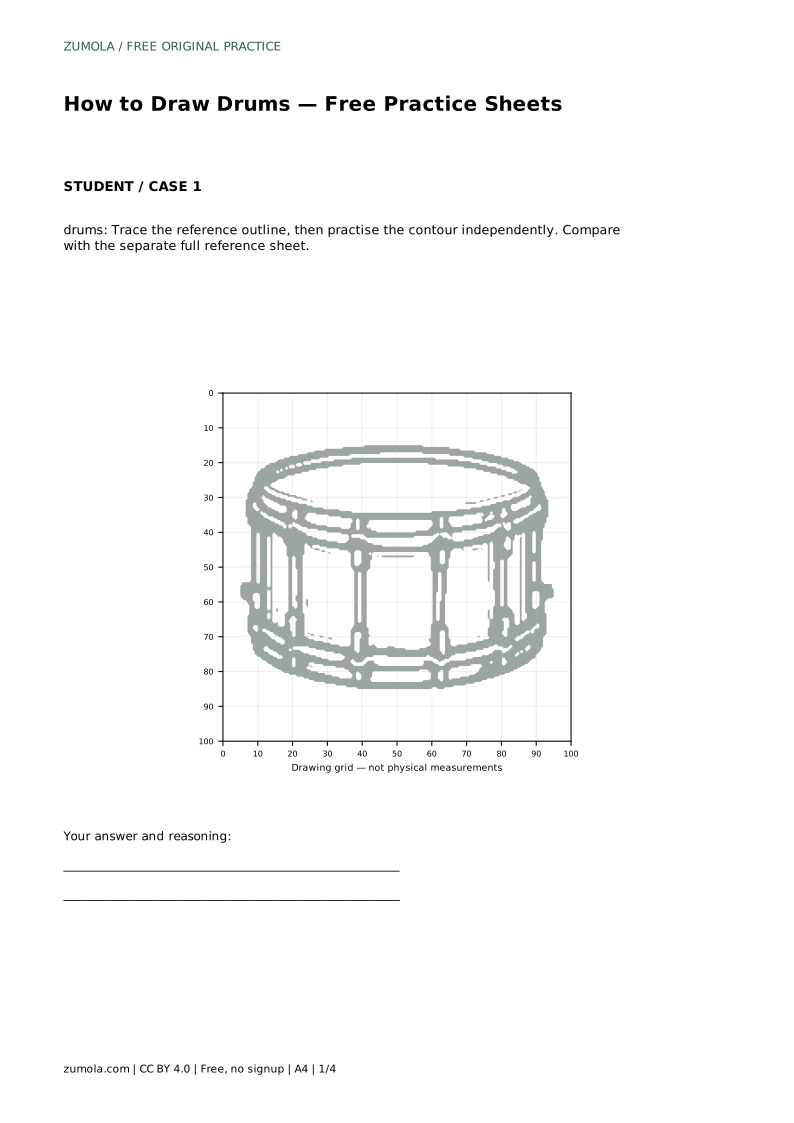
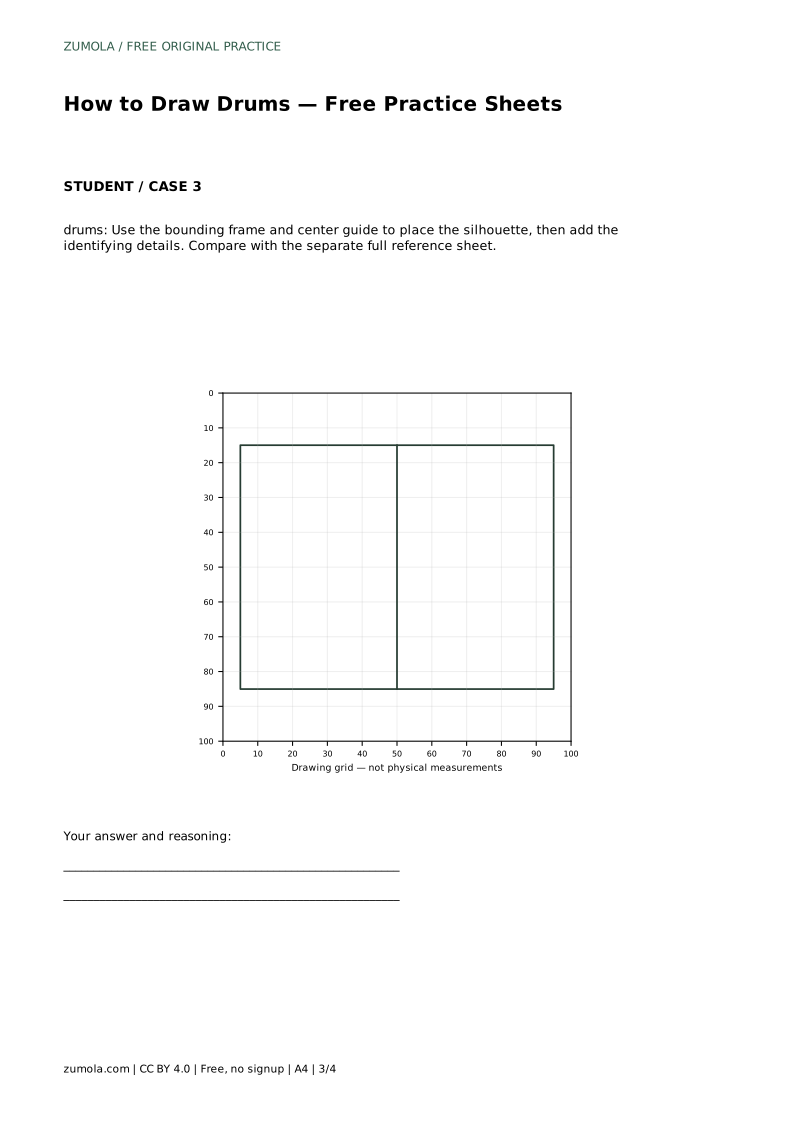
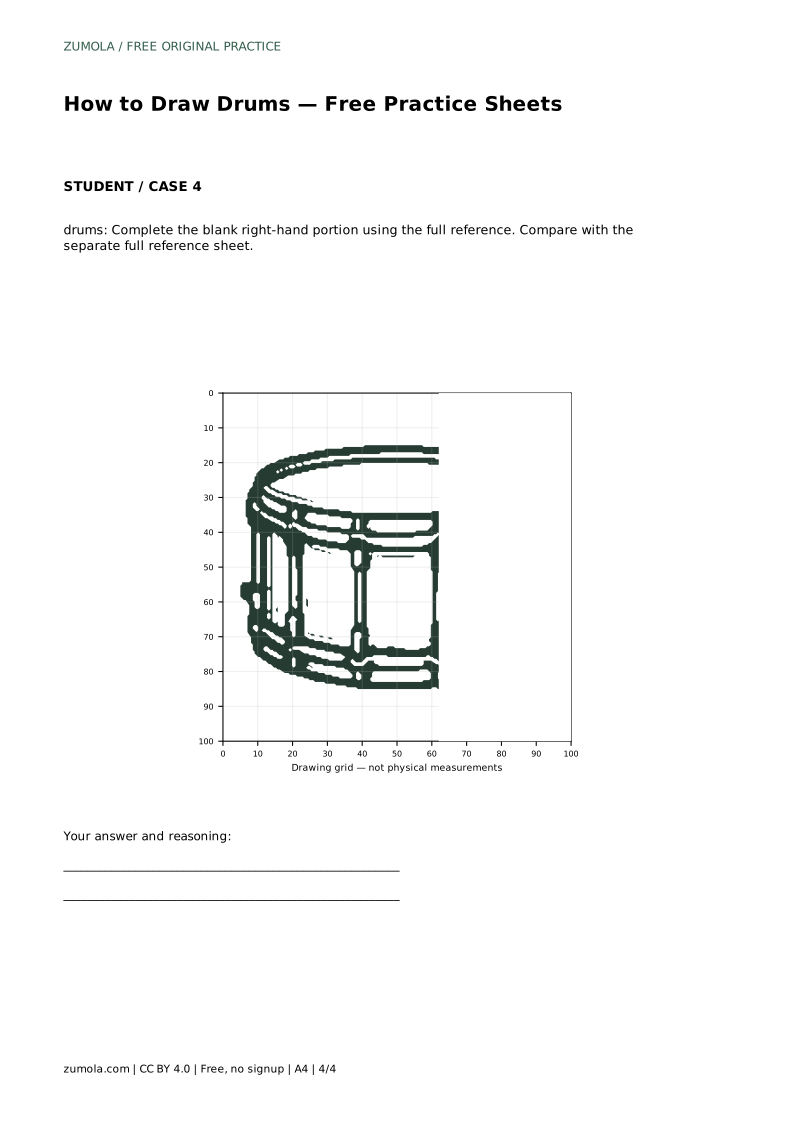
The tracing sheet asks you to follow the reference outline first, then repeat the contour on your own and compare with the separate full reference. The grid sheet asks you to copy the drawing onto a blank grid, matching where lines cross grid intersections. The frame sheet gives a bounding frame and center guide so you can place the silhouette before adding details. The partial sheet leaves the right-hand portion blank for you to complete from the full reference.
Each format trains a different skill: tracing builds the shape, the grid builds proportion, the frame builds placement, and the partial sheet builds recall. Use the format that matches the part you find hardest.
Drum drawings have many valid outcomes, so compare features rather than expecting an exact match. Ask whether the shell reads as cylindrical, whether the top ellipse and bottom curve agree, whether hoops appear as bands, and whether rods are evenly spaced and vertical. A drawing with slightly different proportions can still be correct if those visible features hold together.
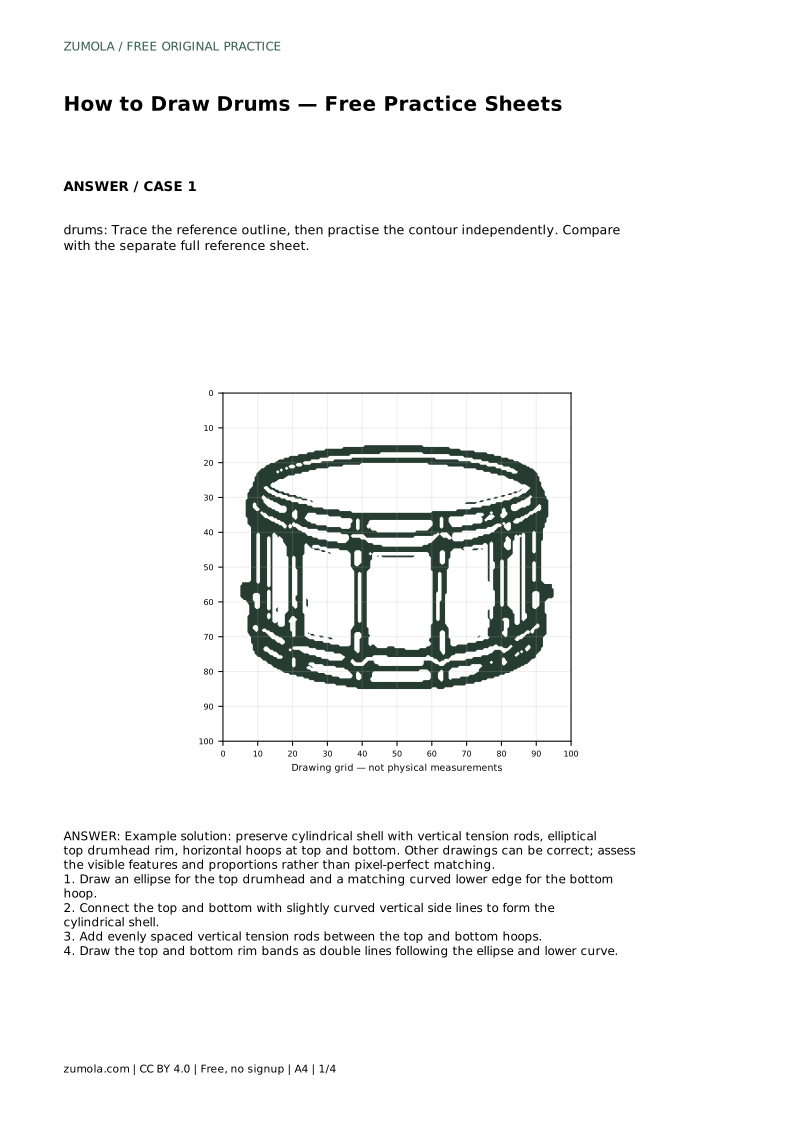
drums: Trace the reference outline, then practise the contour independently. Compare with the separate full reference sheet.
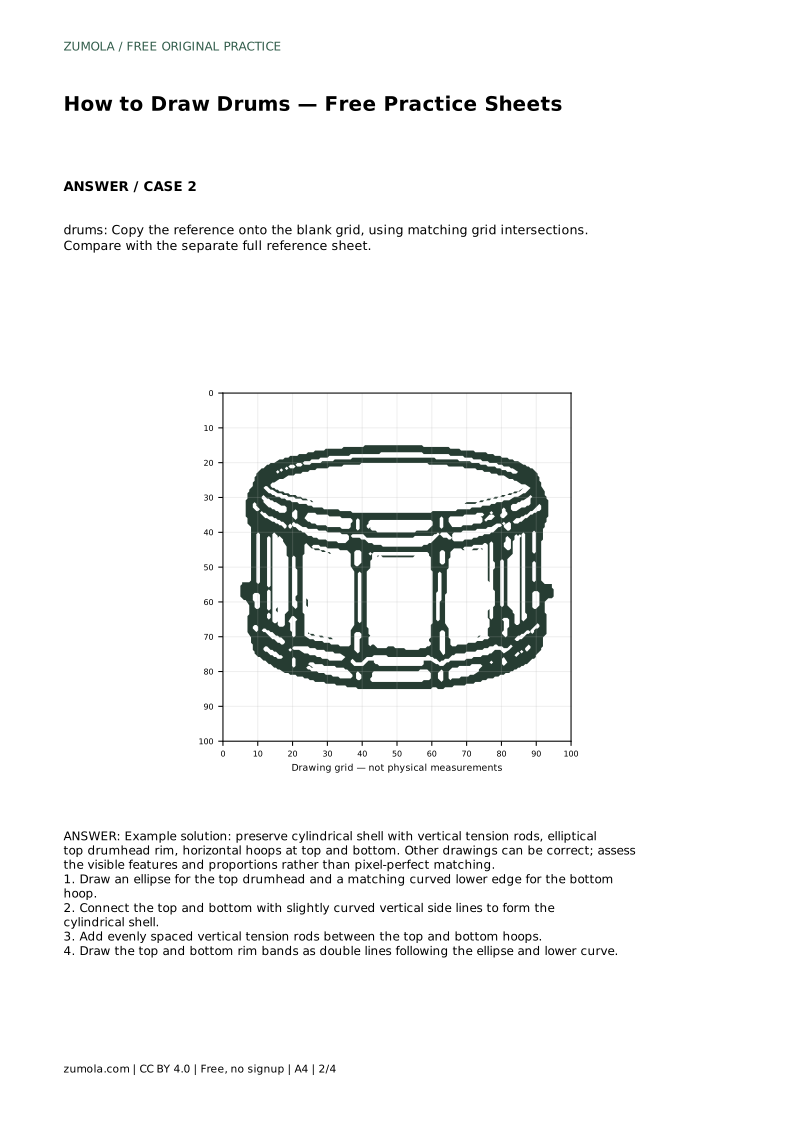
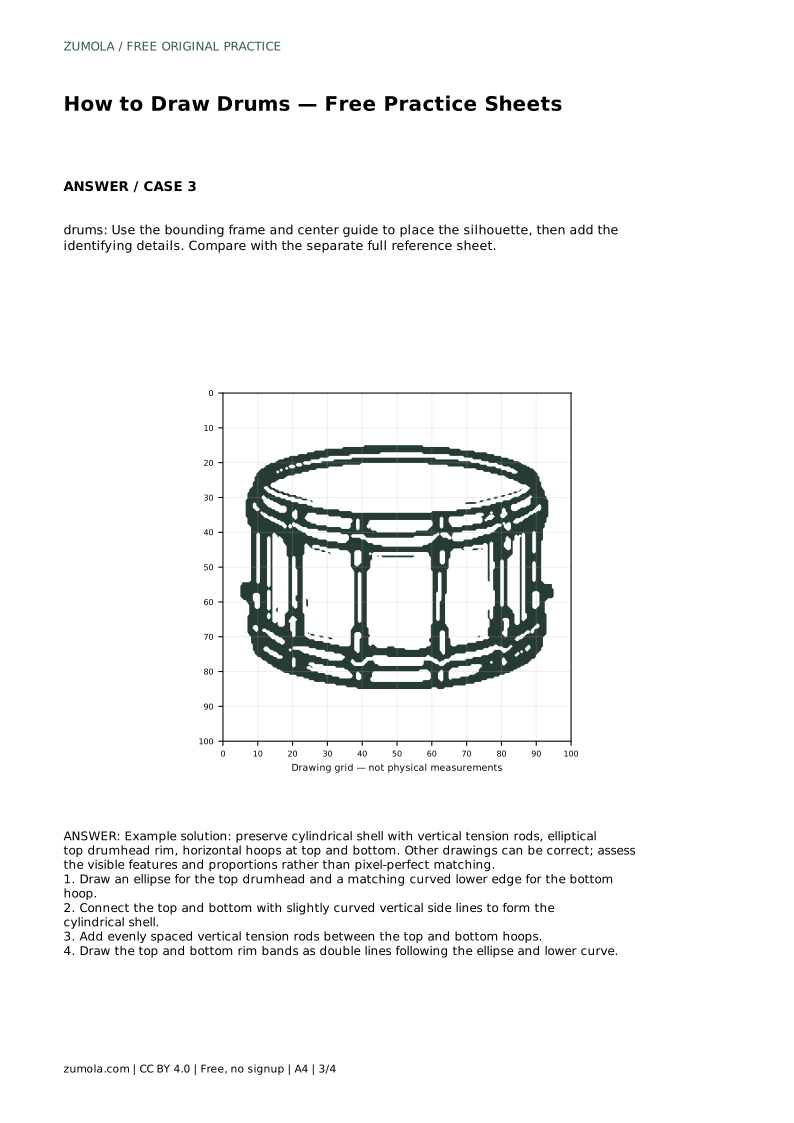
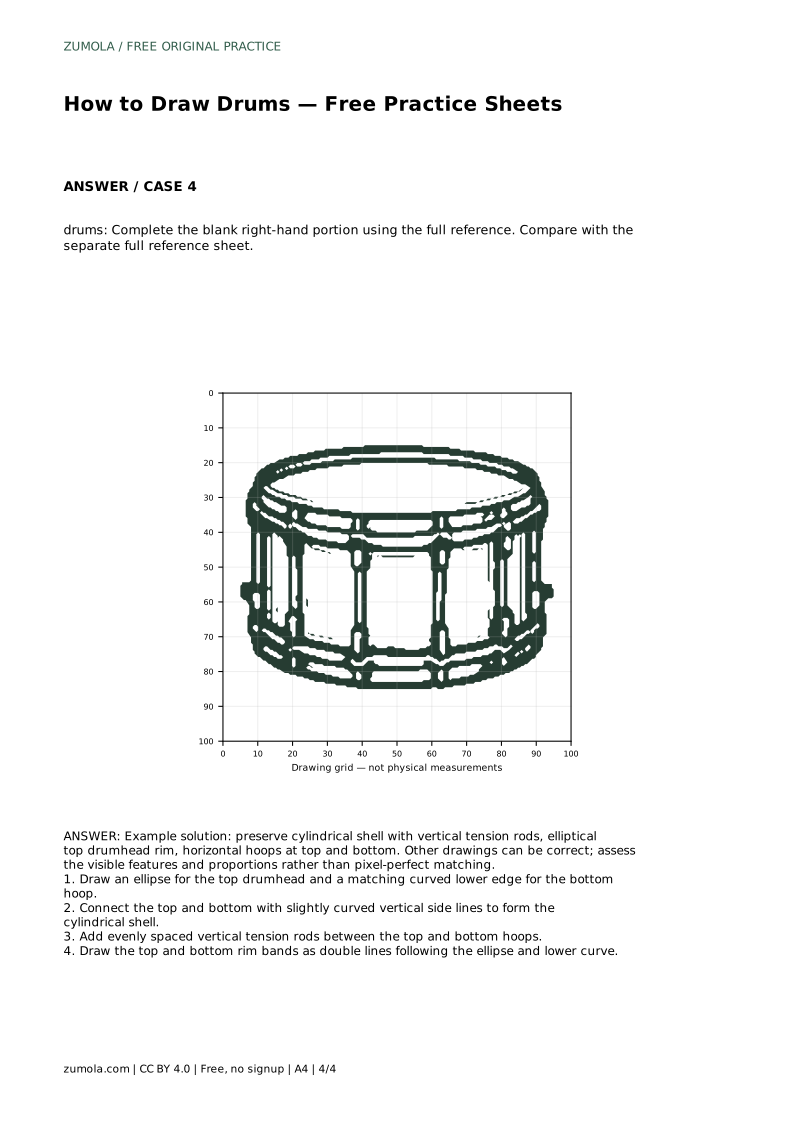
Example solution: preserve cylindrical shell with vertical tension rods, elliptical top drumhead rim, horizontal hoops at top and bottom. Other drawings can be correct; assess the visible features and proportions rather than pixel-perfect matching. Draw an ellipse for the top drumhead and a matching curved lower edge for the bottom hoop. Connect the top and bottom with slightly curved vertical side lines to form the cylindrical shell. Add evenly spaced vertical tension rods between the top and bottom hoops. Draw the top and bottom rim bands as double lines following the ellipse and lower curve.
Draw it closed as a complete ellipse, then add the hoop band just inside it. An open ellipse only suits a drum shown with the head removed.
Use the reference as your guide. Keep the count consistent and the spacing even, with slightly tighter gaps near the left and right edges.
Yes. From a near-level view the top ellipse becomes very flat, but the shell, hoops and vertical rods still follow the same structure.
All drawing practice · Free coordinate paper
Original resources · CC BY 4.0 · Free for personal and classroom use with attribution.