Free original resources
Oblique Projection Exercises: Comparing Cavalier and Cabinet Depth
Compare cavalier and cabinet oblique projection by drawing the same block twice, measuring how depth is shortened, and checking front, top, and side views agree.
Free resources
Letter & A4
PDF & SVG
Letter & A4
PDF & SVG
Make it yours.
Free · no signup · calculated in your browser
Your free printable kit.
Original reference, student practice and separate worked answers. No account or payment.
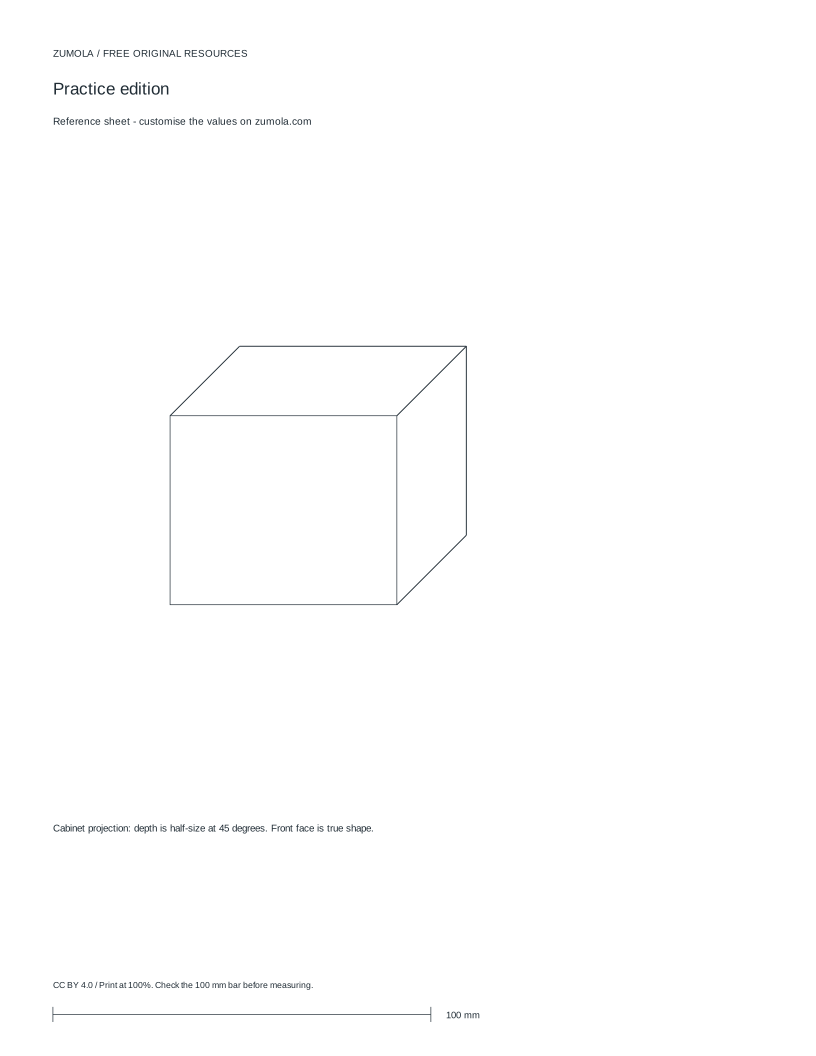
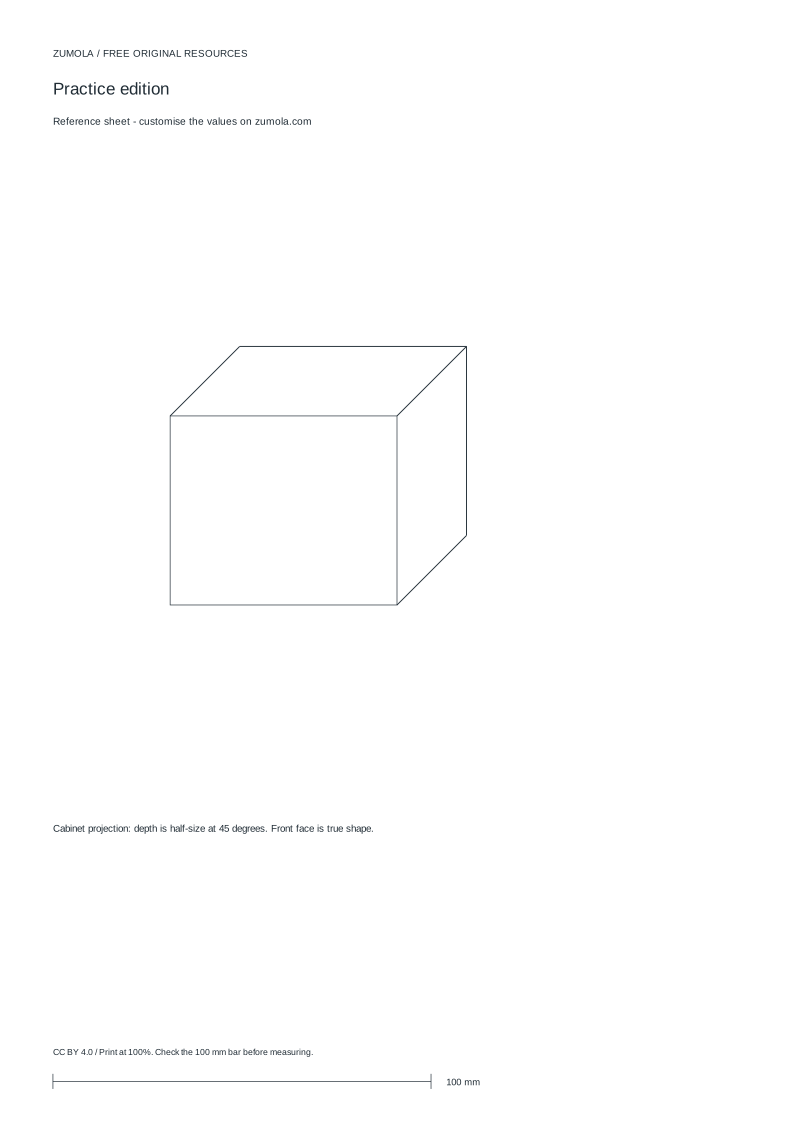
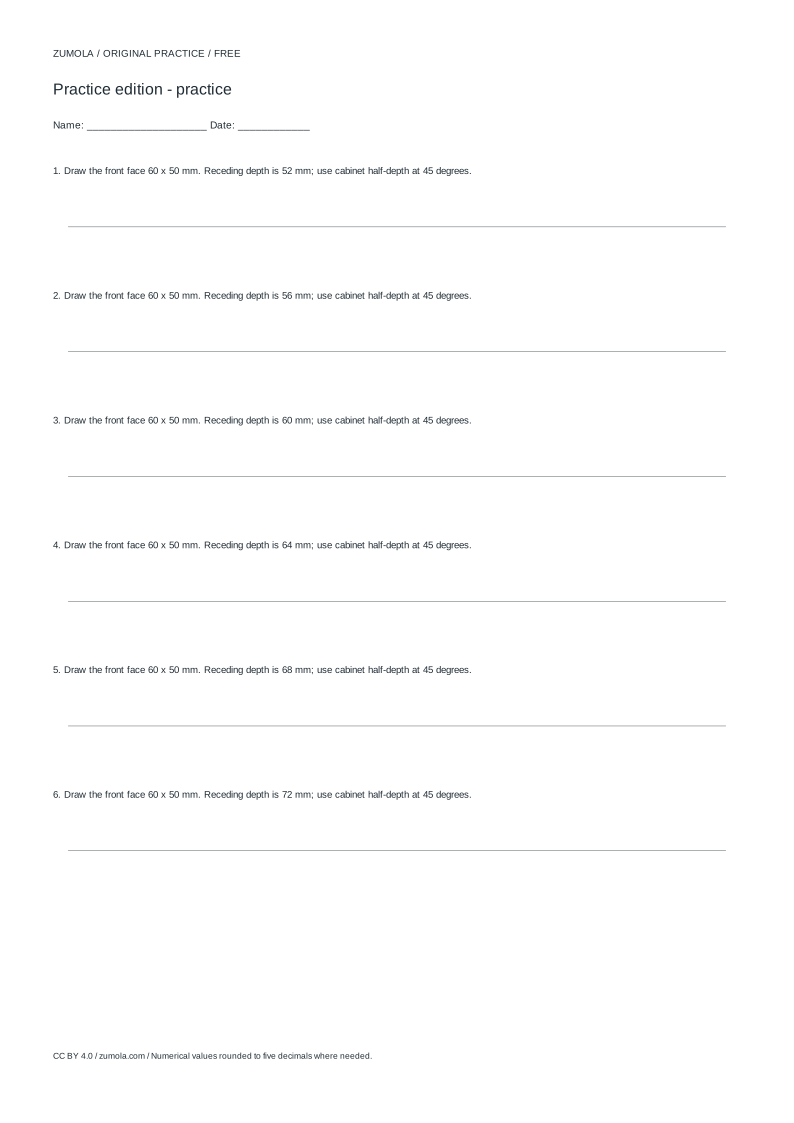
Practice worksheet
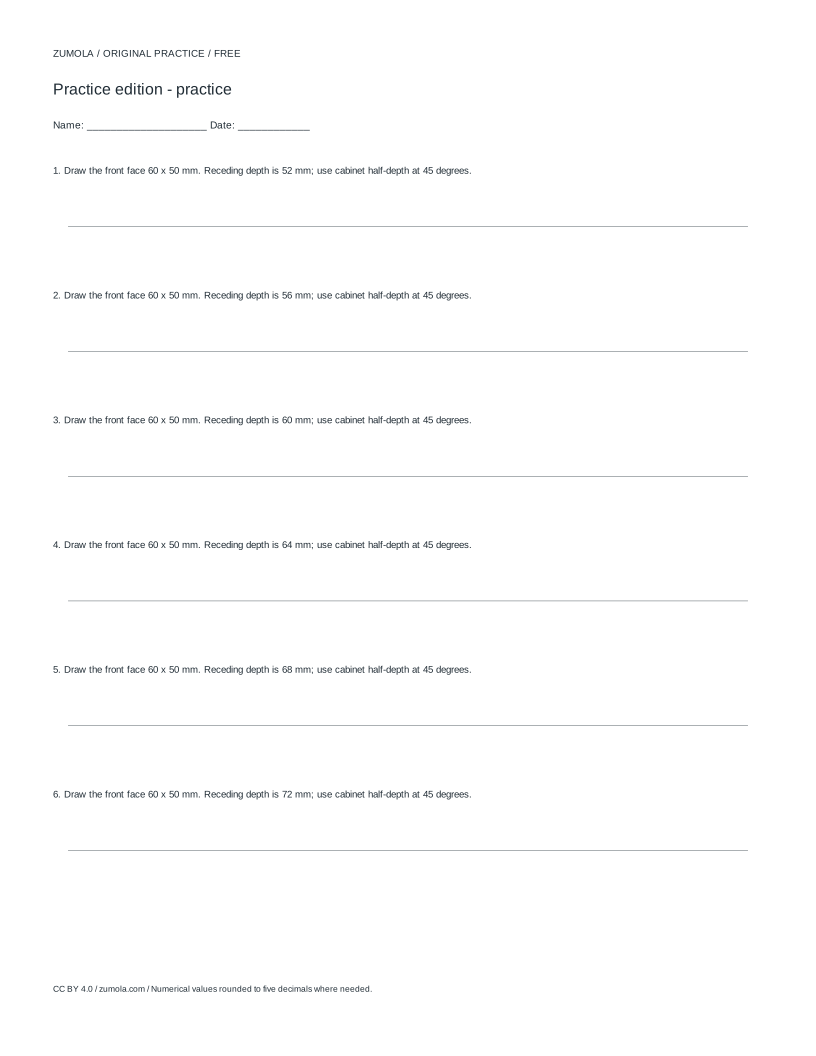
Worked answers / rubric
Print at Actual size / 100%. Check the calibration bar before using physical dimensions.
Oblique projection keeps one face of an object true to shape and sends depth backward at an angle. The two common teaching forms differ mainly in how much depth is drawn: cavalier keeps full depth, while cabinet halves it. This worksheet asks you to draw one simple block both ways, label the viewing direction and units, and compare the results. The aim is to see how a single depth choice changes the drawing without changing the object.
Set the viewing direction and units first
Choose which face is the true front view and state it in words, for example front view faces the reader, depth runs away to the upper right. Fix a unit before drawing, such as millimetres, and write it on the sheet. Every measurement on the page should use that unit.
Oblique projection is not a perspective drawing. Parallel edges stay parallel, and depth lines share one angle, commonly 45 degrees. The front face is drawn at true size in both cavalier and cabinet forms. Only the depth lines change length between the two.
- Write the viewing direction and the unit at the top of the sheet.
- Draw the front face at true size using the stated unit.
- Mark the depth angle, for example 45 degrees from horizontal.
- Draw depth lines at full length for cavalier and at half length for cabinet.
Draw the same block in cavalier and cabinet
Use one block for both drawings so the comparison is fair. A front face 60 by 50 units with an actual depth of 52 units is a clean example. In cavalier, draw the depth lines 52 units long. In cabinet, draw them 26 units long, which is half the actual depth.
Keep the front face identical in both drawings. The top and side faces will look different because the receding edges are shorter in cabinet. Check that each receding edge is parallel to the others and that hidden edges, if shown, follow the same angle and shortening rule.
- Draw the 60 by 50 front face once for cavalier and once for cabinet.
- For cavalier, extend each depth corner 52 units at 45 degrees.
- For cabinet, extend each depth corner 26 units at 45 degrees.
- Connect the receding endpoints to complete the top and side faces.
- Label each drawing with its projection type and the depth scale used.
Check front, top, and side views agree
The three views must describe the same object. The front view shows the 60 by 50 face. The top view shows 60 by 52 in reality, but in the oblique drawing the drawn depth is shortened, so measure the drawn depth rather than assuming it equals actual depth. The side view shows 50 by 52 in reality, again with drawn depth shortened.
Record both actual depth and drawn depth beside each drawing. This keeps the geometry honest and prevents the common error of treating a shortened edge as the true dimension. The exercise is a teaching comparison, not a manufacturing or construction specification.
- List actual dimensions: front 60 by 50, depth 52.
- Note drawn depth: 52 for cavalier, 26 for cabinet.
- Compare the top and side faces in both drawings against those numbers.
- Write one sentence explaining why the cabinet drawing looks shallower.
Compare the two results
Cavalier keeps depth at full scale, so the drawing shows true depth but can look stretched. Cabinet halves the depth, so the drawing looks more compact but no longer shows true depth on receding edges. Neither is wrong; each is a convention with a trade-off.
Use a rubric to judge the work, because several valid drawings can satisfy the same brief. Focus on consistent angle, correct shortening, matching front faces, and clear labels rather than on matching one exact picture.
- Place the two drawings side by side.
- Check that both front faces are identical.
- Check that cavalier depth is 52 and cabinet depth is 26.
- Write a short comparison of the visual effect of each.
Try this example
A block has a front face 60 by 50 units and actual depth 52 units. Draw it in cavalier and cabinet oblique at 45 degrees, then state each drawn depth.
Show the worked explanation
Front face is 60 by 50 in both drawings. Cavalier depth lines are 52 units at 45 degrees, so drawn depth equals actual depth. Cabinet depth lines are 26 units at 45 degrees, half of 52. The front faces match; the cabinet top and side faces are shallower because the receding edges are halved.
Common mistakes
- Shortening the front face in the cabinet drawing. Keep the front face at true size in both forms; shorten only the receding depth lines.
- Using different depth angles in the two drawings. Use the same angle, such as 45 degrees, in both so the comparison isolates depth length.
- Treating the drawn cabinet depth as the real depth. Label actual depth and drawn depth separately, and state that cabinet halves the drawn depth.
Check your work
- Viewing direction and unit are stated on the sheet.
- Front face is drawn at true size in both drawings.
- Cavalier depth lines equal actual depth; cabinet depth lines equal half actual depth.
- All receding edges use the same stated angle and stay parallel.
- Actual depth and drawn depth are labelled separately.
- A short written comparison explains the visual trade-off between the two forms.
Questions before you start
What is the main difference between cavalier and cabinet oblique projection?
Cavalier draws receding depth at full scale; cabinet draws it at half scale. The front face stays true in both.
Is oblique projection the same as isometric drawing?
No. Oblique keeps one face true and sends depth at an angle; isometric shows three axes equally foreshortened with no face at true size.
Can I use any depth angle?
Many angles are workable, but pick one and keep it consistent. A common teaching choice is 45 degrees from horizontal.