Reference diagrams
LETTER · Download PDF
A4 · Download PDF
Free original resources
Teach decimal addition with a place-value grid: align decimal points, add hundredths and tenths with regrouping, and check sums by estimation.
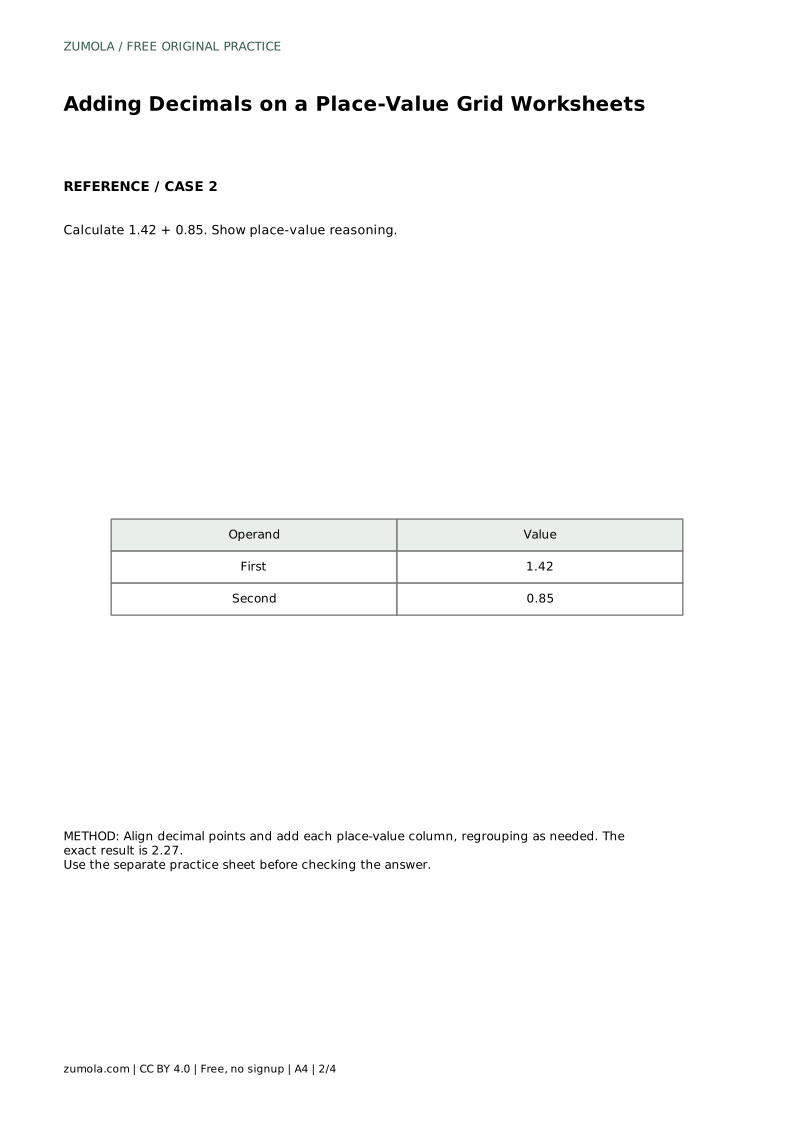
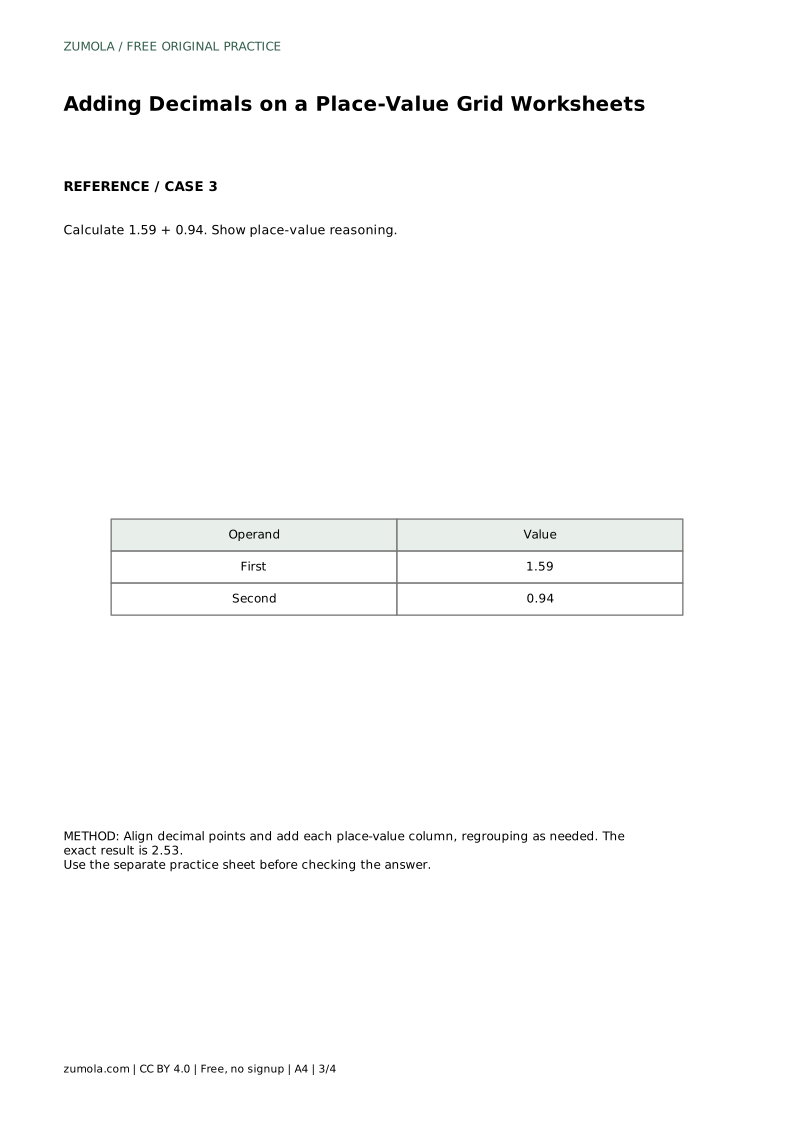
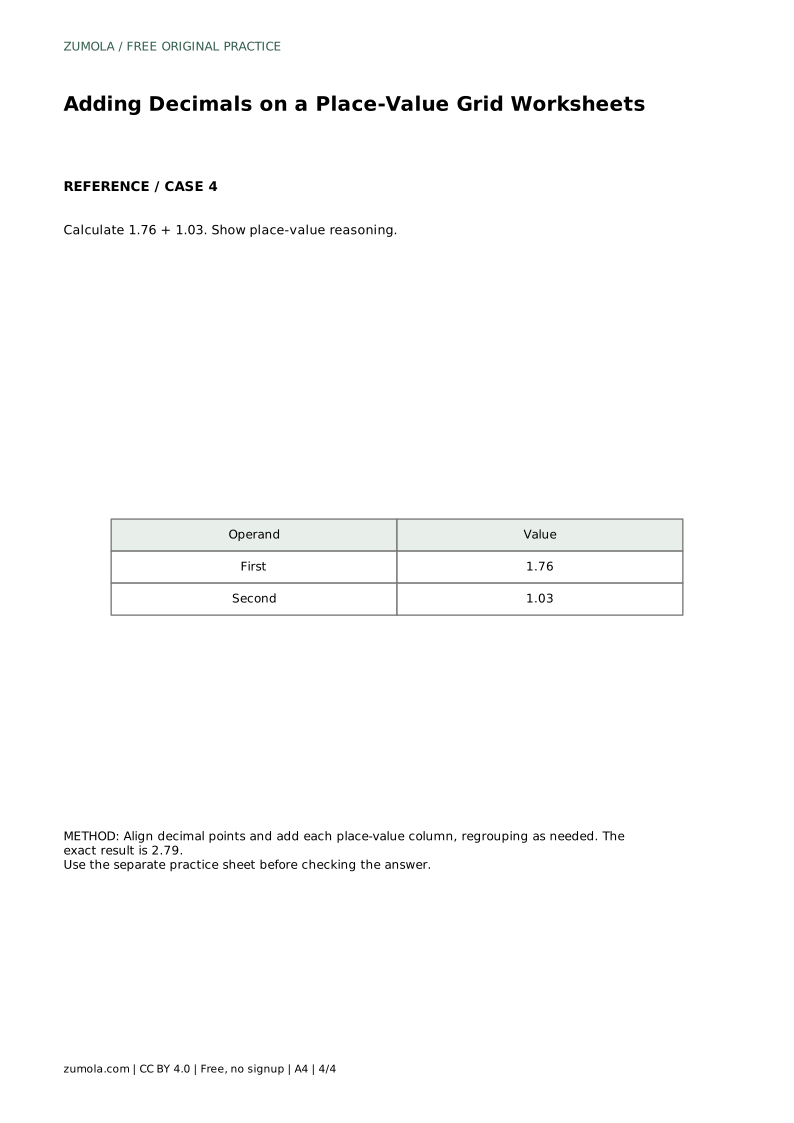
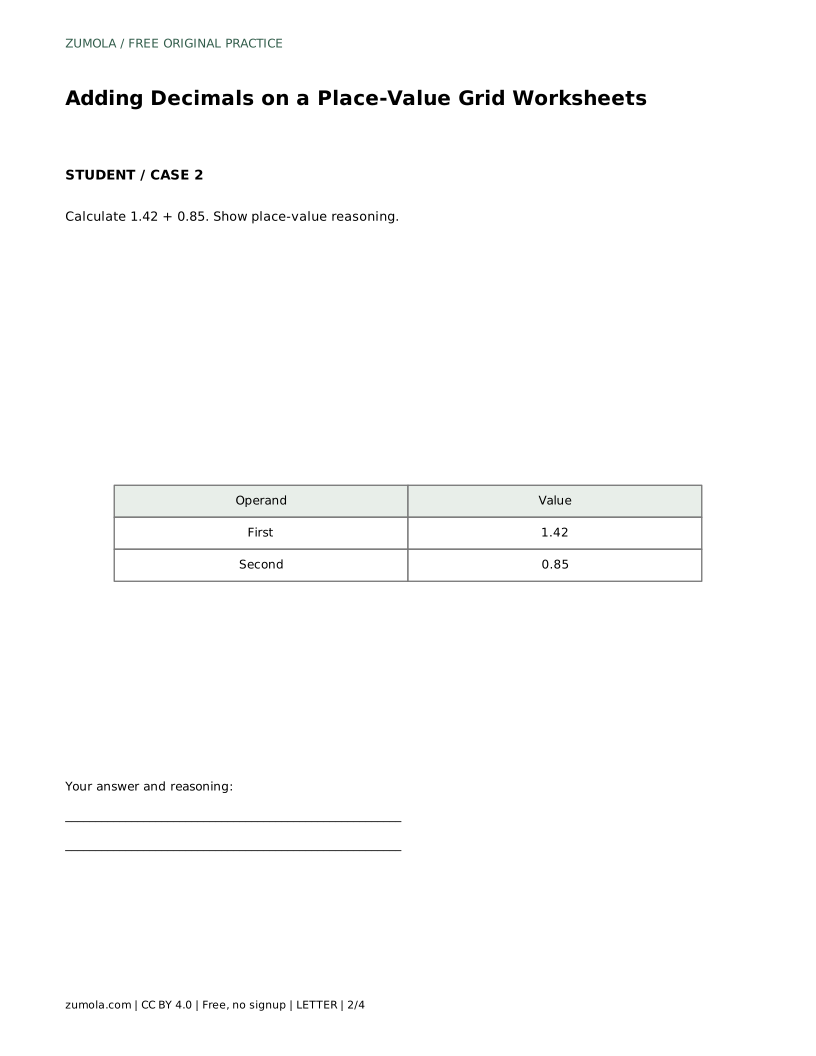
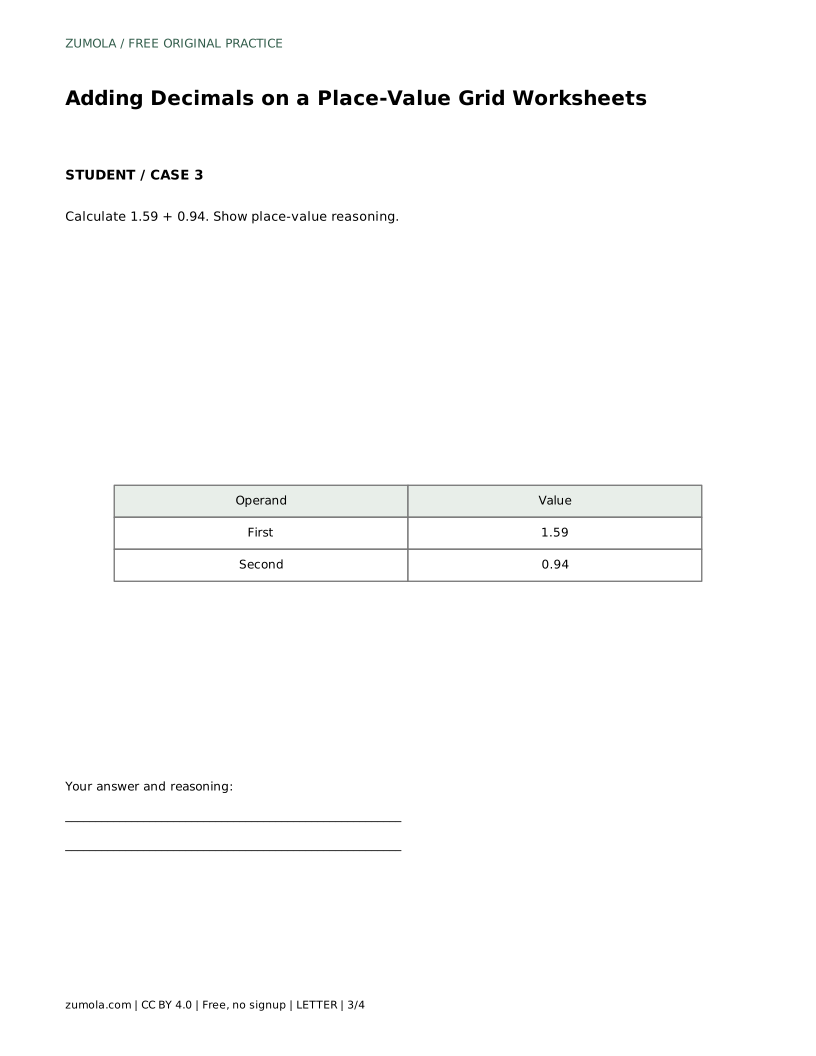
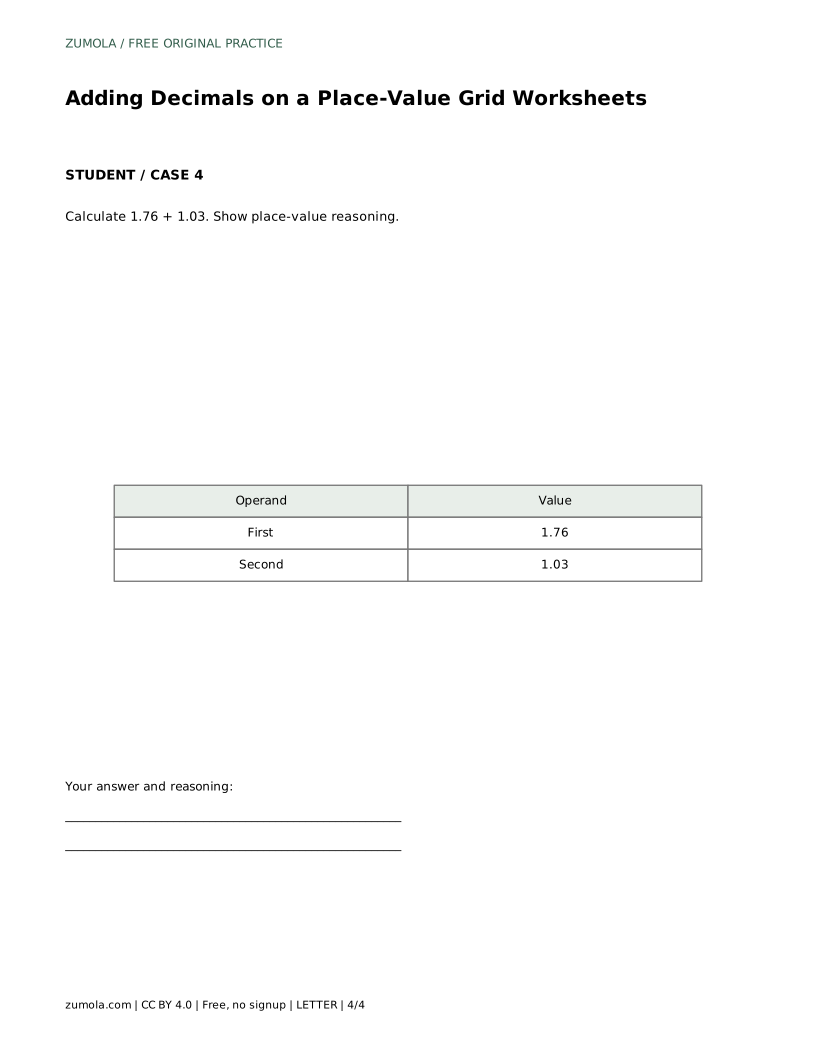
Four original cases, with reference diagrams, practice sheets and worked answers. Everything is free; no signup required.
LETTER · Download PDF
A4 · Download PDF
LETTER · Download PDF
A4 · Download PDF
LETTER · Download PDF
A4 · Download PDF
Use A4 or US Letter to match your printer. Use the stated values and conditions to solve each exercise; diagrams are not physical measuring rulers.
A place-value grid turns decimal addition into a column task. Each digit sits in its own column, so hundredths combine with hundredths and tenths with tenths. When a column reaches ten or more, regroup one unit into the next column to the left. This page explains how to set up the grid, add column by column, and check the result. The method works for any two decimals written to the same number of places, including sums that cross a whole number.
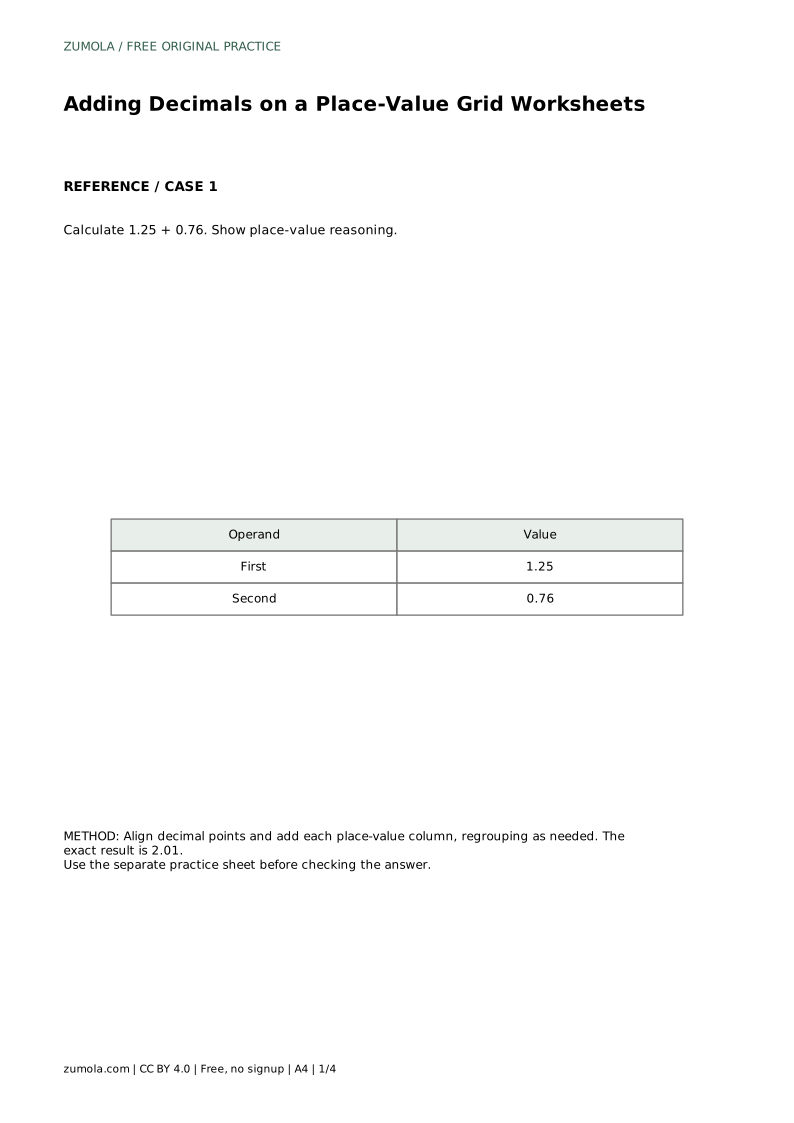
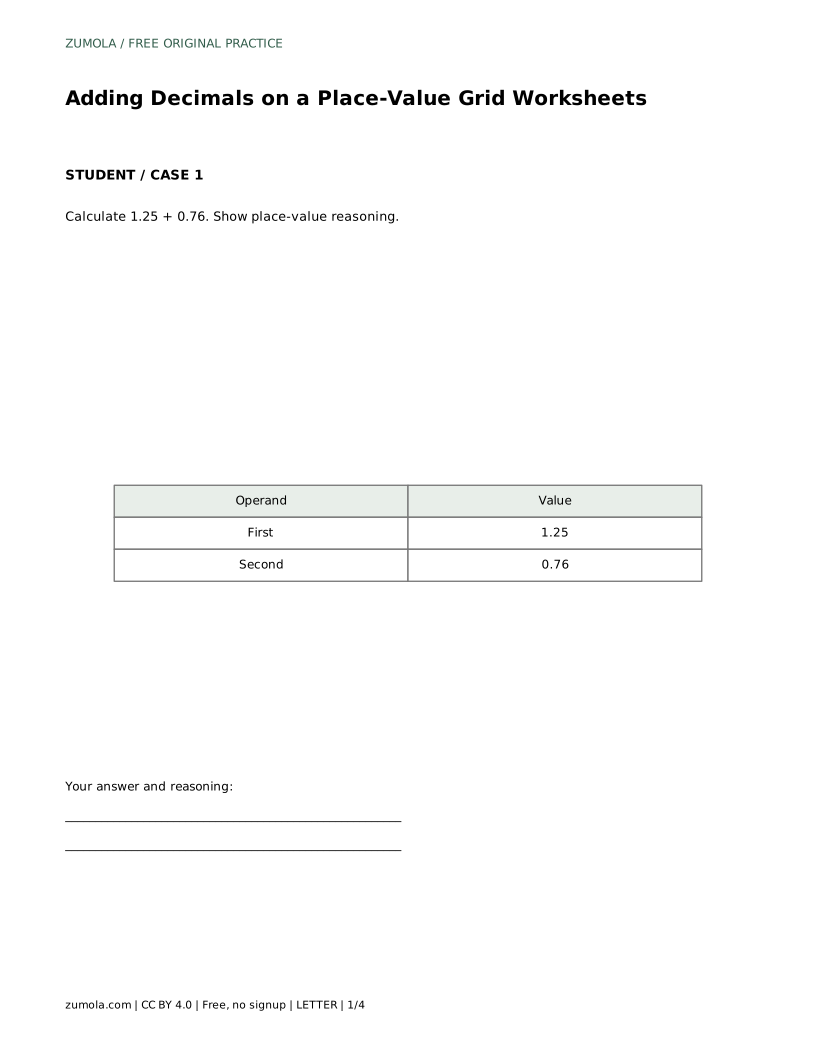
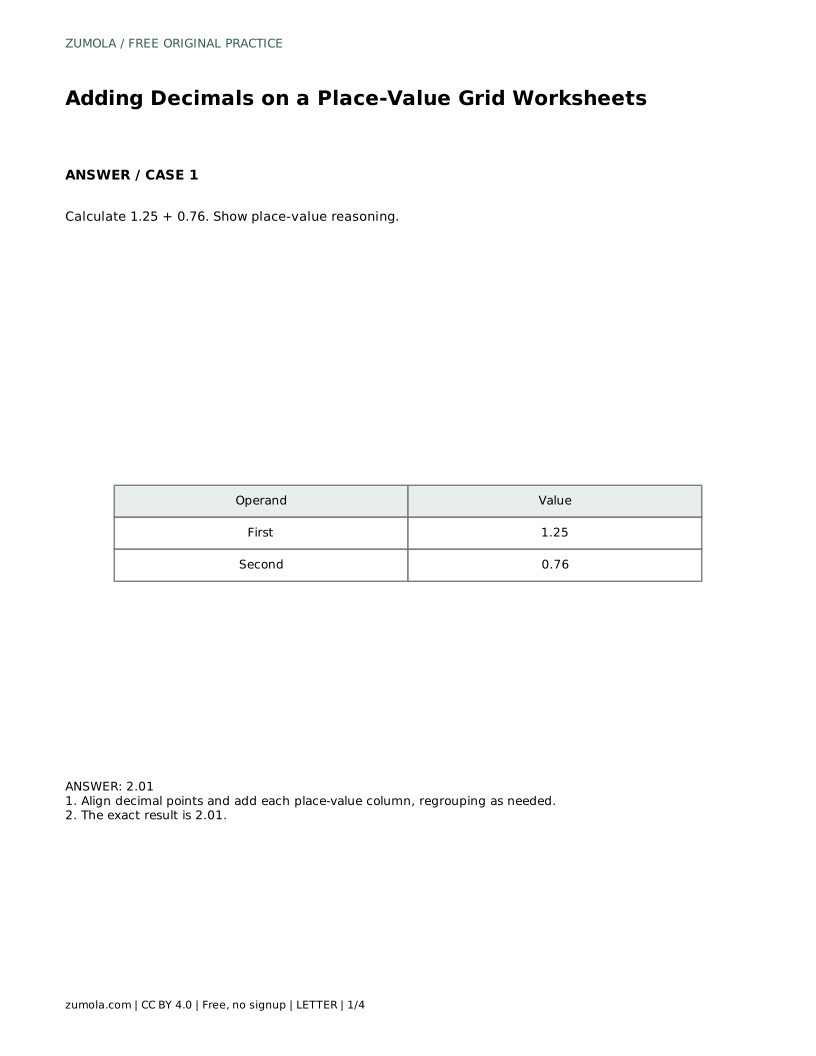
Draw columns labelled ones, tenths, and hundredths, with a decimal point line between ones and tenths. Write each addend so its digits land in the matching column. If one number has fewer decimal places, fill the empty places with zeros so both numbers occupy the same columns. For example, 1.25 and 0.76 both use ones, tenths, and hundredths, so no padding is needed.
Keep the decimal points stacked directly above one another. This alignment is the whole point of the grid: it prevents adding a tenth to a hundredth by mistake. A common slip is writing 0.76 shifted one column right, which silently changes its value to 0.076.
Start at the rightmost column, hundredths, and add the two digits. If the total is 9 or less, write it in that column. If it is 10 or more, write the ones digit and carry 1 into the next column left. Repeat for tenths, then ones, carrying as needed. The decimal point in the answer stays directly below the aligned points.
Regrouping is the step most worth slowing down for. In the hundredths column, 5 + 6 gives 11: write 1 and carry 1 to the tenths. In the tenths column, 2 + 7 plus the carried 1 gives 10: write 0 and carry 1 to the ones. In the ones column, 1 + 0 plus the carried 1 gives 2. The answer is 2.01.
Estimate before or after adding: 1.25 is about 1.3 and 0.76 is about 0.8, so the sum should be near 2.1. An answer of 2.01 is close, while 20.1 or 0.201 signals a misplaced point or column. You can also reverse the addends; the sum must not change.
A second check is to convert to hundredths: 1.25 is 125 hundredths and 0.76 is 76 hundredths, and 125 + 76 = 201 hundredths, or 2.01. This confirms both the digits and the decimal point.
Because grids can be filled in more than one valid order, mark the reasoning as well as the final sum. A correct answer with misaligned columns is worth revisiting, since the alignment is the skill being practised.
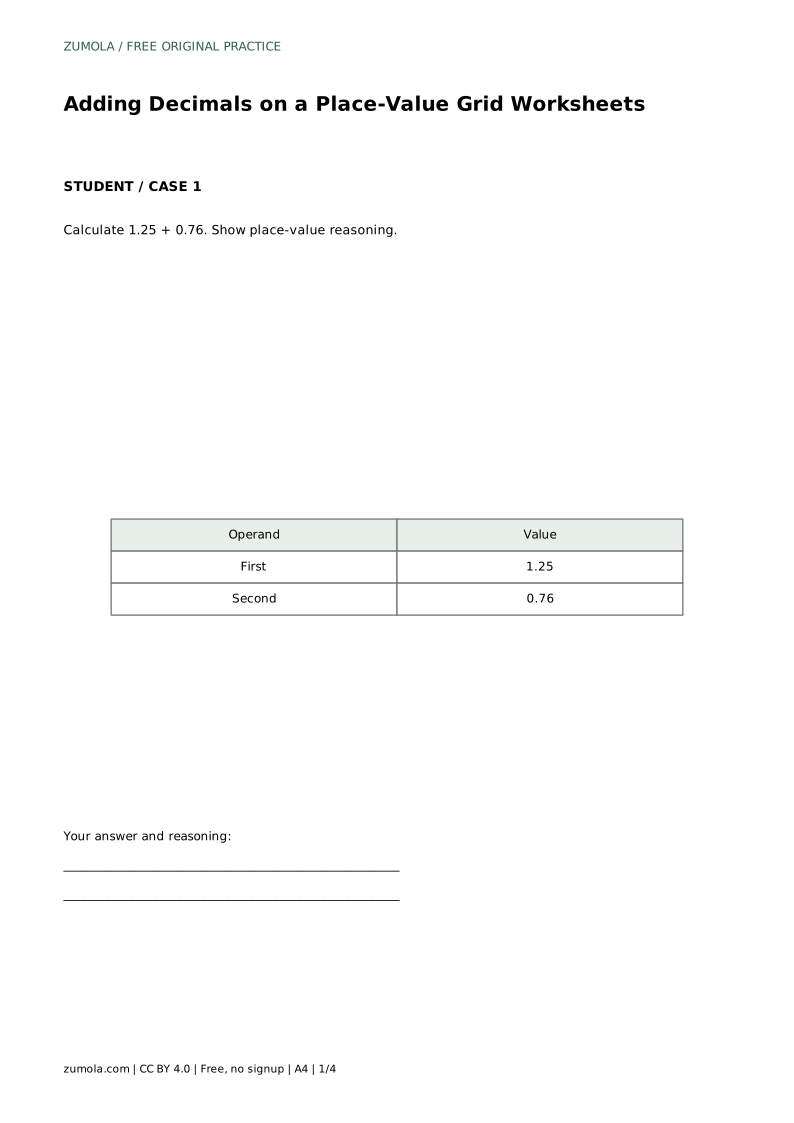
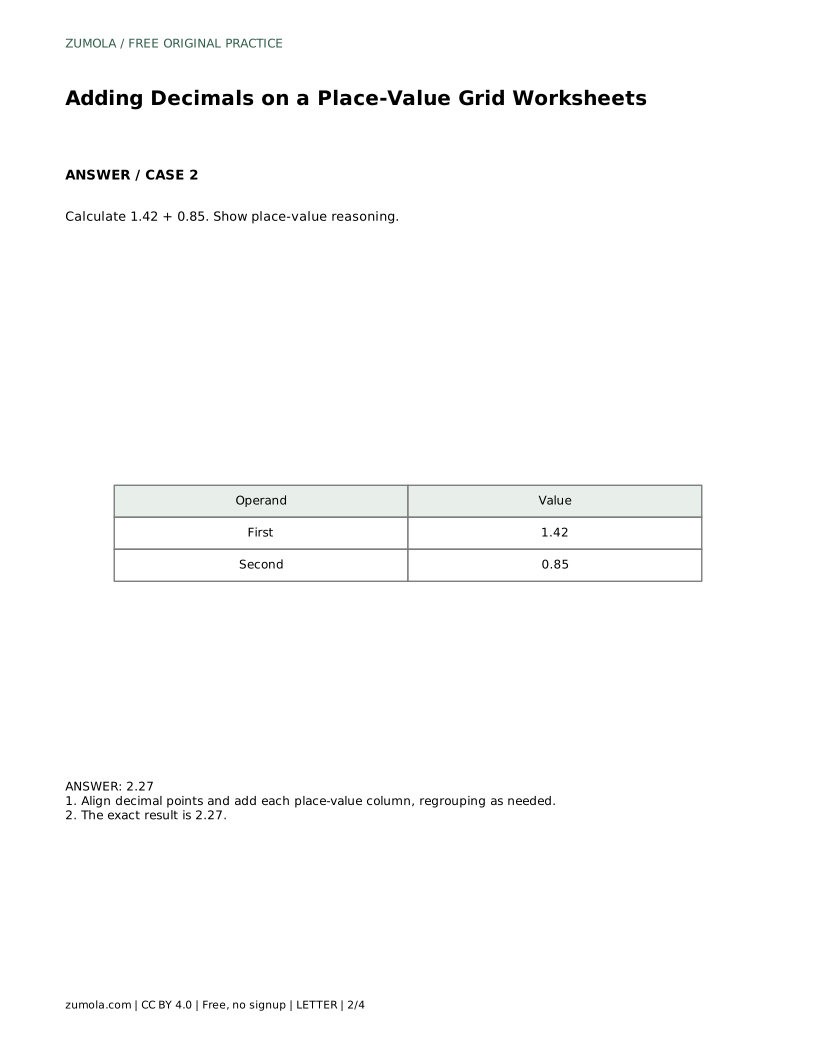
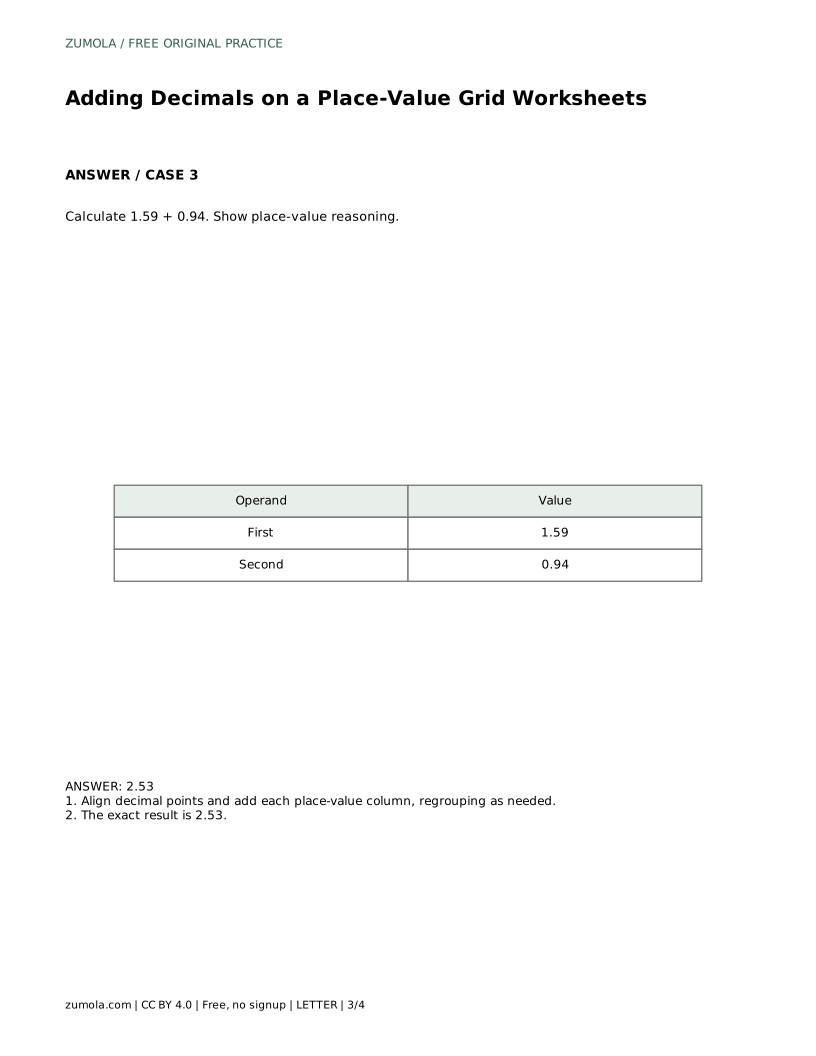
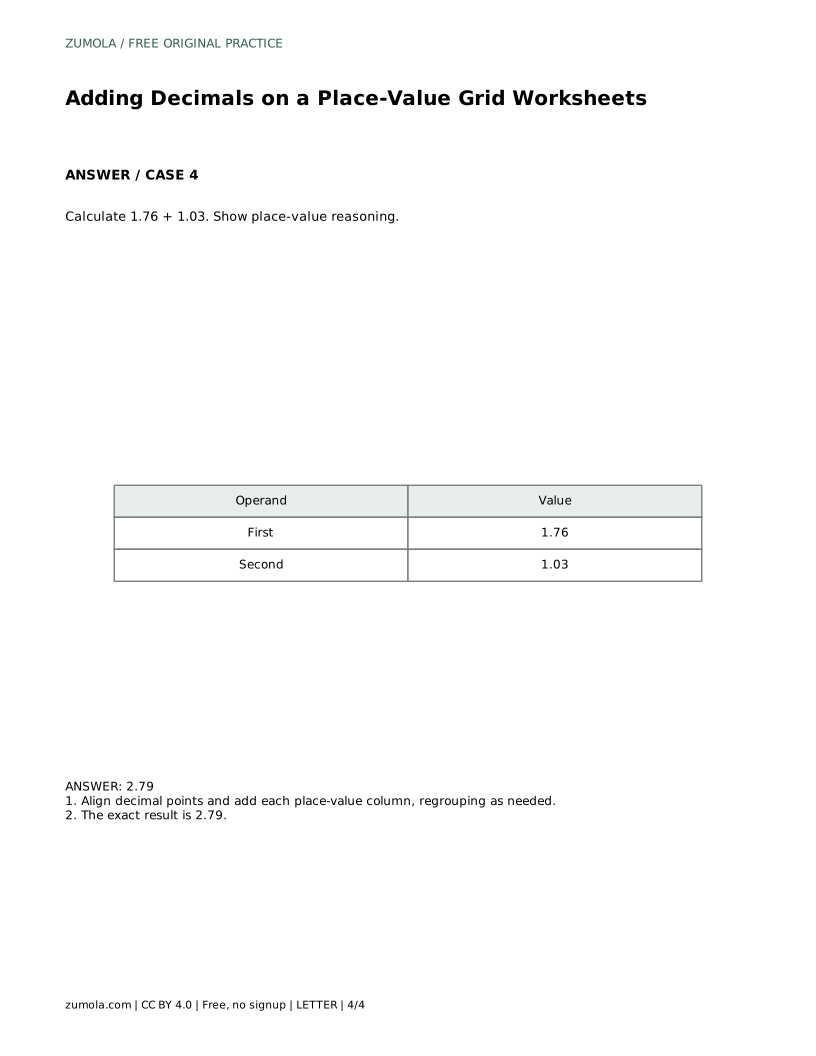
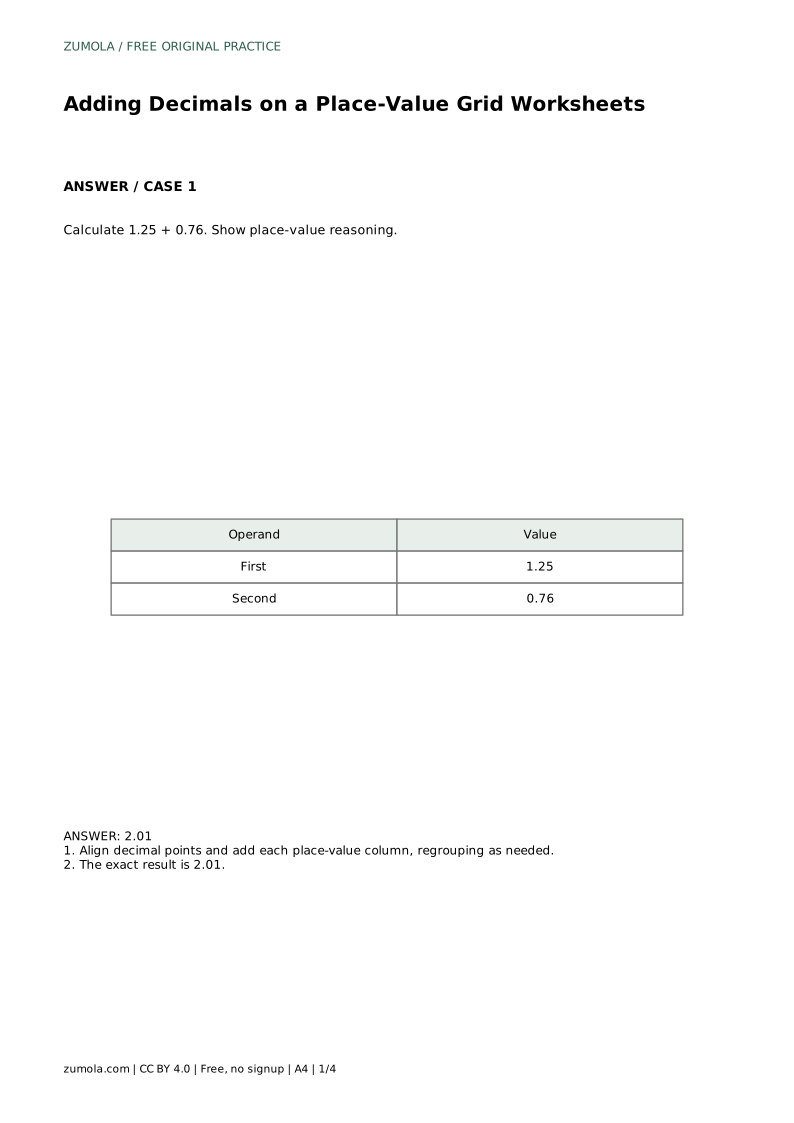
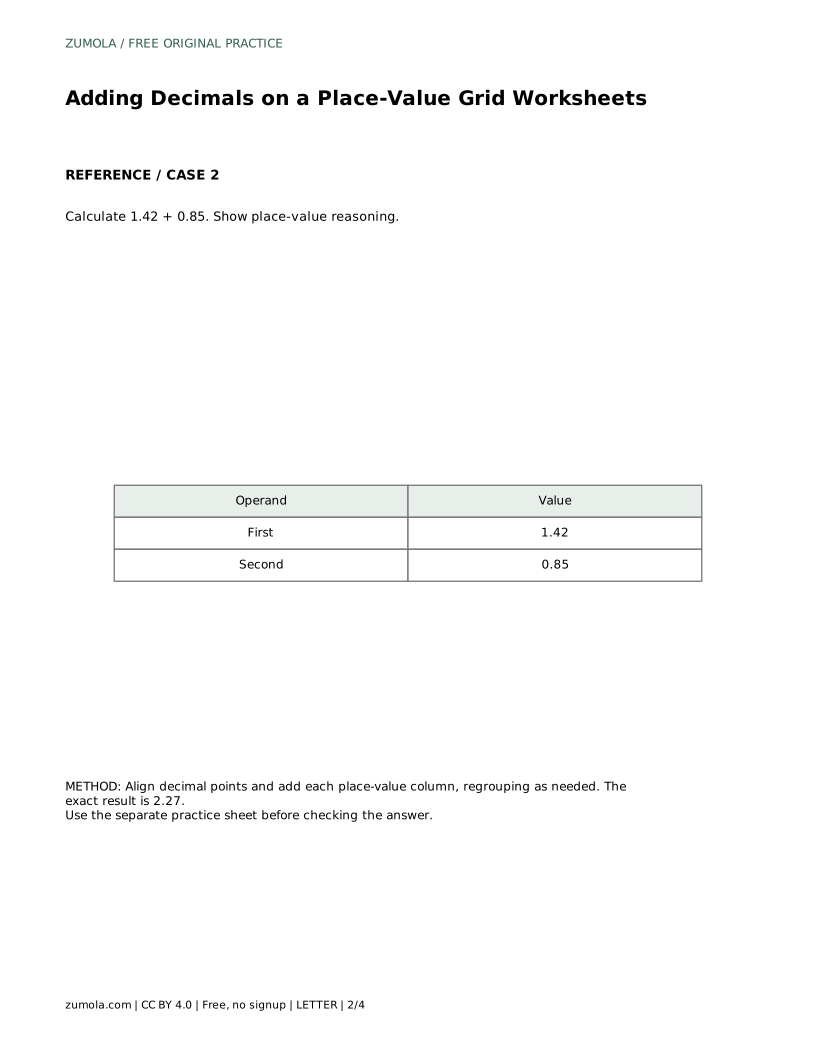
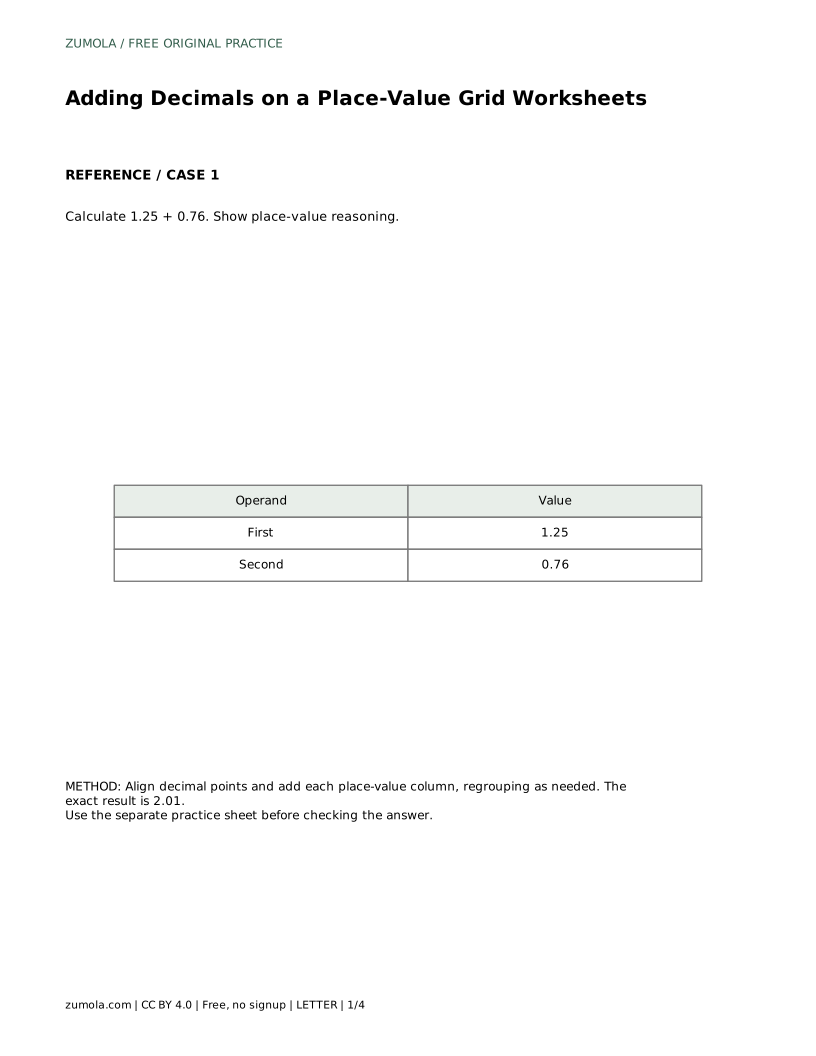
Calculate 1.25 + 0.76. Show place-value reasoning.
2.01 Align decimal points and add each place-value column, regrouping as needed. The exact result is 2.01.
Pad the shorter number with zeros until both use the same columns, then add as usual. For example, treat 1.4 as 1.40 when adding to 1.25.
Ten units in one column equal one unit in the column to its left, just as with whole numbers. Ten hundredths make one tenth, and ten tenths make one one.
No. Adding numbers written to hundredths gives a result in hundredths, so the answer has at most two decimal places.
All math worksheets · Free coordinate paper
Original resources · CC BY 4.0 · Free for personal and classroom use with attribution.