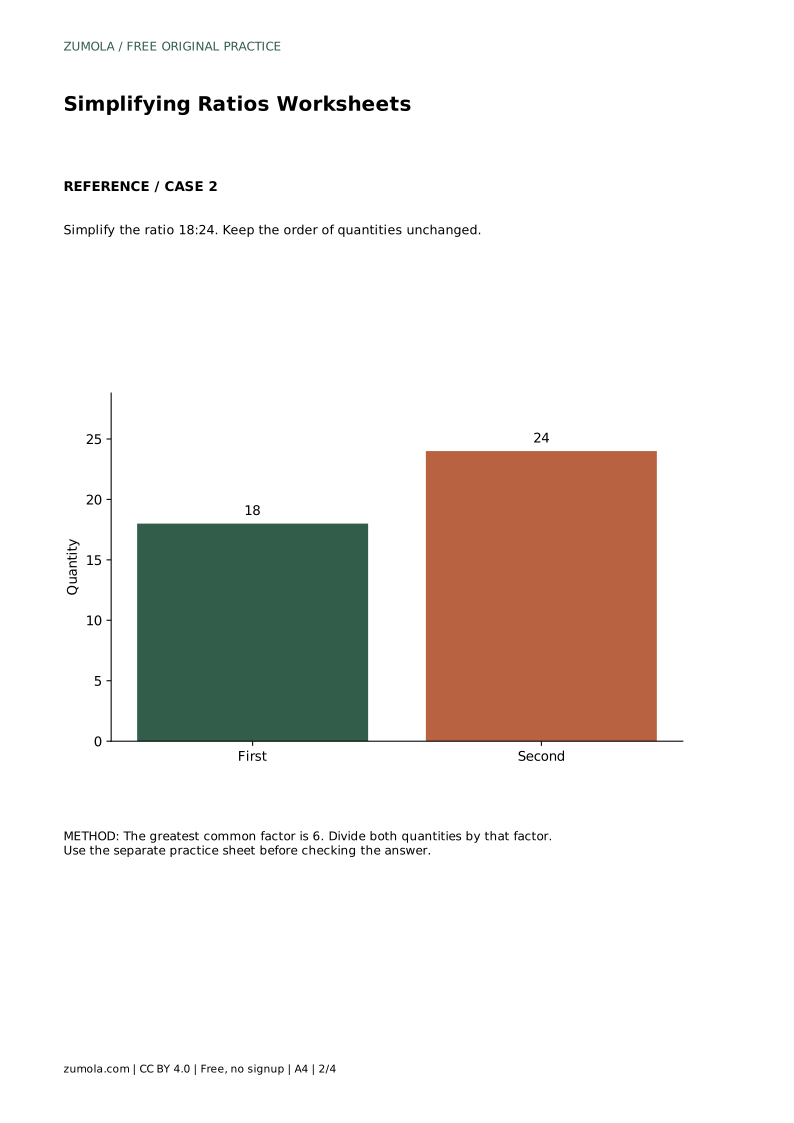
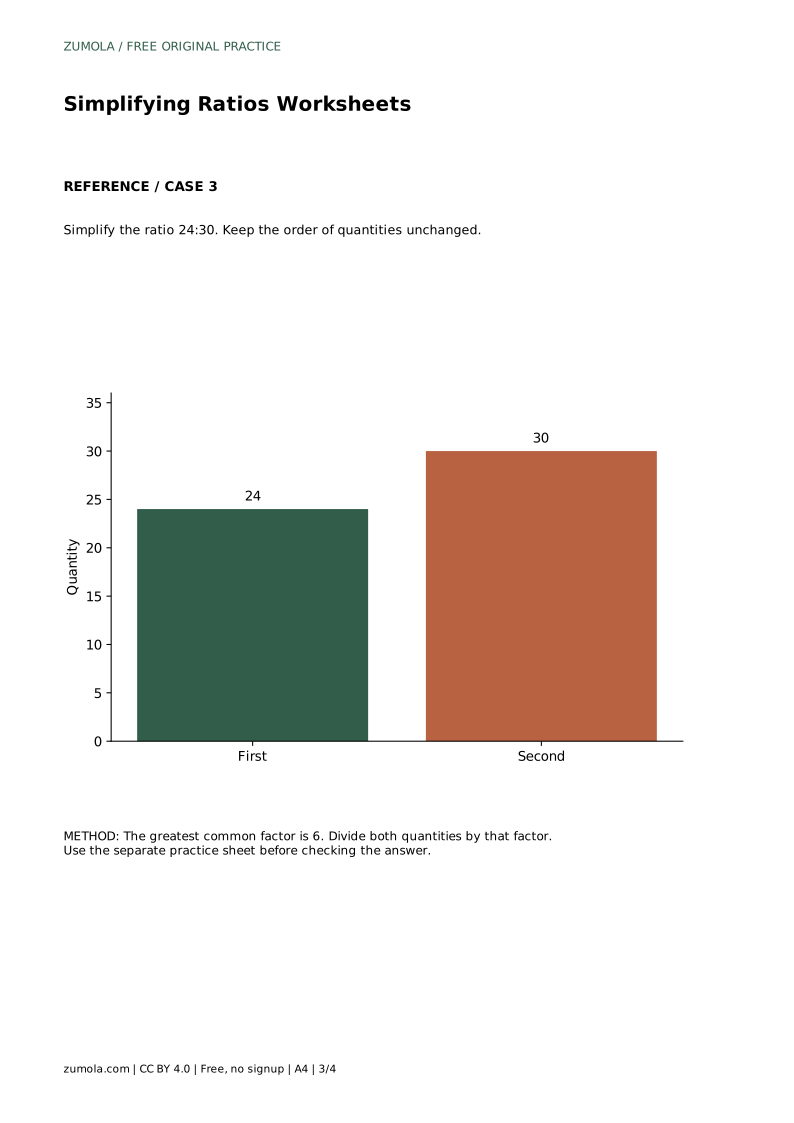
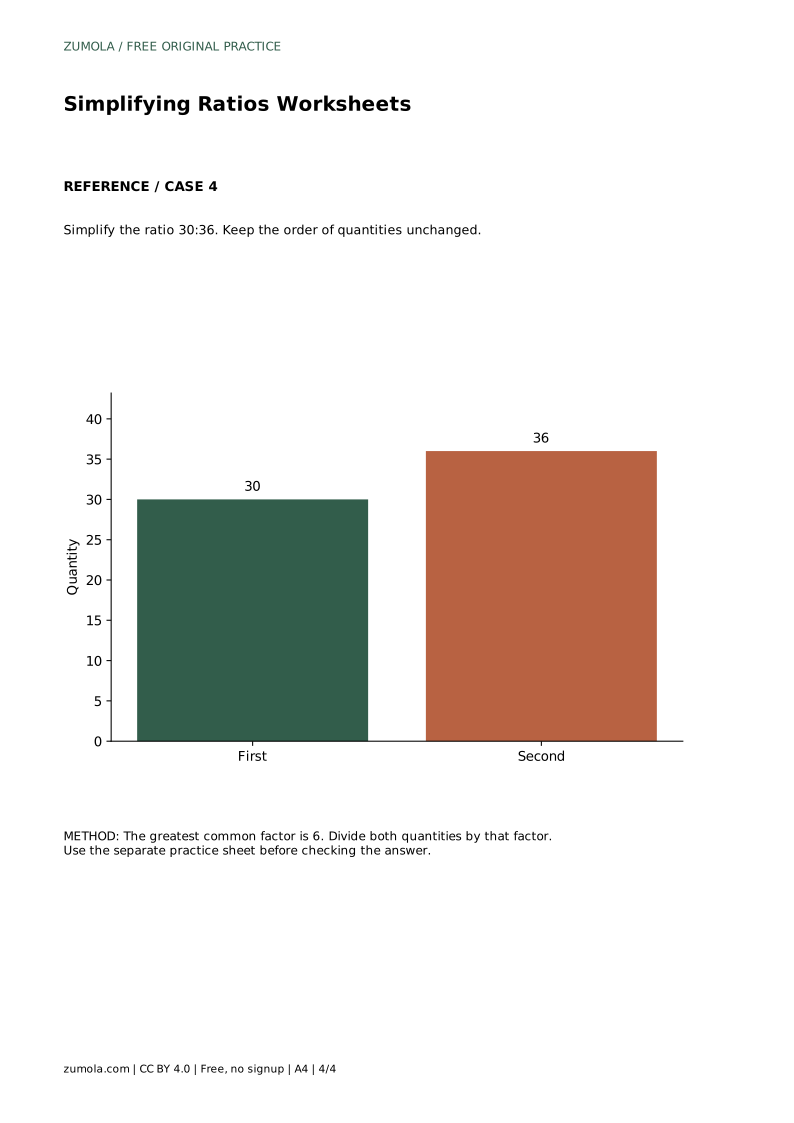
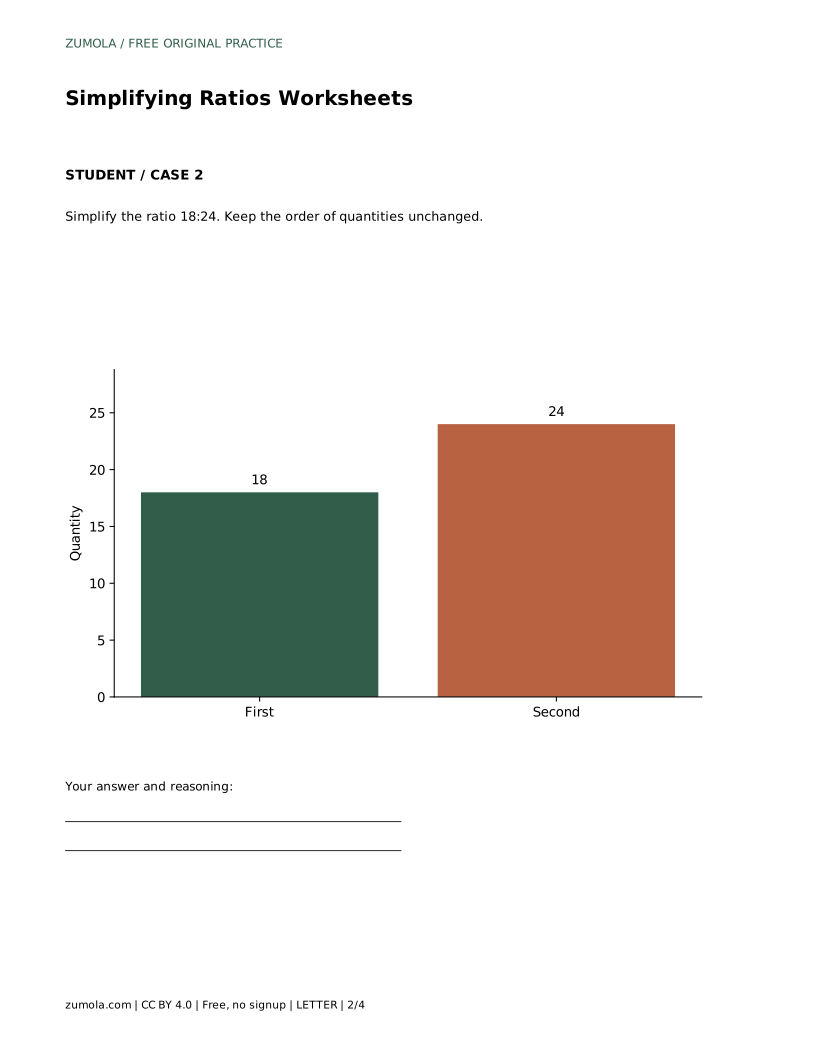
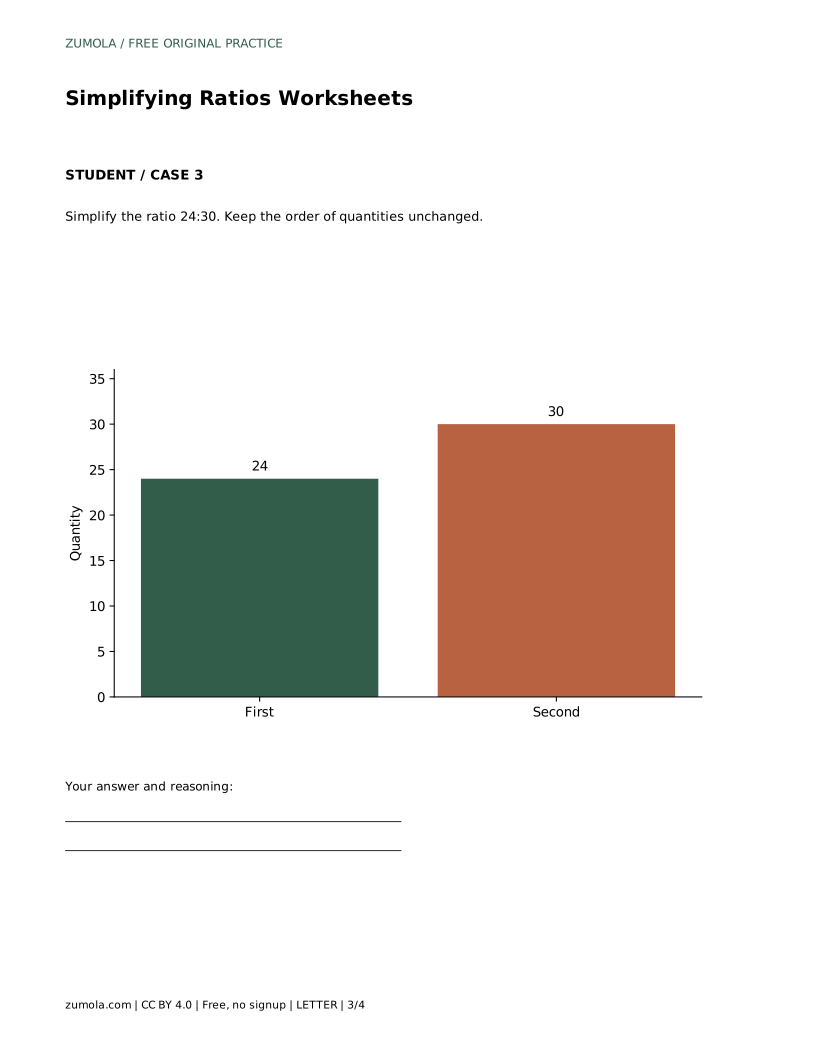
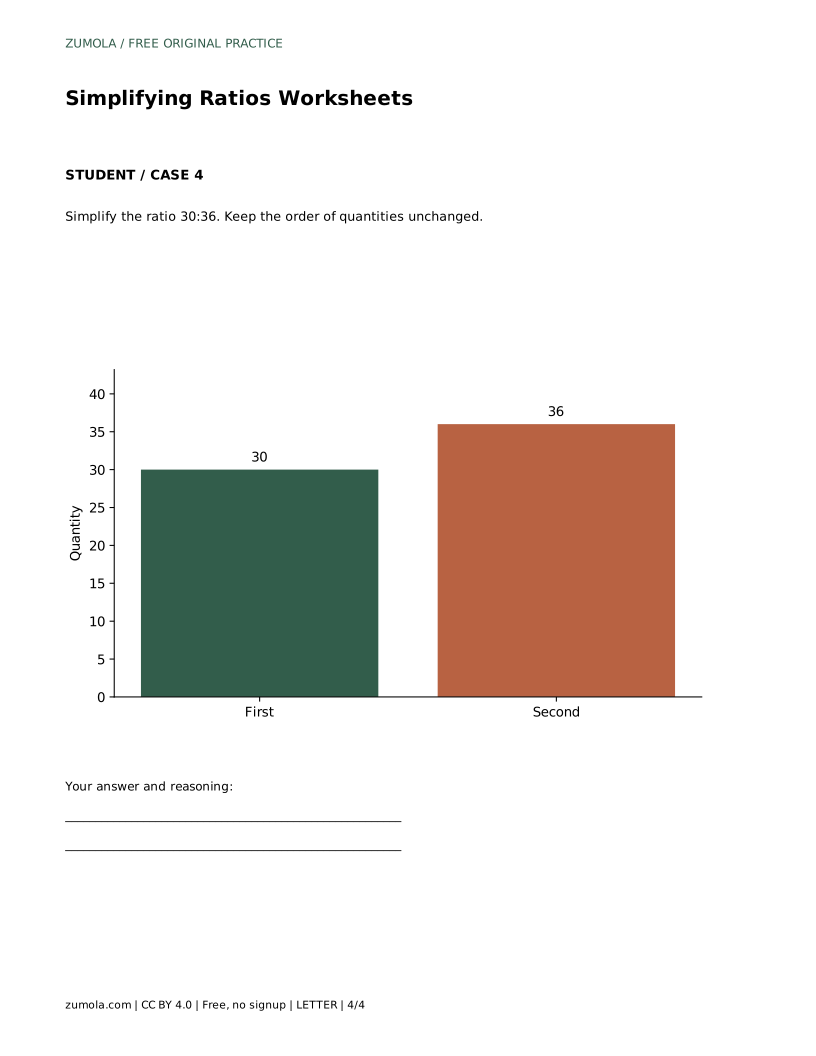
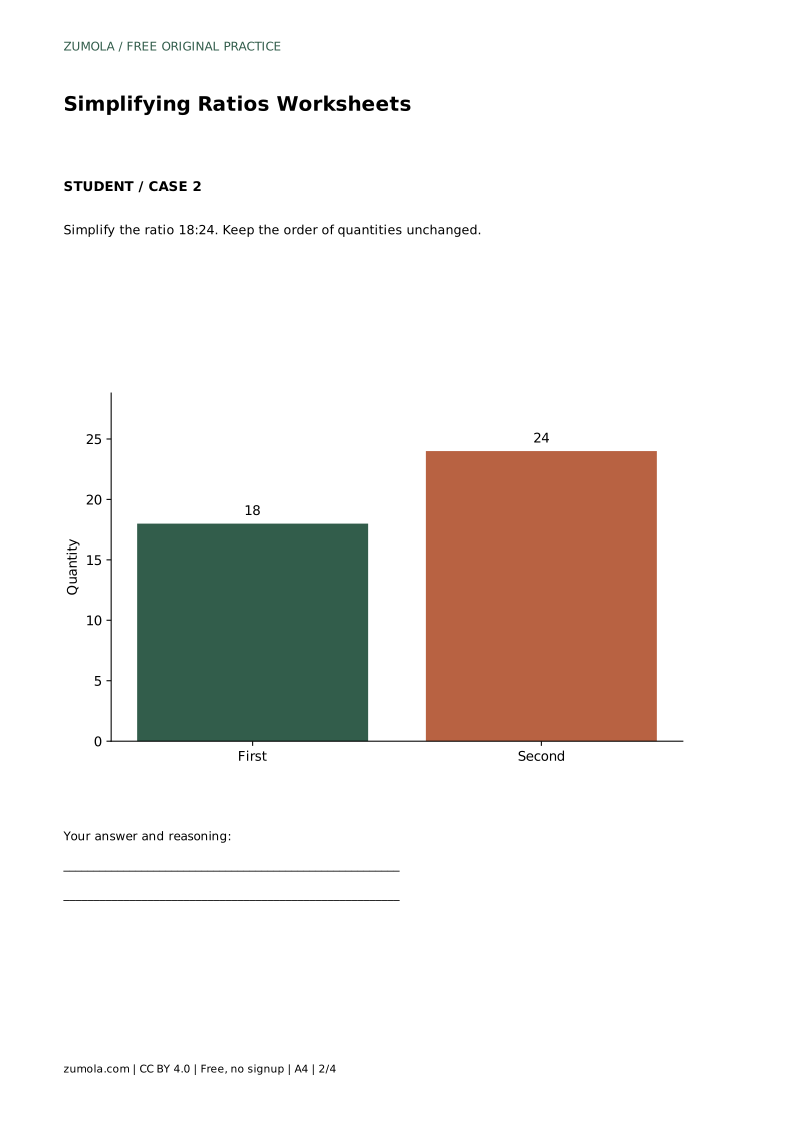
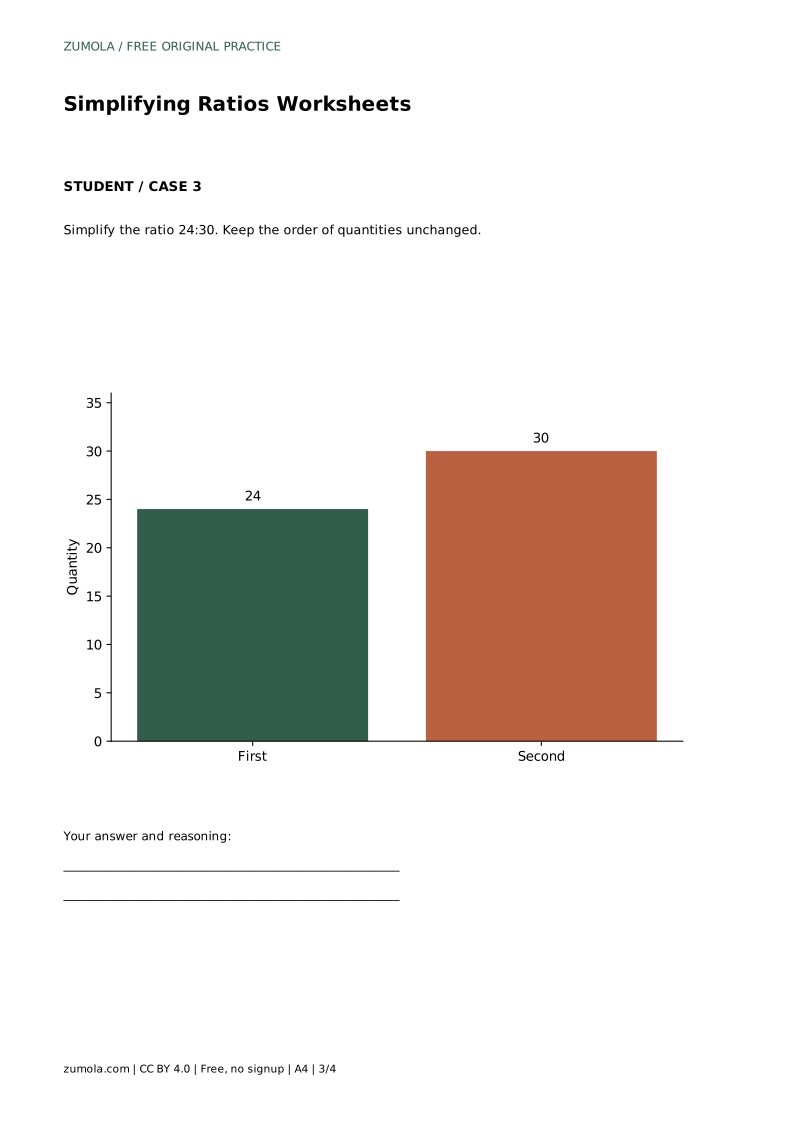
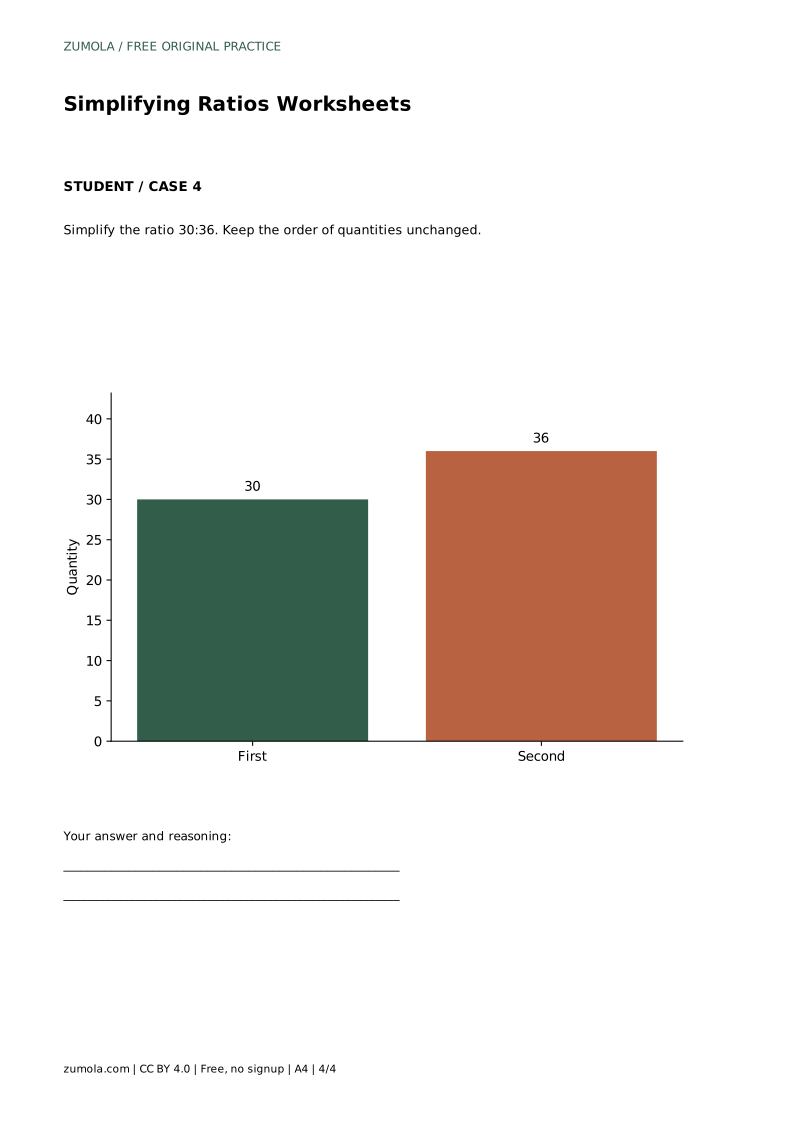
Reference diagrams
LETTER · Download PDF
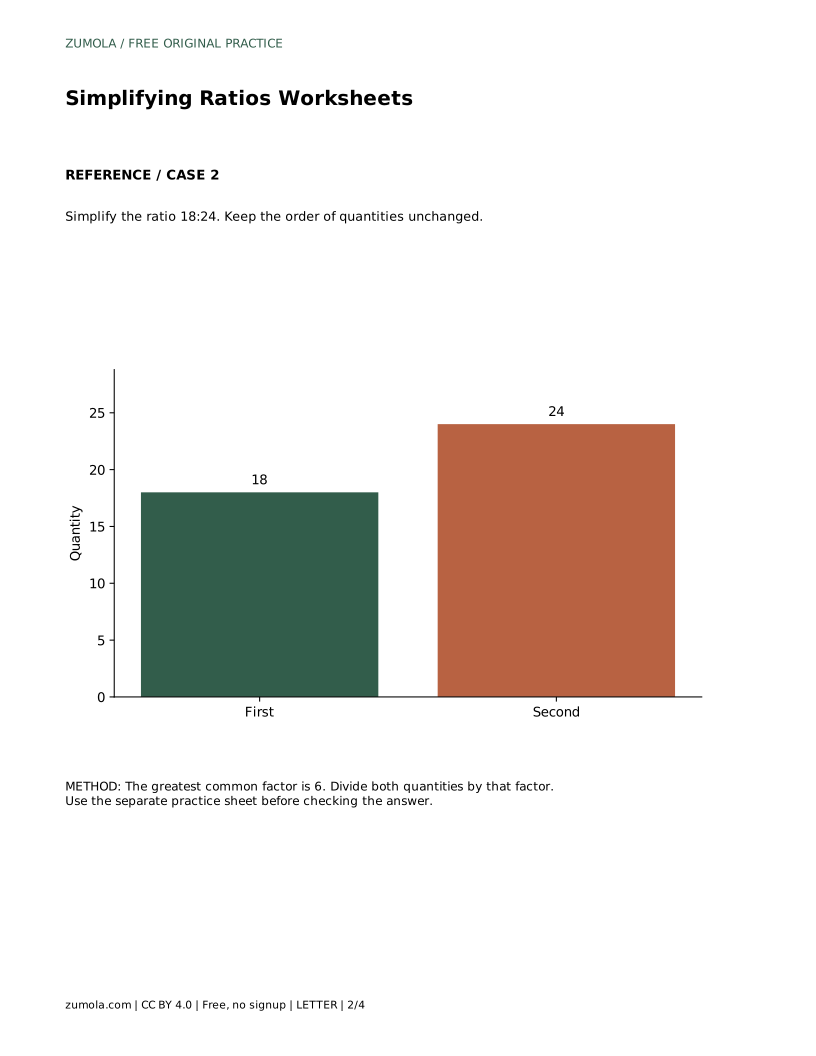
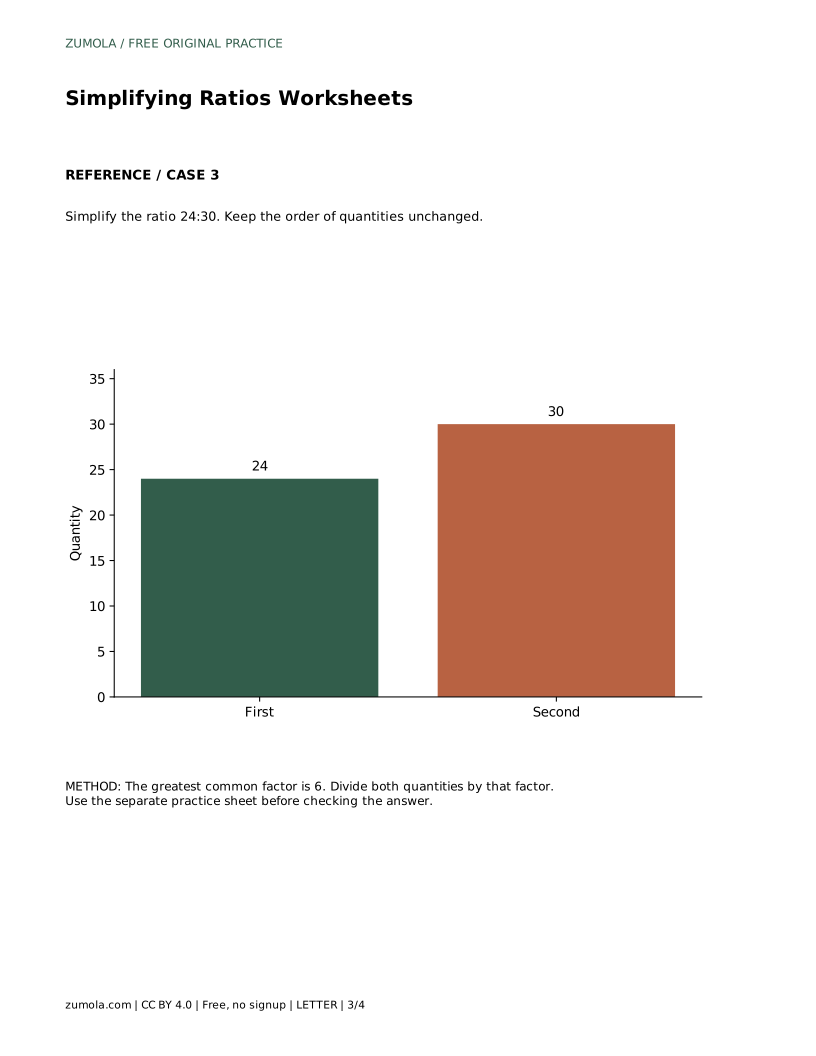
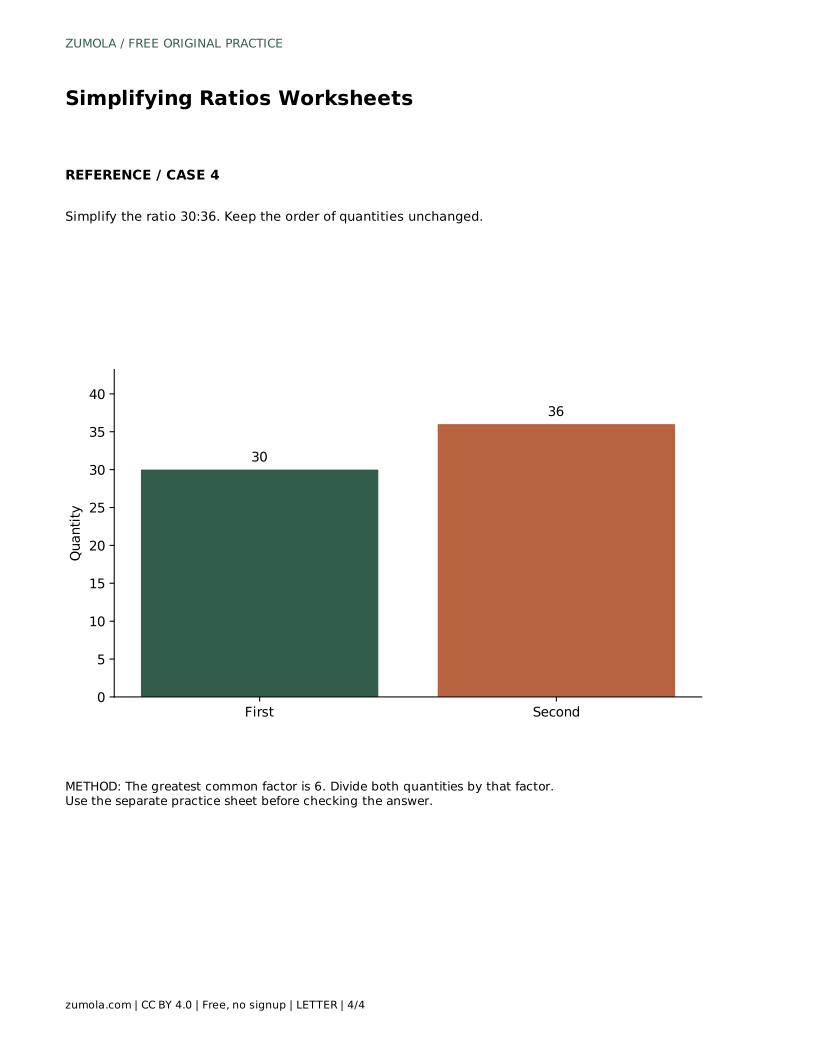
A4 · Download PDF
Free original resources
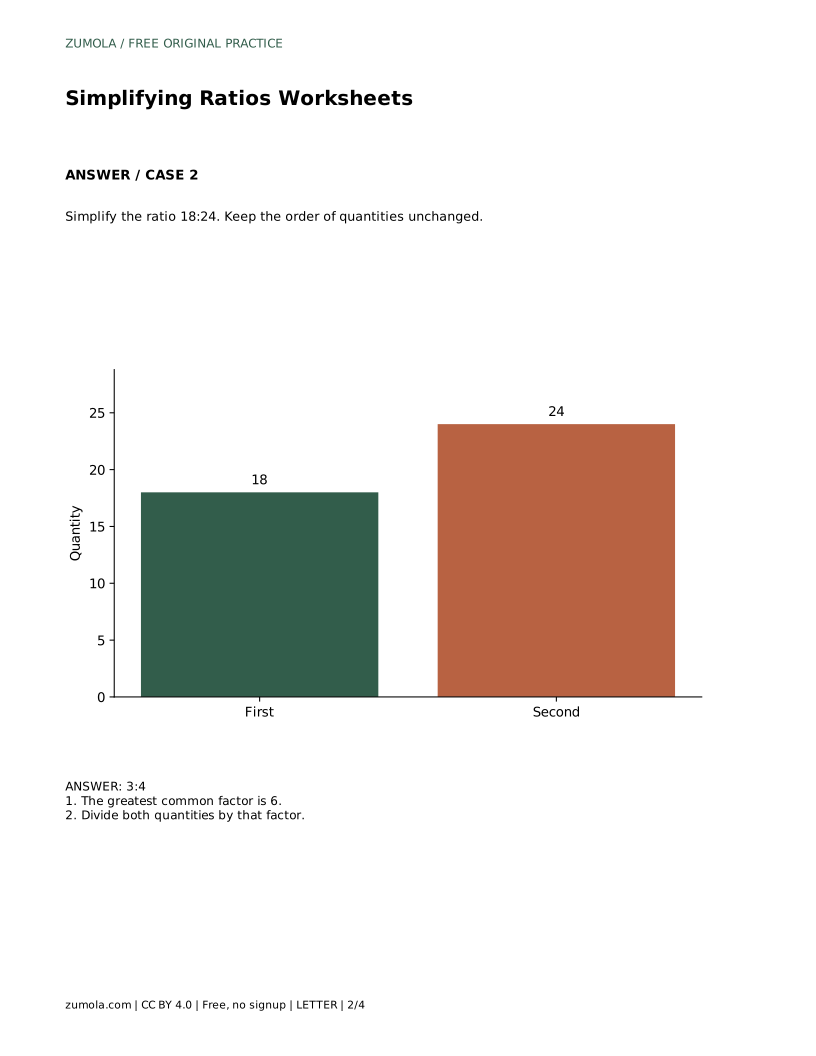
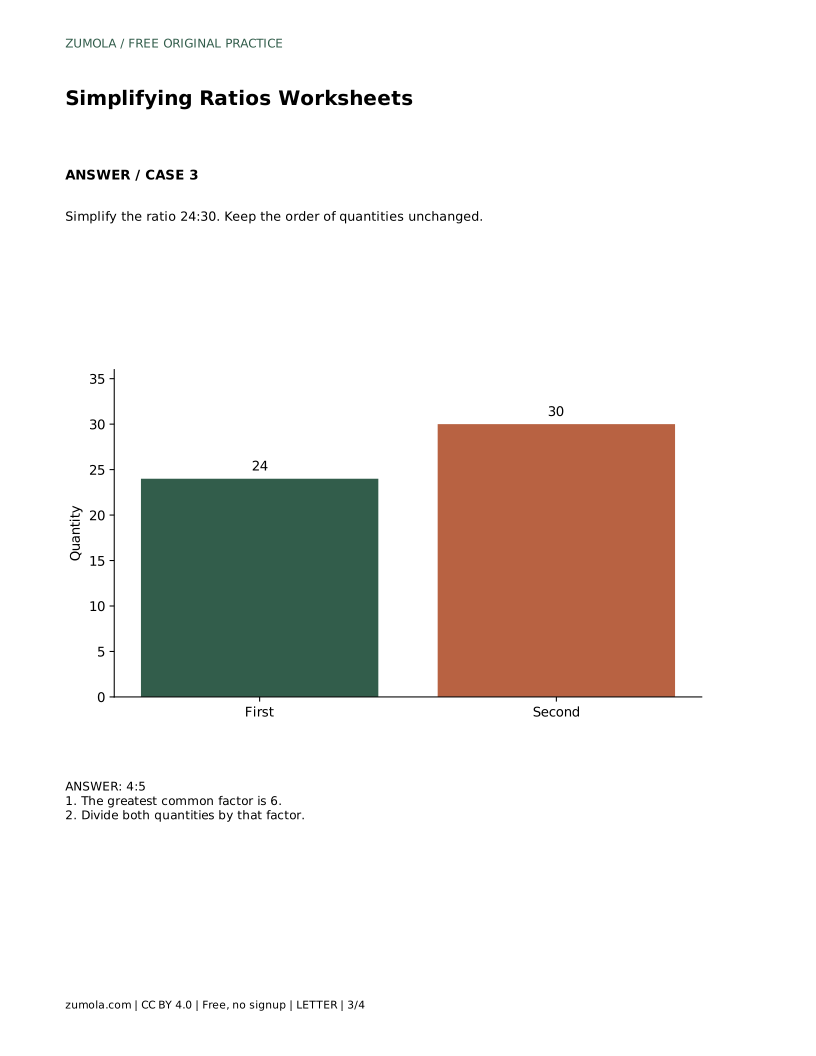
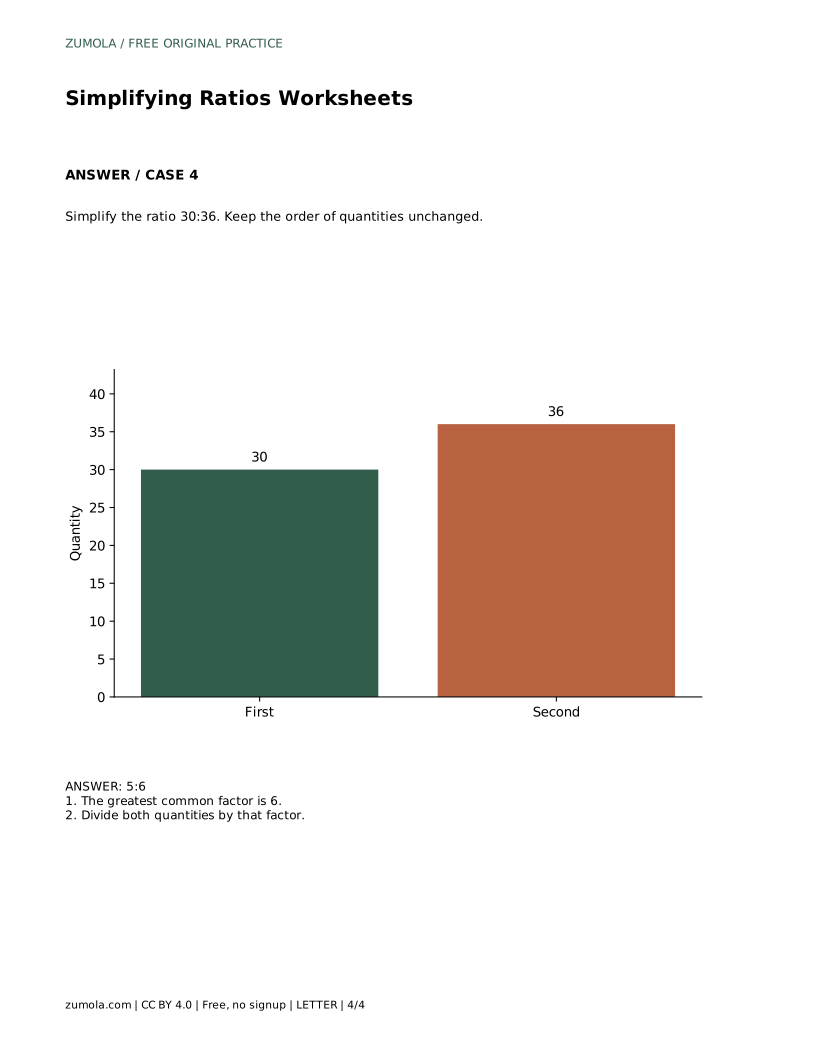
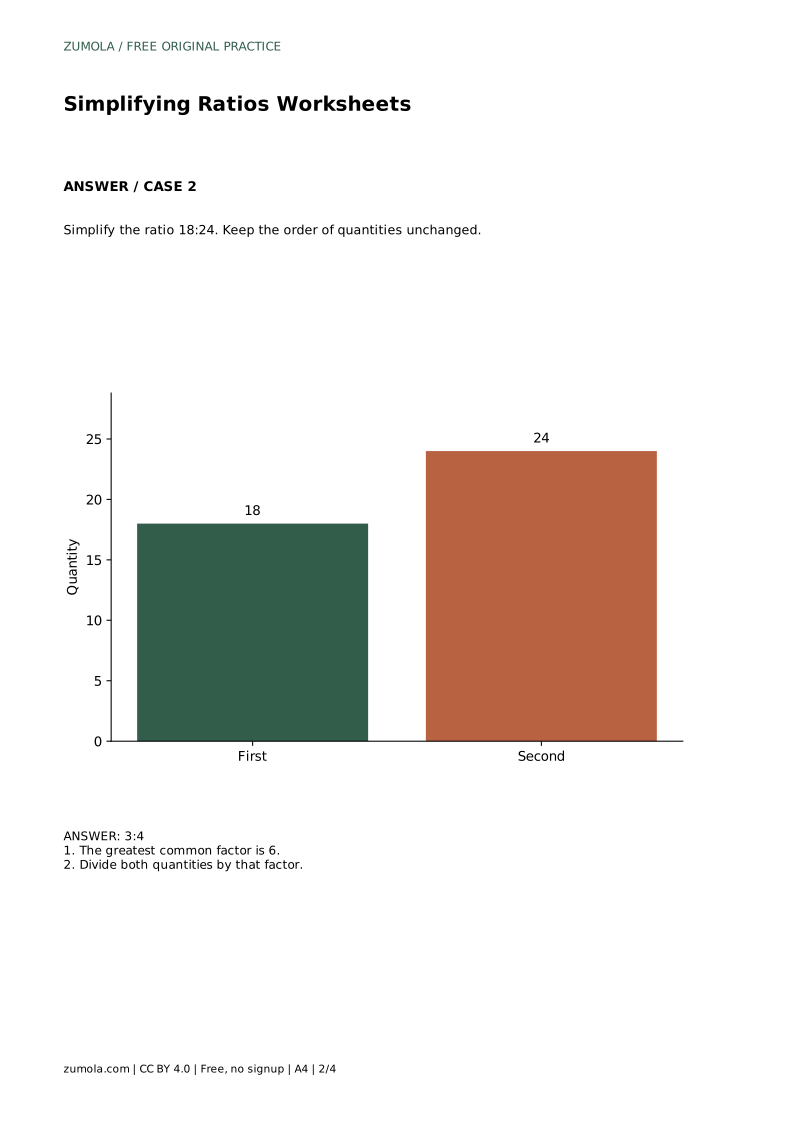
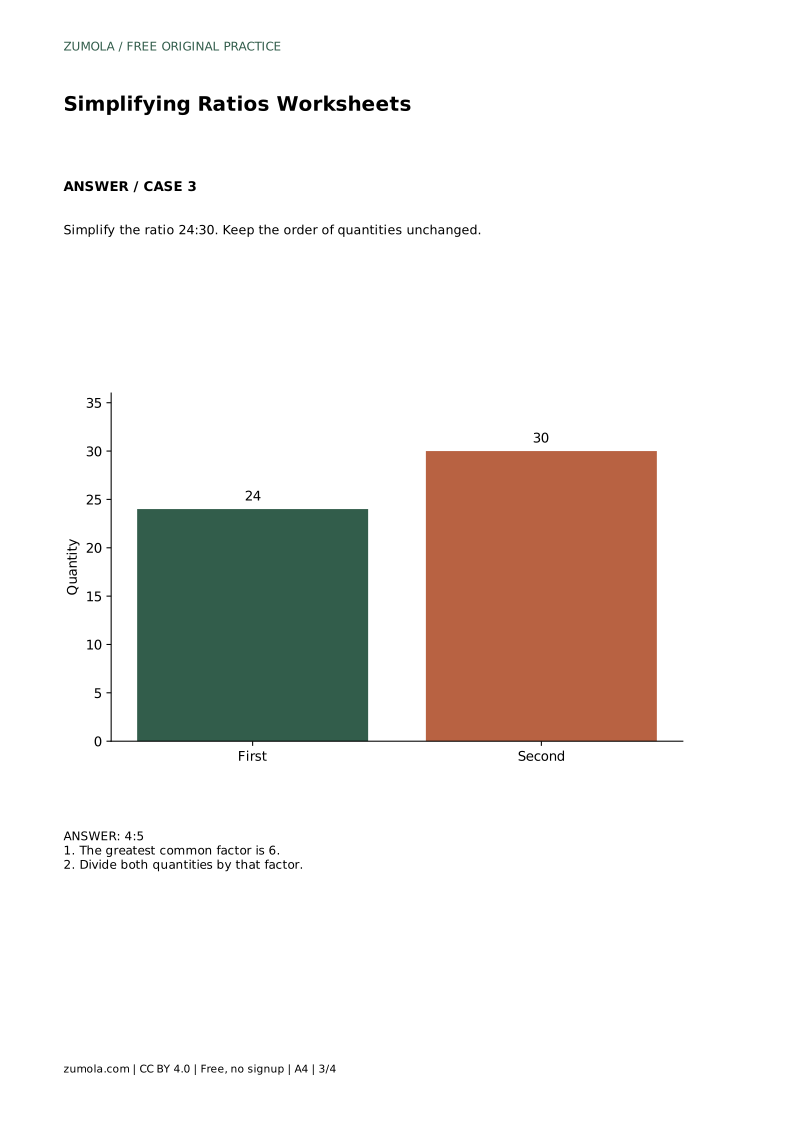
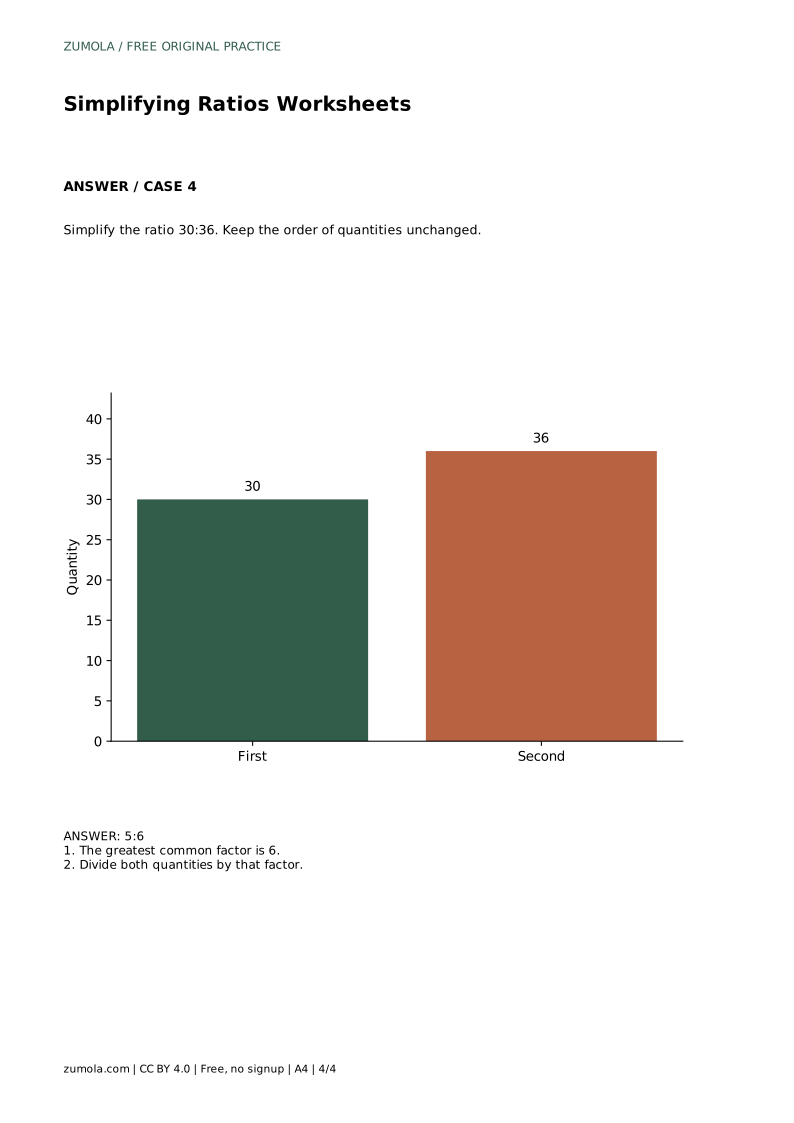
Teach ratio simplification with printable practice: find the greatest common factor of both quantities, divide each term, and keep the order unchanged.
Four original cases, with reference diagrams, practice sheets and worked answers. Everything is free; no signup required.
LETTER · Download PDF
A4 · Download PDF
LETTER · Download PDF
A4 · Download PDF
LETTER · Download PDF
A4 · Download PDF
Use A4 or US Letter to match your printer. Use the stated values and conditions to solve each exercise; diagrams are not physical measuring rulers.
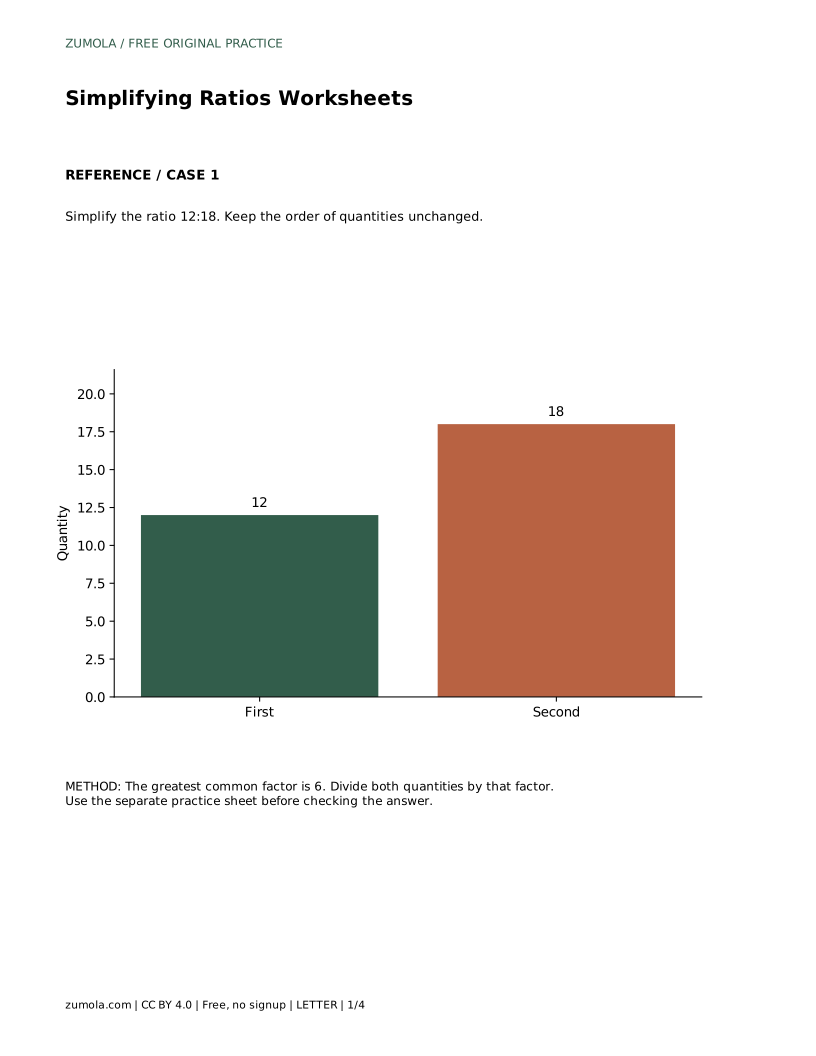

A ratio compares two quantities in a fixed order, and simplifying a ratio rewrites that comparison with smaller whole numbers without changing its value. This page explains the method step by step, using the greatest common factor of both quantities, then offers practice guidance for printable worksheets. The key idea is that both quantities must be divided by the same factor, and the order of the two quantities must stay exactly as given.
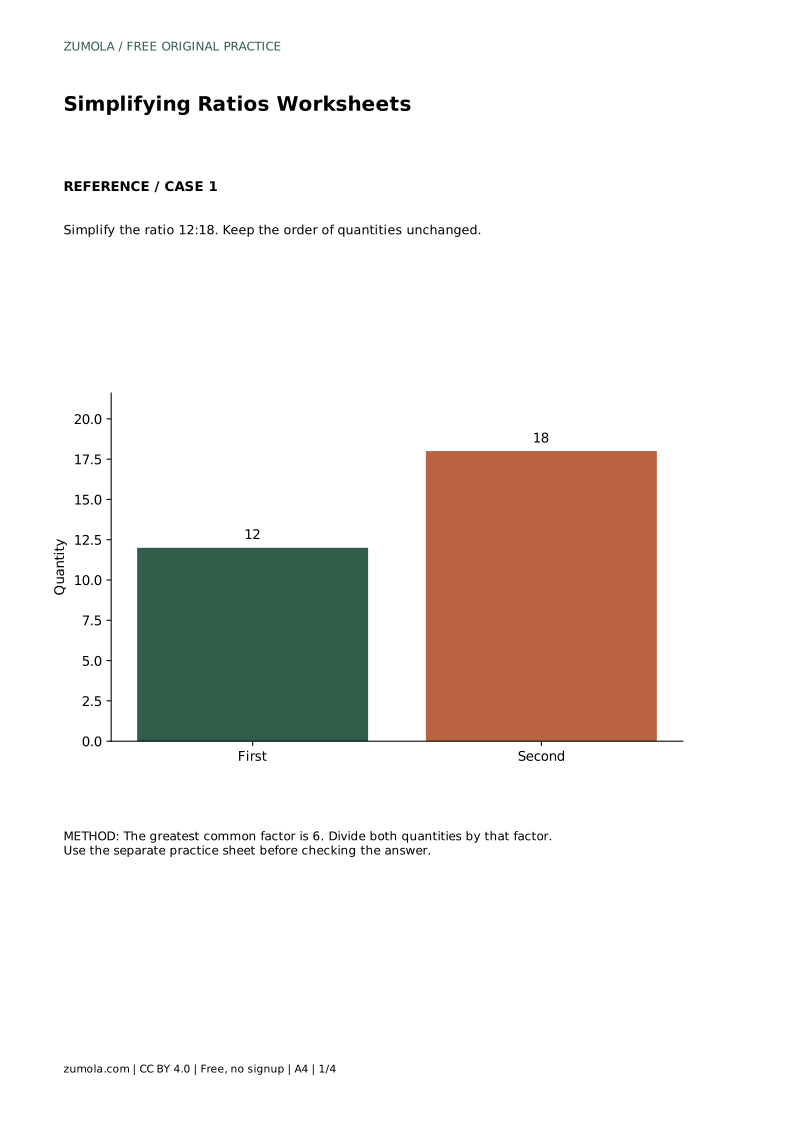
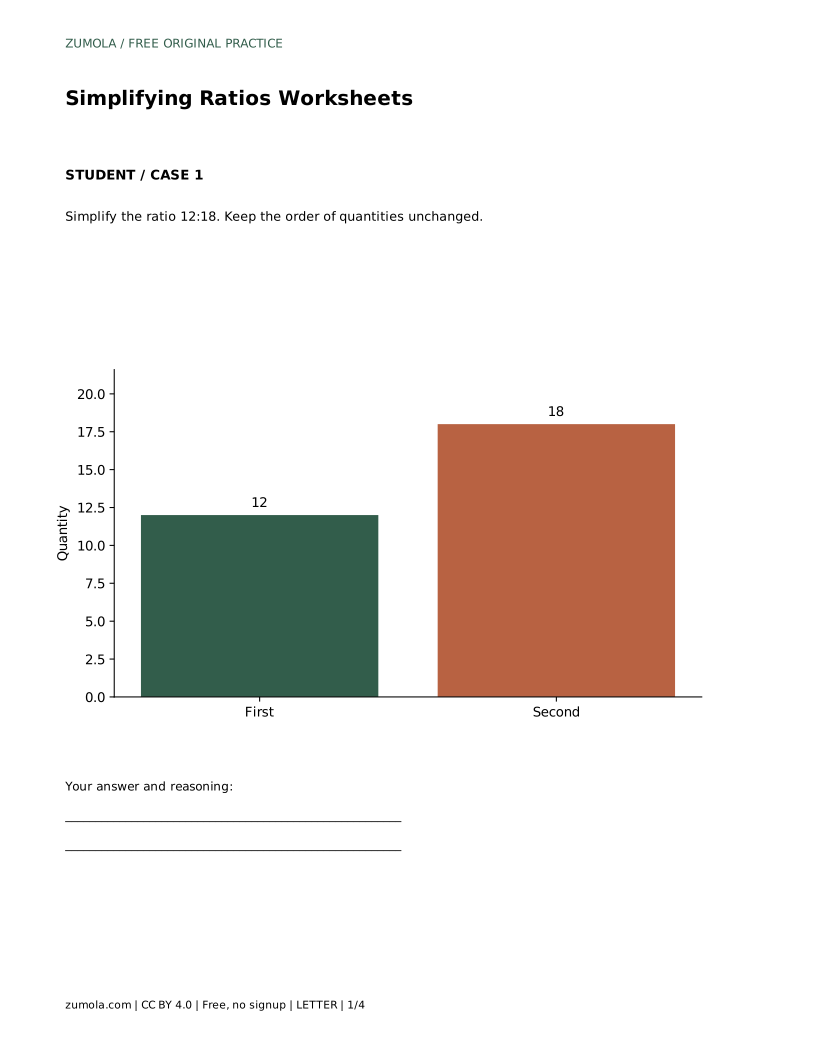
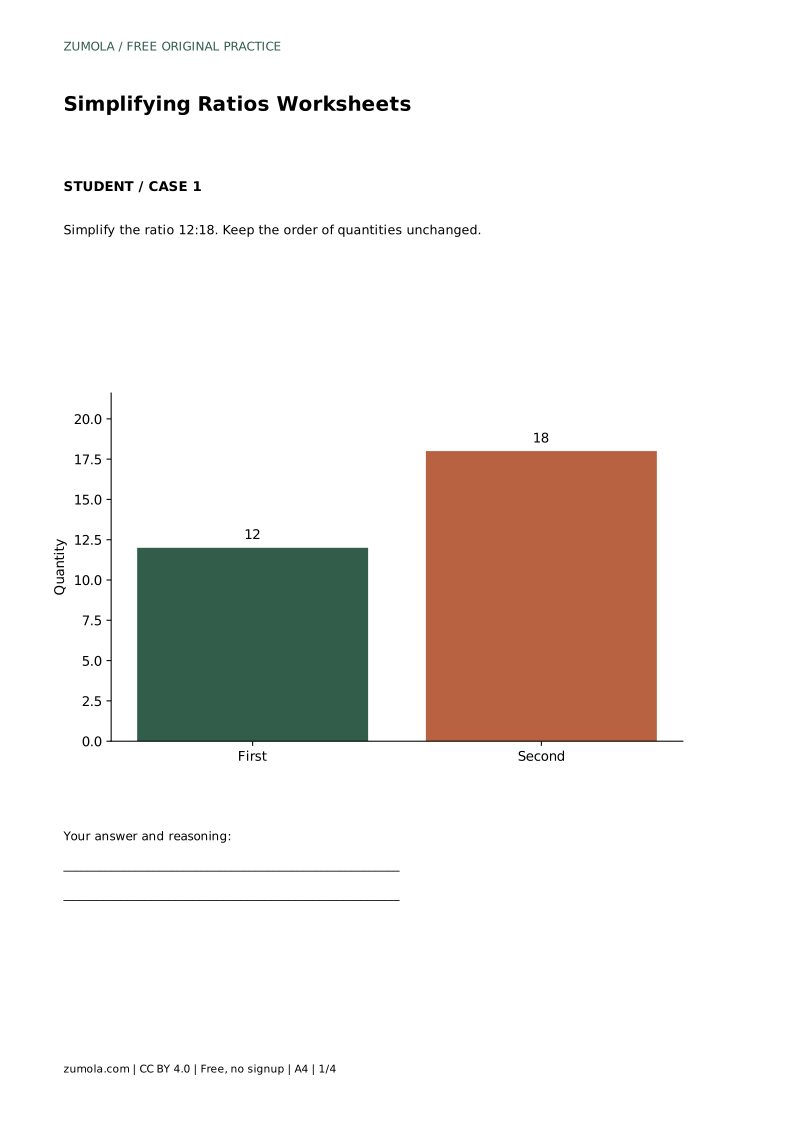
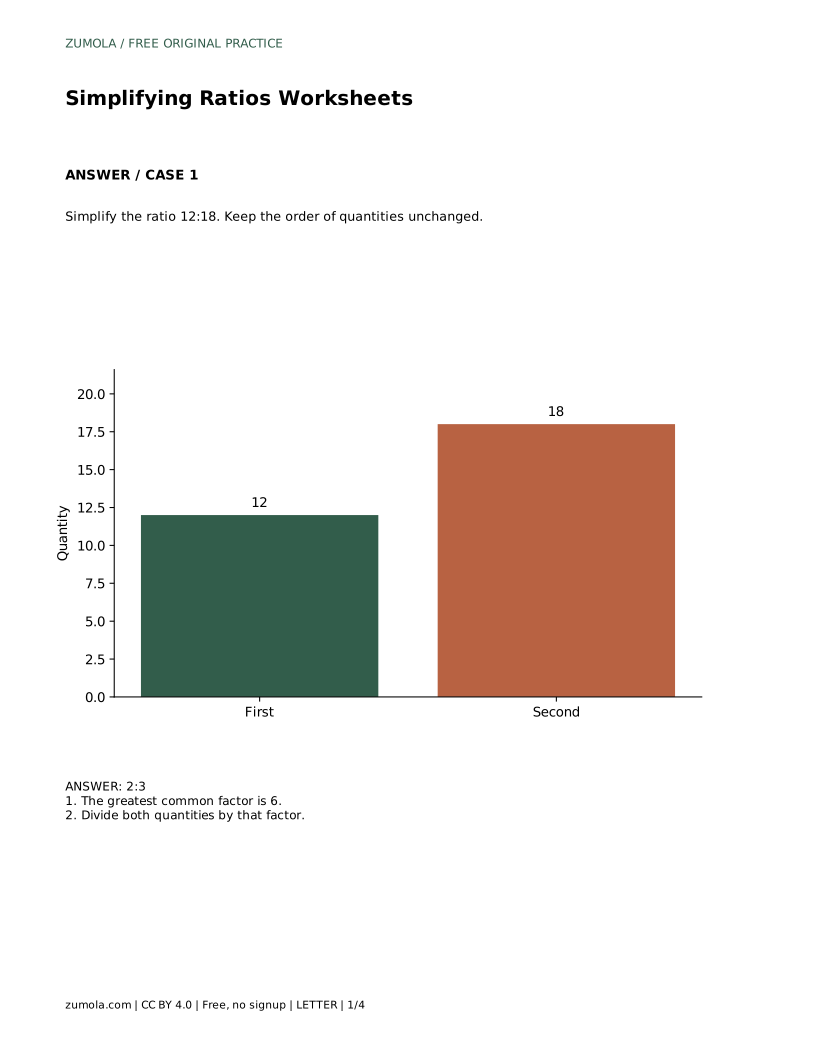
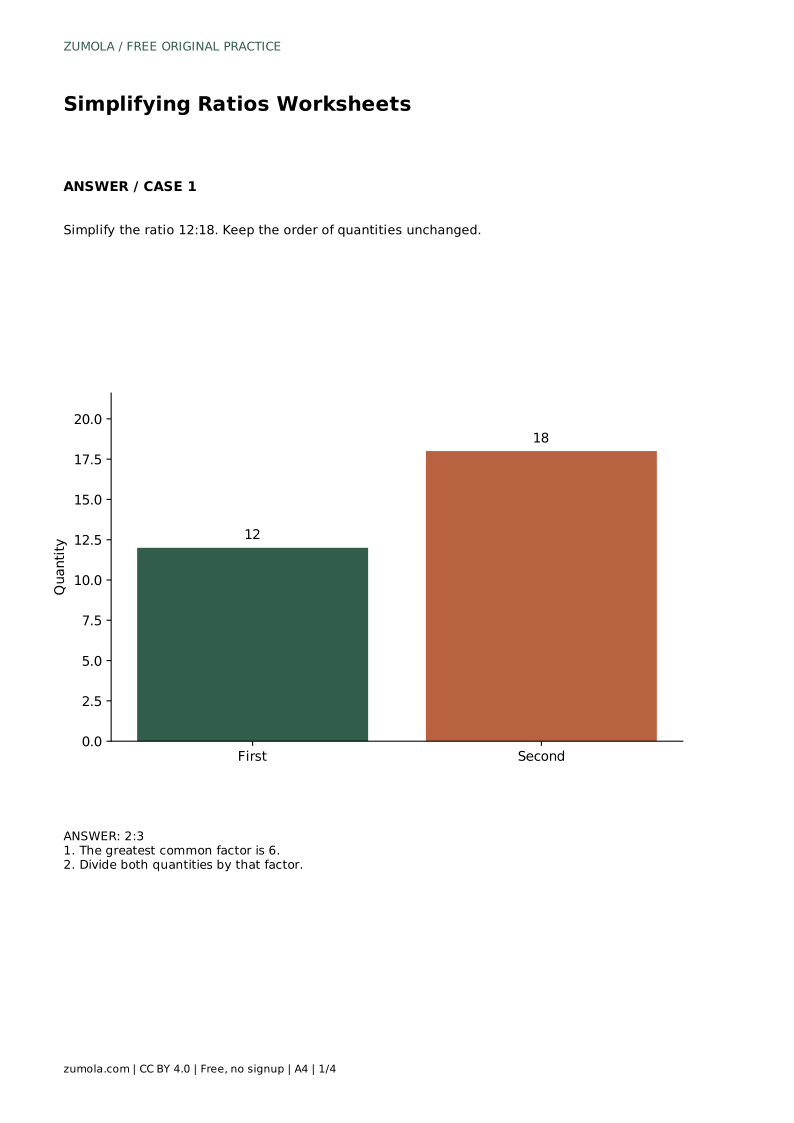
A ratio such as 12:18 compares a first quantity of 12 with a second quantity of 18. Simplifying means replacing both numbers with smaller whole numbers that describe the same comparison. The value of the ratio is the quotient of the first quantity divided by the second, so 12:18 has the same value as 2:3 because 12 divided by 18 equals 2 divided by 3.
The order matters. The ratio 12:18 is not the same comparison as 18:12, even though both simplify to whole-number pairs. When you simplify, divide the first quantity by a factor and the second quantity by that same factor. Never swap the positions to make the numbers look tidier.
The greatest common factor is the largest whole number that divides both quantities with no remainder. For 12 and 18, the factors of 12 are 1, 2, 3, 4, 6, and 12; the factors of 18 are 1, 2, 3, 6, 9, and 18. The largest shared factor is 6. Dividing 12 by 6 gives 2, and dividing 18 by 6 gives 3, so the simplified ratio is 2:3.
You can also build toward the greatest common factor in stages. Dividing both quantities by 2 and then by 3 reaches the same result as dividing once by 6. Staged division is useful when the shared factor is not obvious, but the final pair should have no common factor other than 1. If both simplified quantities still share a factor, the ratio is not fully simplified.
Printable sheets work best when each item asks for one clear action: simplify the given ratio and keep the order unchanged. A useful sheet includes ratios with different greatest common factors so learners must actually find the factor rather than assume every answer divides by the same number. Leave space beside each item for the factor and the division, not just the final pair.
A reliable check is to compare the quotient of the original quantities with the quotient of the simplified quantities. For 12:18, 12 divided by 18 equals two-thirds; for 2:3, 2 divided by 3 also equals two-thirds. Equal quotients confirm the comparison is unchanged. A second check is to multiply both simplified quantities by the factor you divided by and recover the original pair.
Watch for ratios where one quantity is a factor of the other, such as 6:18, which simplifies to 1:3. Also watch for ratios that are already simplified, such as 5:7, where the only shared factor is 1. Not every worksheet item will shrink; recognizing an already-simplified ratio is part of the skill.
Simplify the ratio 12:18. Keep the order of quantities unchanged.
2:3 The greatest common factor is 6. Divide both quantities by that factor.
No. Dividing both quantities by the same nonzero factor keeps the comparison the same, so the ratio value is unchanged.
The ratio is already simplified. Write it as given, keeping the order unchanged.
No. Subtraction changes the comparison. Simplifying requires dividing both quantities by the same factor.
All math worksheets · Free coordinate paper
Original resources · CC BY 4.0 · Free for personal and classroom use with attribution.