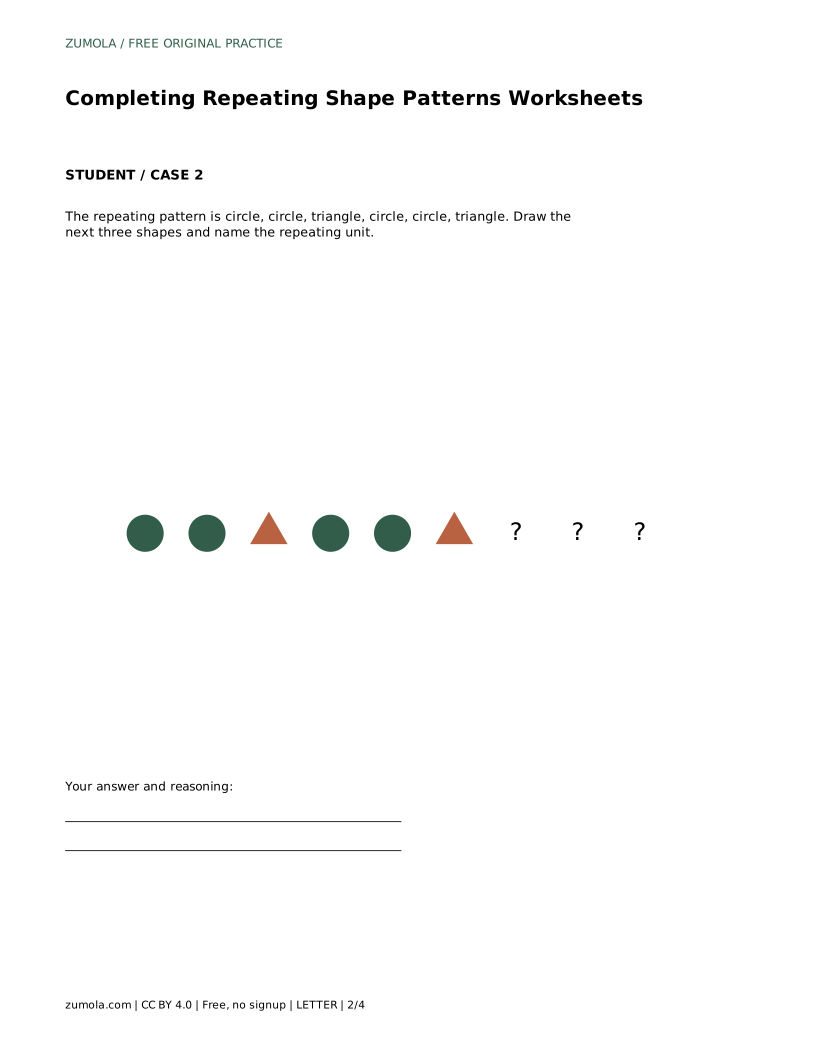
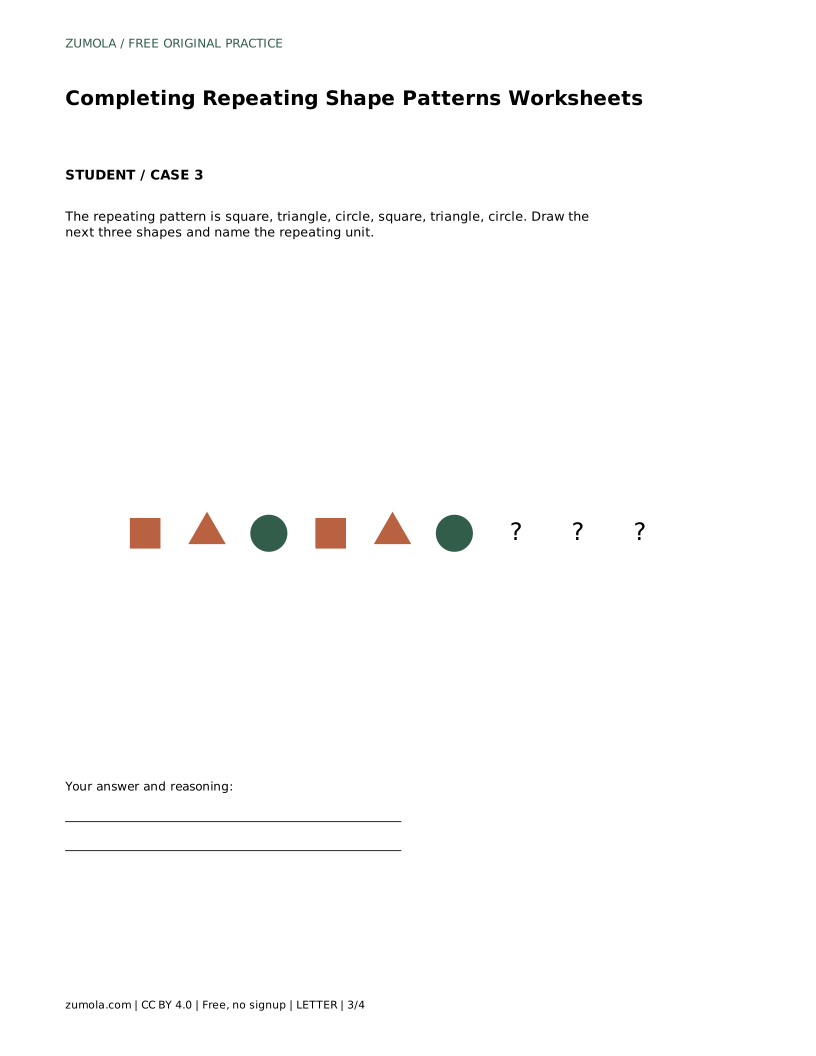
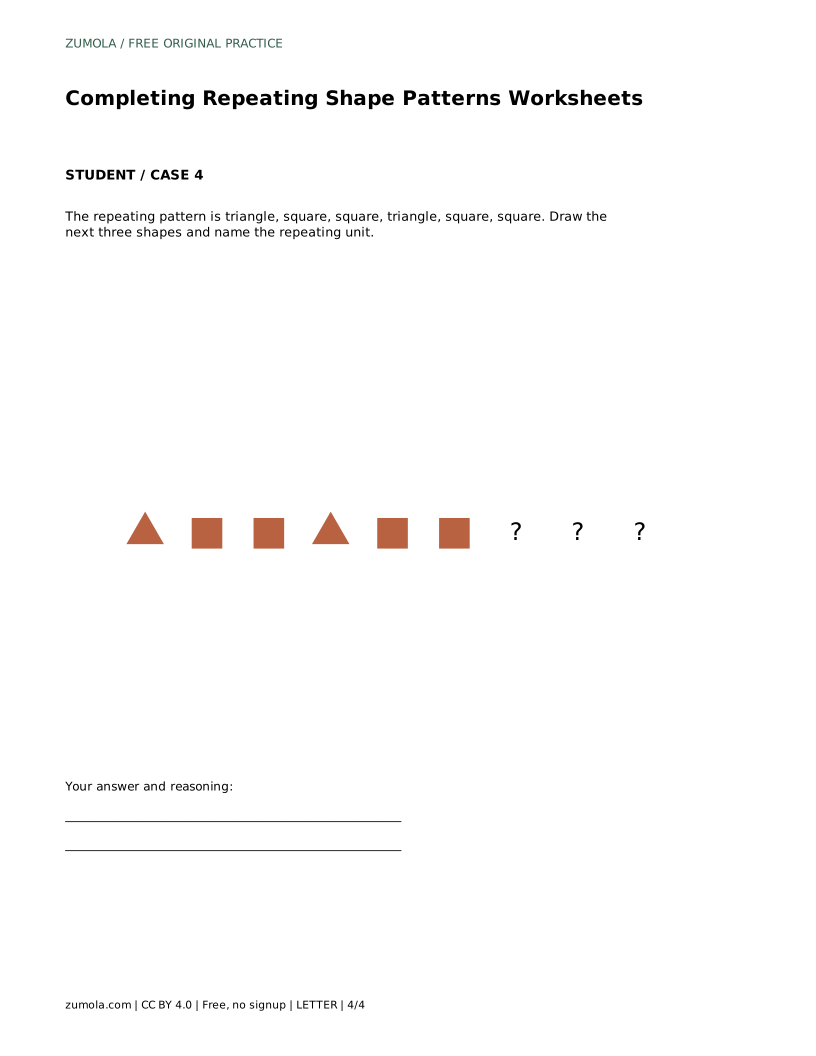
Reference diagrams
LETTER · Download PDF
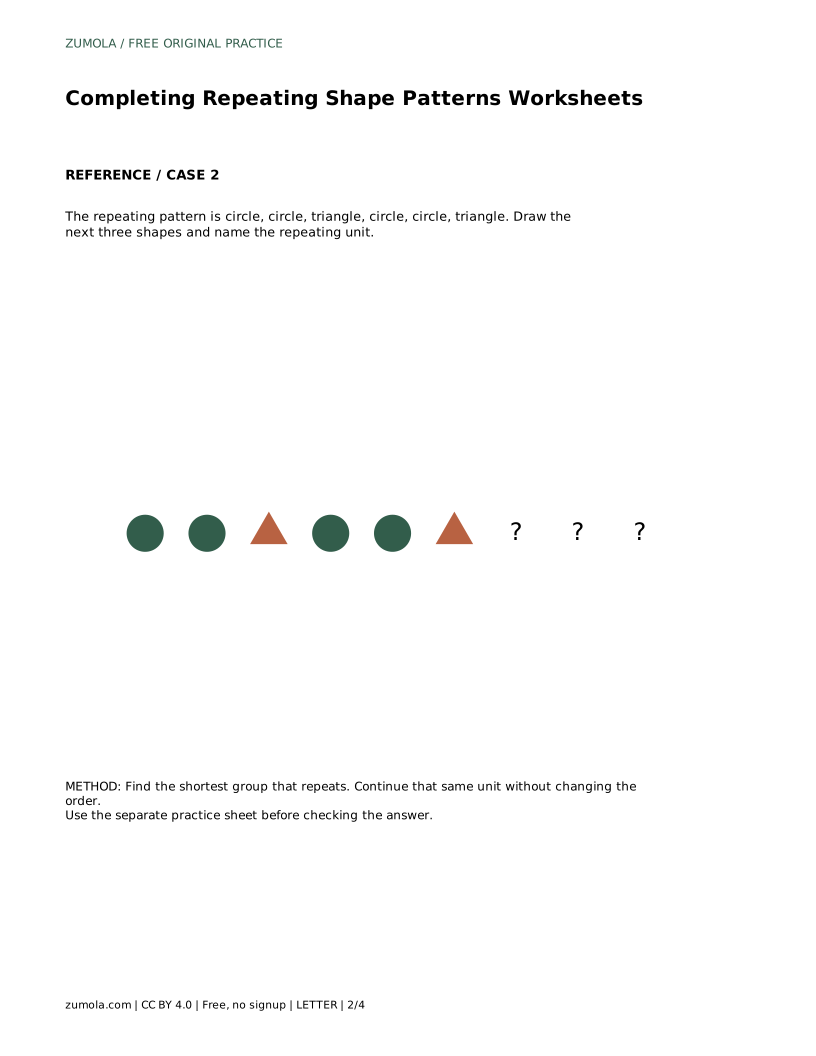
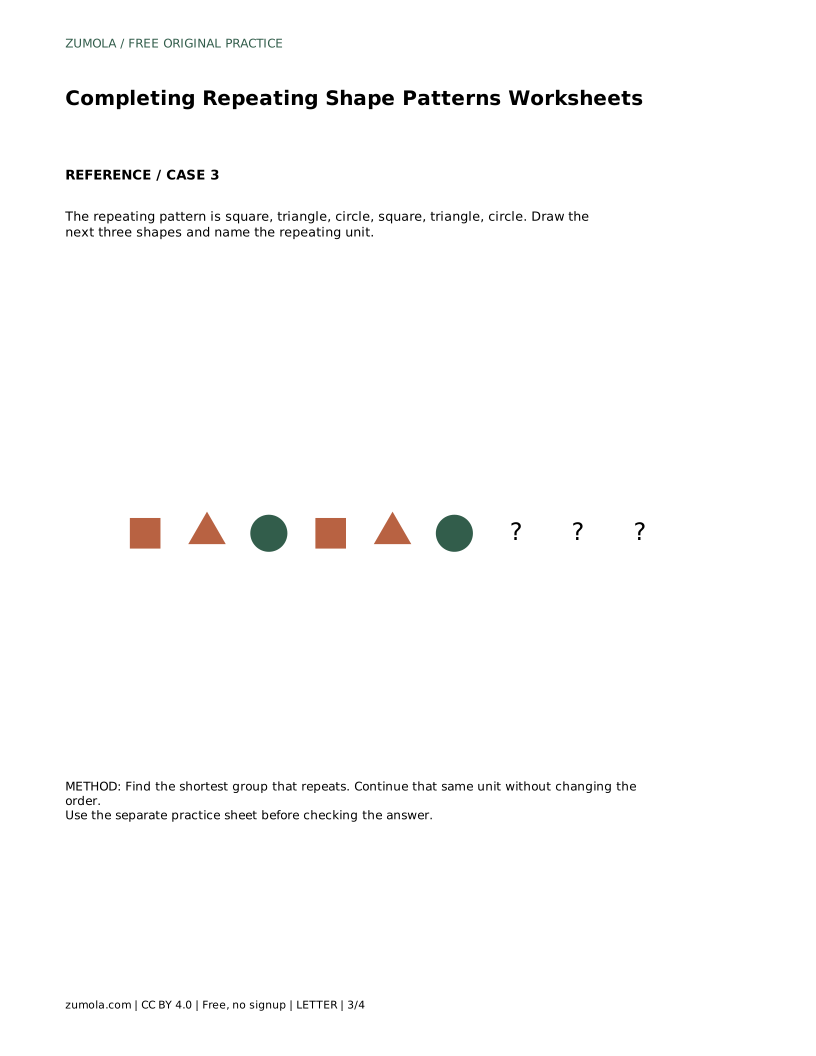
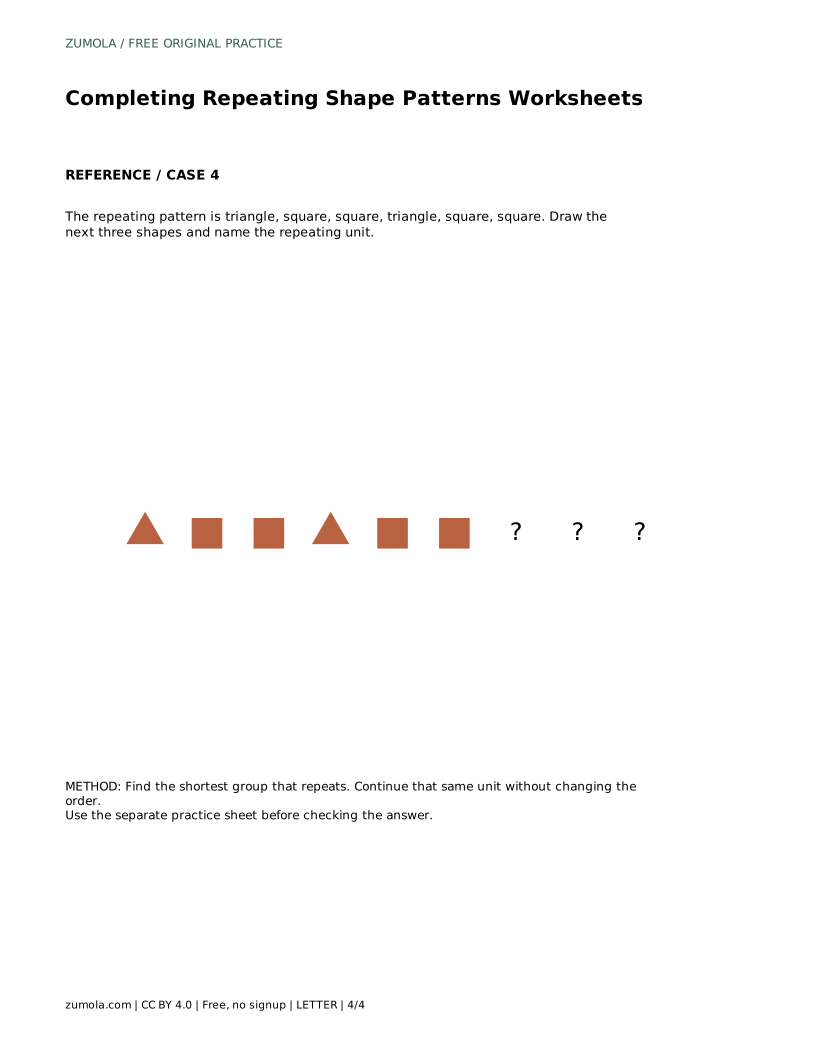
A4 · Download PDF
Free original resources
Teach students to find the shortest repeating unit in a shape sequence, then continue it in order. Includes a worked example, common mistakes, and a drawing rubric.
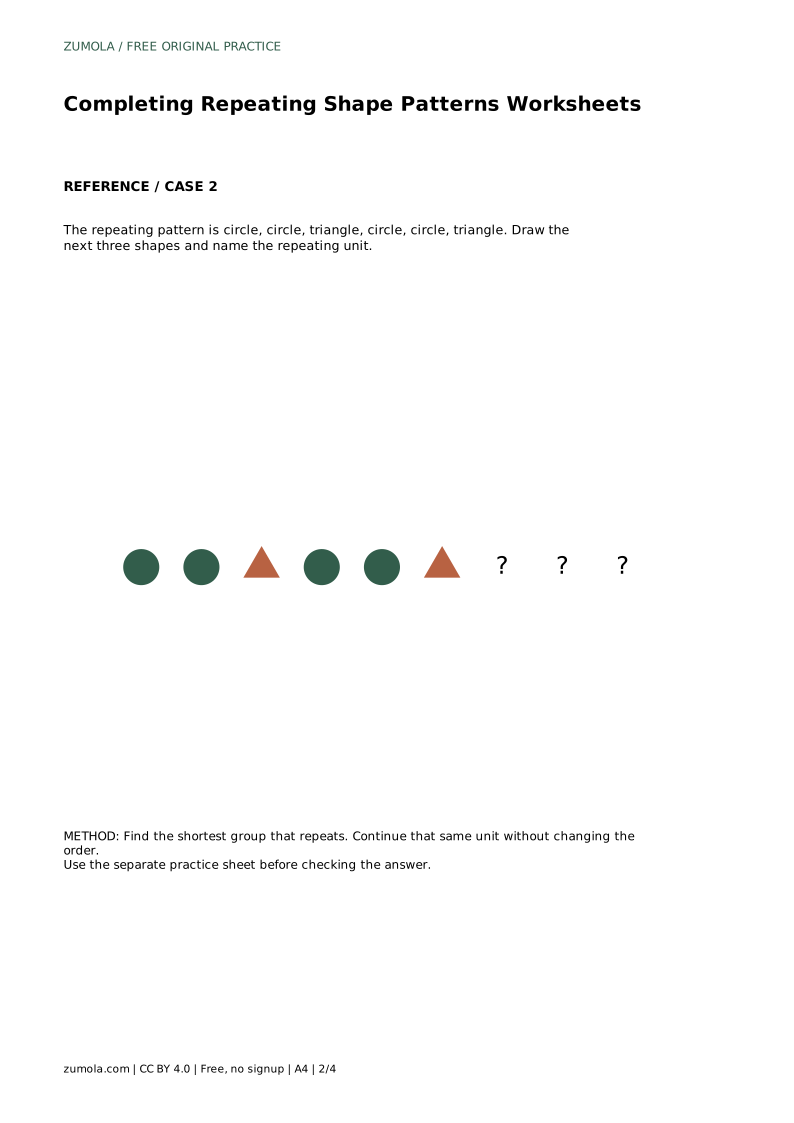
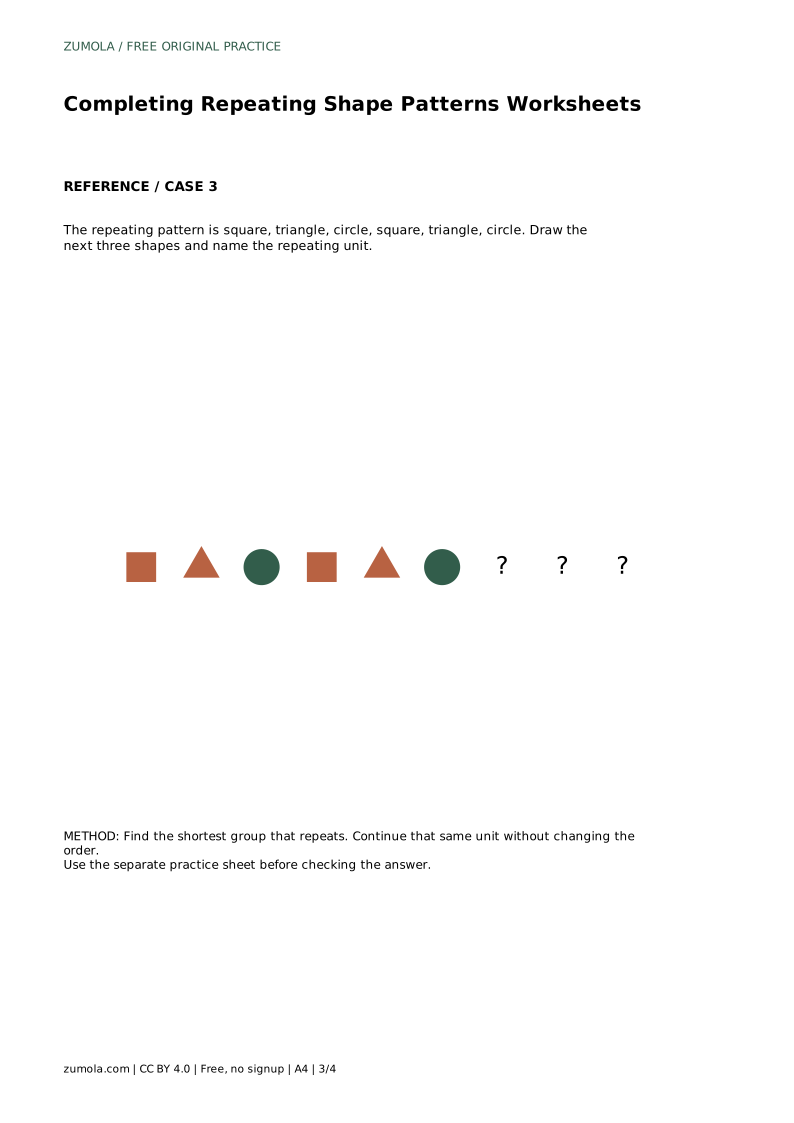
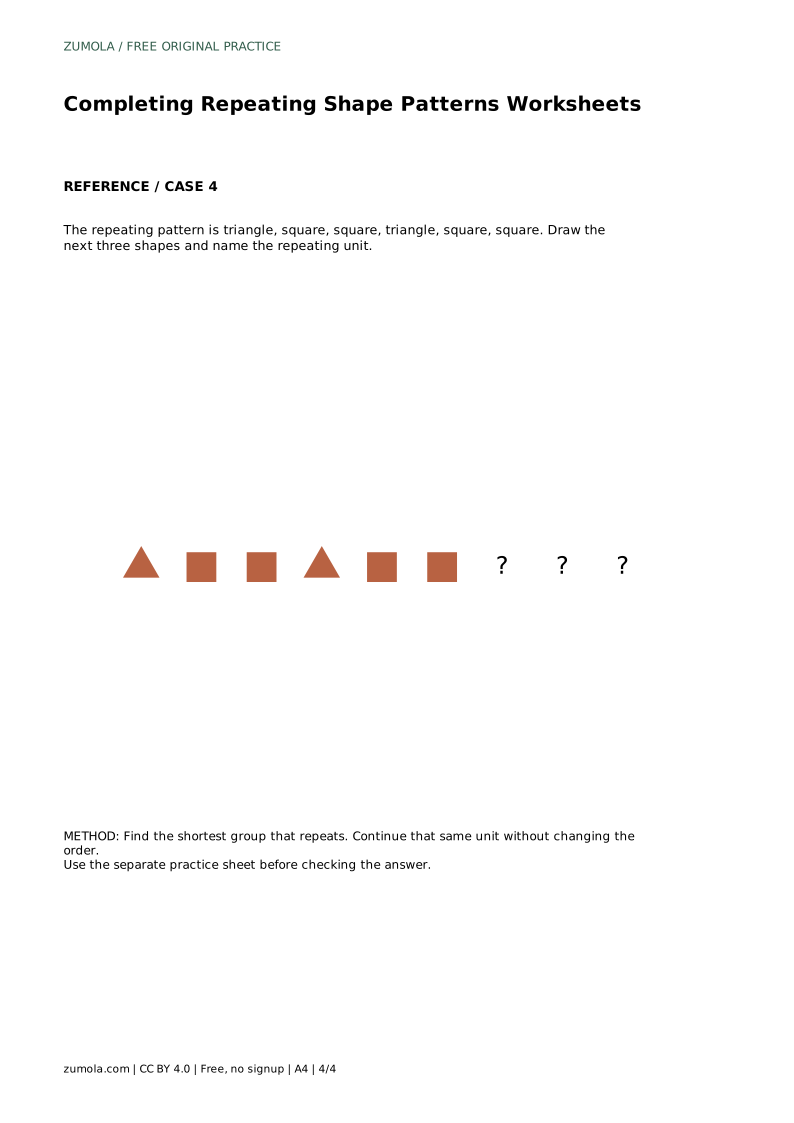
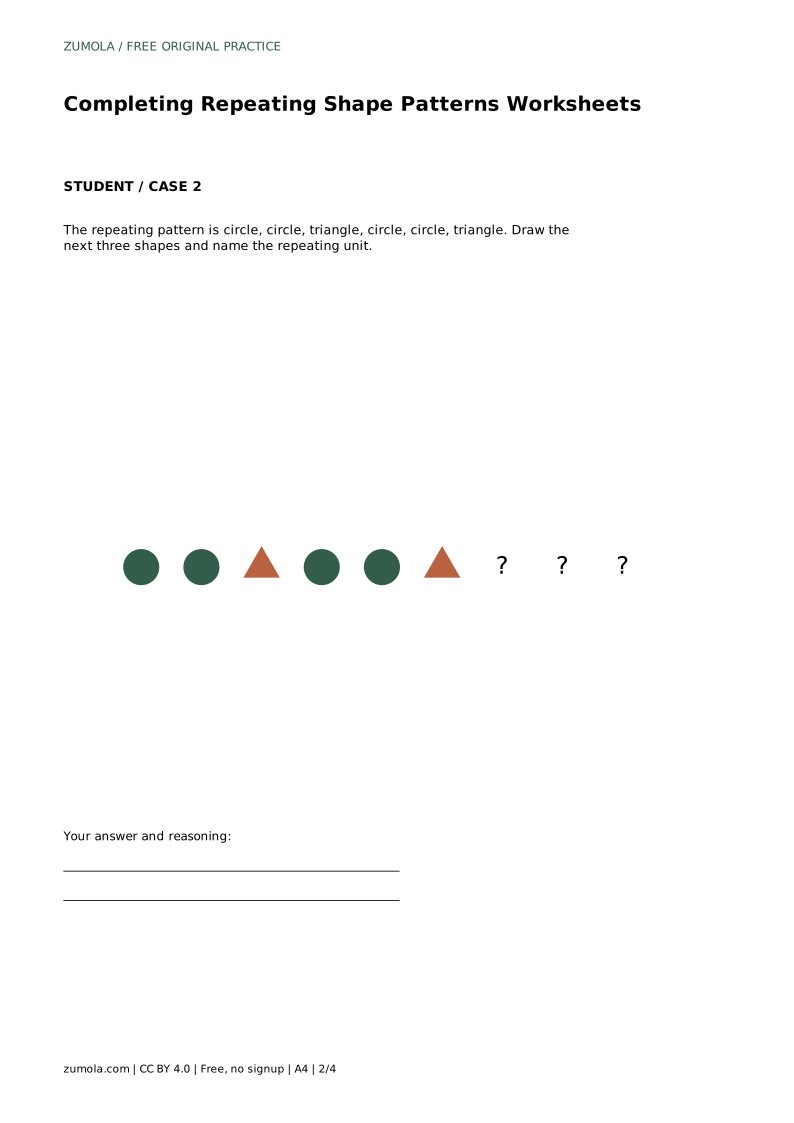
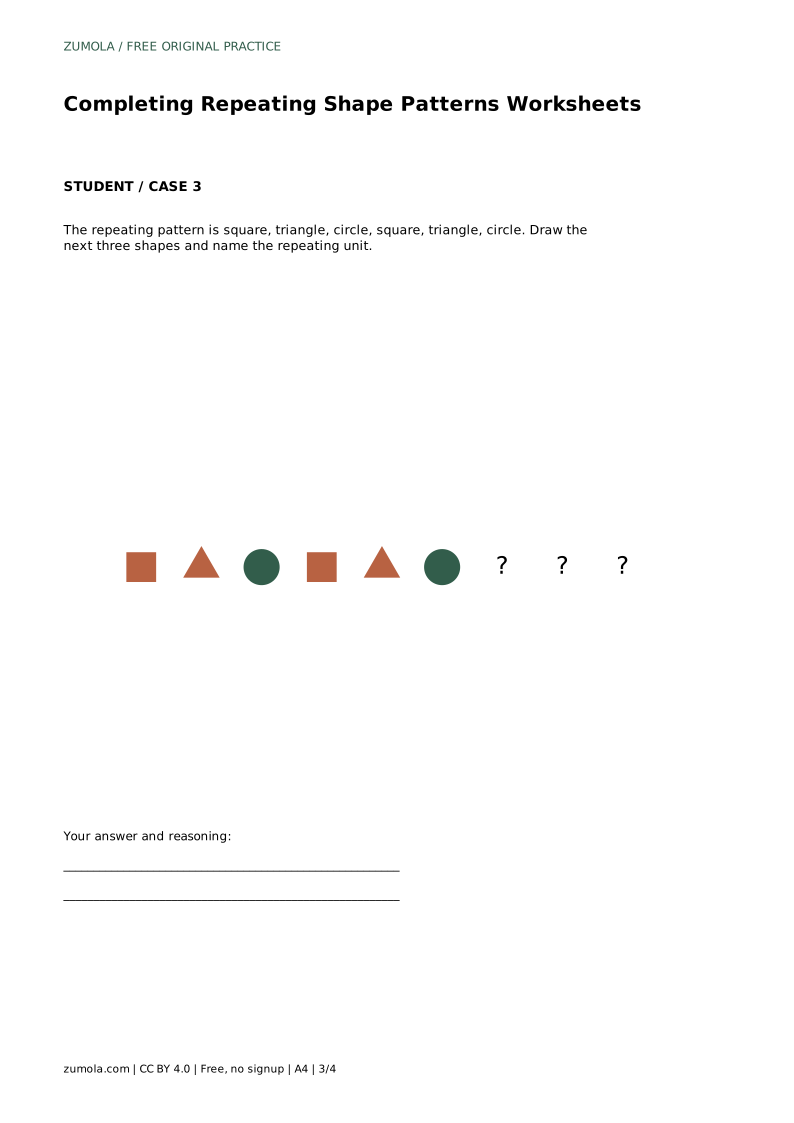
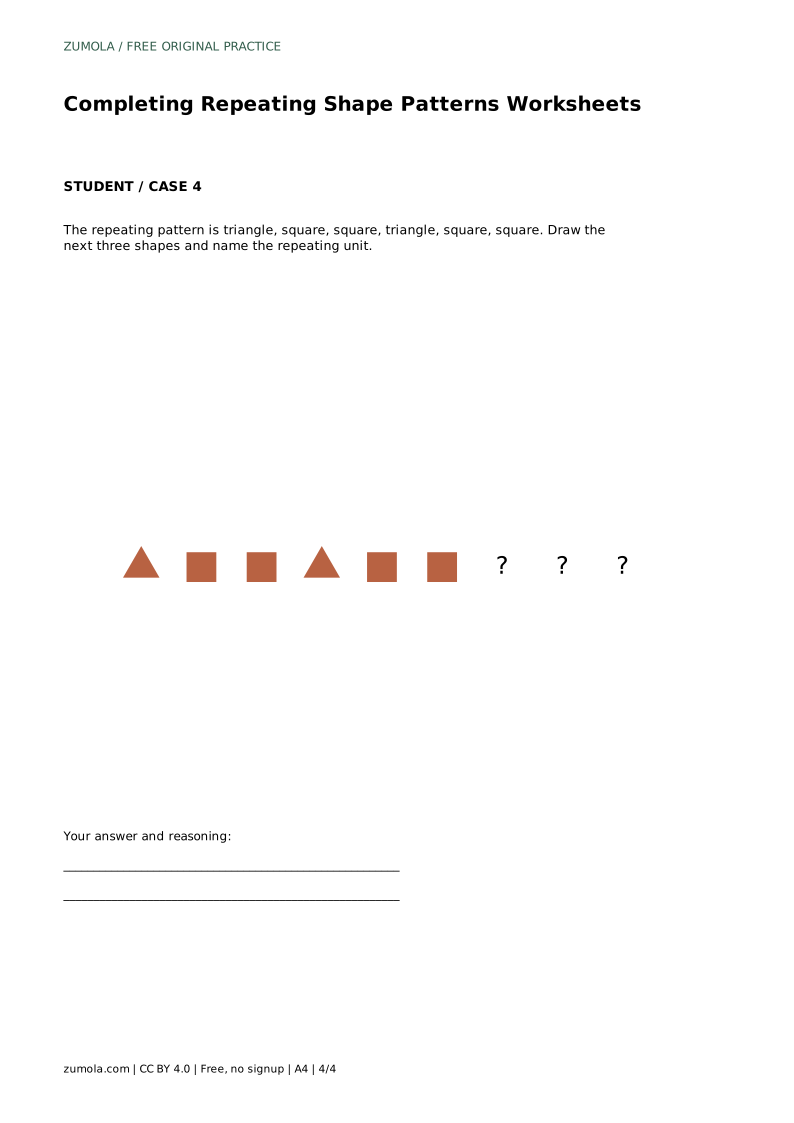
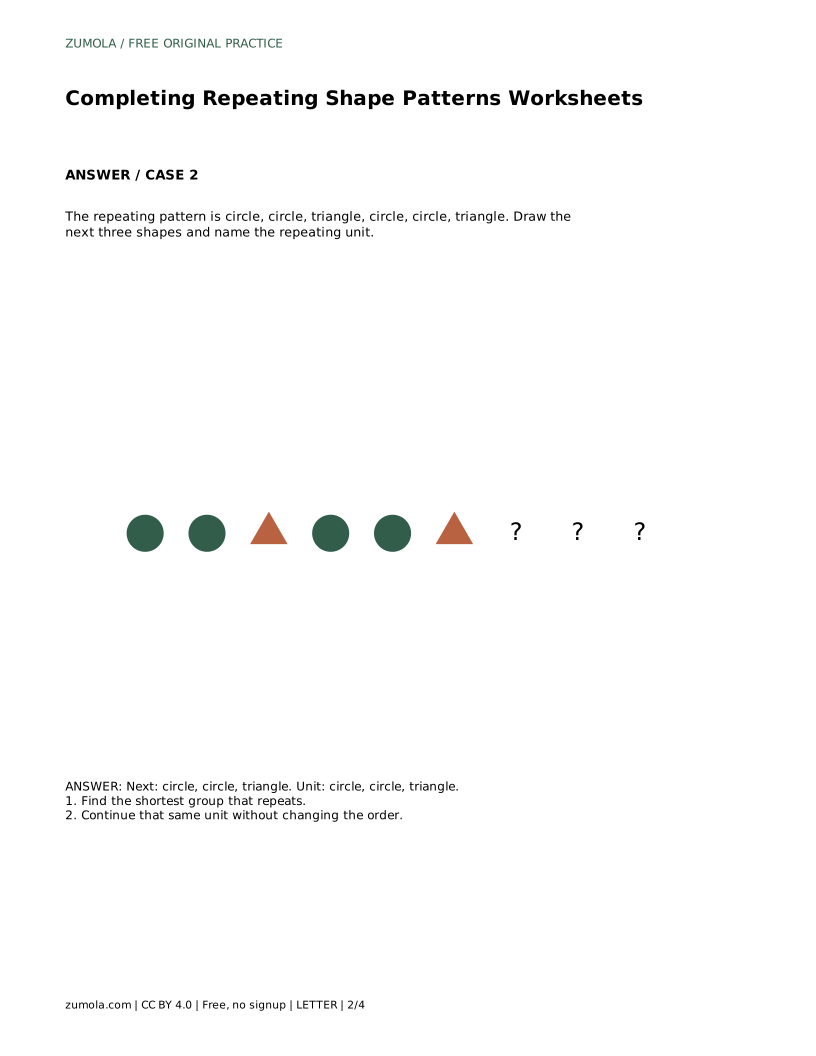
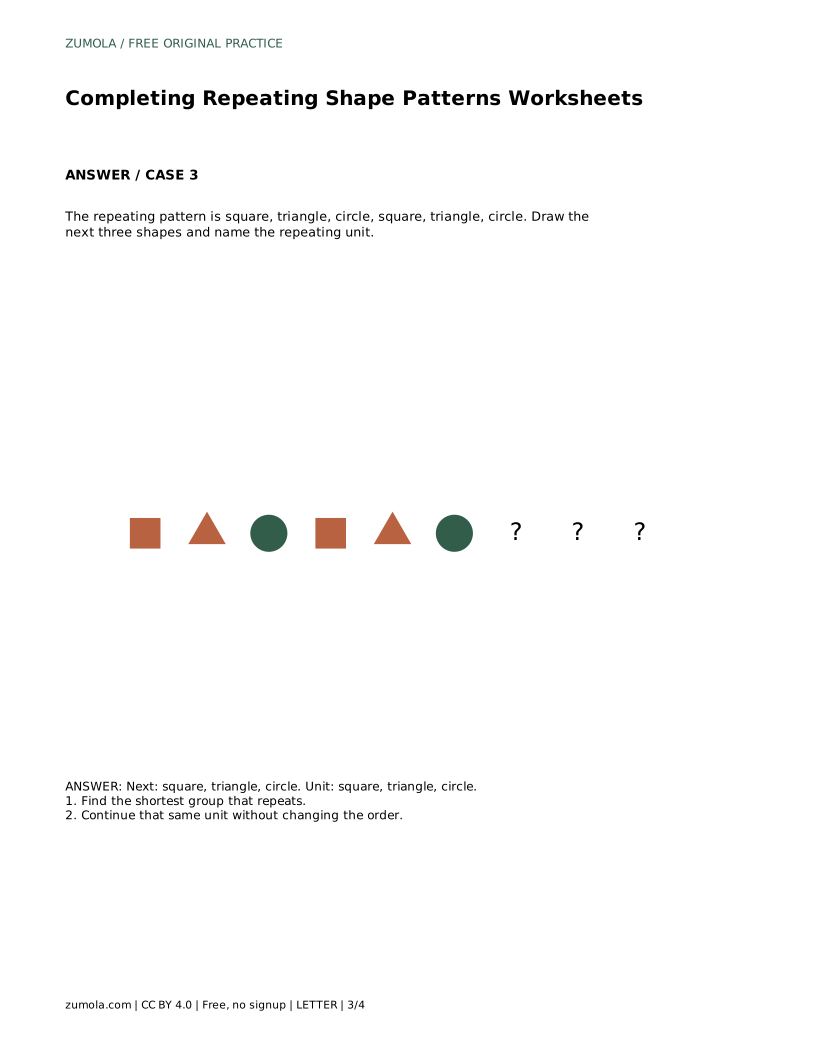
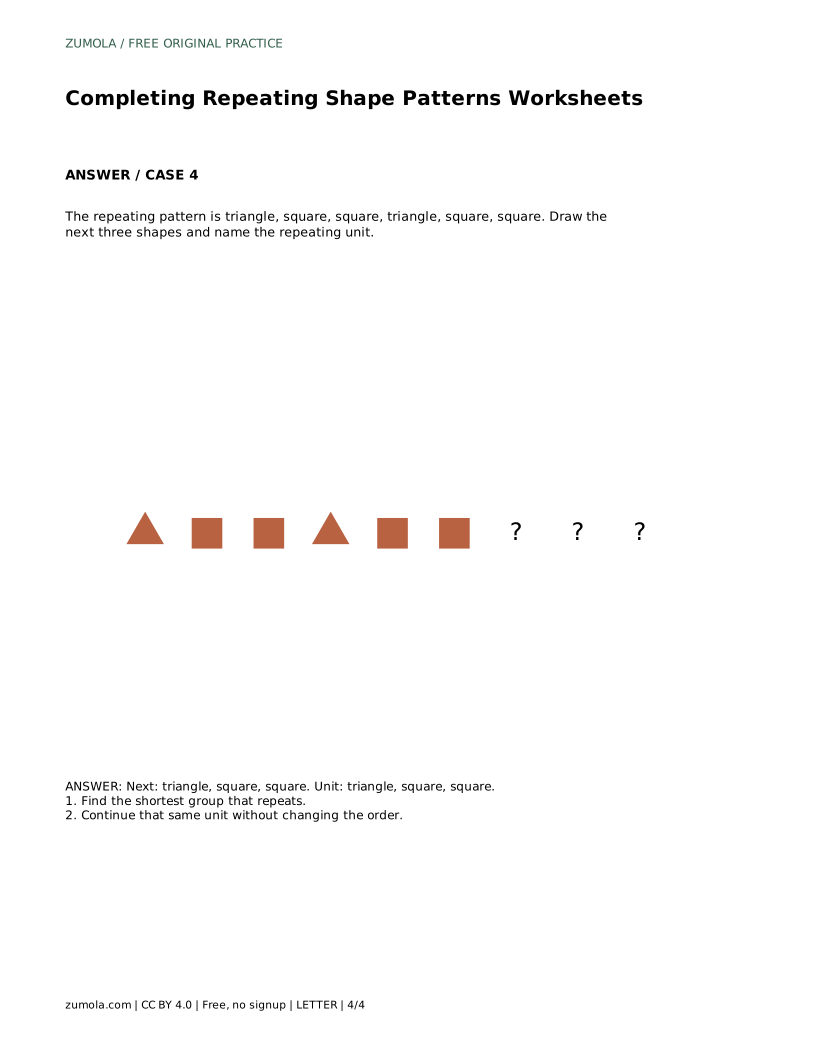
Four original cases, with reference diagrams, practice sheets and worked answers. Everything is free; no signup required.
LETTER · Download PDF
A4 · Download PDF
LETTER · Download PDF
A4 · Download PDF
LETTER · Download PDF
A4 · Download PDF
Use A4 or US Letter to match your printer. Use the stated values and conditions to solve each exercise; diagrams are not physical measuring rulers.
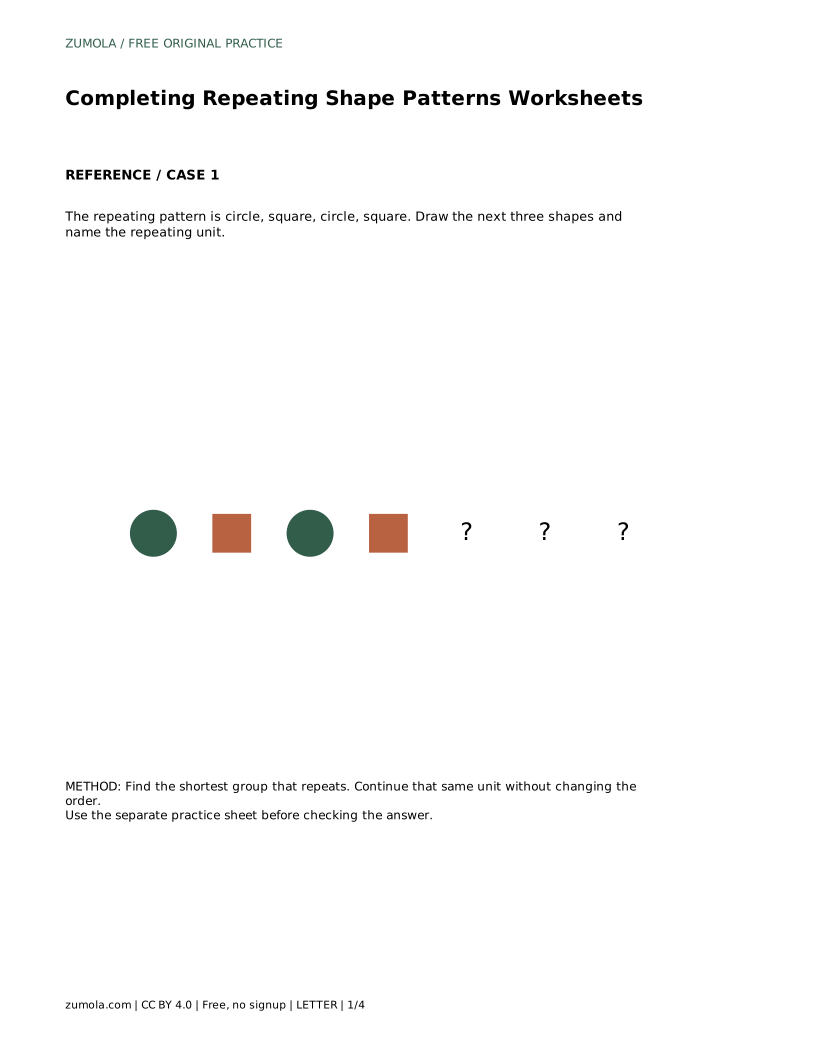
Repeating shape patterns ask one clear question: what comes next? The reliable way to answer is to find the shortest group of shapes that repeats, then continue that same group without changing its order. This page explains that method step by step, using a simple circle-and-square sequence as the worked example. It also covers how to check your answer and how to judge pattern drawings fairly, since more than one neat drawing can be correct.
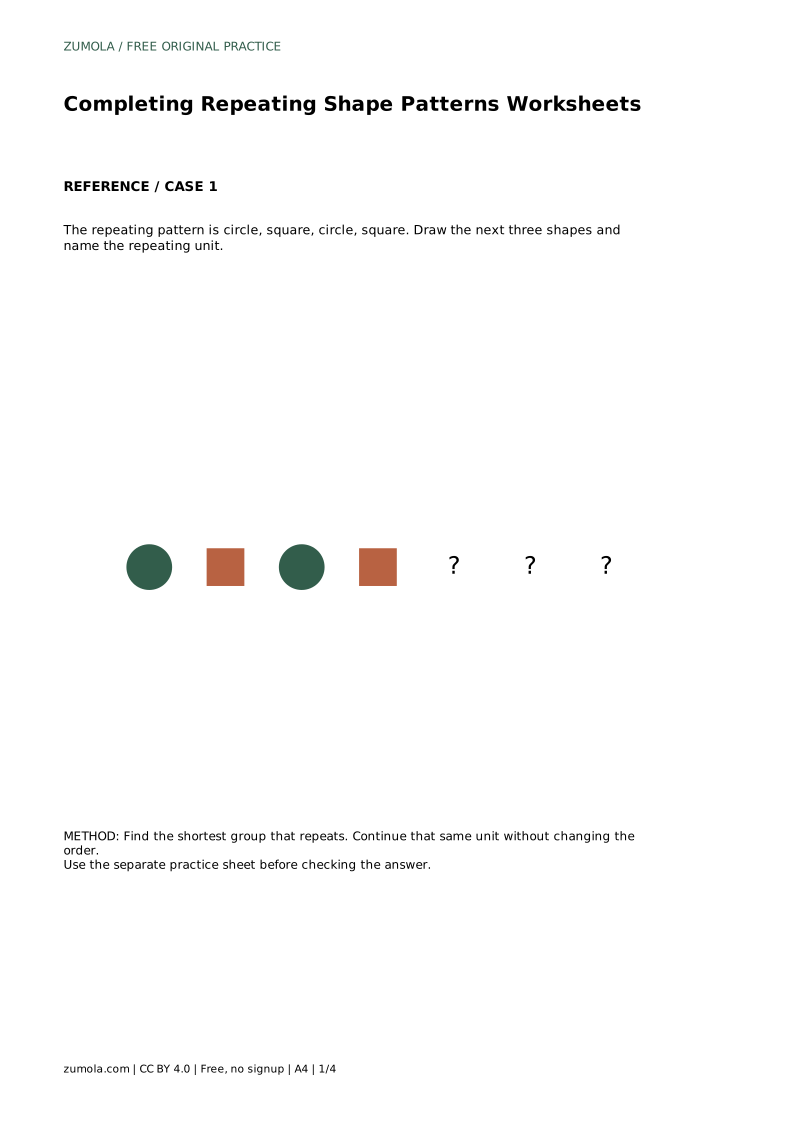
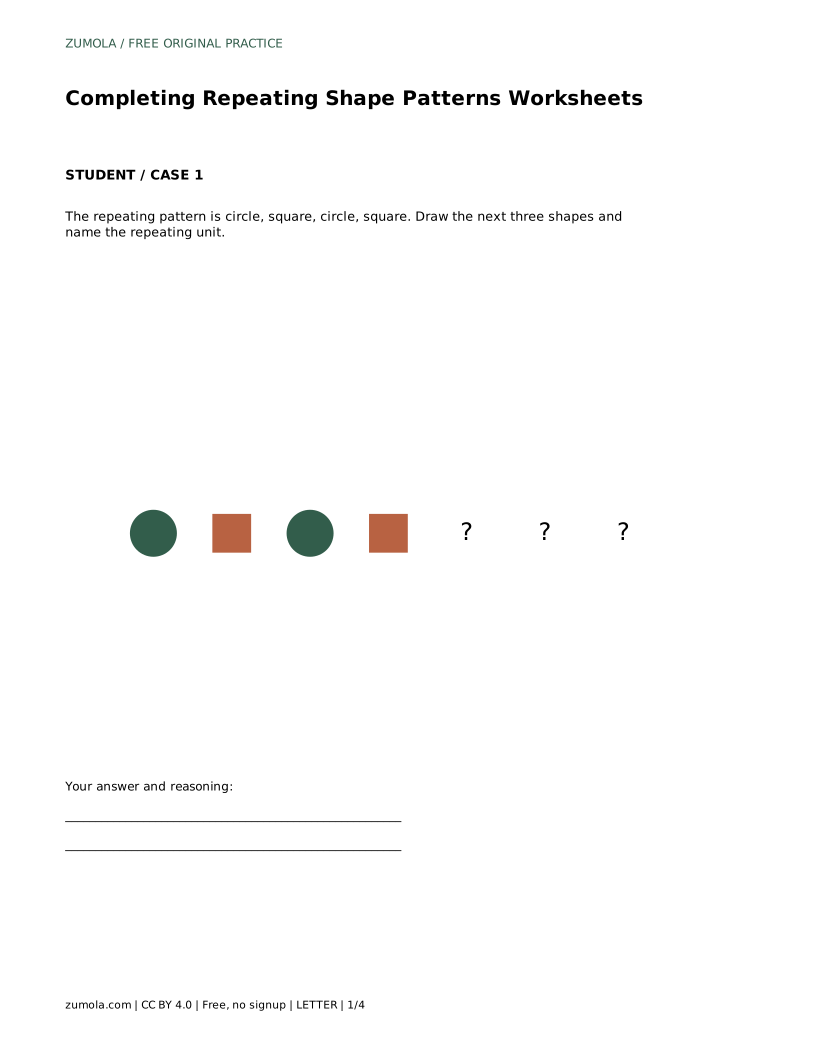
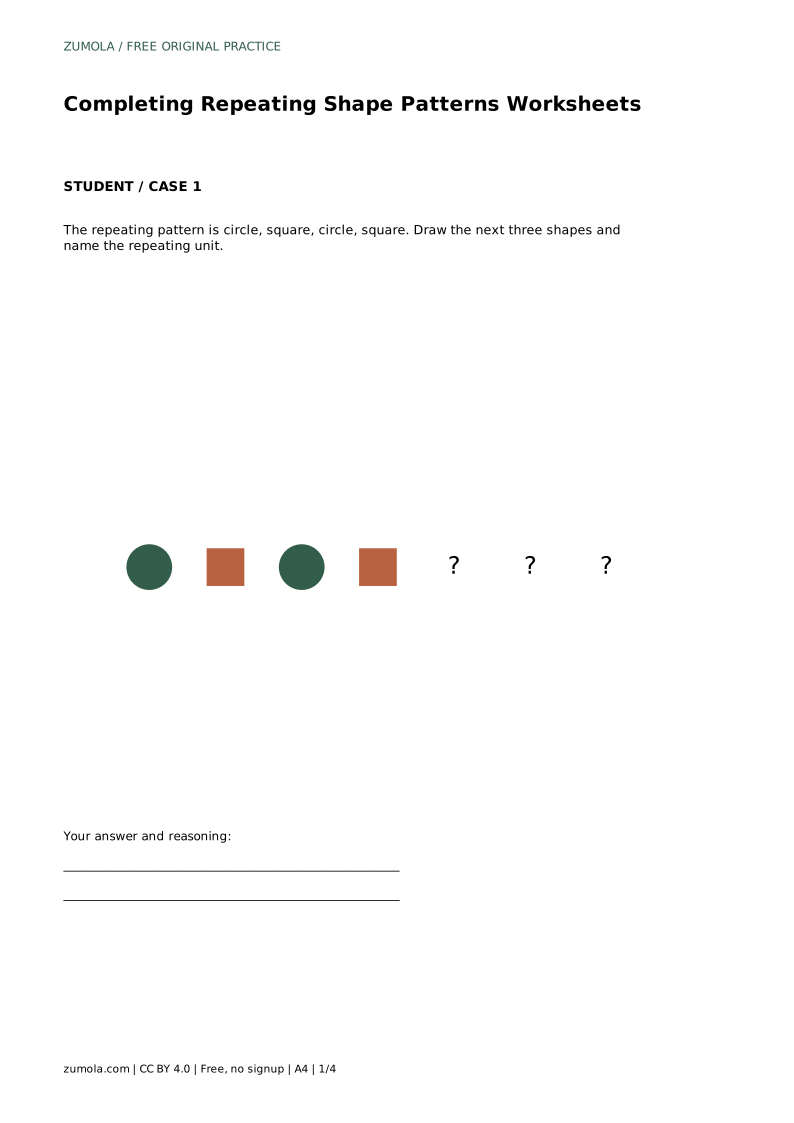
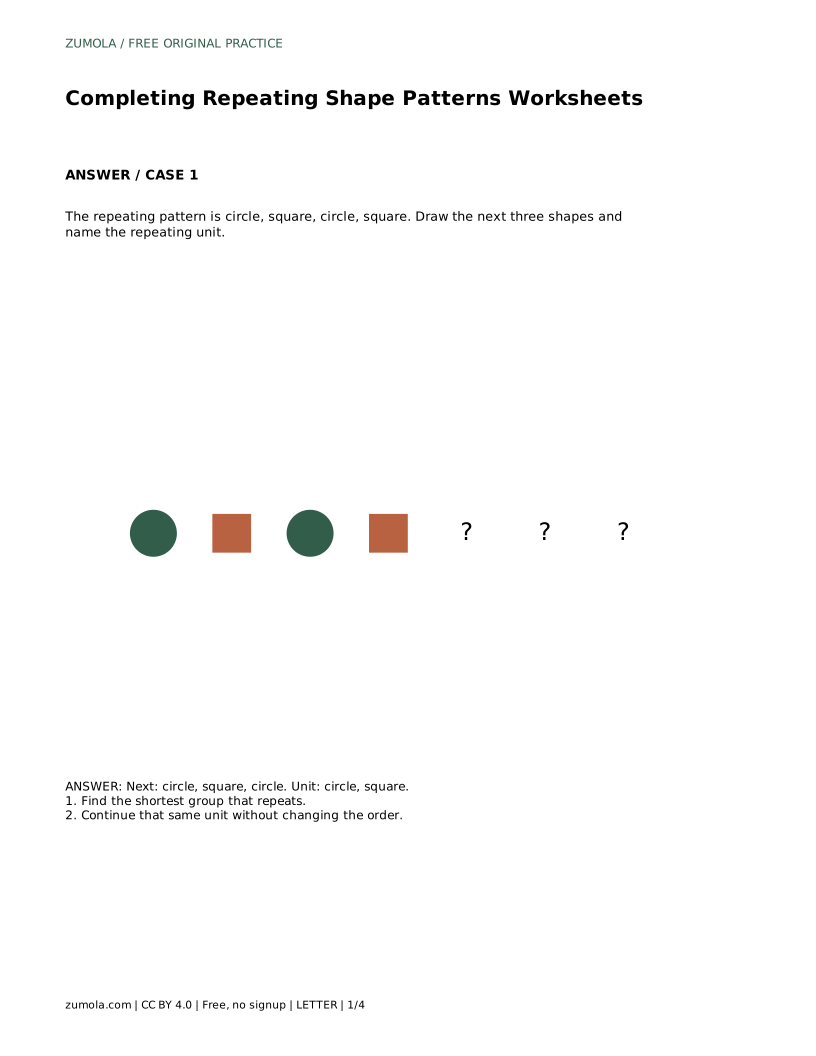
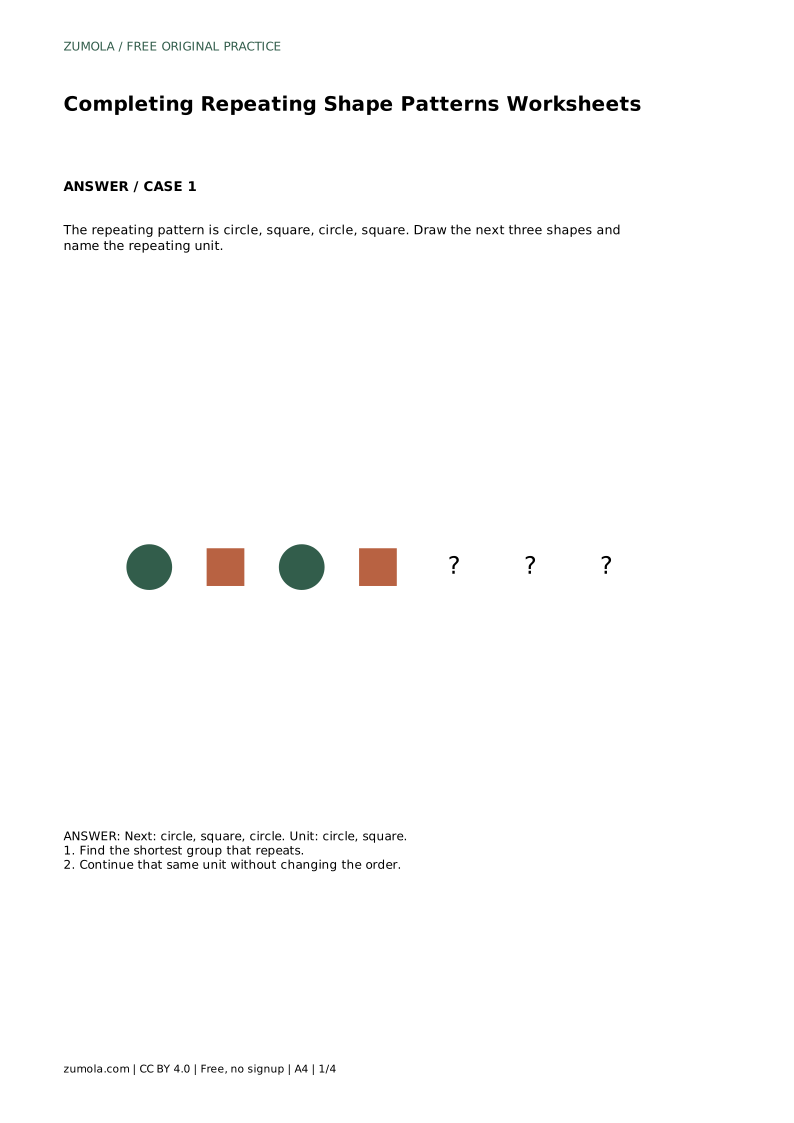
Before drawing anything, read the whole visible sequence from left to right. Look for the smallest group of shapes that, when repeated, rebuilds the entire sequence exactly. That group is the repeating unit. In the sequence circle, square, circle, square, the shortest group that repeats is circle, square. The unit has two shapes, and the sequence shows that unit twice.
Size alone does not decide the unit. A unit of four shapes might repeat, but if a smaller group also rebuilds the sequence, the smaller group is the true unit. Always test the shortest candidate first, then check it against every position in the sequence.
Once the unit is known, the next shapes come from continuing that unit in the same order. Do not restart at the beginning unless the unit has genuinely ended. Count how many shapes you need, then move through the unit that many times, wrapping back to its first shape when you reach the end.
For the sequence circle, square, circle, square, the unit is circle, square. The next three shapes are circle, square, circle. Notice that the third new shape wraps back to the start of the unit. Keeping the order fixed is what makes the continuation correct.
A quick check catches most errors. Join your new shapes onto the original sequence and see whether the repeating unit still holds across the join. If the unit is circle, square, the extended sequence should read circle, square, circle, square, circle, square, circle. Every pair should match the unit.
This check also reveals a wrong unit. If you chose square, circle instead, the extended sequence would start with the wrong shape and break at the join. Comparing the join is faster and more reliable than trusting a first guess.
Pattern worksheets usually ask for shapes, not perfect artwork. Draw each shape clearly enough that a reader can tell a circle from a square or a triangle from a square. Keep shapes roughly the same size and spaced evenly so the sequence stays readable. A slightly uneven circle is still a circle.
Because drawings vary, judge pattern work with a rubric rather than a single exact picture. The important criteria are the correct unit, the correct order of new shapes, and clear, identifiable shapes. Neatness supports these but does not replace them.
The repeating pattern is circle, square, circle, square. Draw the next three shapes and name the repeating unit.
Next: circle, square, circle. Unit: circle, square. Find the shortest group that repeats. Continue that same unit without changing the order.
It is the shortest group of shapes that repeats to rebuild the whole sequence. In circle, square, circle, square, the unit is circle, square.
Draw exactly the number the worksheet asks for, continuing the unit in order. If three are requested, draw the next three shapes only.
No. Shapes should be clear and identifiable, with even spacing. Slight differences in size or roundness do not make a pattern wrong.
All math worksheets · Free coordinate paper
Original resources · CC BY 4.0 · Free for personal and classroom use with attribution.