Reference diagrams
LETTER · Download PDF
A4 · Download PDF
Free original resources
Teach conditional probability with a standard 52-card deck. Restrict the sample space, count matching cards, and reduce fractions with clear worked answers.
Four original cases, with reference diagrams, practice sheets and worked answers. Everything is free; no signup required.
LETTER · Download PDF
A4 · Download PDF
LETTER · Download PDF
A4 · Download PDF
LETTER · Download PDF
A4 · Download PDF
Use A4 or US Letter to match your printer. Use the stated values and conditions to solve each exercise; diagrams are not physical measuring rulers.
Conditional probability asks what happens after some information is known. With playing cards, the condition removes cards from consideration before you count. A standard deck here has 52 cards, no jokers, four suits of 13, and face cards are J, Q and K. This page shows how to shrink the sample space, count the cards that satisfy the event, and write the answer as a reduced fraction.
In a conditional probability question, the phrase after 'given that' tells you which cards remain possible. Those remaining cards form the new denominator. The event you are asked about supplies the numerator, but only among cards that survived the condition.
Write the condition as a count, write the event count inside that condition, then divide. Reducing the fraction is the final step, not a separate trick. Keeping the counts visible makes errors easy to spot.
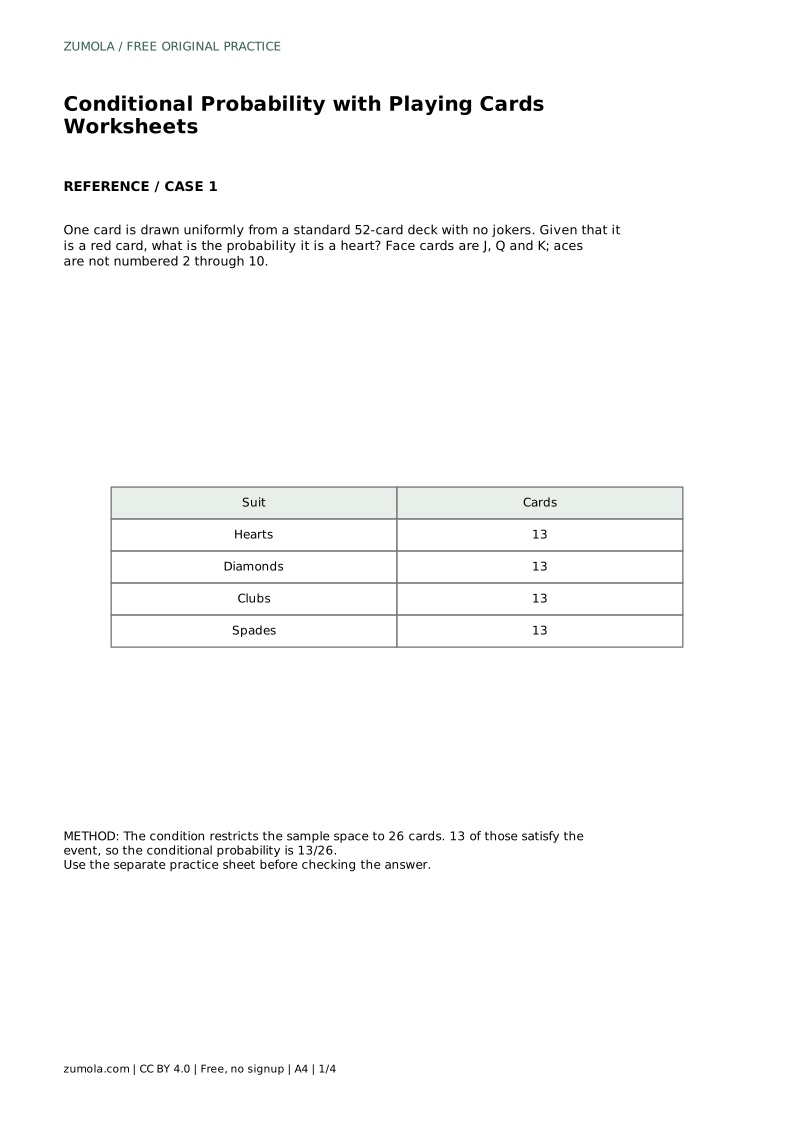
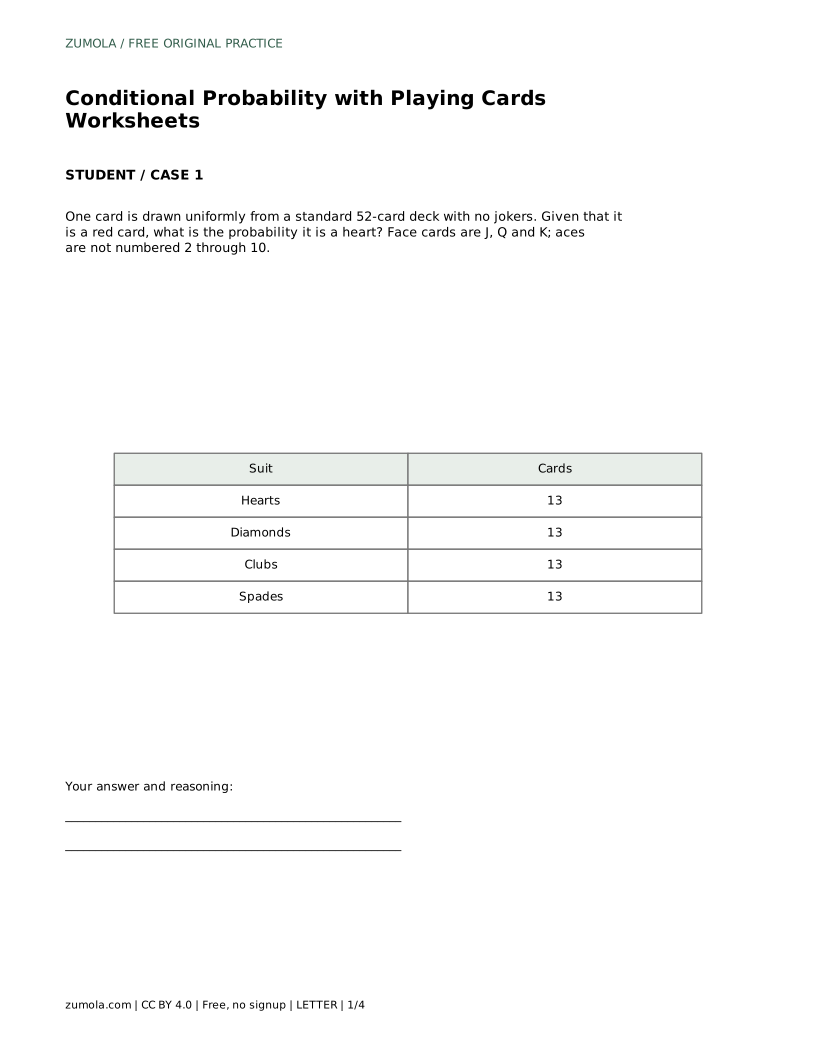
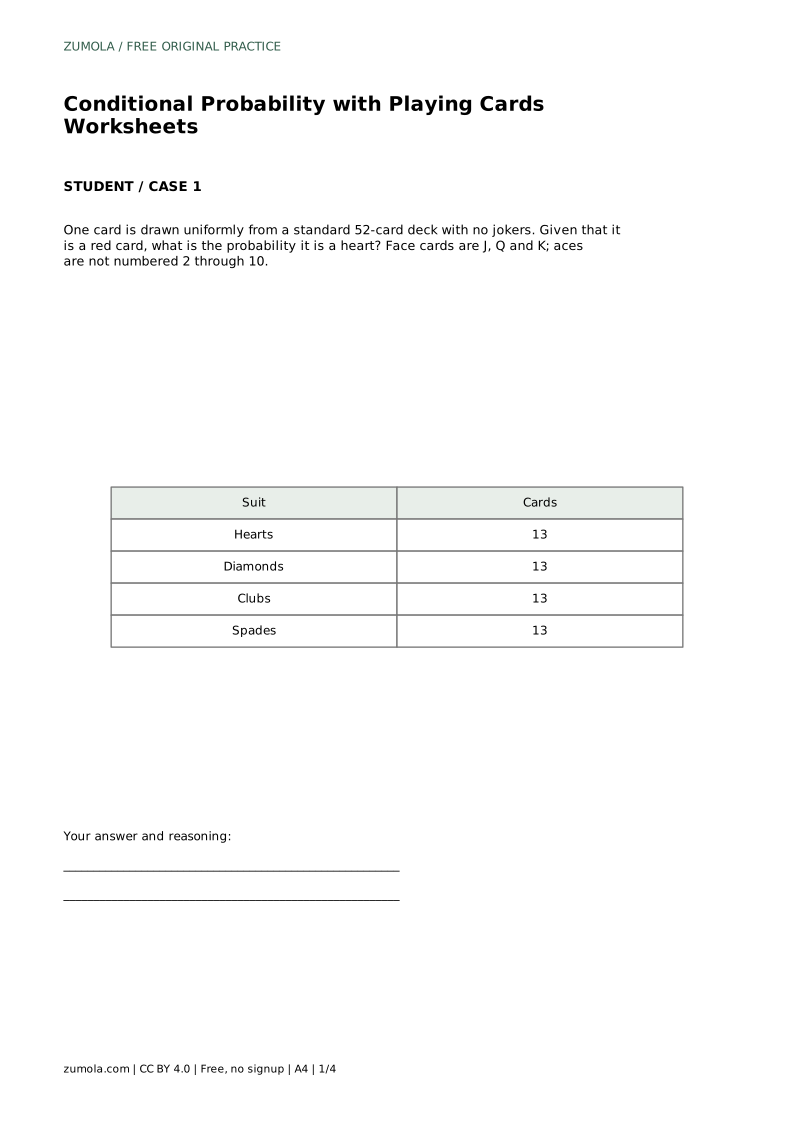
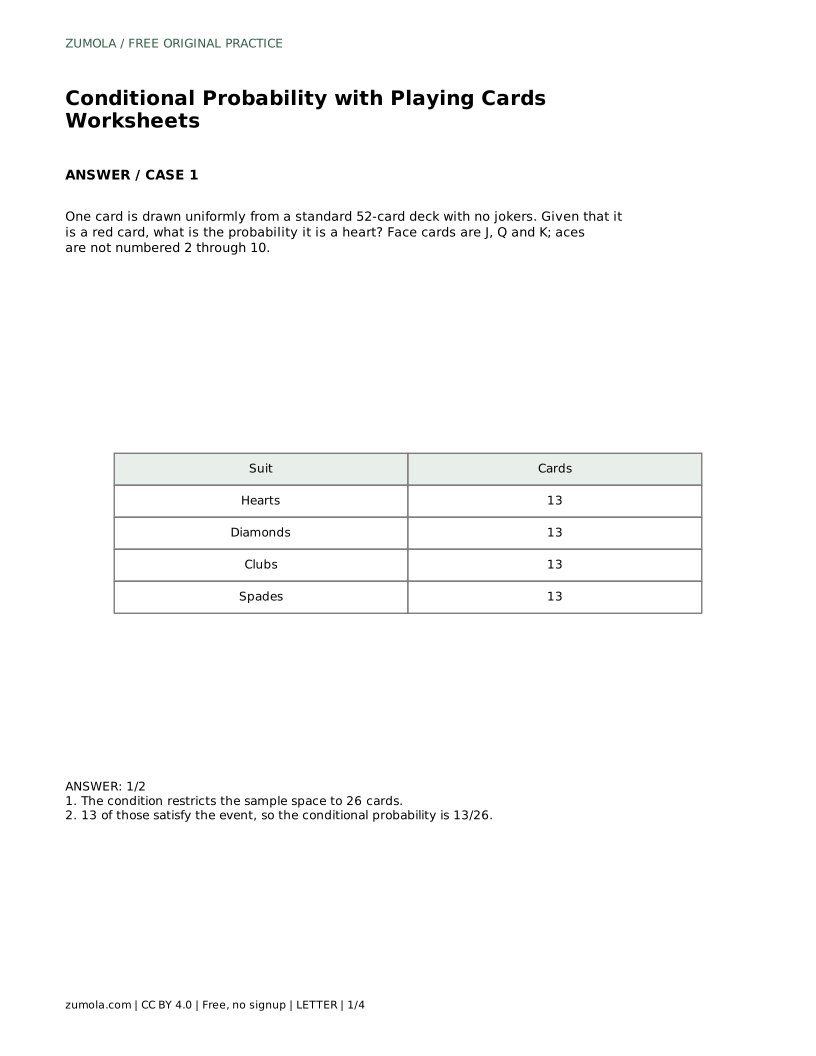
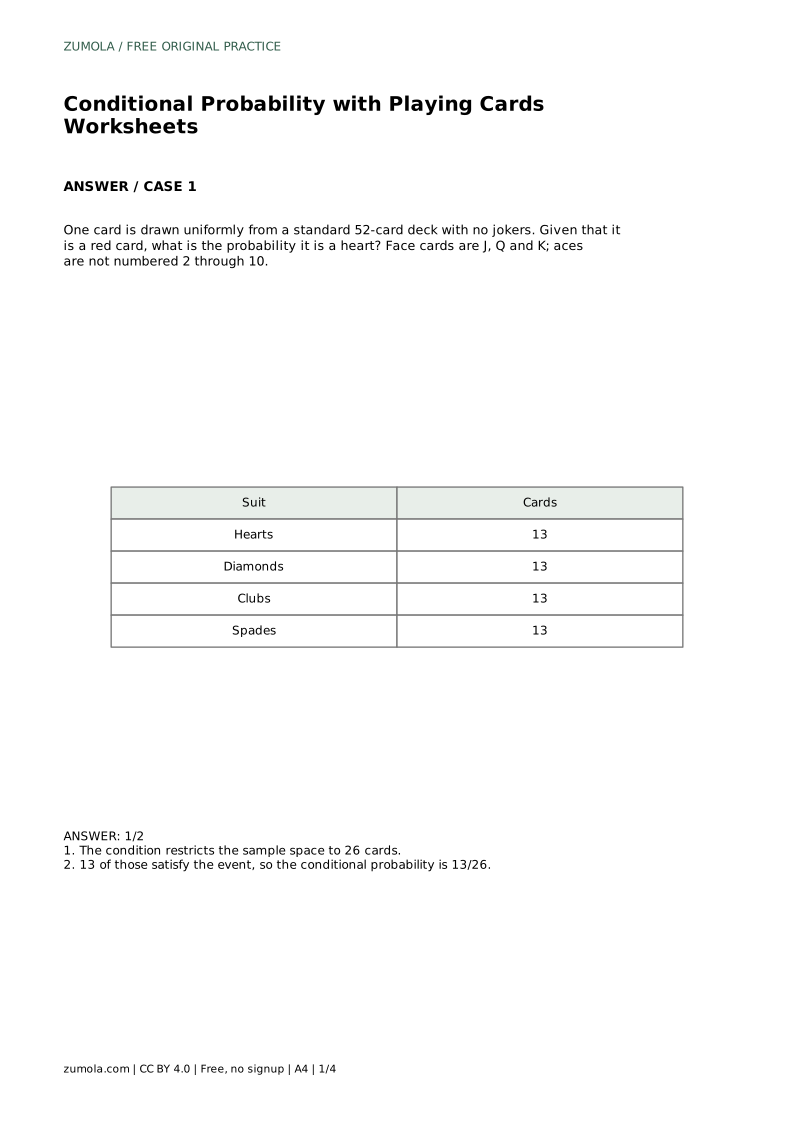
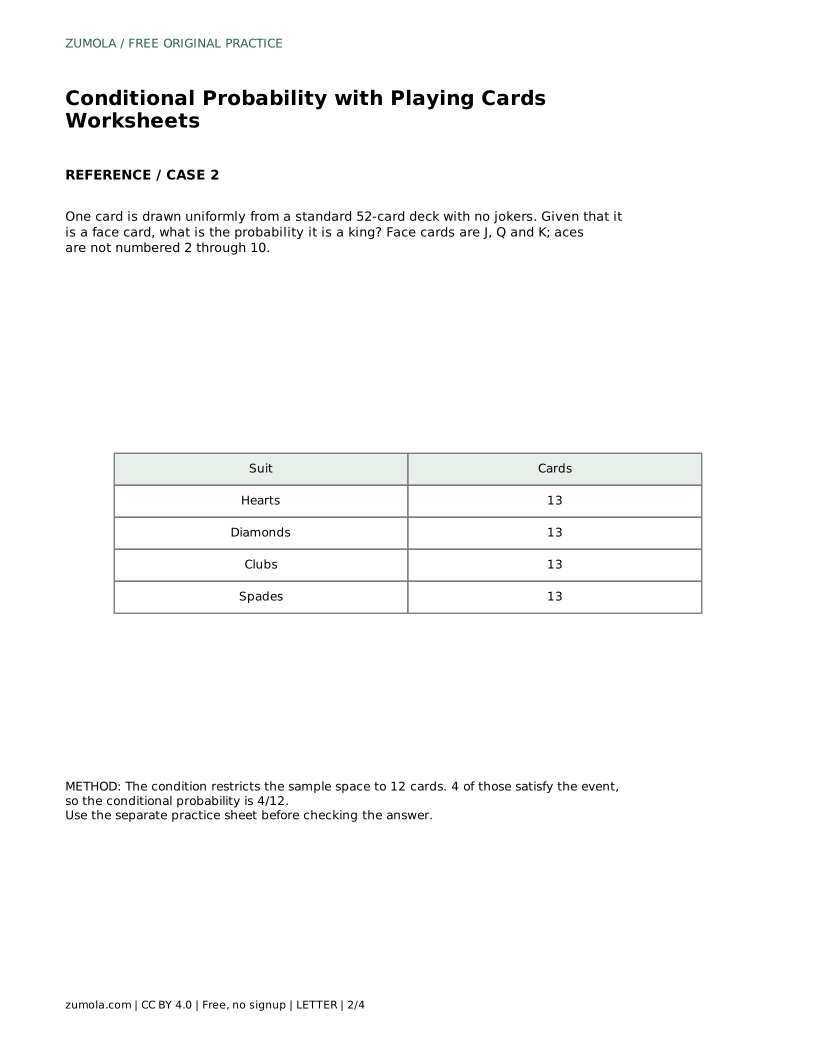
One card is drawn uniformly from a standard 52-card deck with no jokers. Given that it is a red card, what is the probability it is a heart? Face cards are J, Q and K; aces are not numbered 2 through 10.
The condition is red, so only hearts and diamonds remain: 13 + 13 = 26 cards. The event is heart, and all 13 hearts are red, so 13 of the 26 remaining cards qualify. The conditional probability is 13/26, which reduces to 1/2.
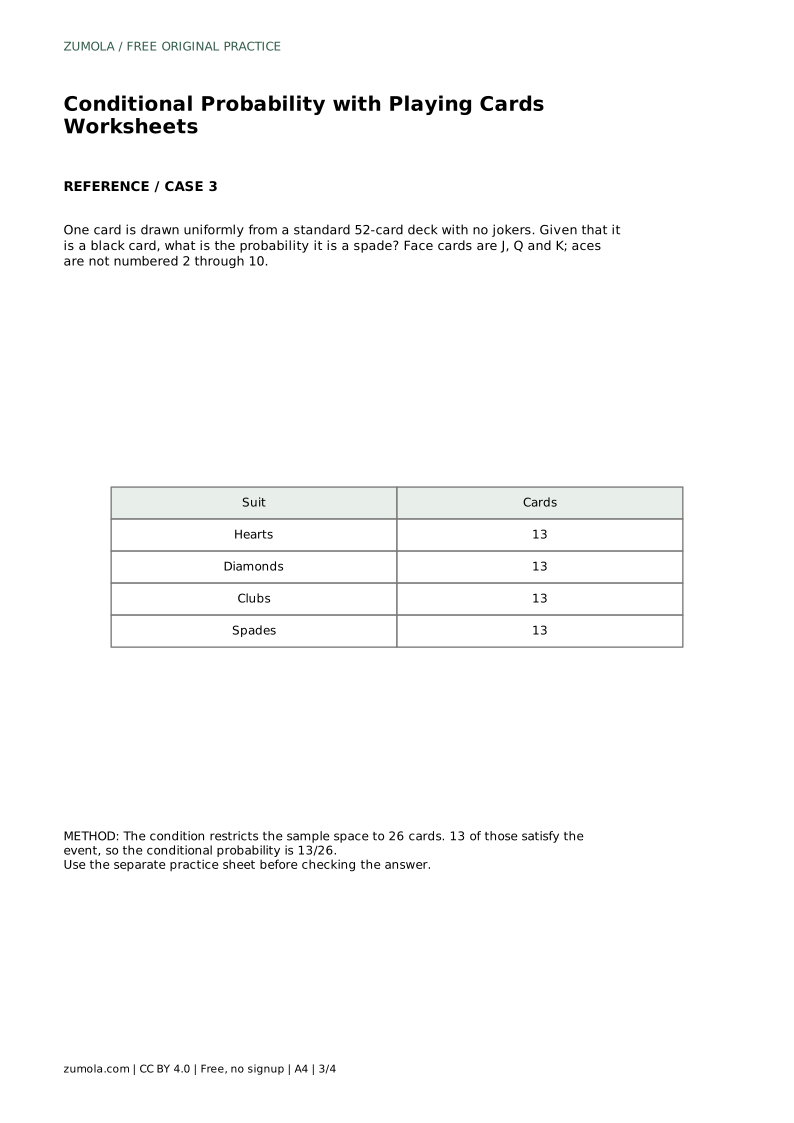
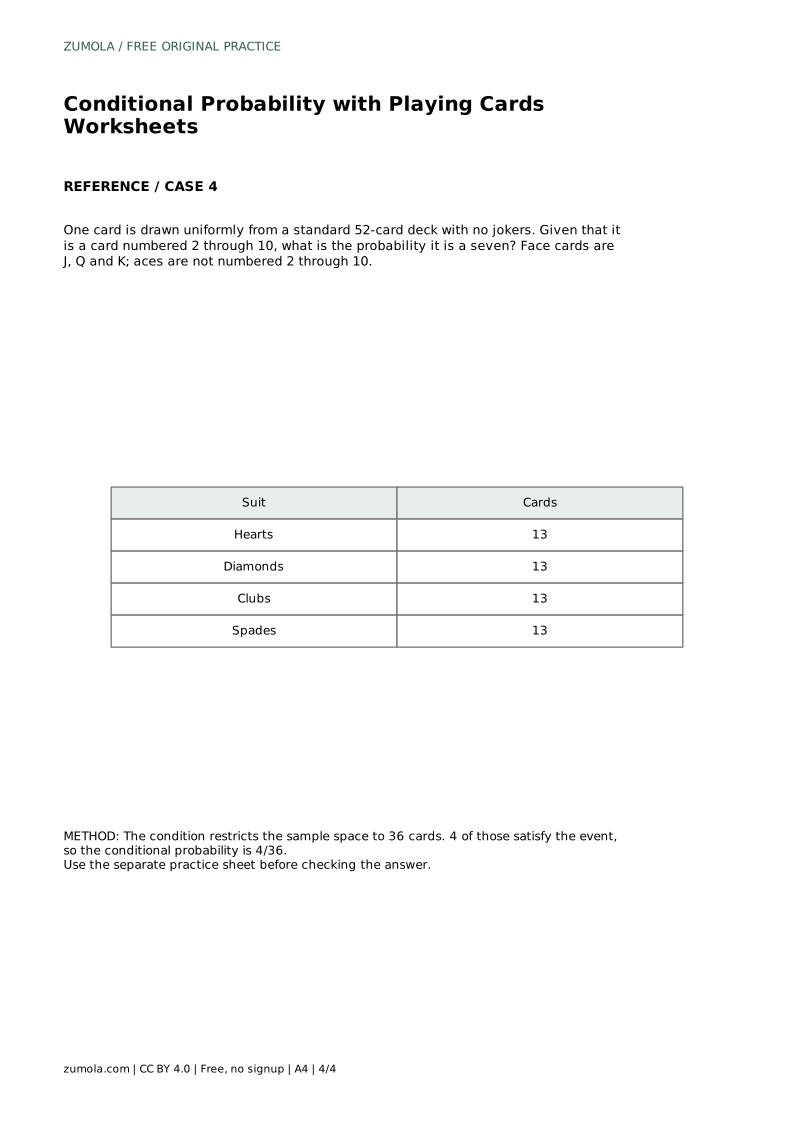
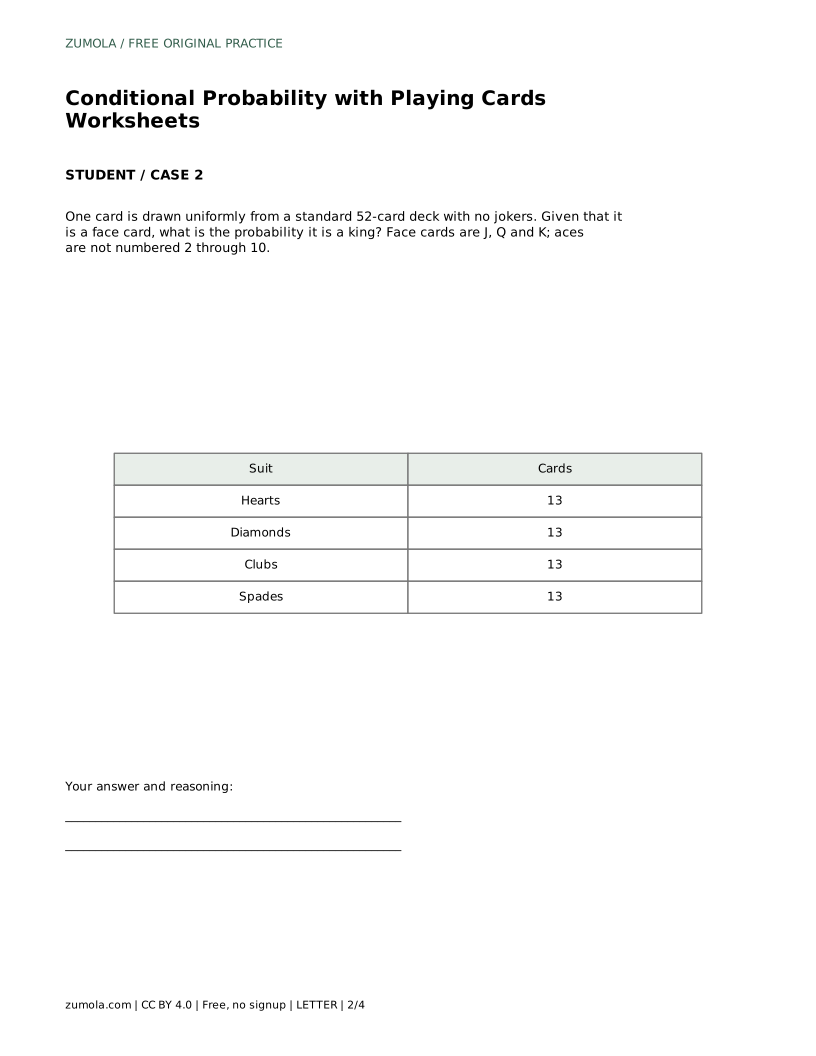
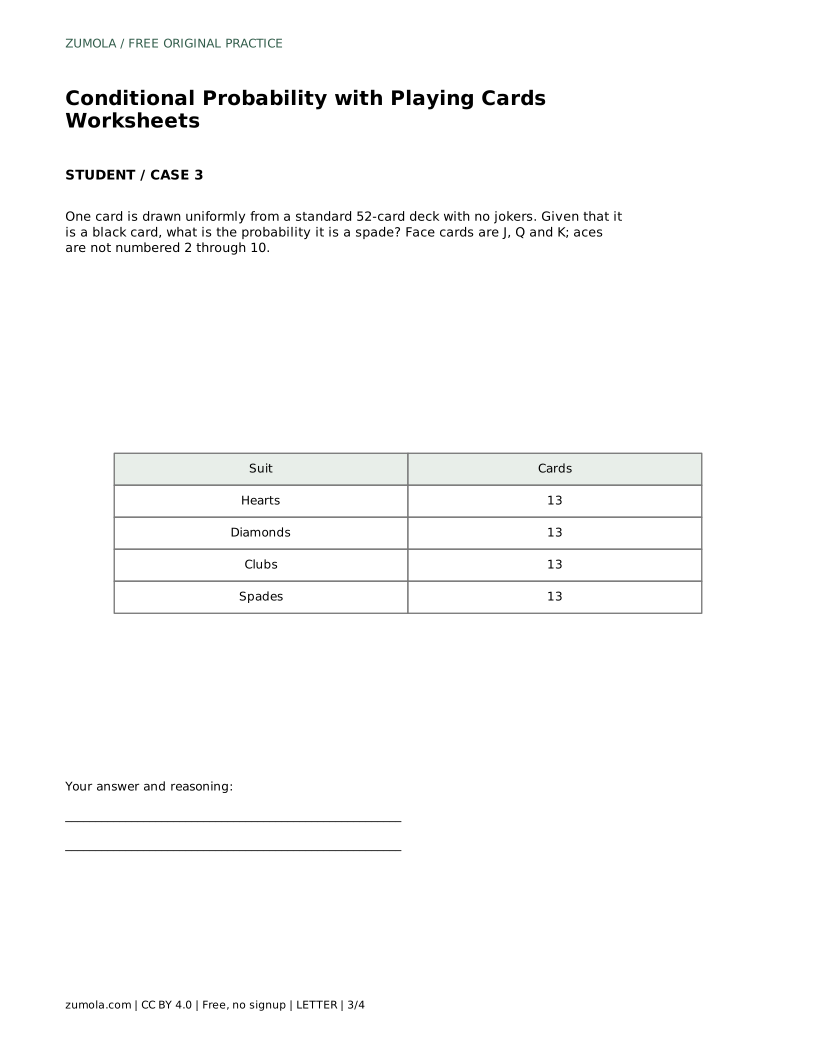
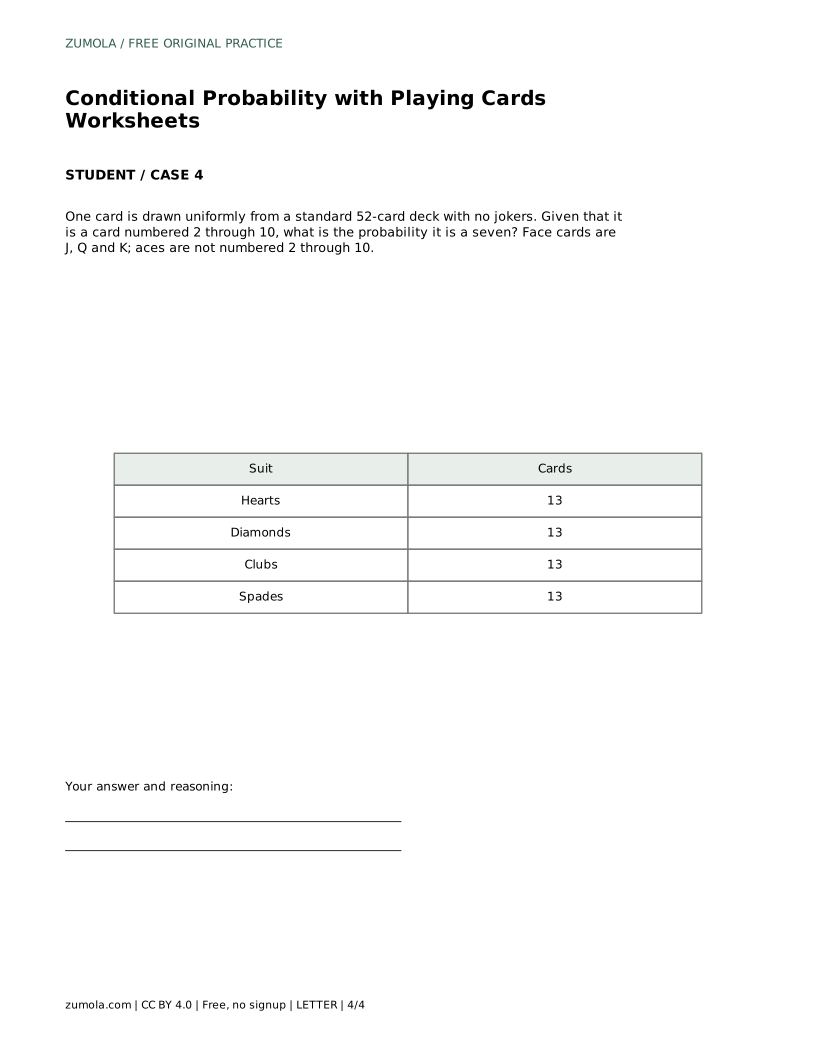
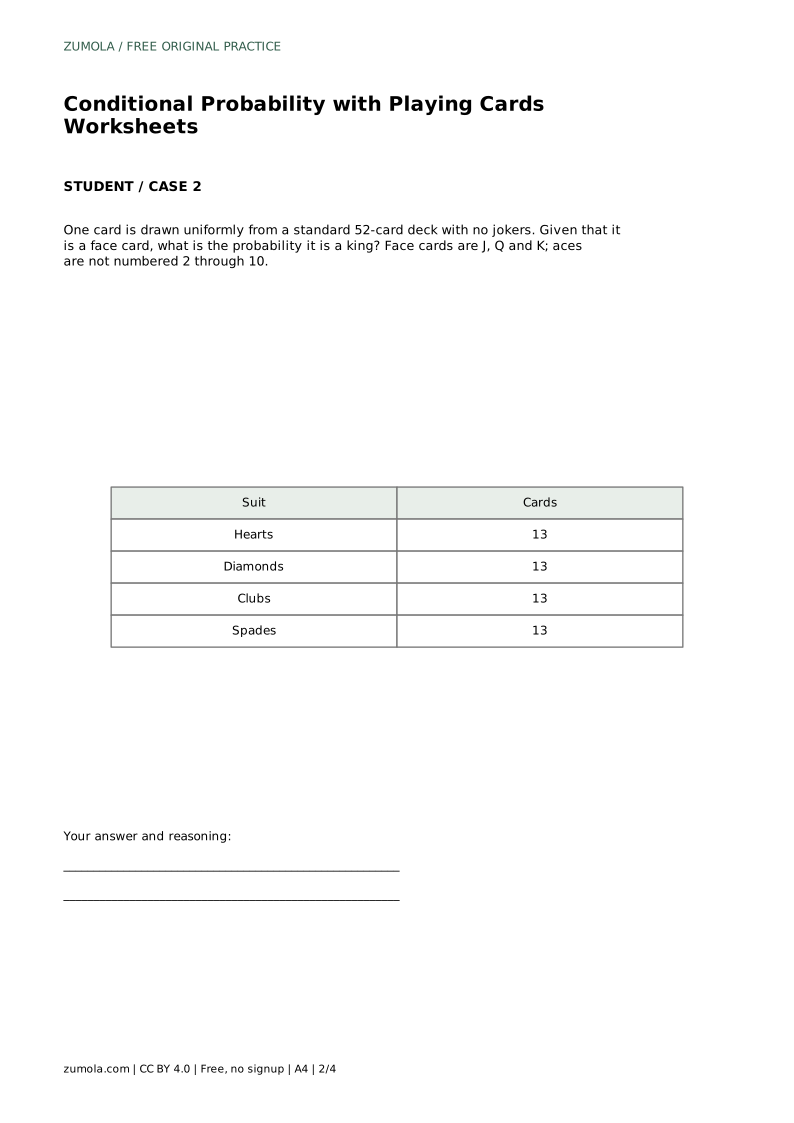
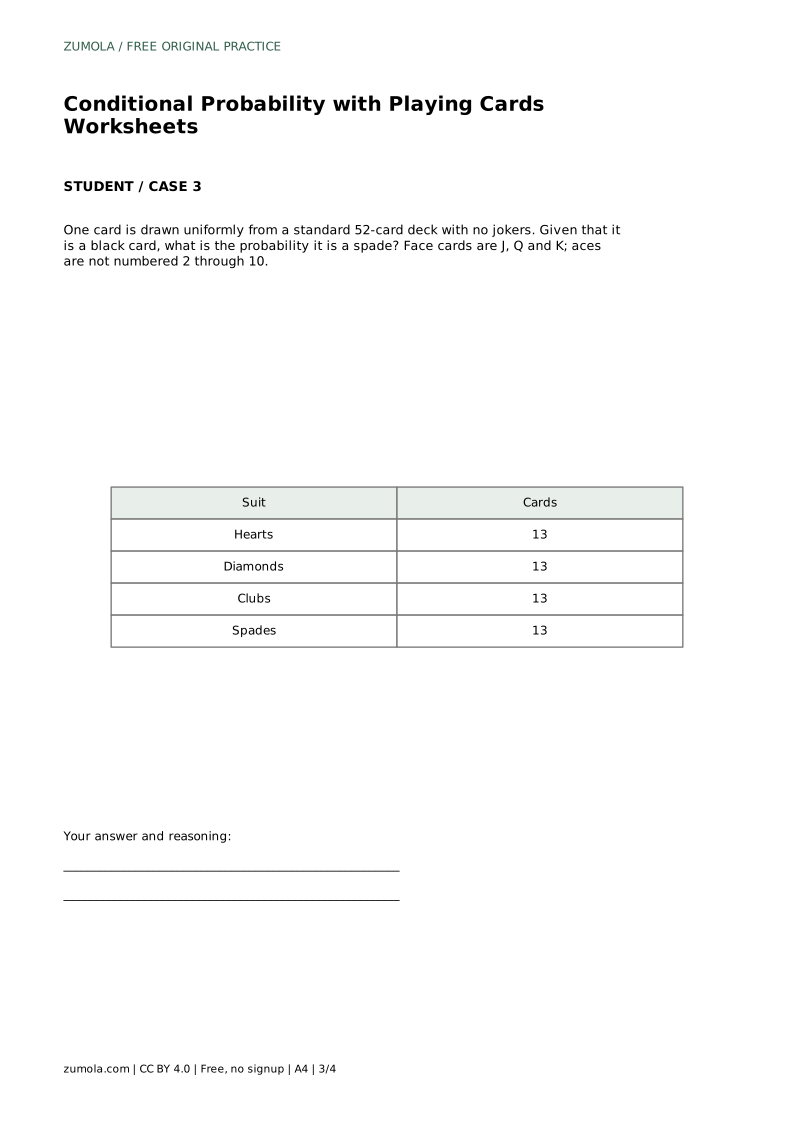
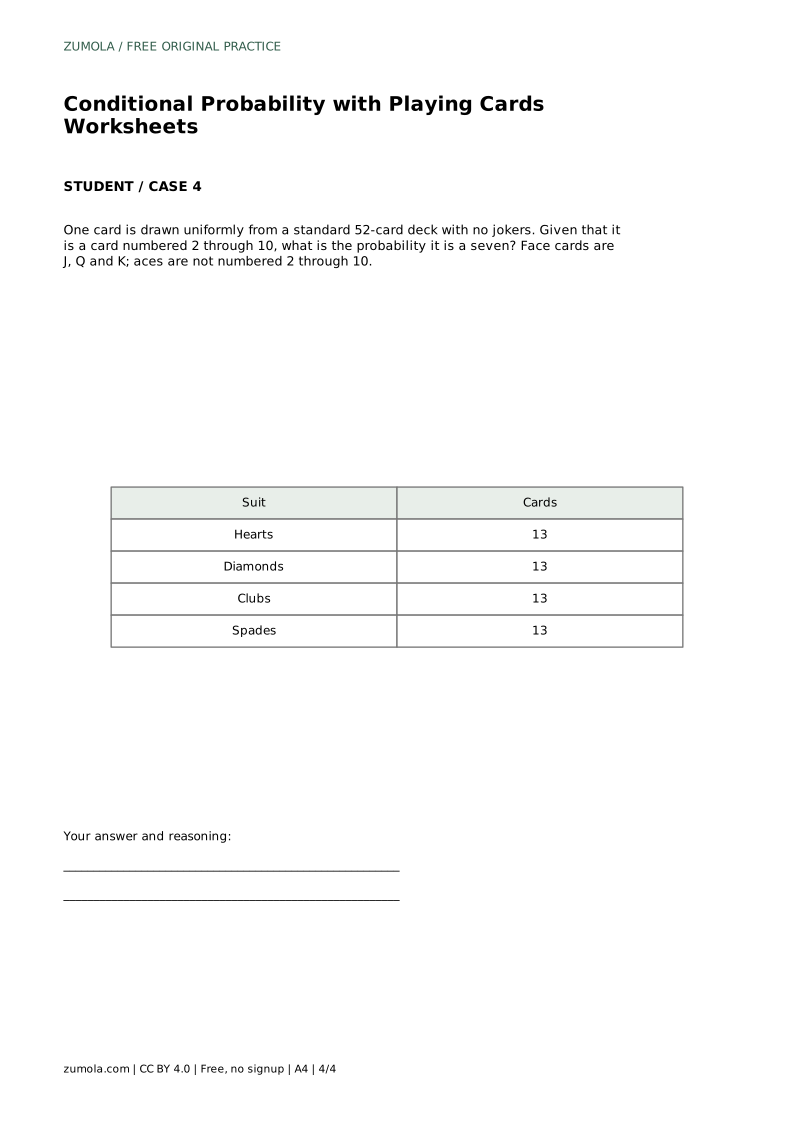
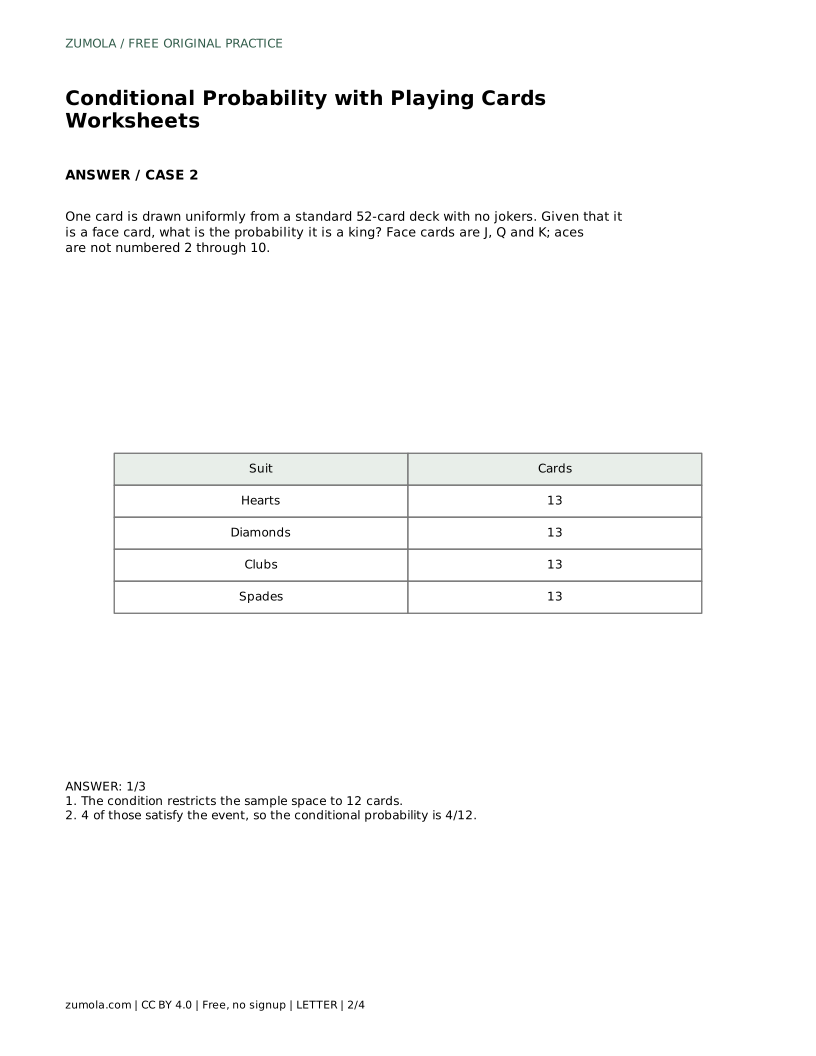
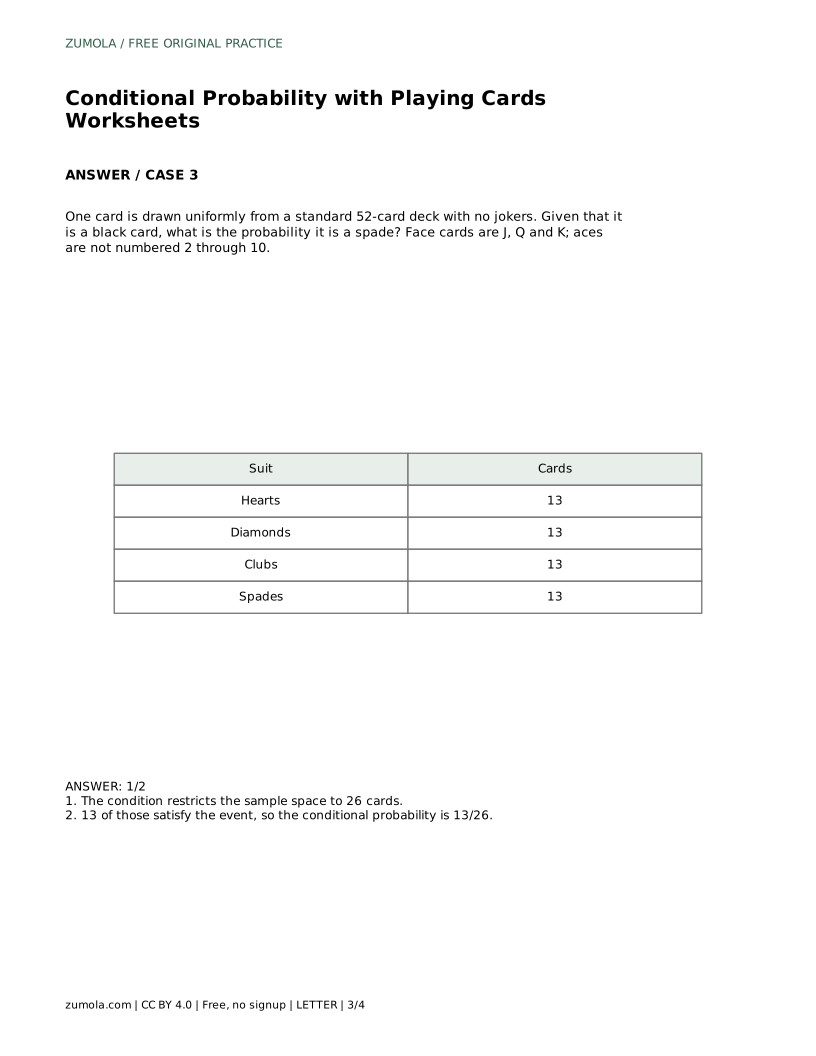
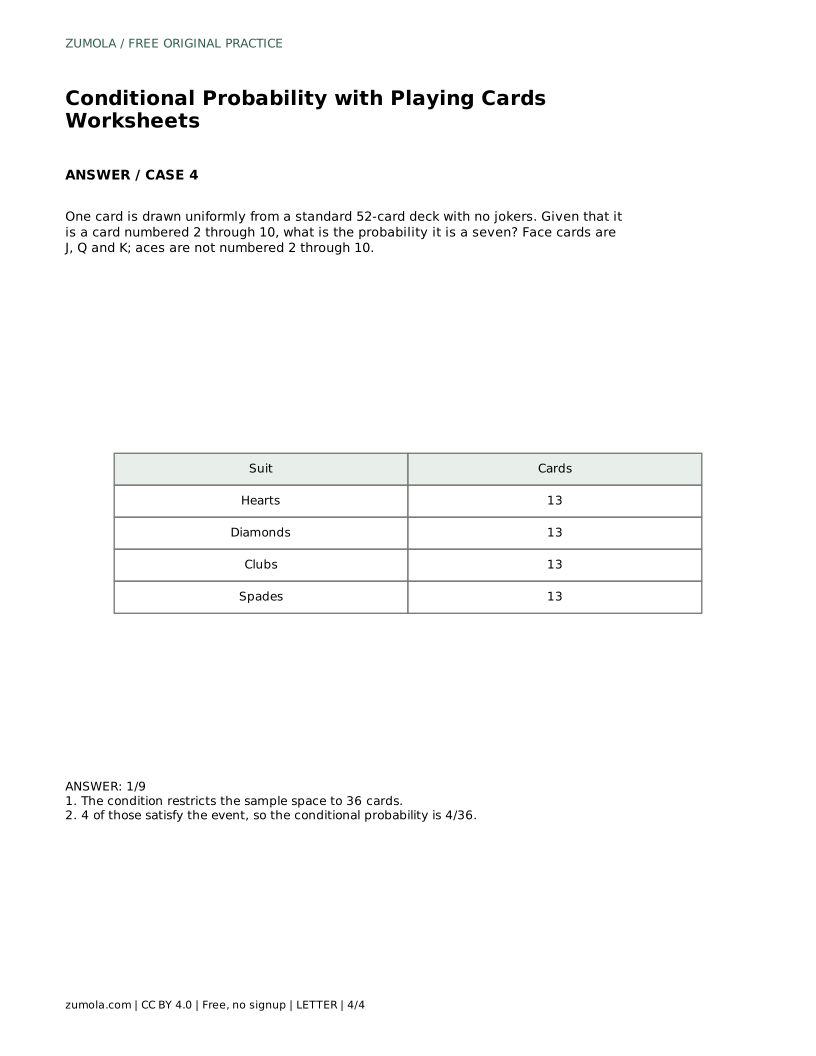
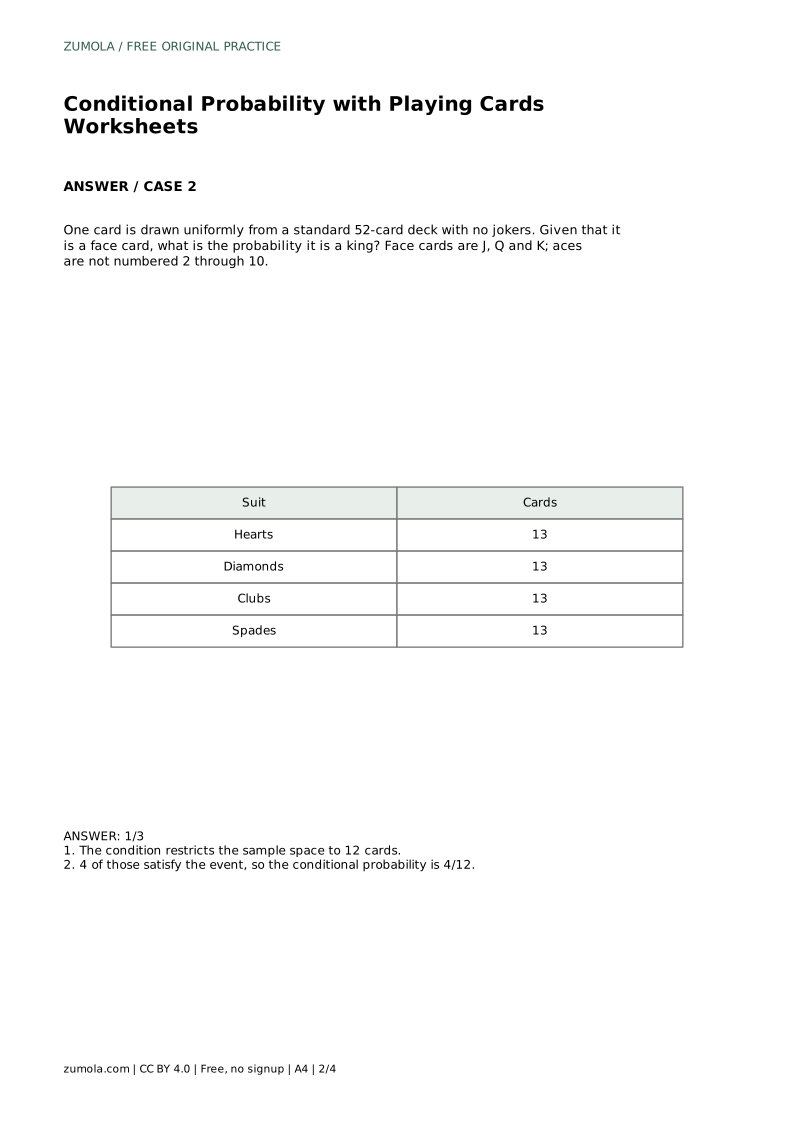
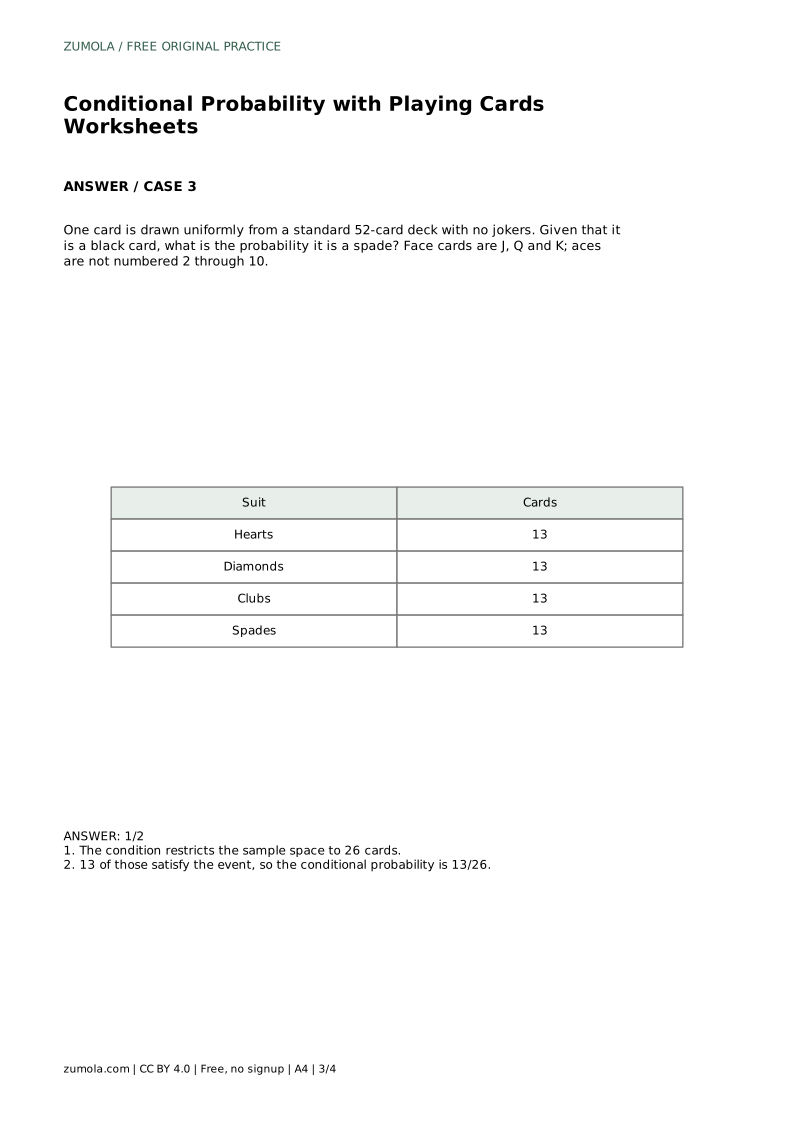
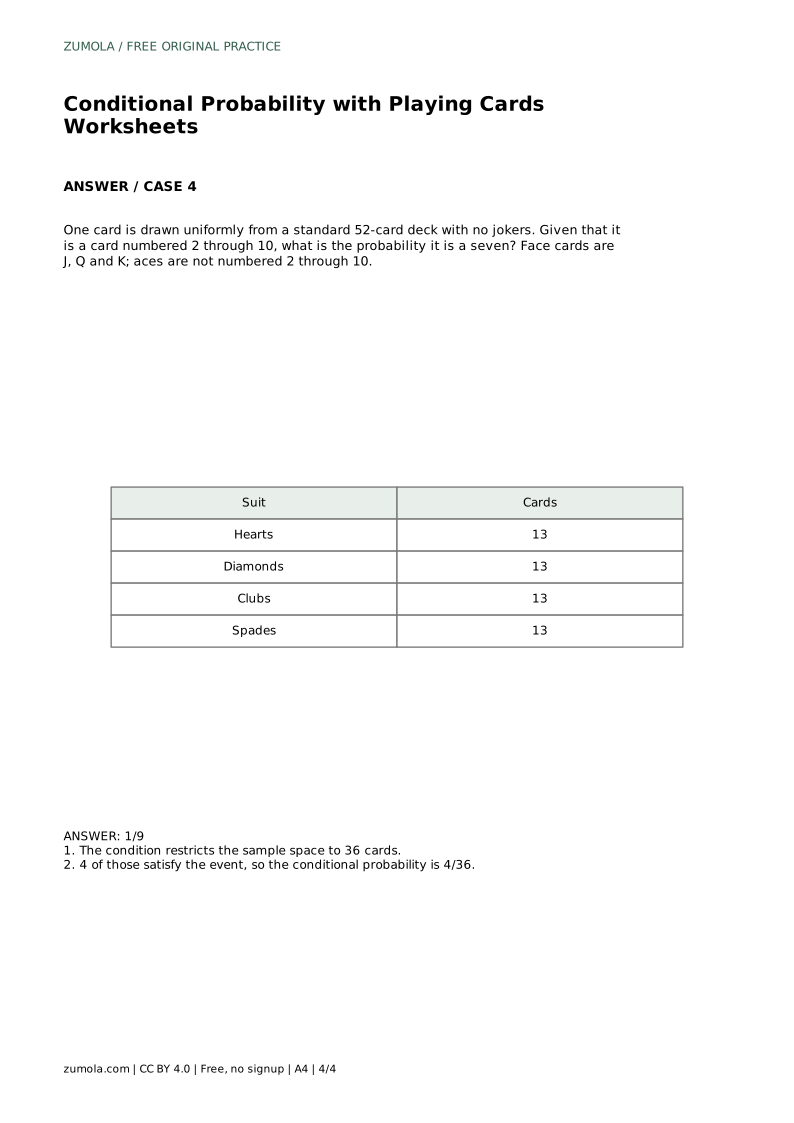
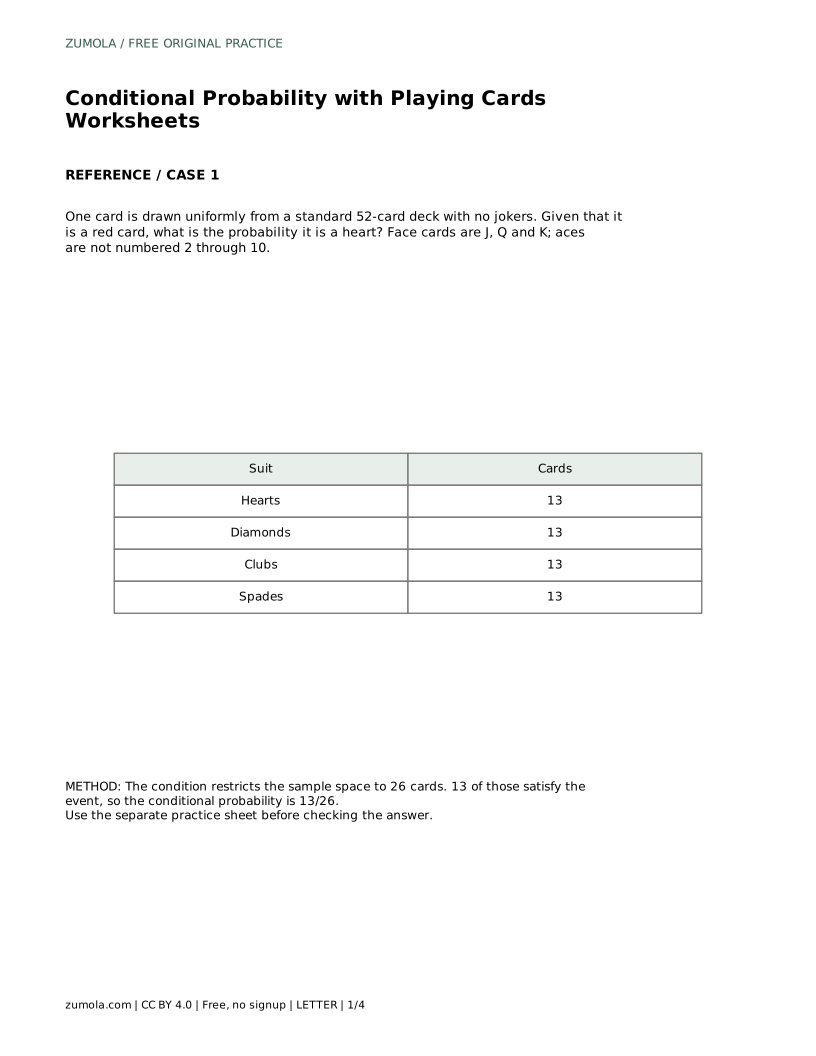
Suit counts are always 13 each: hearts, diamonds, clubs and spades. Red means hearts or diamonds; black means clubs or spades. Face cards are 12 total, three per suit. Numbered cards 2 through 10 give 9 per suit and 36 total, because aces are excluded from that group.
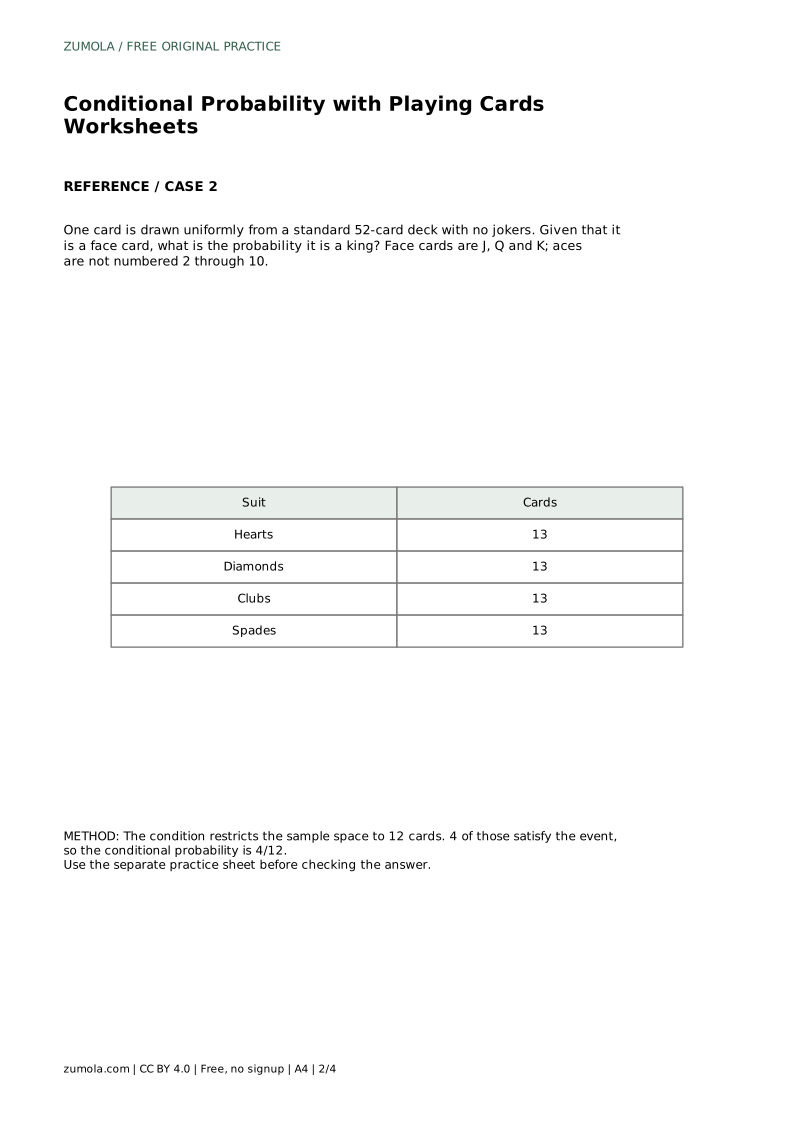
These groupings matter because a condition can cut across suits. A face-card condition leaves 12 cards, not 13. A numbered-card condition leaves 36, not 40. Count the condition group before touching the event.
A good worksheet gives several conditions that produce different denominators, so students cannot reuse one fraction. Ask for the condition count, the event count and the reduced fraction on separate lines. That structure reveals whether an error came from misreading the deck or from arithmetic.
One card is drawn uniformly from a standard 52-card deck with no jokers. Given that it is a red card, what is the probability it is a heart? Face cards are J, Q and K; aces are not numbered 2 through 10.
1/2 The condition restricts the sample space to 26 cards. 13 of those satisfy the event, so the conditional probability is 13/26.
The condition tells you the drawn card is already known to be in a smaller group. Only those cards remain possible, so their count becomes the denominator.
Jacks, queens and kings, three per suit, for 12 total. Aces are separate and are not part of the 2-through-10 numbered group.
Reducing is expected for a clean answer, but showing the unreduced fraction first makes the counting visible and easier to check.
All math worksheets · Free coordinate paper
Original resources · CC BY 4.0 · Free for personal and classroom use with attribution.