Free original resources
Angle Relationships: Find Unknown Angles Using Vertical, Supplementary and Complementary Pairs
Practice finding unknown angles from vertical, supplementary and complementary relationships. Includes a worked example, common mistakes and a marking rubric for angle reasoning.
Free resources
Letter & A4
PDF & SVG
Letter & A4
PDF & SVG
Make it yours.
Free · no signup · calculated in your browser
Your free printable kit.
Original reference, student practice and separate worked answers. No account or payment.
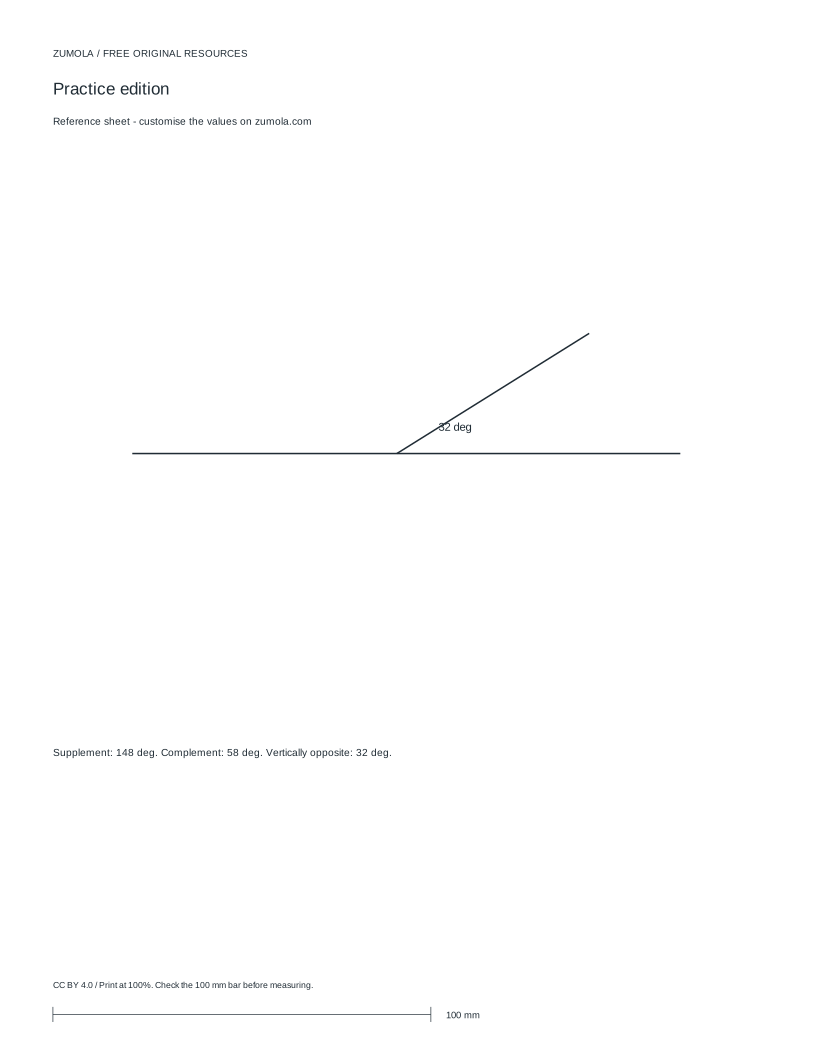
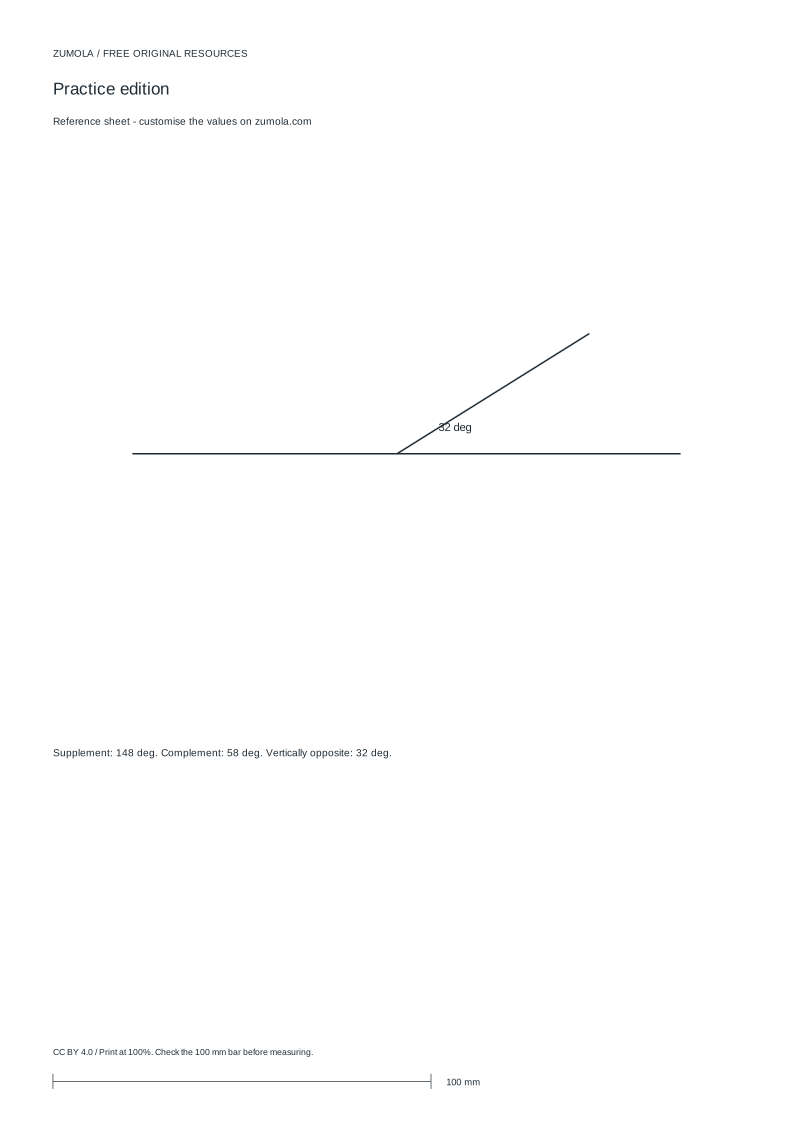
Practice worksheet
Worked answers / rubric
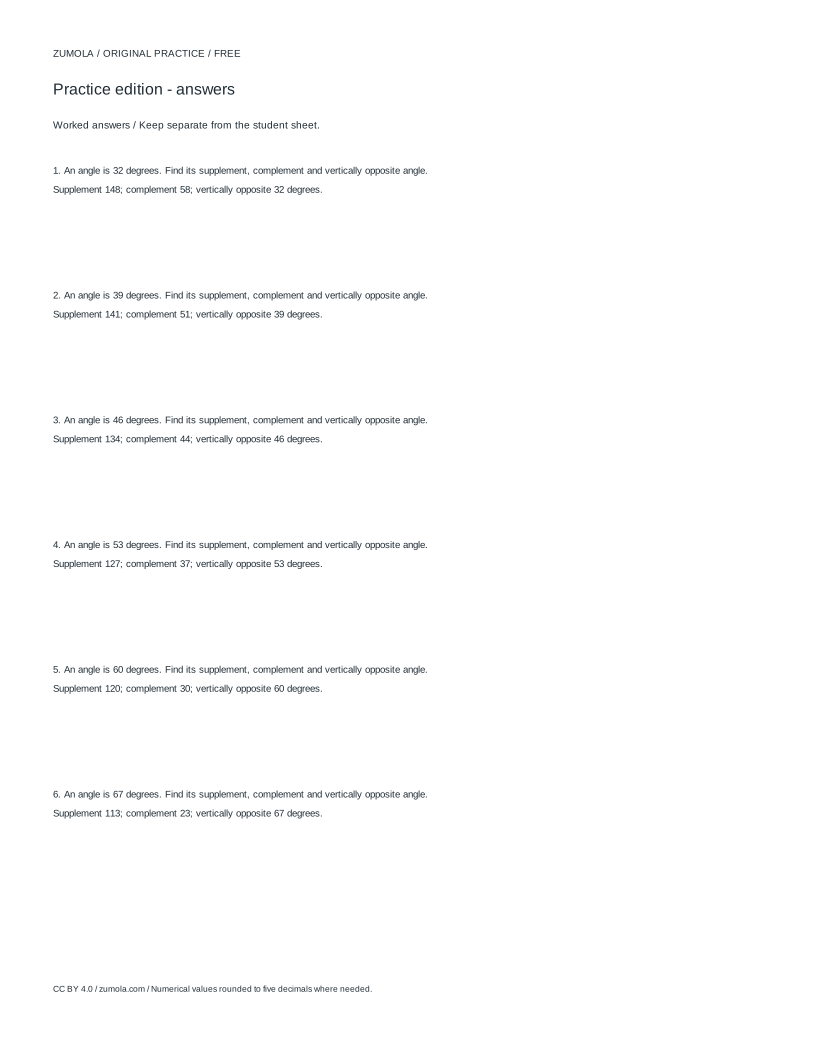
Print at Actual size / 100%. Check the calibration bar before using physical dimensions.
Angle relationships let you find an unknown angle without measuring it. If two angles are complementary, they add to 90 degrees; if supplementary, they add to 180 degrees; if vertical, they are equal. This page explains how to identify which relationship applies, set up a short equation, and check the result. It is written for printable practice where students read a diagram, state the relationship, then calculate the missing value.
Name the relationship before you calculate
Every unknown-angle task starts with classification. Complementary angles form a right angle, so their measures sum to 90 degrees. Supplementary angles form a straight line, so their measures sum to 180 degrees. Vertical angles are the two opposite angles made where two straight lines cross; they are equal. Adjacent angles share a vertex and a side but do not overlap.
Write the relationship as a sentence first, for example: these two angles are supplementary because they sit on a straight line. Then write the equation. This order matters because the same pair of numbers can be added or subtracted depending on the relationship, and naming it prevents guessing.
Keep units explicit. Angles are measured in degrees, written with the degree symbol. Lengths on any diagram are separate measurements in millimetres unless stated otherwise, and they do not belong in an angle equation.
- Locate the unknown angle and the angle or angles it is paired with.
- Decide whether the pair is complementary (sum 90), supplementary (sum 180) or vertical (equal).
- Write the equation, such as x + 32 = 90.
- Solve by subtracting: x = 90 - 32 = 58.
- Check that the answer is positive and less than 90 for a complement, or less than 180 for a supplement.
Working with vertical angles and straight lines
When two straight lines cross, four angles appear. The two angles opposite each other are vertical and equal. The two angles next to each other are supplementary because together they form a straight line. So if one angle is 32 degrees, its vertical partner is also 32 degrees, and each adjacent angle is 180 - 32 = 148 degrees.
A useful check is that all four angles around the crossing point sum to 360 degrees: 32 + 148 + 32 + 148 = 360. If your four values do not total 360, one relationship has been misapplied.
Do not assume lines are straight unless the diagram shows them as straight or the task states it. A bent line does not create supplementary or vertical pairs, and treating it as straight produces a wrong answer even when the arithmetic is correct.
- Mark the crossing point and identify the two straight lines.
- Label the known angle and its vertical opposite as equal.
- Find each adjacent angle by subtracting the known angle from 180.
- Add all four angles and confirm the total is 360 degrees.
Drawing tasks are judged differently from calculation tasks
Some angle worksheets ask students to draw an angle of a given size, including reflex angles greater than 180 degrees. Drawing has many valid outcomes: line length, orientation and position can all differ while the angle itself is correct. Mark drawing work with a rubric that checks the measured angle within a stated tolerance, a clearly marked vertex, and labelled arms.
Calculation tasks have one correct numerical answer for a given diagram, so they can be marked exactly. Keep the two task types separate when giving feedback, because a neat drawing with a slightly off angle and a correct equation with messy handwriting need different corrections.
Drawing an angle is a construction skill, not an anatomy exercise. Nothing here describes joints or clinical measurement, and diagrams should not be read as body anatomy.
- For drawing, place the vertex first, then one arm.
- Use a protractor centred on the vertex to mark the second arm at the required degree value.
- For reflex angles, mark the smaller angle and extend the arm past the straight line, or measure the reflex value directly if the protractor allows.
- Label the angle size and check it against the requested value.
Try this example
Two straight lines cross. One angle measures 32 degrees. Find the vertical angle, the two adjacent angles, and confirm the total around the crossing point.
Show the worked explanation
The vertical angle is equal to 32 degrees. Each adjacent angle is supplementary to 32 degrees: 180 - 32 = 148 degrees. The four angles are 32, 148, 32 and 148. Their sum is 32 + 148 + 32 + 148 = 360 degrees, which confirms the result. As a separate check, the complement of 32 is 90 - 32 = 58 degrees, but that value is not part of this crossing diagram.
Common mistakes
- Adding the known angle to 90 when the pair is actually supplementary. Re-check the diagram: a straight line means sum 180, a right-angle corner means sum 90. Write the relationship sentence before the equation.
- Treating adjacent angles at a crossing as equal instead of supplementary. Only the opposite pair is vertical and equal. Adjacent angles on the same straight line must add to 180.
- Marking a drawn angle as wrong because the arms are a different length from a sample. Judge the angle measure, vertex position and labels. Arm length and orientation are free choices and should not affect the score.
Check your work
- States the angle relationship in words before writing an equation.
- Uses the correct sum: 90 for complementary, 180 for supplementary, equal for vertical.
- Shows the subtraction or equation step, not only the final number.
- Labels answers in degrees and keeps length units separate.
- Checks the answer against the diagram, including the 360-degree total at a crossing.
- For drawing tasks, marks the vertex and arms clearly and records the angle size.
Questions before you start
What is the difference between complementary and supplementary angles?
Complementary angles add to 90 degrees and usually form a right angle. Supplementary angles add to 180 degrees and usually form a straight line. The relationship is decided by the sum, not by how the diagram looks.
Are vertical angles always equal?
Yes, when the angles are formed by two straight lines crossing. The opposite angles are equal. If the lines are not straight, the equal-angle rule does not apply.
How should I mark a drawing task where the angle is close but not exact?
State a tolerance in advance, for example within 2 degrees, and apply it consistently. Check the vertex, the labelled arms and the recorded angle size alongside the measured value.