Free dilation worksheets with integer and fractional scale factors. Plot the image, compare side lengths and use separate Letter/A4 answer files.
Choose Letter or A4, then download a student sheet first. Keep the separate reference or answer file closed until you have attempted the case. Every worksheet, SVG and answer is free without signup.
Choose your paper and download
Download paper size
Every worksheet and answer is free. No signup.
Free original resourceDI01
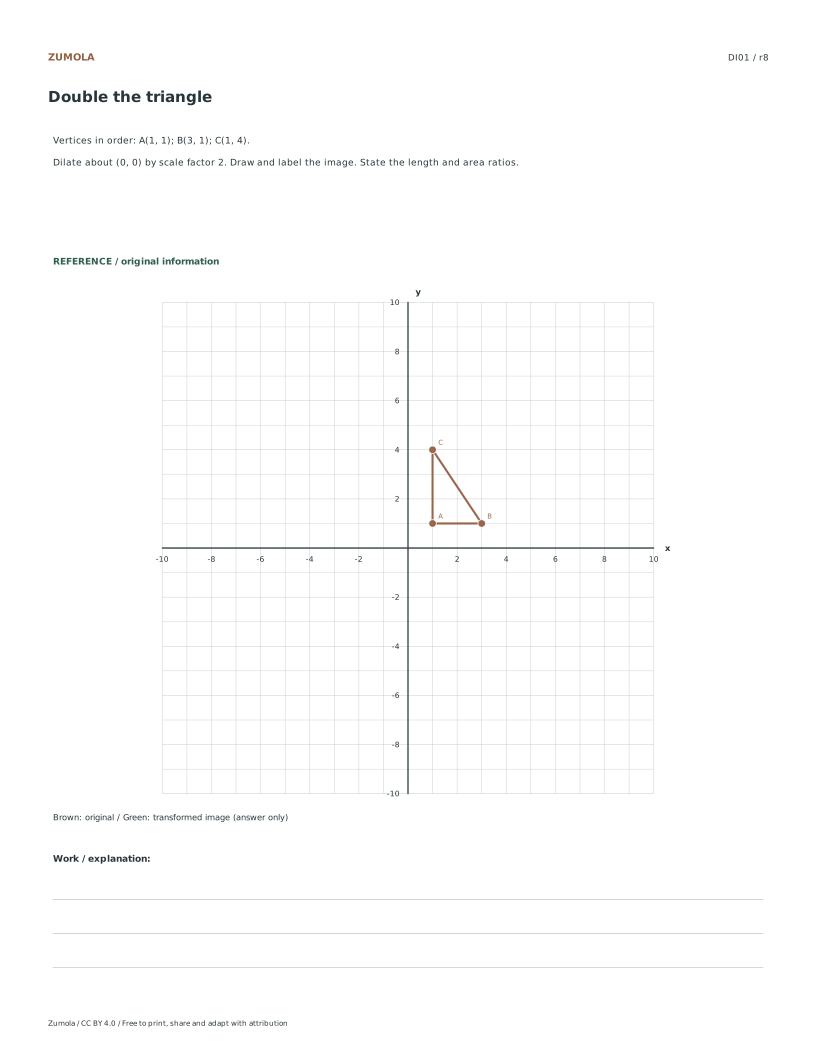
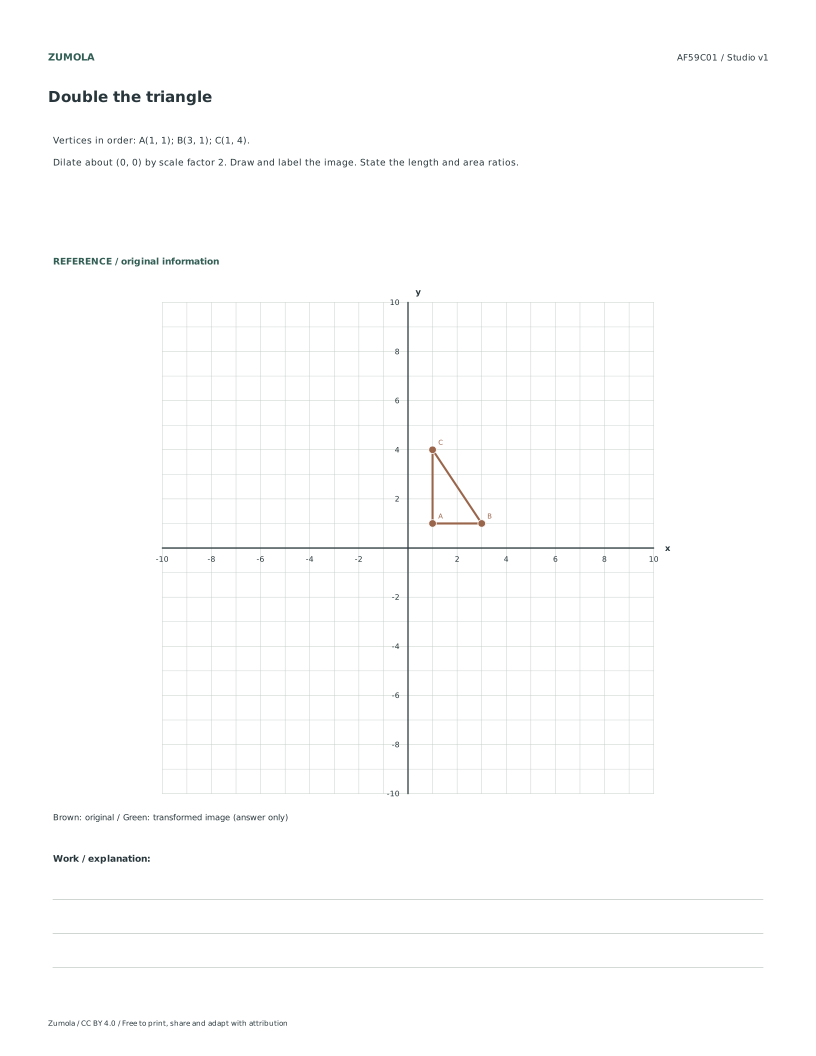
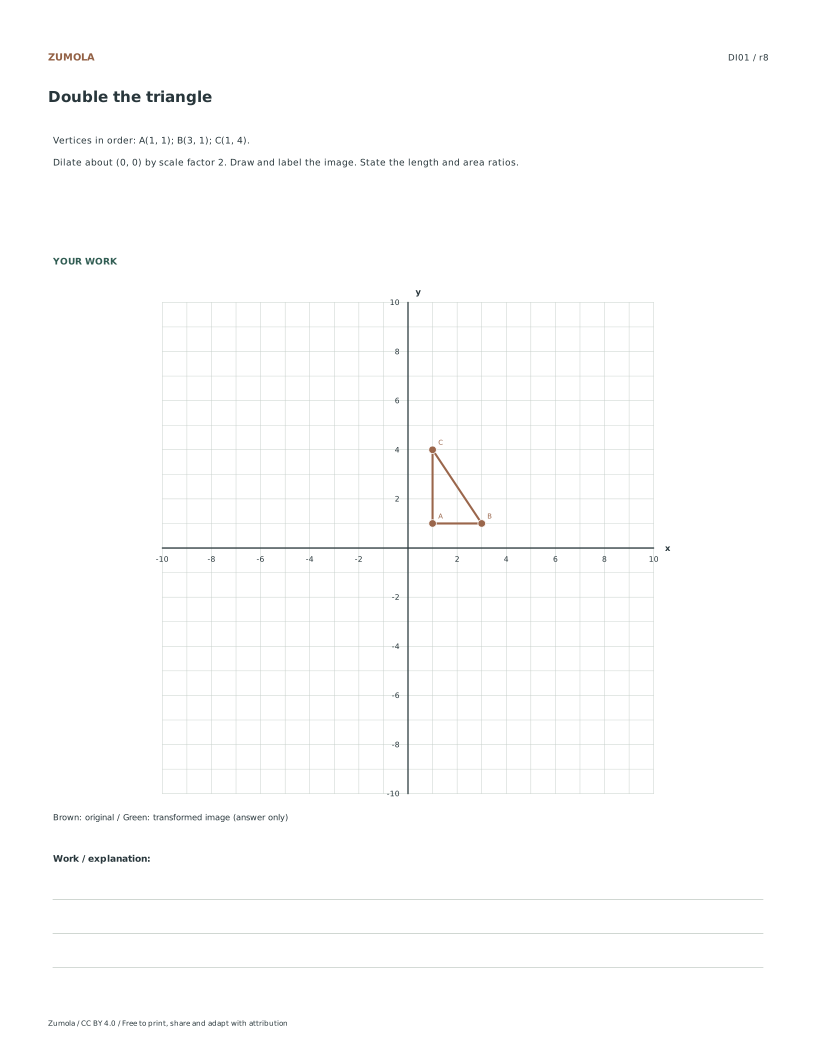
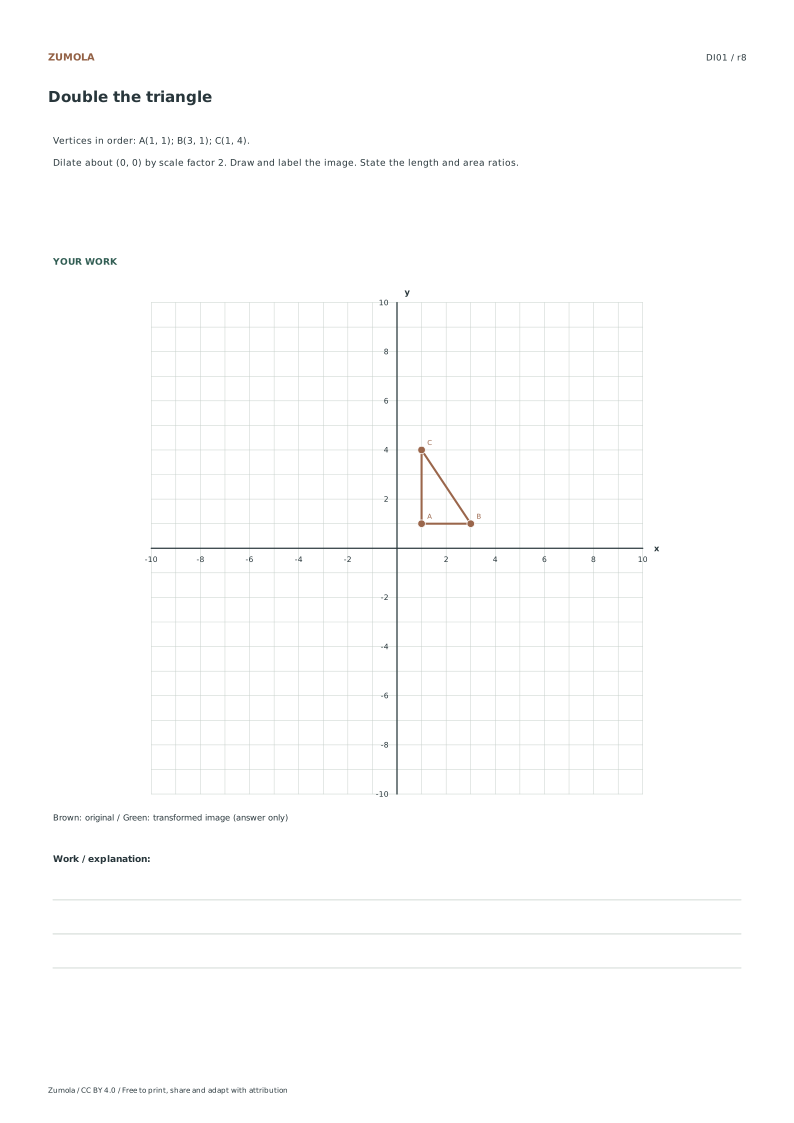
Double the triangle
Original worksheet collection. Letter or A4 PDF and editable SVG.
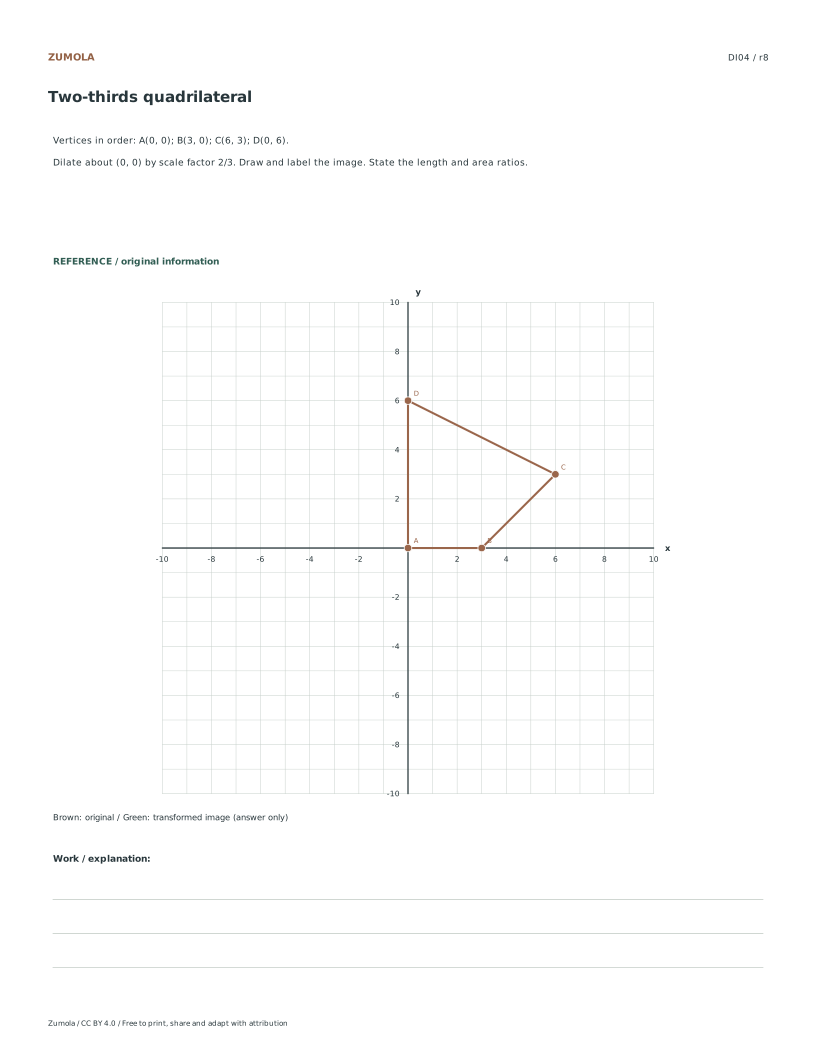
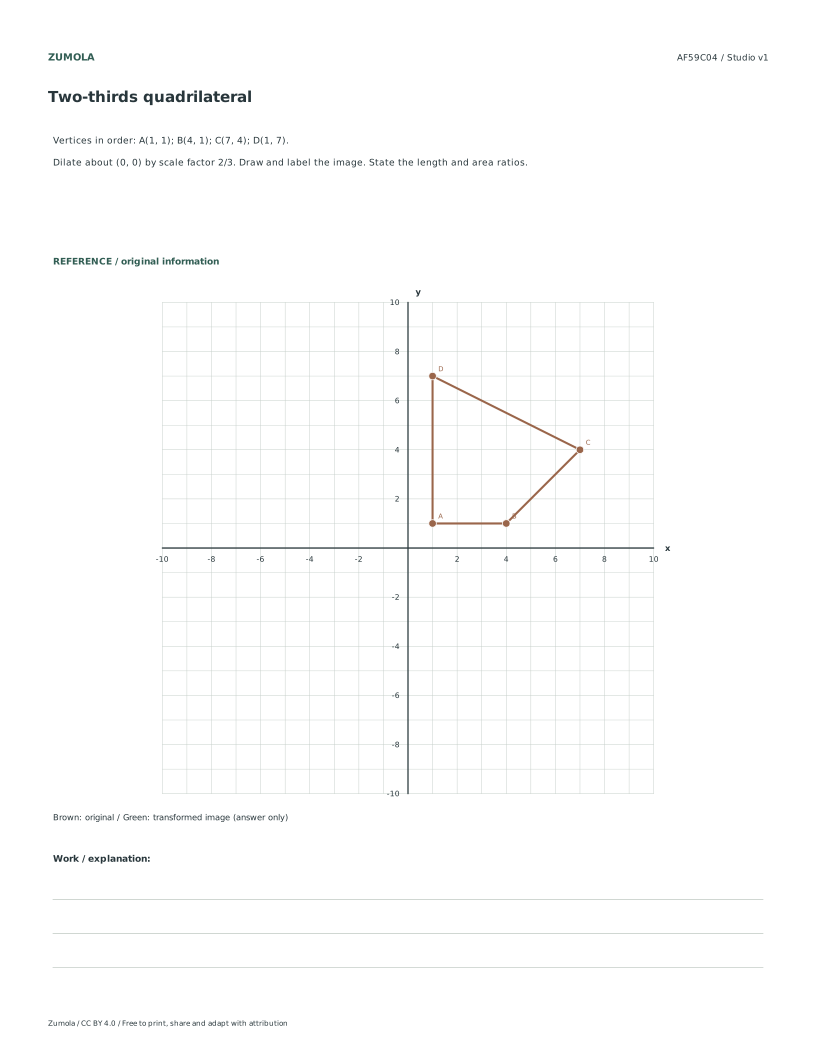
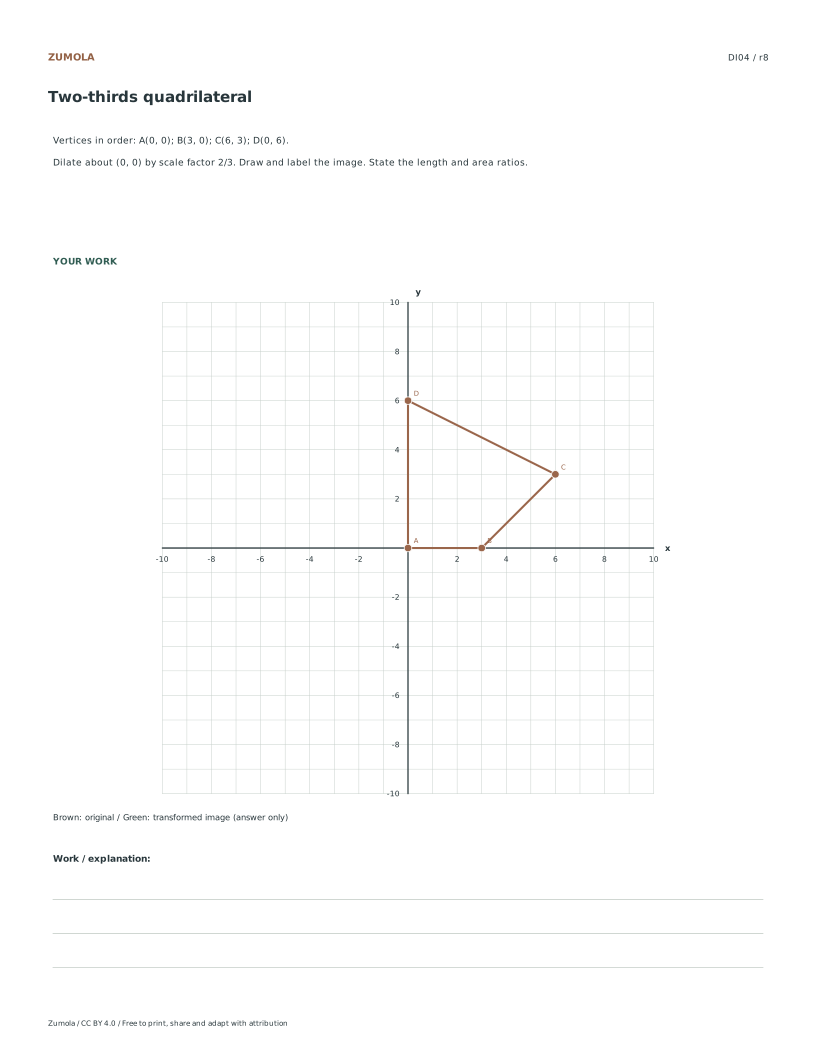
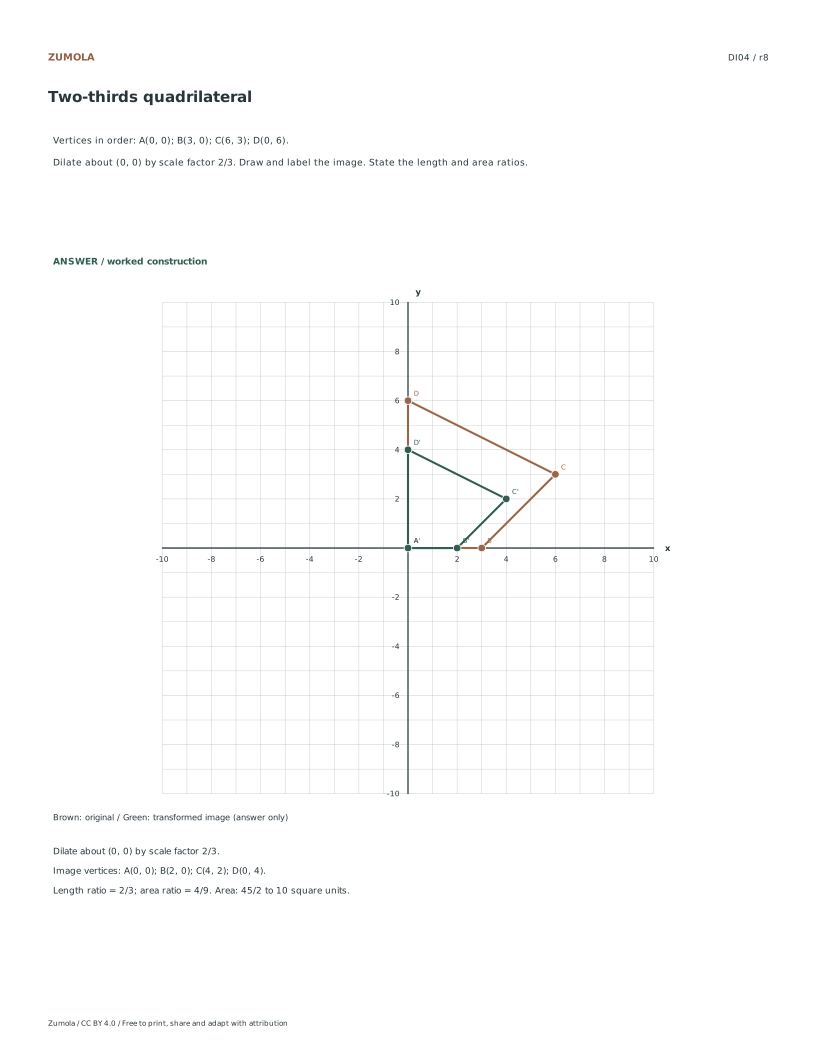
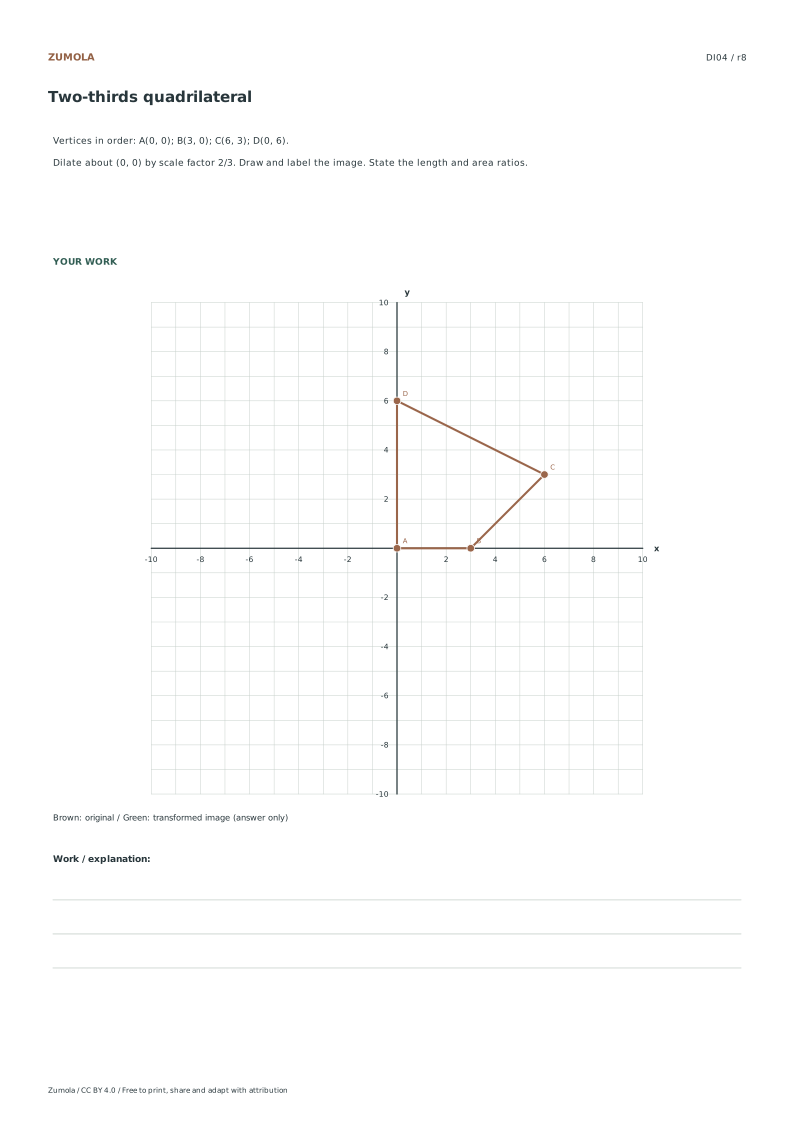
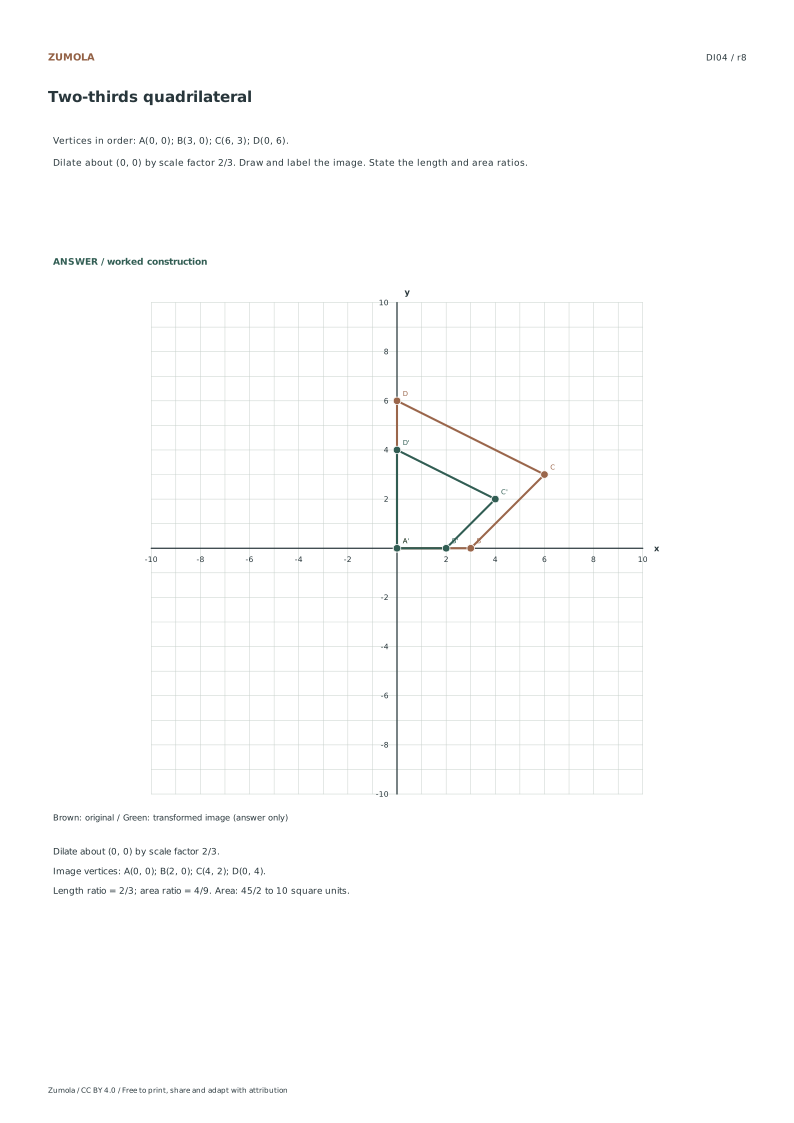
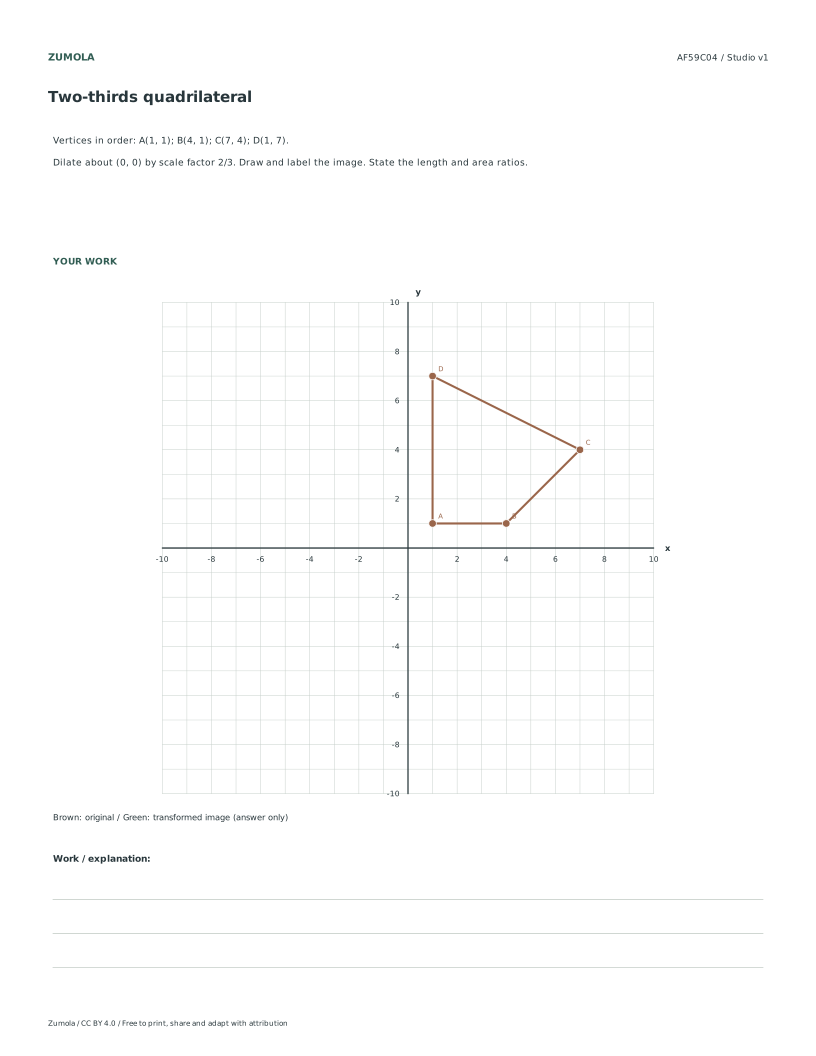
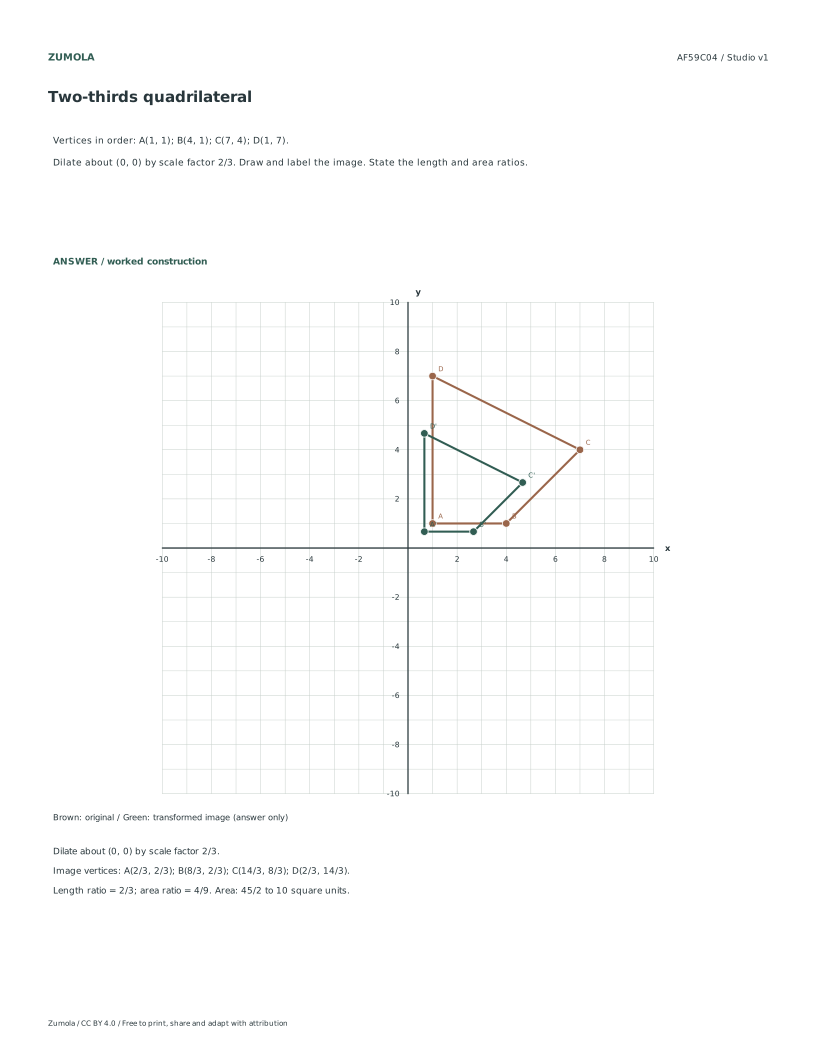
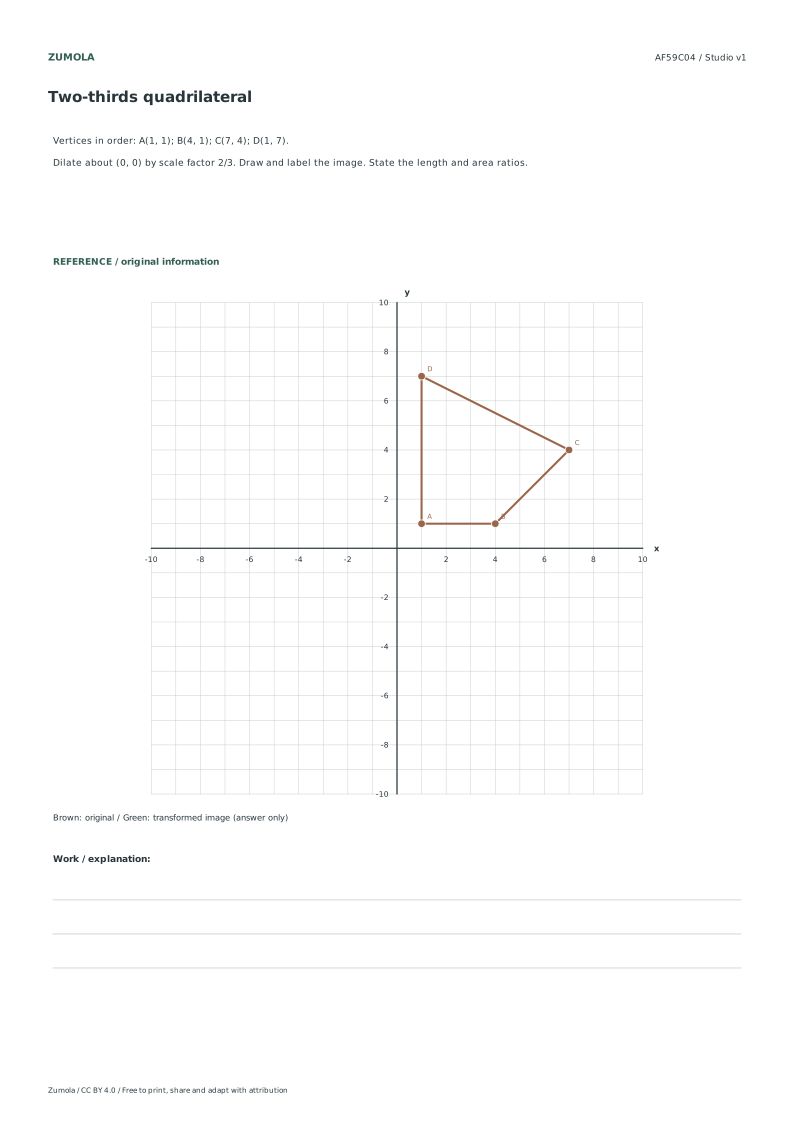
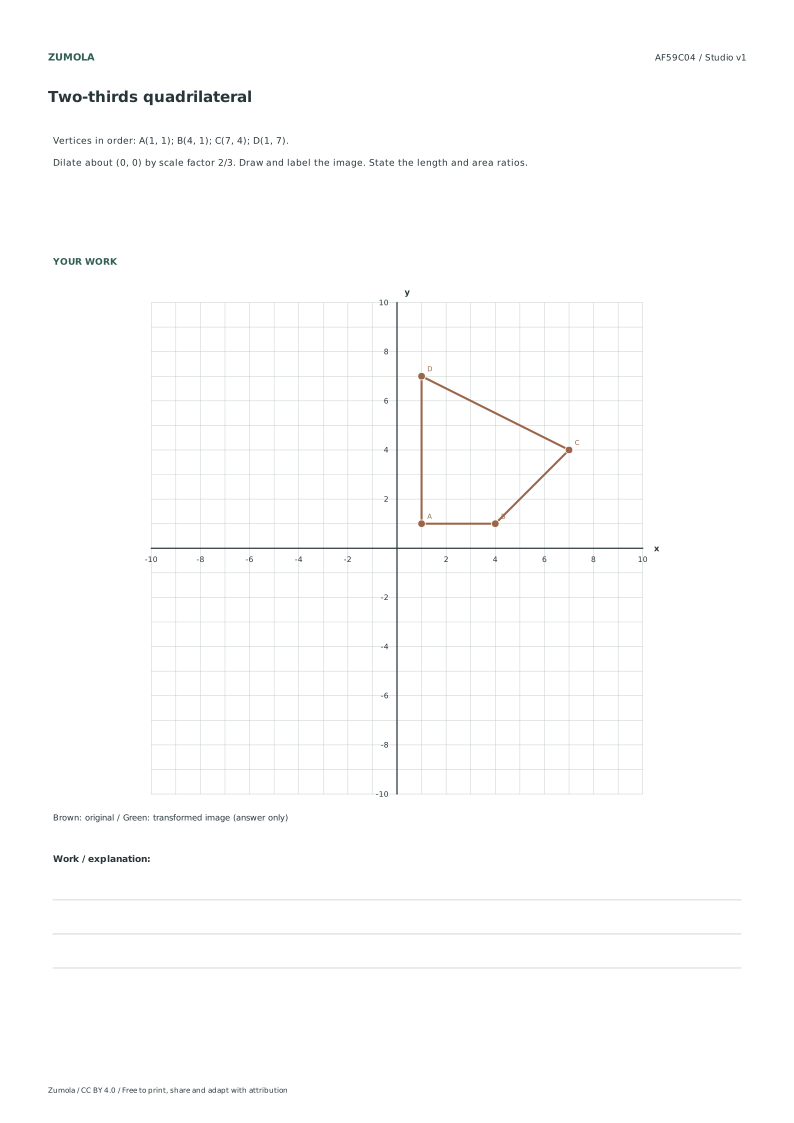
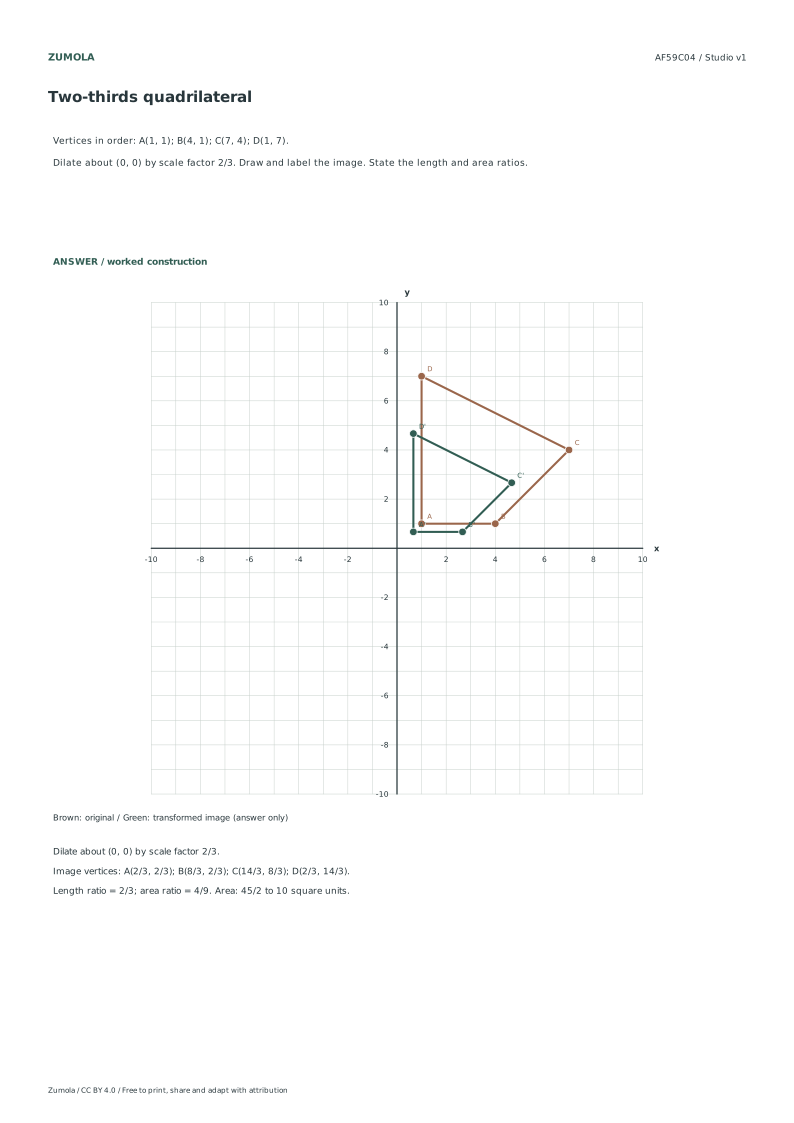
Dilate about (0, 0) by scale factor 2/3. Draw and label the image. State the length and area ratios.
Use the coordinates, dimensions and rules given for each case. Distances and areas are measured in grid units.
Check the first case
DI01: Double the triangle
Step
Worked result
1
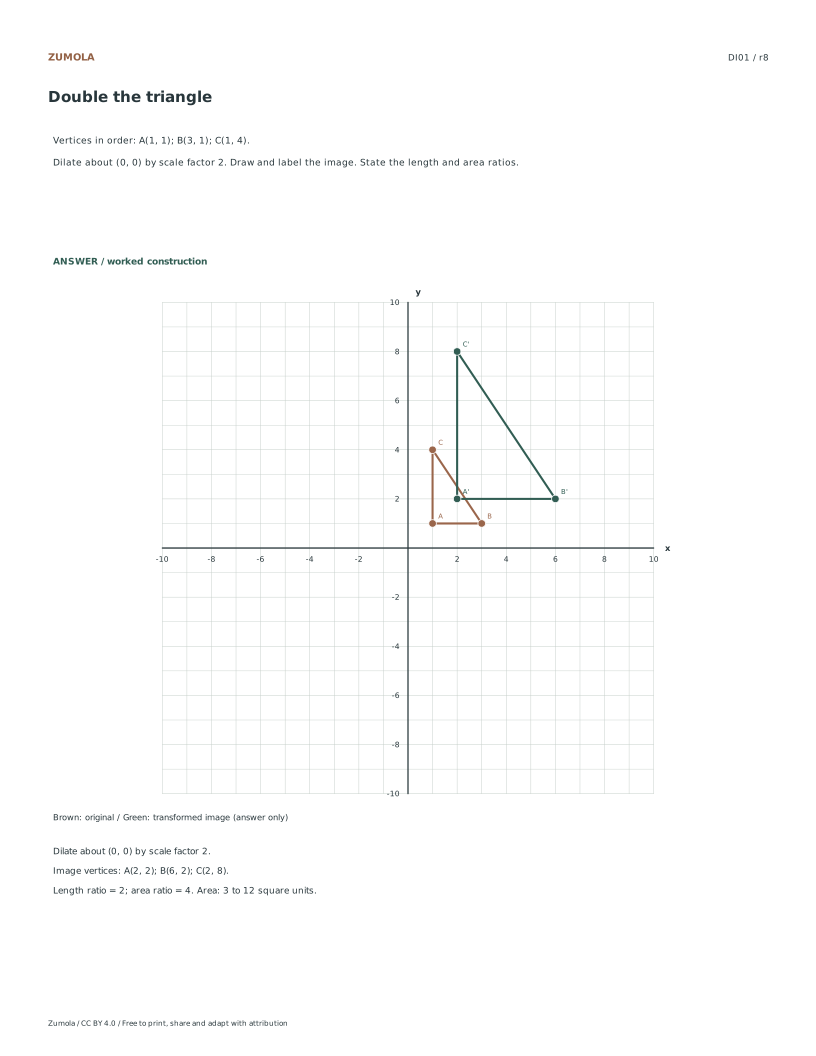
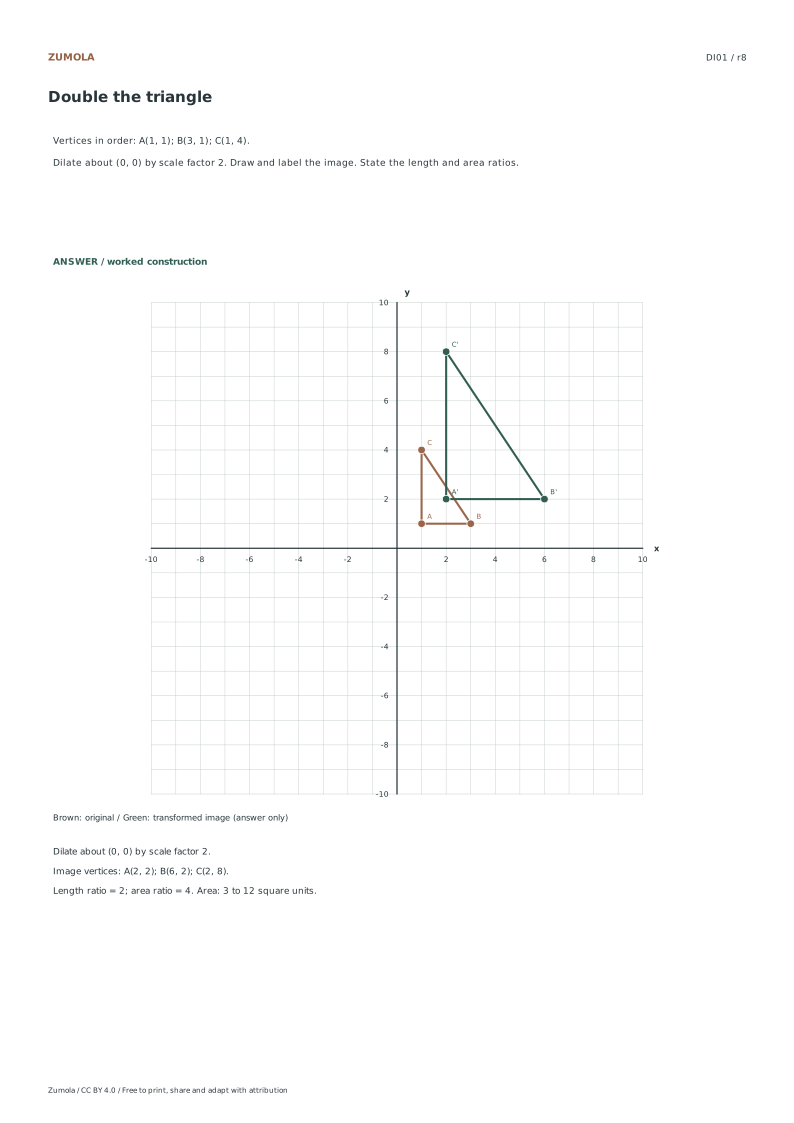
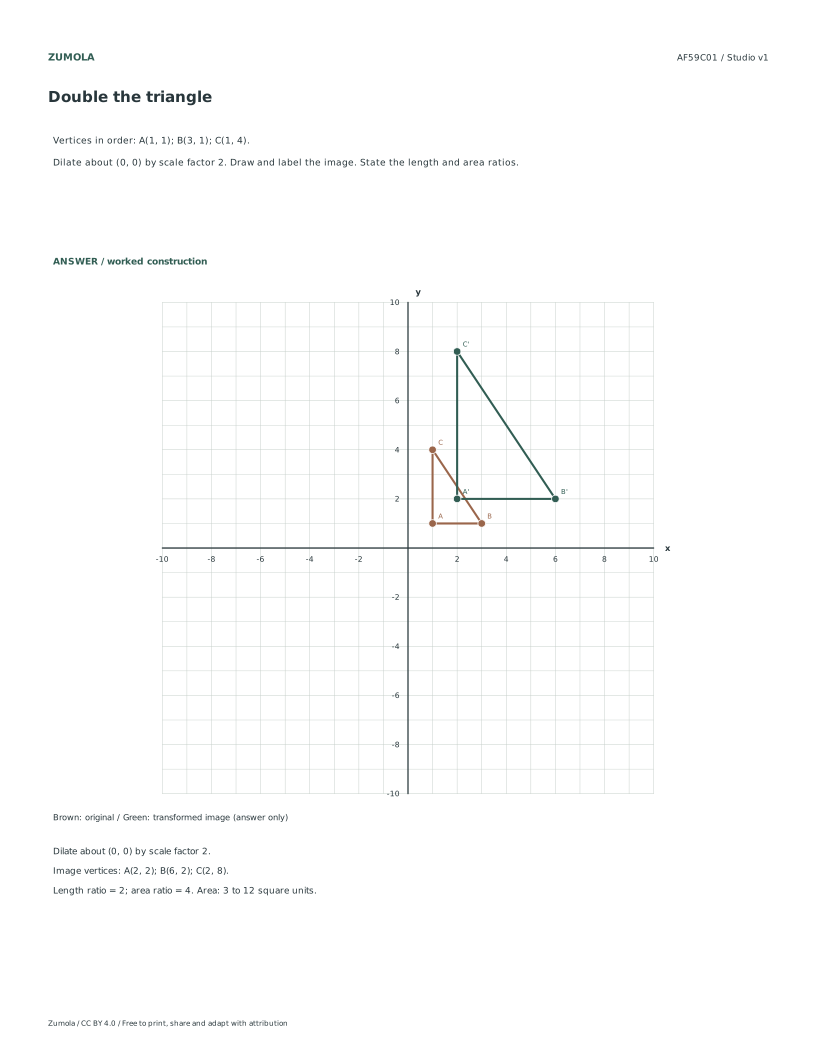
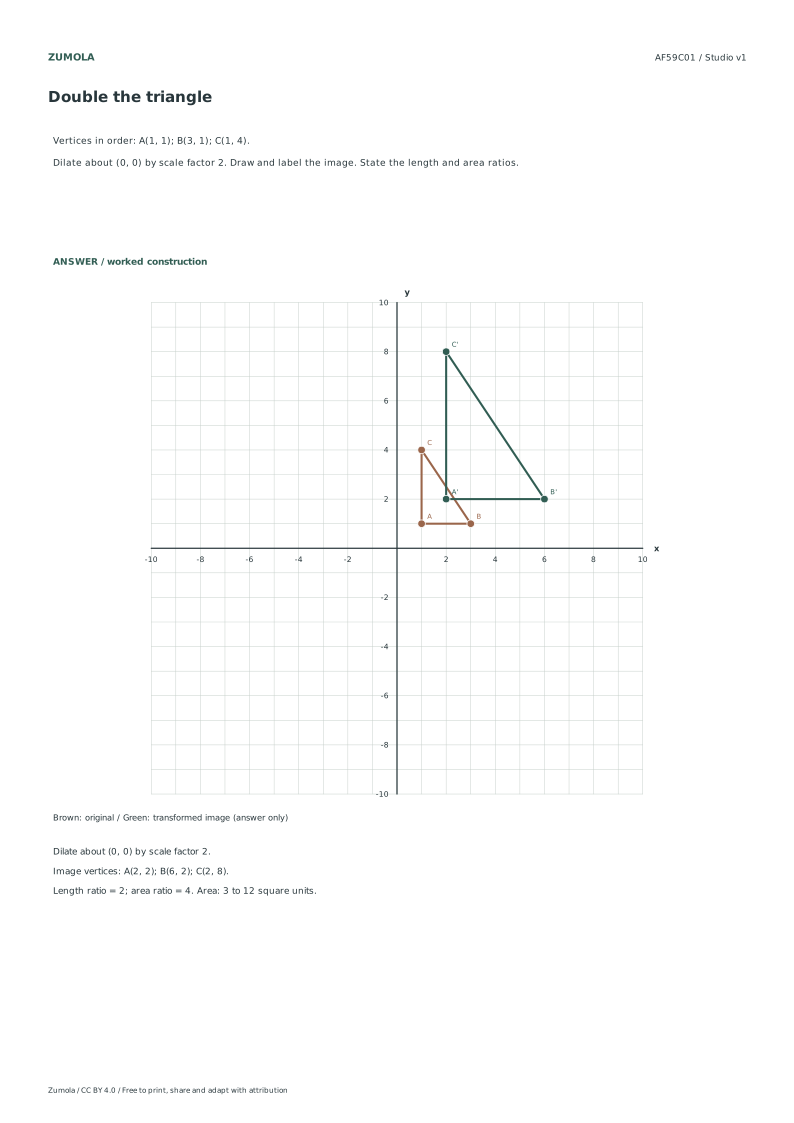
Dilate about (0, 0) by scale factor 2.
2
Image vertices: A(2, 2); B(6, 2); C(2, 8).
3
Length ratio = 2; area ratio = 4. Area: 3 to 12 square units.
The first case shows the checking pattern. Individual answer files contain the completed graph or net and result for every case.
Work through the graph
Dilating a Triangle by Scale Factor 2
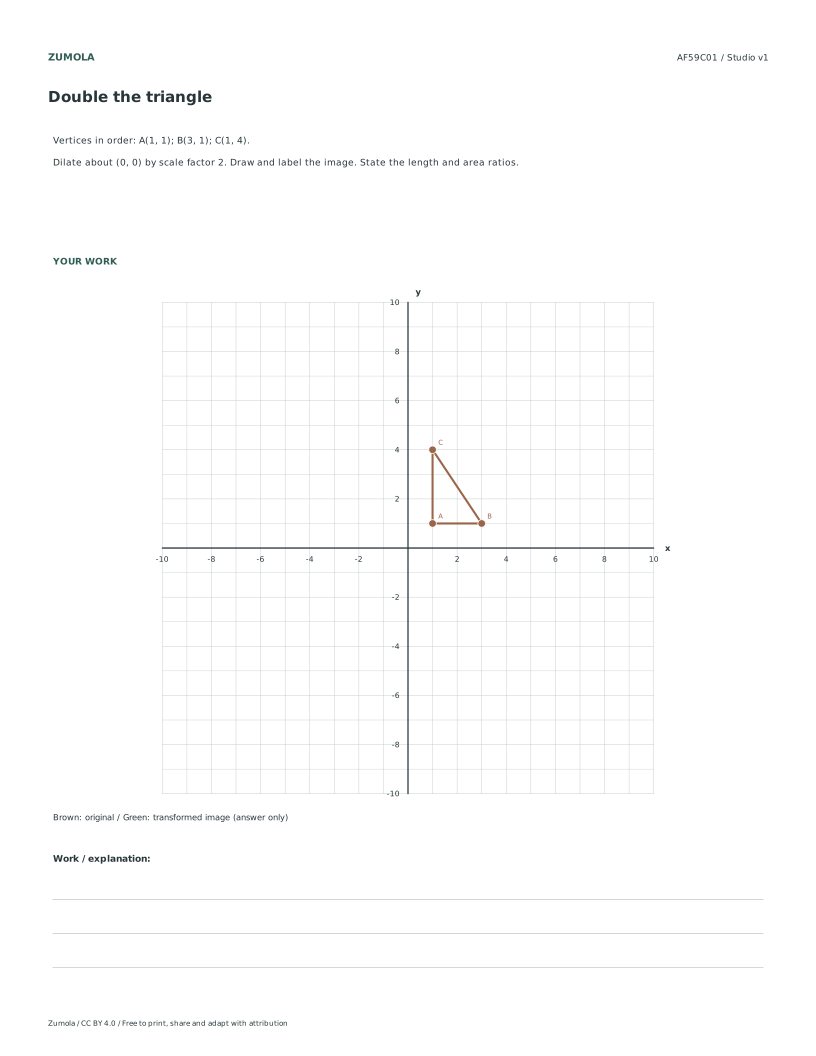
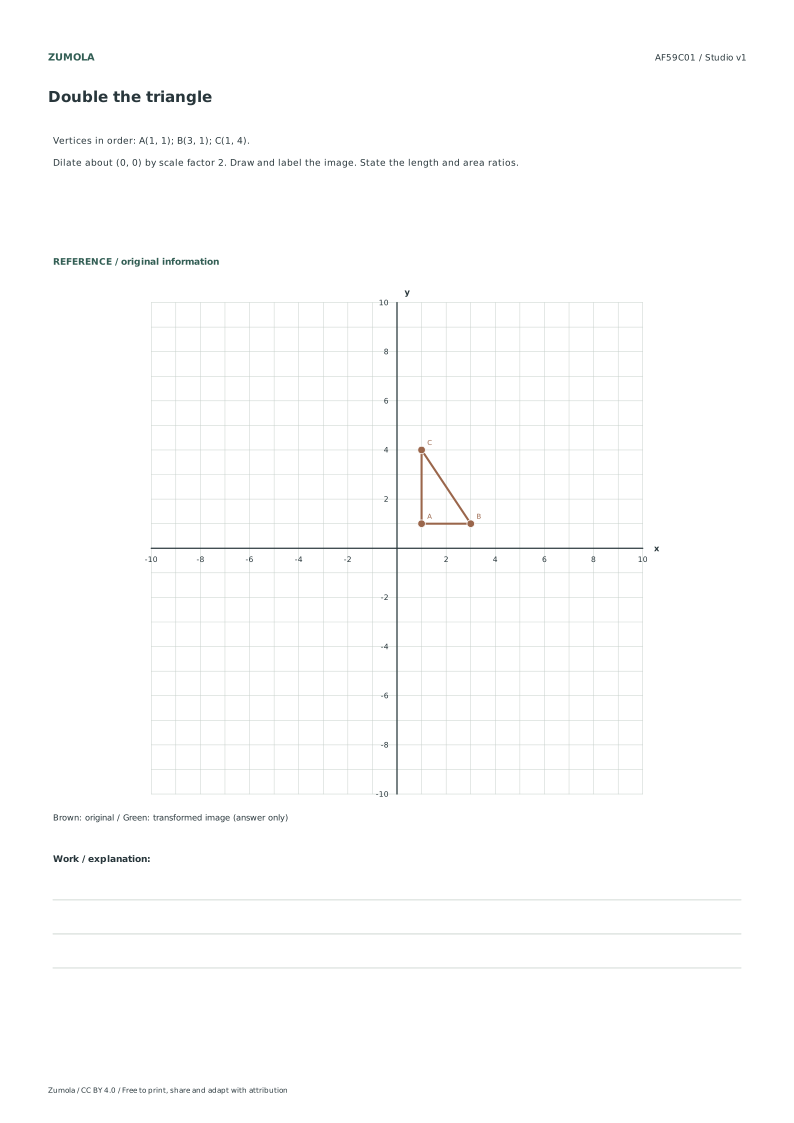
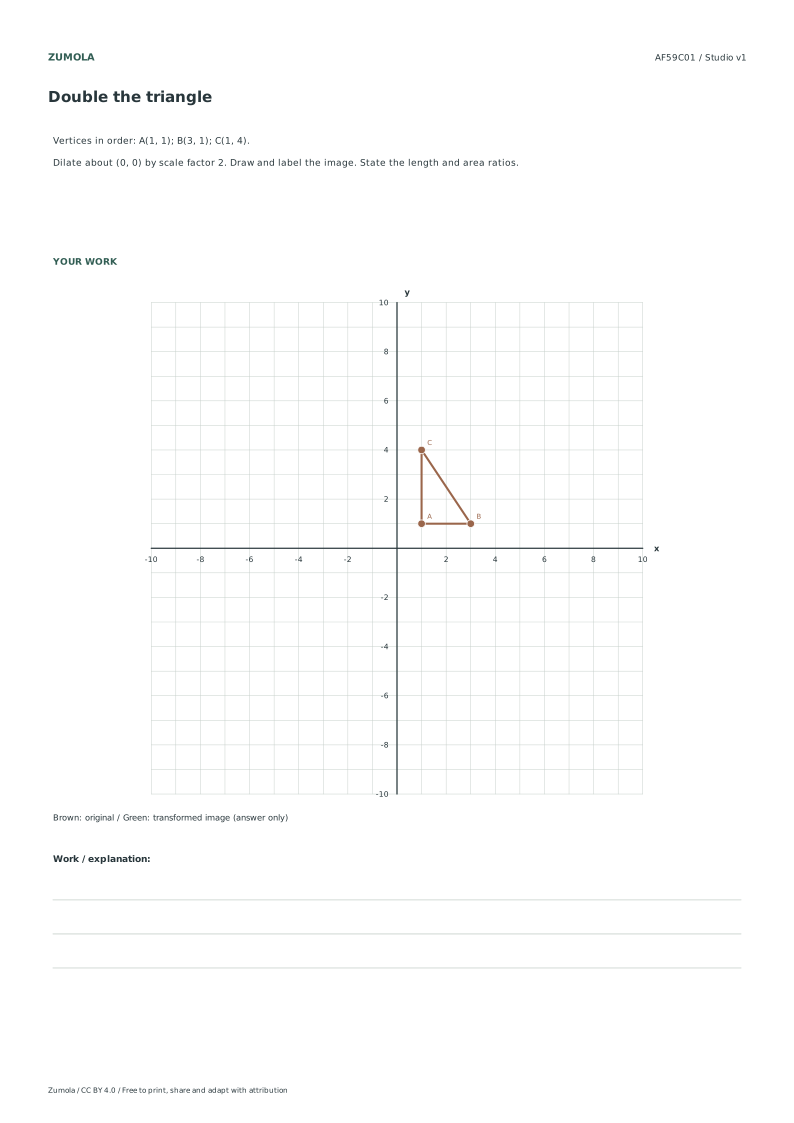
Start with triangle A(1, 1), B(3, 1), C(1, 4). To dilate about (0, 0) by scale factor 2, multiply each coordinate by 2: A becomes (2, 2), B becomes (6, 2), C becomes (2, 8). Plot these image points and connect them in the same order. The original area is 3 square units; the image area is 12 square units. The length ratio is 2, and the area ratio is 4. Check that each side length doubles and that the image area equals the original area times the square of the scale factor.
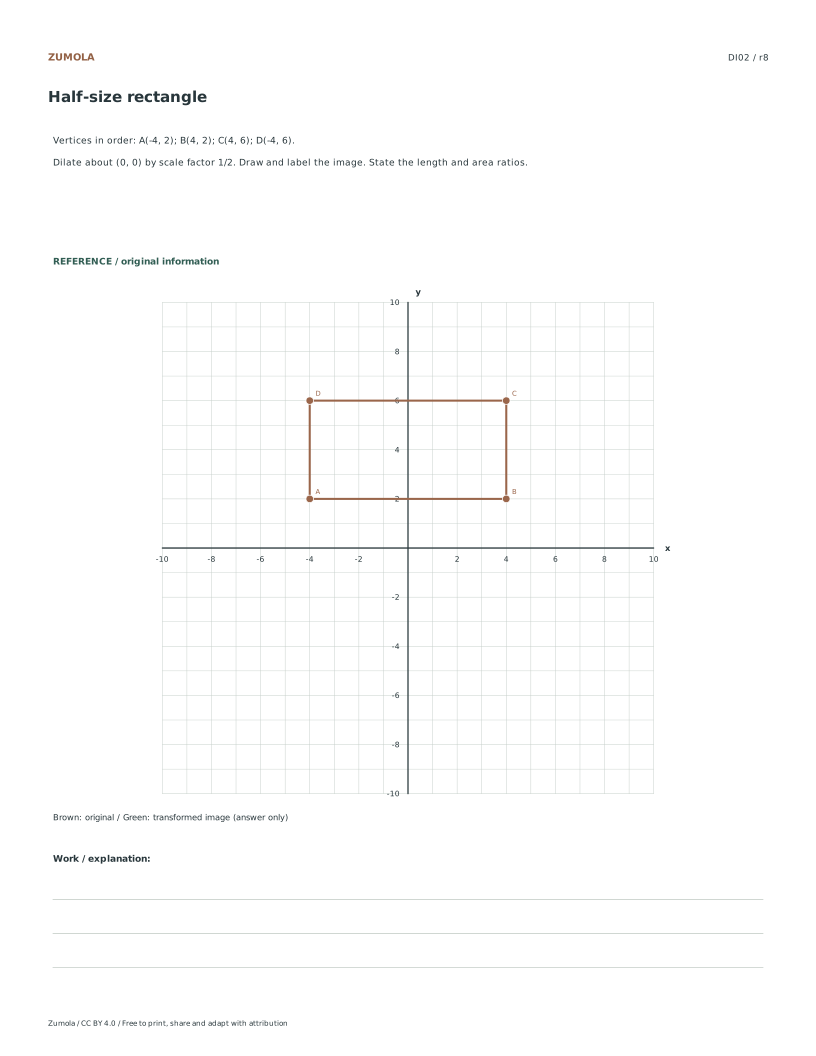
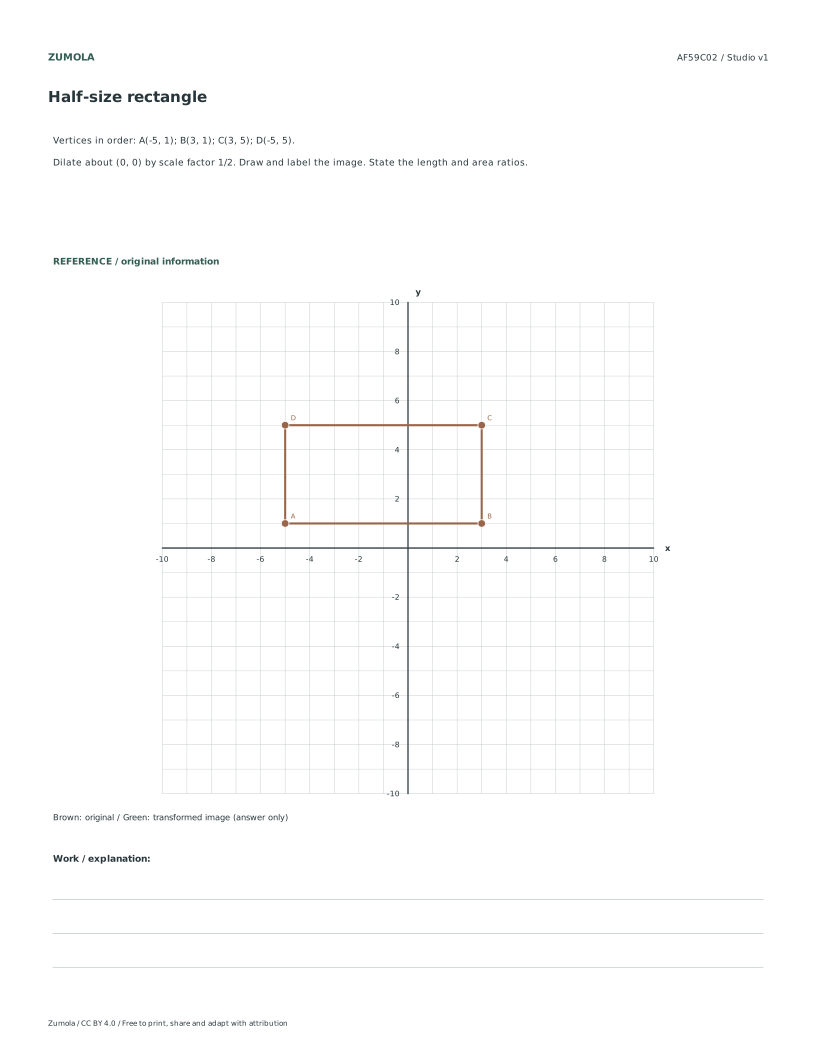
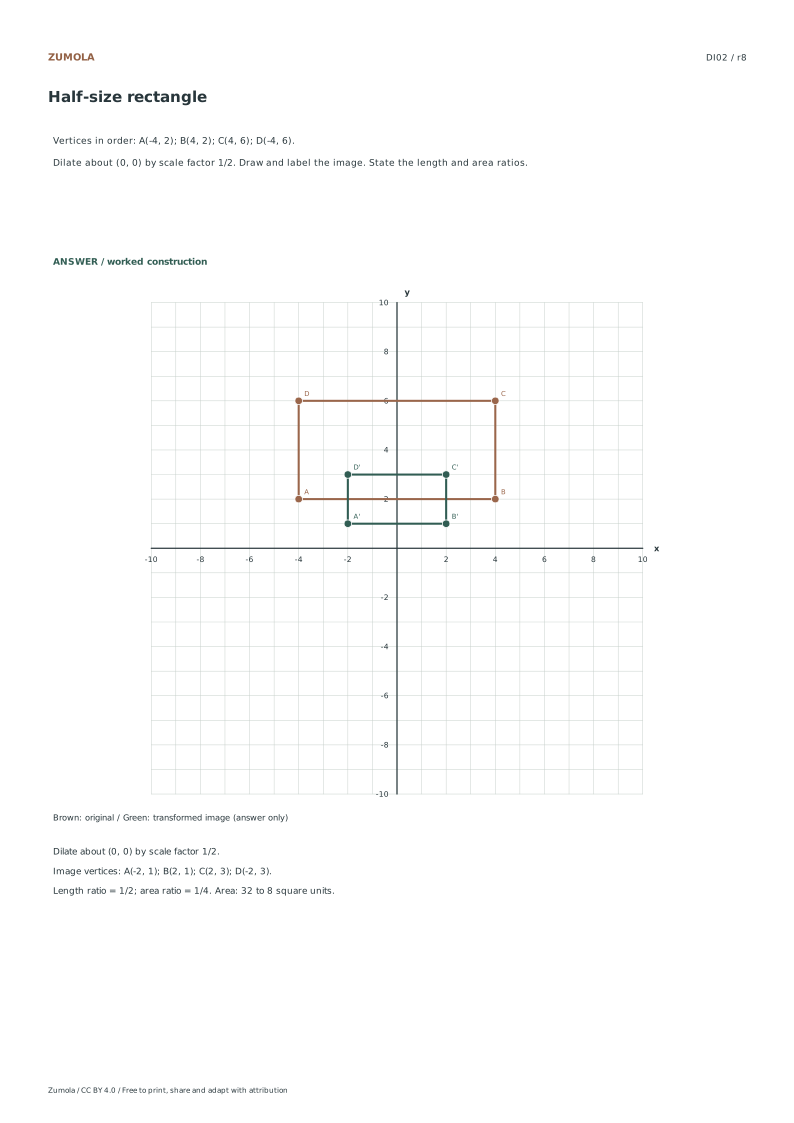
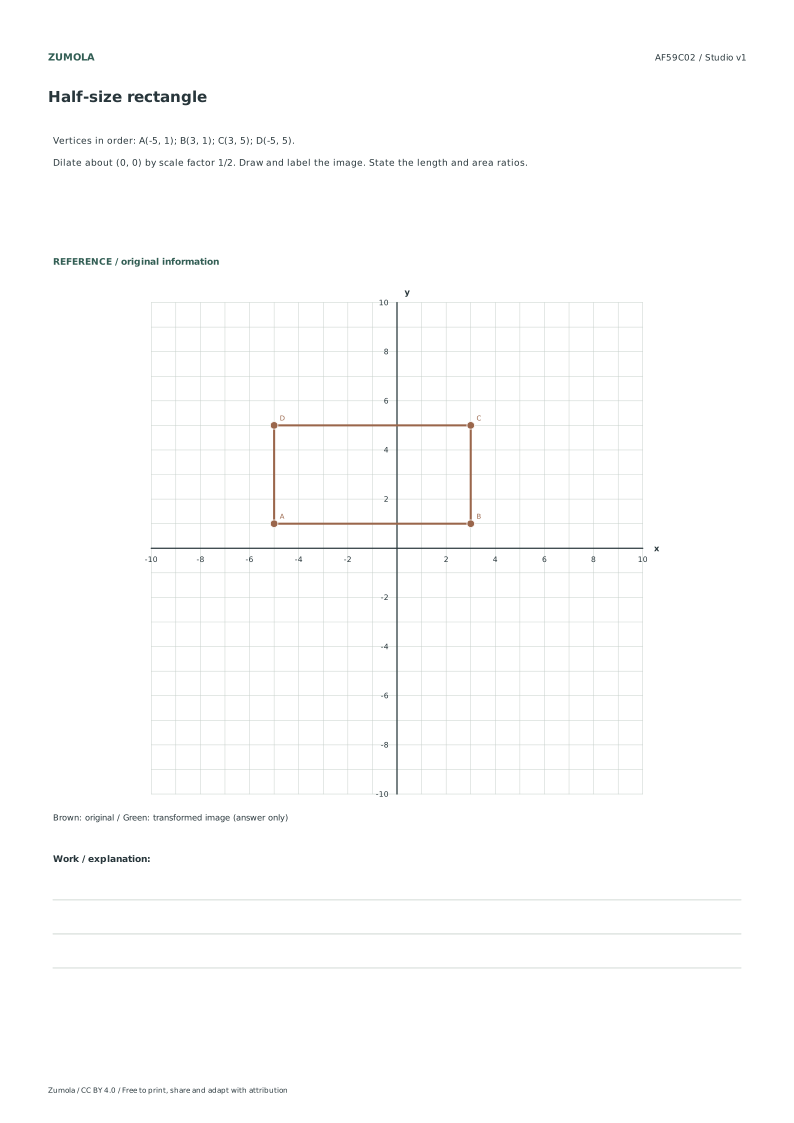
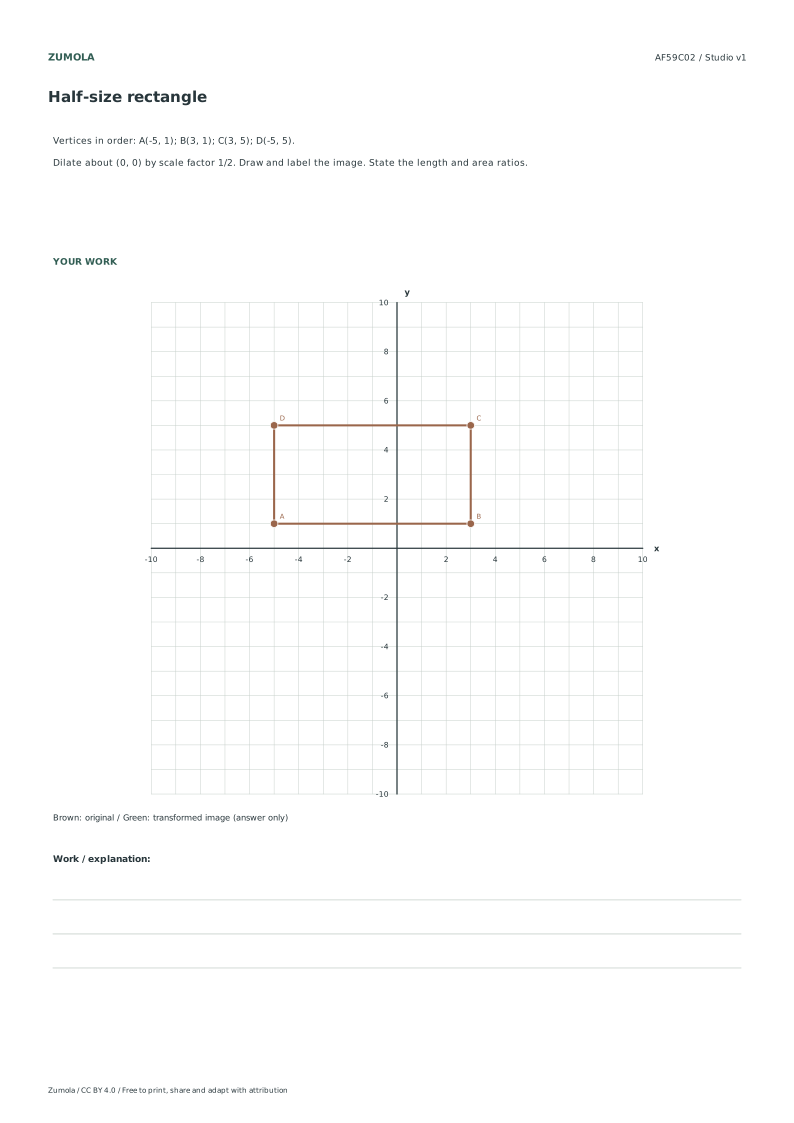
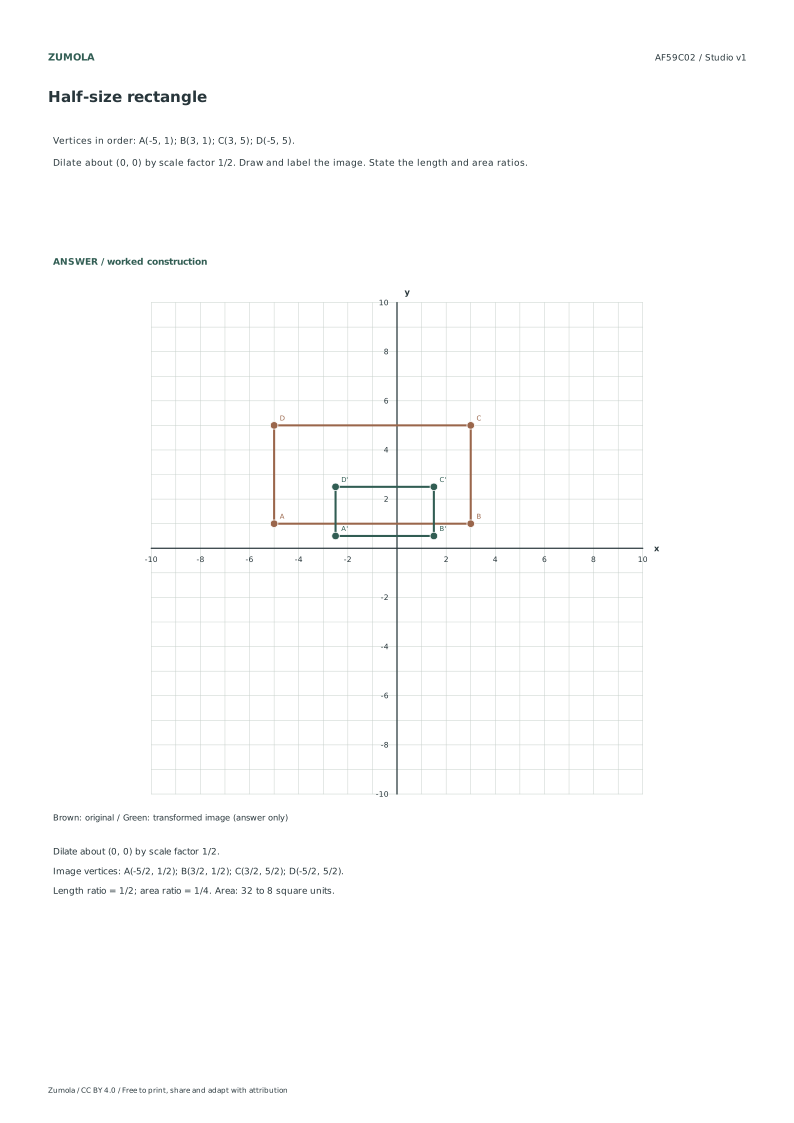
Dilating a Rectangle by Scale Factor 1/2
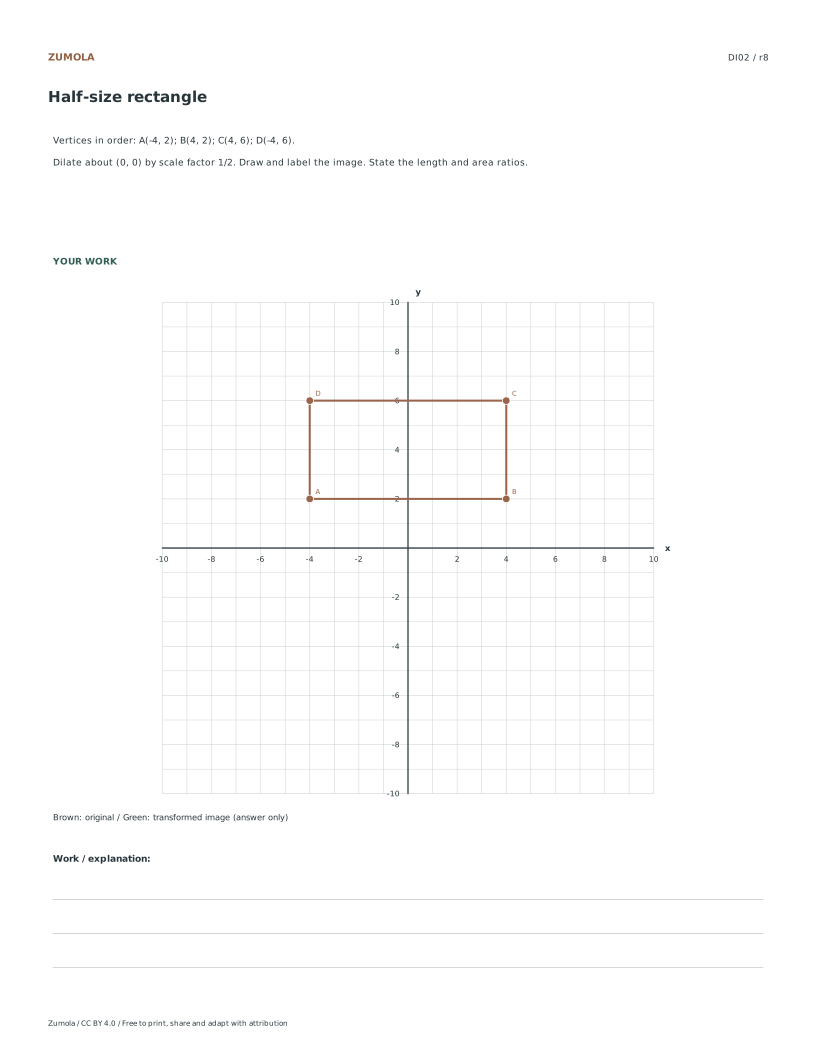
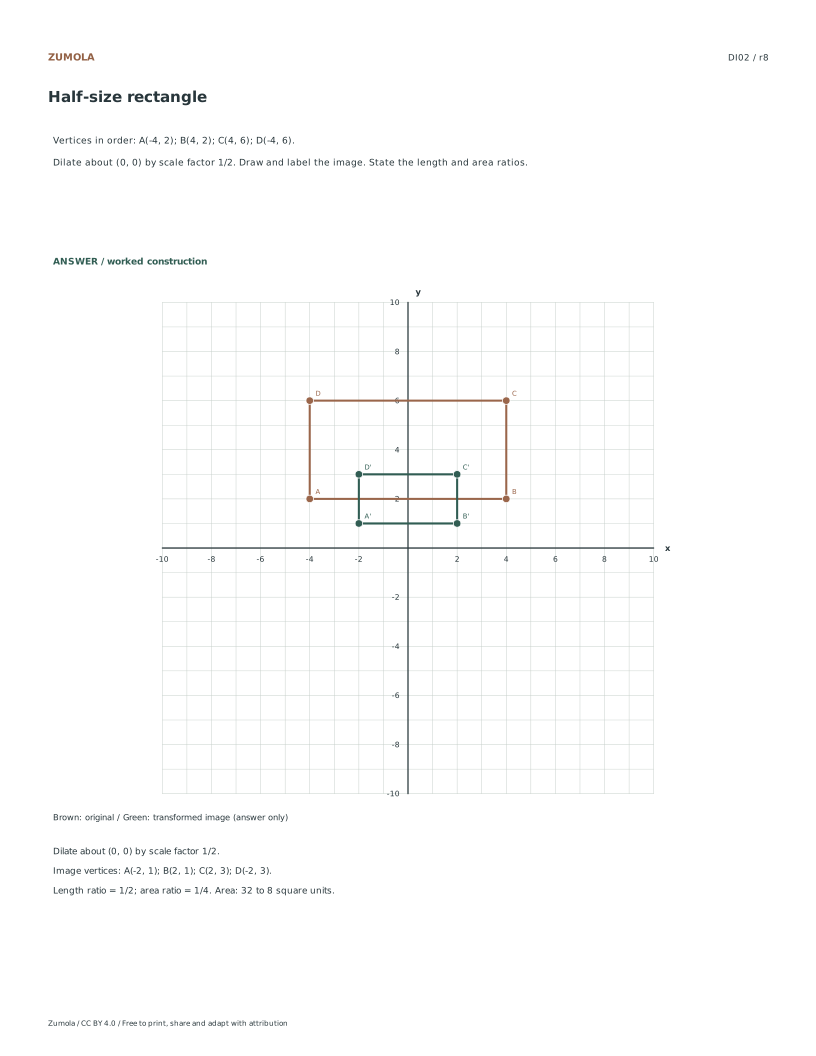
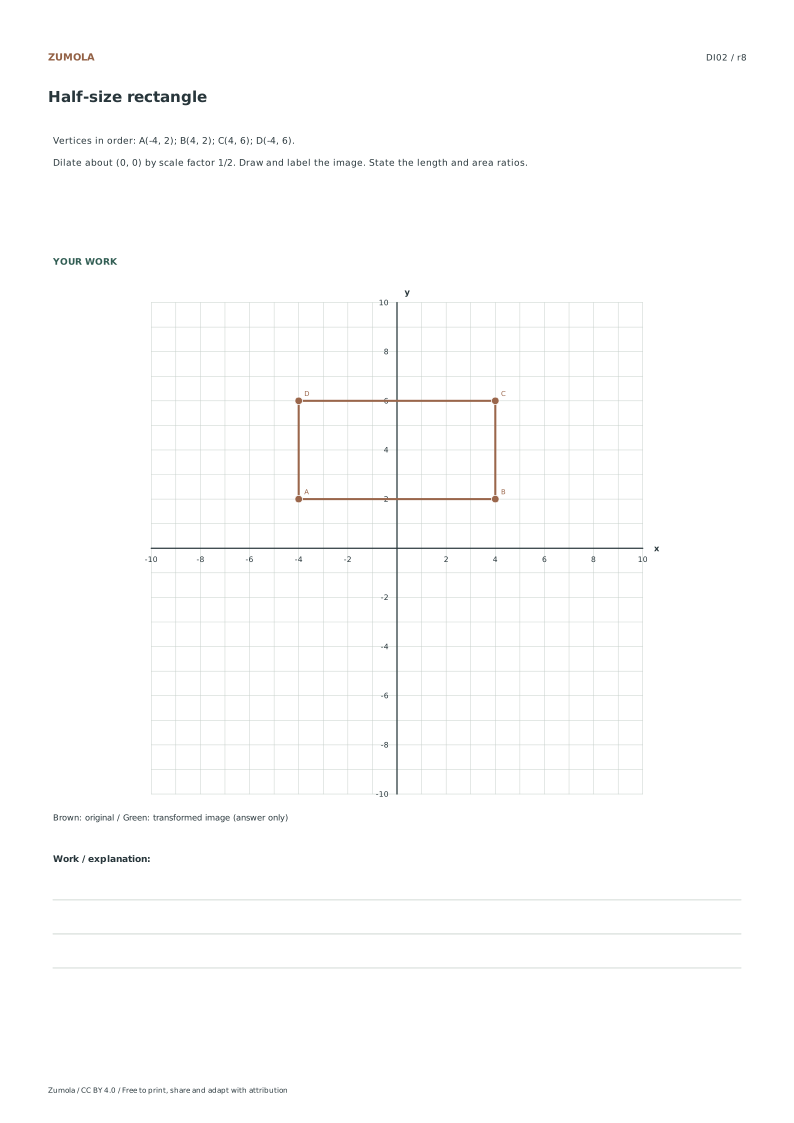
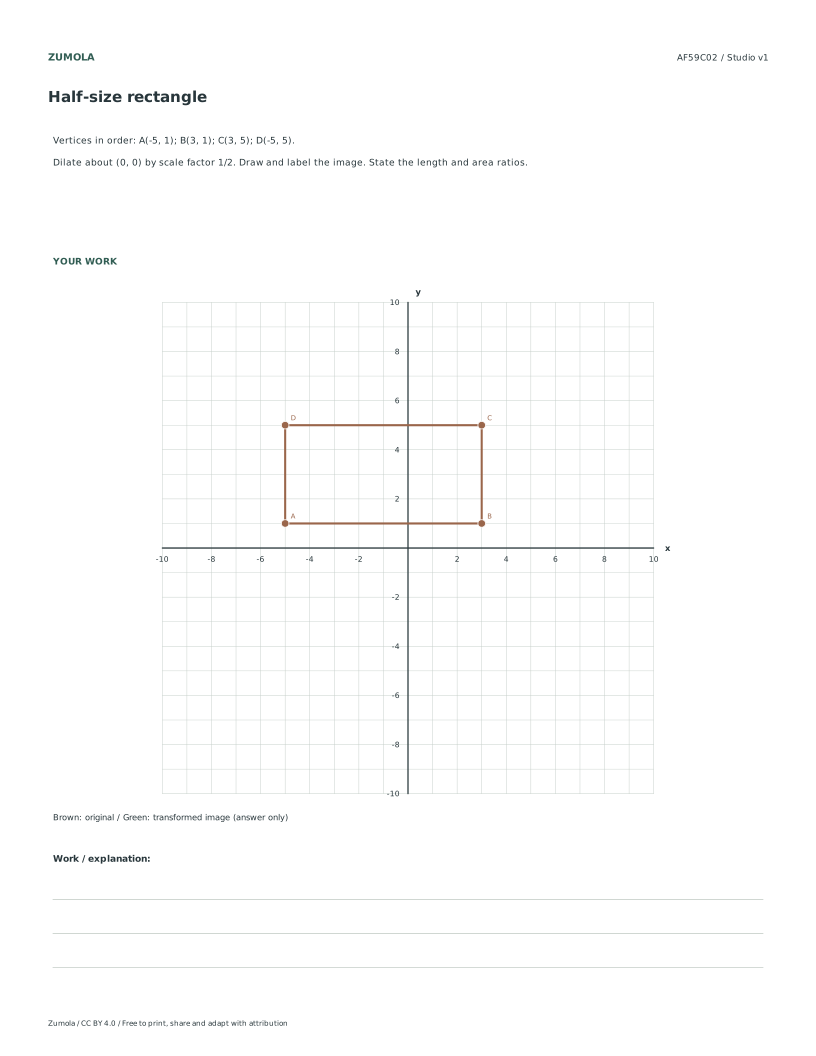
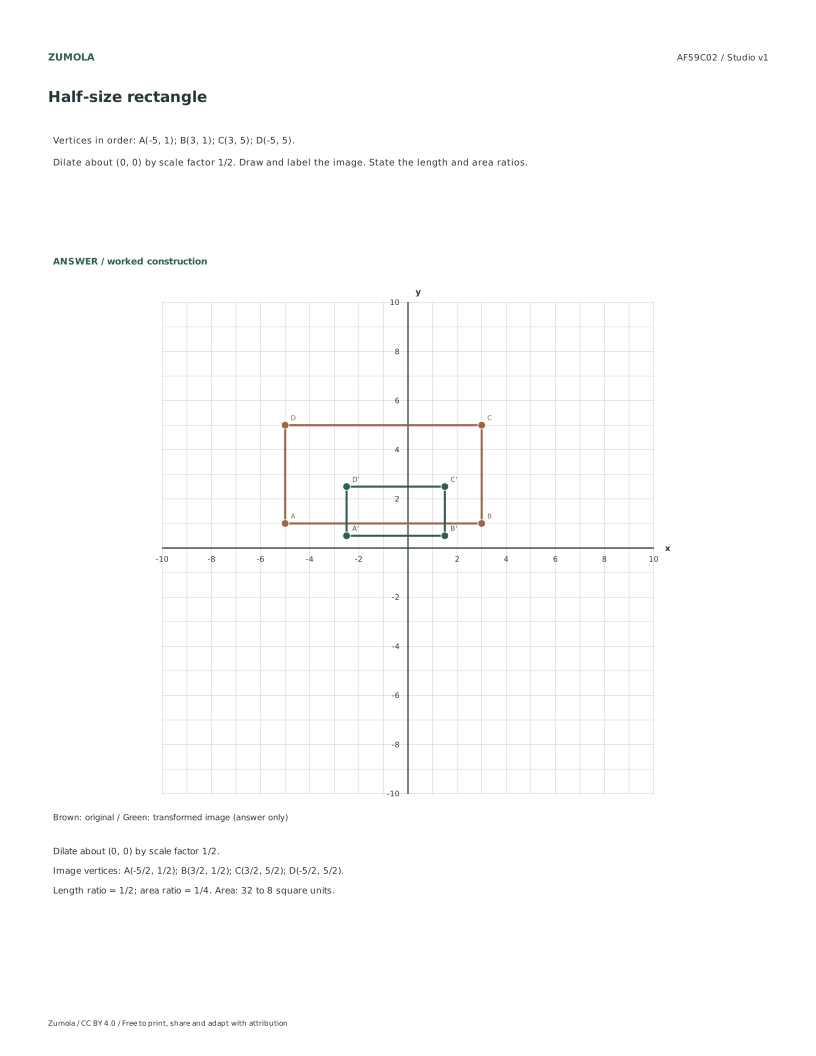
For rectangle A(-4, 2), B(4, 2), C(4, 6), D(-4, 6), dilate about (0, 0) by scale factor 1/2. Multiply each coordinate by 1/2: A(-2, 1), B(2, 1), C(2, 3), D(-2, 3). Plot and label the image. The original area is 32 square units; the image area is 8 square units. The length ratio is 1/2, and the area ratio is 1/4. Verify that each side length is halved and that the image area equals 32 times (1/2)^2, which is 8.
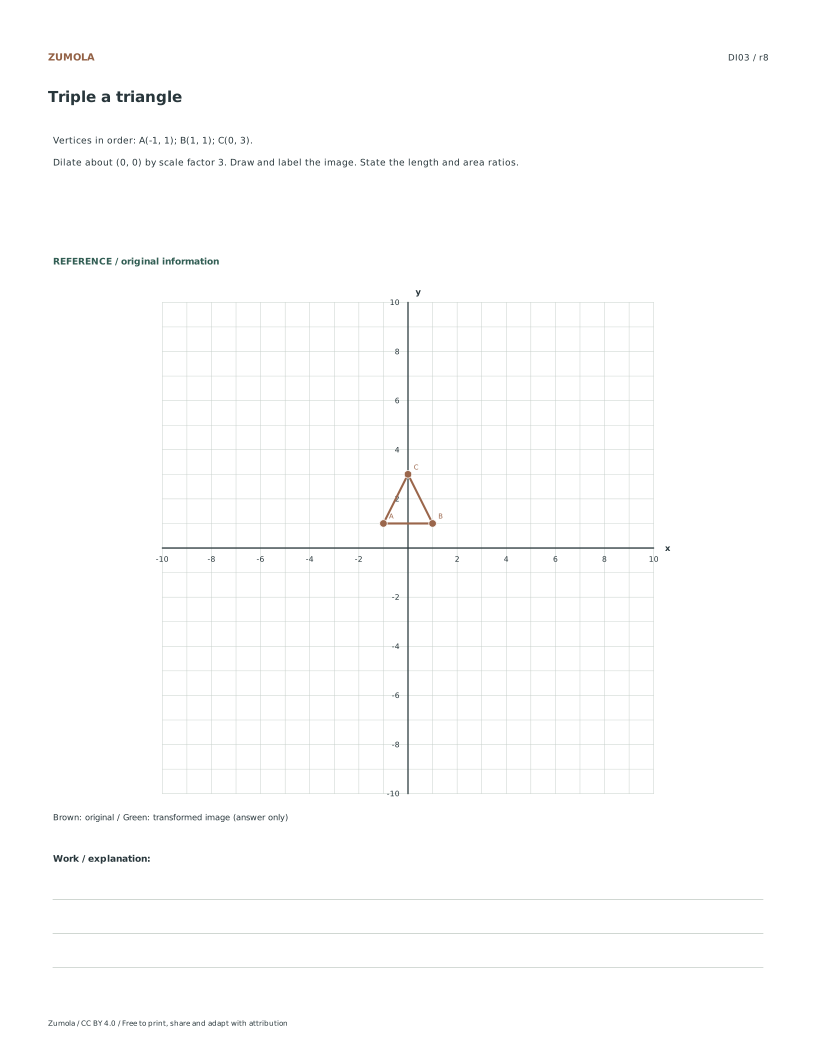
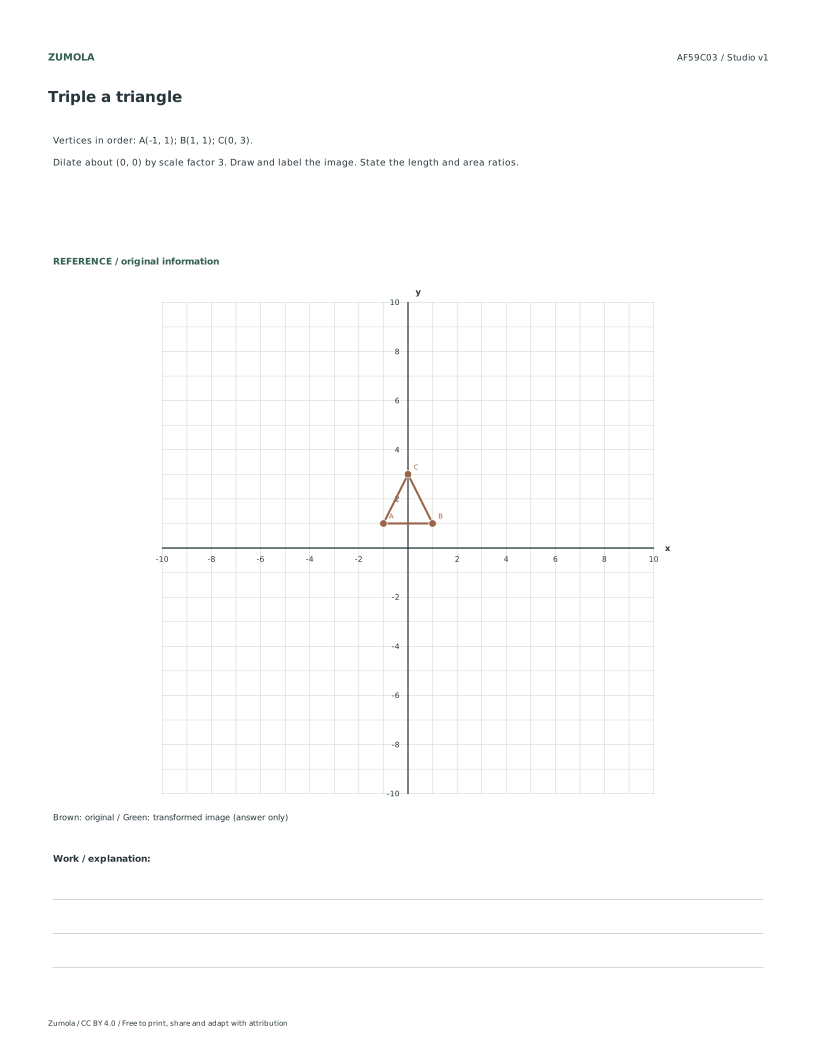
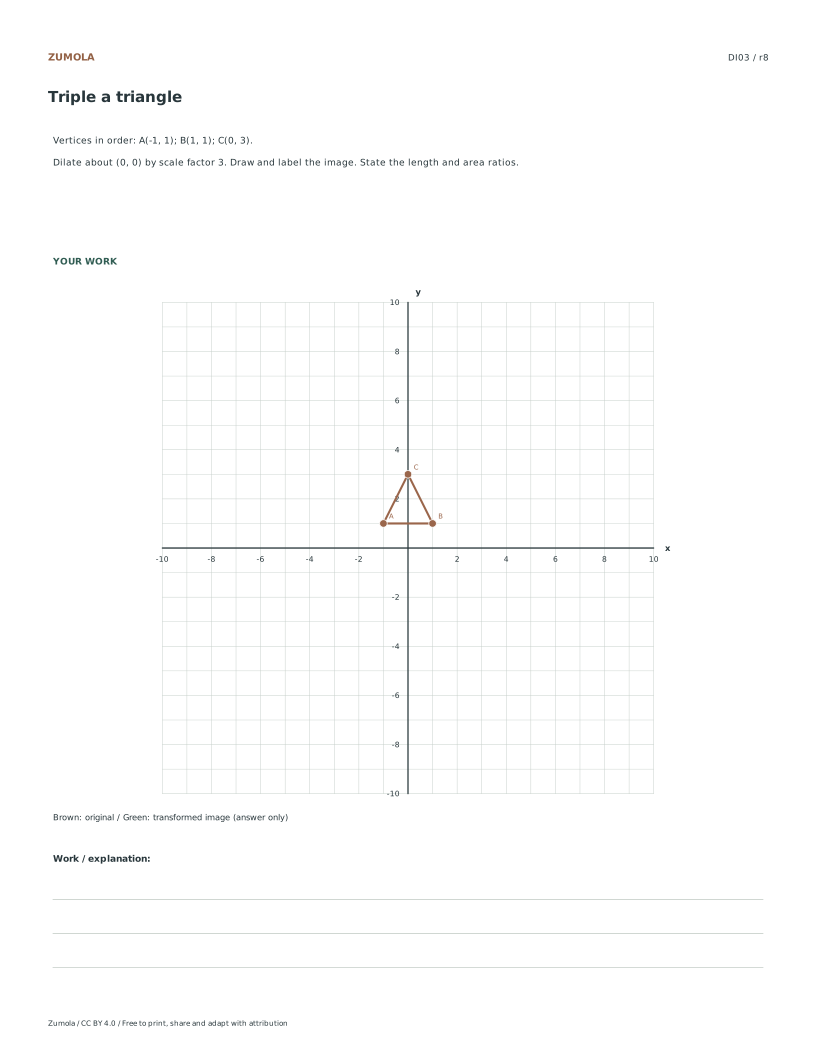
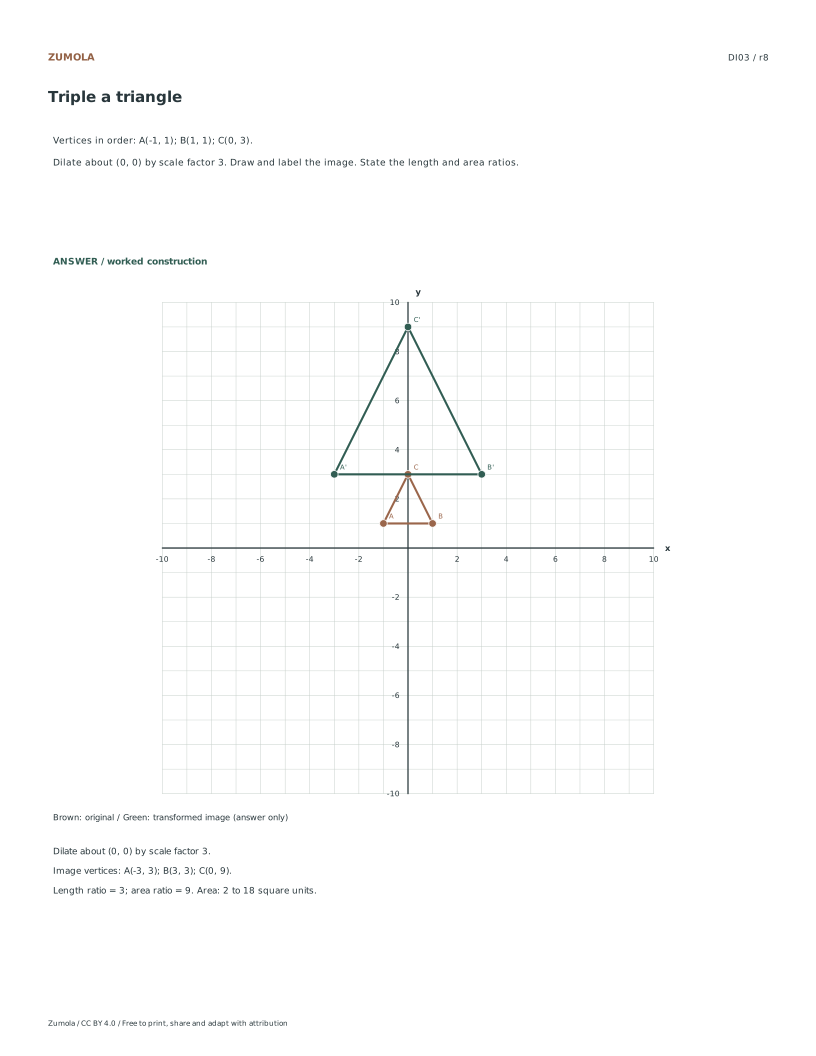
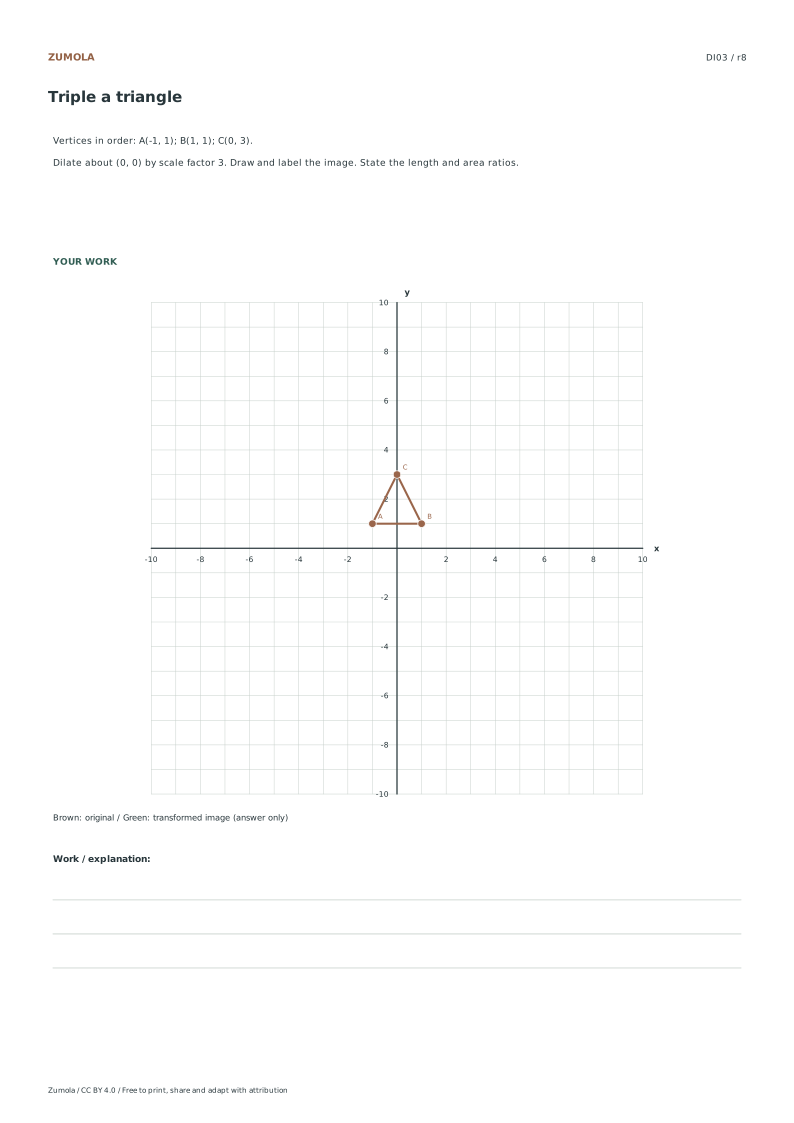
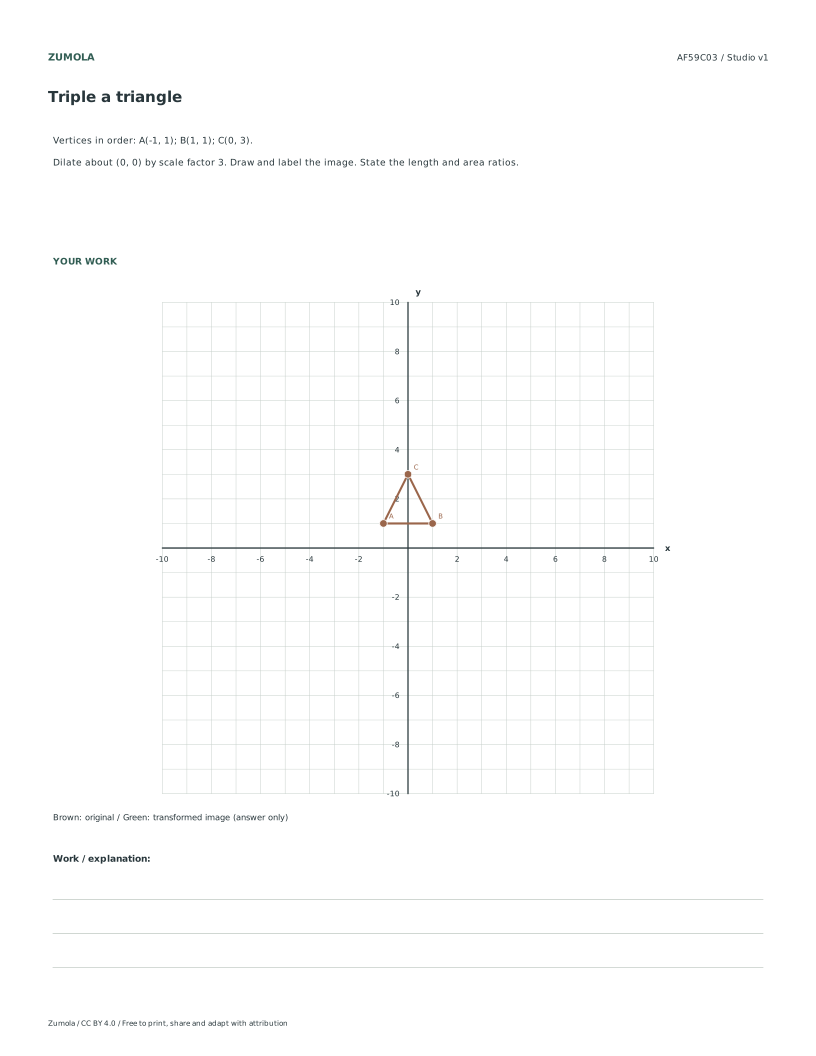
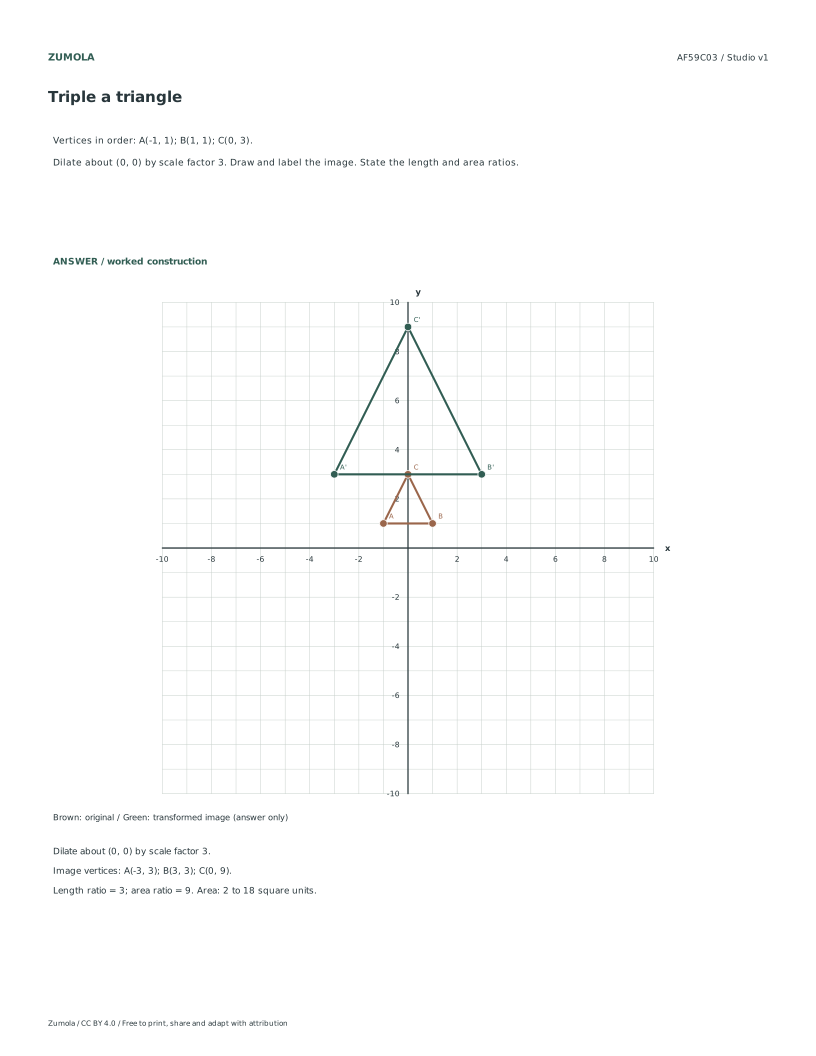
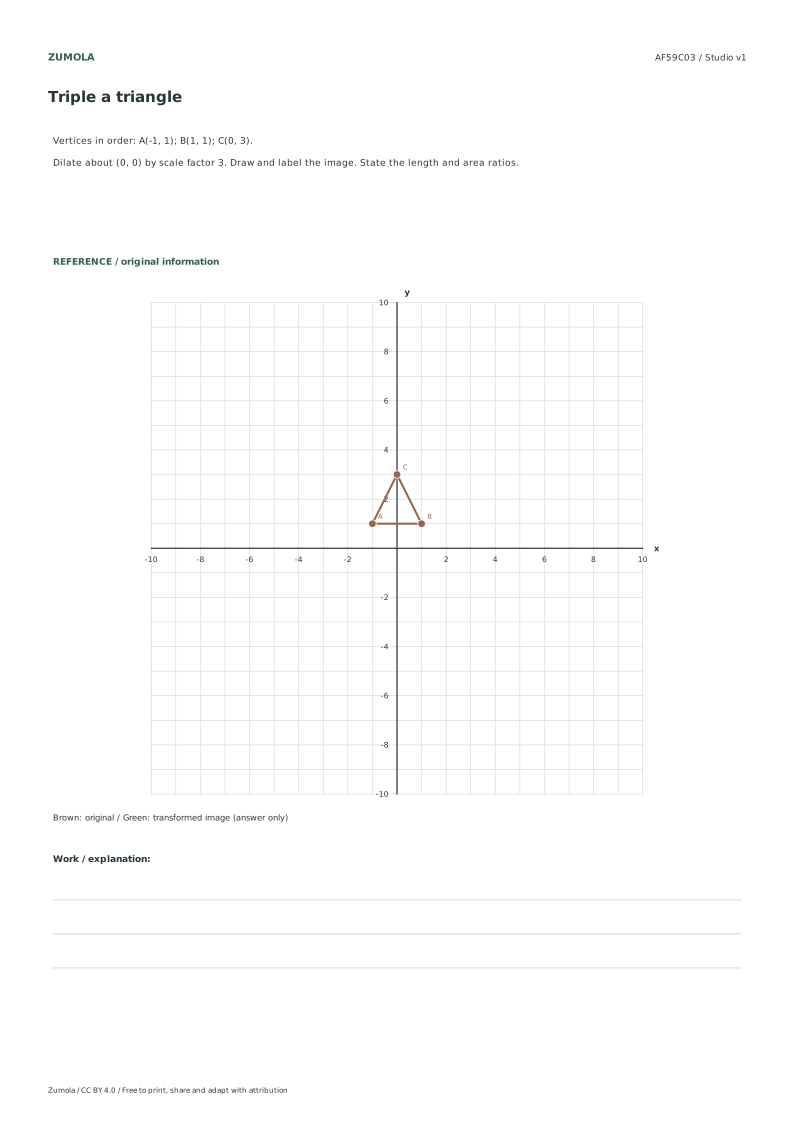
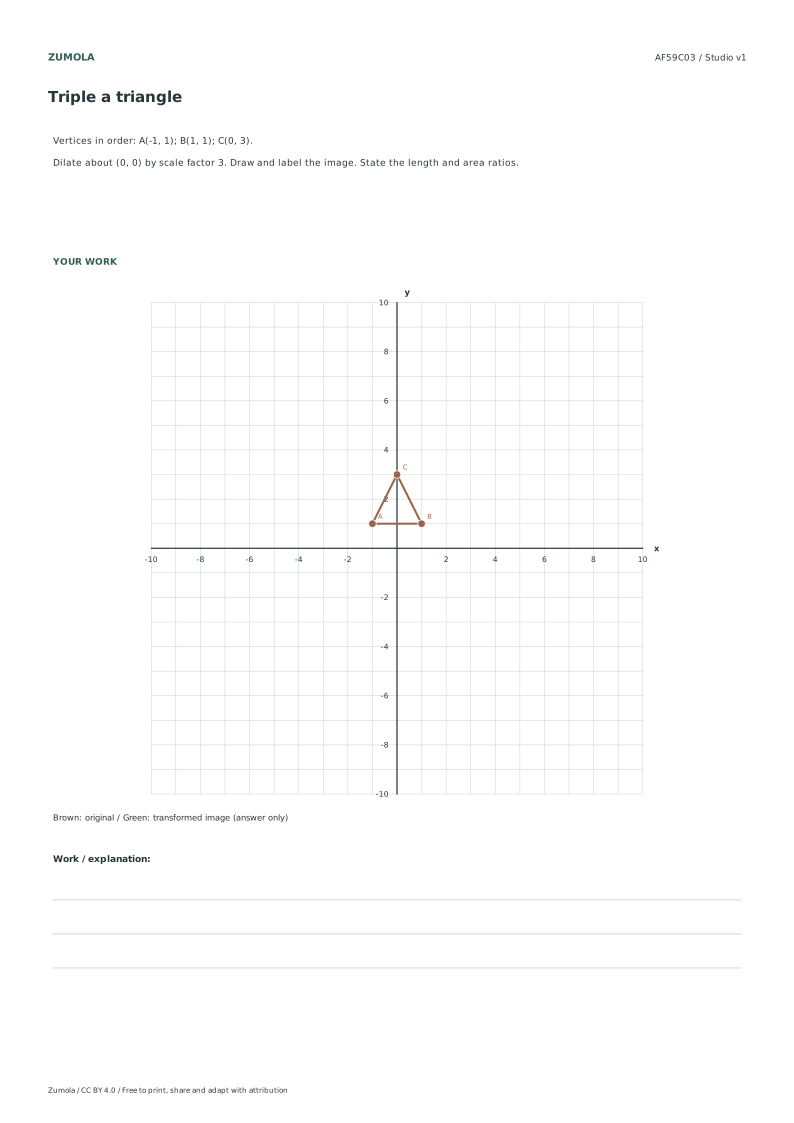
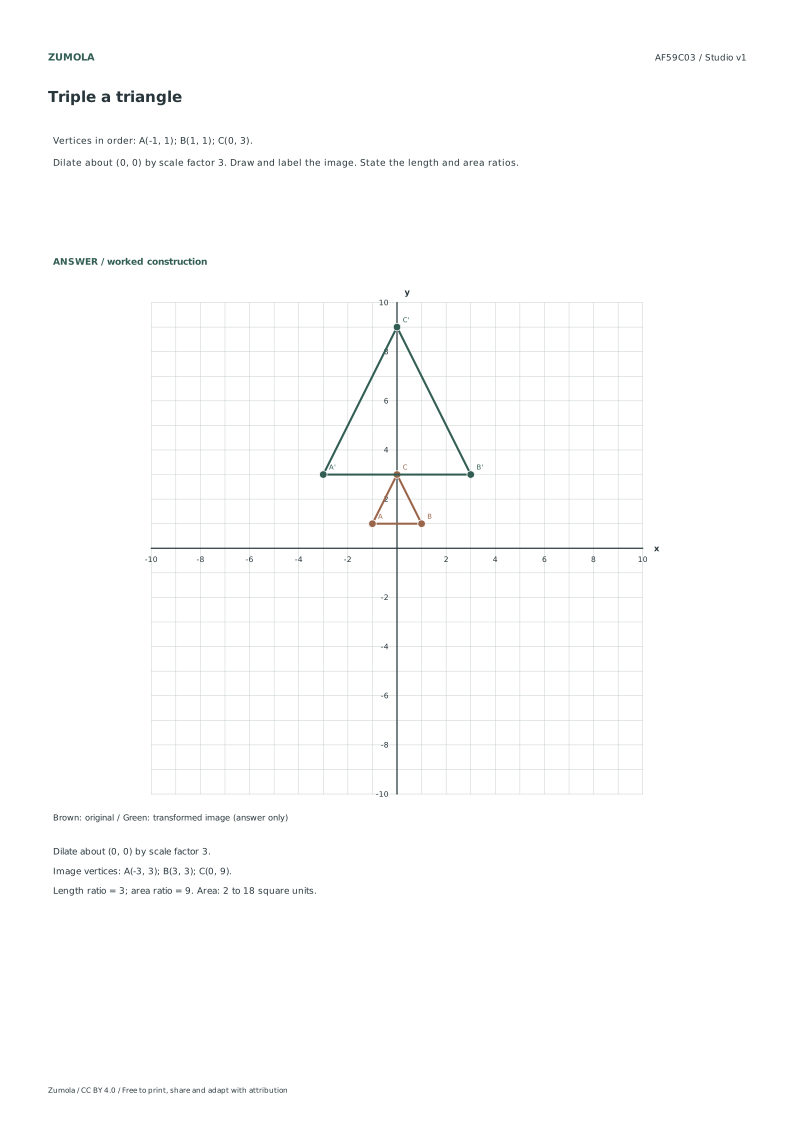
Dilating a Triangle by Scale Factor 3
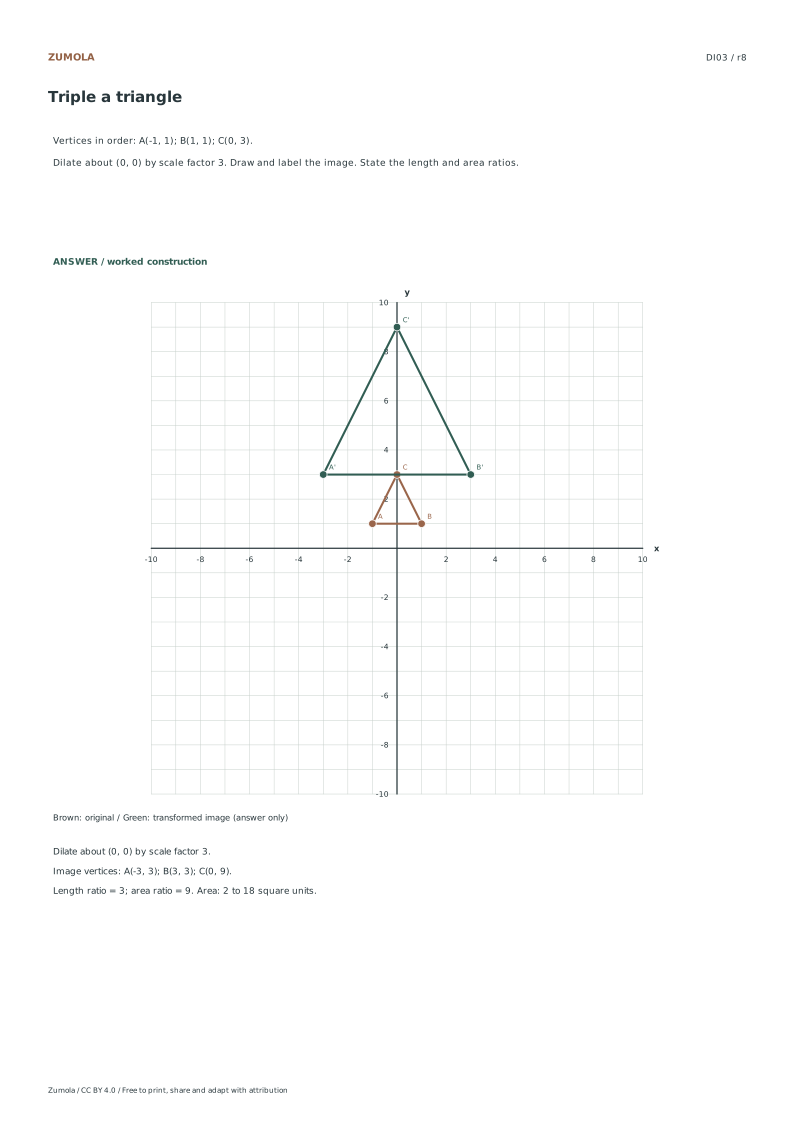
Take triangle A(-1, 1), B(1, 1), C(0, 3). Dilate about (0, 0) by scale factor 3 by multiplying each coordinate by 3: A(-3, 3), B(3, 3), C(0, 9). Plot the image and connect the vertices in order. The original area is 2 square units; the image area is 18 square units. The length ratio is 3, and the area ratio is 9. Confirm that each side length triples and that the image area equals the original area times 3 squared, or 9.
Checks that catch common errors
Watch for
Check instead
Multiplying only one coordinate of each vertex by the scale factor.
Multiply both the x- and y-coordinate of every vertex by the scale factor. For example, dilating A(1, 1) by 2 gives (2, 2), not (2, 1).
Using the scale factor itself as the area ratio.
The area ratio is the square of the scale factor. For scale factor 2, the area ratio is 4; for 1/2, it is 1/4; for 3, it is 9; for 2/3, it is 4/9.
Connecting image vertices in a different order than the original.
Keep the same vertex order when plotting and connecting. For A(1, 1), B(3, 1), C(1, 4) dilated by 2, connect (2, 2) to (6, 2) to (2, 8) and back to (2, 2).
Keep labels and margins readable
Choose the PDF that matches your paper. Print at Actual size / 100% and turn off Fit, Shrink and browser headers. SVG is editable but an editor can rescale it; the PDF is the simpler print route.
Useful answers
How do I find the image coordinates for a dilation about the origin?
Multiply each coordinate of every vertex by the scale factor. For example, dilating A(0, 0), B(3, 0), C(6, 3), D(0, 6) by 2/3 gives A(0, 0), B(2, 0), C(4, 2), D(0, 4).
What are the length and area ratios for a dilation?
The length ratio equals the scale factor. The area ratio equals the square of the scale factor. For scale factor 2/3, the length ratio is 2/3 and the area ratio is 4/9; the area changes from 45/2 to 10 square units.
How can I check that my dilated drawing is correct?
Verify that each image vertex is the original vertex multiplied by the scale factor, that side lengths scale by the same factor, and that the image area equals the original area times the square of the scale factor. For scale factor 3, area 2 becomes 18.
Are the answer files and editable graphs free?
Yes. The individual student, reference and answer files plus collection packs are free without signup. Credit Zumola under CC BY 4.0 when sharing or adapting.
To dilate a figure about the origin, multiply each vertex coordinate by the scale factor. For example, with A(1, 1), B(3, 1), C(1, 4) and scale factor 2, the image vertices are A'(2, 2), B'(6, 2), C'(2, 8). Plot these points and connect them in the same order. The length ratio equals the scale factor, so each side of the image is twice as long as the corresponding side of the original. The area ratio is the square of the scale factor, so the area increases by a factor of 4. The original area is 3 square units, and the image area is 12 square units.
Check the first new case
Vertices in order: A(1, 1); B(3, 1); C(1, 4).
Dilate about (0, 0) by scale factor 2.
Image vertices: A(2, 2); B(6, 2); C(2, 8).
Length ratio = 2; area ratio = 4. Area: 3 to 12 square units.
The answer PDFs include the completed drawings and checks for all four cases. Free original resources, CC BY 4.0. No signup required.
More ways to practice
The center-first coordinate rule
Write the center as C(a, b), the original point as P(x, y), and the scale factor as k. The image point is P' = (a + k(x - a), b + k(y - b)). Subtracting the center first turns the problem into a dilation about the origin, and adding the center back returns the figure to its correct place. This single formula covers positive, fractional, and negative factors, so no separate rule is needed for flipped images.
A negative k rotates the image 180 degrees about the center while scaling it. A factor of -2 therefore doubles every distance from the center and places the image on the opposite side. Lengths scale by the absolute value of k, so a factor of -2 doubles side lengths, while signed coordinates change sign relative to the center.
Subtract the center coordinates from each vertex to get offset vectors.
Multiply both offset components by the scale factor k, keeping signs.
Add the center coordinates back to each scaled offset.
Plot the original and image vertices, then connect them in the same vertex order.
Measure one side on each figure and confirm the ratio equals the absolute value of k.
Diagnostic checks after plotting
Three checks catch nearly every plotting error. First, the center must be its own image: substituting P = C into the formula gives C for any k, so if the marked center moves, the construction is wrong. Second, corresponding vertices and the center must be collinear, because dilation preserves the line through each point and the center. Third, orientation reverses exactly when k is negative; if a figure flips with a positive factor, a sign was dropped.
Area follows a separate rule from length. Area scales by k squared, so a factor of -2 multiplies area by 4, and a factor of one half multiplies area by one quarter. Report lengths in grid units and area in square grid units, and never mix the two when comparing original and image.
Confirm the center maps to itself.
Draw a straight line from each original vertex through the center and check the image vertex lies on it.
Compare one side length ratio with the absolute value of k.
Compare area ratio with k squared.
Check that orientation flipped only if k is negative.
Separating task types on a sheet
A drawing task asks for plotted vertices and connected segments. A property task asks whether lengths, angles, or orientation changed. An area task asks for a numeric comparison in square units. A composite task applies a second transformation after the dilation. Keep these prompts visually distinct so a student does not answer an area question with plotted points, and require units on every numeric answer.
Angles are preserved under dilation, so corresponding angles stay equal even when the image is flipped. This is a useful cross-check: if a plotted image has a different angle at a corresponding vertex, the vertex order or a coordinate is wrong.
Label each prompt as draw, property, area, or composite.
For property prompts, state which quantity is preserved and which changes.
For area prompts, give the ratio and the unit.
For composite prompts, complete the dilation fully before applying the second move.
Try this example
Dilate triangle A(2, 1), B(4, 1), C(2, 3) about center C0(2, 1) with scale factor -2. Find the image vertices and the area ratio.
Show the worked explanation
Offsets from the center: A gives (0, 0), B gives (2, 0), C gives (0, 2). Multiplying by -2 gives (0, 0), (-4, 0), (0, -4). Adding the center (2, 1) gives A'(2, 1), B'(-2, 1), C'(2, -3). Vertex A lies on the center, so it maps to itself, which is consistent. The original legs are 2 and 2 grid units, area 2 square units; the image legs are 4 and 4, area 8 square units. The area ratio is 4, equal to (-2) squared.
Common mistakes
Multiplying the original coordinates by k without subtracting the center first. Subtract the center from each vertex, scale the offset, then add the center back.
Dropping the negative sign on one coordinate when k is negative. Apply k to both offset components and recheck that the image sits opposite the center.
Reporting the area ratio as k instead of k squared. Square the scale factor for area and keep square units in the answer.
Check your work
Center subtracted before scaling and added back after.
Both coordinates multiplied by k with signs kept.
Image vertices connected in the same order as the original.
Center verified to map to itself.
Corresponding vertices checked for collinearity with the center.
Length ratio compared with the absolute value of k.
Area ratio compared with k squared and reported in square units.
Orientation flip noted only when k is negative.
Questions before you start
Does a negative scale factor change side lengths differently from a positive one?
No. Lengths scale by the absolute value of k in both cases; the negative sign only reverses direction through the center.
Can the center of dilation be a vertex of the figure?
Yes. That vertex maps to itself, and every other vertex moves along the line through it and the center.
How do I check a fractional scale factor quickly?
Multiply each offset by the numerator, then divide by the denominator; the image should sit between the original and the center when the factor is between 0 and 1.
Optional Google Analytics helps us understand which free resources are useful. It is off until you allow it. Drawing tools and downloads work with either choice. Privacy details