Free scaled polygon worksheets with rectangles, parallelograms, triangles and trapezoids. Download printable PDF and editable SVG practice and answers.
Choose Letter or A4, then download a student sheet first. Keep the separate reference or answer file closed until you have attempted the case. Every worksheet, SVG and answer is free without signup.
Choose your paper and download
Download paper size
Every worksheet and answer is free. No signup.
Free original resourceSP01
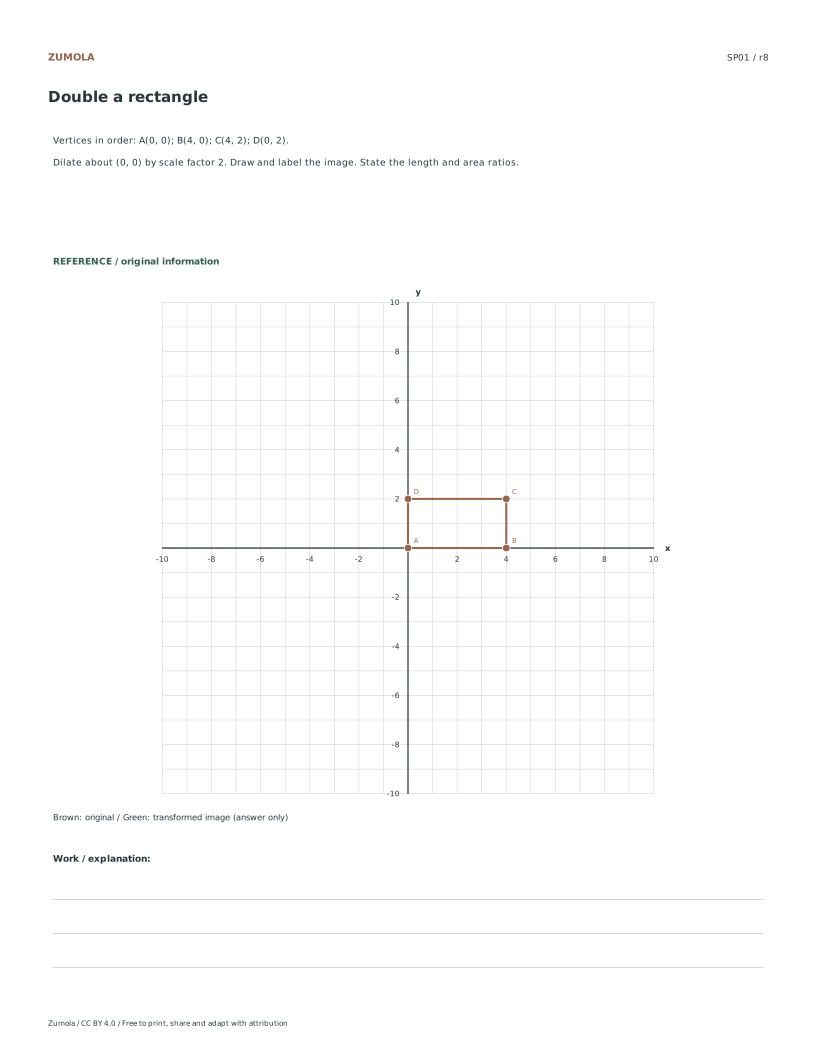
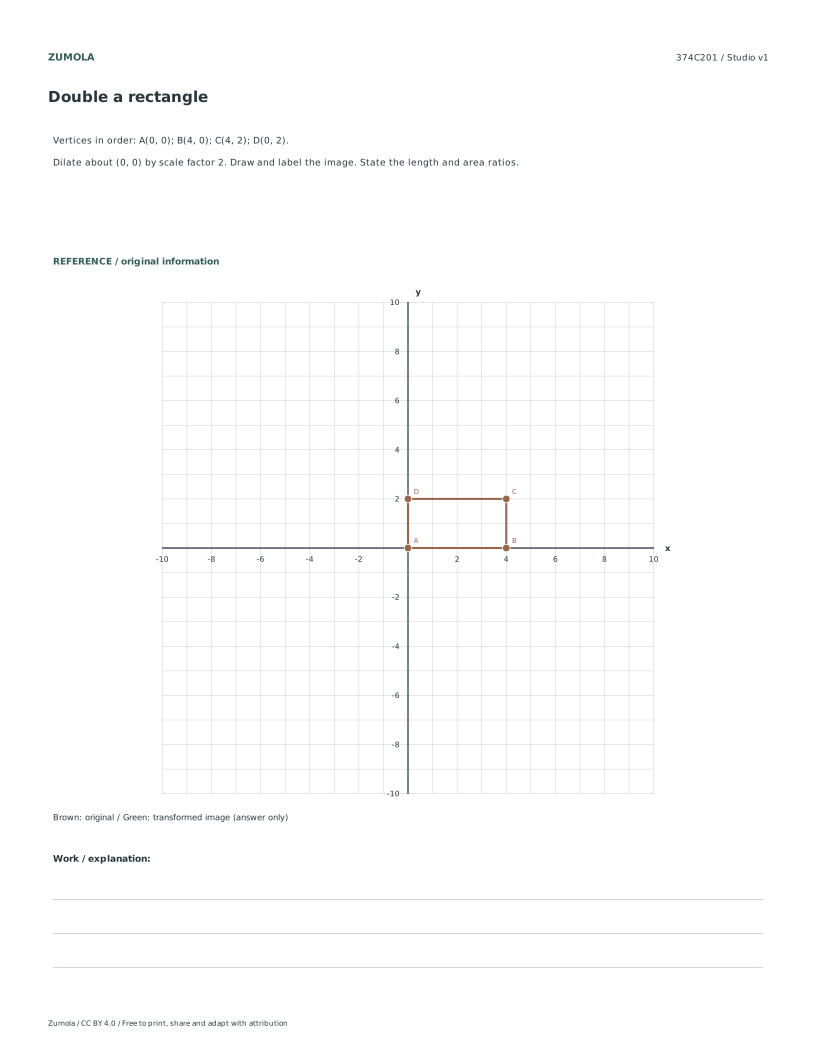
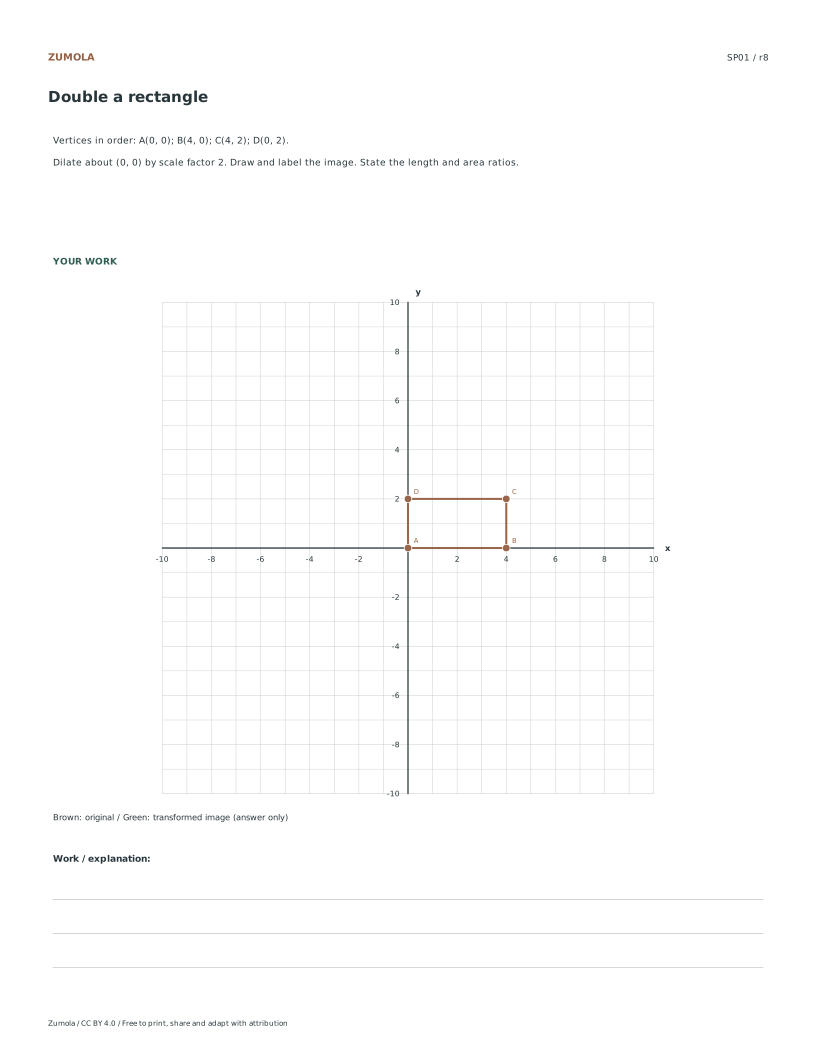
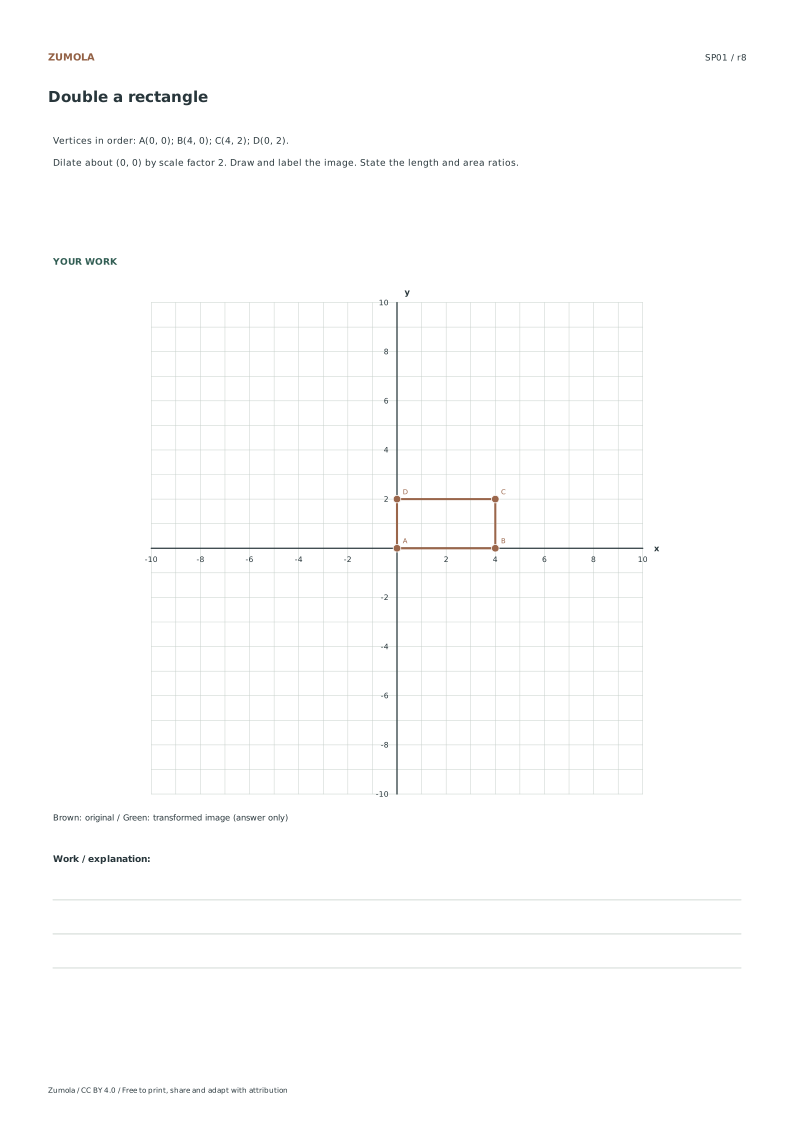
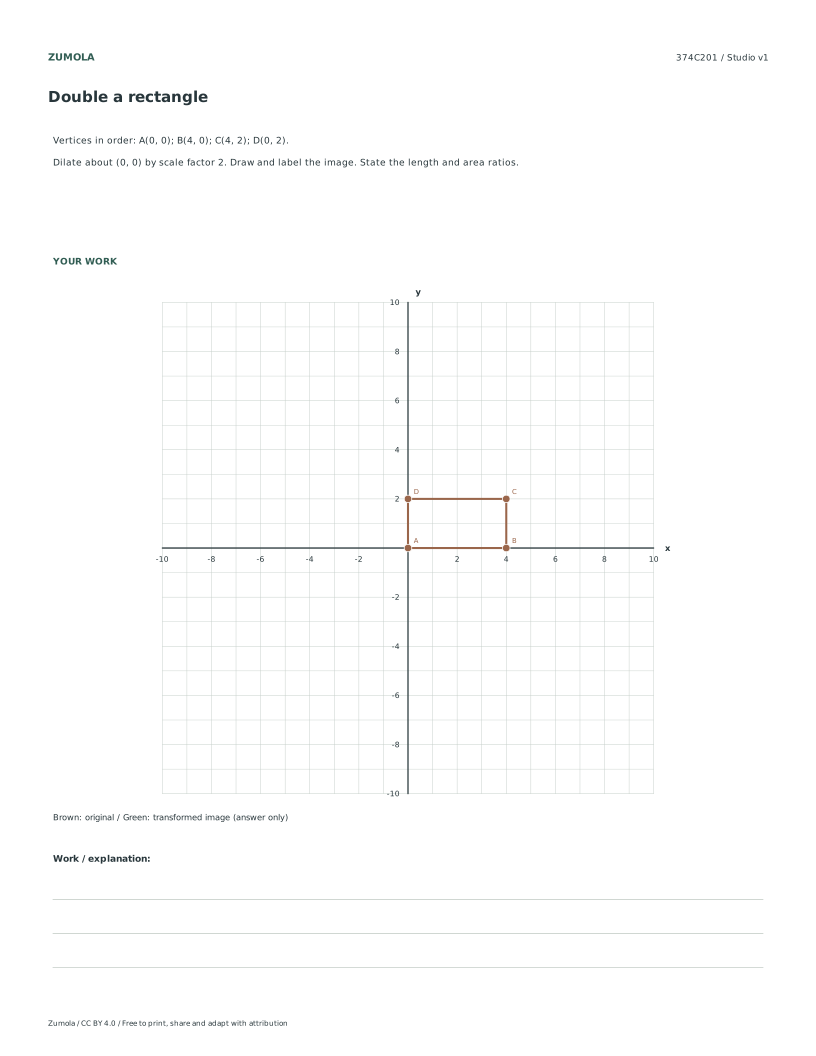
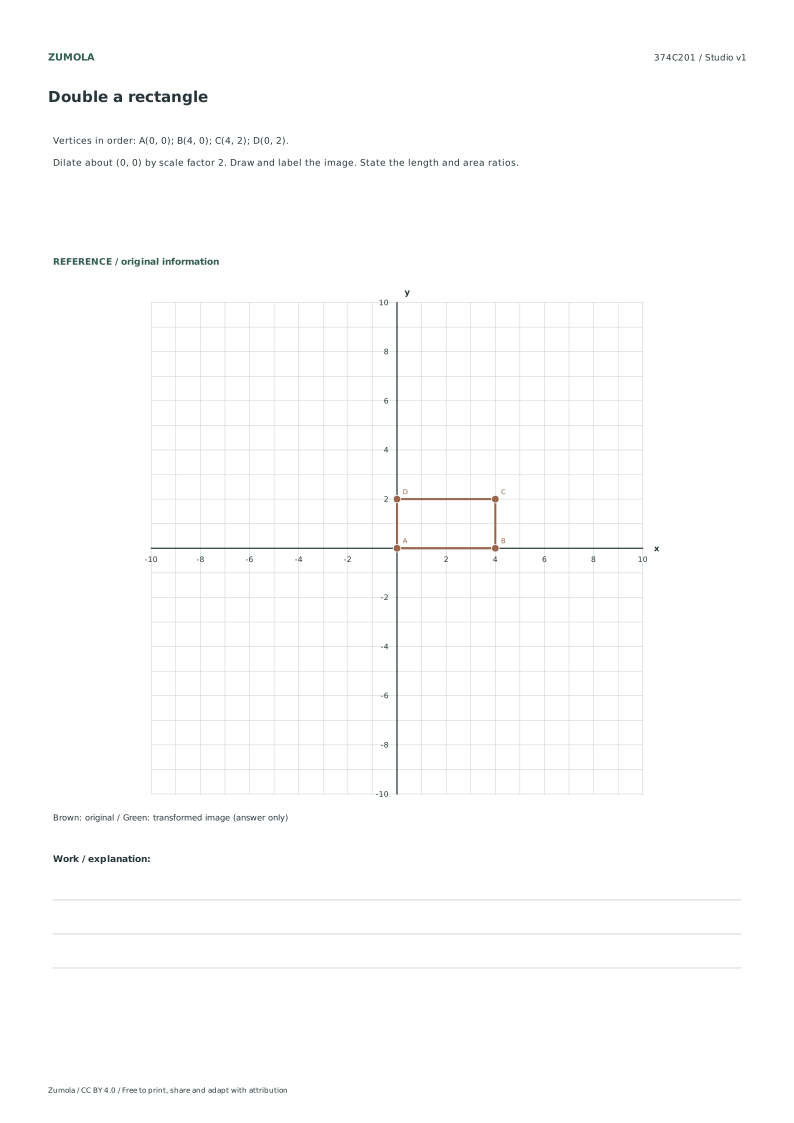
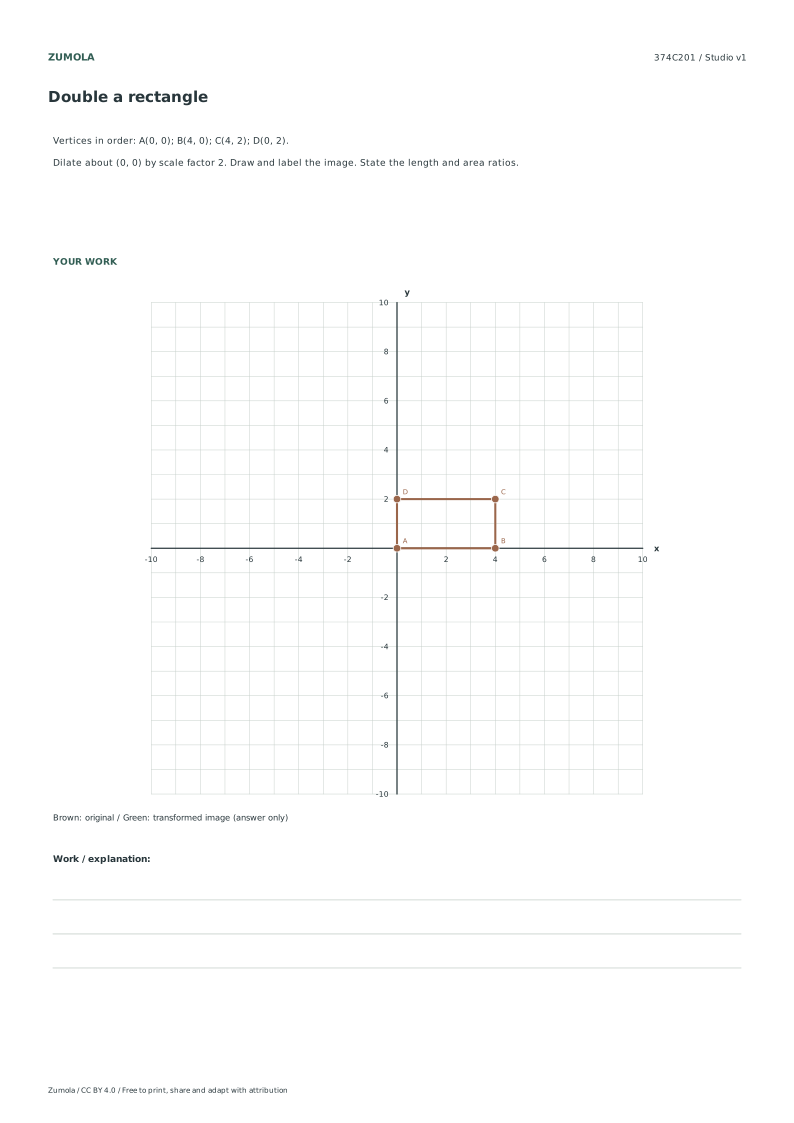
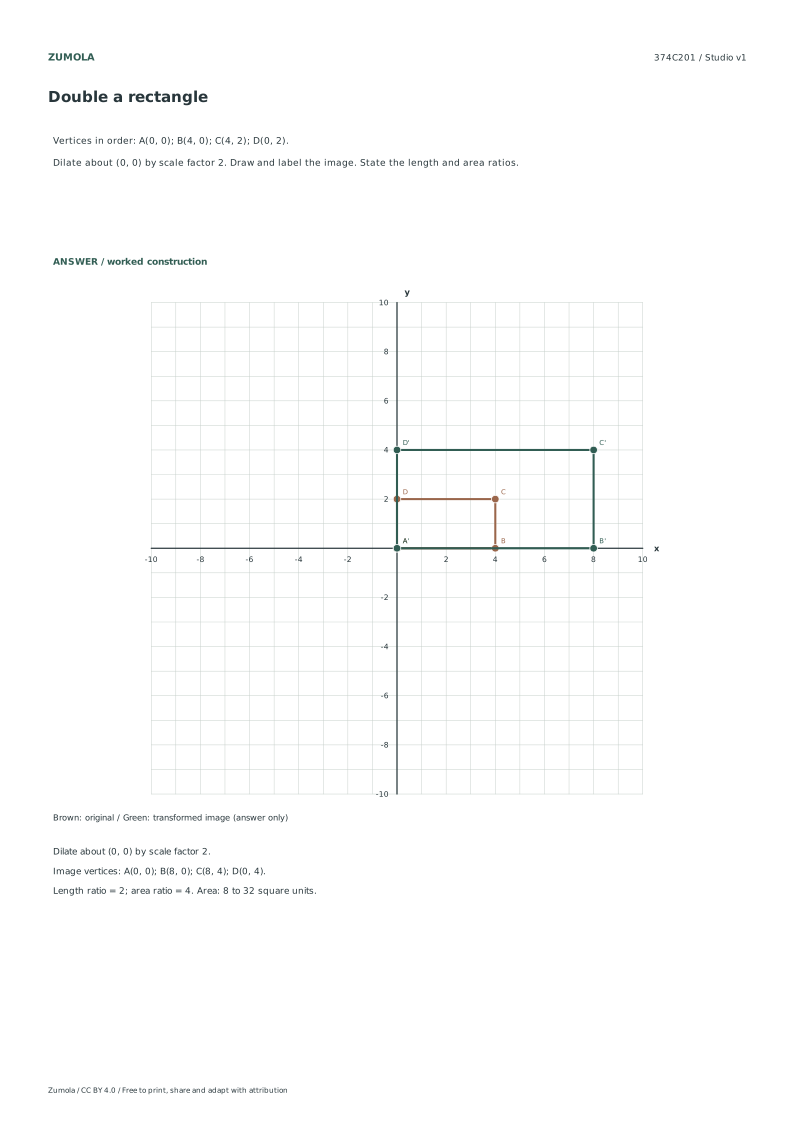
Double a rectangle
Original worksheet collection. Letter or A4 PDF and editable SVG.
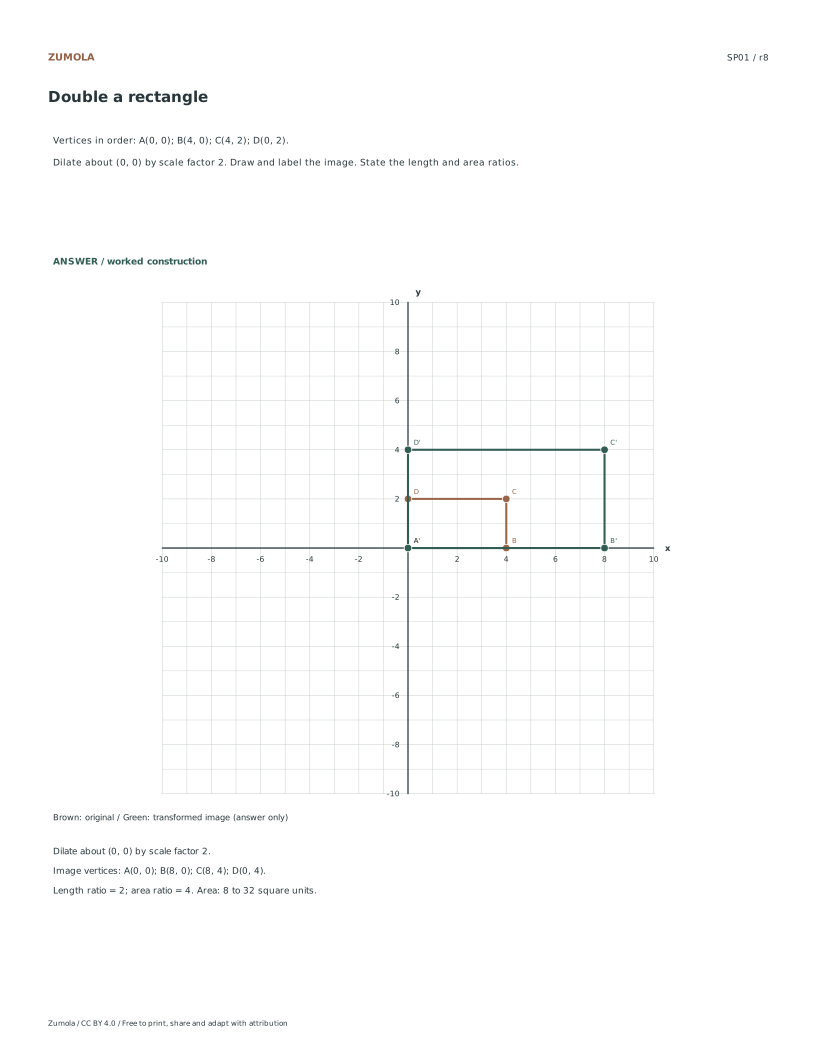
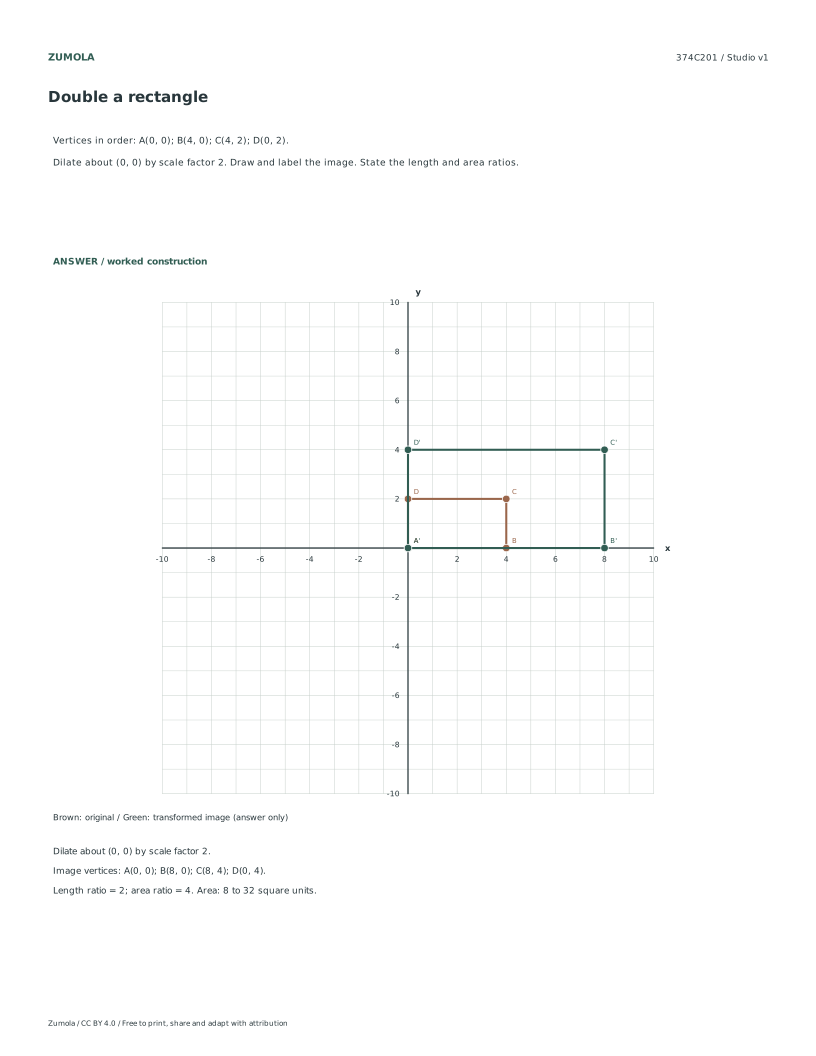
Length ratio = 2; area ratio = 4. Area: 8 to 32 square units.
The first case shows the checking pattern. Individual answer files contain the completed graph or net and result for every case.
Work through the graph
Dilating a Polygon About the Origin
To draw a scaled copy, multiply each vertex coordinate by the scale factor. For the rectangle A(0,0), B(4,0), C(4,2), D(0,2) with factor 2, the image is A(0,0), B(8,0), C(8,4), D(0,4). Connect the vertices in the same order. The length ratio equals the scale factor: 2. The area ratio is the square of the scale factor: 4. The original area is 8 square units, and the image area is 32 square units. Check that corresponding sides are parallel and proportional.
Using Fractional Scale Factors
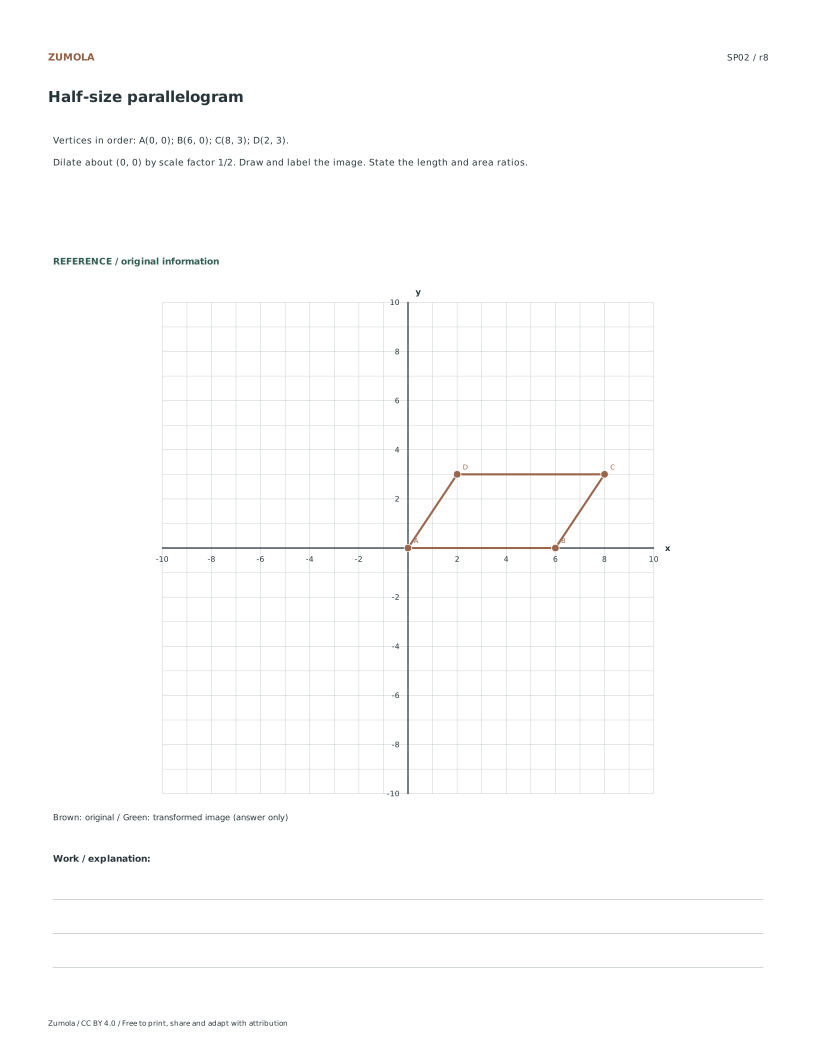
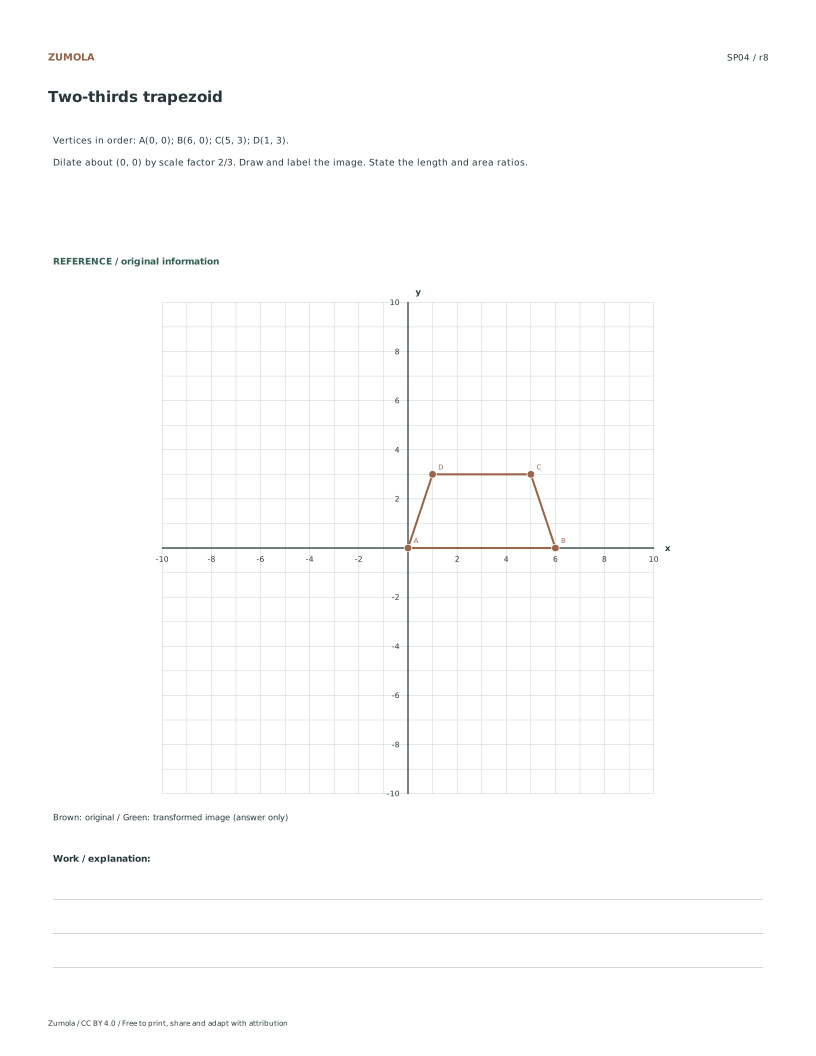
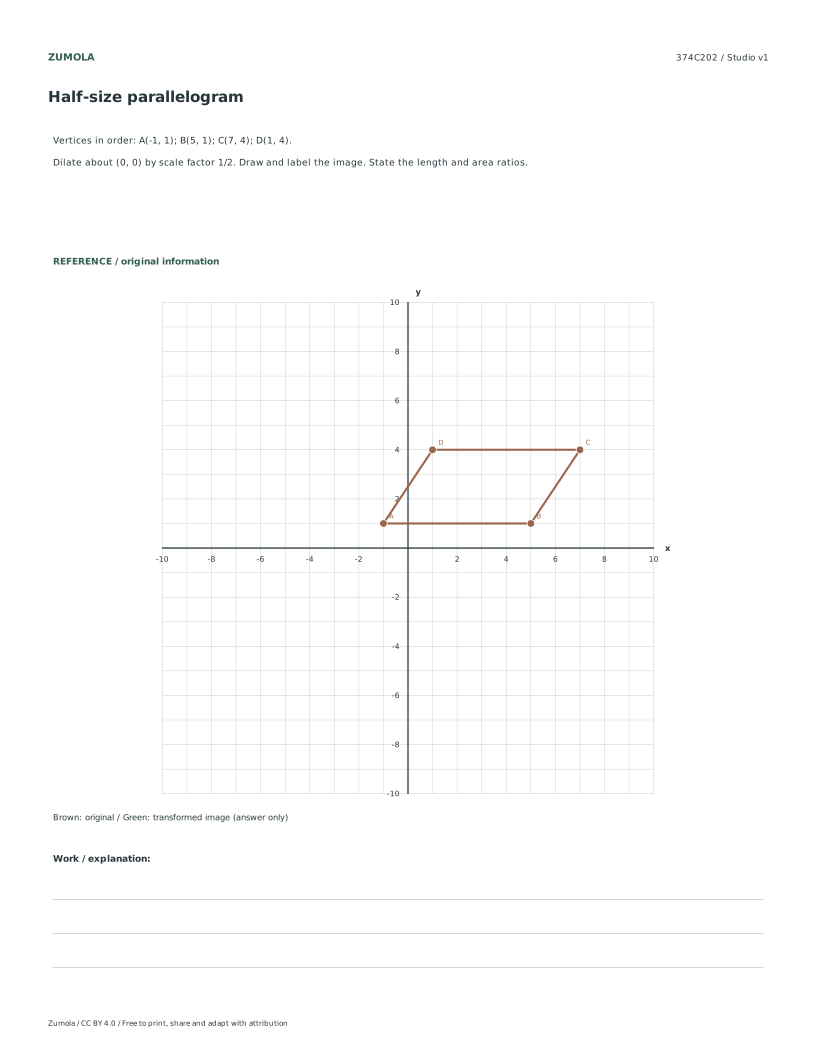
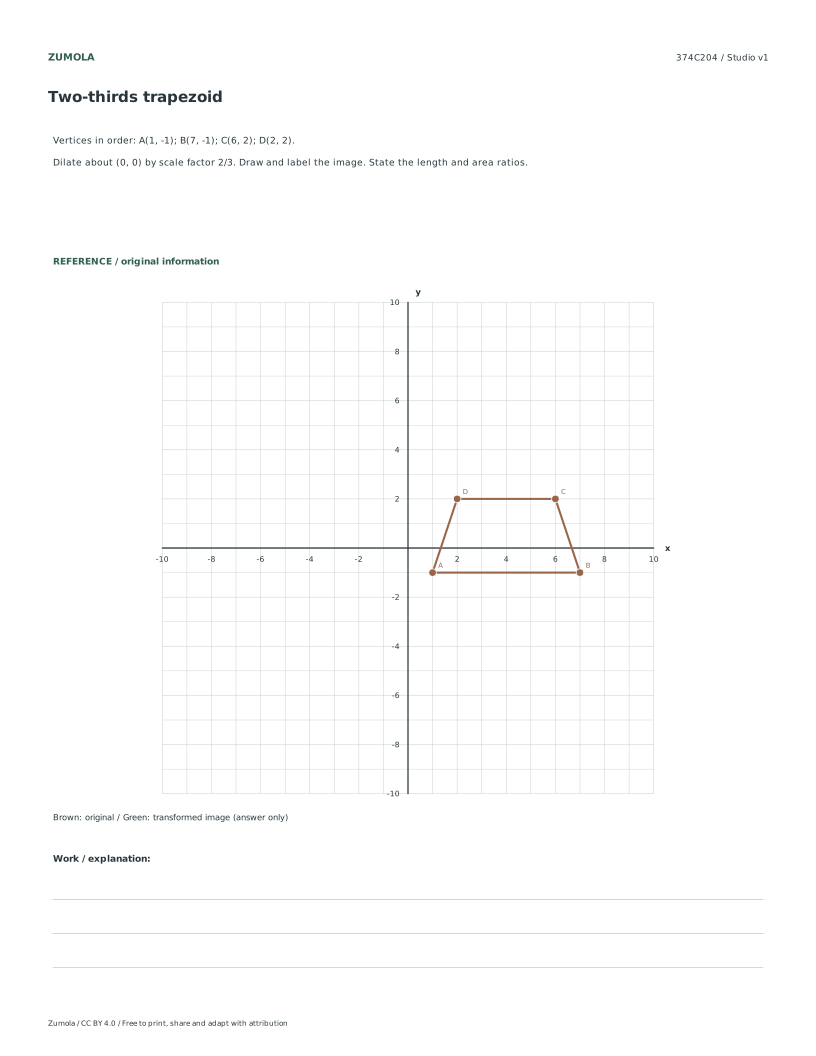
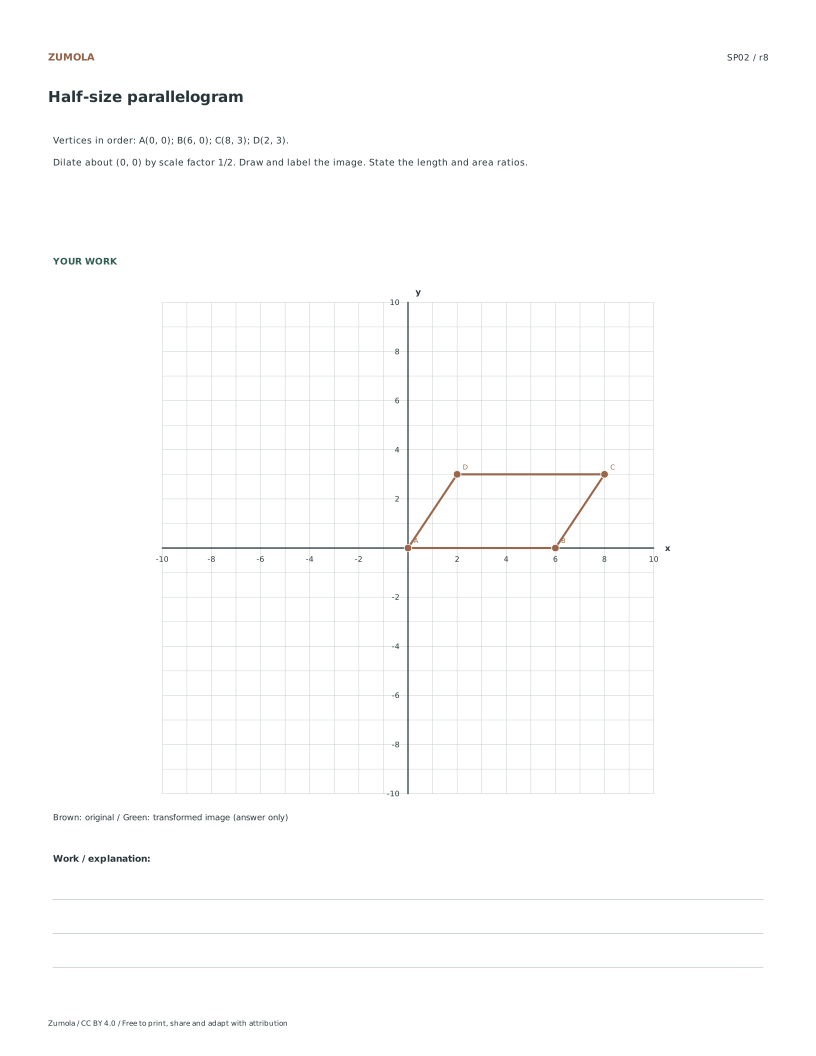
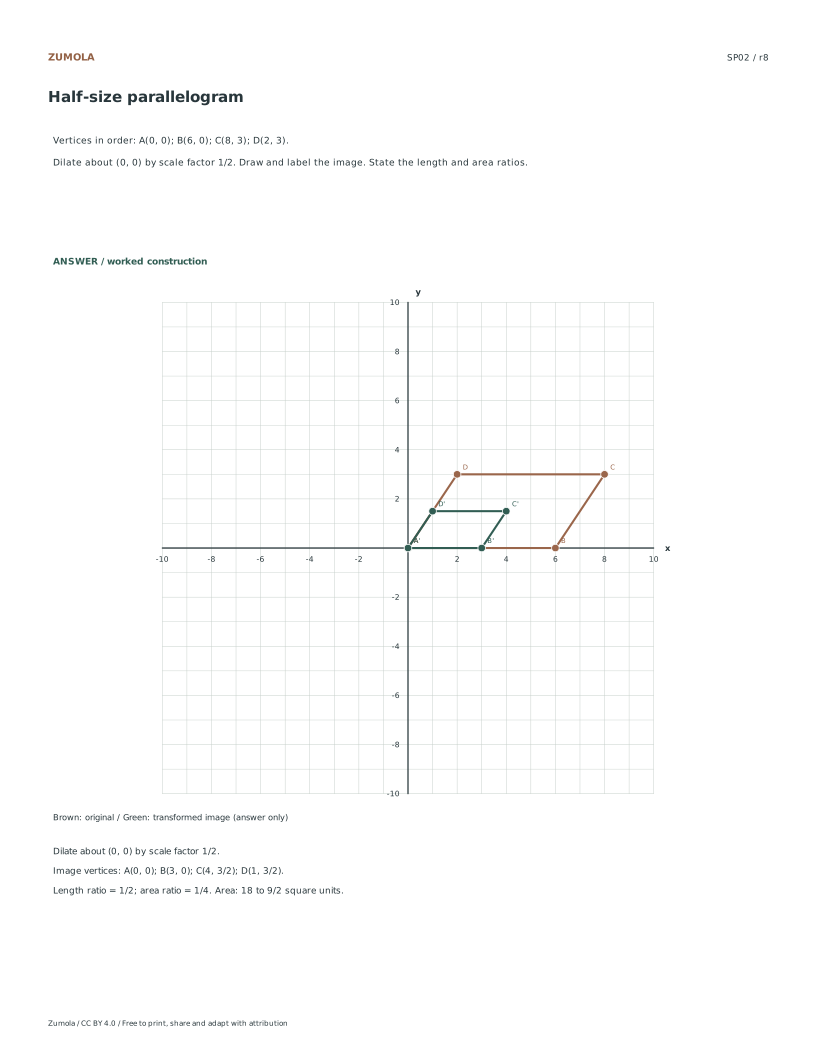
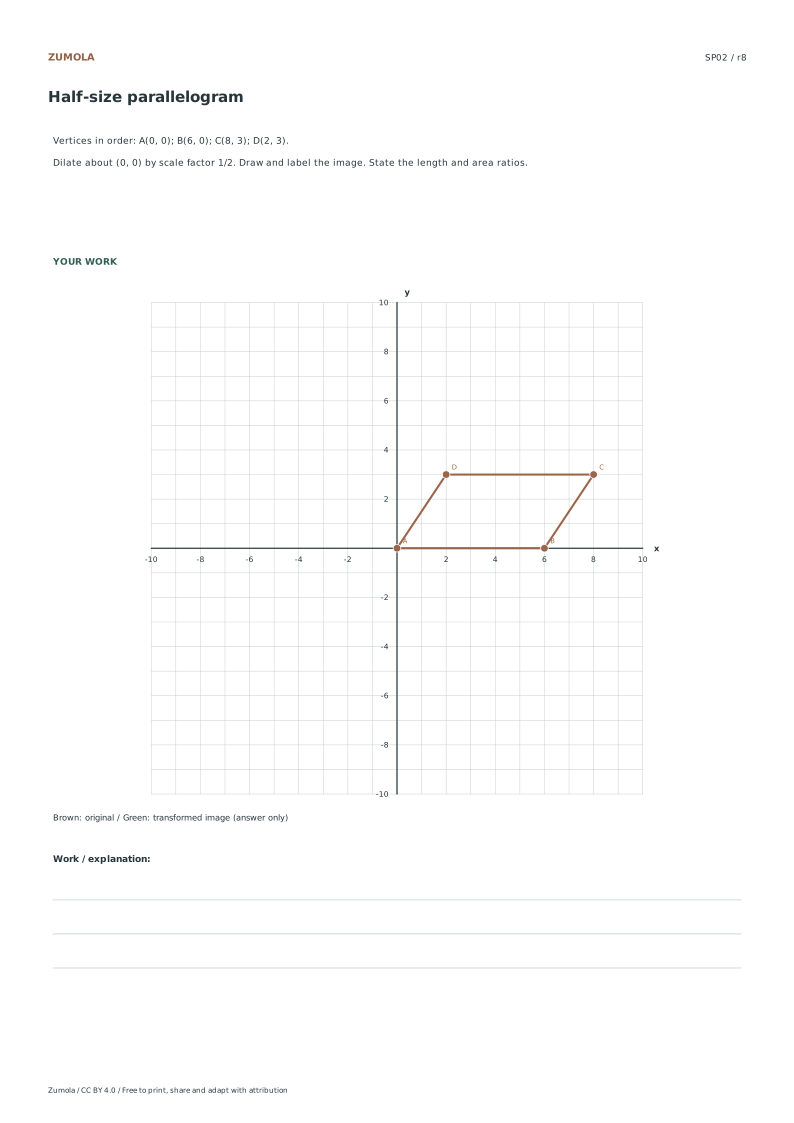
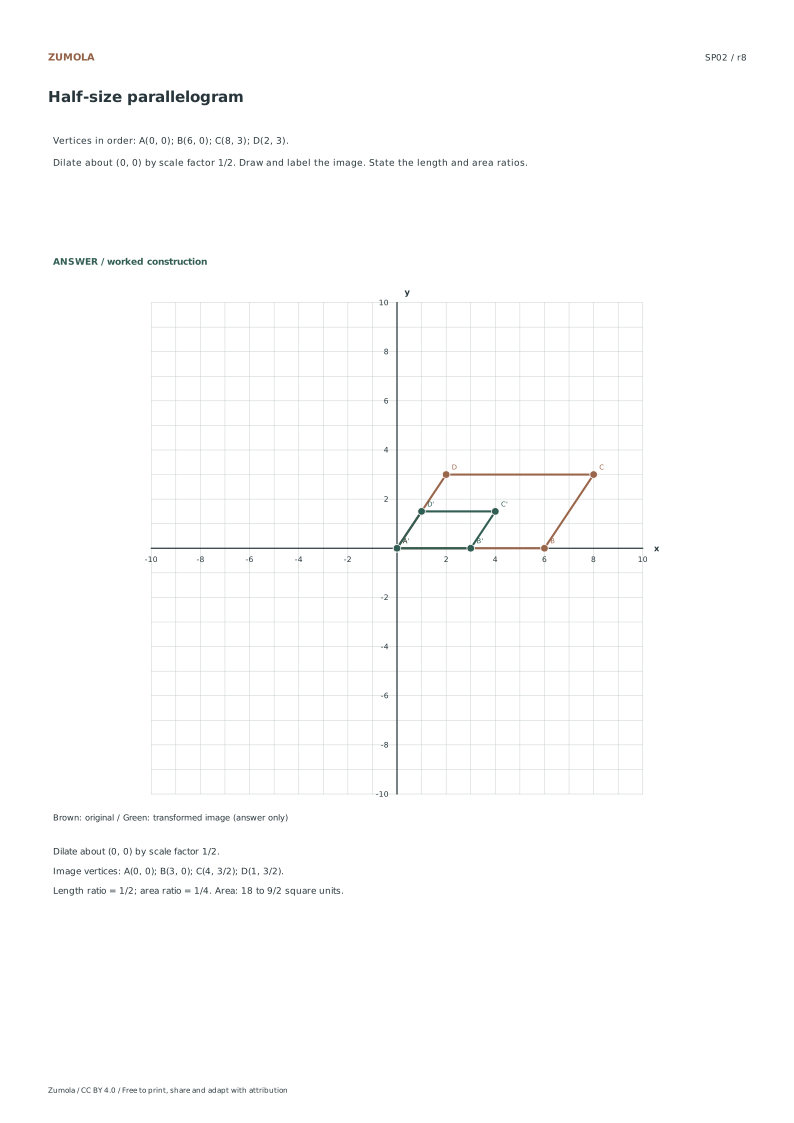
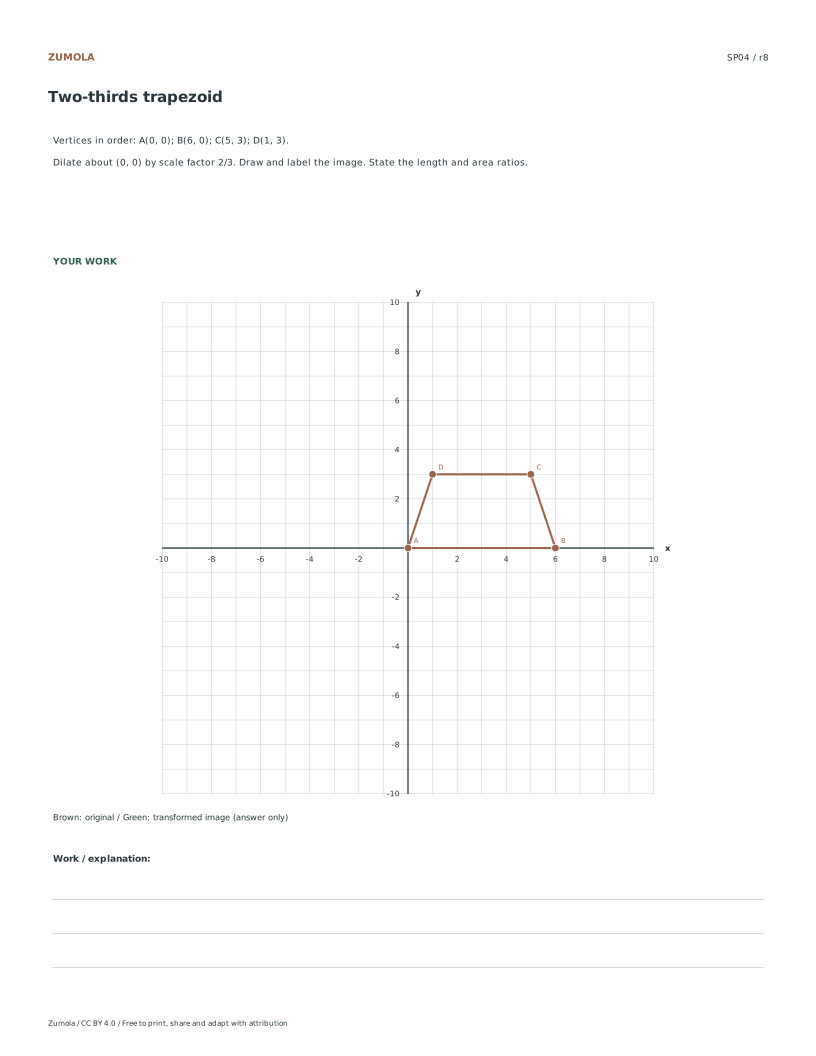
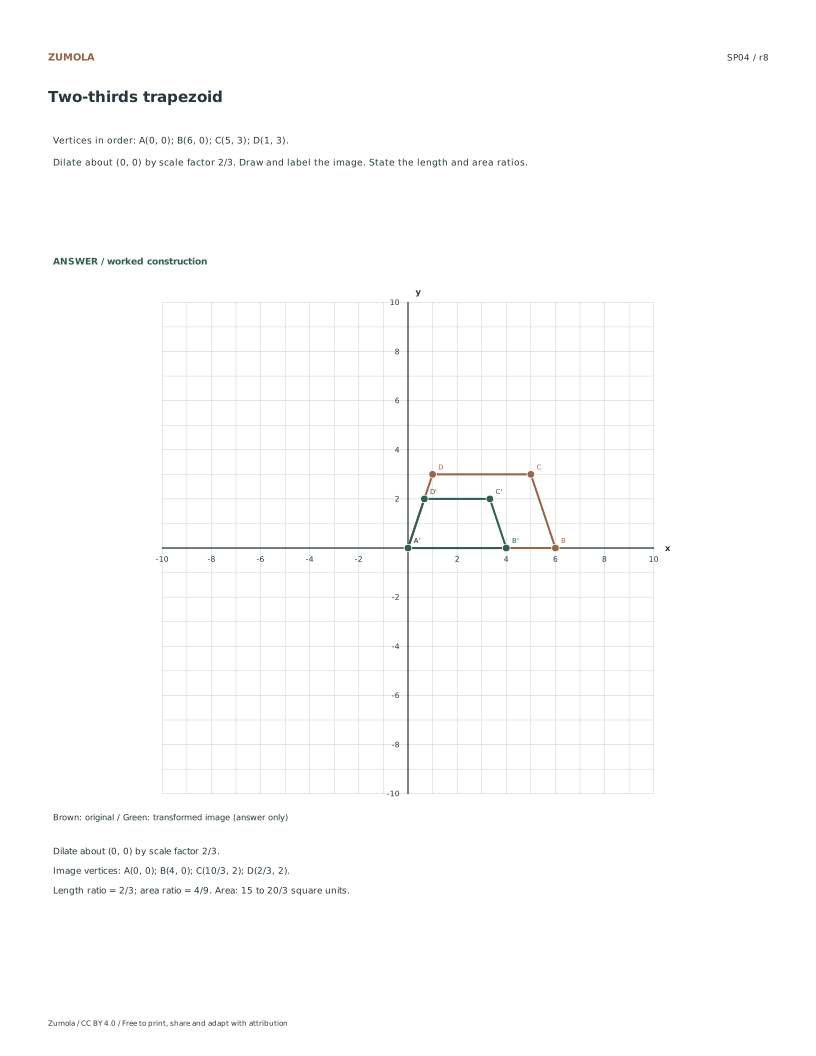
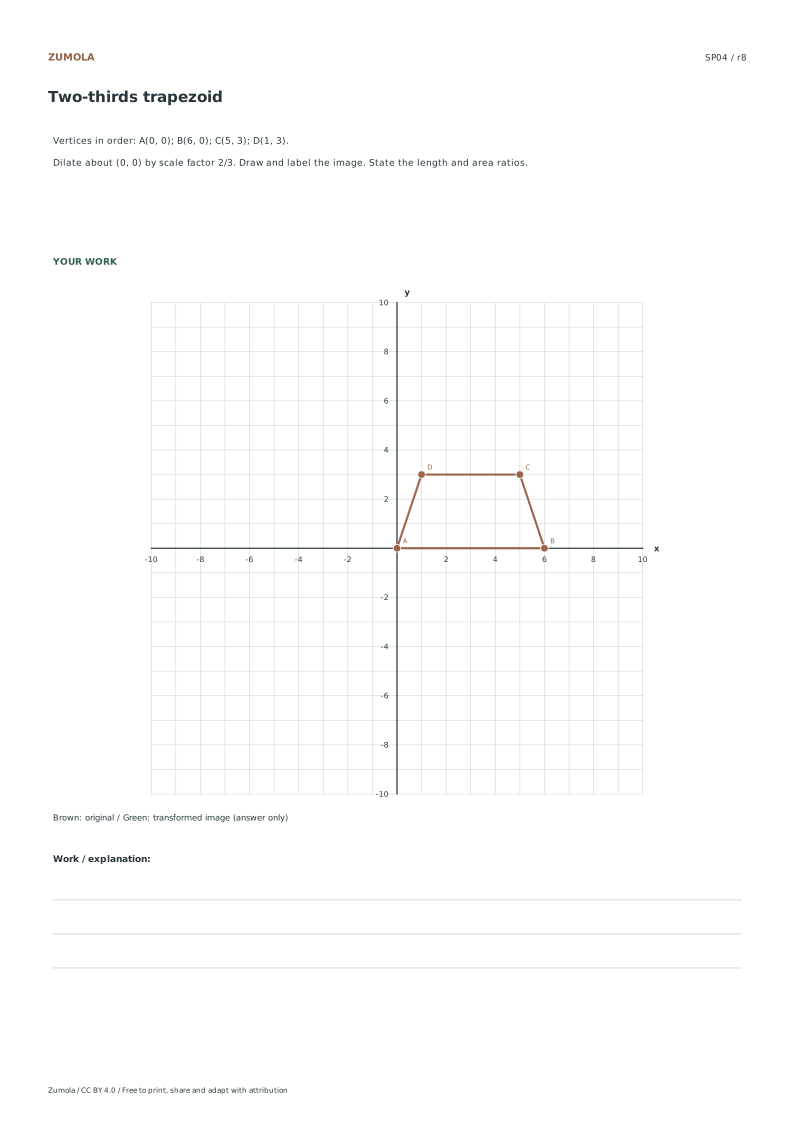
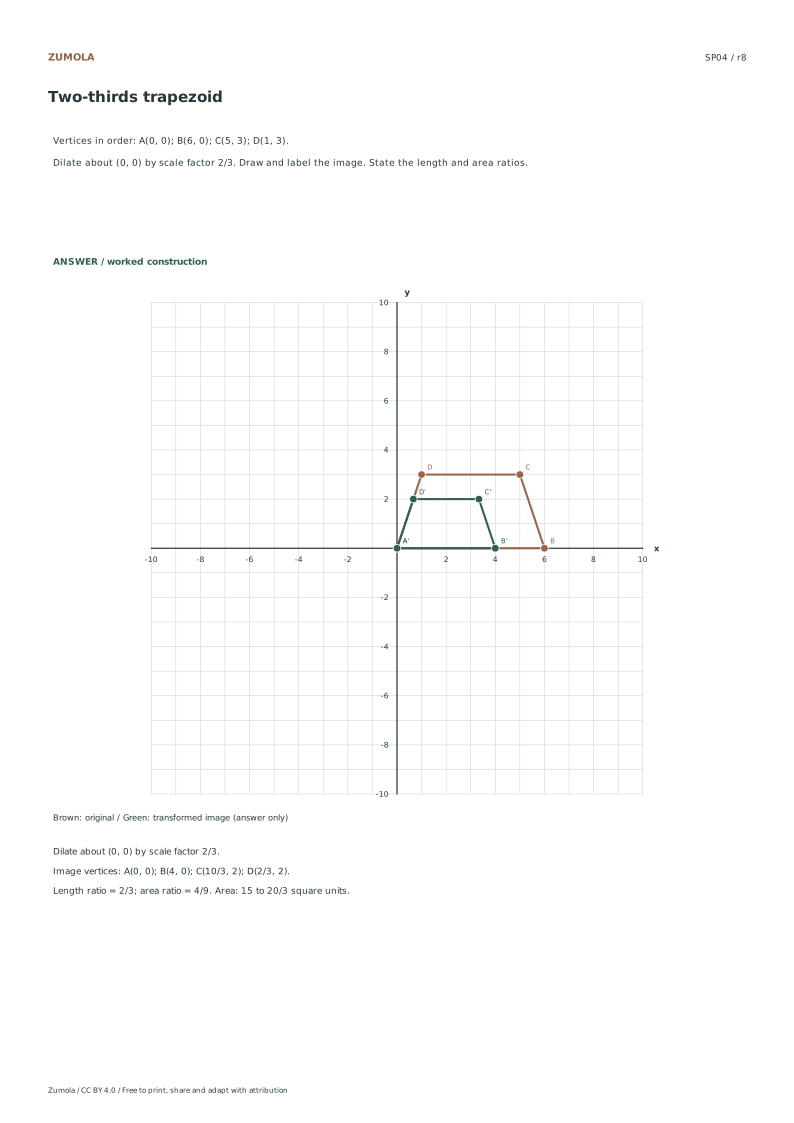
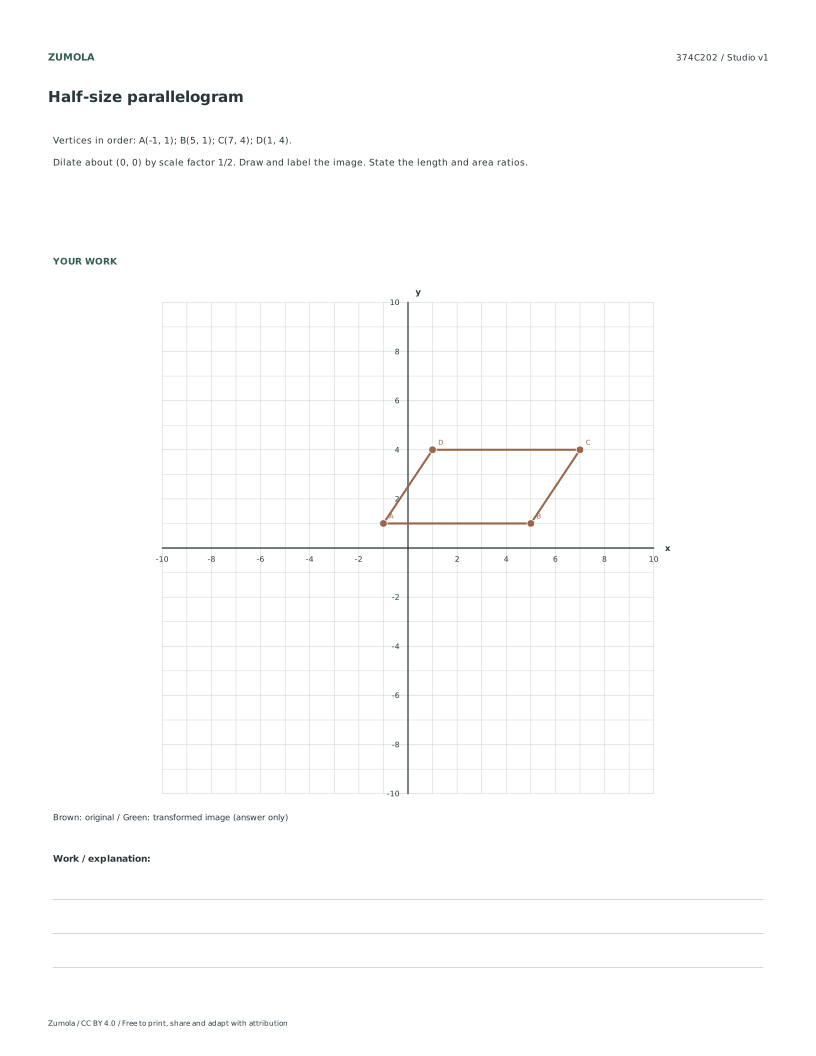
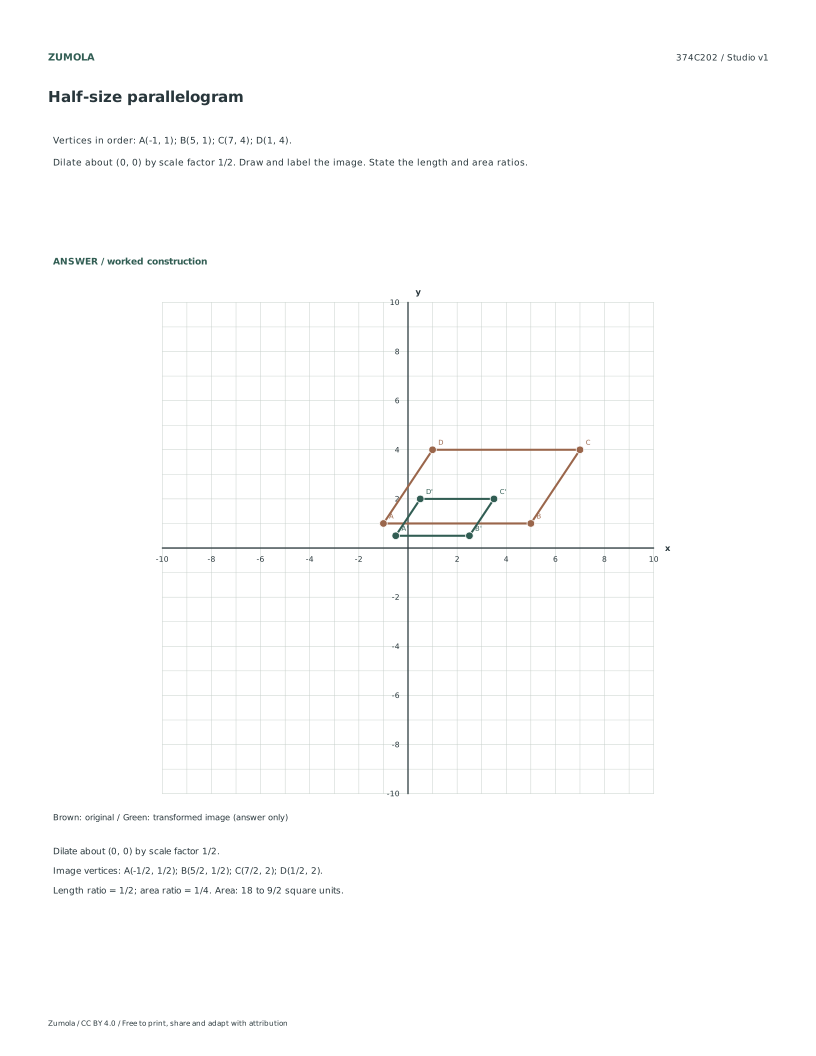
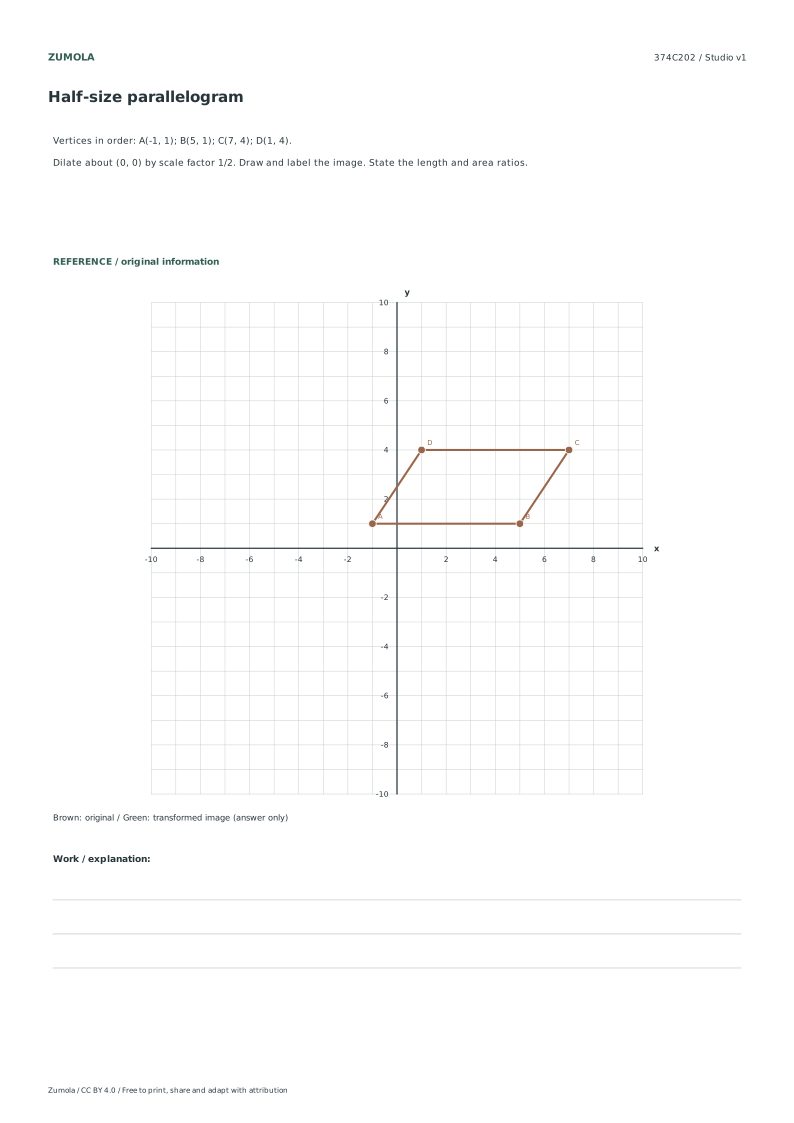
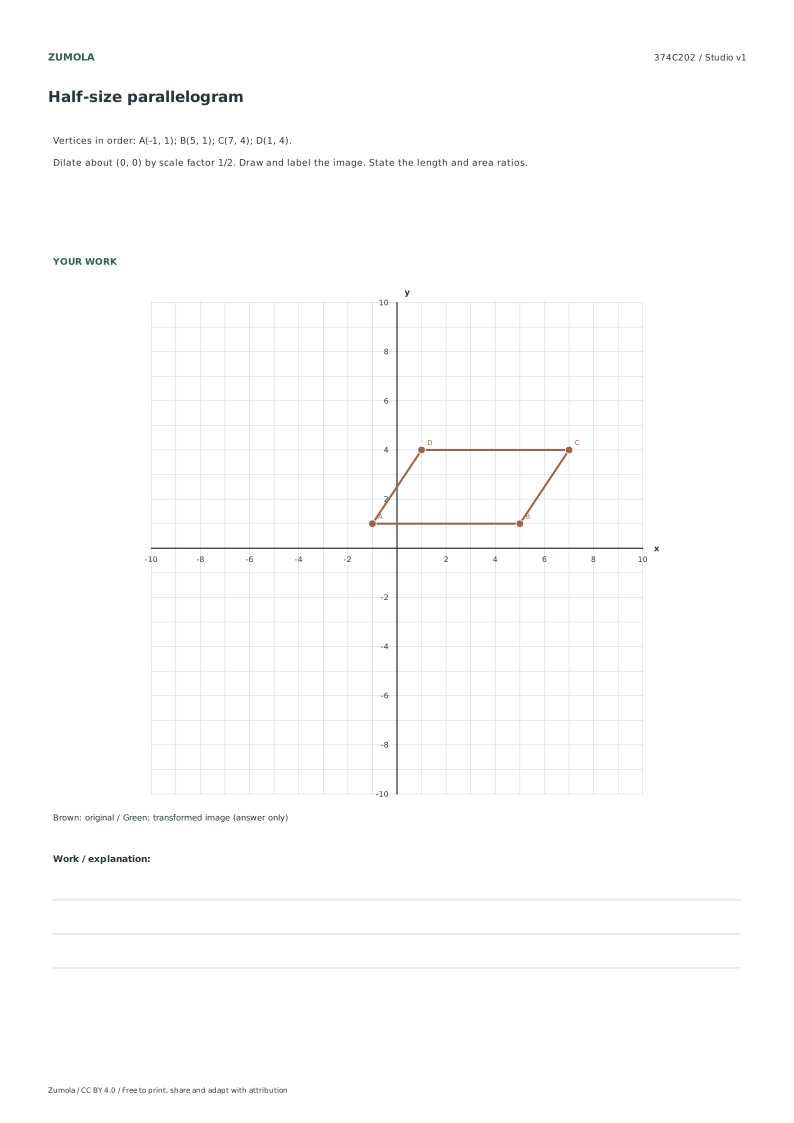
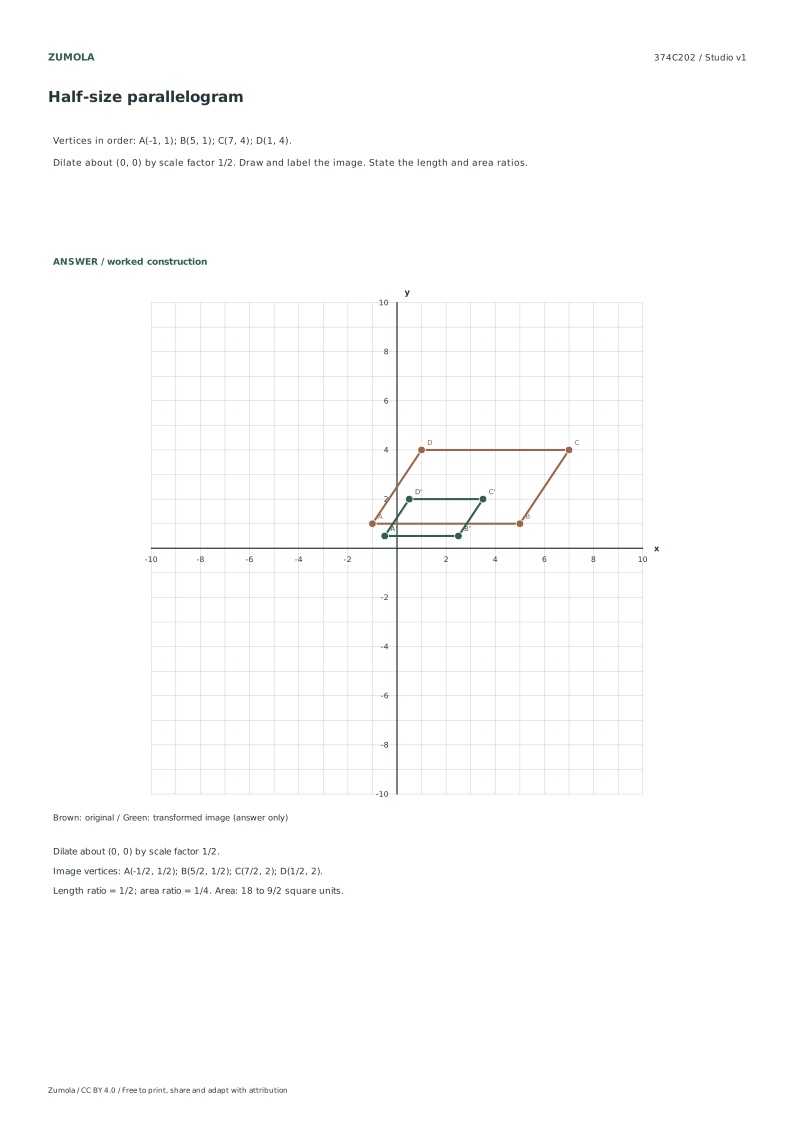
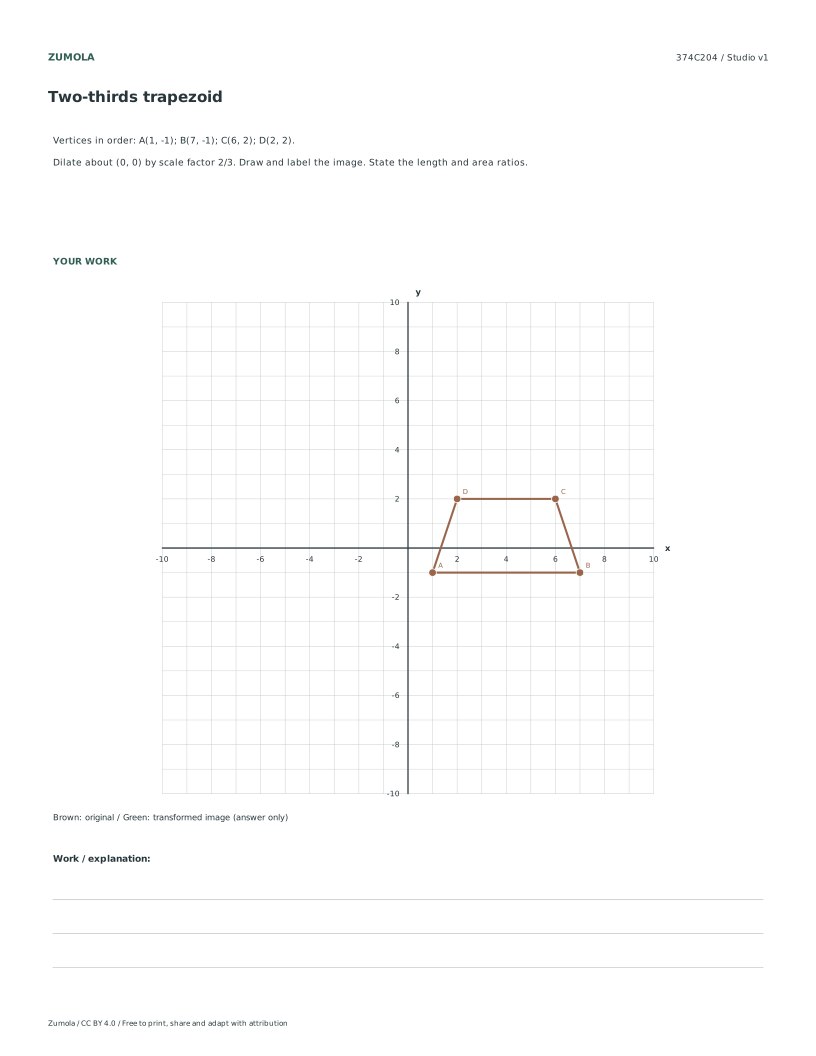
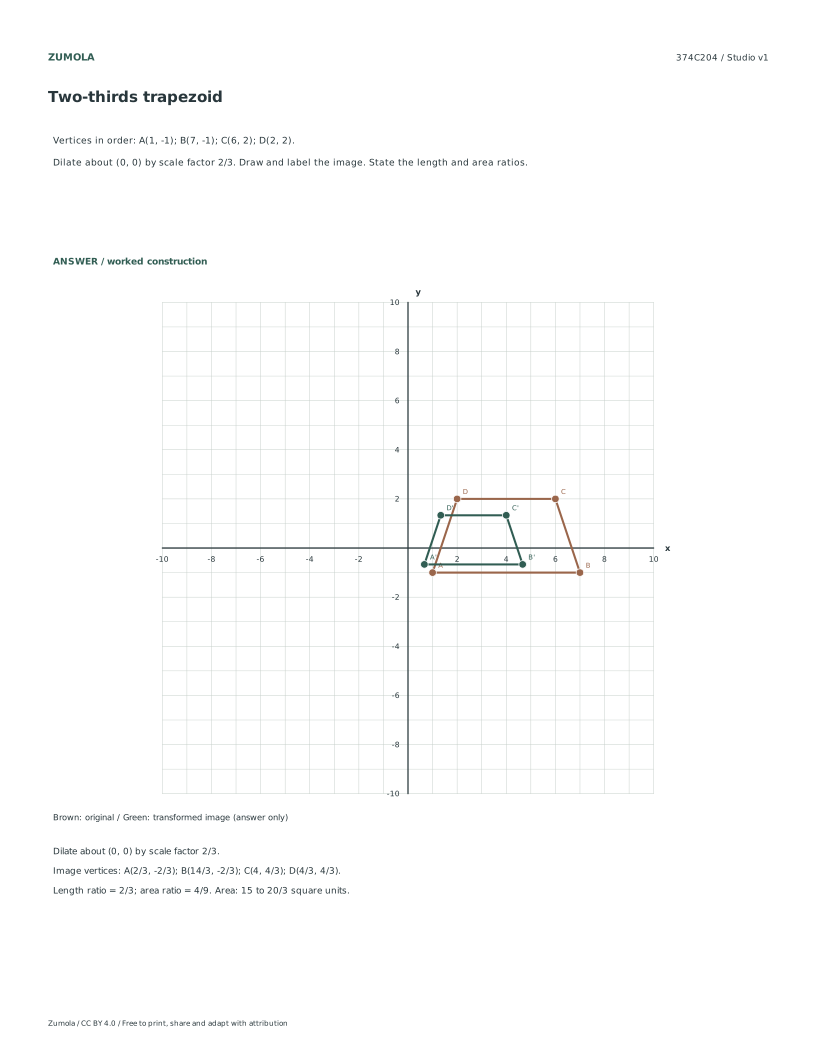
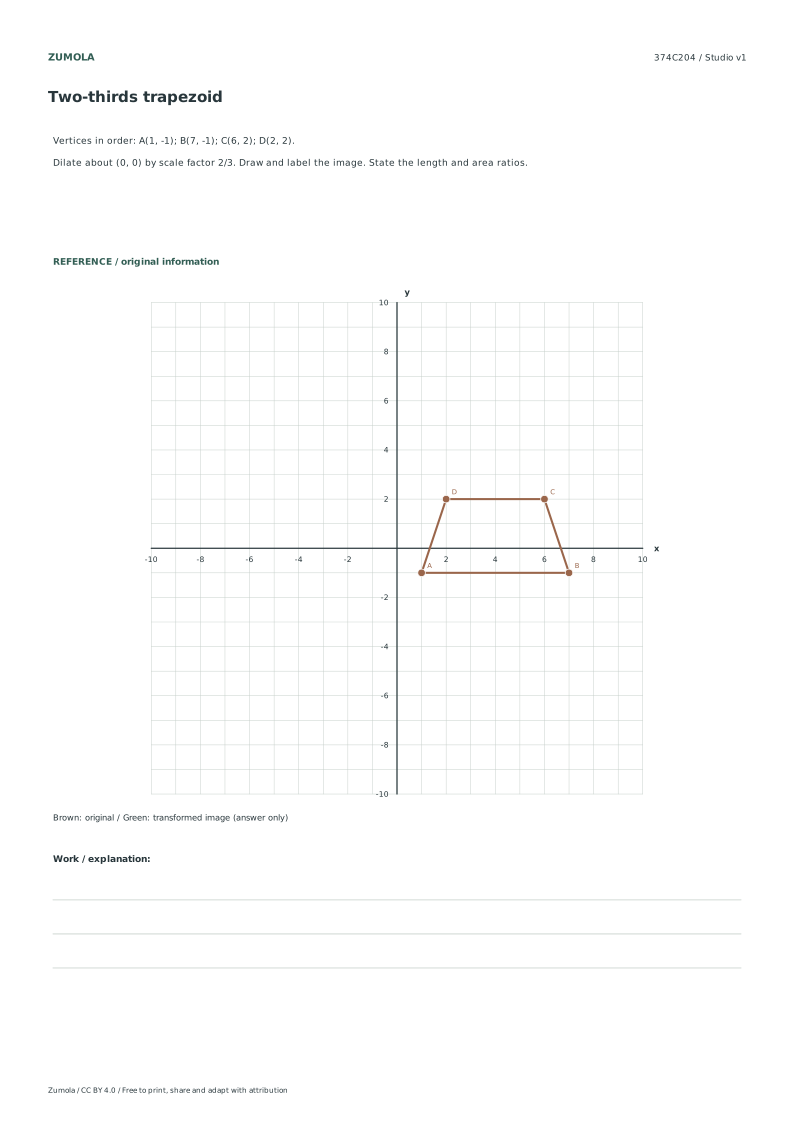
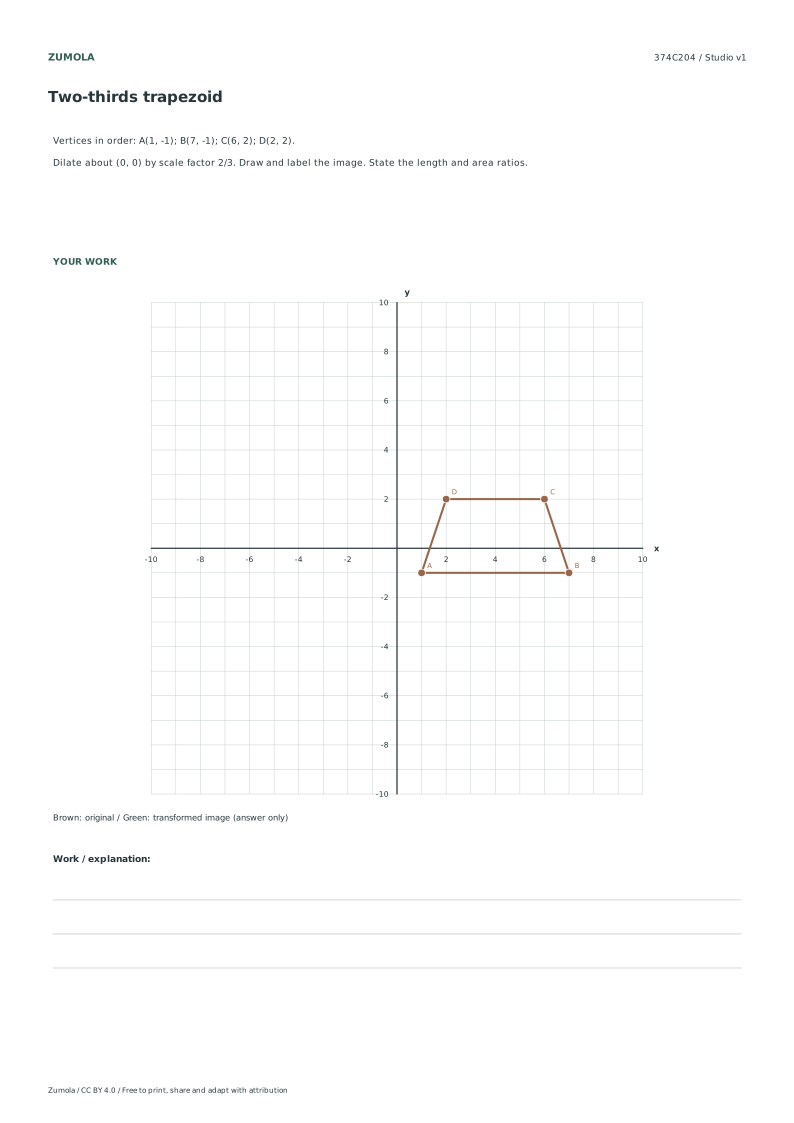
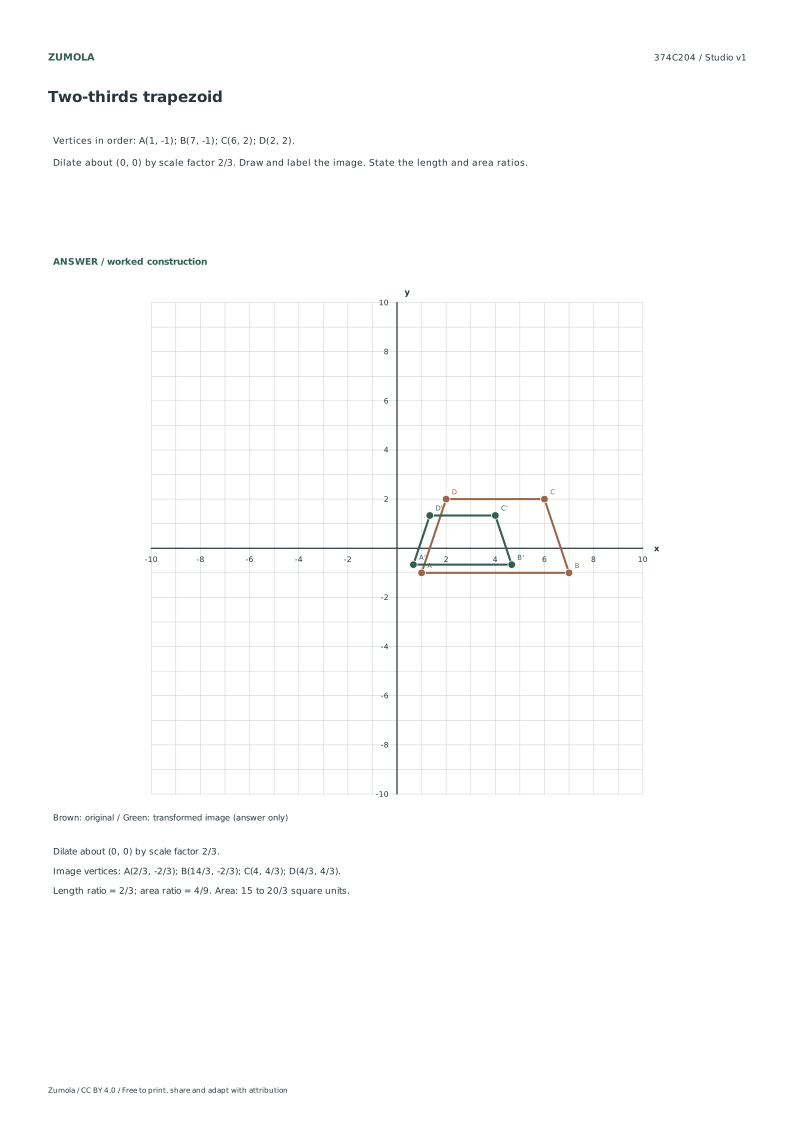
For a scale factor of 1/2 on A(0,0), B(6,0), C(8,3), D(2,3), multiply each coordinate by 1/2 to get A(0,0), B(3,0), C(4,3/2), D(1,3/2). The length ratio is 1/2, and the area ratio is (1/2)^2 = 1/4. The original area is 18 square units, and the image area is 9/2 square units. For a factor of 2/3 on A(0,0), B(6,0), C(5,3), D(1,3), the image vertices are A(0,0), B(4,0), C(10/3,2), D(2/3,2). The length ratio is 2/3, and the area ratio is 4/9. The original area is 15, and the image area is 20/3.
Checking Length and Area Ratios
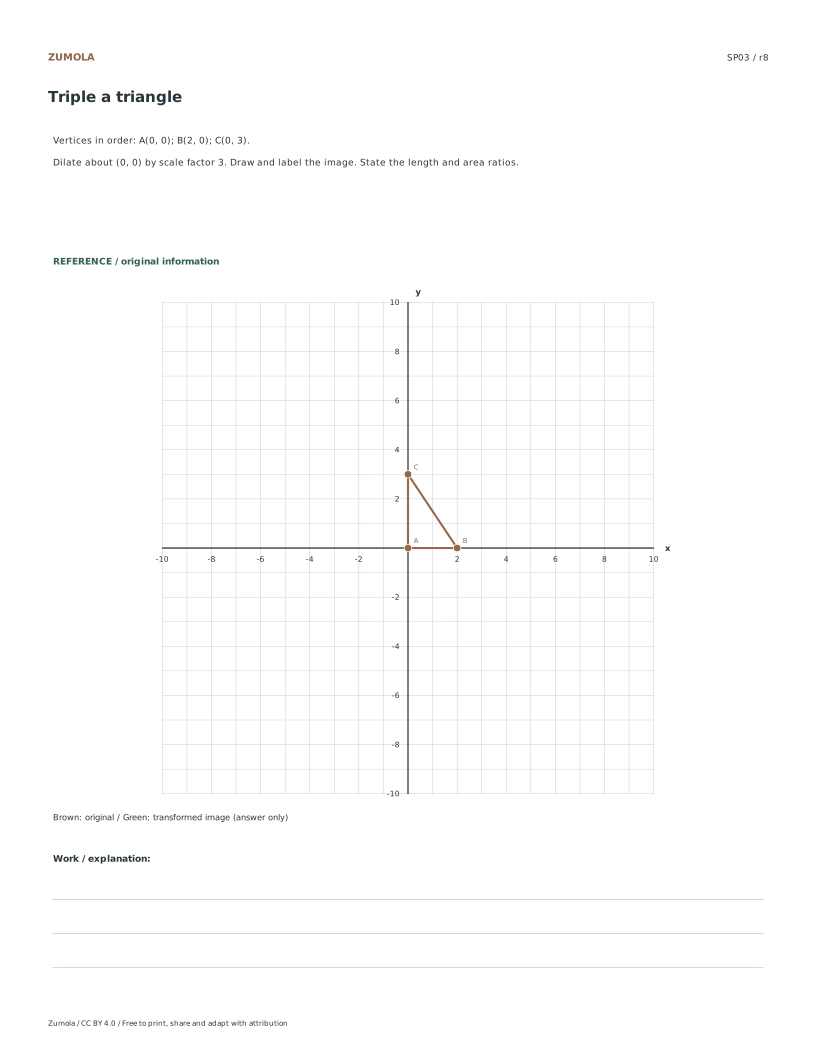
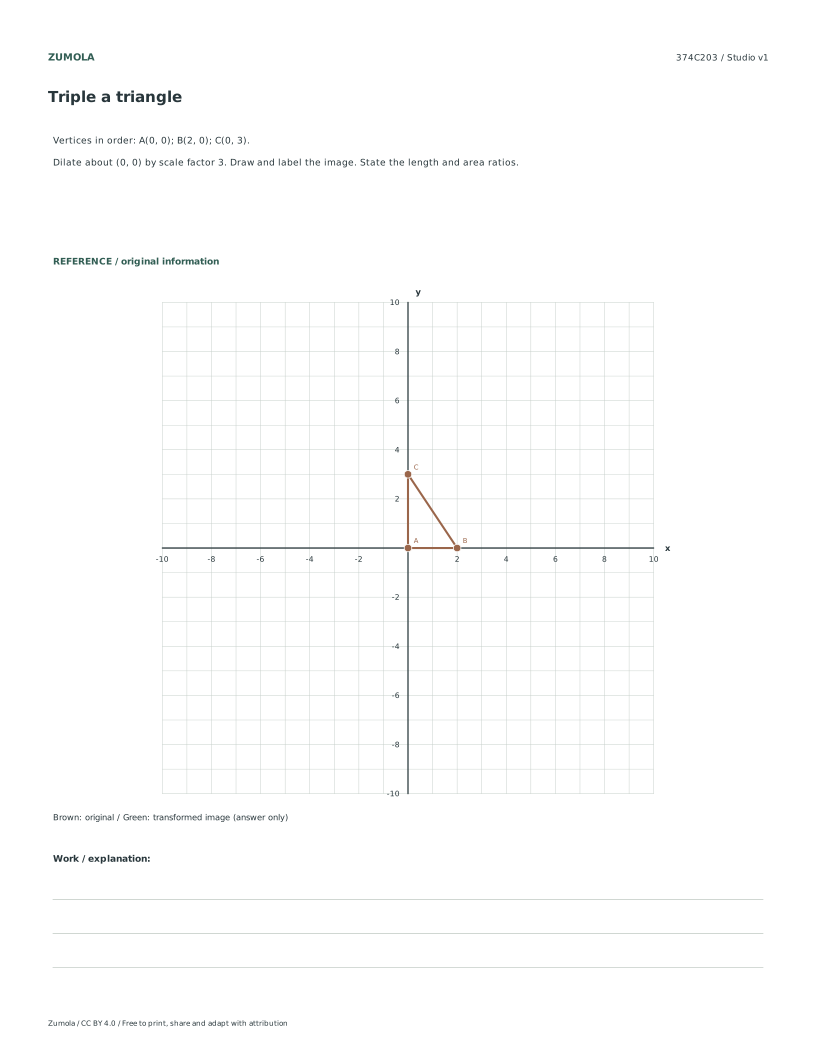
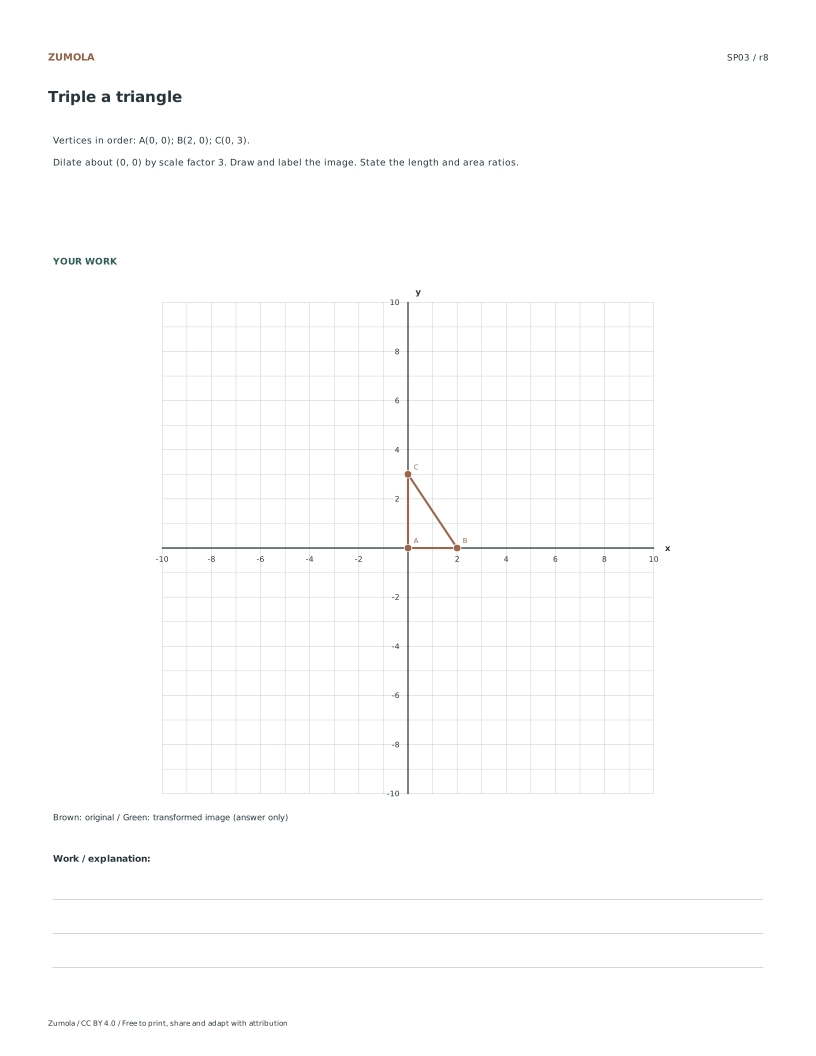
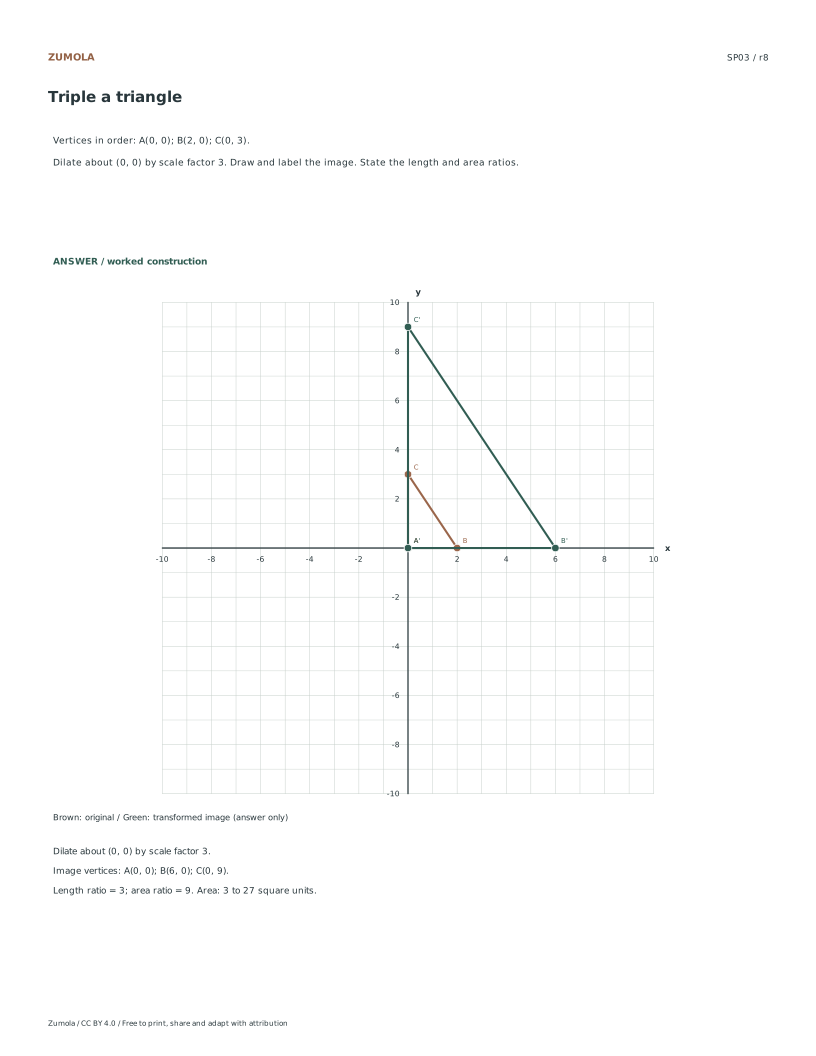
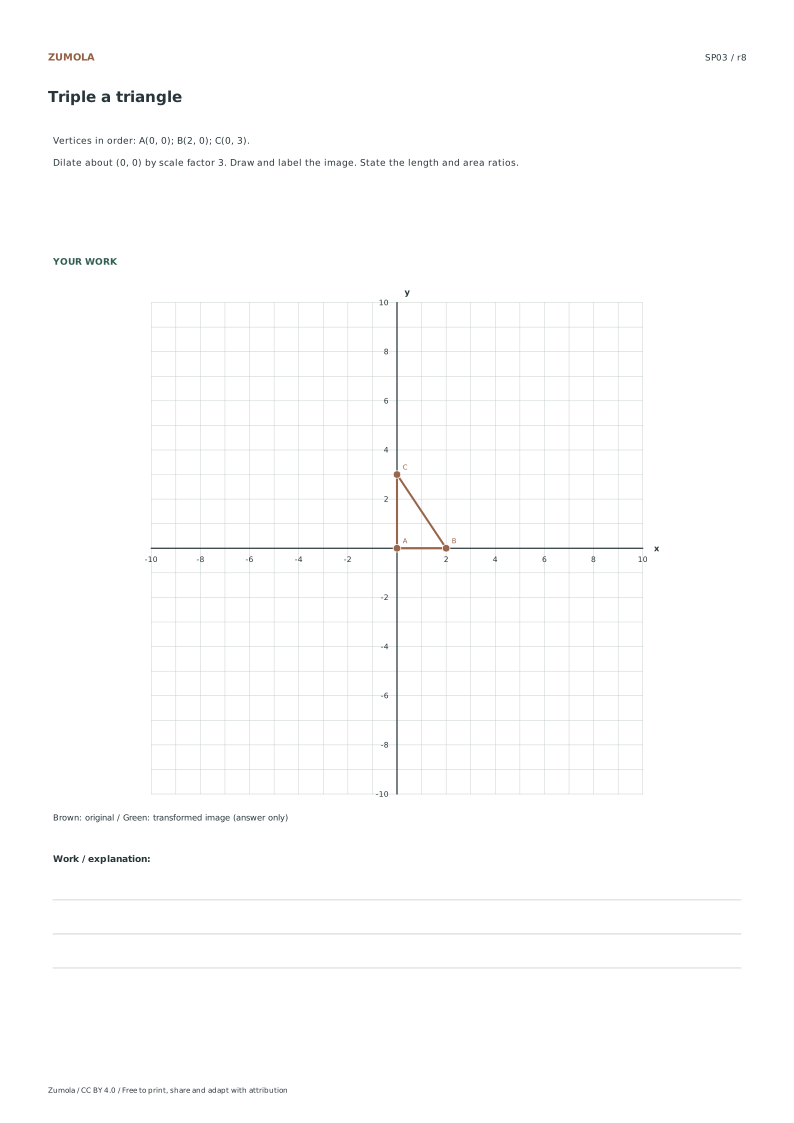
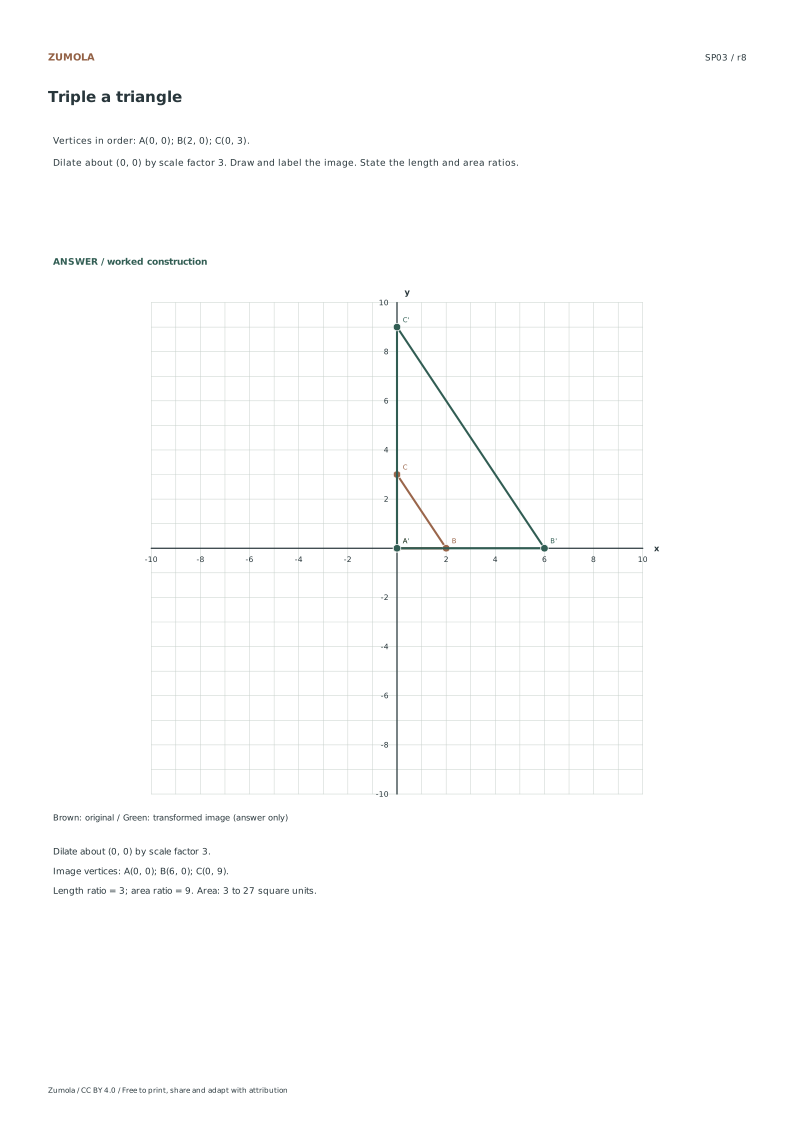
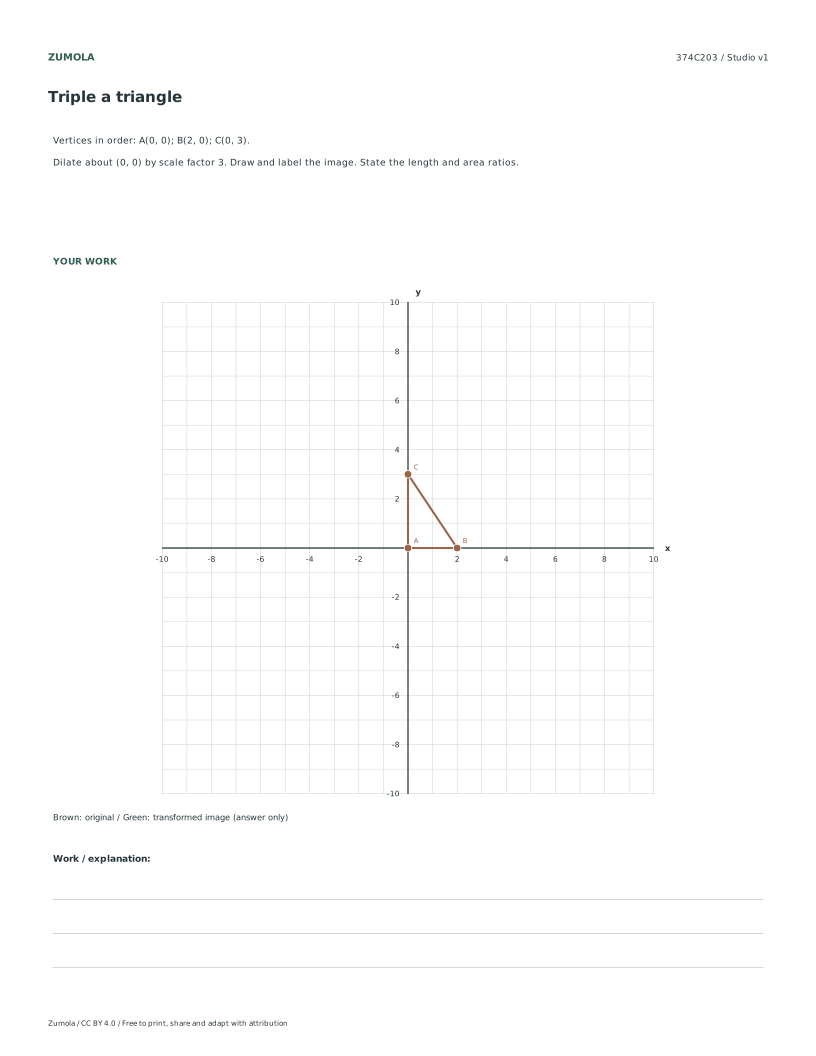
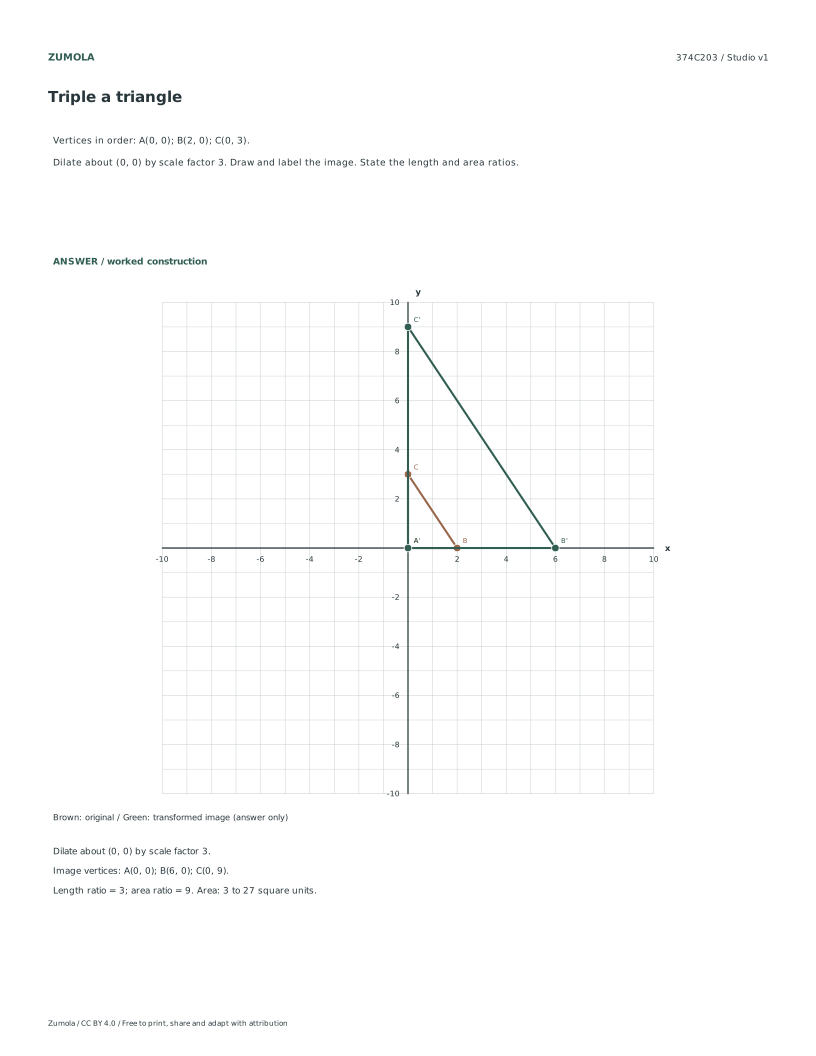
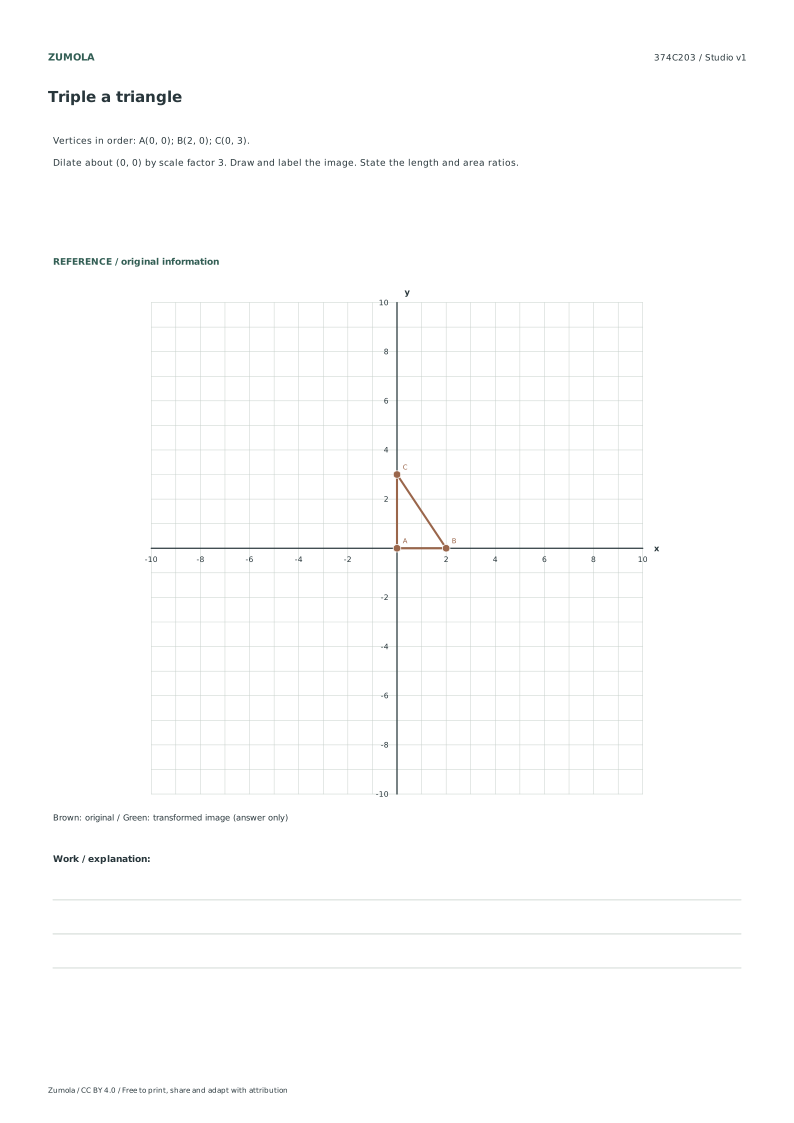
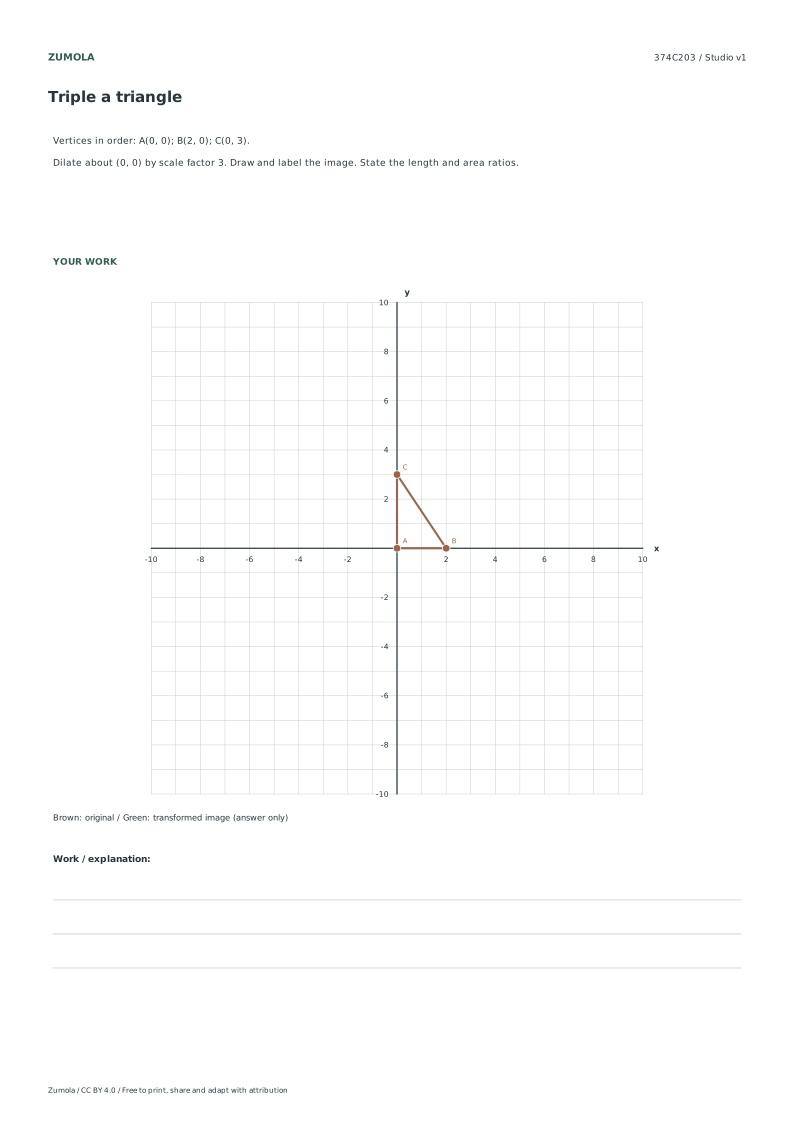
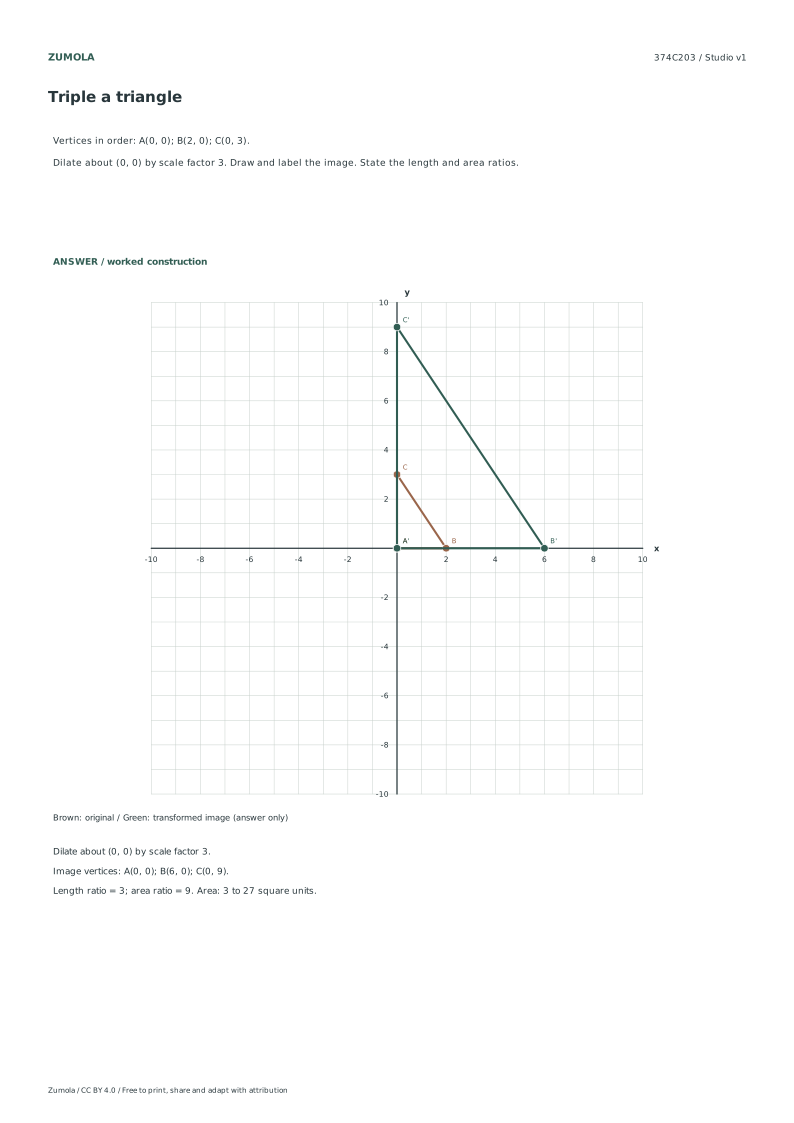
After dilating, verify that every side length is multiplied by the scale factor. For the triangle A(0,0), B(2,0), C(0,3) with factor 3, the image is A(0,0), B(6,0), C(0,9). The original area is 3 square units, and the image area is 27 square units. The length ratio is 3, and the area ratio is 9. Use the area ratio to confirm: (scale factor)^2 = area ratio. For factor 2, area ratio is 4; for 1/2, area ratio is 1/4; for 3, area ratio is 9; for 2/3, area ratio is 4/9. Always state both ratios clearly.
Checks that catch common errors
Watch for
Check instead
Multiplying only one coordinate of each vertex by the scale factor.
Multiply both x and y coordinates of every vertex by the scale factor. For example, B(4,0) with factor 2 becomes B(8,0), not B(8,0) with y unchanged incorrectly.
Using the scale factor as the area ratio.
The area ratio is the square of the scale factor. For factor 2, area ratio is 4; for factor 1/2, area ratio is 1/4; for factor 3, area ratio is 9; for factor 2/3, area ratio is 4/9.
Connecting image vertices in a different order than the original.
Connect the image vertices in the same order as the original polygon. For A(0,0), B(4,0), C(4,2), D(0,2) with factor 2, connect A(0,0) to B(8,0) to C(8,4) to D(0,4) and back to A.
Keep labels and margins readable
Choose the PDF that matches your paper. Print at Actual size / 100% and turn off Fit, Shrink and browser headers. SVG is editable but an editor can rescale it; the PDF is the simpler print route.
Useful answers
How do I find the image vertices when dilating about the origin?
Multiply each coordinate of every vertex by the scale factor. For A(0,0), B(4,0), C(4,2), D(0,2) with factor 2, the image is A(0,0), B(8,0), C(8,4), D(0,4).
What is the relationship between the scale factor and the area ratio?
The area ratio is the square of the scale factor. For factor 2, area ratio is 4; for factor 1/2, area ratio is 1/4; for factor 3, area ratio is 9; for factor 2/3, area ratio is 4/9.
How can I check that my scaled copy is correct?
Check that each side length is multiplied by the scale factor and that the area ratio equals the square of the scale factor. For the triangle with factor 3, original area 3 becomes 27, and length ratio is 3.
Are the answer files and editable graphs free?
Yes. The individual student, reference and answer files plus collection packs are free without signup. Credit Zumola under CC BY 4.0 when sharing or adapting.
To draw a scaled copy, multiply each vertex coordinate by the scale factor. For example, with vertices A(0,0), B(4,0), C(4,2), D(0,2) and factor 2, the image vertices are A(0,0), B(8,0), C(8,4), D(0,4). Plot these points in order and connect them. The length ratio equals the scale factor, so each side length is multiplied by 2. The area ratio is the square of the scale factor, so the area becomes 4 times the original. Check that the image is similar to the original: corresponding angles remain equal and side lengths are proportional.
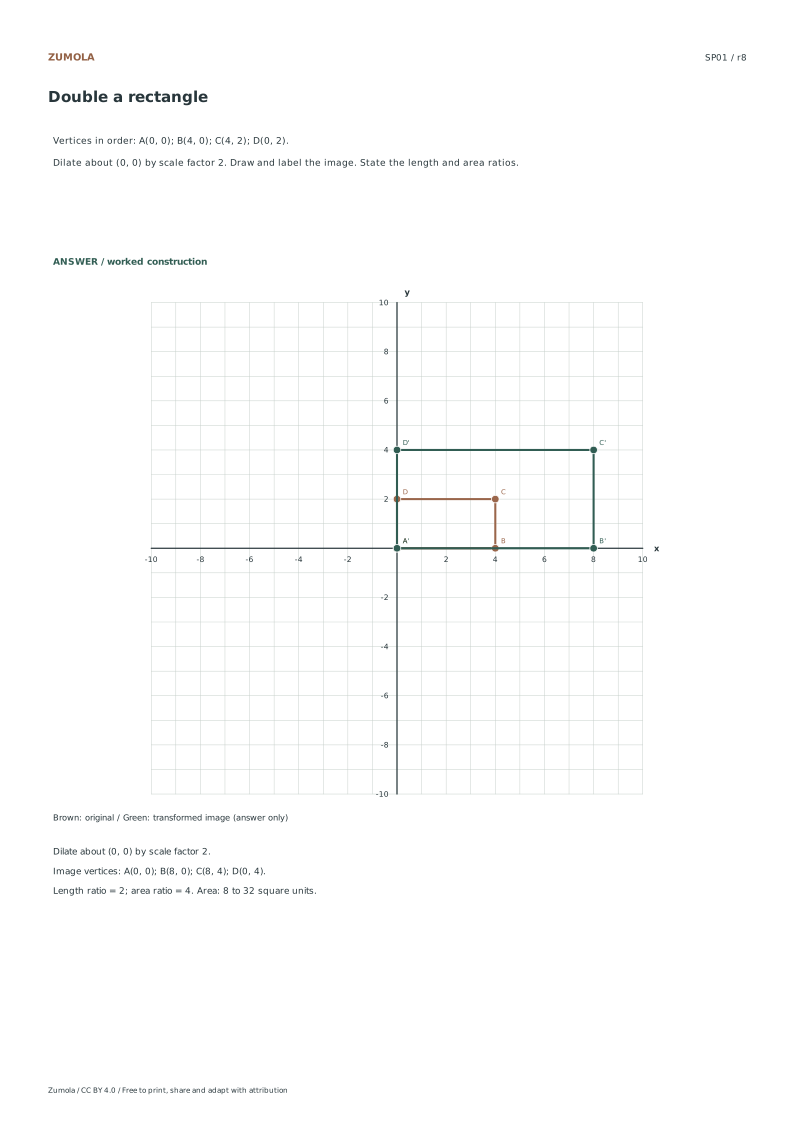
Length ratio = 2; area ratio = 4. Area: 8 to 32 square units.
The answer PDFs include the completed drawings and checks for all four cases. Free original resources, CC BY 4.0. No signup required.
More ways to practice
Coordinate method for an oblique triangle
Place the original triangle with vertices A(1,1), B(4,1), and C(2,3) on a square grid. A scale factor of 1.5 about the origin means each coordinate is multiplied by 1.5: A'(1.5,1.5), B'(6,1.5), C'(3,4.5). Plot these points and connect them in the same order. The new triangle should have sides 1.5 times the original lengths and the same angles.
Check side lengths with the distance formula. AB = 3, so A'B' = 4.5. AC = sqrt((2-1)^2+(3-1)^2)=sqrt(5)≈2.236, so A'C'=1.5×sqrt(5)≈3.354. BC = sqrt((2-4)^2+(3-1)^2)=sqrt(8)≈2.828, so B'C'=1.5×sqrt(8)≈4.243. If your drawing’s measured lengths differ by more than a small ruler tolerance, recheck the coordinate multiplication.
Plot A(1,1), B(4,1), C(2,3) on square grid paper.
Multiply each coordinate by 1.5 to get A'(1.5,1.5), B'(6,1.5), C'(3,4.5).
Plot and connect A', B', C' in the same order.
Measure A'B', A'C', B'C' and compare with 4.5, about 3.35, and about 4.24.
Check that angle A' equals angle A, angle B' equals angle B, and angle C' equals angle C.
Diagnostic checks that catch scaling slips
A common error is scaling only one coordinate direction. For example, multiplying x by 1.5 but leaving y unchanged gives A'(1.5,1), B'(6,1), C'(3,3). This distorts angles and does not produce a similar triangle. Another slip is applying the factor to side lengths but not to position, which can shift the copy incorrectly. Use the coordinate formula as an independent check: new_x = k·old_x and new_y = k·old_y for a dilation about the origin.
Area should scale by the square of the factor. The original triangle area is 3 square units (base AB=3, height from C to AB=2, area=0.5×3×2=3). The scaled triangle area should be 1.5²×3 = 2.25×3 = 6.75 square units. You can verify with the shoelace formula on the new coordinates: 0.5×|1.5(1.5−4.5)+6(4.5−1.5)+3(1.5−1.5)| = 0.5×|−4.5+18+0| = 6.75. If your area does not match, check whether you scaled both coordinates.
Confirm every vertex coordinate was multiplied by the same factor.
Compare each new side length to factor × original side length.
Compare each corresponding angle; they should be equal.
Compute area by factor² × original area and cross-check with coordinates.
Rubric for judging a scaled copy
Because drawings can be placed differently on the page, judge the mathematical relationships rather than an exact pixel match. A strong response shows correct side-length ratios, equal corresponding angles, and a clear label of the scale factor. The copy should be recognizable as the same shape, not a stretched or skewed version. Minor ruler or plotting differences are acceptable if the intended coordinates and ratios are correct.
All corresponding side lengths are multiplied by the same factor within measurement tolerance.
All corresponding angles are equal within drawing tolerance.
The scale factor is stated and applied consistently to both coordinates.
Area check matches factor squared times original area.
Labels and vertices are in corresponding order.
Try this example
Scale triangle A(1,1), B(4,1), C(2,3) by a factor of 1.5 about the origin. Find the new coordinates, verify one side length, and compute the new area.
Show the worked explanation
Multiply each coordinate by 1.5: A'(1.5,1.5), B'(6,1.5), C'(3,4.5). Original AB = 3, so A'B' should be 4.5; the distance formula gives sqrt((6−1.5)²+(1.5−1.5)²)=4.5. Original area = 0.5×3×2 = 3 square units, so new area = 1.5²×3 = 6.75 square units. The shoelace formula on the new coordinates also gives 6.75.
Common mistakes
Scaling only horizontal distances and leaving vertical distances unchanged. Multiply both x and y coordinates by the scale factor, then recheck angles and area.
Measuring side lengths from the drawing but forgetting to compare corresponding sides in the same order. Label original and copy vertices consistently (A→A', B→B', C→C') before measuring.
Assuming area also multiplies by the scale factor instead of its square. Use area_new = k² × area_original and verify with a coordinate area formula.
Check your work
Every vertex coordinate is multiplied by the same scale factor.
Corresponding side lengths are in the correct ratio within measurement tolerance.
Corresponding angles are equal within drawing tolerance.
Area equals the square of the scale factor times the original area.
Vertices are labeled in corresponding order and the scale factor is stated.
Questions before you start
Does a scaled copy have to be in the same position on the page?
No. A scaled copy can be translated or rotated as long as all side lengths are multiplied by the same factor and all corresponding angles stay equal. For a dilation about the origin, coordinates follow new_x = k·old_x and new_y = k·old_y.
How can I check a scaled triangle without measuring every side?
Use coordinates. Multiply each vertex by the scale factor, plot the new points, and compare one or two side lengths with the distance formula. Then check one angle and the area using k² times the original area.
What if my drawn copy looks slightly different from the original?
Small differences from plotting or ruler precision are normal. Check that side-length ratios are consistent and angles match. If the shape looks stretched in only one direction, you likely scaled one coordinate incorrectly.
Optional Google Analytics helps us understand which free resources are useful. It is off until you allow it. Drawing tools and downloads work with either choice. Privacy details