Free area and perimeter drawing worksheets with original orthogonal regions, notches and stepped outlines. Letter/A4 student sheets and answers included.
Choose Letter or A4, then download a student sheet first. Keep the separate reference or answer file closed until you have attempted the case. Every worksheet, SVG and answer is free without signup.
Choose your paper and download
Download paper size
Every worksheet and answer is free. No signup.
Free original resourceAP01
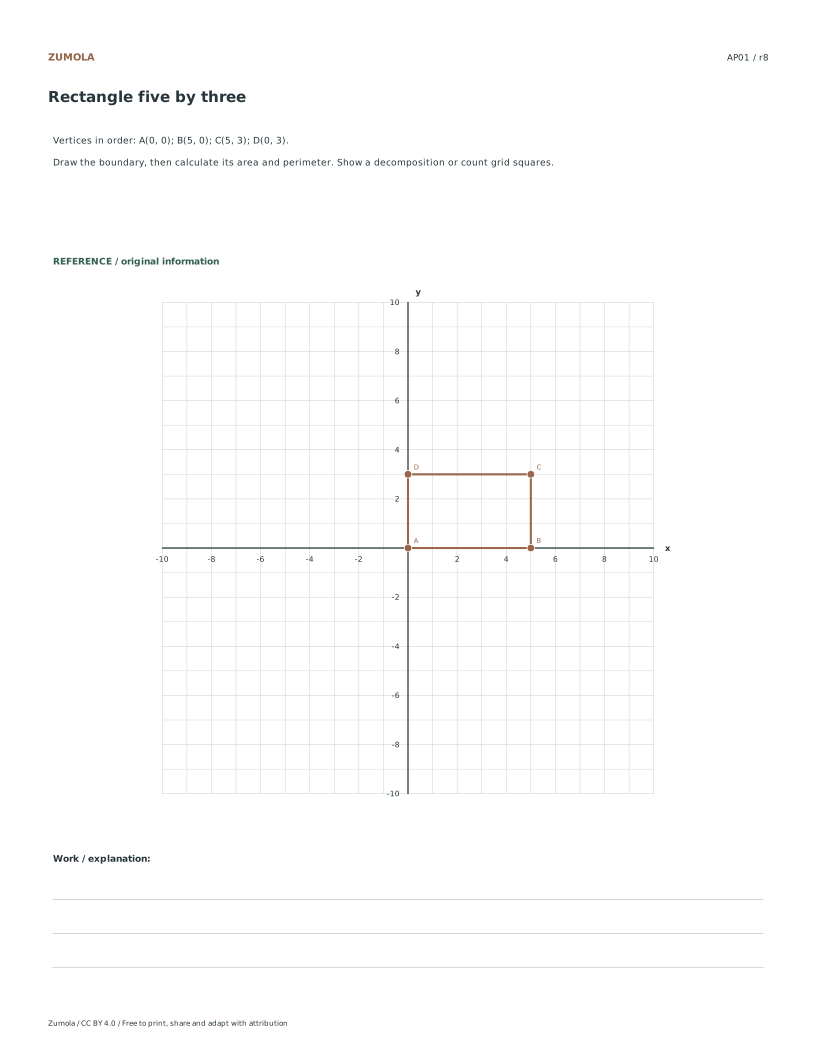
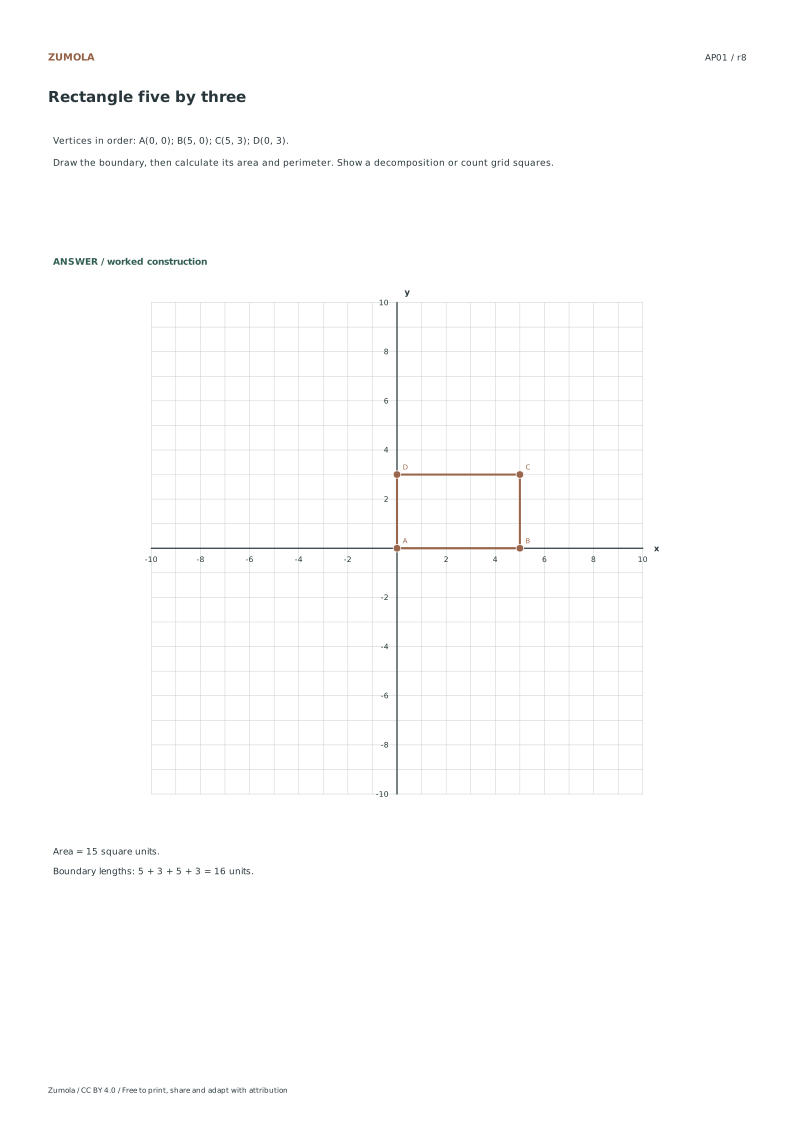
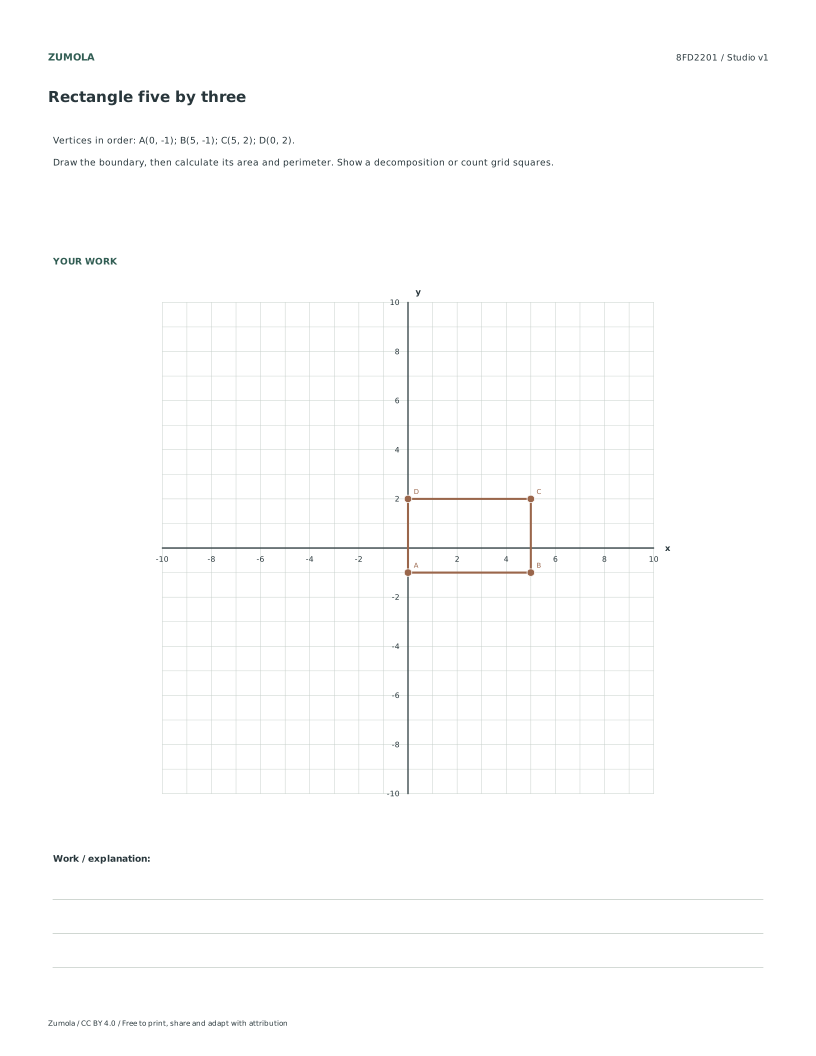
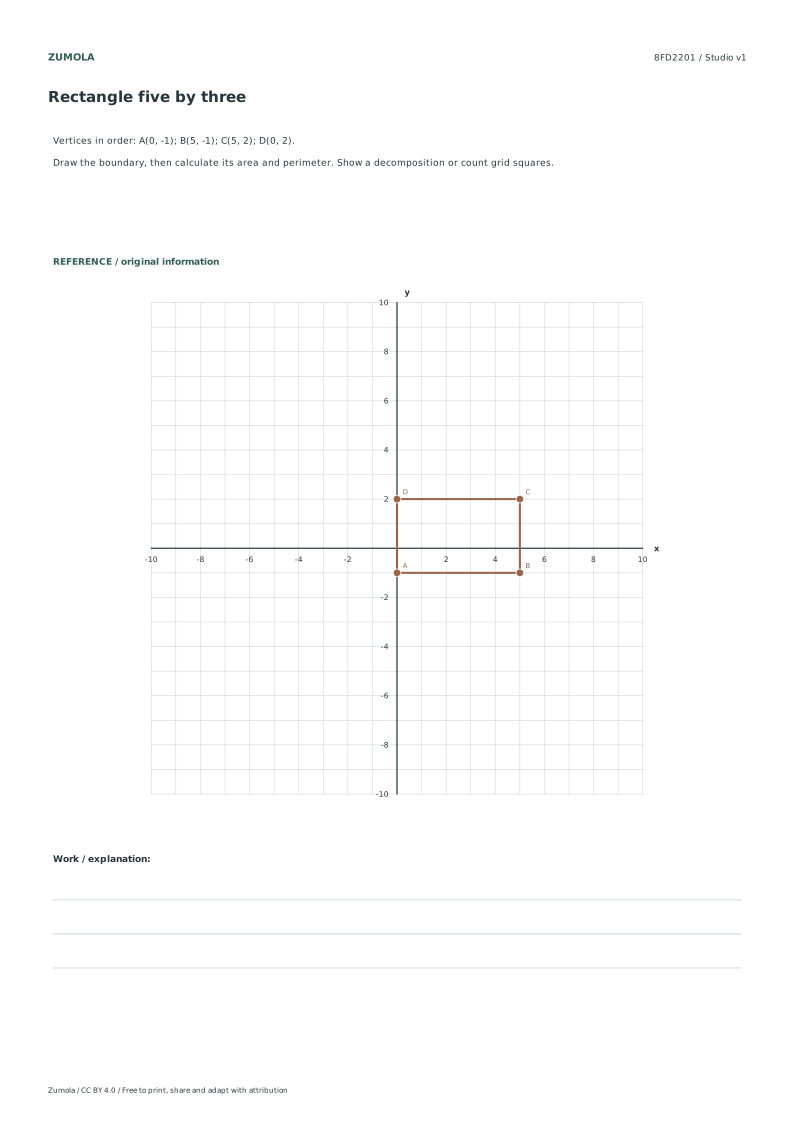
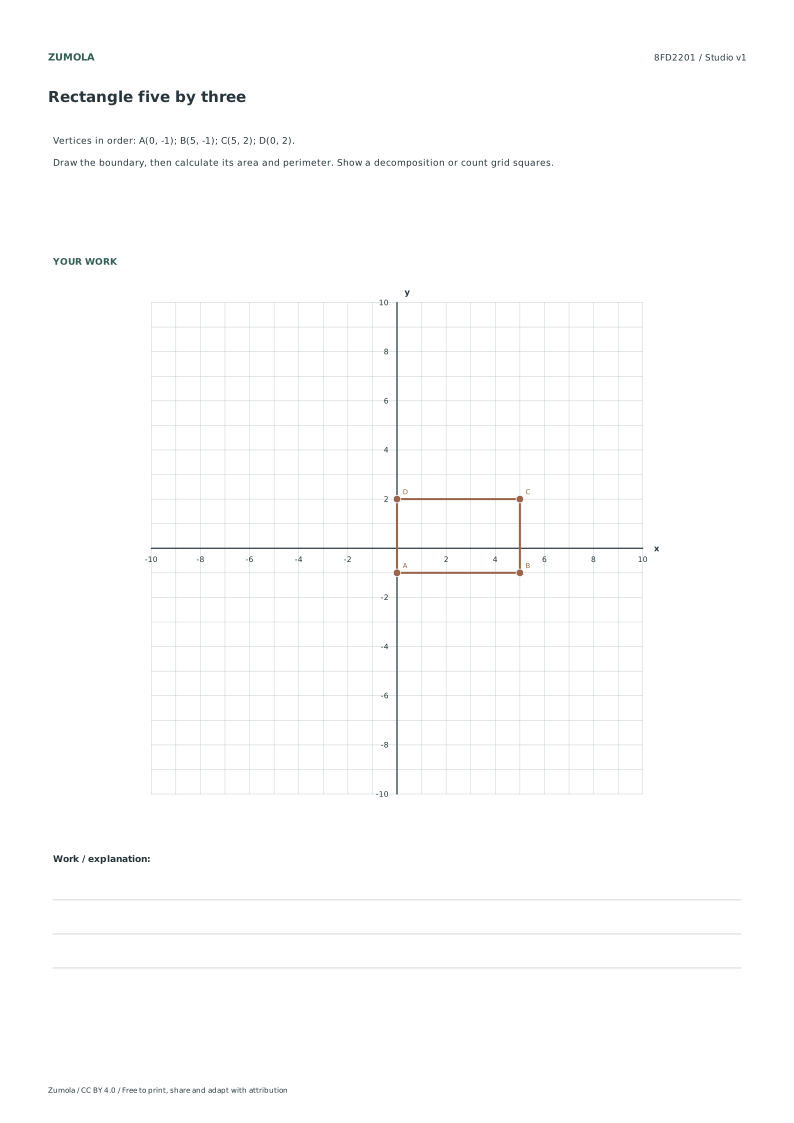
Rectangle five by three
Original worksheet collection. Letter or A4 PDF and editable SVG.
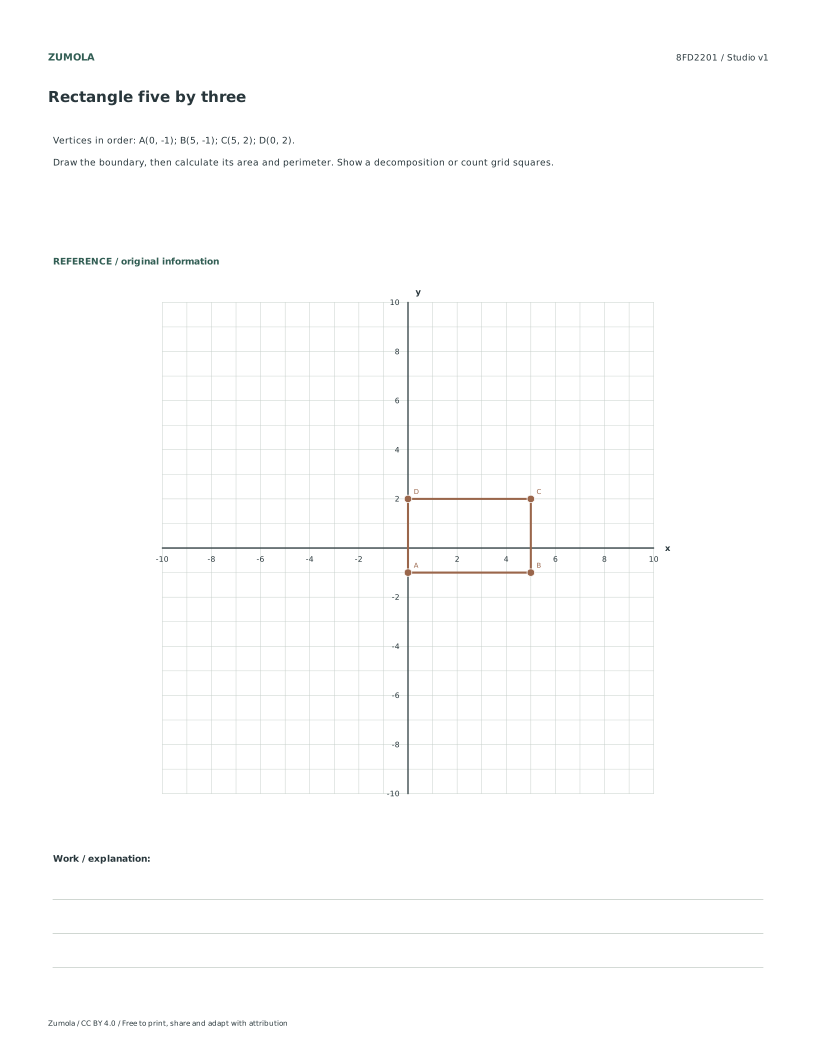
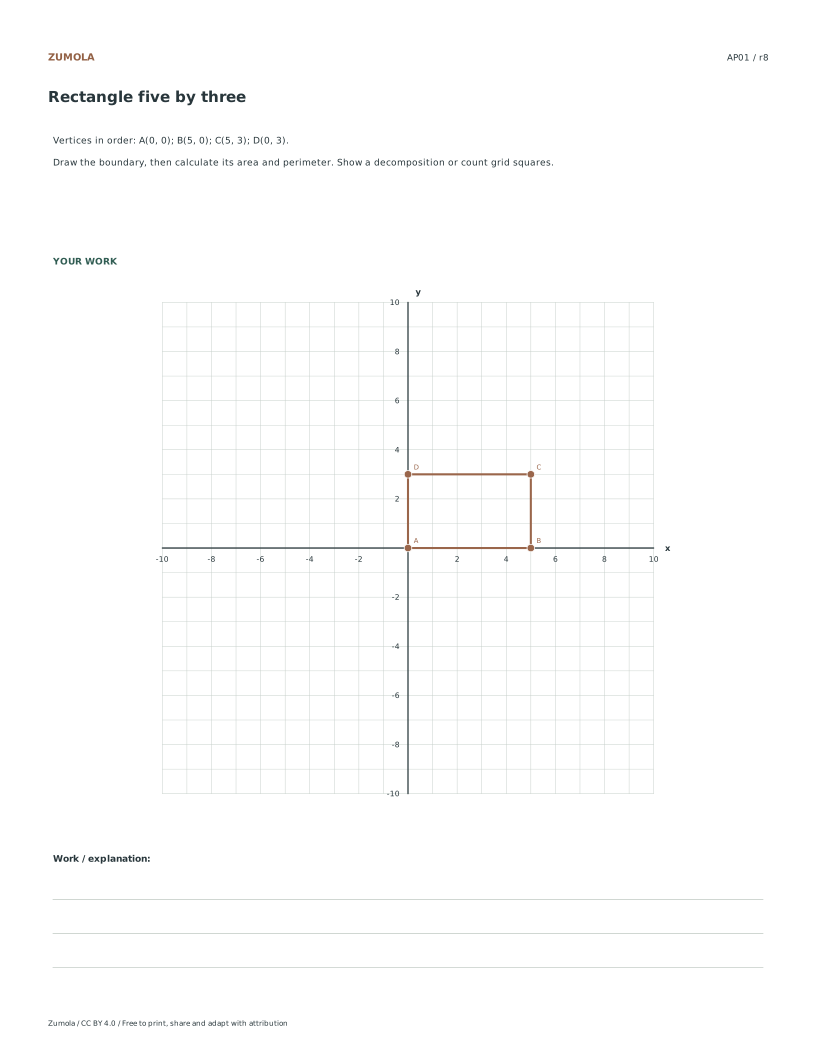
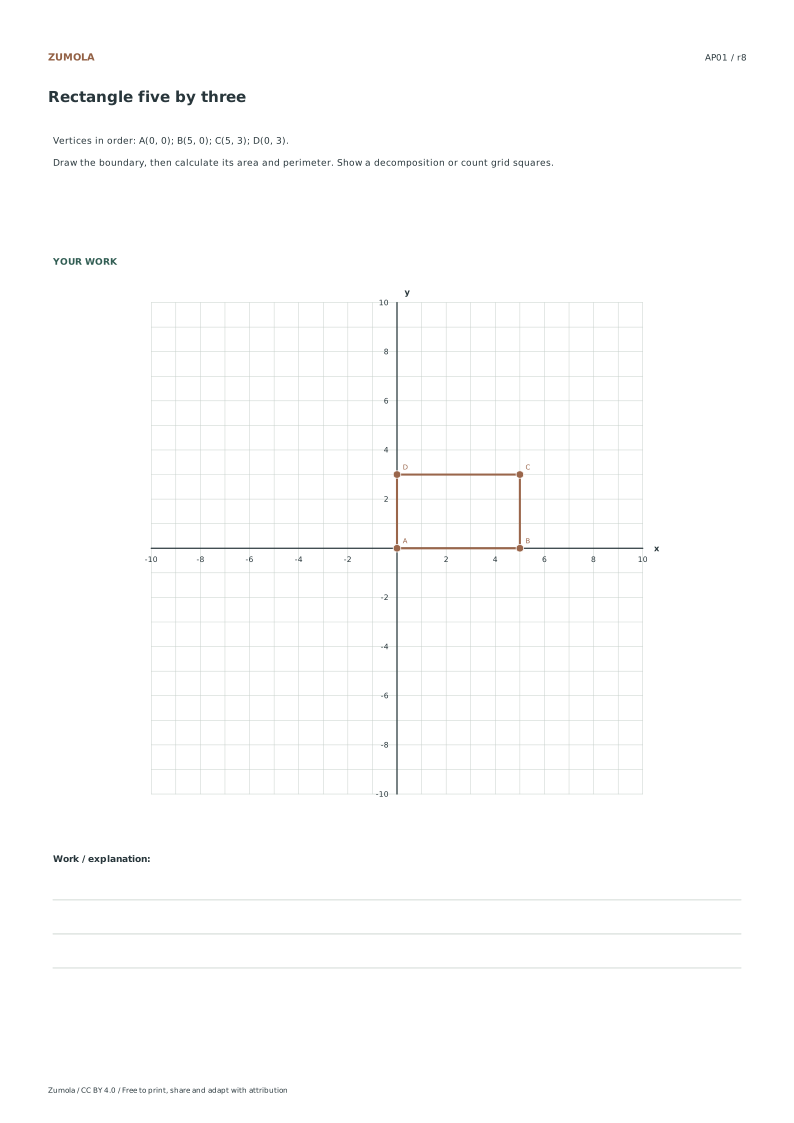
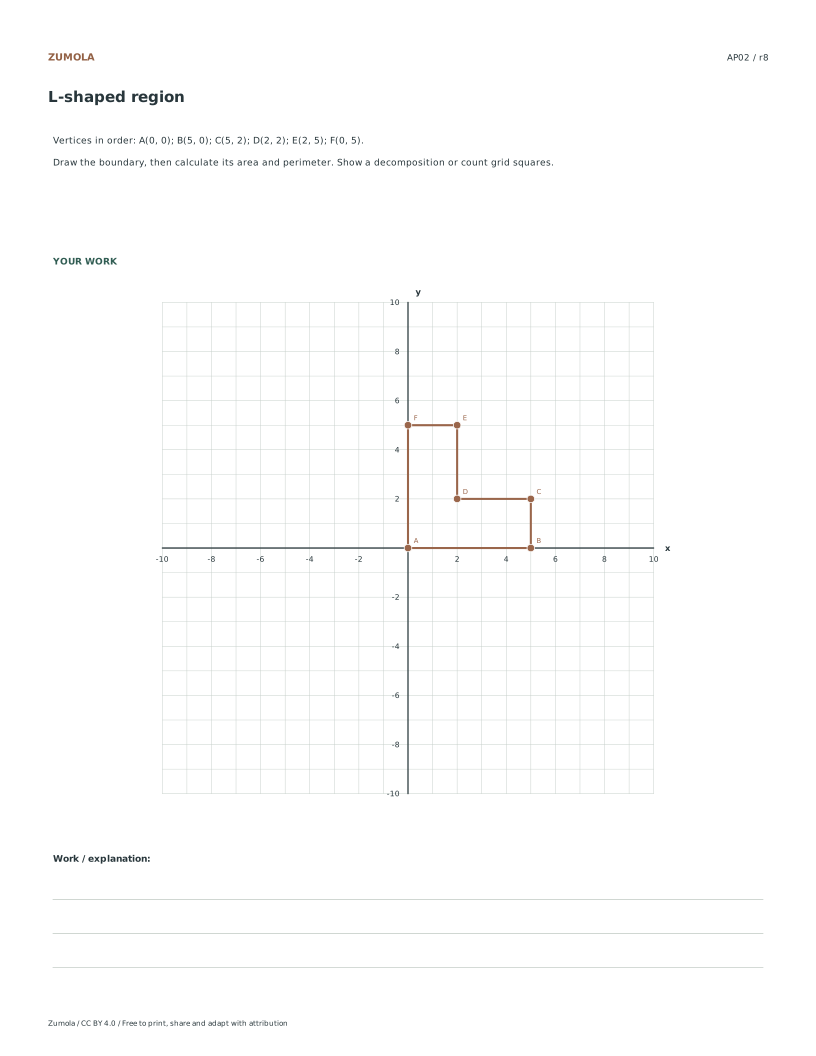
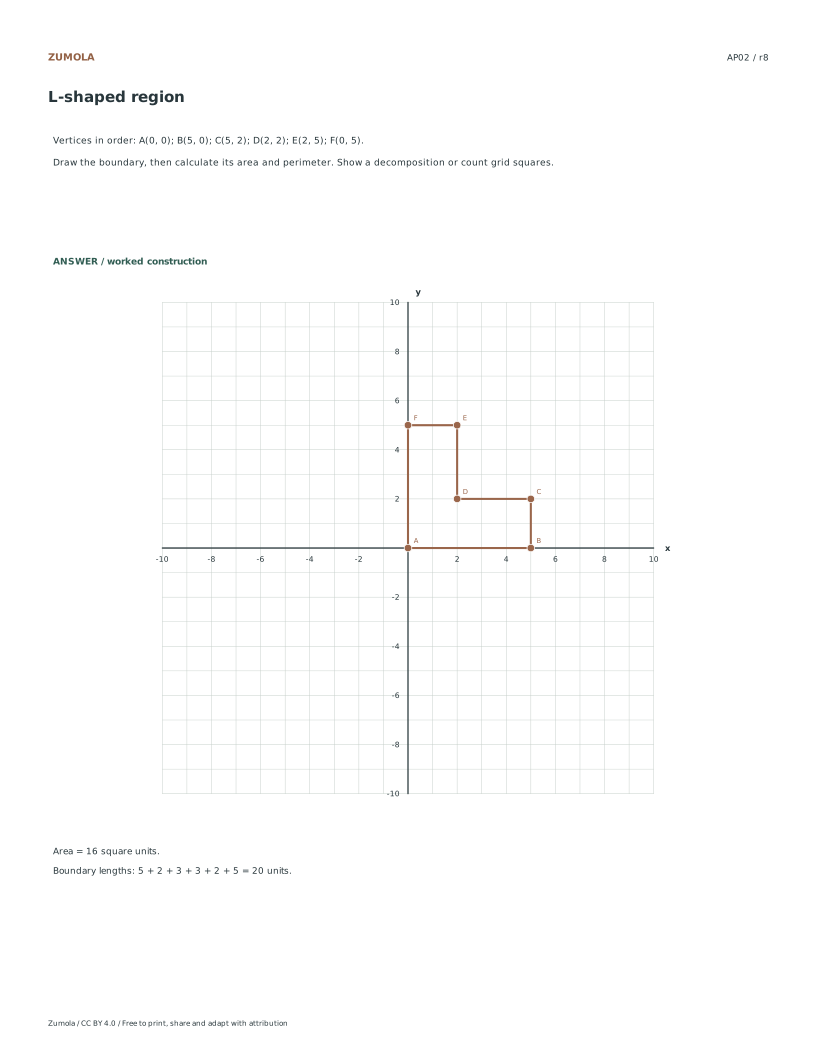
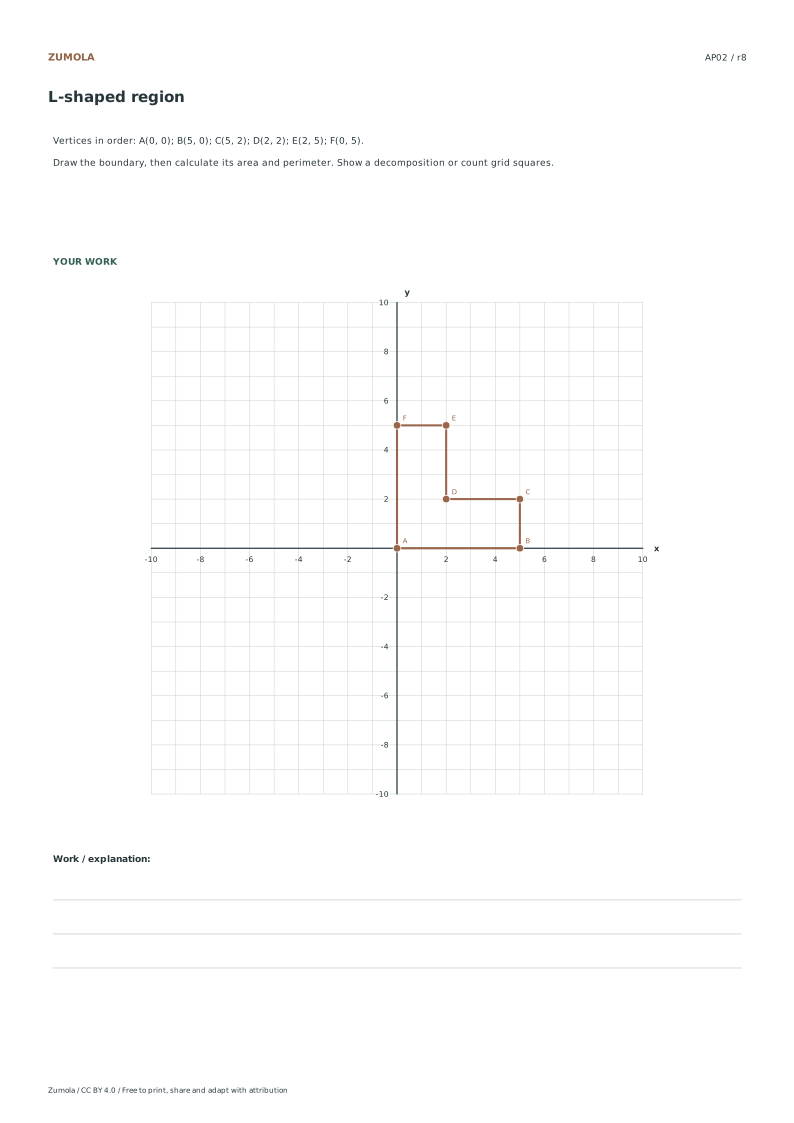
Draw the boundary, then calculate its area and perimeter. Show a decomposition or count grid squares.
Use the coordinates, dimensions and rules given for each case. Distances and areas are measured in grid units.
Check the first case
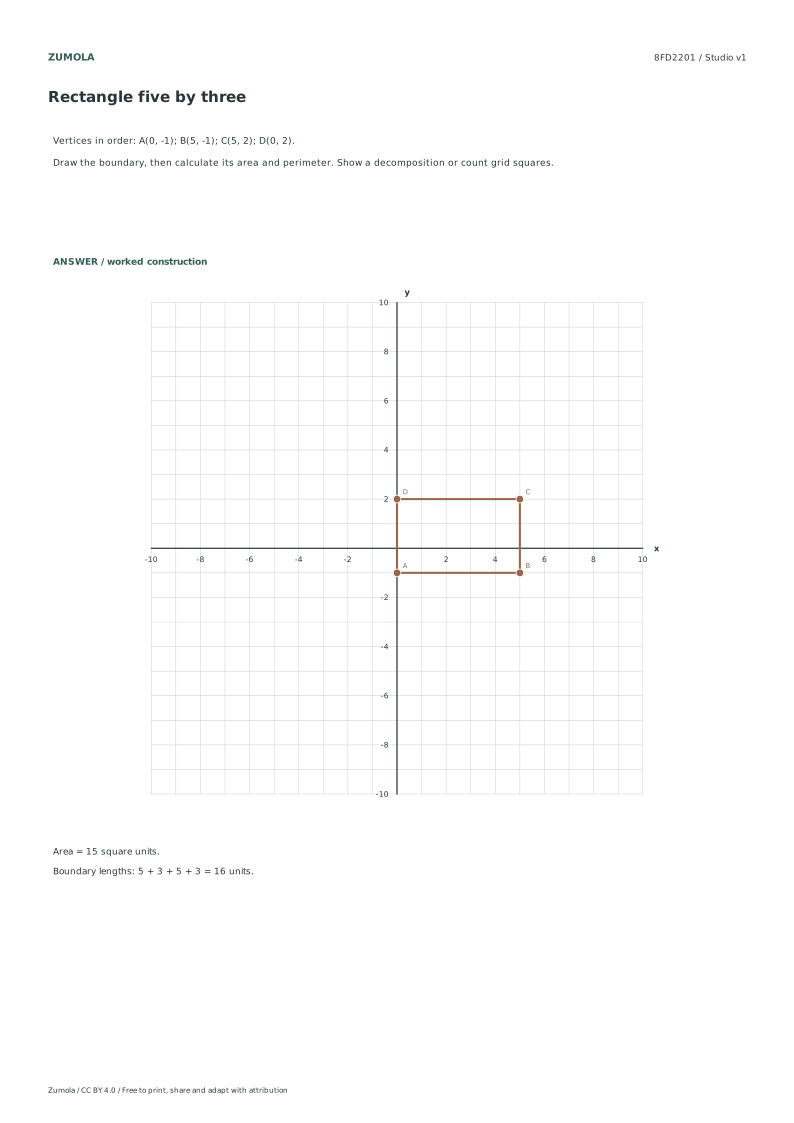
AP01: Rectangle five by three
Step
Worked result
1
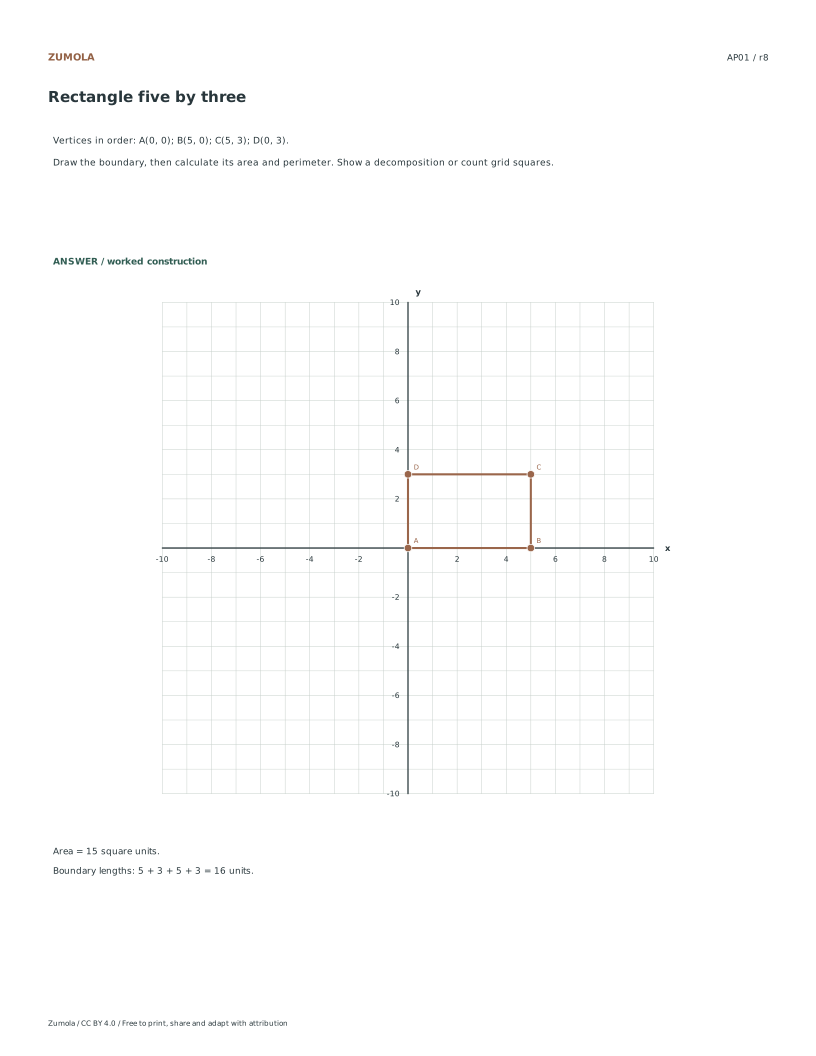
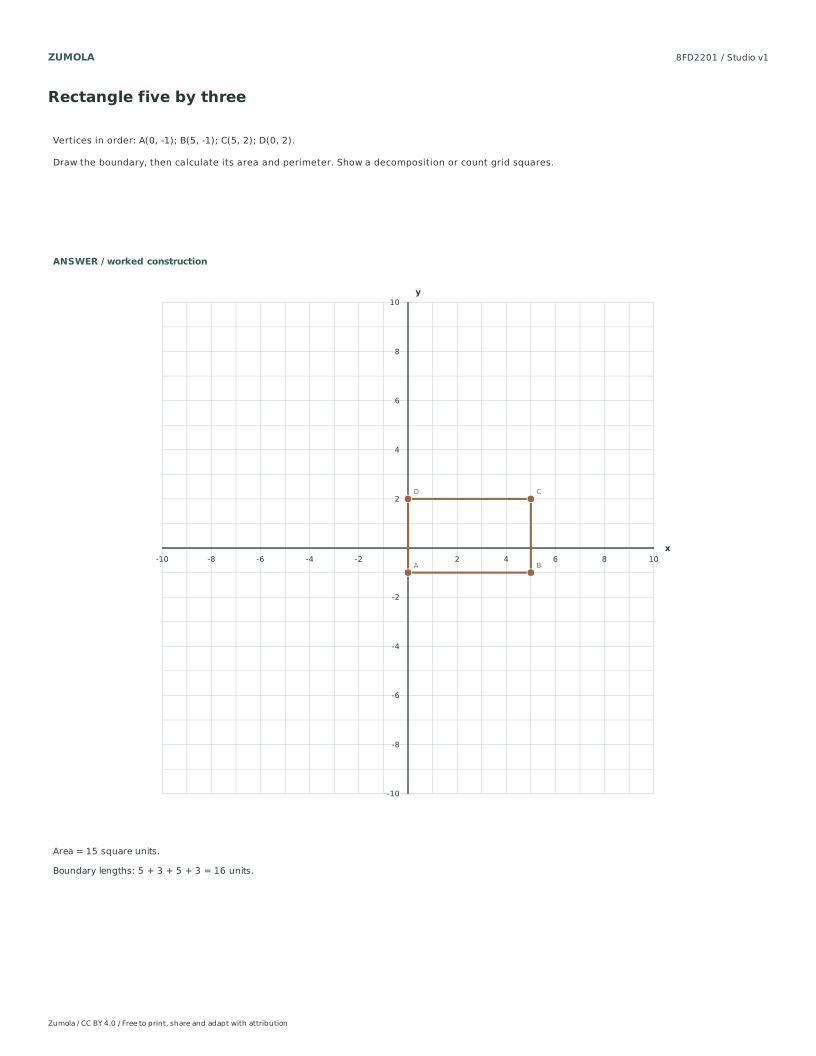
Area = 15 square units.
2
Boundary lengths: 5 + 3 + 5 + 3 = 16 units.
The first case shows the checking pattern. Individual answer files contain the completed graph or net and result for every case.
Work through the graph
Draw the boundary from ordered vertices
Plot each vertex in order on a coordinate grid, then connect consecutive points with straight segments, including the last point back to the first. For AP01, plot A(0,0), B(5,0), C(5,3), D(0,3) and connect A-B-C-D-A. Check that each segment is horizontal or vertical by comparing coordinates: same y means horizontal, same x means vertical. Label each side length directly on the drawing. This boundary is the path you will measure for perimeter and the outline that encloses the area.
Find area by decomposing into rectangles
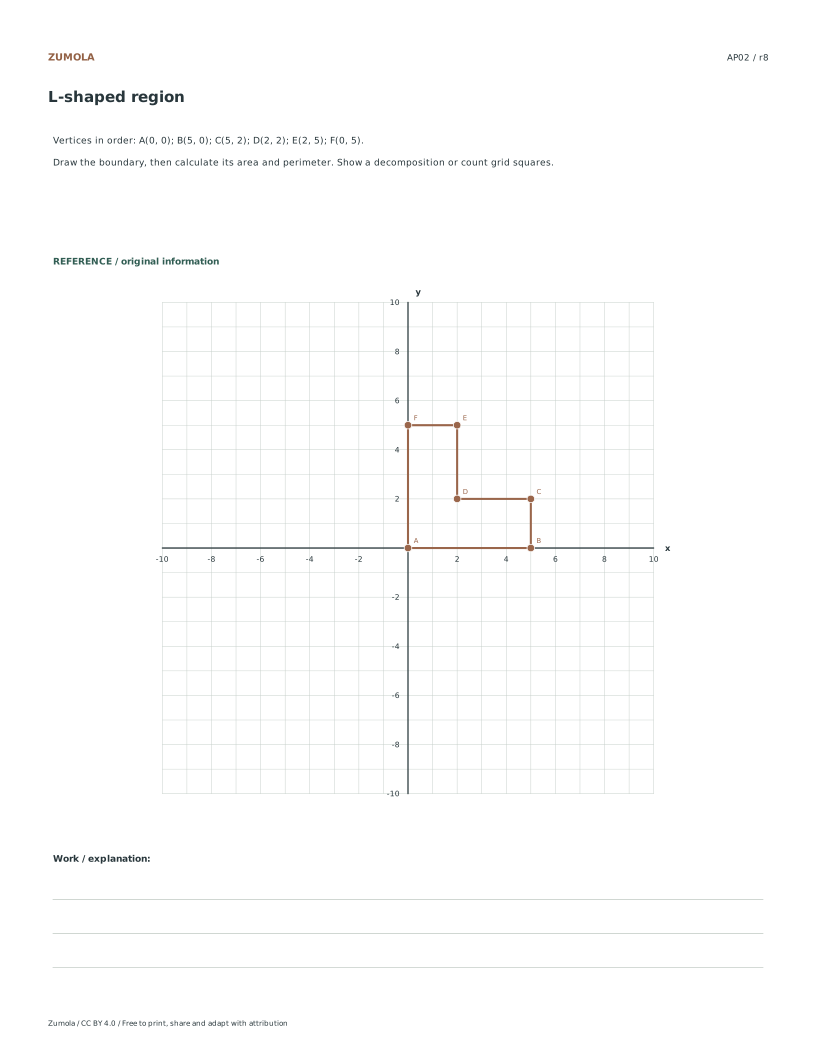
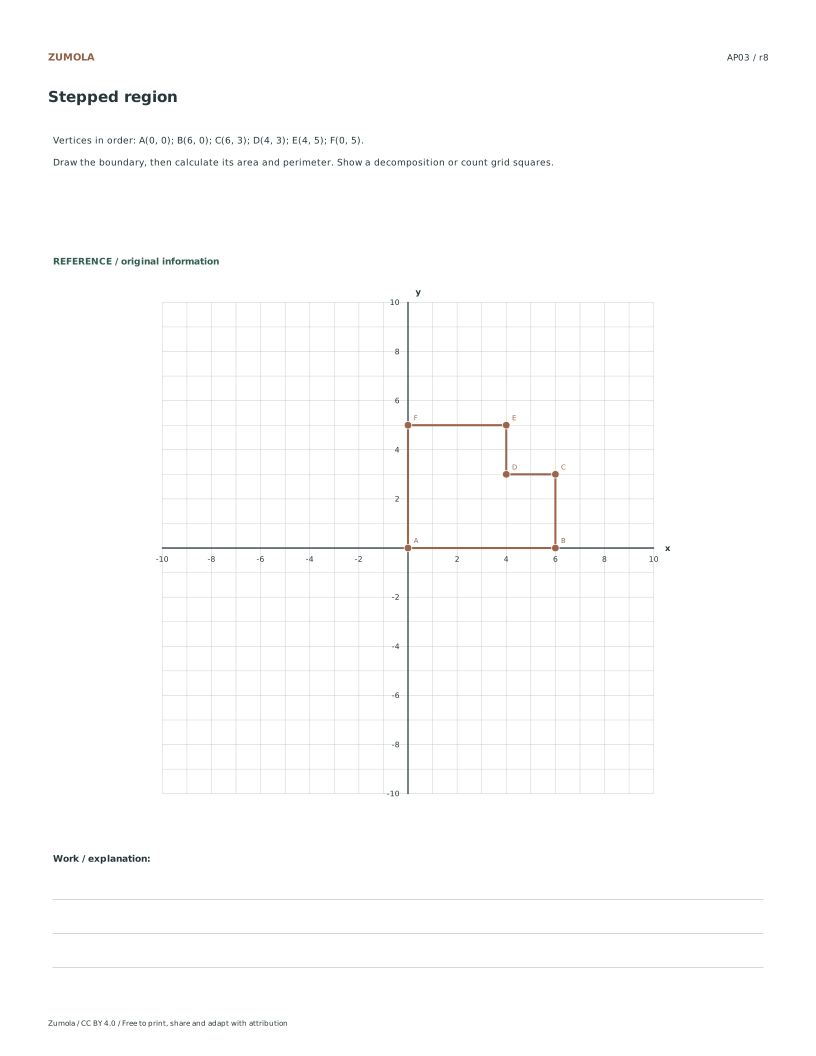
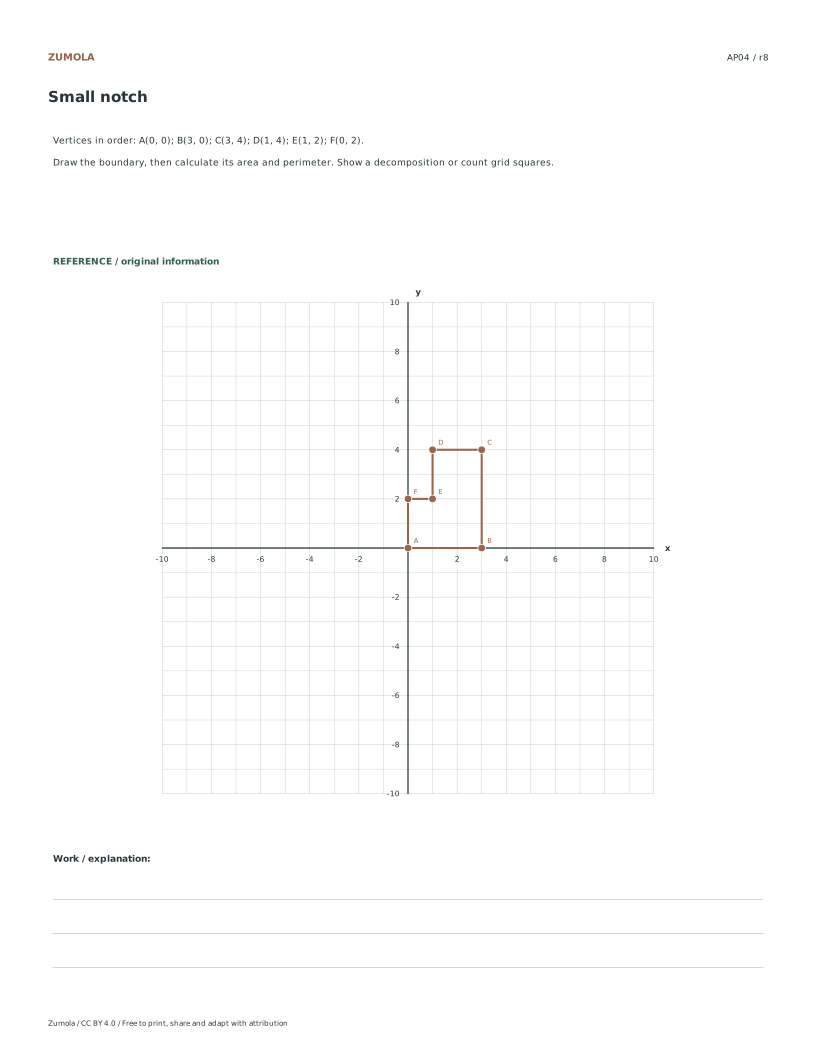
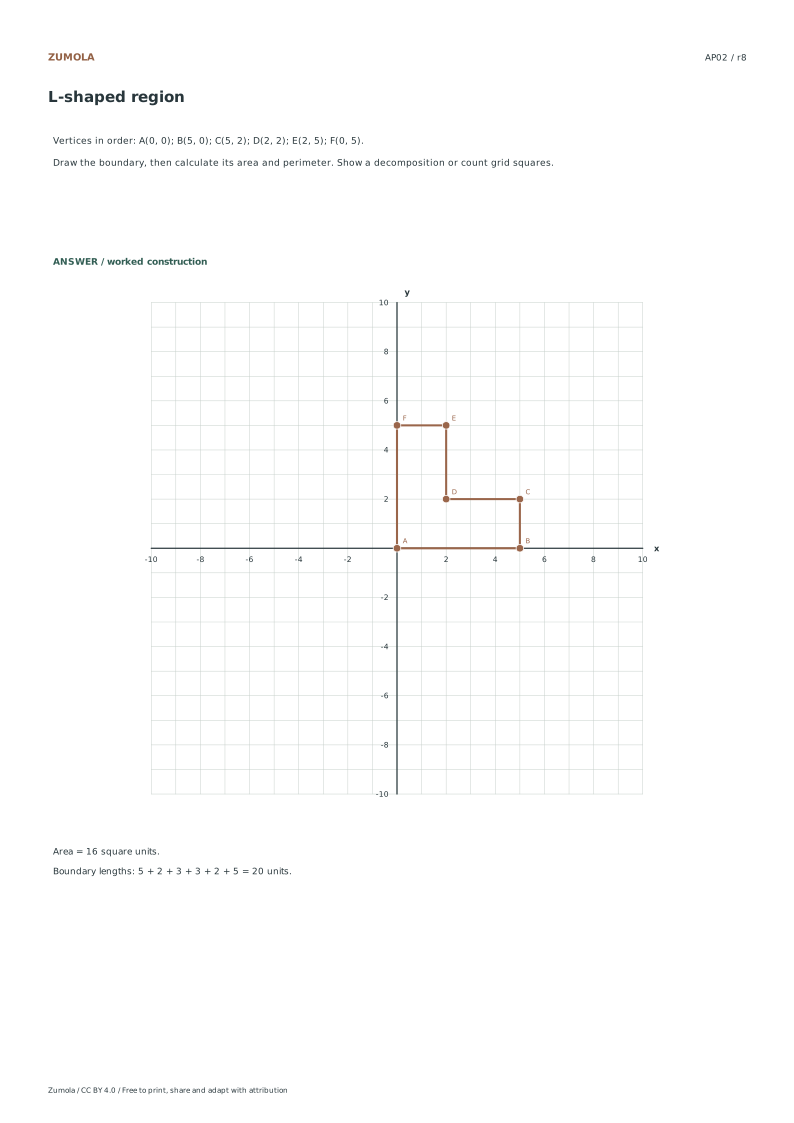
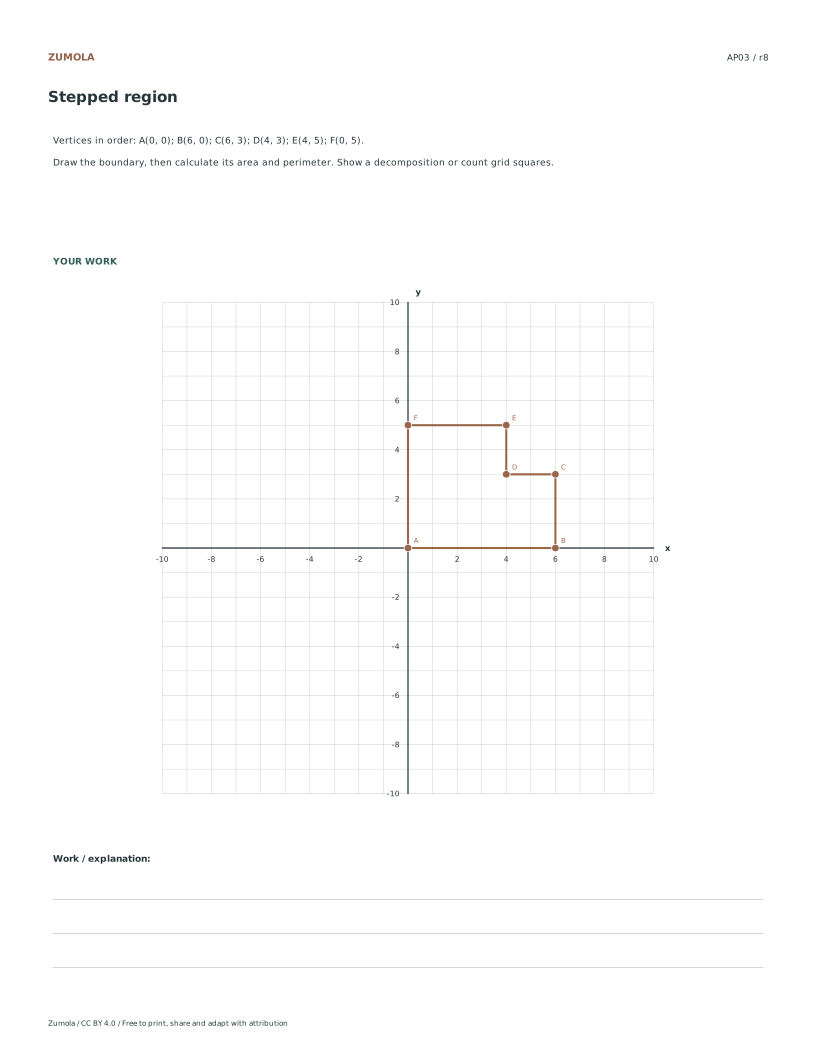
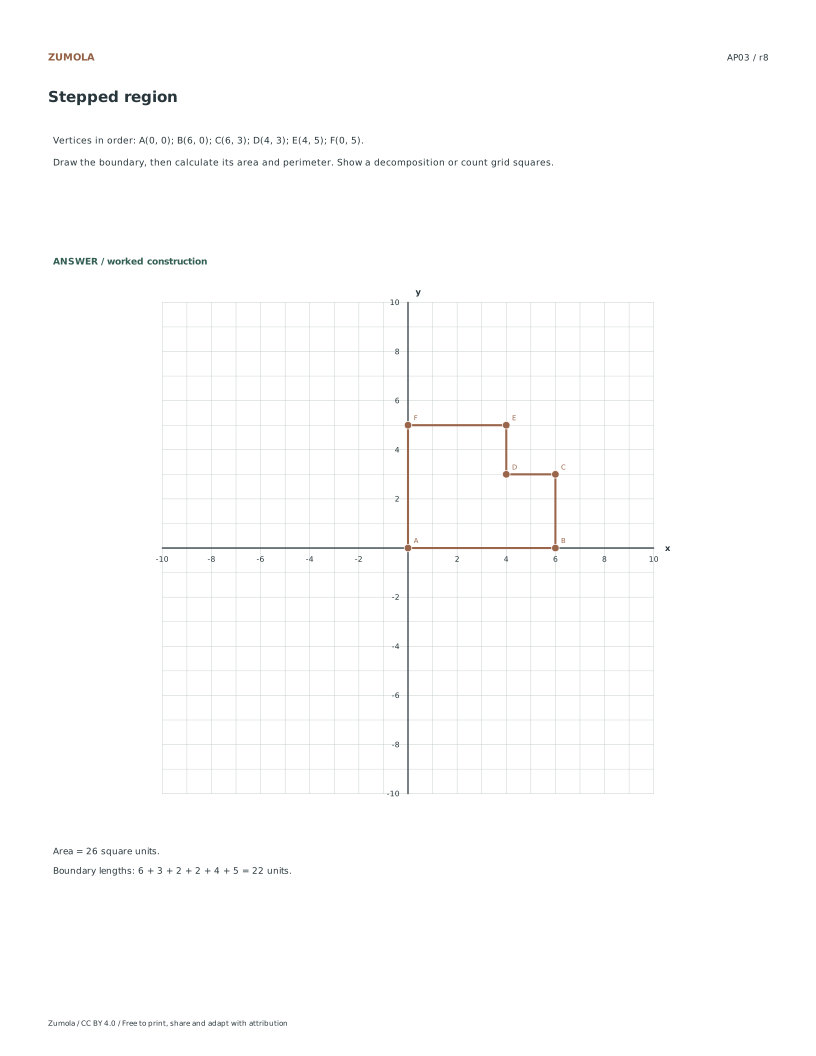
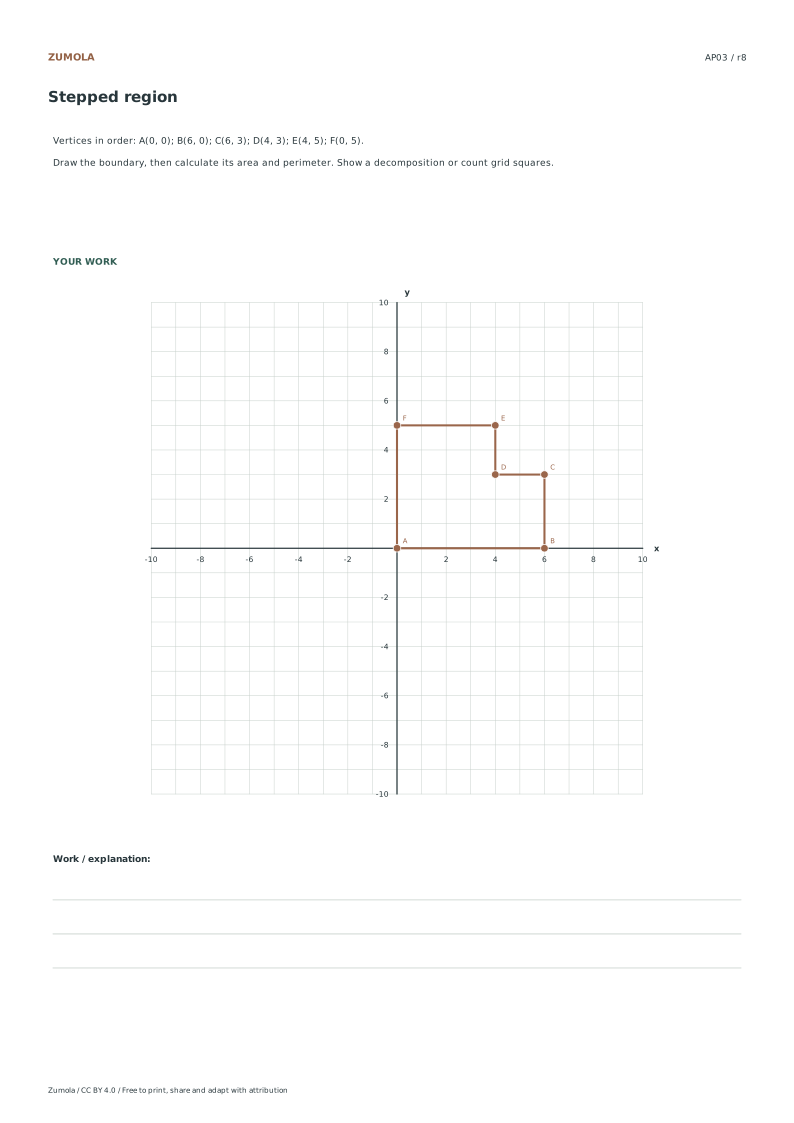
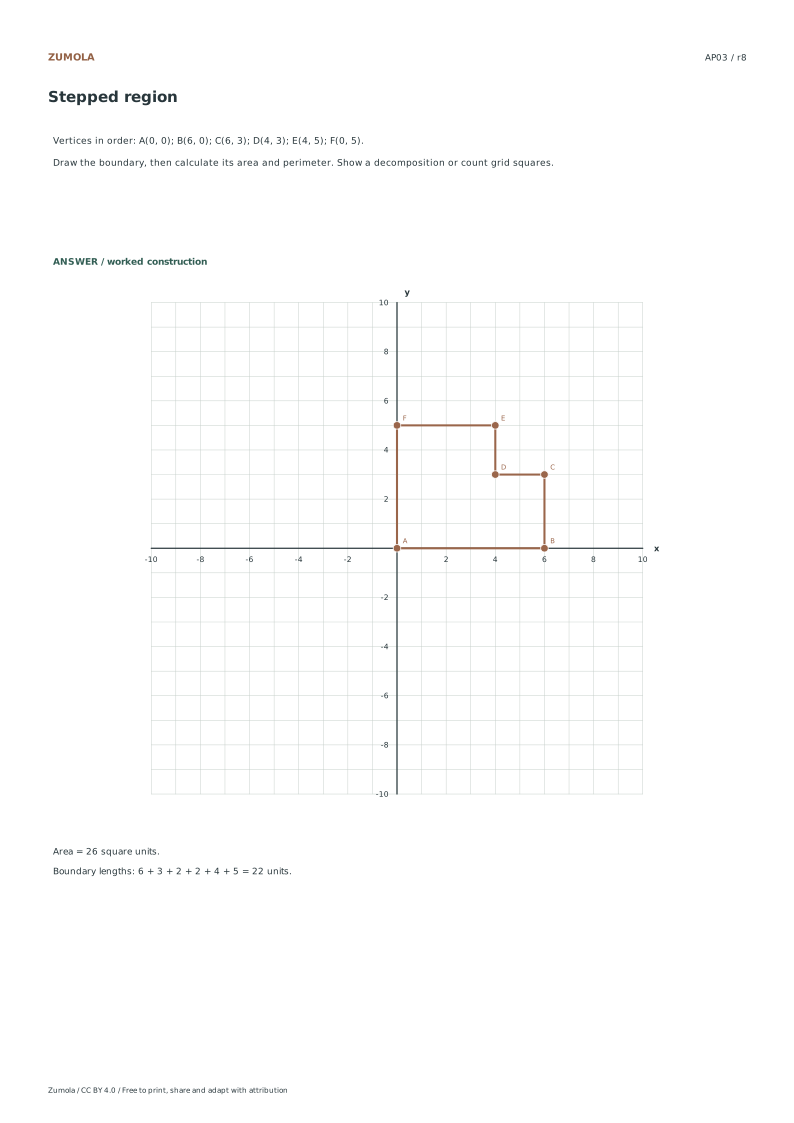
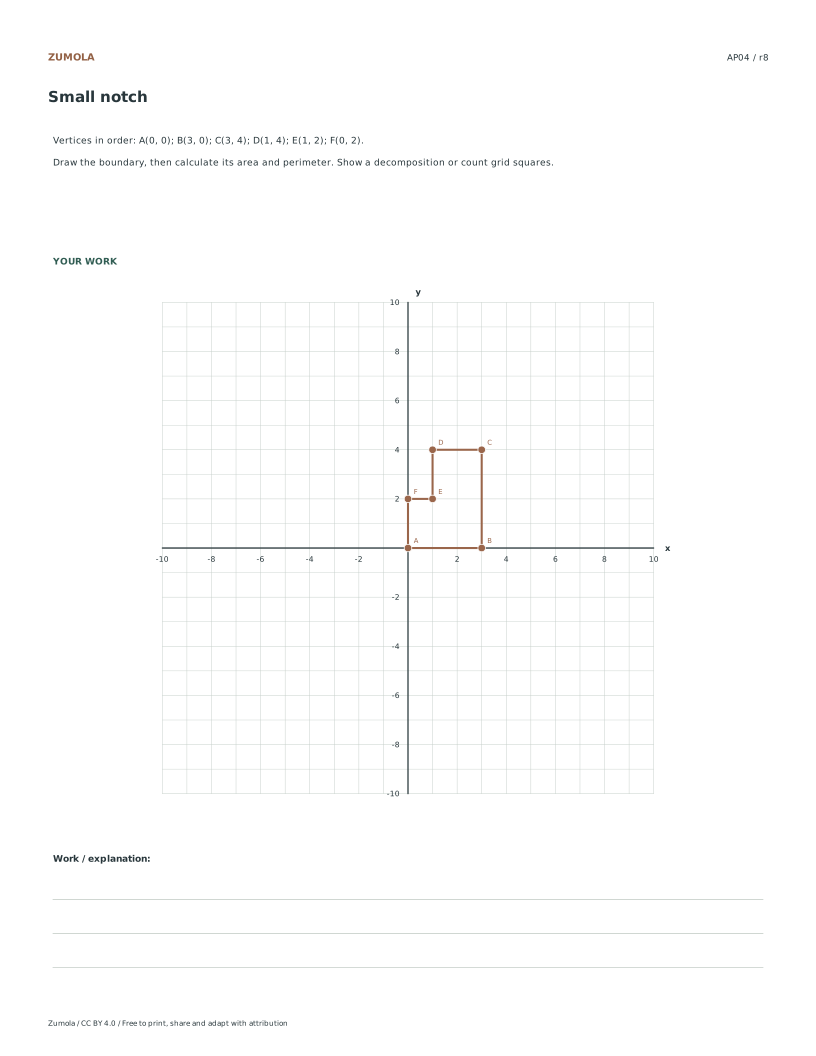
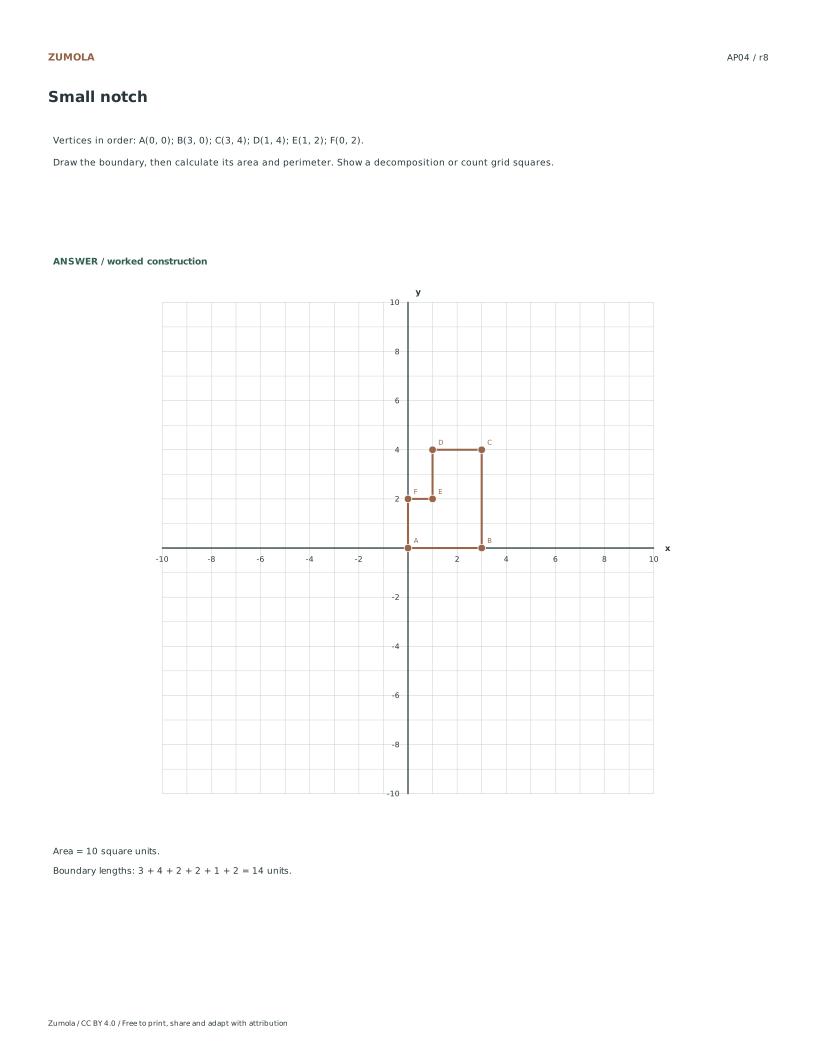
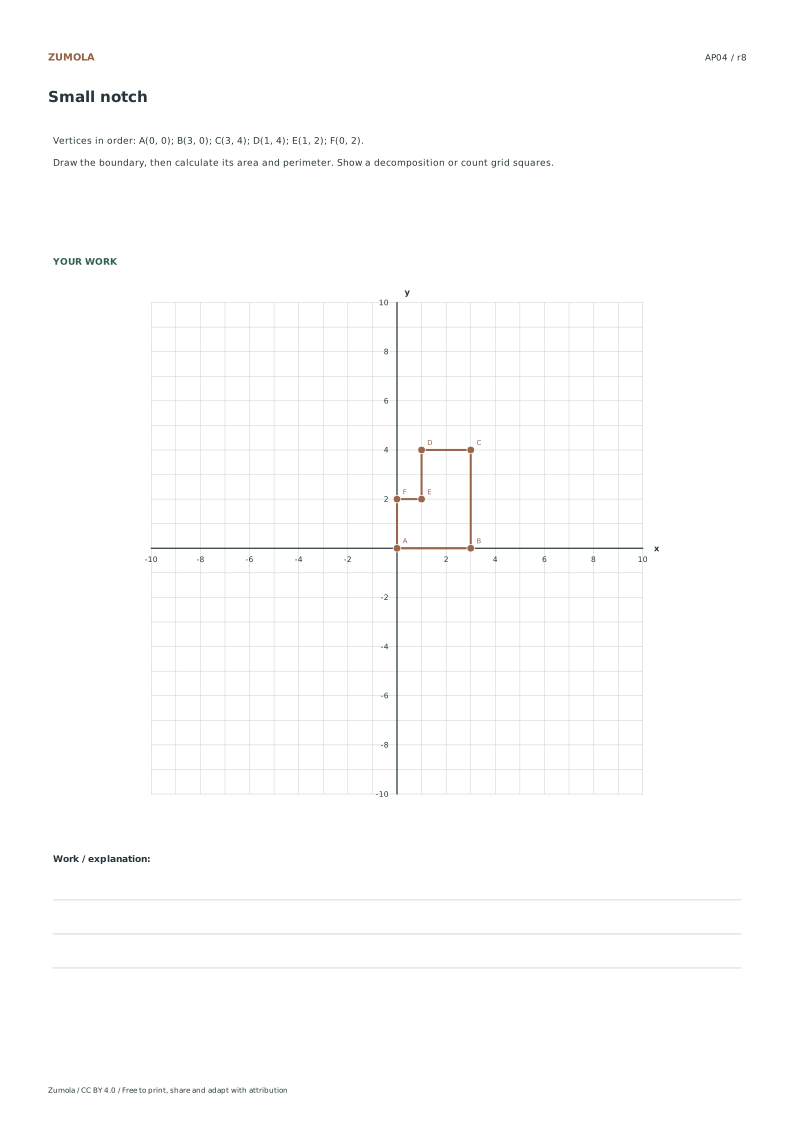
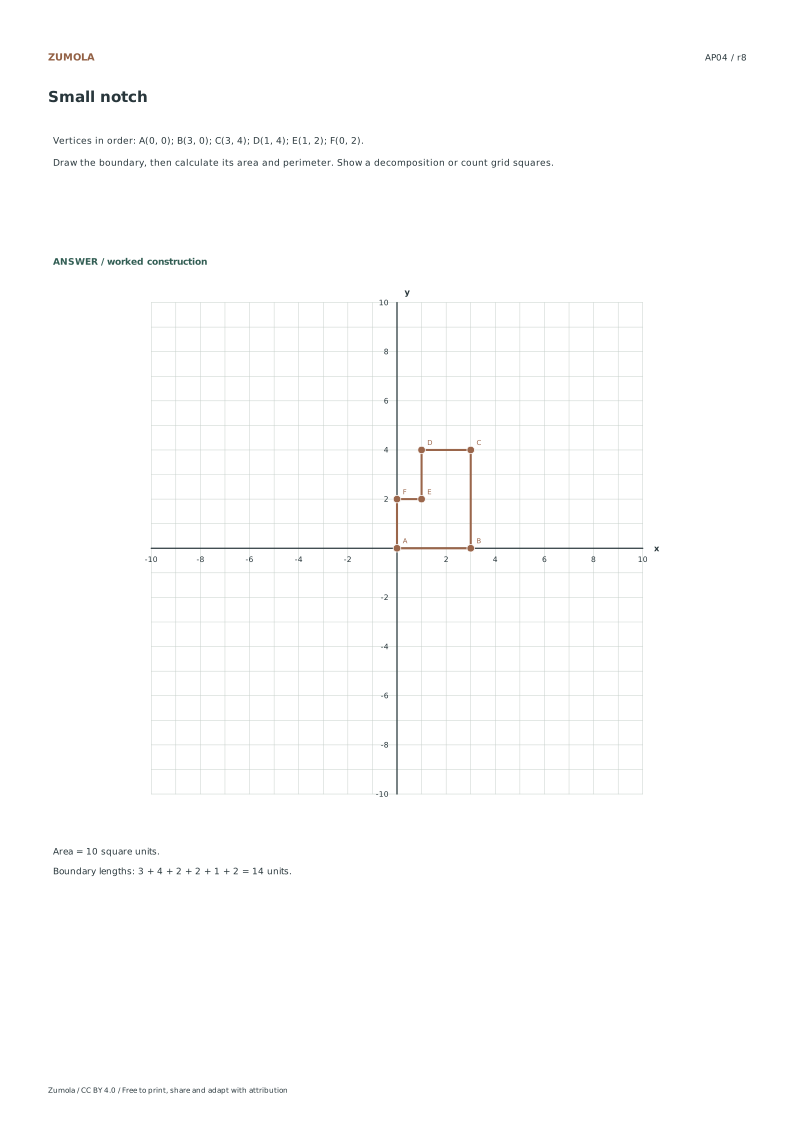
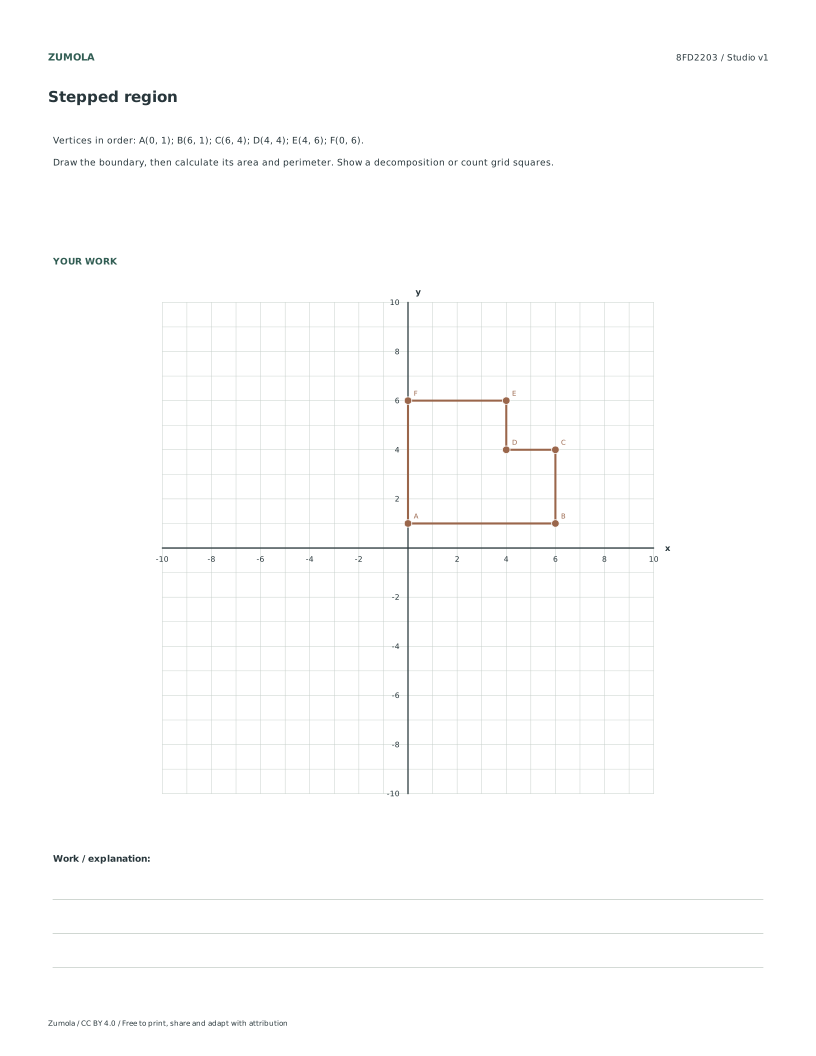
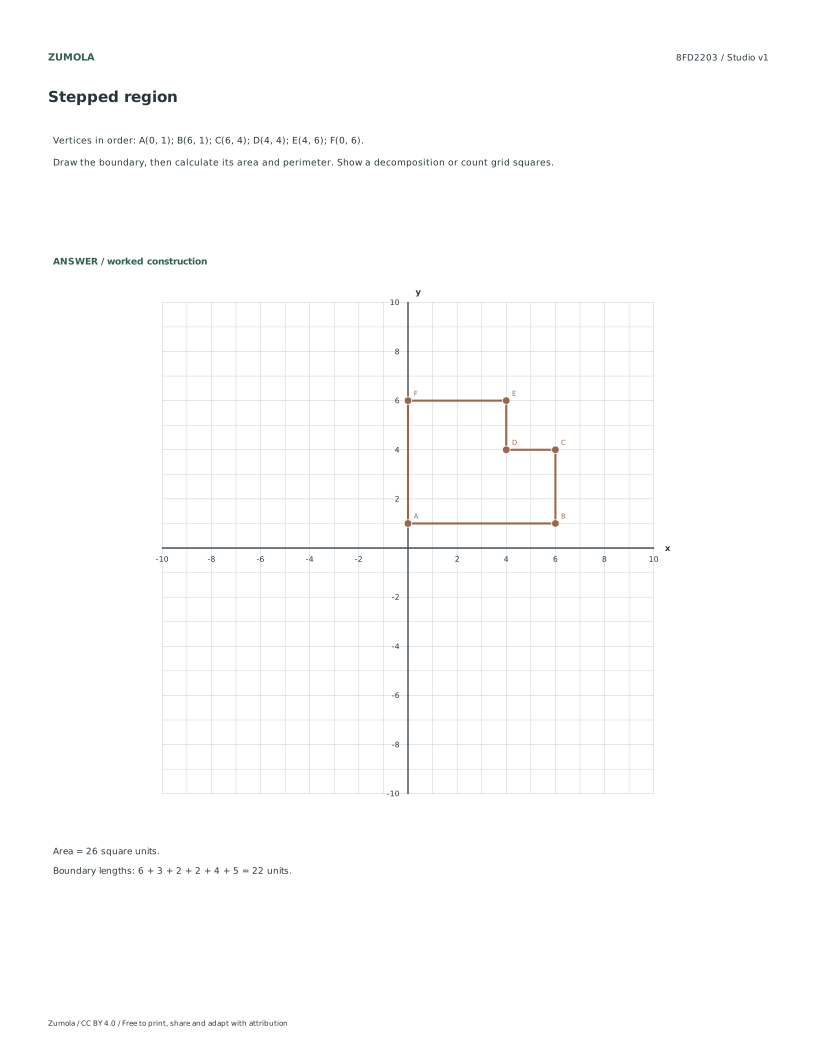
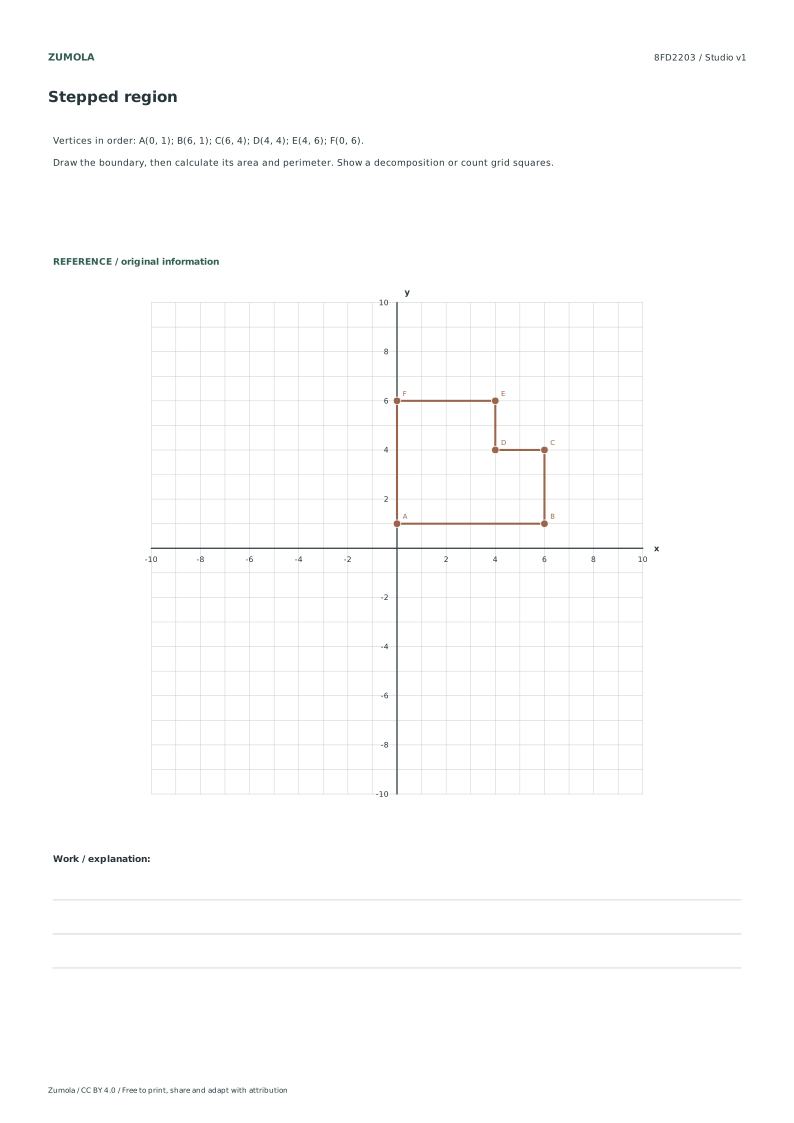
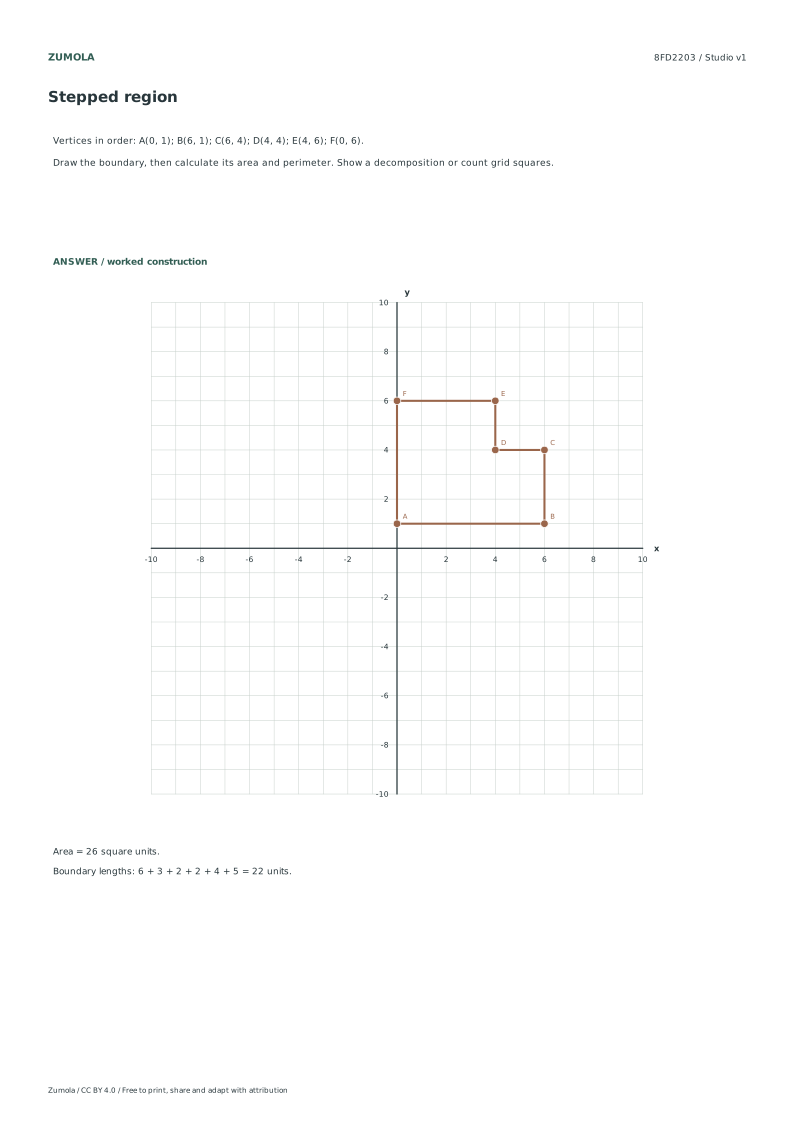
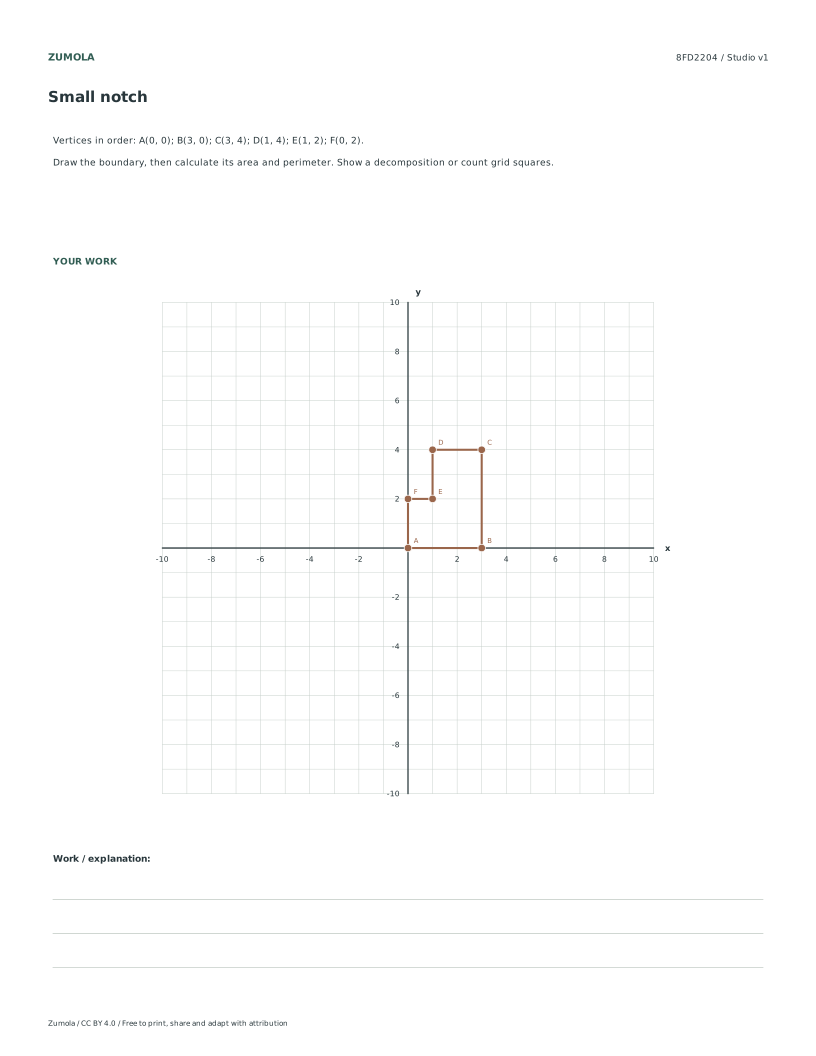
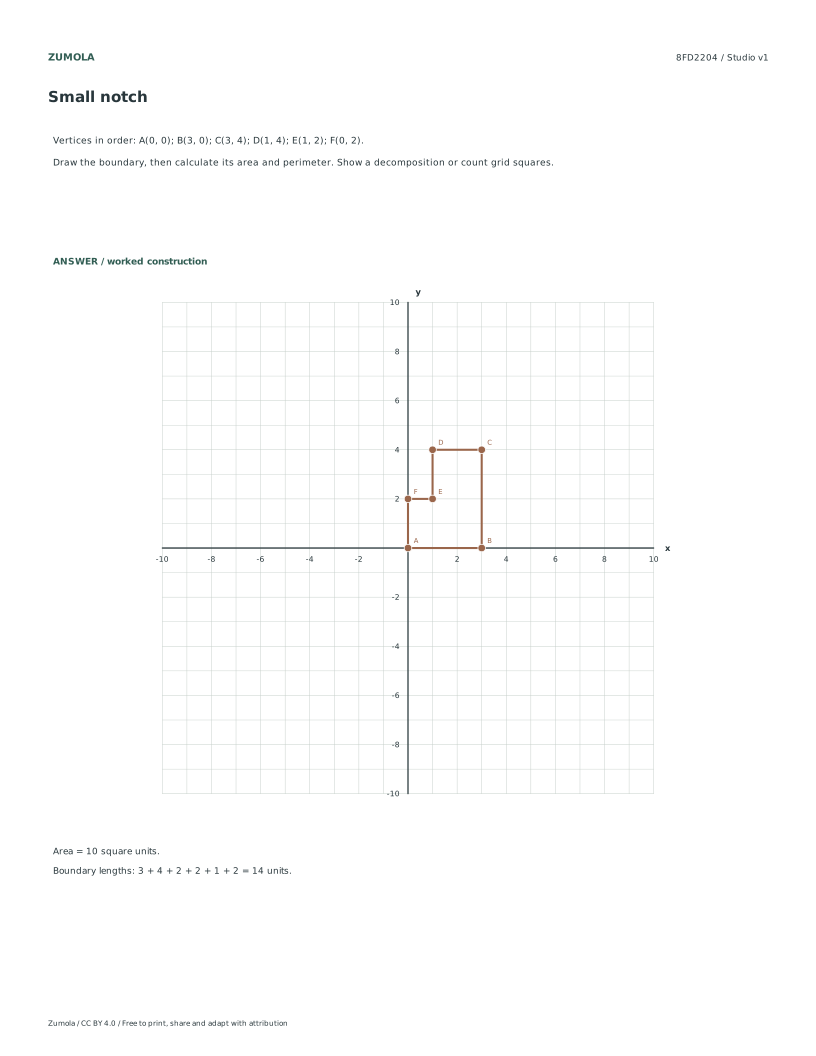
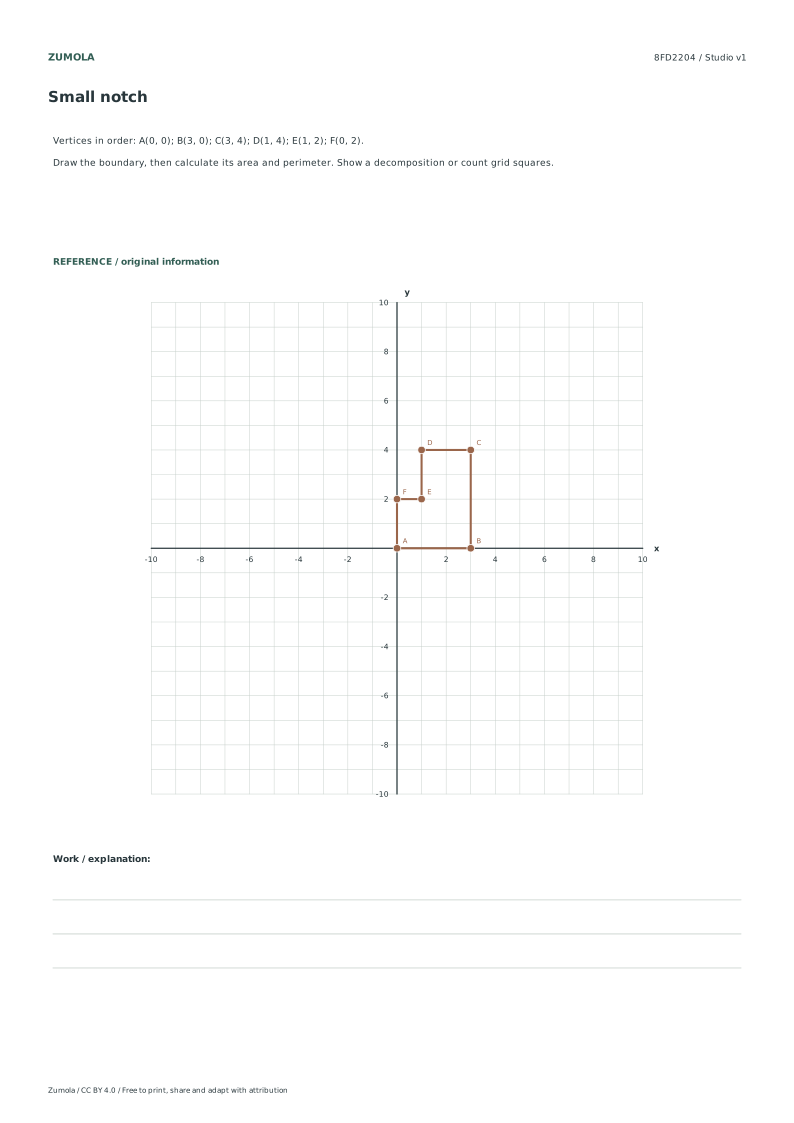
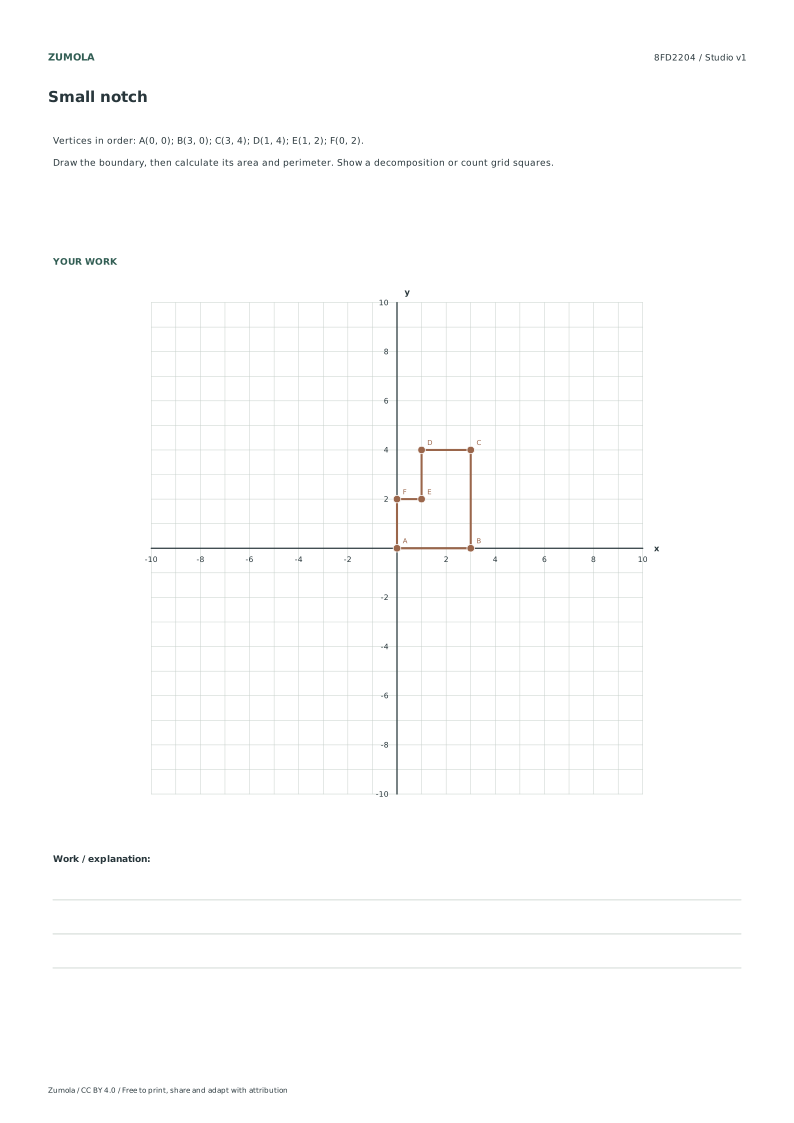
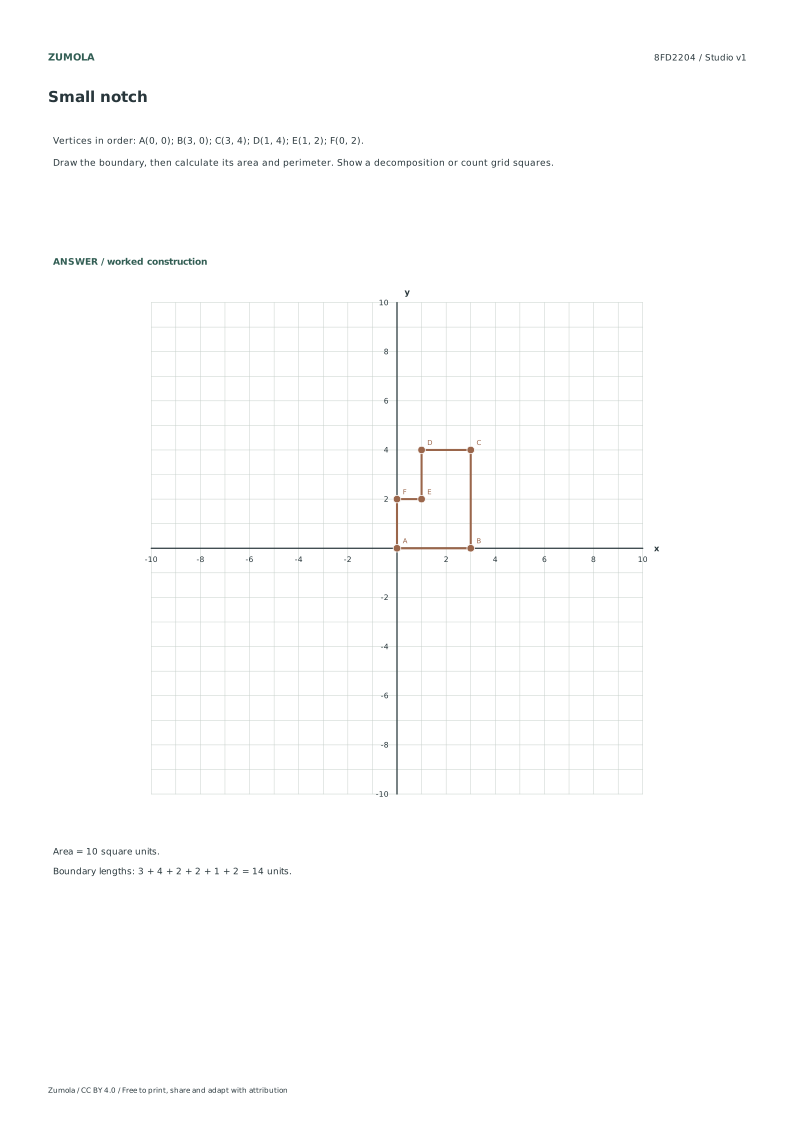
Split the shape into non-overlapping rectangles using the given vertices. For AP02, separate the 5-by-2 rectangle (area 10) and the 2-by-3 rectangle (area 6), giving 16 square units. For AP03, use a 6-by-3 rectangle (18) plus a 4-by-2 rectangle (8), totaling 26. For AP04, use a 3-by-2 rectangle (6) plus a 2-by-2 rectangle (4), totaling 10. Alternatively, count grid squares inside the boundary. Record each rectangle's dimensions and partial area before adding.
Add boundary lengths for perimeter
Perimeter is the sum of all outer side lengths, not the sum of rectangle areas. Measure each segment from the coordinates: horizontal length is the difference in x, vertical length is the difference in y. For AP01, add 5+3+5+3=16 units. For AP02, add 5+2+3+3+2+5=20 units. For AP03, add 6+3+2+2+4+5=22 units. For AP04, add 3+4+2+2+1+2=14 units. Write each length on the matching side before summing so no segment is counted twice or missed.
Checks that catch common errors
Watch for
Check instead
Counting interior decomposition lines as part of the perimeter.
Perimeter uses only the outer boundary segments. Interior lines used to split the shape into rectangles are not added to the perimeter sum.
Assuming equal slopes always mean the lines are parallel without checking intercepts.
Equal slopes with different intercepts give parallel lines. Equal slopes with equal intercepts describe the same line, not two parallel lines.
Using a slope product of 1 as the test for parallel lines.
A slope product of -1 tests perpendicularity. Parallel lines require equal slopes and distinct intercepts; a product of 1 is not the parallel criterion.
Keep labels and margins readable
Choose the PDF that matches your paper. Print at Actual size / 100% and turn off Fit, Shrink and browser headers. SVG is editable but an editor can rescale it; the PDF is the simpler print route.
Useful answers
How do I decide the order to connect the vertices?
Connect them in the order listed, then close the shape by joining the last vertex to the first. For AP01, that means A to B to C to D and back to A. Check that each segment is horizontal or vertical by comparing coordinates.
Can I count grid squares instead of decomposing into rectangles?
Yes. Count the full unit squares inside the boundary. For AP02 the count is 16, for AP03 it is 26, and for AP04 it is 10. Decomposing into rectangles gives the same totals and shows the arithmetic clearly.
Why is the perimeter not just the sum of the rectangle areas?
Area measures square units inside the shape, while perimeter measures linear units along the outer boundary. For AP01 the area is 15 square units but the perimeter is 16 units, found by adding the side lengths 5+3+5+3.
Are the answer files and editable graphs free?
Yes. The individual student, reference and answer files plus collection packs are free without signup. Credit Zumola under CC BY 4.0 when sharing or adapting.
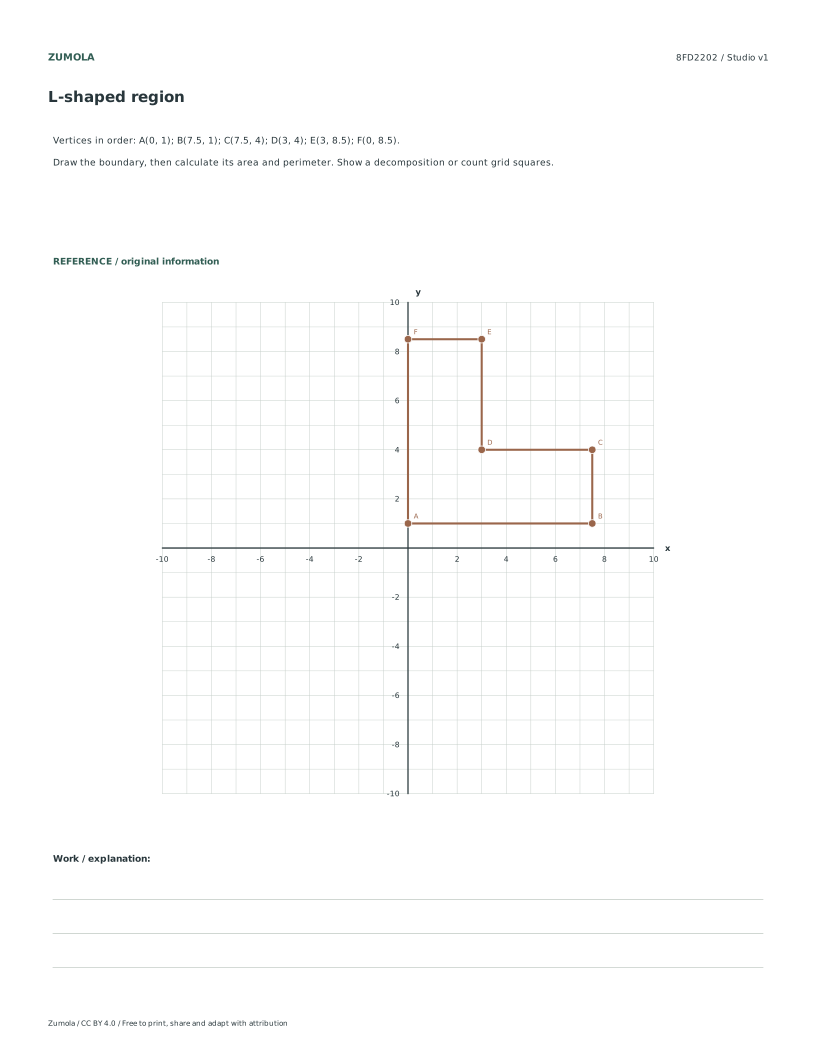
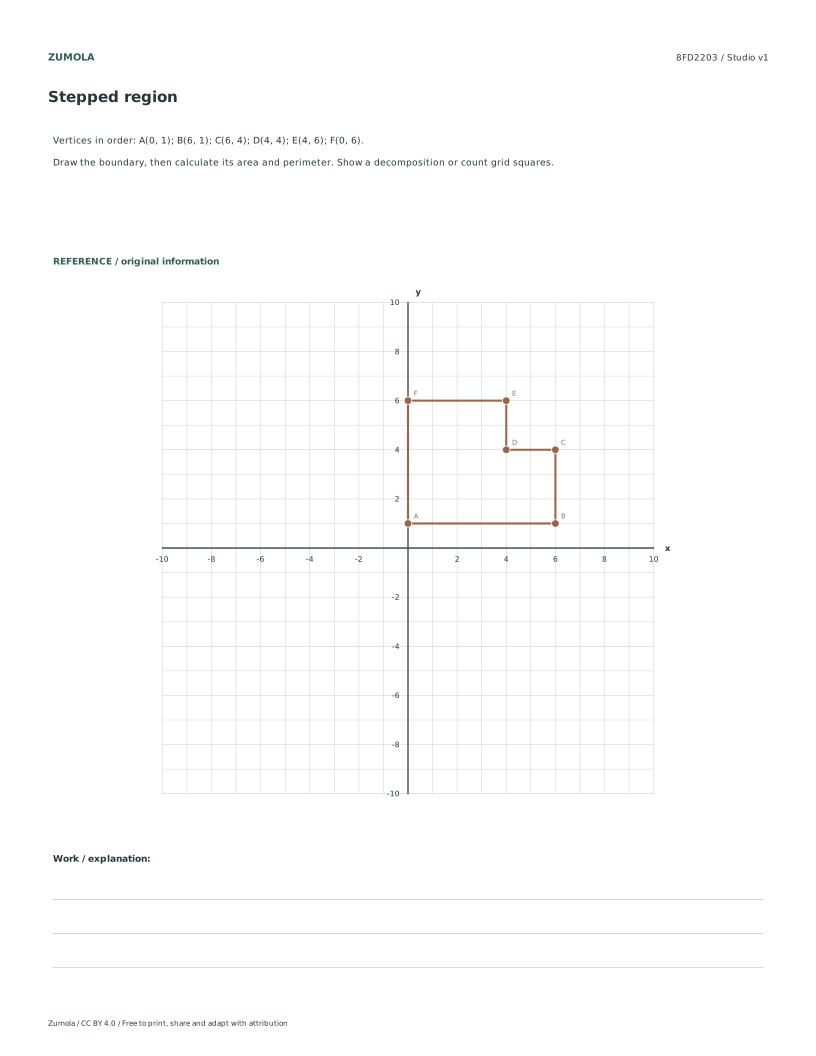
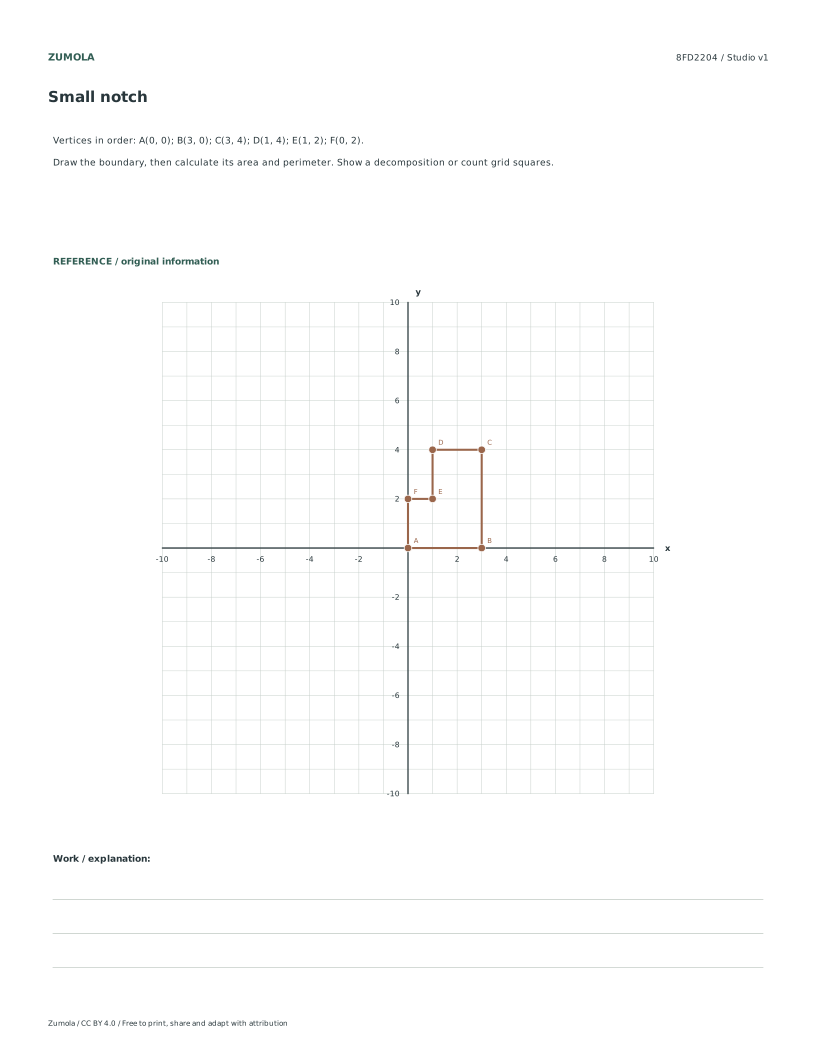
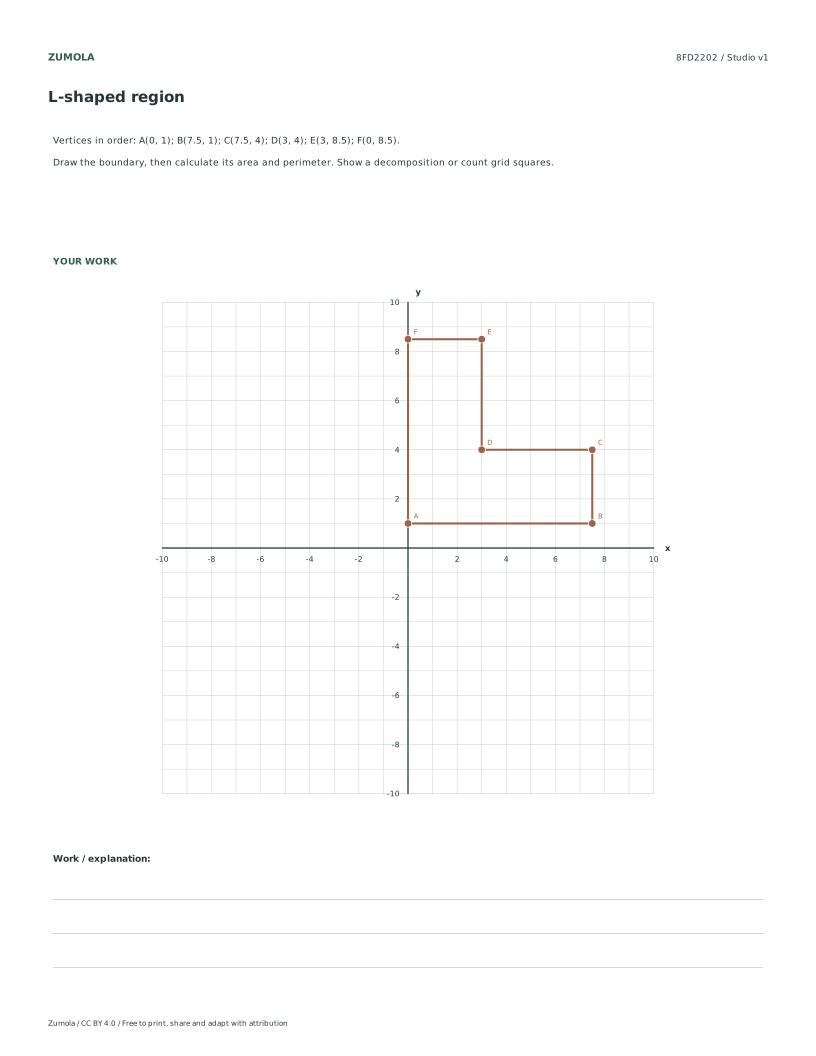
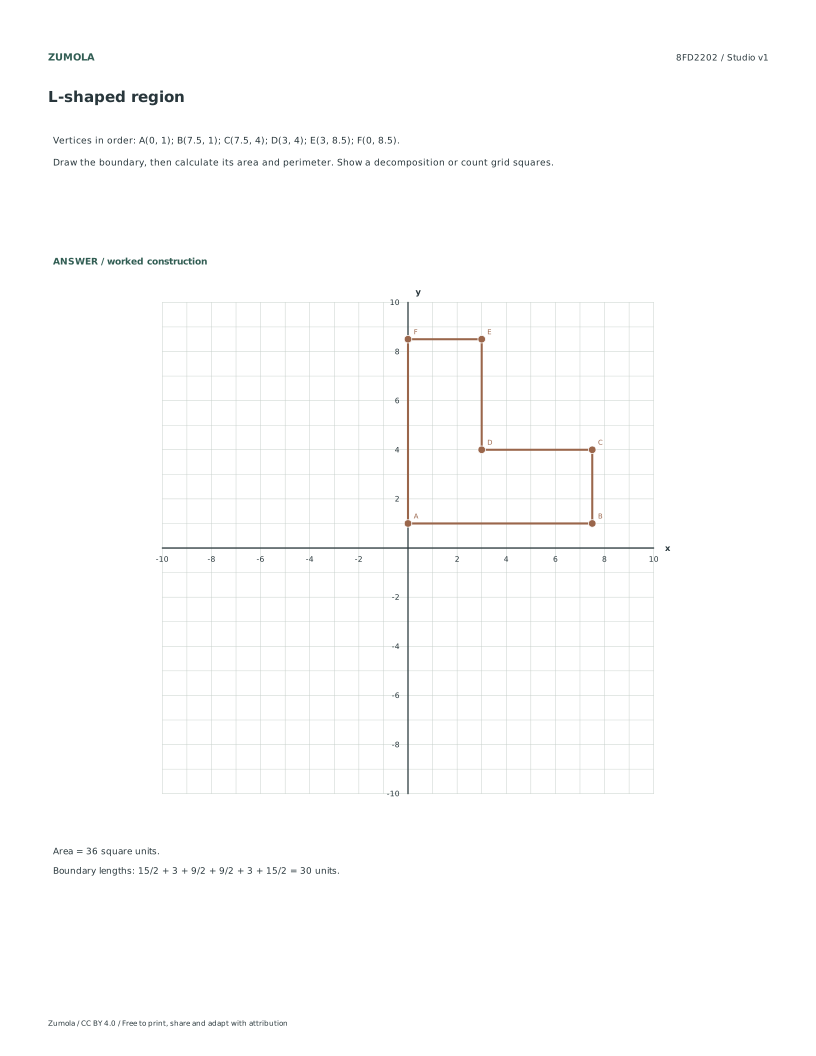
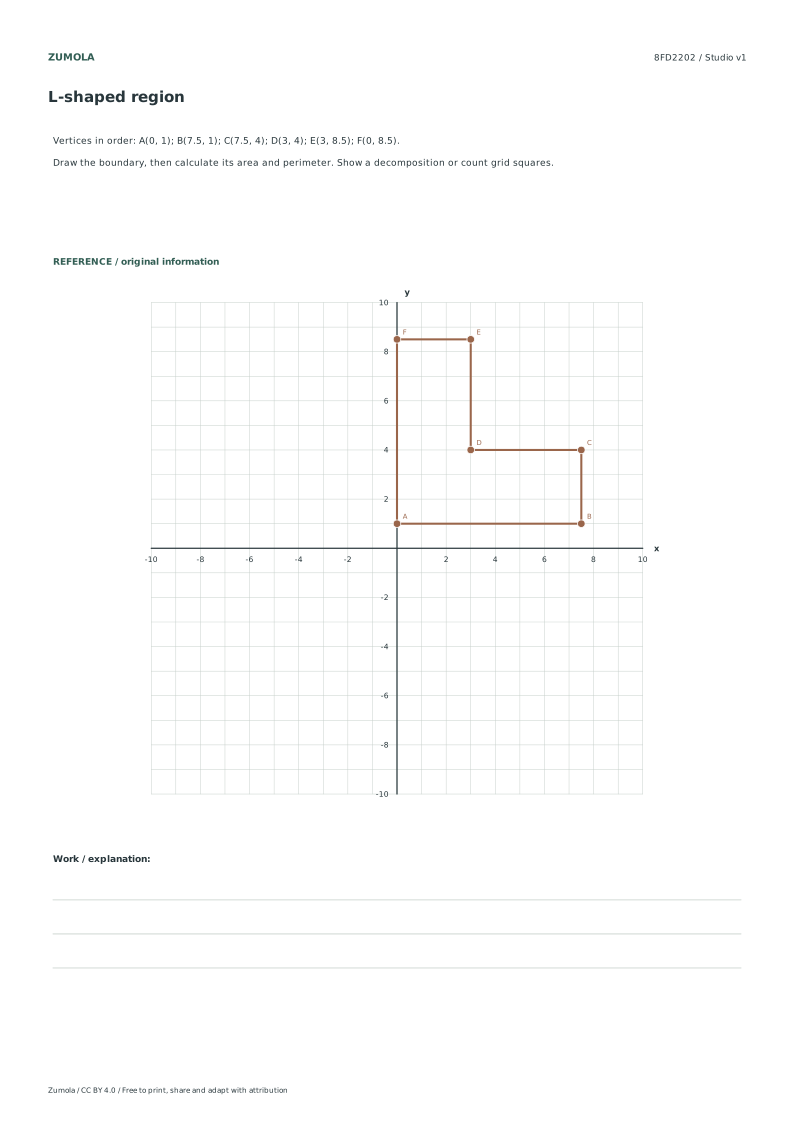
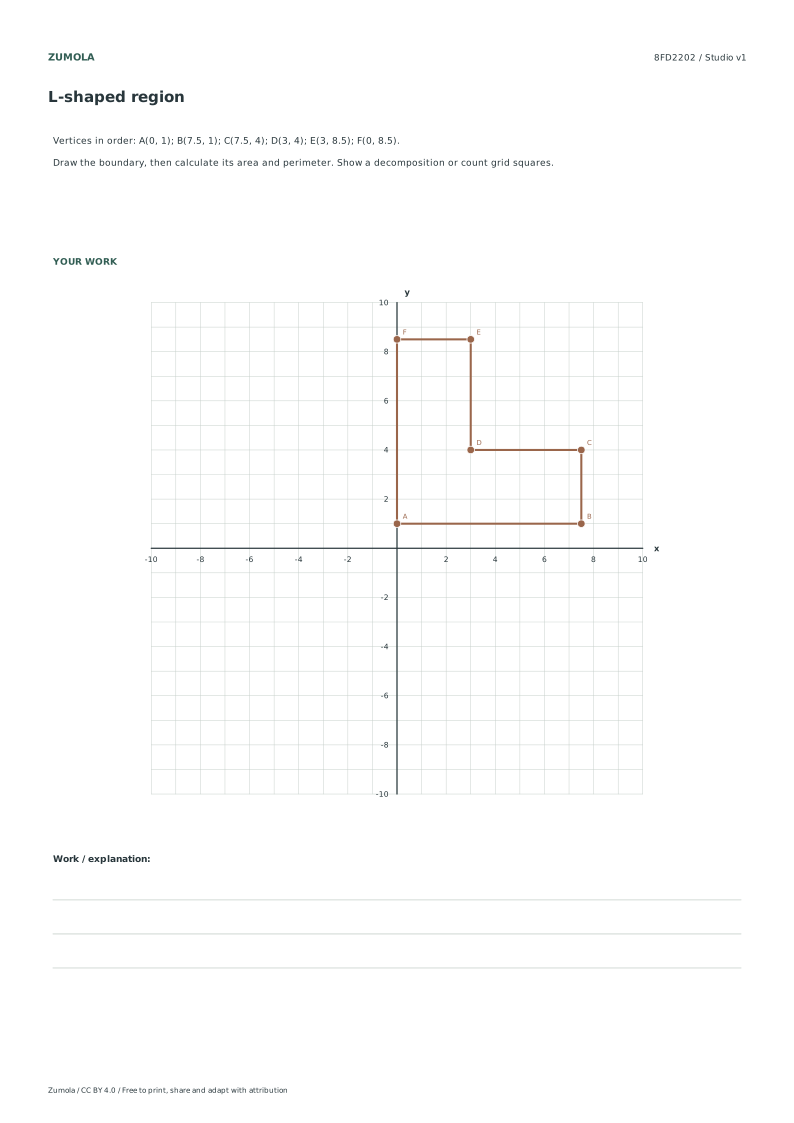
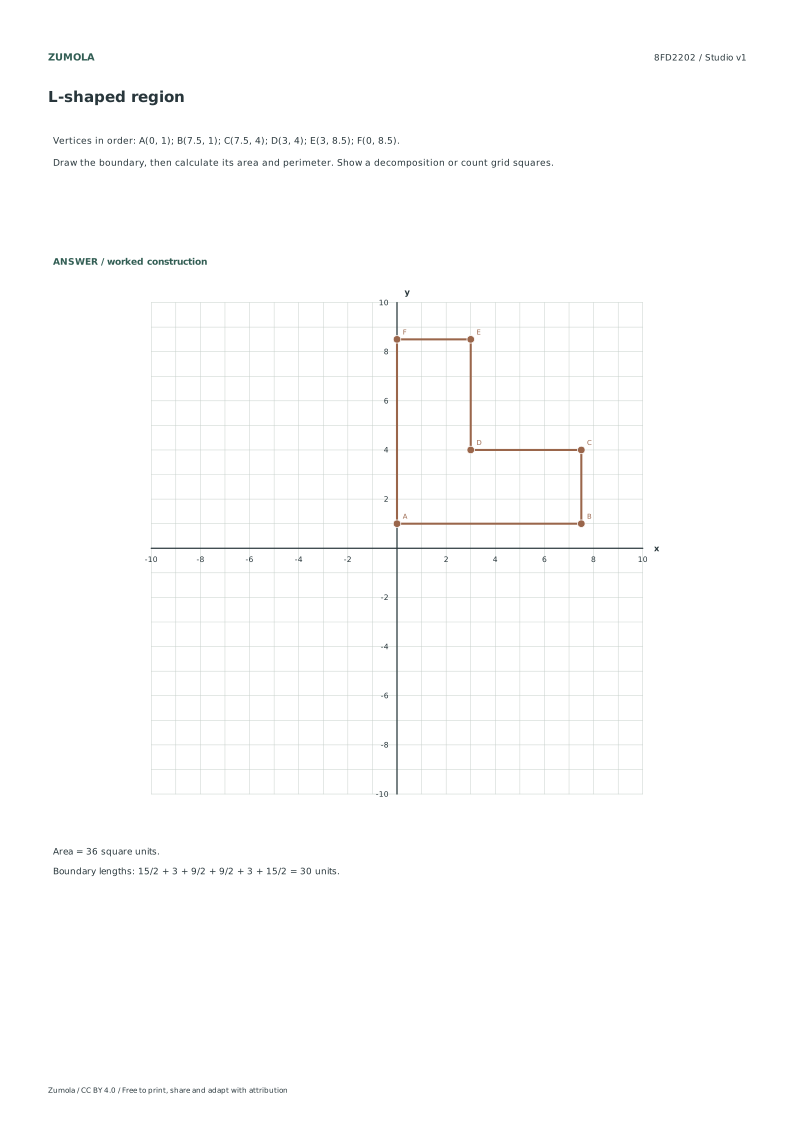
Plot each vertex in order and connect consecutive points to form the polygon. For case 8FD2201, vertices A(0, -1), B(5, -1), C(5, 2), D(0, 2) create a rectangle. After drawing, label each side length by counting grid units: AB is 5, BC is 3, CD is 5, DA is 3. This visual check prevents misreading coordinates. For irregular shapes like 8FD2202, mark each segment carefully; the boundary lengths are 15/2, 3, 9/2, 9/2, 3, and 15/2. Always verify that the drawn shape matches the given order before calculating.
The answer PDFs include the completed drawings and checks for all four cases. Free original resources, CC BY 4.0. No signup required.
More ways to practice
Turn vertices into a checkable record
List each vertex once, in order around the boundary, either clockwise or counterclockwise. Do not repeat the first vertex at the end unless you are applying a formula that requires a closing pair. For an orthogonal polygon on grid paper, every edge is horizontal or vertical, so each edge length is the difference between two coordinates along one axis.
The perimeter is the sum of those edge lengths, in grid units. The area can be checked by decomposing the polygon into rectangles, or by a coordinate formula. Both methods should agree; if they do not, the vertex order or a coordinate is wrong. Keep area in square units and perimeter in units, and state the grid spacing if one square is not one unit.
Write vertices in boundary order, for example (1,1), (5,1), (5,4), (1,4).
Compute each edge length from coordinate differences along one axis only.
Sum edge lengths for perimeter in units.
Check area by splitting into rectangles or by a coordinate formula.
Compare the coordinate result with the drawn outline before accepting the answer.
Worked coordinate case with a notch
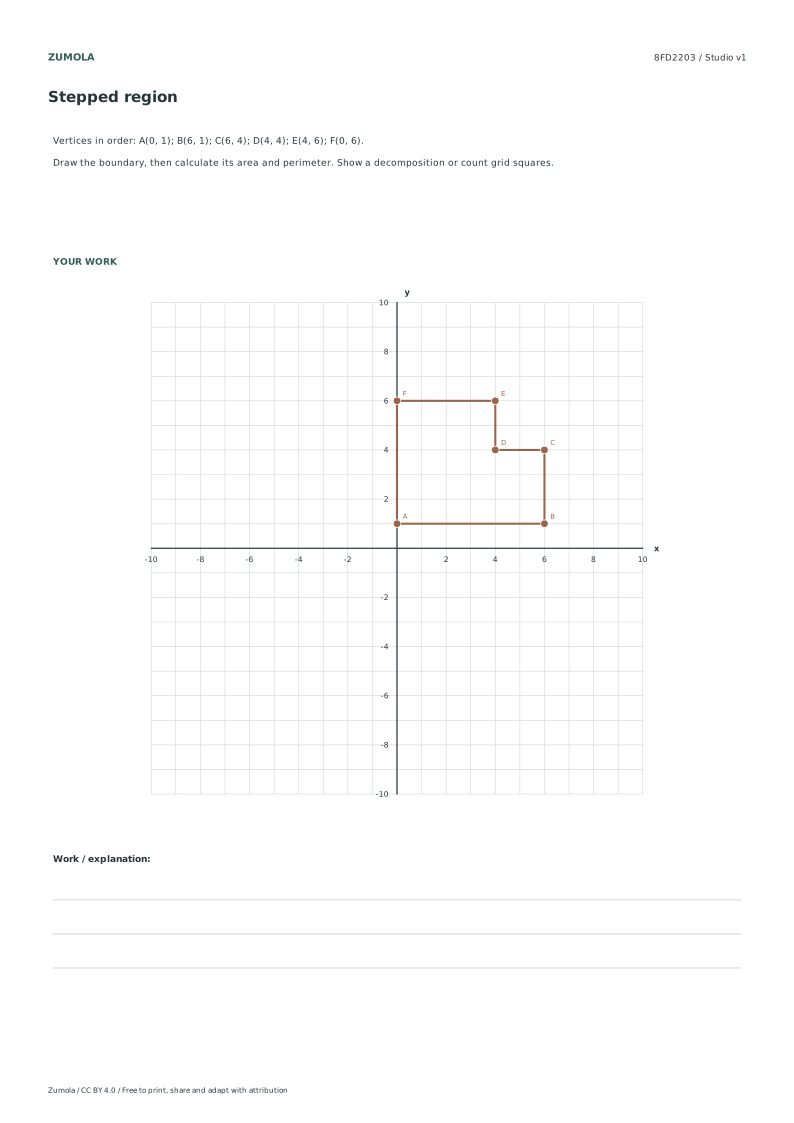
Consider a polygon with vertices (0,0), (6,0), (6,3), (4,3), (4,5), (0,5). Trace the boundary: bottom edge 6 units, right edge 3 units, inward edge 2 units, upward edge 2 units, top edge 4 units, left edge 5 units. The perimeter is 6 + 3 + 2 + 2 + 4 + 5 = 22 units.
For area, split into a 6 by 3 rectangle from y = 0 to y = 3 and a 4 by 2 rectangle from y = 3 to y = 5. Areas are 18 and 8 square units, total 26 square units. A coordinate formula should return the same 26; if it returns 22, the vertex order likely skipped or repeated a corner.
Mark each vertex on the grid and label it with its coordinate pair.
Check that consecutive vertices share exactly one coordinate for orthogonal edges.
Add edge lengths and record the perimeter with units.
Decompose into rectangles and add areas, or apply a coordinate formula.
Confirm the drawn shape matches the vertex list before finalising.
Diagnostic checks for coordinate drawings
A common error is mixing grid squares with centimetres when the grid spacing is not one centimetre. State the unit per square at the top of the sheet. Another error is listing vertices in a non-boundary order, which produces crossing edges and an unreliable area.
Check closure: the last vertex should connect back to the first with a single edge. Check that no edge passes through another vertex unless the polygon is explicitly self-touching. For slanted edges, length is not a simple coordinate difference; use the distance formula and keep the result in the same unit as the grid.
Confirm unit per grid square is written on the sheet.
Verify vertex order follows the boundary without crossing.
Check closure from last vertex to first.
For slanted edges, compute length with the distance formula.
Recompute area by a second method and compare.
Try this example
A polygon has vertices (0,0), (6,0), (6,3), (4,3), (4,5), (0,5) on a grid where one square is one unit. Find perimeter and area.
Show the worked explanation
Edges: 6, 3, 2, 2, 4, 5 units, so perimeter is 22 units. Split into a 6 by 3 rectangle (18 square units) and a 4 by 2 rectangle (8 square units), giving 26 square units. A coordinate formula should also return 26; a mismatch signals a vertex-order or coordinate error.
Common mistakes
Listing vertices in an order that crosses edges. Re-order vertices by walking around the boundary once and checking each consecutive pair shares an edge.
Reporting area in units or perimeter in square units. Label area as square units and perimeter as units, and state the grid spacing used.
Using coordinate differences for slanted edges. Use the distance formula for any edge that is not horizontal or vertical, and keep the same unit throughout.
Check your work
Vertices are listed in boundary order without crossing edges.
Perimeter is the sum of edge lengths in units.
Area is reported in square units and checked by two methods.
Grid spacing and unit per square are stated.
Slanted edges use the distance formula, not coordinate differences.
The drawn outline matches the vertex list before the answer is accepted.
Questions before you start
Can I check area without a formula?
Yes. Split an orthogonal polygon into rectangles, add their areas, and compare with a coordinate method. Both should agree.
What if one grid square is not one unit?
Multiply lengths by the grid spacing and areas by the square of the spacing, then state the unit clearly on the sheet.
How do I know the vertex list is complete?
Walk the boundary once; every corner should appear exactly once, and the last vertex should connect back to the first.
Optional Google Analytics helps us understand which free resources are useful. It is off until you allow it. Drawing tools and downloads work with either choice. Privacy details