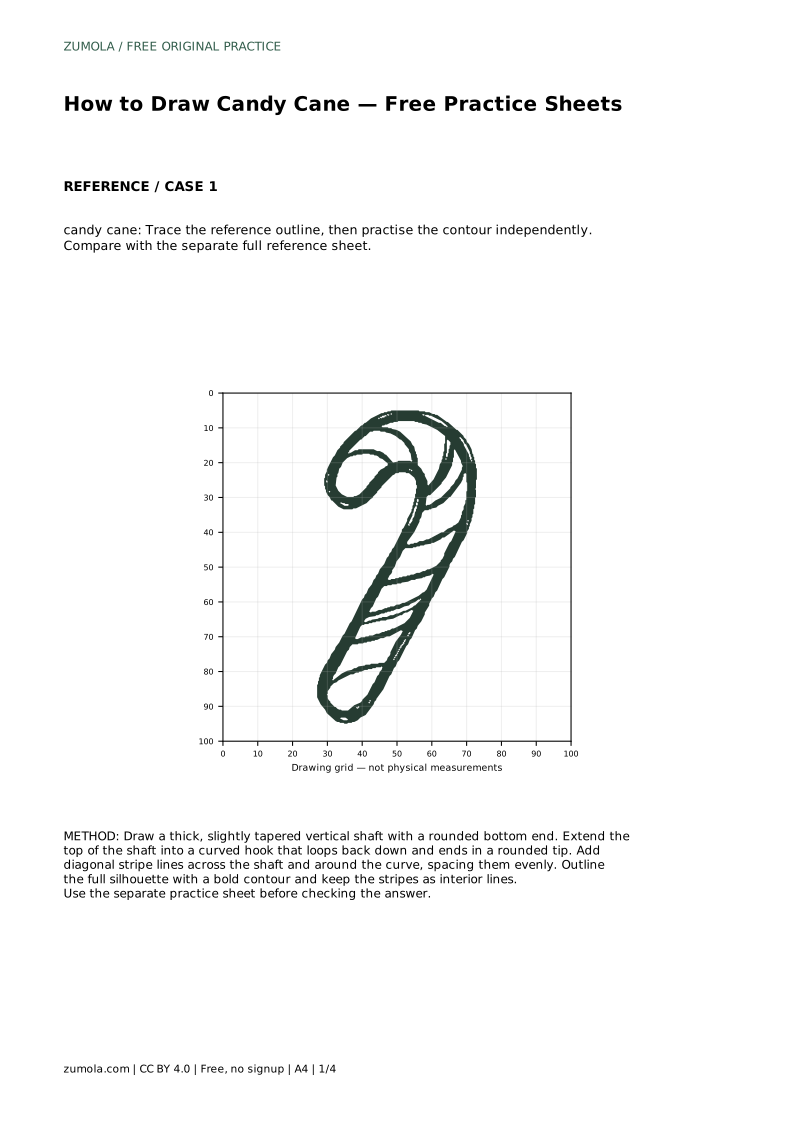
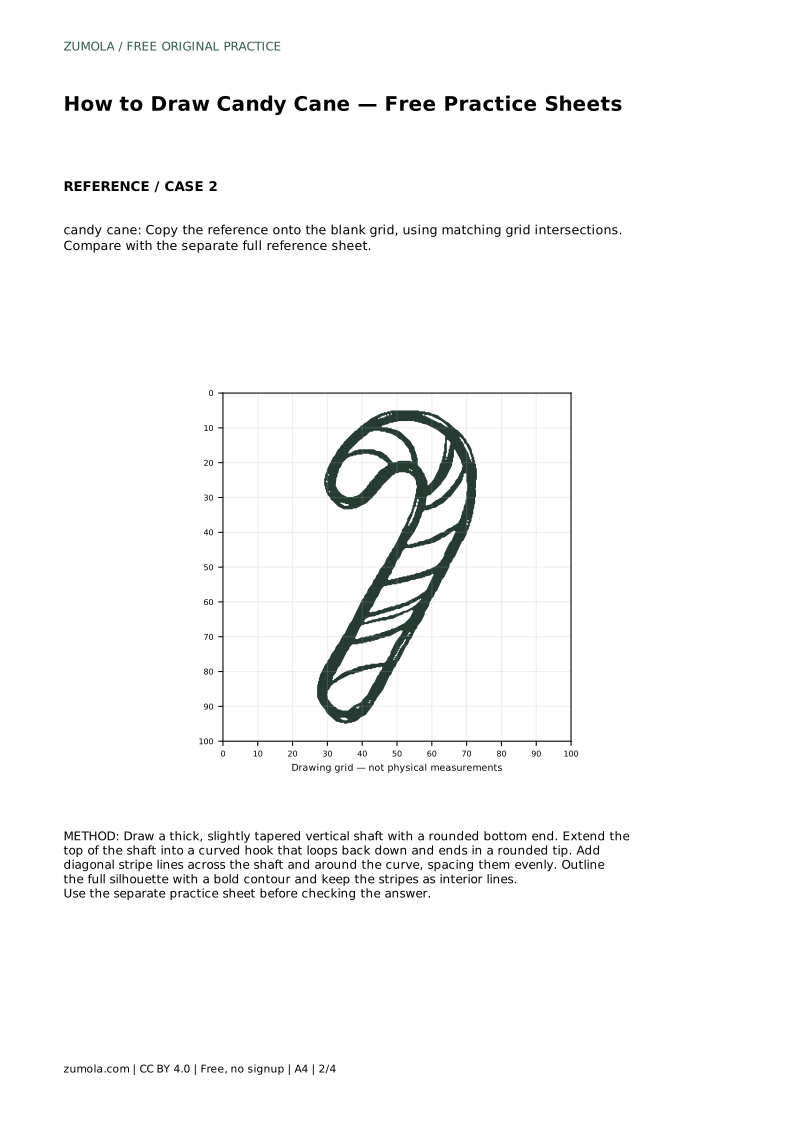
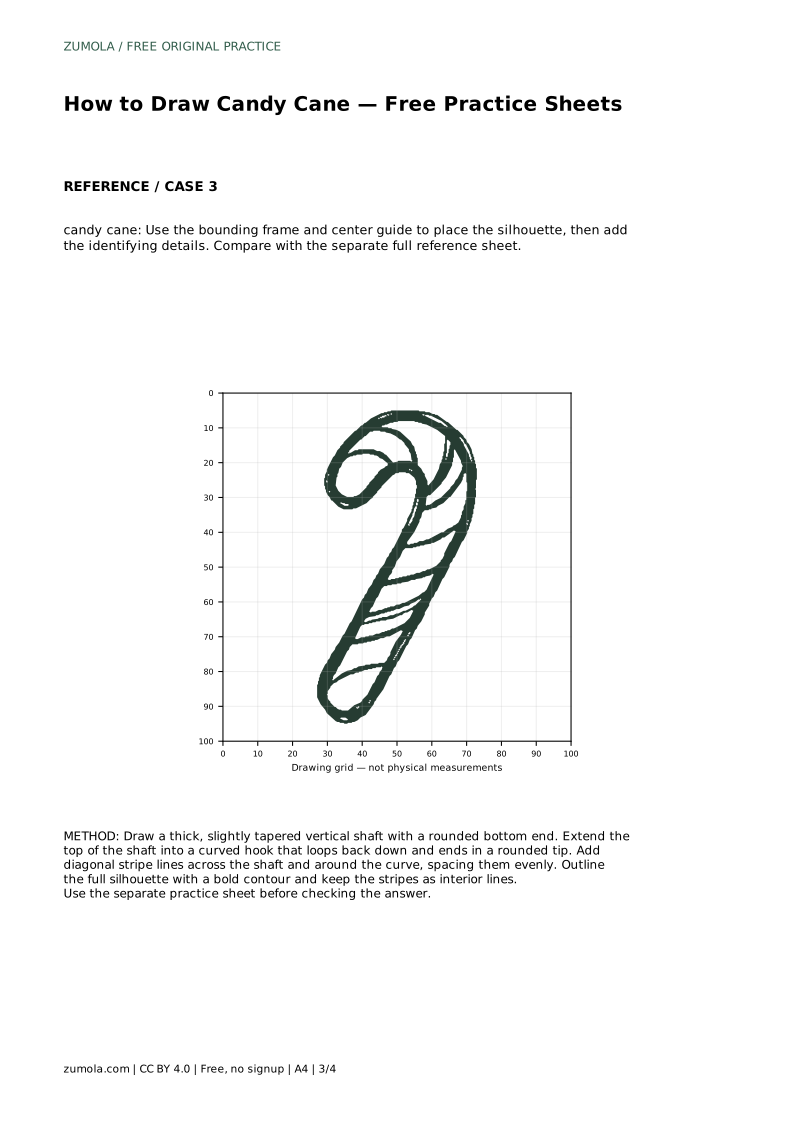
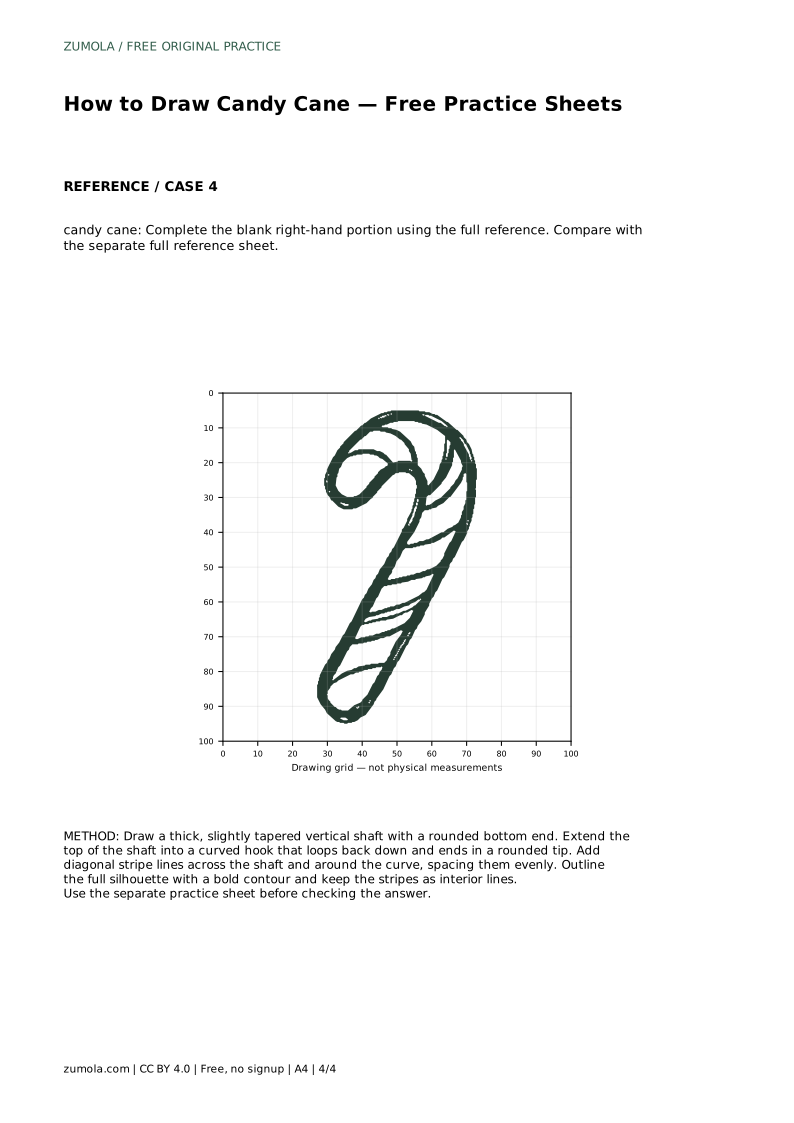
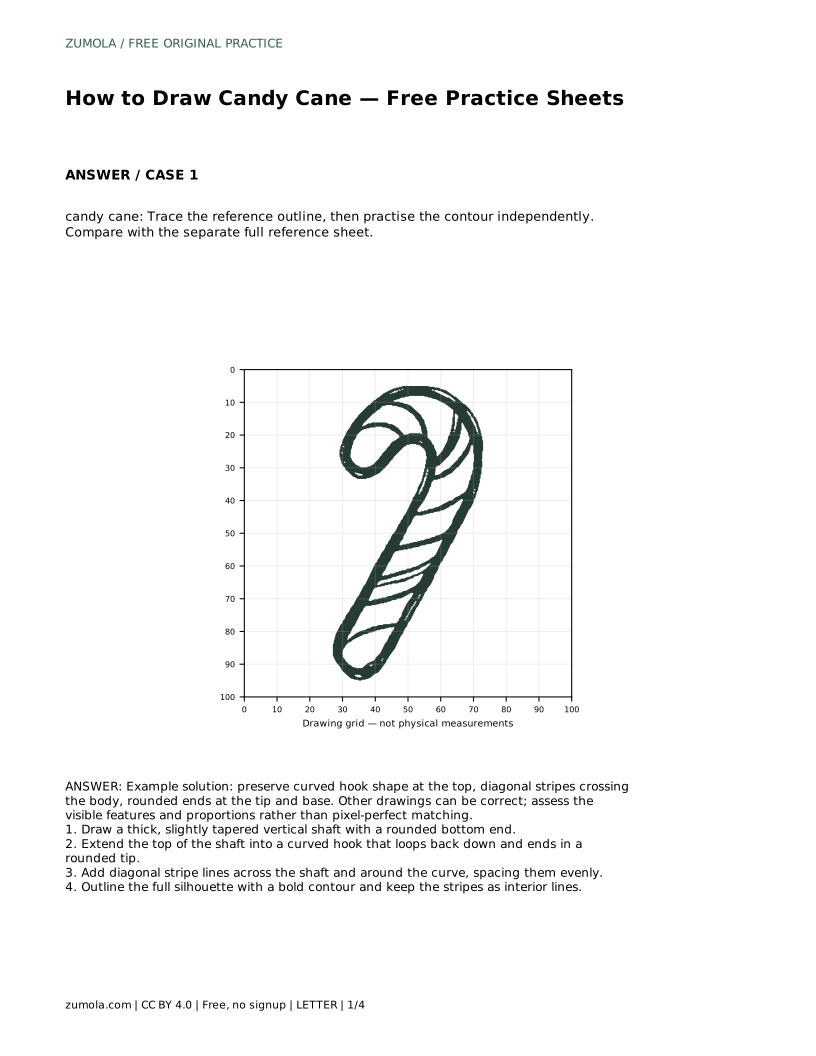
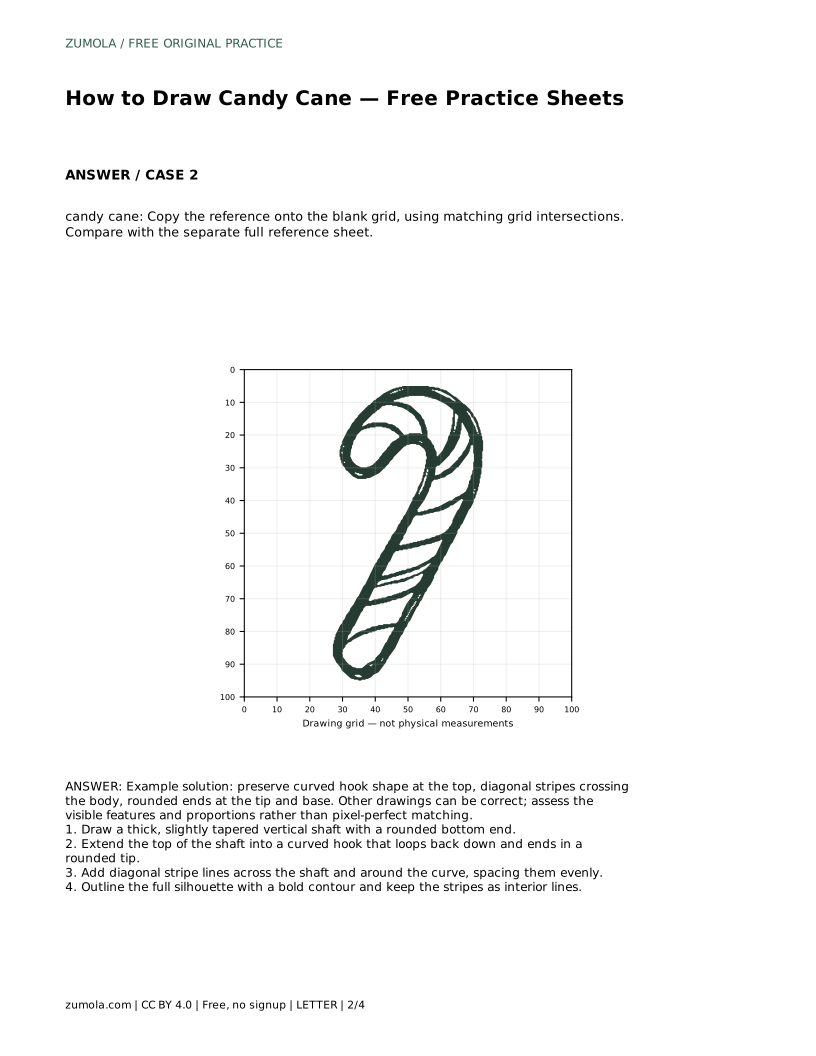
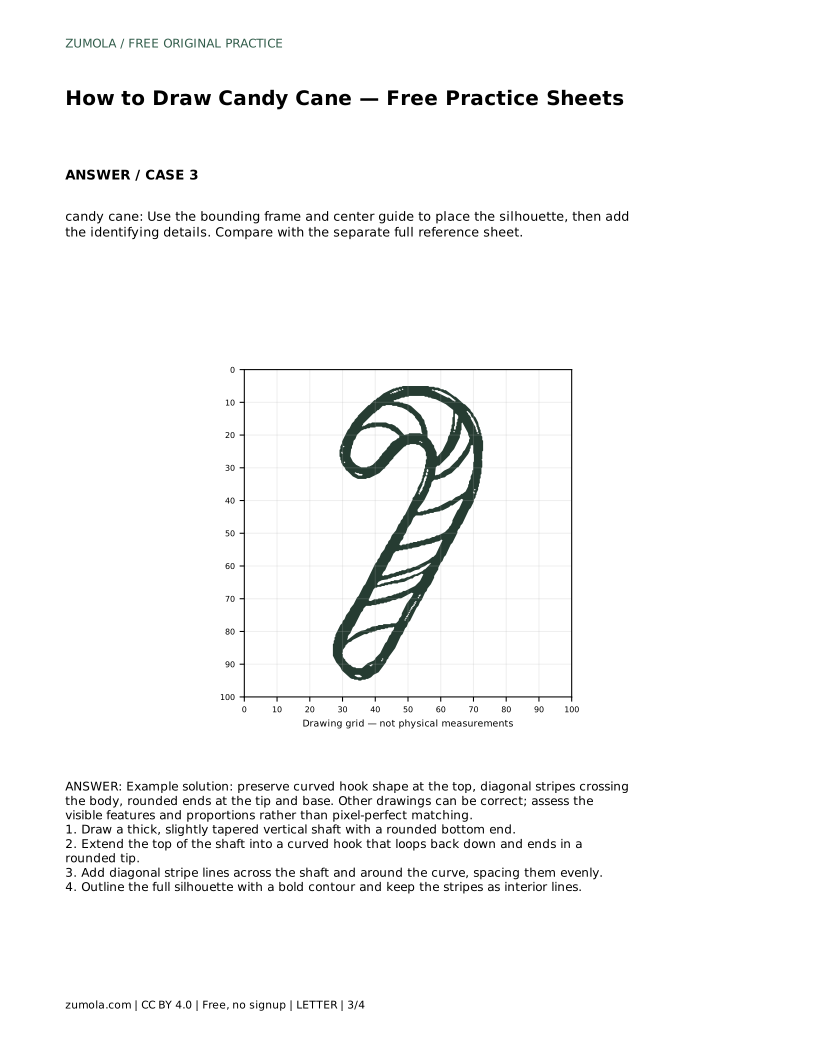
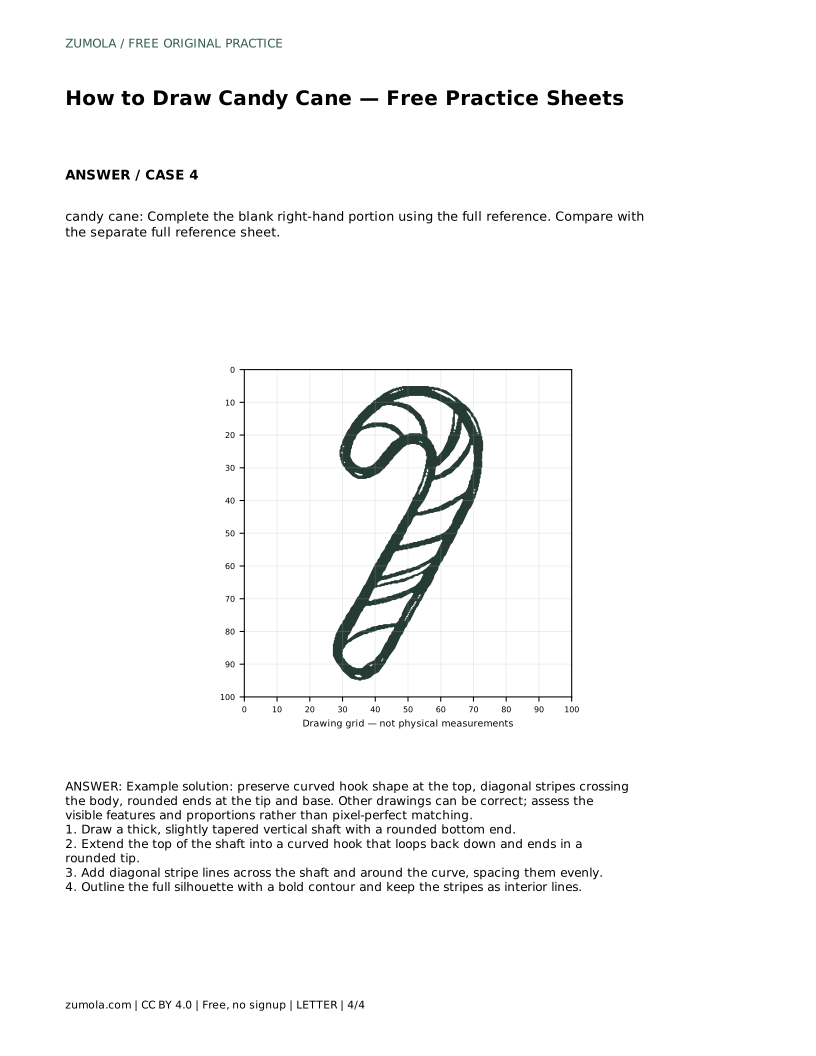
Reference diagrams
LETTER · Download PDF
A4 · Download PDF
Free original resources
Learn to draw a candy cane with a tapered shaft, curved hook, rounded ends, and evenly spaced diagonal stripes. Free printable practice sheets support each stage.
Four original cases, with reference diagrams, practice sheets and worked answers. Everything is free; no signup required.
LETTER · Download PDF
A4 · Download PDF
LETTER · Download PDF
A4 · Download PDF
LETTER · Download PDF
A4 · Download PDF
Use A4 or US Letter to match your printer. Use the stated values and conditions to solve each exercise; diagrams are not physical measuring rulers.
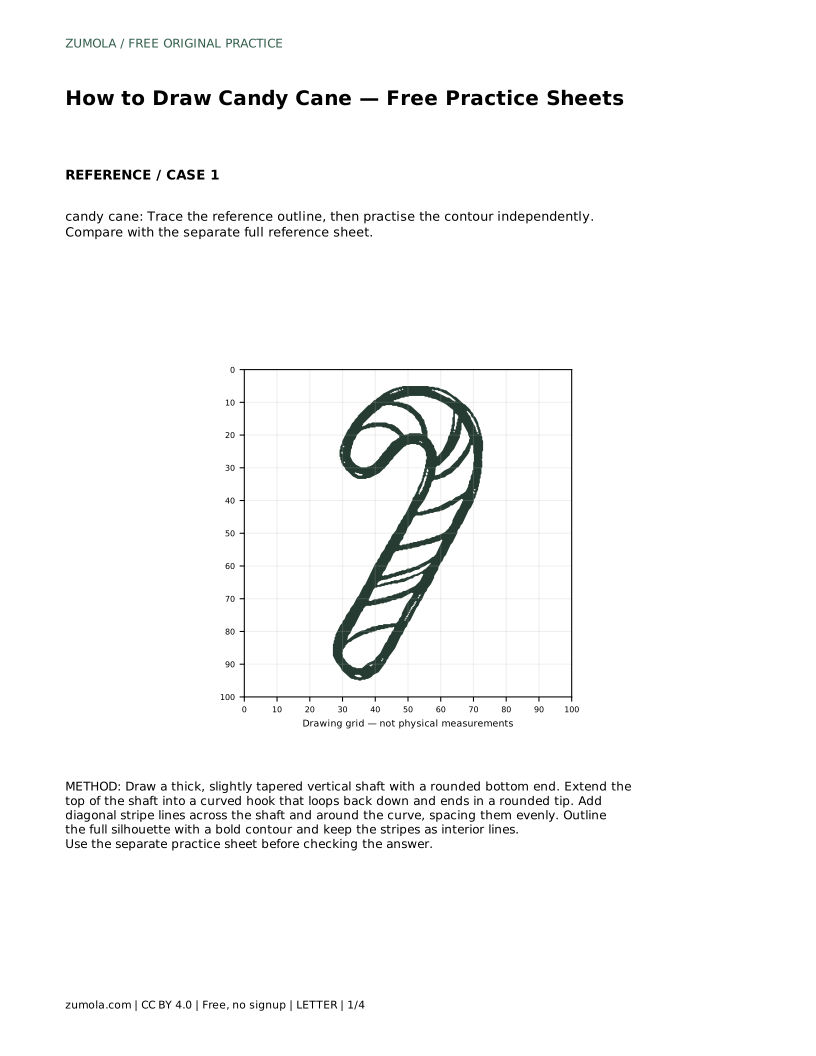
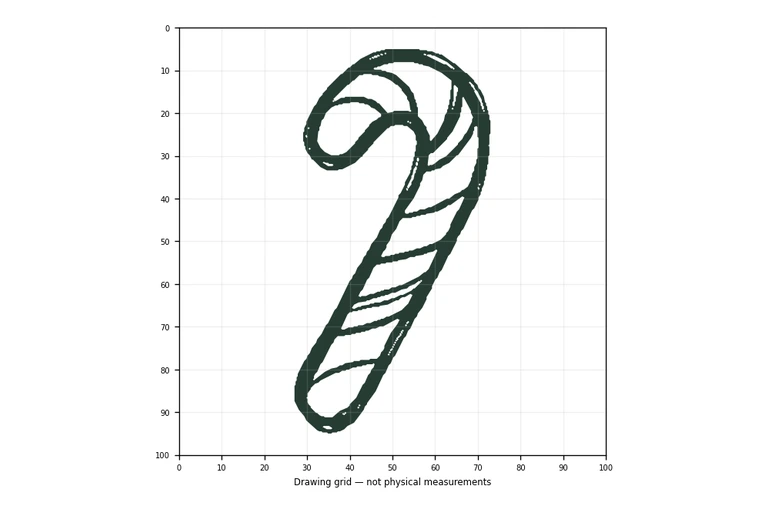
A candy cane is a simple shape with a few demanding details: the shaft tapers slightly, the hook curves smoothly, both ends are rounded, and the stripes cross the body at a consistent diagonal. This page explains how to build that shape in stages, then use the free practice sheets to trace, copy onto a grid, place within a guide frame, or complete a partial drawing. Each sheet asks you to compare your work with the separate full reference sheet, so you can judge proportion and placement rather than chase a pixel-perfect match.
Start with the body before any stripes. Draw a thick, slightly tapered vertical shaft with a rounded bottom end. The taper should be gentle: the shaft is a little narrower near the hook than at the base, but it should not look like a cone. Keep both sides of the shaft roughly parallel in direction, even as the width changes.
From the top of the shaft, extend a curved hook that loops back down and ends in a rounded tip. Treat the hook as a continuation of the same thickness, not a separate tube attached at the top. The curve should turn smoothly and consistently, with no sharp corner where the shaft meets the hook. Check that the tip points downward and sits clear of the shaft, leaving a visible gap.
Stripes are interior lines, not part of the outline. Add diagonal stripe lines across the shaft and around the curve, spacing them evenly. On the straight shaft, the stripes run at a consistent angle. As they pass around the hook, they bend with the curve so they still read as bands wrapping the cane rather than flat marks on the page.
Keep the spacing between neighbouring stripes similar along the whole cane. A common problem is crowding stripes near the base and stretching them near the hook. Step back and compare the gaps: if one gap is much wider than the others, adjust it before adding the bold contour.
Outline the full silhouette with a bold contour and keep the stripes as interior lines. The outer edge should read as one continuous shape from the rounded base, up the shaft, around the hook, and to the rounded tip. Do not let stripe lines break through the contour or turn into part of the outline.
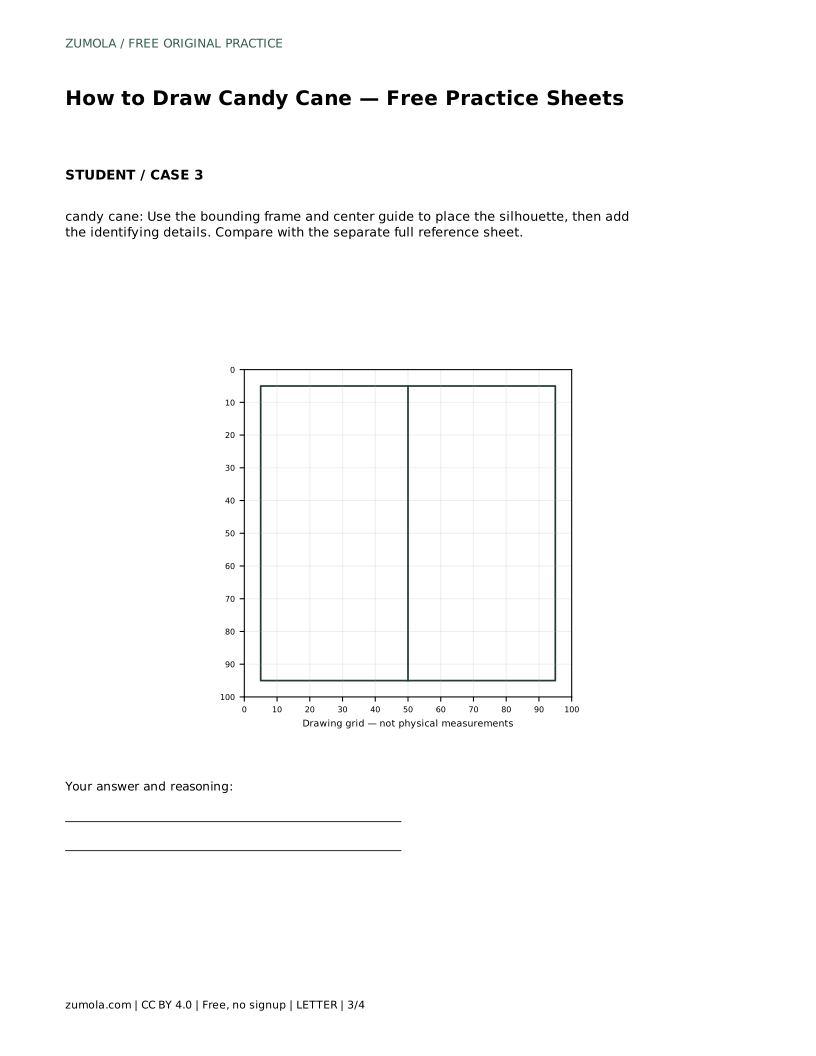
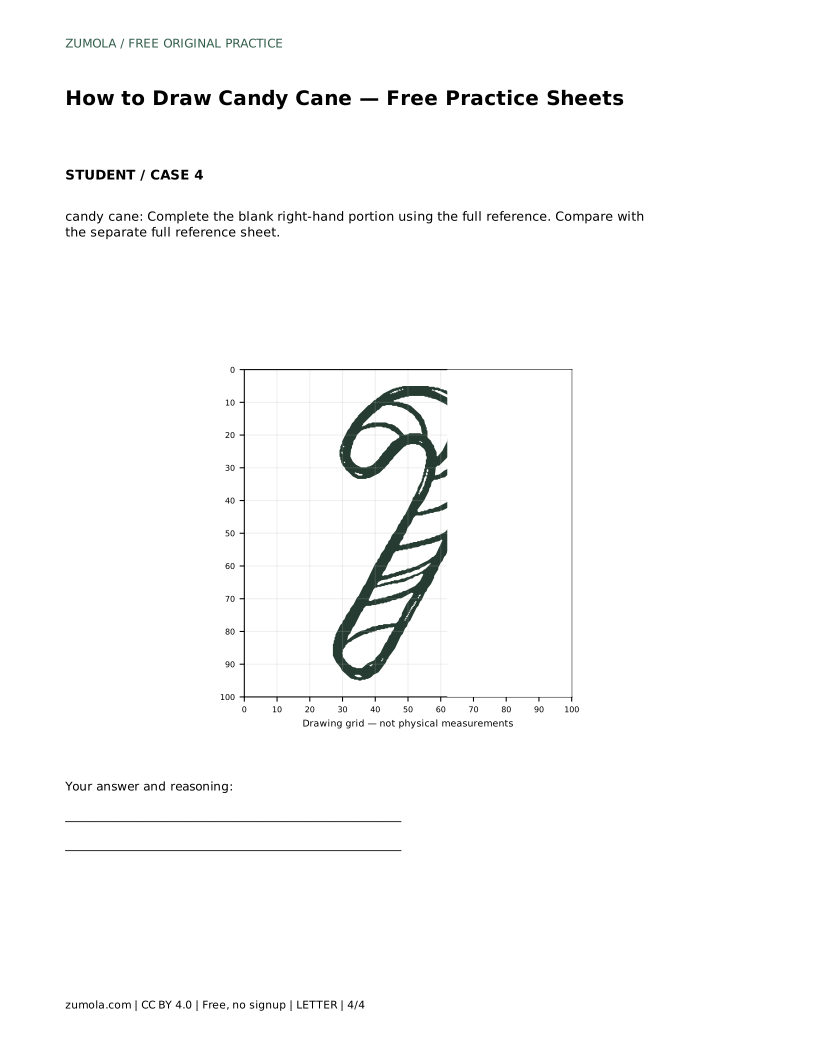
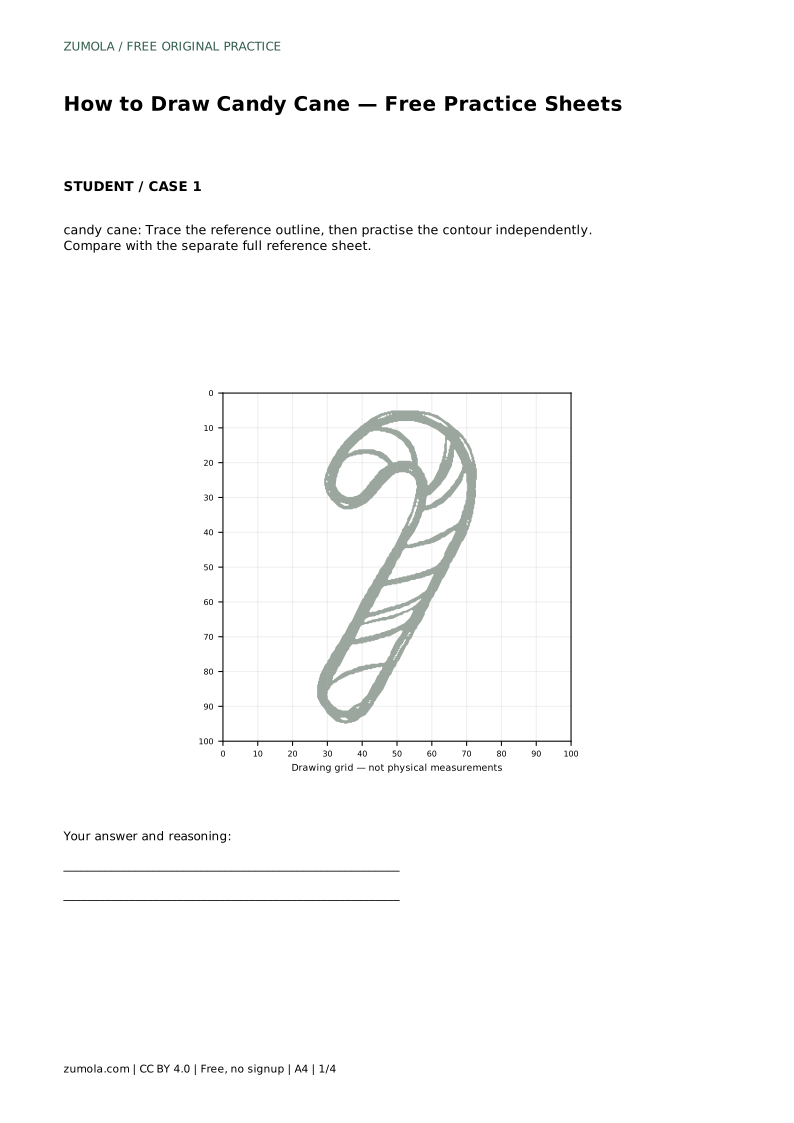
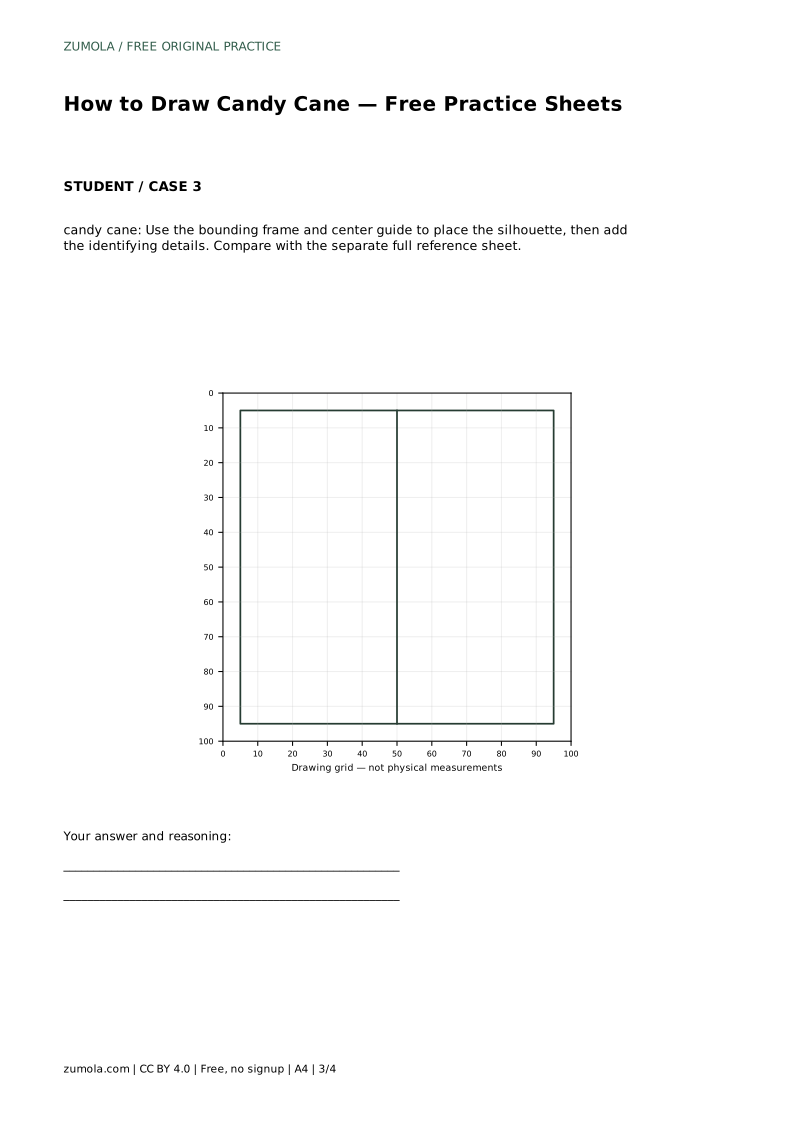
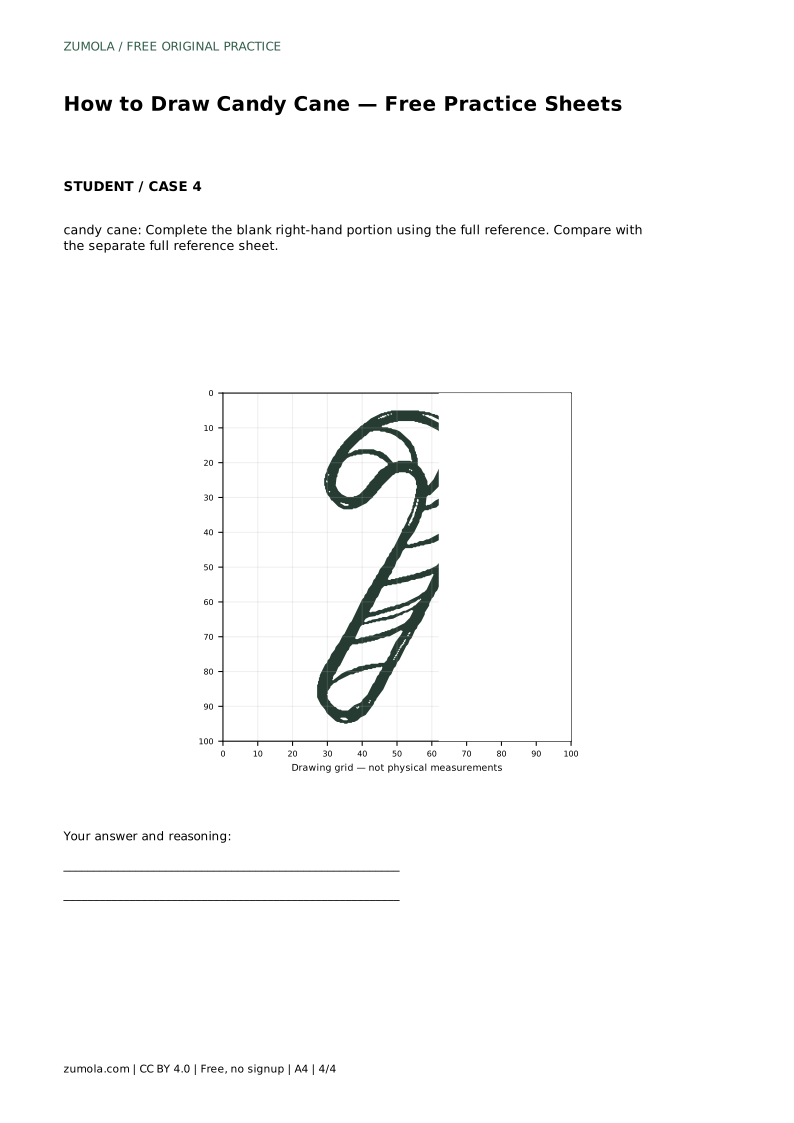
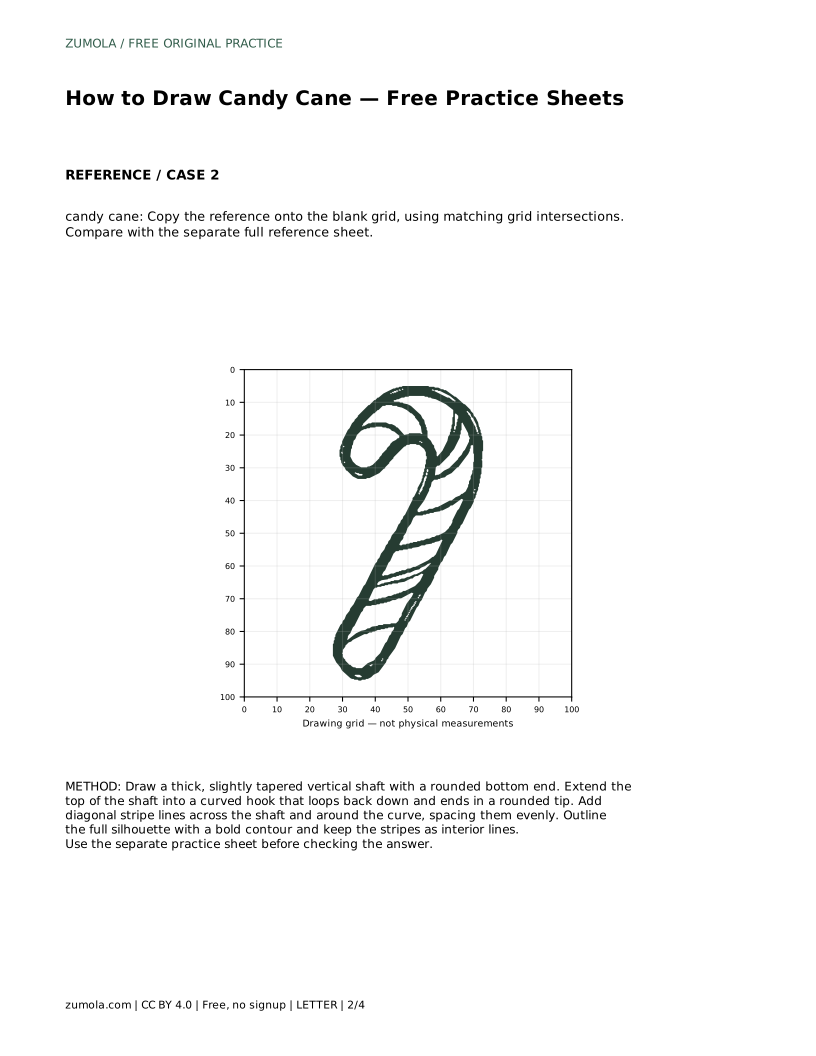
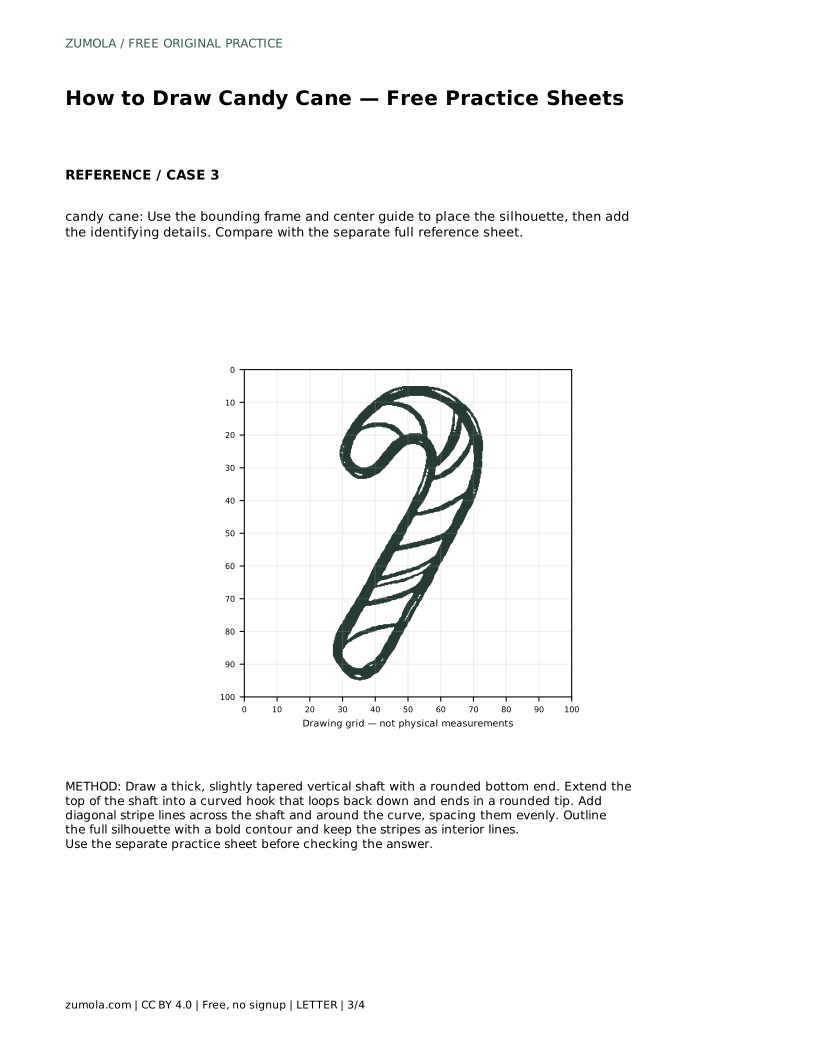
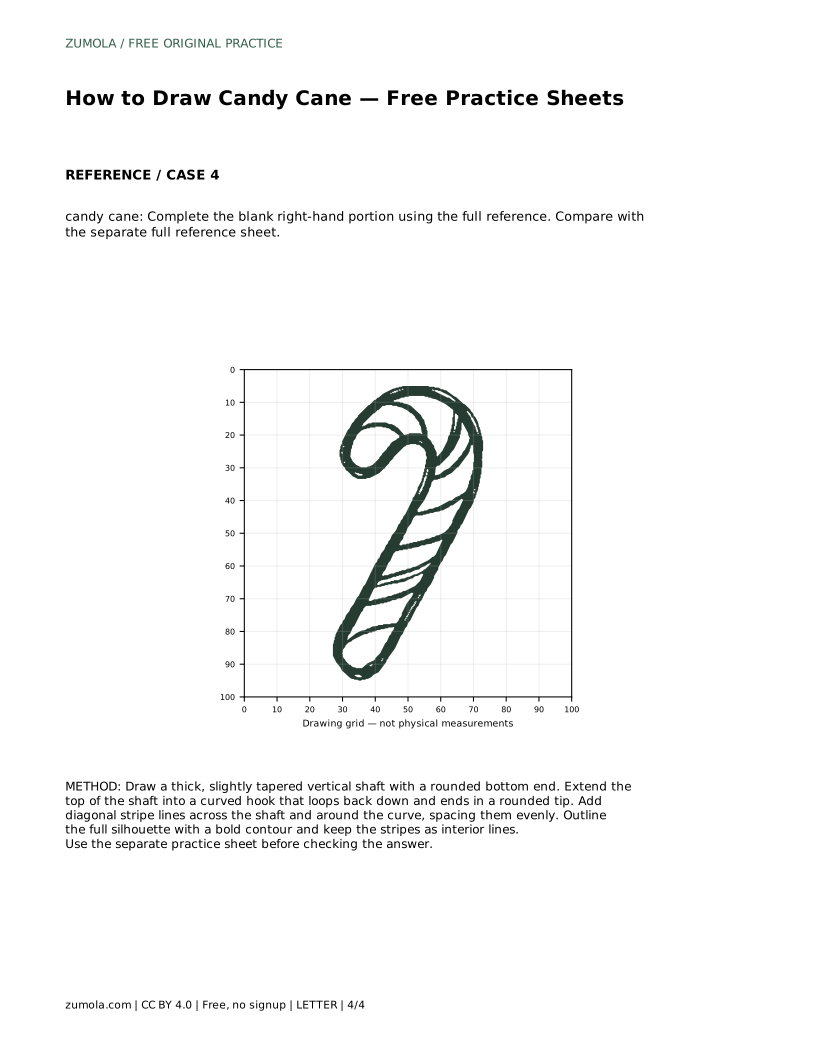
When you use a practice sheet, work in the order the sheet supports. Tracing helps you feel the contour; the grid version asks you to match intersections; the guide frame helps you place the silhouette before adding details; the partial sheet asks you to complete the blank right-hand portion using the full reference. In every case, compare with the separate full reference sheet at the end.
A candy cane drawing has more than one valid outcome. Two drawings can both be correct while differing in hook size, stripe angle, or shaft width. Judge the features that make the object recognisable: a curved hook at the top, diagonal stripes crossing the body, and rounded ends at the tip and base. Then judge proportion: does the hook look balanced against the shaft, and are the stripes spaced consistently?
Use the rubric below as a checklist. It separates the identifying features from the finishing choices, so you can see which part of your drawing needs another pass.
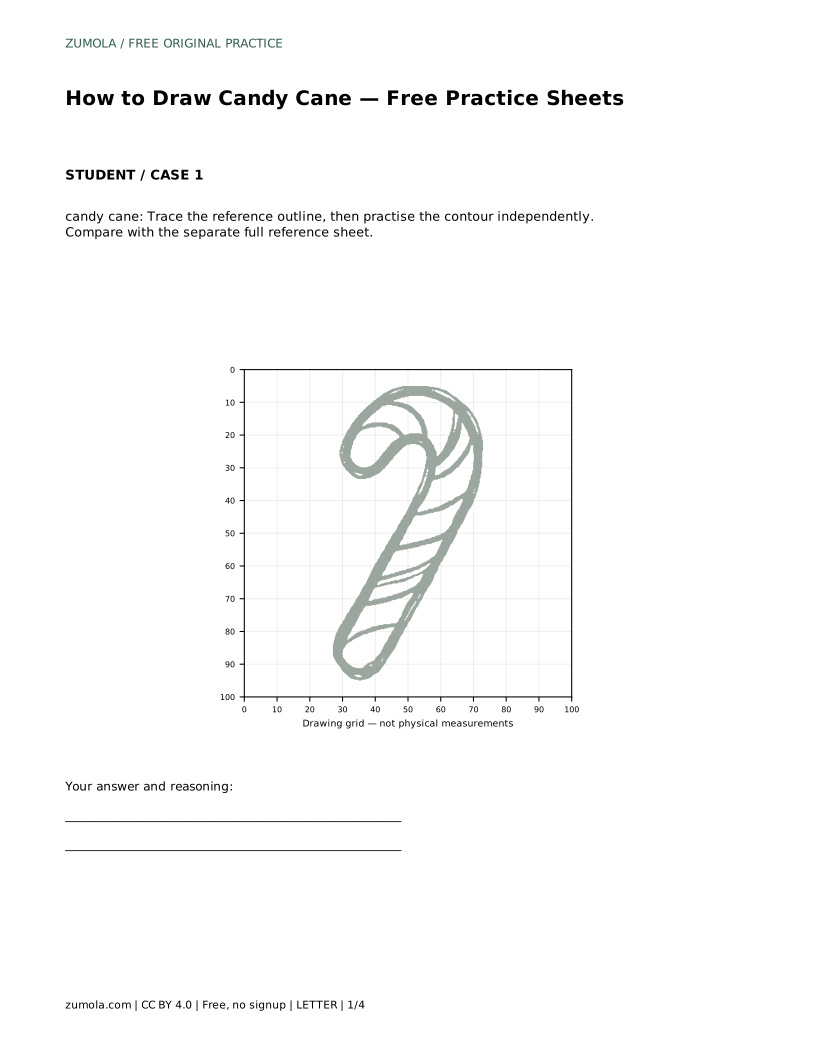
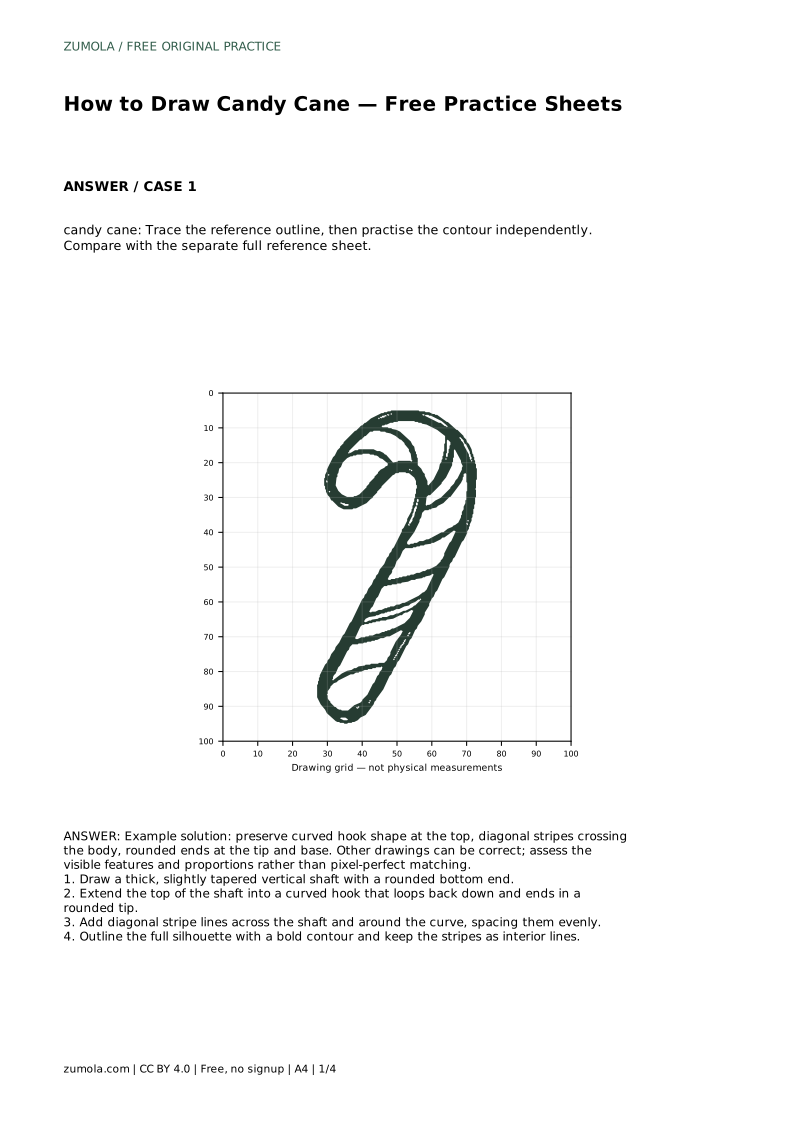
candy cane: Trace the reference outline, then practise the contour independently. Compare with the separate full reference sheet.
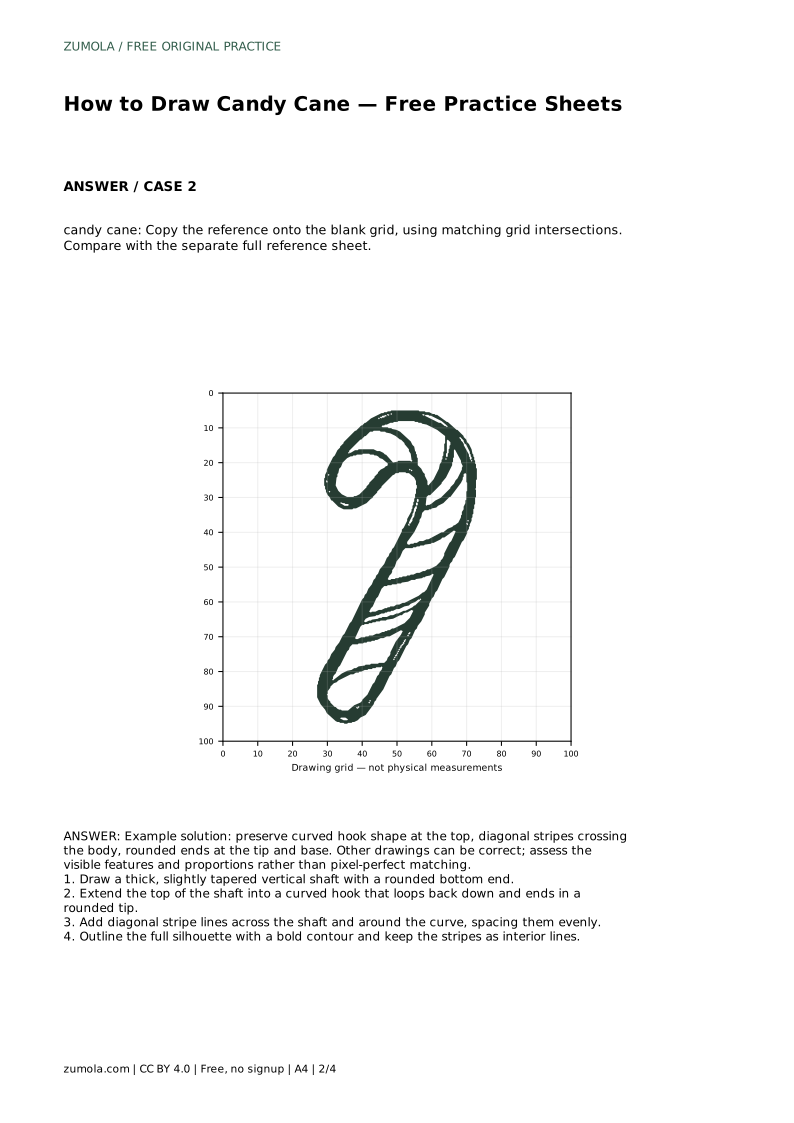
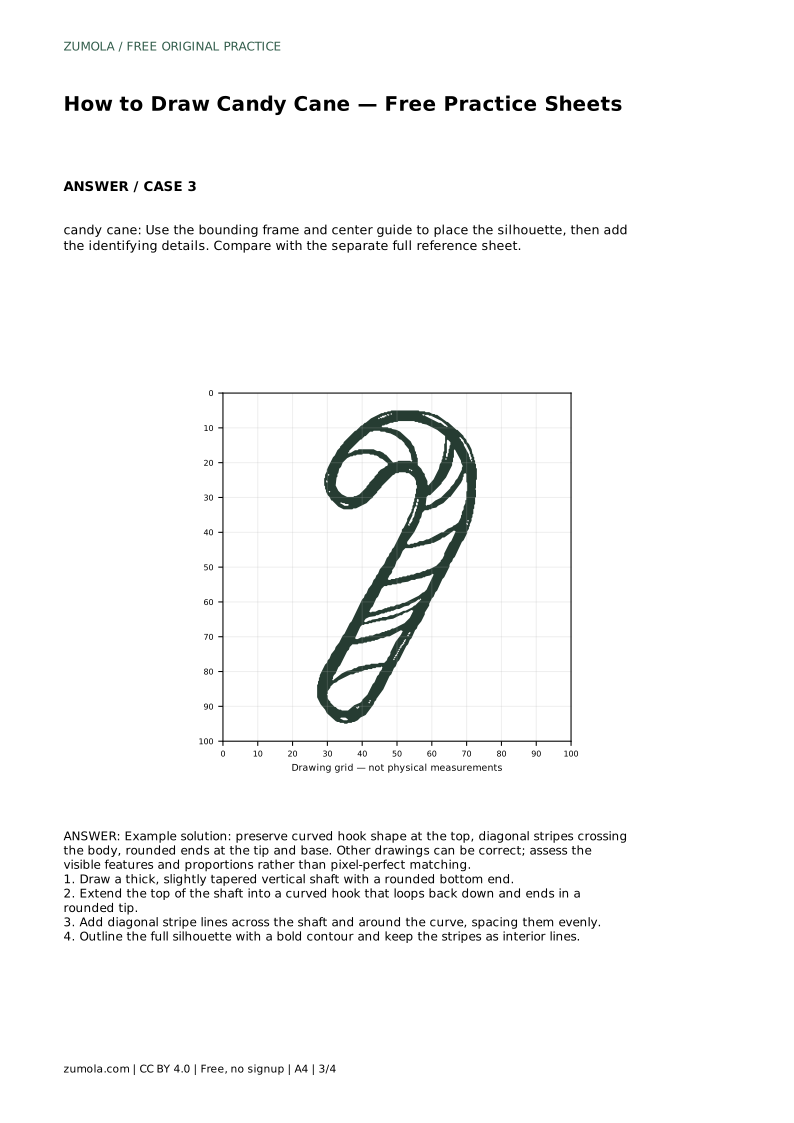
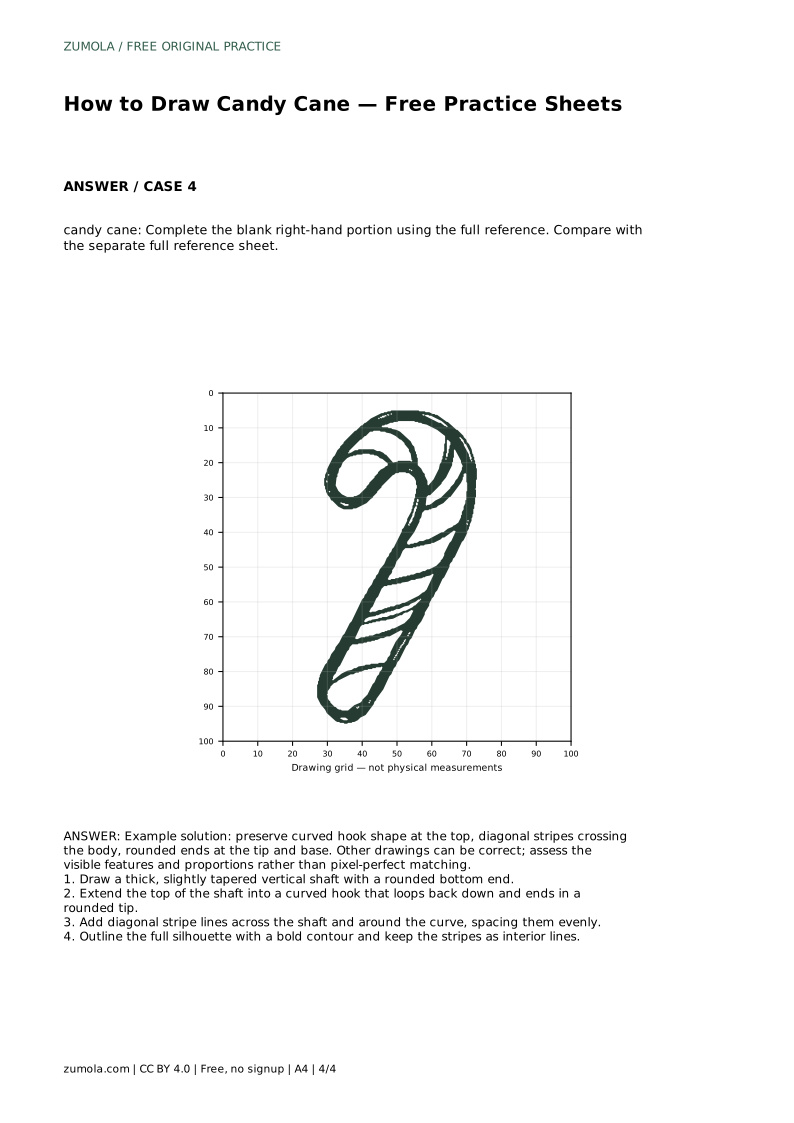
Example solution: preserve curved hook shape at the top, diagonal stripes crossing the body, rounded ends at the tip and base. Other drawings can be correct; assess the visible features and proportions rather than pixel-perfect matching. Draw a thick, slightly tapered vertical shaft with a rounded bottom end. Extend the top of the shaft into a curved hook that loops back down and ends in a rounded tip. Add diagonal stripe lines across the shaft and around the curve, spacing them evenly. Outline the full silhouette with a bold contour and keep the stripes as interior lines.
They should look consistently spaced. Small differences are acceptable, but a stripe that is obviously wider or narrower than its neighbours will make the cane look uneven.
You can, but the silhouette is easier to control first. Build the shaft and hook, then add stripes inside that shape, then finish with the bold contour.
Compare the hook shape, the diagonal direction of the stripes, the rounded ends, and the overall proportions. Exact line-for-line matching is not required.
All drawing practice · Free coordinate paper
Original resources · CC BY 4.0 · Free for personal and classroom use with attribution.