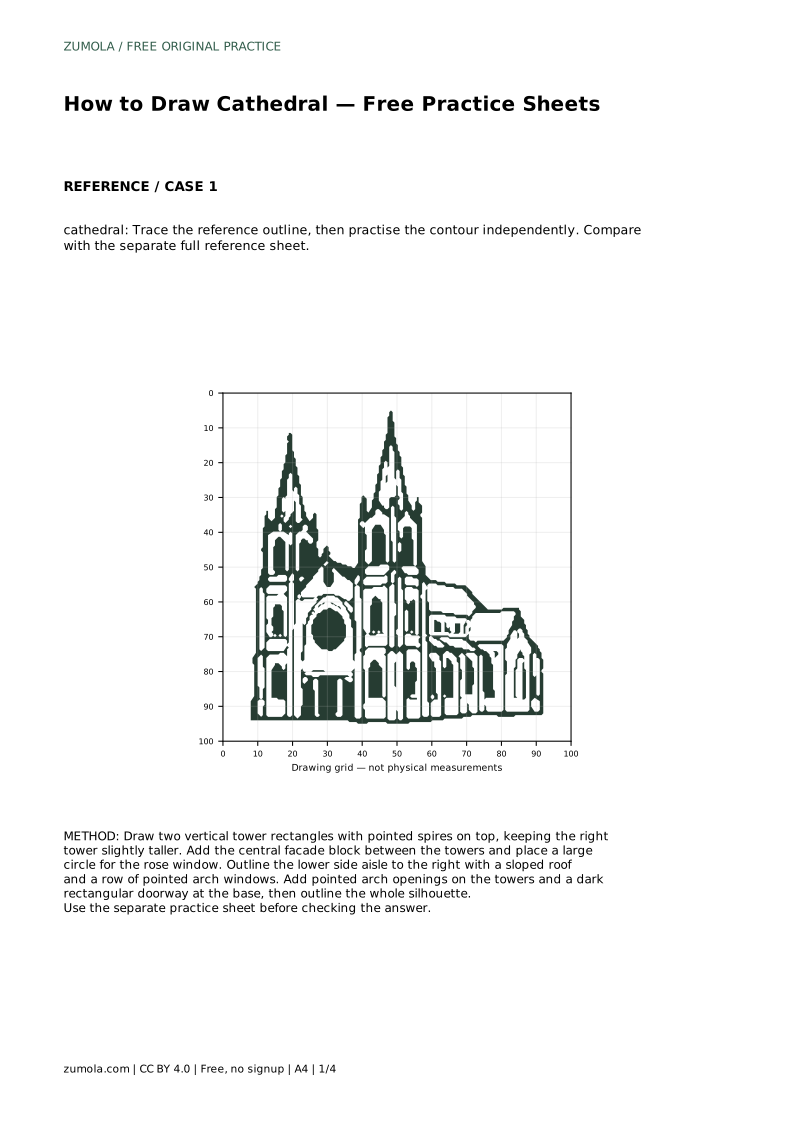
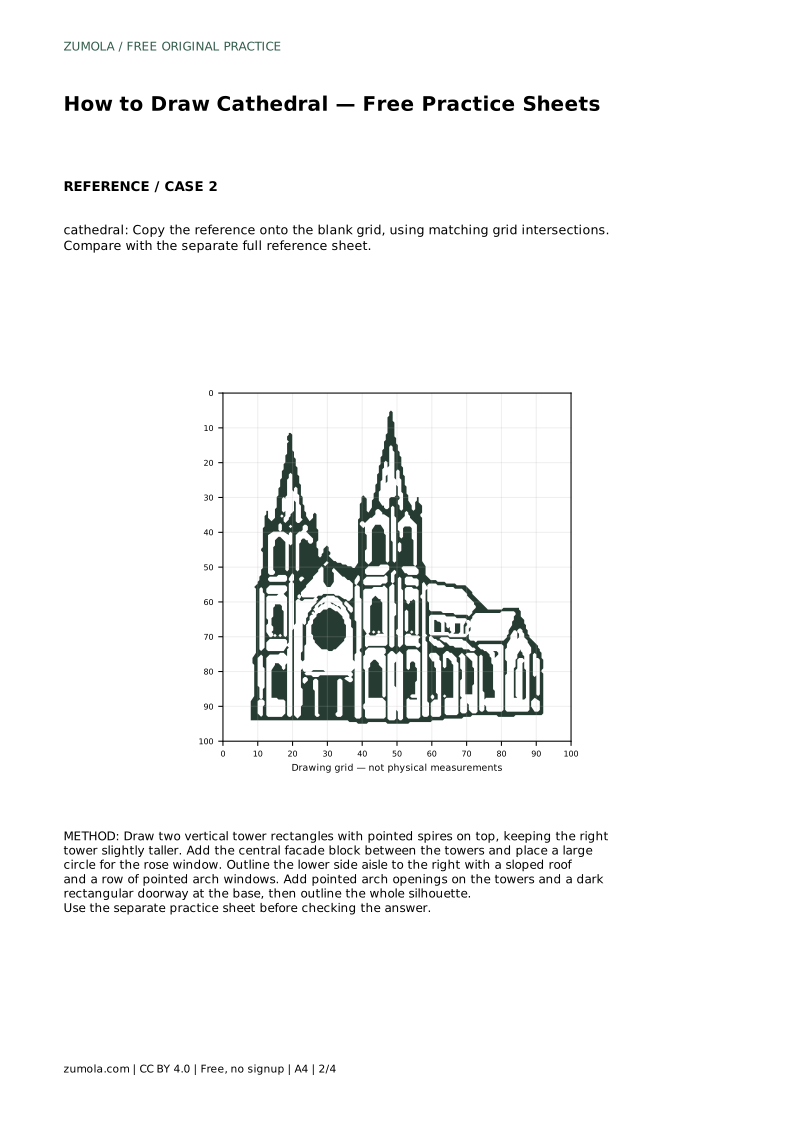
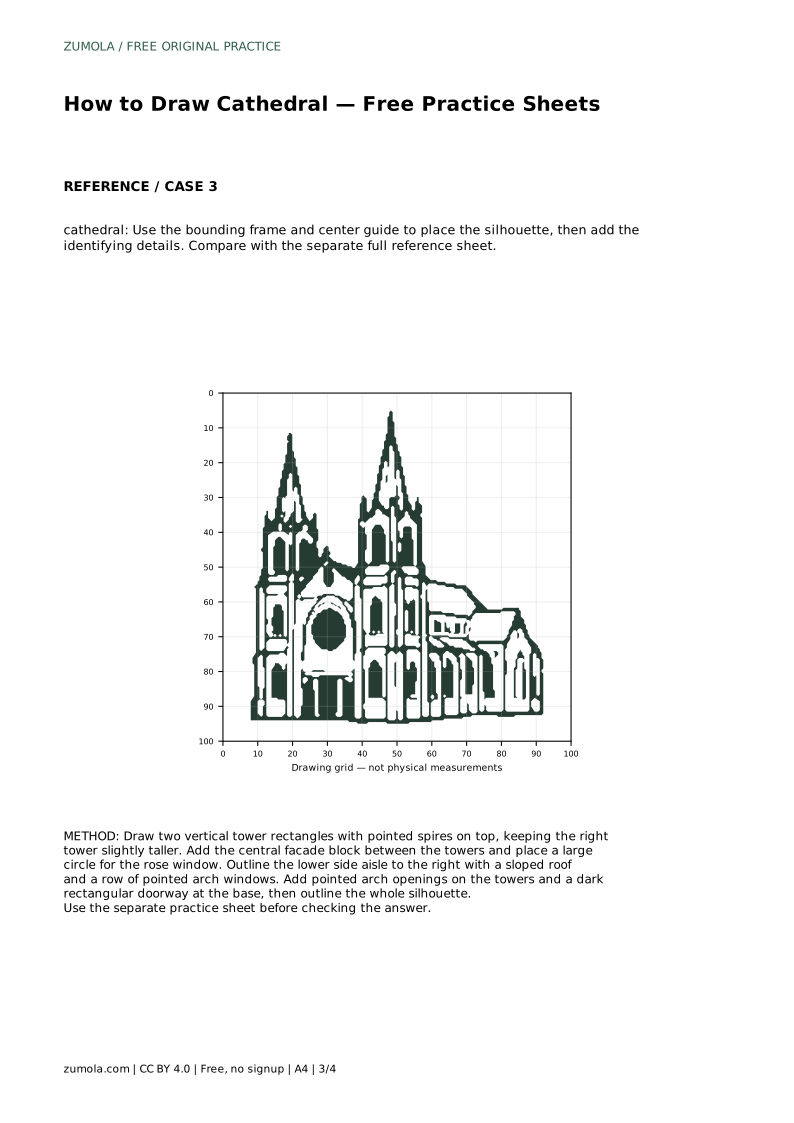
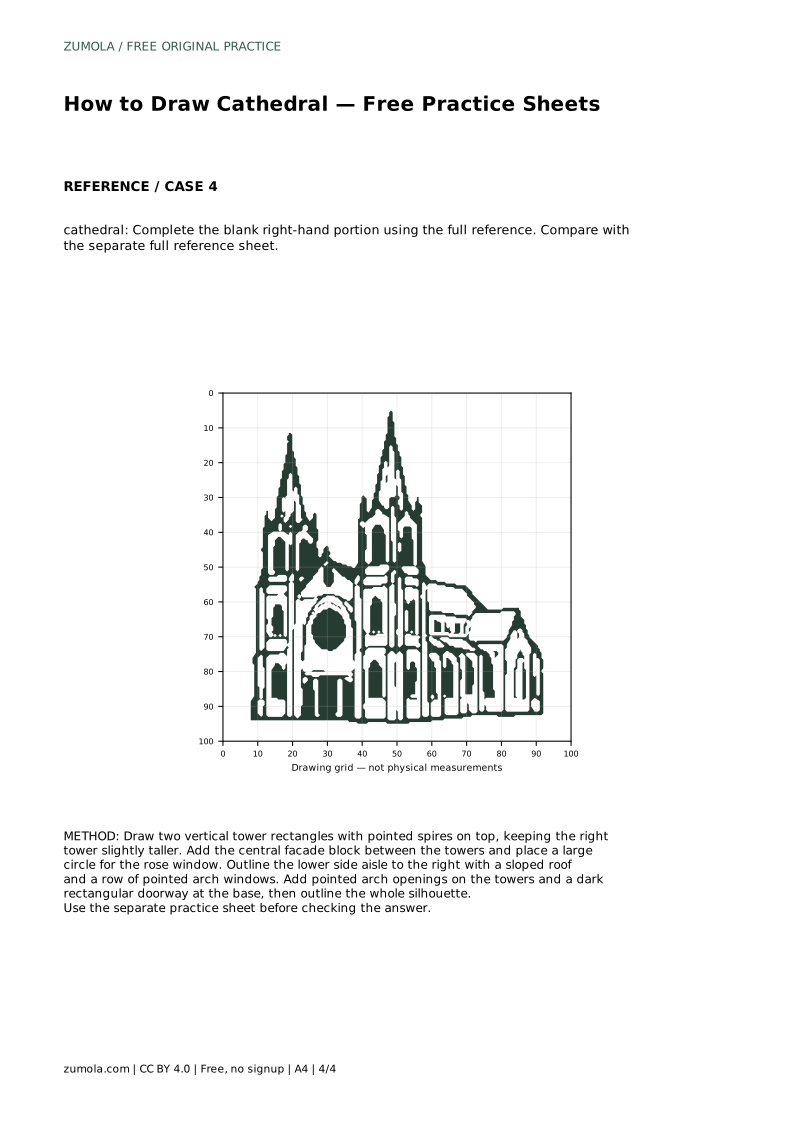
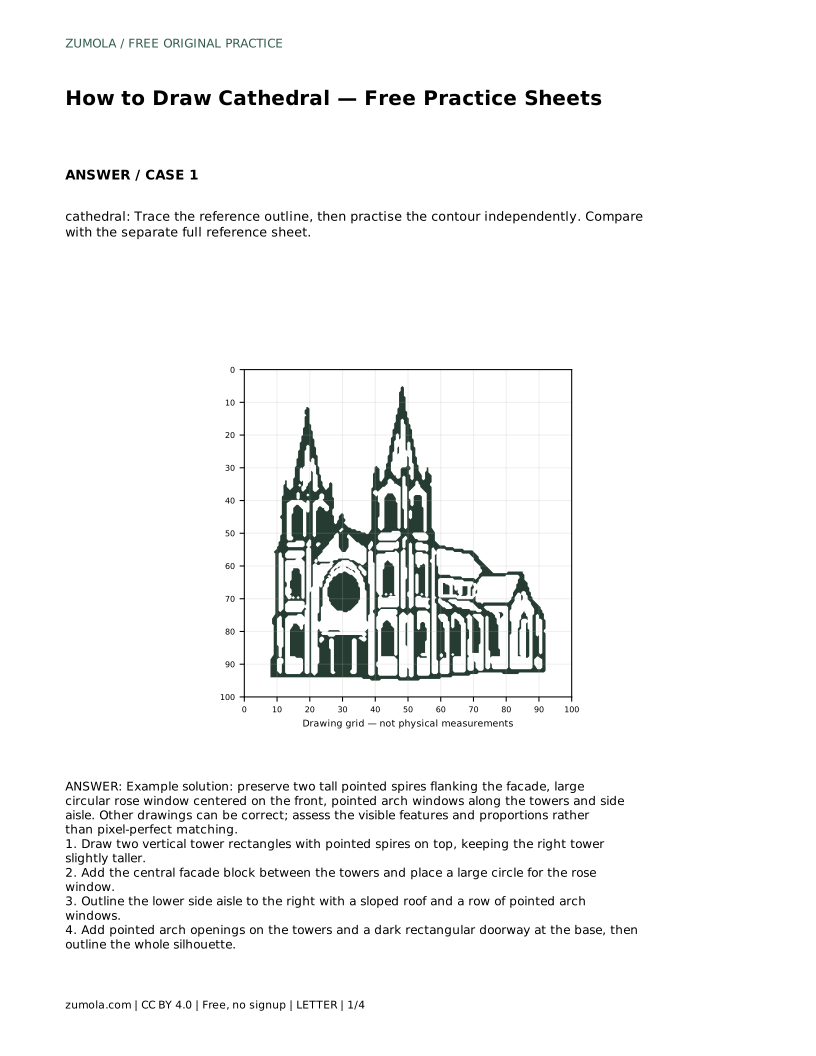
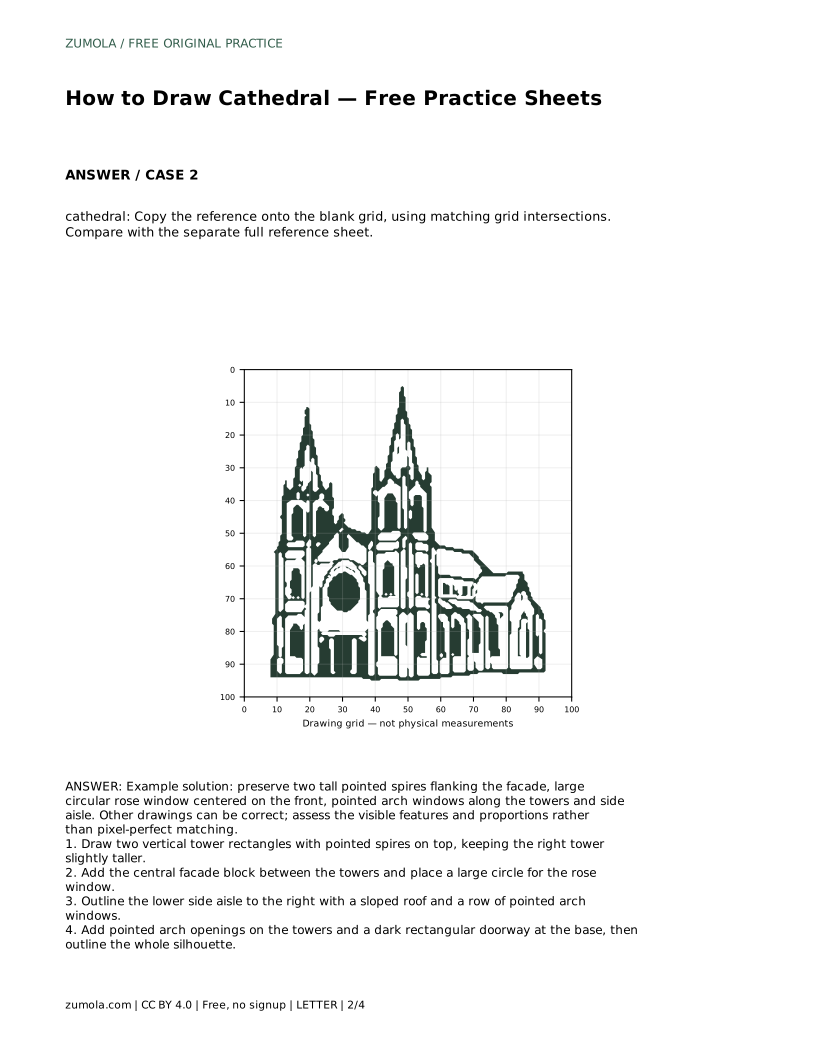
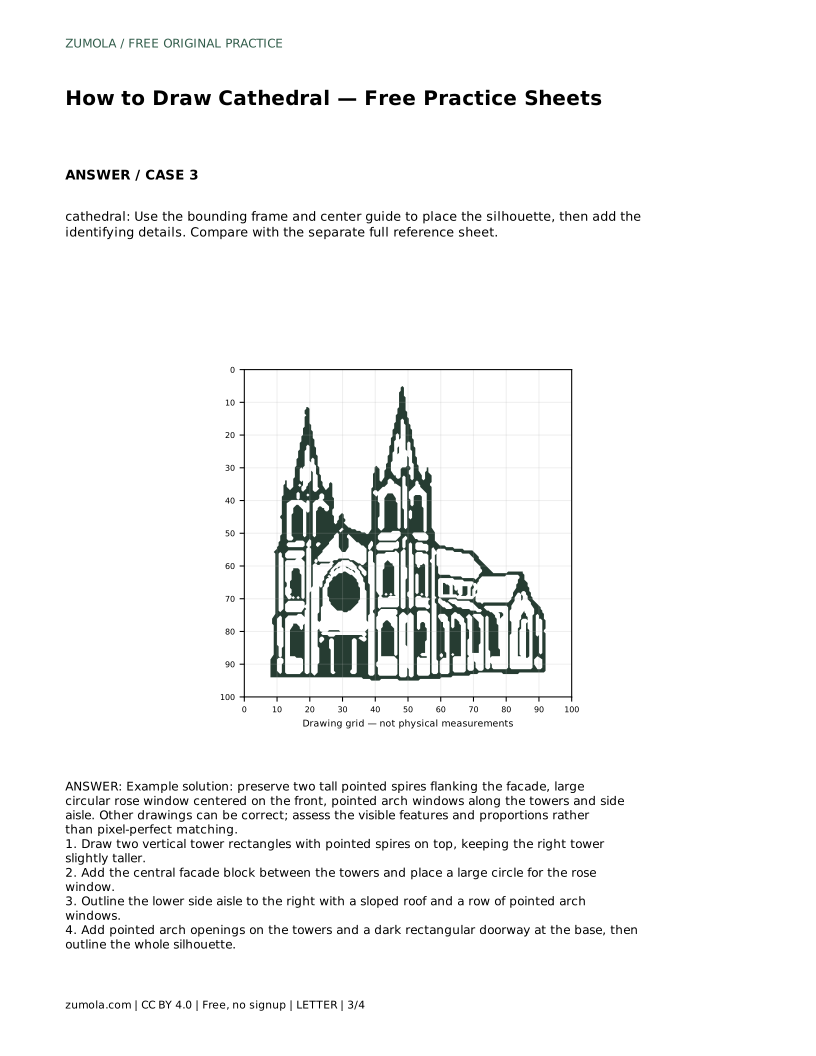
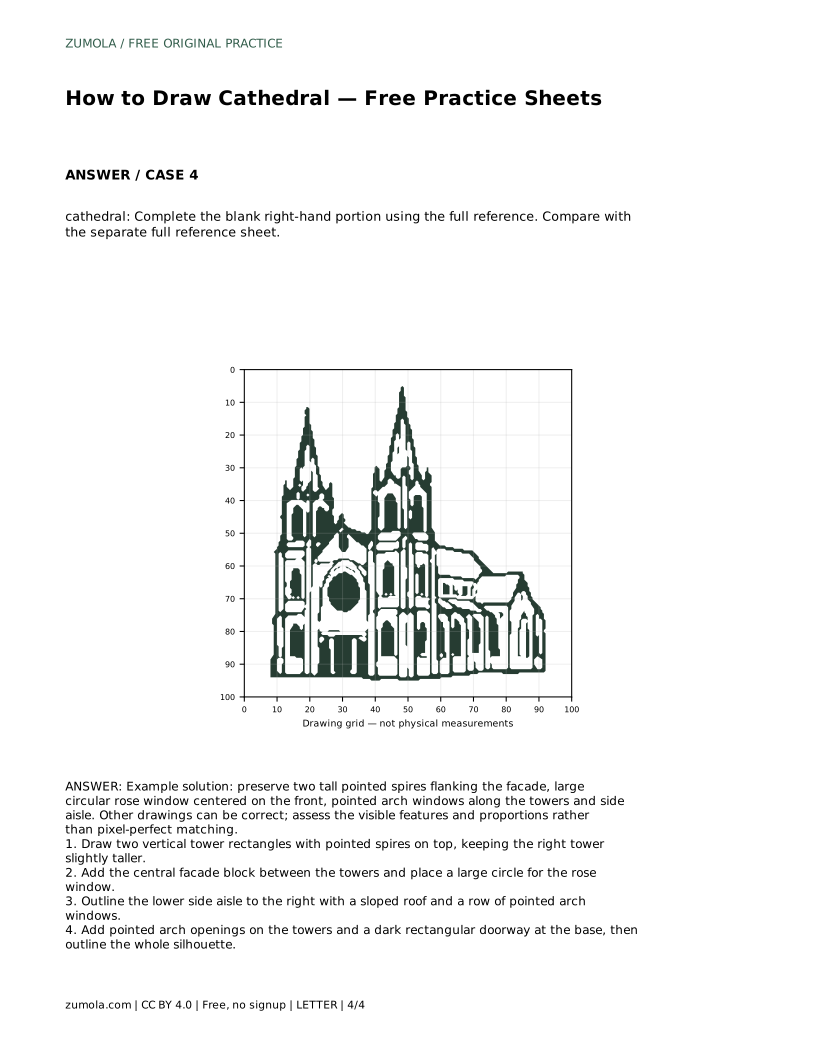
Reference diagrams
LETTER · Download PDF
A4 · Download PDF
Free original resources
Learn to draw a cathedral by placing two towers, pointed spires, a centered rose window, and pointed arch windows. Free printable practice sheets support each stage.
Four original cases, with reference diagrams, practice sheets and worked answers. Everything is free; no signup required.
LETTER · Download PDF
A4 · Download PDF
LETTER · Download PDF
A4 · Download PDF
LETTER · Download PDF
A4 · Download PDF
Use A4 or US Letter to match your printer. Use the stated values and conditions to solve each exercise; diagrams are not physical measuring rulers.
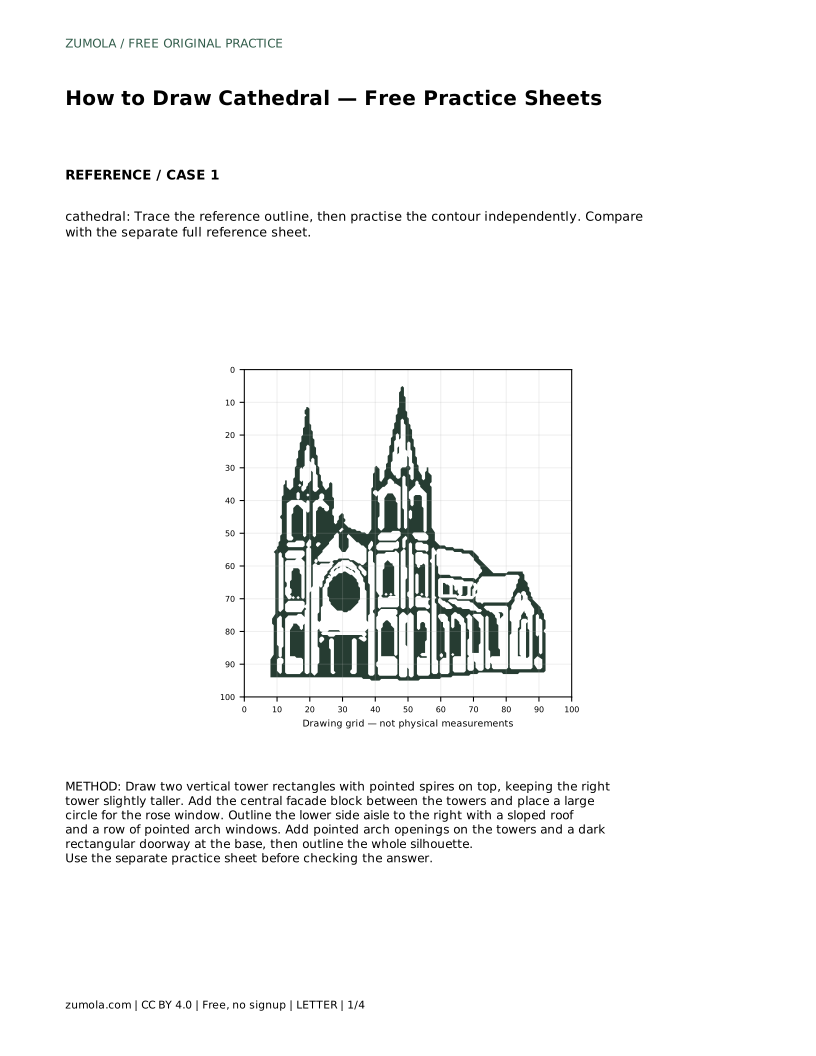
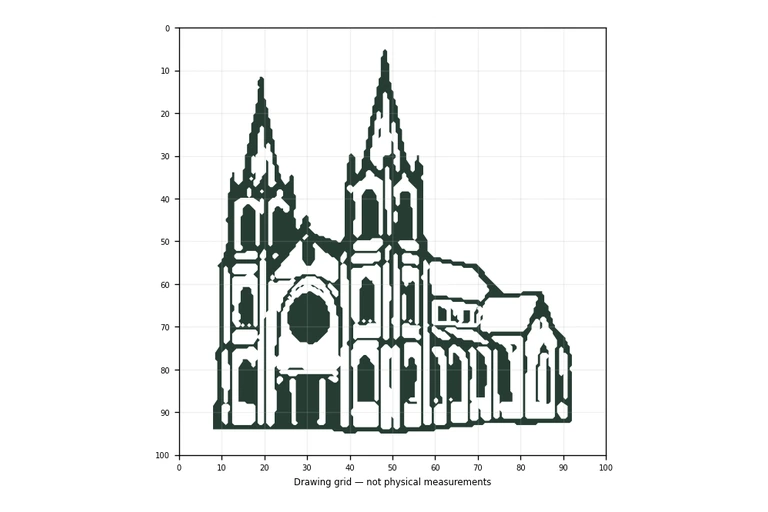
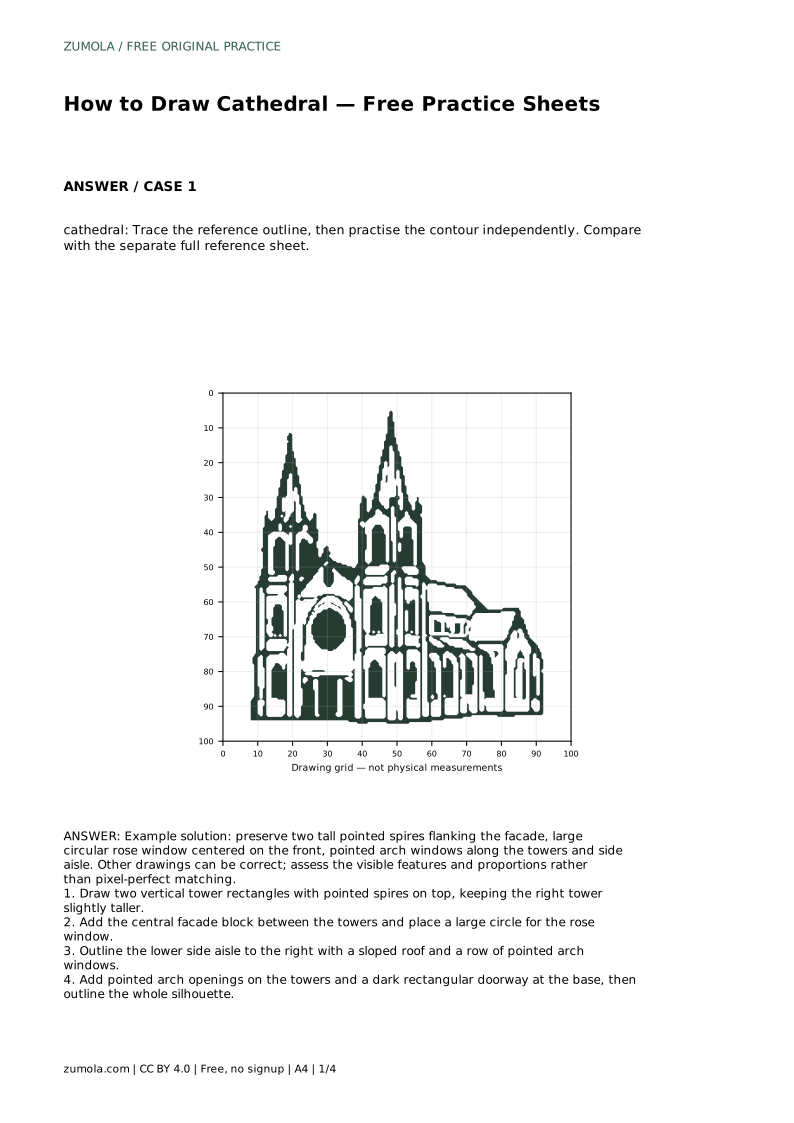
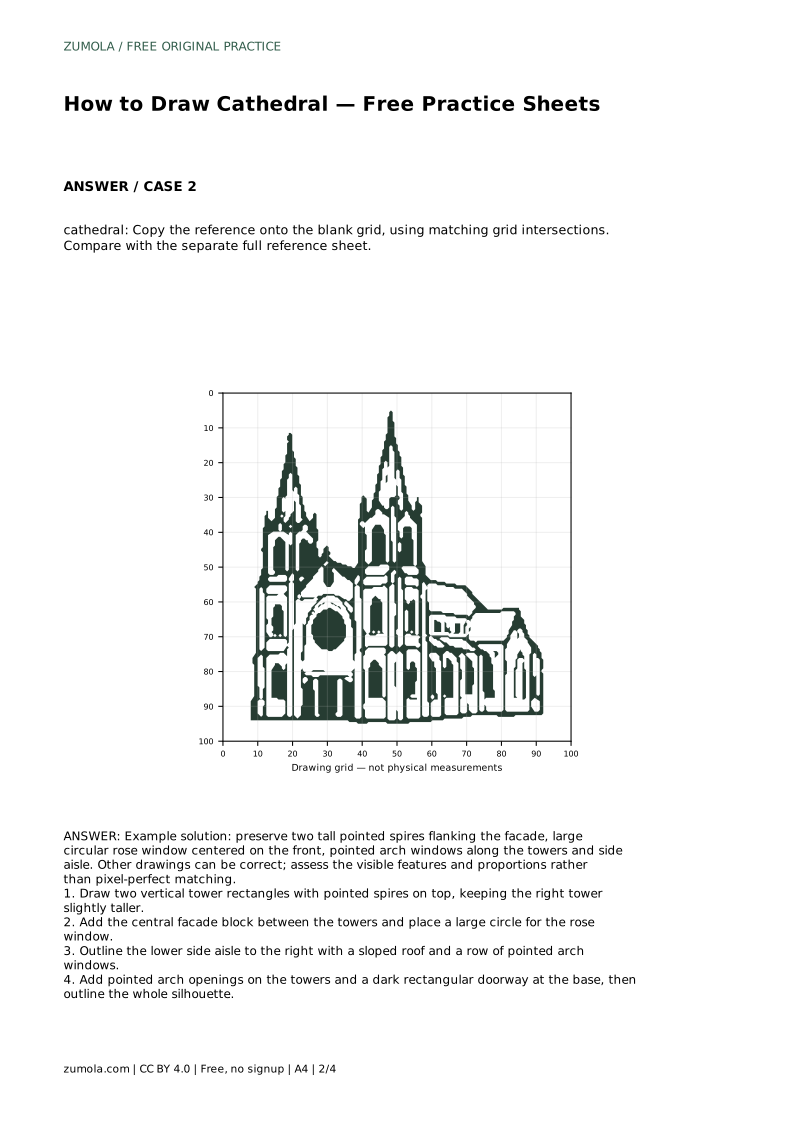
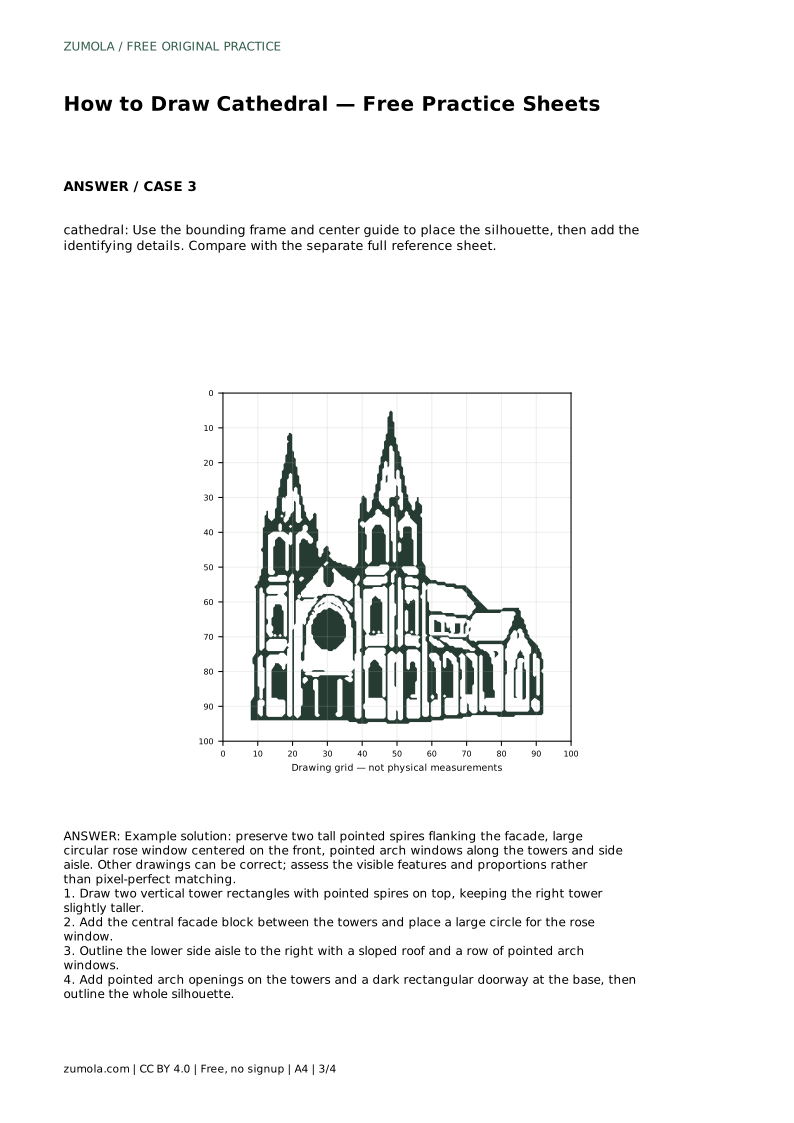
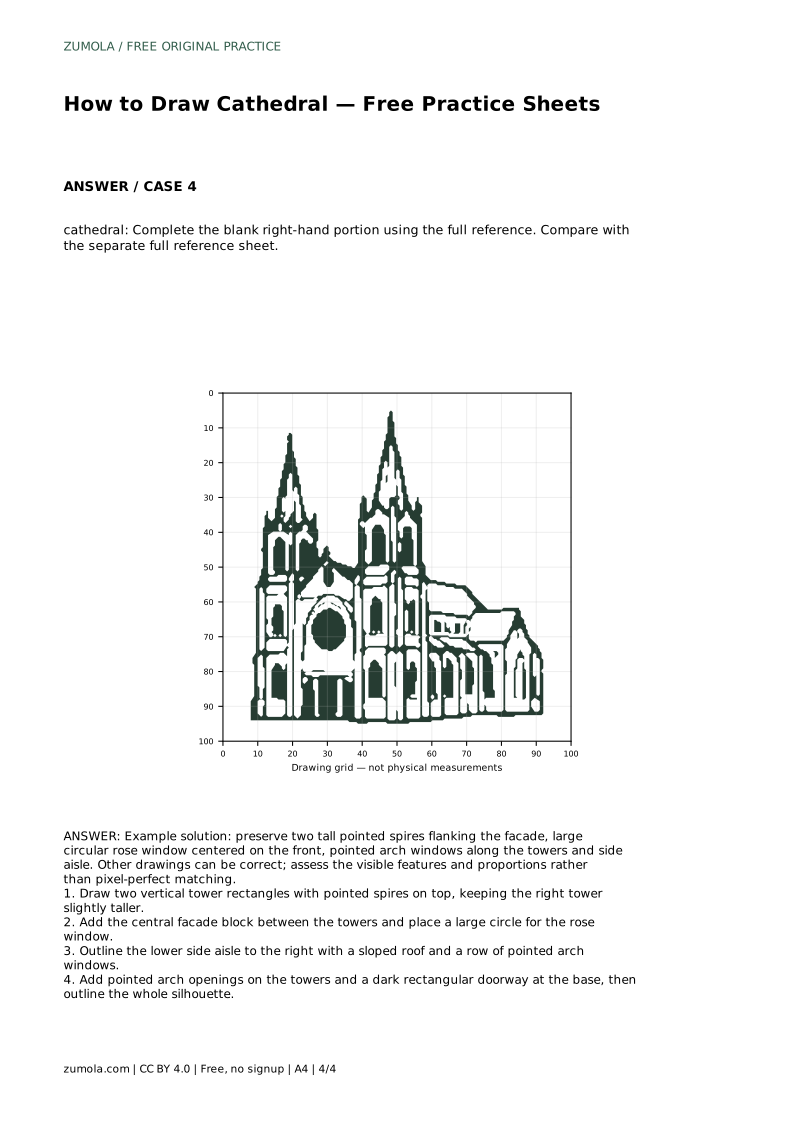
A cathedral drawing is easiest to manage when you build it from large shapes to small details. Start with two vertical towers, add pointed spires, then place the central facade and rose window before drawing windows and the doorway. The practice sheets let you trace an outline, copy onto a grid, use a center guide, or complete a partial drawing, so you can focus on one observation skill at a time.
Begin by treating the cathedral as a stack of simple forms rather than a collection of decorative lines. The two towers are vertical rectangles. Their spires are pointed shapes sitting on top. The central facade is a block between the towers, and the side aisle is a lower block with a sloped roof. Keep the towers close to the same width, and note that the right tower is slightly taller in the reference.
Place the rose window before adding smaller windows. It is a large circle centered on the front facade, so its position controls how the facade reads. Only after the circle is placed should you add pointed arch openings on the towers and the row of pointed arch windows along the side aisle. Finish the silhouette with a dark rectangular doorway at the base.
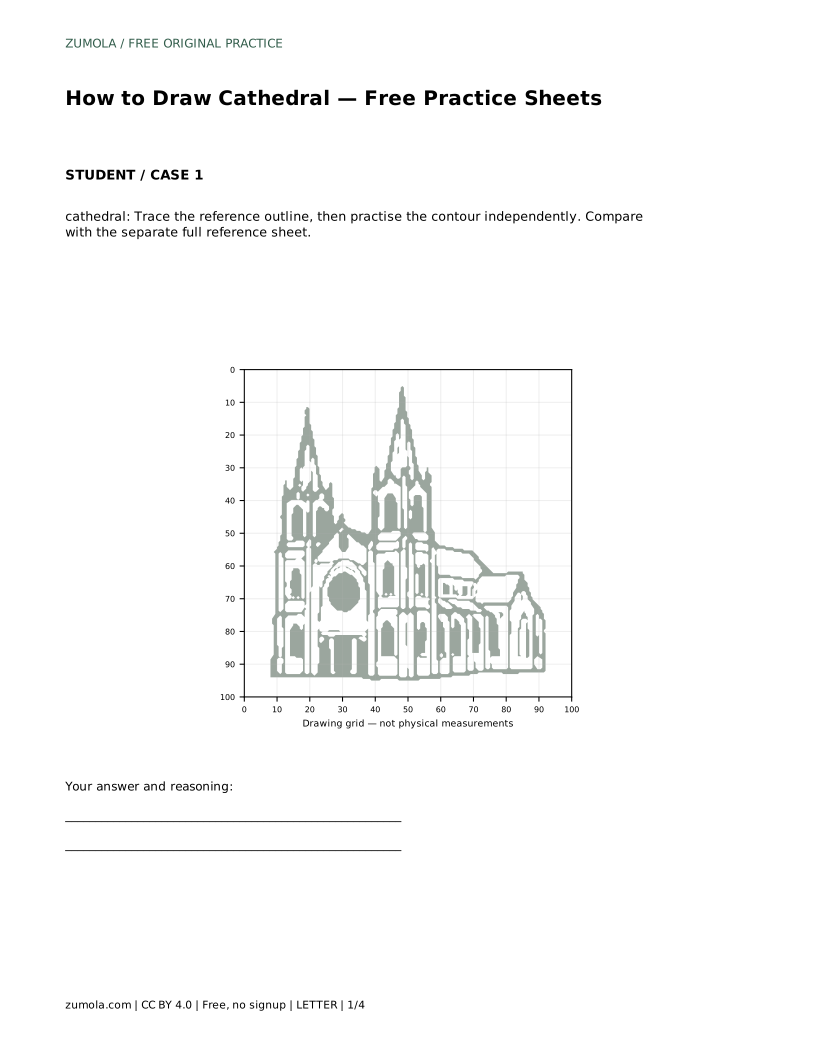
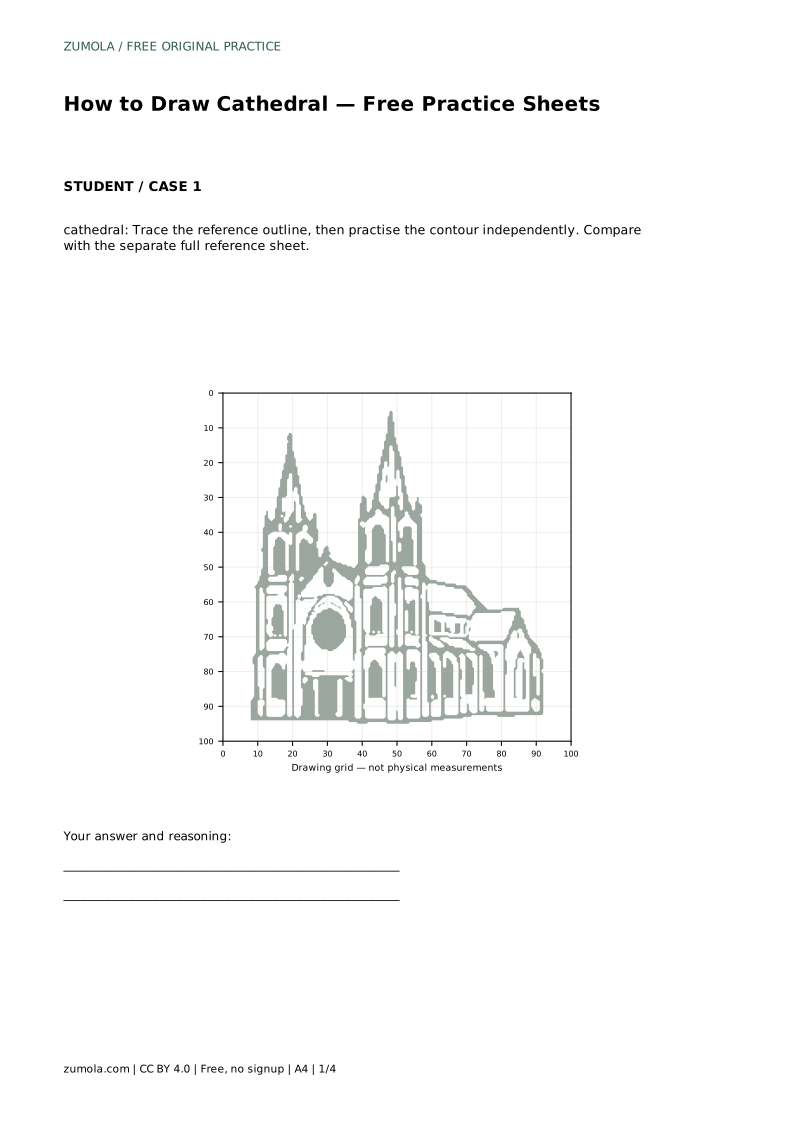
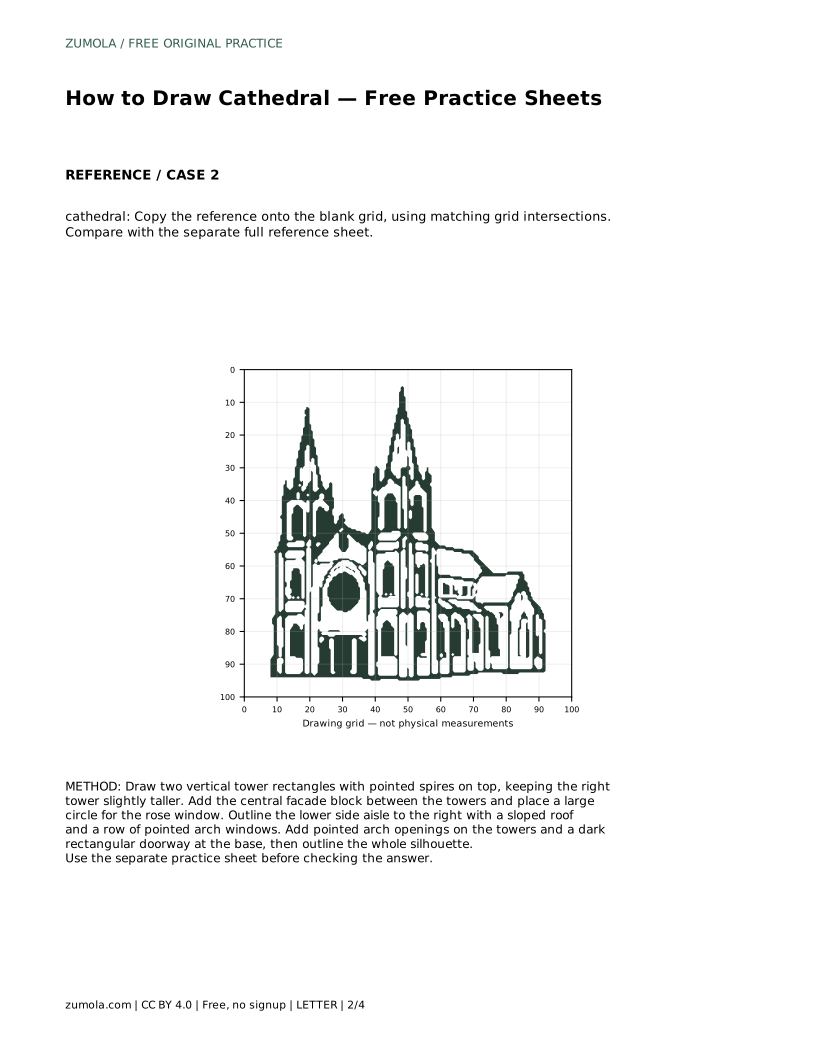
The trace sheet asks you to follow the reference outline first, then practise the contour independently. Tracing shows where the edges sit; the independent pass shows whether you can reproduce those edges without help. Compare your result with the separate full reference sheet rather than with your traced line.
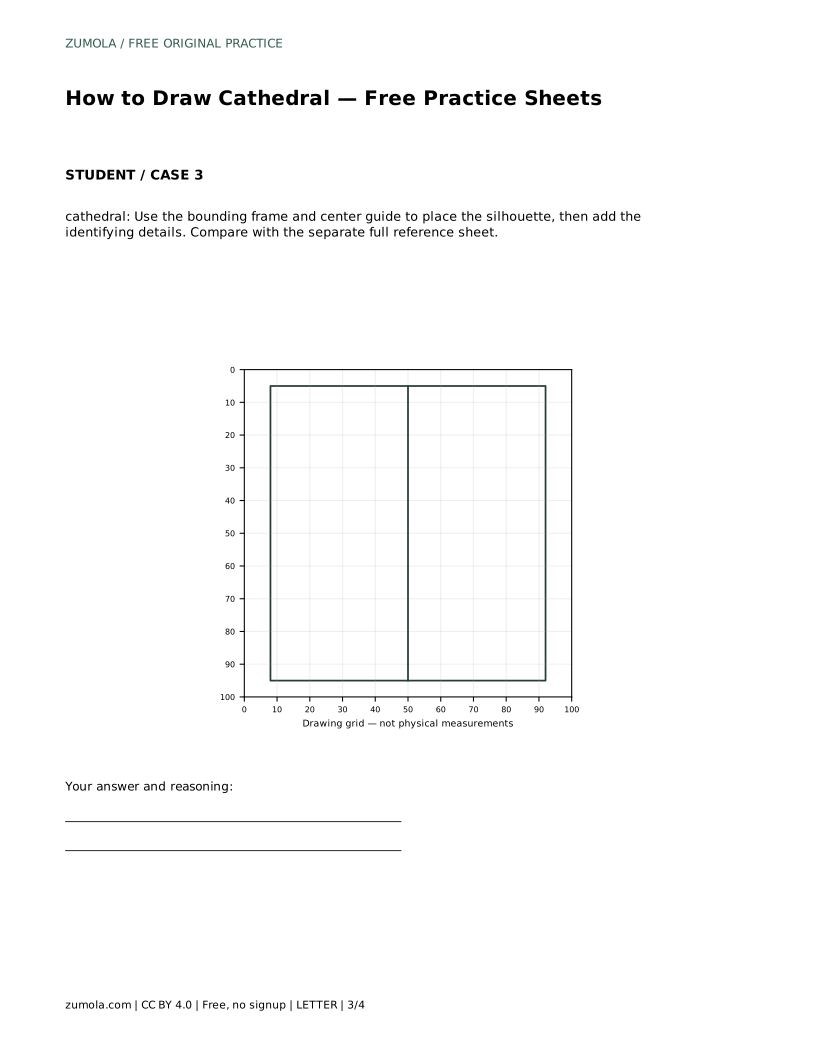
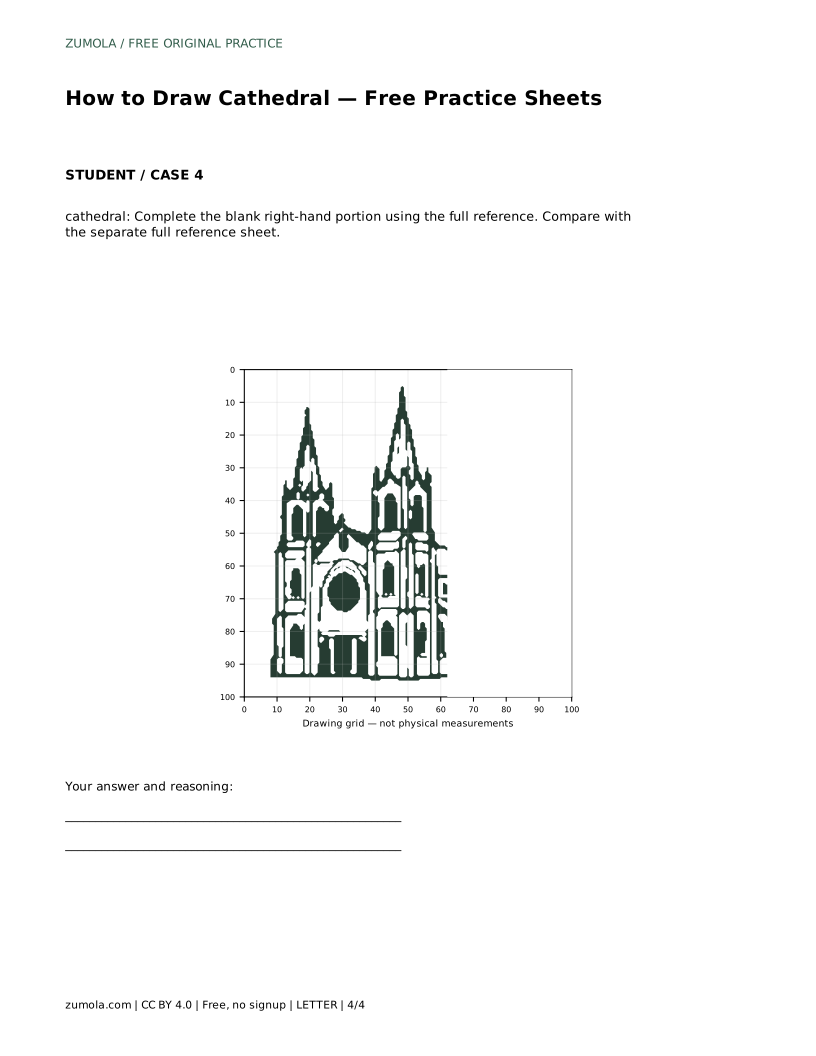
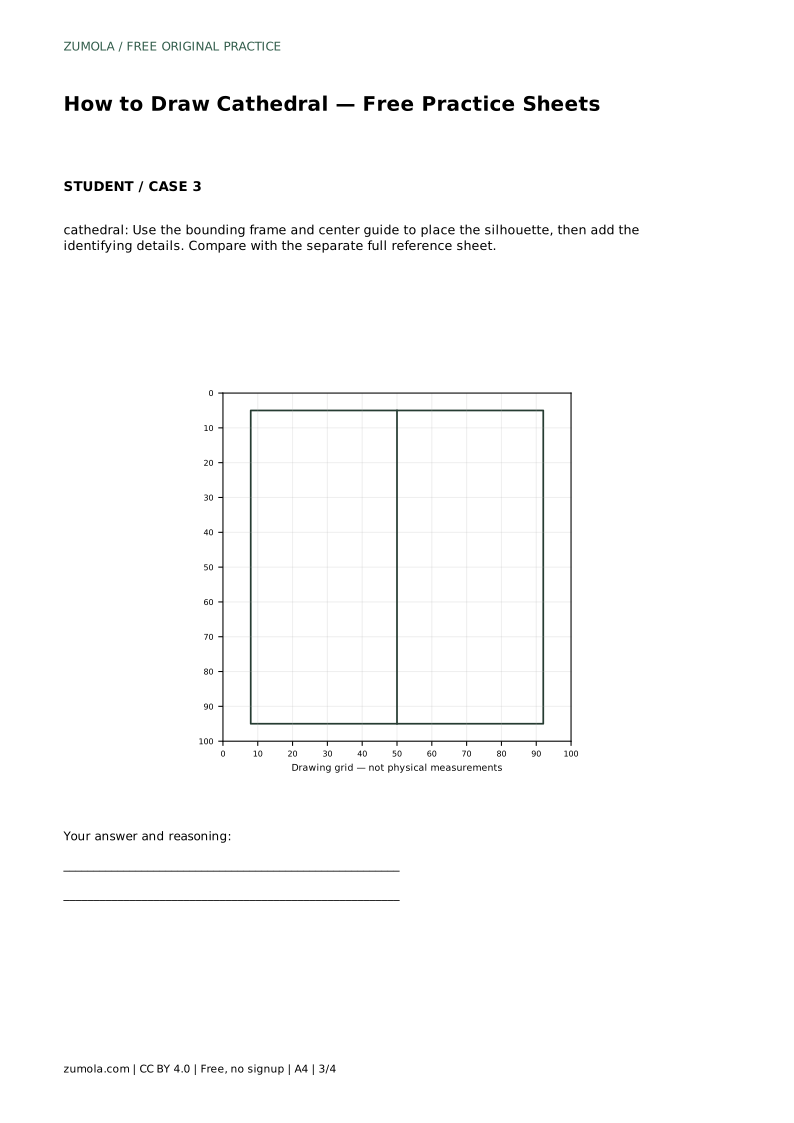
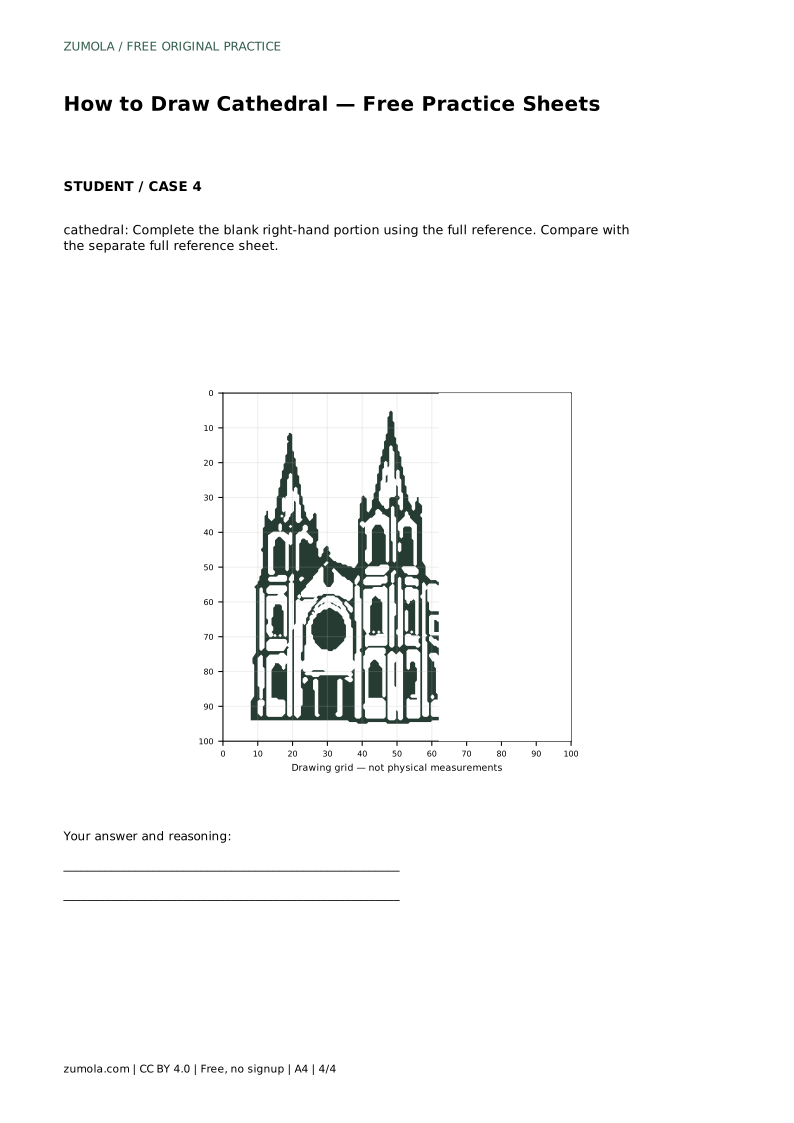
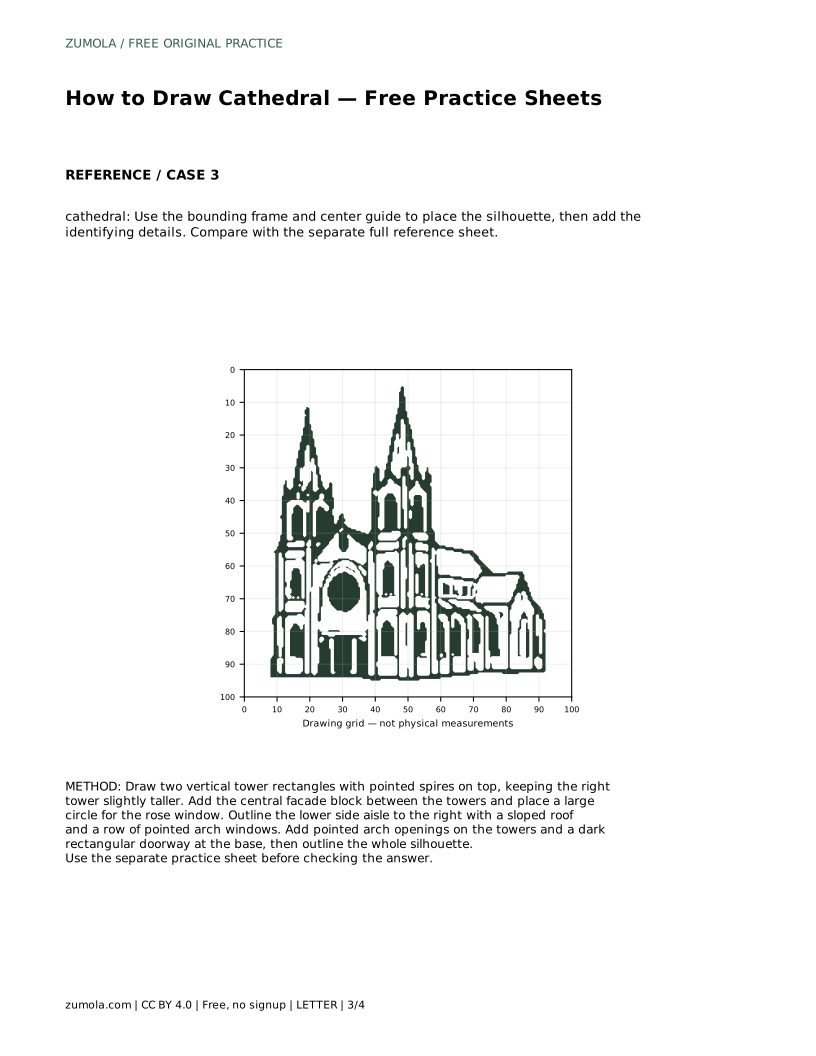
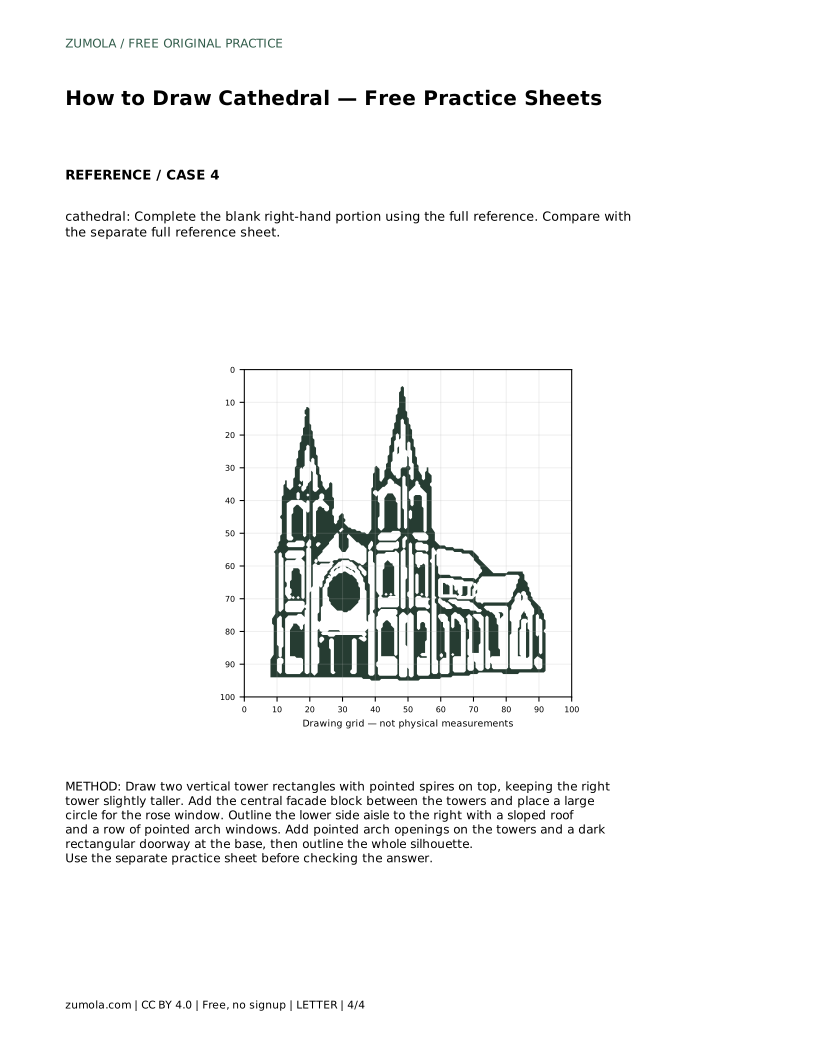
The grid sheet asks you to copy the reference onto a blank grid using matching grid intersections. Use the intersections to judge where a tower edge, spire tip, or window center falls. The bounding-frame sheet asks you to place the silhouette inside the frame using the center guide, which helps you check whether the facade sits centrally between the towers. The partial sheet gives you the left portion and asks you to complete the blank right-hand portion from the full reference, so you must infer the missing side aisle and tower details.
A cathedral drawing can be correct without matching every line exactly. Check that two tall pointed spires flank the facade, that the rose window is large and centered on the front, and that pointed arch windows appear along the towers and side aisle. Check that the side aisle is lower than the towers and that the doorway sits at the base.
If the towers look too wide, narrow them before adding windows. If the rose window drifts off center, move it rather than redrawing the facade. If the spires look blunt, check that each point rises from the tower top. These corrections keep the drawing readable as a cathedral while allowing your own line quality and spacing.
Use short sessions. Draw only the tower rectangles and spires on one attempt, then add the facade and rose window on the next. A later attempt can add the side aisle and windows. This separates placement from detail and makes errors easier to spot.
Keep your practice sheets together so you can compare an early attempt with a later one. Look for changes in tower proportion, rose window placement, and arch shape. The goal is a clearer cathedral silhouette and more confident placement, not an identical copy.
cathedral: Trace the reference outline, then practise the contour independently. Compare with the separate full reference sheet.
Example solution: preserve two tall pointed spires flanking the facade, large circular rose window centered on the front, pointed arch windows along the towers and side aisle. Other drawings can be correct; assess the visible features and proportions rather than pixel-perfect matching. Draw two vertical tower rectangles with pointed spires on top, keeping the right tower slightly taller. Add the central facade block between the towers and place a large circle for the rose window. Outline the lower side aisle to the right with a sloped roof and a row of pointed arch windows. Add pointed arch openings on the towers and a dark rectangular doorway at the base, then outline the whole silhouette.
No. Preserve the visible features and proportions, such as two pointed spires, a centered rose window, and pointed arch windows. Other drawings can be correct.
Start with the trace sheet to learn the outline, then use the grid or frame sheet to practise placement without tracing.
Check the two tower rectangles and their pointed spires, then check that the rose window is centered on the facade.
All drawing practice · Free coordinate paper
Original resources · CC BY 4.0 · Free for personal and classroom use with attribution.