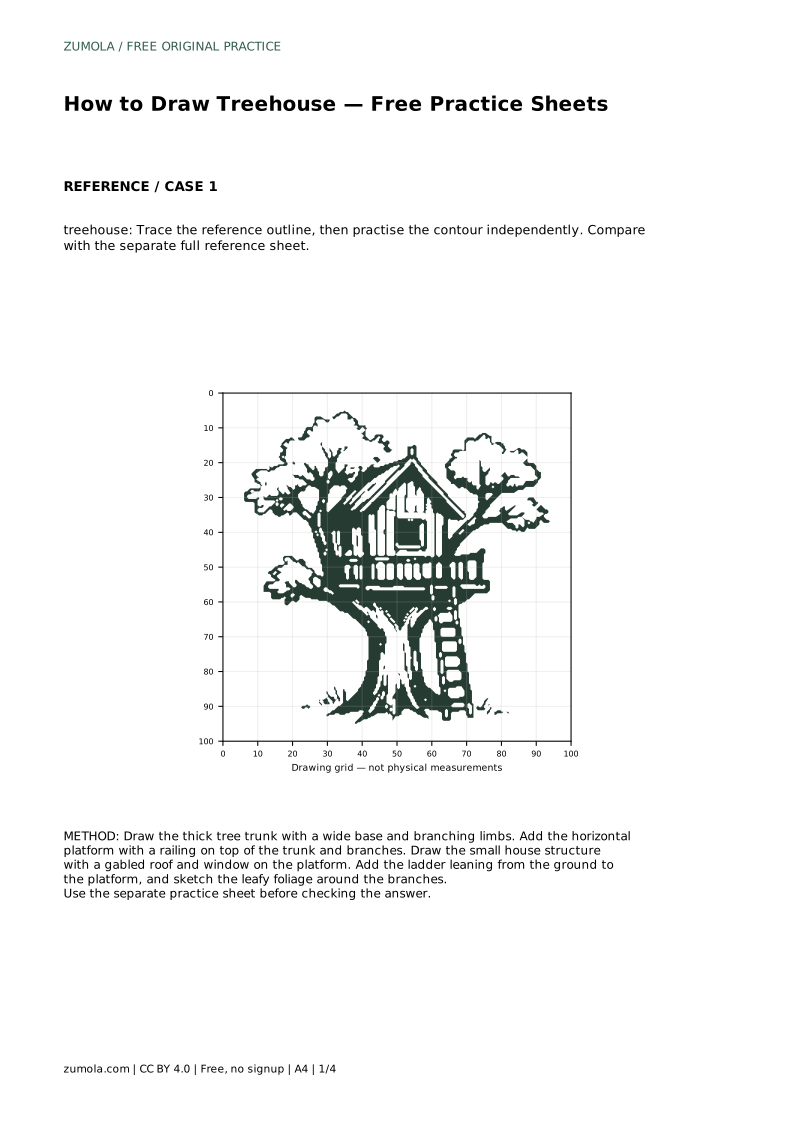
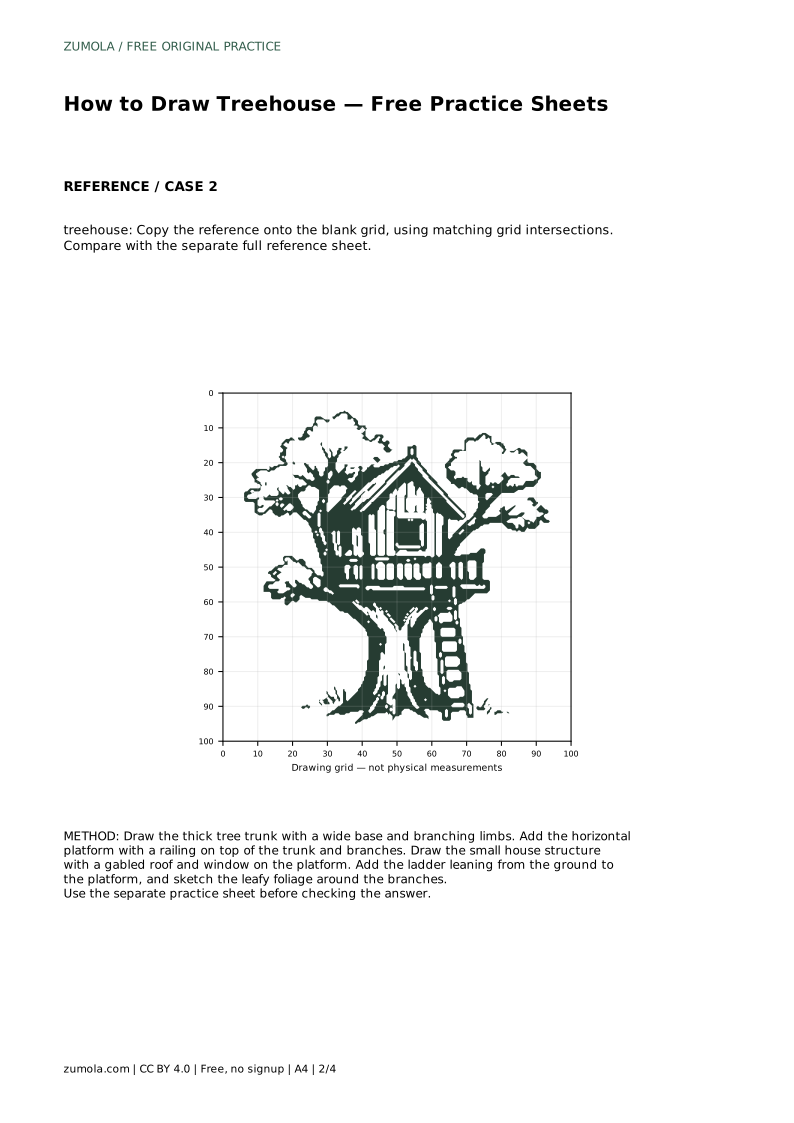
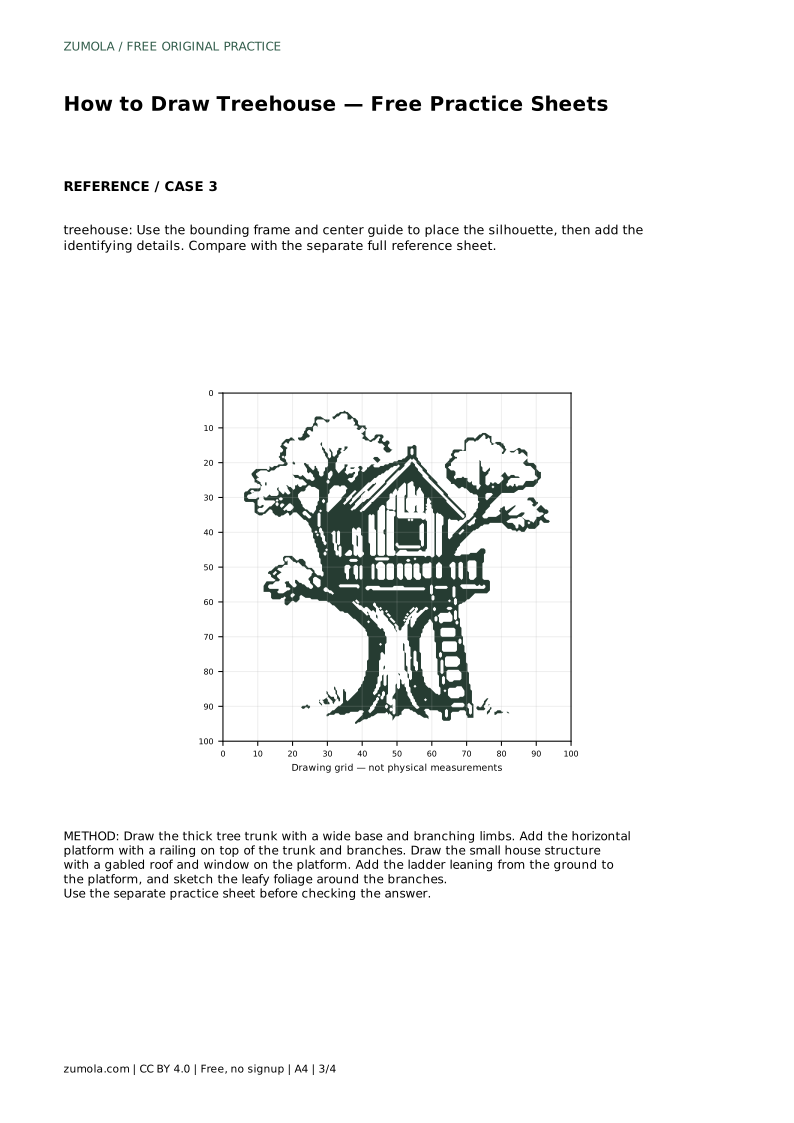
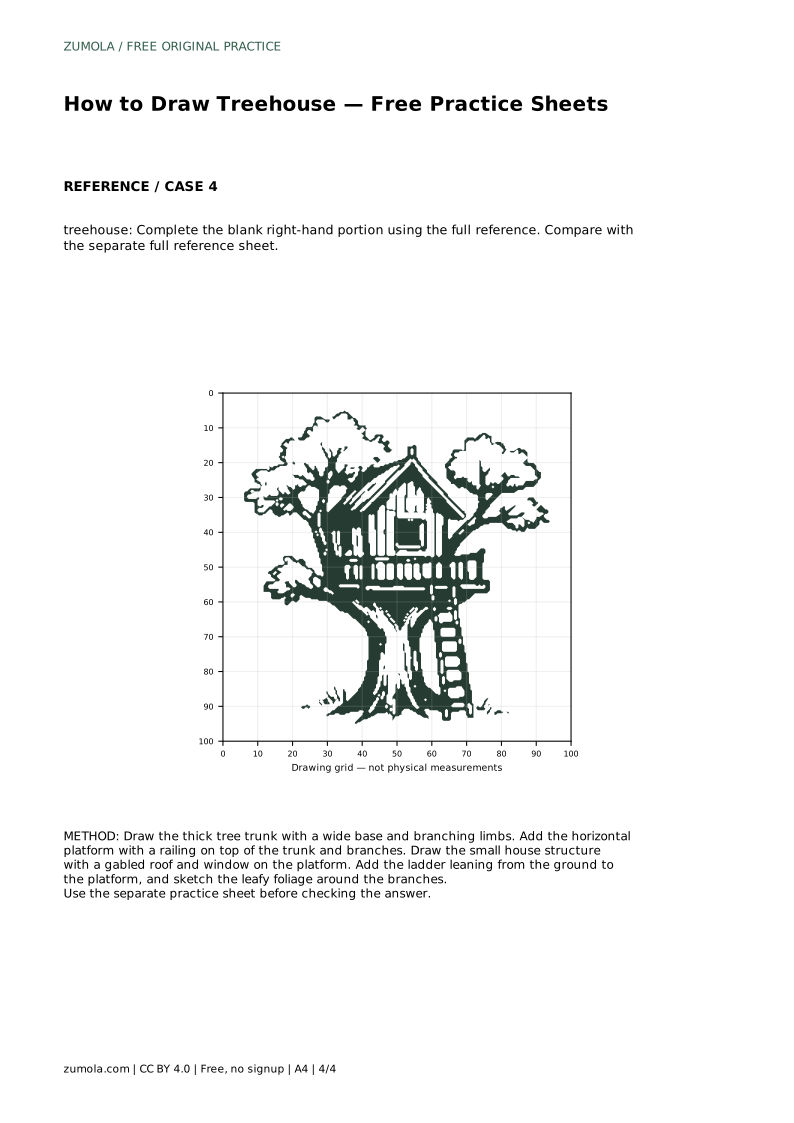
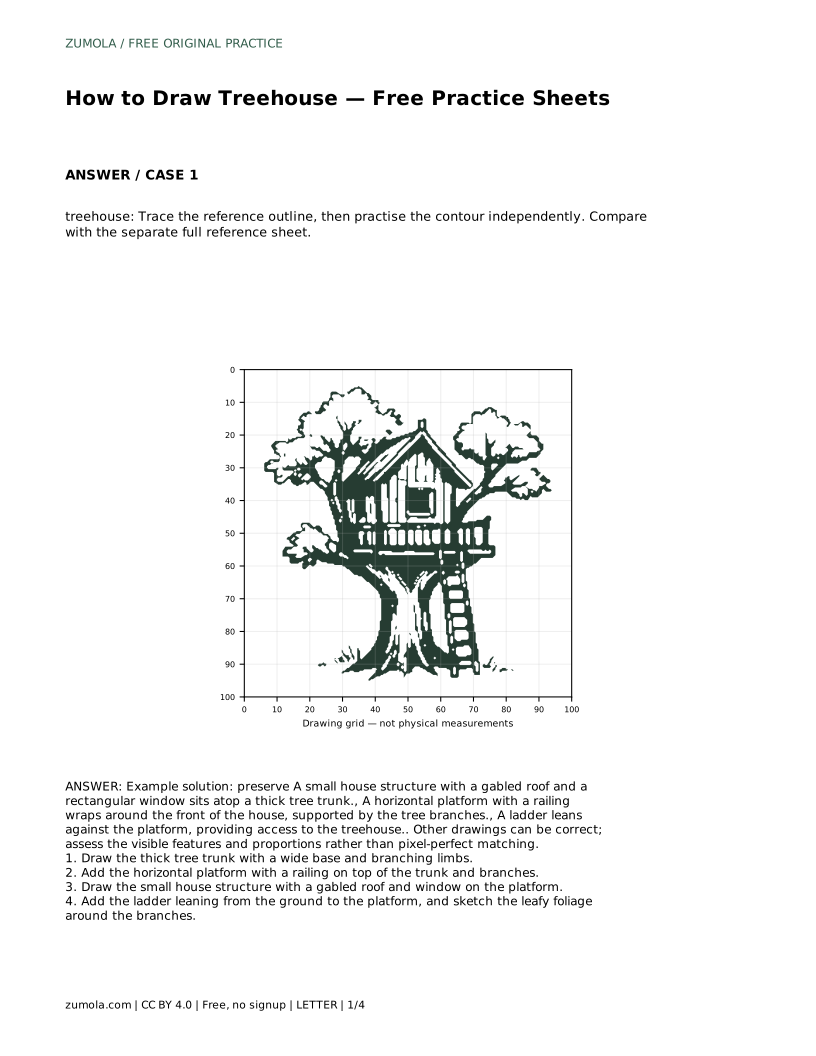
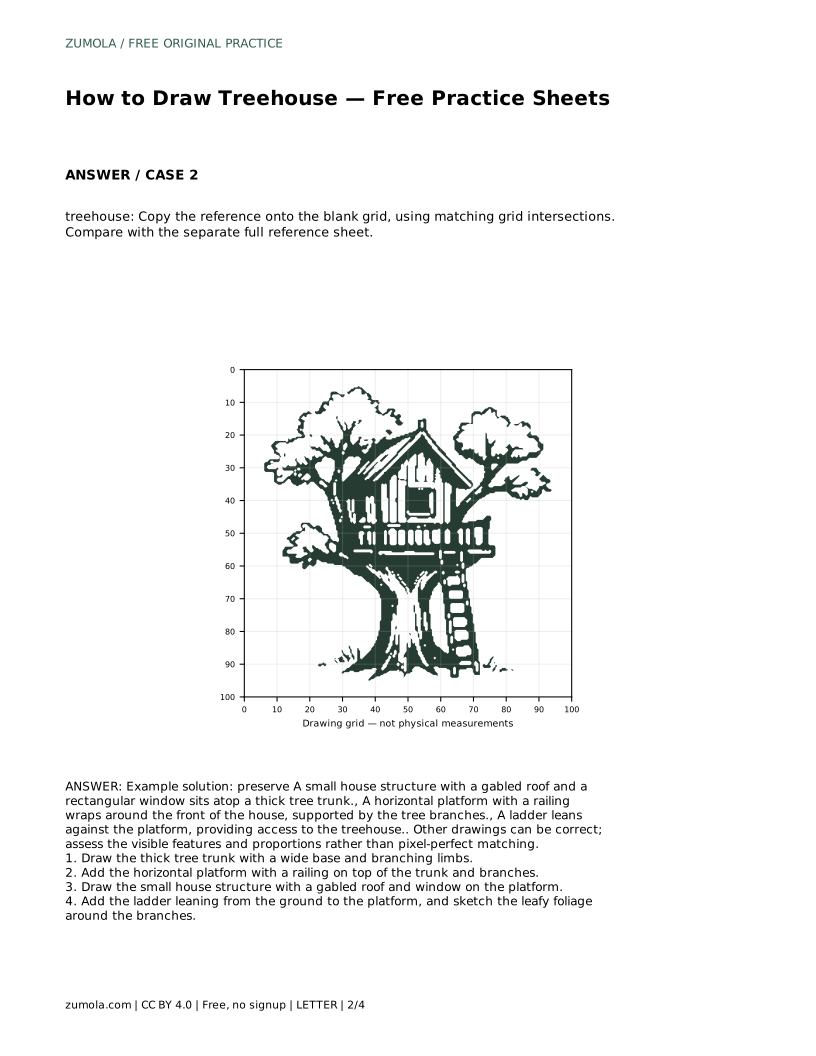
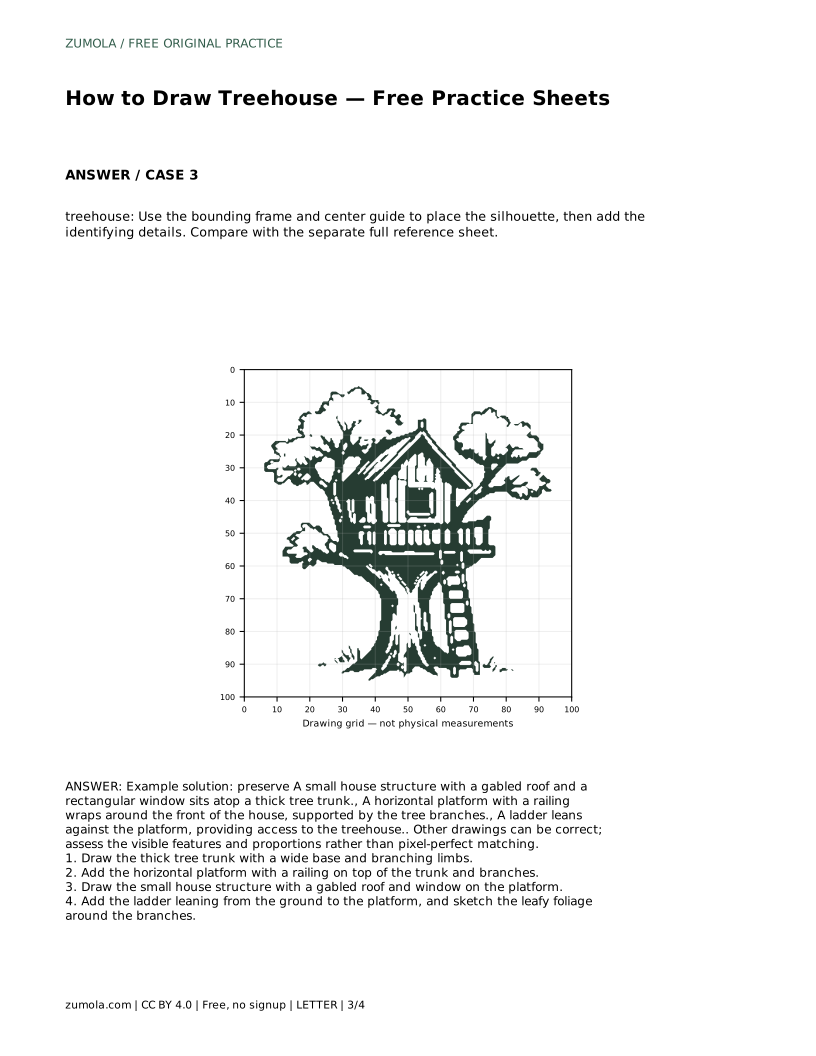
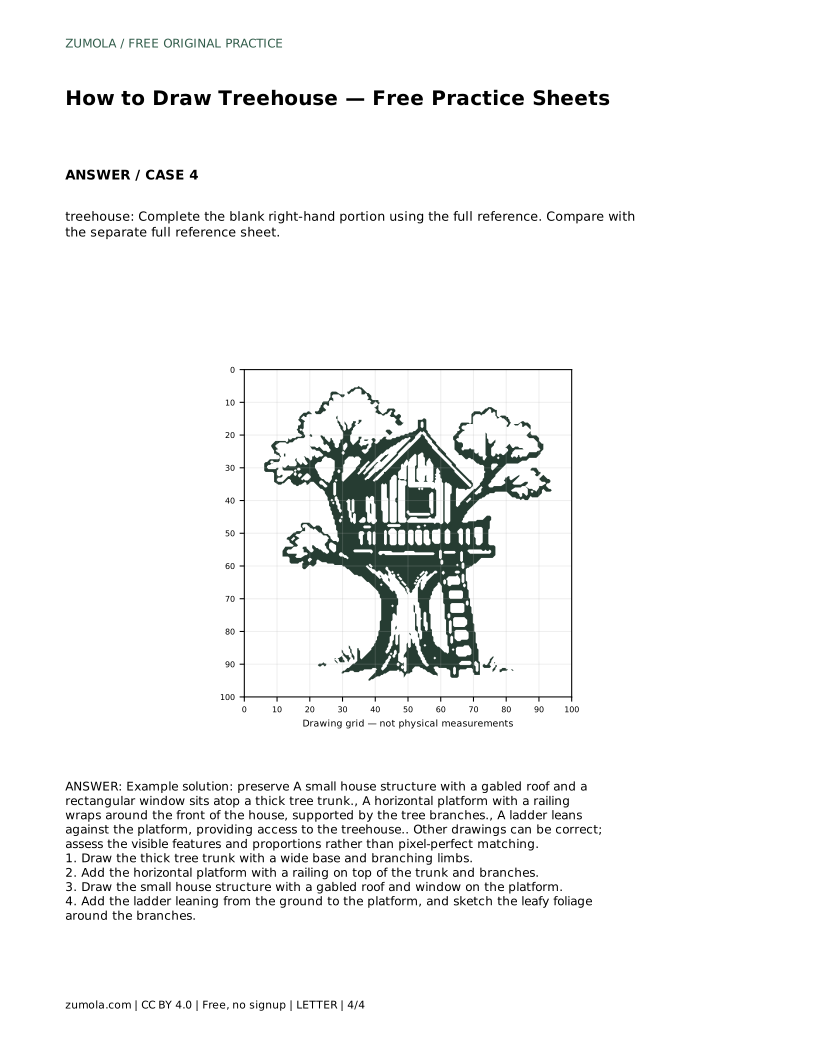
Reference diagrams
LETTER · Download PDF
A4 · Download PDF
Free original resources
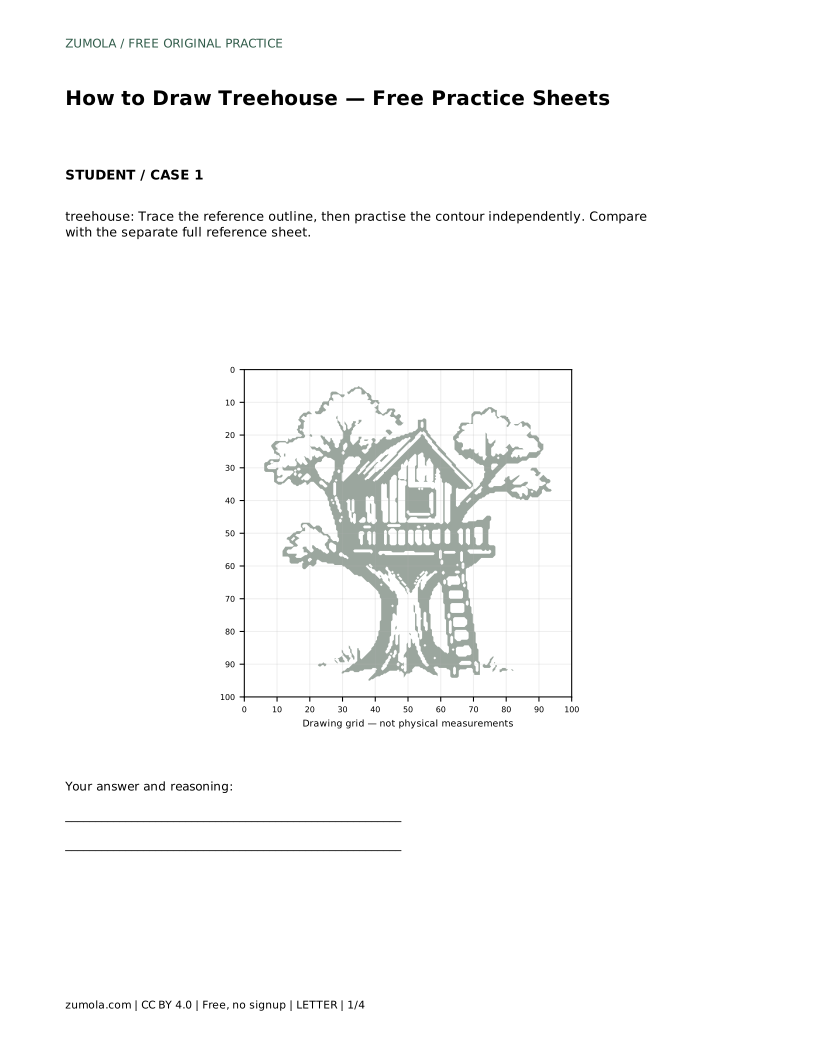
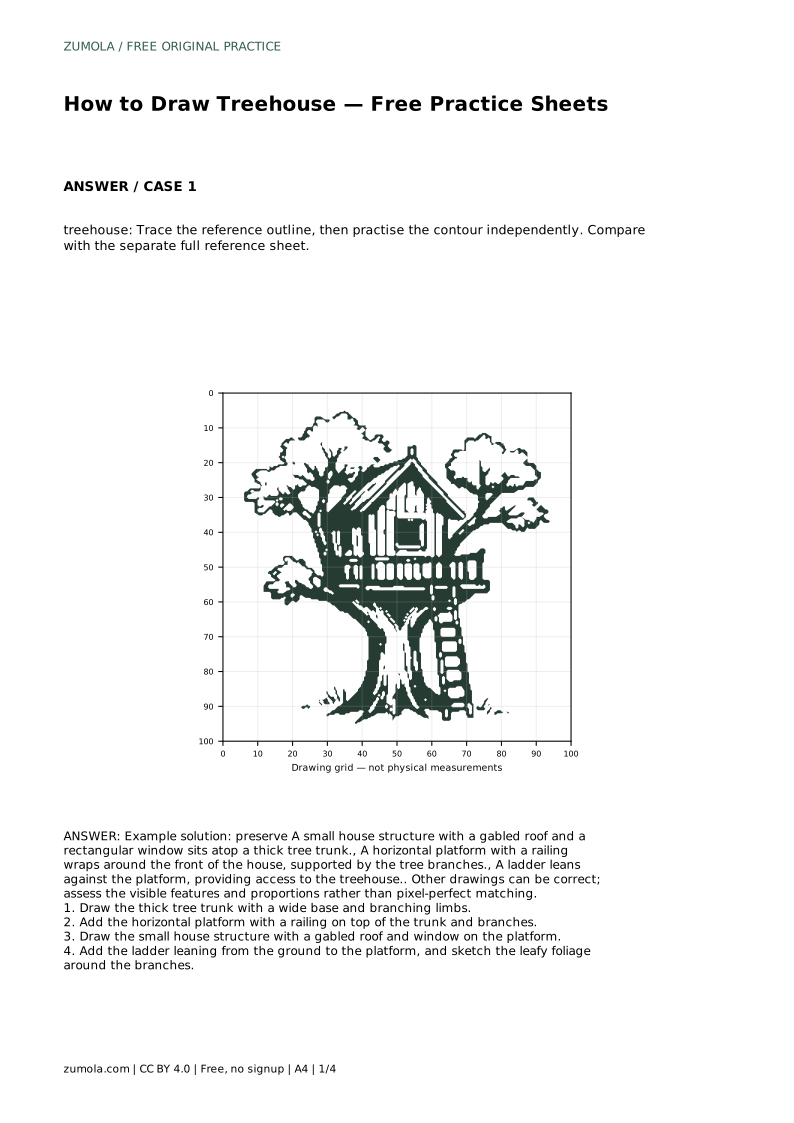
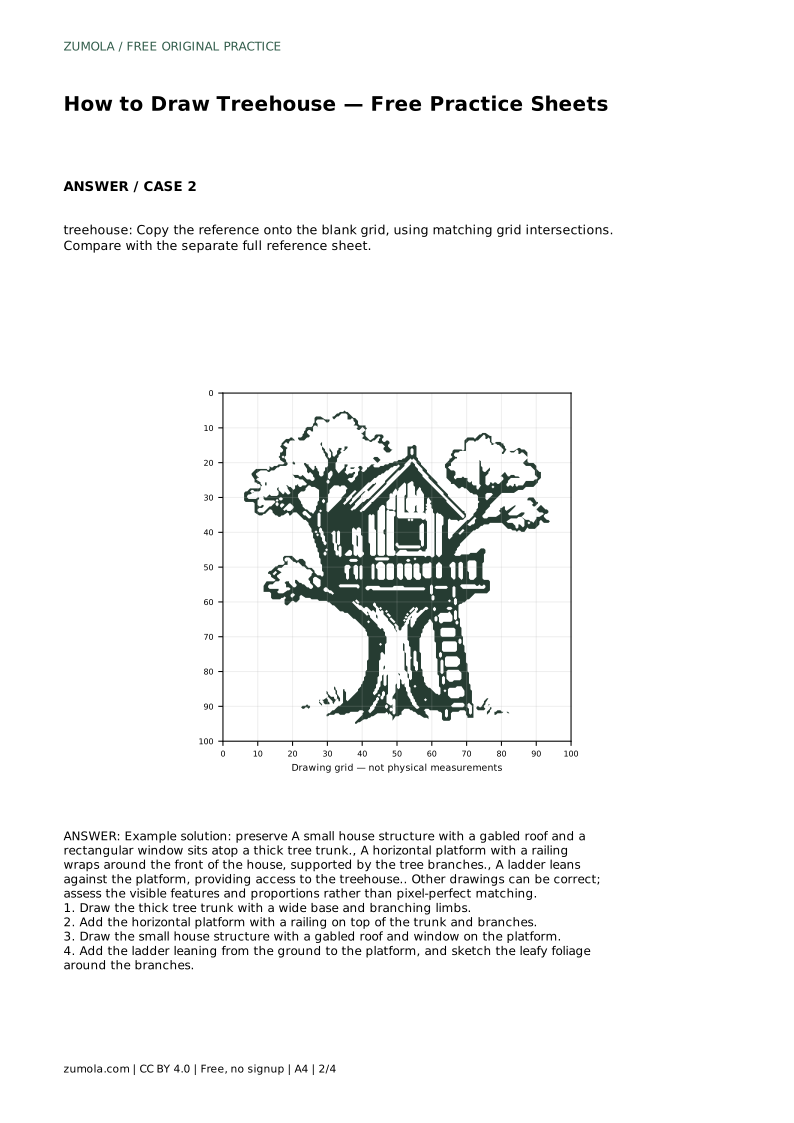
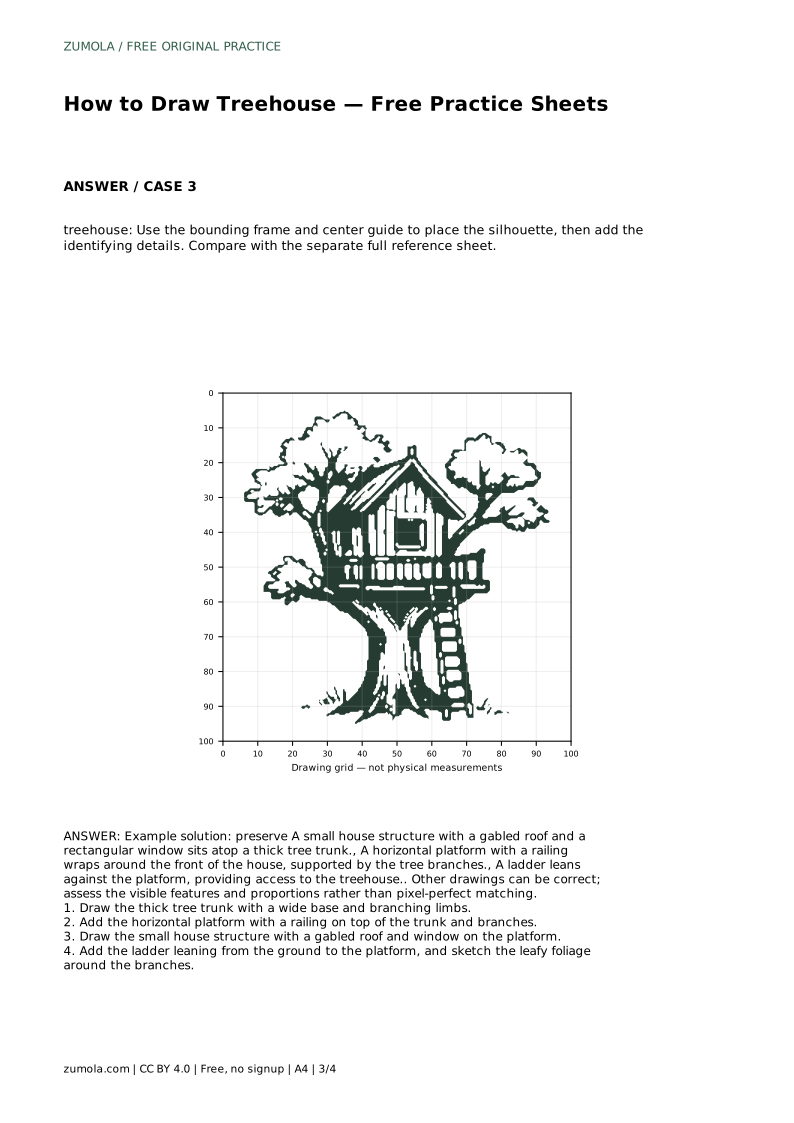
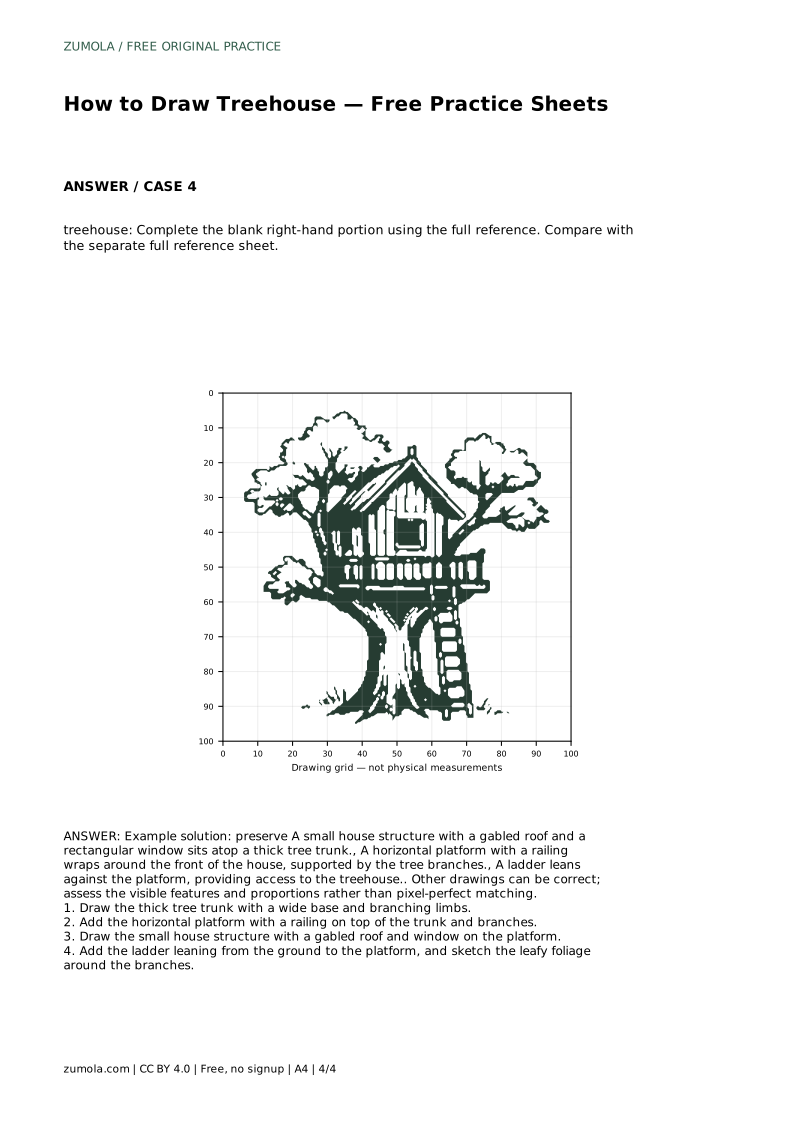
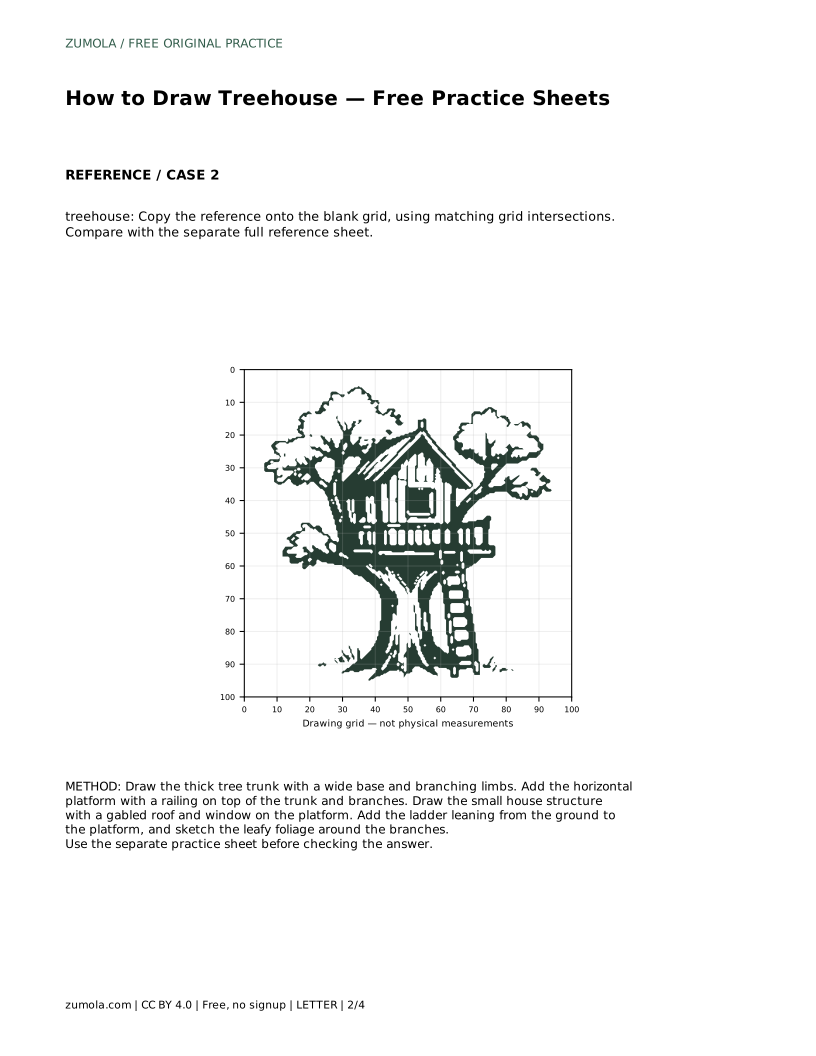
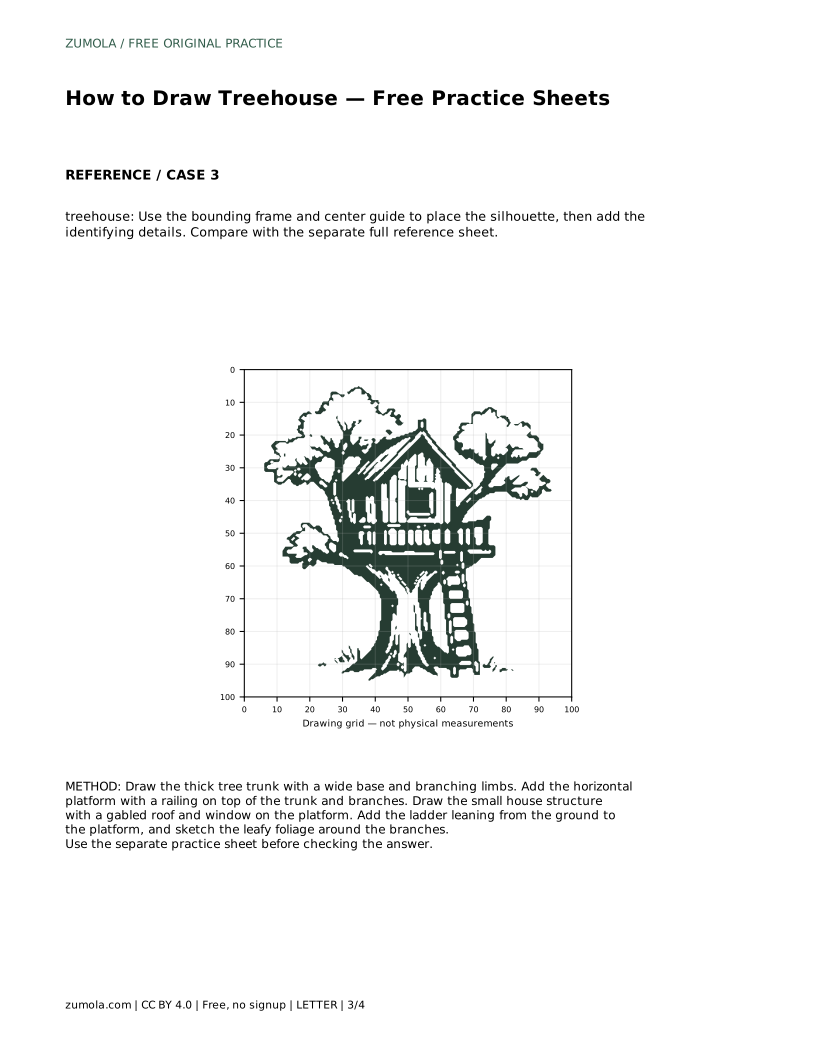
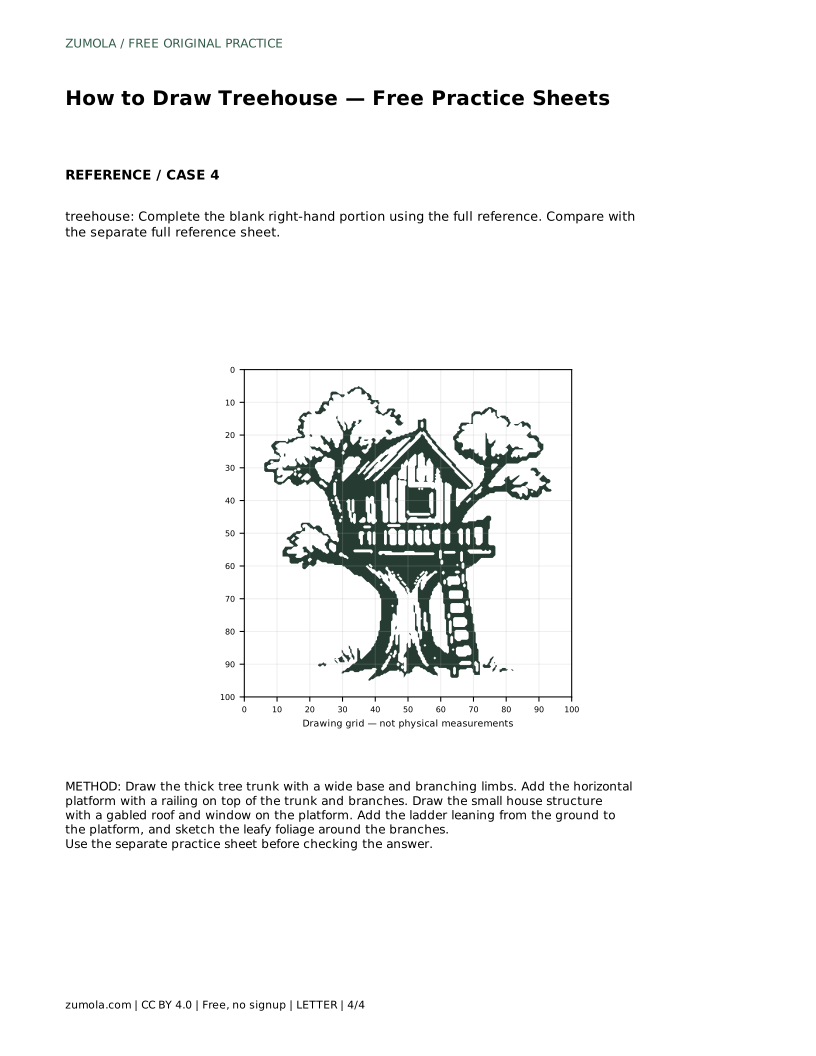
Learn to draw a treehouse with a thick trunk, railed platform, gabled house, window, ladder, and foliage. Trace, grid, and complete practice sheets build the same core skills.
Four original cases, with reference diagrams, practice sheets and worked answers. Everything is free; no signup required.
LETTER · Download PDF
A4 · Download PDF
LETTER · Download PDF
A4 · Download PDF
LETTER · Download PDF
A4 · Download PDF
Use A4 or US Letter to match your printer. Use the stated values and conditions to solve each exercise; diagrams are not physical measuring rulers.
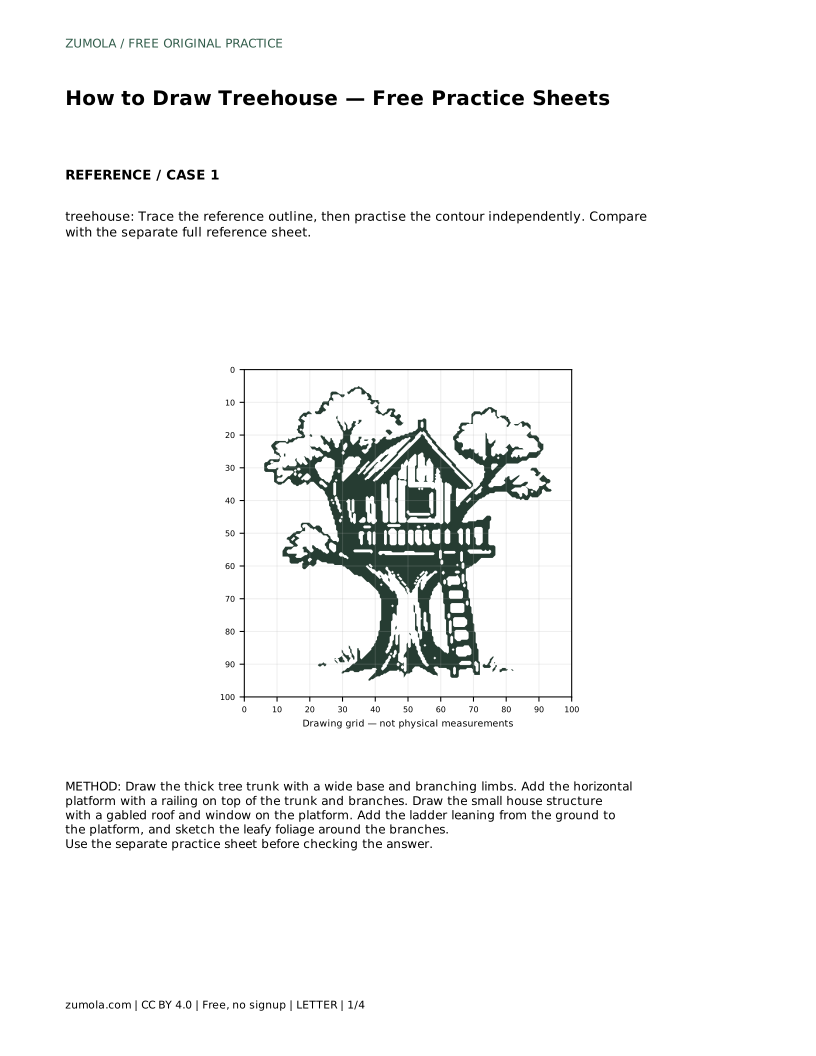
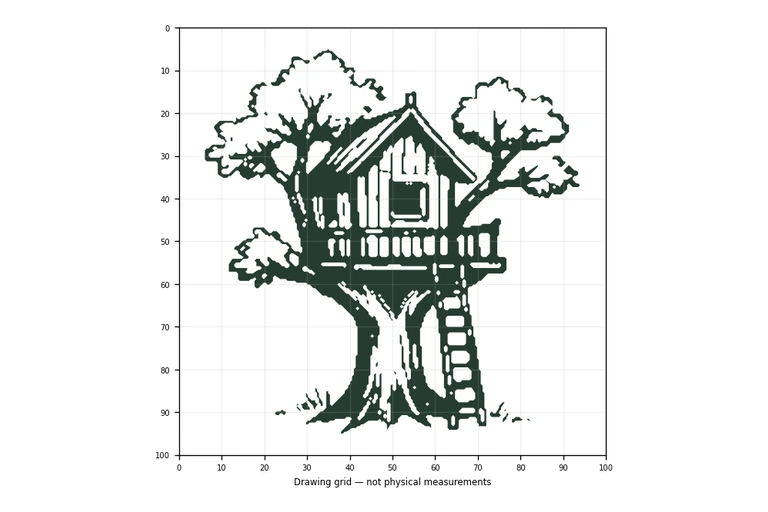
A drawing of a treehouse works best when you build it in layers: the tree supports everything, the platform sits on the tree, and the house sits on the platform. This guide explains how to place those parts in a believable order, how to use tracing, grid, and partial-completion practice sheets, and how to judge your own drawing by visible features and proportions rather than an exact match.
Start with the tree, because every other part depends on it. Draw a thick trunk with a wide base that narrows slightly as it rises, then add branching limbs that spread outward. The trunk should look strong enough to carry weight. Keep the base wide and the upper limbs thinner so the tree reads as stable rather than top-heavy.
Next, place a horizontal platform across the trunk and branches. A platform that tilts or floats away from the tree will make the whole drawing feel unstable, so keep its top edge roughly level and let it rest visibly on the supporting limbs. Add a railing around the front of the platform. The railing gives the platform a clear edge and makes the house above feel safe and intentional.
Then draw the small house on the platform. A gabled roof and a rectangular window are the identifying features: the roof gives the house its shape, and the window gives it scale. Finally, add a ladder leaning from the ground to the platform and sketch leafy foliage around the branches. The ladder connects the ground to the structure, and the foliage softens the branch ends without hiding the main forms.
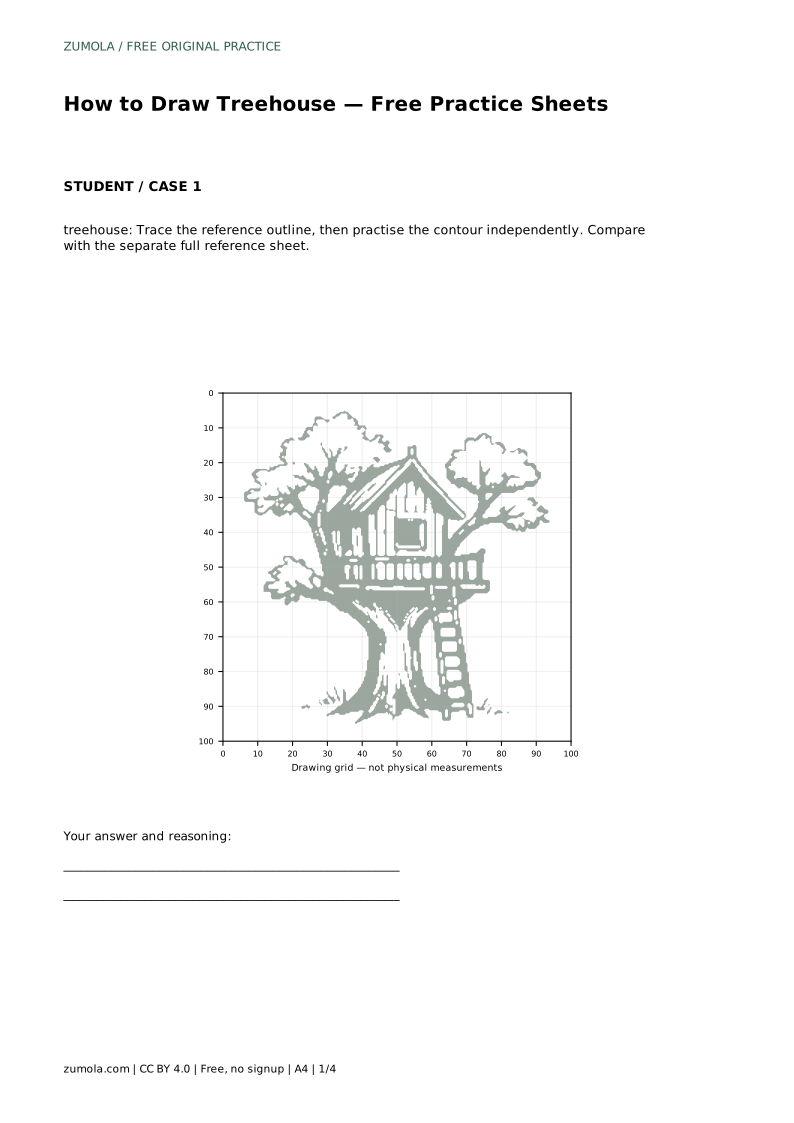
The trace sheet asks you to follow the reference outline first, then practise the contour independently. Tracing teaches the sequence of the forms; the independent pass shows whether you can reproduce that sequence without help. Compare your result with the separate full reference sheet afterward.
The grid sheet asks you to copy the reference onto a blank grid using matching grid intersections. Grids help with placement and proportion: instead of guessing where the platform or roof begins, you match a feature to a nearby intersection. Work one square at a time and check the position of each major line before adding detail.
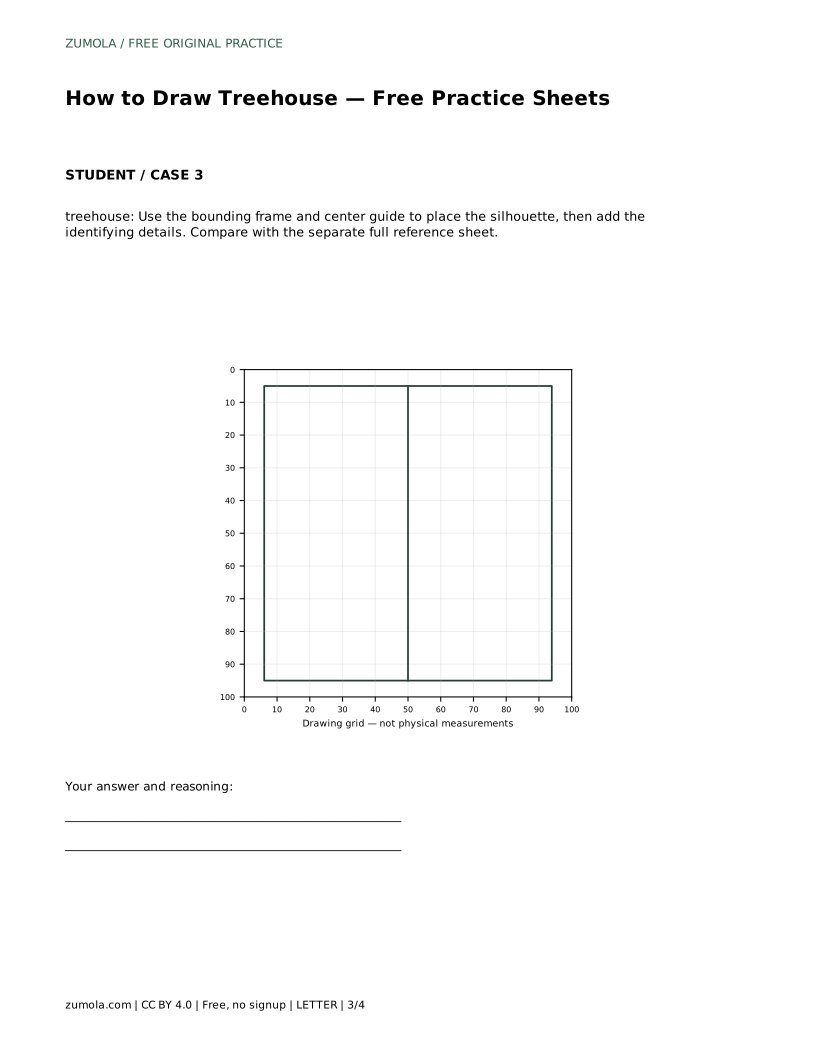
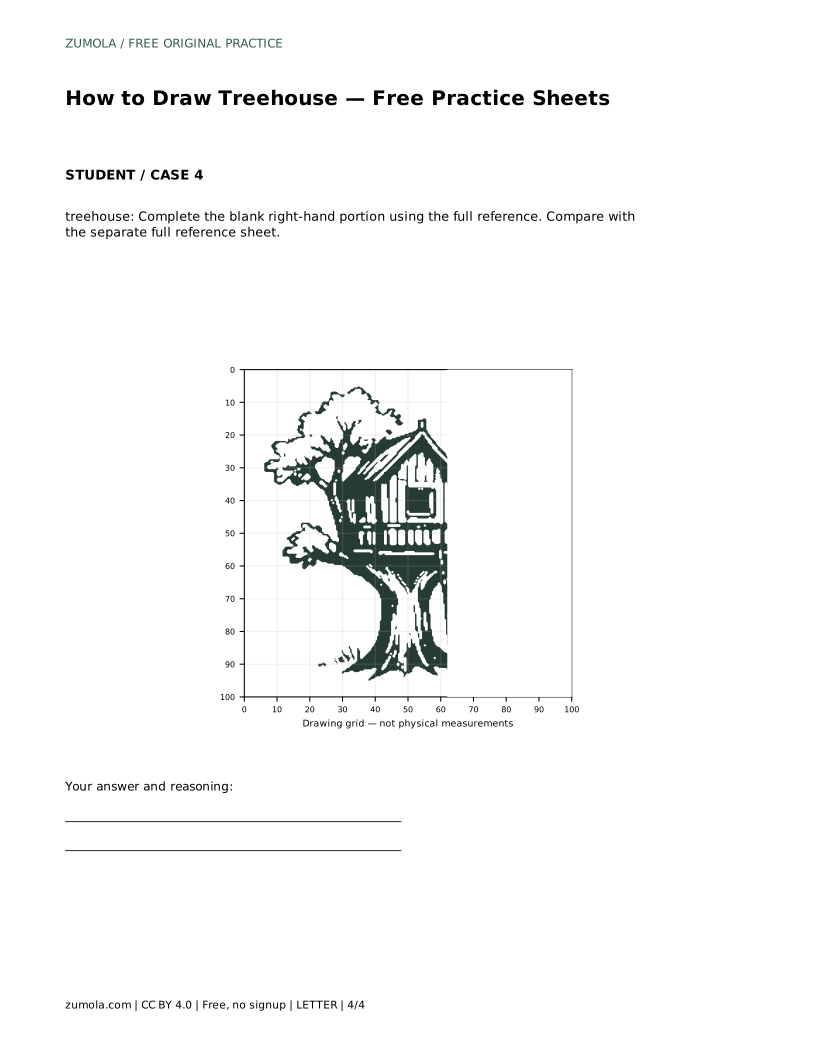
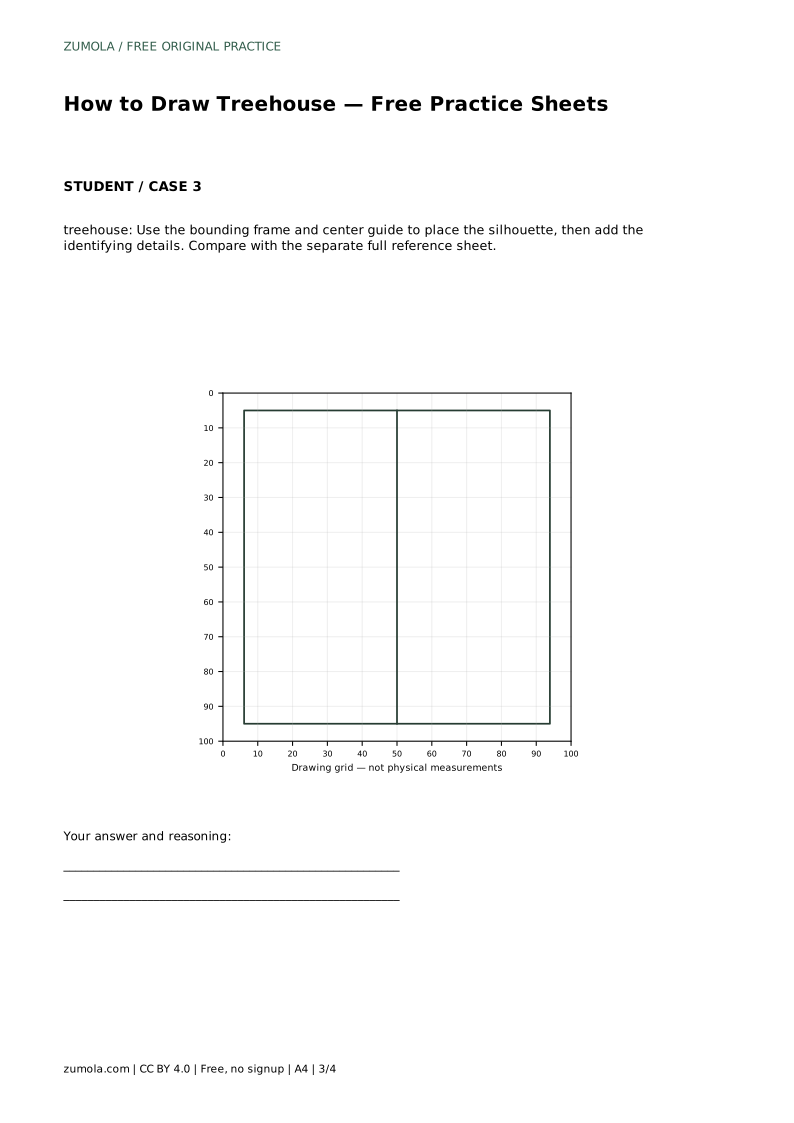
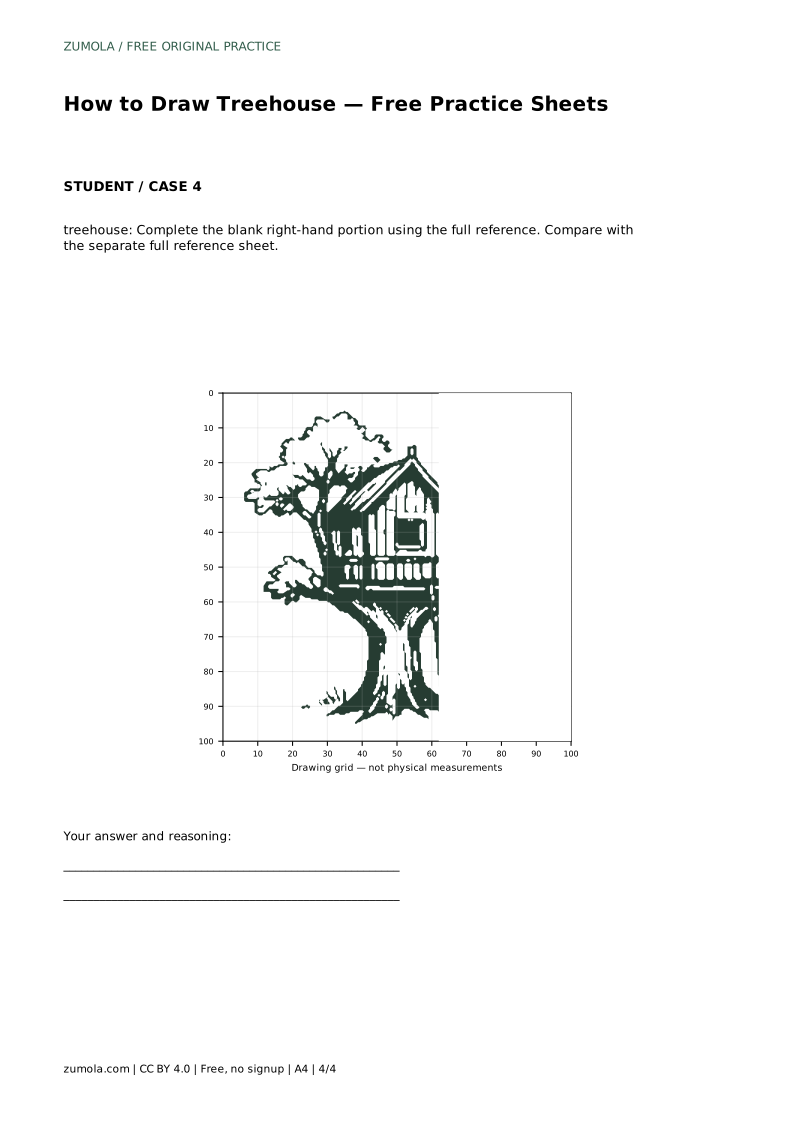
The bounding-frame sheet gives you a frame and center guide. Use them to place the overall silhouette first, then add the identifying details. The partial-completion sheet gives you the left portion and asks you to finish the blank right-hand portion using the full reference. In both cases, compare with the separate full reference sheet at the end, not while you are still placing the main shapes.
A believable treehouse depends on relationships between parts. The platform should be wide enough to hold the house and railing, the house should sit fully on the platform, and the ladder should reach from the ground to the platform edge. Check that the trunk meets the platform rather than passing through the house, and that the railing follows the platform edge instead of drifting into open air.
Foliage is the most flexible part. Leaves can cluster densely or sparsely, and branches can curve in many directions. Treat foliage as a finishing layer: sketch loose clusters around the branch ends, then refine only the shapes you want to keep. Because drawings can be correct in different ways, assess visible features and proportions rather than pixel-perfect matching.
Prompt: treehouse: Trace the reference outline, then practise the contour independently. Compare with the separate full reference sheet.
Example solution: preserve A small house structure with a gabled roof and a rectangular window sits atop a thick tree trunk., A horizontal platform with a railing wraps around the front of the house, supported by the tree branches., A ladder leans against the platform, providing access to the treehouse.. Other drawings can be correct; assess the visible features and proportions rather than pixel-perfect matching.
treehouse: Trace the reference outline, then practise the contour independently. Compare with the separate full reference sheet.
Example solution: preserve A small house structure with a gabled roof and a rectangular window sits atop a thick tree trunk., A horizontal platform with a railing wraps around the front of the house, supported by the tree branches., A ladder leans against the platform, providing access to the treehouse.. Other drawings can be correct; assess the visible features and proportions rather than pixel-perfect matching. Draw the thick tree trunk with a wide base and branching limbs. Add the horizontal platform with a railing on top of the trunk and branches. Draw the small house structure with a gabled roof and window on the platform. Add the ladder leaning from the ground to the platform, and sketch the leafy foliage around the branches.
No. Other drawings can be correct. Assess the visible features and proportions rather than pixel-perfect matching.
Trunk first, then the platform and railing, then the house with its gabled roof and window, then the ladder and foliage.
Copy the reference onto the blank grid using matching grid intersections, placing major features before adding detail.
All drawing practice · Free coordinate paper
Original resources · CC BY 4.0 · Free for personal and classroom use with attribution.