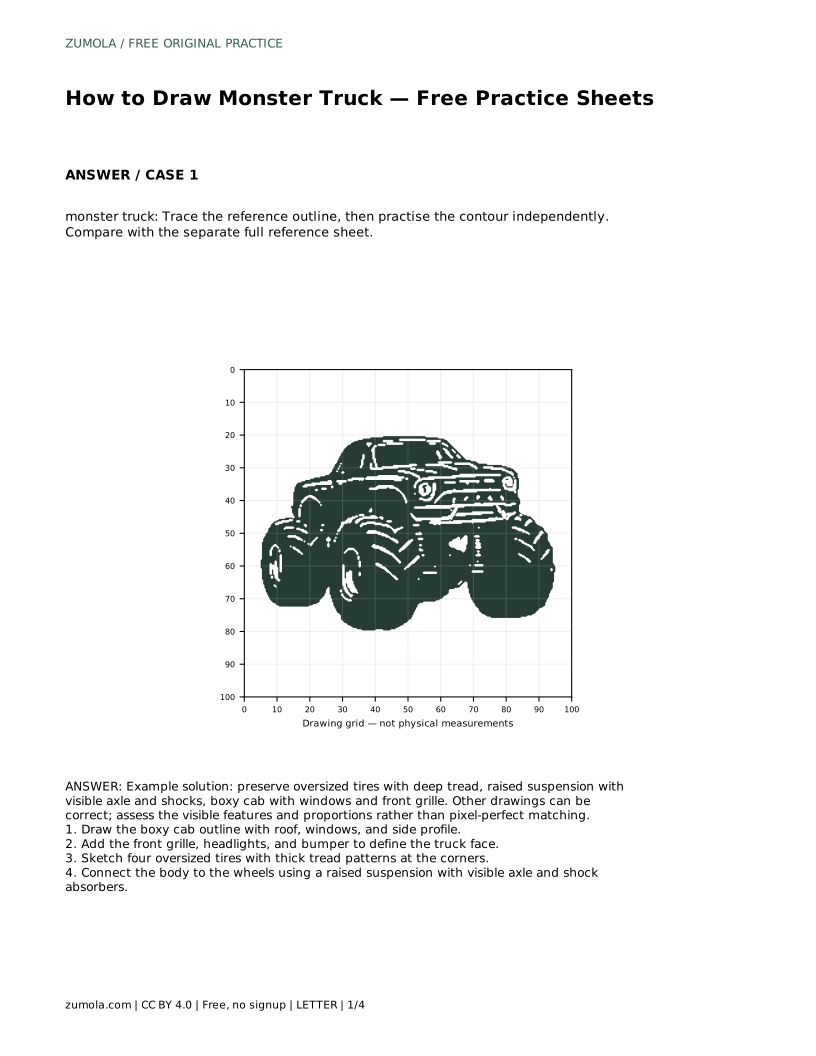
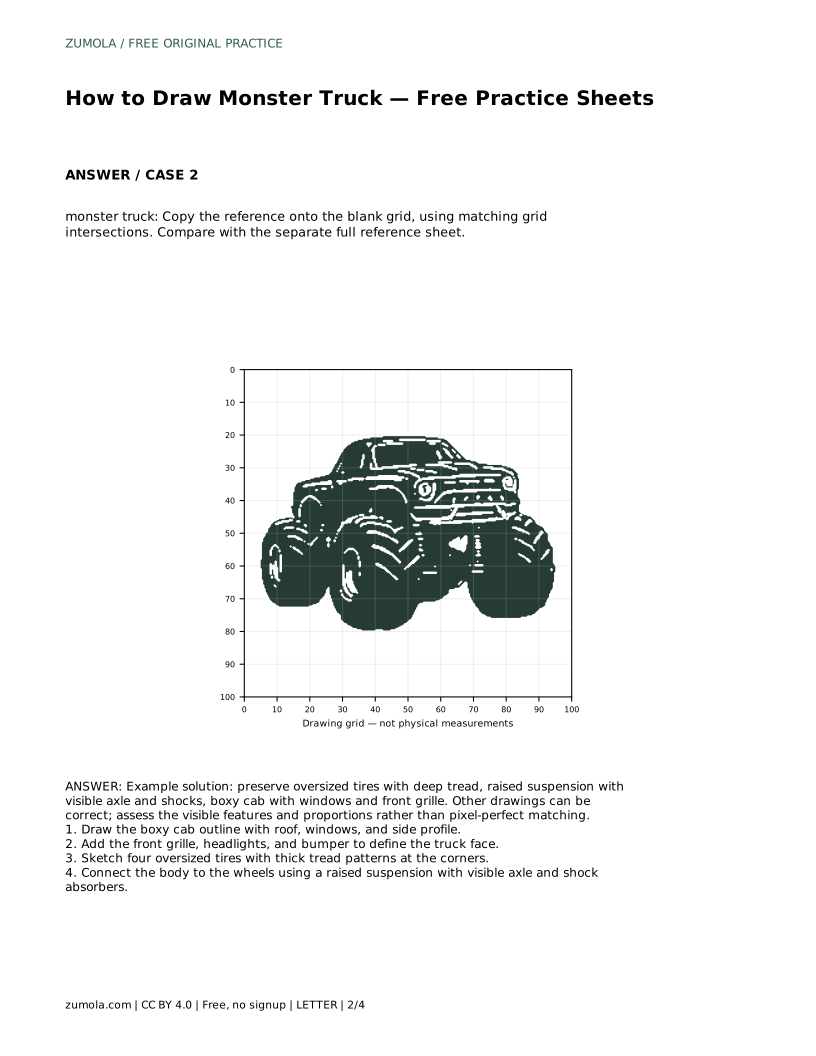
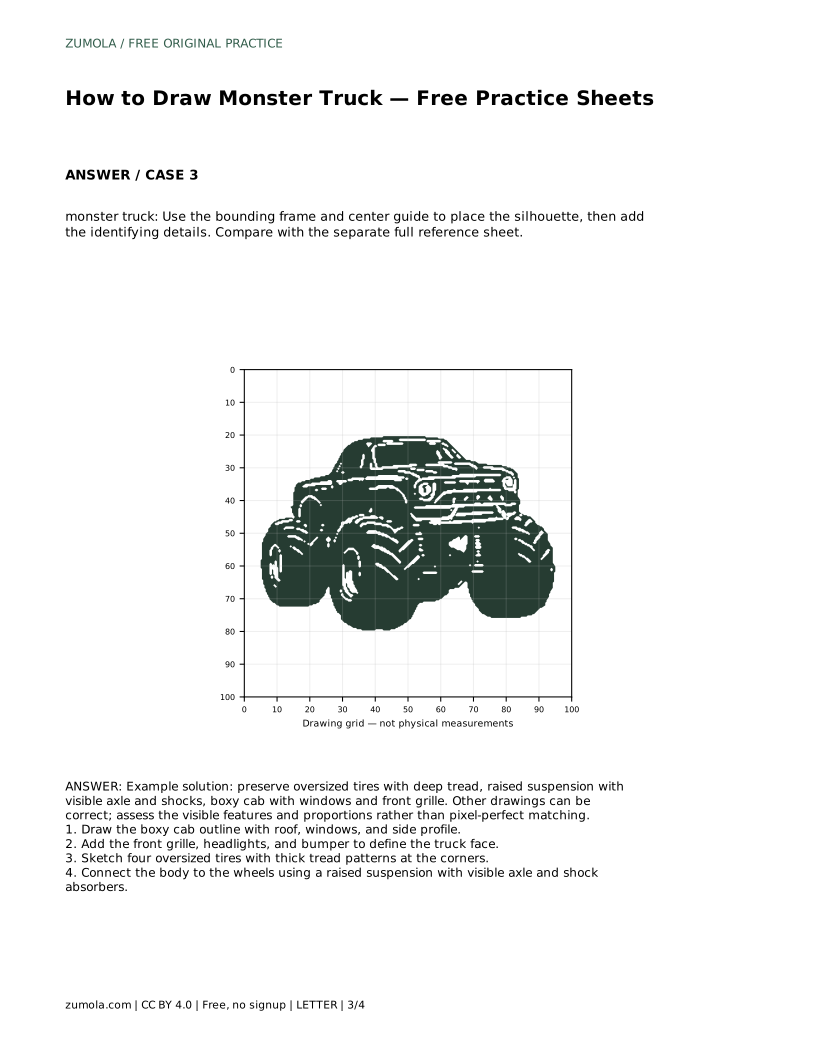
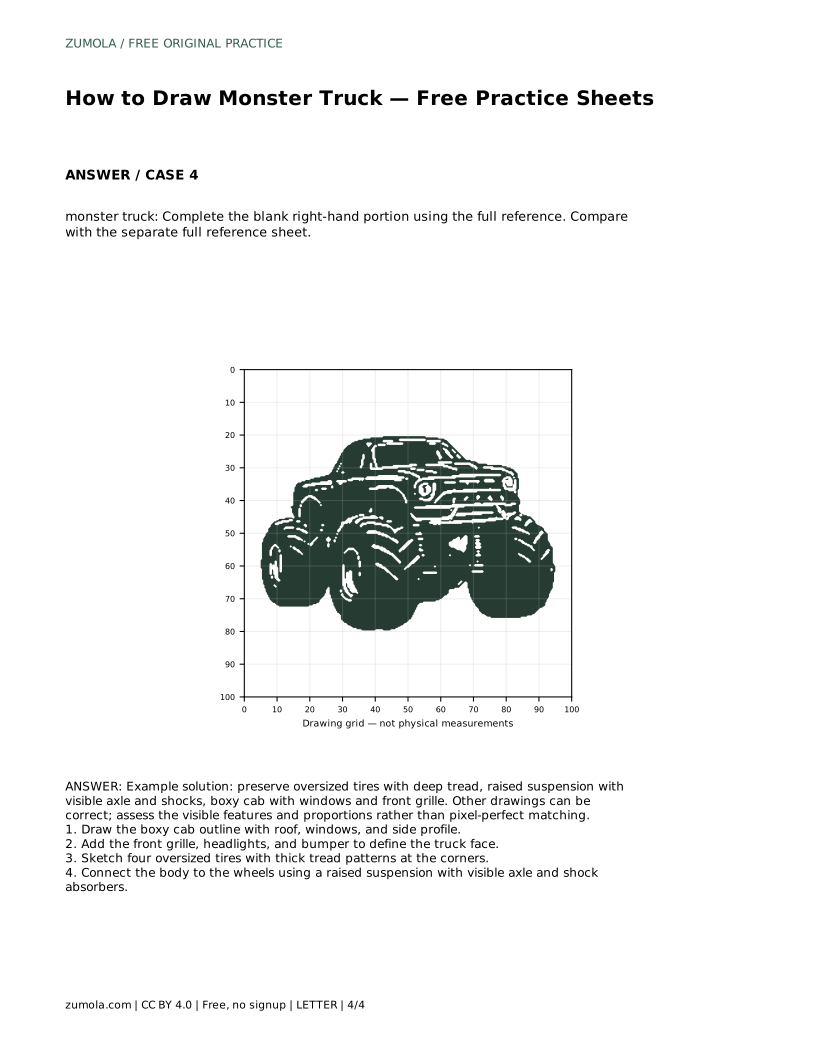
Reference diagrams
LETTER · Download PDF
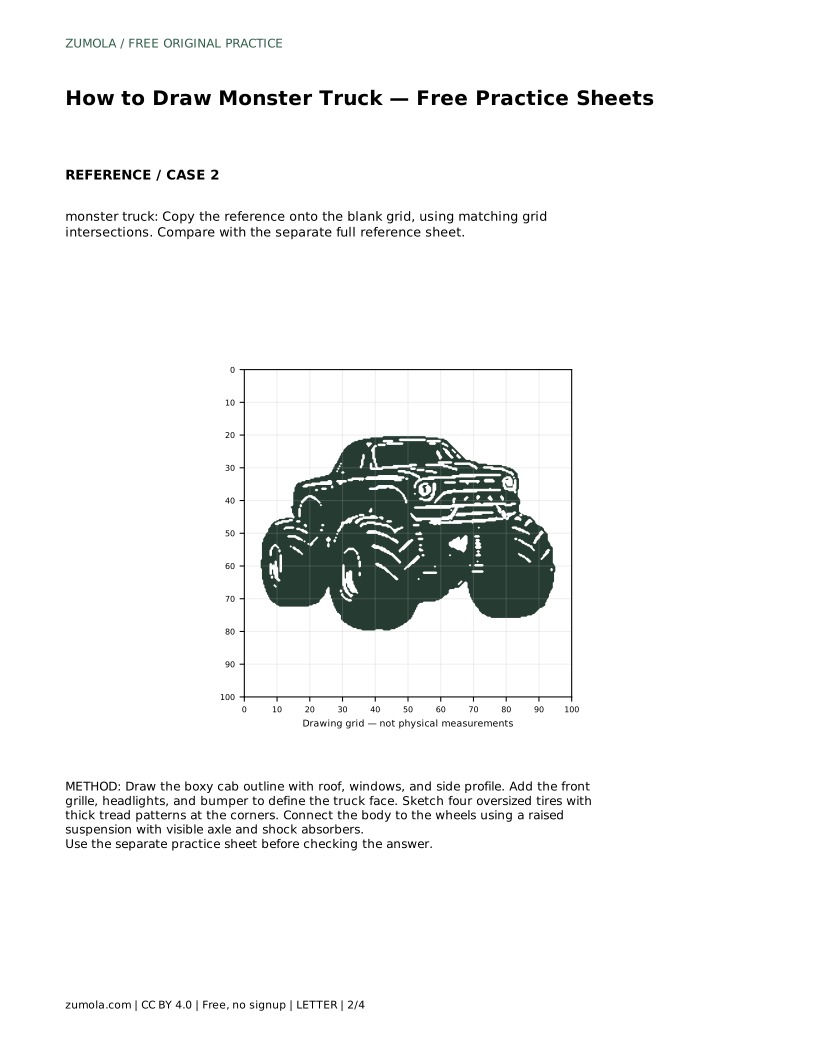
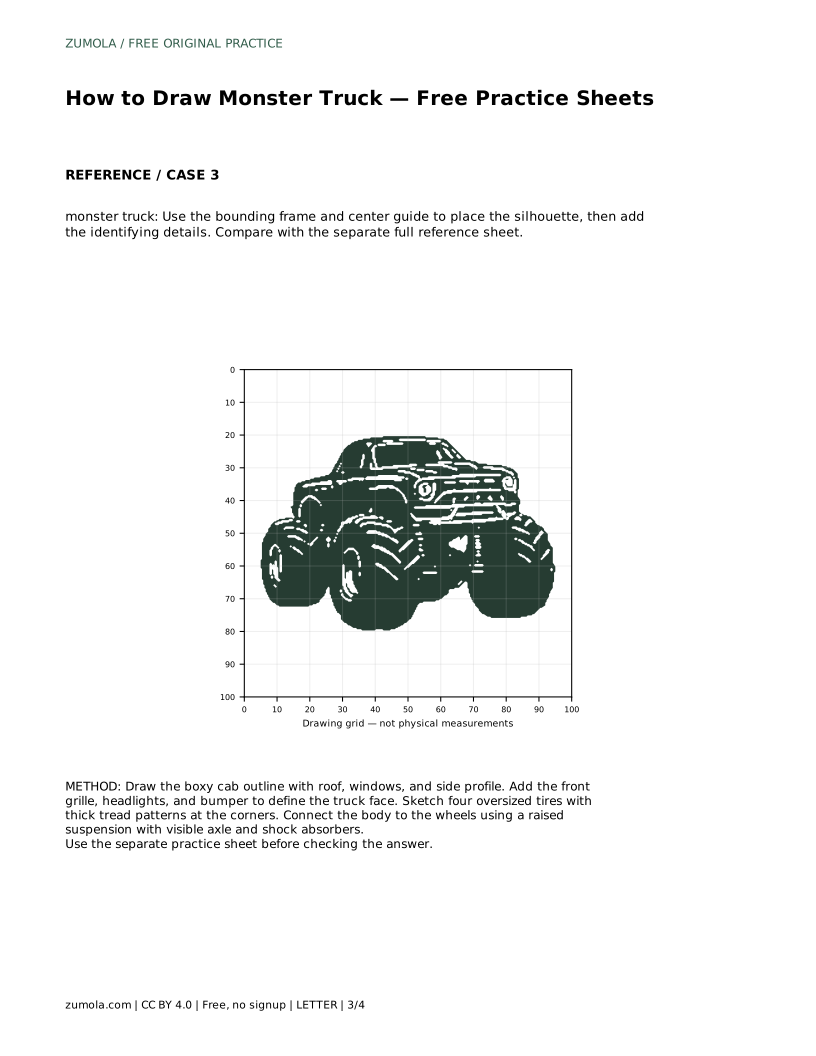
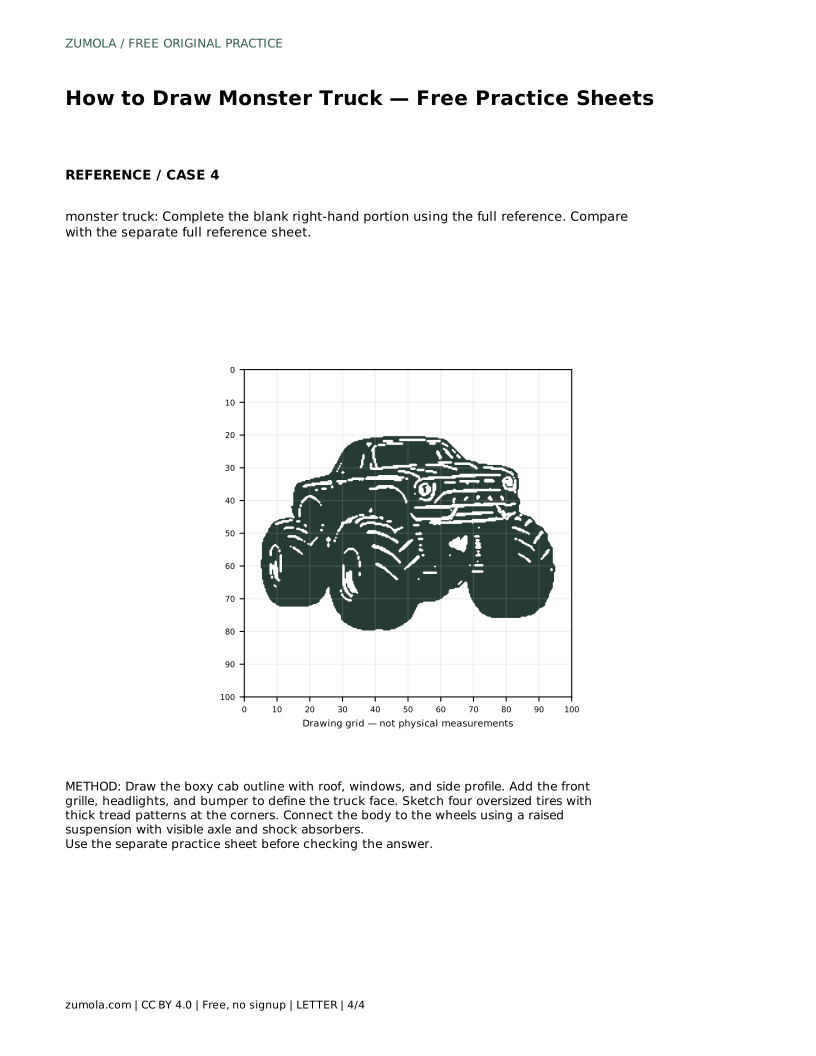
A4 · Download PDF
Free original resources
Learn to draw a monster truck in pencil: boxy cab, grille, oversized treaded tires, and raised suspension. Trace, grid, and frame practice sheets included.
Four original cases, with reference diagrams, practice sheets and worked answers. Everything is free; no signup required.
LETTER · Download PDF
A4 · Download PDF
LETTER · Download PDF
A4 · Download PDF
LETTER · Download PDF
A4 · Download PDF
Use A4 or US Letter to match your printer. Use the stated values and conditions to solve each exercise; diagrams are not physical measuring rulers.
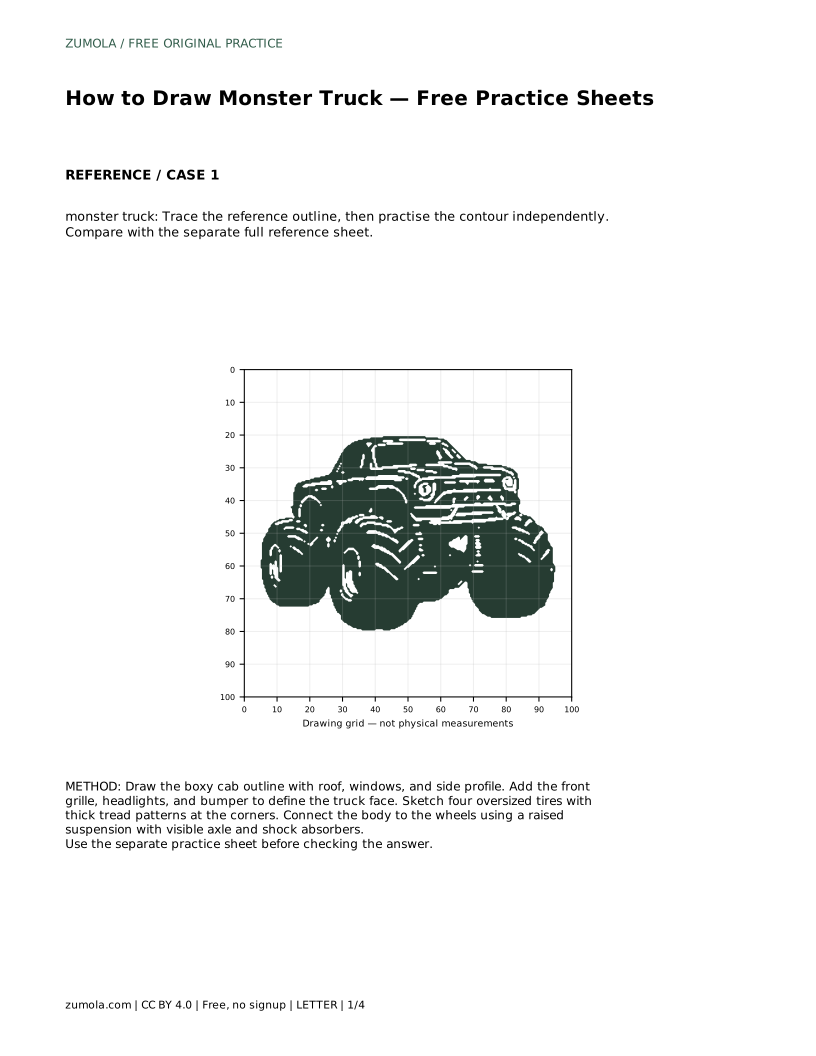
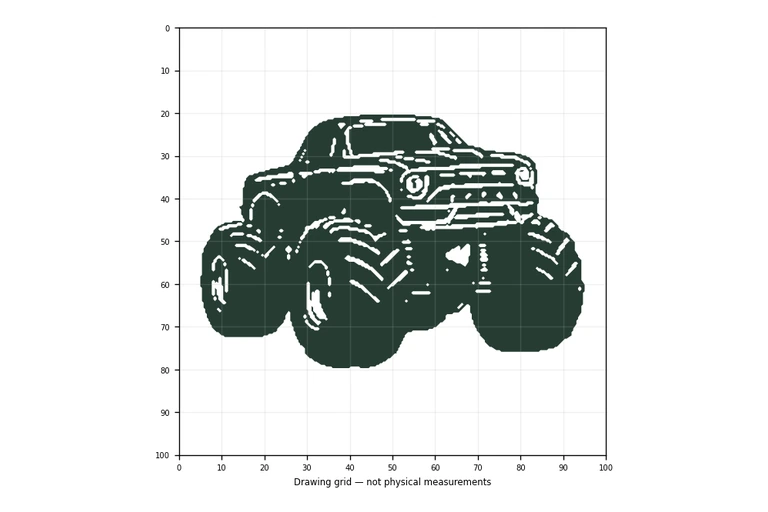
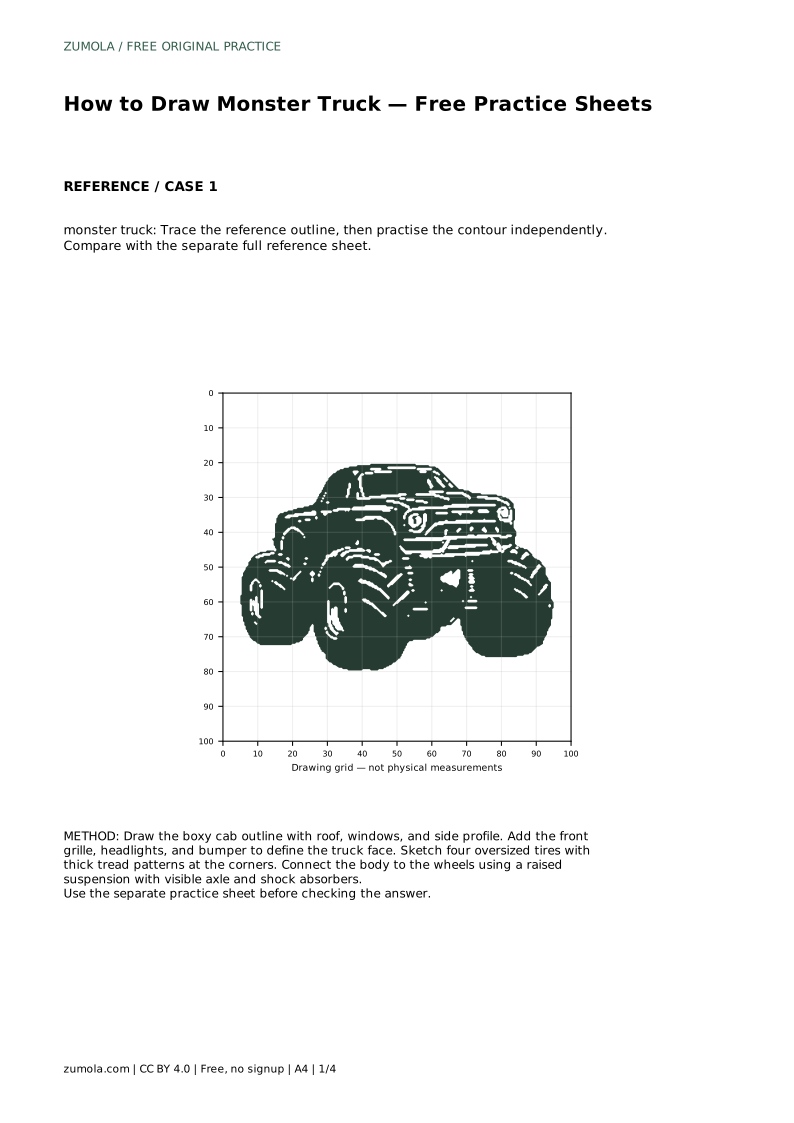
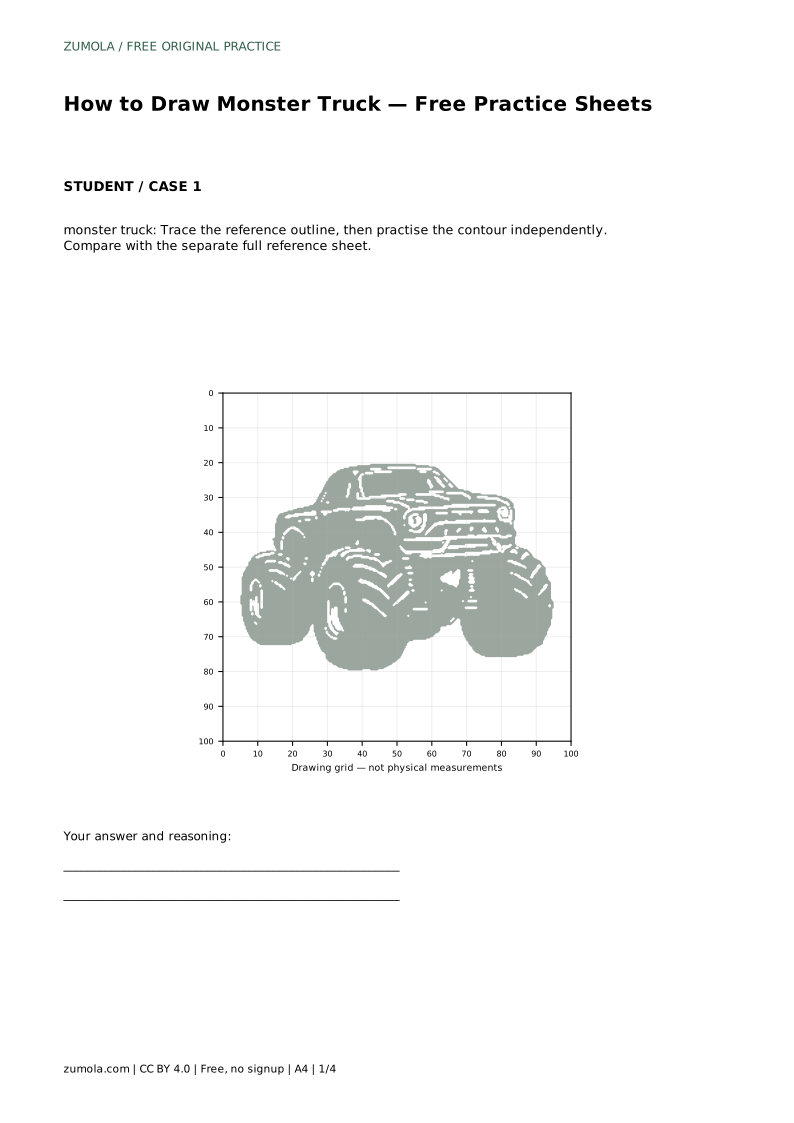
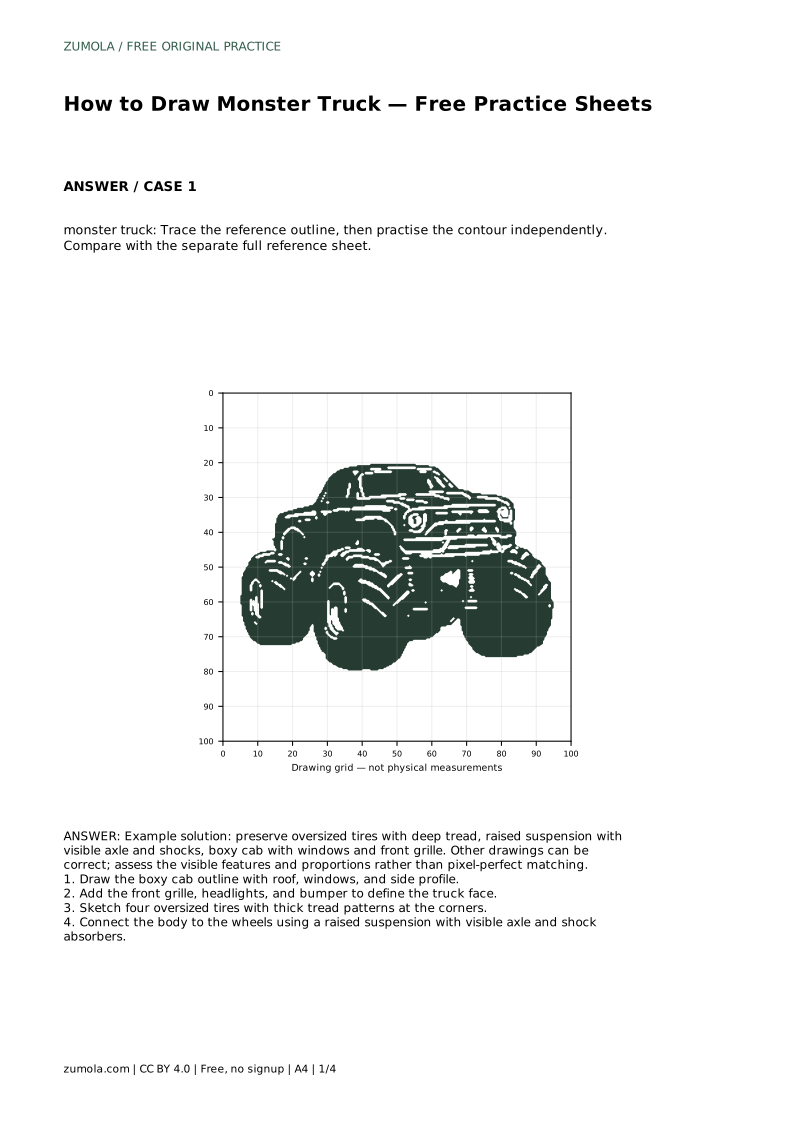
A monster truck drawing is mostly a study in contrast: a small, boxy cab sitting high above four enormous tires. This page explains how to build that shape in pencil, starting with the cab and working outward to the wheels and suspension. The practice sheets let you trace a reference outline first, then try the contour independently, so you can compare your drawing with a separate full reference sheet and judge which features you kept.
Begin with the cab because it anchors the whole drawing. Draw a boxy side profile: a flat roof, a near-vertical rear edge, and a front that slopes slightly. Add the windows as simple rectangles or trapezoids inside the cab outline, keeping the roofline straight. Then define the truck face at the front: a rectangular grille, two headlights, and a bumper below. These details are small compared with the tires, and that scale difference is what makes the drawing read as a monster truck rather than a pickup.
Keep your pencil lines light at this stage. You are placing shapes, not committing to final edges.
The tires are the signature feature. Sketch four circles or rounded rectangles at the corners of the drawing, making each one noticeably taller than the cab. A useful check: the tire diameter should be close to the cab height, or larger. Once the tire shapes are placed, add thick tread blocks around the outer edge. Draw them as repeated angled or rectangular shapes rather than a single outline, and keep the spacing even so the tread looks deliberate.
On the trace sheet, follow the reference outline closely. On the independent practice, draw the contour yourself first, then compare with the full reference sheet and adjust the tire size and tread spacing where they drifted.
Connect the body to the wheels with a raised suspension. Leave visible space between the cab floor and the top of each tire, then draw an axle line across and add shock absorbers as short angled or vertical shapes linking the body to the axle. This gap is what separates a monster truck from a low vehicle, so keep it clear rather than filling it in.
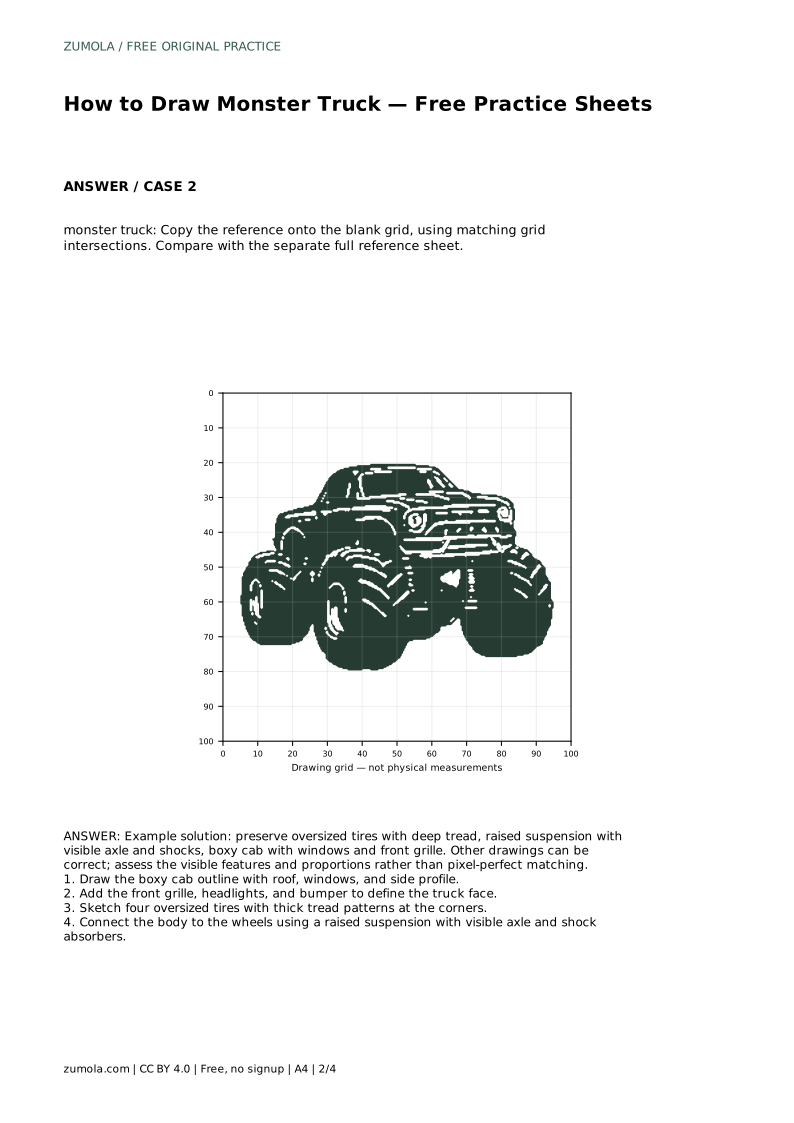
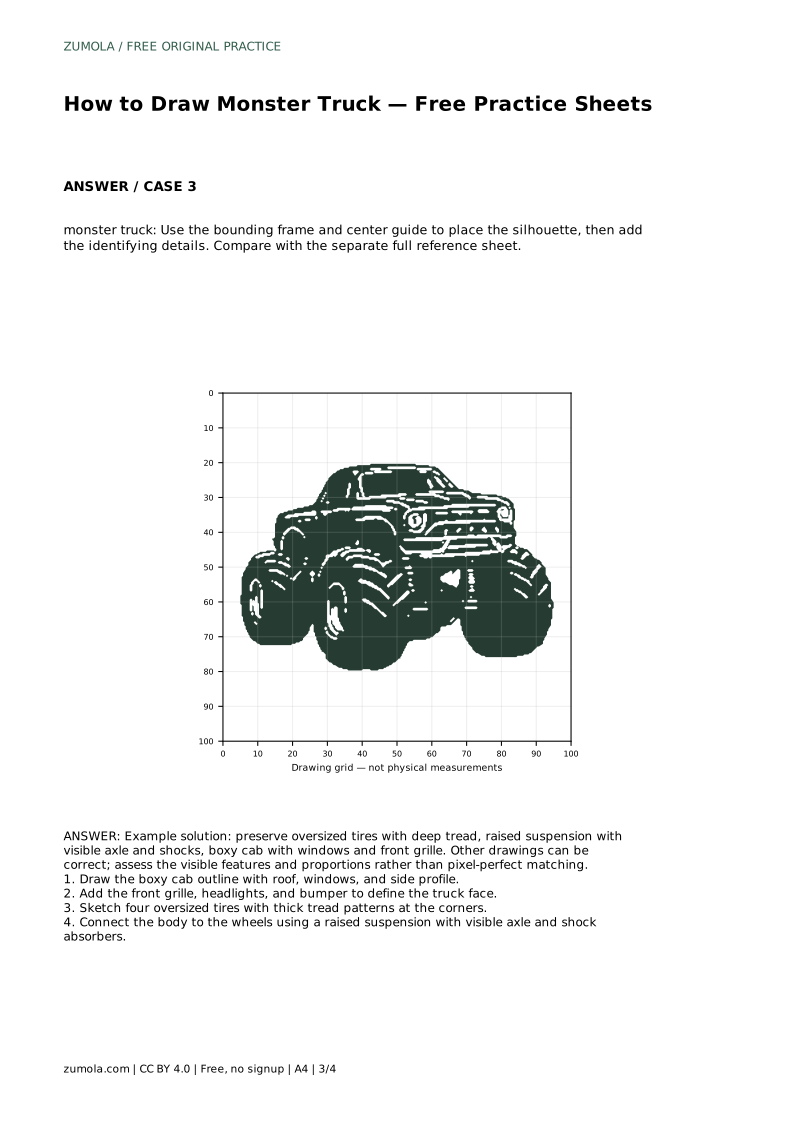
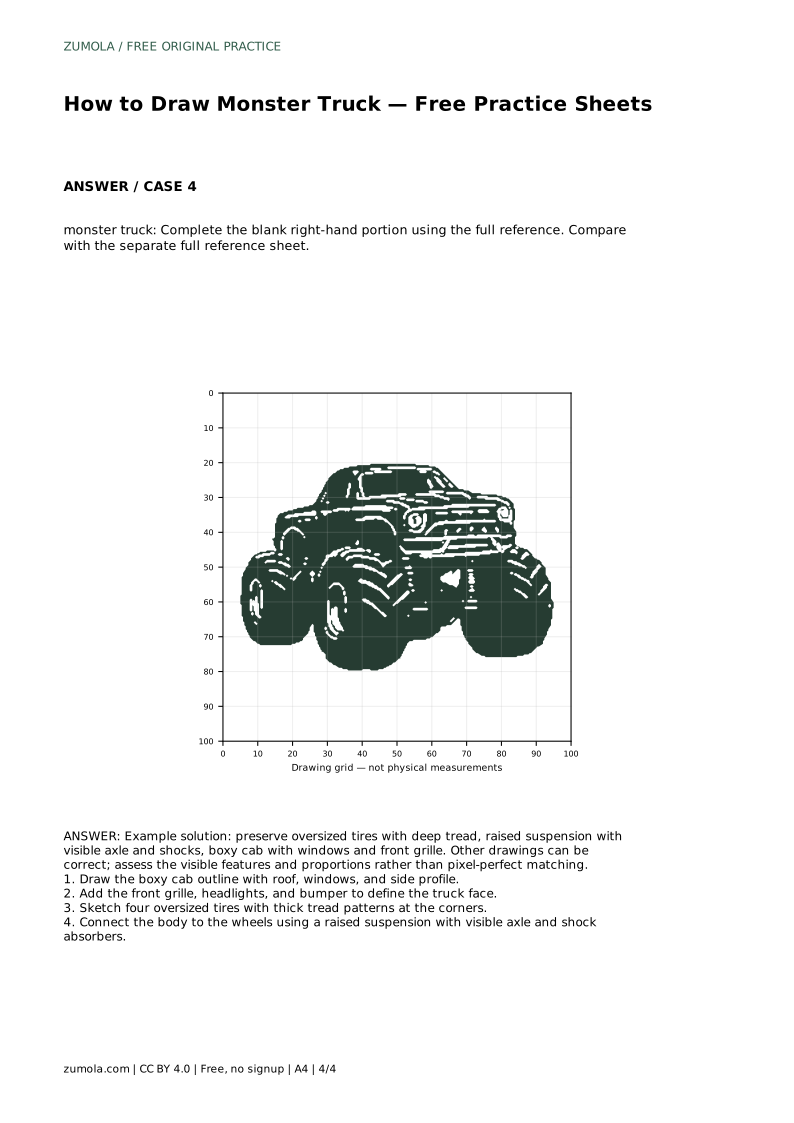
When the drawing is complete, compare it with the separate full reference sheet. Check four things: oversized tires, deep tread, a visible raised suspension with axle and shocks, and a boxy cab with windows and front grille. Other drawings can be correct, so assess the visible features and proportions rather than pixel-perfect matching.
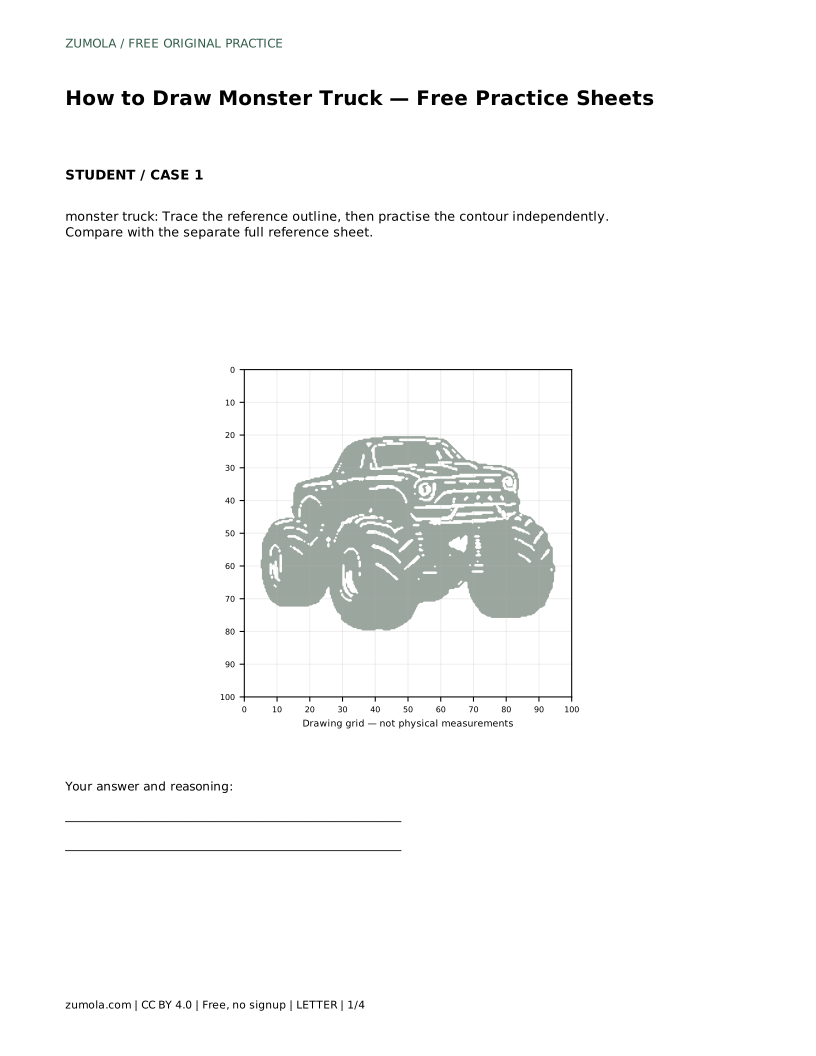
monster truck: Trace the reference outline, then practise the contour independently. Compare with the separate full reference sheet.
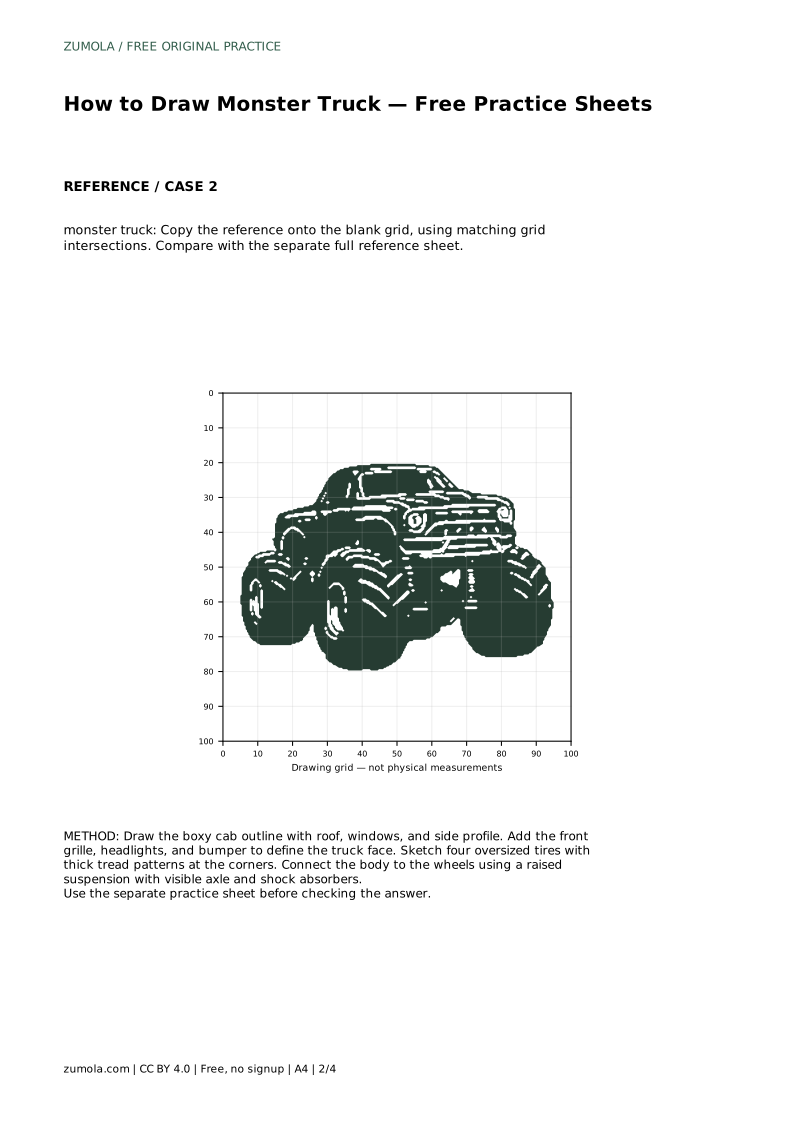
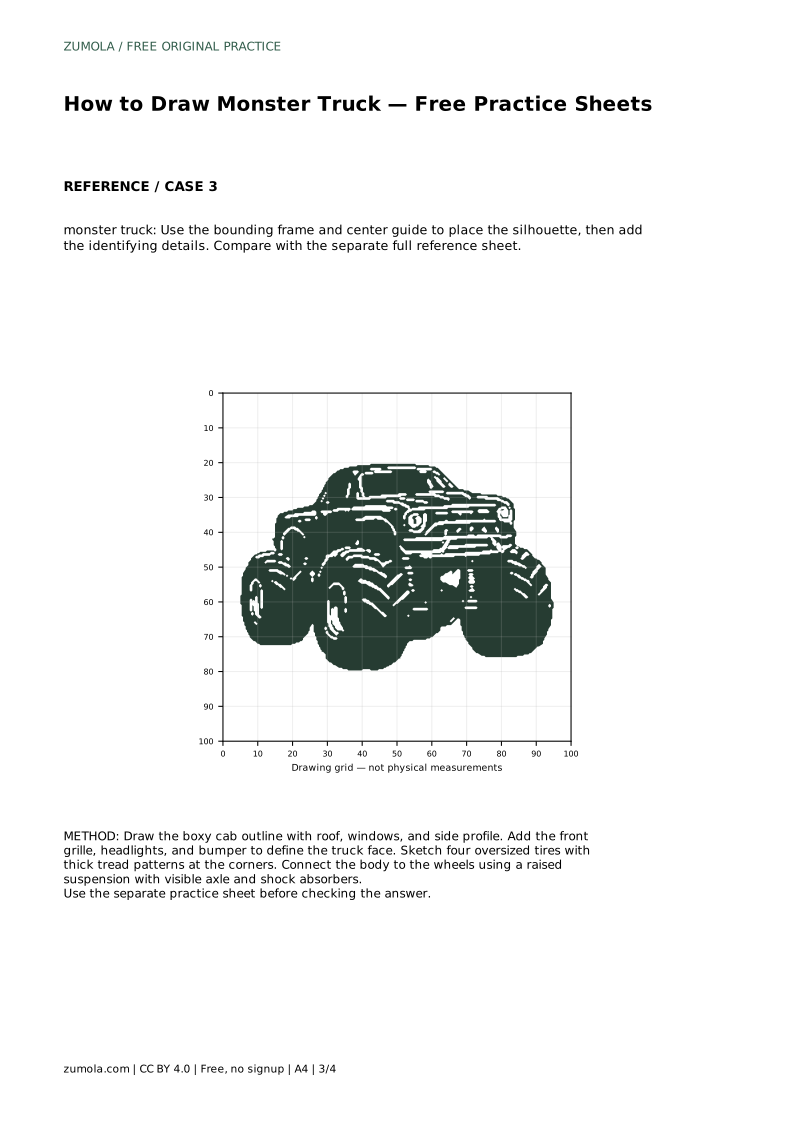
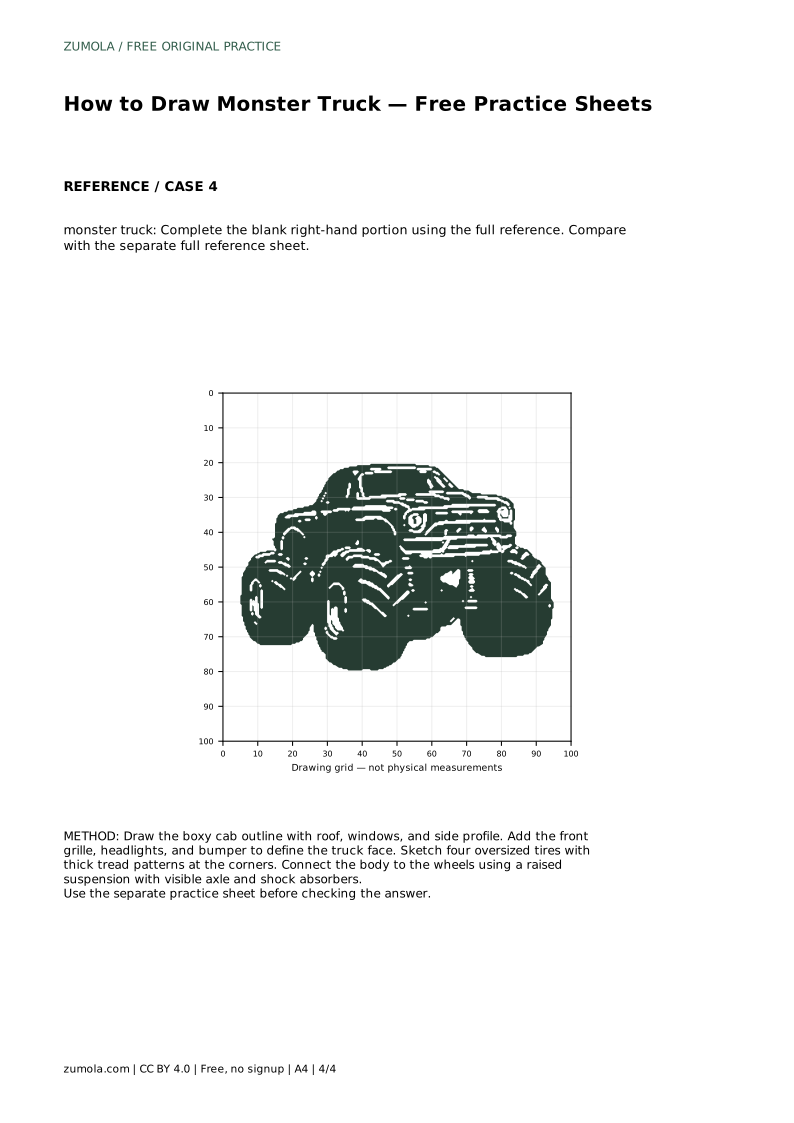
Example solution: preserve oversized tires with deep tread, raised suspension with visible axle and shocks, boxy cab with windows and front grille. Other drawings can be correct; assess the visible features and proportions rather than pixel-perfect matching. Draw the boxy cab outline with roof, windows, and side profile. Add the front grille, headlights, and bumper to define the truck face. Sketch four oversized tires with thick tread patterns at the corners. Connect the body to the wheels using a raised suspension with visible axle and shock absorbers.
No. Several drawings can be correct. Judge your work by whether the oversized tires, deep tread, raised suspension, and boxy cab with grille are clearly visible and in sensible proportion.
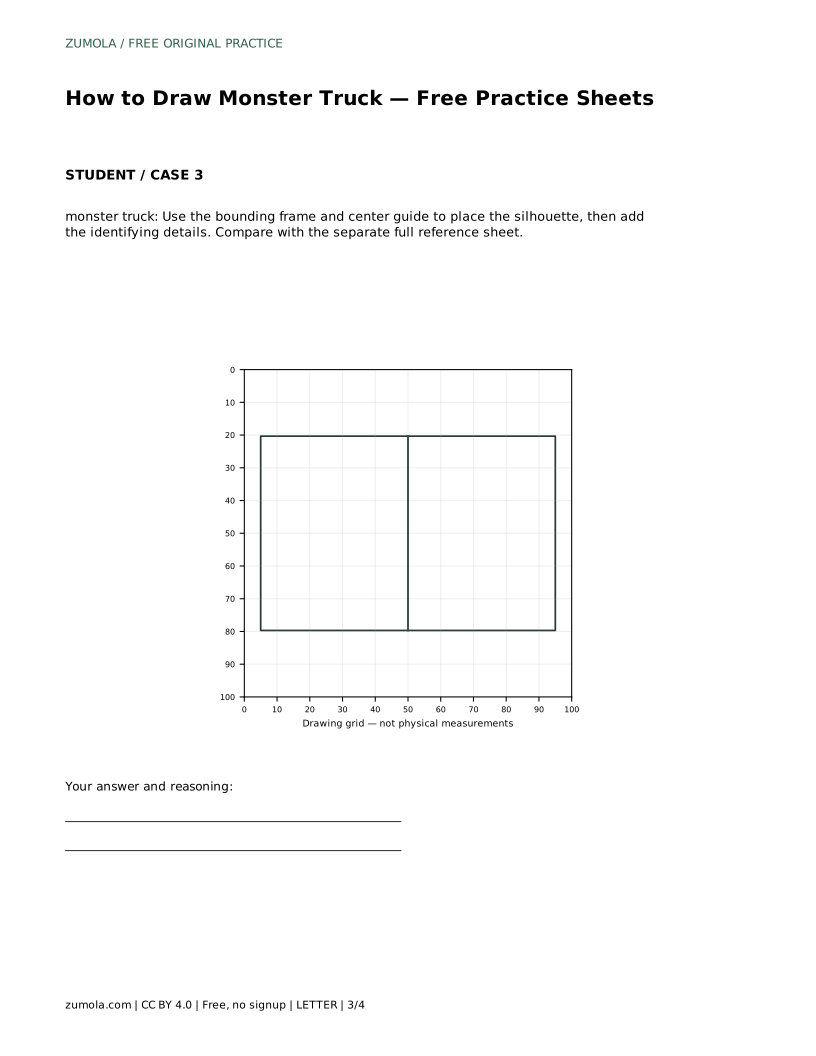
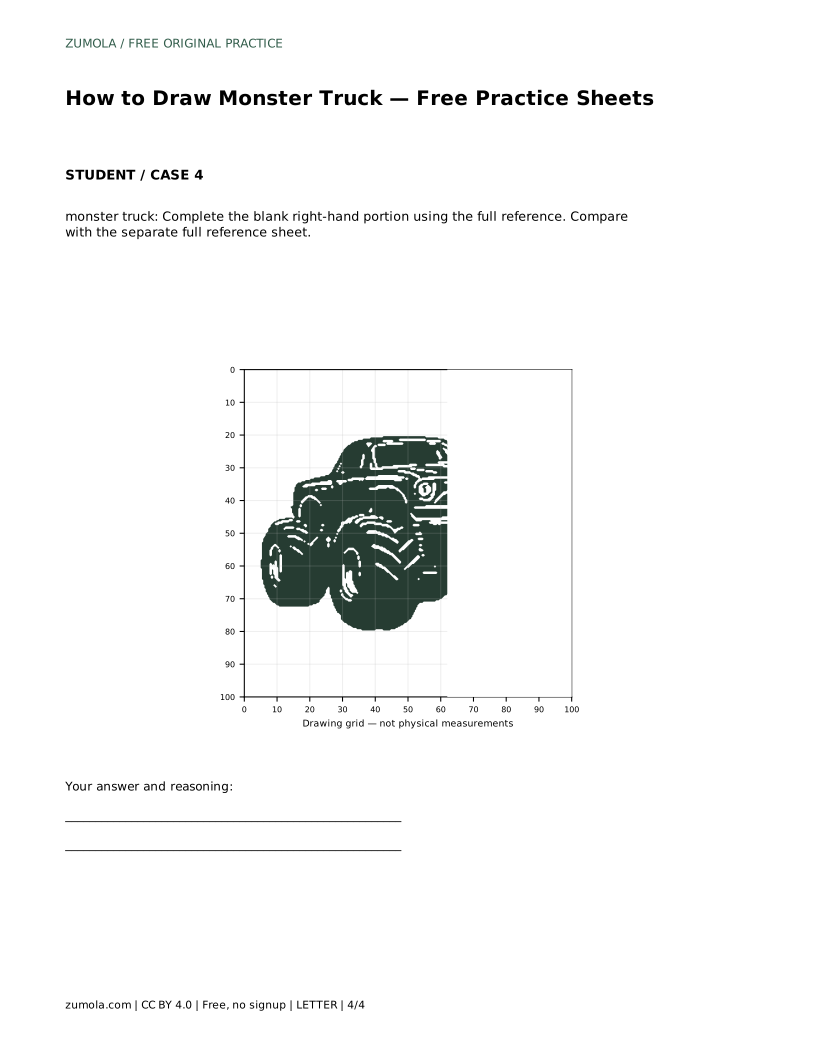
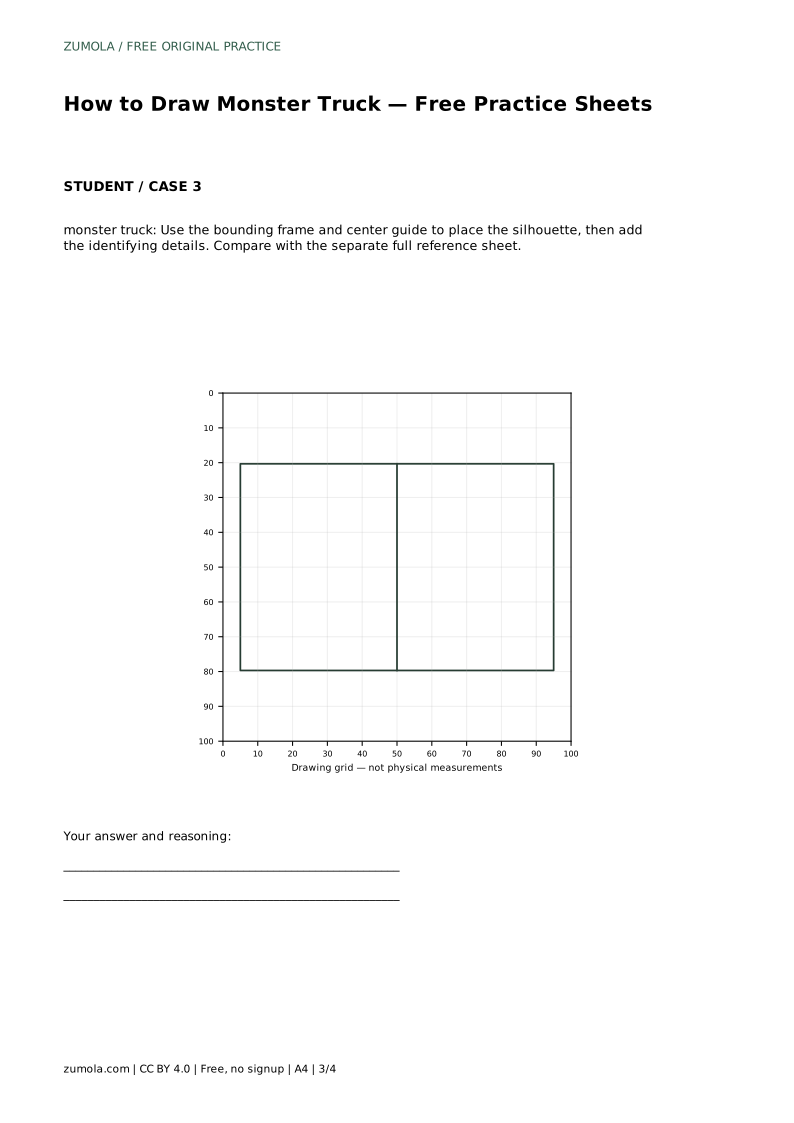
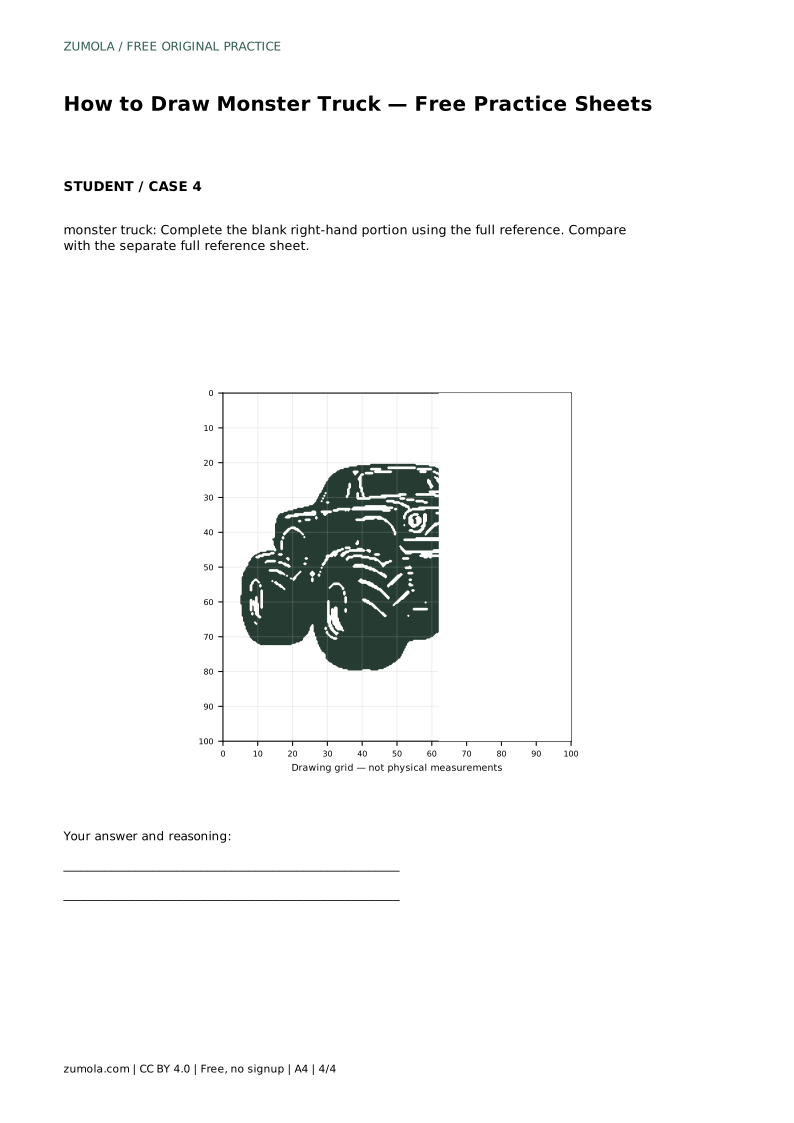
Start with the trace sheet to learn the contour, then move to the grid, frame, or partial-completion sheet for independent practice. Each one asks for a slightly different kind of control.
Exaggerate the tires and the gap between the body and the wheels. A small cab above very large tires with visible axle and shocks is the key contrast.
All drawing practice · Free coordinate paper
Original resources · CC BY 4.0 · Free for personal and classroom use with attribution.