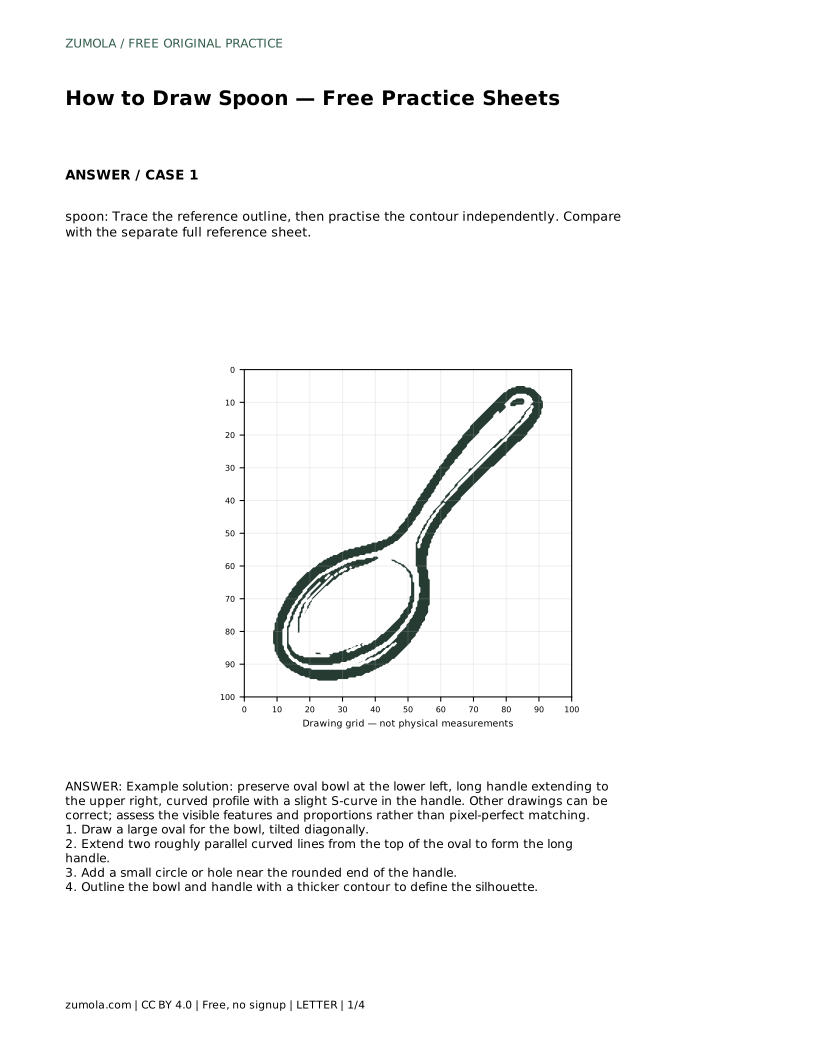
Reference diagrams
LETTER · Download PDF
A4 · Download PDF
Free original resources
Learn to draw a spoon by placing the oval bowl, extending a curved handle, and checking proportions. Free printable practice sheets support tracing, grids, and completion.
Four original cases, with reference diagrams, practice sheets and worked answers. Everything is free; no signup required.
LETTER · Download PDF
A4 · Download PDF
LETTER · Download PDF
A4 · Download PDF
LETTER · Download PDF
A4 · Download PDF
Use A4 or US Letter to match your printer. Use the stated values and conditions to solve each exercise; diagrams are not physical measuring rulers.
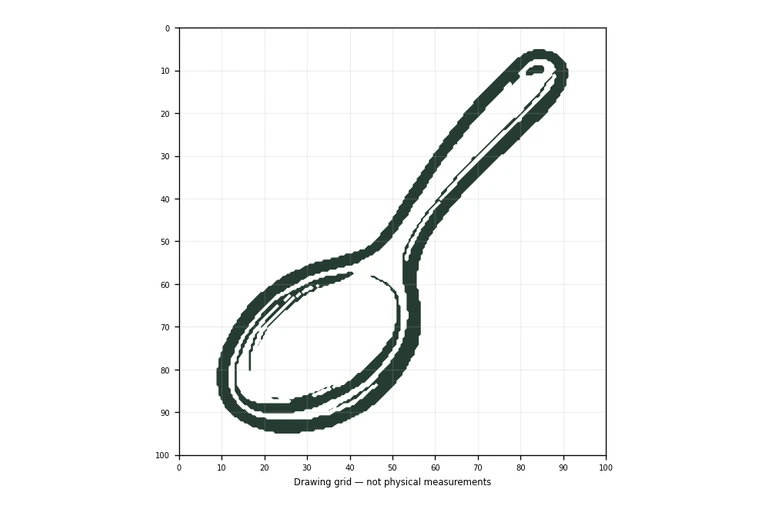
A spoon is a useful drawing subject because its shape is simple but not rigid: the bowl is an oval seen at an angle, and the handle is a long curve that must stay connected to it. This page explains how to build the silhouette in stages, then how to use the free practice sheets to trace, copy, or complete the drawing. The goal is a recognizable spoon with believable proportions, not a pixel-perfect copy.
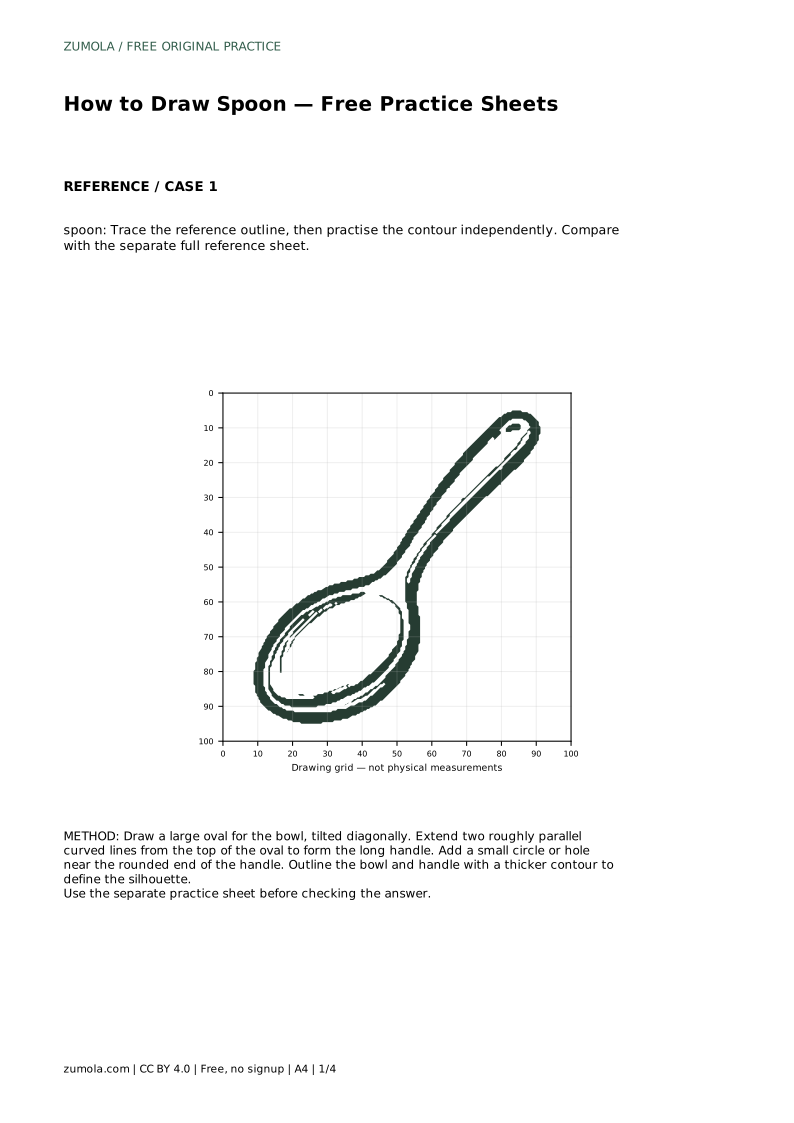
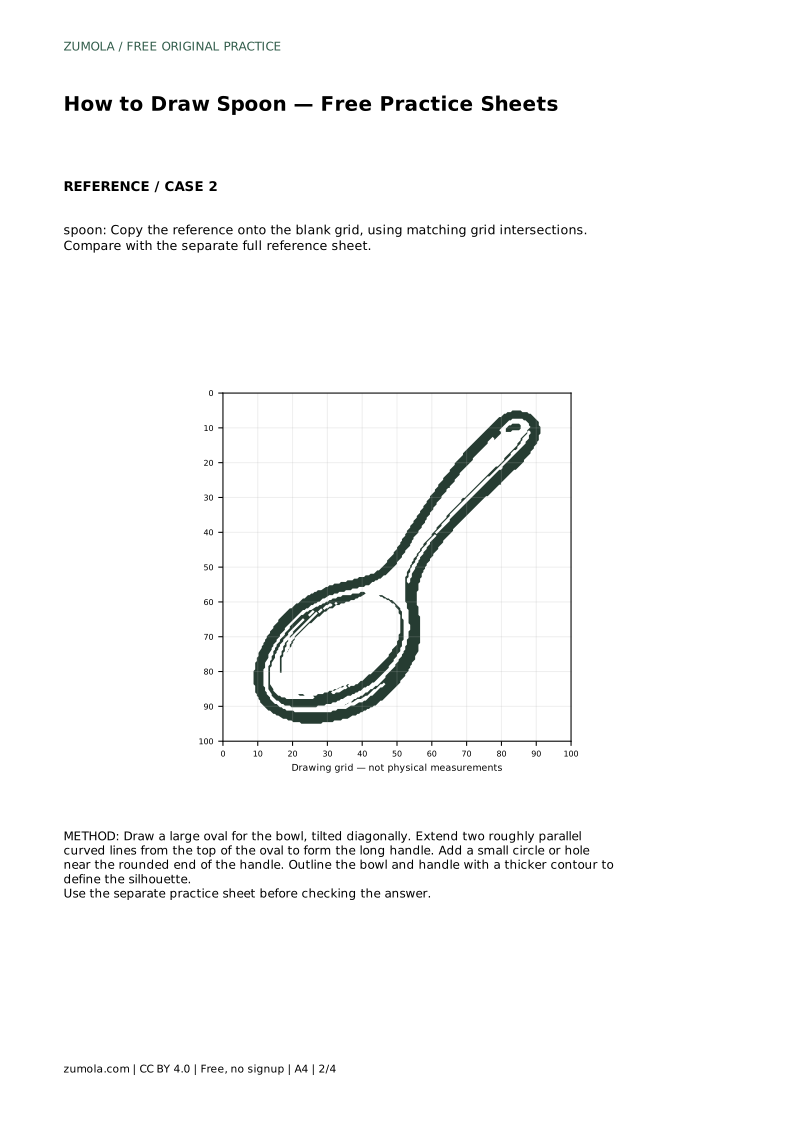
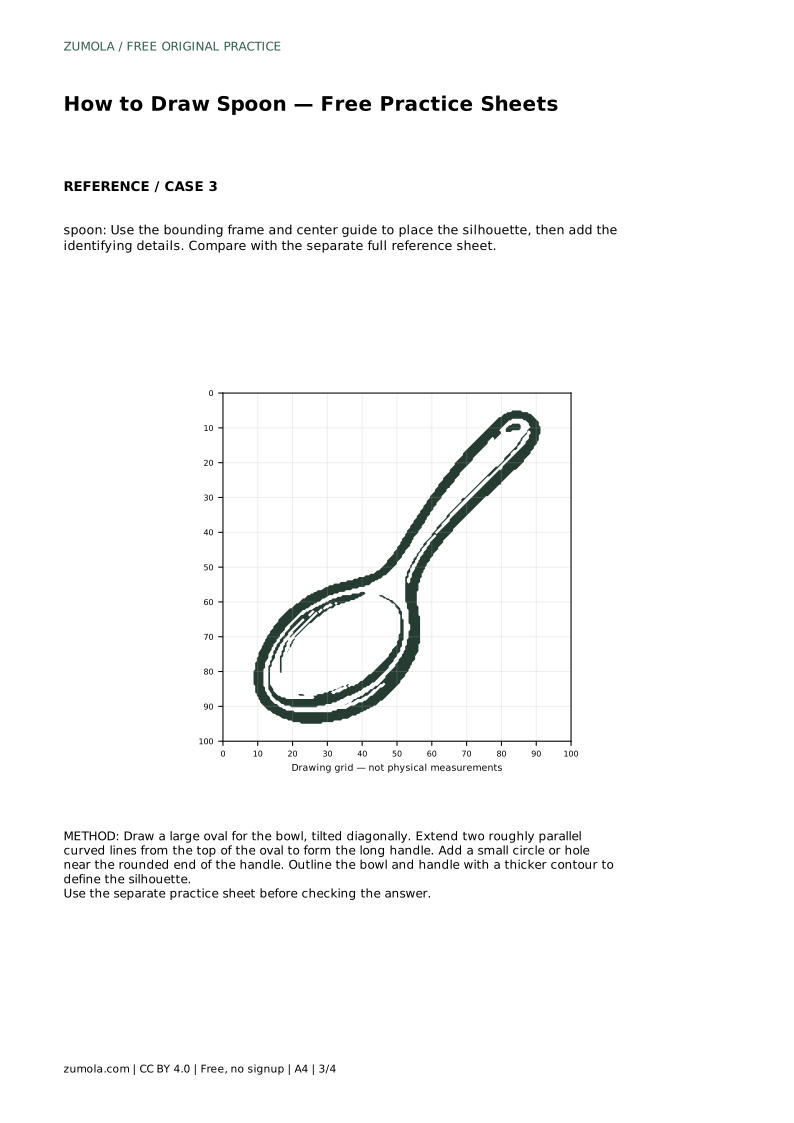
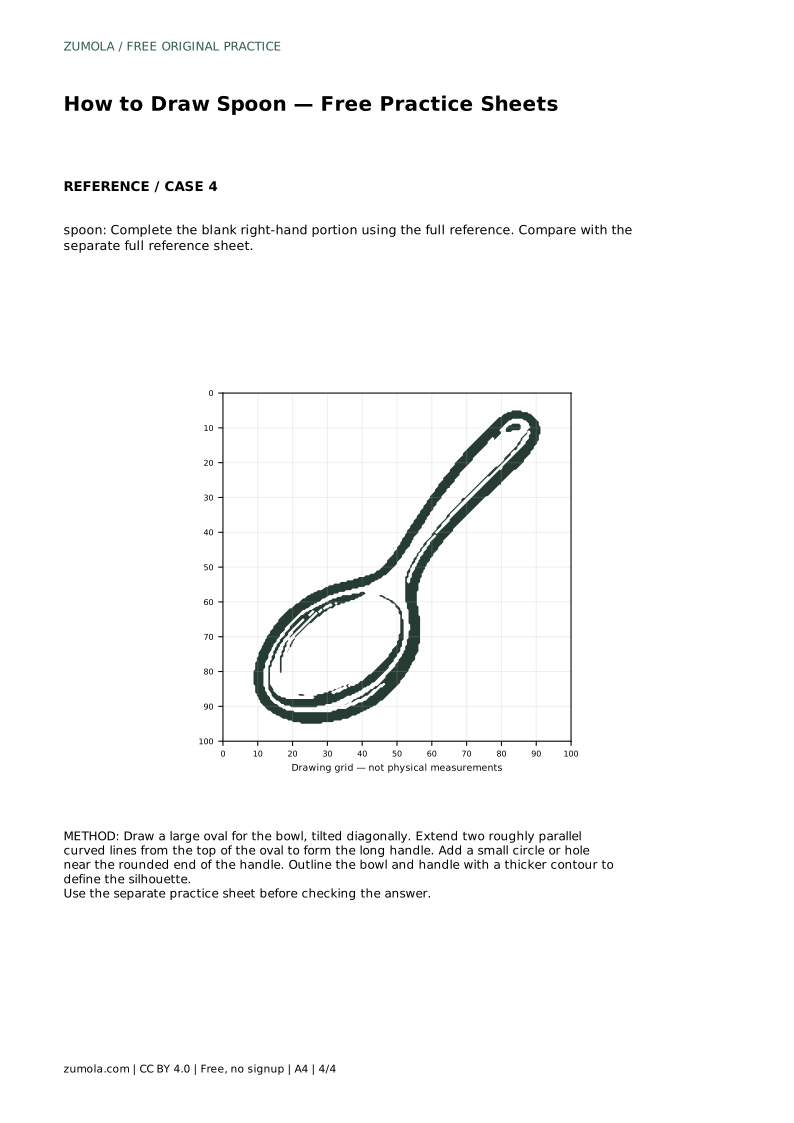
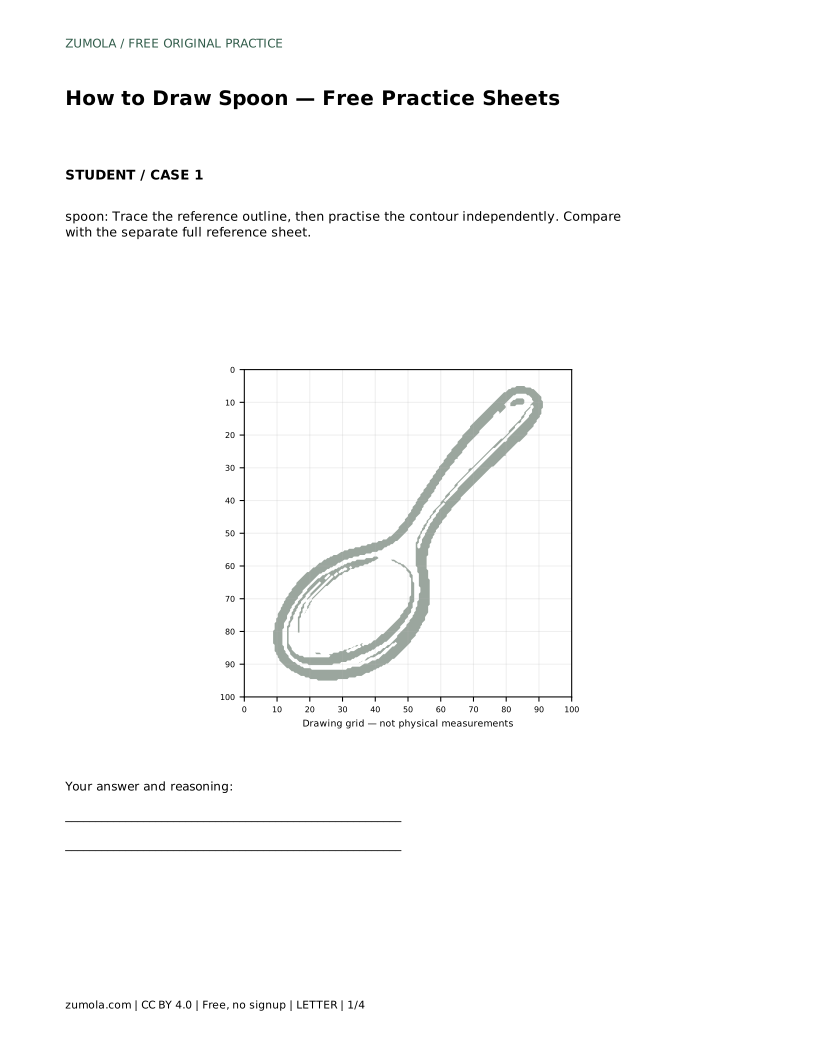
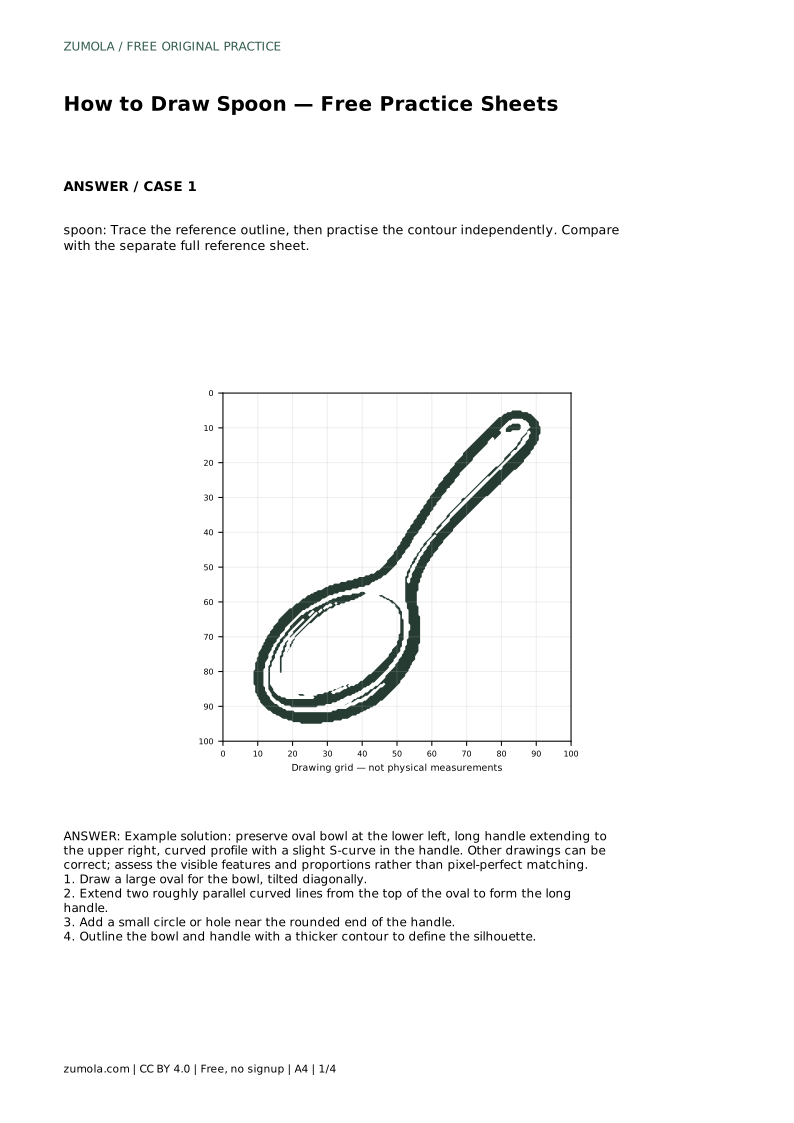
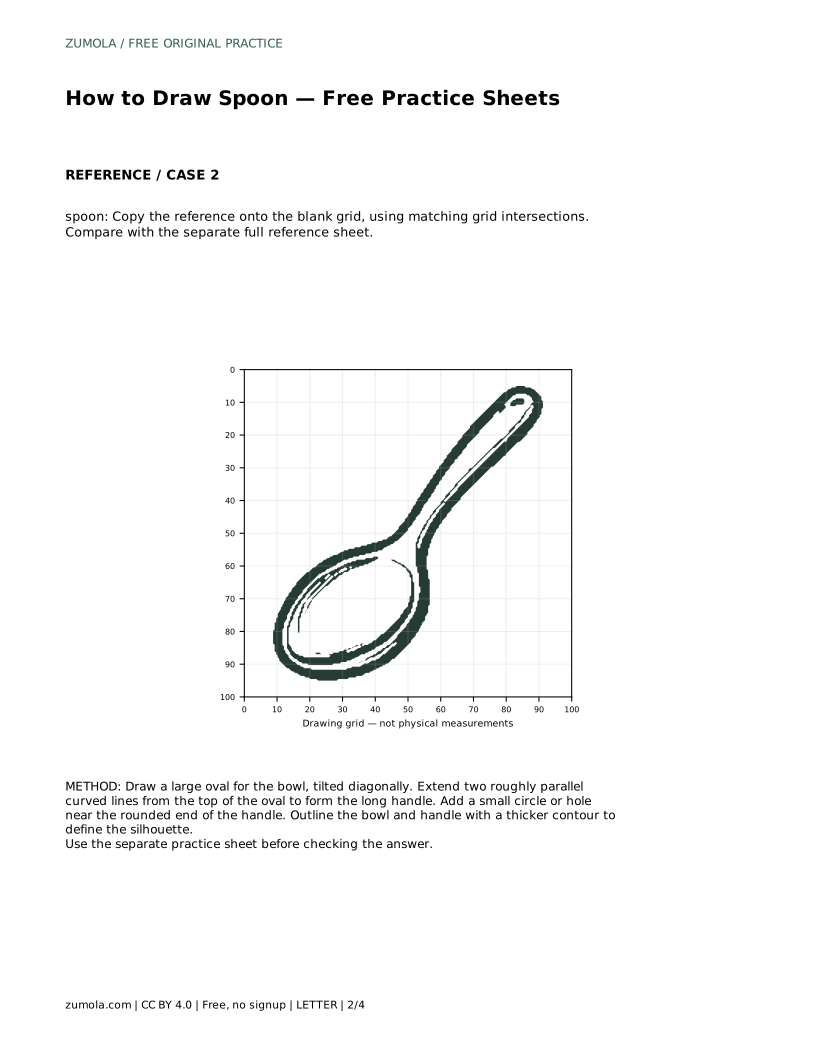
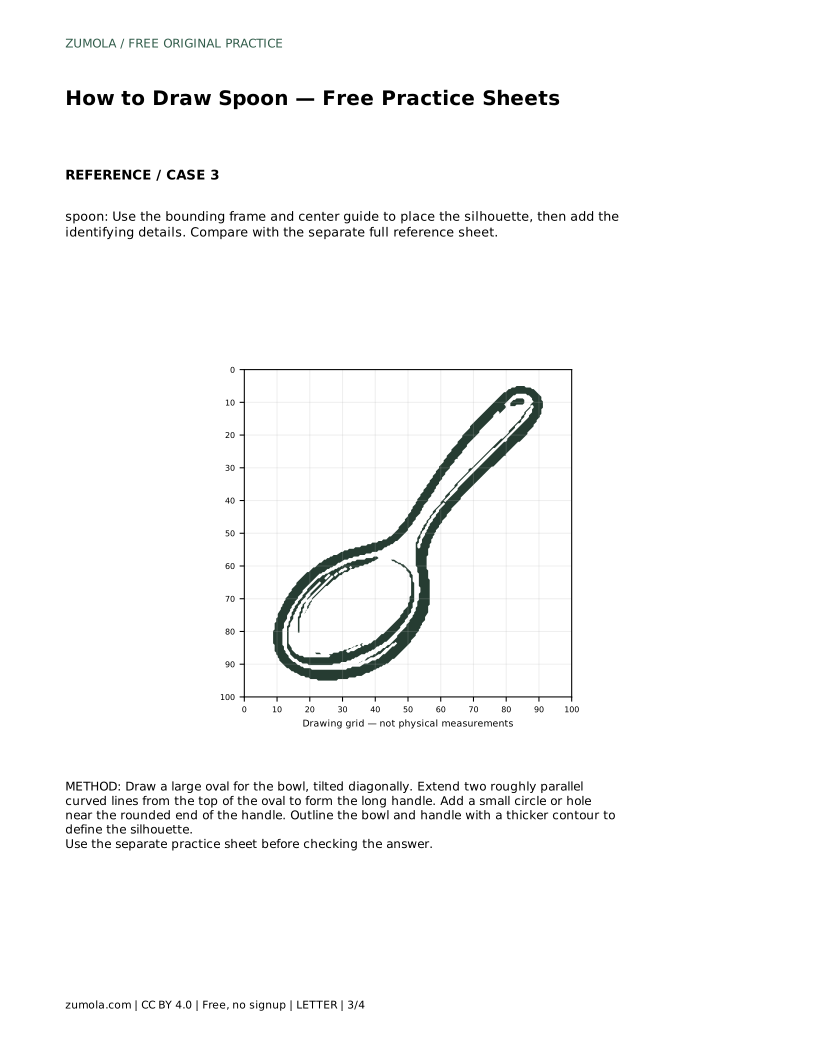
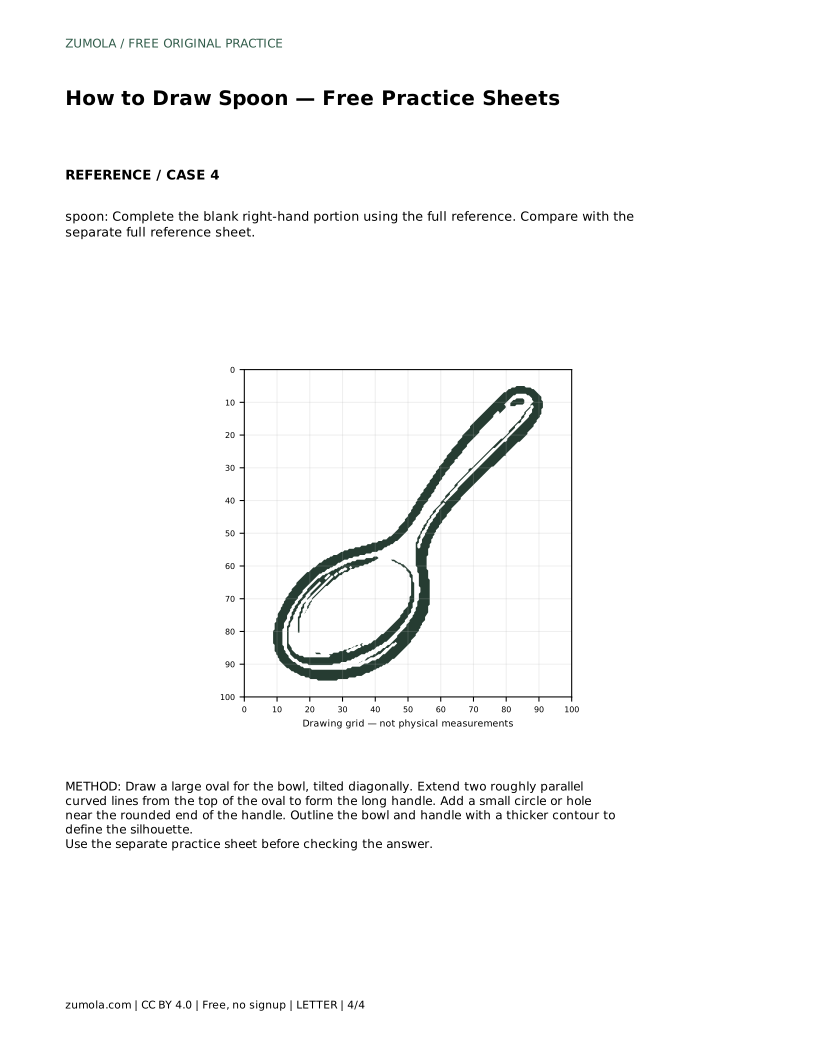
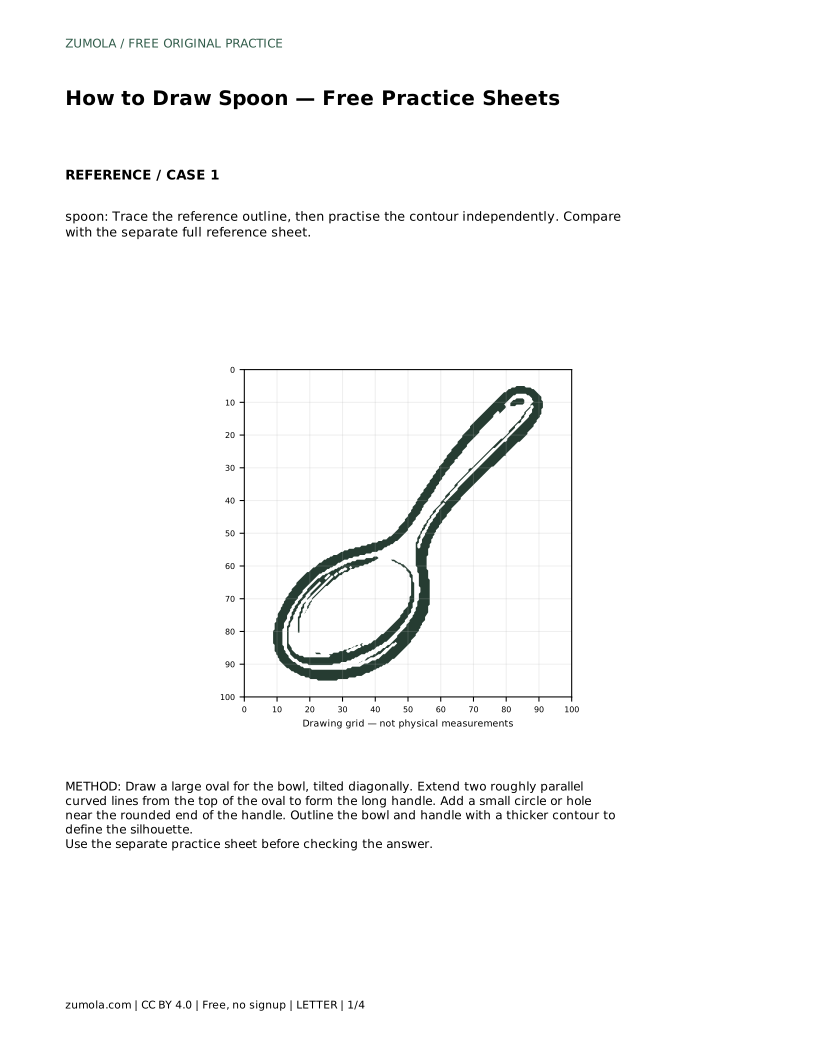
Begin by deciding where the bowl sits and which way the handle travels. In the practice reference, the bowl is an oval at the lower left and the handle extends toward the upper right. Treat the oval as a tilted shape rather than a flat circle; its long axis should point roughly along the handle direction.
Next, extend two roughly parallel curved lines from the top of the oval. Keep the gap between them fairly even so the handle reads as one continuous form. A slight S-curve can make the handle feel natural, but avoid sharp bends that break the connection to the bowl.
Once the basic silhouette is in place, compare the bowl width to the handle length. The bowl should look wide enough to hold something, and the handle should look long enough to grip. Adjust the oval before thickening any lines; changing proportions early is easier than correcting a finished outline.
Add the small circle or hole near the rounded end of the handle if your reference includes it. This detail helps identify the object, but it should sit within the handle rather than floating outside it. Finish by tracing over the outer edge with a thicker contour so the spoon stands out from construction lines.
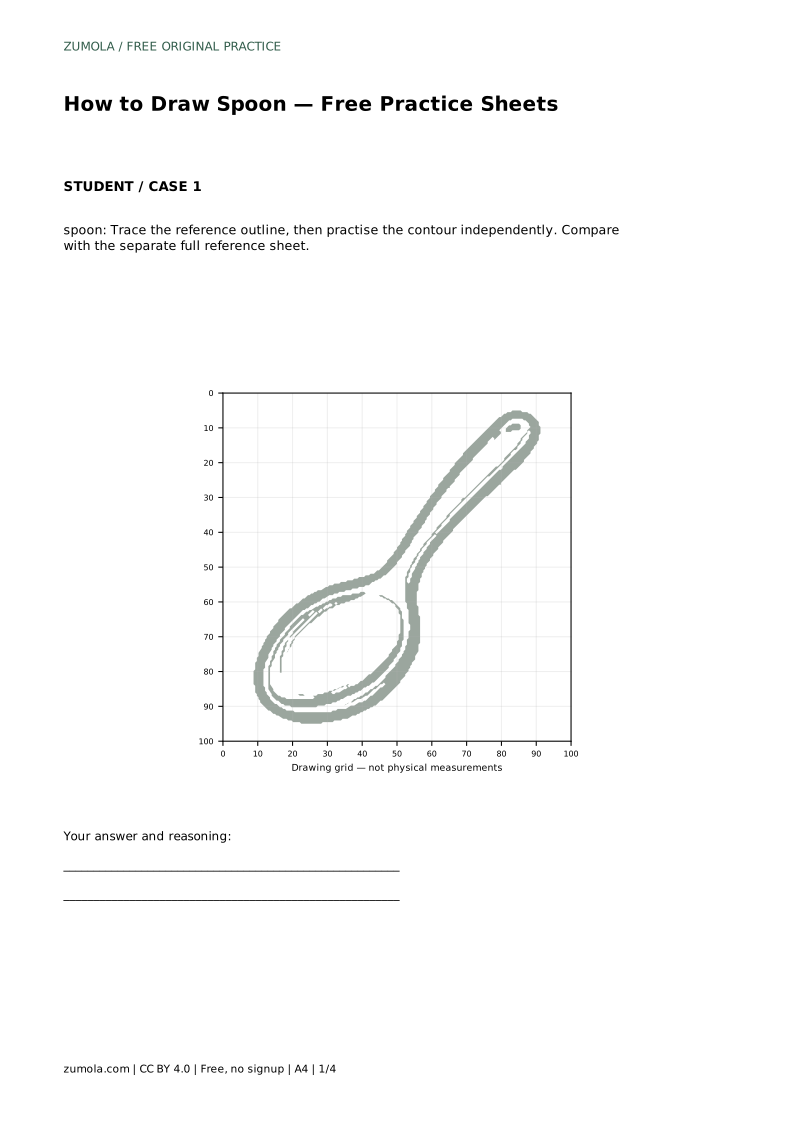
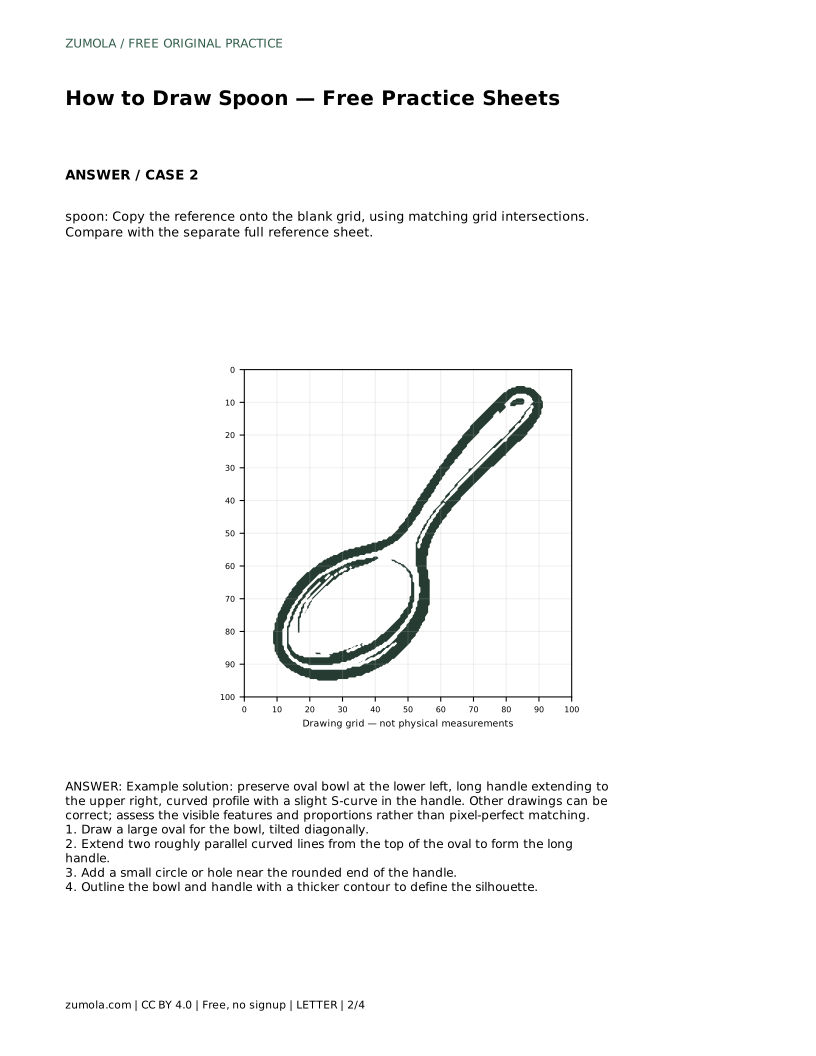
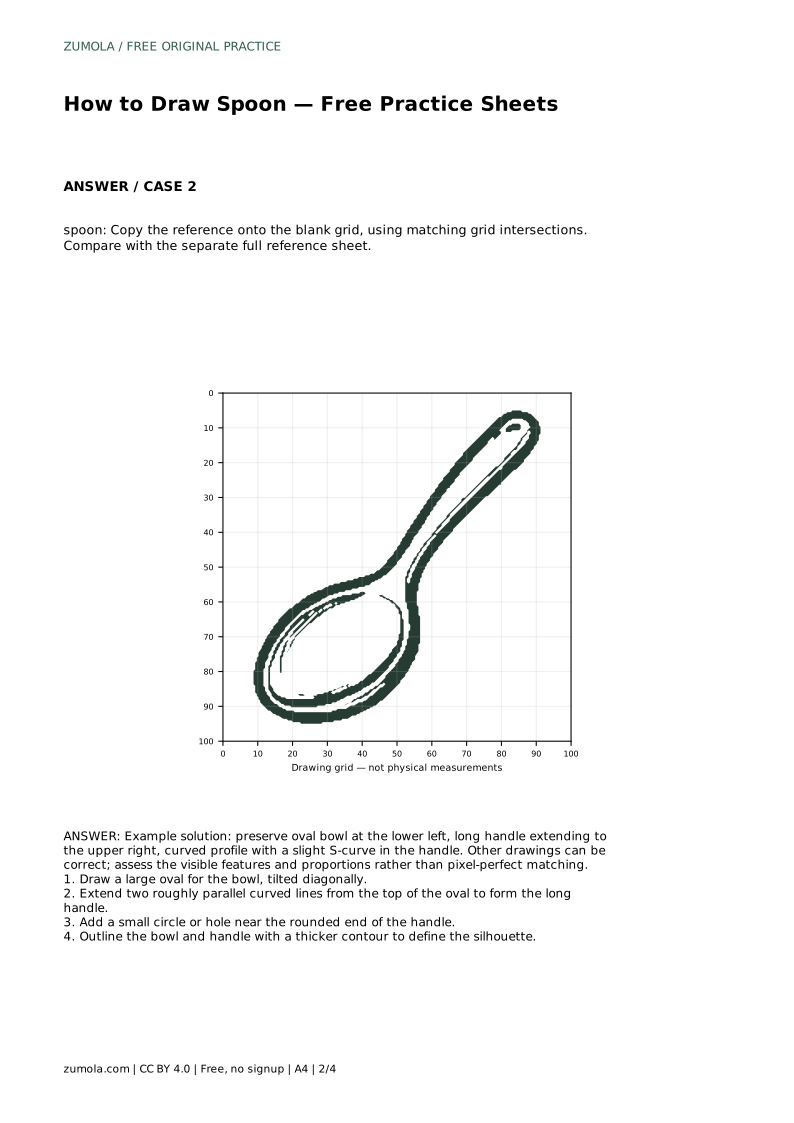
The trace sheet asks you to follow the reference outline first, then practise the contour independently. Compare your result with the separate full reference sheet. The grid sheet asks you to copy the reference onto a blank grid using matching grid intersections, which helps with placement and scale.
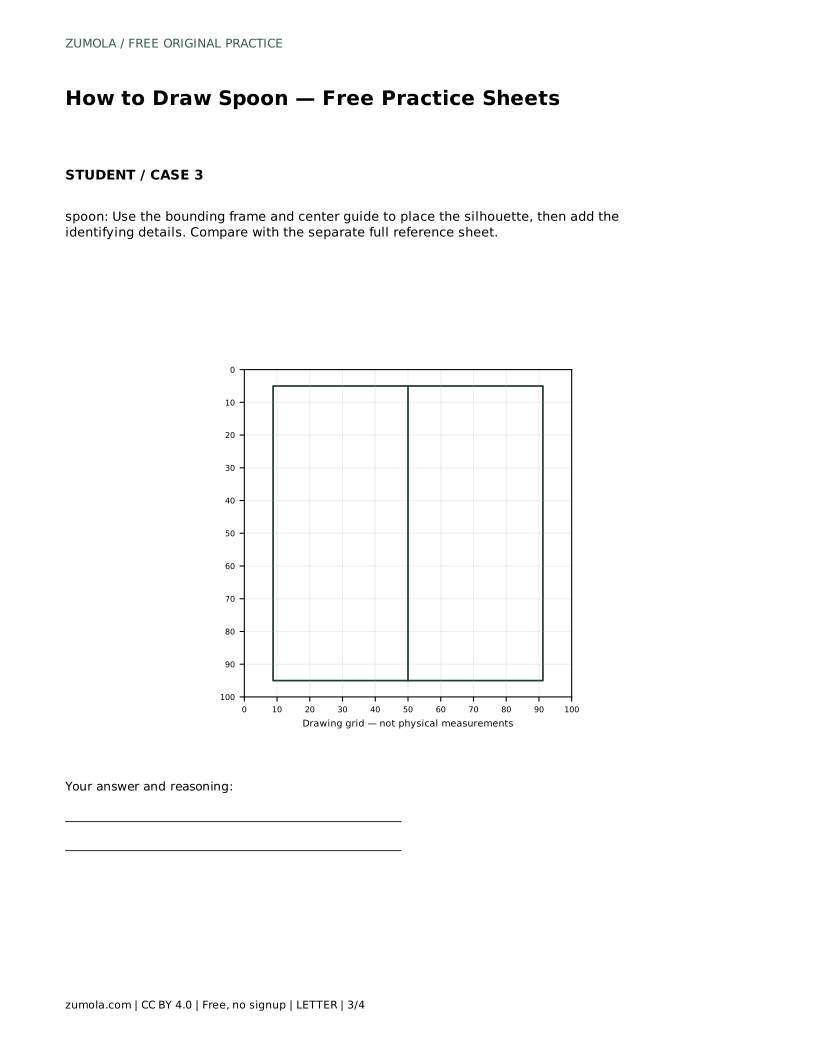
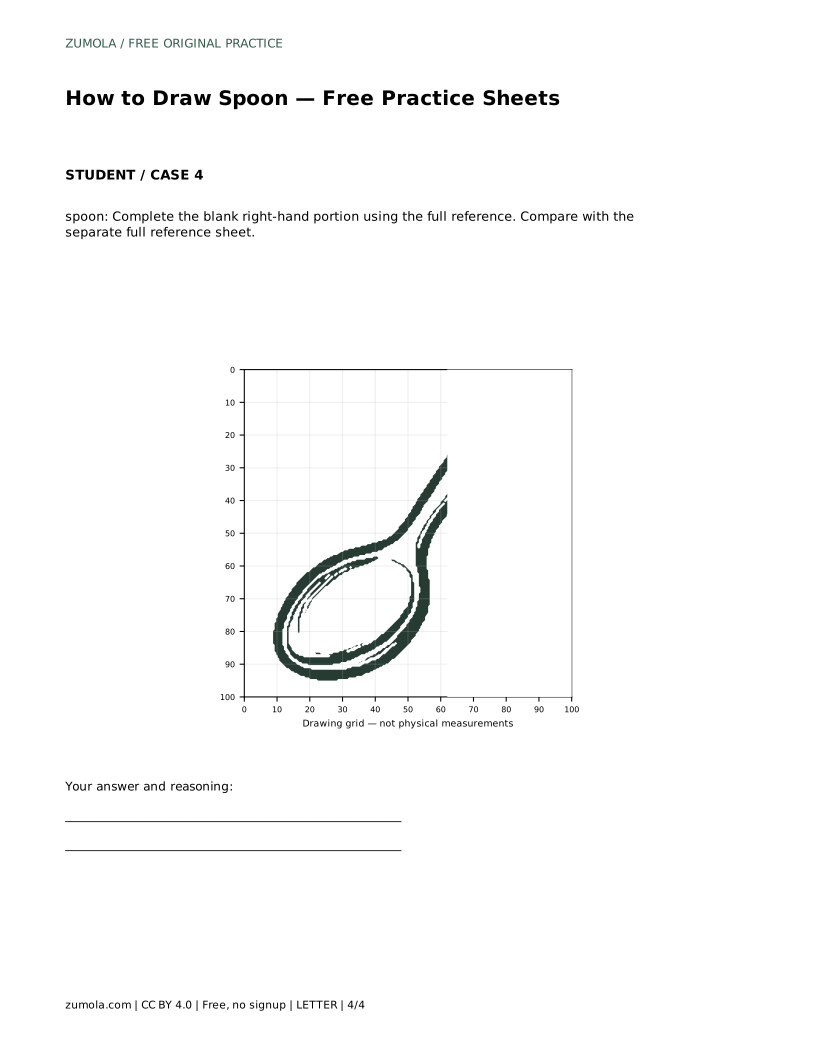
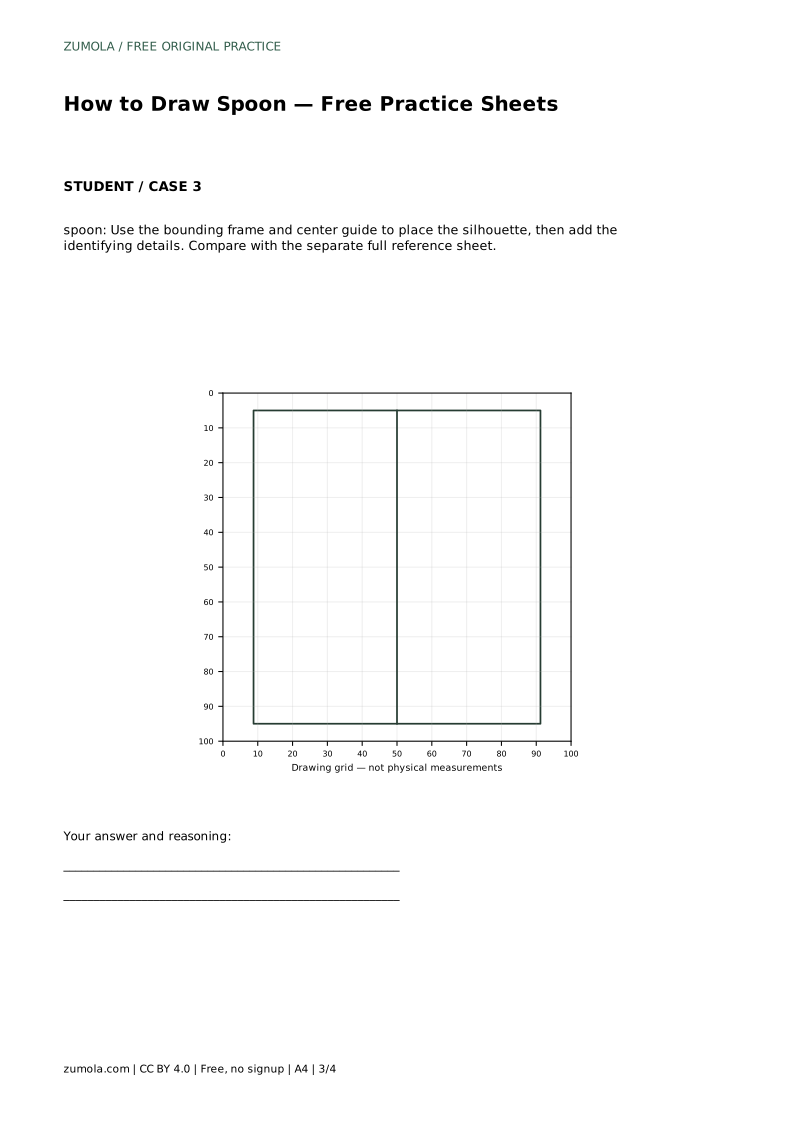
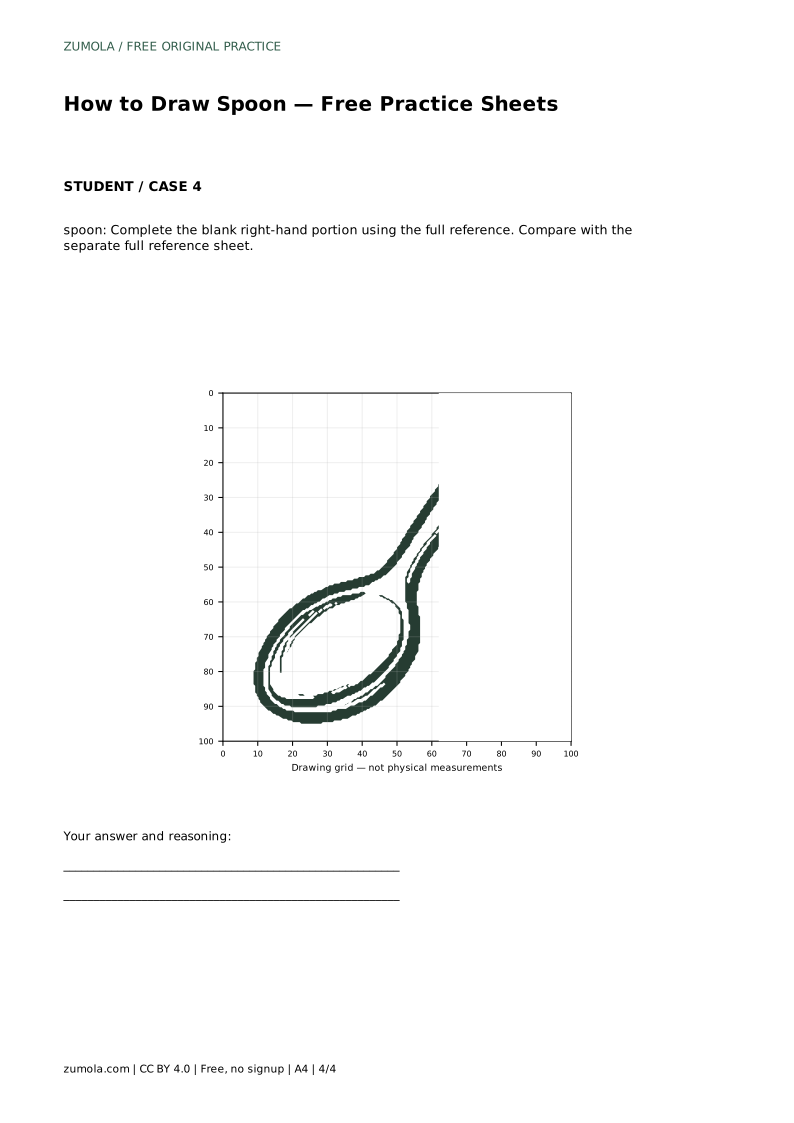
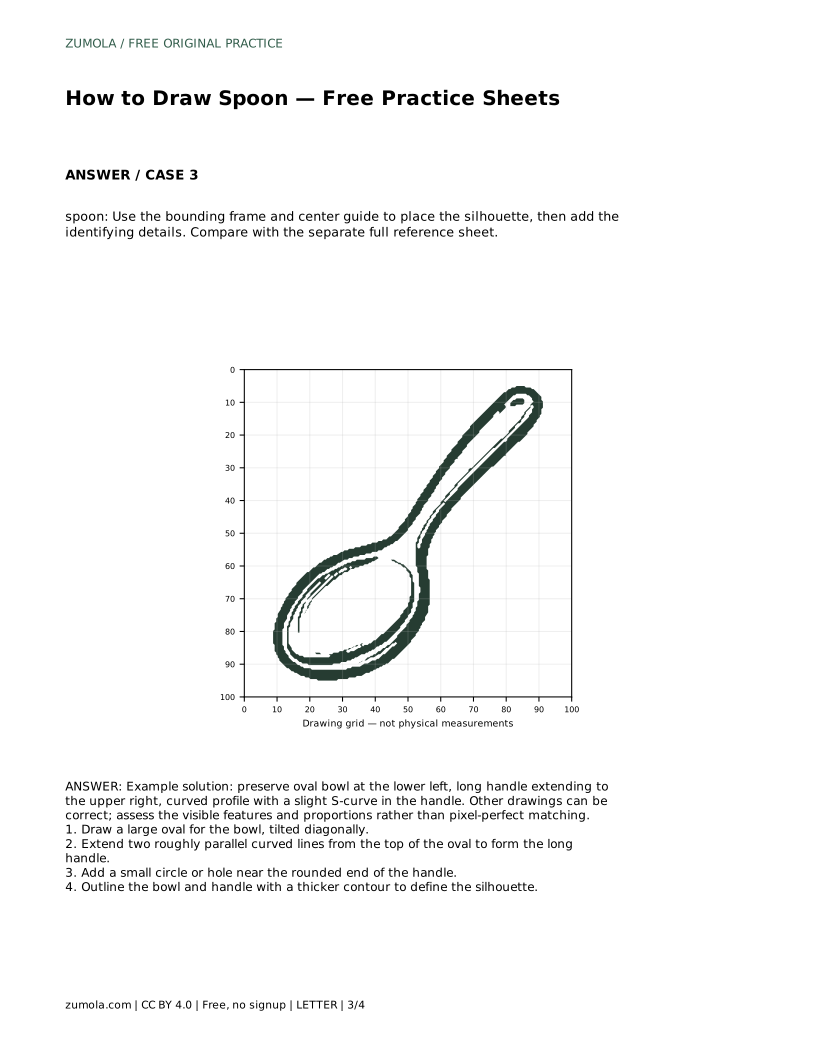
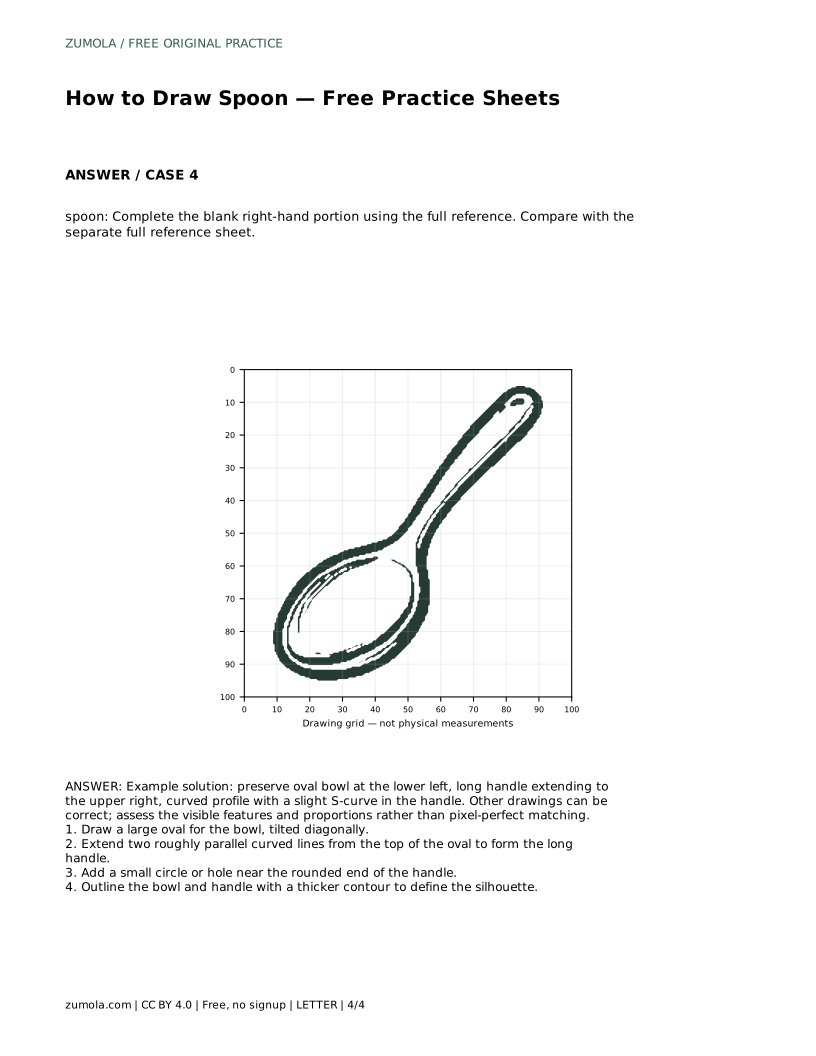
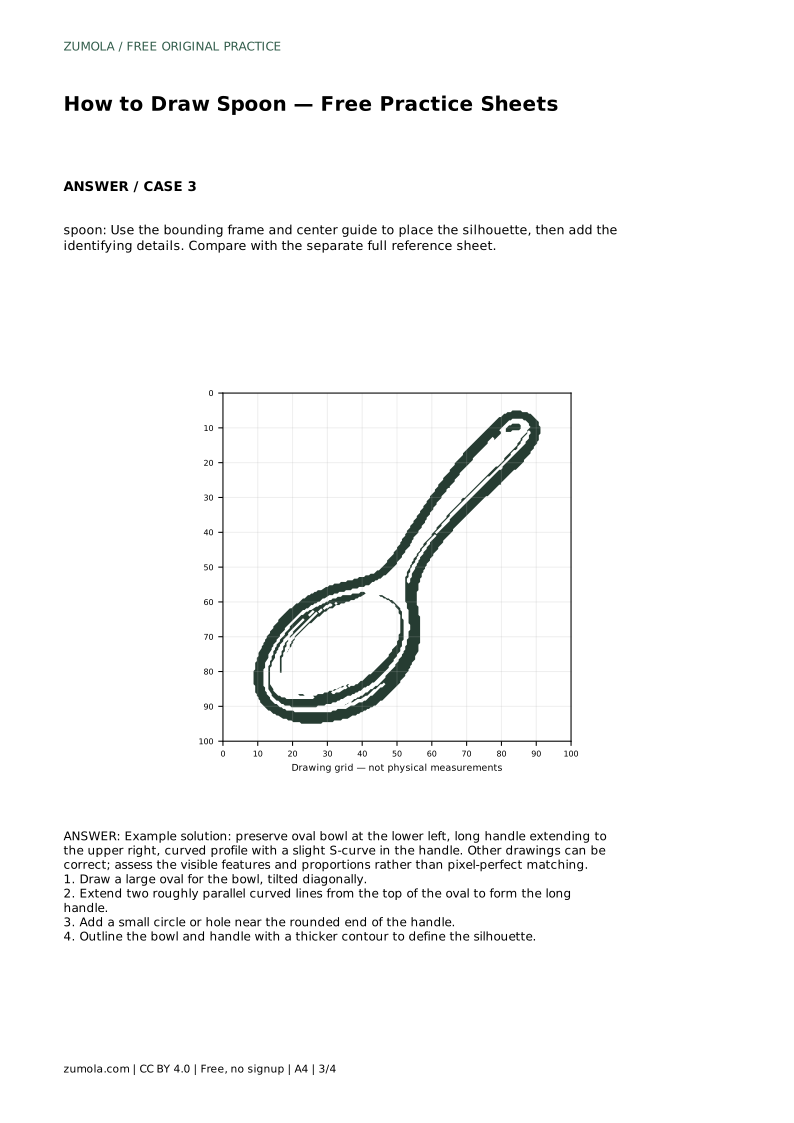
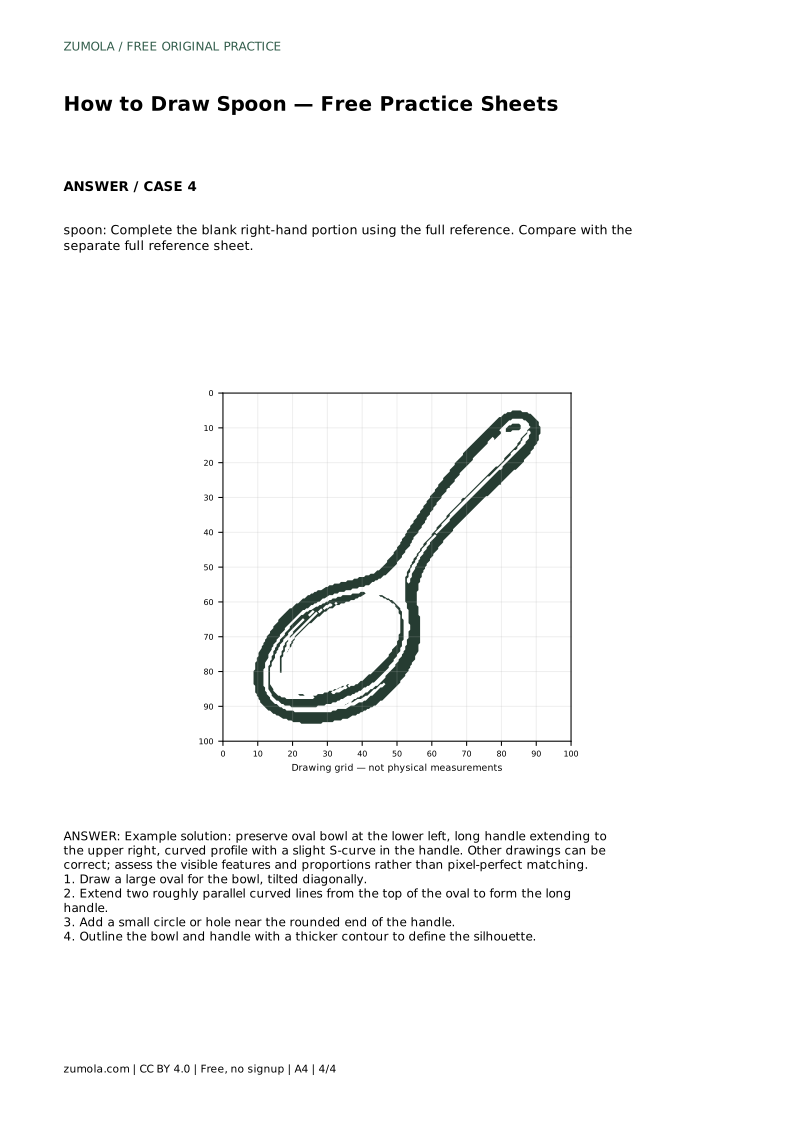
The bounding-frame sheet gives a center guide for placing the silhouette before adding identifying details. The completion sheet leaves the right-hand portion blank so you can finish the drawing from the full reference. Each format targets a different skill: tracing builds familiarity, grids build proportion control, frames build placement, and completion builds recall.
A correct spoon drawing does not need to match the reference exactly. Check instead for the visible features: an oval bowl, a long handle extending from it, a curved profile, and any small end detail. Confirm that the handle connects to the bowl rather than passing beside it.
Use the rubric below to assess your own sheet. Multiple valid outcomes are possible, so judge the presence and relationship of features rather than exact line placement.
spoon: Trace the reference outline, then practise the contour independently. Compare with the separate full reference sheet.
Example solution: preserve oval bowl at the lower left, long handle extending to the upper right, curved profile with a slight S-curve in the handle. Other drawings can be correct; assess the visible features and proportions rather than pixel-perfect matching. Draw a large oval for the bowl, tilted diagonally. Extend two roughly parallel curved lines from the top of the oval to form the long handle. Add a small circle or hole near the rounded end of the handle. Outline the bowl and handle with a thicker contour to define the silhouette.
No. Other drawings can be correct. Assess the visible features and proportions rather than pixel-perfect matching.
Check that the oval bowl connects to a long curved handle and that the handle lines remain roughly parallel.
Yes. The grid sheet works independently by matching key points to grid intersections, though tracing first can help you learn the contour.
All drawing practice · Free coordinate paper
Original resources · CC BY 4.0 · Free for personal and classroom use with attribution.