Graph both equations, compare their slopes and use the product rule for nonvertical perpendicular lines. Do not infer the relationship from a printed angle.
4 line-pair cases. Parallel, perpendicular and neither.
A graph, a task and a worked check
Free parallel and perpendicular line worksheets with exact slope pairs and coordinate graphs. Practice, reference and answer files are free.
Choose Letter or A4, then download a student sheet first. Keep the separate reference or answer file closed until you have attempted the case. Every worksheet, SVG and answer is free without signup.
Choose your paper and download
Download paper size
Every worksheet and answer is free. No signup.
Free original resourcePL01
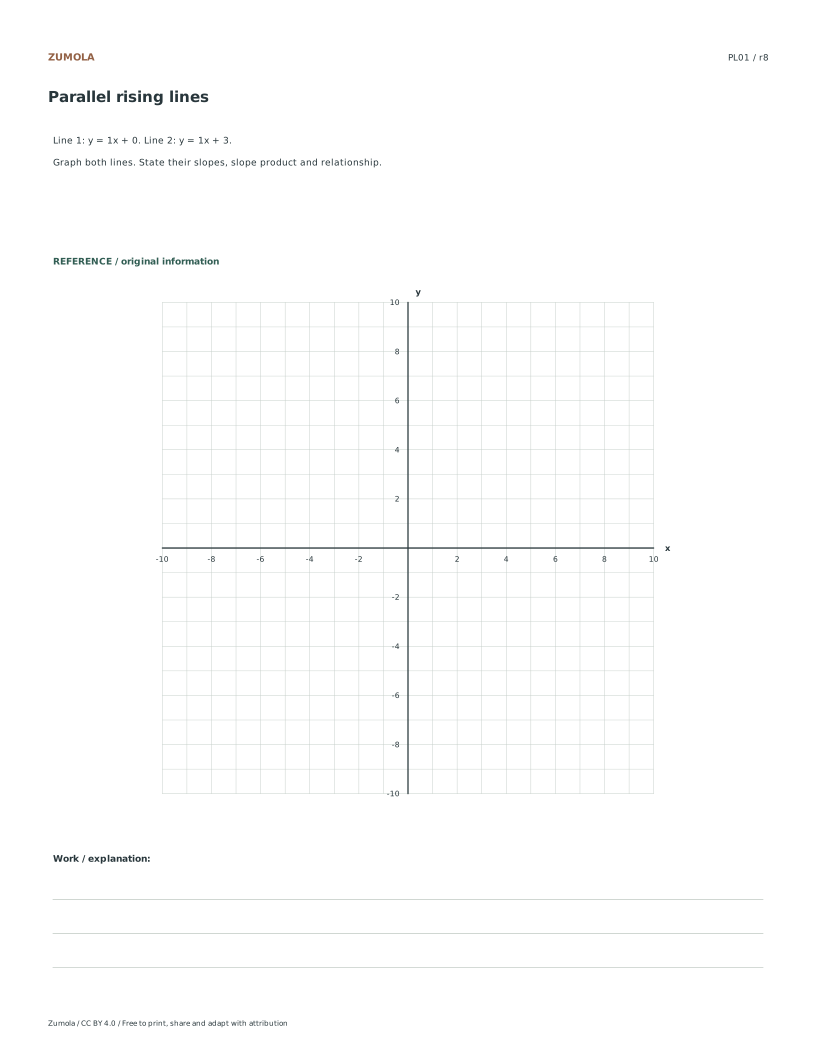
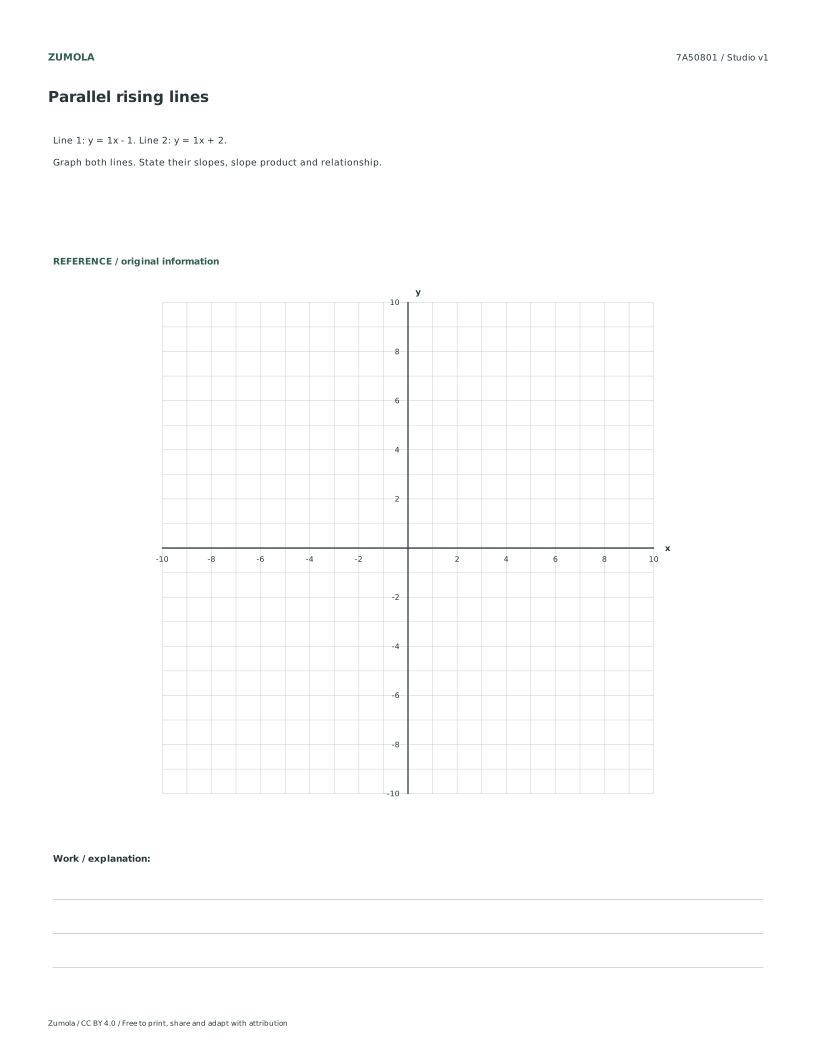
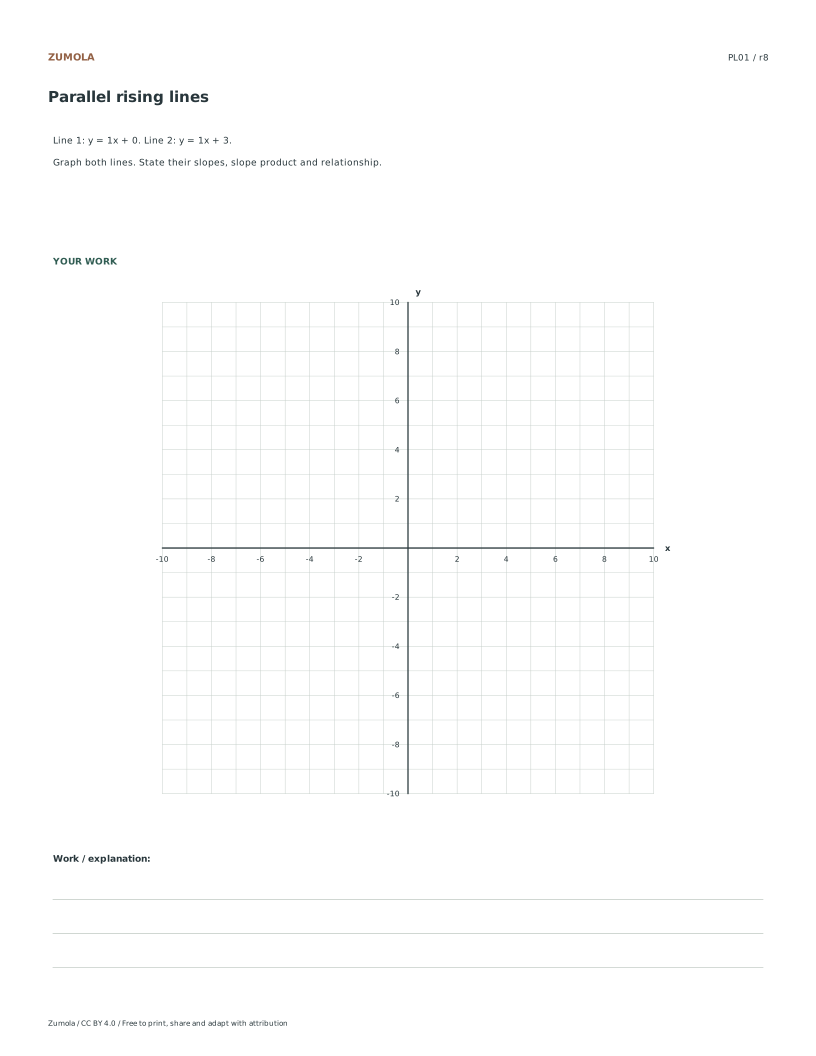
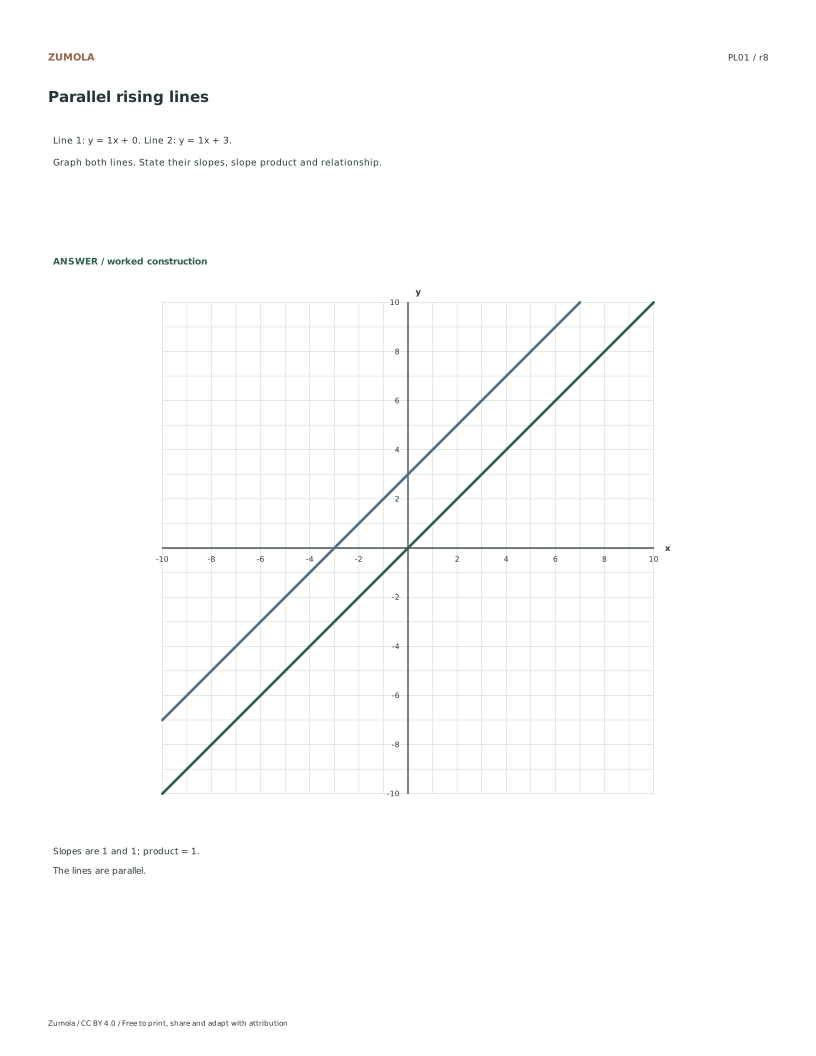
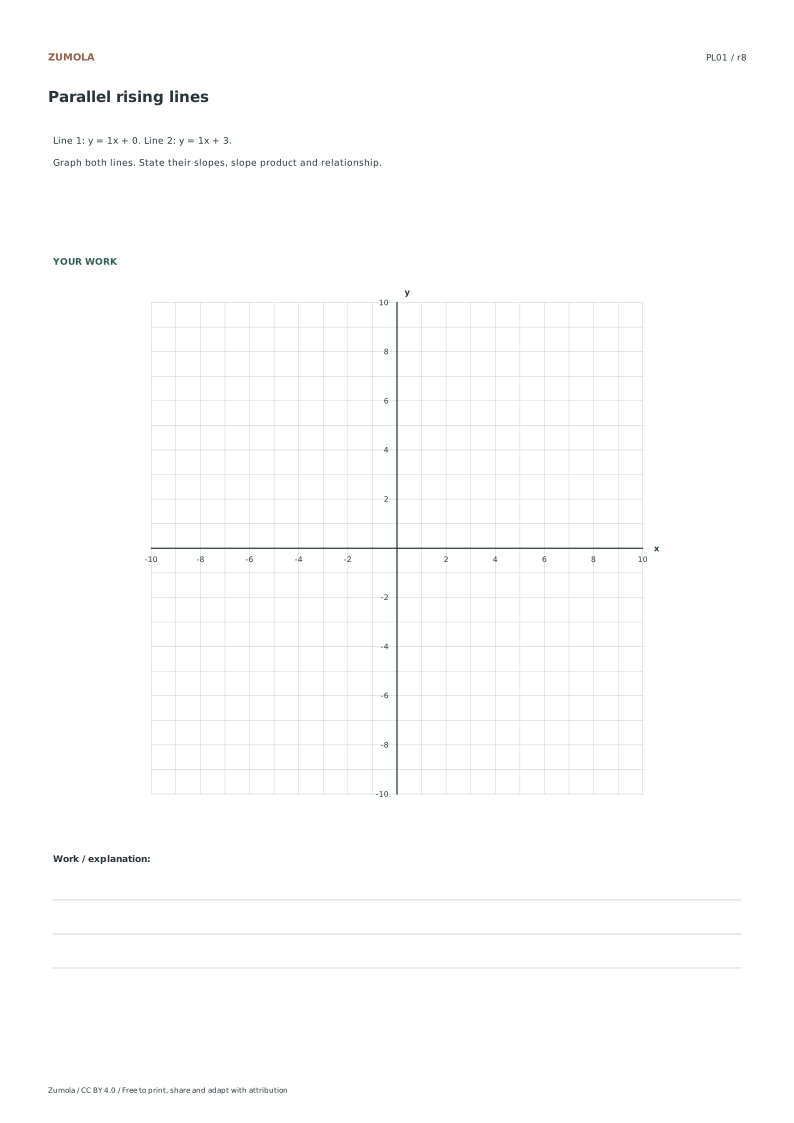
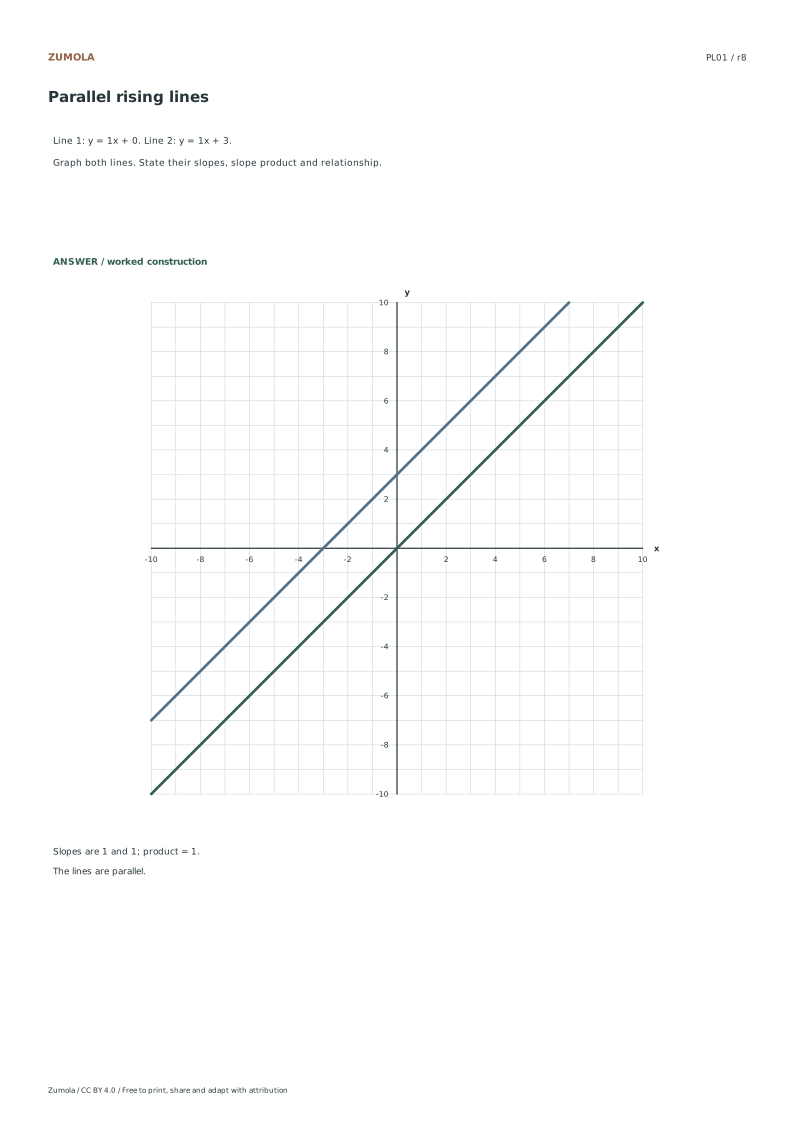
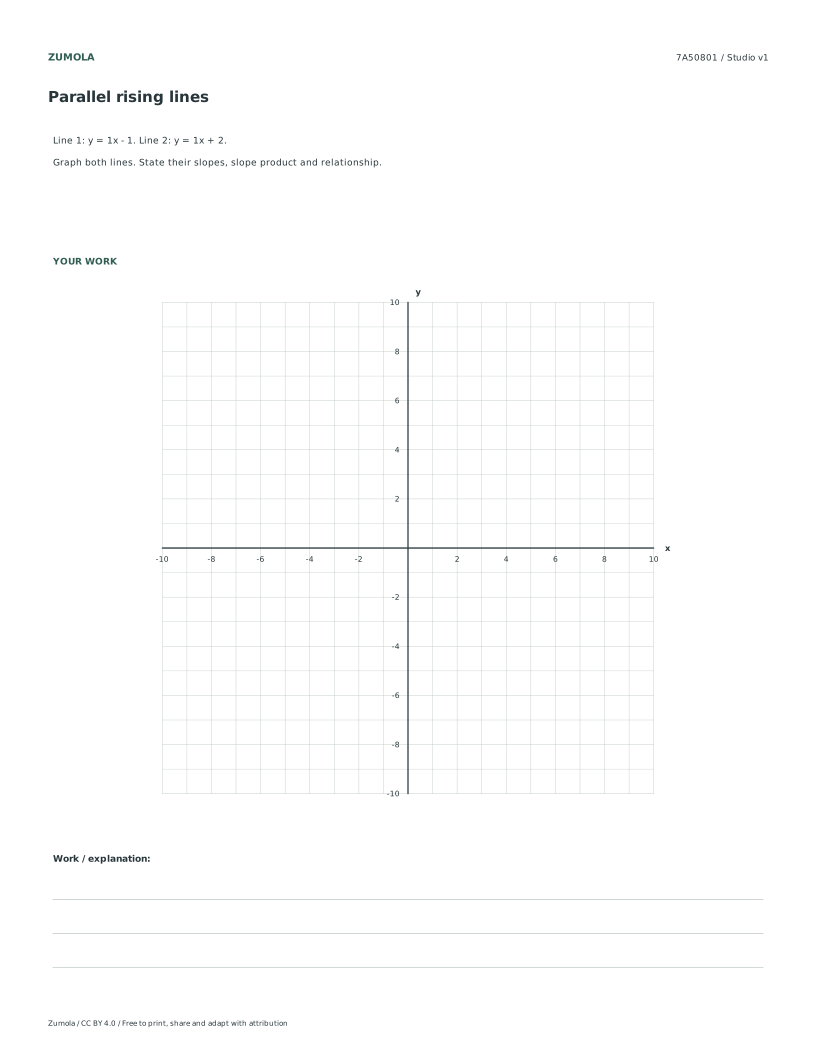
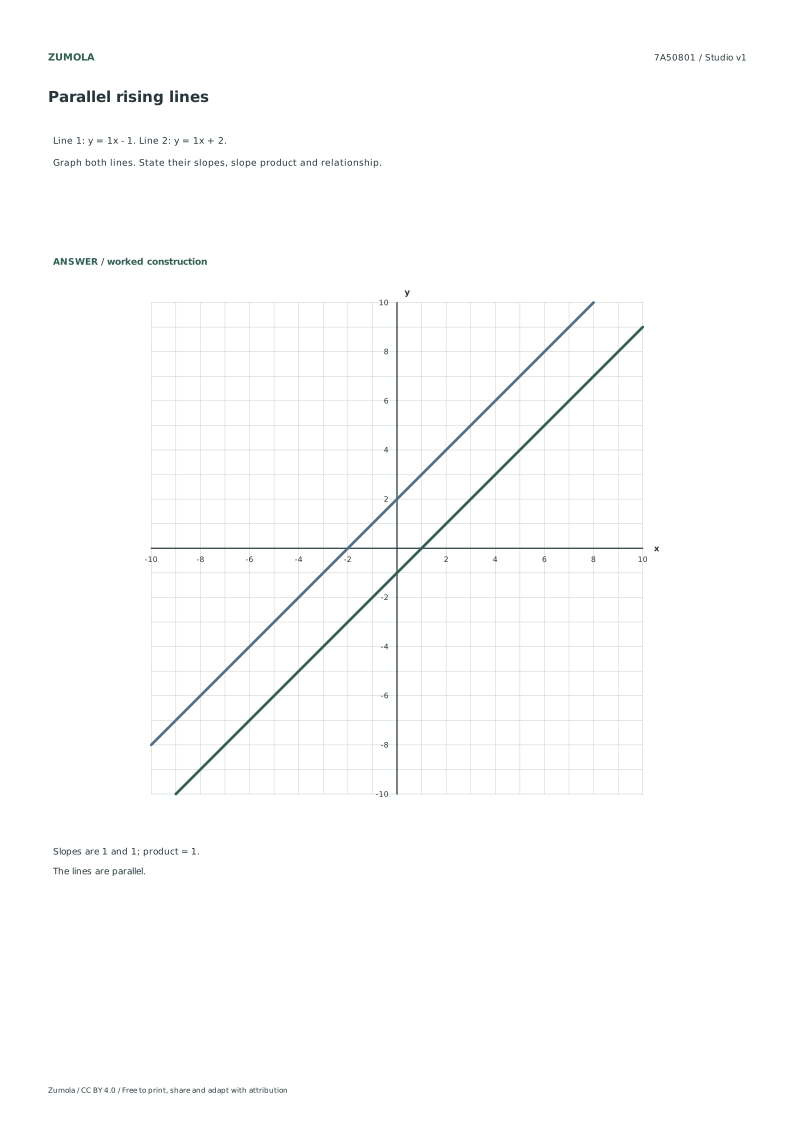
Parallel rising lines
Original worksheet collection. Letter or A4 PDF and editable SVG.
Graph both lines. State their slopes, slope product and relationship.
PL02
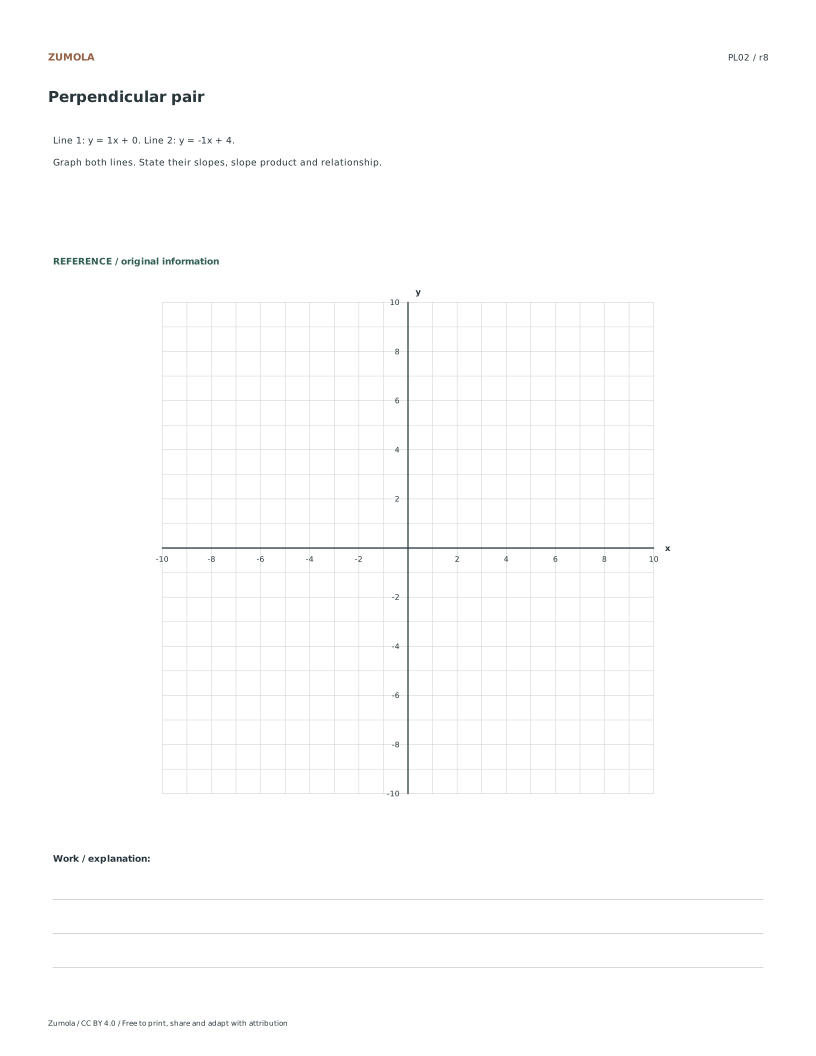
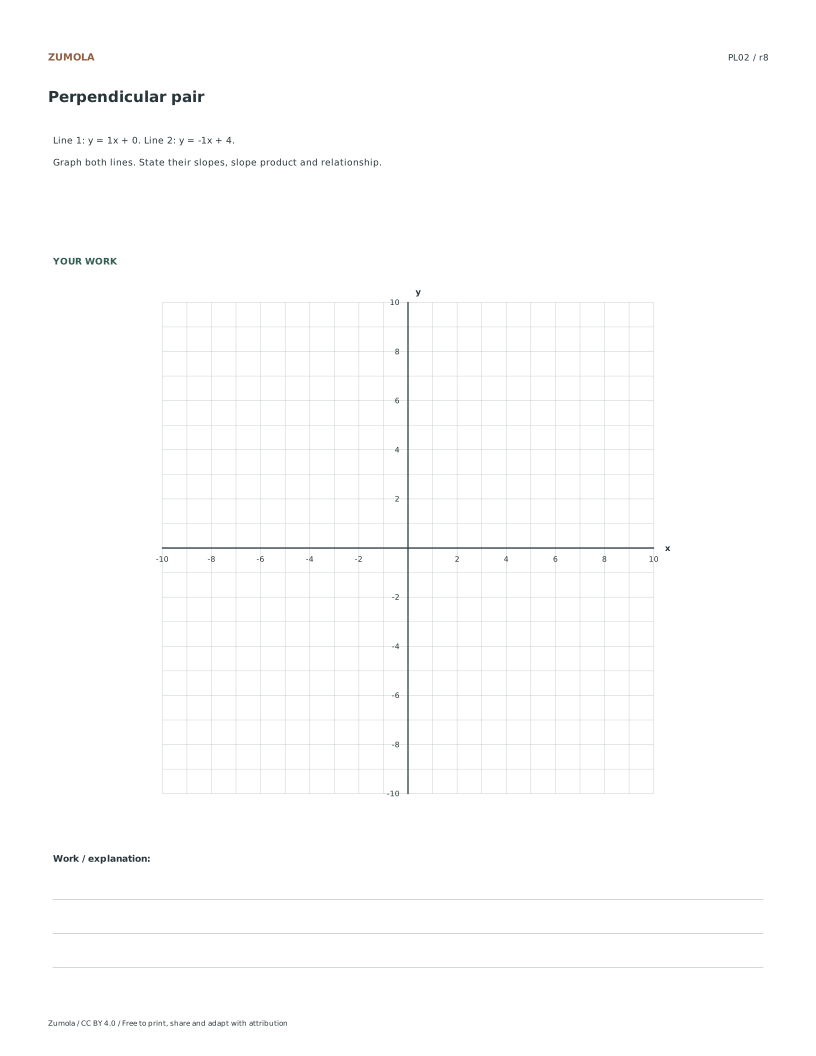
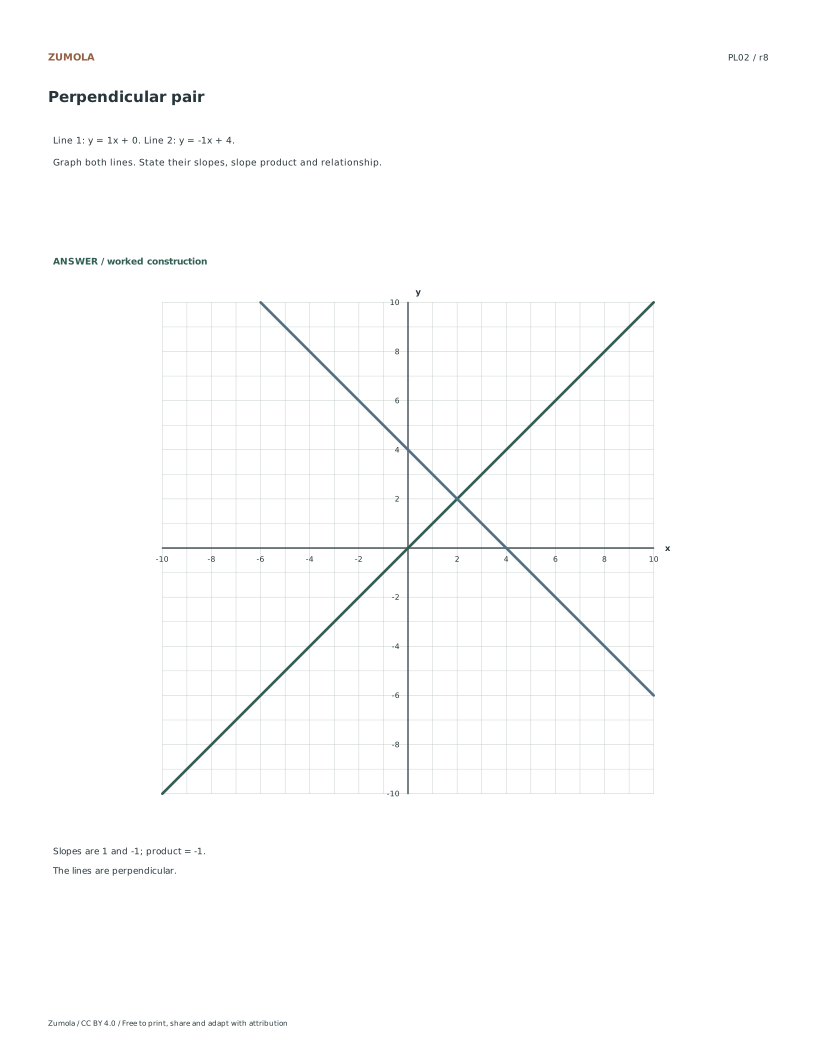
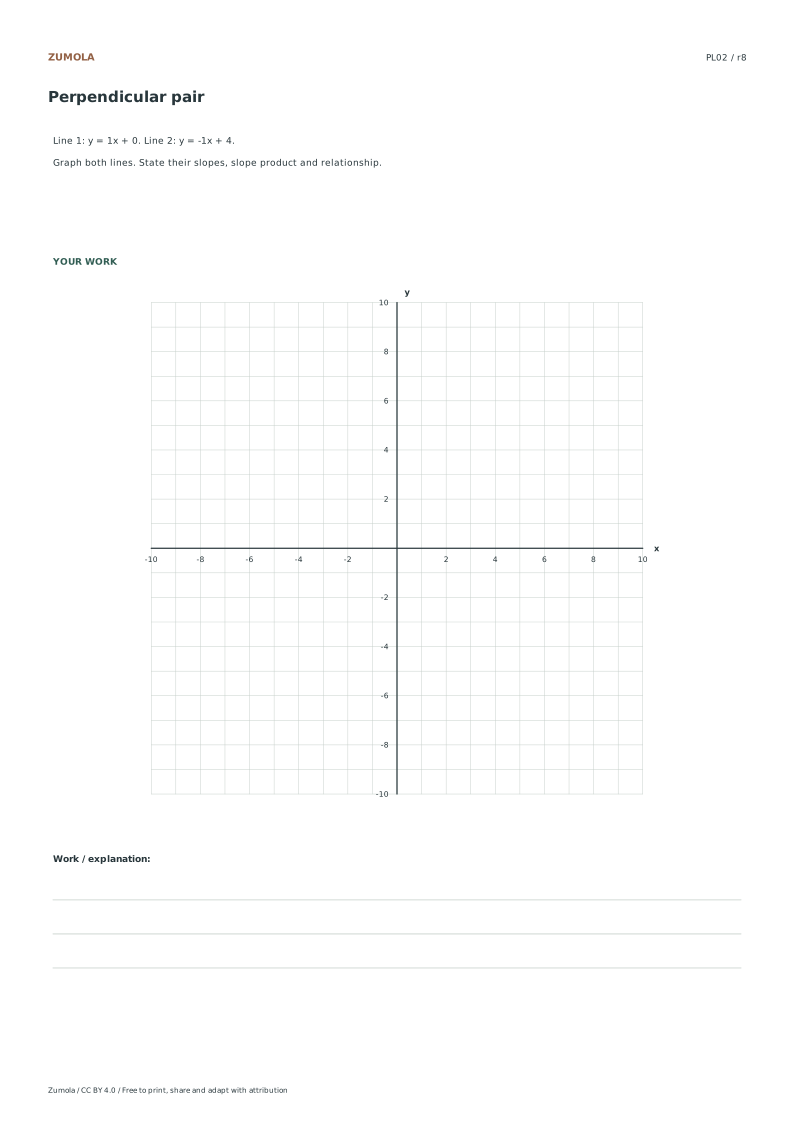
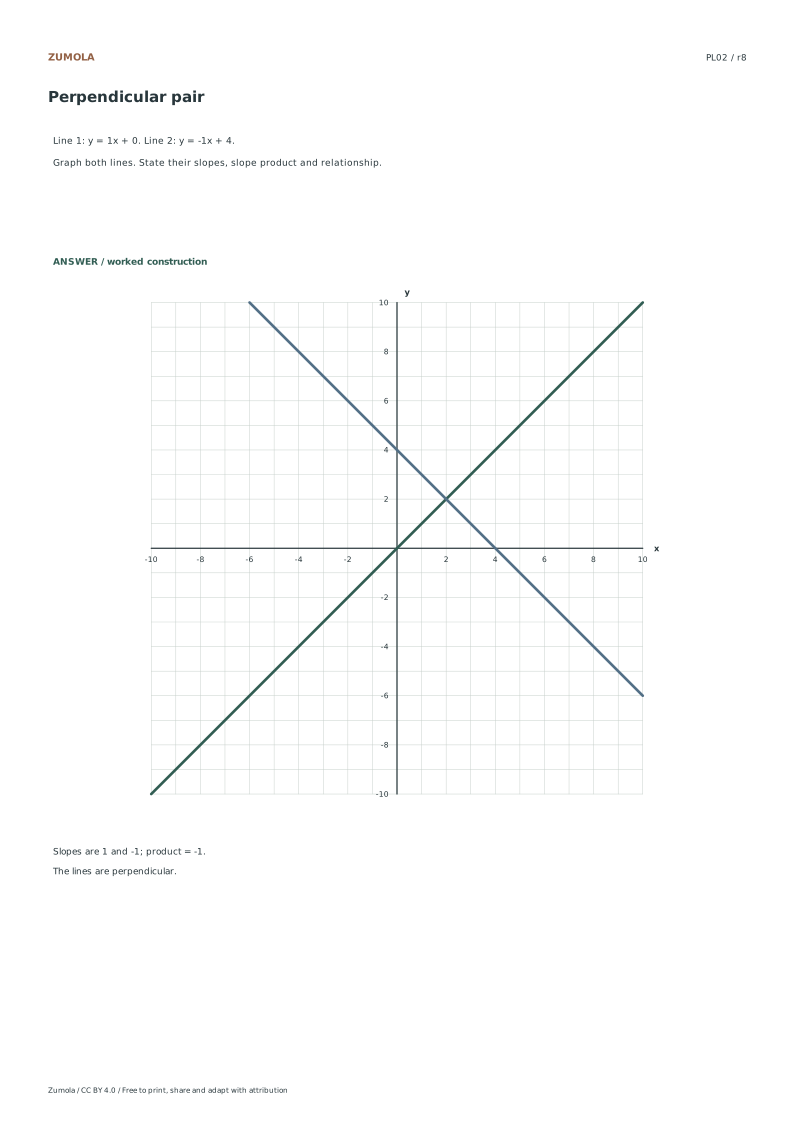
Line 1: y = 1x + 0. Line 2: y = -1x + 4.
Graph both lines. State their slopes, slope product and relationship.
PL03
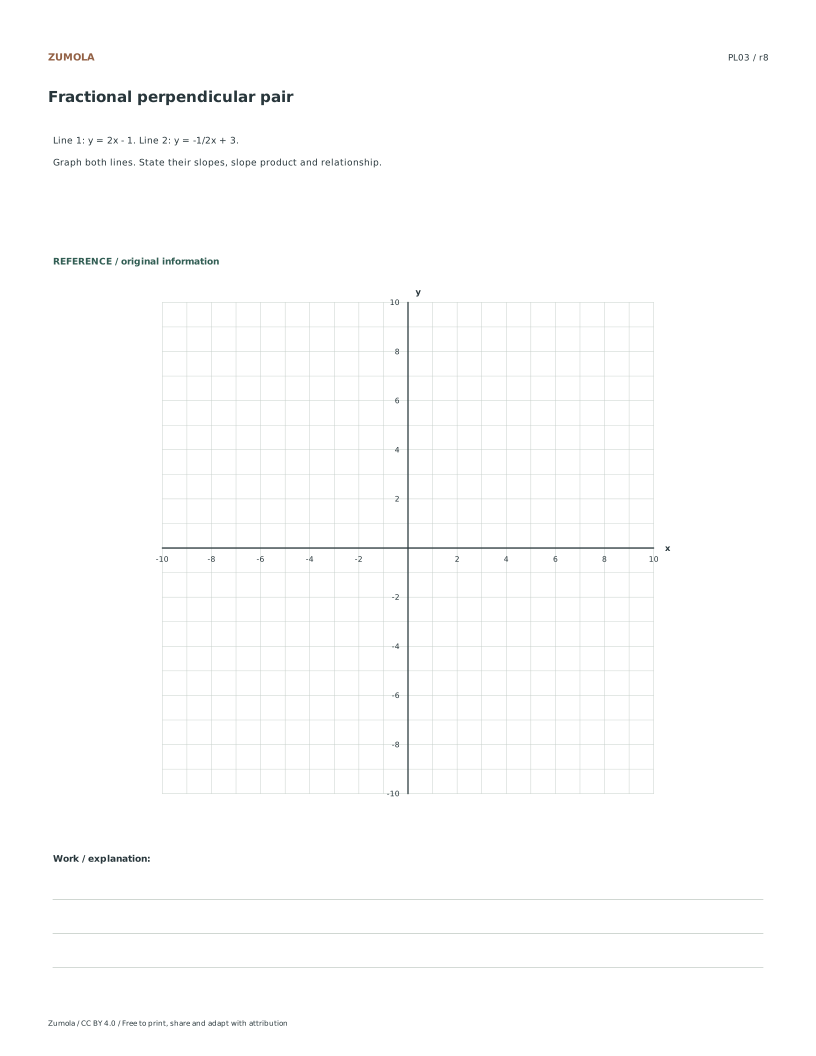
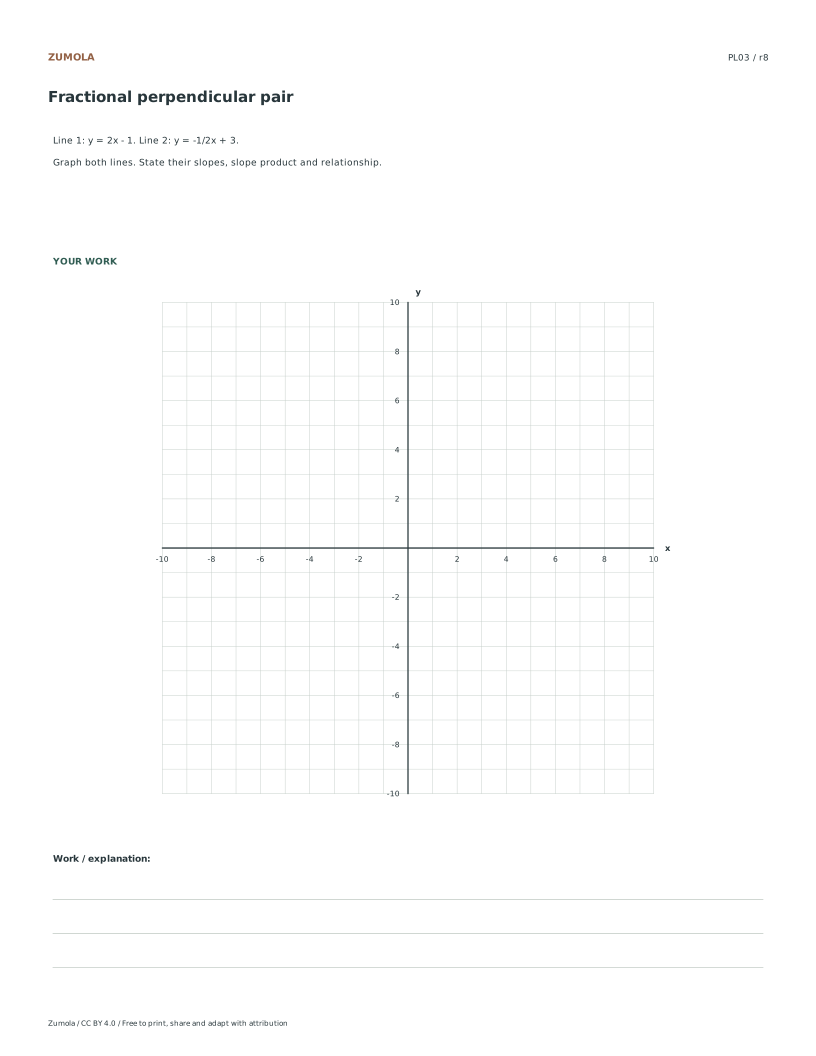
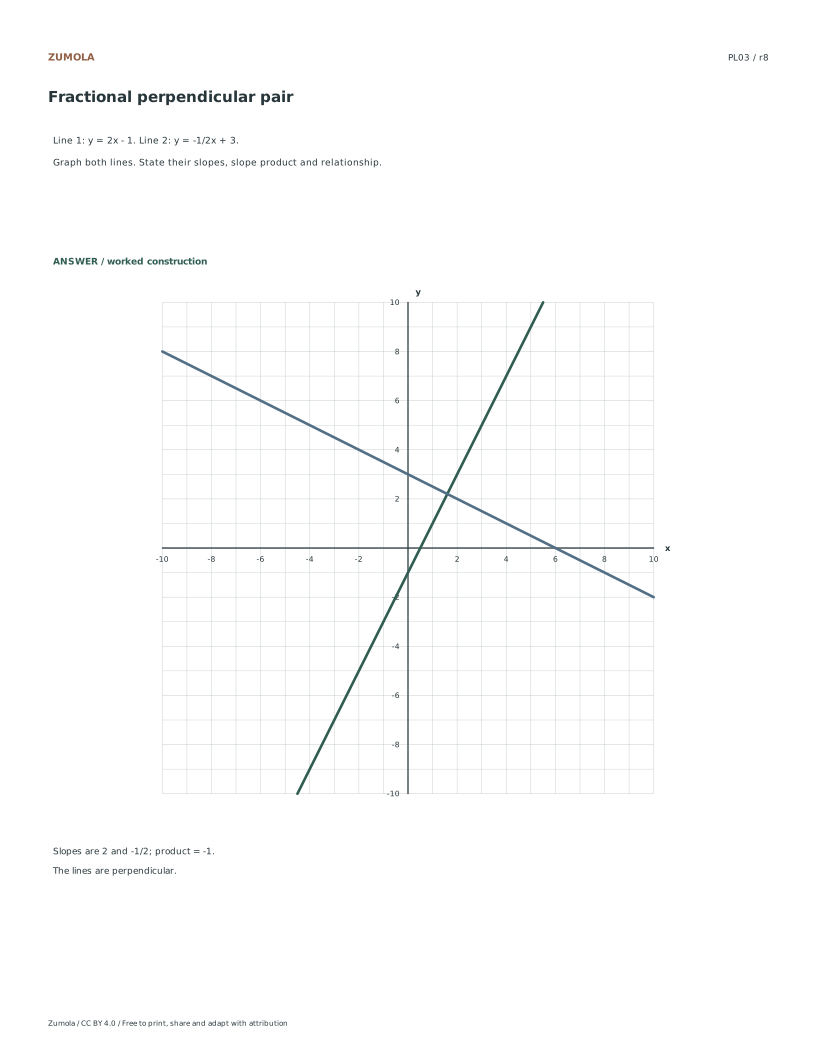
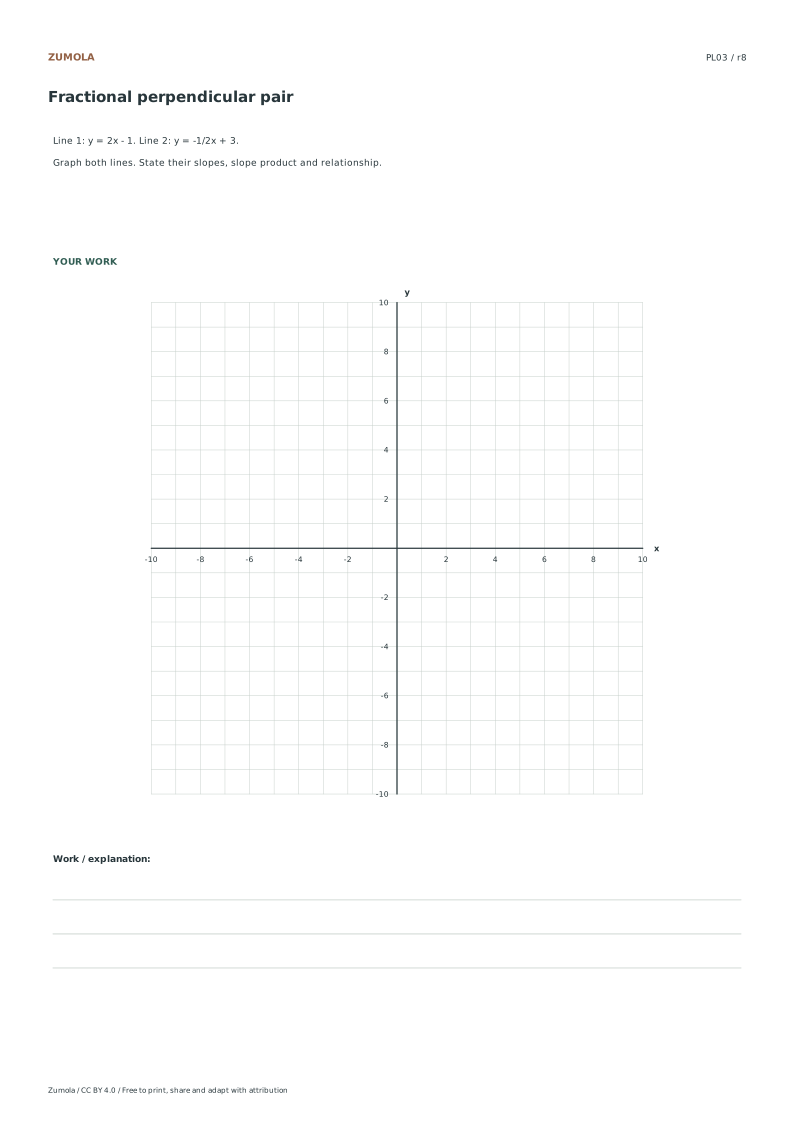
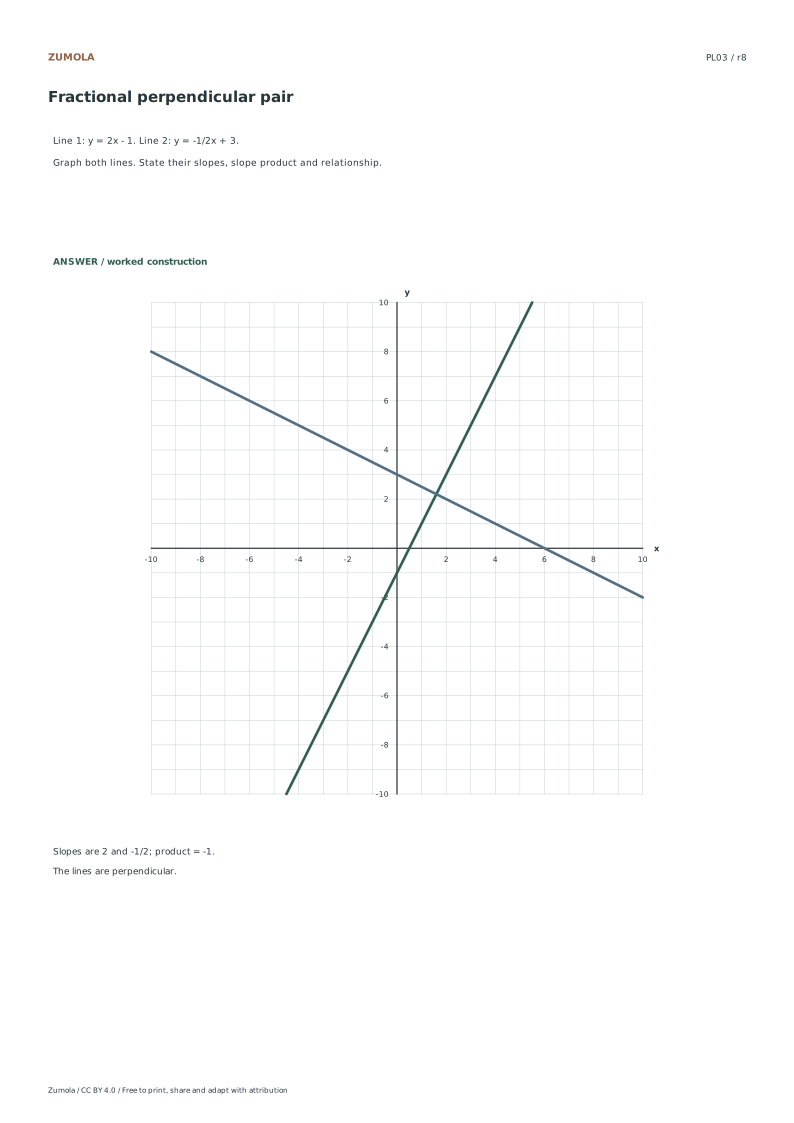
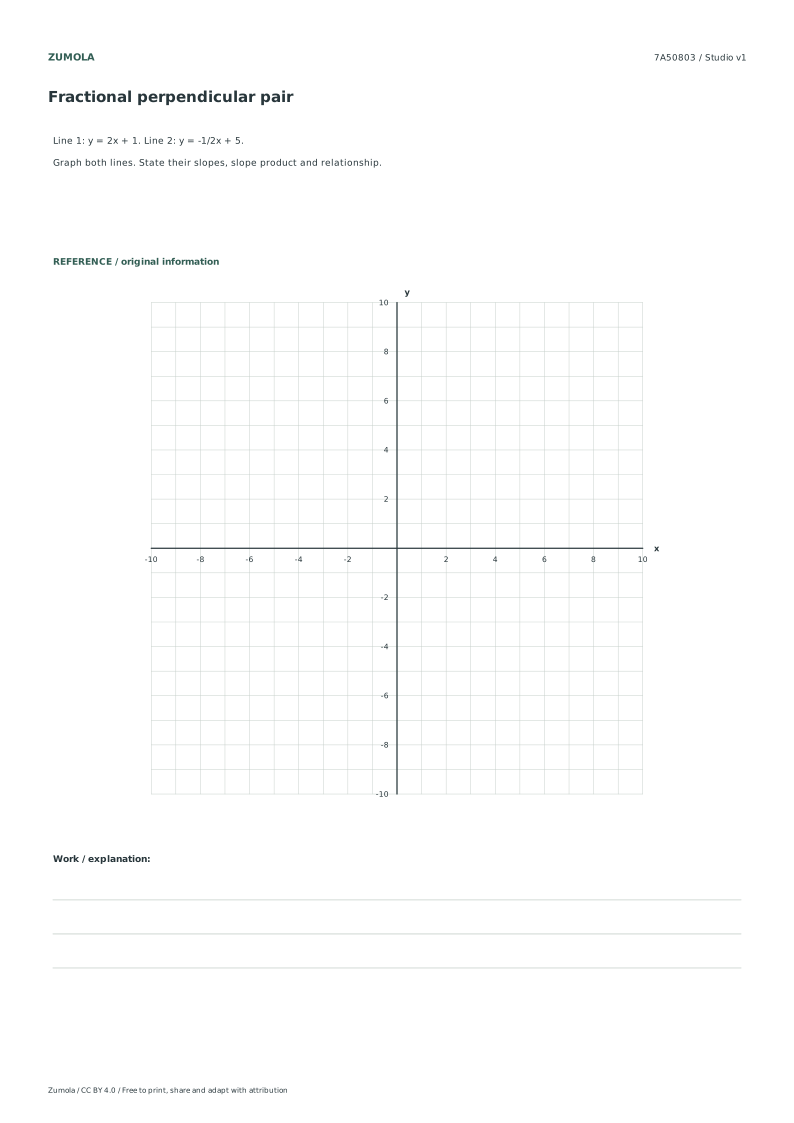
Line 1: y = 2x - 1. Line 2: y = -1/2x + 3.
Graph both lines. State their slopes, slope product and relationship.
PL04
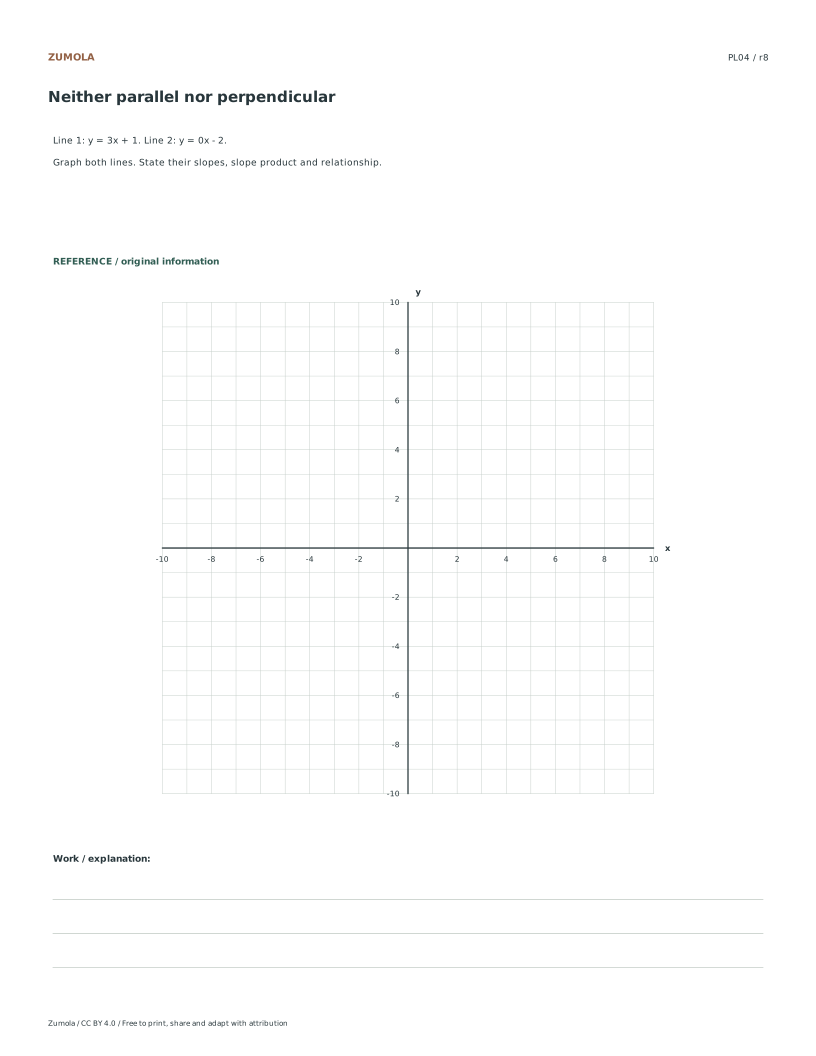
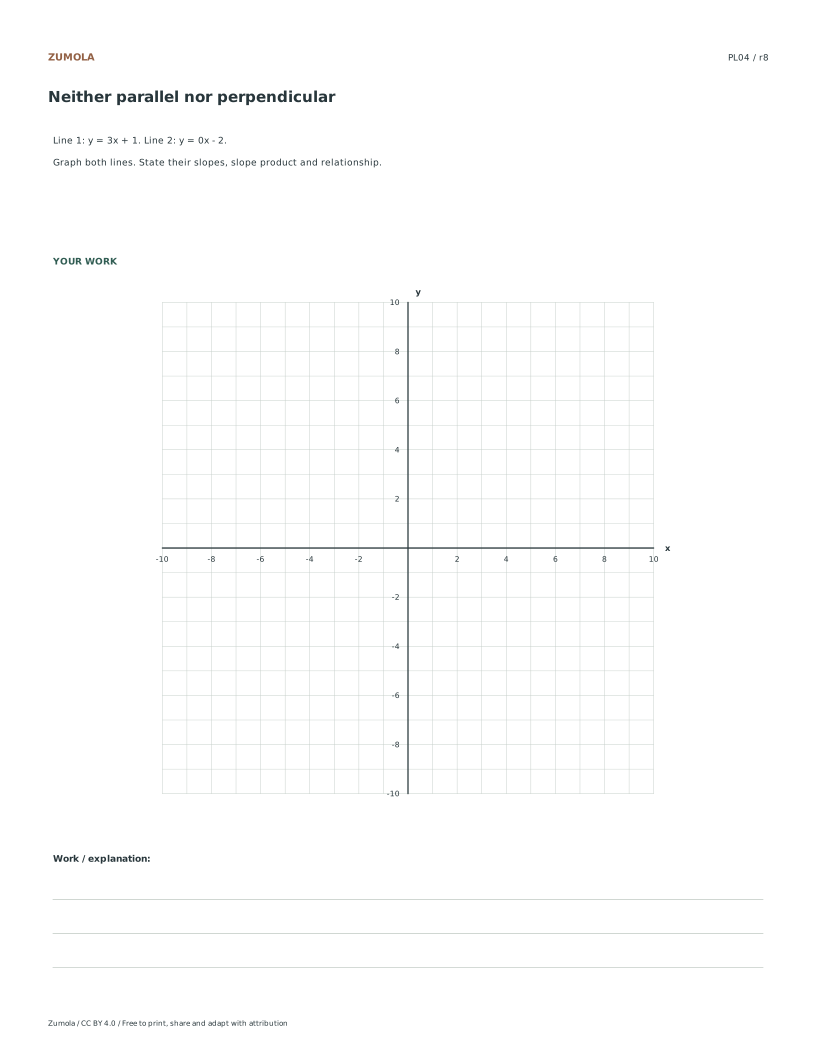
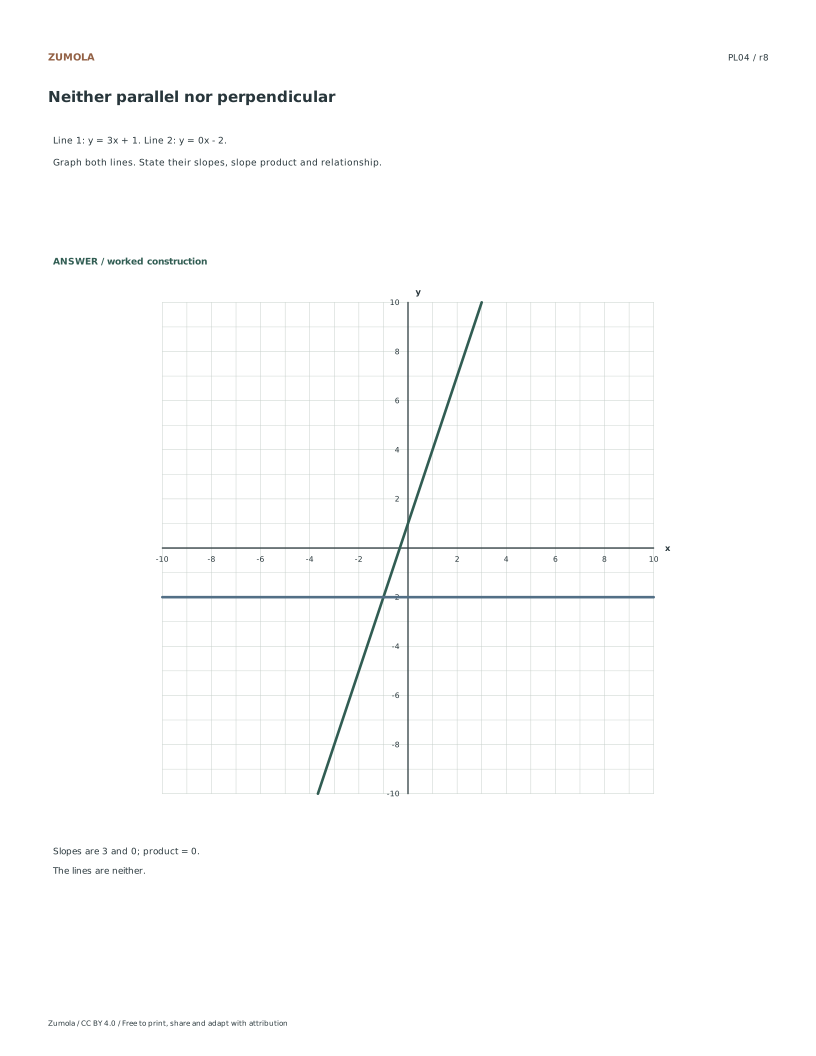
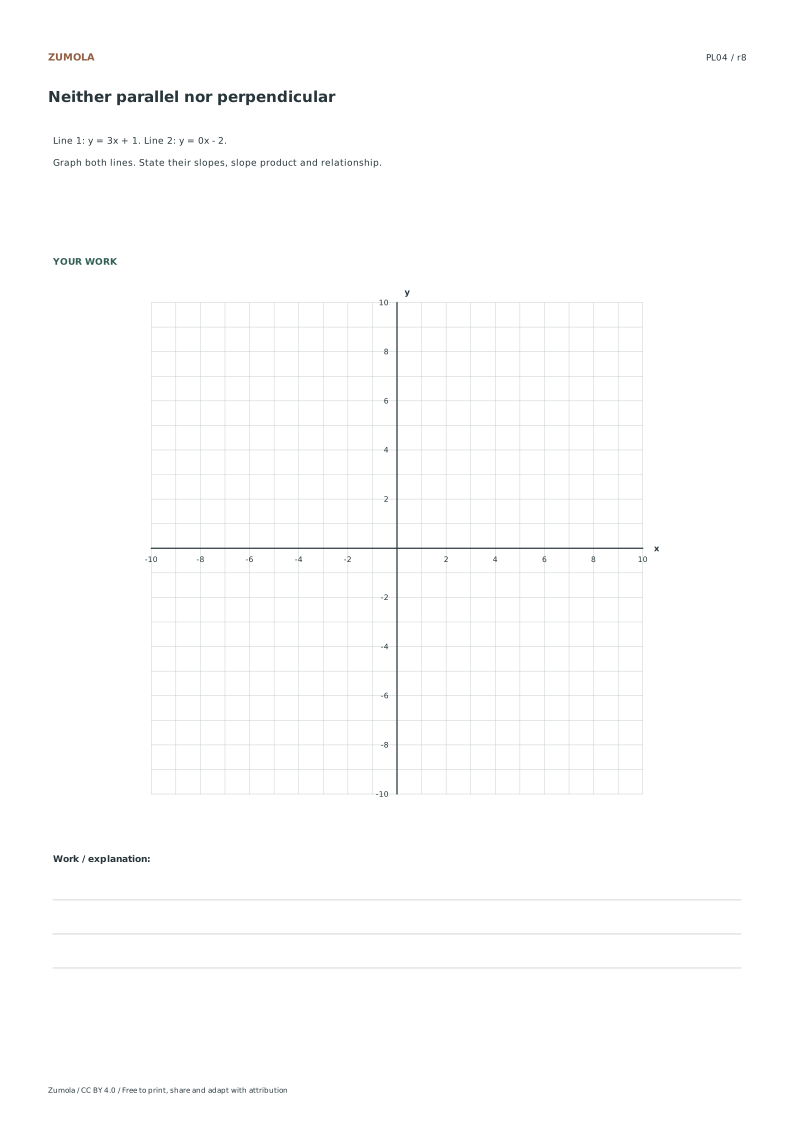
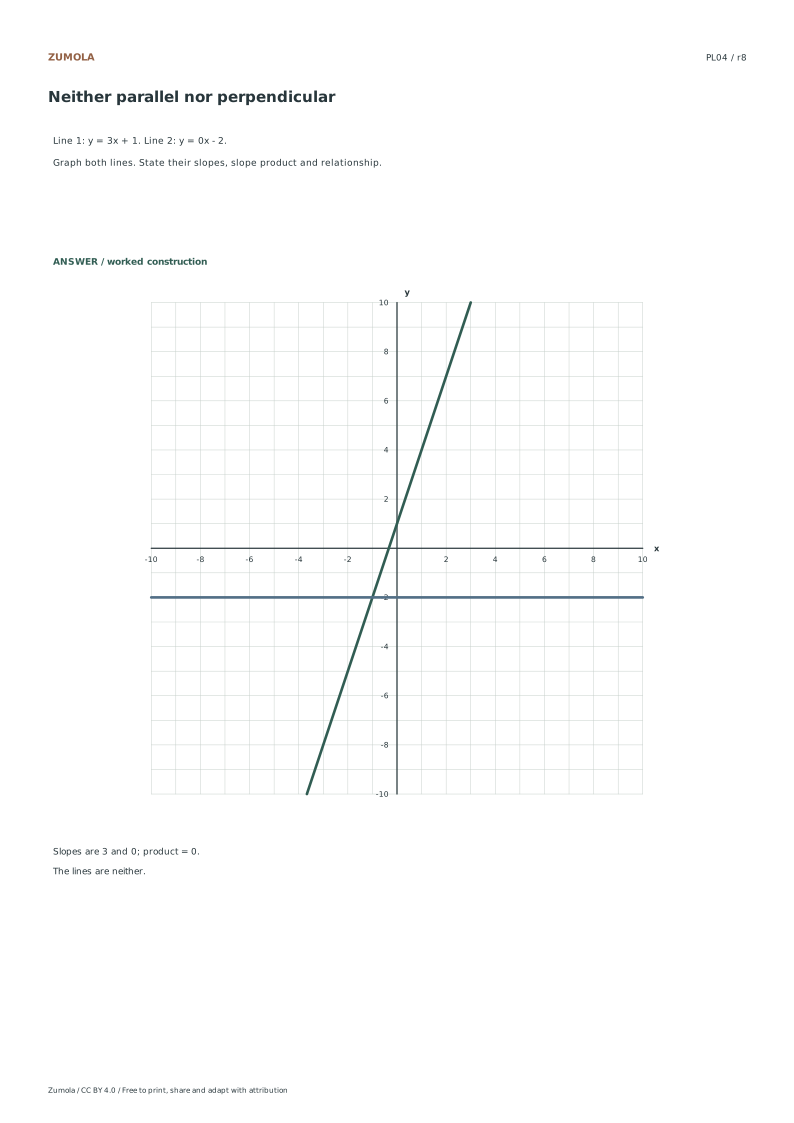
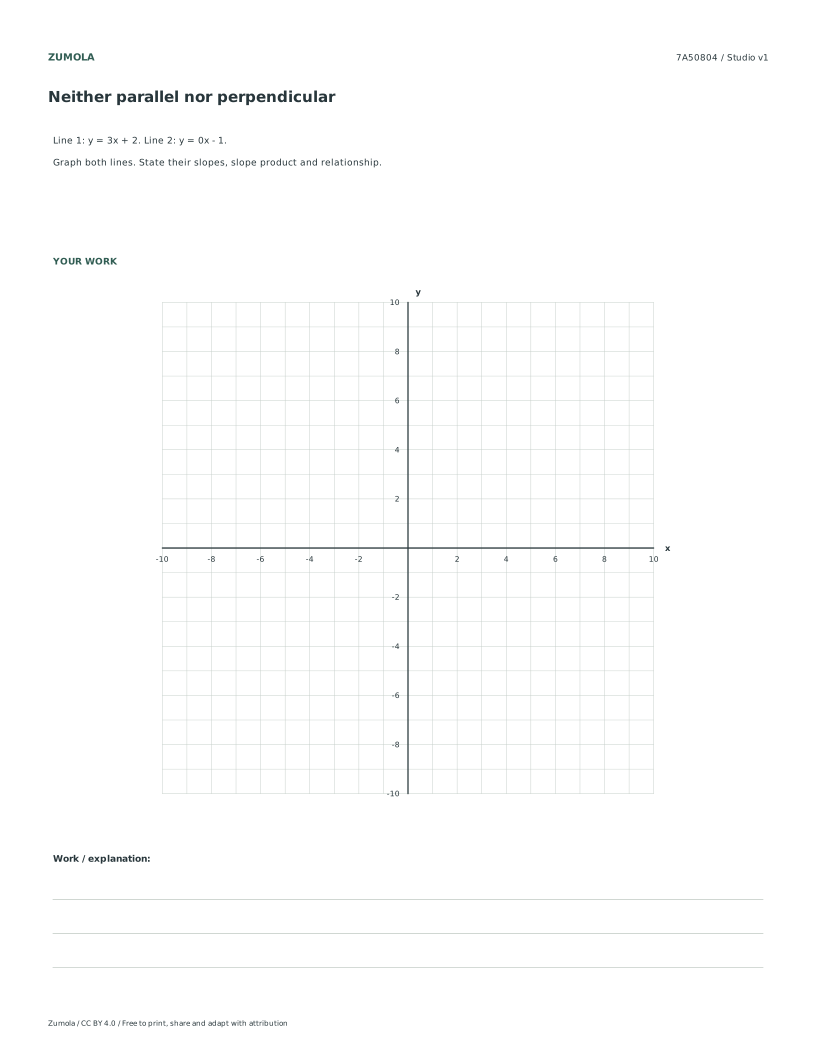
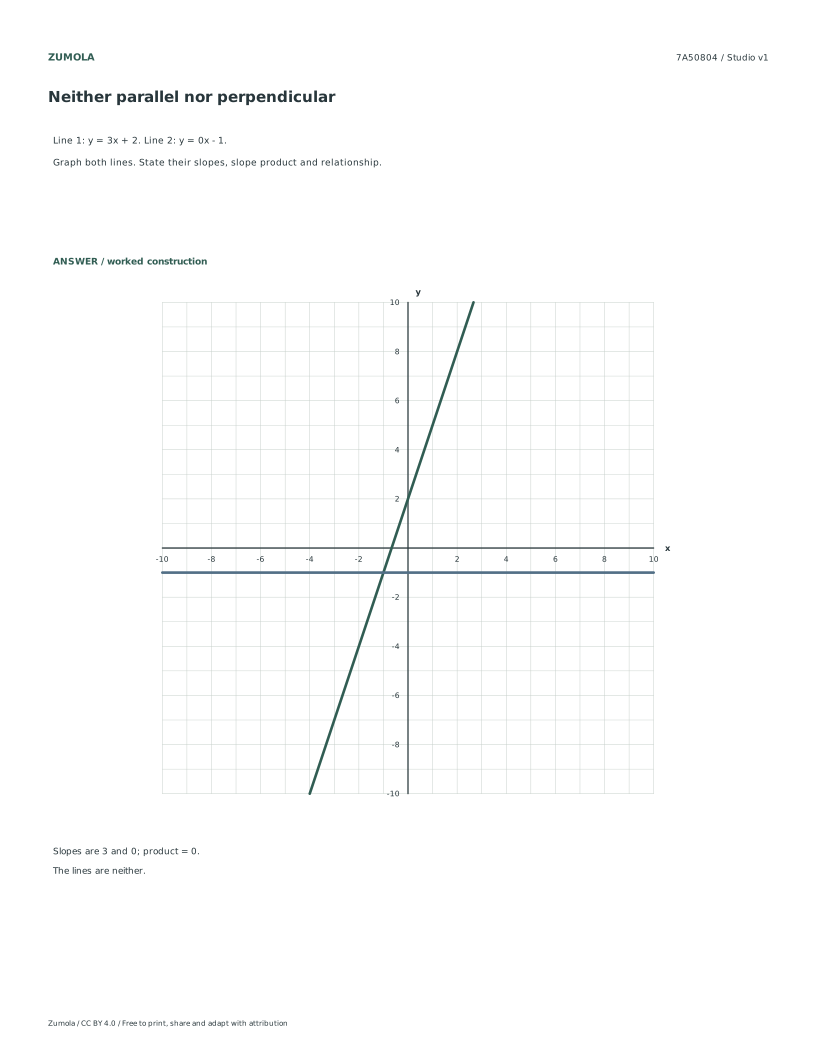
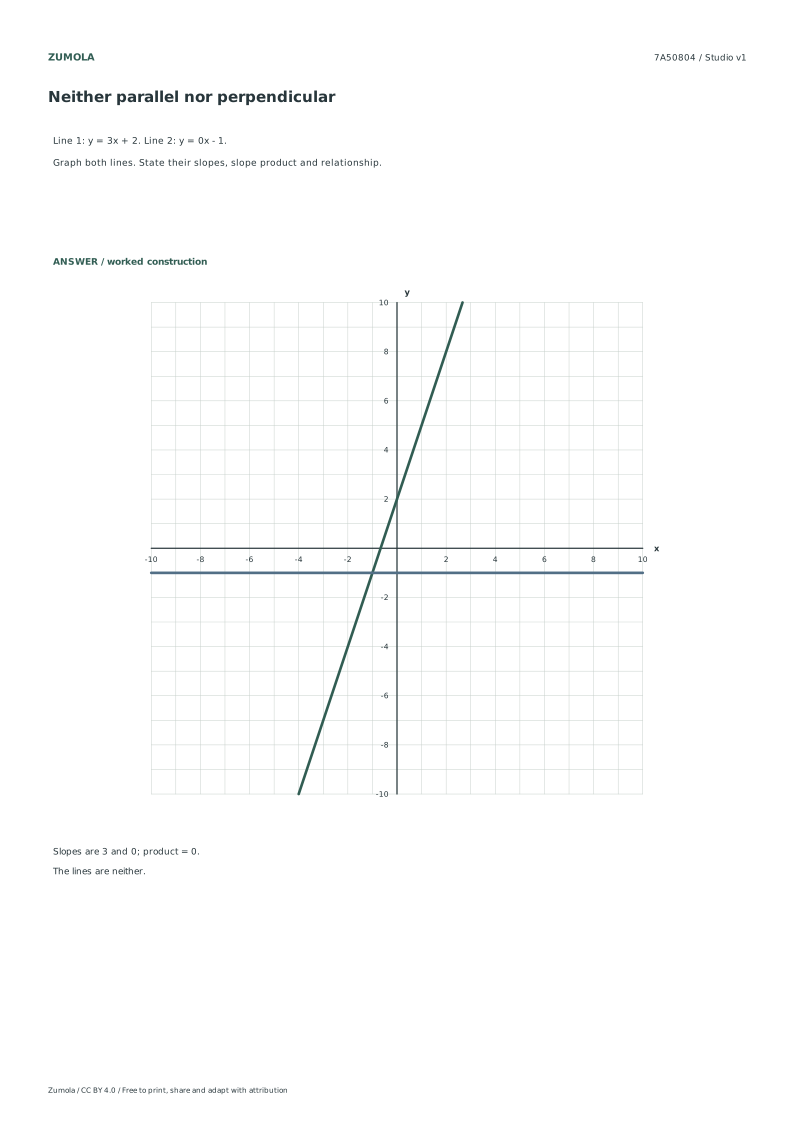
Line 1: y = 3x + 1. Line 2: y = 0x - 2.
Graph both lines. State their slopes, slope product and relationship.
Use the coordinates, dimensions and rules given for each case. Distances and areas are measured in grid units.
Check the first case
PL01: Parallel rising lines
Step
Worked result
1
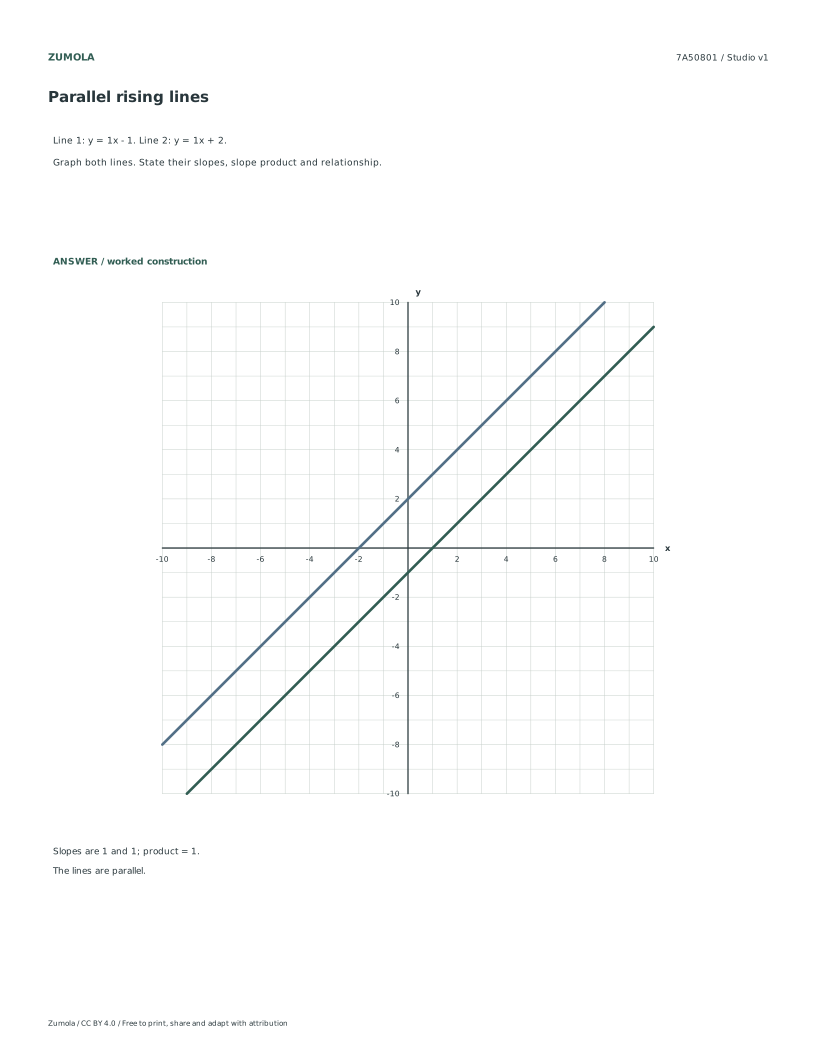
Slopes are 1 and 1; product = 1.
2
The lines are parallel.
The first case shows the checking pattern. Individual answer files contain the completed graph or net and result for every case.
Work through the graph
Identify Parallel Lines by Equal Slopes and Different Intercepts
Two distinct nonvertical lines are parallel exactly when their slopes are equal and their y-intercepts are different. For example, y = 1x + 0 and y = 1x + 3 both have slope 1 but intercepts 0 and 3, so they are parallel. If both slope and intercept match, the equations describe the same line, not two parallel lines. A slope product of 1 does not generally signal parallel lines; for instance, slopes 2 and 1/2 give product 1 but are neither parallel nor perpendicular. Always compare slopes first, then check intercepts to confirm distinctness.
Test Perpendicularity with Slope Product -1
Nonvertical lines are perpendicular exactly when the product of their slopes is -1. For y = 1x + 0 and y = -1x + 4, slopes 1 and -1 multiply to -1, so the lines are perpendicular. Similarly, y = 2x - 1 and y = -1/2x + 3 have slopes 2 and -1/2, product -1, confirming perpendicularity. A product of 0 occurs when one slope is 0 (a horizontal line) and the other is nonzero; such lines are neither parallel nor perpendicular. Check the product only after confirming both lines are nonvertical.
Classify Neither and Avoid Common Traps
When slopes are neither equal nor multiply to -1, the lines are neither parallel nor perpendicular. For y = 3x + 1 and y = 0x - 2, slopes 3 and 0 give product 0, so the lines are neither. Do not assume a product of 1 means parallel; that only happens when both slopes are 1 or both are -1, but equal slopes with different intercepts is the real parallel test. Also, equal slopes with equal intercepts mean the same line. Graph both equations on a blank grid to verify visually before stating the relationship.
Checks that catch common errors
Watch for
Check instead
Using slope product 1 as the test for parallel lines.
Parallel lines require equal slopes and different intercepts. A product of 1 is not the general criterion; for example, slopes 2 and 1/2 give product 1 but the lines are neither parallel nor perpendicular.
Declaring lines parallel when slopes are equal but intercepts are also equal.
Equal slopes with equal intercepts describe the same line, not two distinct parallel lines. Check that the intercepts differ before classifying as parallel.
Assuming any two lines with product -1 are perpendicular without checking for vertical lines.
The product rule applies to nonvertical lines. If one line is vertical, its slope is undefined, so compare slopes directly or use the definition of perpendicularity instead of the product.
Keep labels and margins readable
Choose the PDF that matches your paper. Print at Actual size / 100% and turn off Fit, Shrink and browser headers. SVG is editable but an editor can rescale it; the PDF is the simpler print route.
Useful answers
How can I tell if two lines are parallel from their equations?
Write each equation in slope-intercept form y = mx + b. If the slopes m are equal and the intercepts b are different, the lines are parallel. For example, y = 1x + 0 and y = 1x + 3 have equal slopes 1 and different intercepts 0 and 3, so they are parallel.
What slope product confirms perpendicular lines?
For nonvertical lines, the product of their slopes must be -1. For instance, slopes 1 and -1 give product -1, and slopes 2 and -1/2 also give product -1, so those pairs are perpendicular. If the product is not -1, the lines are not perpendicular.
What if the slopes are equal and the intercepts are also equal?
Then the two equations represent the same line, not two parallel lines. Parallel lines must be distinct, so their intercepts must differ. Always compare both slope and intercept before classifying the relationship.
Are the answer files and editable graphs free?
Yes. The individual student, reference and answer files plus collection packs are free without signup. Credit Zumola under CC BY 4.0 when sharing or adapting.
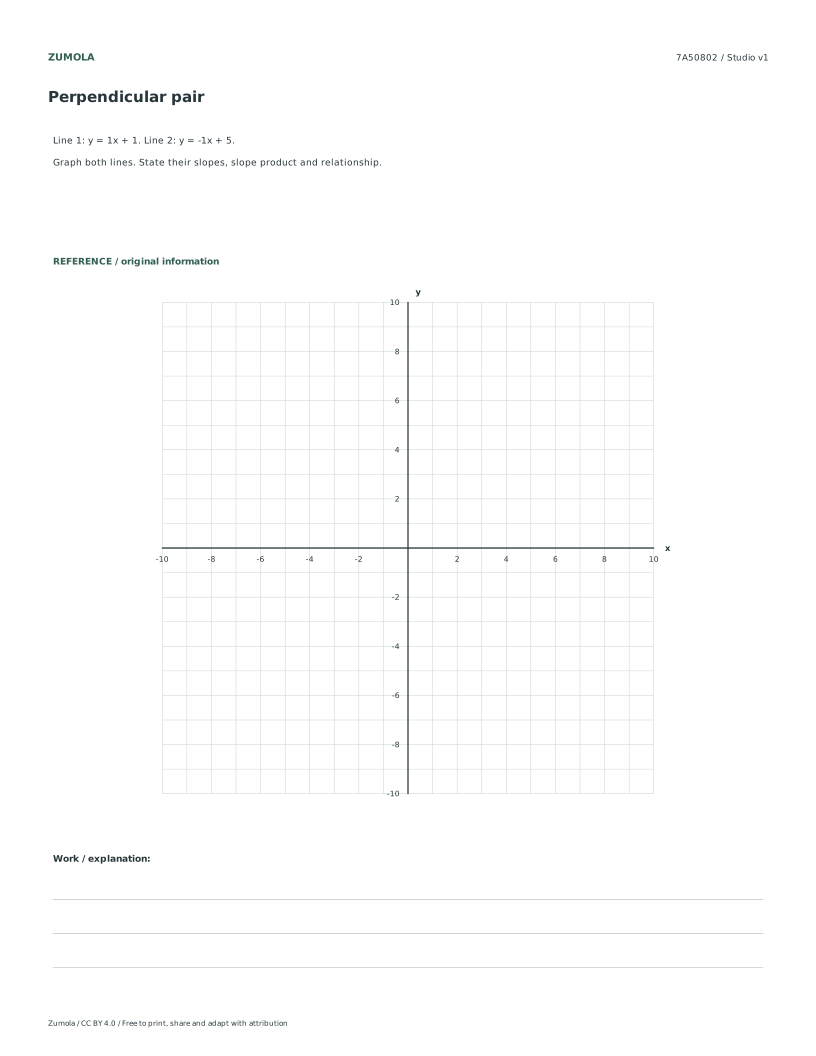
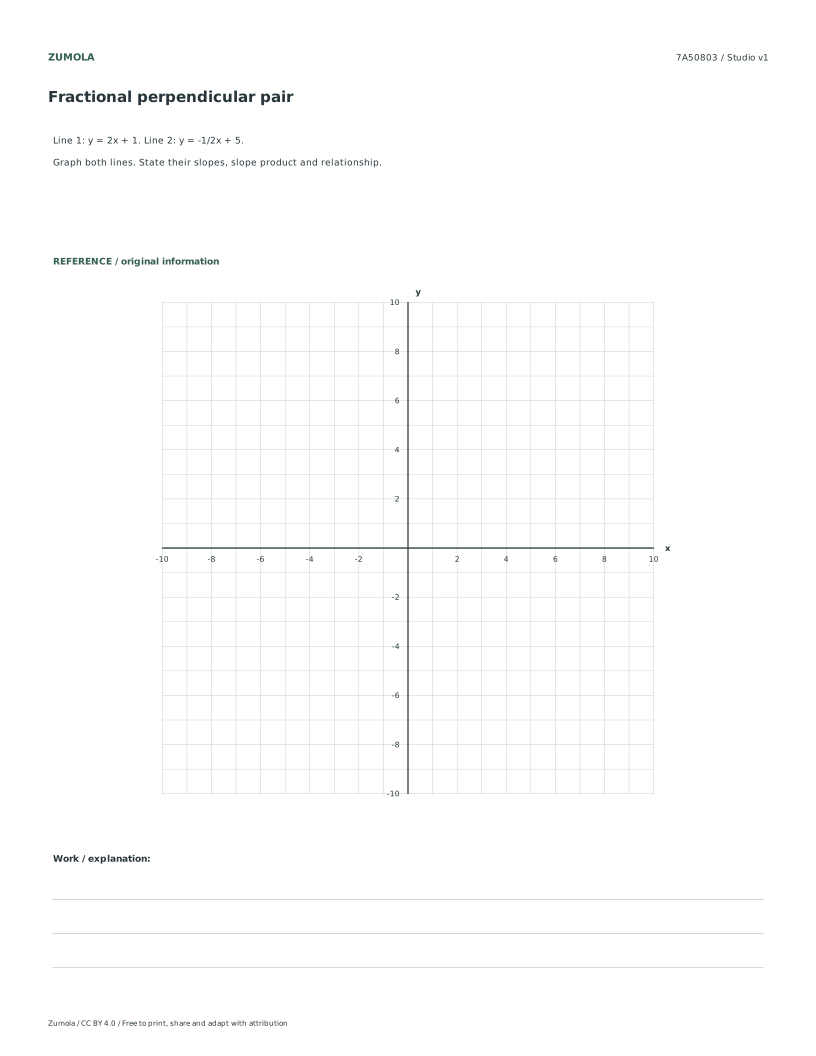
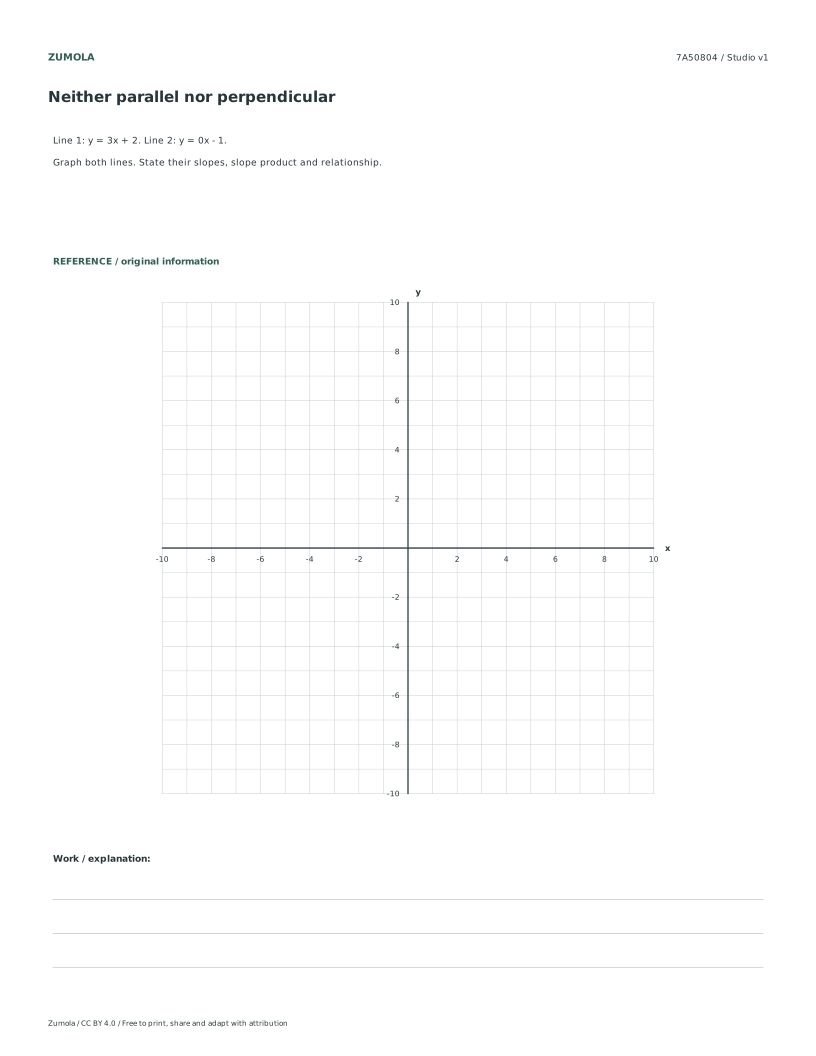
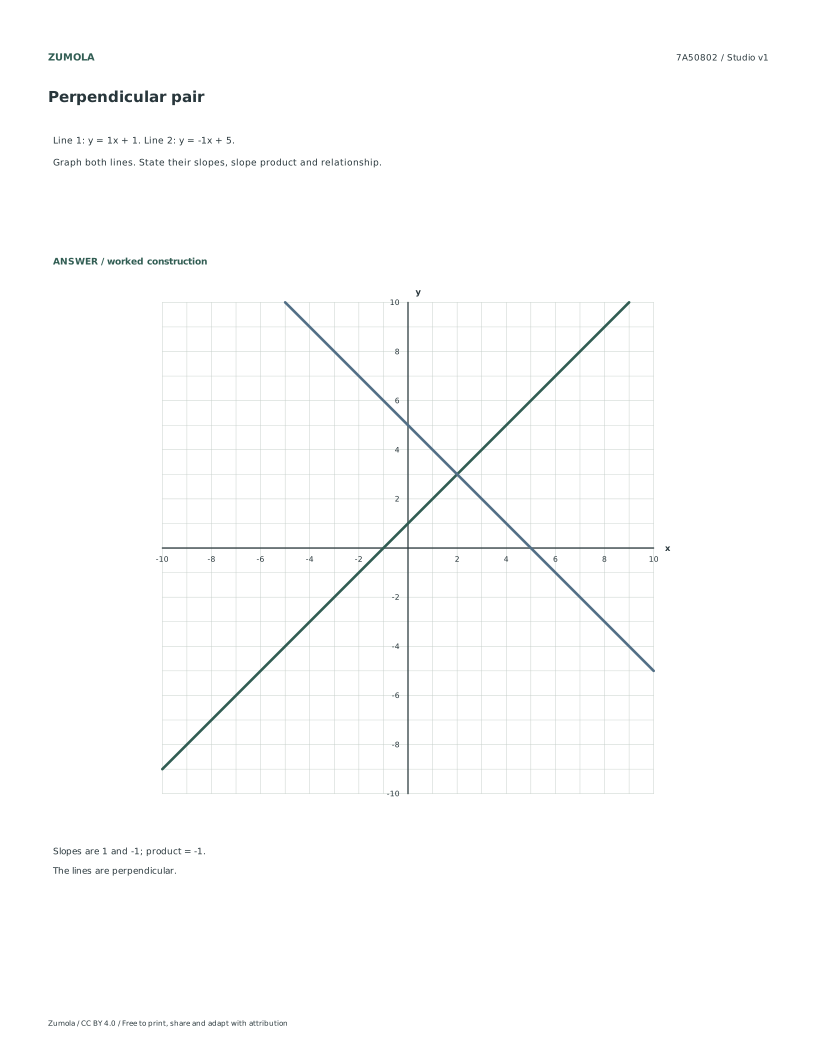
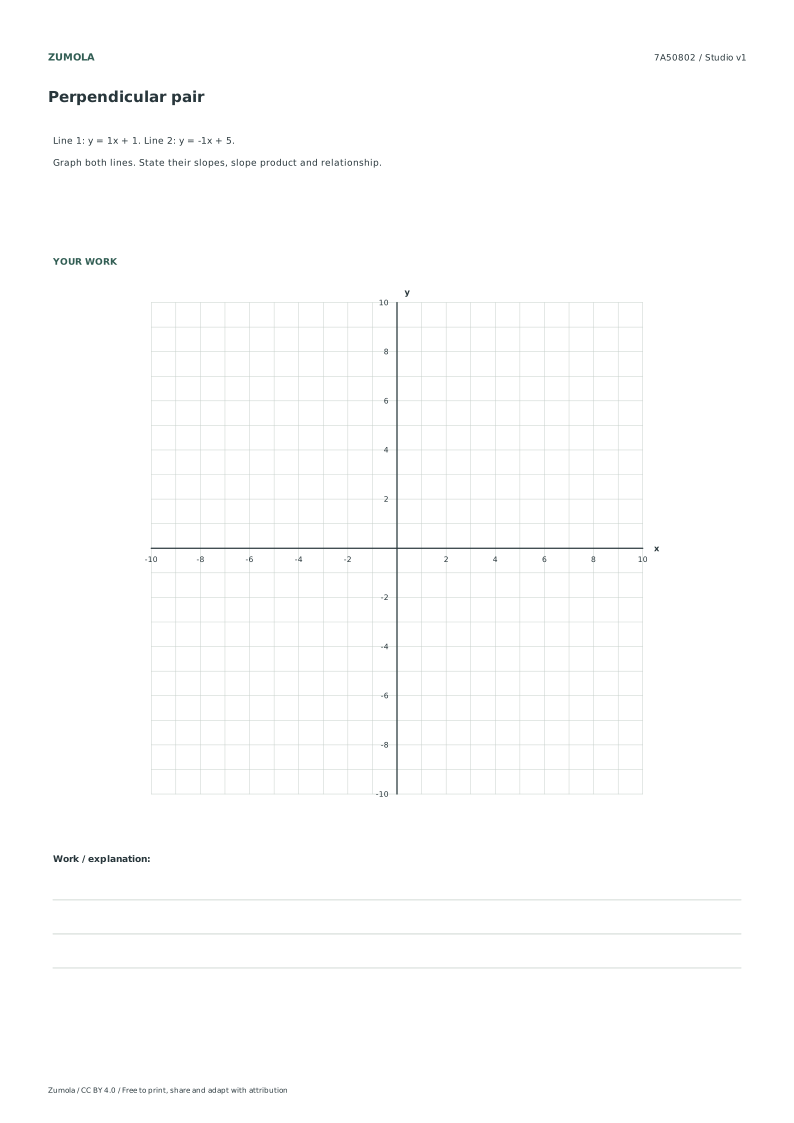
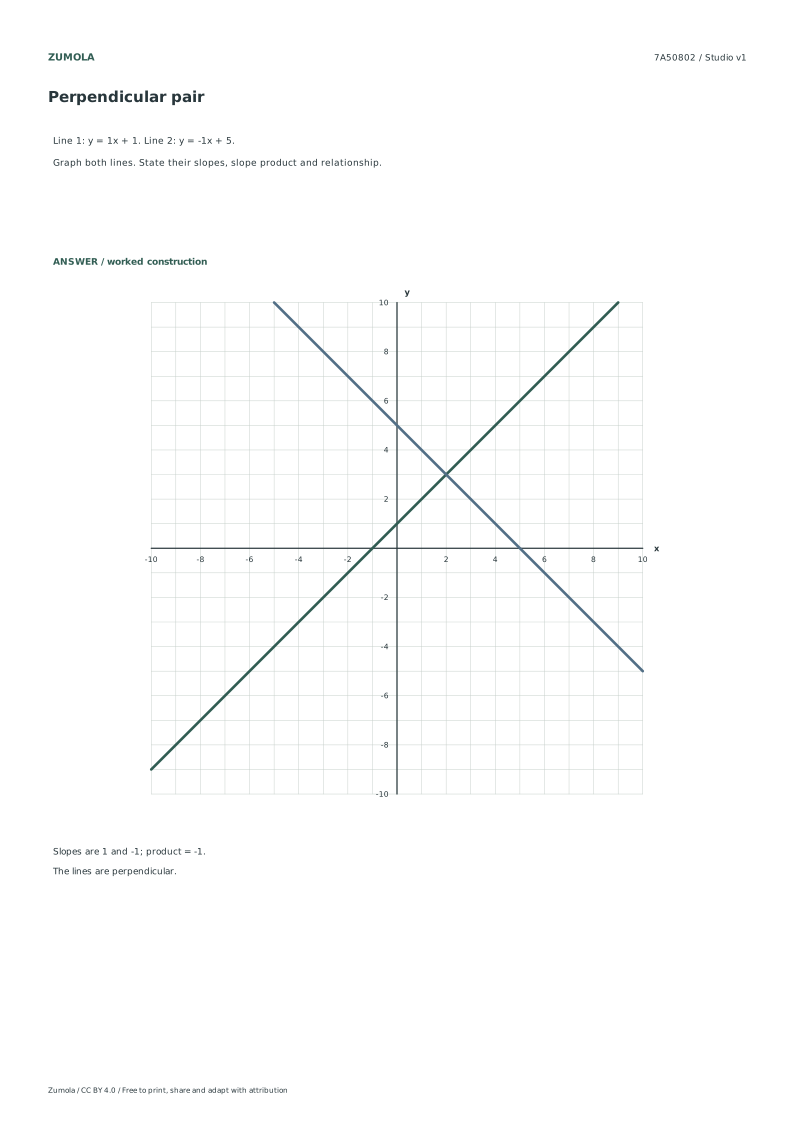
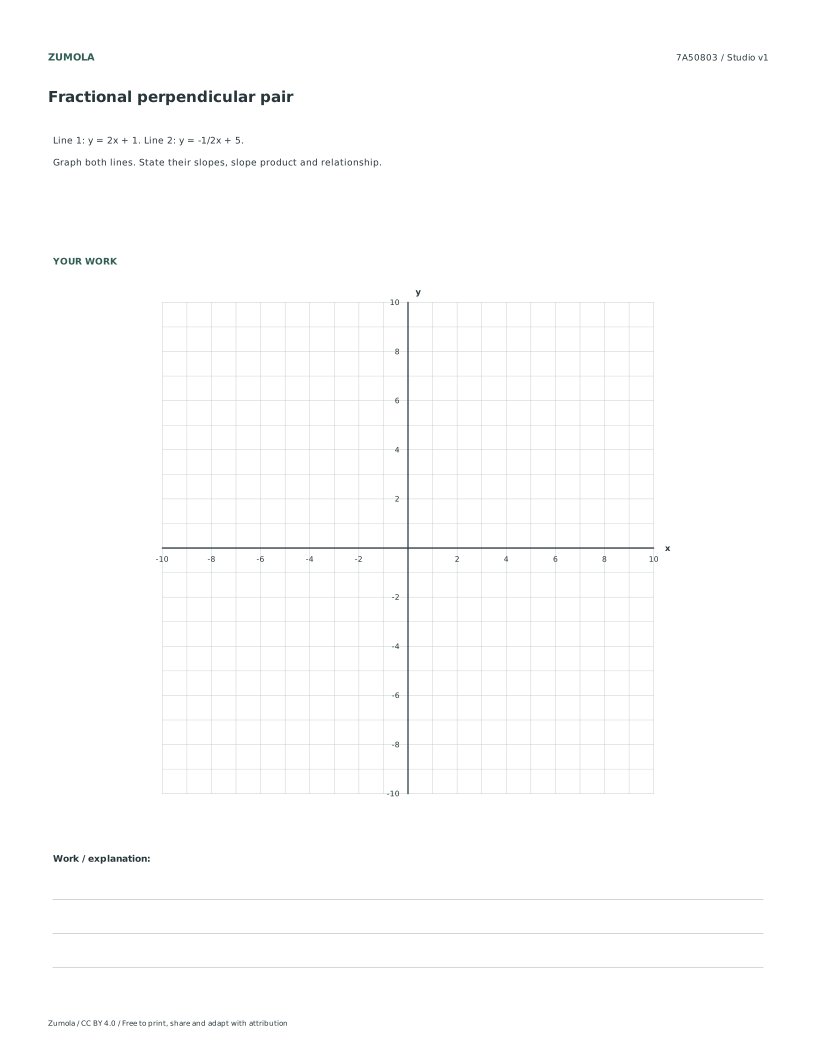
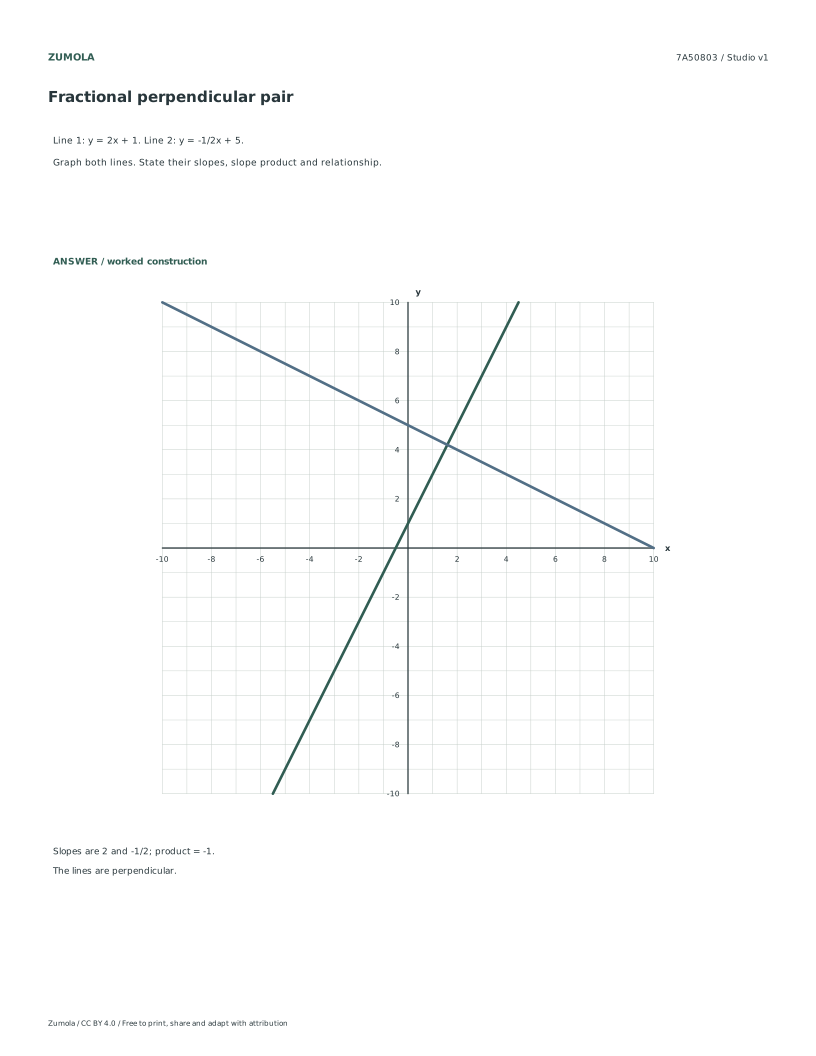
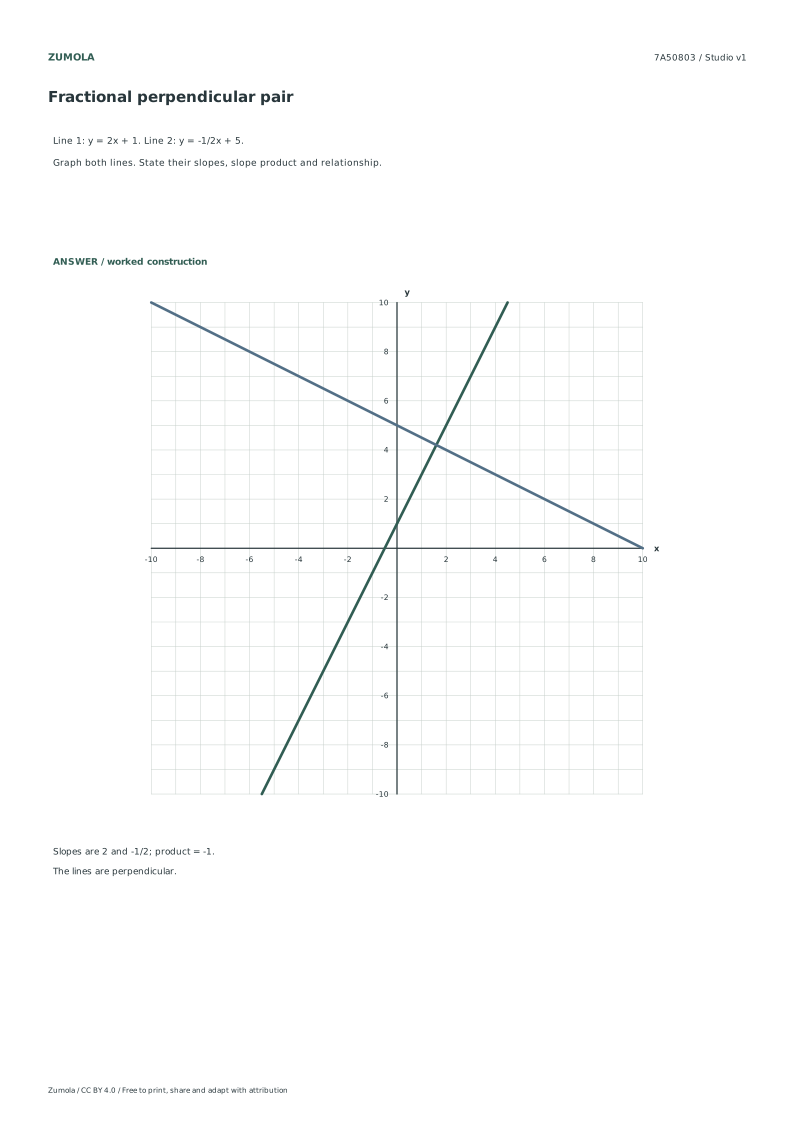
Start by writing each equation in slope-intercept form, y = mx + b, and record m and b. For y = 1x - 1 and y = 1x + 2, both slopes are 1 but intercepts differ, so the lines are parallel. For y = 1x + 1 and y = -1x + 5, the slopes are 1 and -1; their product is -1, so the lines are perpendicular. For y = 2x + 1 and y = -1/2x + 5, the slopes are 2 and -1/2; the product is -1, so they are perpendicular. For y = 3x + 2 and y = 0x - 1, the slopes are 3 and 0; the product is 0, so the lines are neither parallel nor perpendicular.
Check the first new case
Line 1: y = 1x - 1. Line 2: y = 1x + 2.
Slopes are 1 and 1; product = 1.
The lines are parallel.
The answer PDFs include the completed drawings and checks for all four cases. Free original resources, CC BY 4.0. No signup required.
More ways to practice
A fresh case: classify before you draw
The existing page already covers parallel rising lines, a perpendicular pair, and a fractional perpendicular pair. This case deliberately mixes a negative slope with a positive one so that visual inspection alone is unreliable.
Work from equations first. Rewrite each line in slope-intercept form, y = mx + b, then compare m values. Two nonvertical lines are parallel when their slopes are equal. They are perpendicular when the product of their slopes is exactly -1, which is the same as one slope being the negative reciprocal of the other. Vertical lines are a special case: a vertical line is perpendicular to any horizontal line, but vertical lines have undefined slope, so the product rule does not apply.
Write both equations in y = mx + b form and record each slope as a fraction.
Compare slopes: equal means parallel; product equal to -1 means perpendicular; otherwise neither.
Plot each intercept b on the y-axis, then use rise over run from that point to place a second point.
Draw each line with a ruler through both points and extend it across the grid.
Label each line with its equation near one end, keeping labels inside the margin.
Diagnostic checks that catch real errors
Most mistakes in this task come from arithmetic, not drawing. Run these checks before comparing your graph to any answer file.
A sign slip is the most common failure. If one slope is 2/3 and the other is -3/2, the product is -1, so the pair is perpendicular. If you wrote 3/2 instead of -3/2, the product becomes 1 and you will wrongly classify the pair.
Coordinate misreads also matter. Confirm that you moved up for positive rise and right for positive run. A line with slope -2/3 should fall two units for every three units right, not rise.
Multiply the two slopes as fractions and simplify; the result should be exactly -1 for perpendicular lines.
Check that parallel slopes are identical, including sign, not just similar in size.
Verify each plotted point by substituting its coordinates back into the original equation.
Confirm the drawn line passes through both plotted points, not just one.
Judging your own graph with a rubric
Drawing has multiple valid outcomes, so an exact-match answer is not the right standard. Use the criteria below to assess whether your work is mathematically sound and readable.
The rubric separates classification accuracy from drafting quality. A correct classification with a messy graph still needs revision, and a neat graph with a wrong slope product is not acceptable.
Classify the pair correctly using slope arithmetic, not appearance.
Plot at least two verified points per line.
Draw straight lines with a ruler and extend them fully across the grid.
Label each line clearly and keep all text inside the page margin.
Show your slope calculation so the classification can be checked.
Try this example
Classify the lines y = 3x - 1 and y = -1/3 x + 4, then describe how to graph them on a coordinate grid.
Show the worked explanation
The first slope is 3 and the second is -1/3. Their product is 3 times -1/3, which equals -1, so the lines are perpendicular. To graph the first line, plot (0, -1), then move up 3 and right 1 to reach (1, 2), and draw through both points. To graph the second line, plot (0, 4), then move down 1 and right 3 to reach (3, 3), and draw through both points. Extend both lines across the grid and label each with its equation.
Common mistakes
Classifying a pair as perpendicular because the lines look like they meet at a right angle on the printed grid. Compute the slope product. Only a product of exactly -1 confirms perpendicularity for nonvertical lines; printed angles are not reliable evidence.
Using the reciprocal instead of the negative reciprocal when checking perpendicularity. Flip the fraction and change its sign. For slope 4/5, the perpendicular slope is -5/4, and their product is -1.
Plotting a negative slope by moving up and left instead of down and right. For slope -2/3, move down 2 and right 3 from the intercept, or up 2 and left 3; both give the same line.
Check your work
Slopes are written as fractions and the product is computed correctly.
The pair is classified as parallel, perpendicular, or neither using slope arithmetic, not visual appearance.
Each line passes through at least two points that satisfy its equation.
Lines are drawn straight with a ruler and extended across the grid.
Labels are legible and placed inside the page margin.
Questions before you start
How do I check perpendicularity when one line is vertical?
A vertical line has undefined slope, so the product rule does not apply. A vertical line is perpendicular to any horizontal line, whose slope is 0. Classify by orientation instead of multiplication.
Can two lines with different slopes still be parallel?
No. For nonvertical lines, parallel requires identical slopes. Different slopes always produce lines that intersect somewhere, so the pair is neither parallel nor perpendicular unless the product is -1.
Why should I rewrite equations before graphing?
Slope-intercept form exposes the slope and intercept directly, which makes classification and plotting faster. It also reduces plotting errors because you start from a known point on the y-axis.
Optional Google Analytics helps us understand which free resources are useful. It is off until you allow it. Drawing tools and downloads work with either choice. Privacy details