4 quadrilateral cases. Parallel sides and diagonals.
A graph, a task and a worked check
Free quadrilateral drawing worksheets with rectangles, parallelograms, trapezoids and kites. Letter/A4 reference and answer files included.
Choose Letter or A4, then download a student sheet first. Keep the separate reference or answer file closed until you have attempted the case. Every worksheet, SVG and answer is free without signup.
Choose your paper and download
Download paper size
Every worksheet and answer is free. No signup.
Free original resourceQU01
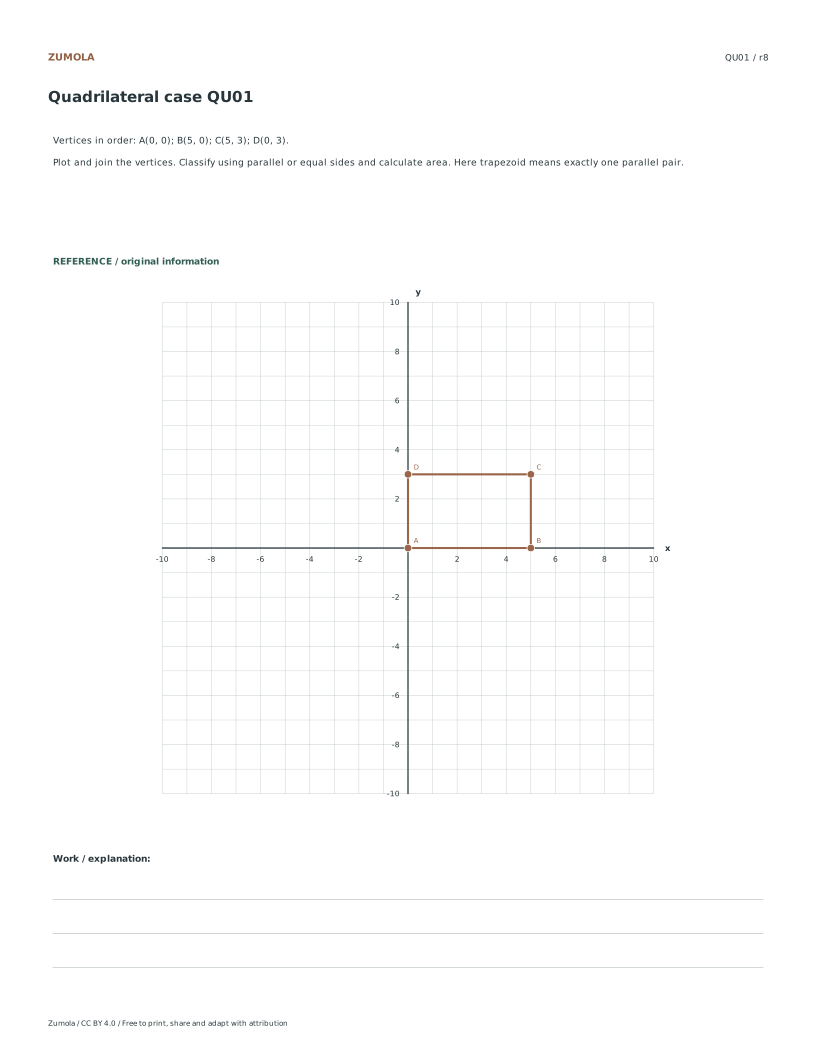
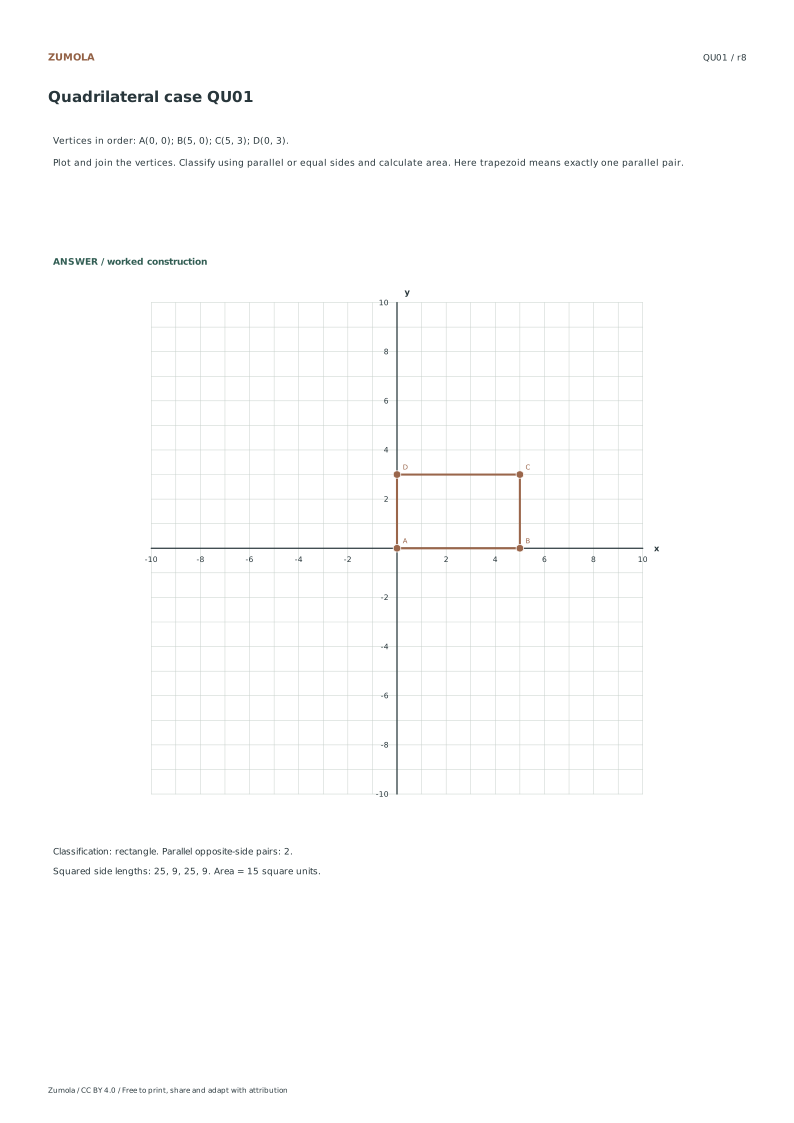
Rectangle
Original worksheet collection. Letter or A4 PDF and editable SVG.
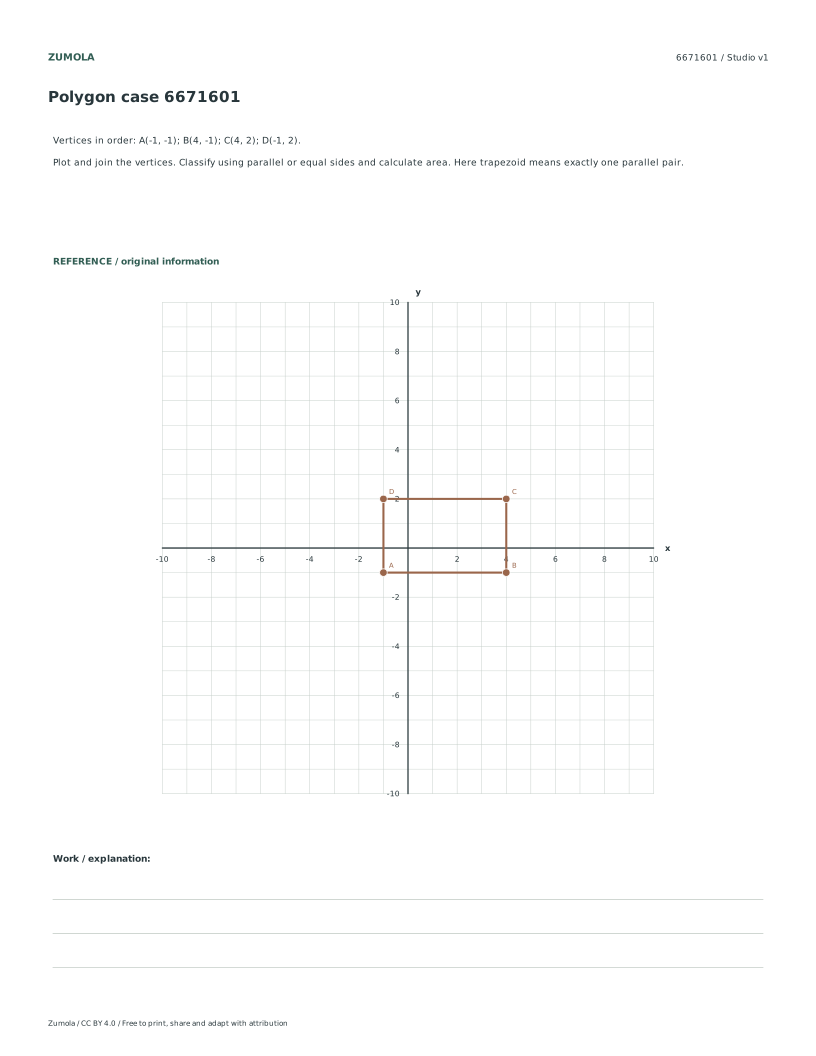
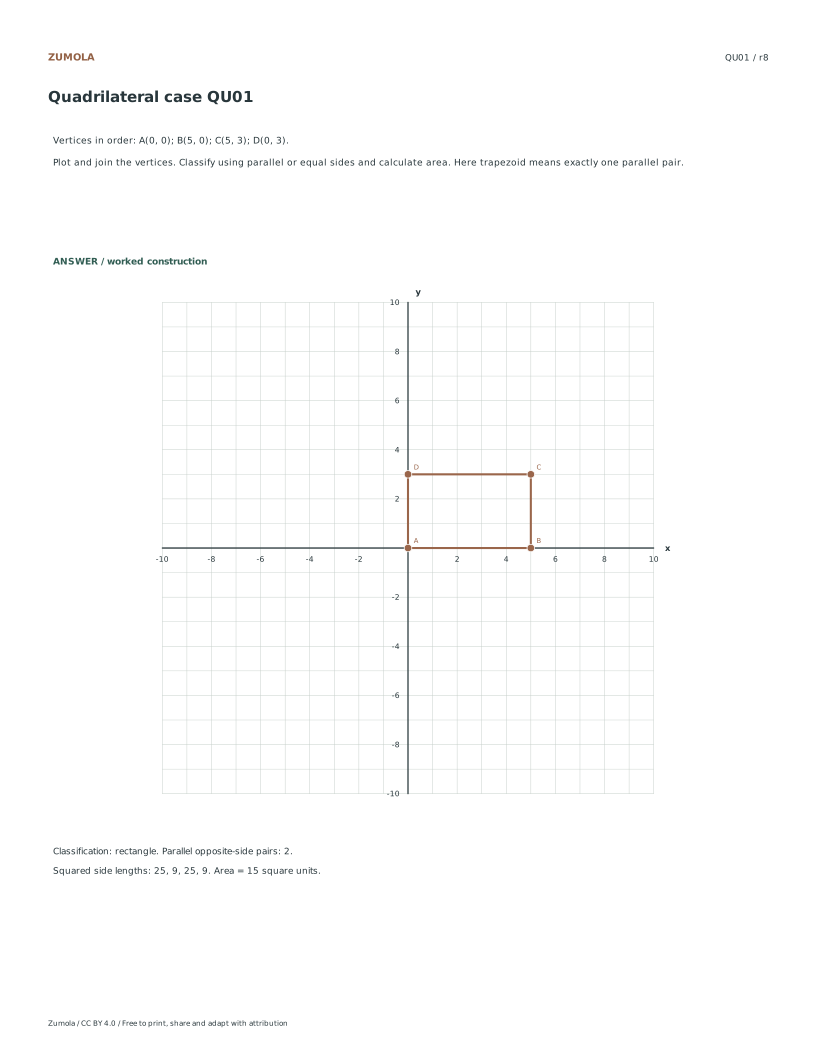
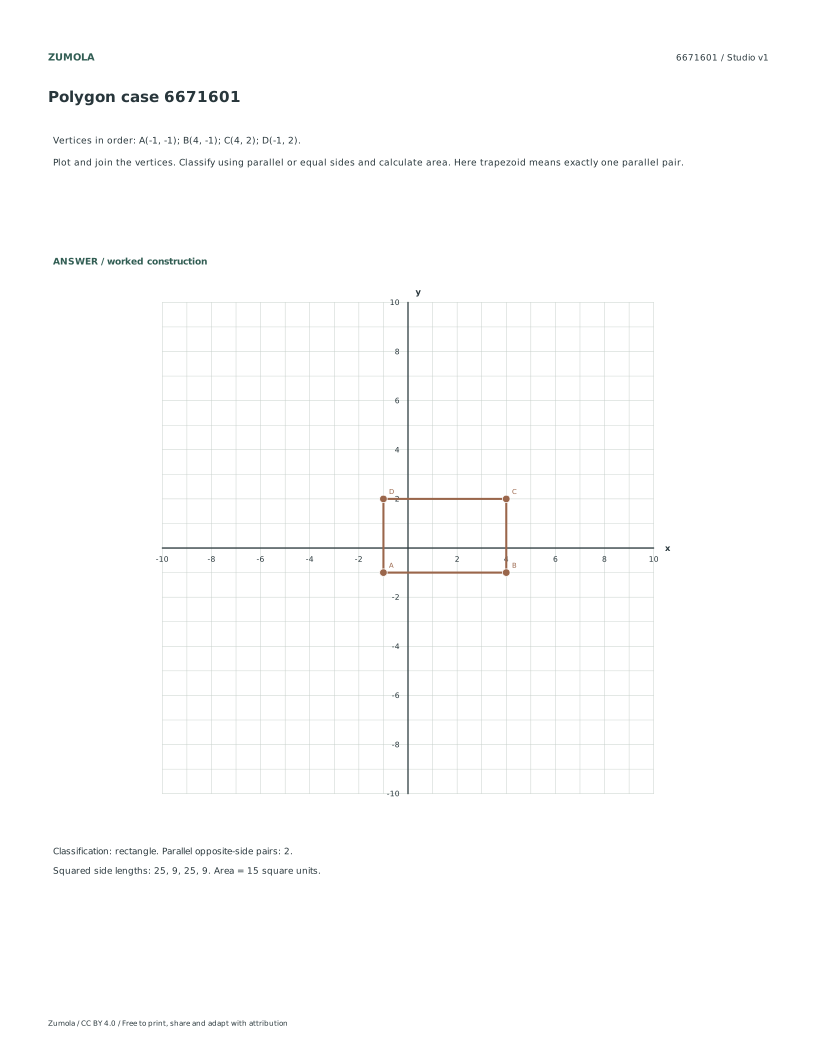
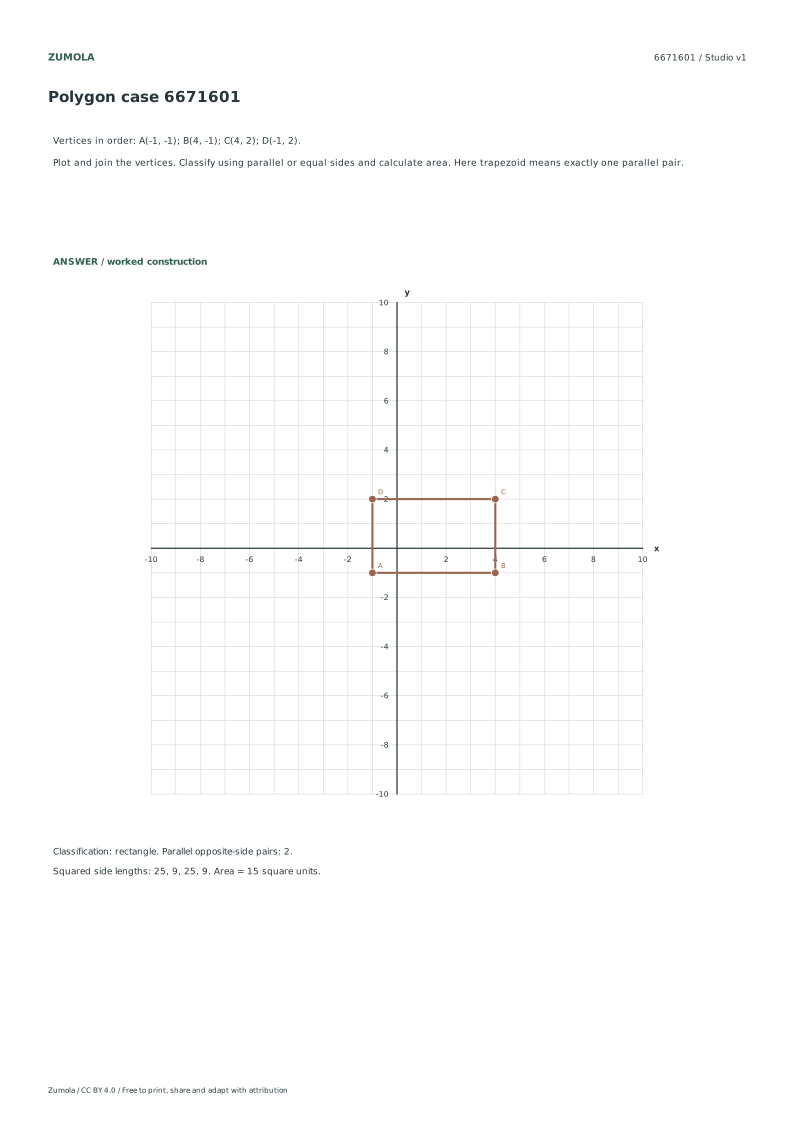
Squared side lengths: 25, 9, 25, 9. Area = 15 square units.
The first case shows the checking pattern. Individual answer files contain the completed graph or net and result for every case.
Work through the graph
Plot and Classify by Sides
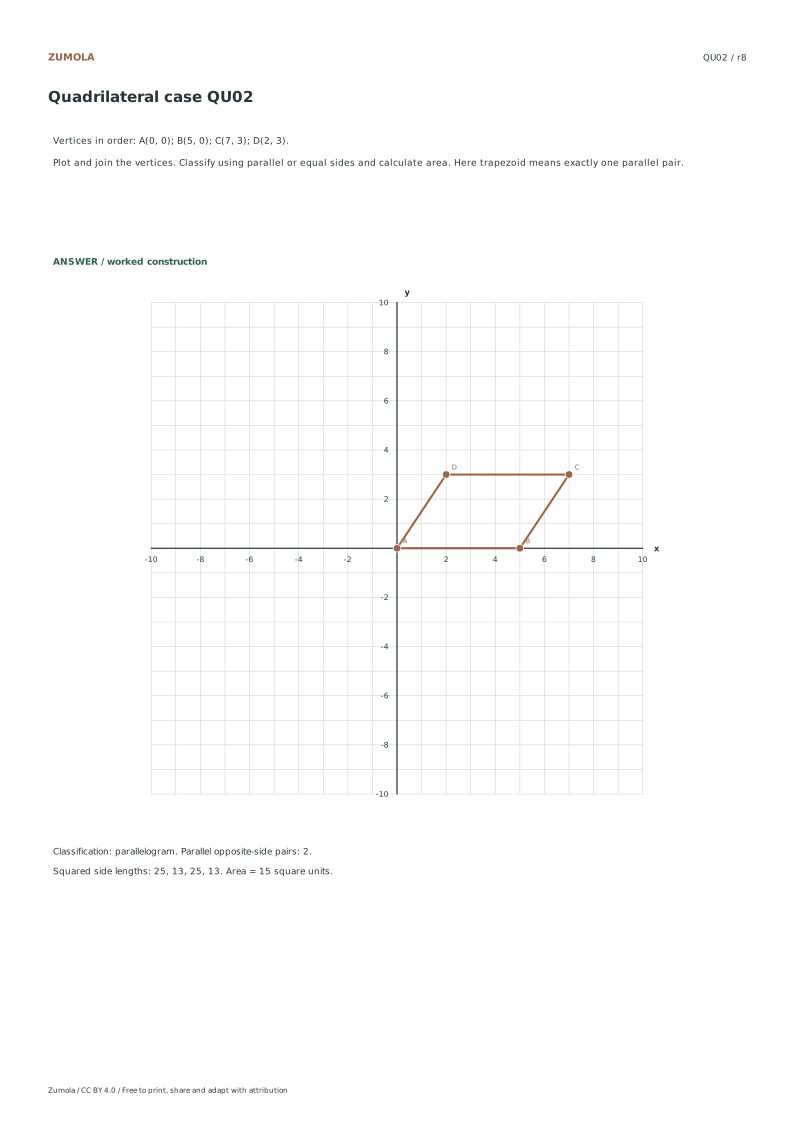
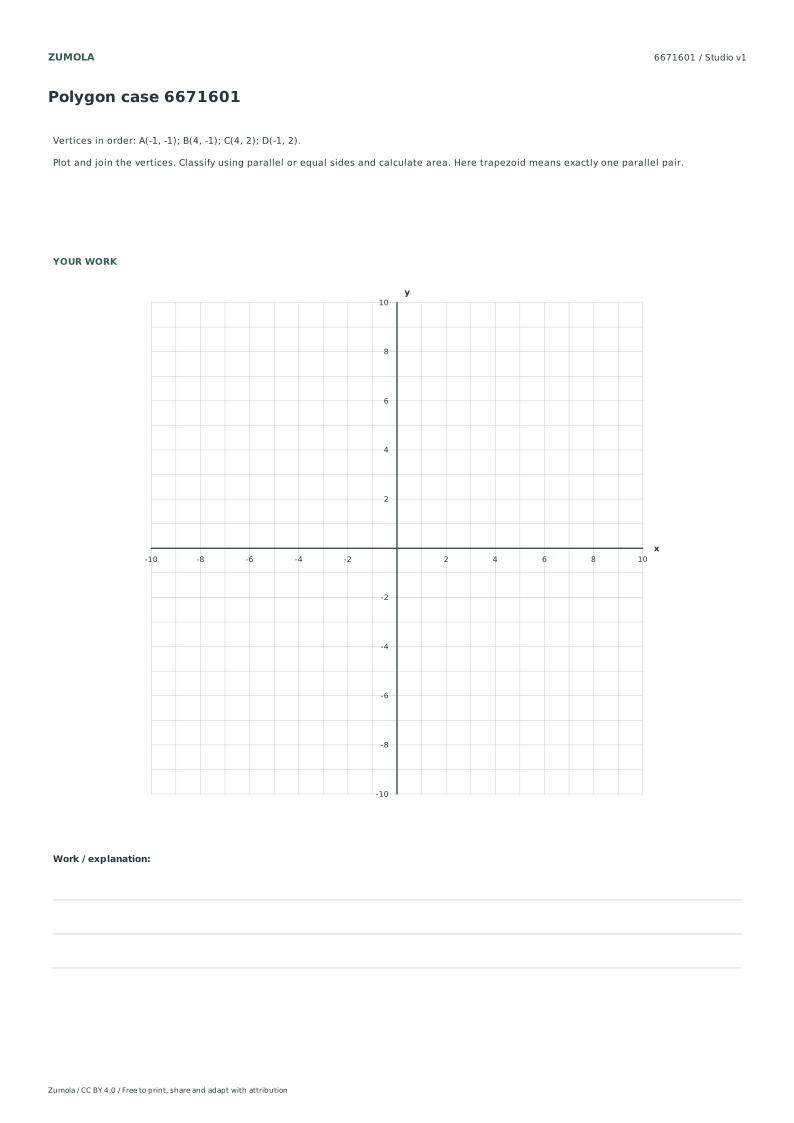
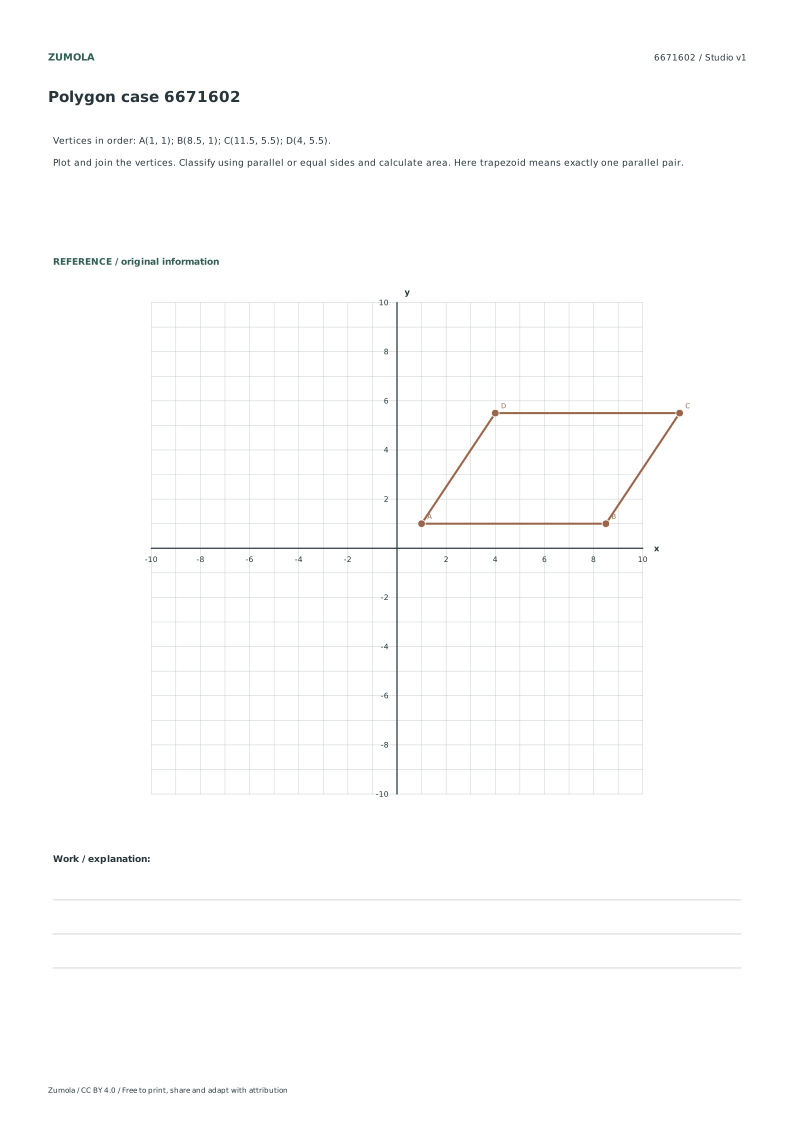
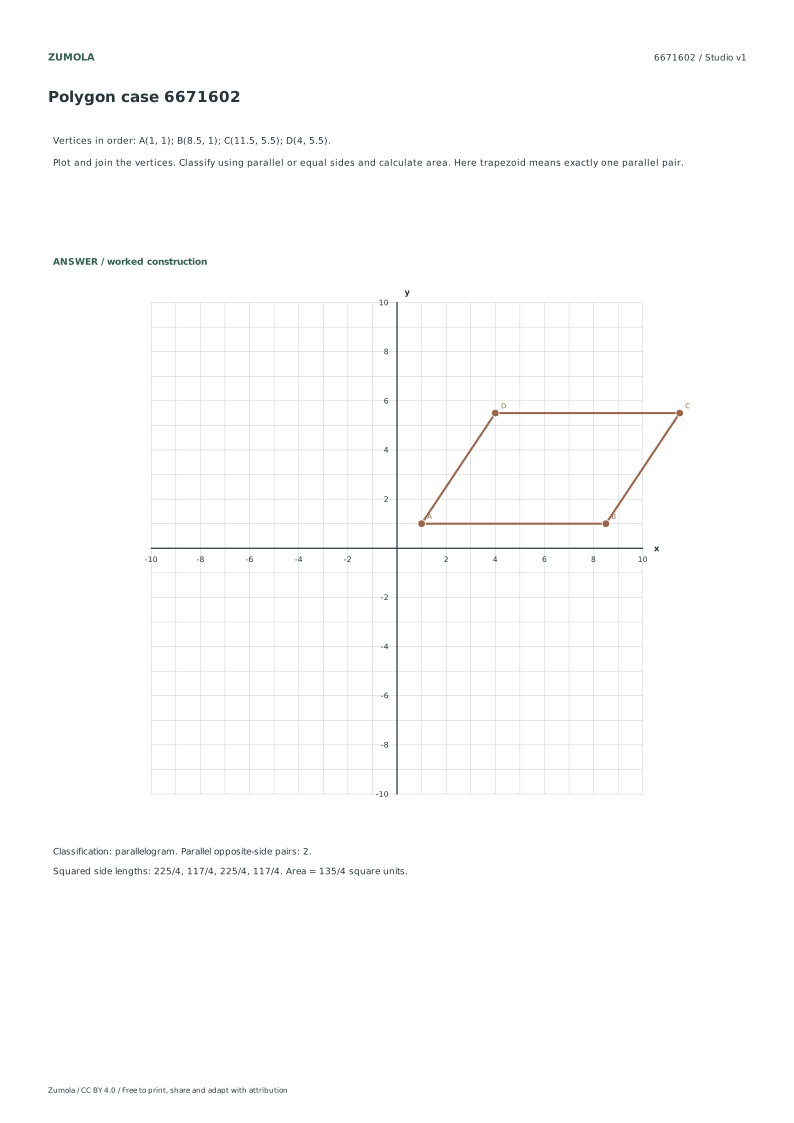
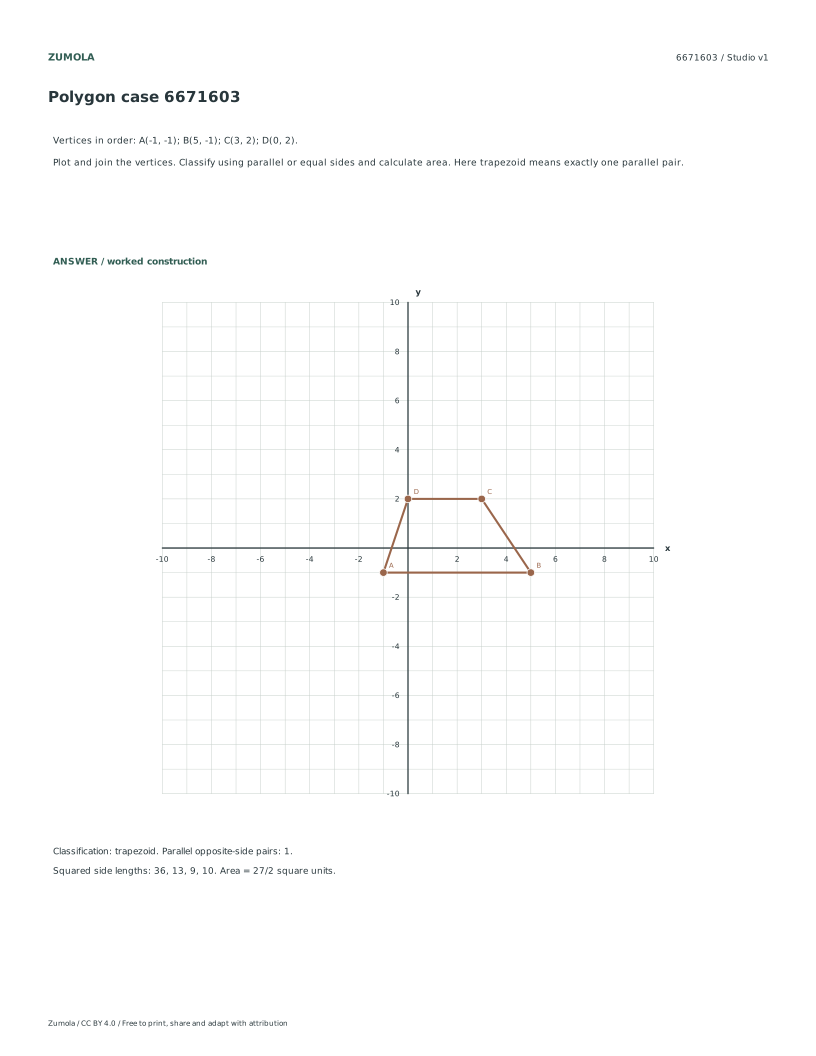
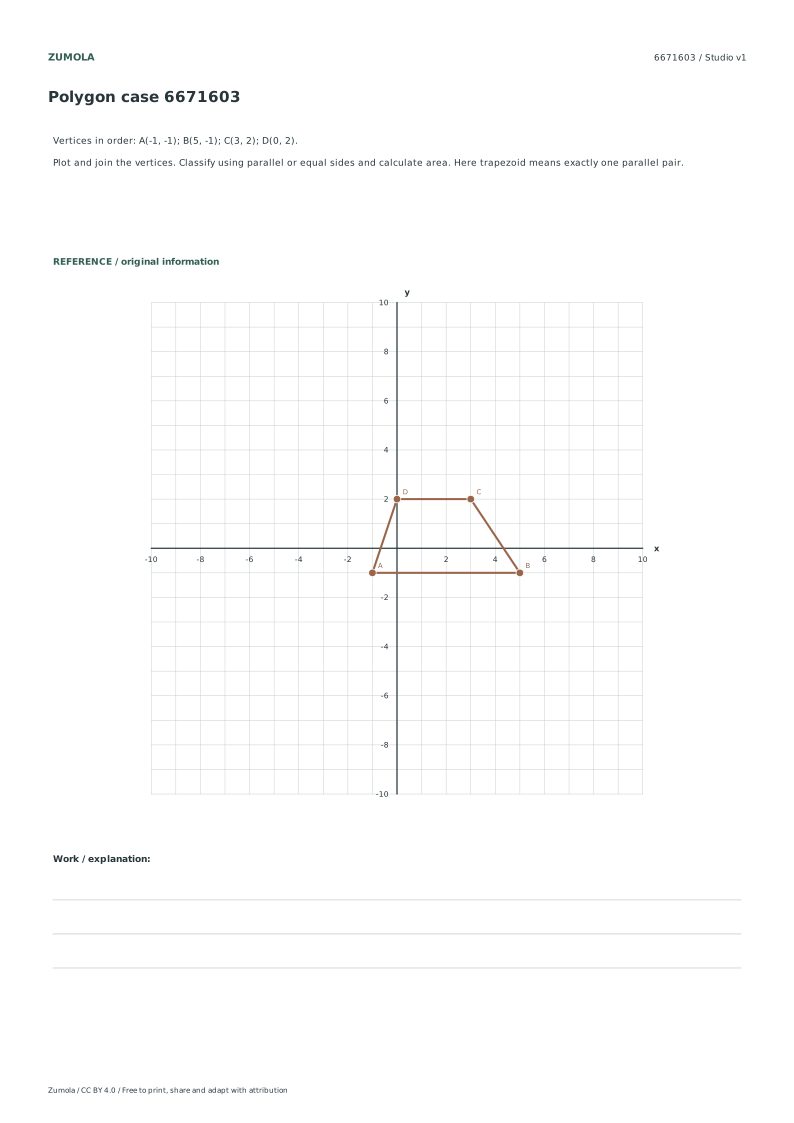
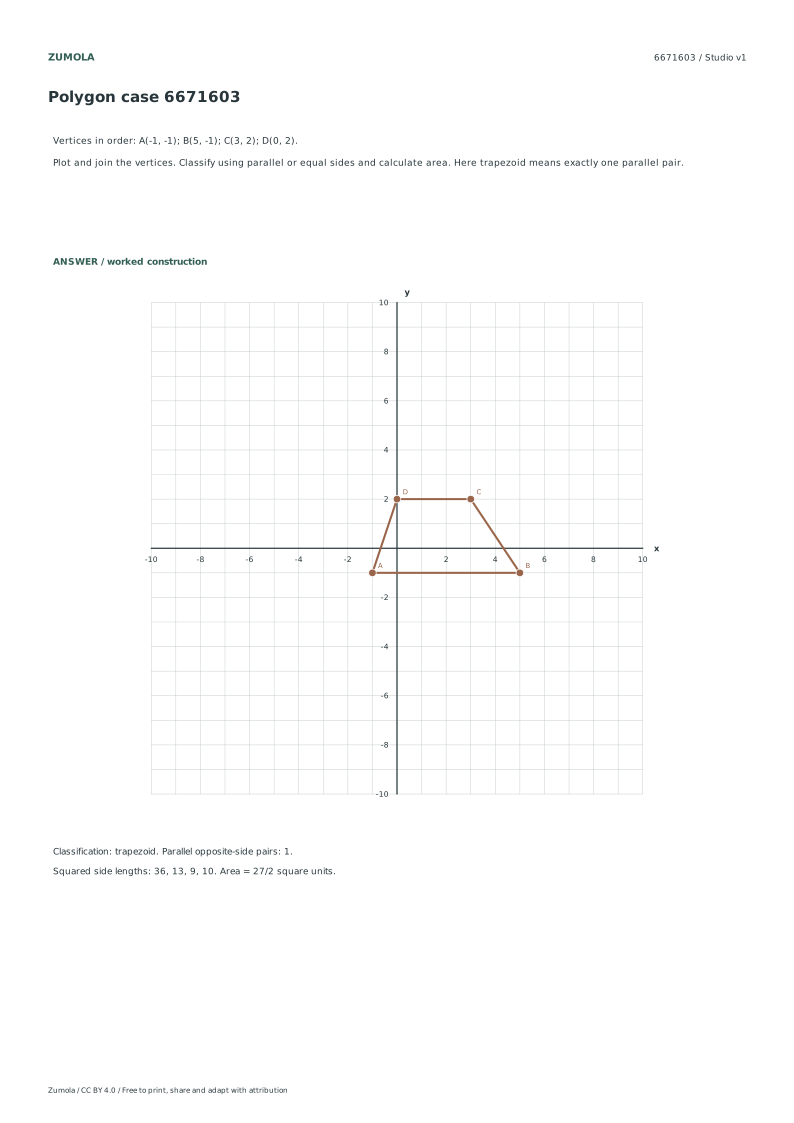
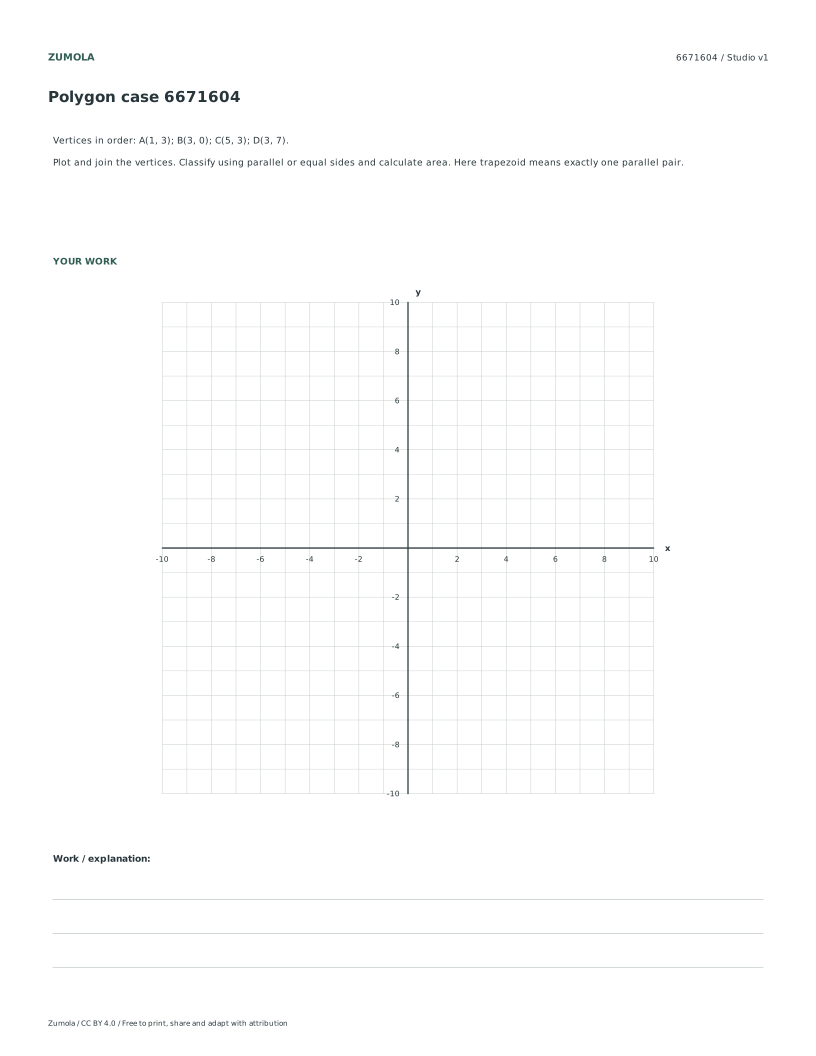
Plot each vertex in order and join consecutive points. Two pairs of parallel opposite sides identify a parallelogram; equal opposite side lengths alone do not prove that it is a rectangle. To identify a rectangle, also check that adjacent sides meet at right angles. A trapezoid here has exactly one parallel pair. A kite here has two distinct pairs of equal adjacent sides. Use squared lengths to compare sides without square roots. For A(0,0), B(5,0), C(5,3), D(0,3), alternate sides are horizontal and vertical, so all angles are right; the area is 5 × 3 = 15 square units.
Compute Area from Coordinates
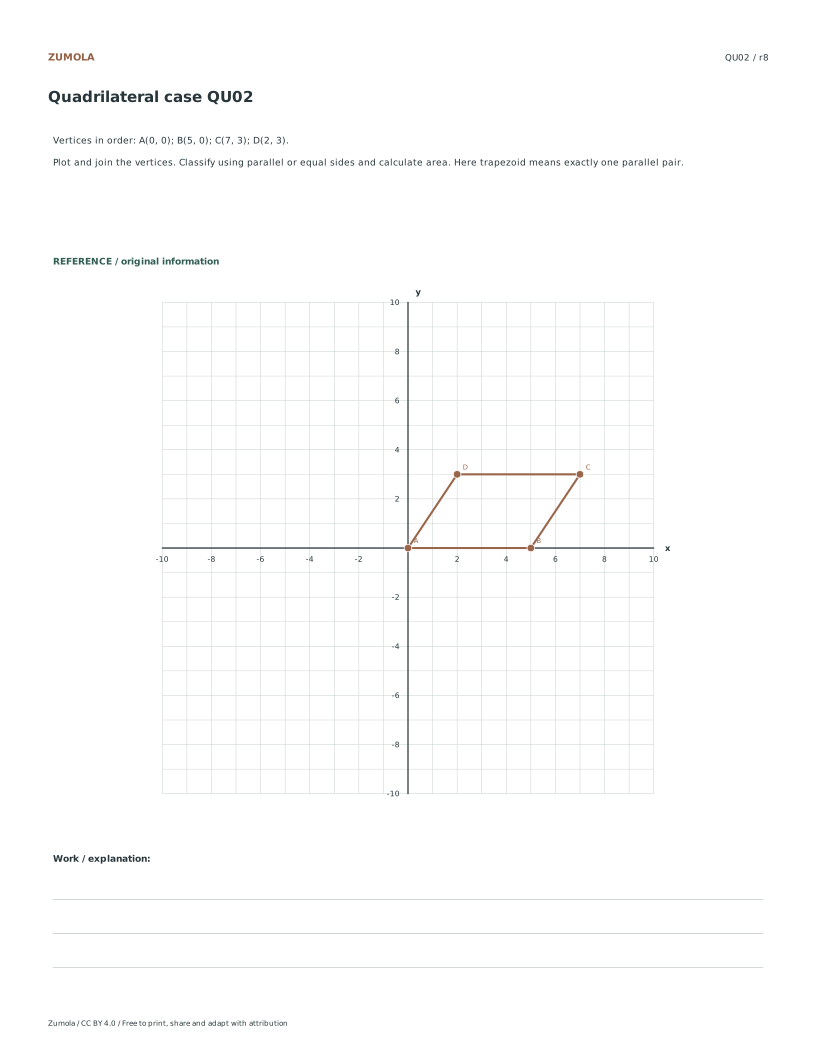
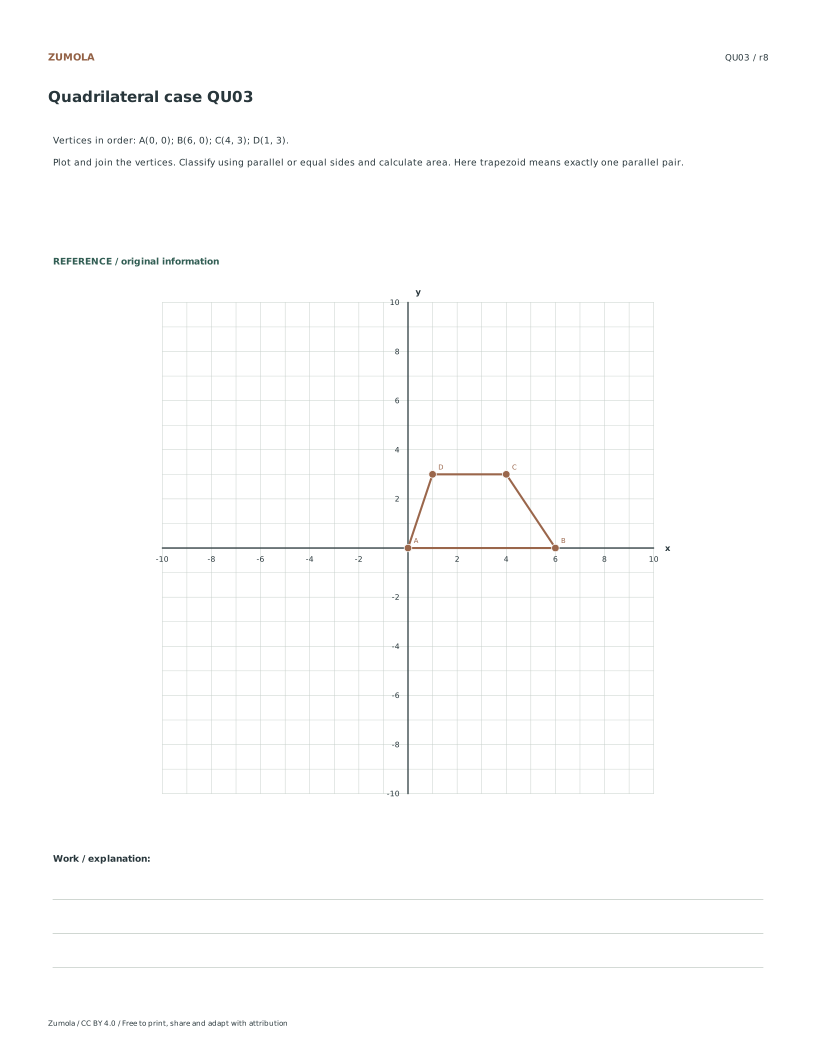
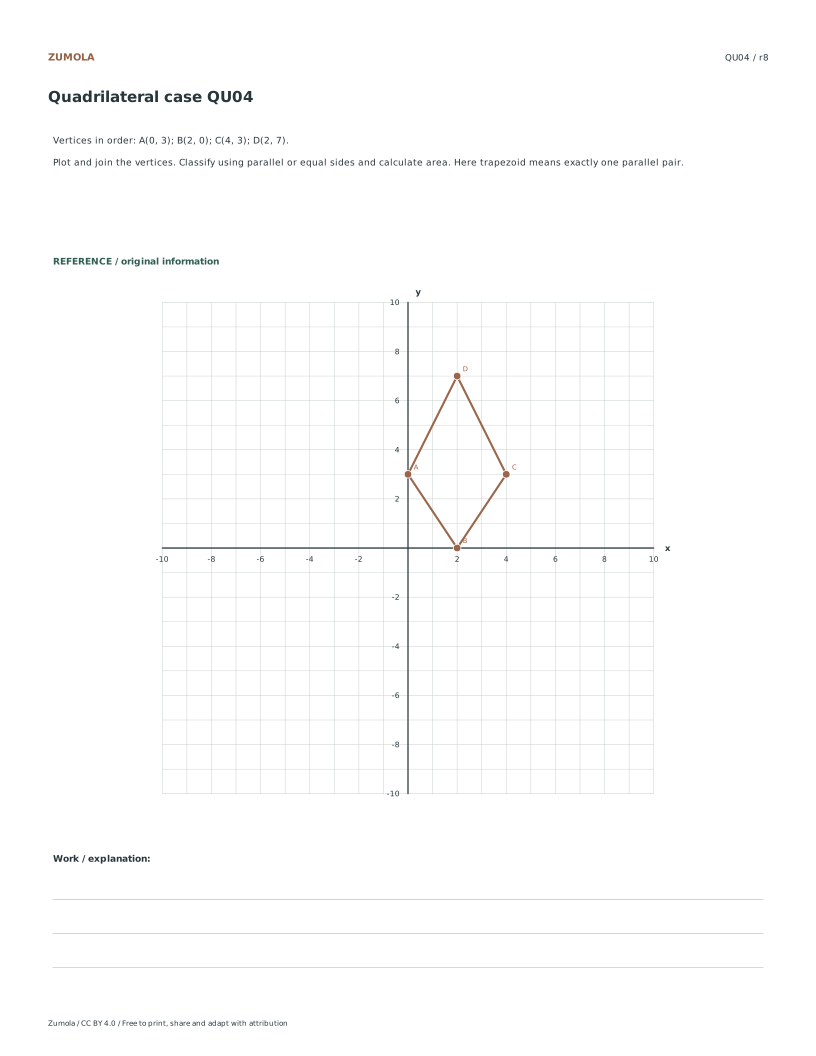
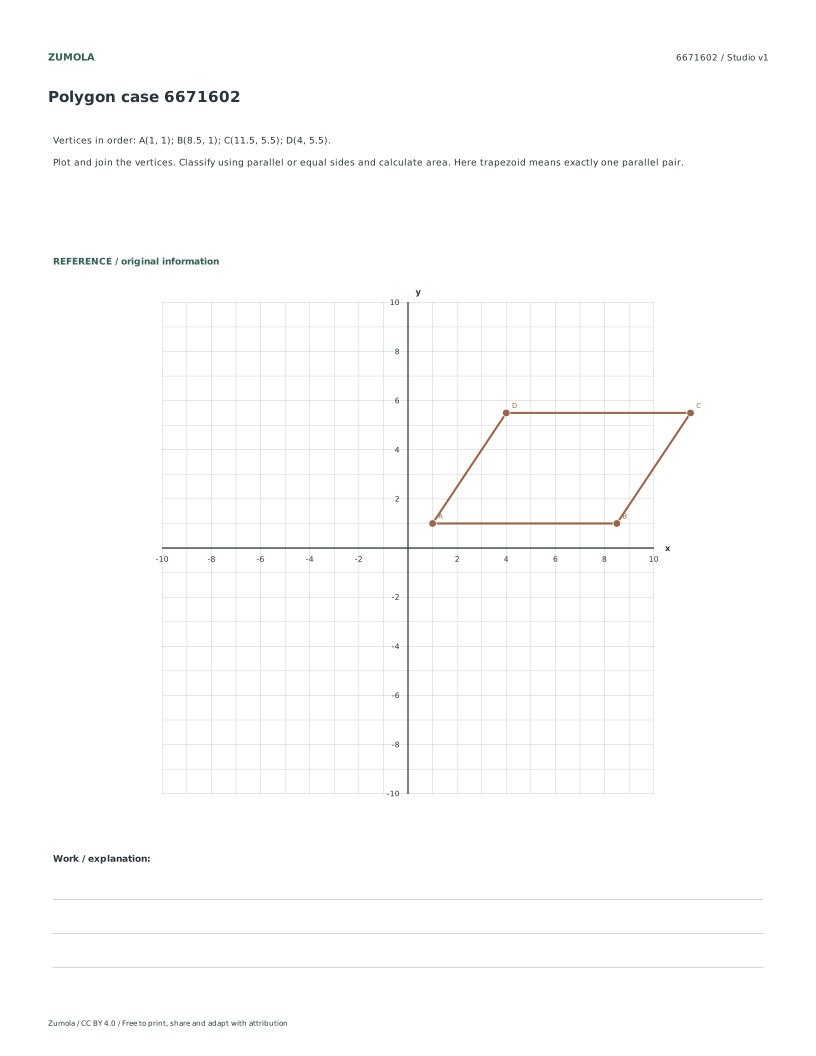
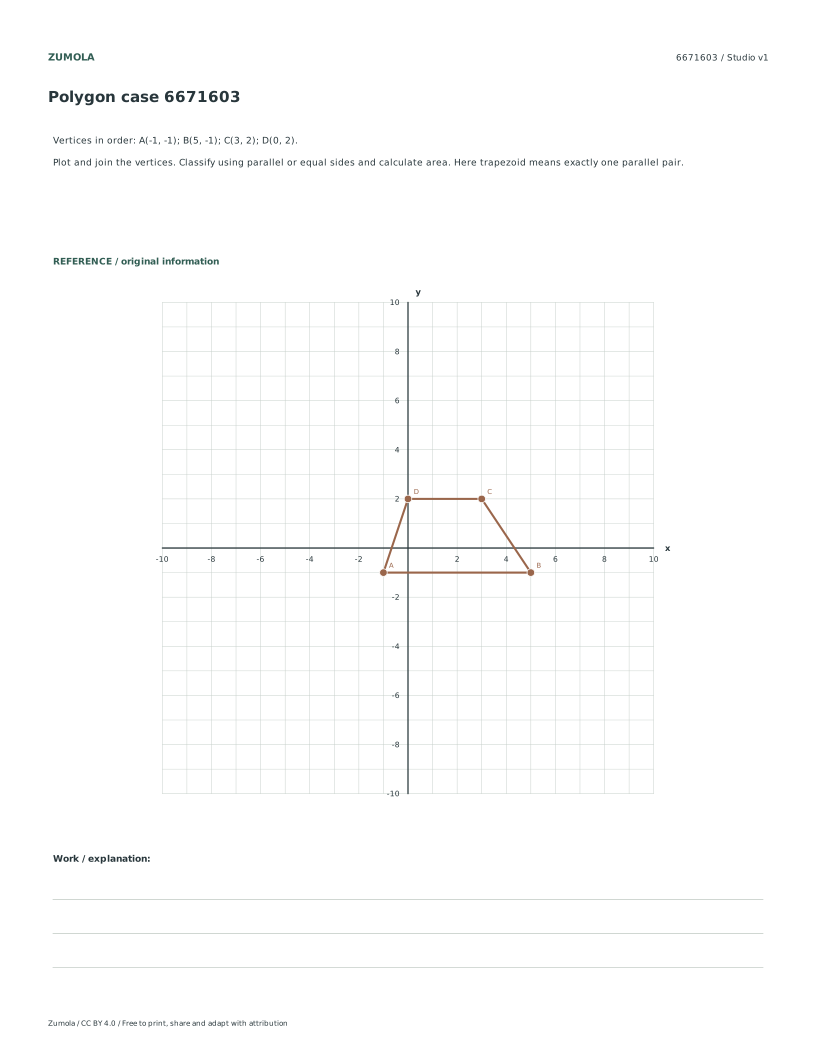
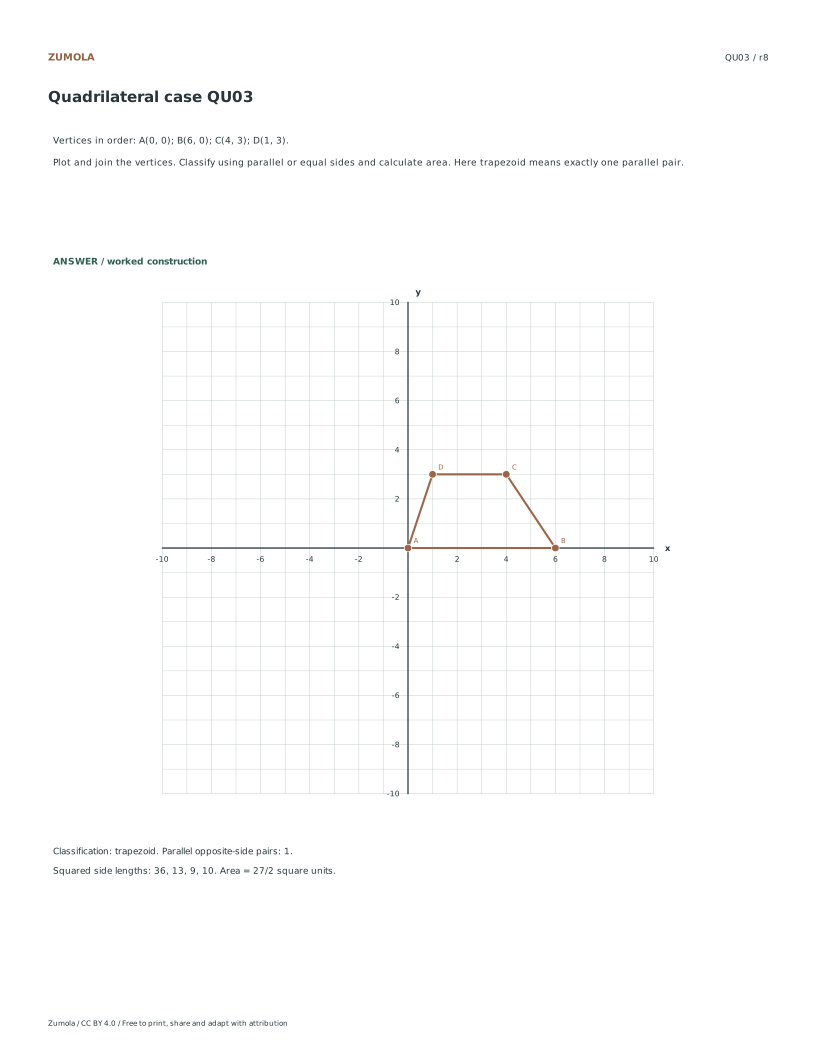
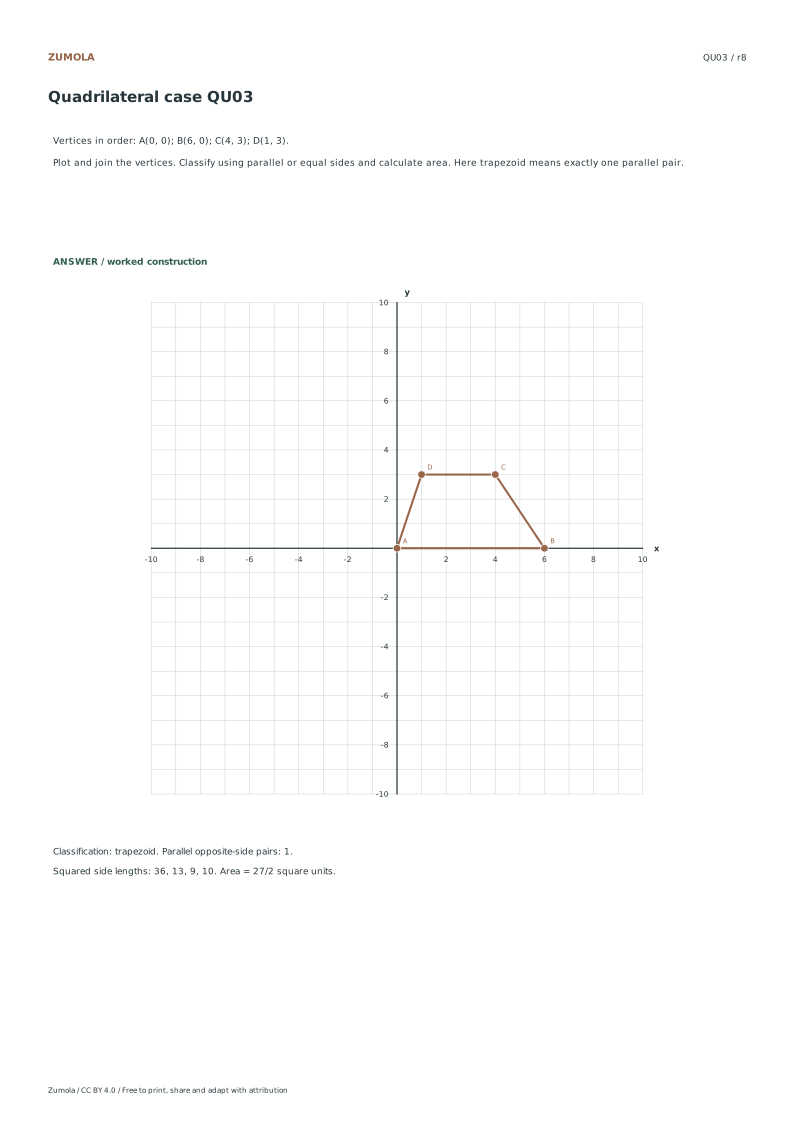
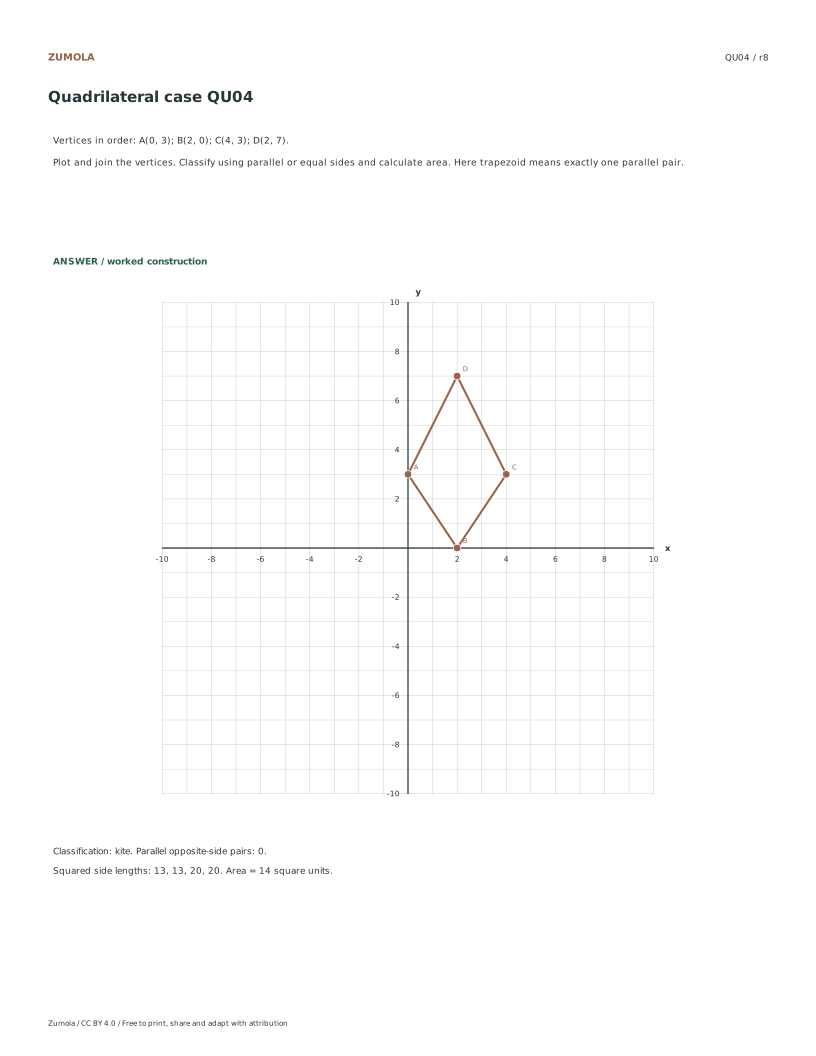
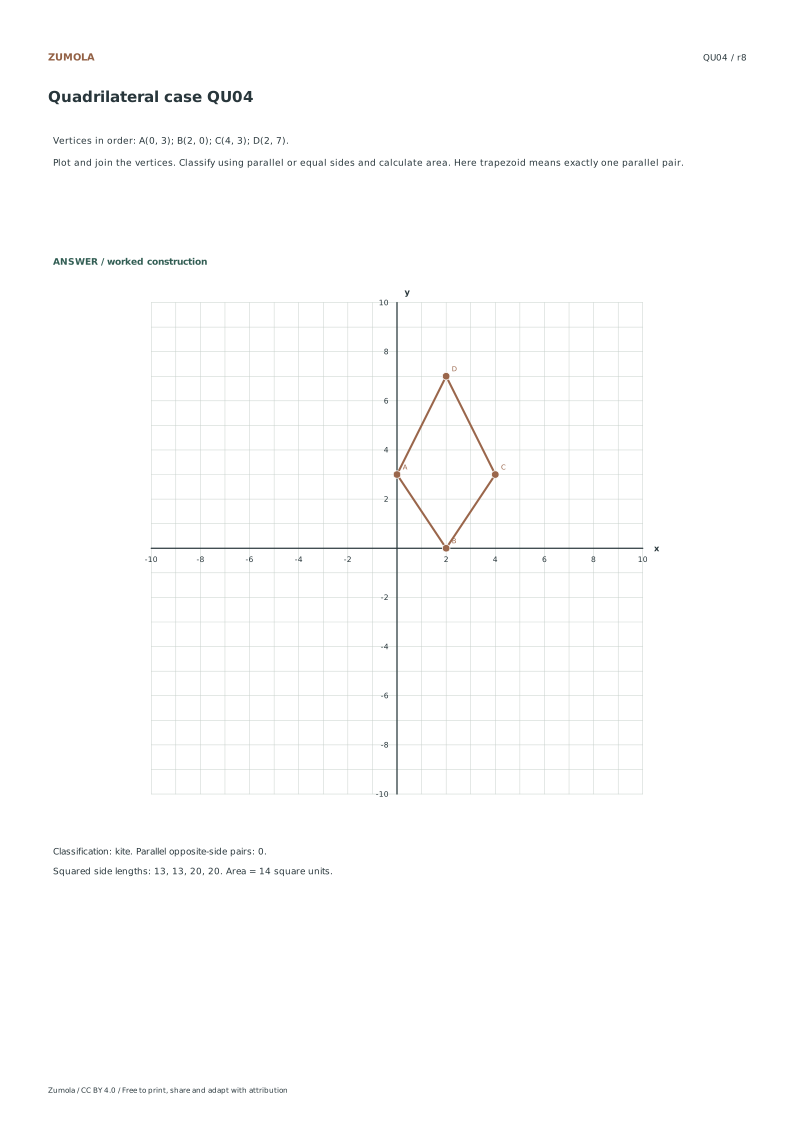
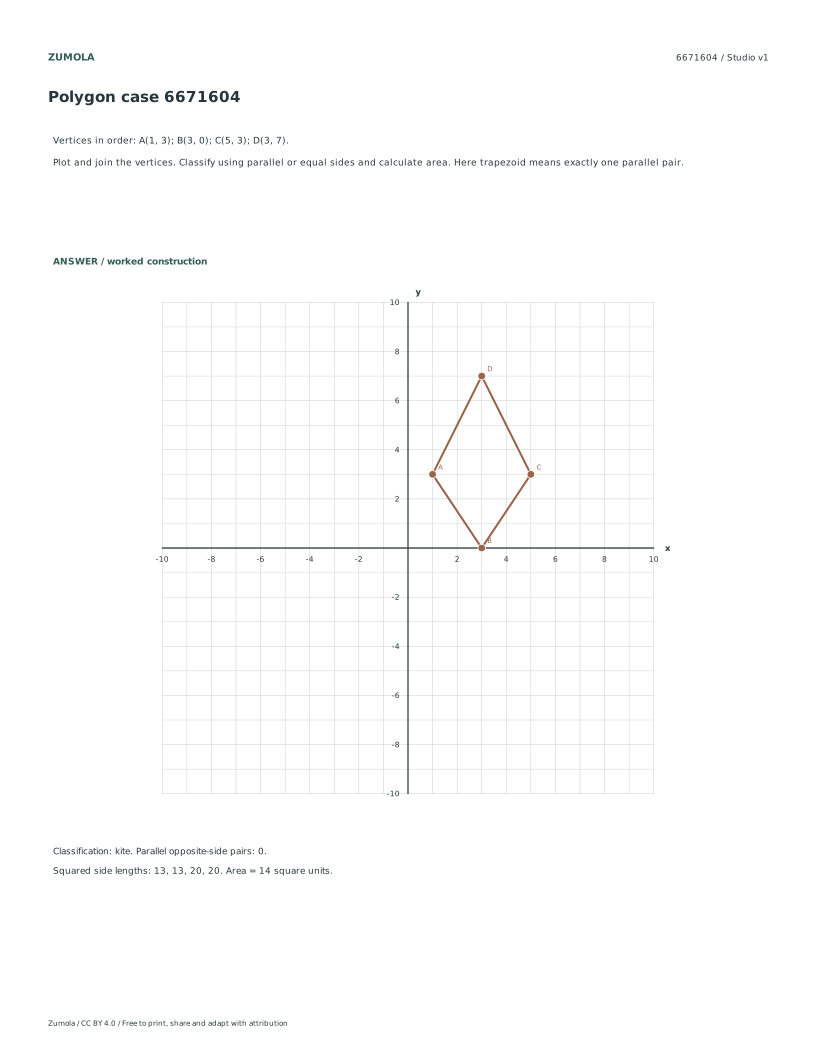
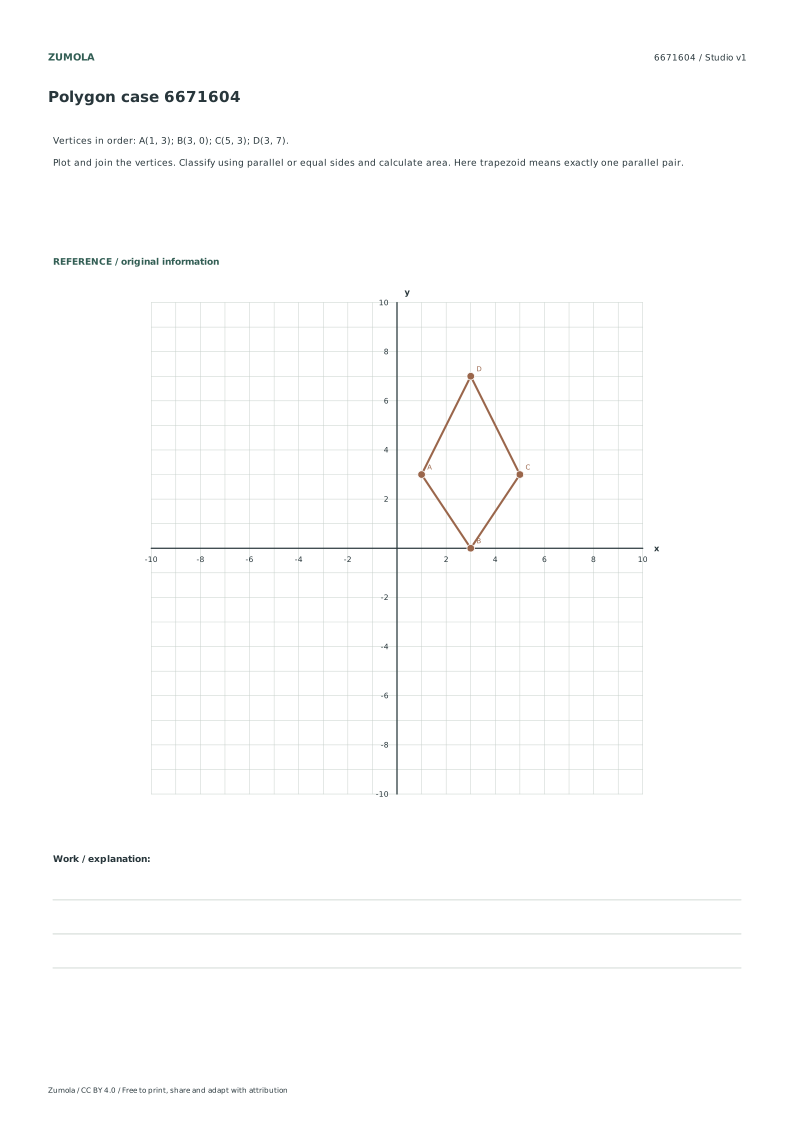
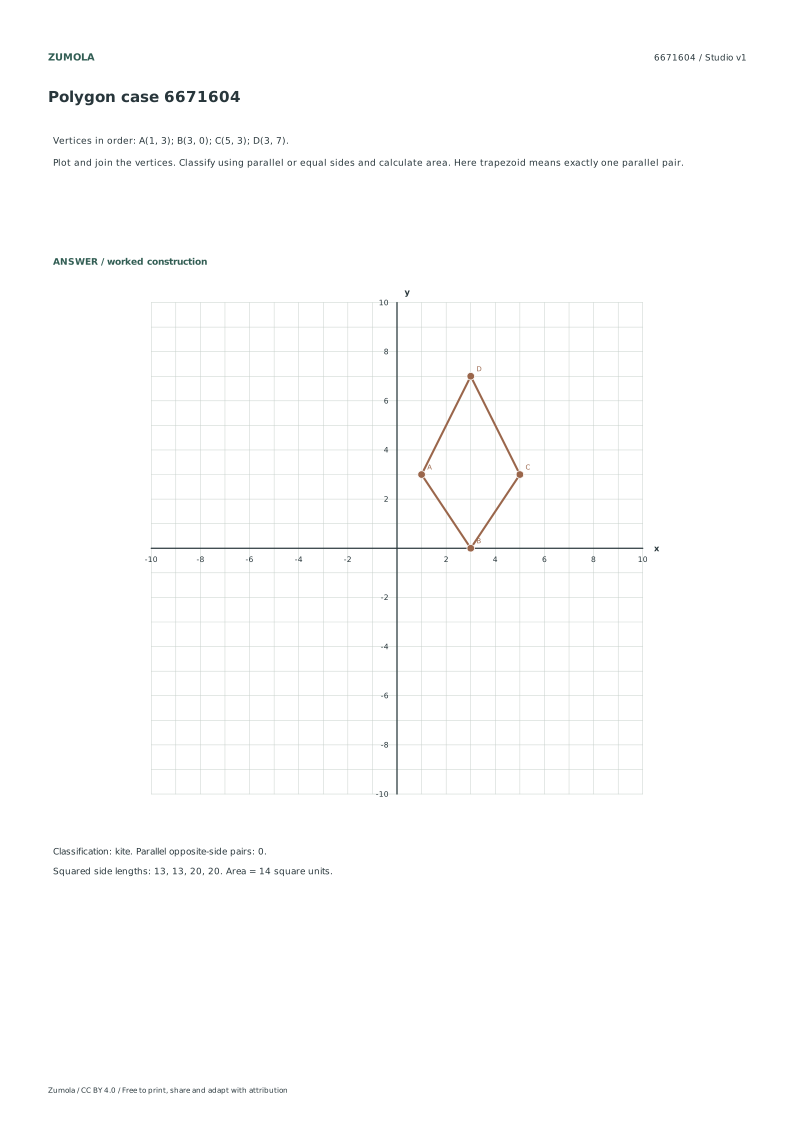
After plotting, compute area using the coordinate grid. For rectangles and parallelograms, area equals base times height. For the trapezoid, use the average of the parallel sides times the height. For the kite, use half the product of the diagonals. In the supplied cases: rectangle area 15; parallelogram area 15; trapezoid area 27/2; kite area 14. For the kite, diagonals AC = 4 and BD = 7, so area = (4 × 7)/2 = 14. Keep exact fractions where given; do not round 27/2 to a decimal unless asked.
Check Parallel and Perpendicular Lines
For nonvertical lines, parallel lines have equal slopes and different intercepts. Perpendicular lines have slopes whose product is -1. A product of 1 does not indicate parallel lines. Vertical and horizontal lines are perpendicular even though the slope product is undefined. Equal slopes with equal intercepts describe the same line, not two parallel lines. When classifying quadrilaterals, verify both parallel pairs and side lengths; slope product alone only tests perpendicularity, so it cannot establish parallelism.
Checks that catch common errors
Watch for
Check instead
Assuming equal slopes always mean parallel lines.
Equal slopes with equal intercepts describe the same line. Parallel lines require equal slopes and different intercepts.
Using slope product 1 to test for parallel lines.
For nonvertical lines, parallel lines have equal slopes. A slope product of -1 tests perpendicularity, not parallelism.
Classifying a kite as having parallel sides.
In this worksheet, a kite has two distinct pairs of adjacent equal sides and no parallel sides. The supplied kite example has zero parallel pairs.
Keep labels and margins readable
Choose the PDF that matches your paper. Print at Actual size / 100% and turn off Fit, Shrink and browser headers. SVG is editable but an editor can rescale it; the PDF is the simpler print route.
Useful answers
How do I decide if a quadrilateral is a trapezoid?
Count parallel opposite-side pairs. This worksheet defines a trapezoid as having exactly one parallel pair. If there are two parallel pairs, classify as a parallelogram or rectangle instead.
Why use squared side lengths instead of side lengths?
Squared lengths avoid square roots and still show equality. For example, squared lengths 25, 9, 25, 9 indicate opposite sides equal. Compare squared values directly when checking side equality.
How is the kite area calculated in the example?
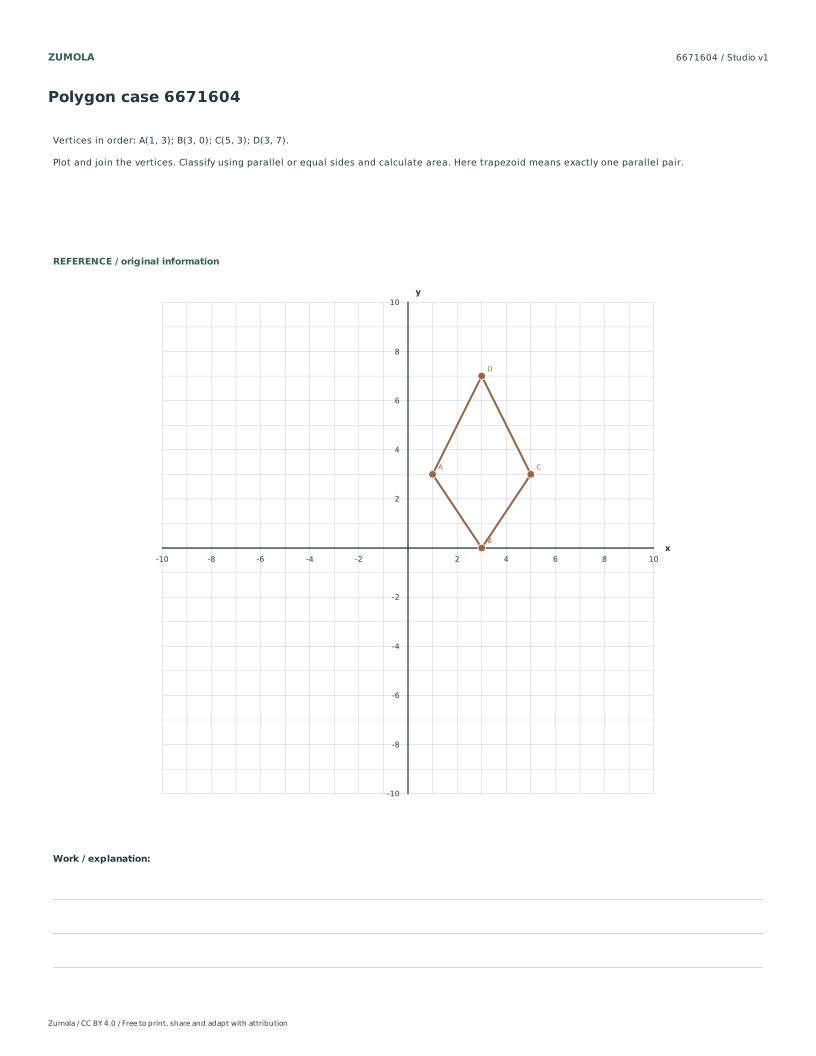
For the kite with vertices A(0,3), B(2,0), C(4,3), D(2,7), diagonals AC = 4 and BD = 7. Area equals half the product of the diagonals: (4 × 7)/2 = 14 square units.
Are the answer files and editable graphs free?
Yes. The individual student, reference and answer files plus collection packs are free without signup. Credit Zumola under CC BY 4.0 when sharing or adapting.
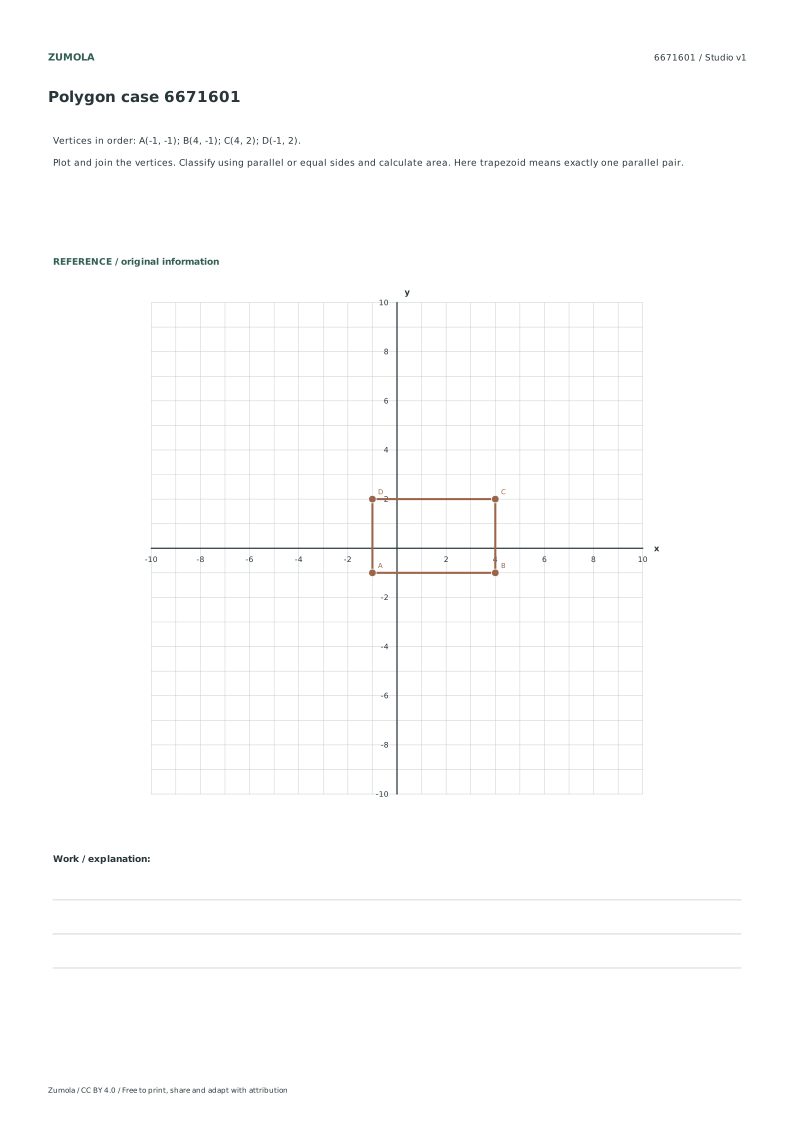
Start by plotting each vertex in order on a coordinate grid. Connect them to form the quadrilateral. To classify, compare slopes of opposite sides. For nonvertical lines, parallel sides have equal slopes and different intercepts. Perpendicular sides have slopes whose product is -1. Also check side lengths using the distance formula. For example, vertices A(-1,-1), B(4,-1), C(4,2), D(-1,2) give two pairs of parallel sides and squared side lengths 25, 9, 25, 9, so it is a rectangle with area 15 square units. A kite has two distinct pairs of adjacent equal sides; the example with squared lengths 13, 13, 20, 20 has no parallel sides.
Squared side lengths: 25, 9, 25, 9. Area = 15 square units.
The answer PDFs include the completed drawings and checks for all four cases. Free original resources, CC BY 4.0. No signup required.
More ways to practice
Plot, then verify with independent formulas
Work on a grid where one square equals one unit. Plot vertices in cyclic order so the outline does not cross itself. After drawing, check each side length with the distance formula and each slope with rise over run. Do not rely on appearance alone: a side that looks horizontal may be slightly tilted if coordinates are misread.
For area, use the trapezoid formula only after confirming which pair of sides is parallel. Alternatively, subtract surrounding triangles from the bounding rectangle, or apply the shoelace sum. Two independent methods that agree give strong evidence the coordinates and arithmetic are consistent.
Mark axes and label each vertex with a capital letter in cyclic order.
Record coordinates in a table before drawing any side.
Compute each side length using the distance formula and write units.
Compute slopes for all four sides and identify any parallel pairs.
Calculate area by one method, then repeat with a second method and compare.
Diagnostic checks that catch quiet errors
A common failure is plotting vertices out of cyclic order, which produces a crossed shape that still has four sides. Trace the perimeter with your finger before measuring. Another is confusing equal-looking sides with equal lengths; measure or calculate rather than judging by eye.
Check orientation separately from shape. A rotation preserves side lengths, angles and area, while a reflection reverses cyclic orientation. If a transformed figure has the same lengths but reversed orientation, it is a reflection, not a rotation. Keep angle units explicit: degrees for turn angles, square units for area.
Confirm the outline is simple, with no crossing sides.
Compare calculated lengths, not visual lengths.
State which sides are parallel using equal slopes, not appearance.
Label area in square units and lengths in linear units.
For transformations, note whether orientation is preserved or reversed.
Open drawing tasks need a rubric
When learners draw their own quadrilateral to satisfy a property list, several valid shapes may result. Judge the work against stated criteria rather than a single expected picture. A correct response meets every required property, shows readable labels, and includes a check that supports the claimed classification.
Separate construction from classification. A drawing task asks for accurate plotting and closure; a property task asks for justified claims about sides, angles or symmetry. Mixing them without saying which is being assessed makes feedback vague.
Read the property list and underline each required condition.
Sketch, then verify each condition with a calculation or measurement.
Write one sentence explaining why the shape belongs to the claimed family.
Exchange with a partner and check only the stated criteria.
Try this example
Plot A(1,1), B(5,1), C(4,4), D(2,4) in cyclic order. Identify the shape, find its area, and state whether it is a parallelogram.
Show the worked explanation
AB is horizontal with length 4. CD is horizontal with length 2. BC and DA each have length sqrt(10), since each rises 3 and runs 1. Slopes: AB and CD are 0, BC is -3, DA is 3, so only AB and CD are parallel. The shape is an isosceles trapezoid, not a parallelogram. Height is 3, so area is (4+2)*3/2 = 9 square units. Check: bounding rectangle 4 by 3 has area 12; subtract two triangles each with base 1 and height 3, area 1.5 each, giving 12 - 3 = 9. The shoelace sum also gives 9.
Common mistakes
Judging parallel sides by appearance on the grid. Calculate slopes for both sides and compare exact values; equal slopes indicate parallel lines.
Reporting area without units or mixing linear and square units. Write lengths in units and area in square units, and keep the same unit throughout.
Assuming a rotation and a reflection produce the same result. Check cyclic orientation: rotations preserve it, reflections reverse it, even when lengths match.
Check your work
Vertices are plotted in cyclic order and the outline closes without crossing.
All four side lengths are calculated or measured and recorded with units.
Parallel sides are justified by equal slopes rather than appearance.
Area is stated in square units and confirmed by a second method.
The classification claim matches the verified side and slope evidence.
Labels and axes remain readable, and any transformation notes whether orientation is preserved.
Questions before you start
How can I check a quadrilateral drawing without trusting the picture?
Calculate side lengths with the distance formula, compare slopes for parallel pairs, and verify area by two independent methods such as decomposition and the shoelace sum.
What does cyclic order mean when plotting vertices?
It means listing vertices as you travel around the perimeter, so consecutive points are connected by sides and the outline does not cross itself.
Why use a rubric for drawing quadrilaterals?
Open drawing tasks can have multiple valid outcomes, so criteria such as meeting each property, readable labels and a supporting check give fair, specific feedback.
Optional Google Analytics helps us understand which free resources are useful. It is off until you allow it. Drawing tools and downloads work with either choice. Privacy details