Free triangle drawing worksheets on coordinate grids with right, scalene and isosceles examples. Plot, classify and calculate area with separate answers.
Choose Letter or A4, then download a student sheet first. Keep the separate reference or answer file closed until you have attempted the case. Every worksheet, SVG and answer is free without signup.
Choose your paper and download
Download paper size
Every worksheet and answer is free. No signup.
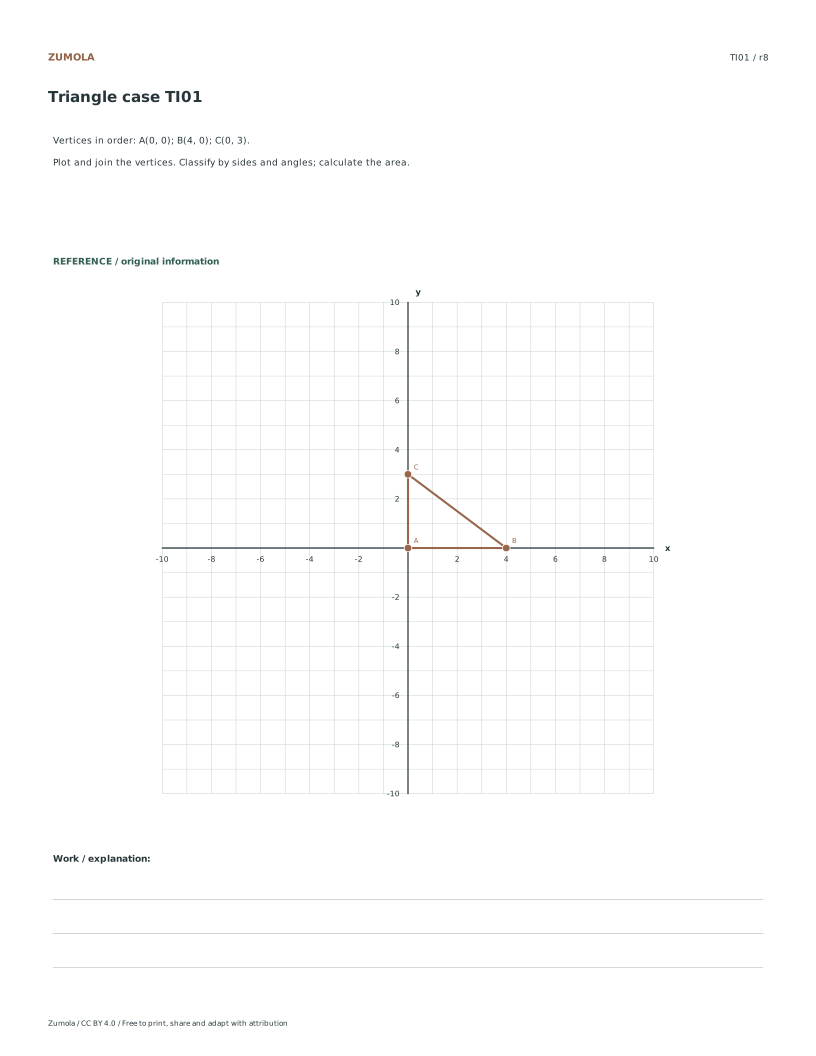
Free original resourceTI01
Right triangle
Original worksheet collection. Letter or A4 PDF and editable SVG.
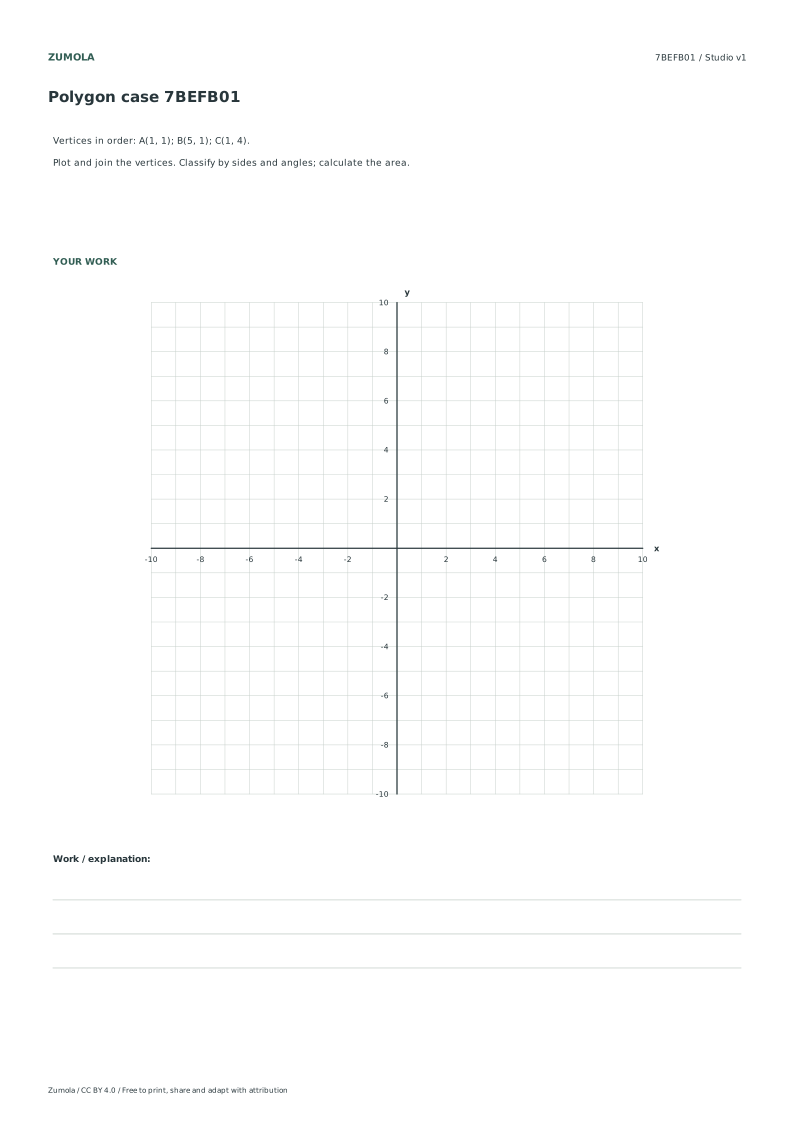
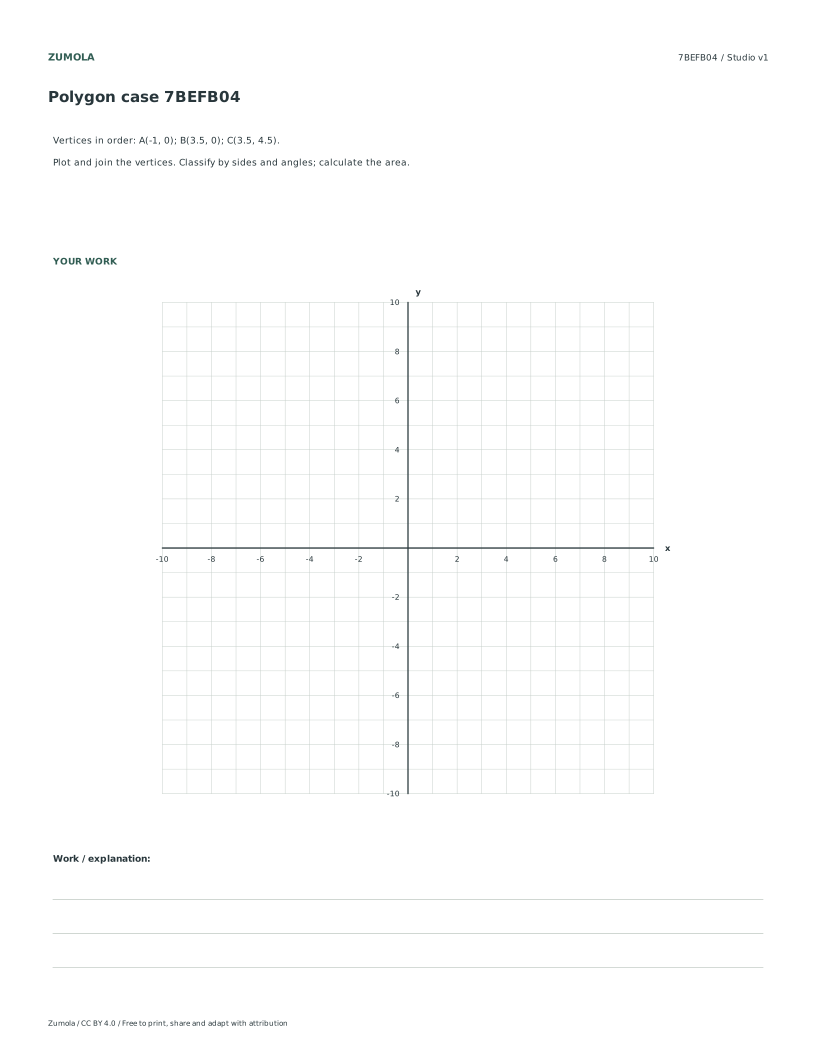
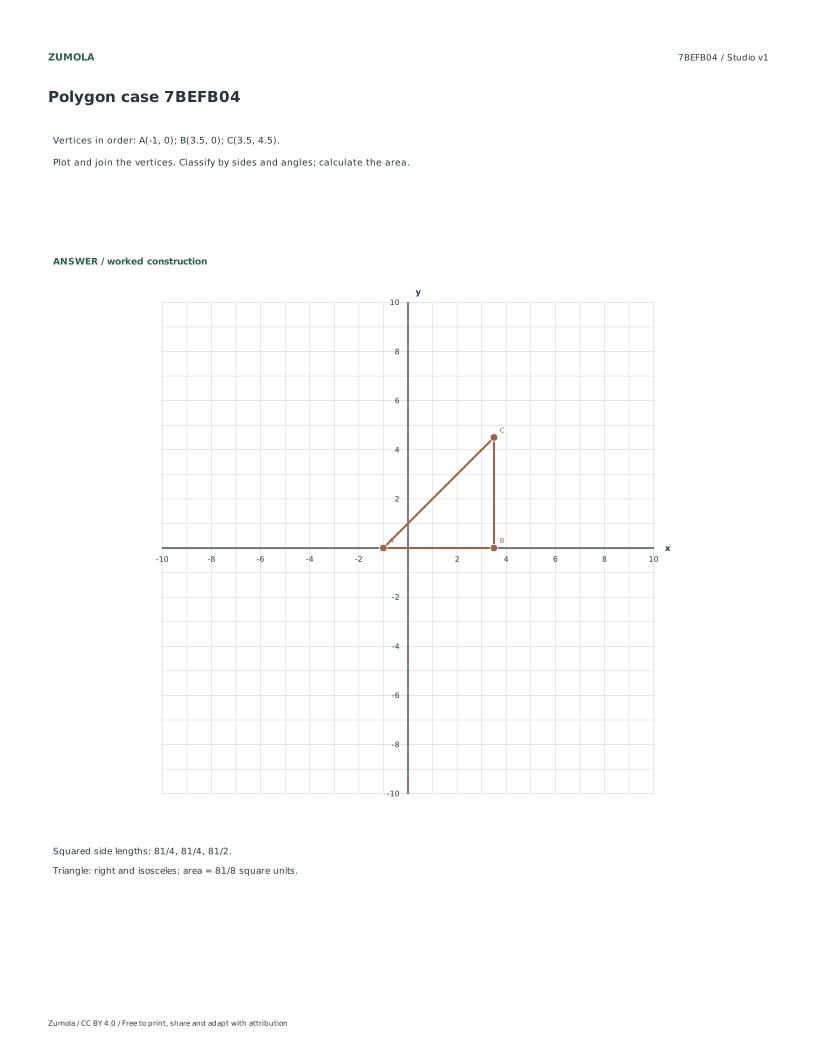
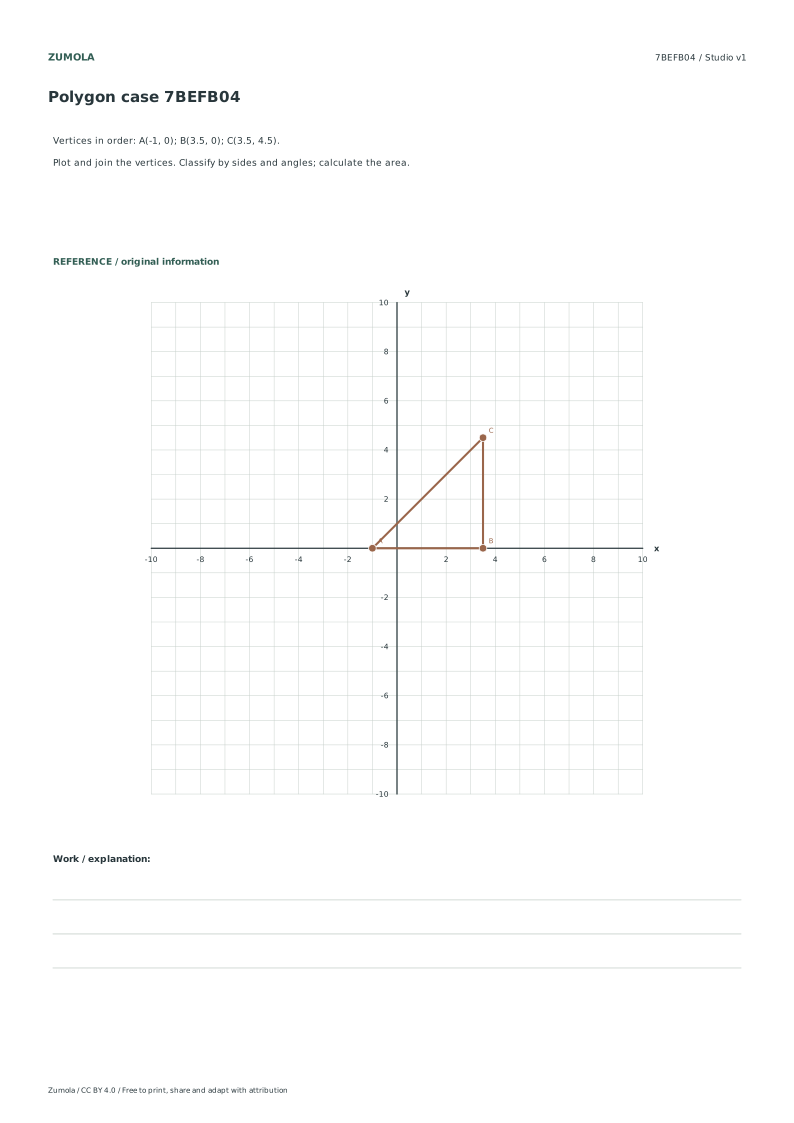
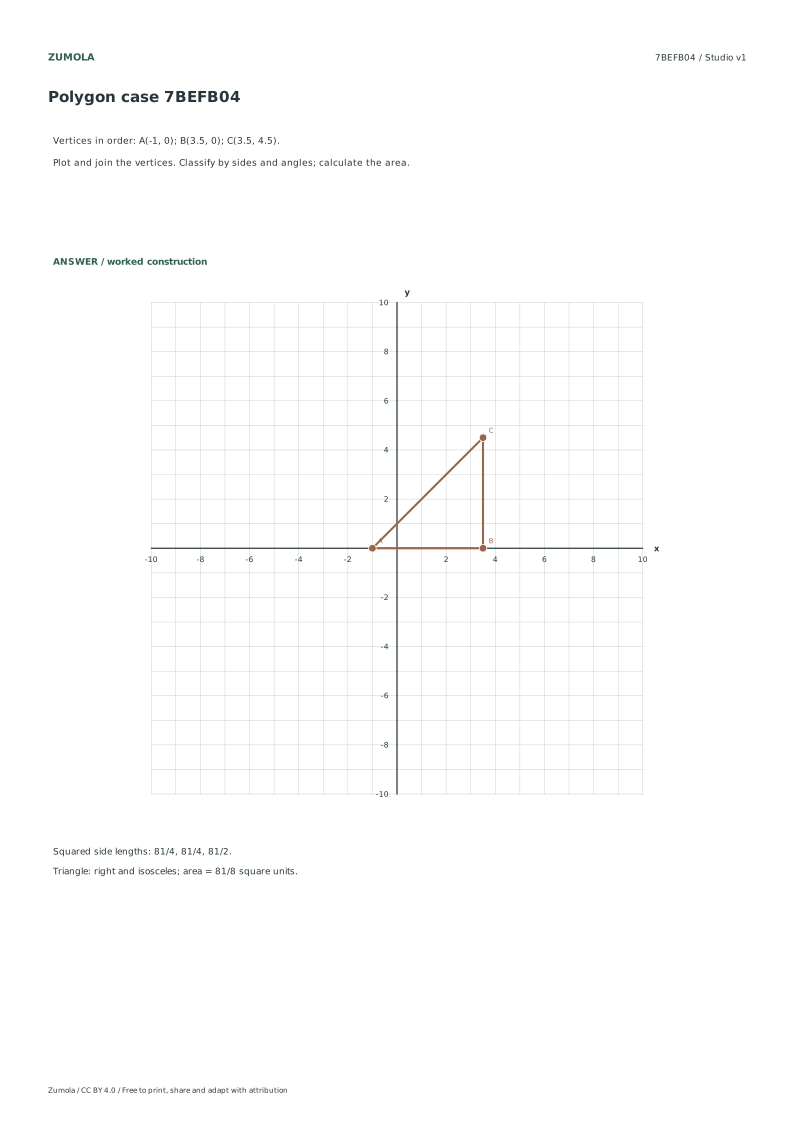
Plot and join the vertices. Classify by sides and angles; calculate the area.
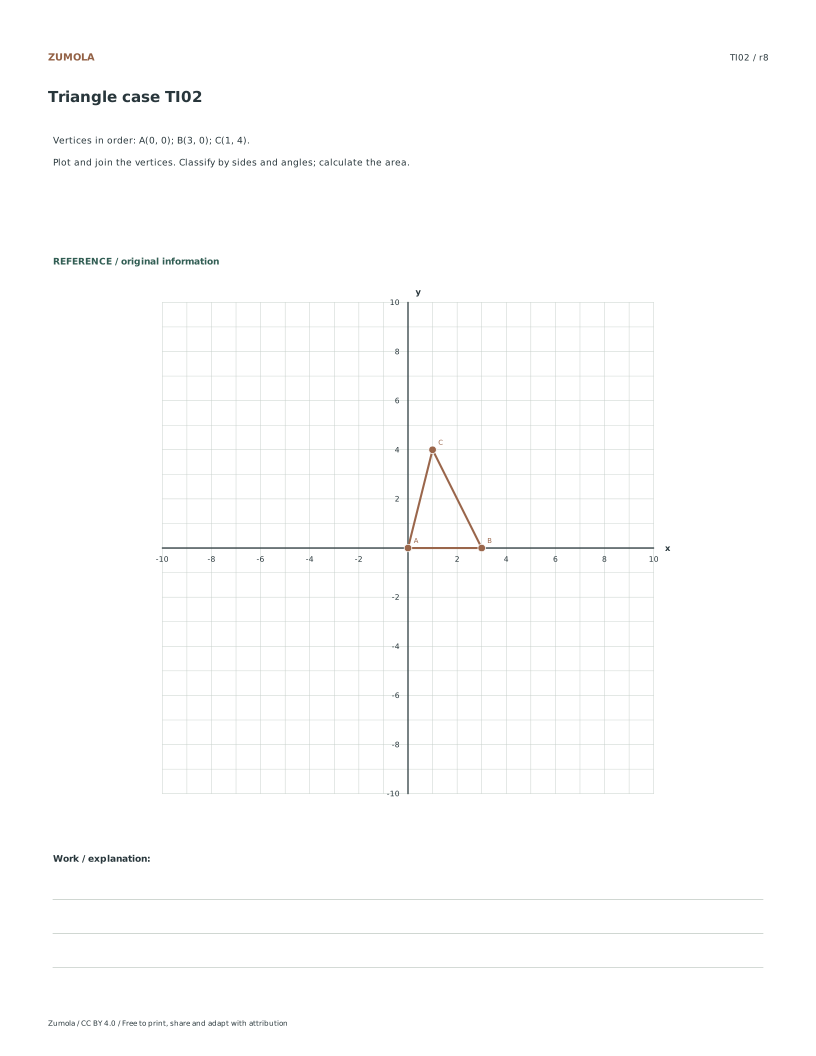
TI02
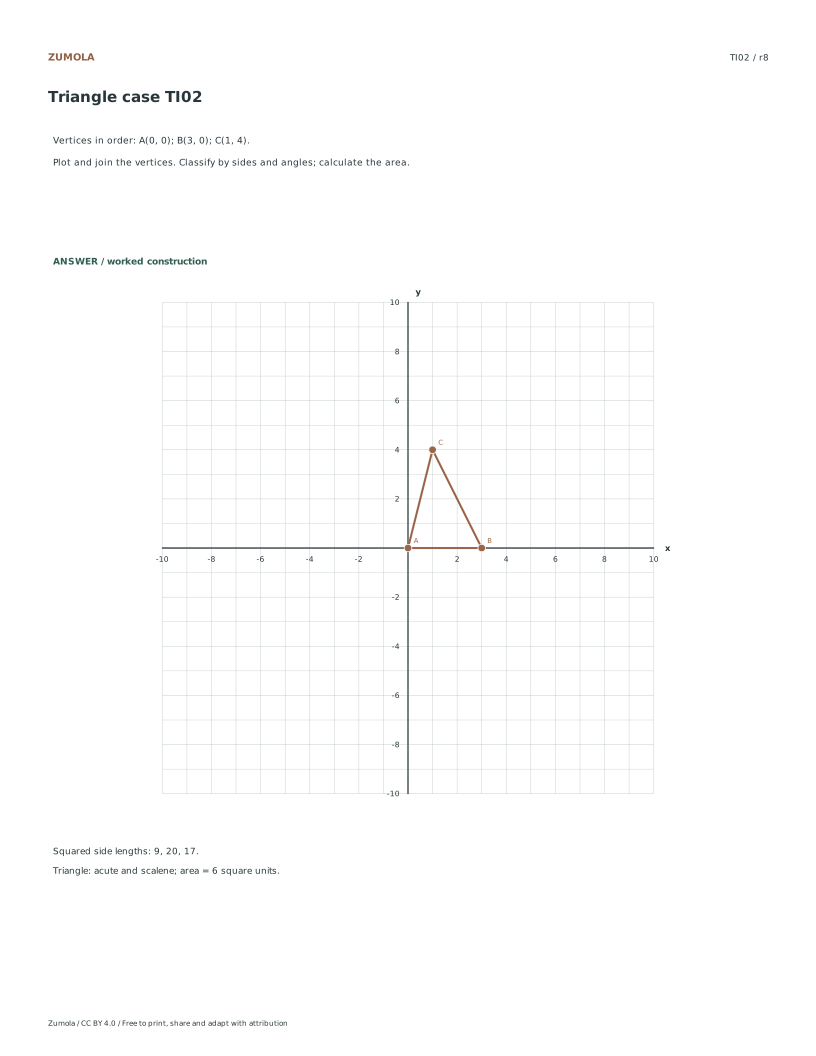
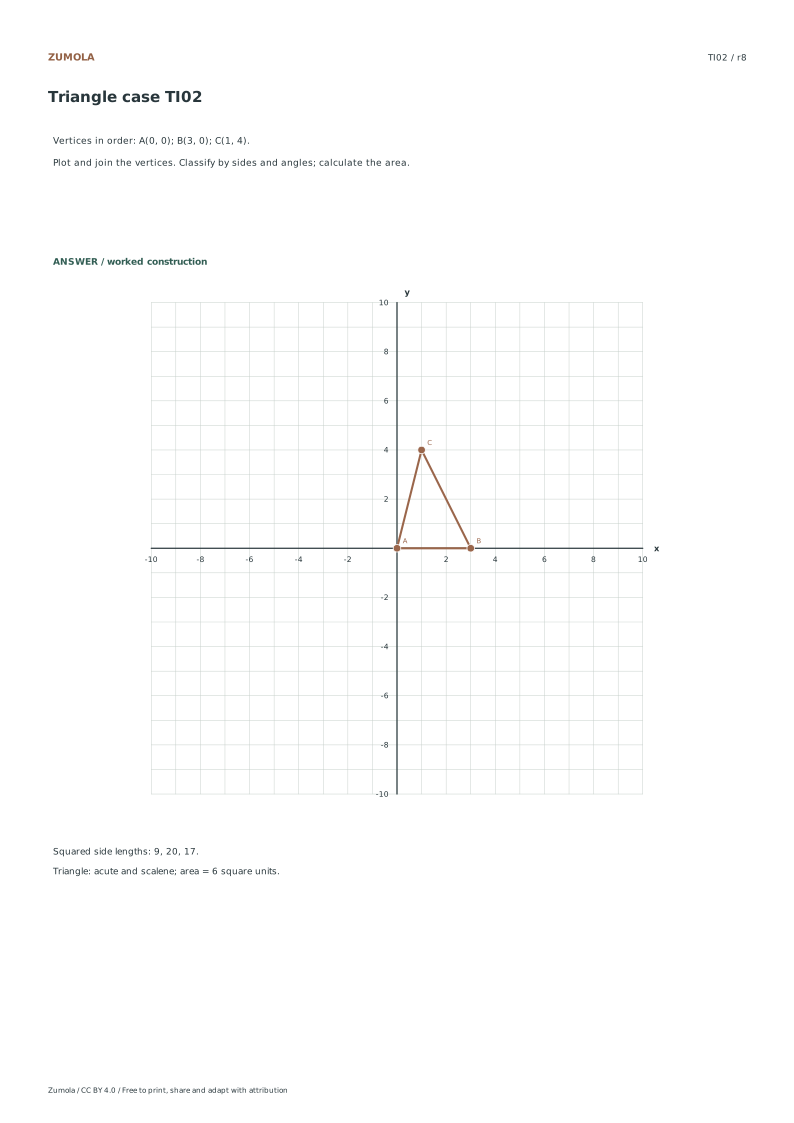
Vertices in order: A(0, 0); B(3, 0); C(1, 4).
Plot and join the vertices. Classify by sides and angles; calculate the area.
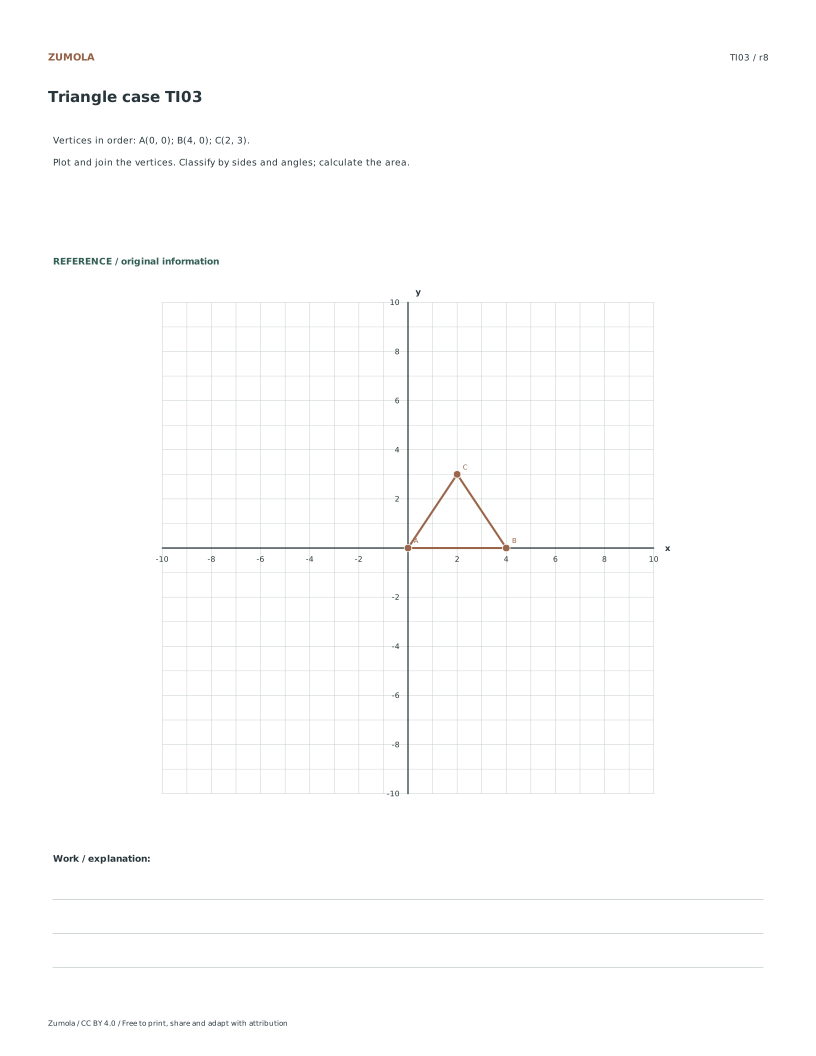
TI03
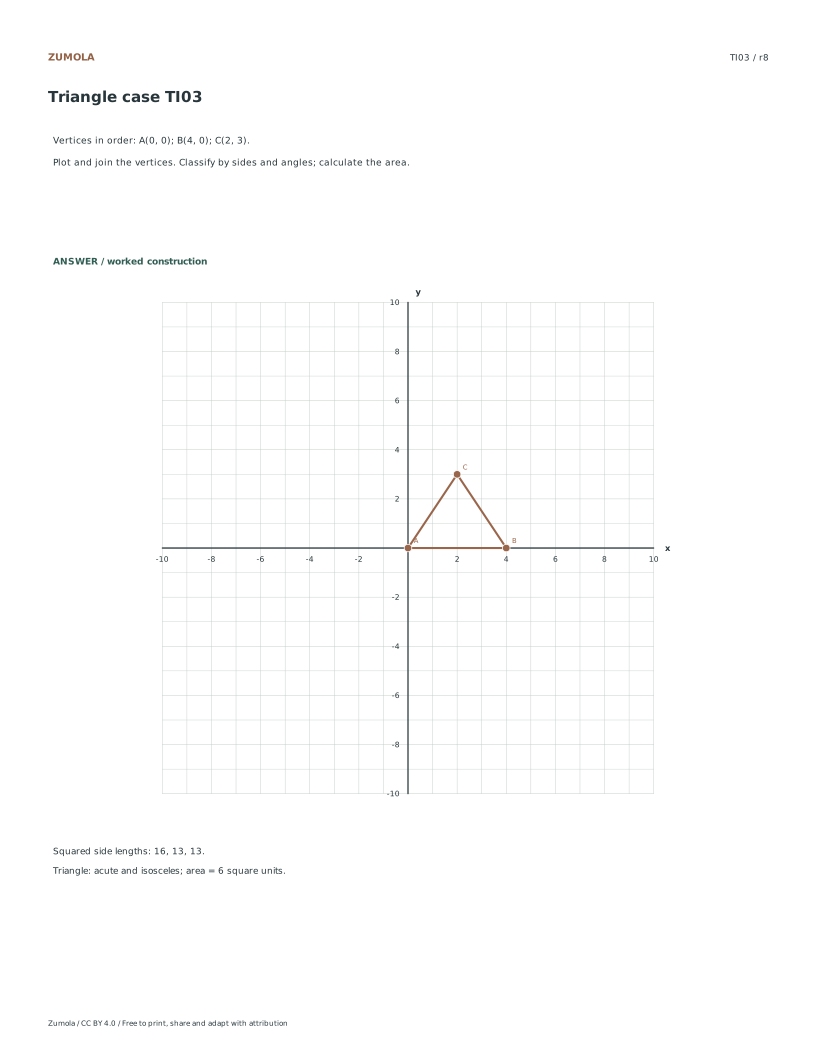
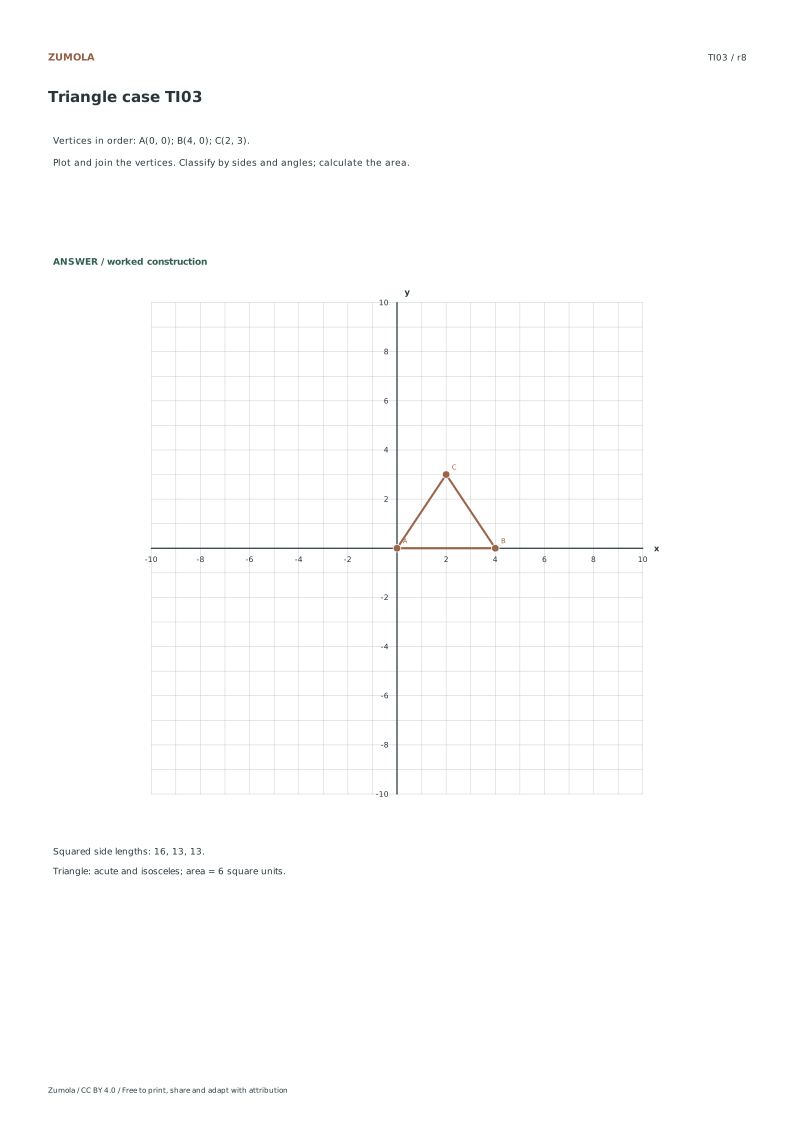
Vertices in order: A(0, 0); B(4, 0); C(2, 3).
Plot and join the vertices. Classify by sides and angles; calculate the area.
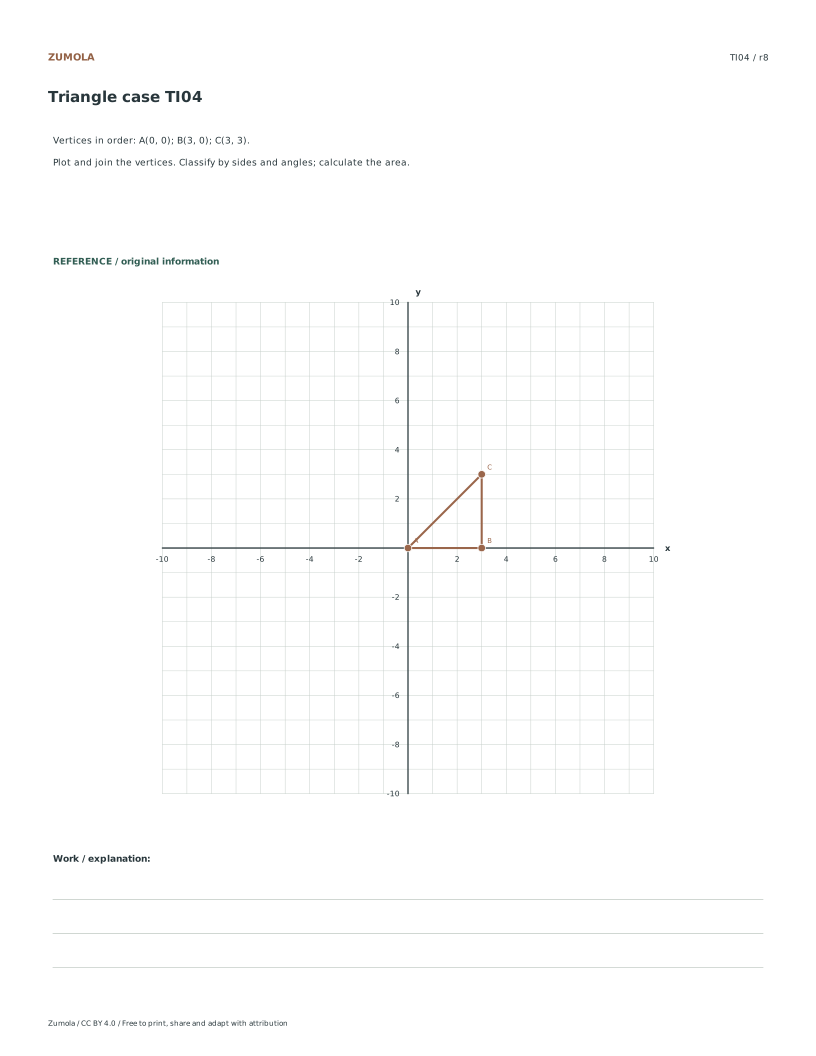
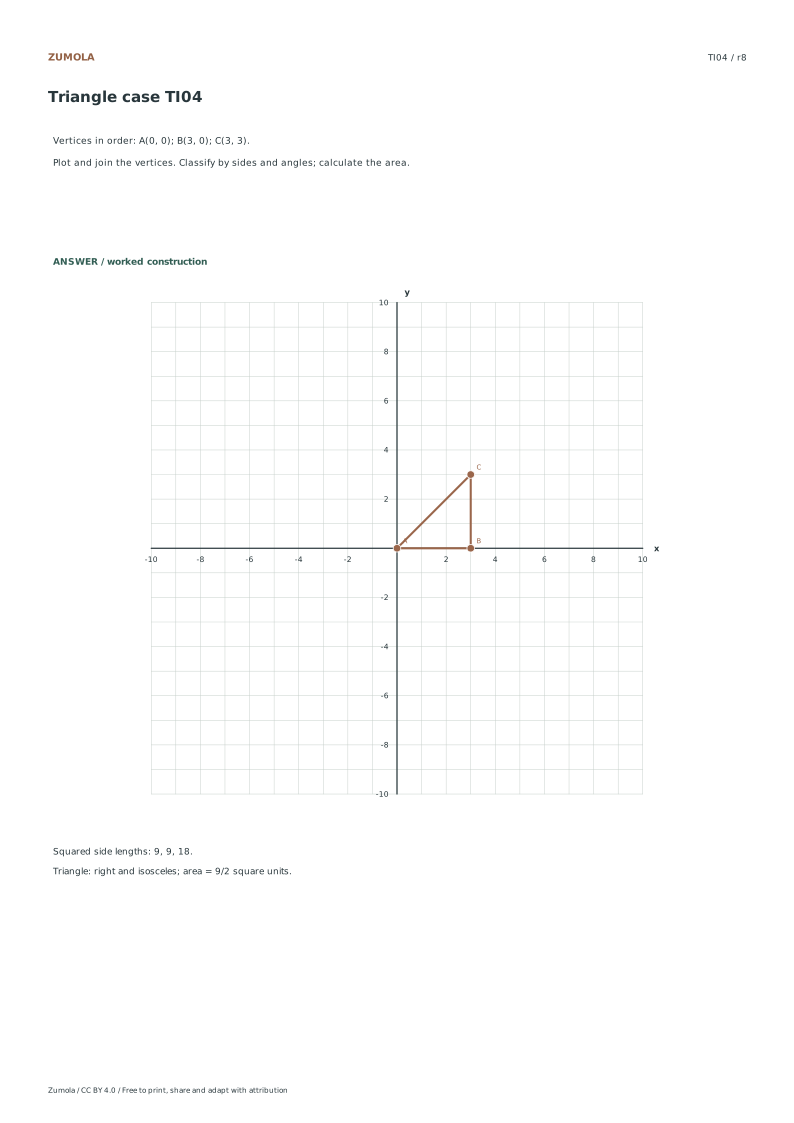
TI04
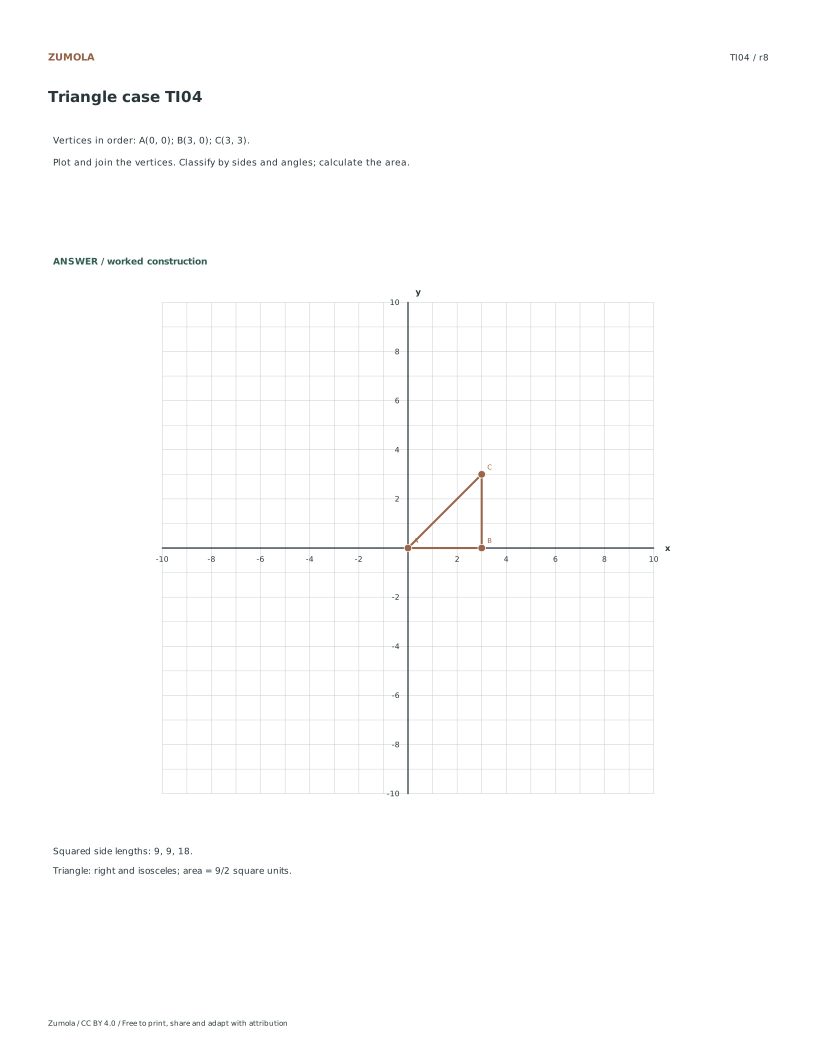
Vertices in order: A(0, 0); B(3, 0); C(3, 3).
Plot and join the vertices. Classify by sides and angles; calculate the area.
Use the coordinates, dimensions and rules given for each case. Distances and areas are measured in grid units.
Check the first case
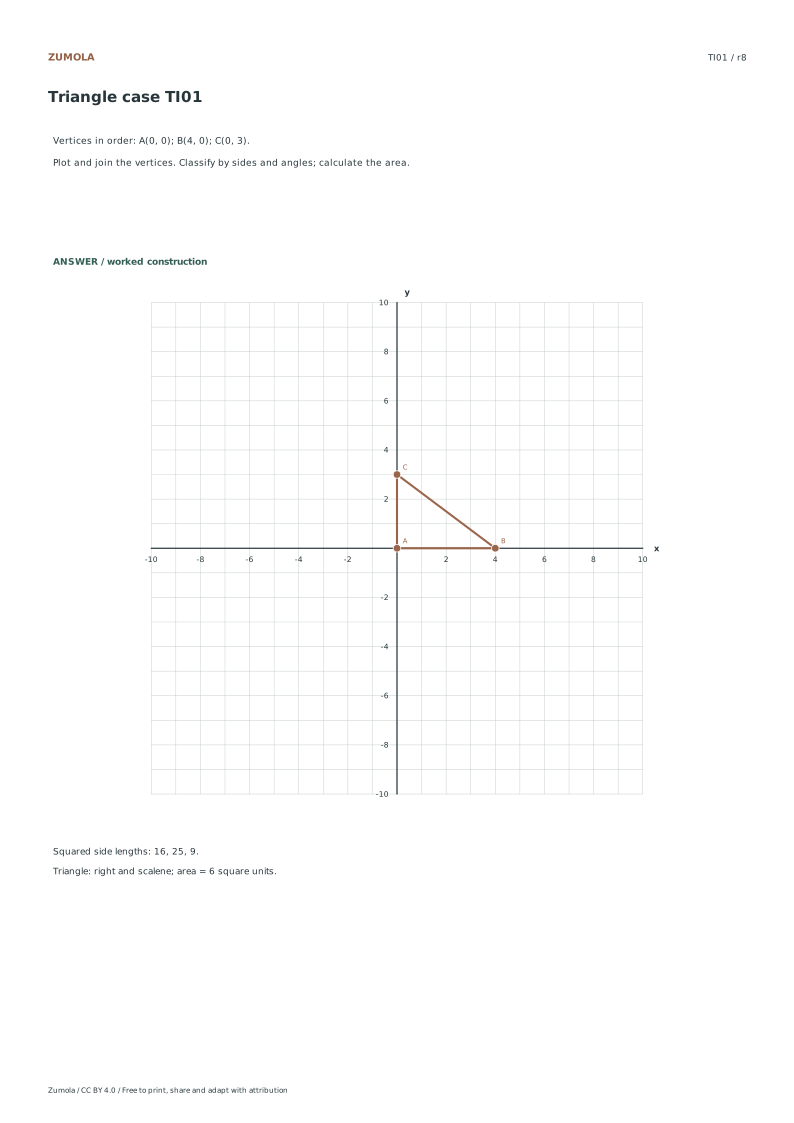
TI01: Right triangle
Step
Worked result
1
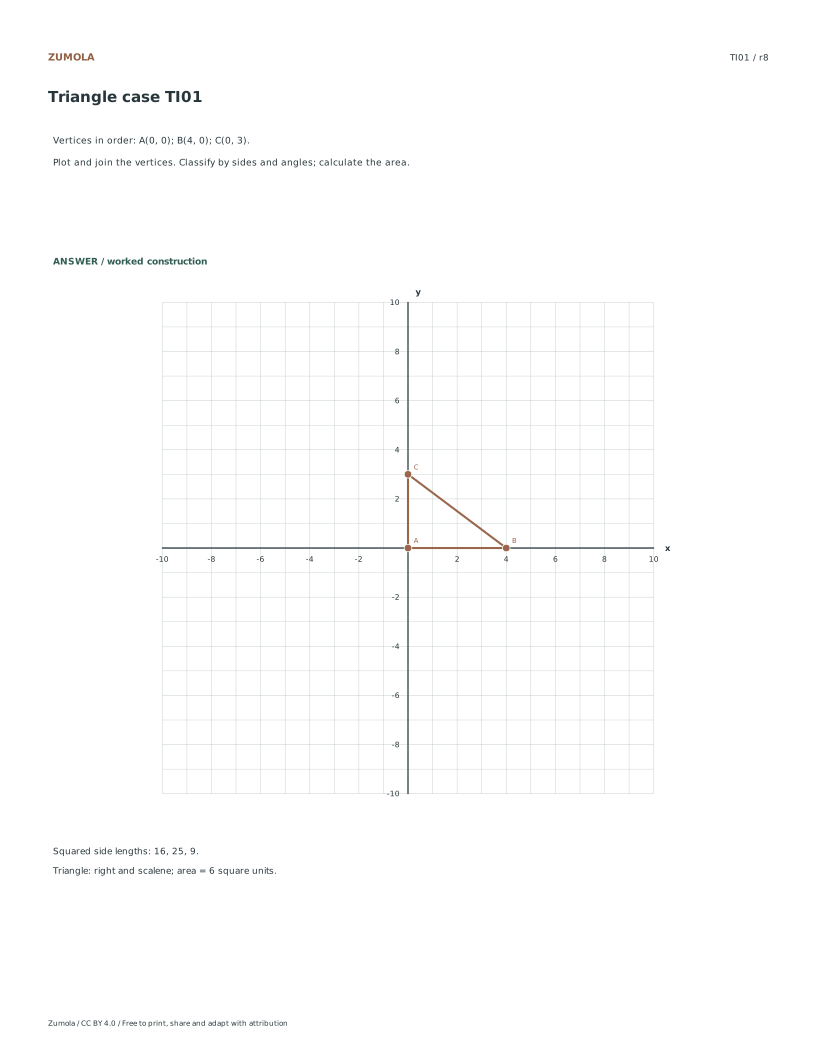
Squared side lengths: 16, 25, 9.
2
Triangle: right and scalene; area = 6 square units.
The first case shows the checking pattern. Individual answer files contain the completed graph or net and result for every case.
Work through the graph
Plotting Points and Forming Triangles
Start by plotting each vertex on the grid using its coordinates. For example, with A(0, 0), B(4, 0), and C(0, 3), mark these points precisely. Then join the points in order to form the triangle. This step ensures you see the shape before calculating. Next, find the squared side lengths using the distance formula or by counting grid squares when sides are horizontal or vertical. For the example, the squared lengths are 16, 25, and 9. These values help classify the triangle and compute the area.
Classifying Triangles by Sides and Angles
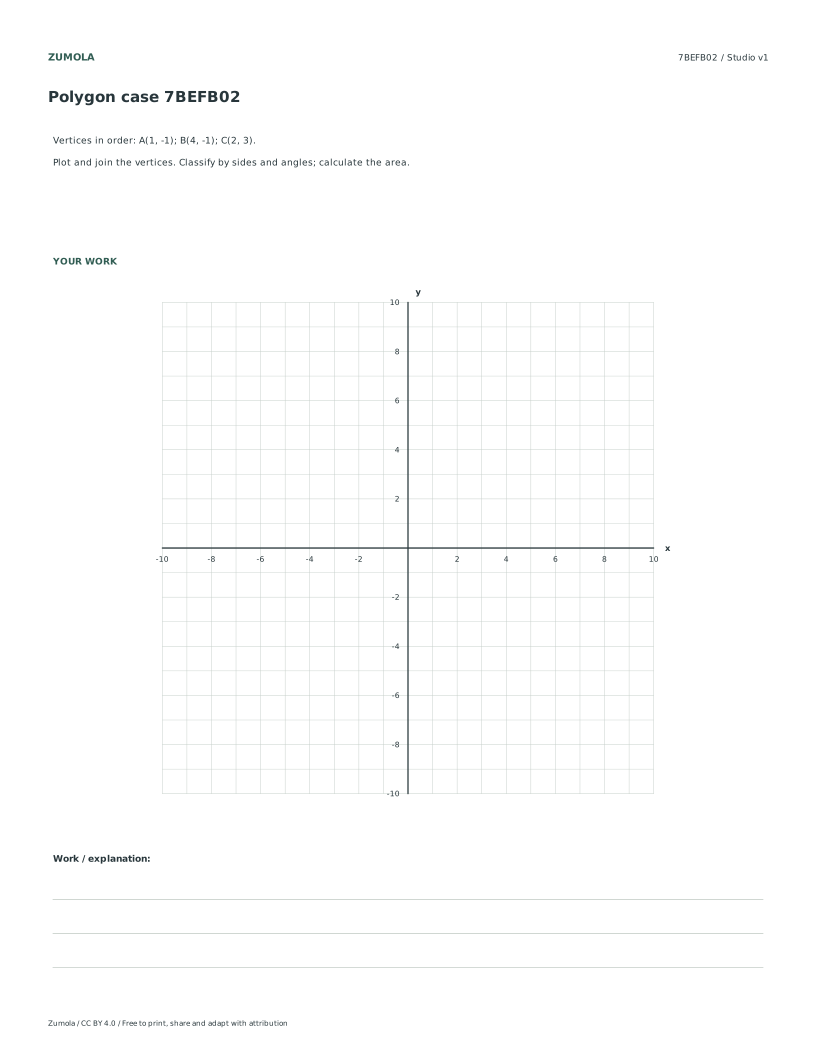
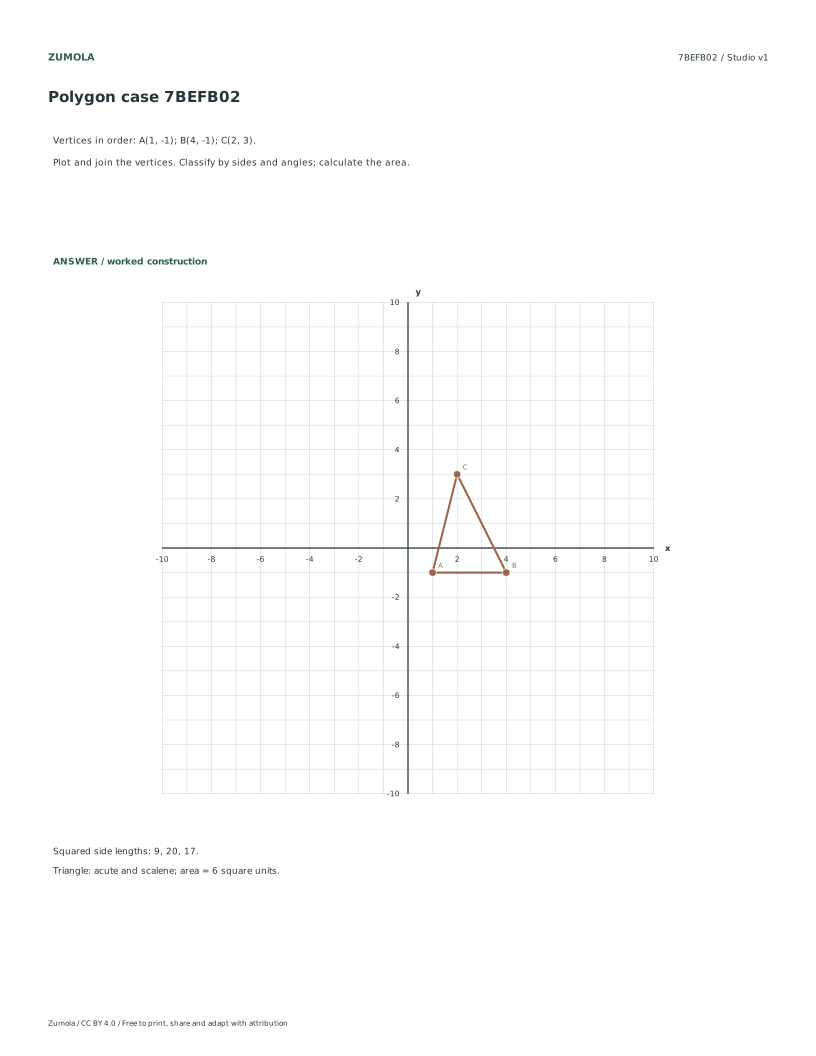
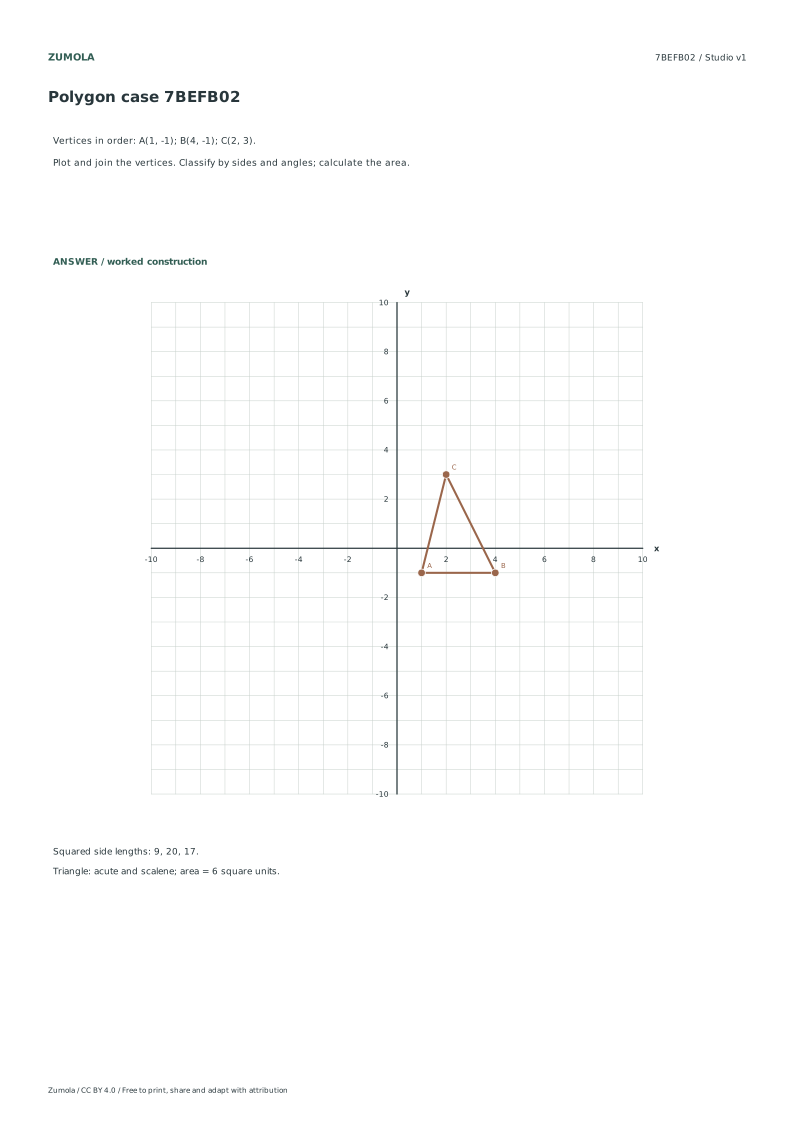
Compare the squared side lengths to classify the triangle. If all three squared lengths are different, the triangle is scalene. If two are equal, it is isosceles. For angles, check the relationship between the squares: if the sum of the two smaller squares equals the largest, it is right; if greater, acute; if less, obtuse. For instance, squared lengths 16, 25, 9 give 16+9=25, so it is right. Lengths 9, 20, 17 give 9+17=26>20, so acute. Lengths 16, 13, 13 give 13+13=26>16, so acute. Lengths 9, 9, 18 give 9+9=18, so right.
Calculating Area on a Grid
For triangles with a horizontal or vertical base, use the base-height formula: area = 1/2 × base × height. Identify the base length by counting squares along the horizontal or vertical side, and the height as the perpendicular distance from the opposite vertex to the base line. For A(0,0), B(4,0), C(0,3), base AB=4, height from C to AB is 3, so area=1/2×4×3=6. For A(0,0), B(3,0), C(1,4), base AB=3, height=4, area=6. For A(0,0), B(4,0), C(2,3), base=4, height=3, area=6. For A(0,0), B(3,0), C(3,3), base=3, height=3, area=9/2.
Checks that catch common errors
Watch for
Check instead
Assuming that if two sides are equal, the triangle must be isosceles and acute.
An isosceles triangle can be right, acute, or obtuse. Check the angle using the squared lengths: for 9, 9, 18, 9+9=18, so it is right isosceles, not acute.
Using slope product alone to decide if lines are parallel.
Slope product only tests perpendicularity (product = -1). For parallelism, slopes must be equal and intercepts must differ. Equal slopes with equal intercepts describe the same line.
Calculating area by counting only whole squares inside the triangle.
Use the base-height formula or decompose into right triangles. Counting squares can miss partial squares and give incorrect results. For example, the triangle with vertices (0,0), (3,0), (1,4) has area 6, not a whole number of squares.
Keep labels and margins readable
Choose the PDF that matches your paper. Print at Actual size / 100% and turn off Fit, Shrink and browser headers. SVG is editable but an editor can rescale it; the PDF is the simpler print route.
Useful answers
How do I know if a triangle is right without drawing it?
Use the squared side lengths. If the sum of the two smaller squared lengths equals the largest squared length, the triangle is right. For example, 16+9=25, so the triangle with squared lengths 16, 25, 9 is right.
Can two different triangles on the grid have the same area?
Yes. For example, the triangles with vertices (0,0), (4,0), (0,3) and (0,0), (3,0), (1,4) both have area 6 square units, but they are different shapes and classifications.
What does it mean if two lines have the same slope but different intercepts?
They are parallel. If the slopes are equal and the intercepts are different, the lines never intersect. If the intercepts are also equal, they are the same line.
Are the answer files and editable graphs free?
Yes. The individual student, reference and answer files plus collection packs are free without signup. Credit Zumola under CC BY 4.0 when sharing or adapting.
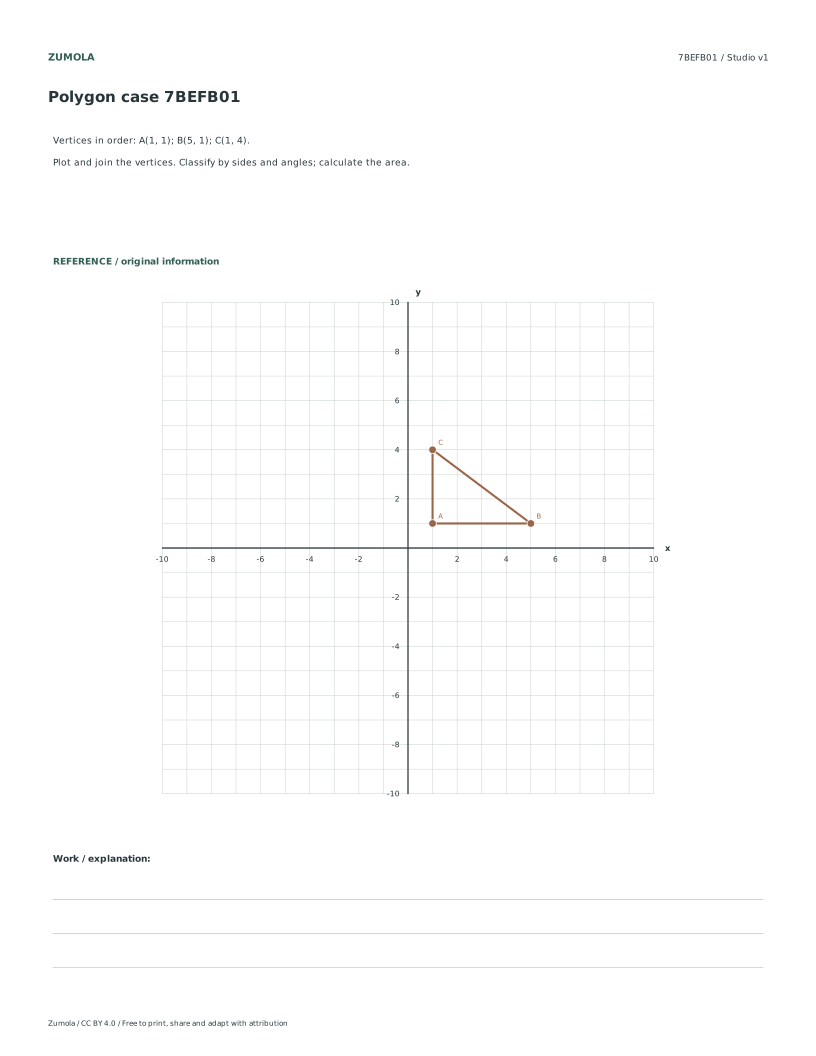
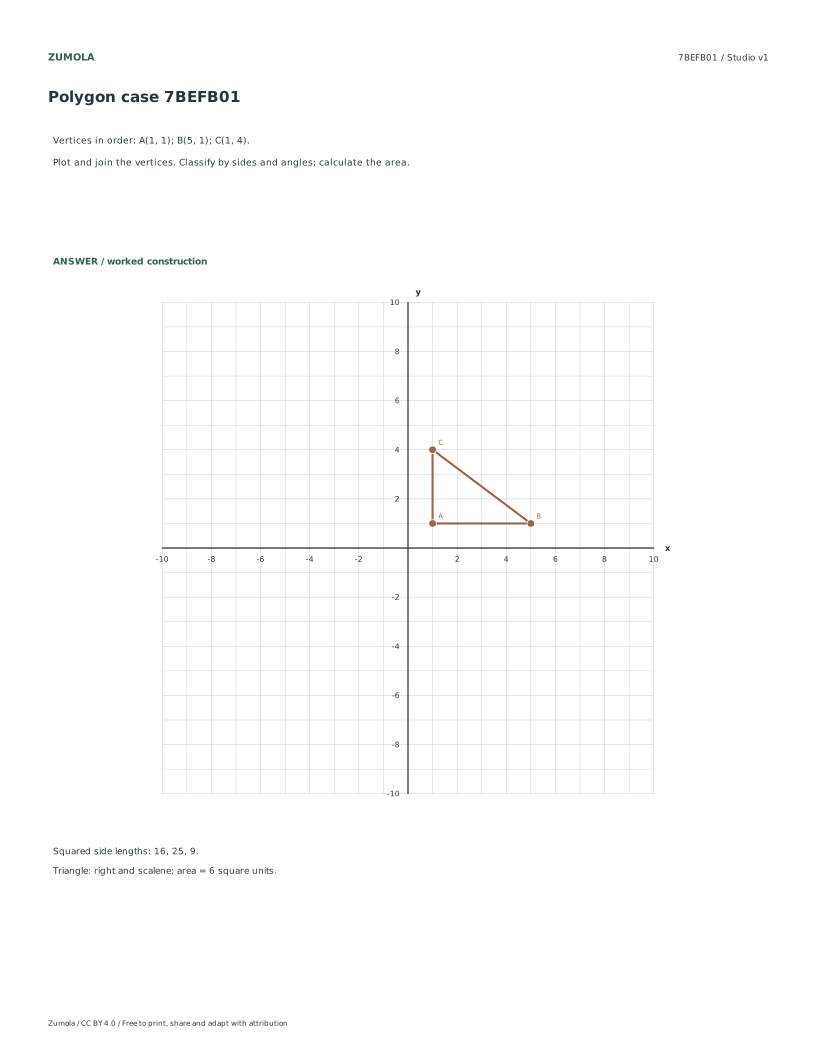
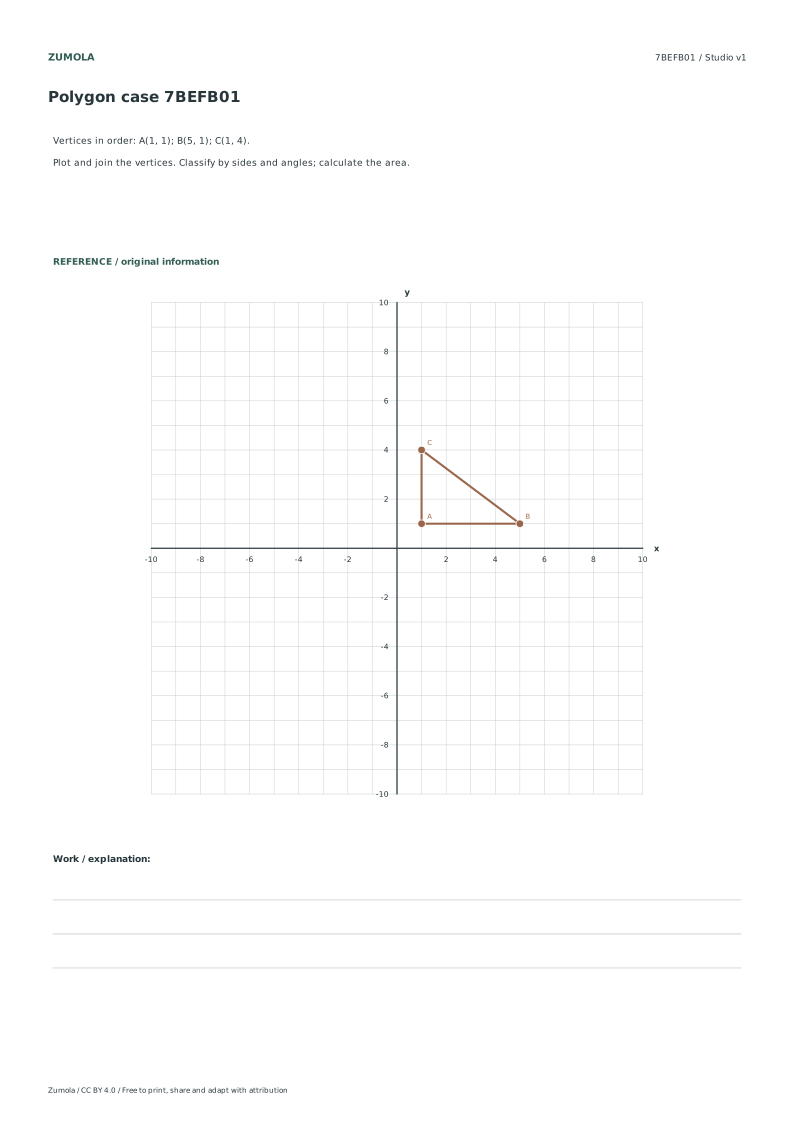
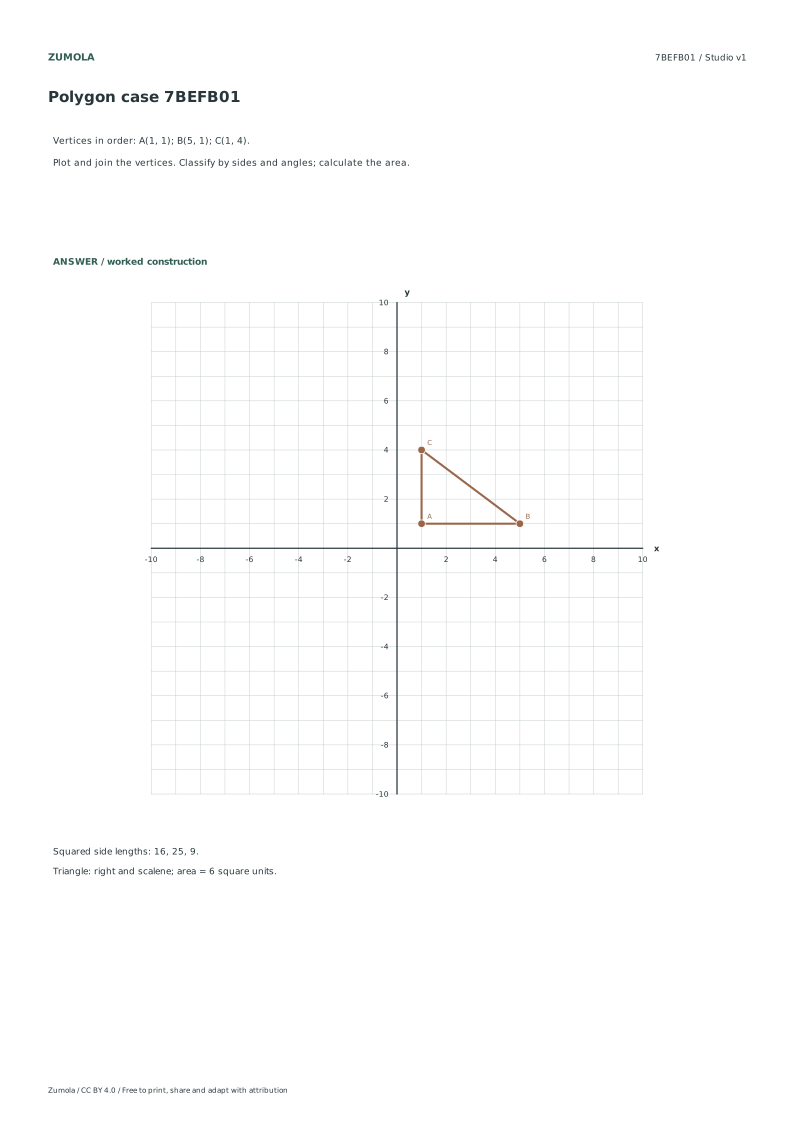
Start by plotting each vertex on the grid using its coordinates. For example, with A(1, 1), B(5, 1), and C(1, 4), mark the points and connect them. To find side lengths, use the distance formula or count grid units for horizontal and vertical segments. For AB, the horizontal distance is 4, so the squared length is 16. For AC, the vertical distance is 3, so the squared length is 9. For BC, use the distance formula: (5-1)^2 + (1-4)^2 = 16 + 9 = 25. Record squared lengths to avoid square roots until needed.
Check the first new case
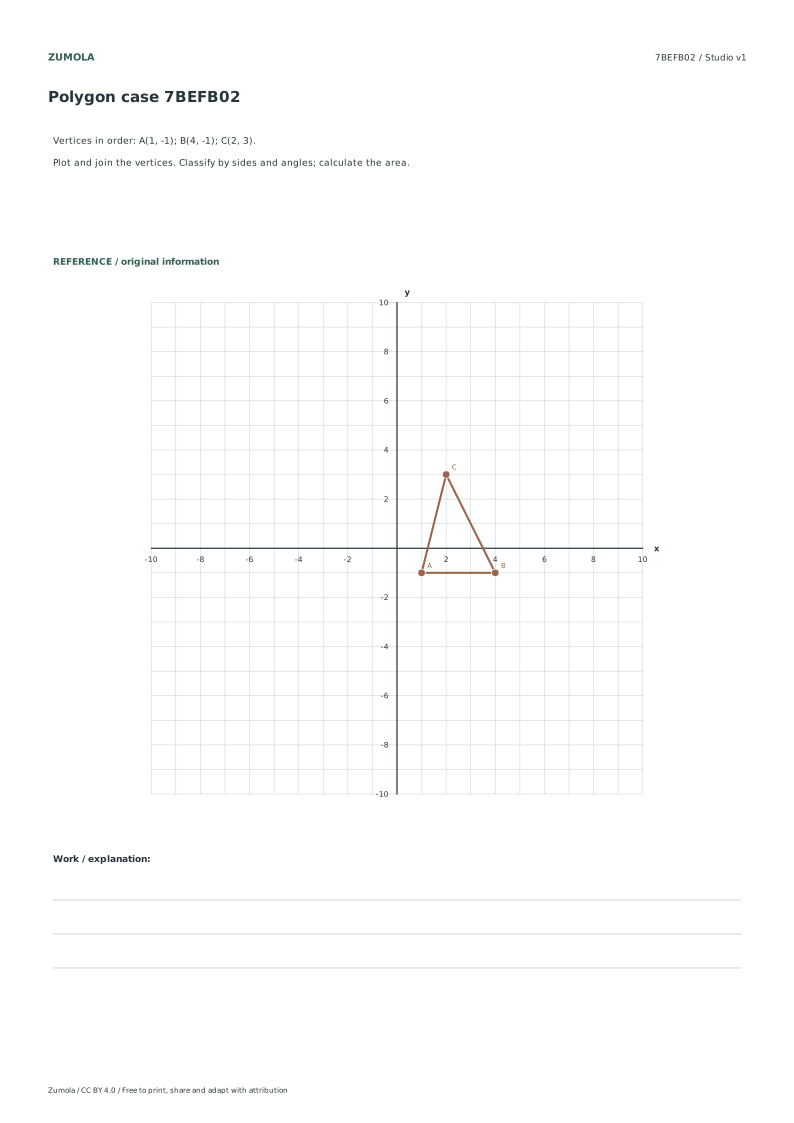
Vertices in order: A(1, 1); B(5, 1); C(1, 4).
Squared side lengths: 16, 25, 9.
Triangle: right and scalene; area = 6 square units.
The answer PDFs include the completed drawings and checks for all four cases. Free original resources, CC BY 4.0. No signup required.
More ways to practice
Separate the four task types before you start
A drawing task asks you to place vertices at given coordinates and close the outline. A property task asks you to justify side lengths or angles from the grid. An area task asks for a numeric result with square units. A transformation task asks you to apply a rule to every vertex and redraw. Mixing these produces answers that look complete but fail one requirement.
Label each answer with its task type. For a plot, the evidence is vertex positions. For a property, the evidence is measured or counted grid distances. For area, the evidence is a base, a perpendicular height, and the unit. For a transformation, the evidence is the new coordinates of all three vertices.
Write the task type at the top of your working before plotting.
Record each vertex as an ordered pair in the form (x, y).
For property claims, state the grid distance you counted or computed.
For area, identify the base and the perpendicular height separately.
For transformations, list all three new vertices before drawing.
Coordinate transform check with an independent formula
A translation adds the same value to every x-coordinate and the same value to every y-coordinate. Check it with a formula written separately from your drawing: new x equals old x plus horizontal shift, and new y equals old y plus vertical shift. If any vertex breaks the pattern, the drawing is wrong even if it looks plausible.
A reflection across a vertical grid line at x equals k maps each point to (2k minus x, y). A reflection across a horizontal line at y equals k maps (x, y) to (x, 2k minus y). These formulas let you verify a reflected triangle without trusting the picture. Keep units consistent: grid steps are counts, not centimetres, unless the paper states a scale.
Write the transform rule as a formula before touching the grid.
Apply the formula to each vertex and list the results.
Plot the new vertices and connect them in the same order.
Recheck one vertex by reversing the formula back to the original.
Area units and endpoint conditions
Area on a grid is counted in square grid units. A triangle with base 6 grid steps and perpendicular height 4 grid steps has area one half times 6 times 4, which equals 12 square grid units. If the paper scale says one grid step equals 1 cm, the area is 12 square centimetres; if it says 2 cm, the area is 48 square centimetres. State the scale you used.
Endpoint conditions matter. A vertex on a grid intersection is exact; a vertex between intersections introduces a fractional coordinate that must be written as a fraction, not rounded. When a side lies along a grid line, the perpendicular height is a straight count. When no side is horizontal or vertical, choose a base and count the perpendicular distance to the opposite vertex carefully, or use a surrounding rectangle and subtract corner triangles.
State the grid scale before computing area.
Choose a base that lies along a grid line when possible.
Count the perpendicular height from the opposite vertex to that base line.
Write the area with square units and the scale used.
If vertices fall between intersections, keep fractional coordinates exact.
Diagnostic checks after drawing
Run three checks in order. First, confirm every vertex sits where the coordinates say. Second, confirm the classification matches measured side or angle evidence, not appearance. Third, confirm the area uses a base and a perpendicular height, not a slanted side. A triangle can look isosceles while its grid distances differ by one step, so measure rather than assume.
Compare plotted vertices against the written coordinate list.
Measure each side by counting grid steps, including diagonals via the square of the horizontal and vertical differences.
Confirm the area calculation uses a perpendicular height.
Note any vertex that is not on an intersection and keep its fraction.
Try this example
Plot A at (1, 1), B at (7, 1) and C at (1, 5) on a grid where one step equals 1 cm. Classify the triangle, find its area, then translate it 3 steps right and 2 steps up.
Show the worked explanation
AB is horizontal with length 6 steps. AC is vertical with length 4 steps. BC is the diagonal from (7, 1) to (1, 5): horizontal difference 6, vertical difference 4, so its squared length is 36 plus 16 equals 52, and its length is the square root of 52, about 7.21 steps. The right angle is at A because AB is horizontal and AC is vertical. Area is one half times 6 times 4 equals 12 square grid units, which is 12 square centimetres at the stated scale. The translation gives A' at (4, 3), B' at (10, 3) and C' at (4, 7). Reverse-check: subtract 3 from 4 and 2 from 3 to recover (1, 1).
Common mistakes
Classifying a triangle by how it looks rather than by measured grid distances. Count or compute all three side lengths and compare them before naming the triangle.
Using a slanted side as the height in an area calculation. Identify a base along a grid line and count the perpendicular distance to the opposite vertex.
Applying a translation to only some vertices. Write the shift formula and apply it to every vertex, then reverse-check one point.
Check your work
All three vertices are plotted at the stated coordinates, with fractions kept exact where needed.
The classification is supported by measured or computed side lengths or angle evidence, not appearance.
The area uses a base and a perpendicular height, with square units and the grid scale stated.
Any transformation is applied to all three vertices and verified with an independent formula.
Labels and margins remain readable, and the task type is identified at the top of the working.
Questions before you start
How do I check a reflection without trusting the drawing?
Use the formula: across a vertical line x equals k, each point becomes (2k minus x, y); across a horizontal line y equals k, each point becomes (x, 2k minus y). Apply it to all three vertices.
What unit should an area answer use on grid paper?
Use square grid units unless the paper states a scale. If one grid step equals a stated length, convert and state the scale in your answer.
Can a vertex sit between grid intersections?
Yes, but write its coordinate as an exact fraction rather than rounding, and expect fractional side lengths or heights.
Optional Google Analytics helps us understand which free resources are useful. It is off until you allow it. Drawing tools and downloads work with either choice. Privacy details