Free original resources
Circle Area and Circumference Practice: Radius, Diameter, and Exact Pi
Practice finding a circle's circumference and area from its radius or diameter. Keep answers exact with pi, then give a decimal approximation using correct square and linear units.
Free resources
Letter & A4
PDF & SVG
Letter & A4
PDF & SVG
Make it yours.
Free · no signup · calculated in your browser
Your free printable kit.
Original reference, student practice and separate worked answers. No account or payment.
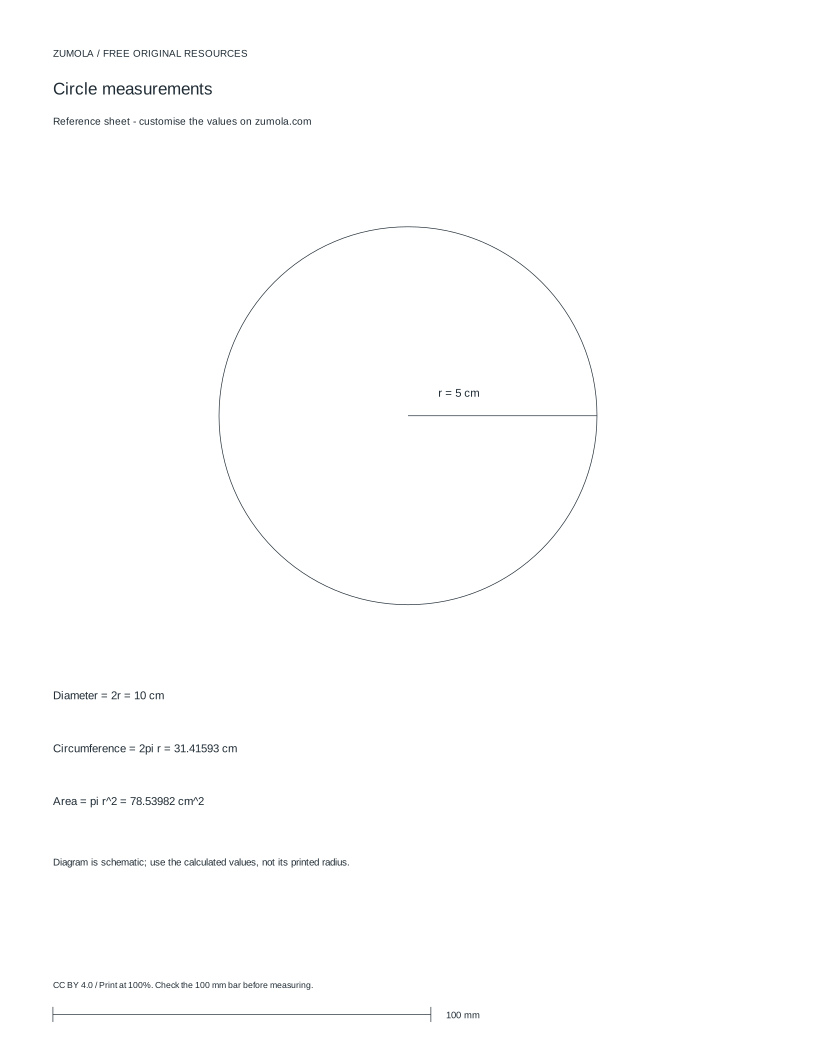
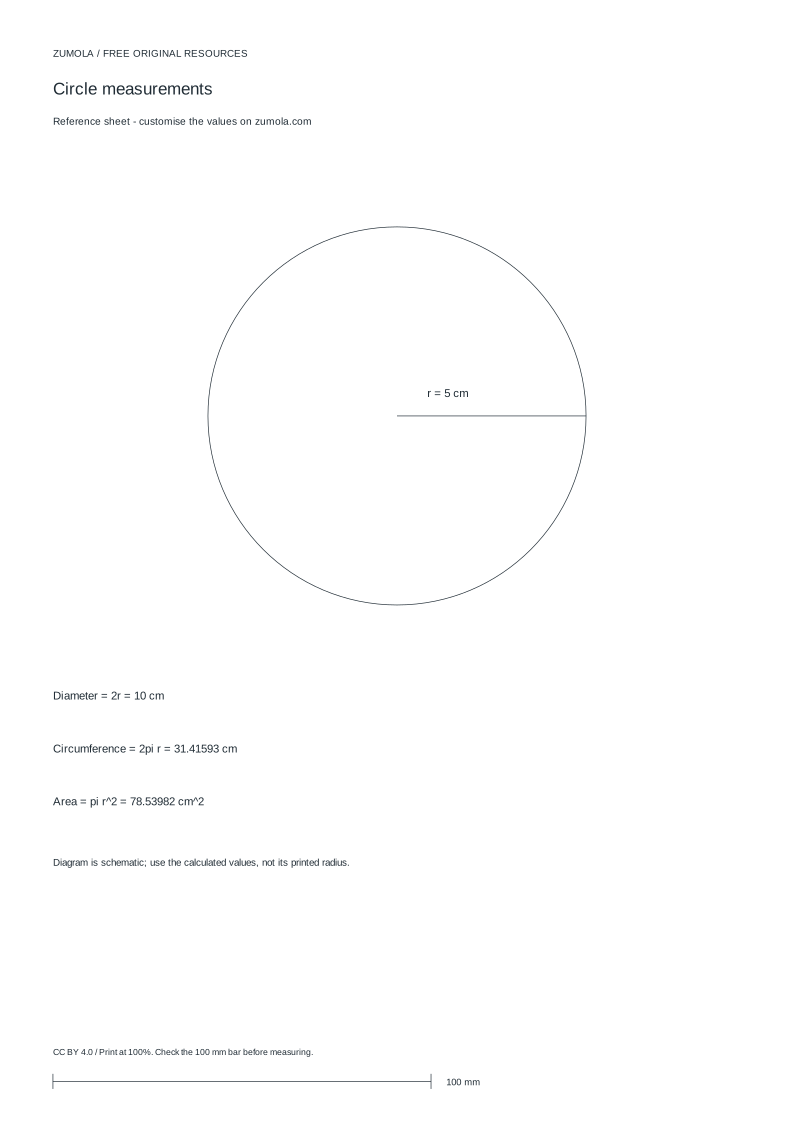
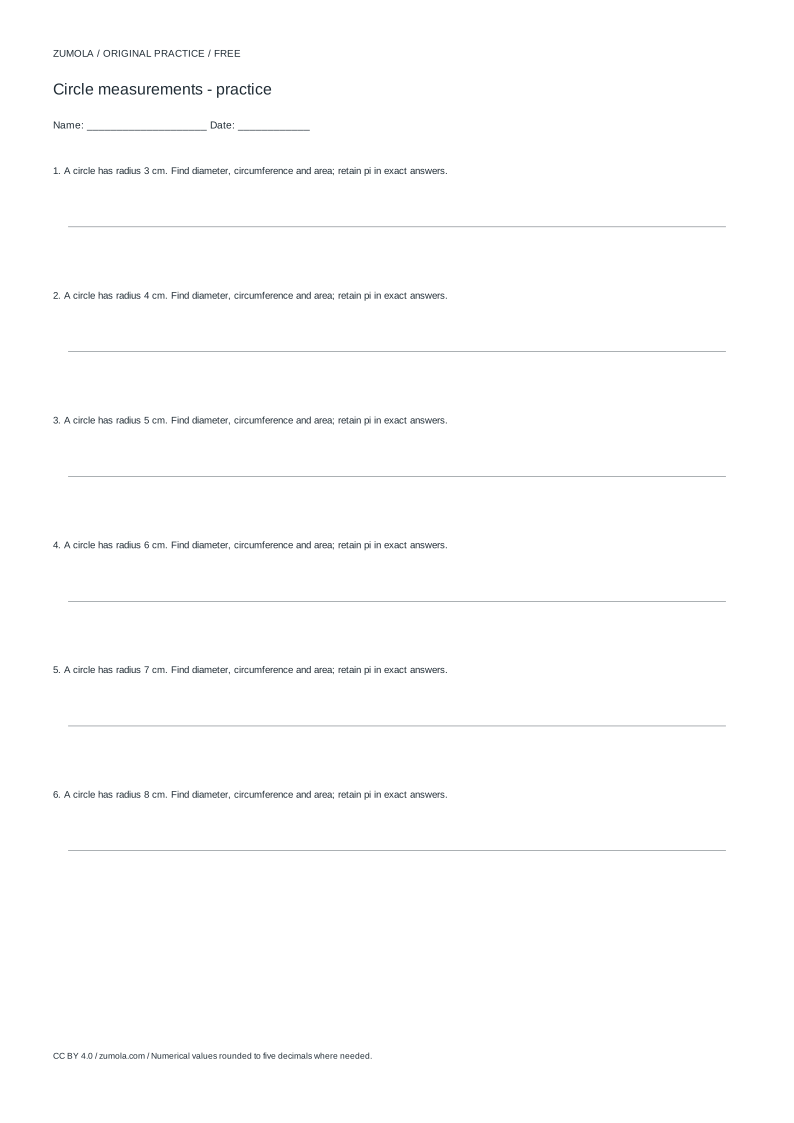
Practice worksheet

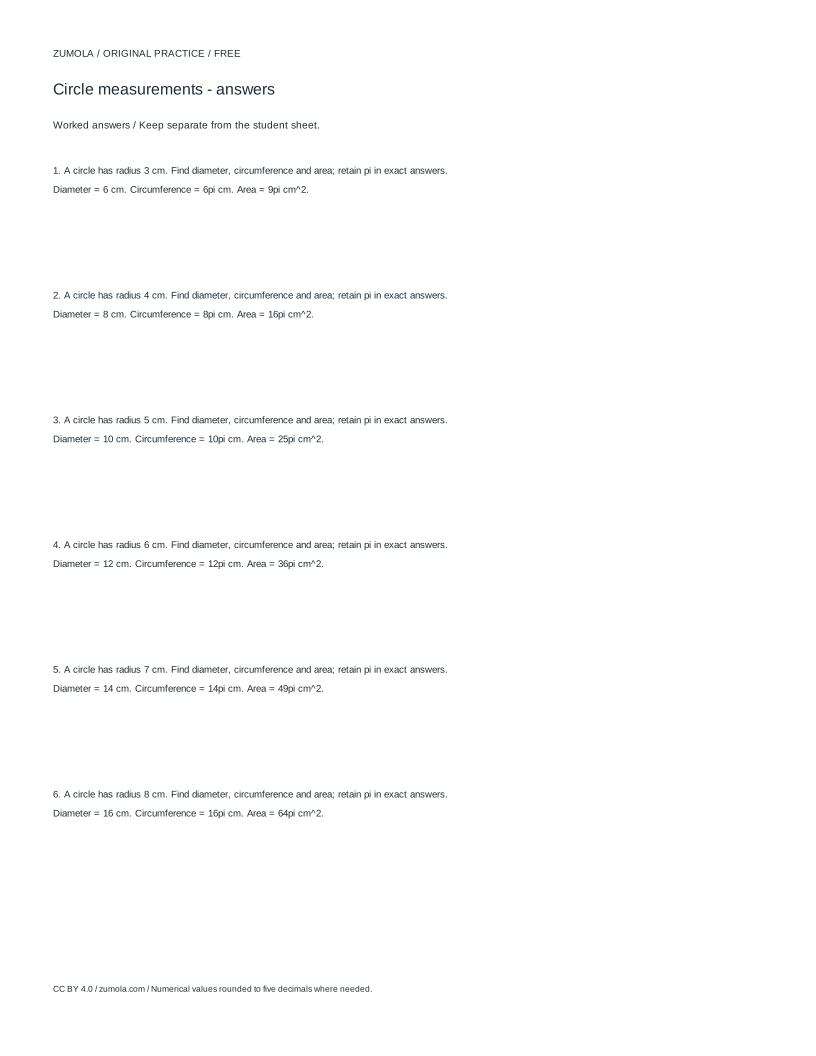
Worked answers / rubric
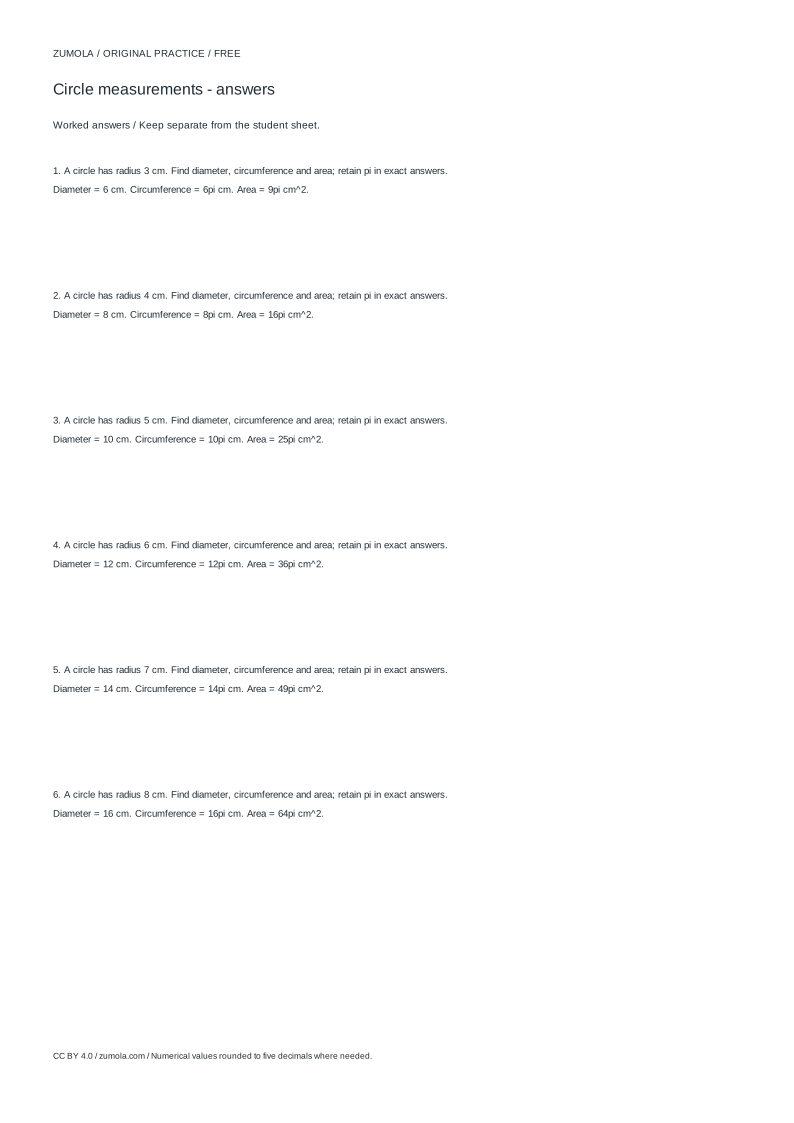
Print at Actual size / 100%. Check the calibration bar before using physical dimensions.
This page focuses on one task: given a circle's radius or diameter, calculate its circumference and area, first in exact form with pi and then as a decimal approximation. You will see how the formulas connect, why the diameter is twice the radius, and how units differ between a length around the circle and the space inside it. The method works for any circle size; the numbers here are simple enough to check by hand.
Two formulas, one radius
A circle is defined by its centre and its radius r, the distance from the centre to any point on the circle. The diameter d is the straight distance across the circle through the centre, so d = 2r and r = d divided by 2. Every circumference and area calculation starts by expressing the radius in the same unit you will report.
Circumference is the distance once around the circle: C = 2 times pi times r, or equivalently C = pi times d. Area is the space enclosed: A = pi times r squared. The squared radius is why area grows much faster than circumference when the circle gets larger. Keep pi as a symbol for the exact answer, then replace pi with an approximation such as 3.14159 only for the decimal value.
Units matter. Circumference is a length, so it uses centimetres, millimetres, metres, or whatever linear unit the radius uses. Area is measured in square units, such as square centimetres. If the radius is given in centimetres, the area is in square centimetres, not centimetres.
- Write down the given value and label it as radius or diameter.
- If a diameter is given, halve it to get the radius; if a radius is given, double it only when you need the diameter.
- Compute exact circumference as 2 times pi times radius, or pi times diameter.
- Compute exact area as pi times radius squared.
- Replace pi with a decimal approximation to report circumference and area, keeping the correct linear or square unit.
Working from a diameter without losing the radius
When the diameter is given, many errors come from substituting the diameter into the area formula. Area needs the radius, so divide the diameter by two first. For example, a diameter of 10 cm gives a radius of 5 cm. The circumference can be written directly as 10 pi cm, because C = pi times d. The area is pi times 5 squared, which is 25 pi square centimetres.
A useful check is to compare the two answers. Circumference is a length around the outside; area is a two-dimensional quantity inside. Their numerical values are not directly comparable, but their units must differ. If both answers carry the same unit, one of them is wrong. Also check that the area uses the radius, not the diameter, before squaring.
- Identify the diameter and divide by 2 to obtain the radius.
- Write circumference as pi times diameter for a quick exact form.
- Write area as pi times radius squared, using the halved value.
- Approximate pi to get decimal values and attach cm for circumference and cm squared for area.
Exact form versus decimal approximation
Exact answers keep pi visible, such as 10 pi cm and 25 pi square centimetres. Decimal answers replace pi with a number. Because pi is irrational, any decimal is an approximation; the more digits you use, the closer it is. For hand practice, 3.14 or 3.14159 is common. State which approximation you used so the reader can reproduce your value.
Rounding should happen at the end, not in the middle. If you round the radius or an intermediate product too early, the final area can drift. Keep the exact expression until the last step, then round the decimal to the precision requested. A sensible check is that the decimal circumference should be a little more than three times the diameter, since pi is a little more than 3.
- Record the exact answer with pi before doing any decimal arithmetic.
- Choose a pi approximation and note it.
- Multiply and square using the full radius value, not a rounded one.
- Round only the final decimal and keep the unit.
Try this example
A circle has radius 5 cm. Find its exact circumference and area, then give decimal approximations using pi approximately 3.14159.
Show the worked explanation
Diameter is 10 cm. Exact circumference is 2 times pi times 5 = 10 pi cm. Exact area is pi times 5 squared = 25 pi square centimetres. Using pi approximately 3.14159, circumference is about 31.4159 cm and area is about 78.53975 square centimetres. The circumference is a length in cm; the area is in cm squared.
Common mistakes
- Using the diameter in the area formula instead of the radius. Halve the diameter first, then square that radius: A = pi times (d divided by 2) squared.
- Writing square centimetres for circumference or plain centimetres for area. Label circumference with a linear unit such as cm and area with a square unit such as cm squared.
- Rounding pi or the radius too early and carrying the rounded value into later steps. Keep pi symbolic and the radius exact until the final decimal, then round once.
Check your work
- Correctly identifies whether the given value is a radius or a diameter and converts to radius when needed.
- States exact circumference with pi and the correct linear unit.
- States exact area with pi and the correct square unit.
- Uses the radius, not the diameter, when squaring for area.
- Provides a decimal approximation with the pi value or precision stated.
- Rounds only at the final step and keeps units consistent throughout.
Questions before you start
Can I calculate circumference directly from the diameter?
Yes. Circumference equals pi times diameter, so a diameter of 10 cm gives exactly 10 pi cm. For area you still need the radius, which is half the diameter.
Why is the area unit squared but the circumference unit not squared?
Circumference measures a one-dimensional distance around the circle, so it uses a linear unit. Area measures a two-dimensional region, so multiplying two lengths gives square units.
How precise should a decimal answer be?
Use the precision your task requests. Keep the exact pi form alongside the decimal, and state the pi approximation you used so the result can be checked.