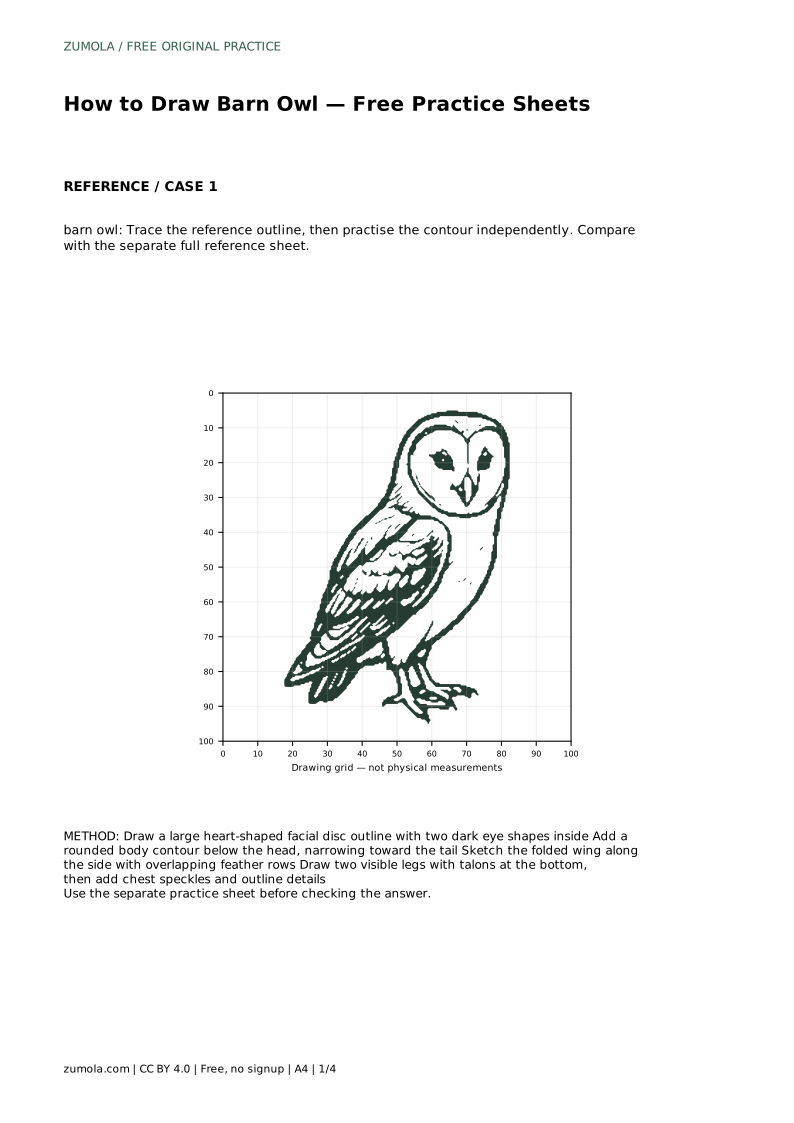
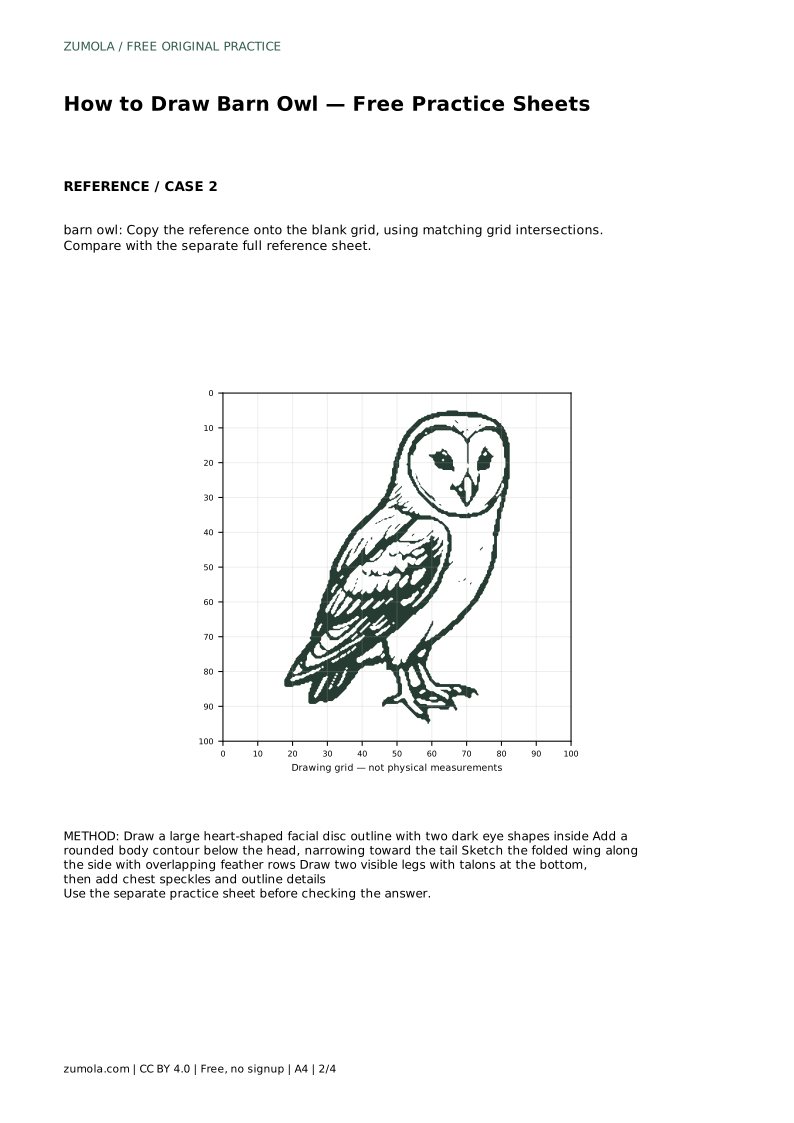
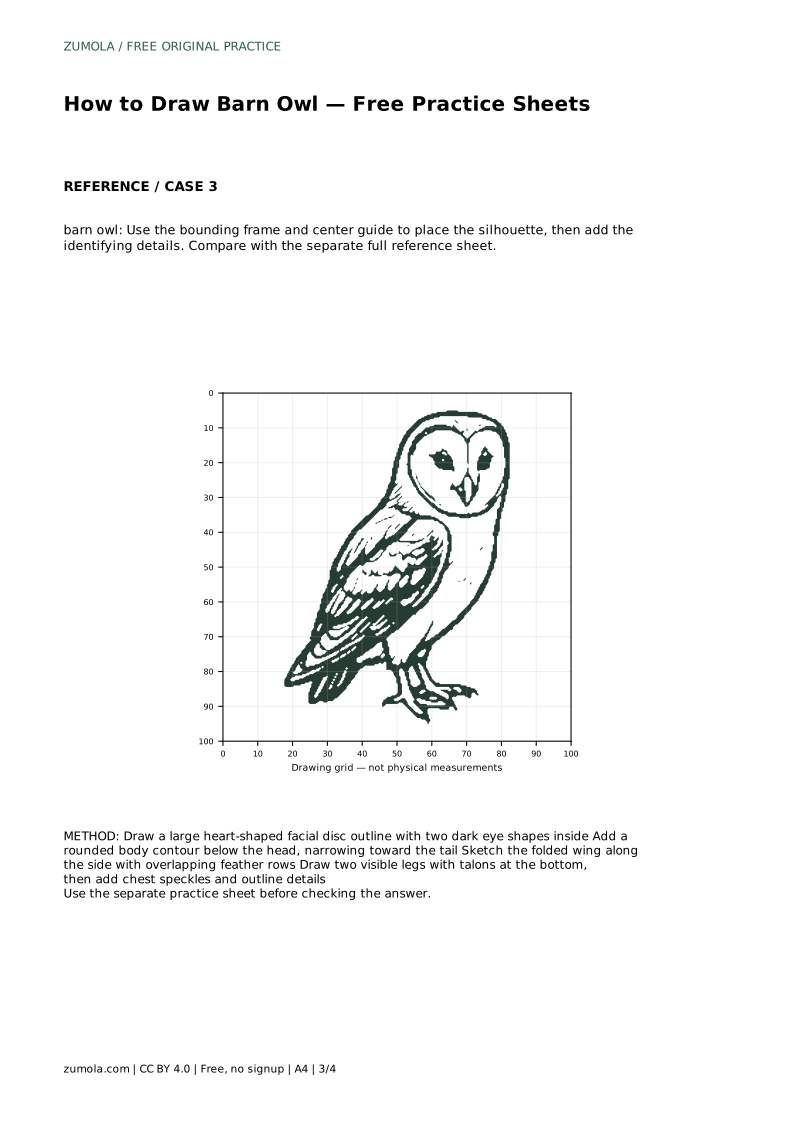
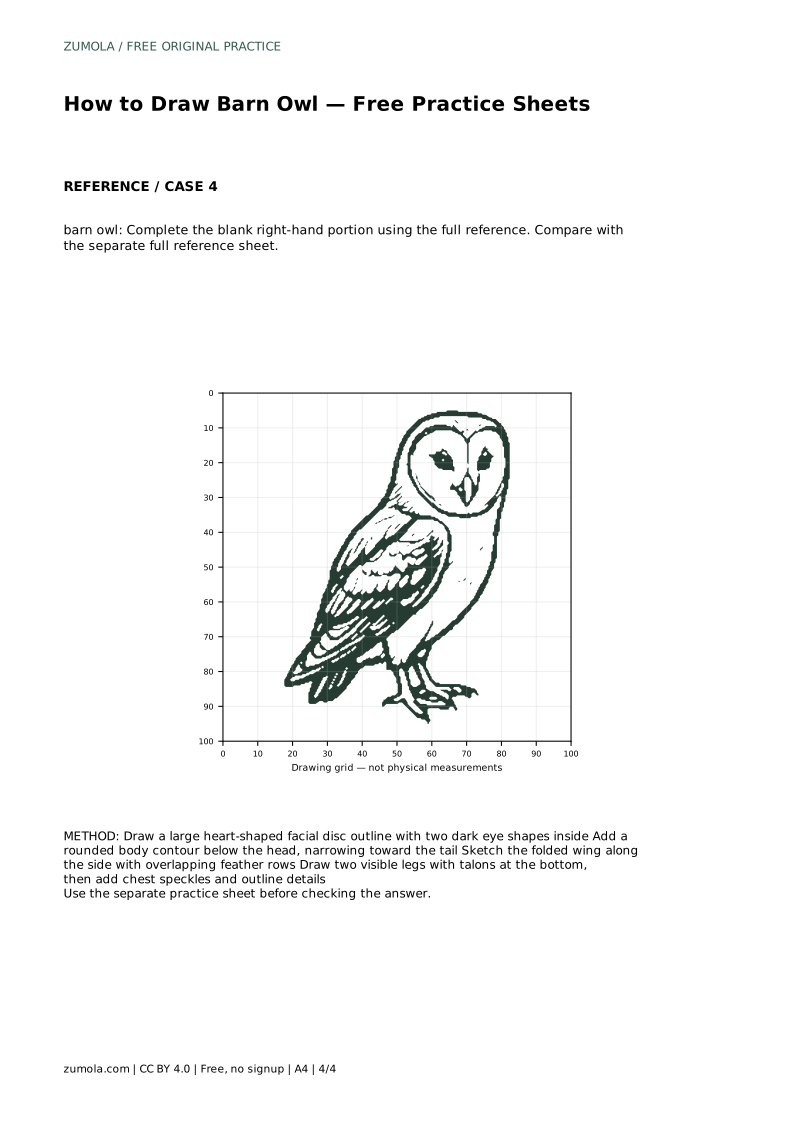
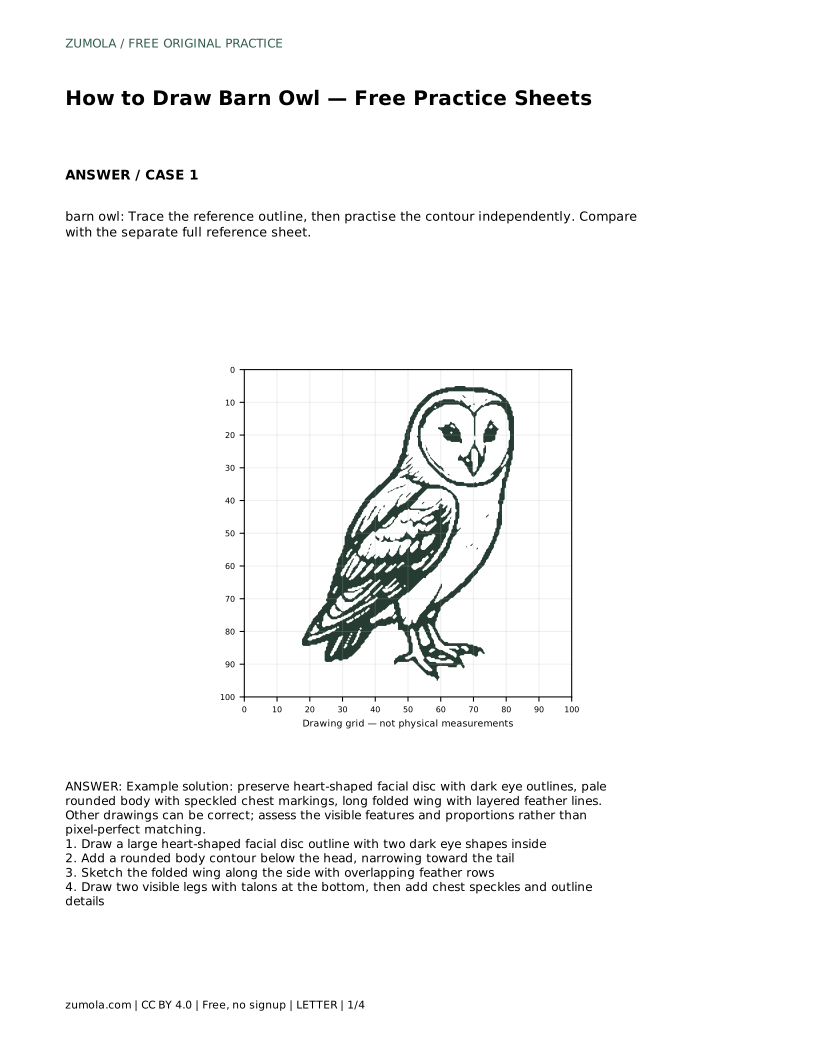
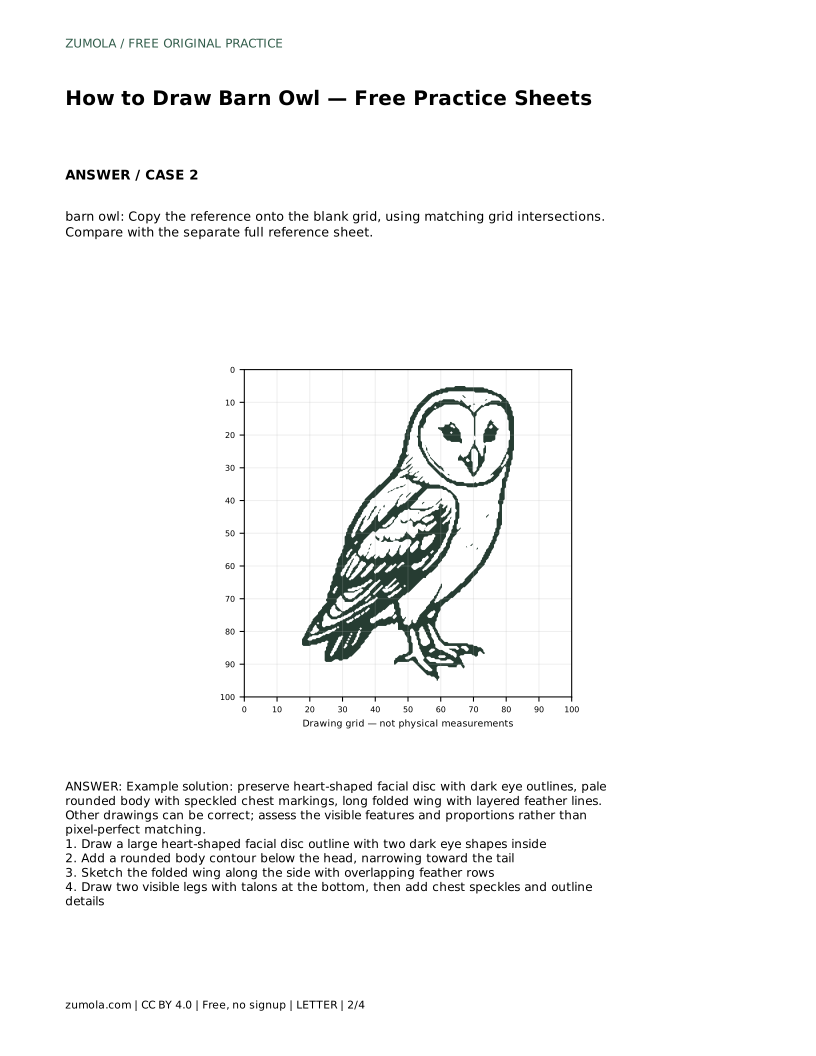
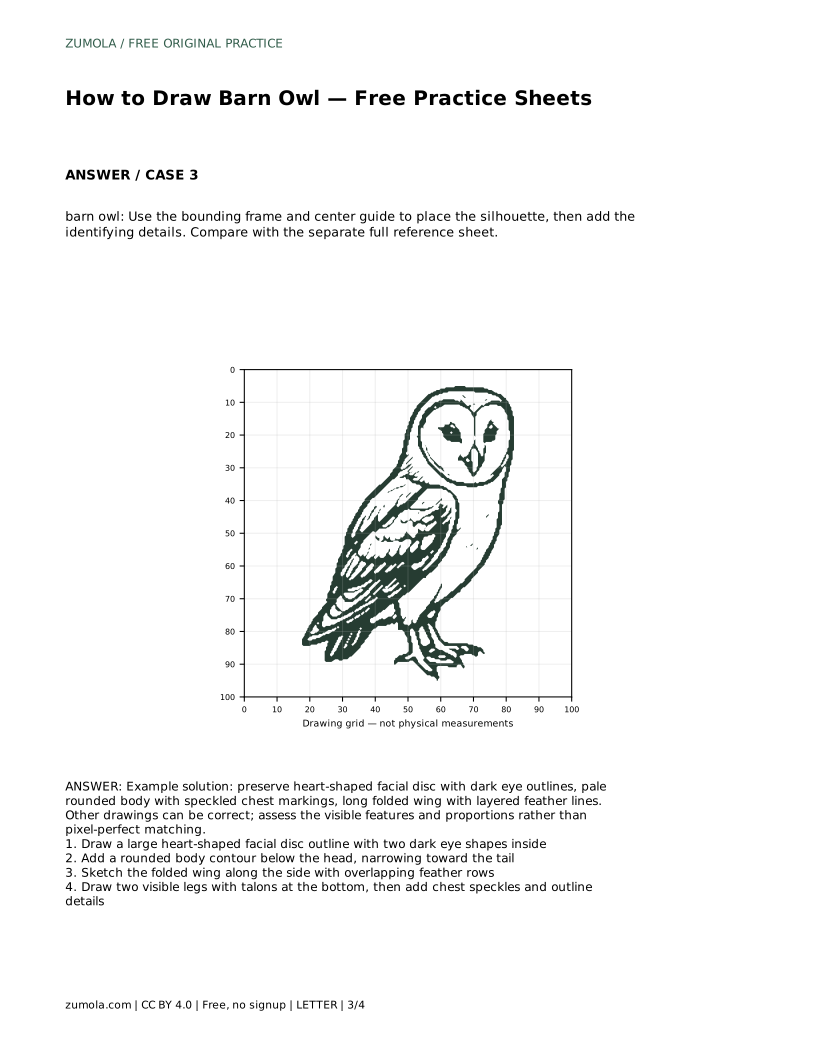
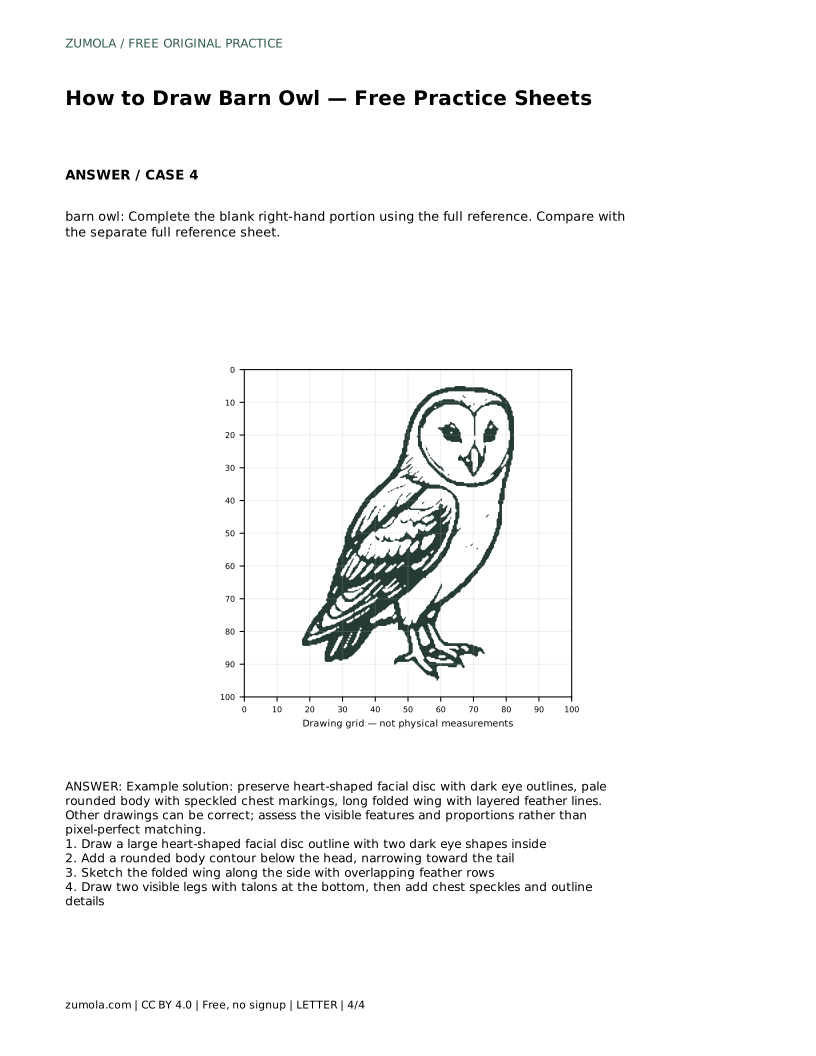
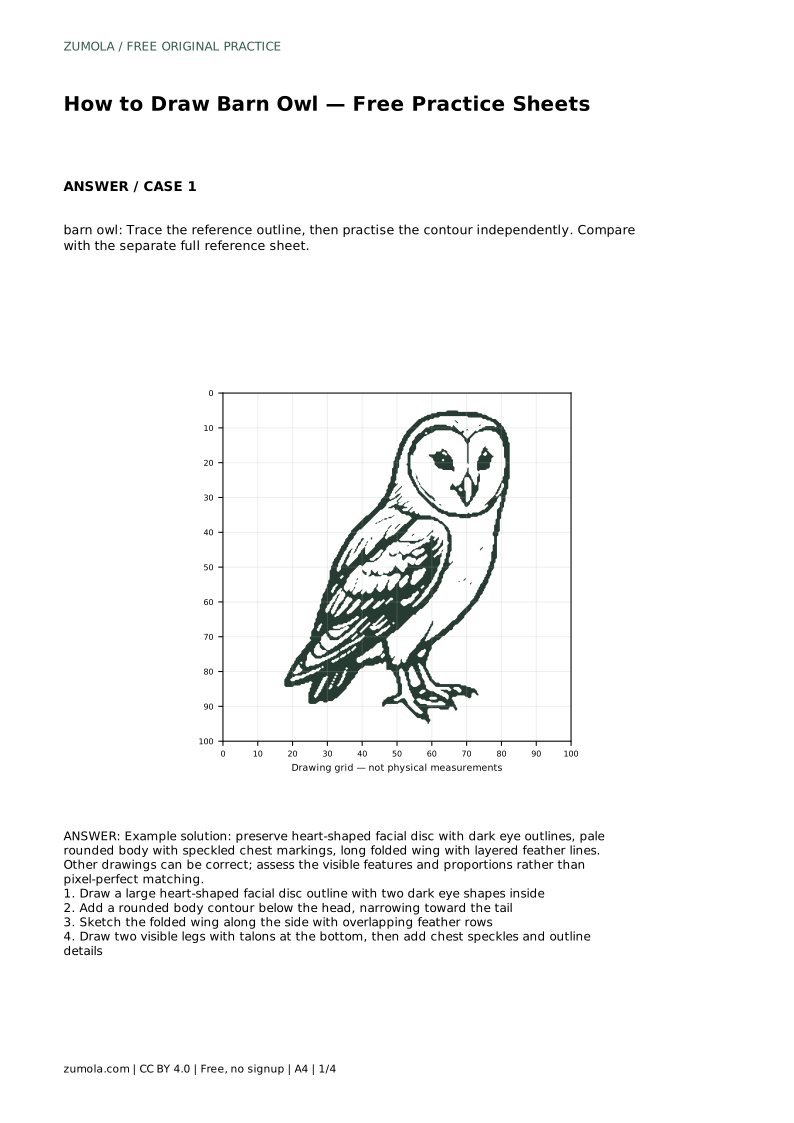
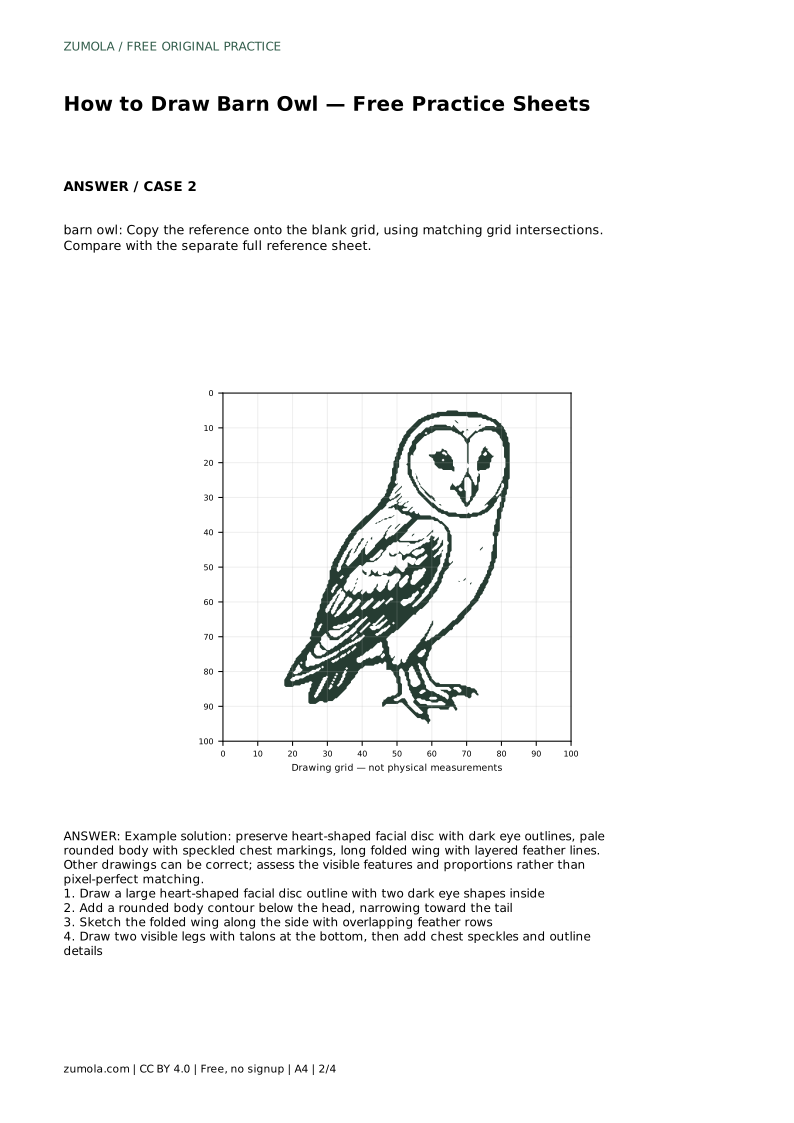
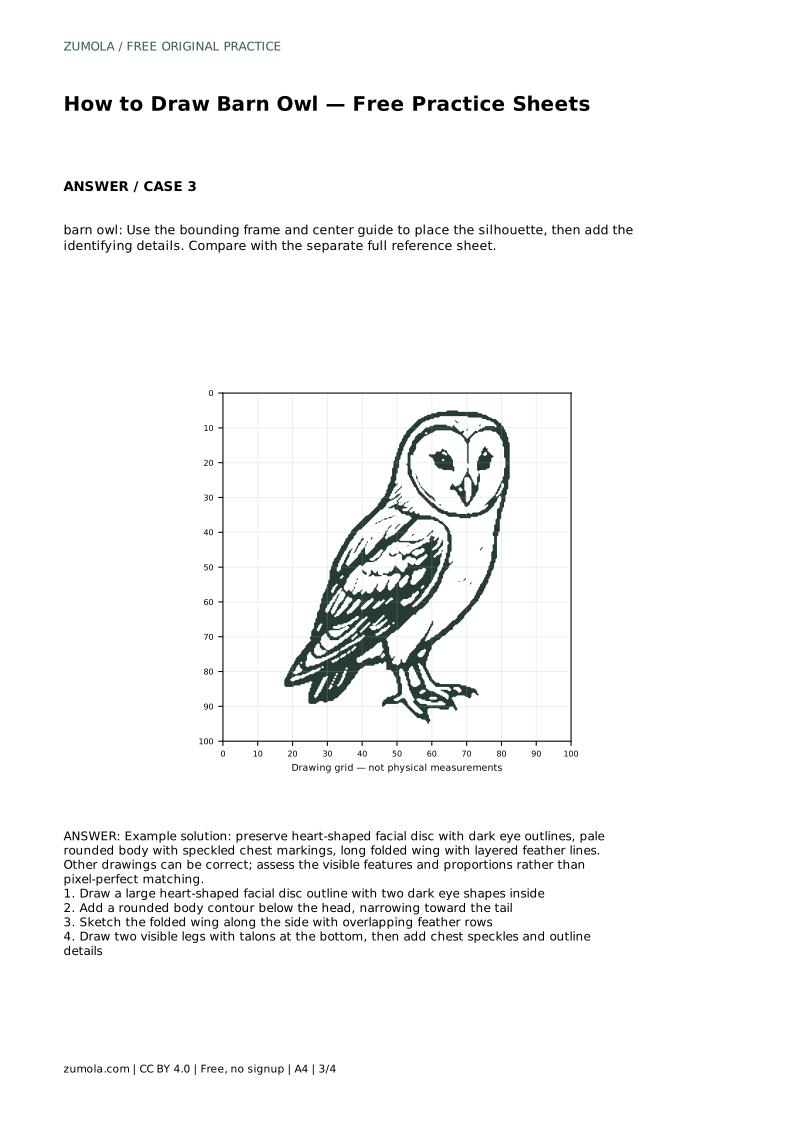
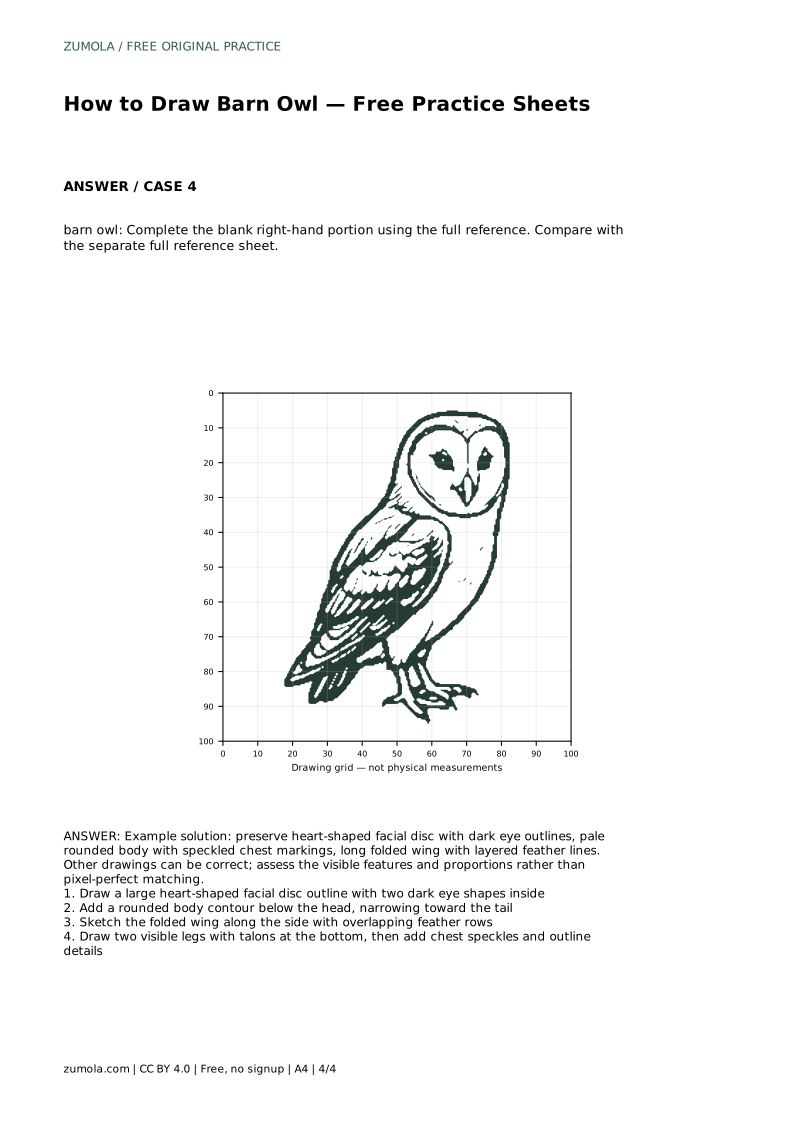
Reference diagrams
LETTER · Download PDF
A4 · Download PDF
Free original resources
Learn to draw a barn owl by building its heart-shaped facial disc, rounded body, folded wing, and speckled chest, then check your work with a feature rubric.
Four original cases, with reference diagrams, practice sheets and worked answers. Everything is free; no signup required.
LETTER · Download PDF
A4 · Download PDF
LETTER · Download PDF
A4 · Download PDF
LETTER · Download PDF
A4 · Download PDF
Use A4 or US Letter to match your printer. Use the stated values and conditions to solve each exercise; diagrams are not physical measuring rulers.
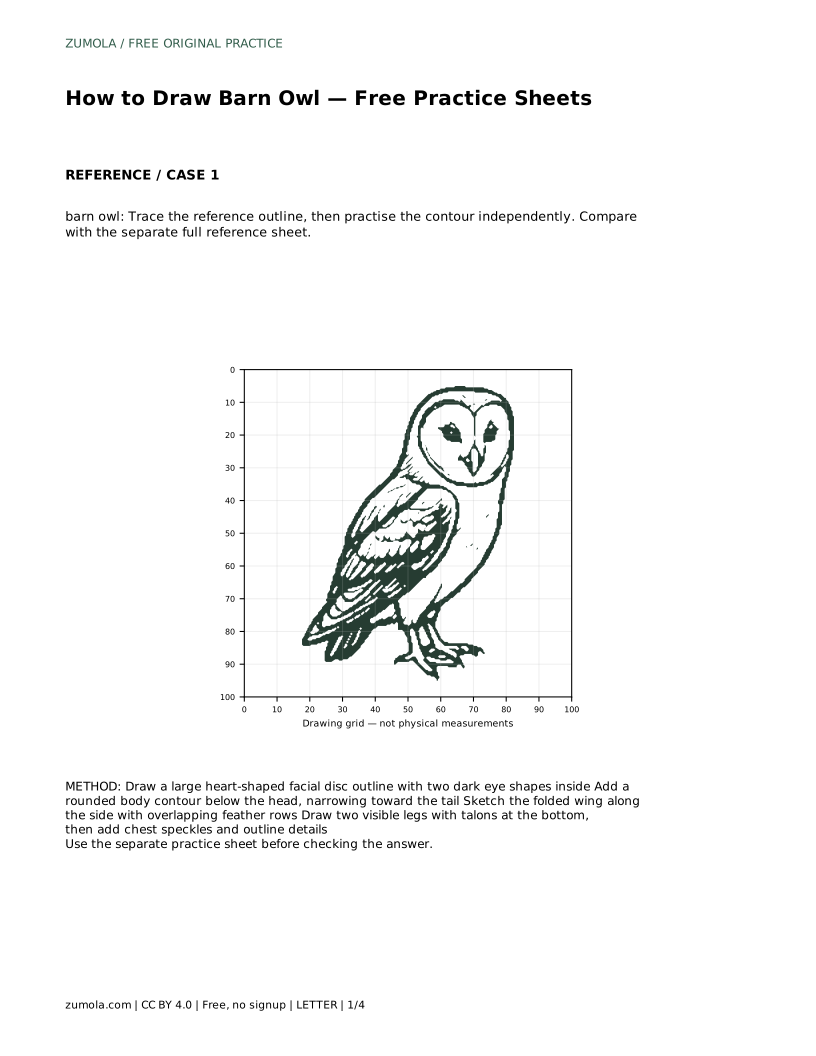
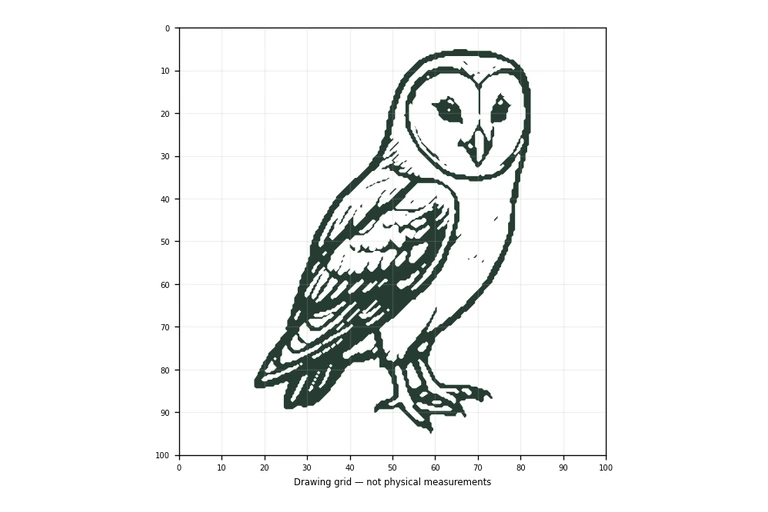
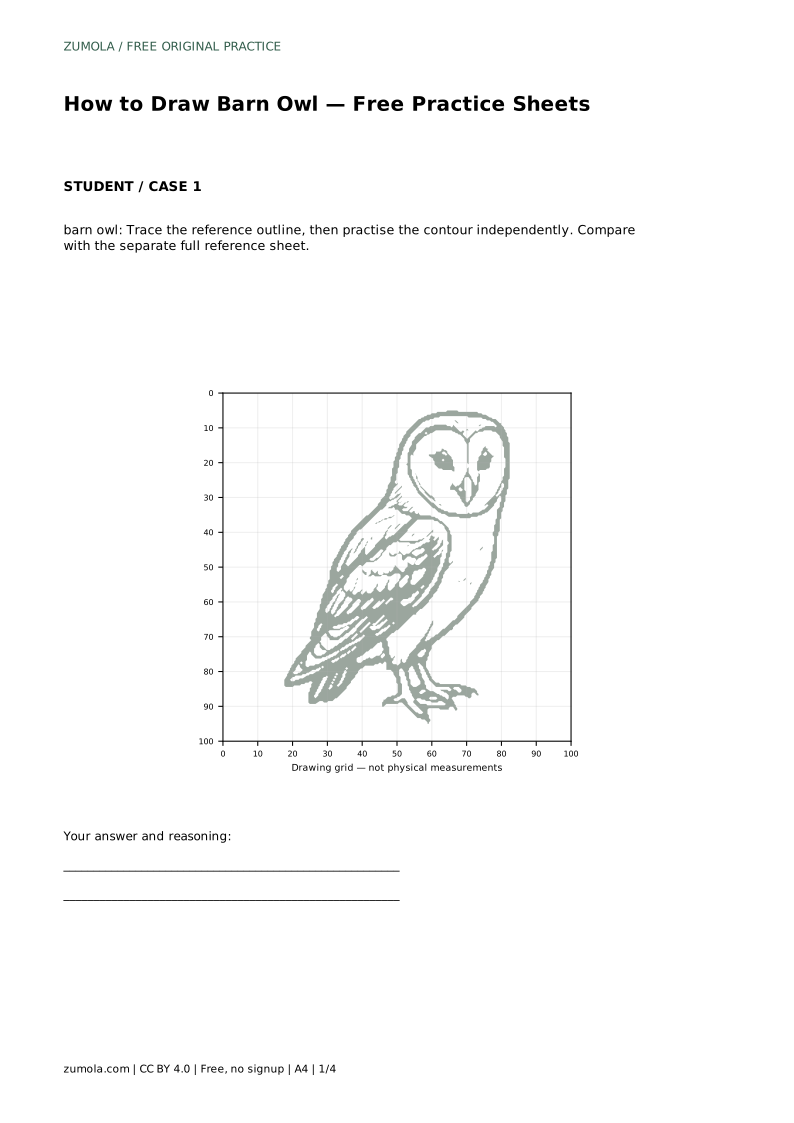
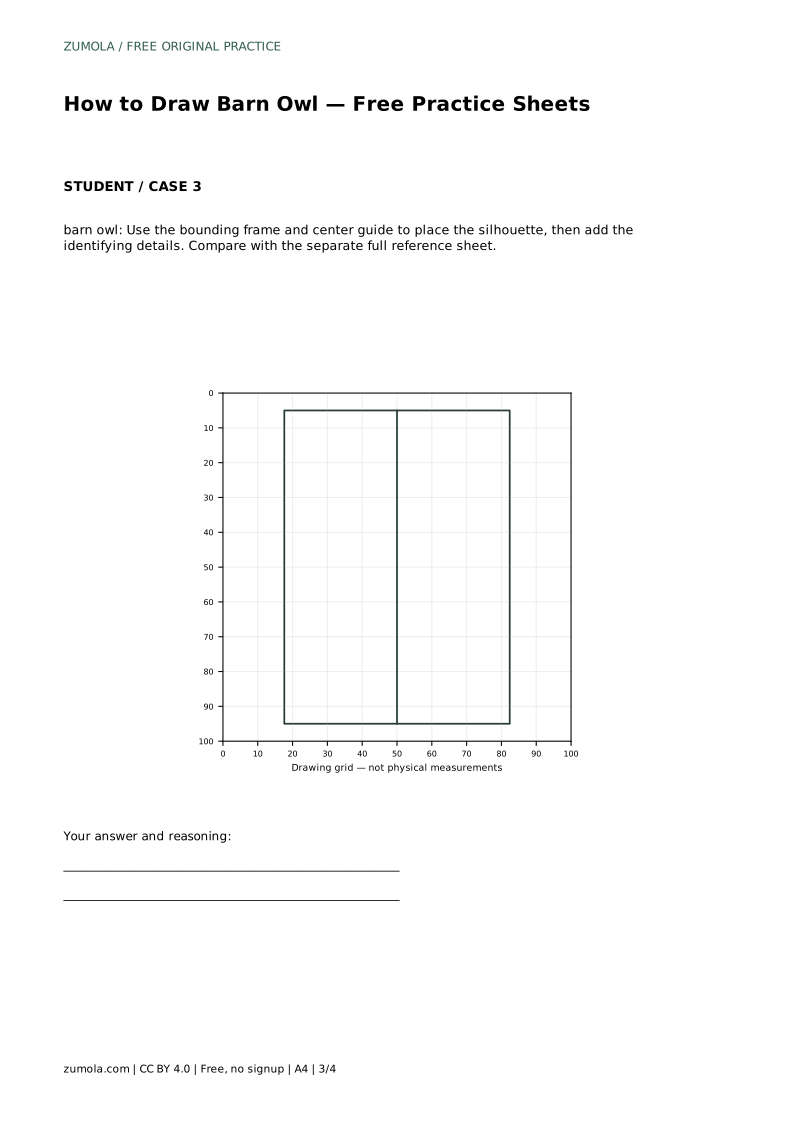
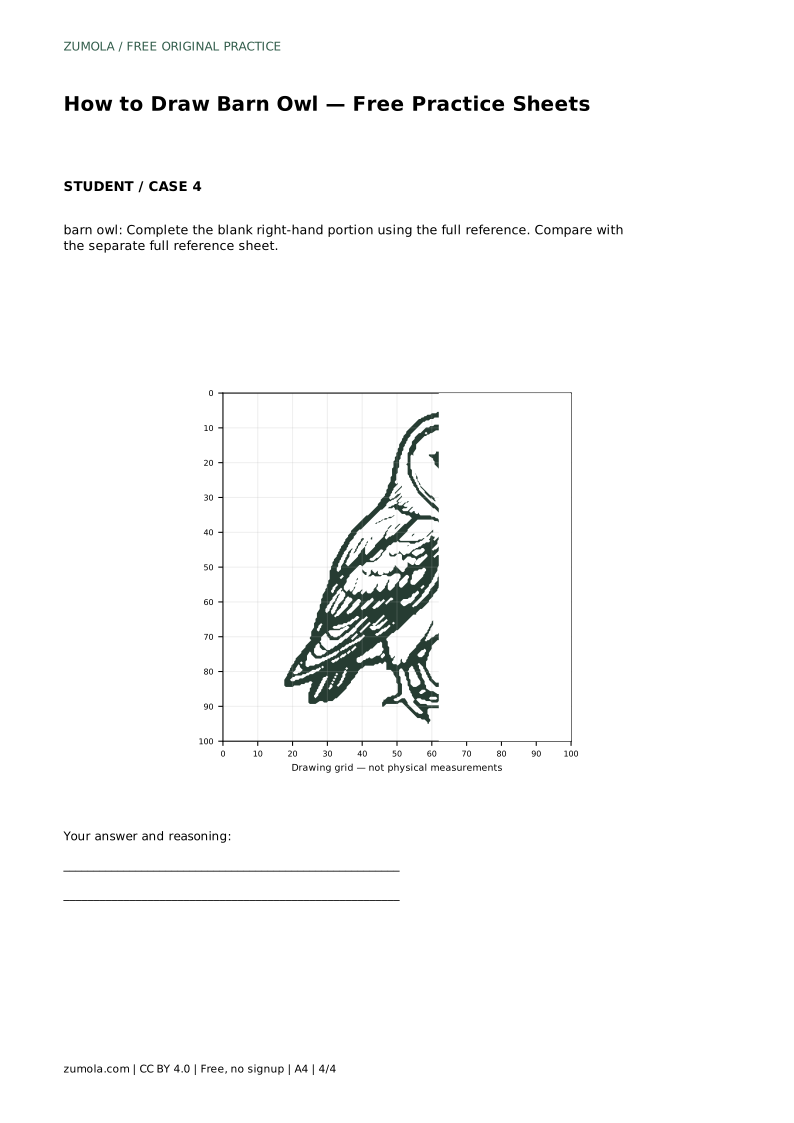
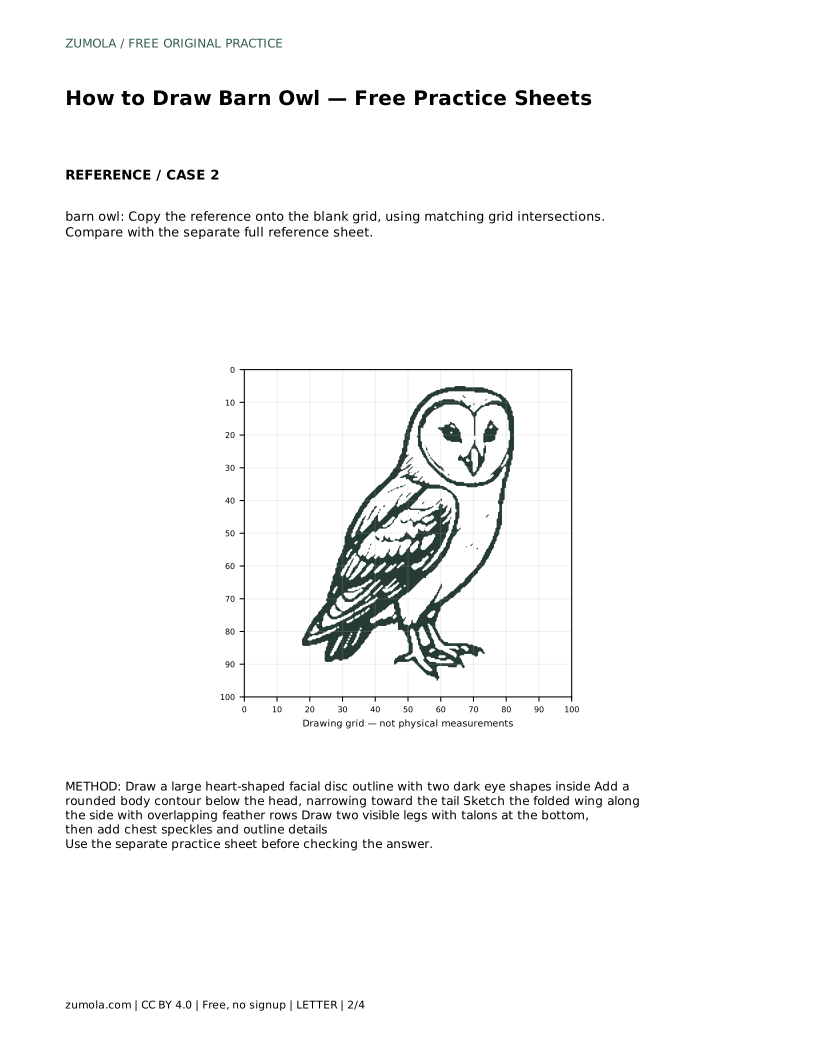
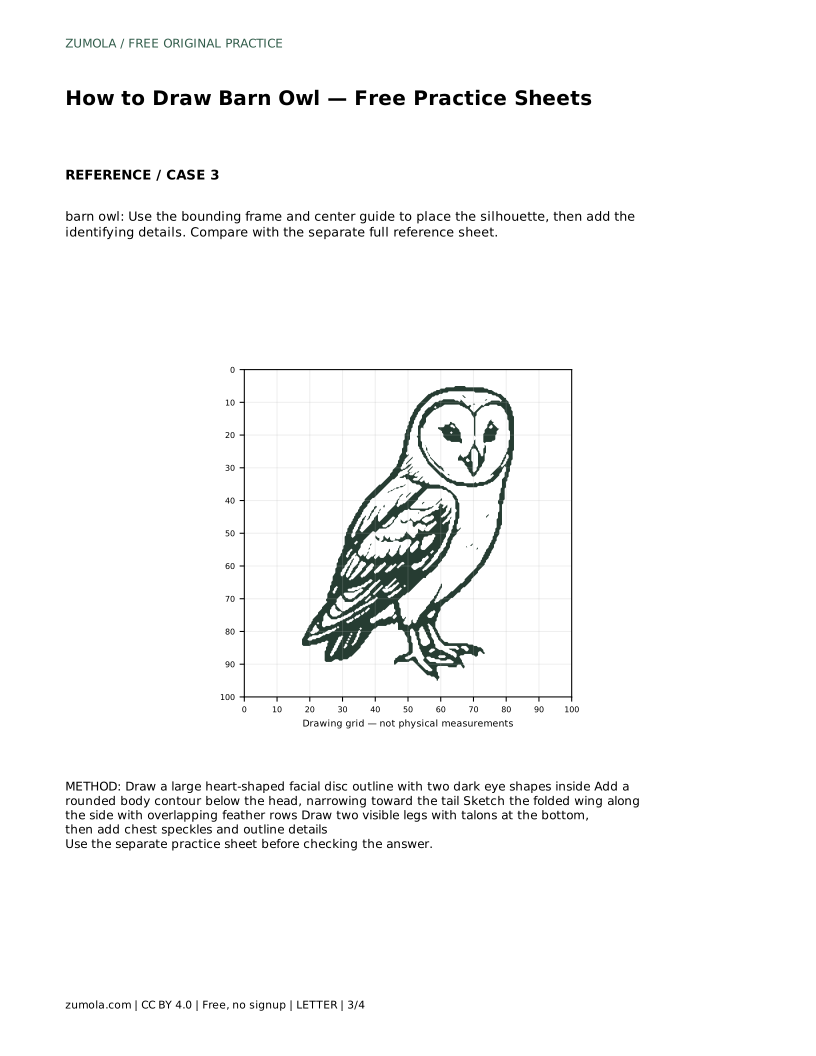
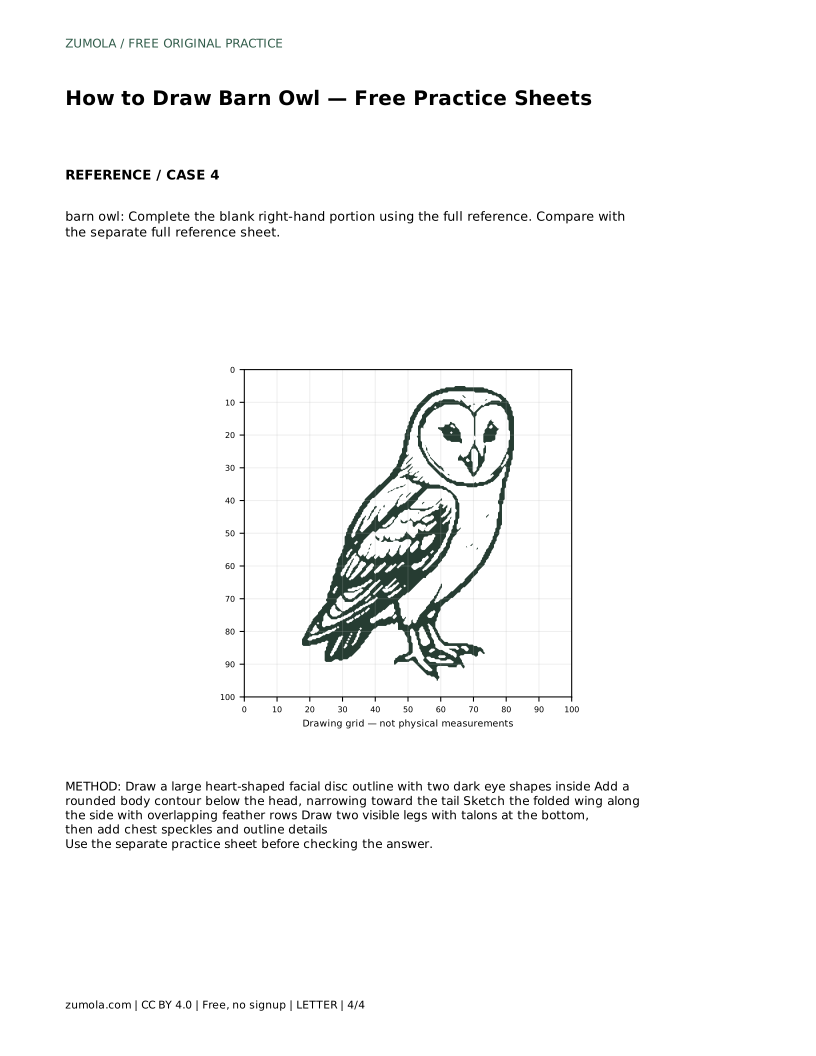
A barn owl drawing is recognizable before any fine detail appears, because its face is a broad heart shape rather than a round disc. This page teaches a practical order: face first, body contour second, folded wing third, then legs and markings. You can trace a reference outline, copy onto a grid, or use a bounding frame and center guide to place the silhouette. Because drawings vary, judge your result by visible features and proportions, not pixel-perfect matching.
The barn owl's most identifying feature is the pale, heart-shaped facial disc. Draw it as one continuous outline: two rounded upper lobes meeting at a shallow dip in the middle, widening at the cheeks, then tapering to a point at the chin. Keep the shape broad rather than tall; a narrow face reads as a different owl.
Place two dark eye shapes inside the disc, set fairly close together and slightly above the vertical middle. Leave pale space around each eye so the dark outlines stand out. Avoid filling the whole disc dark; the contrast between pale face and dark eyes is what makes the bird readable.
Below the head, add a rounded body contour that narrows gradually toward the tail. The body should feel compact and upright, not stretched. Let the chin of the facial disc overlap the chest slightly so the head sits on the body rather than floating above it.
Sketch one long folded wing along the side of the body. Build it from overlapping rows of feather lines rather than a single smooth edge, working from the shoulder down toward the tail. Layer the rows so each one sits slightly over the one below, which gives the wing depth without heavy shading.
Draw two visible legs at the bottom of the body, ending in talons. Keep the legs short and the talons simple curved shapes; the feet should look like they support the body rather than dangle. If your reference shows the owl perched, let the talons grip a simple line.
Finish with chest speckles and outline details. Scatter small marks across the pale chest, denser near the center and sparser toward the edges. Then strengthen the main outlines: facial disc, eyes, body edge, wing rows, and legs. Check that the heart-shaped face still reads clearly at a glance.
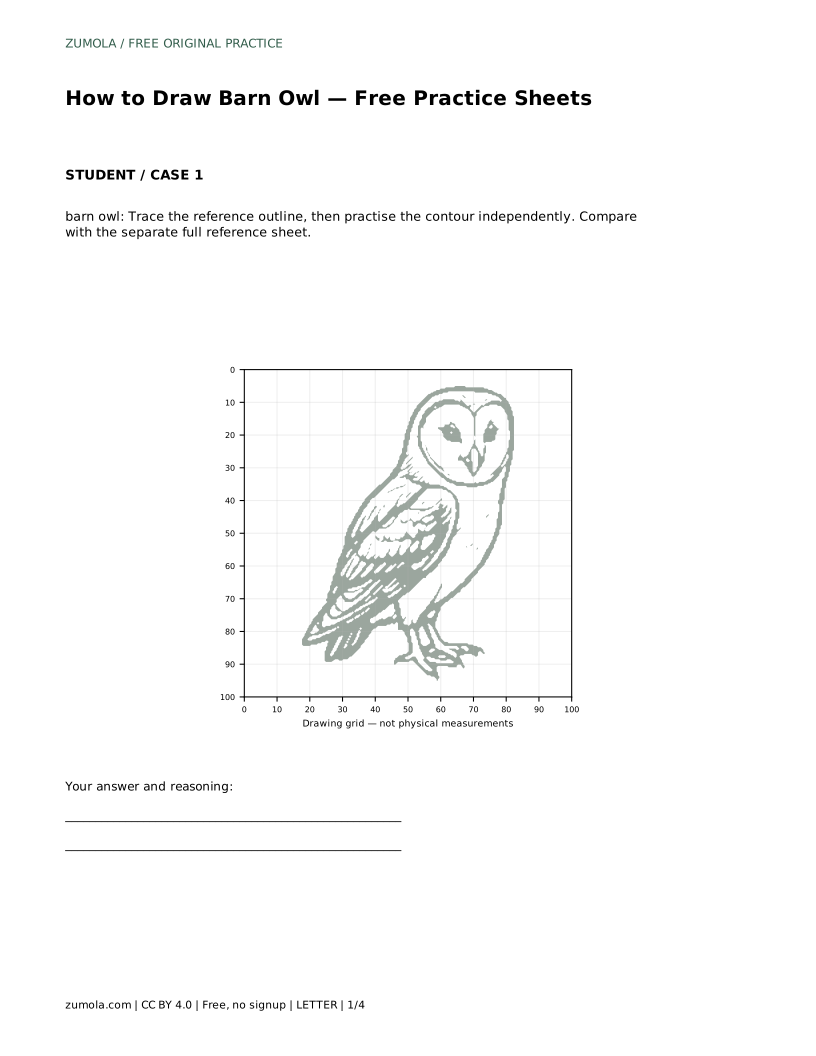
barn owl: Trace the reference outline, then practise the contour independently. Compare with the separate full reference sheet.
Example solution: preserve heart-shaped facial disc with dark eye outlines, pale rounded body with speckled chest markings, long folded wing with layered feather lines. Other drawings can be correct; assess the visible features and proportions rather than pixel-perfect matching. Draw a large heart-shaped facial disc outline with two dark eye shapes inside Add a rounded body contour below the head, narrowing toward the tail Sketch the folded wing along the side with overlapping feather rows Draw two visible legs with talons at the bottom, then add chest speckles and outline details
No. Several drawings can be correct. Assess visible features and proportions, such as the heart-shaped disc, dark eye outlines, rounded pale body, speckled chest, and layered folded wing, rather than pixel-perfect matching.
Draw the heart-shaped facial disc and eyes first, then the rounded body, then the folded wing with layered feather rows, and finally the legs, talons, chest speckles, and outline details.
Use overlapping rows of feather lines along the wing instead of a single smooth edge, layering each row slightly over the one beneath it.
All drawing practice · Free coordinate paper
Original resources · CC BY 4.0 · Free for personal and classroom use with attribution.