Reference diagrams
LETTER · Download PDF
A4 · Download PDF
Free original resources
Learn to classify functions as even, odd, or neither using f(-x) tests, and connect each result to y-axis or origin symmetry on a graph.
Four original cases, with reference diagrams, practice sheets and worked answers. Everything is free; no signup required.
LETTER · Download PDF
A4 · Download PDF
LETTER · Download PDF
A4 · Download PDF
LETTER · Download PDF
A4 · Download PDF
Use A4 or US Letter to match your printer. Graph coordinates determine the answers; these worksheets are not physical measuring rulers.

Even and odd functions are classified by what happens when you replace x with -x. An even function satisfies f(-x) = f(x) for every x in its domain, and its graph mirrors across the y-axis. An odd function satisfies f(-x) = -f(x), and its graph maps onto itself when rotated 180 degrees about the origin. A function that meets neither condition is neither. This page shows the algebraic test, the matching symmetry, and how to avoid common sign errors.
Start with the function rule and substitute -x wherever x appears. Simplify carefully, especially with powers and negative signs inside parentheses. Compare the simplified result with the original f(x) and with -f(x). If f(-x) equals f(x) exactly, the function is even. If f(-x) equals -f(x) exactly, the function is odd. If it matches neither, the function is neither. The test must hold for every x in the domain, not just one or two sample values. A single counterexample is enough to rule out even or odd status.
Domain matters. The test assumes that if x is in the domain, then -x is also in the domain. Functions with restricted domains, such as a square root defined only for nonnegative inputs, usually fail this requirement and are neither even nor odd on that domain. State the domain before classifying so the conclusion is honest.
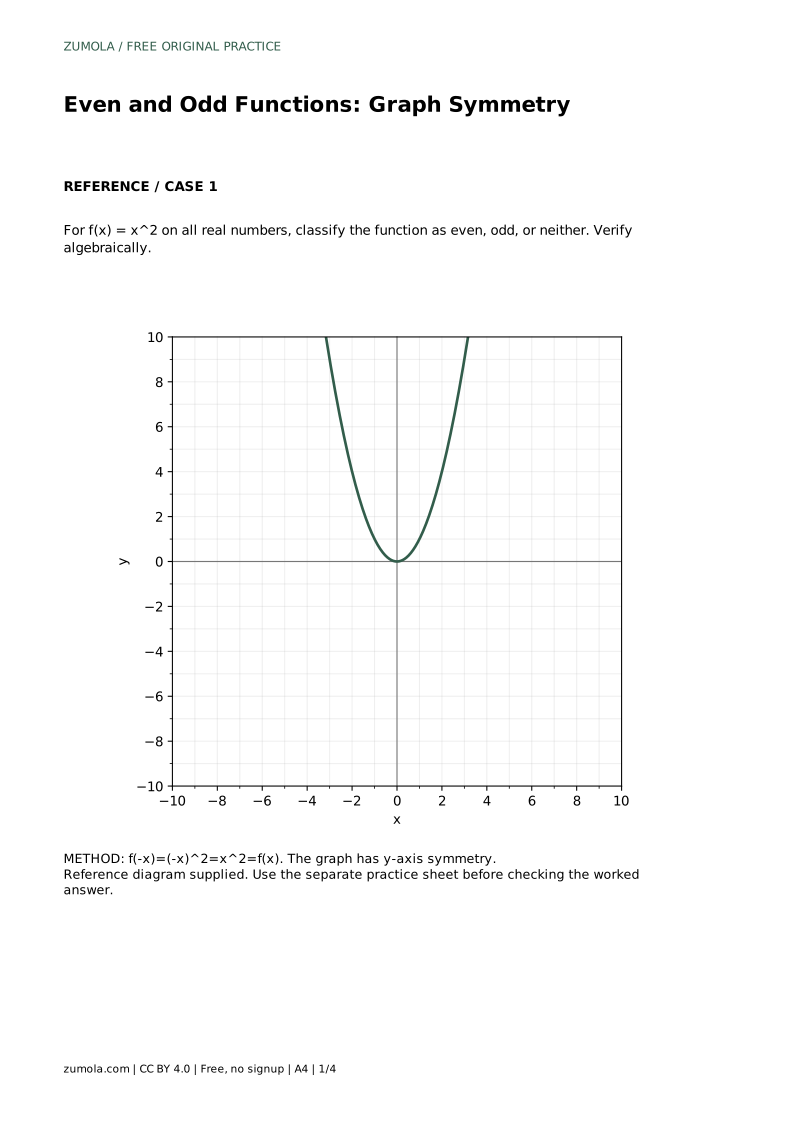
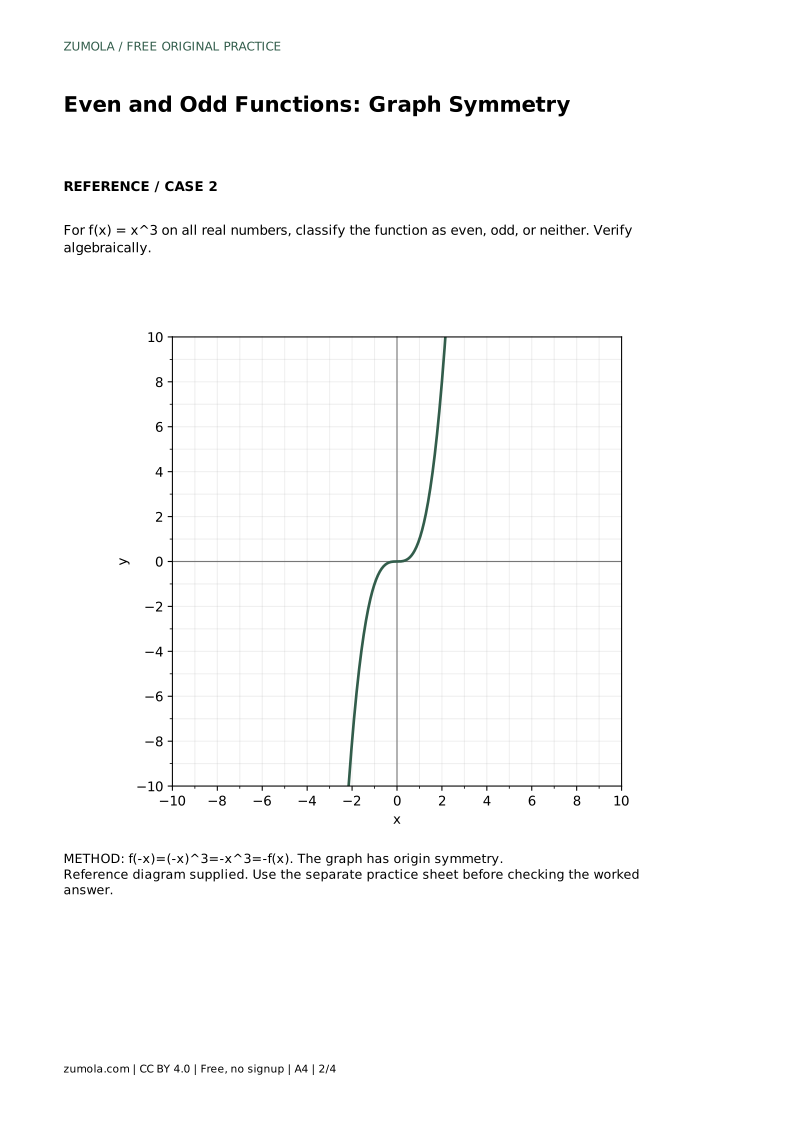
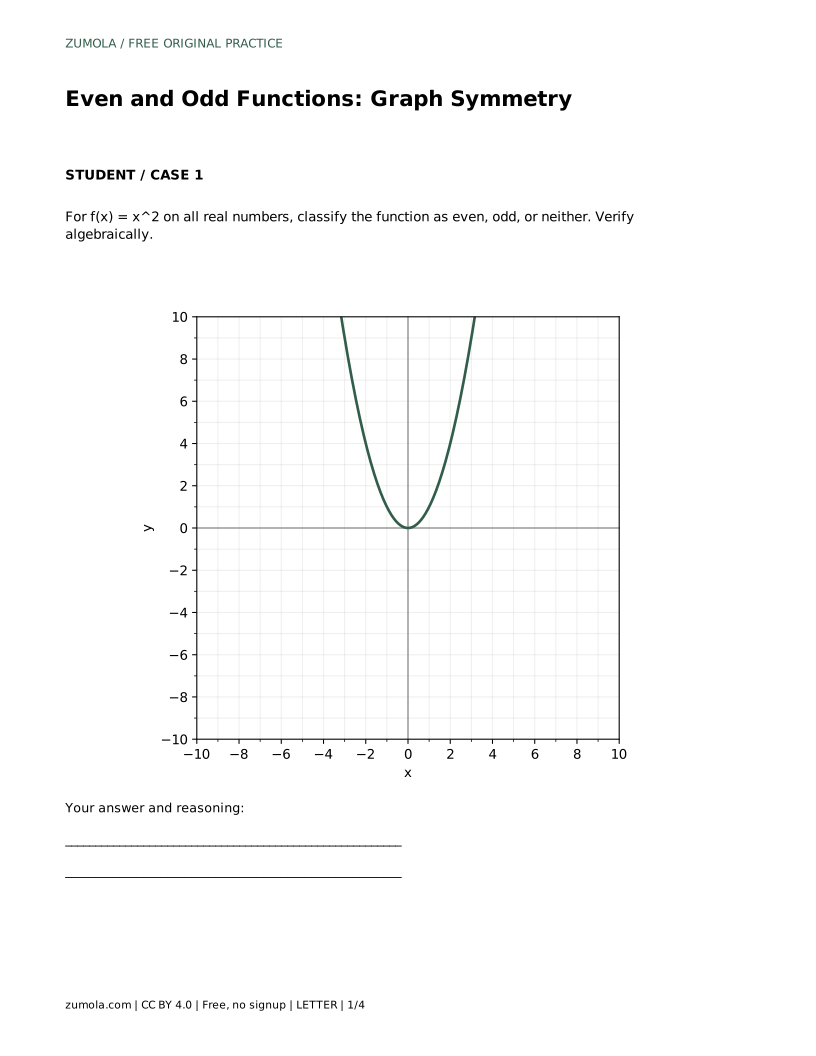
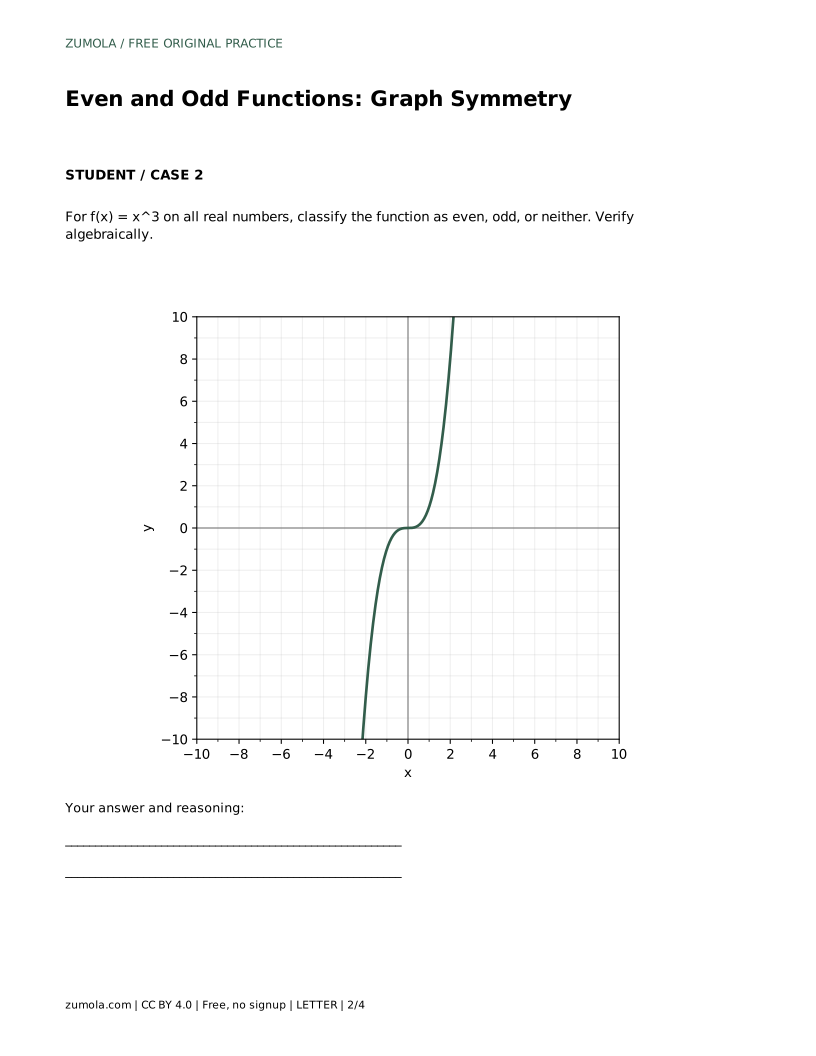
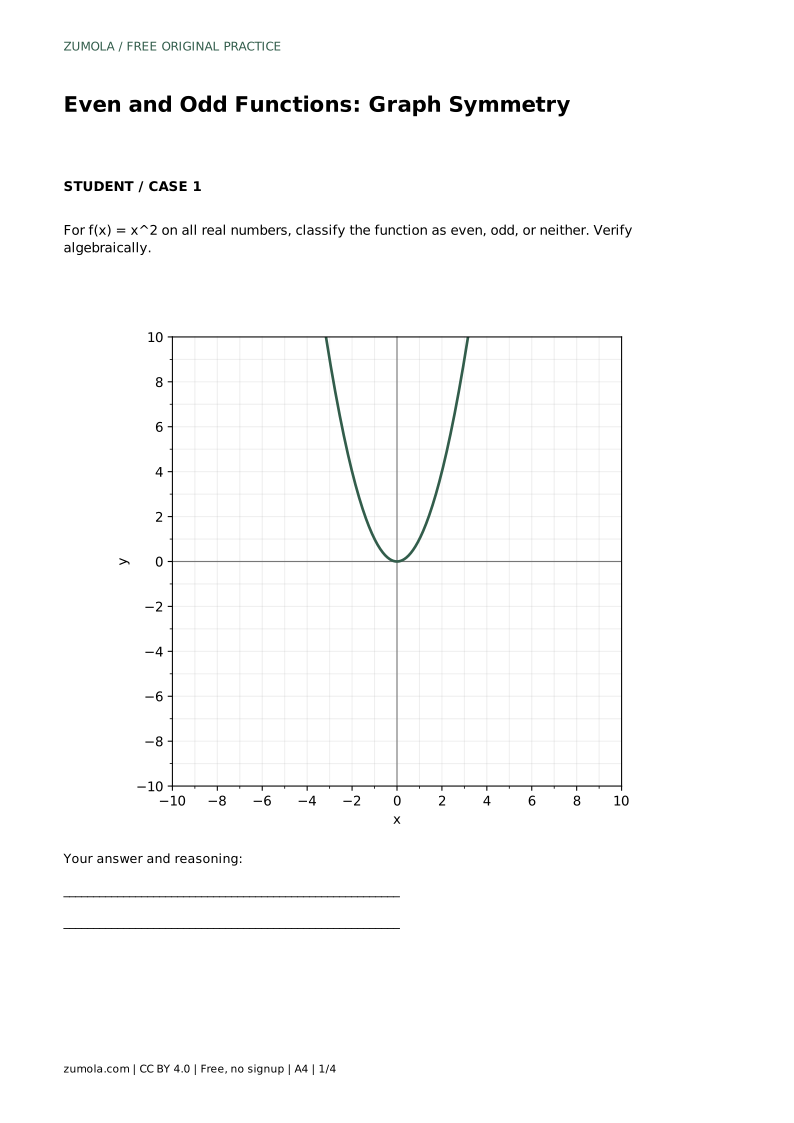
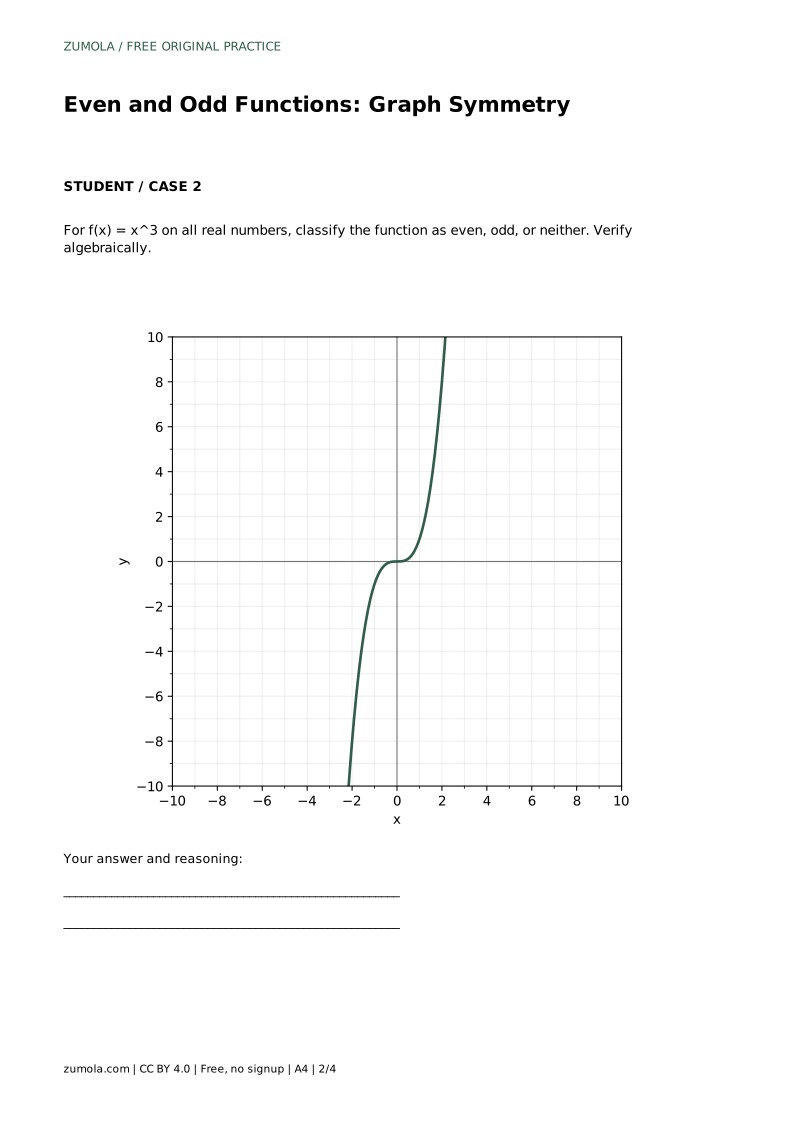
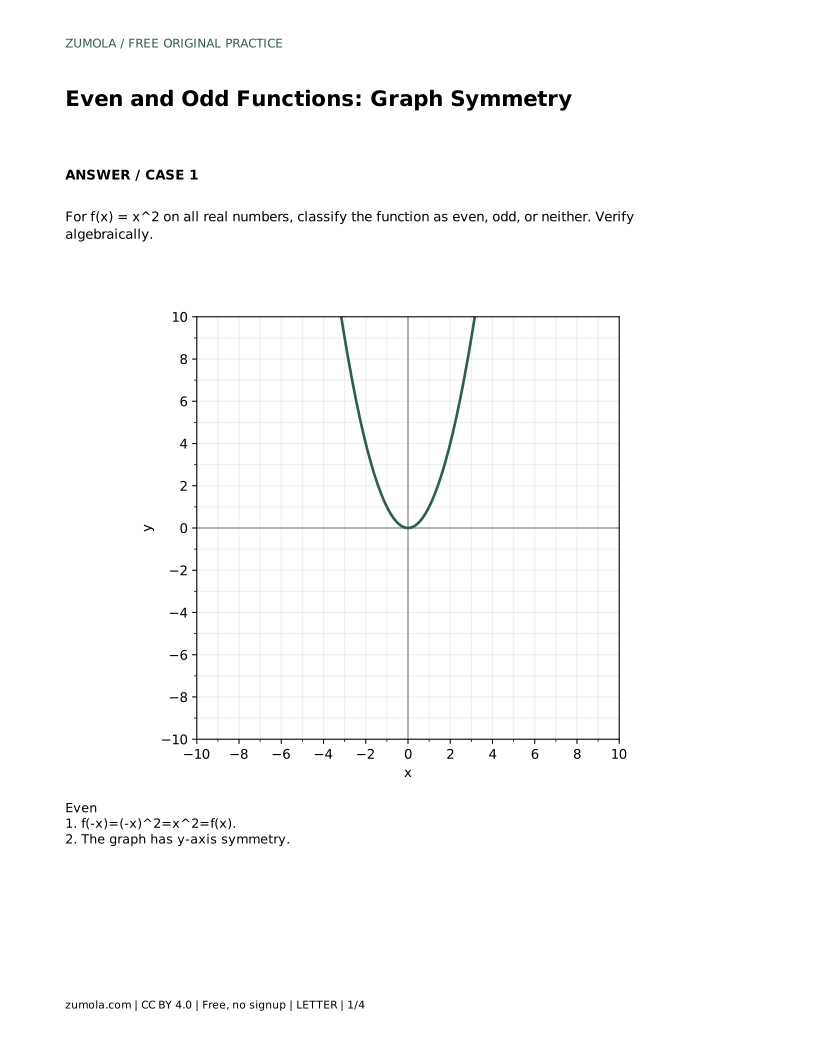
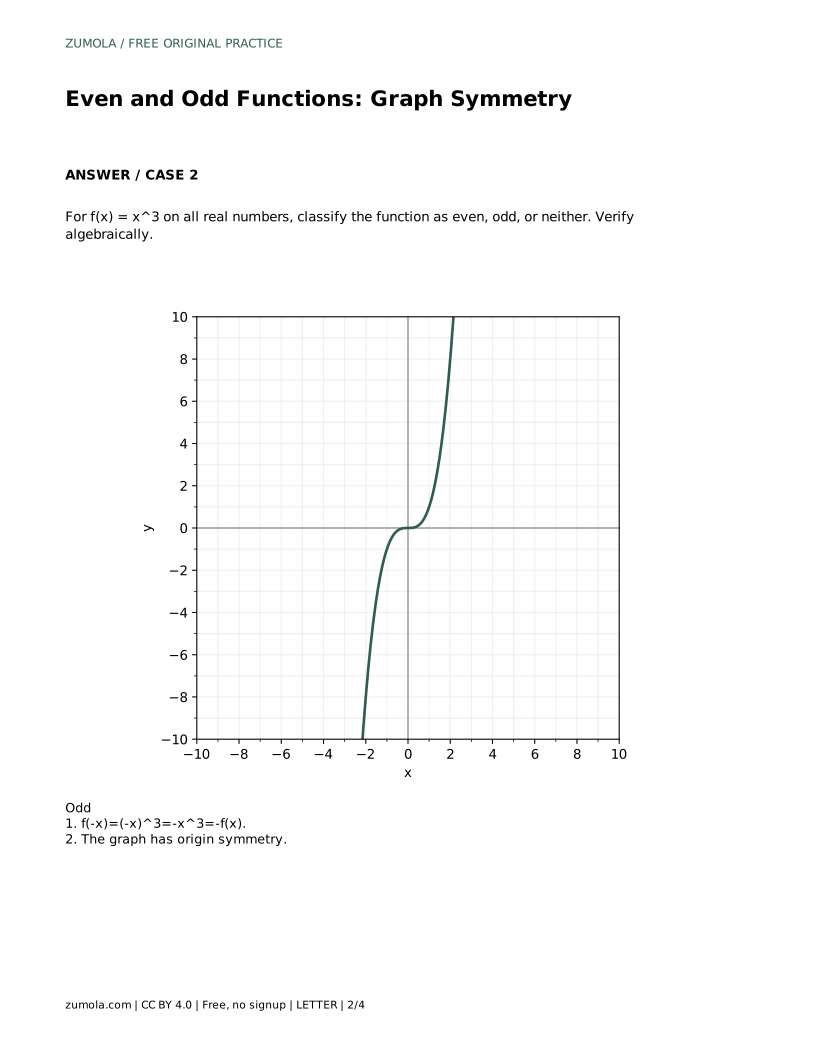
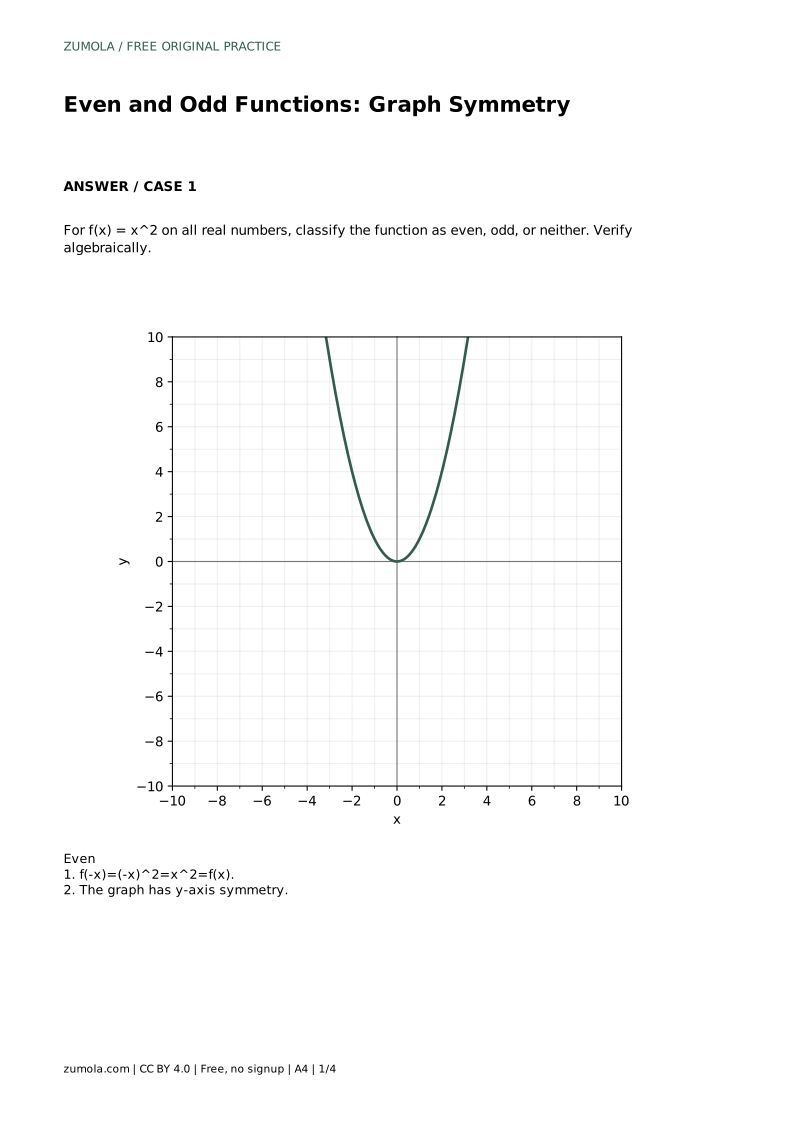
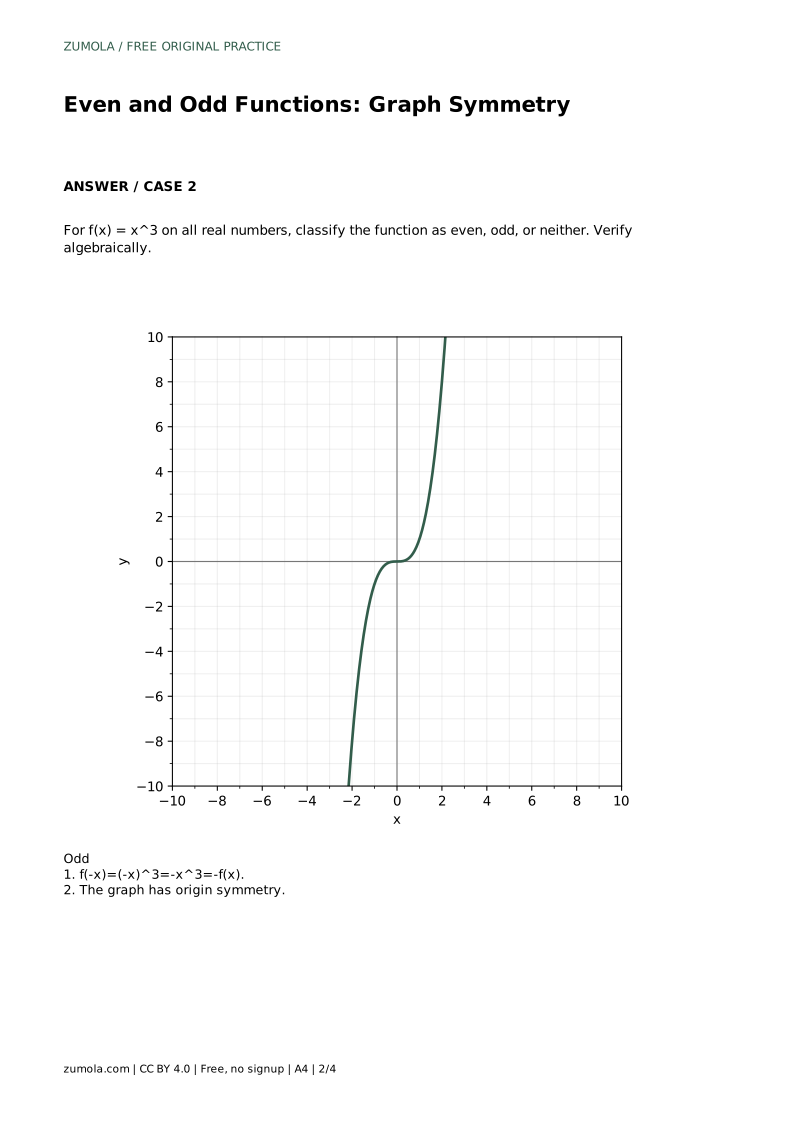
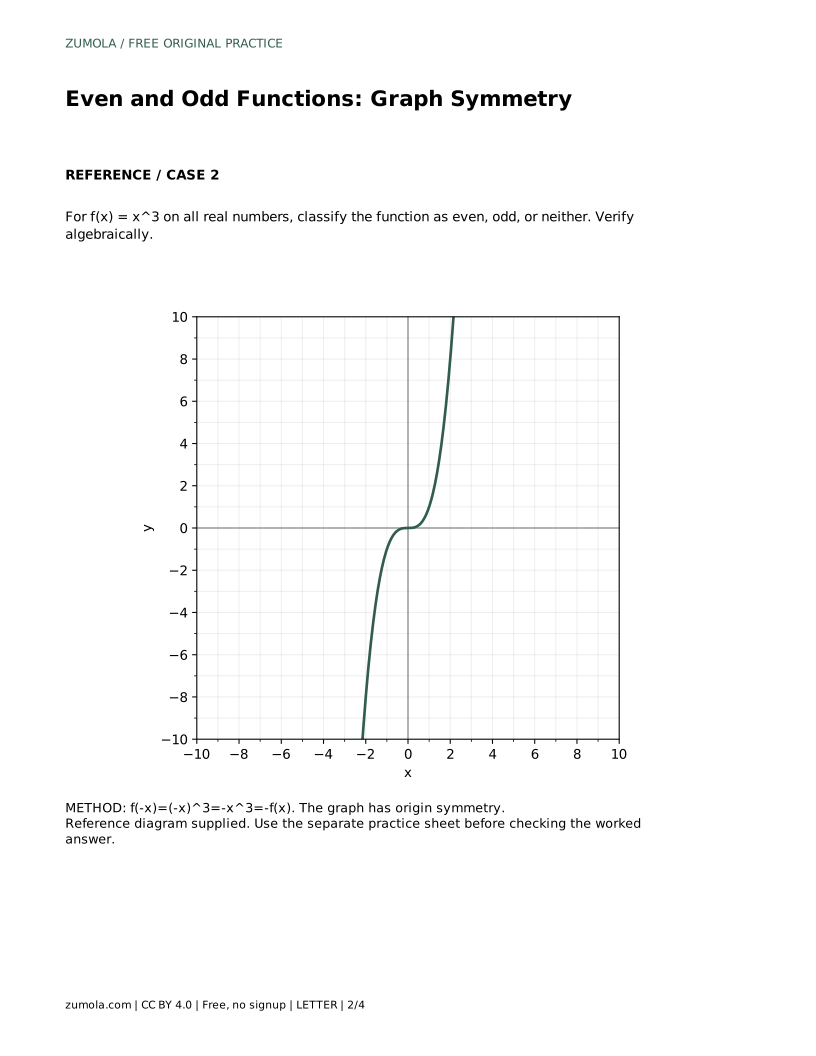
Even functions have y-axis symmetry: the left half is a mirror image of the right half. If the point (a, b) is on the graph, then (-a, b) is also on the graph. The parabola y = x^2 is the standard picture. Odd functions have origin symmetry: rotating the graph 180 degrees about the origin leaves it unchanged. If (a, b) is on the graph, then (-a, -b) is also on the graph. The curve y = x^3 shows this pattern.
A graph can look roughly symmetric by eye yet fail the algebraic test, so use the algebra as the deciding evidence. Conversely, the algebra tells you which symmetry to expect, which helps you check a sketch. Neither classification says anything about whether the function is increasing, positive, or continuous; it describes only this reflection or rotation behavior.
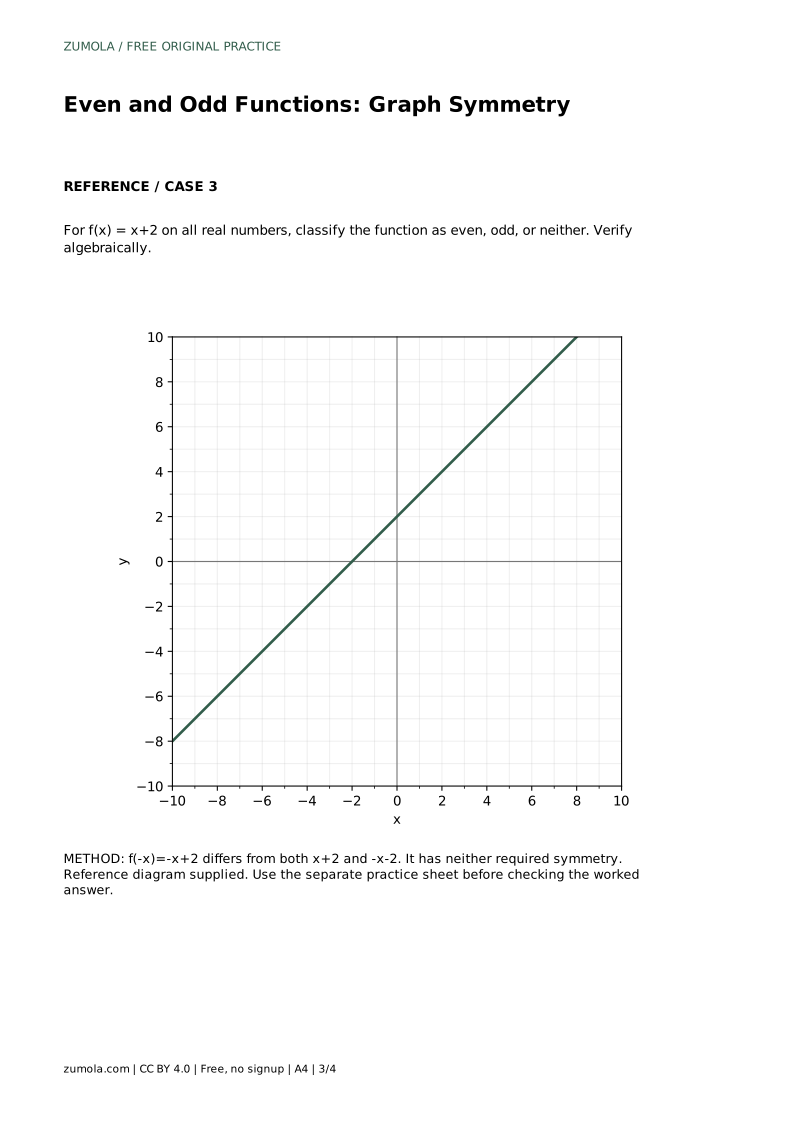
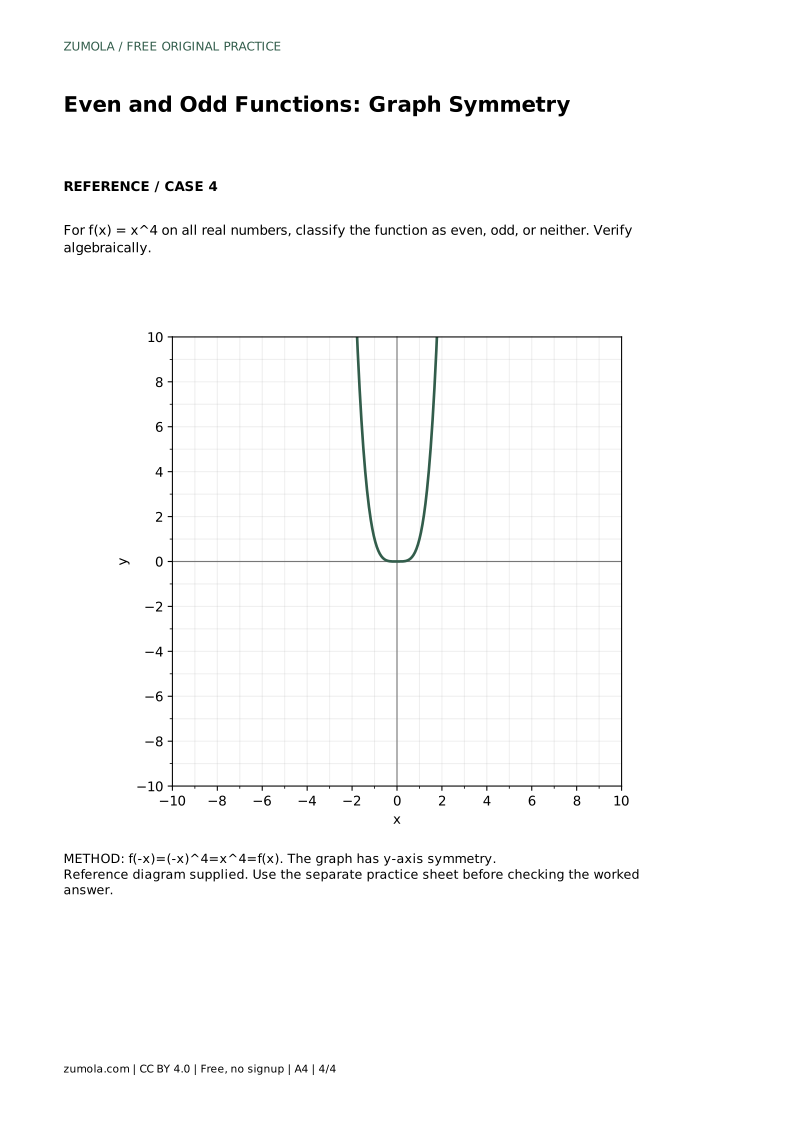
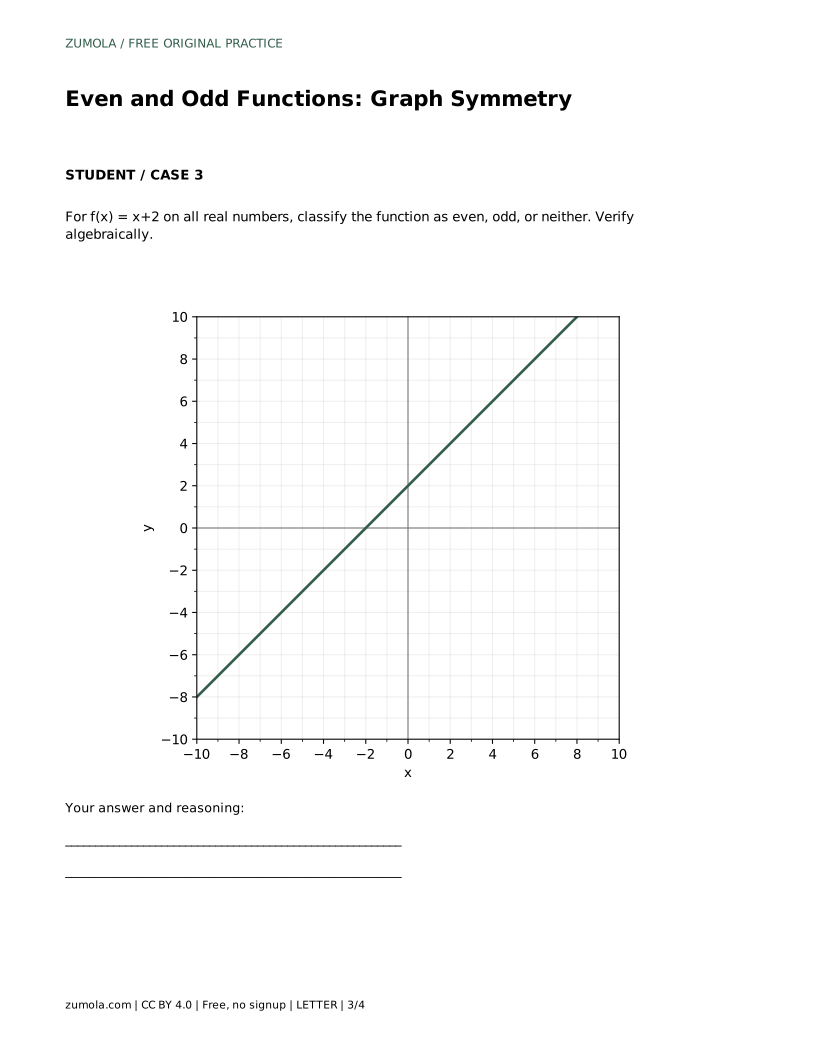
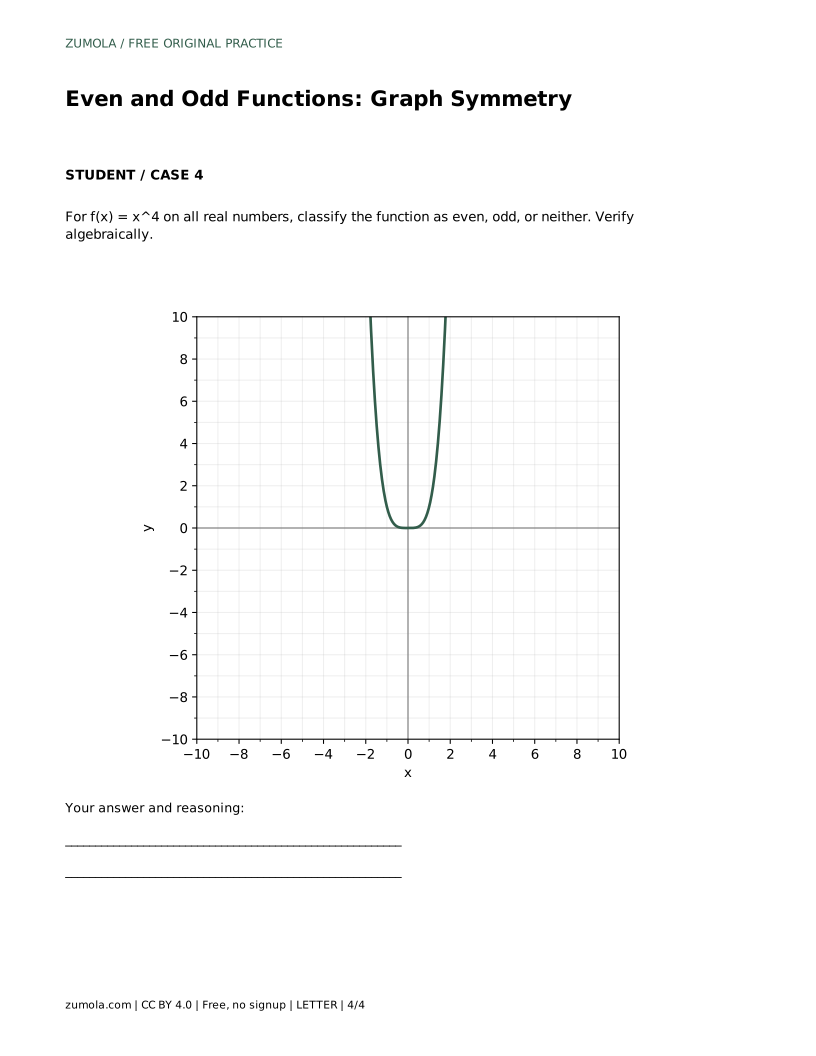
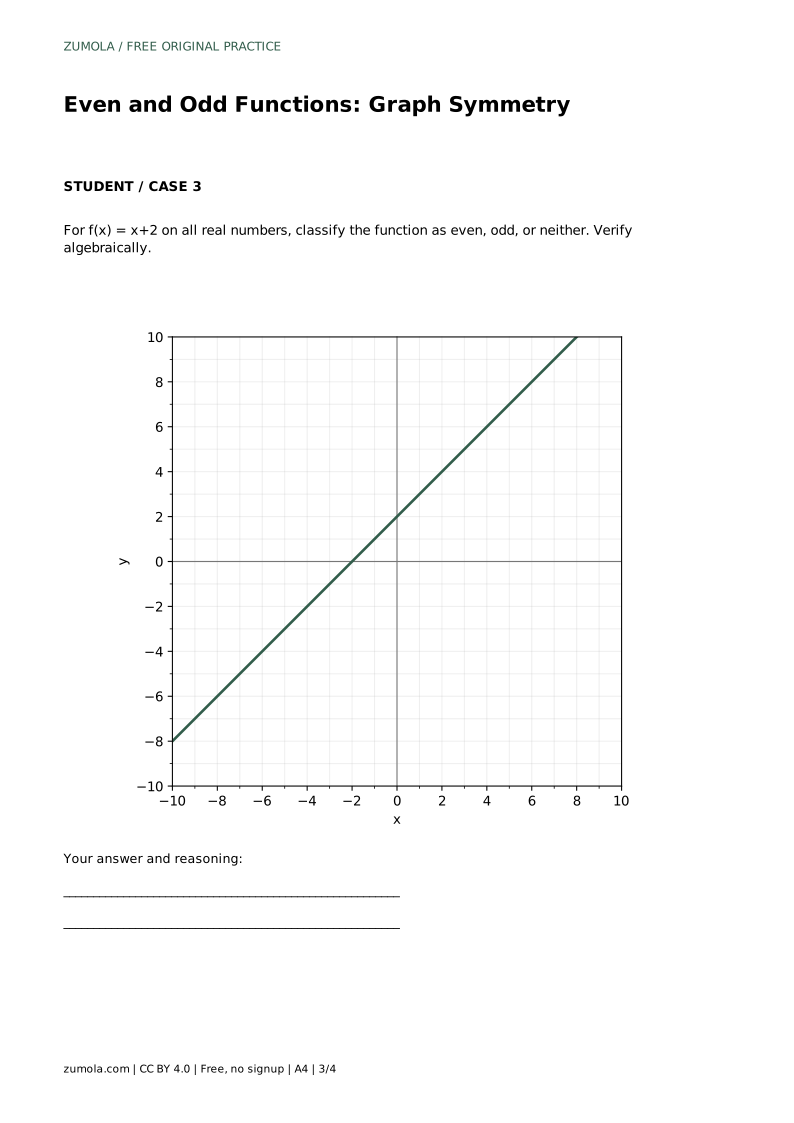
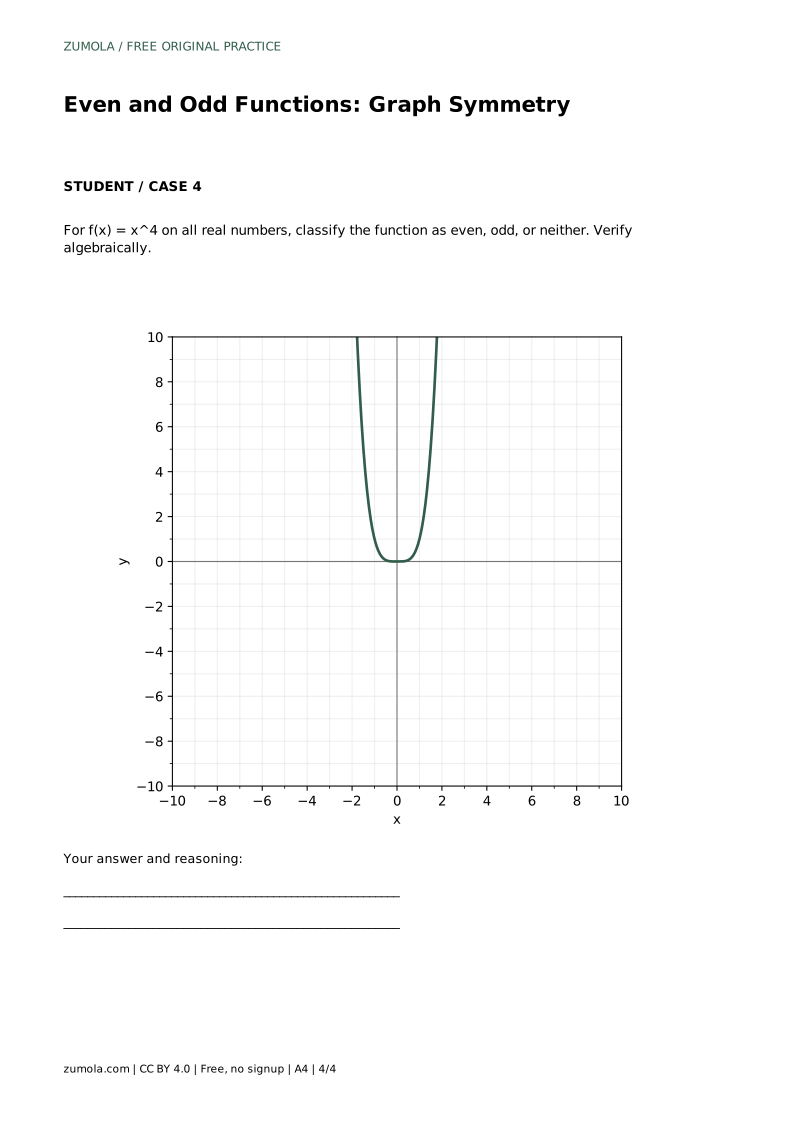
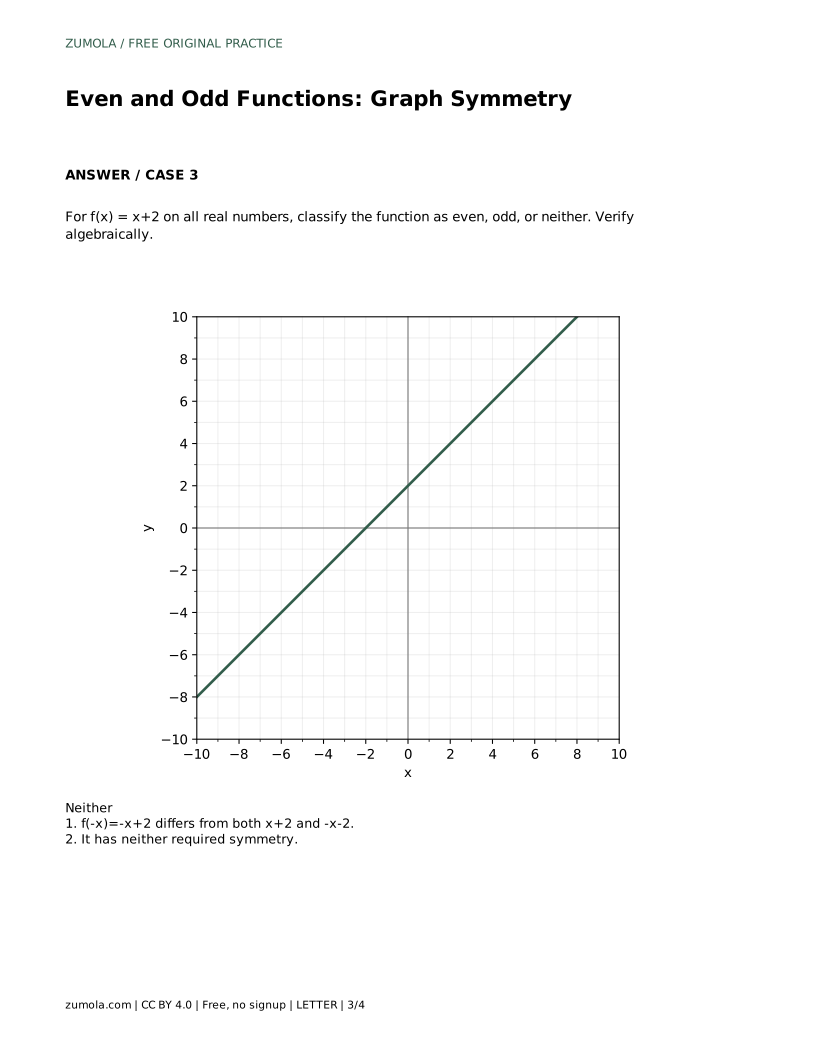
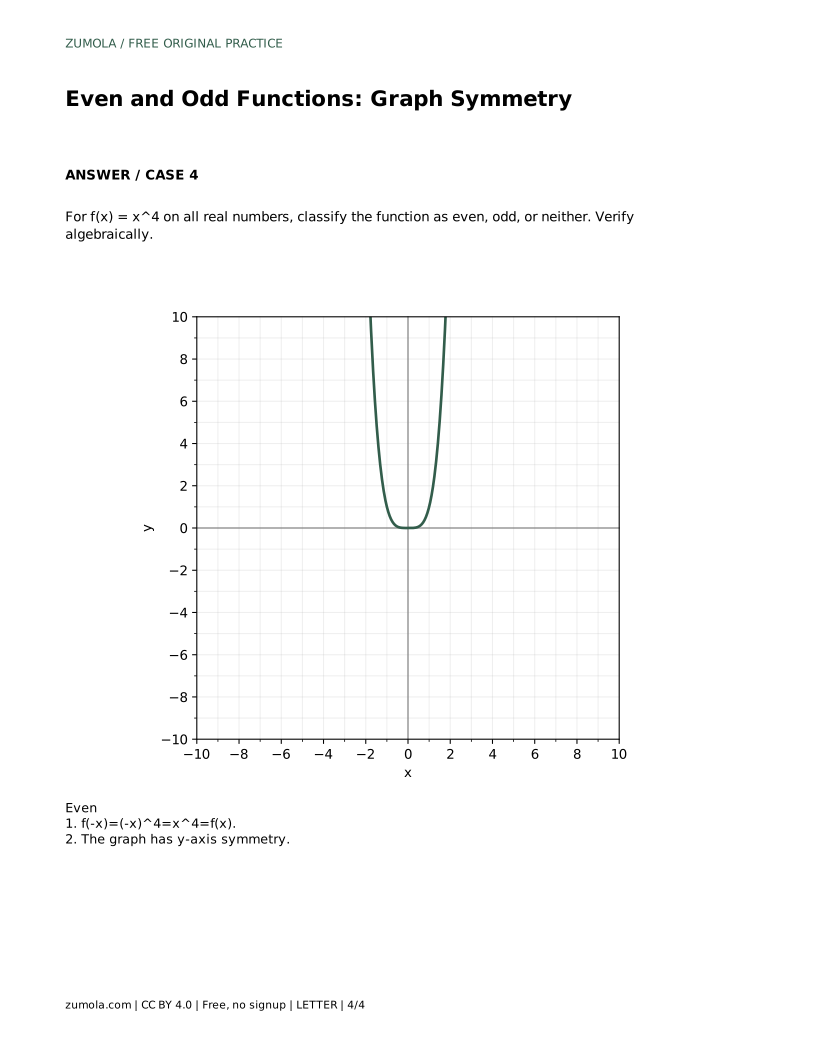
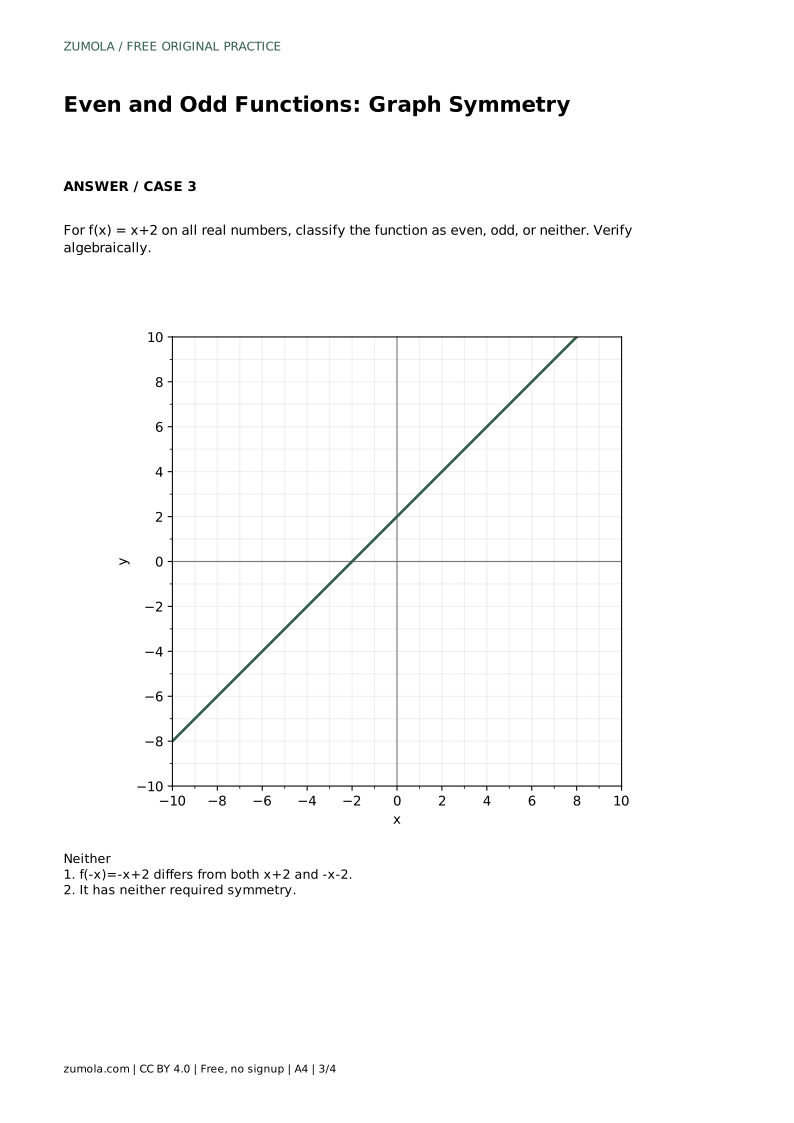
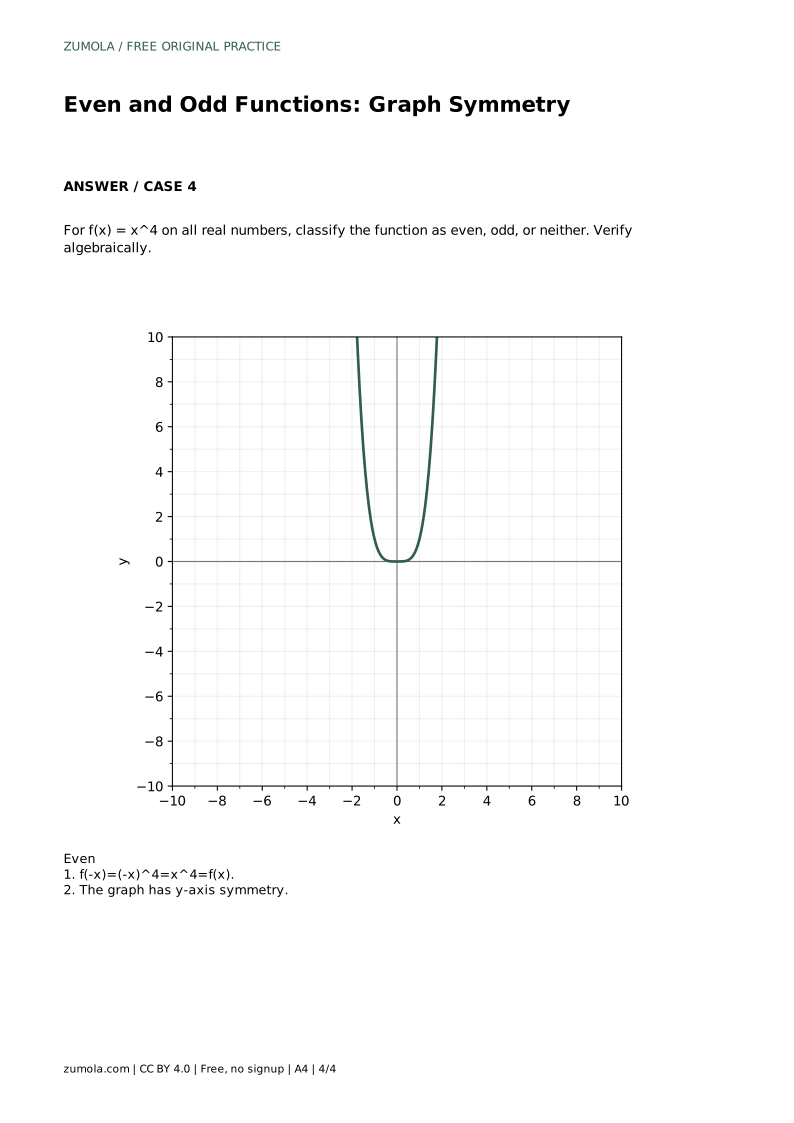
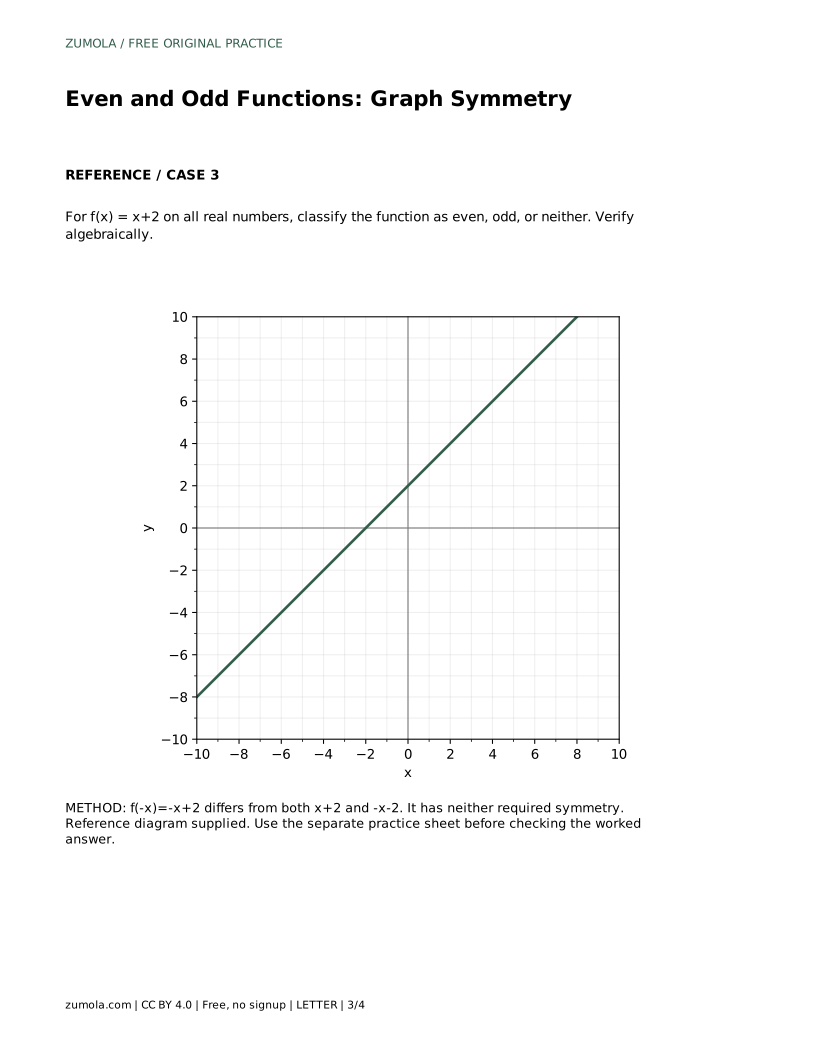
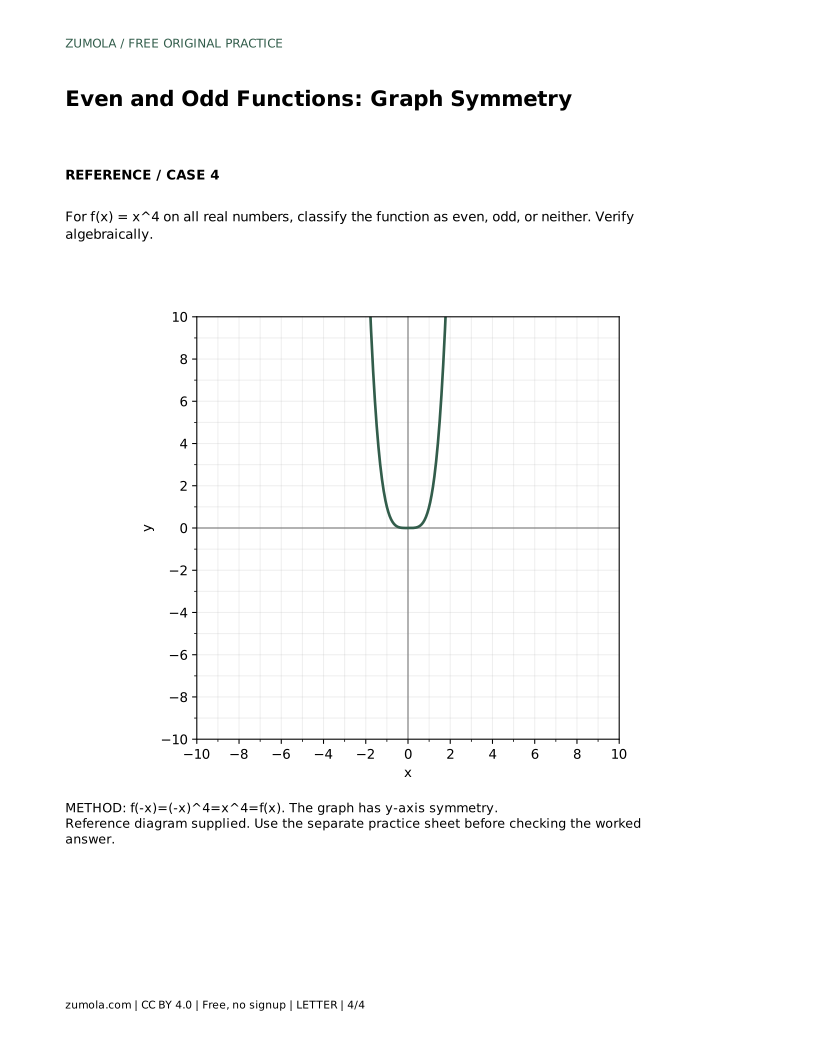
Even powers of x, such as x^2 and x^4, give even functions when they stand alone, because a negative number raised to an even power is positive. Odd powers, such as x^3, give odd functions, because a negative number raised to an odd power stays negative. Constants added to a power usually break the symmetry: x^2 + 1 is still even, but x + 2 is neither. Mixed sums such as x^3 + x^2 combine an odd and an even part and are generally neither.
Watch parentheses. Writing -x^2 means -(x^2), which is negative for nonzero x, while (-x)^2 is positive. That difference changes the classification. When a function includes fractions, substitute -x into both numerator and denominator and simplify the whole expression before comparing.
A printed reference can hold the four core examples side by side: x^2 and x^4 as even, x^3 as odd, and x + 2 as neither. Before trusting measurements on a printed page, print at 100% scale and check a calibration bar with a ruler; do not assume the printer preserved size. Use the sheet to practice substitution and to compare graph shapes, then write your own algebraic verification rather than copying a label.
Art and graph sketches have many valid appearances, so judge them with a rubric: correct symmetry type, labeled axes, accurate sample points, and a written algebraic check. A tidy drawing with the wrong symmetry should not score higher than a rough drawing with correct reasoning.
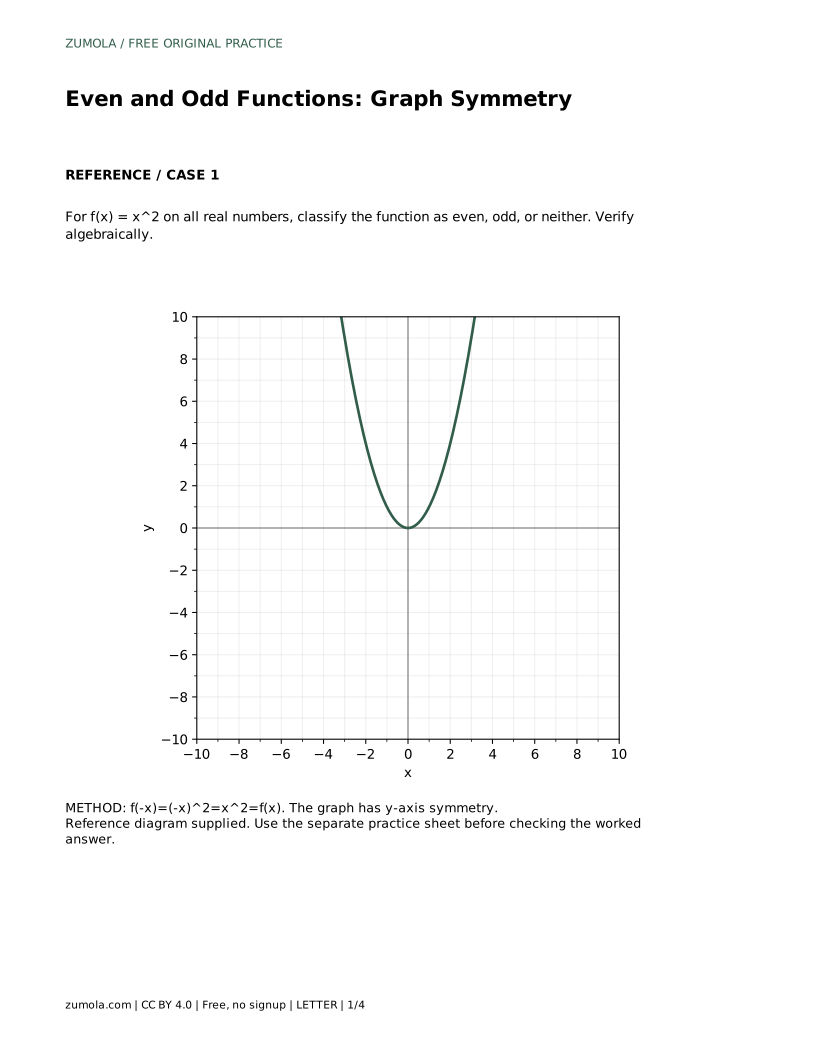
Classify f(x) = x^2 on all real numbers as even, odd, or neither, and verify algebraically.
Substitute -x: f(-x) = (-x)^2. Squaring a negative gives a positive, so (-x)^2 = x^2. Therefore f(-x) = x^2 = f(x) for every real x. The function is even, and its graph has y-axis symmetry: the point (2, 4) pairs with (-2, 4).
An even function satisfies f(-x) = f(x) and has y-axis symmetry. An odd function satisfies f(-x) = -f(x) and has origin symmetry. A function matching neither is neither.
Only the zero function, f(x) = 0, satisfies both conditions on a symmetric domain, since f(-x) = 0 equals both f(x) and -f(x).
Yes. The test requires that -x is in the domain whenever x is. If the domain is not symmetric about zero, the function is generally classified as neither on that domain.
All math worksheets · Free coordinate paper
Original resources · CC BY 4.0 · Free for personal and classroom use with attribution.