Reference diagrams
LETTER · Download PDF
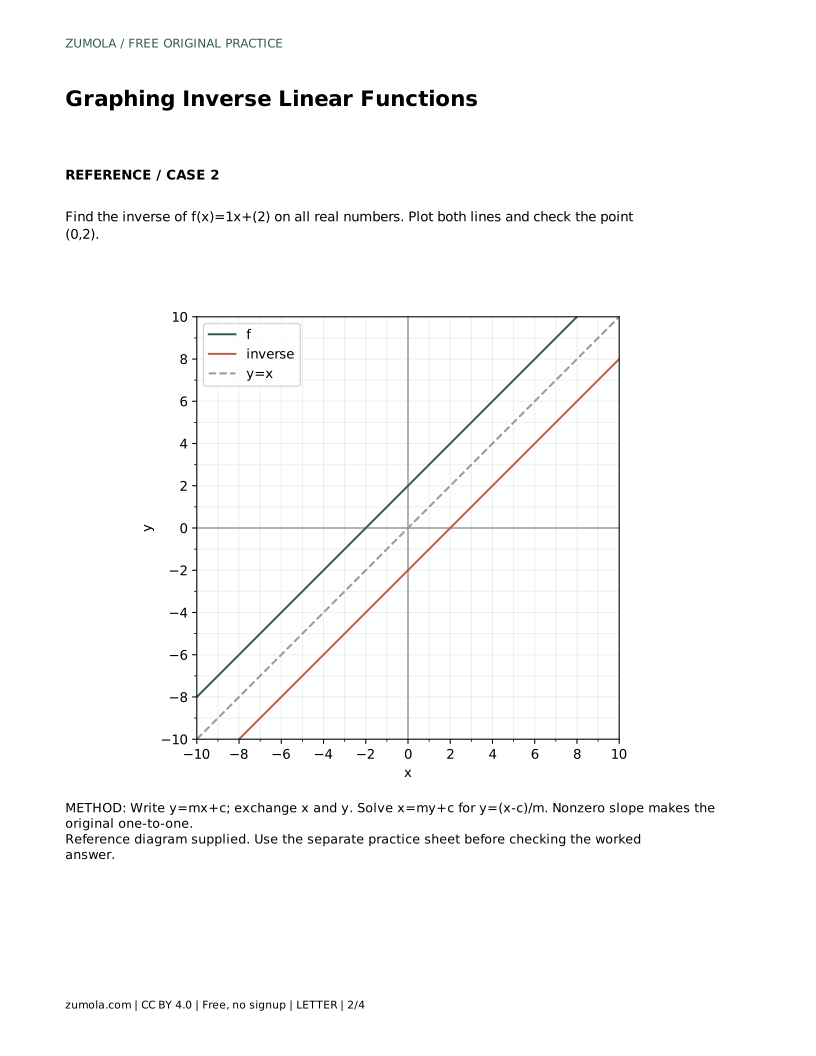
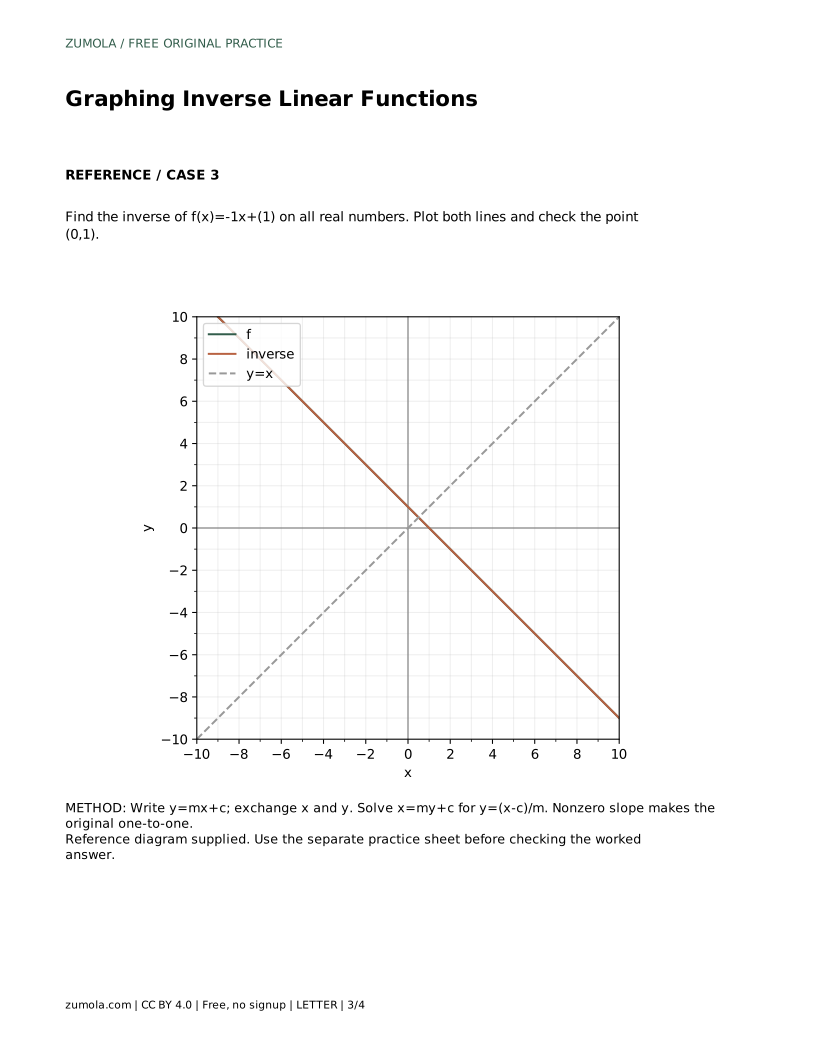
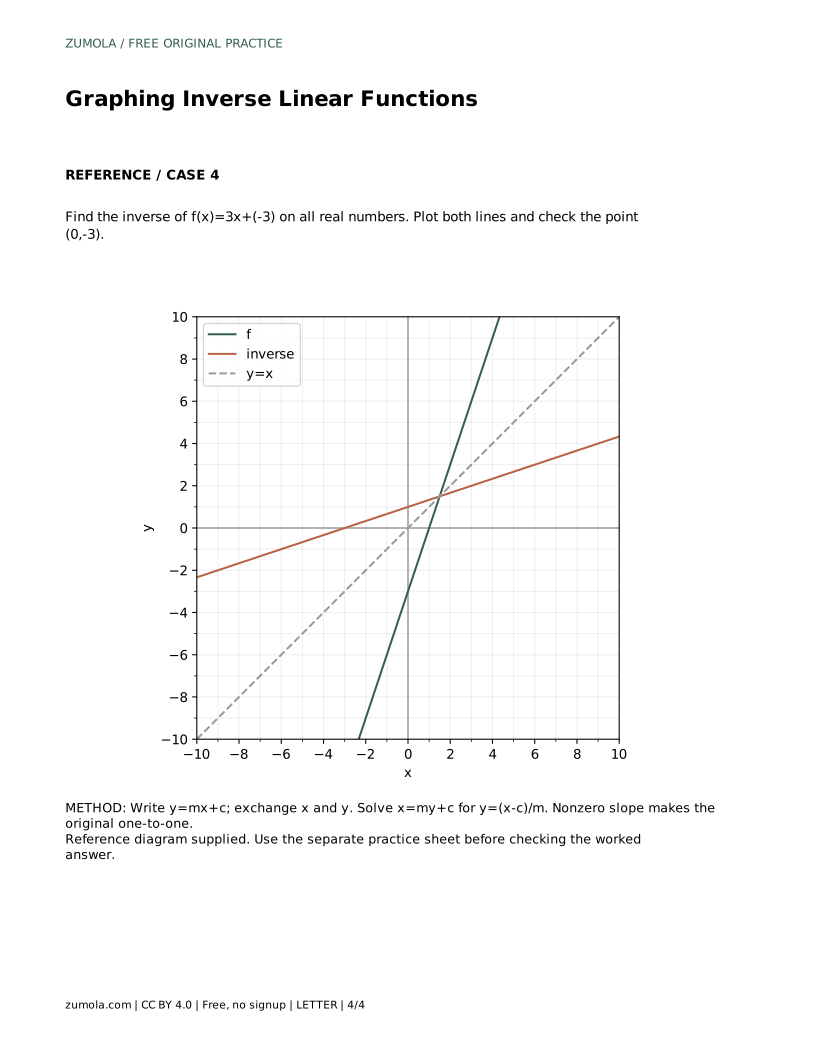
A4 · Download PDF
Free original resources
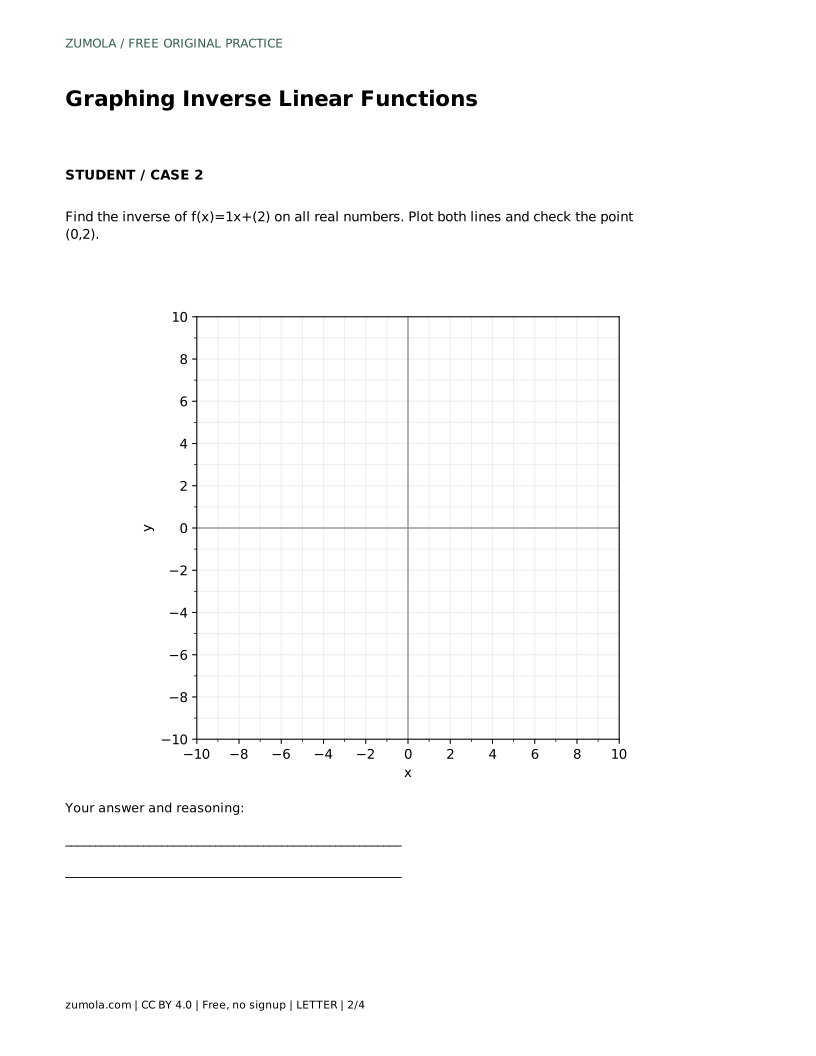
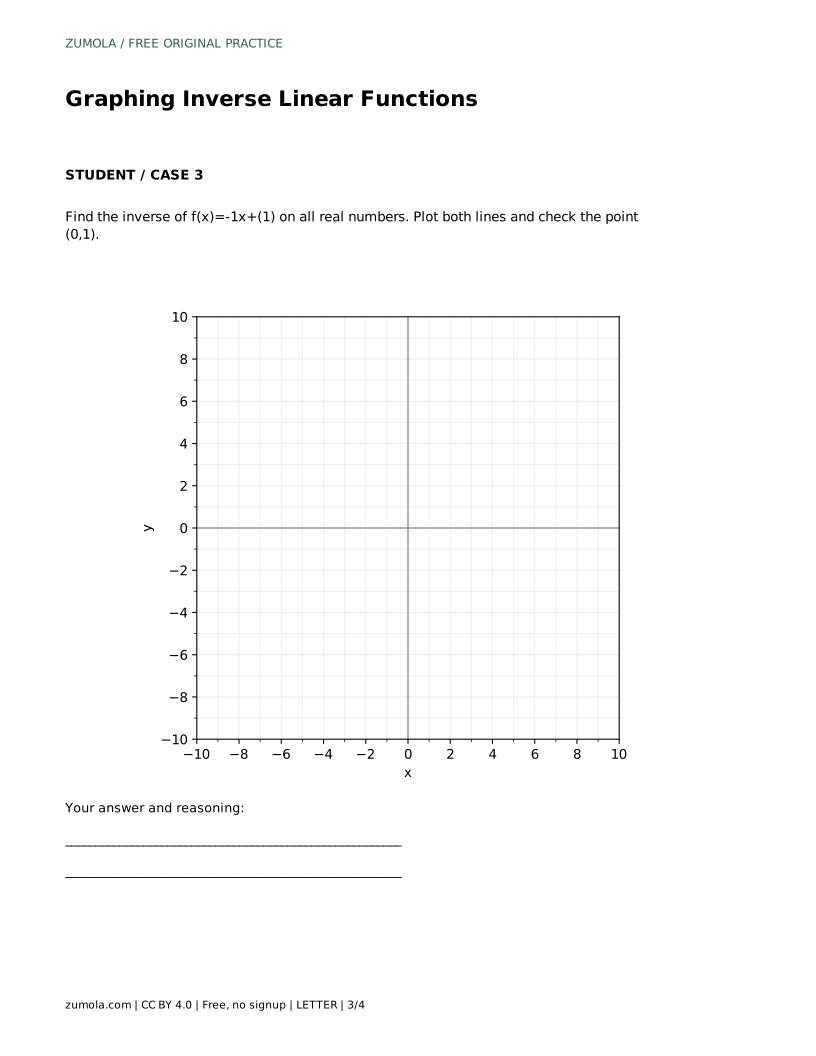
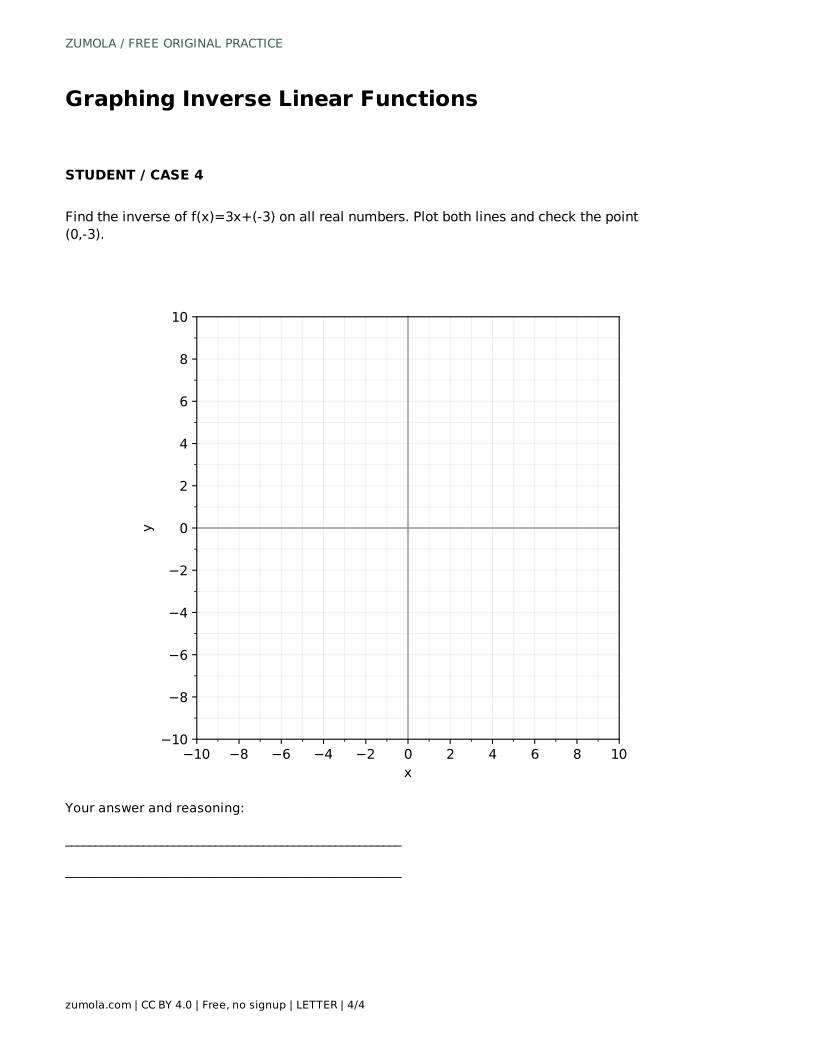
Learn to find and graph the inverse of a linear function by swapping x and y, then verify that each point reflects across y = x. Includes a worked example and rubric.
Four original cases, with reference diagrams, practice sheets and worked answers. Everything is free; no signup required.
LETTER · Download PDF
A4 · Download PDF
LETTER · Download PDF
A4 · Download PDF
LETTER · Download PDF
A4 · Download PDF
Use A4 or US Letter to match your printer. Graph coordinates determine the answers; these worksheets are not physical measuring rulers.
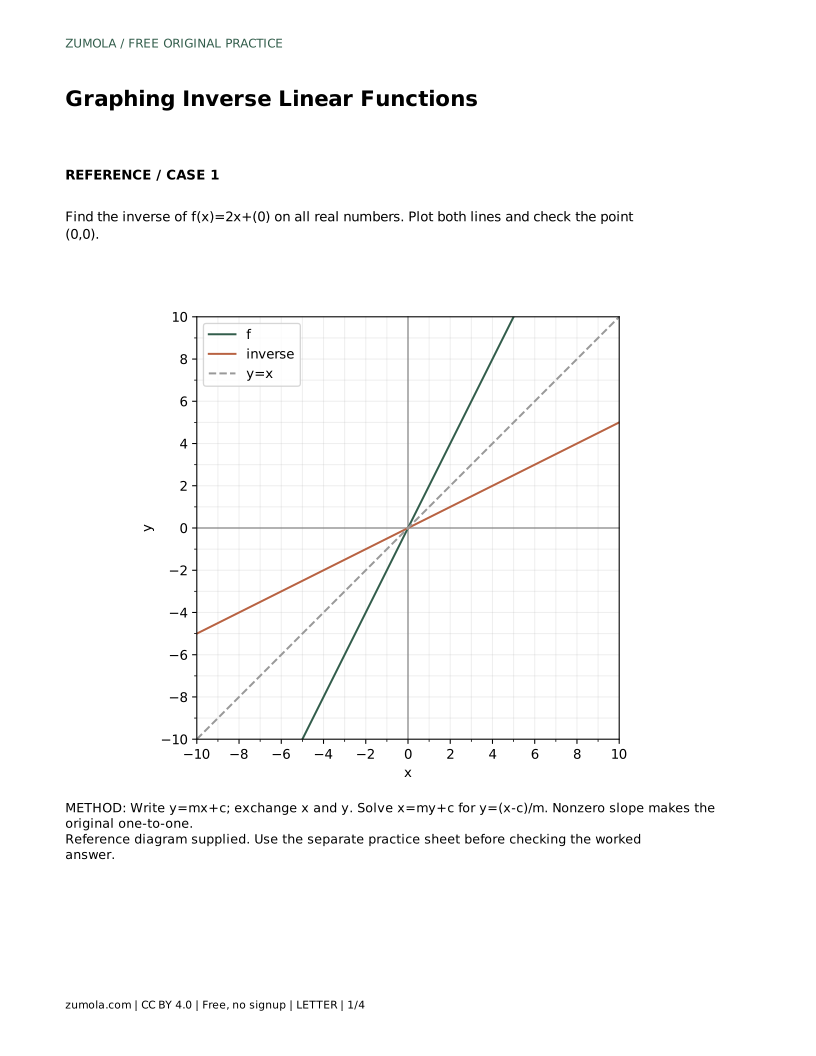

An inverse linear function undoes the original function. For a line written as y = mx + c with a nonzero slope, exchanging x and y and solving for y gives the inverse. On a graph, the two lines are mirror images across the line y = x, so a point (a, b) on the original line corresponds to (b, a) on the inverse. This page explains the method, the reflection check, and common graphing errors.
A linear function f(x) = mx + c is one-to-one exactly when m is not zero. A horizontal line such as y = 3 assigns the same output to every input, so reversing it would not produce a single output for each input. When m is nonzero, every x-value maps to a different y-value, and the inverse is also a linear function.
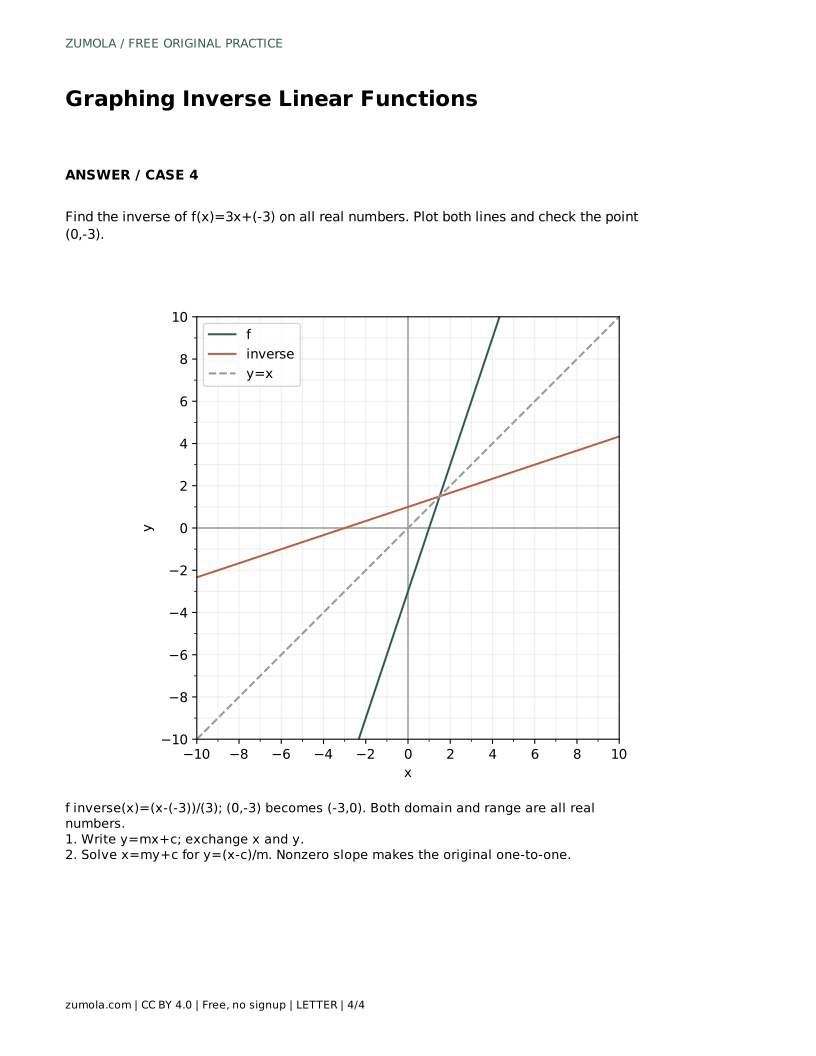
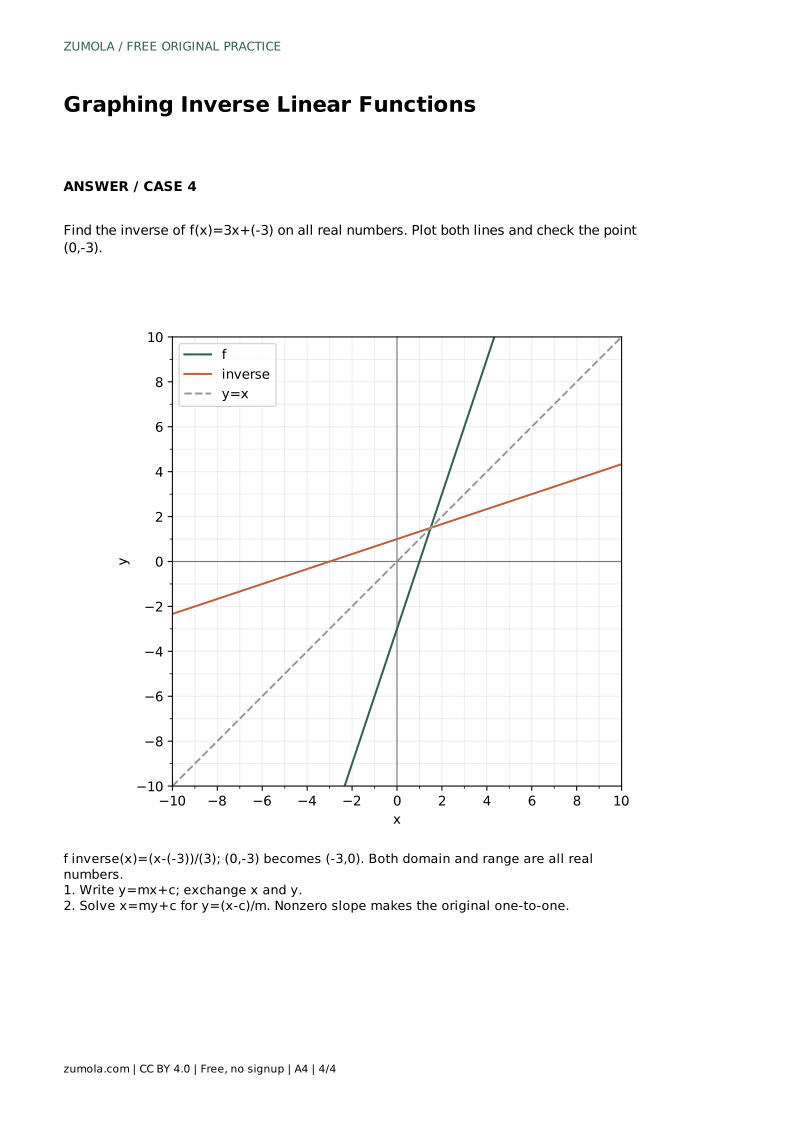
The inverse of y = mx + c is y = (x - c) / m. Its slope is 1/m, the reciprocal of the original slope, and its intercept is -c/m. Because both functions are lines with nonzero slopes, their domains and ranges are all real numbers unless a restricted domain is stated separately.
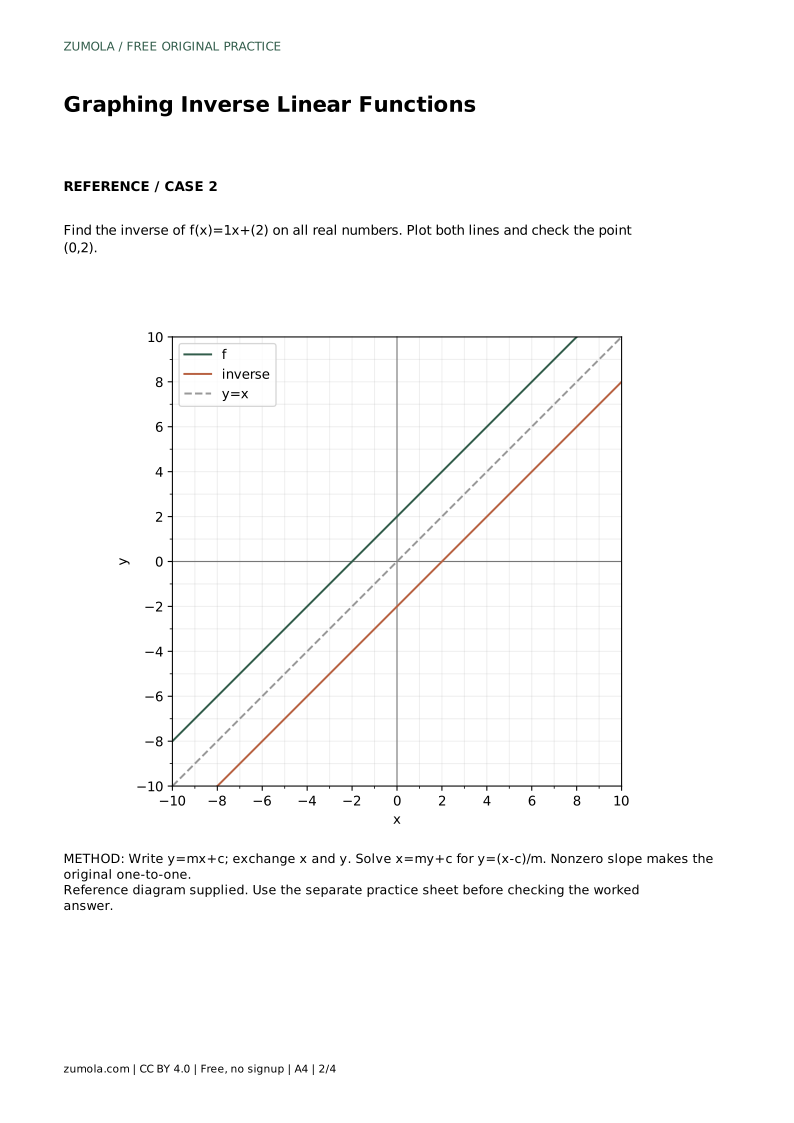
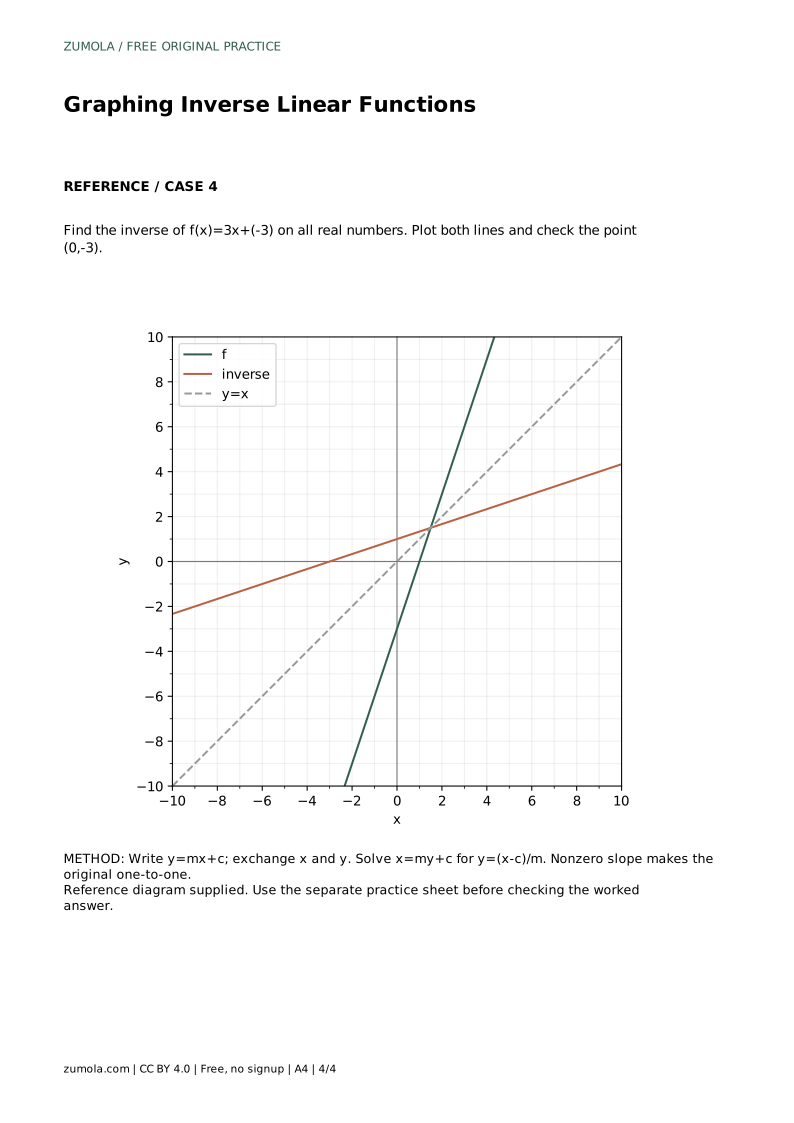
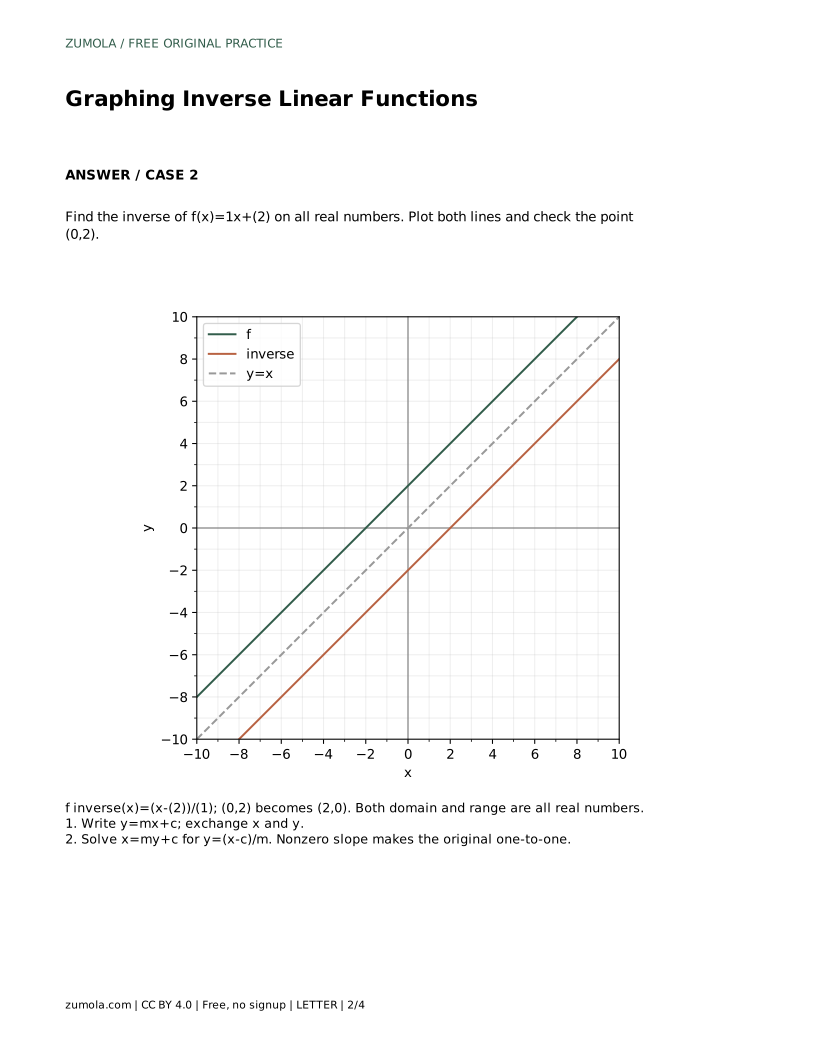
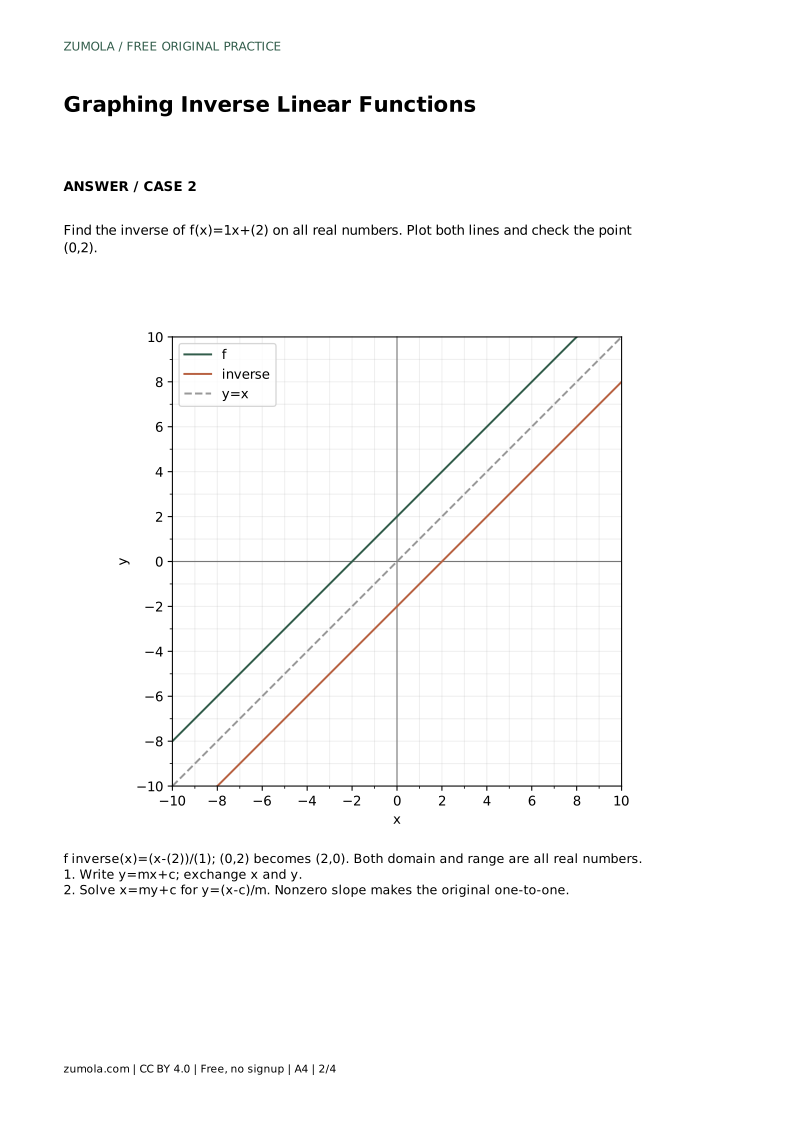
Reflection across y = x swaps the coordinates of every point. If the original line passes through (0, c), the inverse passes through (c, 0). This single check catches most sign and division errors before you finish the graph.
Choose one or two additional points with small integer inputs to confirm the pattern. For example, if the original line contains (1, m + c), the inverse should contain (m + c, 1). Plot both and compare their positions relative to the diagonal y = x.
A useful worksheet gives each student a coordinate grid large enough to show both lines and the diagonal y = x. Include the original equation, space to show the exchange and solving steps, and a labeled grid for plotting. Keep the scale consistent so the reflection is visually obvious.
Before printing, check a calibration bar at 100% scale so grid squares remain square. If the bar measures incorrectly, adjust the print settings rather than stretching the page. Separate answer sheets let students compare their graphs without copying a finished line.
Substitute a simple value into both functions to test whether they undo each other. If f(2) = 7, then the inverse should return 2 when given 7. This composition check works for any point you can compute by hand.
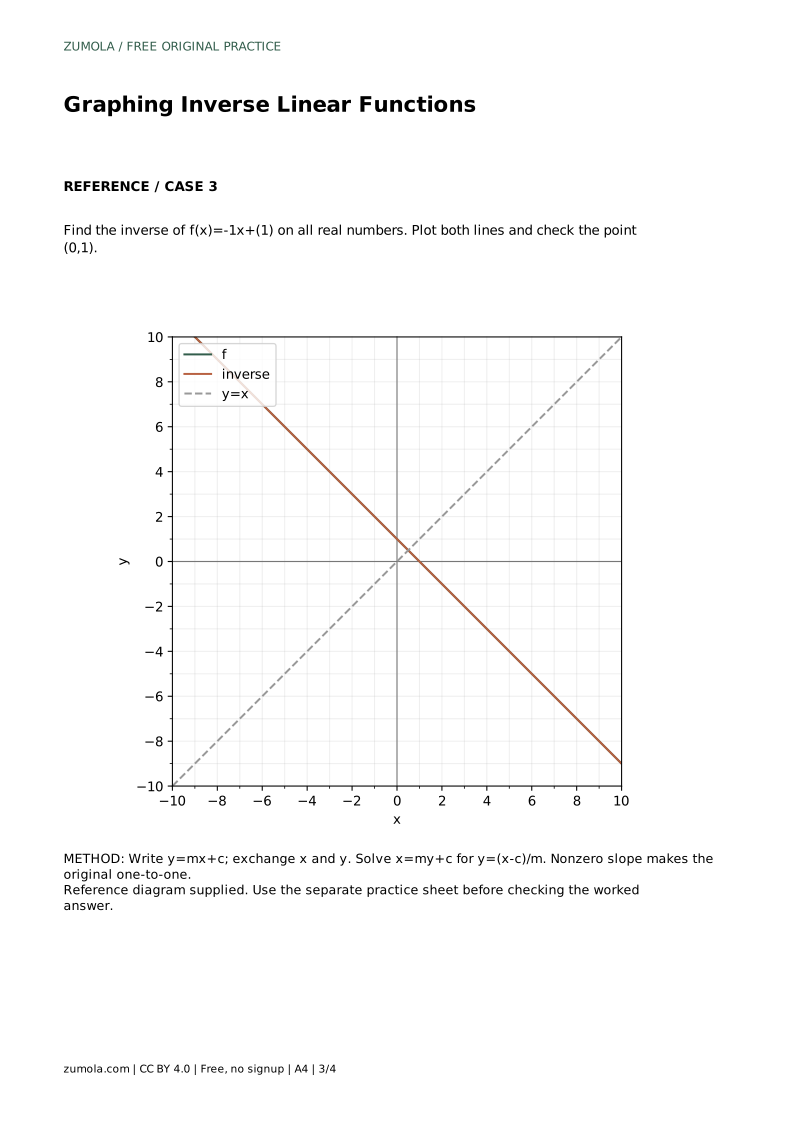
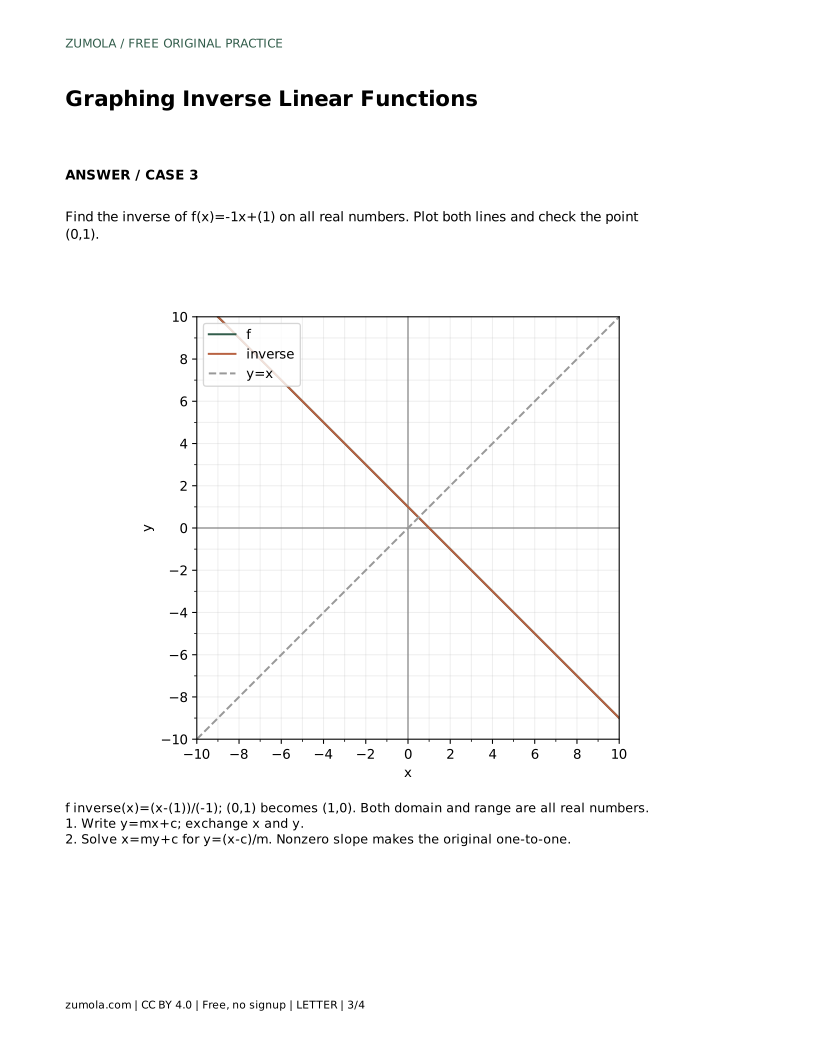
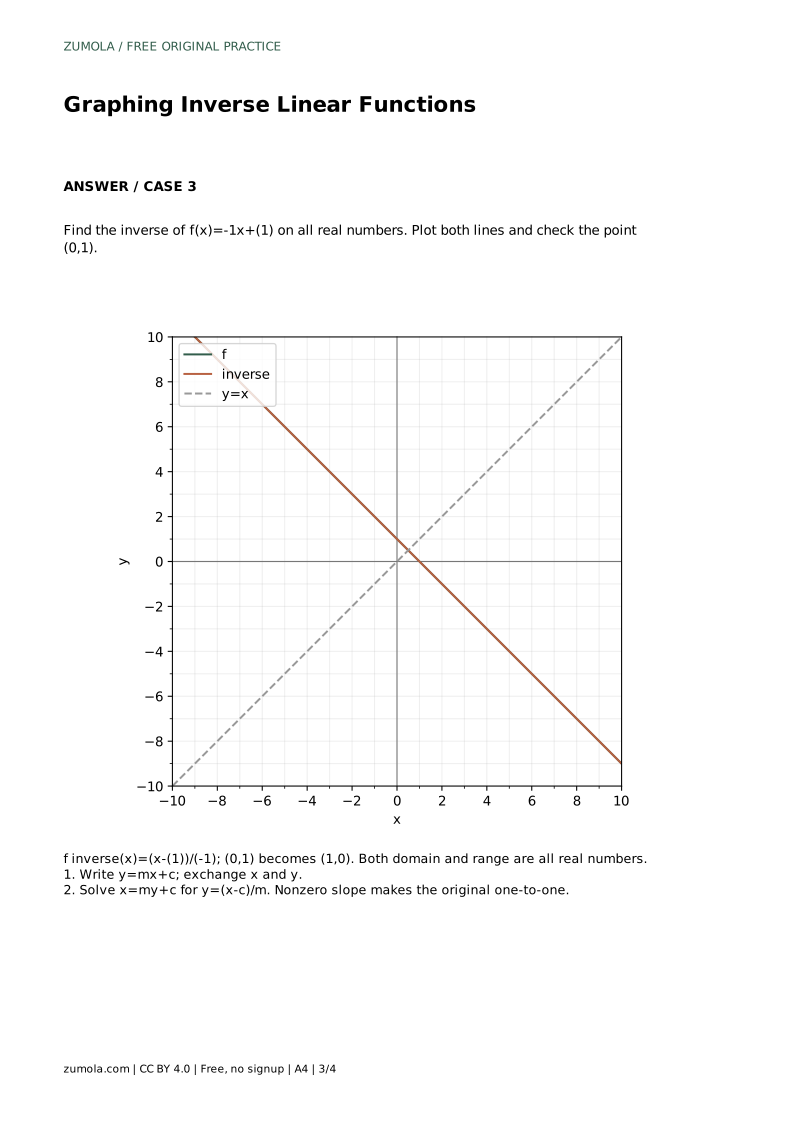
Also verify the slope relationship: the inverse slope should be the reciprocal of the original slope, including its sign. A slope of 2 becomes 1/2; a slope of -1 stays -1. If the slopes are not reciprocals, recheck the division step.
Most errors come from swapping only the variables in the equation without solving for y, or from dividing by the wrong coefficient. Another frequent problem is plotting the inverse as a rotation rather than a reflection. A rotation moves the line around a point; a reflection flips it across y = x.
Labeling also matters. Students sometimes mark the inverse intercept on the original line or forget to draw the diagonal. A short checklist before submission prevents these slips.
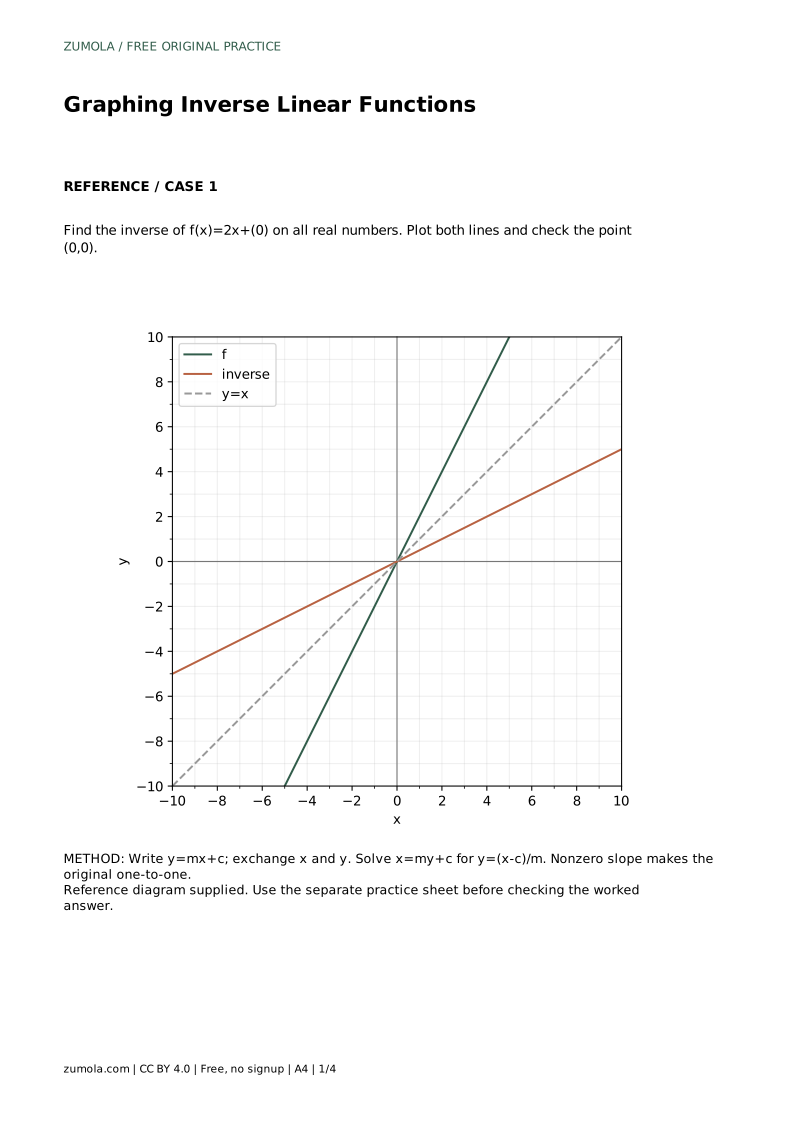
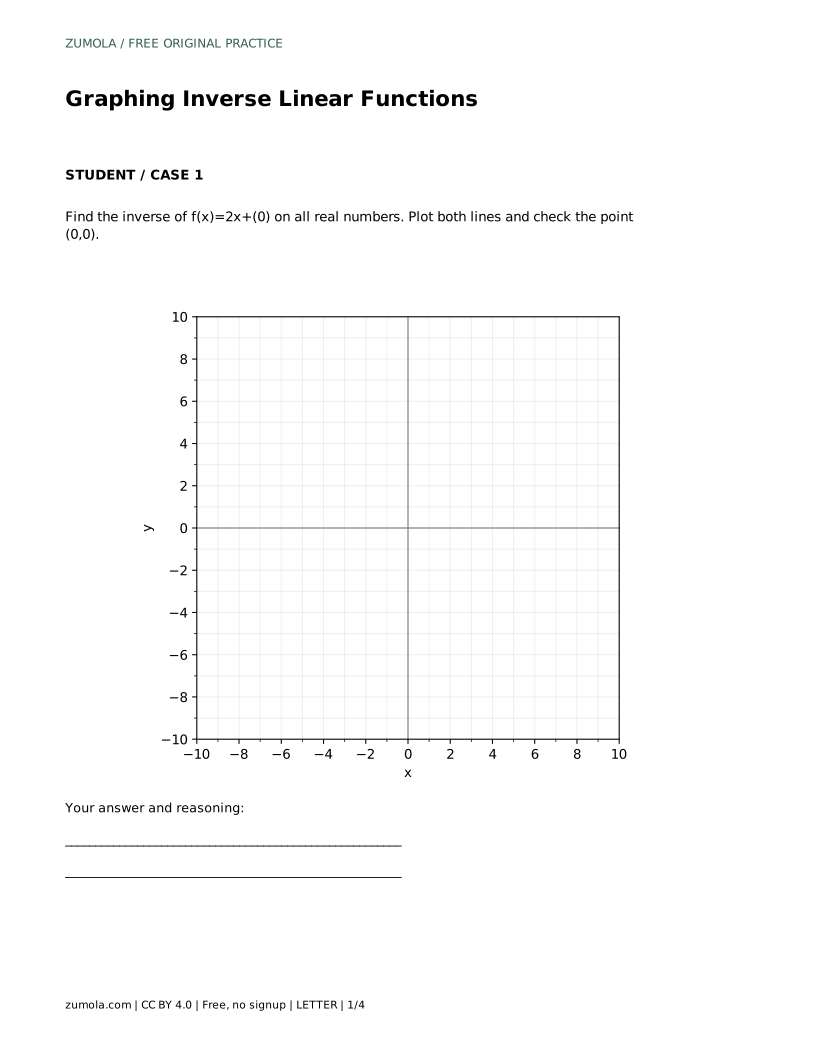
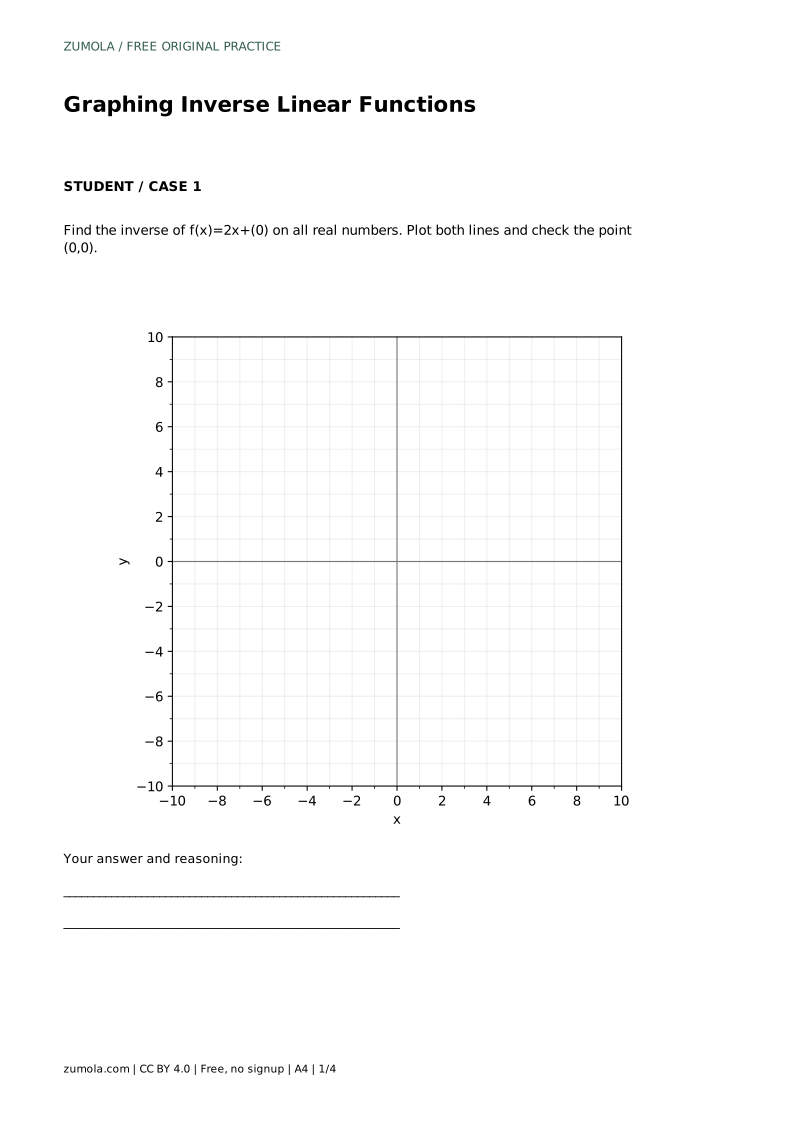
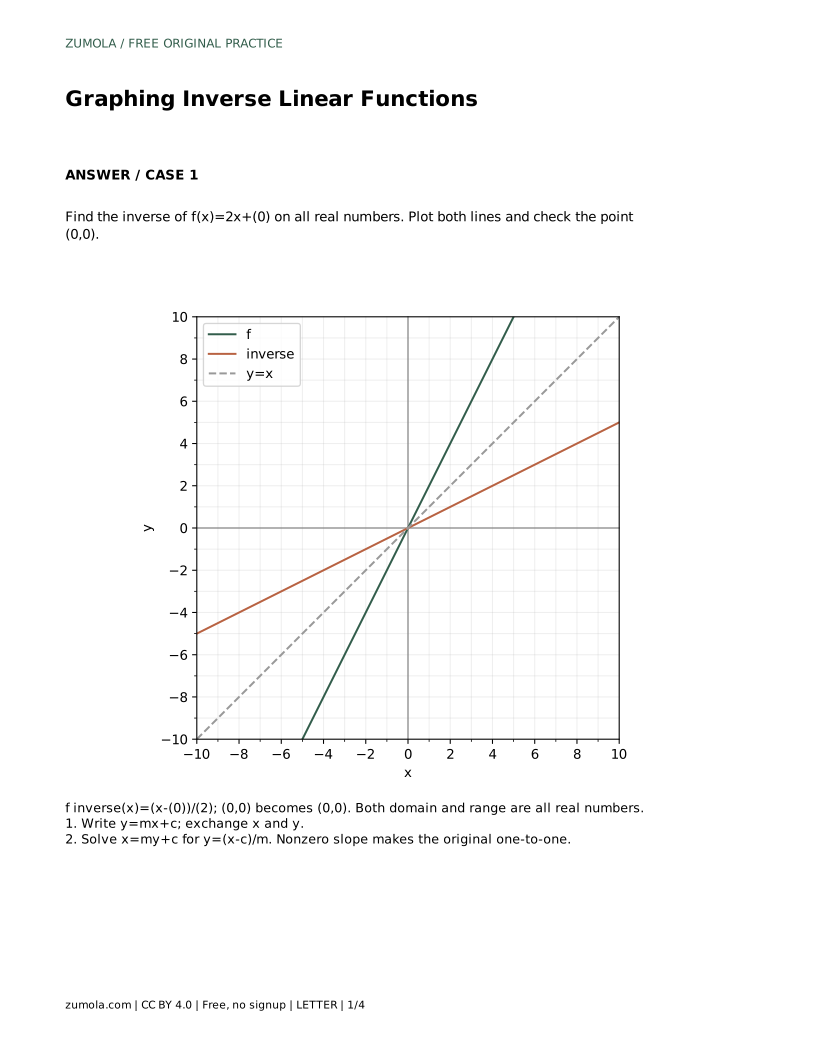
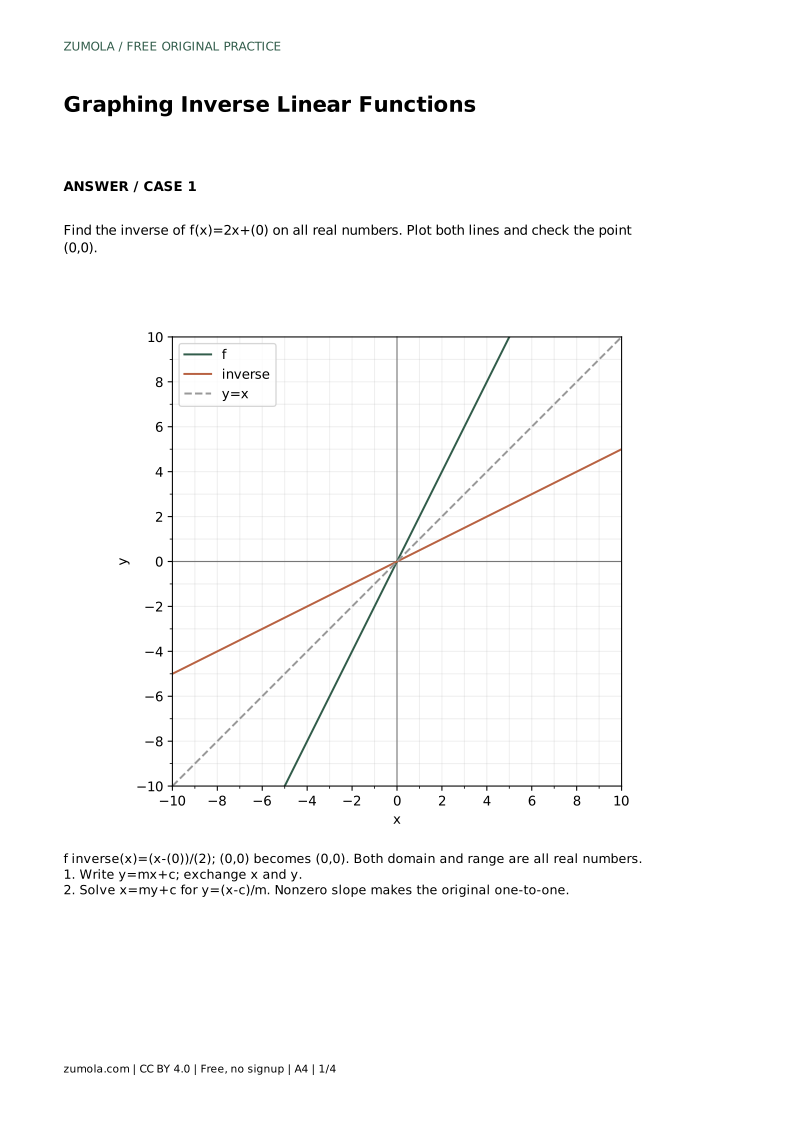
Find the inverse of f(x) = 2x + 0 on all real numbers, plot both lines, and check the point (0, 0).
Write y = 2x + 0. Exchange x and y: x = 2y + 0. Solve for y: y = x / 2. The inverse is f inverse(x) = x / 2. The original passes through (0, 0), and swapping gives (0, 0), which lies on both lines. The original slope is 2 and the inverse slope is 1/2, which are reciprocals. Both domain and range are all real numbers. On the graph, the two lines cross at the origin and are mirror images across y = x.
Only linear functions with a nonzero slope have an inverse over all real numbers. A horizontal line is not one-to-one, so it does not have an inverse function without restricting its domain.
Swap the coordinates of one or two points from the original line and confirm they lie on the inverse line. The two lines should be mirror images across y = x.
The inverse slope is the reciprocal of the original slope. For y = mx + c, the inverse is y = (x - c) / m, so its slope is 1/m.
All math worksheets · Free coordinate paper
Original resources · CC BY 4.0 · Free for personal and classroom use with attribution.