Reference diagrams
LETTER · Download PDF
A4 · Download PDF
Free original resources
Build a printable divisibility quiz for 2, 3, 5, 9 and 10. Teach last-digit tests and digit-sum tests, then check answers with clear reasoning.
Four original cases, with reference diagrams, practice sheets and worked answers. Everything is free; no signup required.
LETTER · Download PDF
A4 · Download PDF
LETTER · Download PDF
A4 · Download PDF
LETTER · Download PDF
A4 · Download PDF
Use A4 or US Letter to match your printer. Use the stated values and conditions to solve each exercise; diagrams are not physical measuring rulers.

Divisibility rules let students decide whether one whole number divides another exactly, without long division. This page focuses on five common divisors: 2, 3, 5, 9 and 10. Students apply two different kinds of test, record yes-or-no answers in a table, and explain each decision. The practice is designed for a printable quiz sheet, with a worked example and a rubric so reasoning matters as much as the final answer.
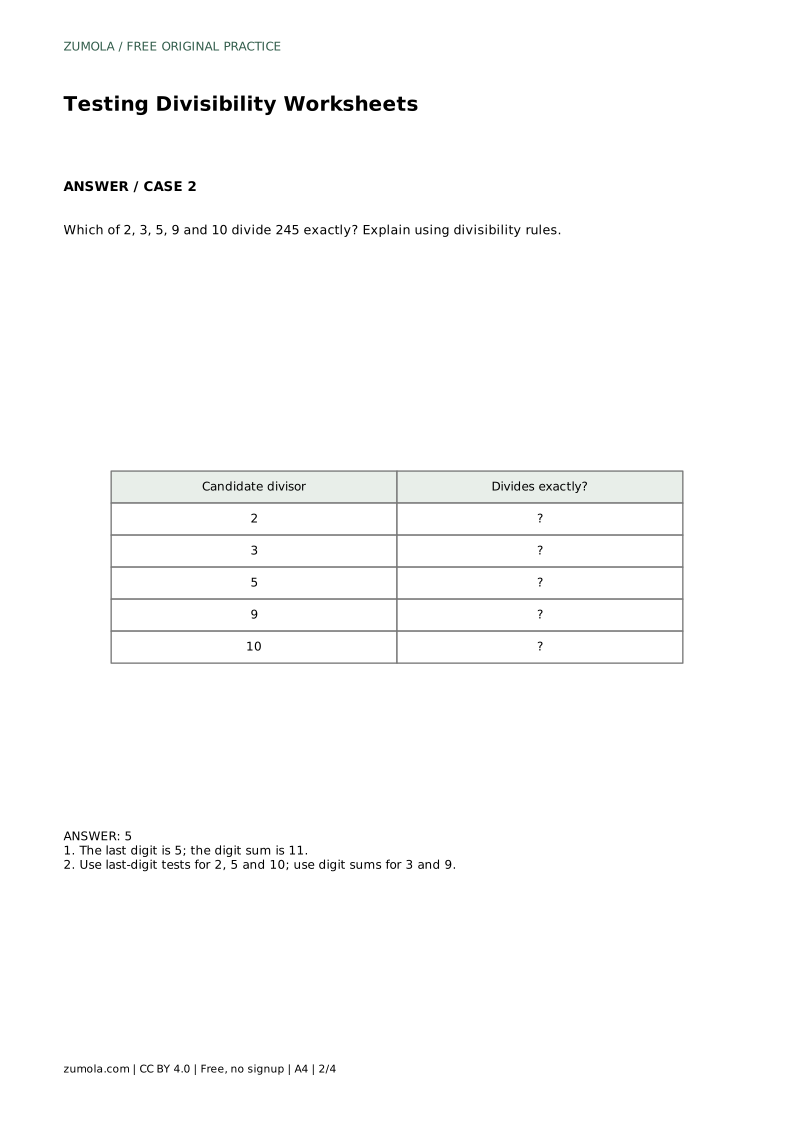
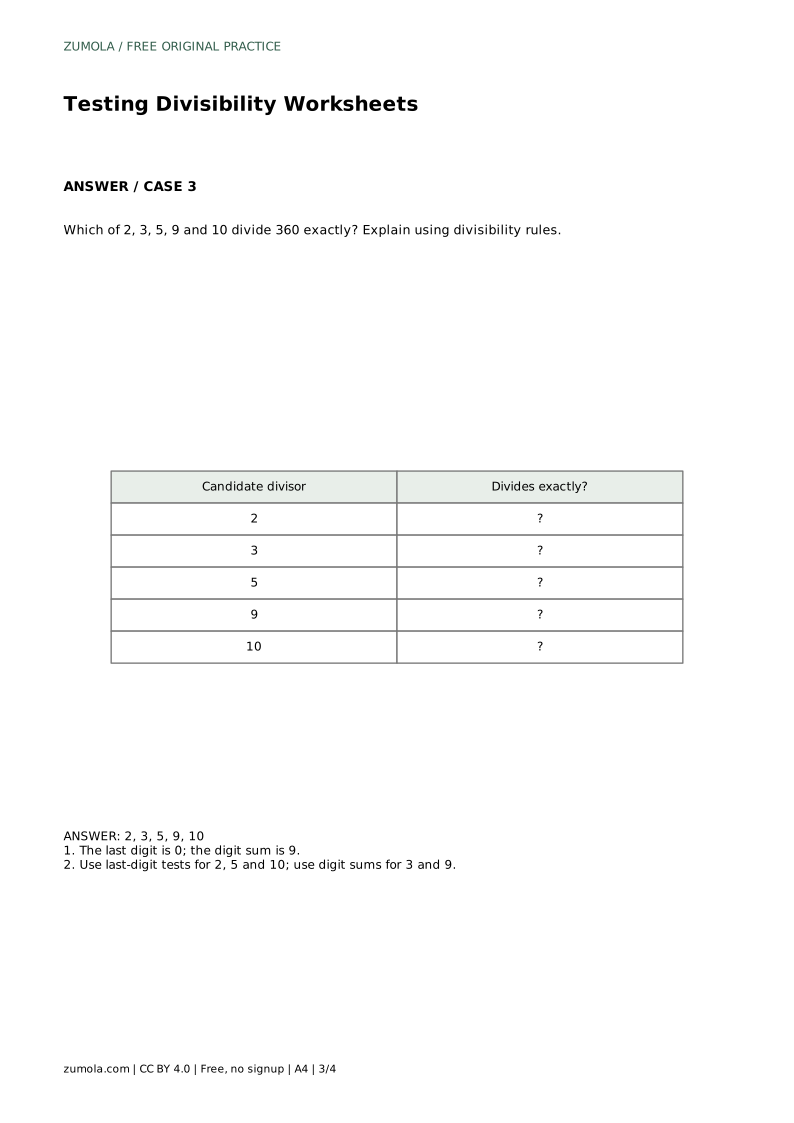
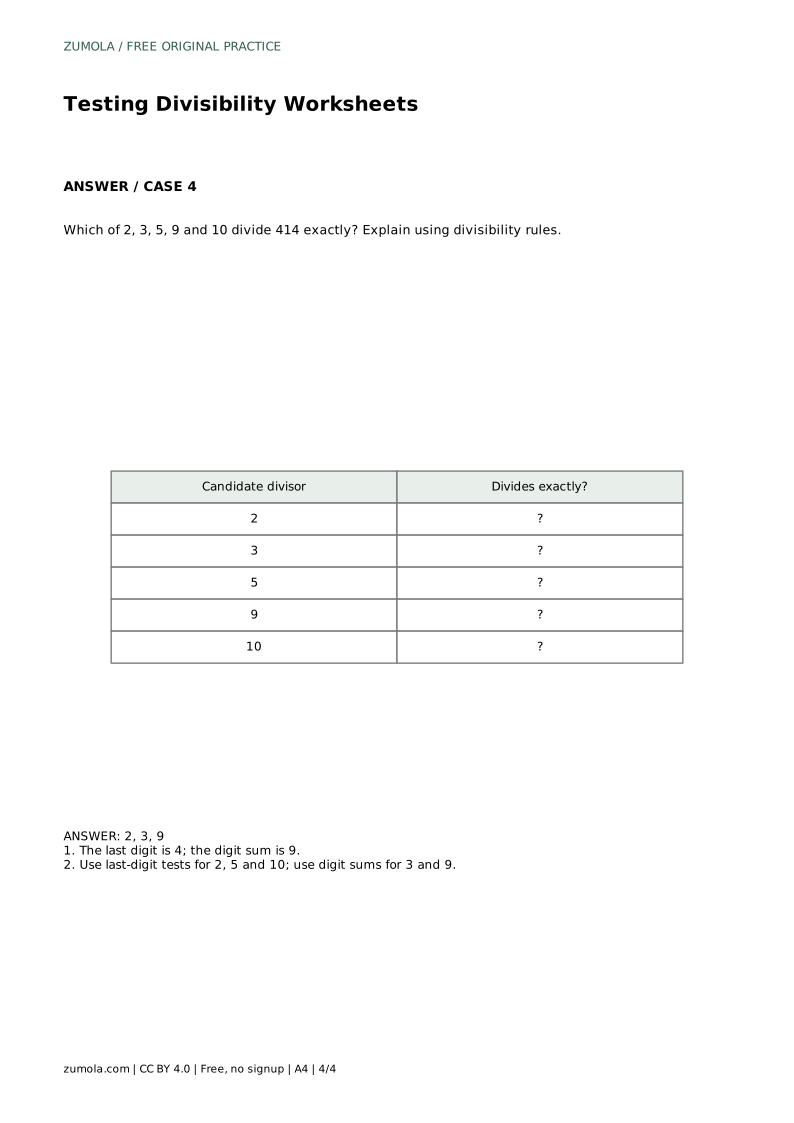
For divisors 2, 5 and 10, look only at the last digit. A number is divisible by 2 when its last digit is 0, 2, 4, 6 or 8. It is divisible by 5 when its last digit is 0 or 5. It is divisible by 10 when its last digit is 0. These tests work because 10 is a multiple of both 2 and 5, so every digit except the last contributes a multiple of 10.
For divisors 3 and 9, add the digits and test the sum. A number is divisible by 3 when its digit sum is divisible by 3. It is divisible by 9 when its digit sum is divisible by 9. Adding digits can be repeated on large numbers, but for three-digit numbers one addition is usually enough. Keep the two families of tests distinct: a last-digit test never decides divisibility by 3 or 9, and a digit sum never decides divisibility by 2, 5 or 10.
A useful quiz sheet gives one number per row and five candidate divisors across the top. Students fill each cell with yes or no, then write one sentence explaining the digit evidence. Leave space for the digit sum so the reasoning is visible rather than guessed.
Two students can write the same yes-or-no pattern for different reasons, and one may have copied. Ask for the evidence: the last digit, or the digit sum. A correct table with no reasoning hides whether the rule was understood. A wrong answer with a clear, correctly applied test is easier to diagnose than a lucky guess.
Use the rubric below to score each number. The worked example shows the expected level of explanation. Note that the first case is not a template for every number: 126 is divisible by 2, 3 and 9, but other numbers will produce different patterns, including cases divisible by only one candidate.
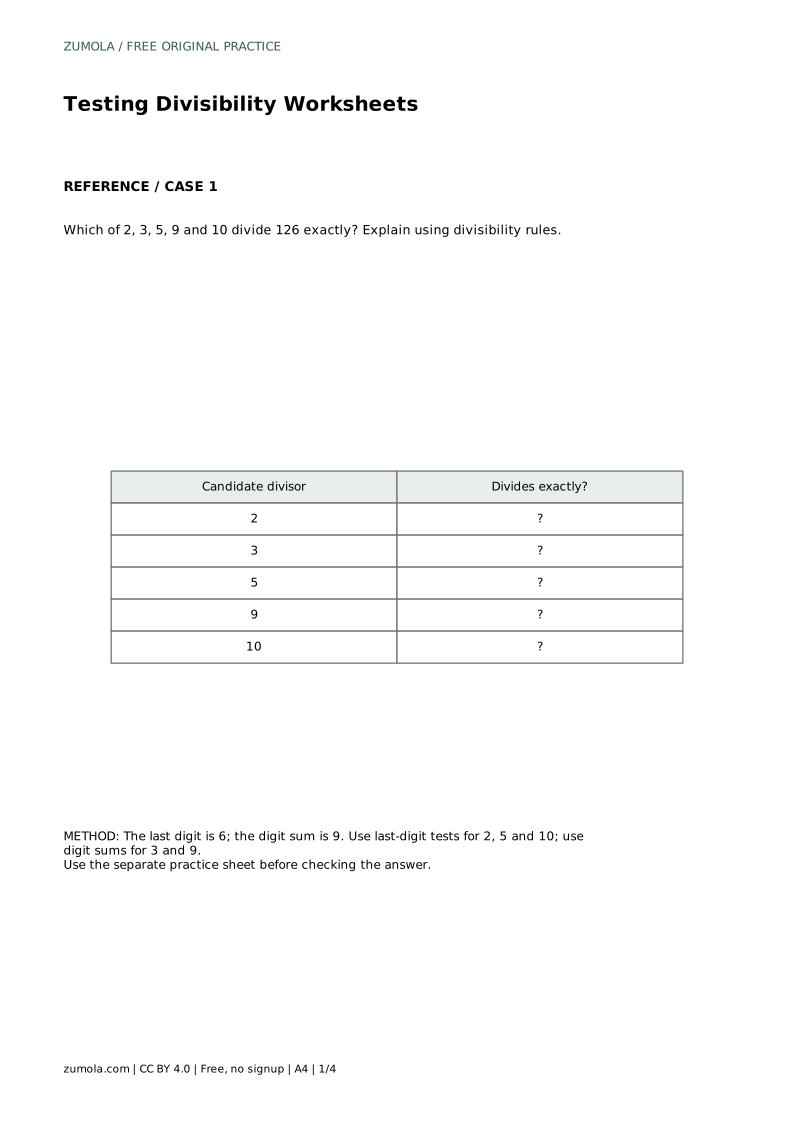
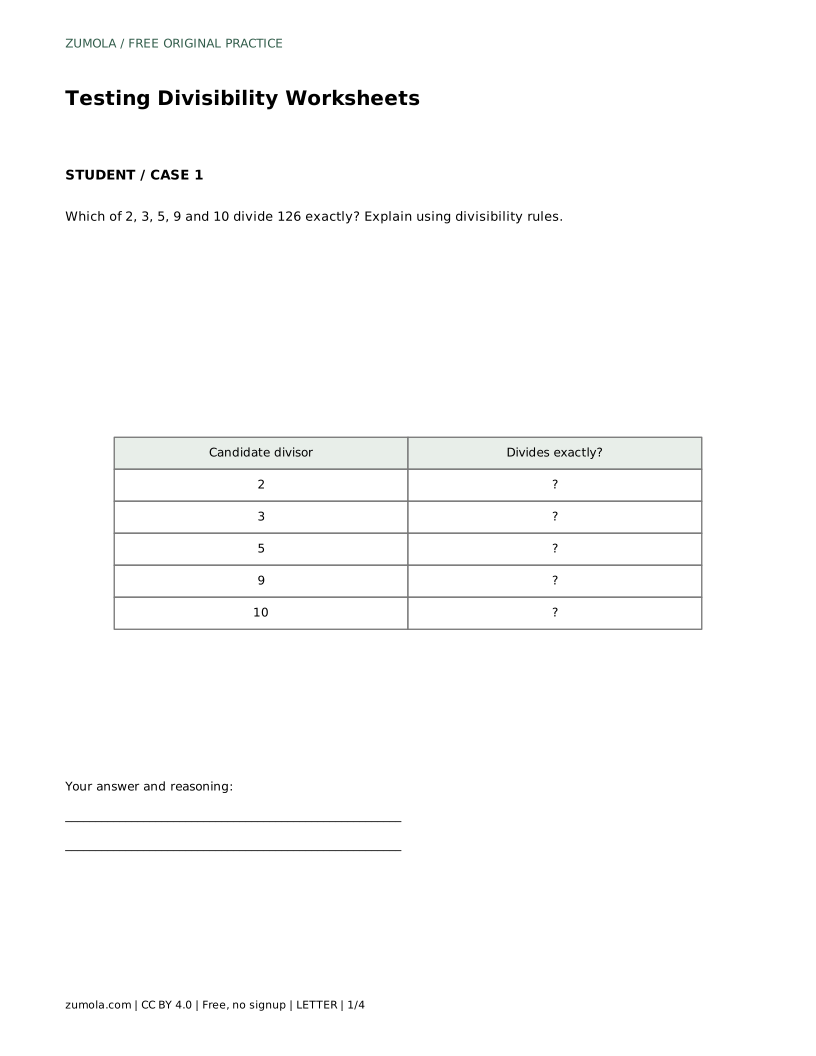
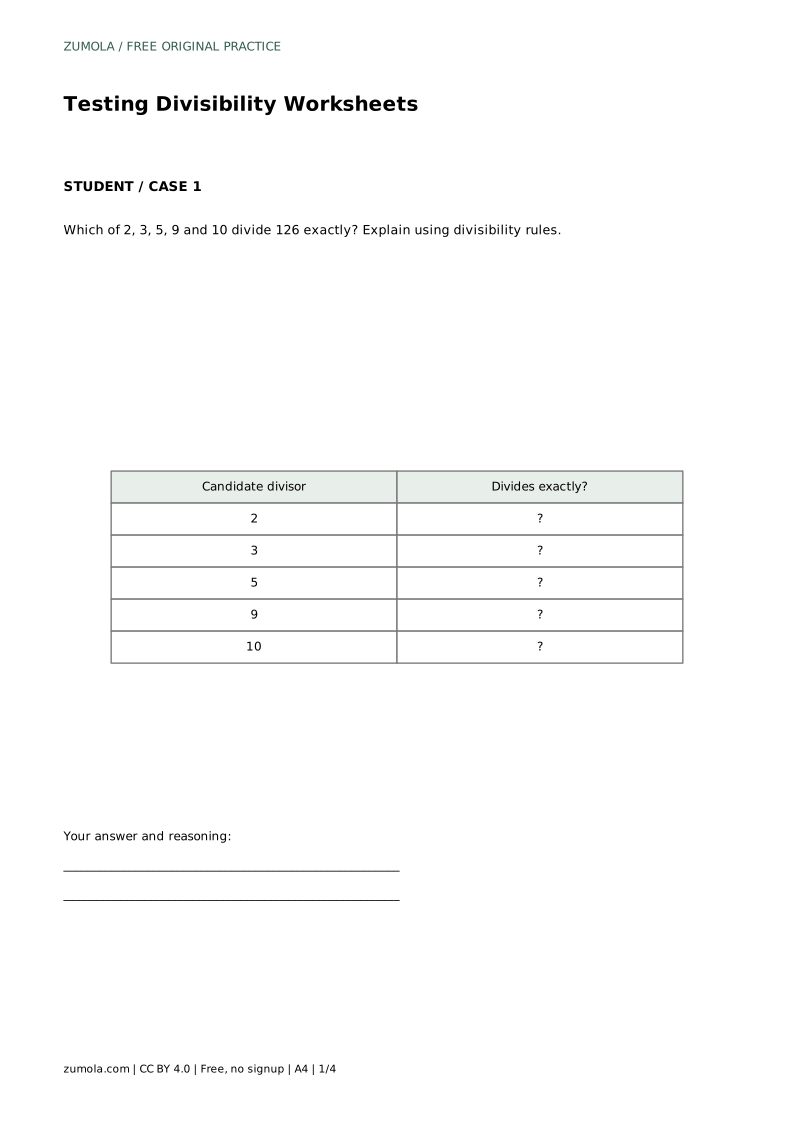
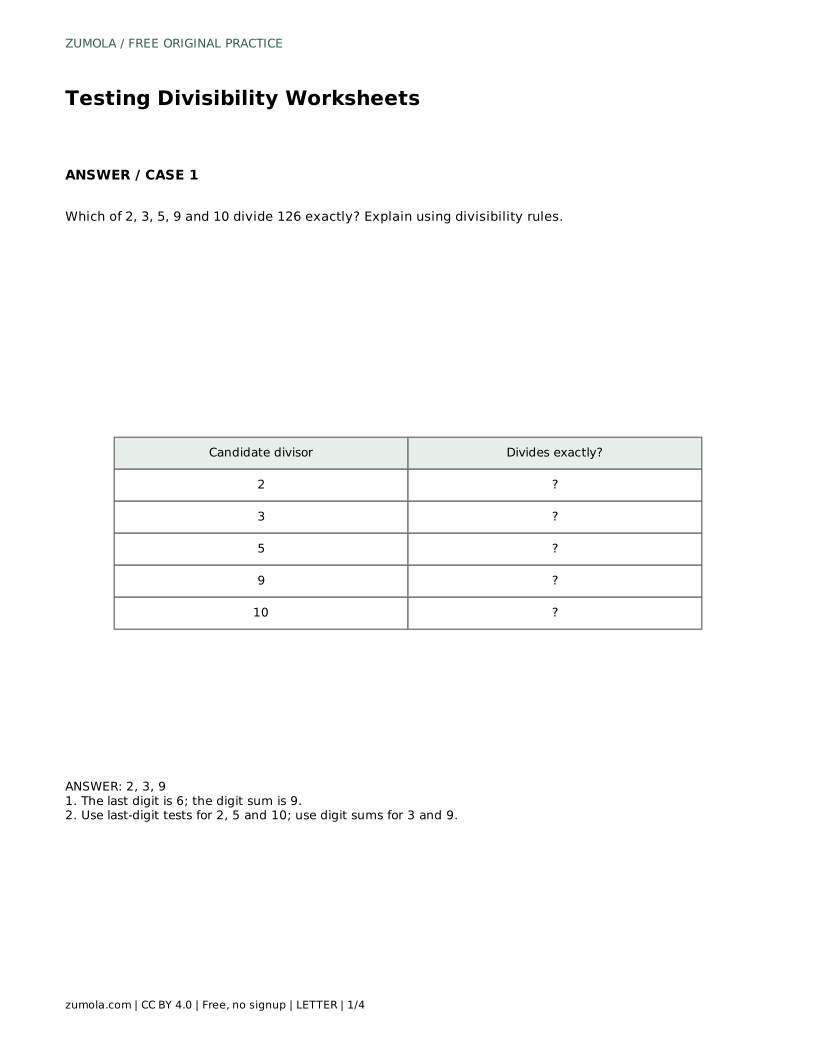
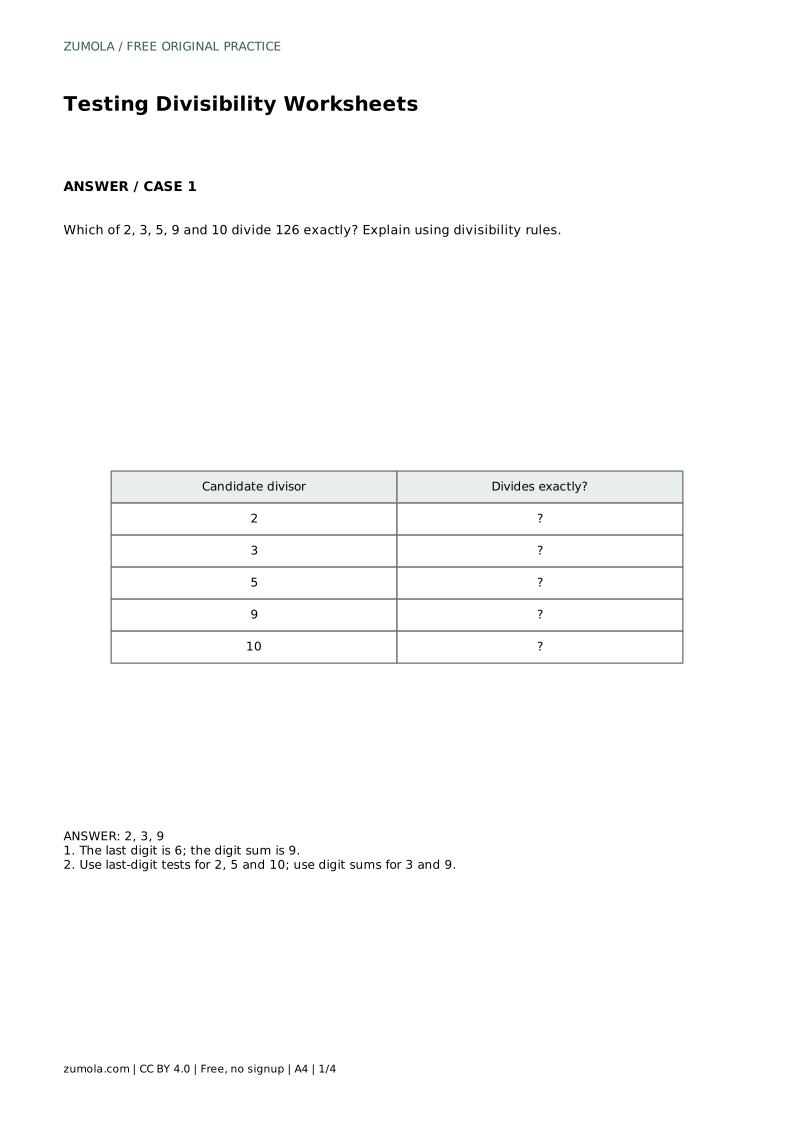
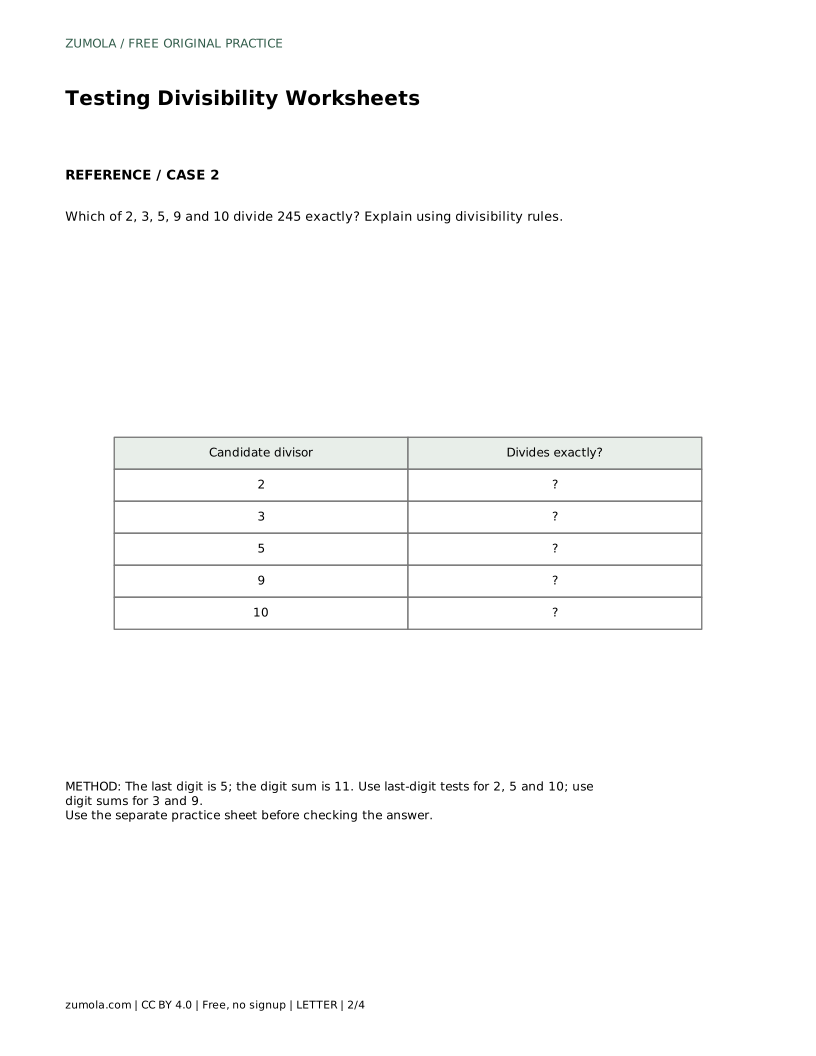
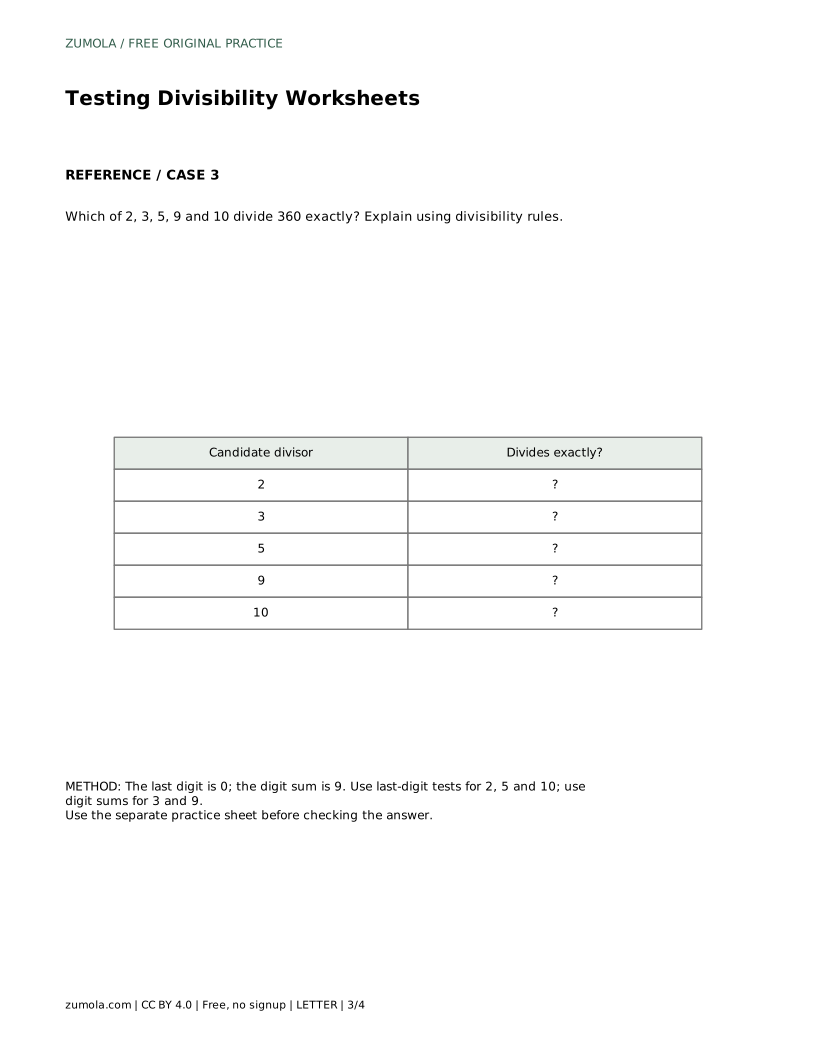
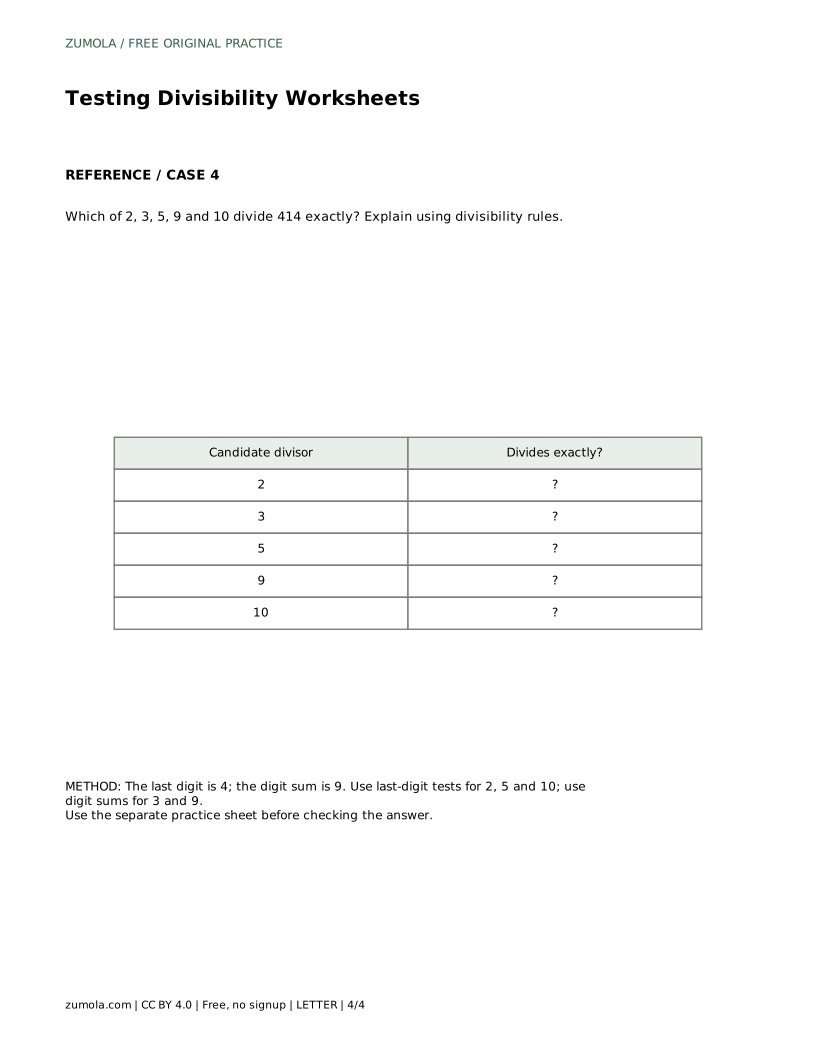
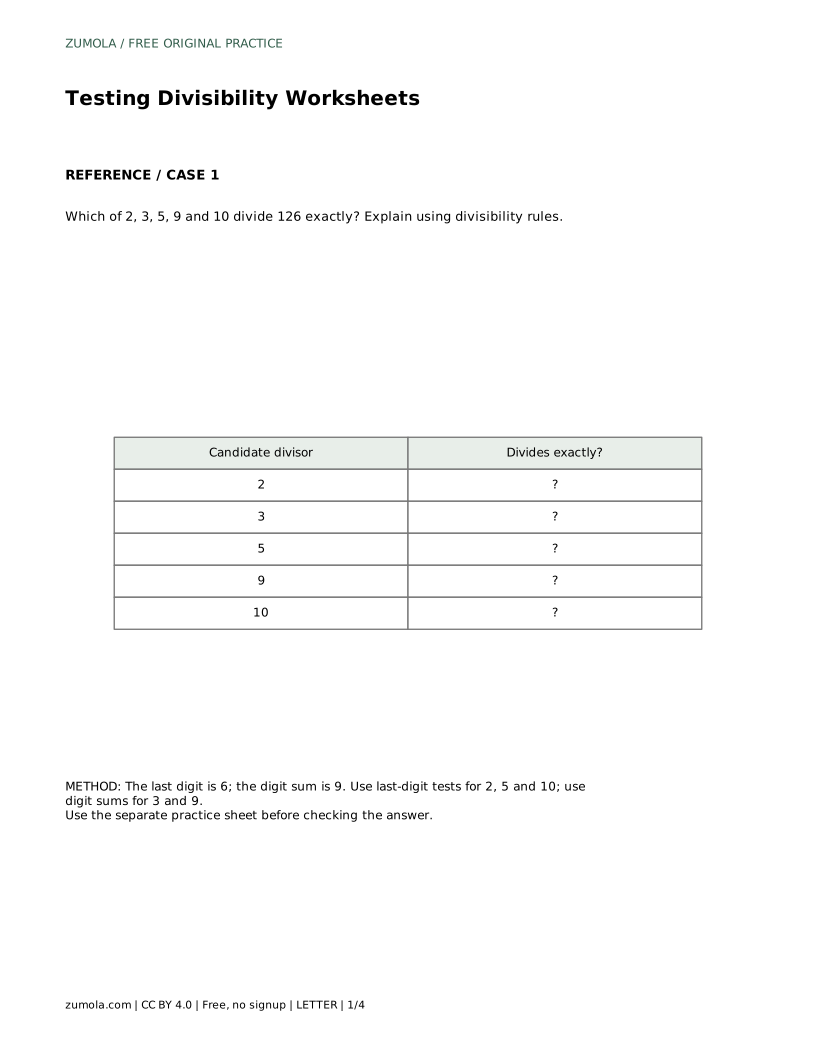
Which of 2, 3, 5, 9 and 10 divide 126 exactly? Explain using divisibility rules.
2, 3, 9 The last digit is 6; the digit sum is 9. Use last-digit tests for 2, 5 and 10; use digit sums for 3 and 9.
Yes. If the digit sum is a multiple of 9, it is also a multiple of 3, so divisibility by 9 implies divisibility by 3. The reverse is not true.
Every place value above the units is a multiple of 10, and 10 is divisible by 2 and 5. So only the units digit can affect the remainder.
Yes, as a check, but the quiz should require the rule and its evidence. Long division alone does not show that the rule was applied.
All math worksheets · Free coordinate paper
Original resources · CC BY 4.0 · Free for personal and classroom use with attribution.