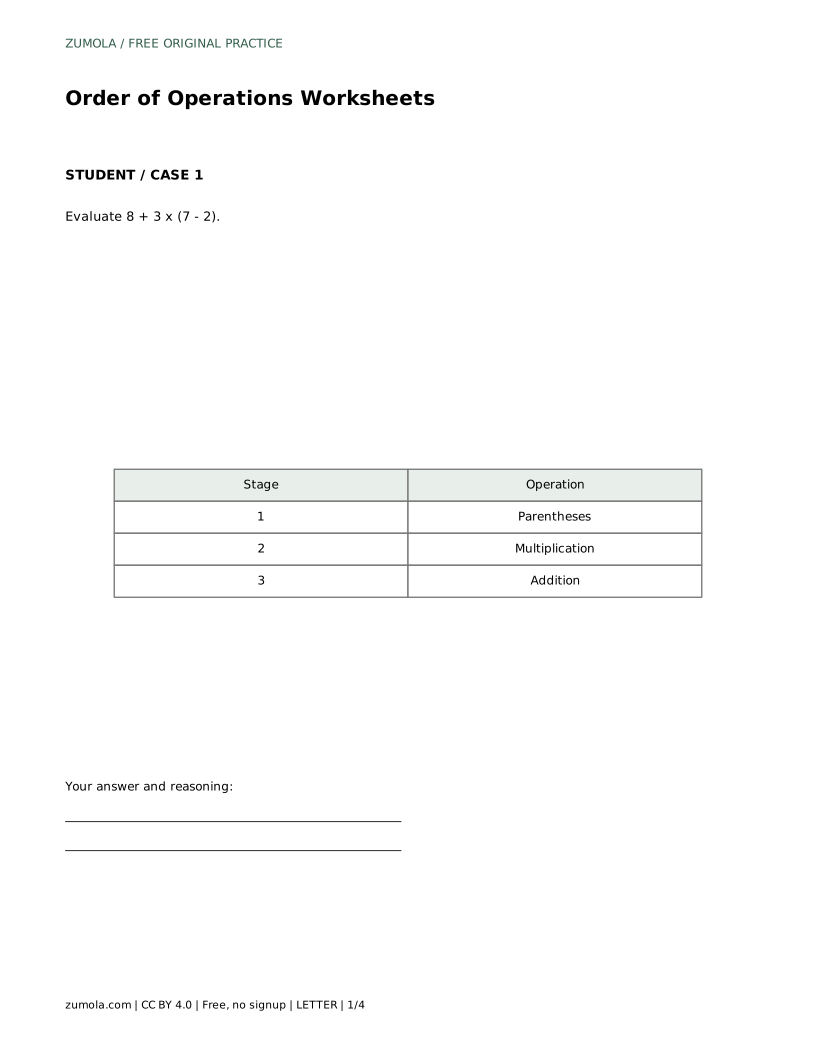
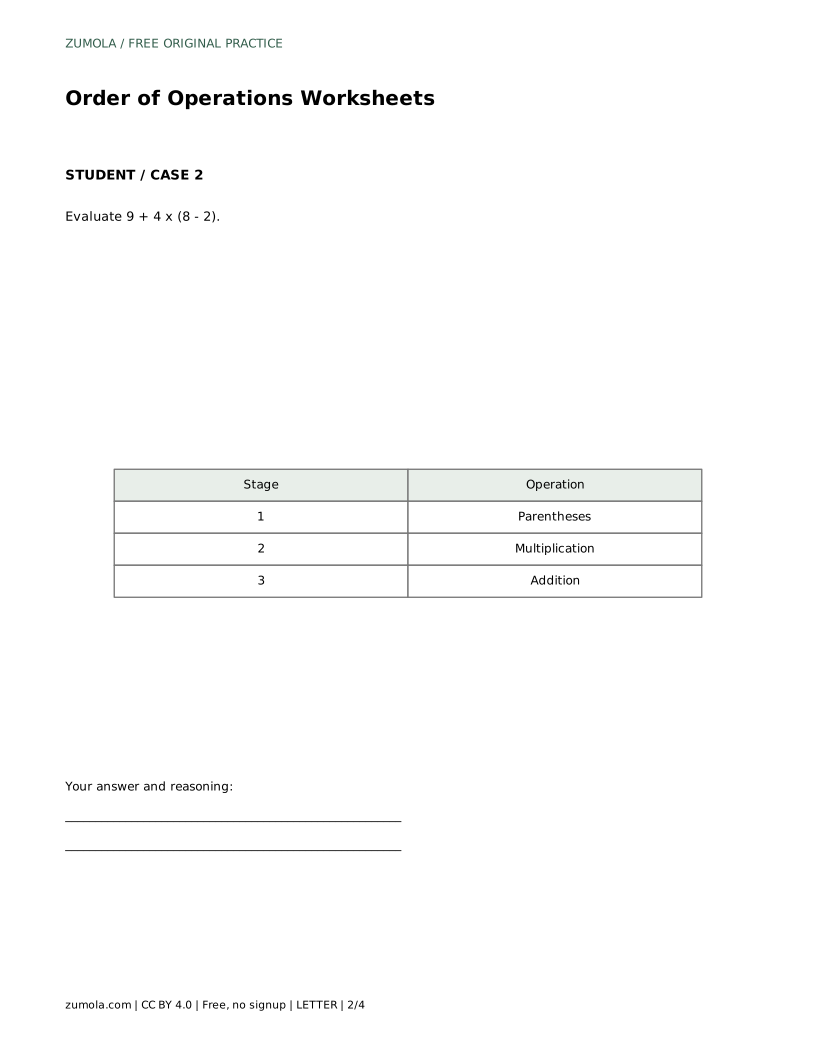
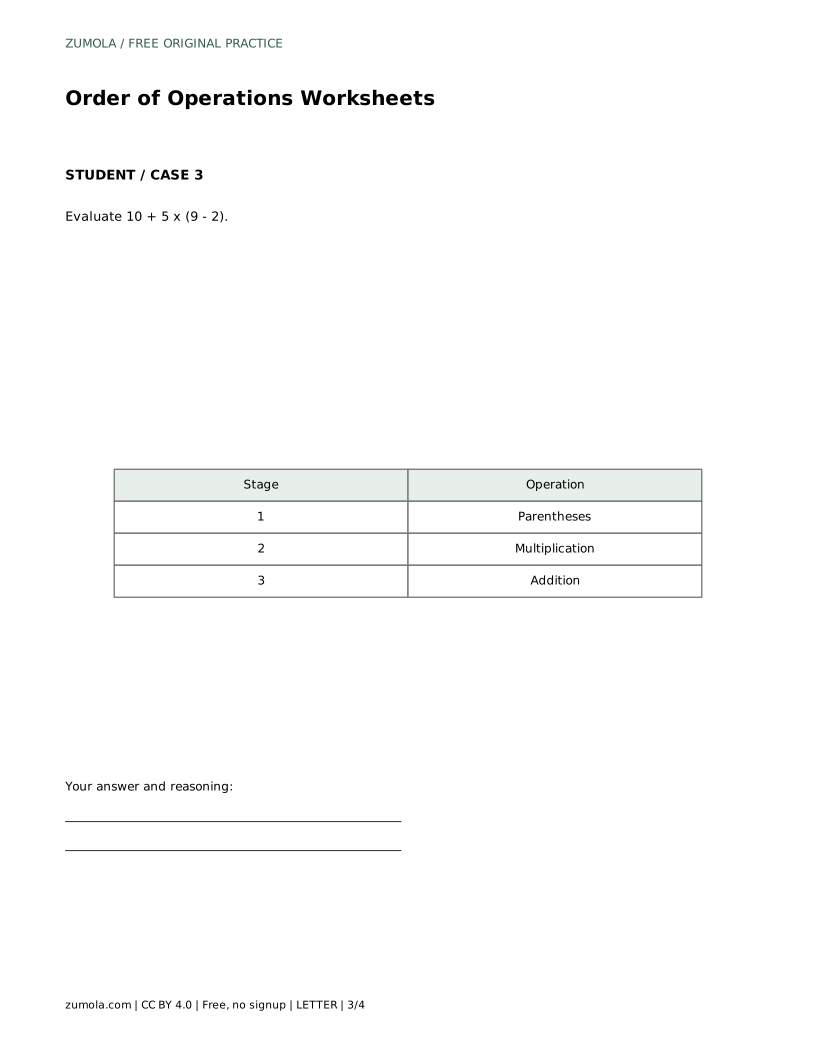
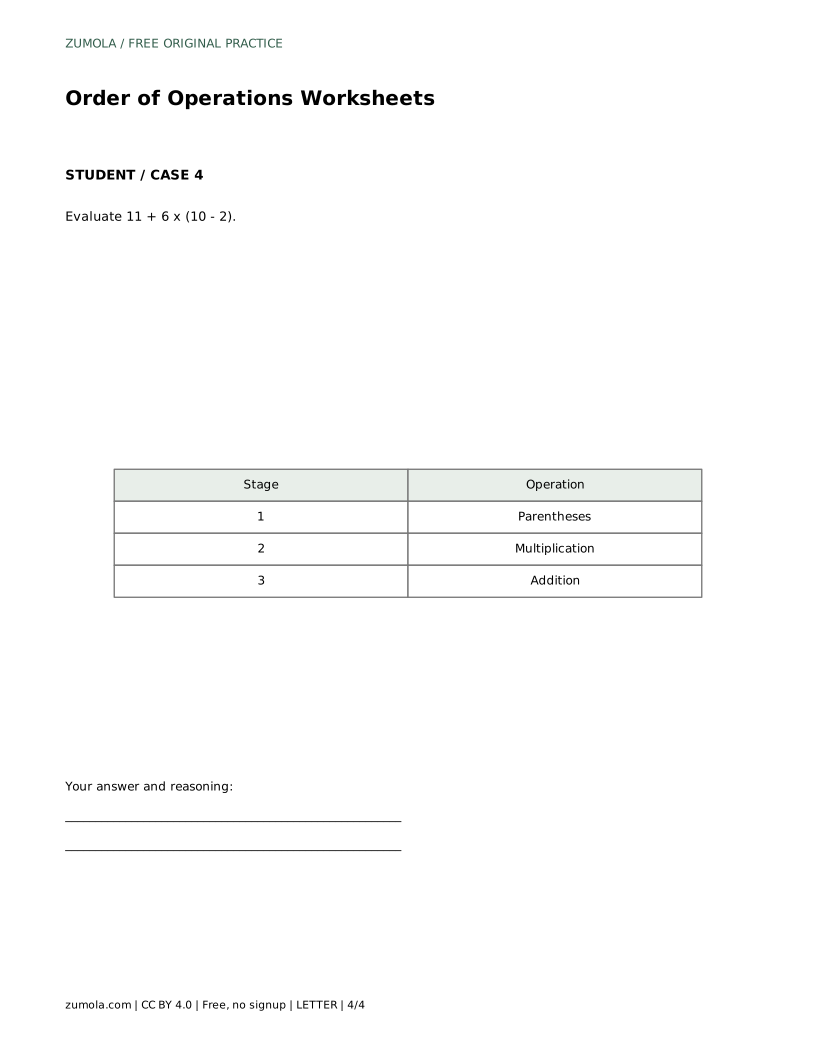
Reference diagrams
LETTER · Download PDF
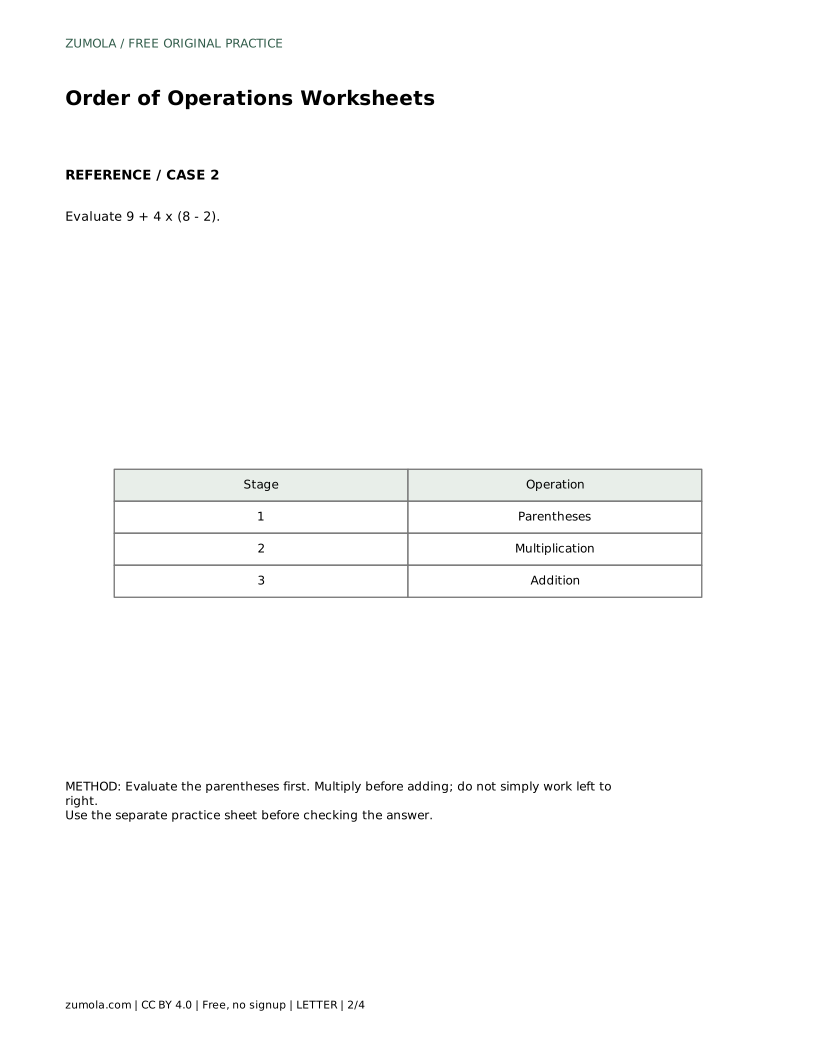
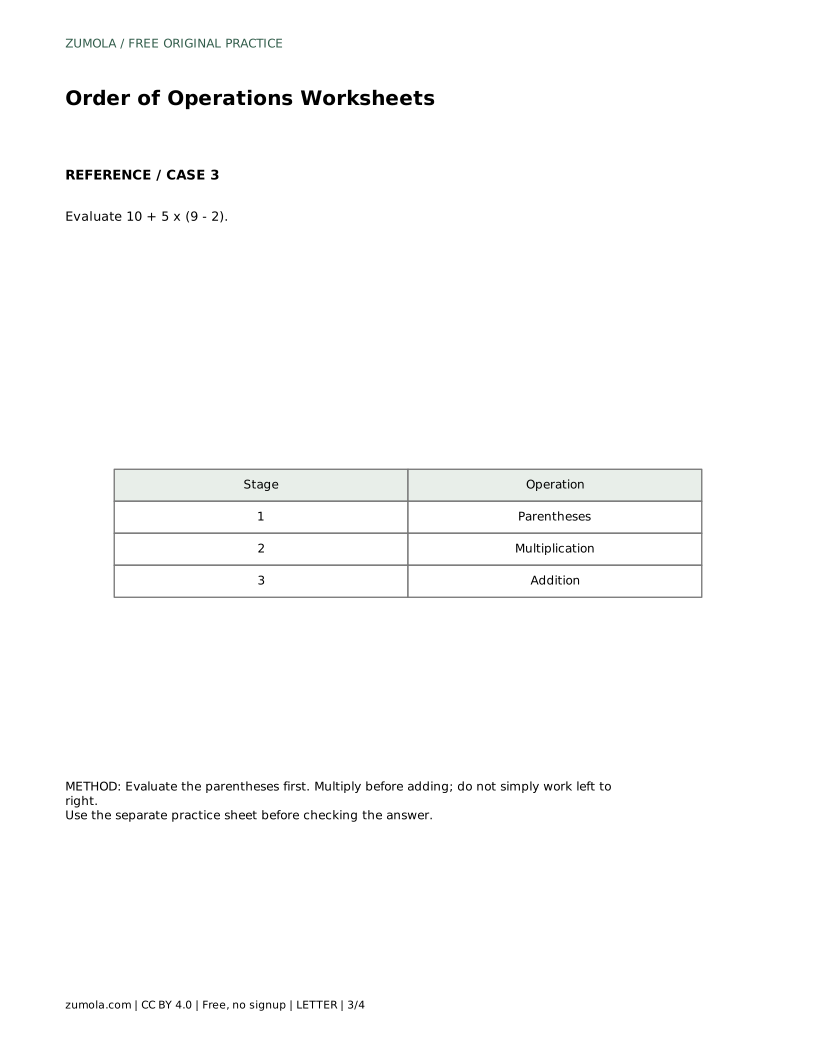
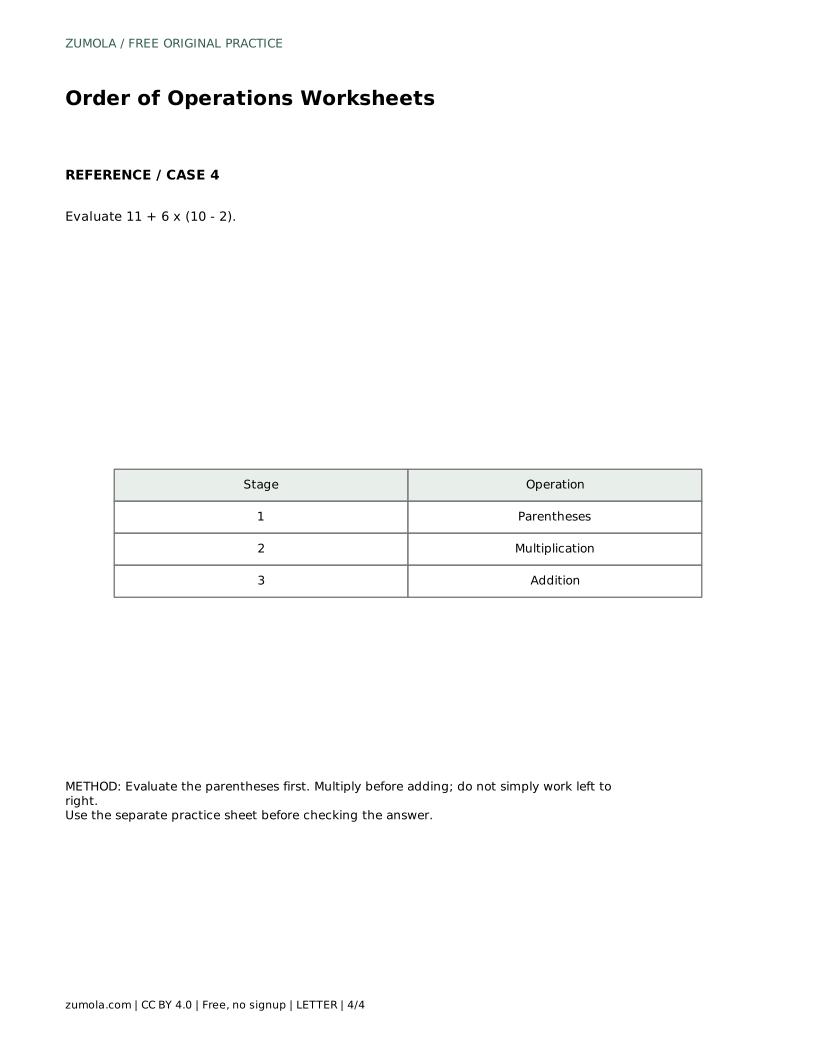
A4 · Download PDF
Free original resources
Teach the order of operations with printable practice. Work through parentheses first, then multiplication, then addition, using clear staged examples.
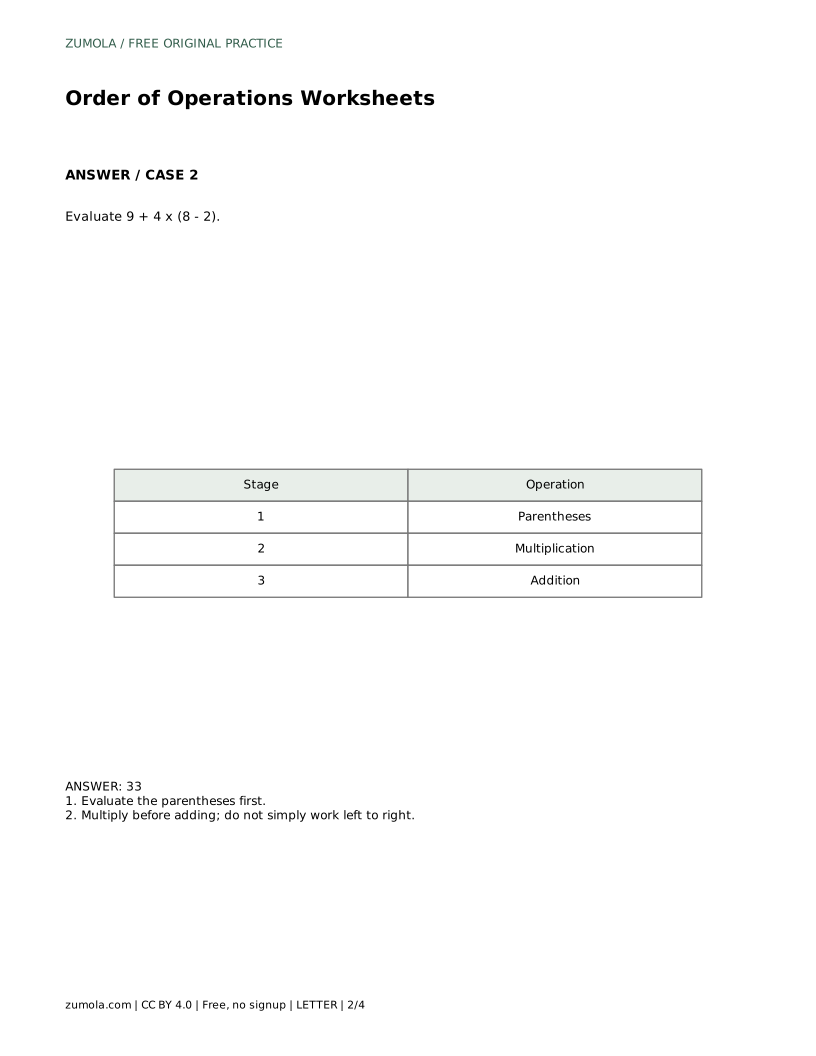
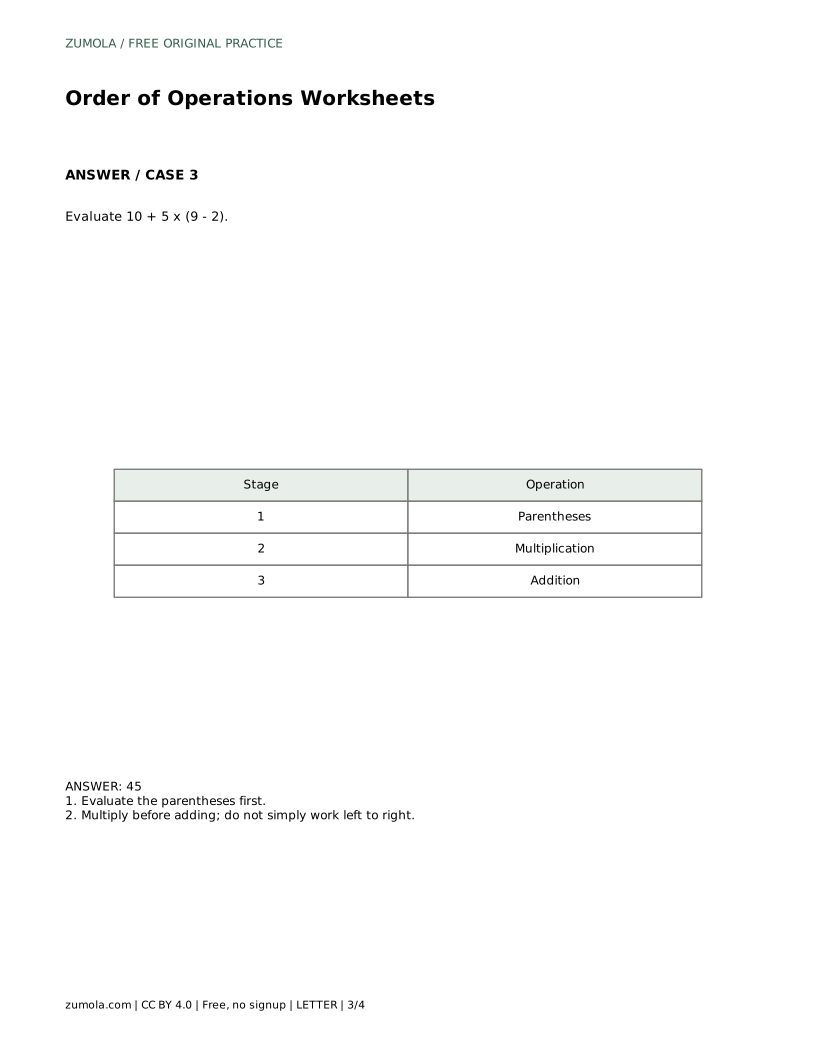
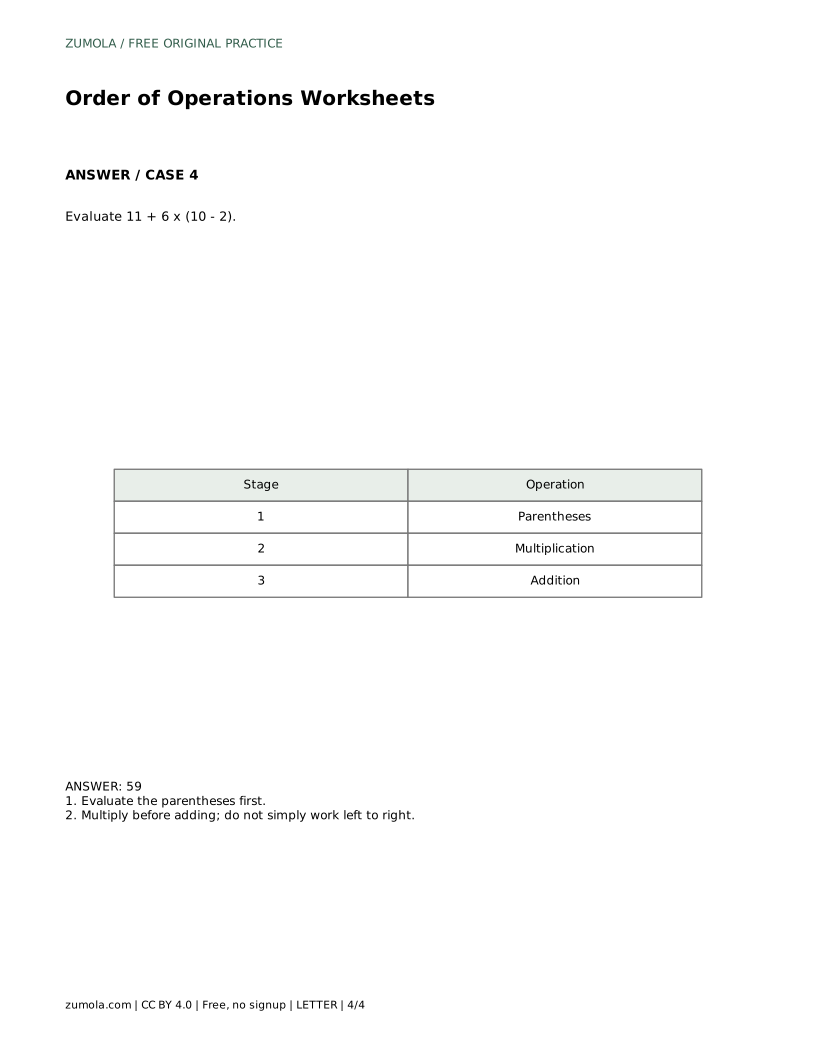
Four original cases, with reference diagrams, practice sheets and worked answers. Everything is free; no signup required.
LETTER · Download PDF
A4 · Download PDF
LETTER · Download PDF
A4 · Download PDF
LETTER · Download PDF
A4 · Download PDF
Use A4 or US Letter to match your printer. Use the stated values and conditions to solve each exercise; diagrams are not physical measuring rulers.
Order of operations worksheets give students a reliable routine for expressions with more than one operation. The core idea is simple: some operations change an expression more than others, so they are handled in a set order. In the pattern used here, parentheses come first, multiplication comes next, and addition comes last. This page explains that sequence, shows a fully worked example, and describes how to check answers so students build accuracy rather than guessing left to right.
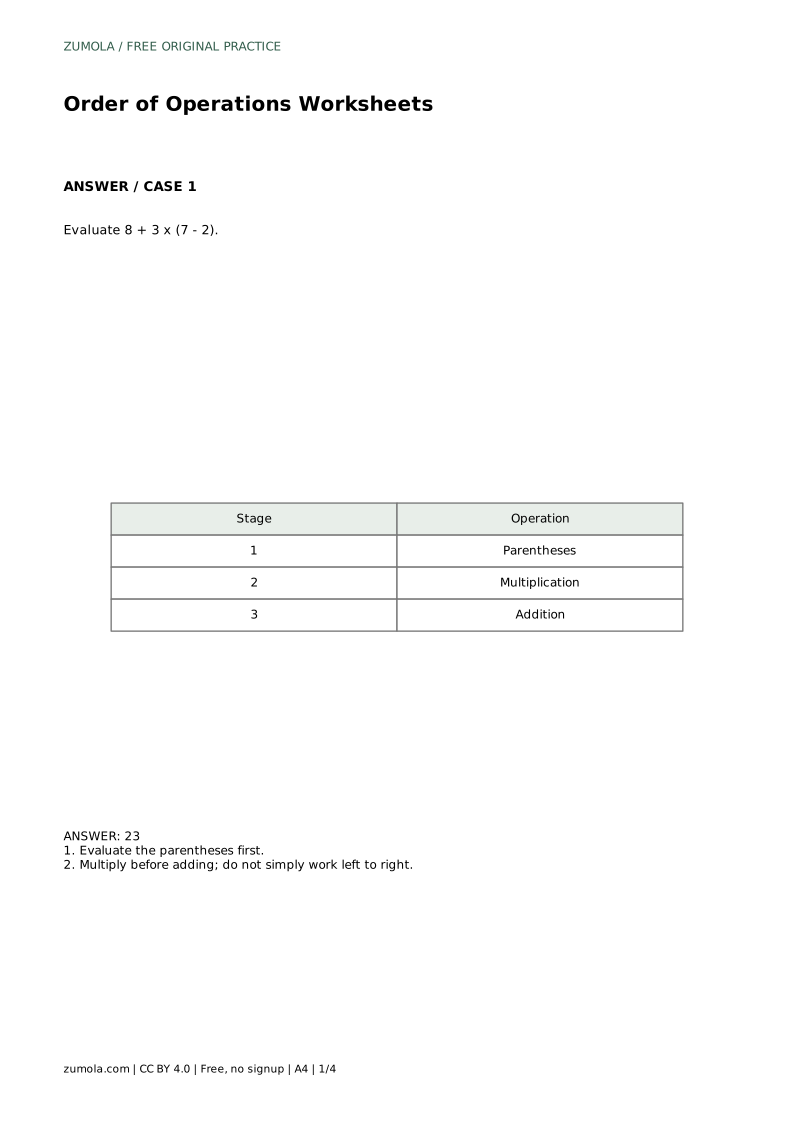
An expression such as 8 + 3 x (7 - 2) contains three operations: addition, multiplication, and subtraction inside parentheses. If you read strictly left to right, you would add 8 and 3 first, then multiply, then subtract, and get a different result. The standard order prevents that ambiguity. Parentheses group a quantity that must be settled before it is used elsewhere. Multiplication then combines that quantity with its factor. Addition finishes the job.
The order is not a trick or a preference; it is a shared convention so that everyone evaluating the same expression reaches the same number. When students understand the reason, they stop treating the rules as arbitrary and start seeing parentheses as packaging that keeps a value together.
A useful habit is to rewrite the expression after each stage rather than trying to hold every step in your head. Copy the expression, resolve the parentheses, and write the new line beneath it. Then resolve multiplication, and write another line. The final line is the answer. This staged record makes errors visible and gives a teacher or peer something concrete to check.
Keep the units and symbols intact as you rewrite. If a stage produces a value, substitute it exactly where the parentheses were, so the structure of the expression stays clear. Students who rewrite carefully make fewer sign and copying mistakes.
Checking is part of the skill, not an extra. Re-evaluate the parentheses independently, then confirm the multiplication, then the addition. If any stage disagrees with your written line, the error is usually in that stage rather than in the final sum. A second check is to estimate: the parenthesized value is small, the product is moderate, and the final answer should be a little larger than the product.
Because order-of-operations tasks have one correct numerical value, answers can be verified exactly. That makes these worksheets well suited to self-checking, provided students show each stage rather than only the final number.
Art and diagram tasks elsewhere on the site may have several valid outcomes, but numerical order-of-operations work has a single correct value, so mark it against the staged reasoning rather than appearance.
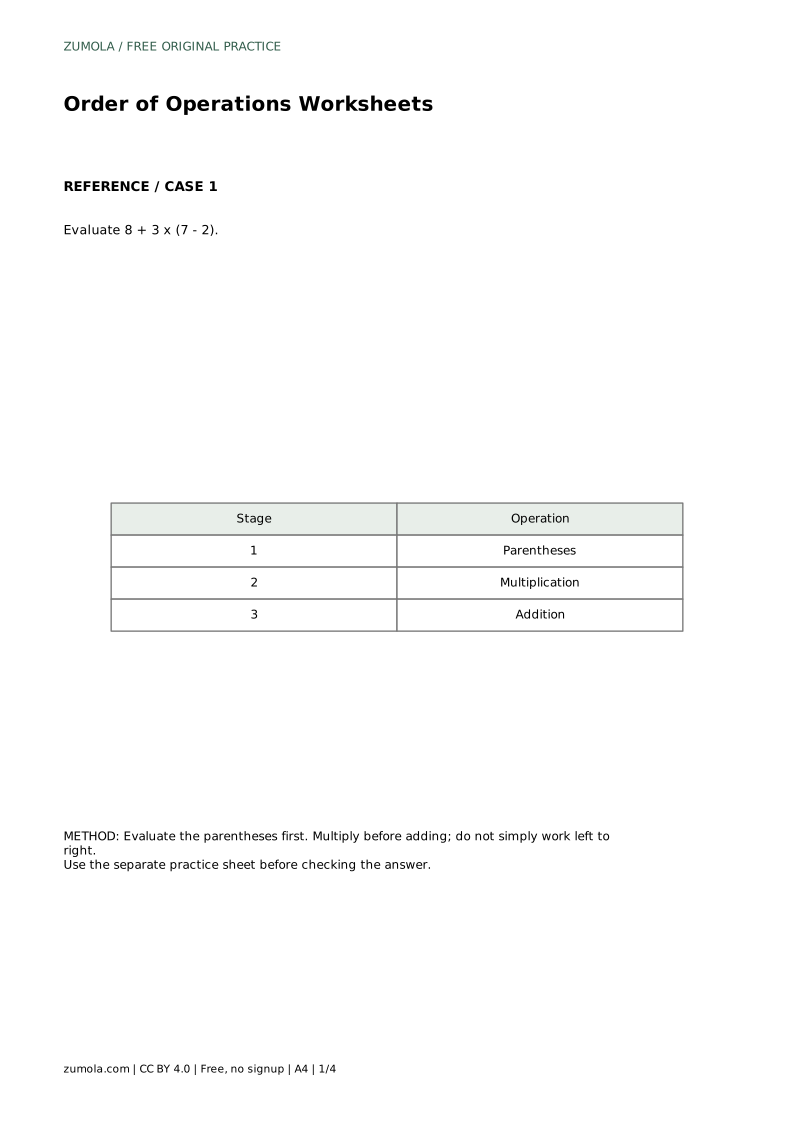
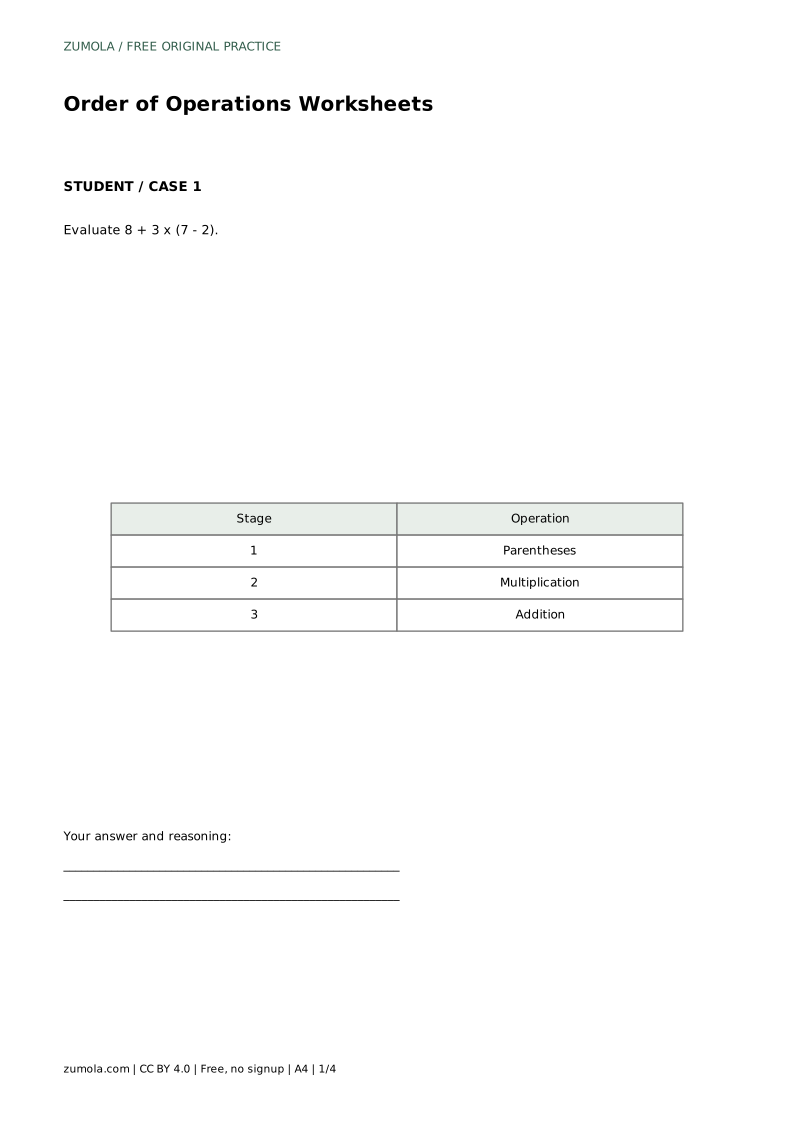
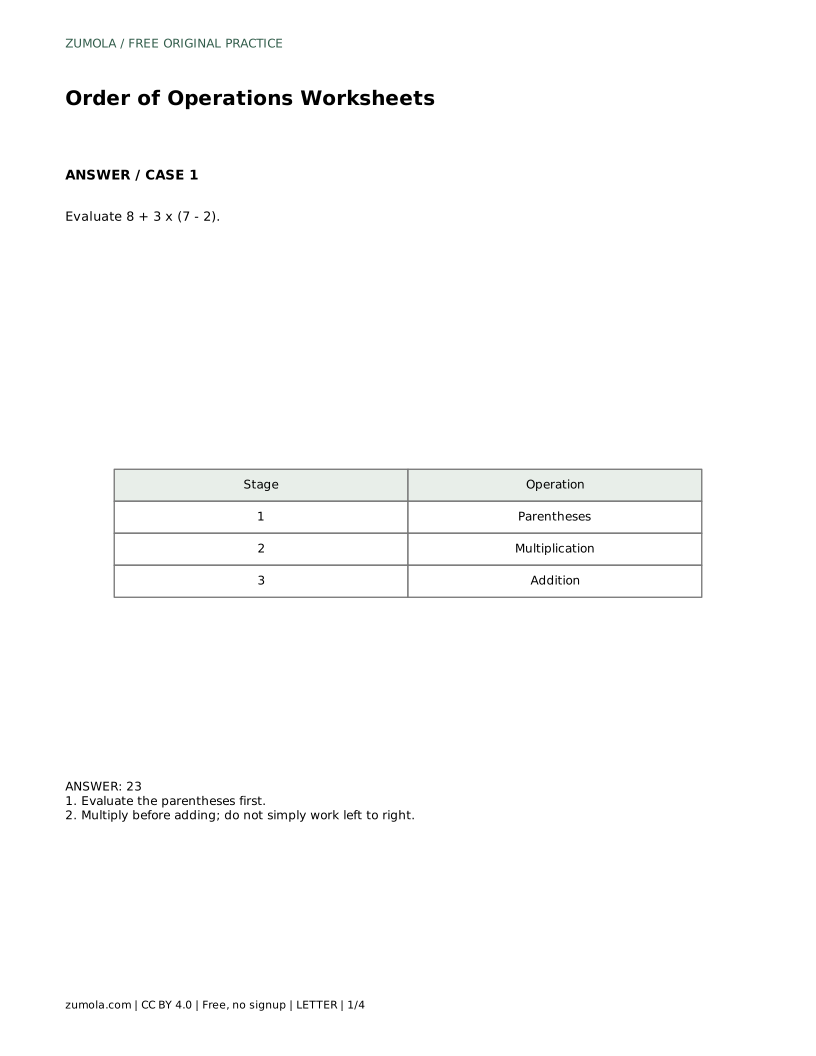
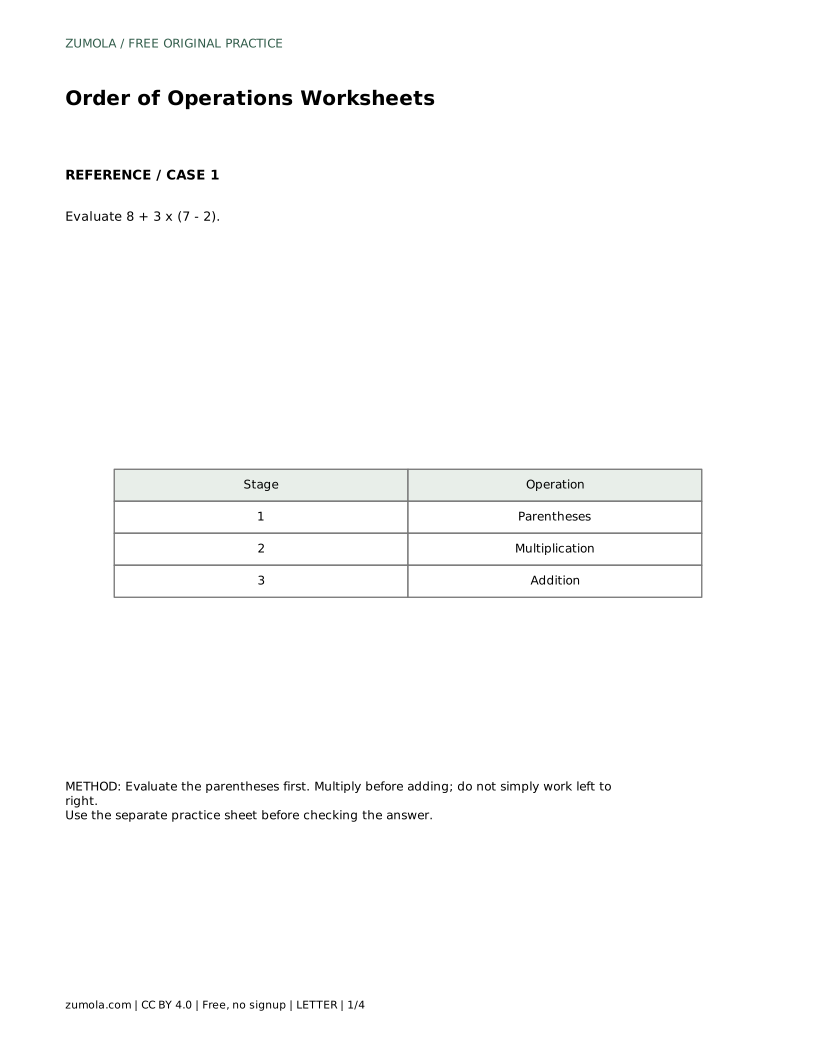
Evaluate 8 + 3 x (7 - 2).
23 Evaluate the parentheses first. Multiply before adding; do not simply work left to right.
Yes, in the standard order used here, multiplication is performed before addition unless parentheses change the grouping.
Then begin with multiplication or division, then finish with addition or subtraction, working left to right within each level.
Recompute each stage separately and confirm the rewritten lines match; the final value should follow directly from the last stage.
All math worksheets · Free coordinate paper
Original resources · CC BY 4.0 · Free for personal and classroom use with attribution.