Reference diagrams
LETTER · Download PDF
A4 · Download PDF
Free original resources
Practice writing numbers such as 1200 and 0.025 in scientific notation, checking coefficients between 1 and 10, and reading exponents back to standard form.
Four original cases, with reference diagrams, practice sheets and worked answers. Everything is free; no signup required.
LETTER · Download PDF
A4 · Download PDF
LETTER · Download PDF
A4 · Download PDF
LETTER · Download PDF
A4 · Download PDF
Use A4 or US Letter to match your printer. Use the stated values and conditions to solve each exercise; diagrams are not physical measuring rulers.

Scientific notation rewrites a number as a coefficient multiplied by a power of ten. The coefficient must be at least 1 and less than 10, and the exponent records how many powers of ten recover the original value. These worksheets give students structured practice moving between ordinary numbers and scientific notation, with attention to direction of movement, exponent signs, and checking the result by multiplication.
Scientific notation has two parts: a coefficient and a power of ten. The coefficient sits in the interval from 1 up to, but not including, 10. That means 1.2 and 9.7 are valid coefficients, while 12 and 0.97 are not. The exponent is an integer and may be positive, negative, or zero.
The exponent is not decoration. It states how many factors of ten are multiplied by the coefficient. A positive exponent produces a value of 10 or more, a negative exponent produces a value between 0 and 1, and an exponent of zero leaves the coefficient unchanged. Reading the exponent correctly is as important as writing it.
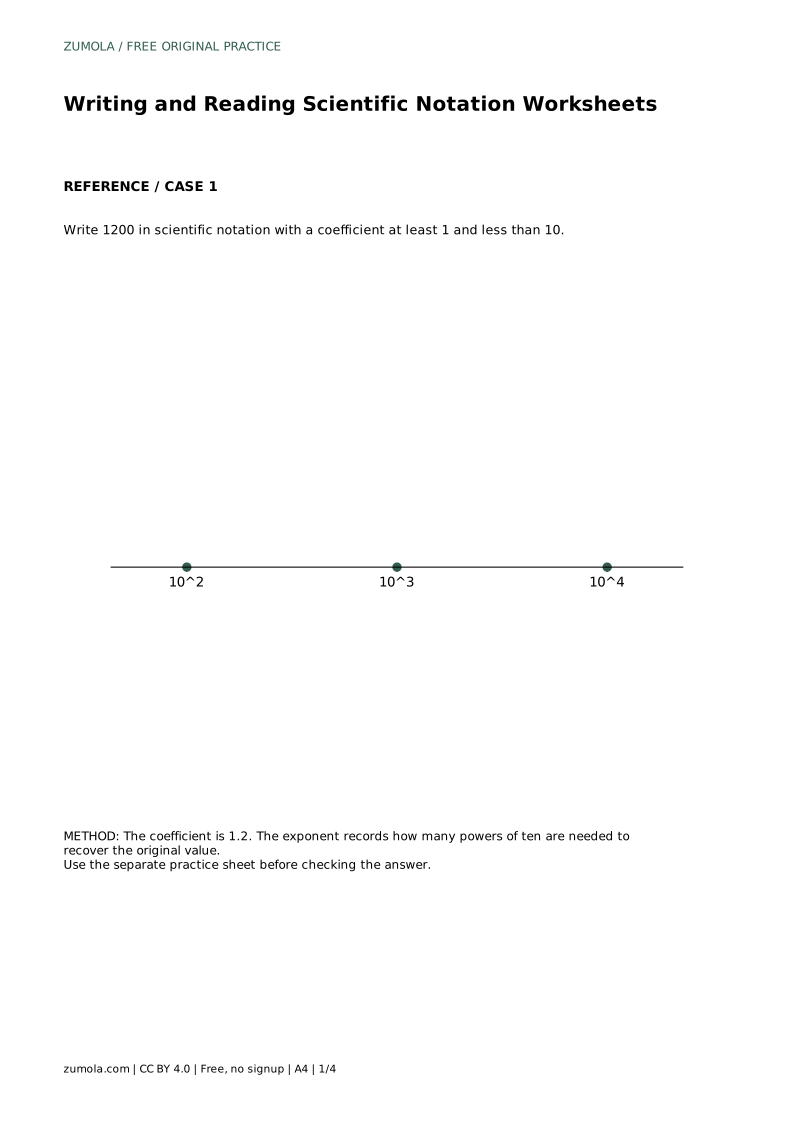
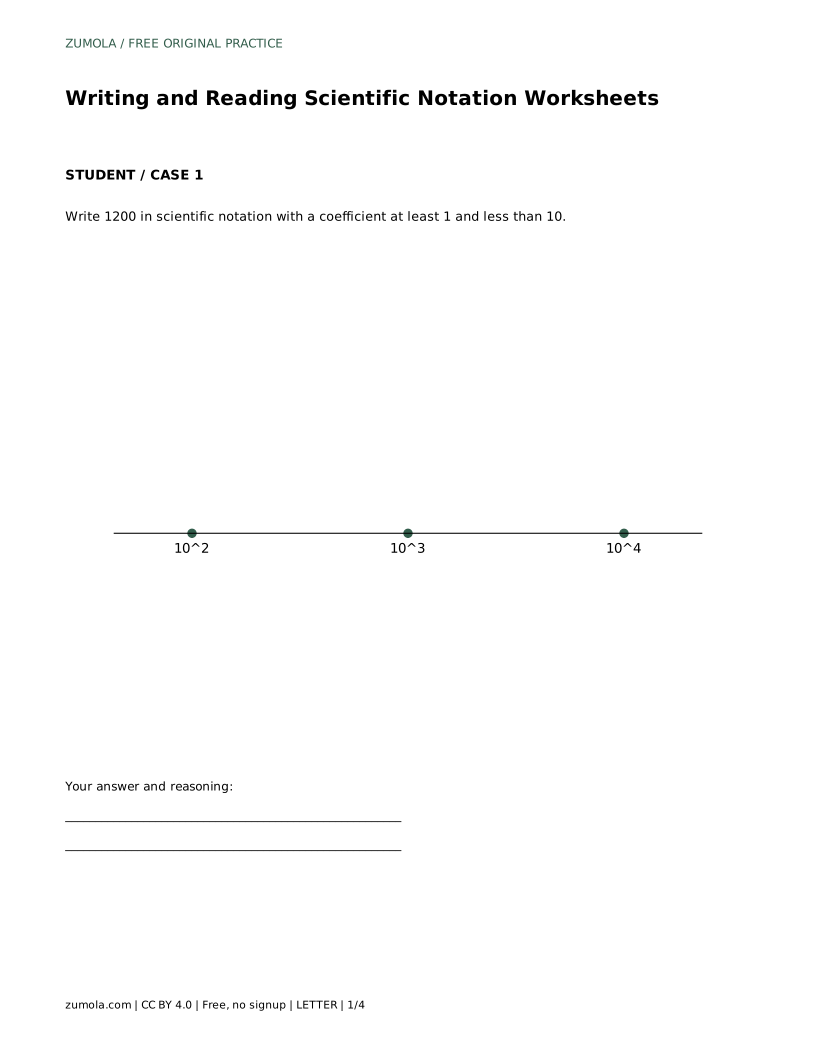
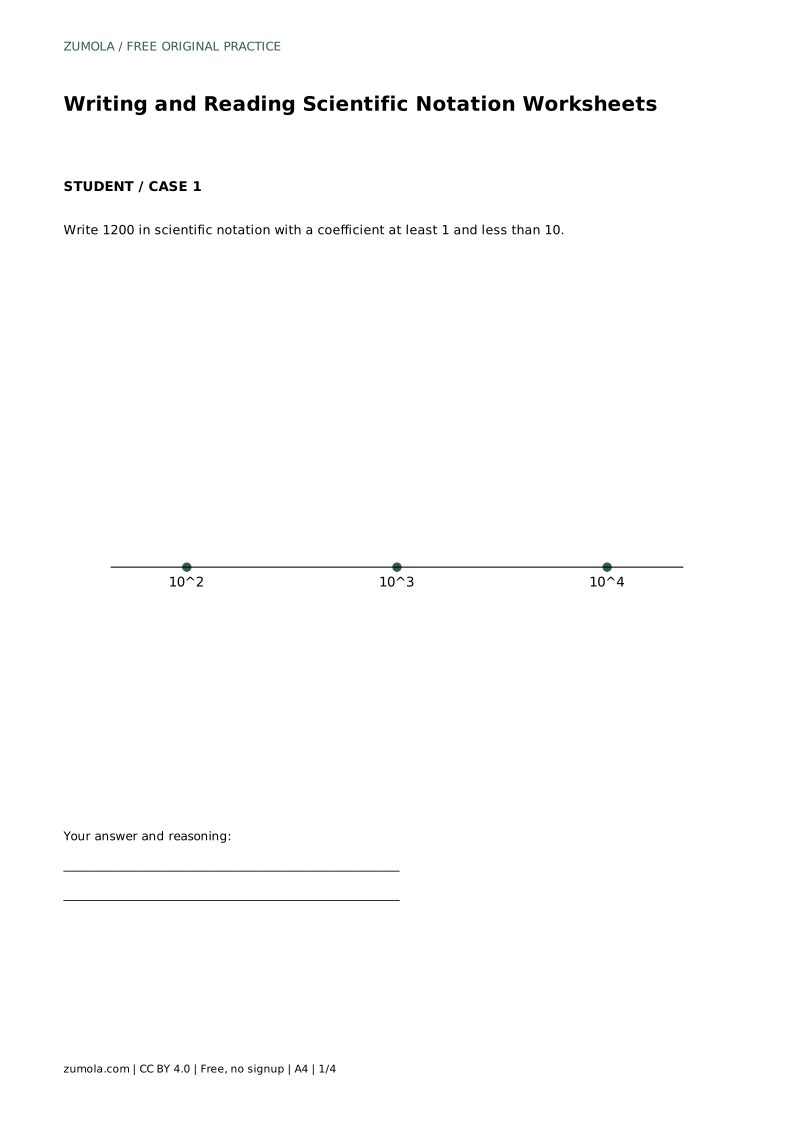
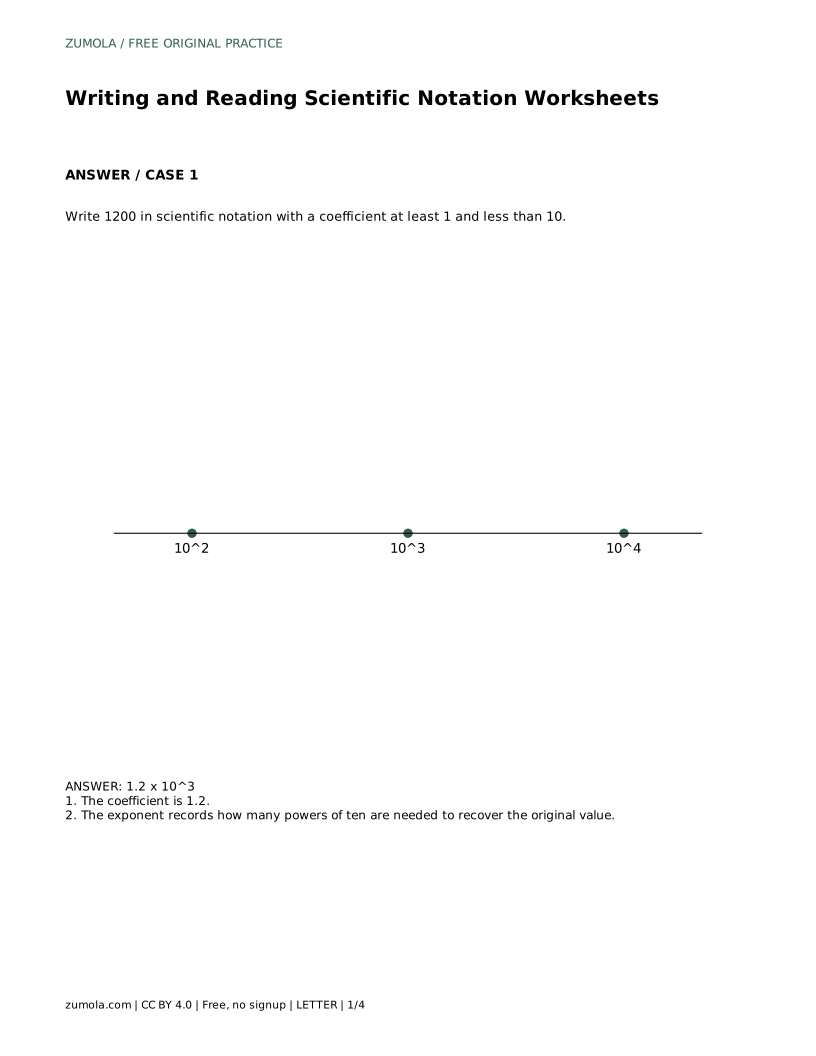
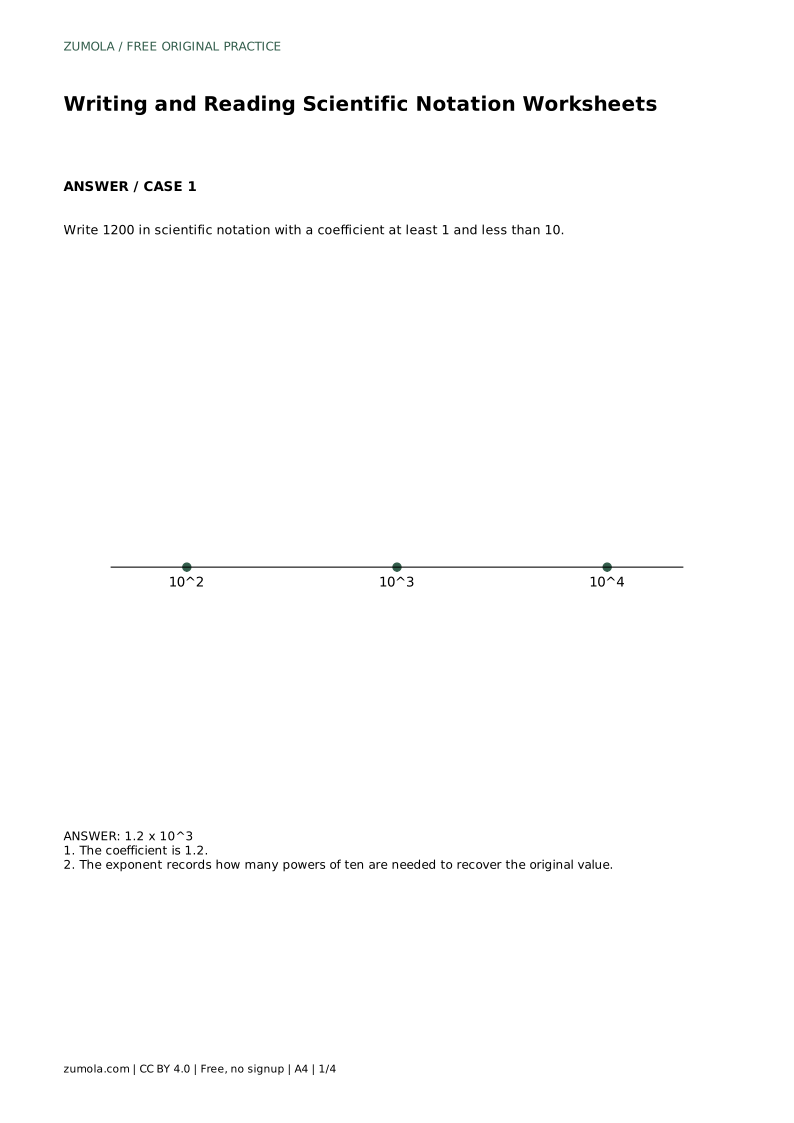
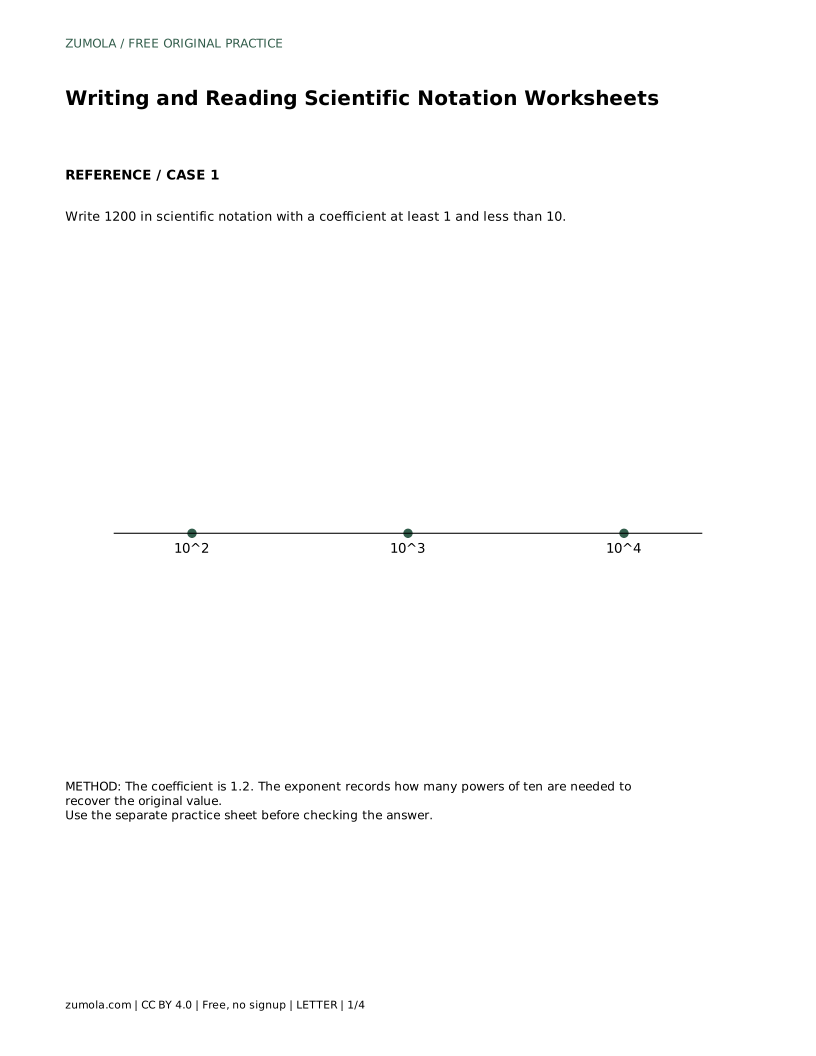
Start with 1200. The first nonzero digit is 1, so the coefficient begins as 1.2 after the decimal point is placed between 1 and 2. The decimal point moved three places from the end of 1200 to reach 1.2, so the exponent is 3. The result is 1.2 x 10^3.
A useful check is to multiply back: 1.2 x 10^3 means 1.2 x 1000, which equals 1200. If the check does not return the original number, either the coefficient or the exponent needs correction. Note that this case has a positive exponent because 1200 is greater than 10; other numbers may behave differently.
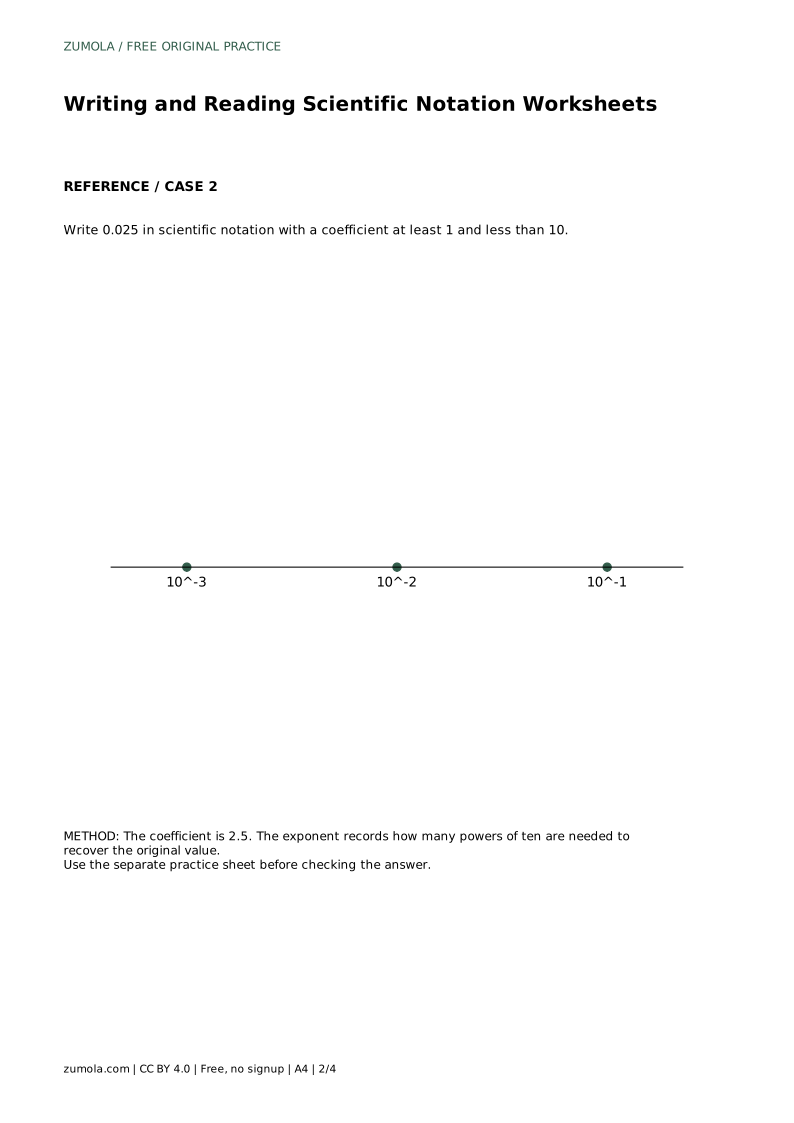
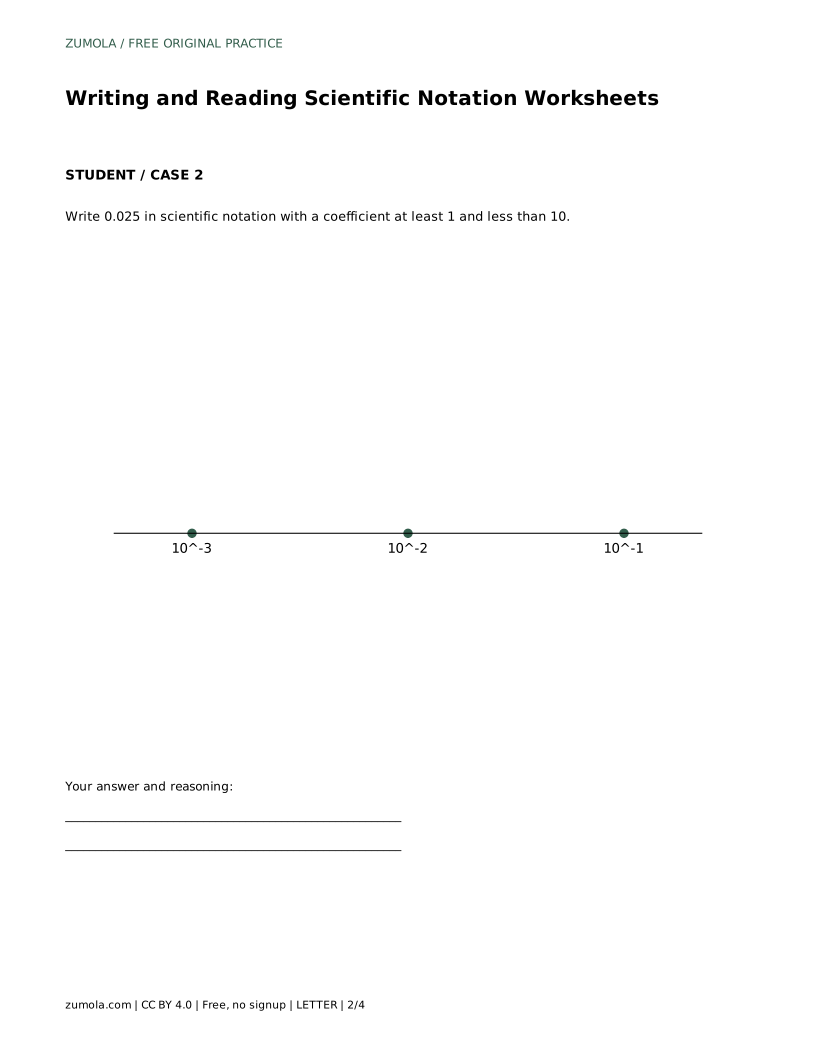
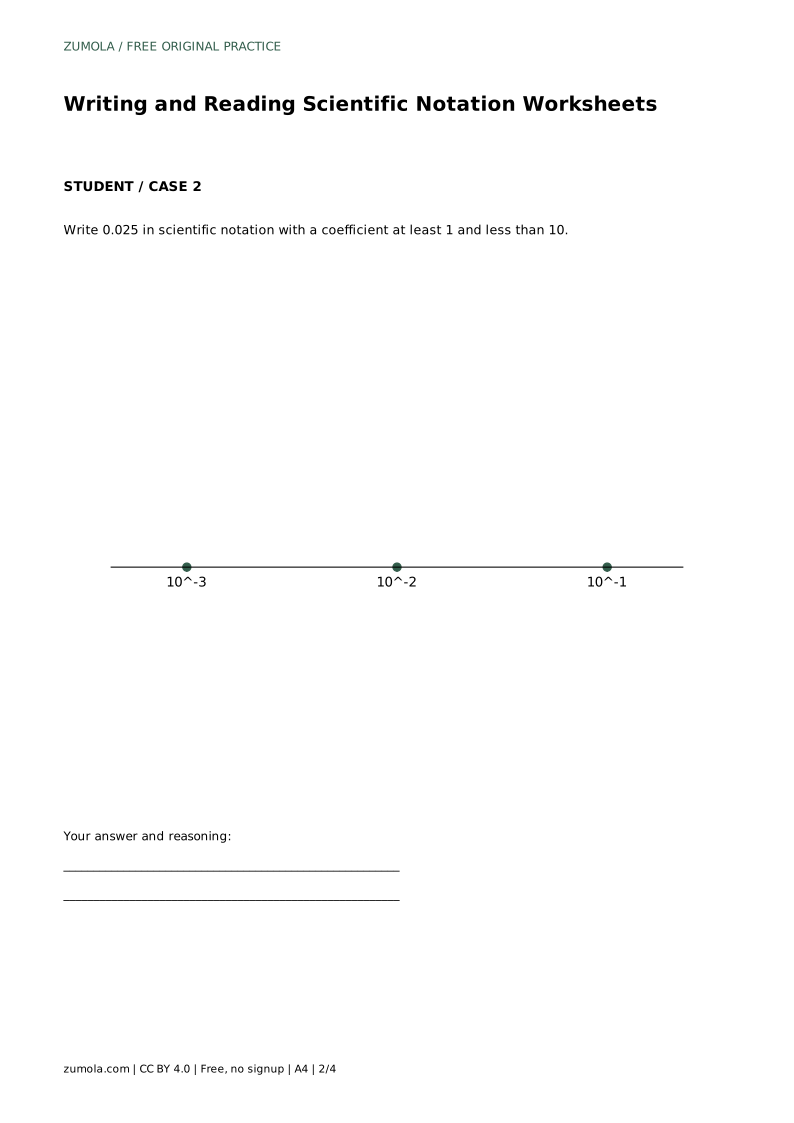
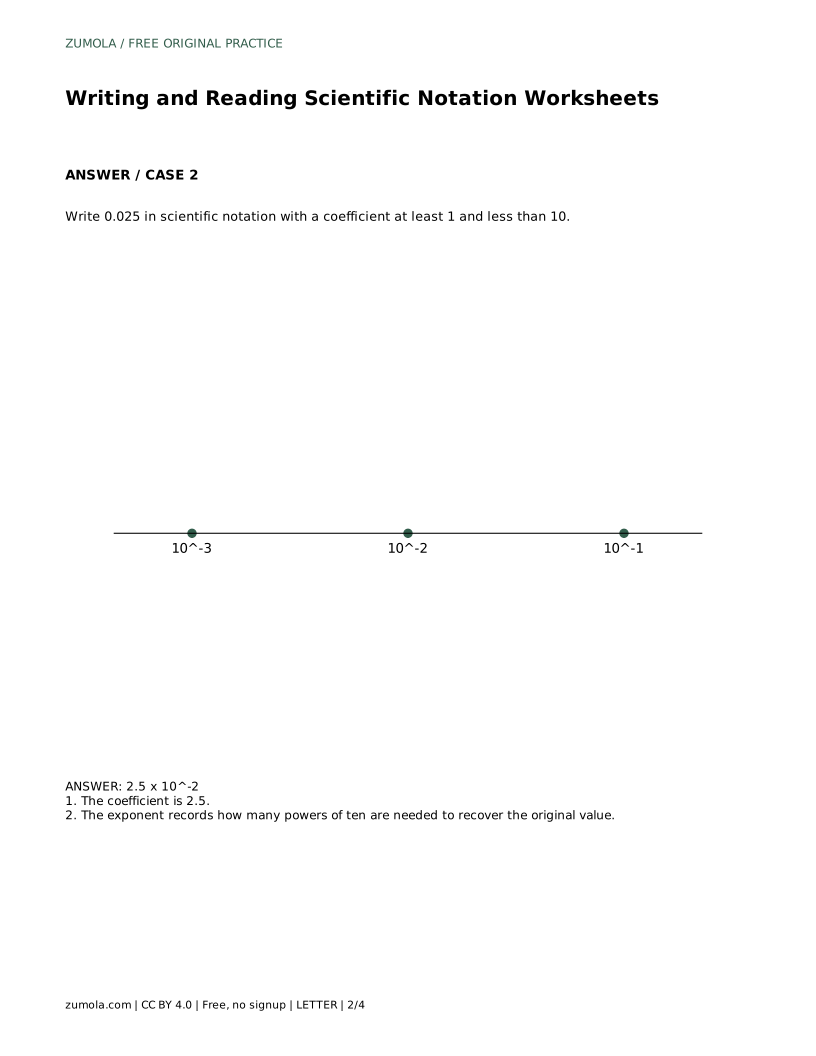
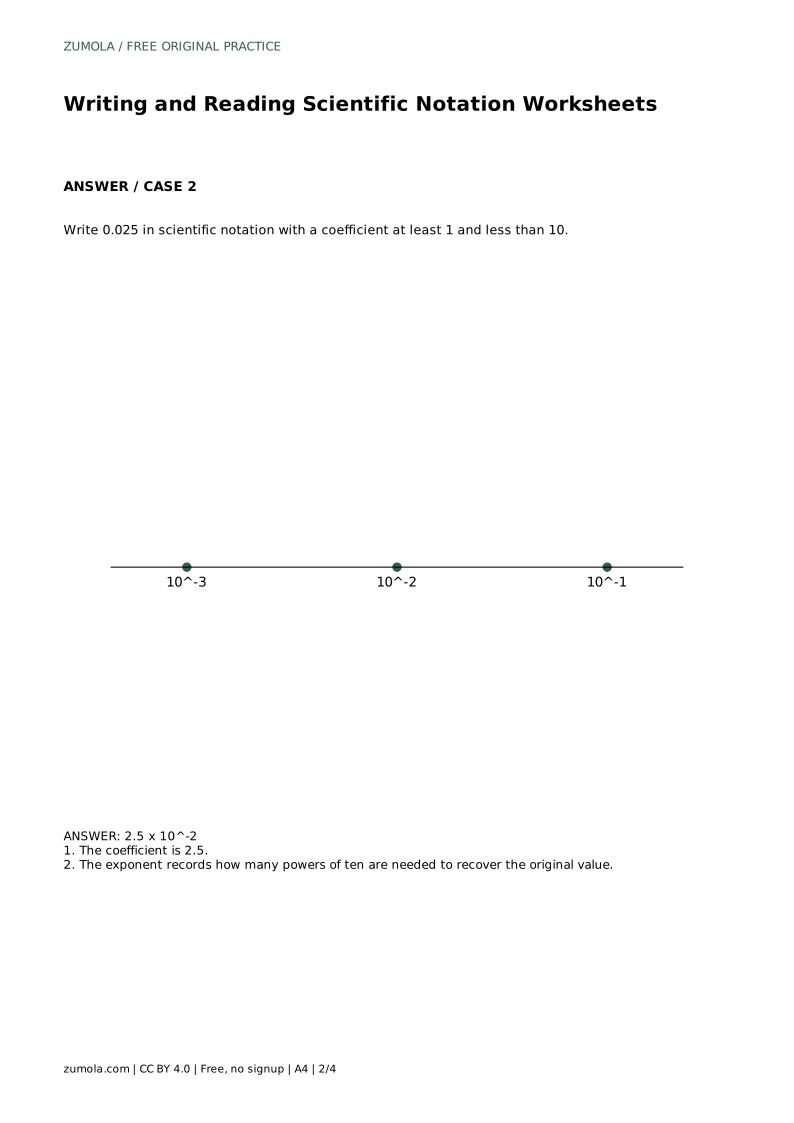
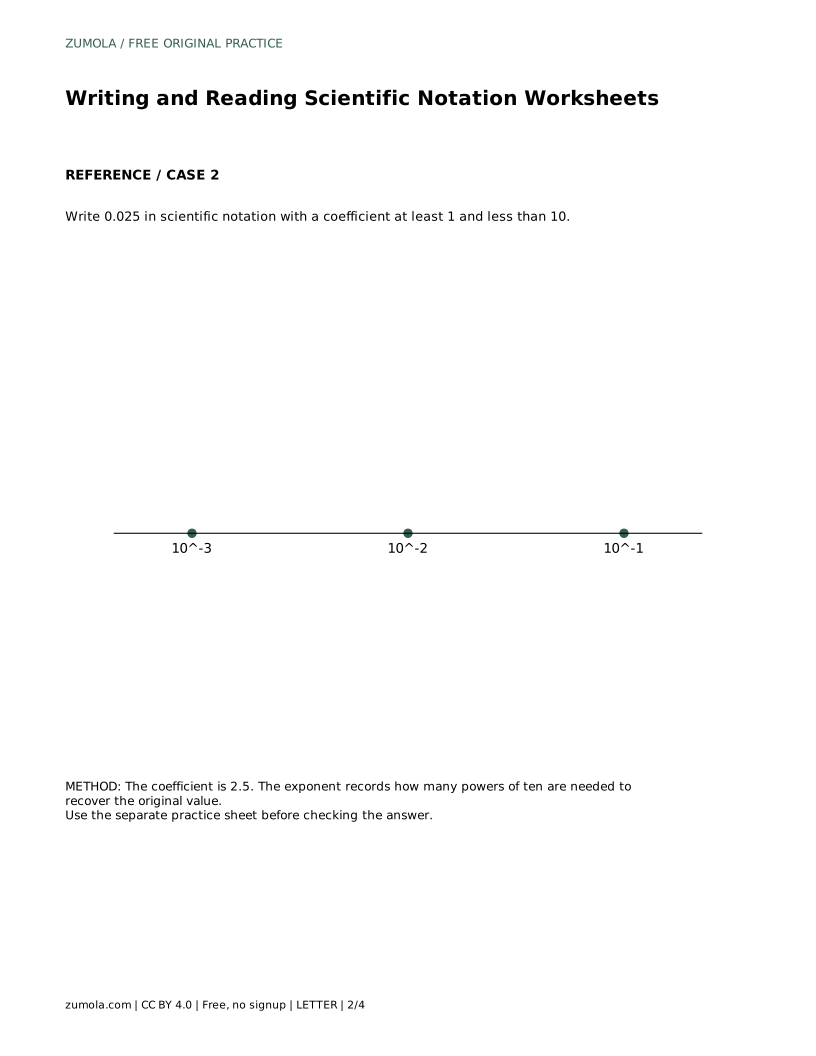
For a number such as 0.025, the first nonzero digit is 2. Moving the decimal point to the right of 2 gives 2.5. Because the decimal point moved two places to the right, the exponent is negative two, written as 2.5 x 10^-2. Multiplying 2.5 by 10^-2, which is 0.01, returns 0.025.
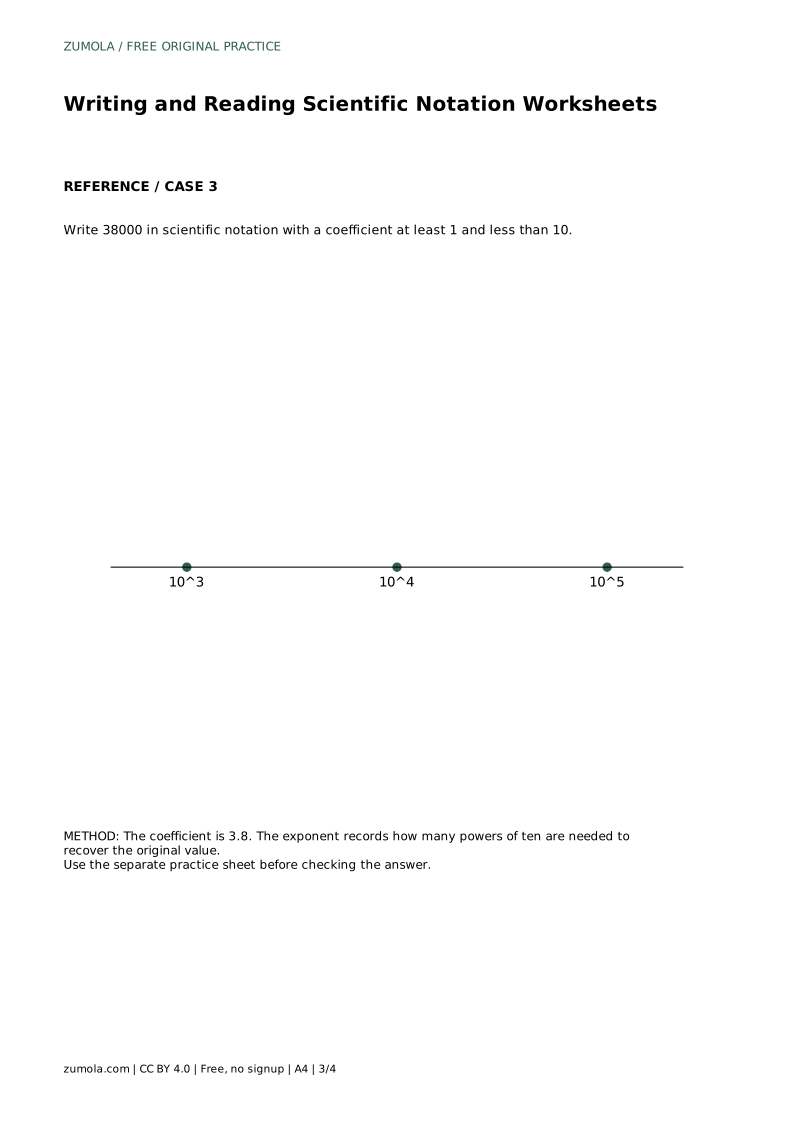
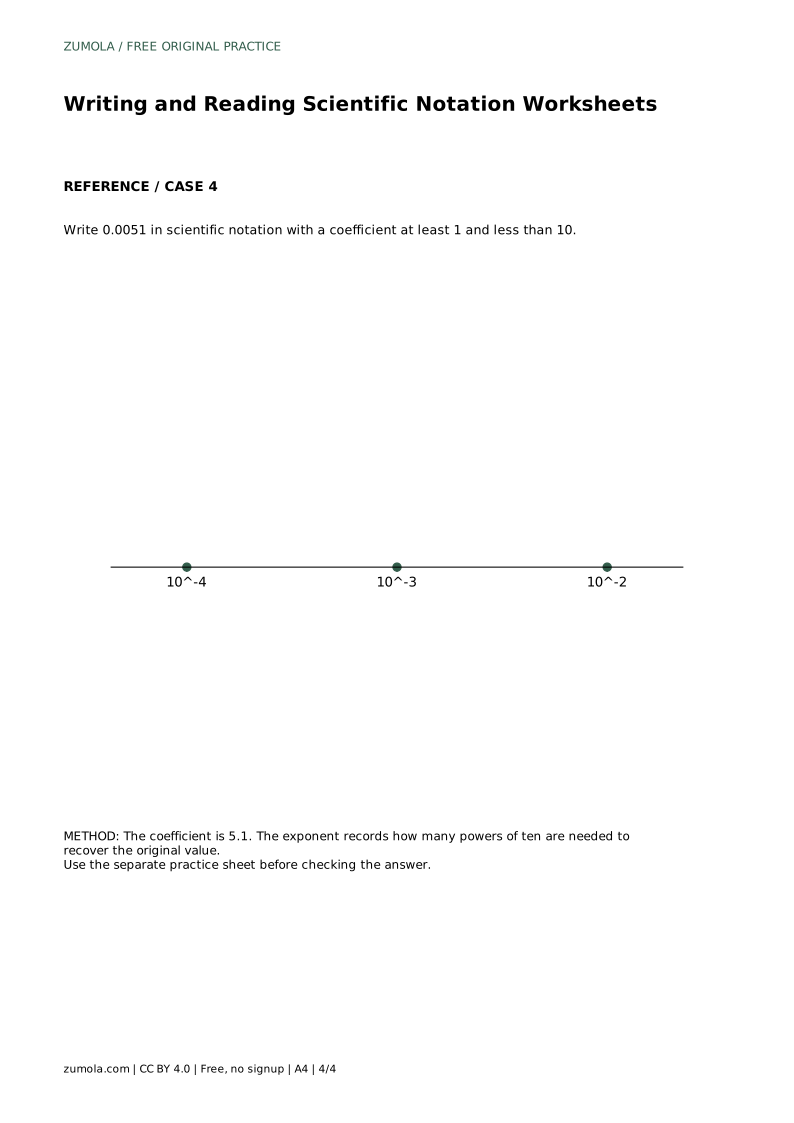
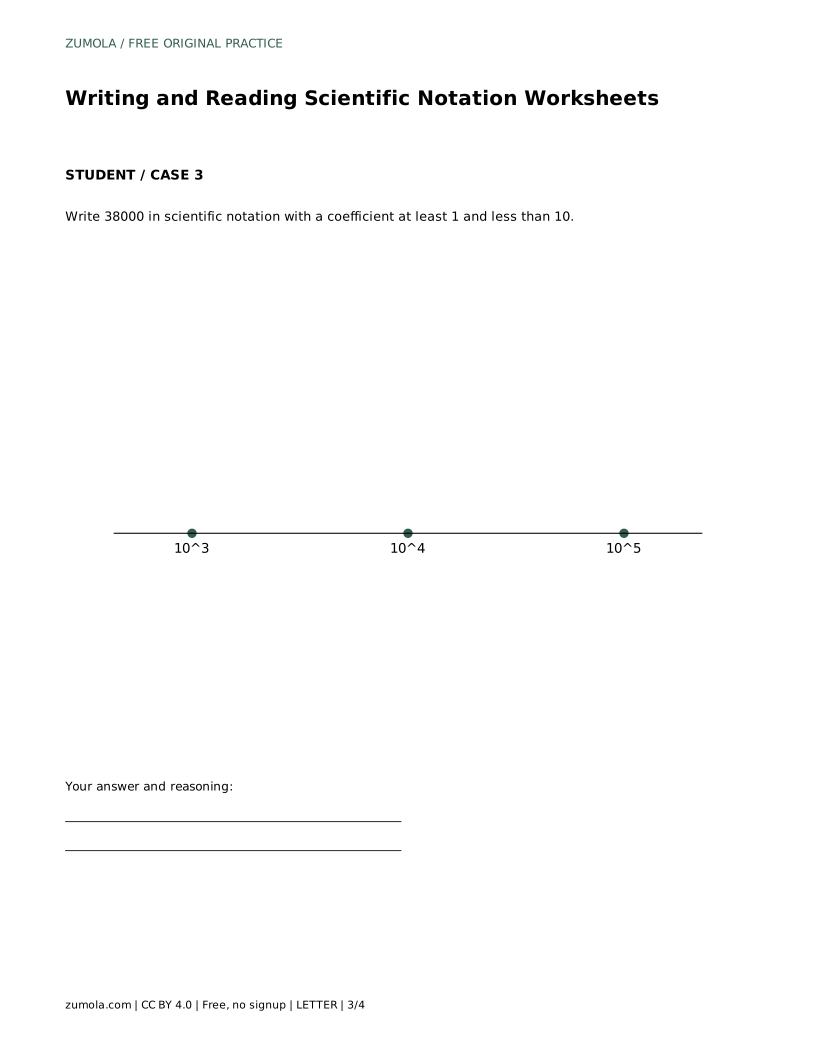
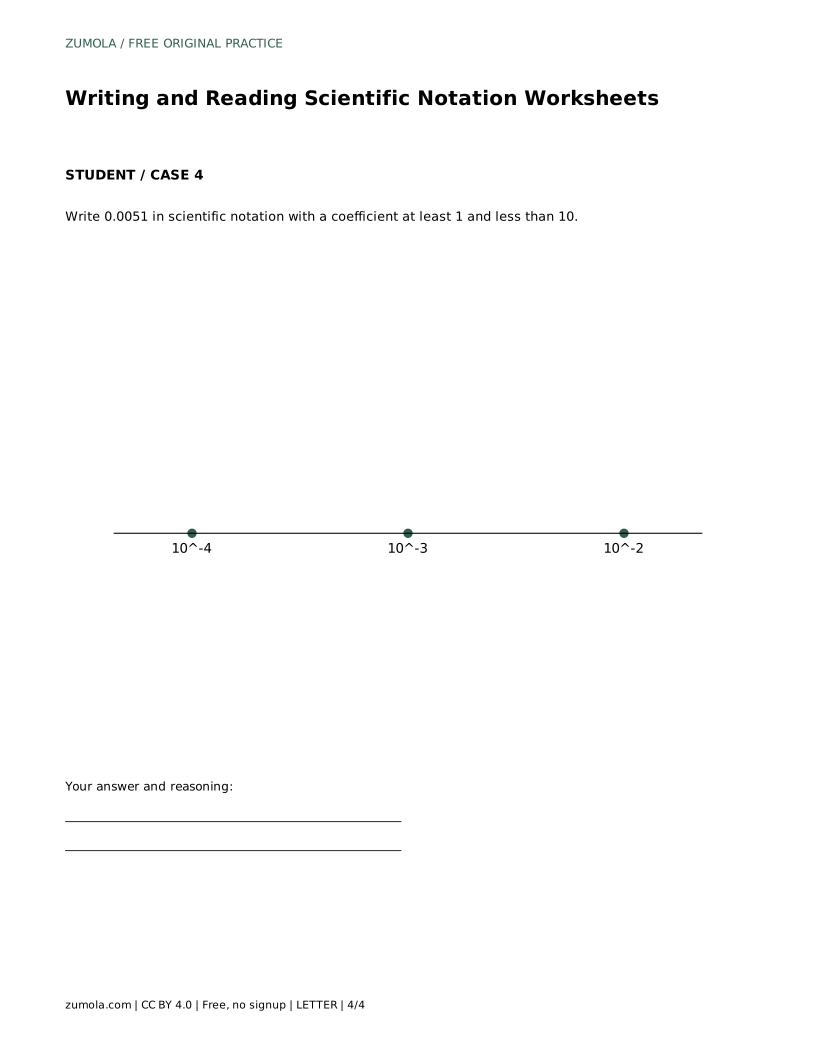
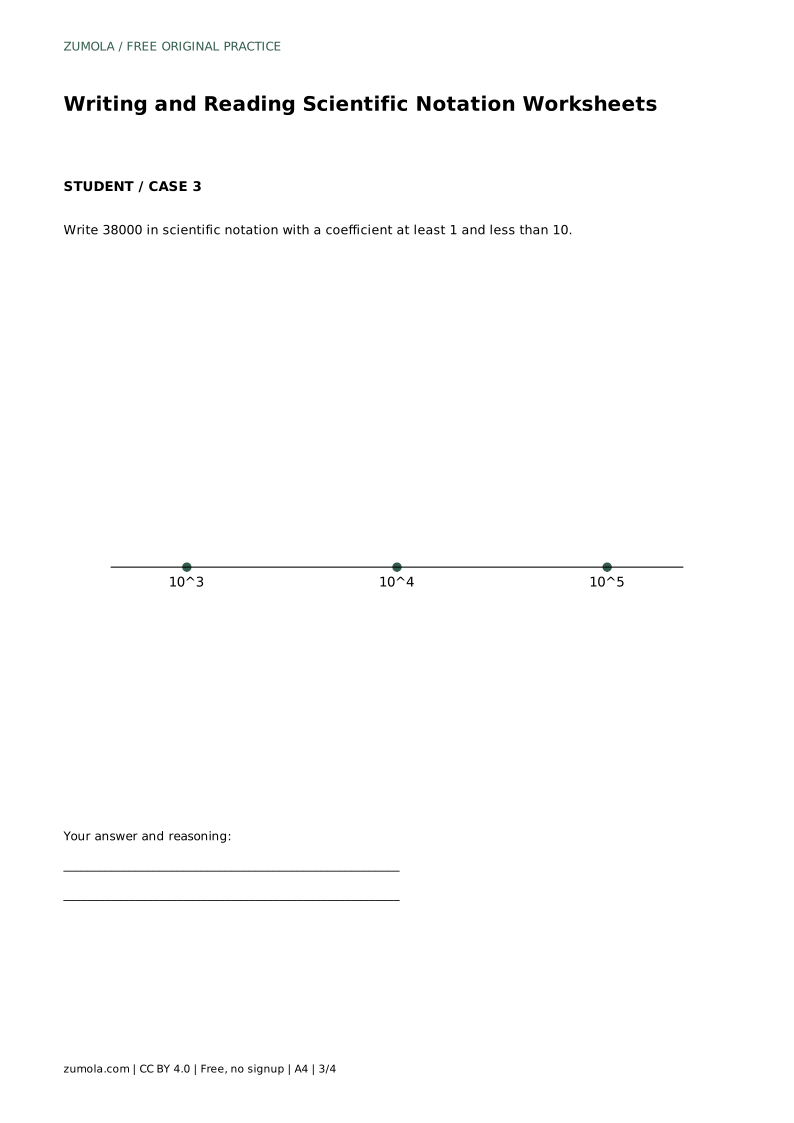
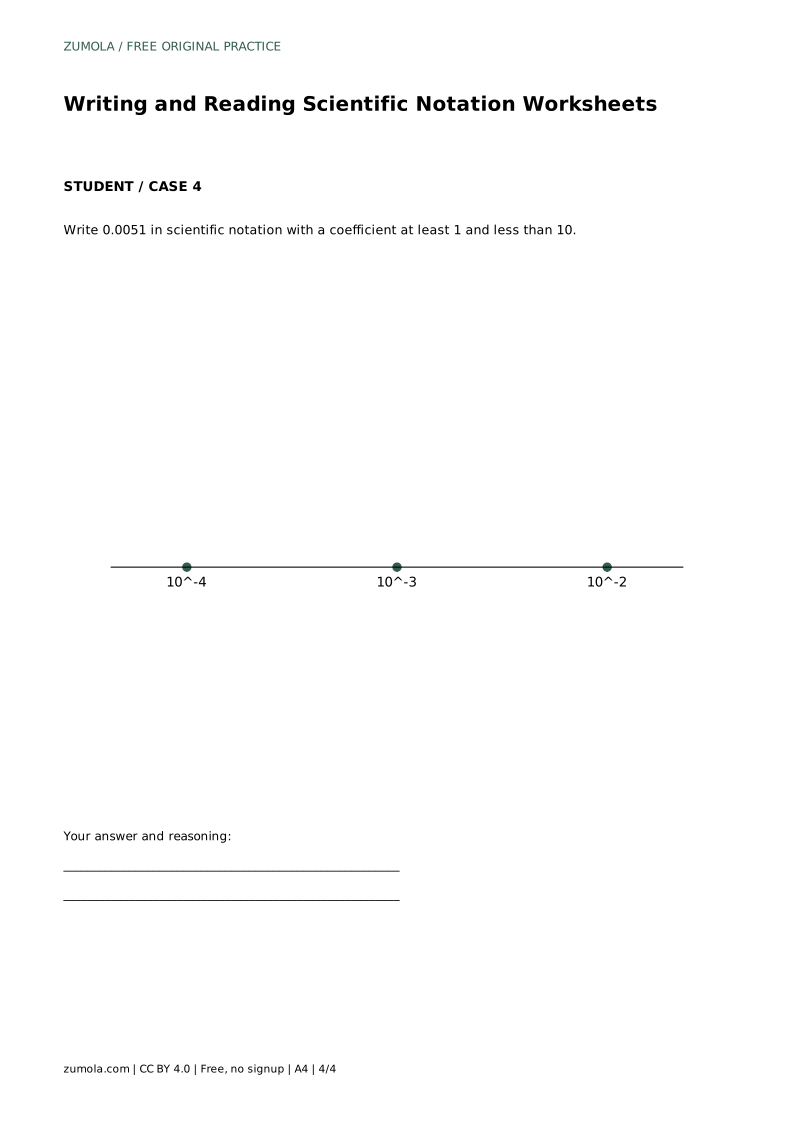
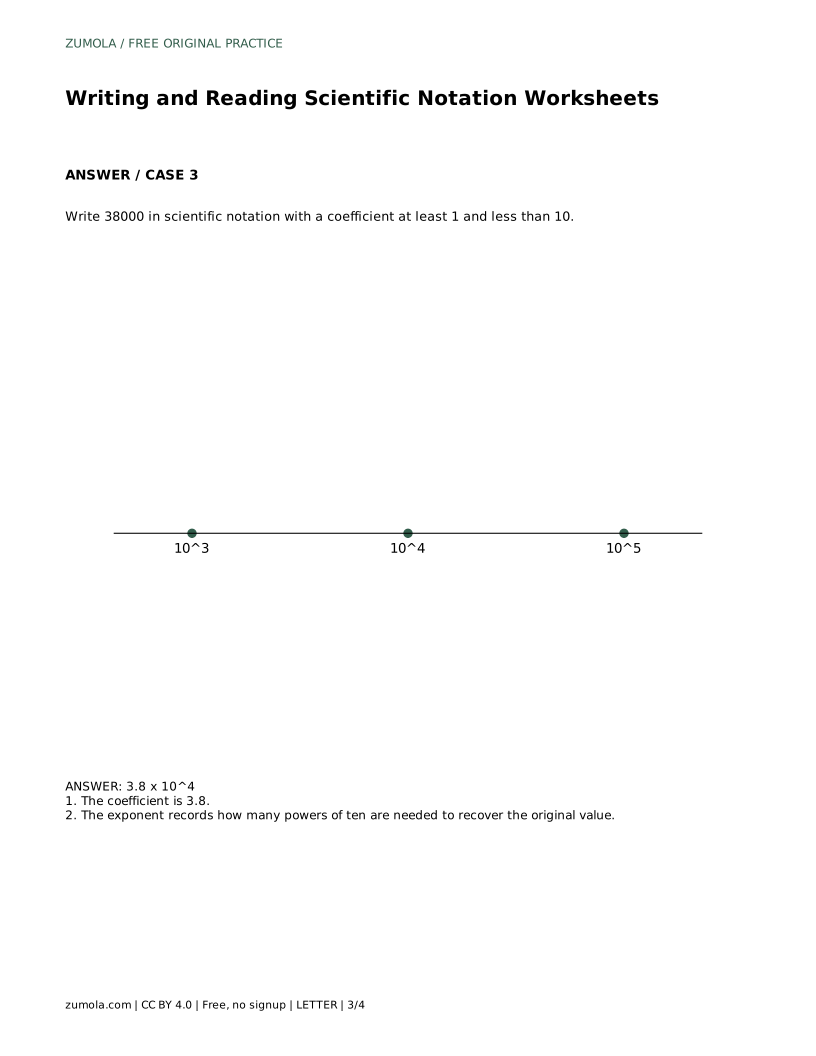
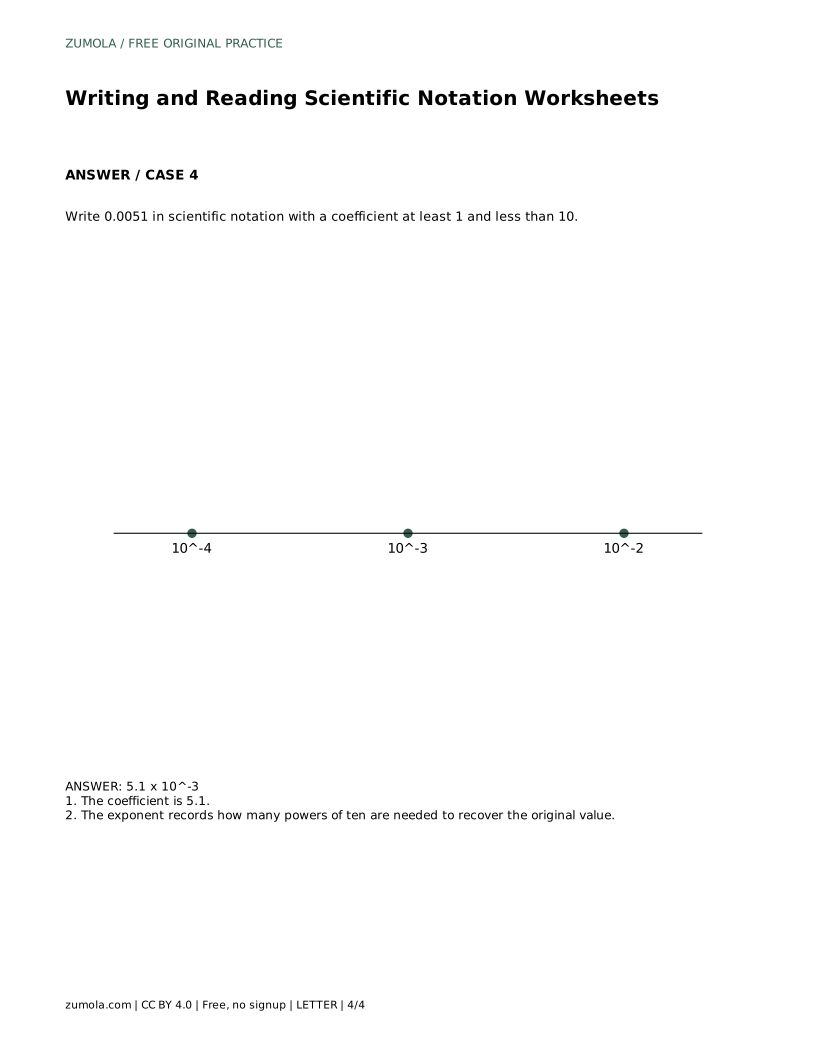
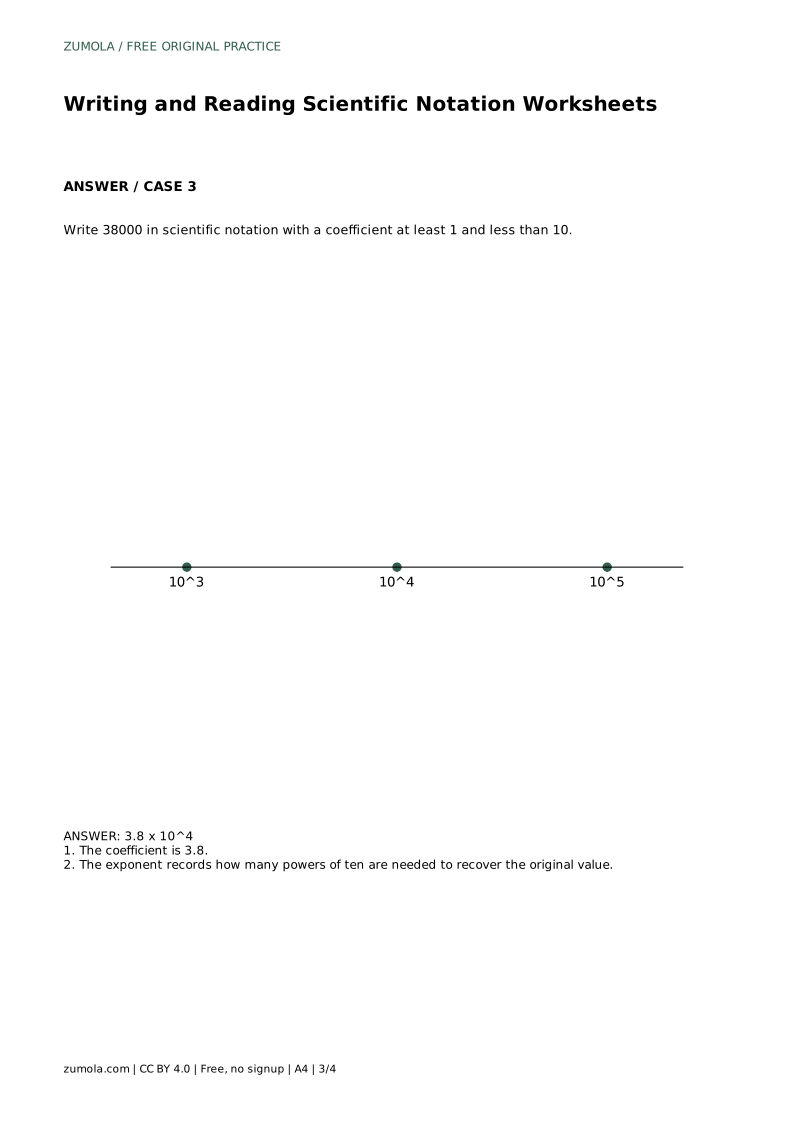
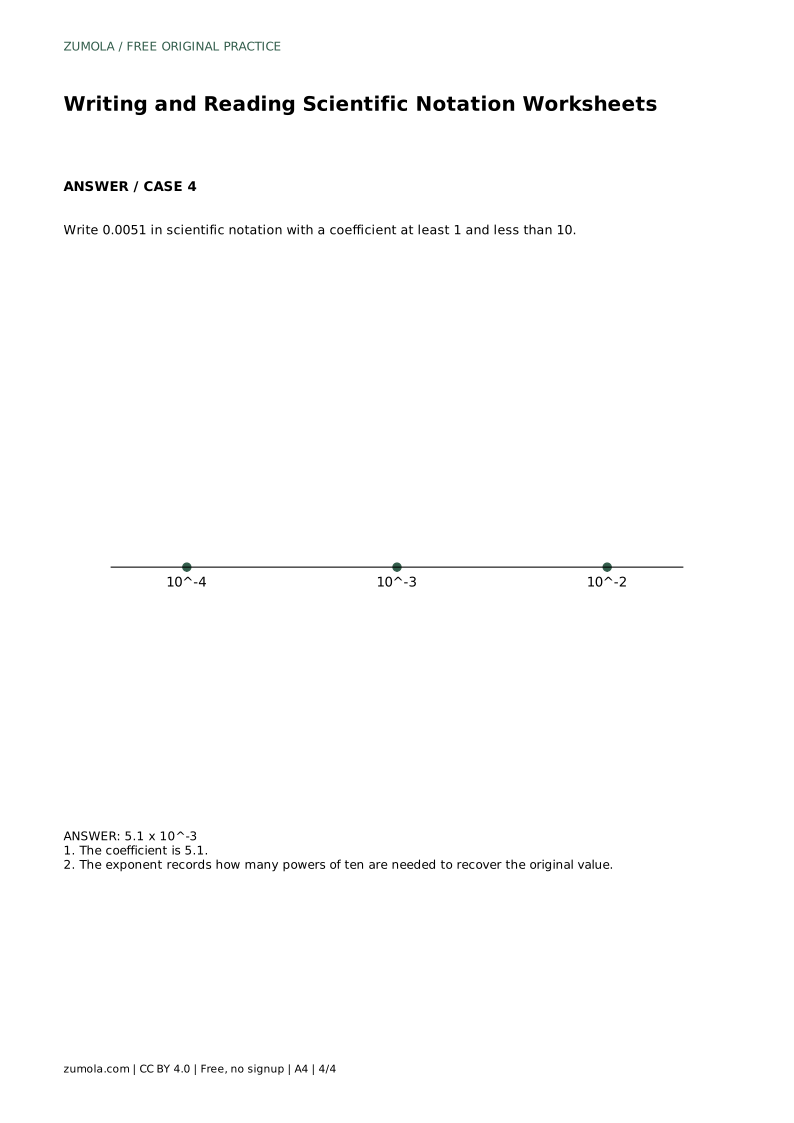
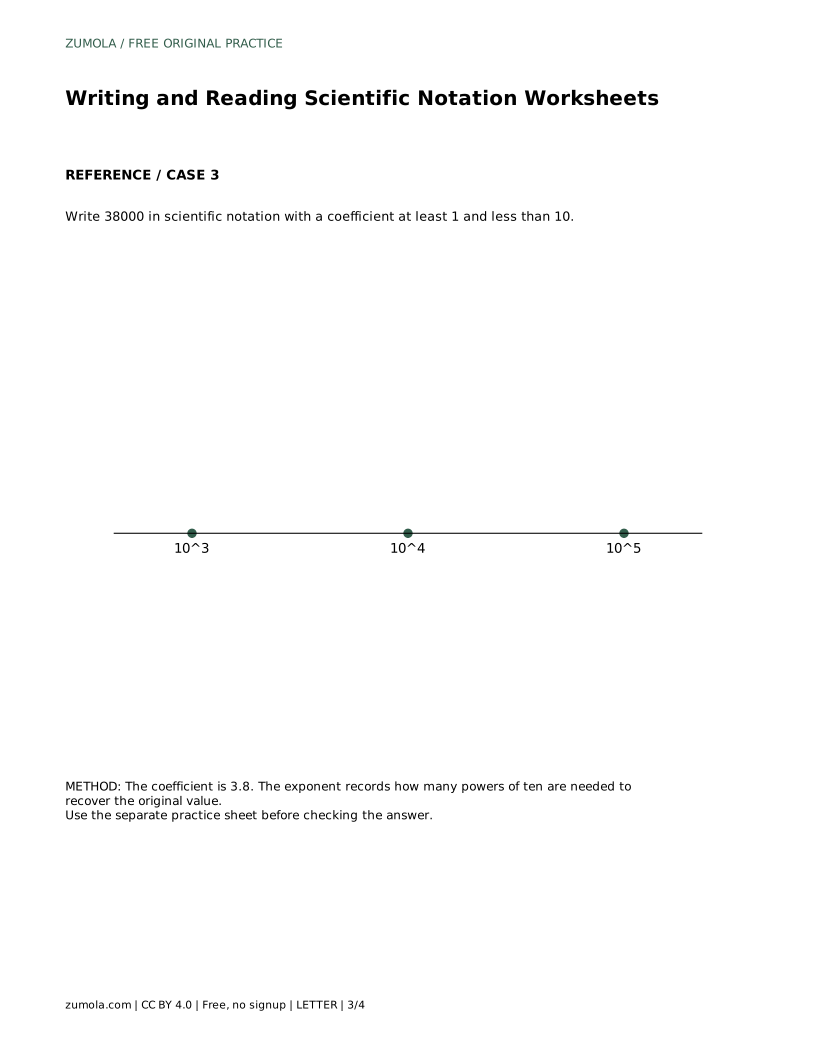
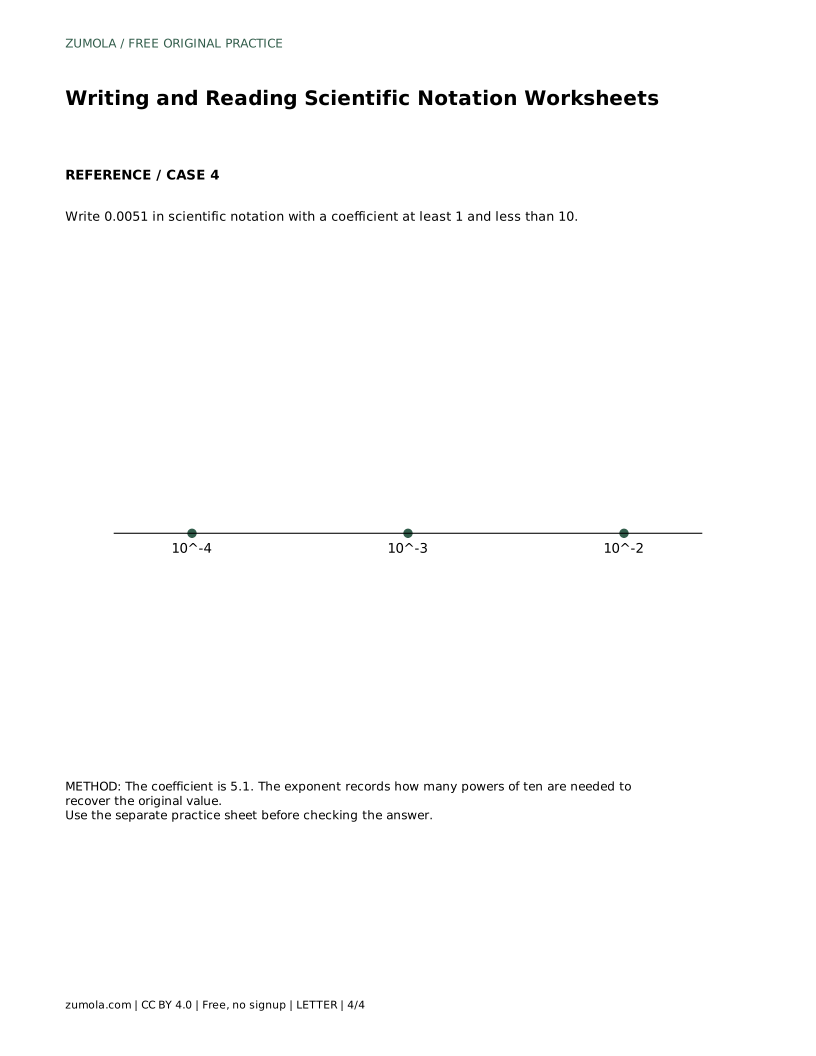
Reading works in reverse. Given 3.8 x 10^4, the exponent 4 tells you to move the decimal point four places to the right, producing 38000. Given 5.1 x 10^-3, the negative exponent tells you to move the decimal point three places to the left, producing 0.0051. Always confirm the coefficient stays between 1 and 10 before trusting the exponent.
Write 1200 in scientific notation with a coefficient at least 1 and less than 10.
1.2 x 10^3 The coefficient is 1.2. The exponent records how many powers of ten are needed to recover the original value.
No. The coefficient must be at least 1 and less than 10, so 1.2, 3.8, and 5.1 are all valid. Only the position of the decimal point is fixed, not the number of digits.
The original number is between 0 and 1, so the decimal point moves right to form the coefficient. A negative exponent records that rightward movement and restores the small value when multiplied.
Multiply the coefficient by the power of ten by hand. For 1.2 x 10^3, compute 1.2 x 1000 = 1200. If the product matches the original number, the notation is consistent.
All math worksheets · Free coordinate paper
Original resources · CC BY 4.0 · Free for personal and classroom use with attribution.