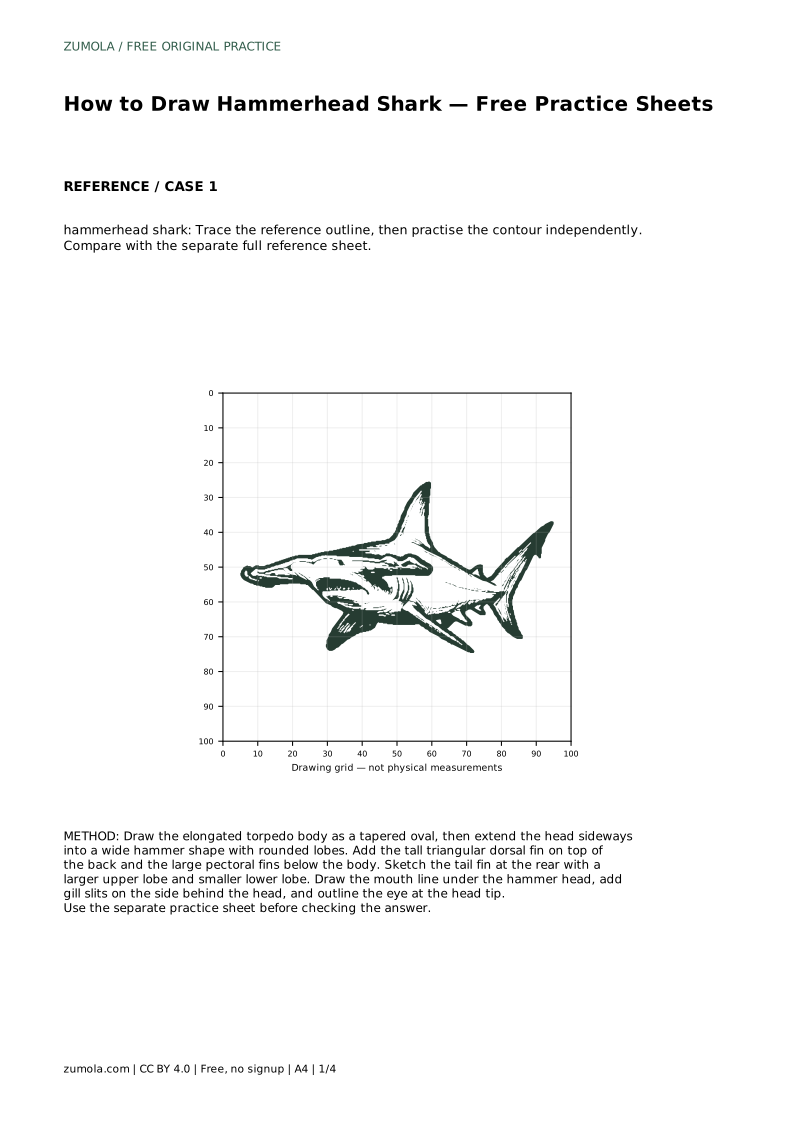
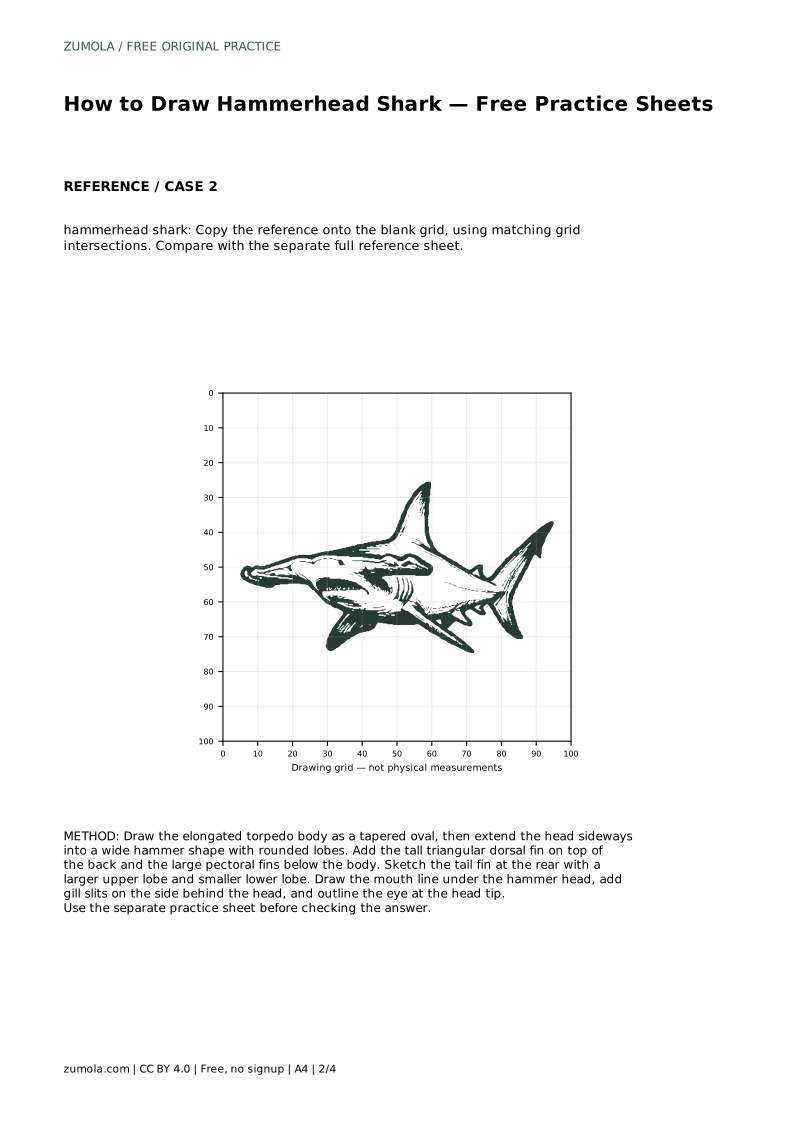
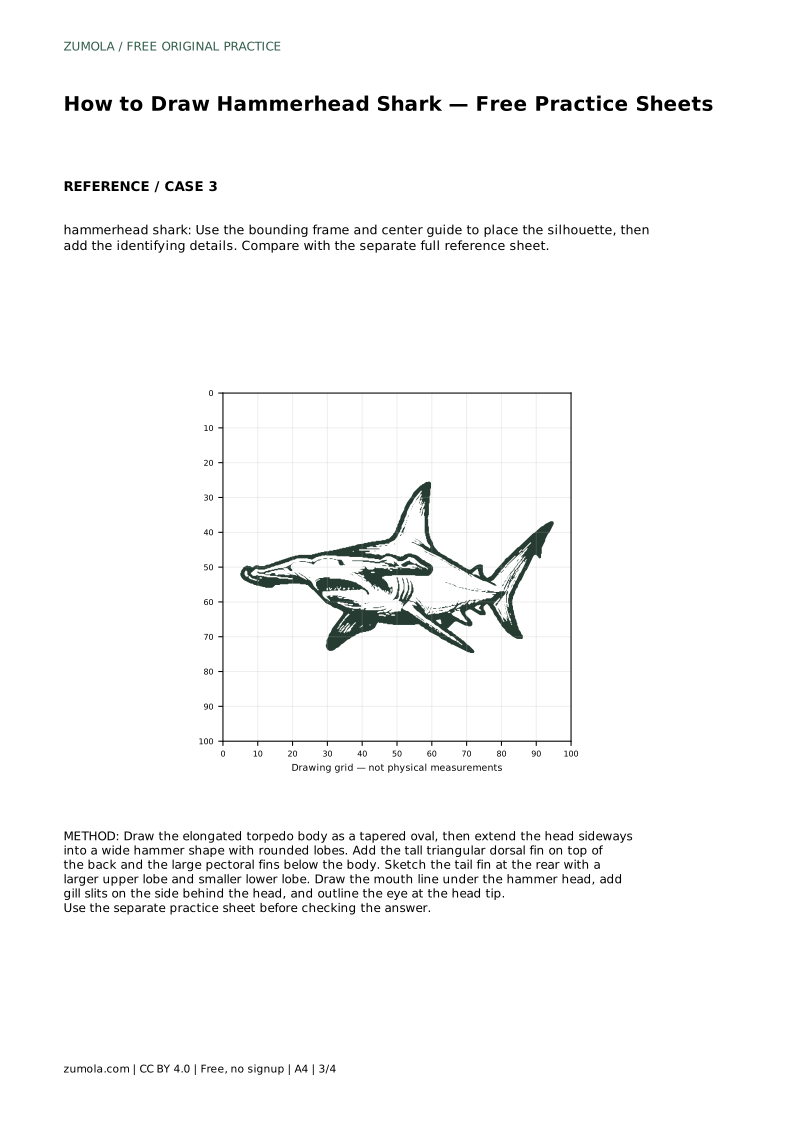
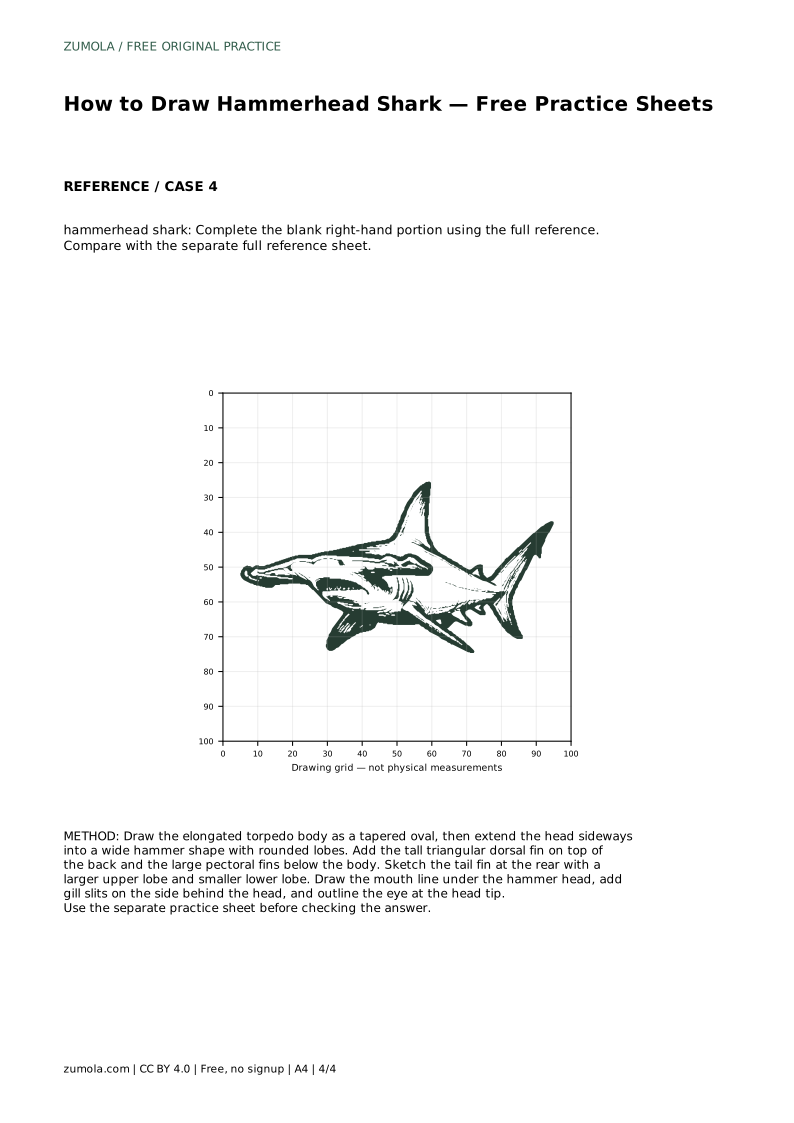
Reference diagrams
LETTER · Download PDF
A4 · Download PDF
Free original resources
Learn to draw a hammerhead shark by building the wide head, torpedo body, fins, gill slits, and eye in order, then check your work with a feature rubric.
Four original cases, with reference diagrams, practice sheets and worked answers. Everything is free; no signup required.
LETTER · Download PDF
A4 · Download PDF
LETTER · Download PDF
A4 · Download PDF
LETTER · Download PDF
A4 · Download PDF
Use A4 or US Letter to match your printer. Use the stated values and conditions to solve each exercise; diagrams are not physical measuring rulers.
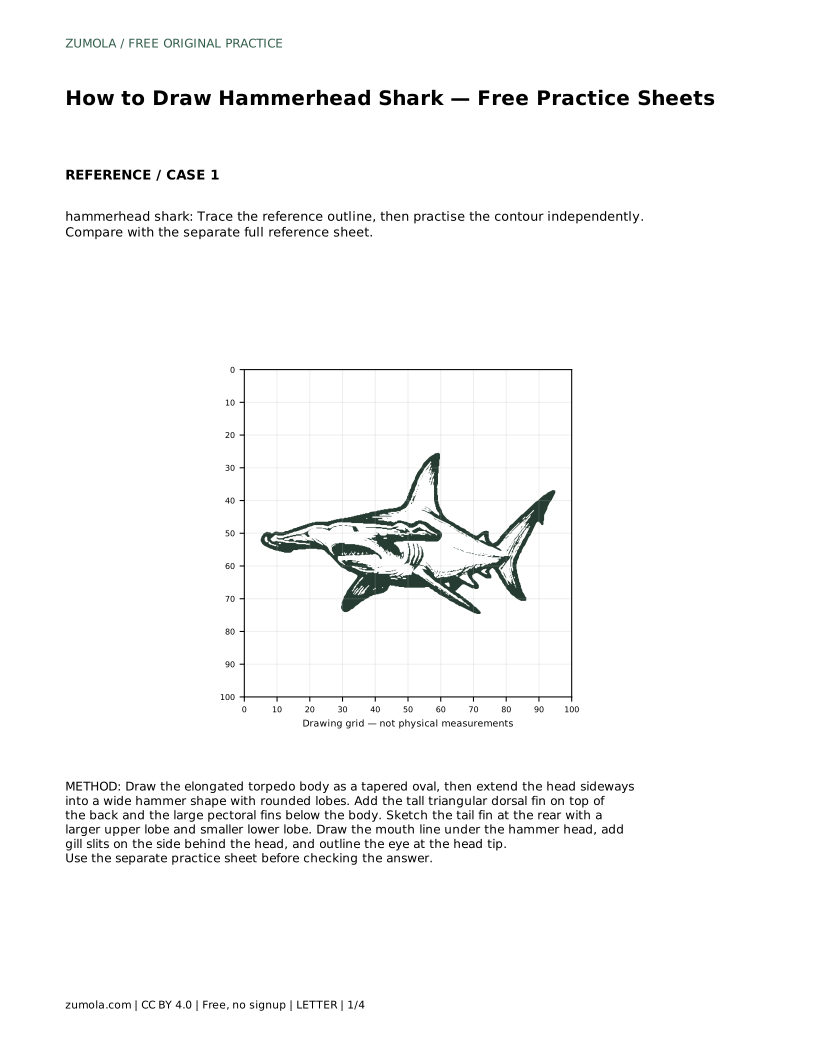
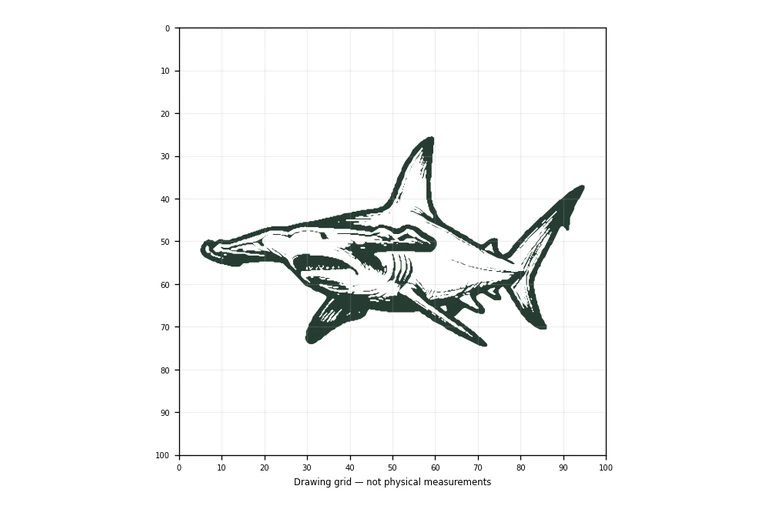
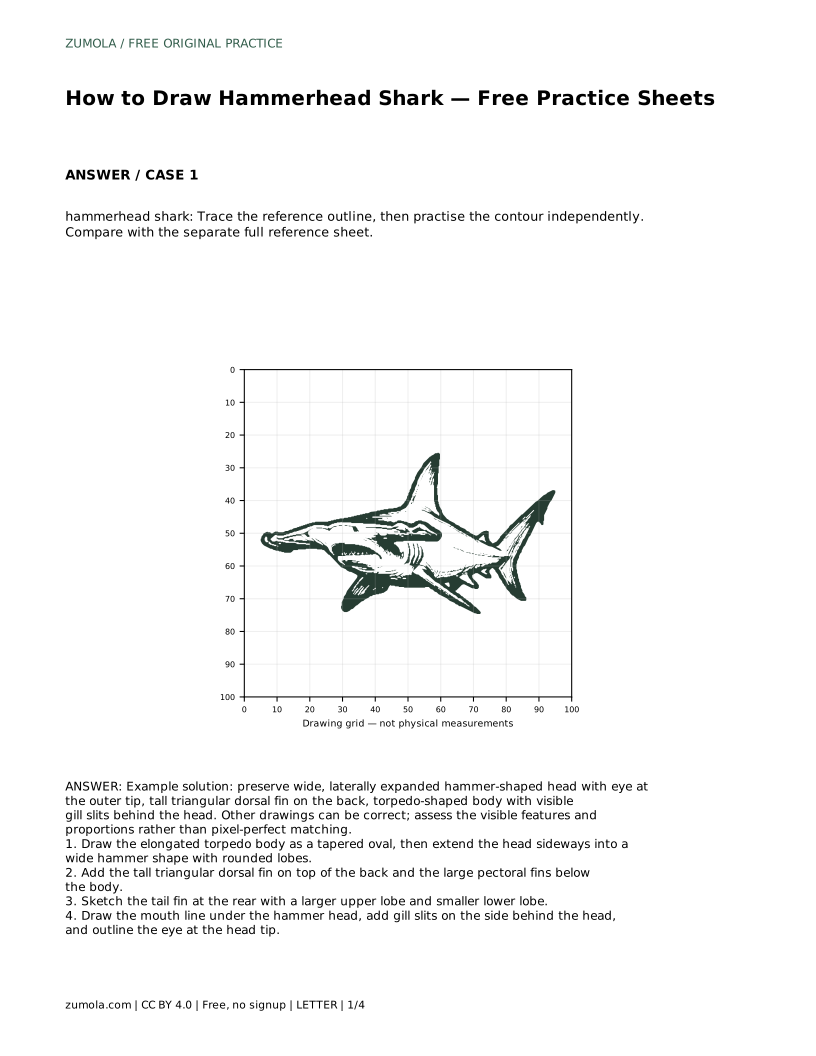
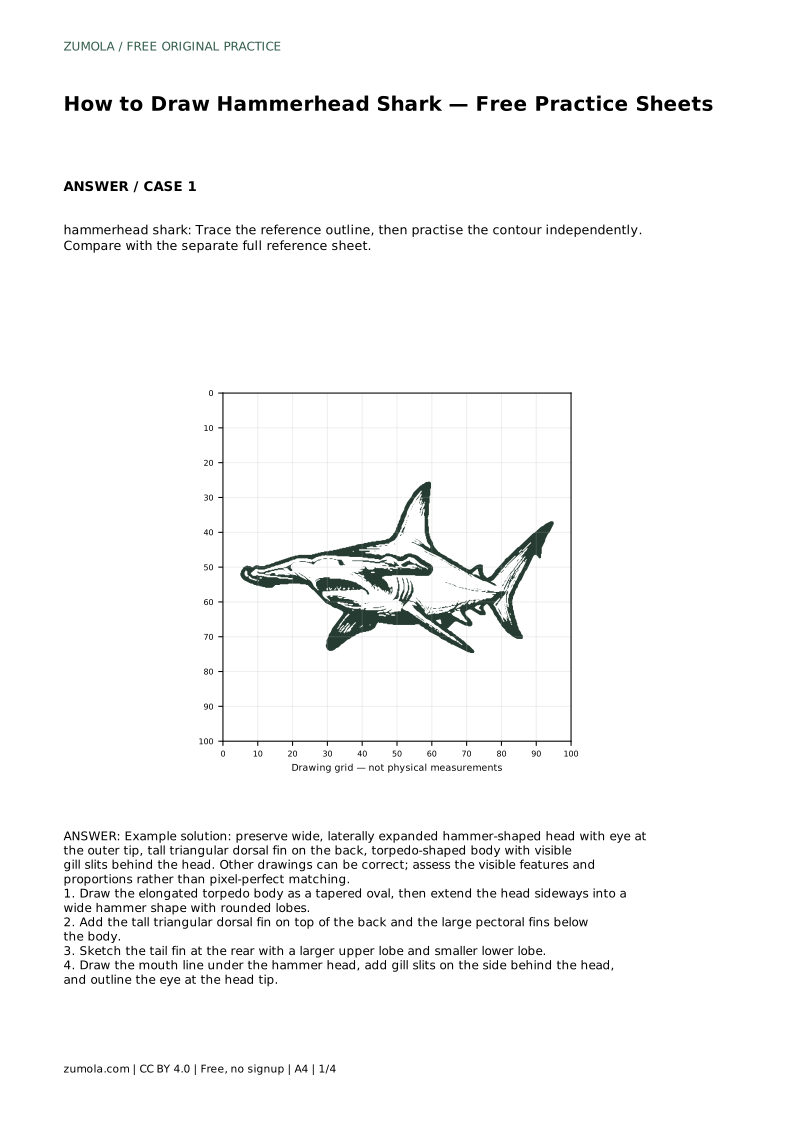
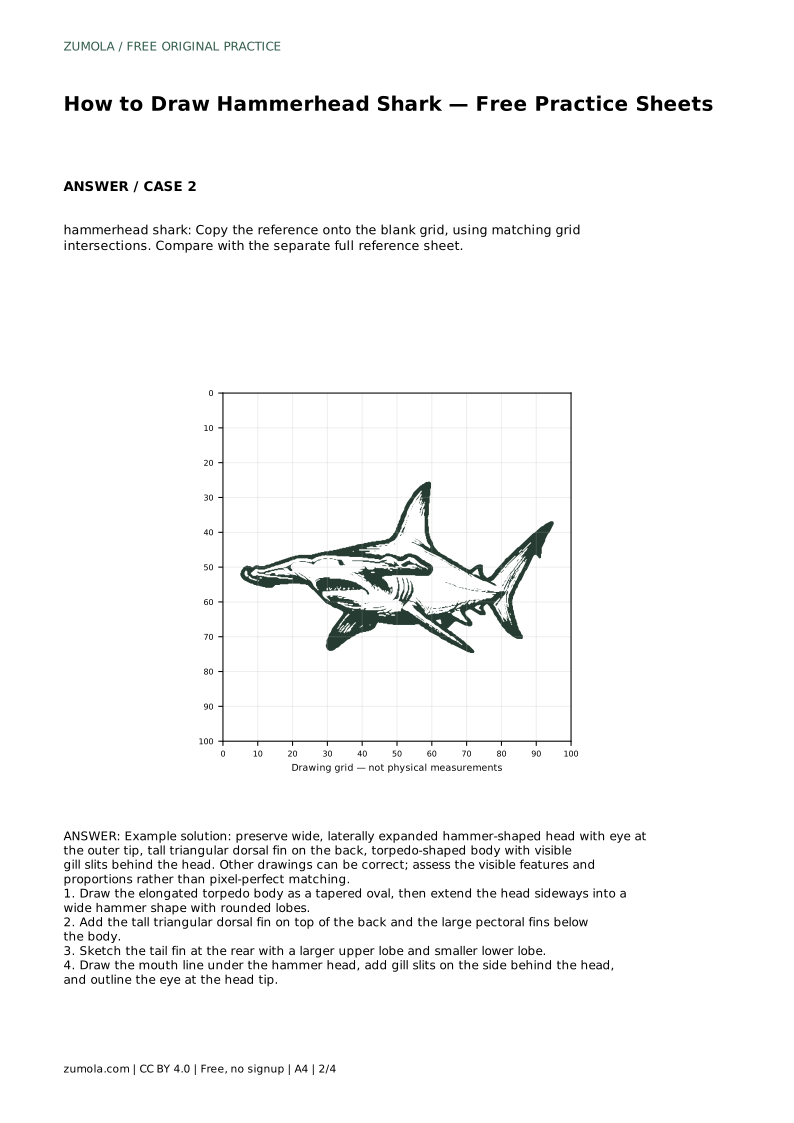
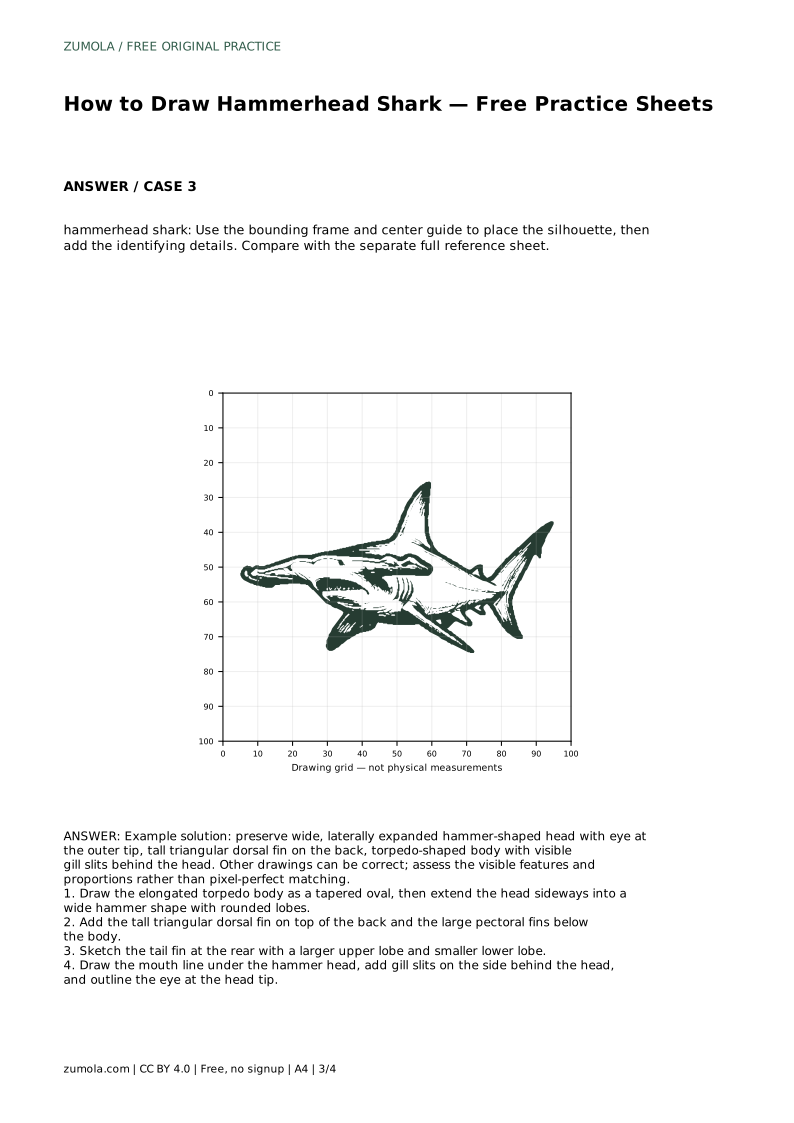
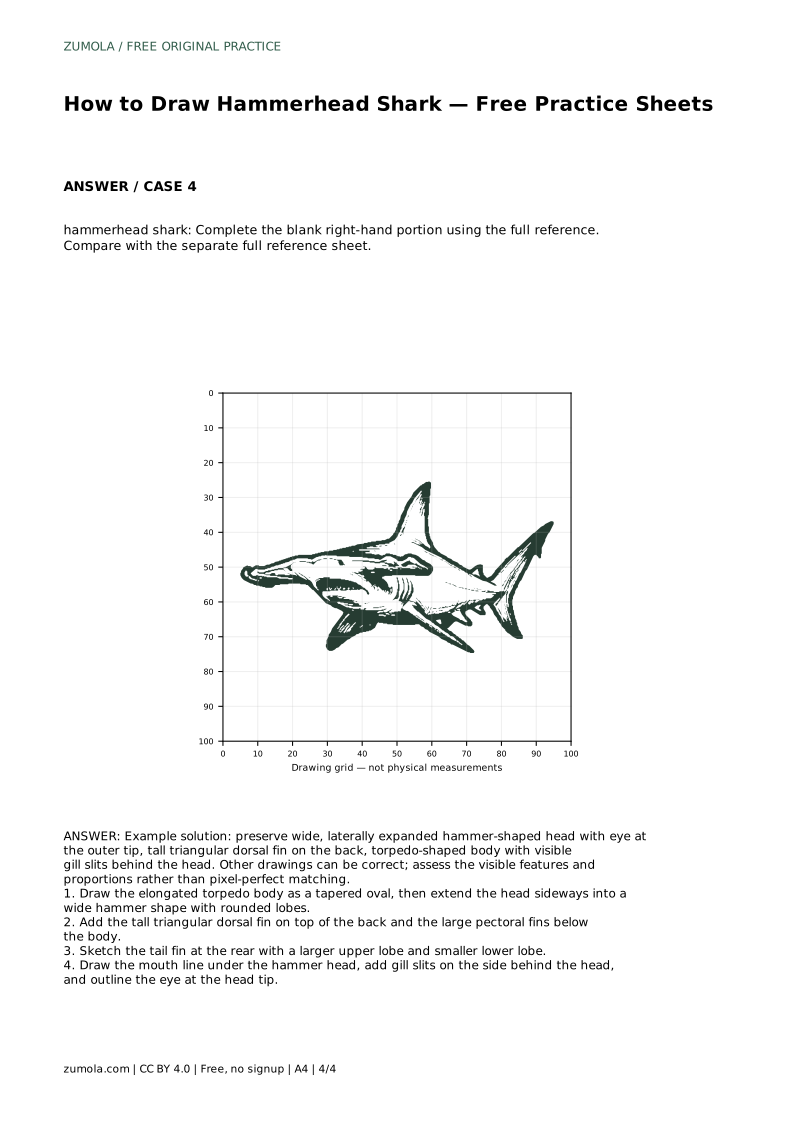
A hammerhead shark is recognizable before any detail is added: the head spreads sideways into a wide, flattened hammer, and the eye sits at the outer tip of each lobe. This page walks through a practical drawing order for that silhouette, then shows how to use tracing, grid, frame, and partial-reference practice sheets to build independence. Because drawings can be correct in more than one way, you will assess visible features and proportions rather than chase a pixel-perfect match.
Begin with the largest shapes so the shark's proportions are settled before small details compete for attention. The body is an elongated torpedo: a tapered oval that is widest behind the head and narrows toward the tail. Keep the long axis roughly horizontal on your page, leaving room at both ends.
Next, extend the head sideways rather than forward. The hammer shape is a lateral expansion, with rounded lobes projecting to the left and right of the body's centerline. Sketch it lightly at first, checking that both lobes reach a similar distance from the body and that the front edge is not pointed like a cone. The eye belongs at the outer tip of the lobe, not on top of the head.
With the silhouette in place, add the tall triangular dorsal fin on top of the back, positioned roughly above the midpoint of the body. The large pectoral fins sit below the body, angled outward and slightly back. At the rear, the tail fin has a larger upper lobe and a smaller lower lobe; keep that asymmetry visible so the tail does not look like a symmetrical fan.
Details come last. Draw the mouth line underneath the hammer head, add gill slits on the side just behind the head, and outline the eye at the head tip. Space the gill slits evenly and keep them short. These features are what let a viewer identify the drawing as a hammerhead rather than a generic shark, so give them deliberate placement rather than quick scribbles.
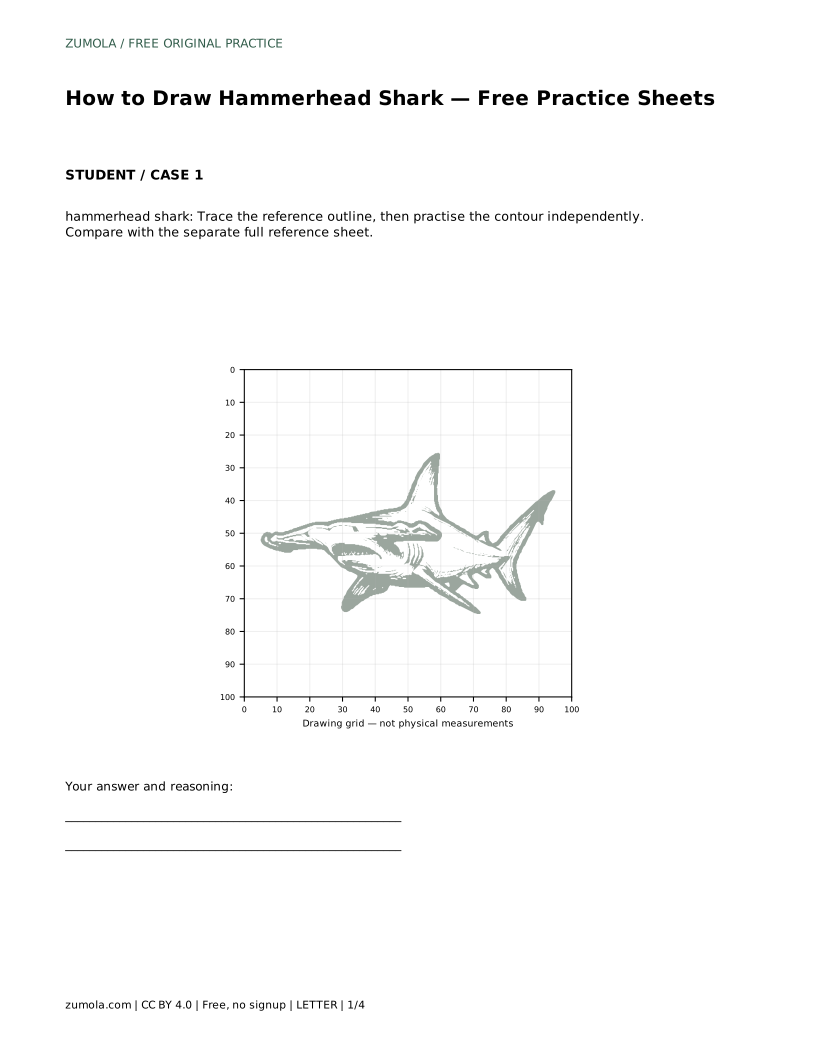
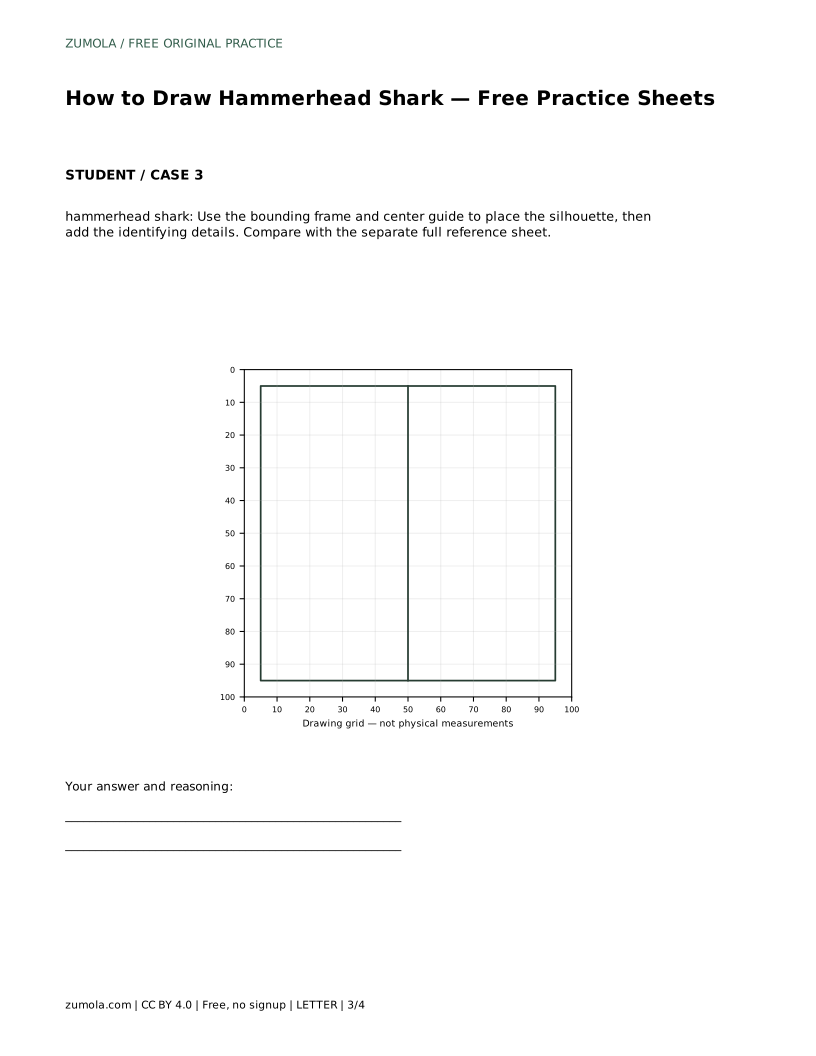
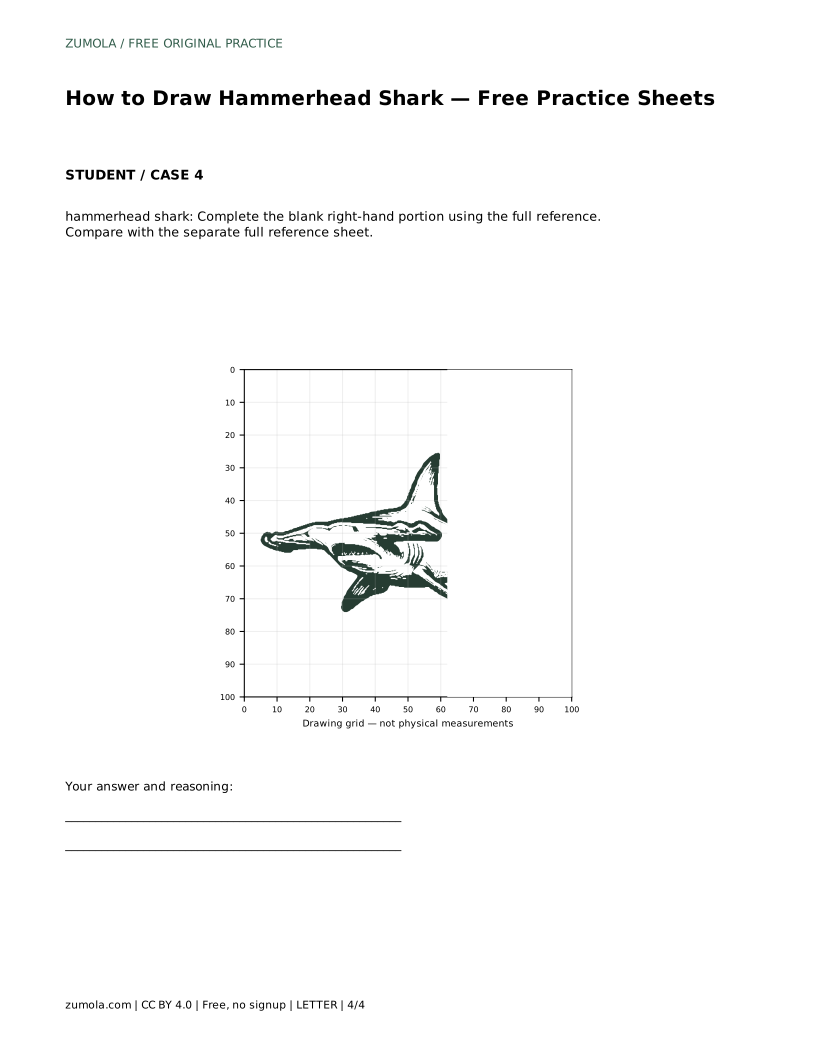
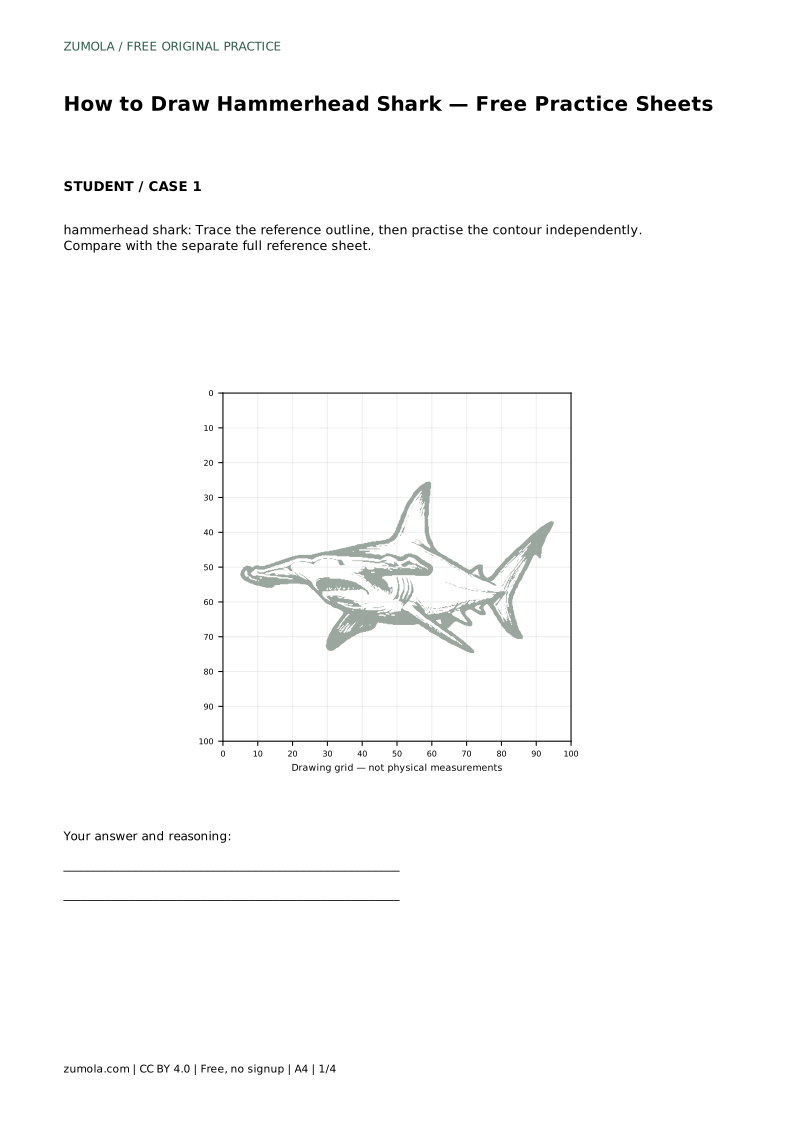
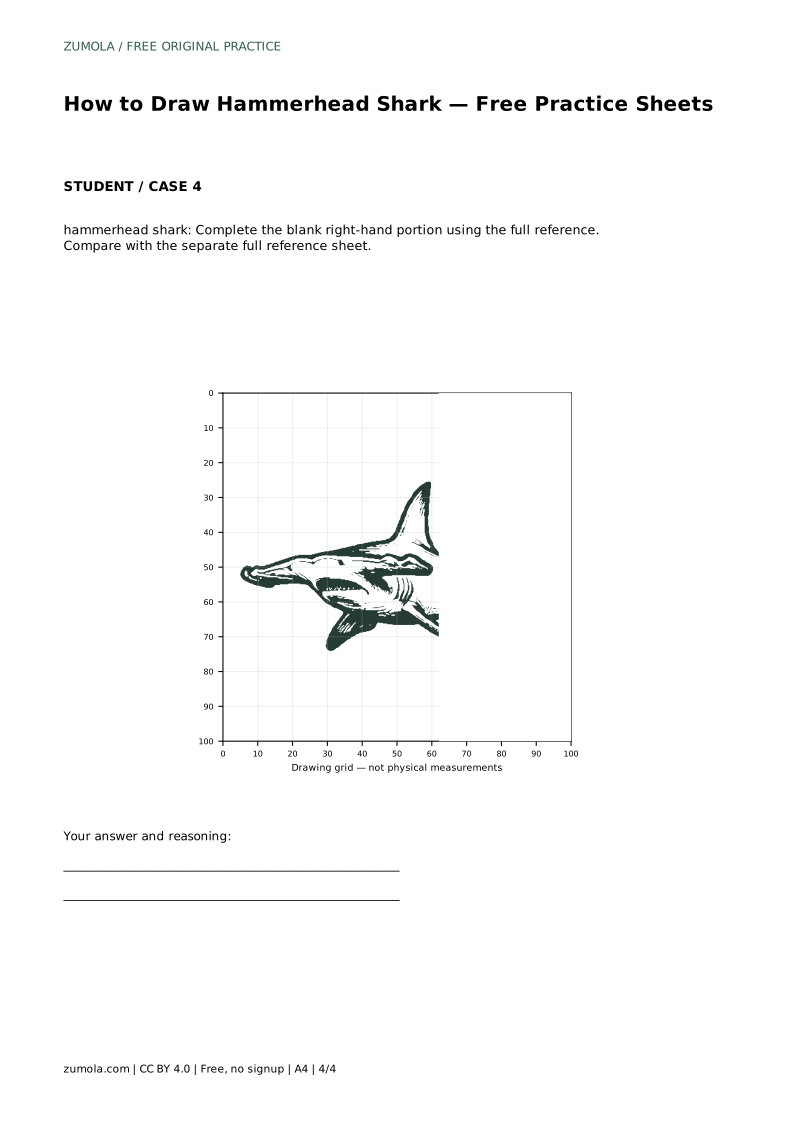
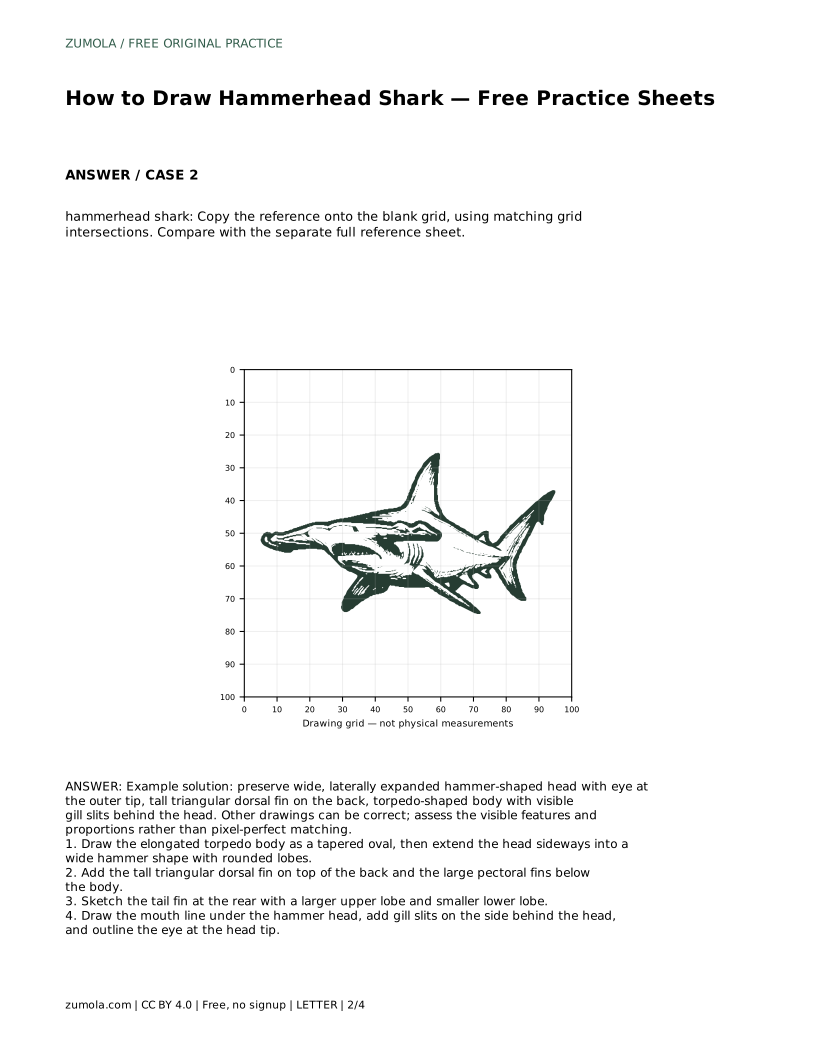
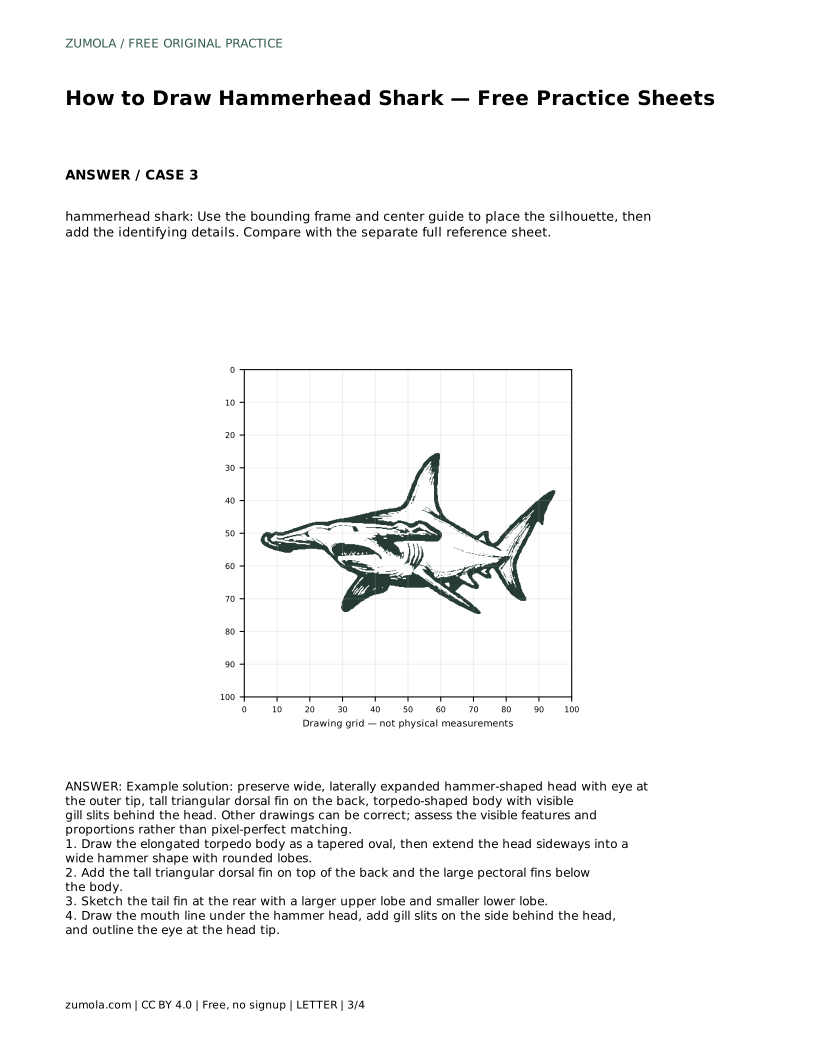
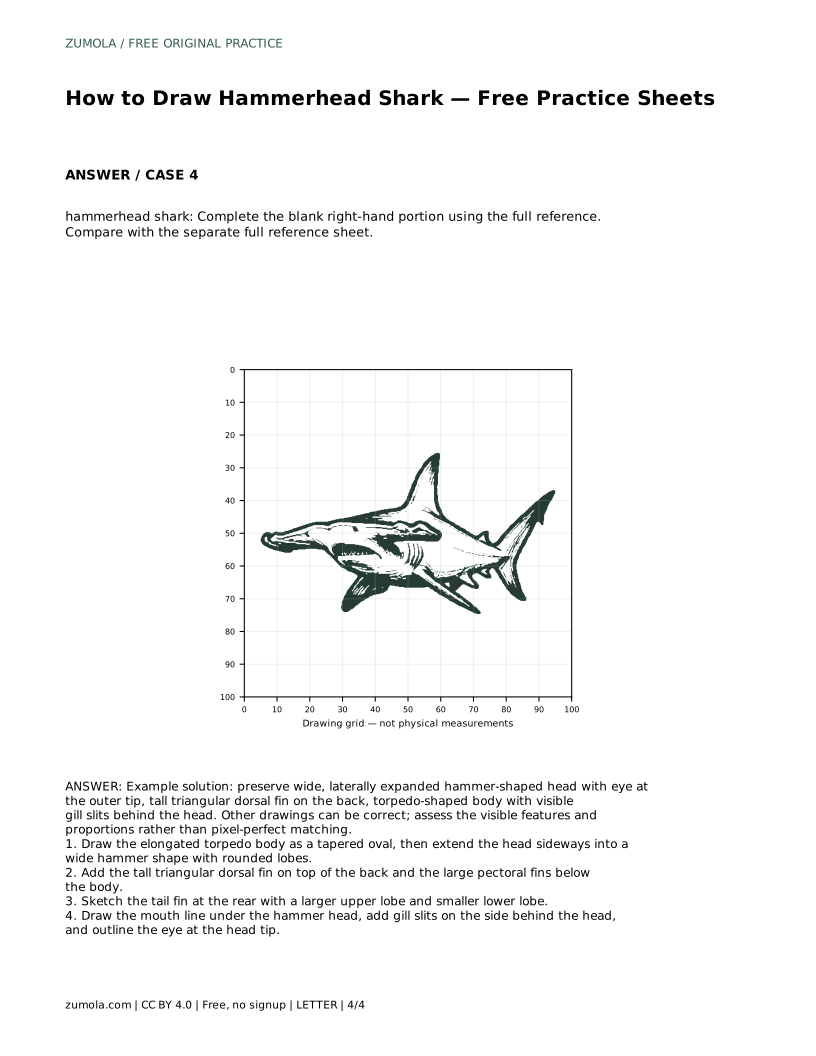
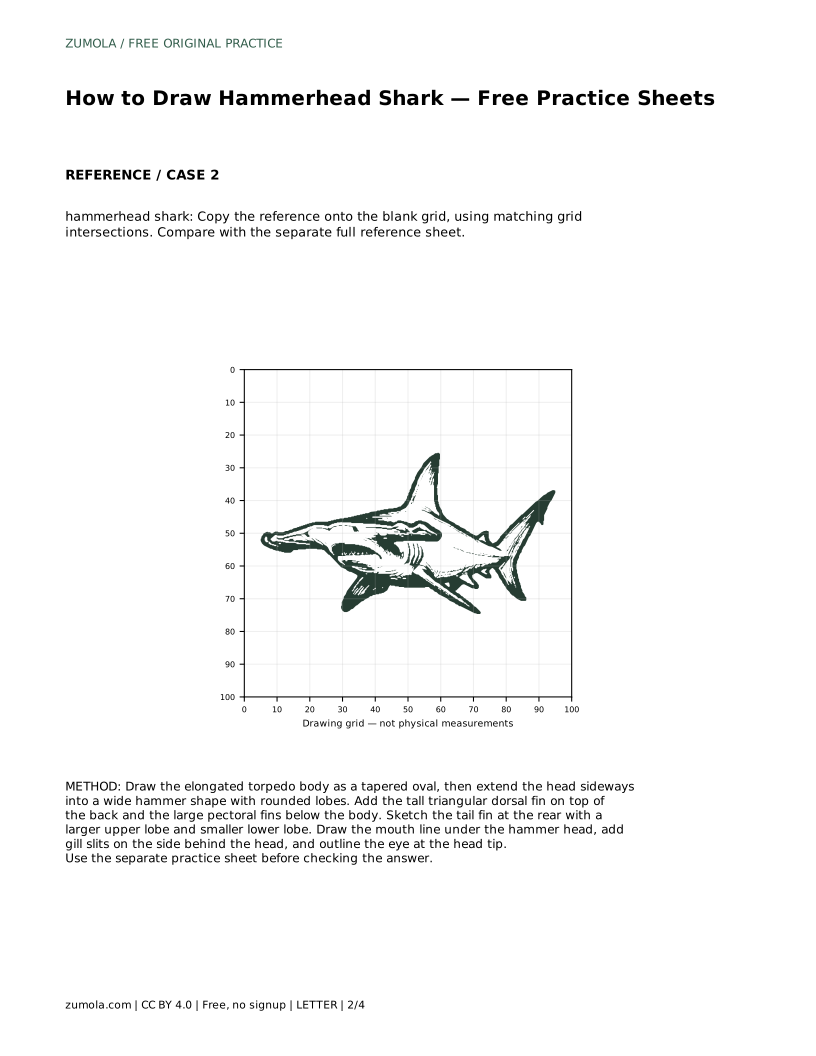
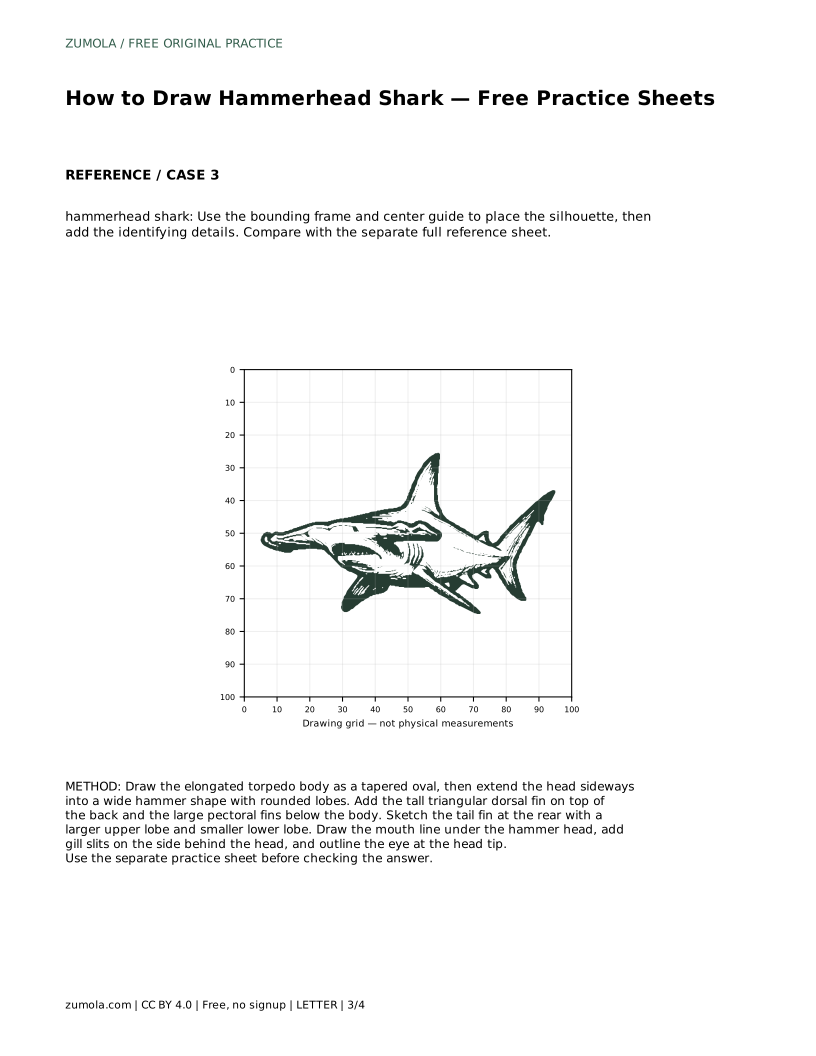
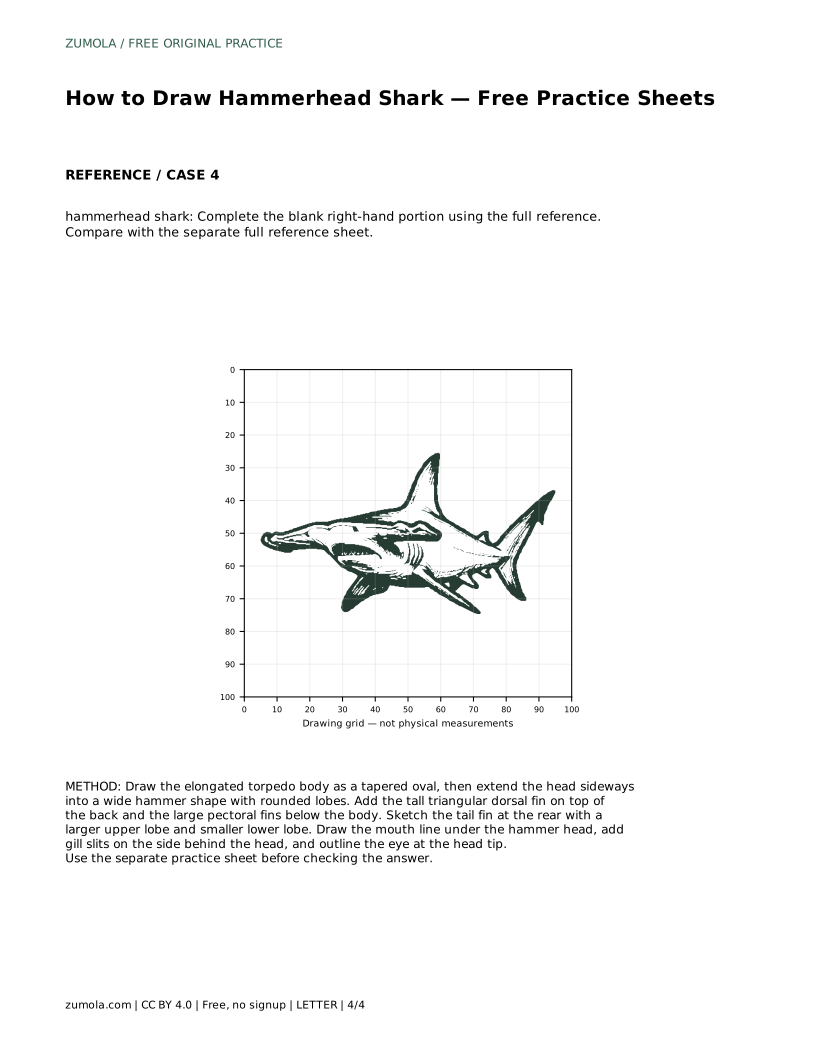
The tracing sheet asks you to follow the reference outline first, then repeat the contour on your own without the guide. The grid sheet asks you to copy the reference onto a blank grid, matching where lines cross grid intersections so proportions transfer accurately. The frame sheet gives a bounding frame and center guide for placing the silhouette before details go in. The partial sheet shows one side and asks you to complete the blank portion from the full reference.
In every case, compare your finished drawing with the separate full reference sheet. Ask whether the head is wide and laterally expanded, whether the eye sits at the outer tip, whether the dorsal fin is tall and triangular, and whether the gill slits are visible behind the head. A drawing can differ in line style or shading and still be correct.
Treat the checklist as a rubric, not an answer key. Two drawings with different fin angles or body curves can both succeed if the identifying features are present and the proportions hold together. Look for the wide hammer head, the eye at the outer tip, the tall dorsal fin, the torpedo body, and the gill slits behind the head. If one feature is missing or misplaced, adjust that part rather than redrawing everything.
hammerhead shark: Trace the reference outline, then practise the contour independently. Compare with the separate full reference sheet.
Example solution: preserve wide, laterally expanded hammer-shaped head with eye at the outer tip, tall triangular dorsal fin on the back, torpedo-shaped body with visible gill slits behind the head. Other drawings can be correct; assess the visible features and proportions rather than pixel-perfect matching. Draw the elongated torpedo body as a tapered oval, then extend the head sideways into a wide hammer shape with rounded lobes. Add the tall triangular dorsal fin on top of the back and the large pectoral fins below the body. Sketch the tail fin at the rear with a larger upper lobe and smaller lower lobe. Draw the mouth line under the hammer head, add gill slits on the side behind the head, and outline the eye at the head tip.
No. Other drawings can be correct. Assess the visible features and proportions rather than pixel-perfect matching.
The wide, laterally expanded hammer-shaped head with the eye at the outer tip, plus the tall triangular dorsal fin, torpedo body, and gill slits behind the head.
Body first, then the hammer head, then the dorsal, pectoral, and tail fins, and finally the mouth line, gill slits, and eye.
All drawing practice · Free coordinate paper
Original resources · CC BY 4.0 · Free for personal and classroom use with attribution.