Reference diagrams
LETTER · Download PDF
A4 · Download PDF
Free original resources
Learn to draw a manatee by building its rounded body, small head, paddle tail, and flippers. Trace, copy, or complete a reference sheet, then check proportions.
Four original cases, with reference diagrams, practice sheets and worked answers. Everything is free; no signup required.
LETTER · Download PDF
A4 · Download PDF
LETTER · Download PDF
A4 · Download PDF
LETTER · Download PDF
A4 · Download PDF
Use A4 or US Letter to match your printer. Use the stated values and conditions to solve each exercise; diagrams are not physical measuring rulers.
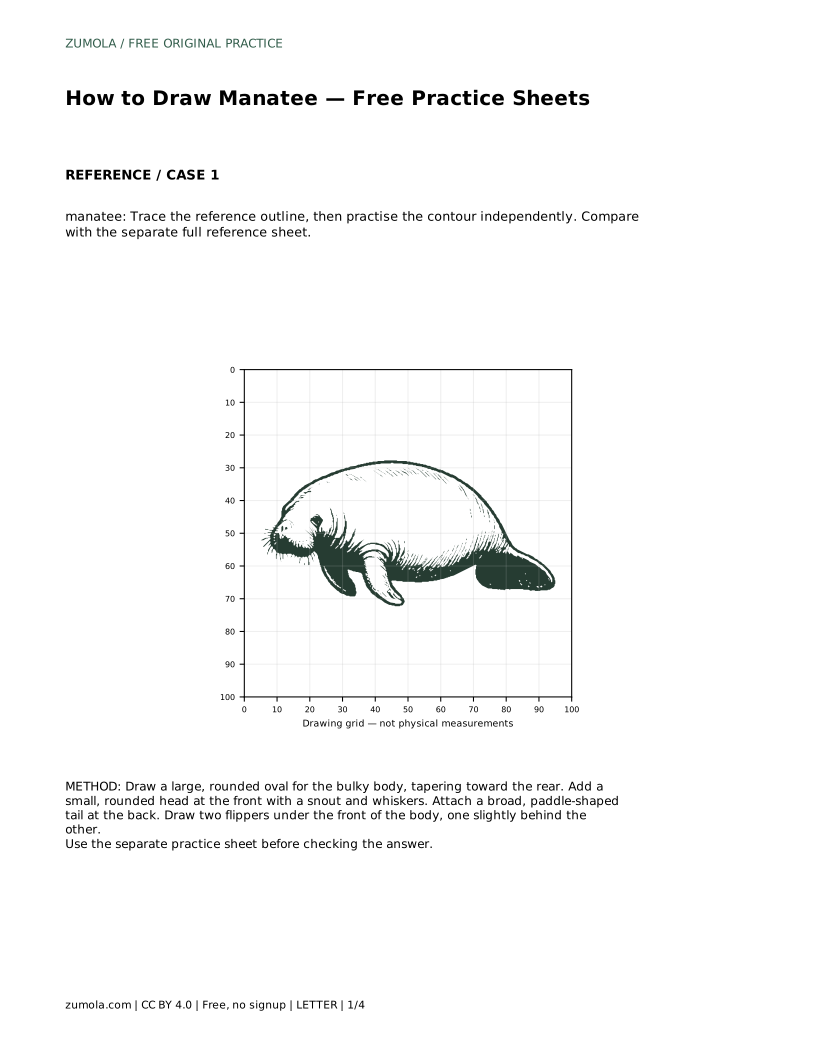
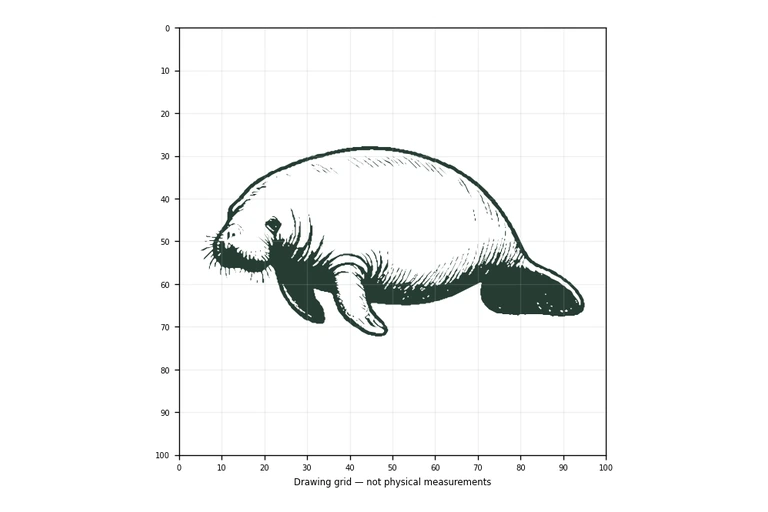
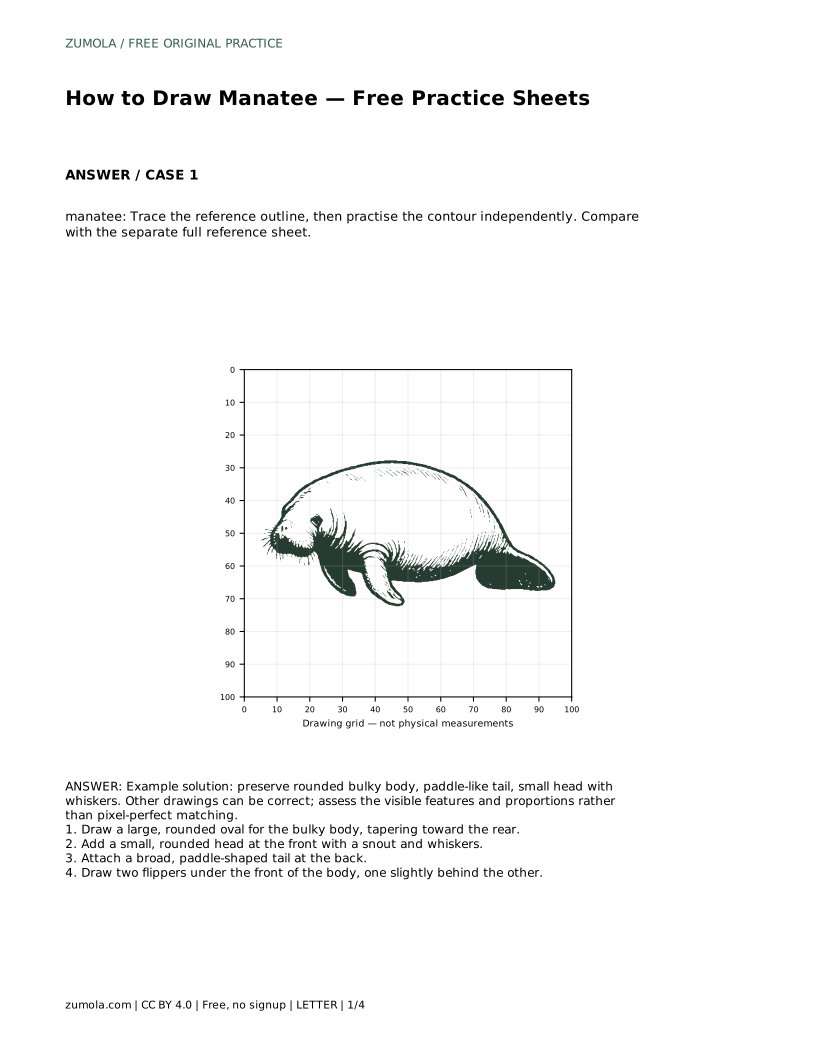
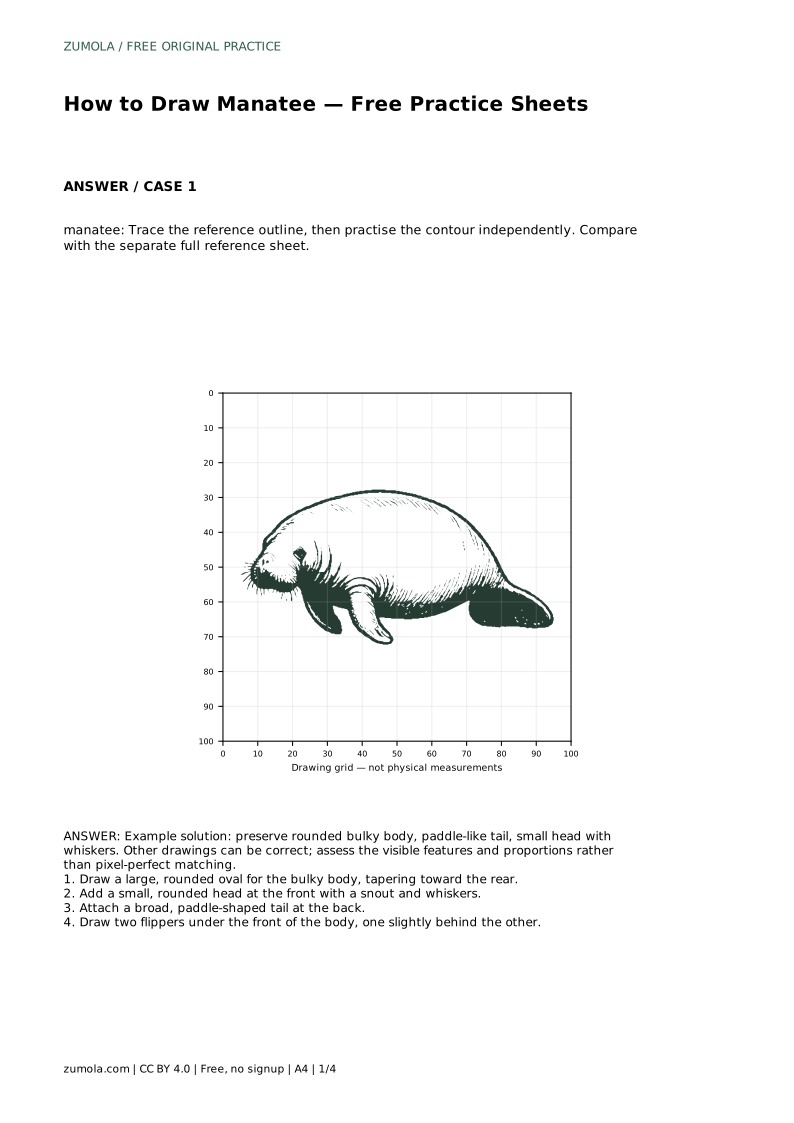
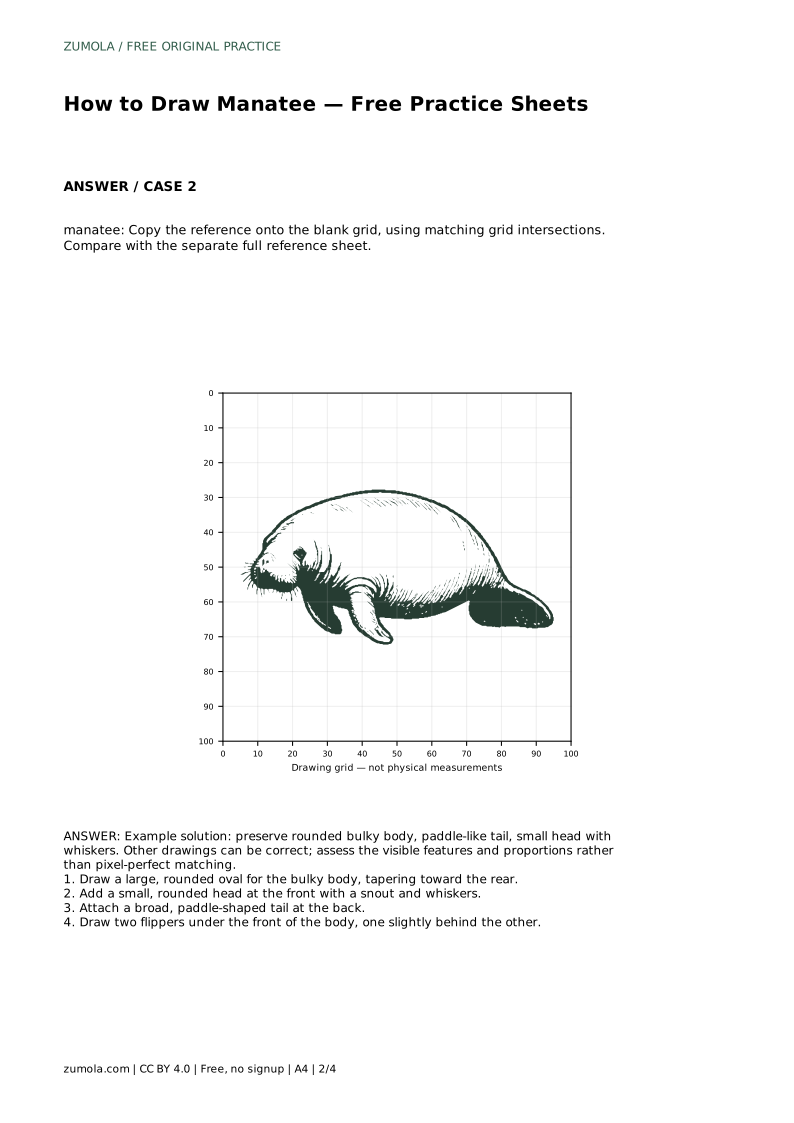
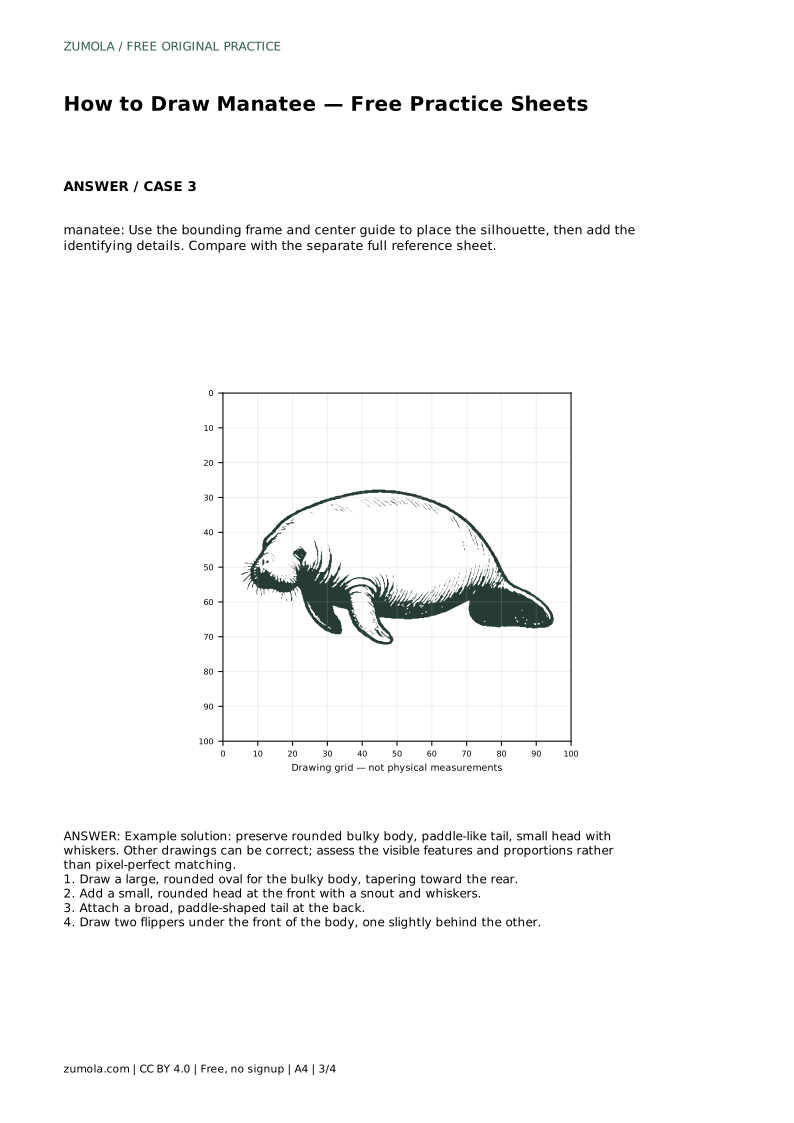
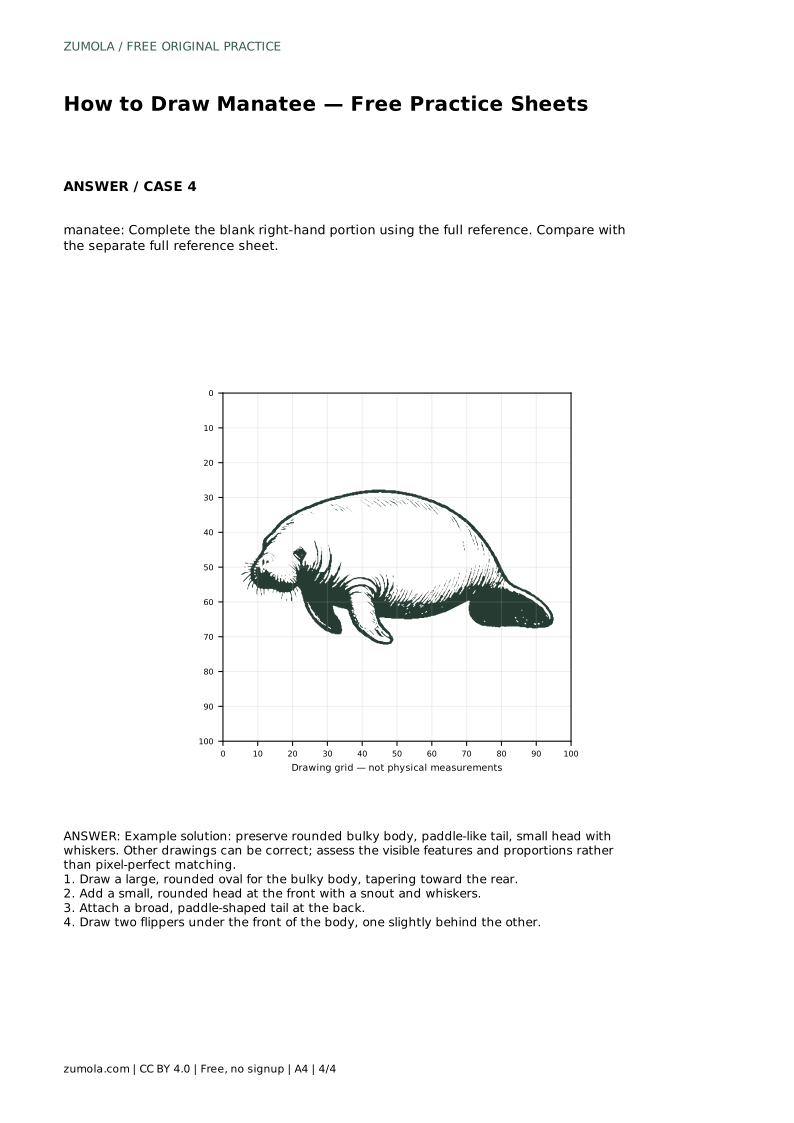
A manatee is mostly a study in rounded mass: a heavy oval body, a small head, a broad paddle tail, and two modest flippers. This page explains how to construct that silhouette step by step, then how to use tracing, grid copying, and partial-reference practice sheets to strengthen the same skill. Because drawings can vary, judge your work by visible features and proportions rather than an exact match.
Start with the body, because it controls everything else. A manatee reads as bulky and rounded, widest through the middle and tapering gently toward the tail. Place a large oval first, then adjust its ends: the front should leave room for a small head, and the rear should narrow enough that the paddle tail looks attached rather than added on.
Next, add the head at the front. Keep it small relative to the body, with a blunt snout and a gentle curve where it meets the torso. Whiskers belong near the snout and should be light, short strokes. Then attach the tail: a broad, paddle-shaped form that widens slightly before rounding off. Finally, draw two flippers beneath the front of the body, one slightly behind the other so the pose looks natural rather than symmetrical.
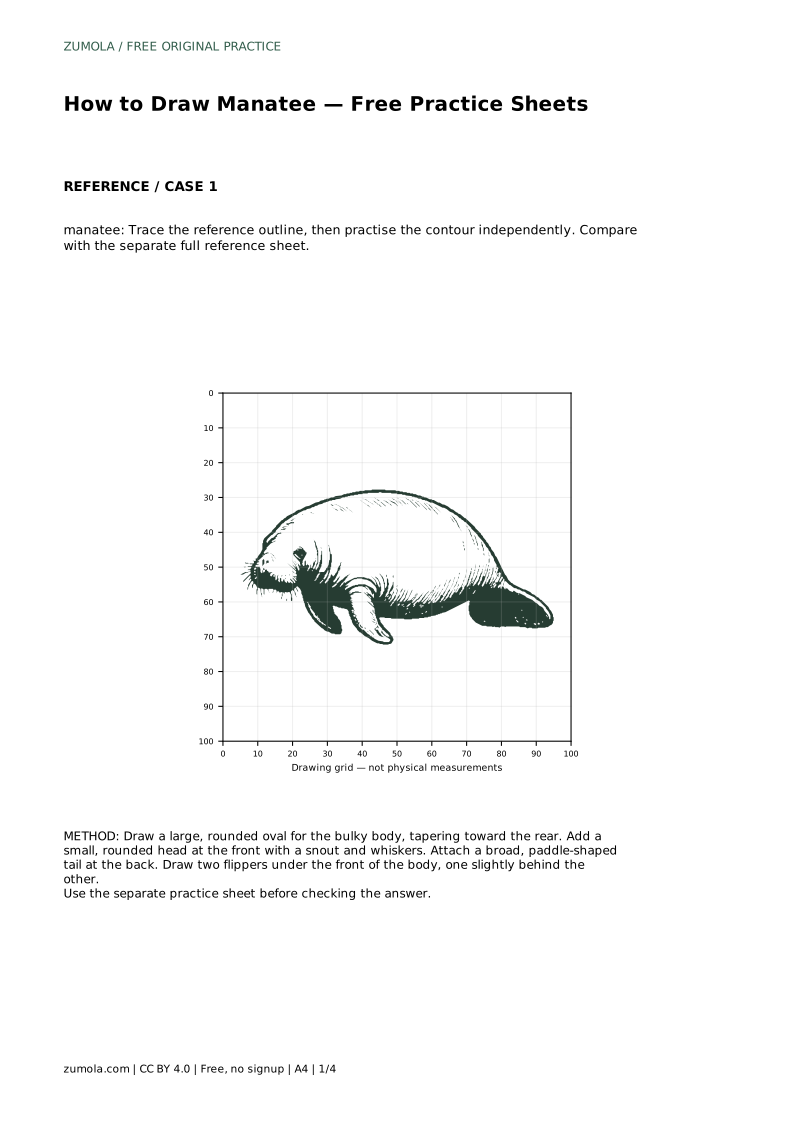
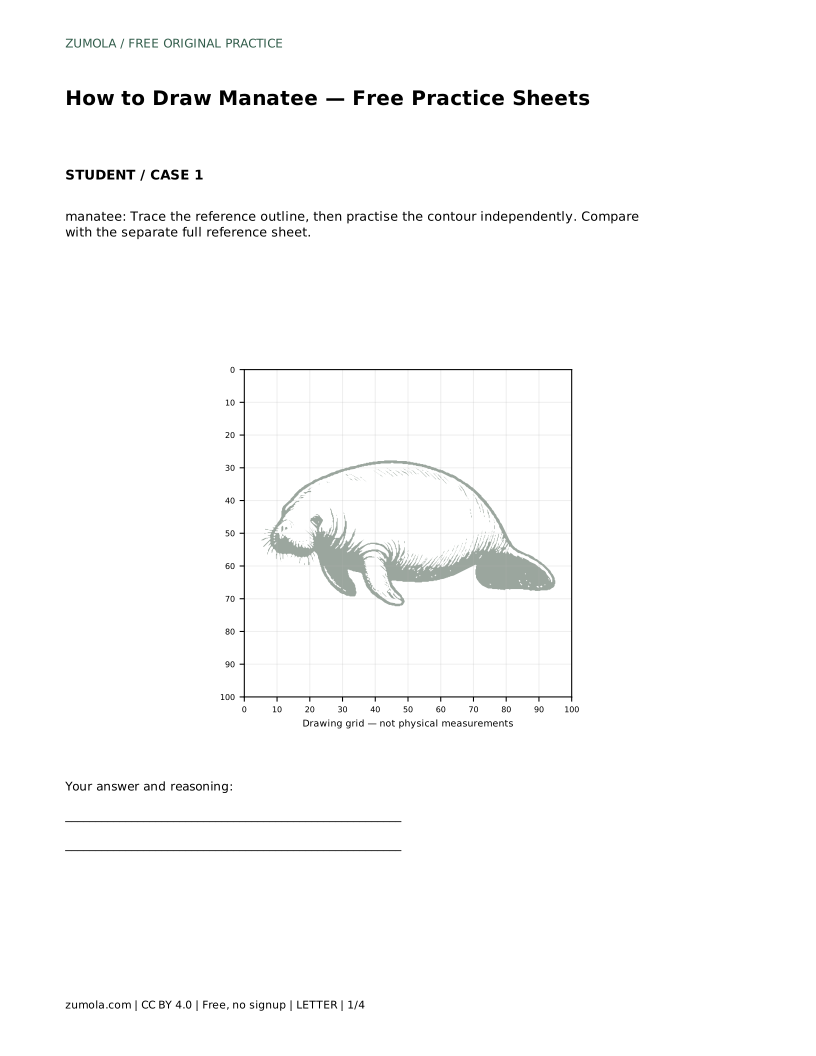
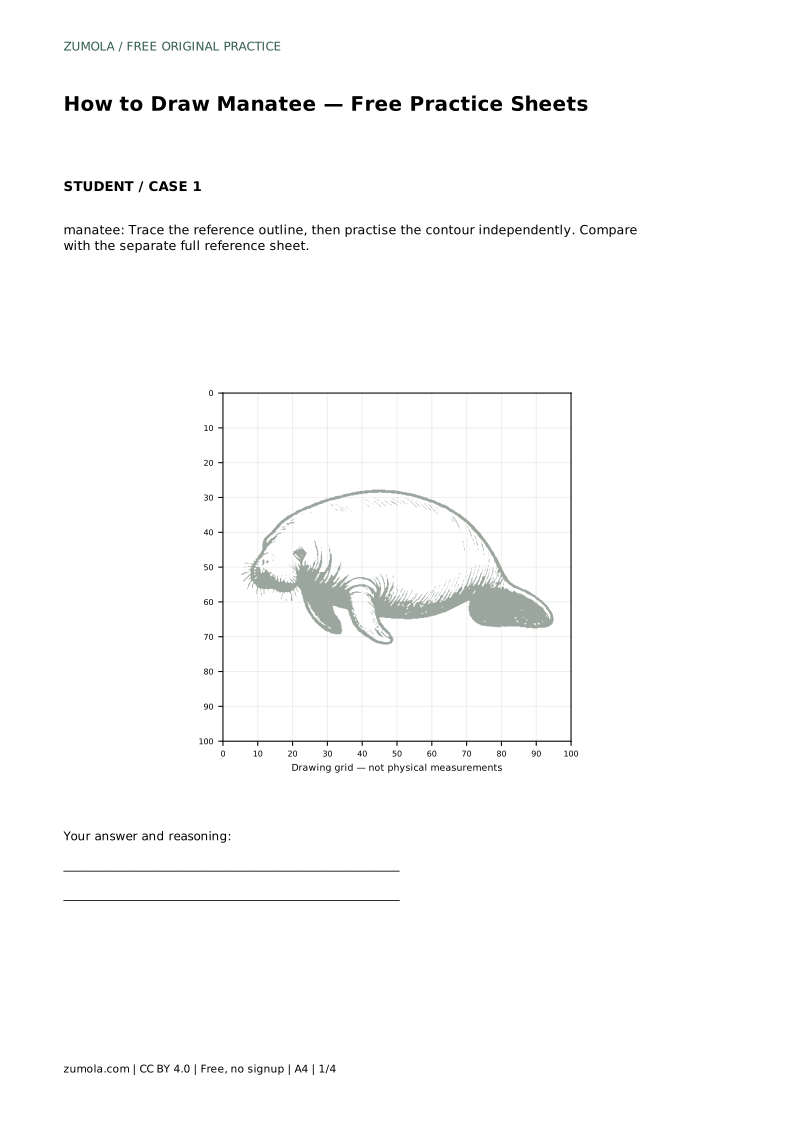
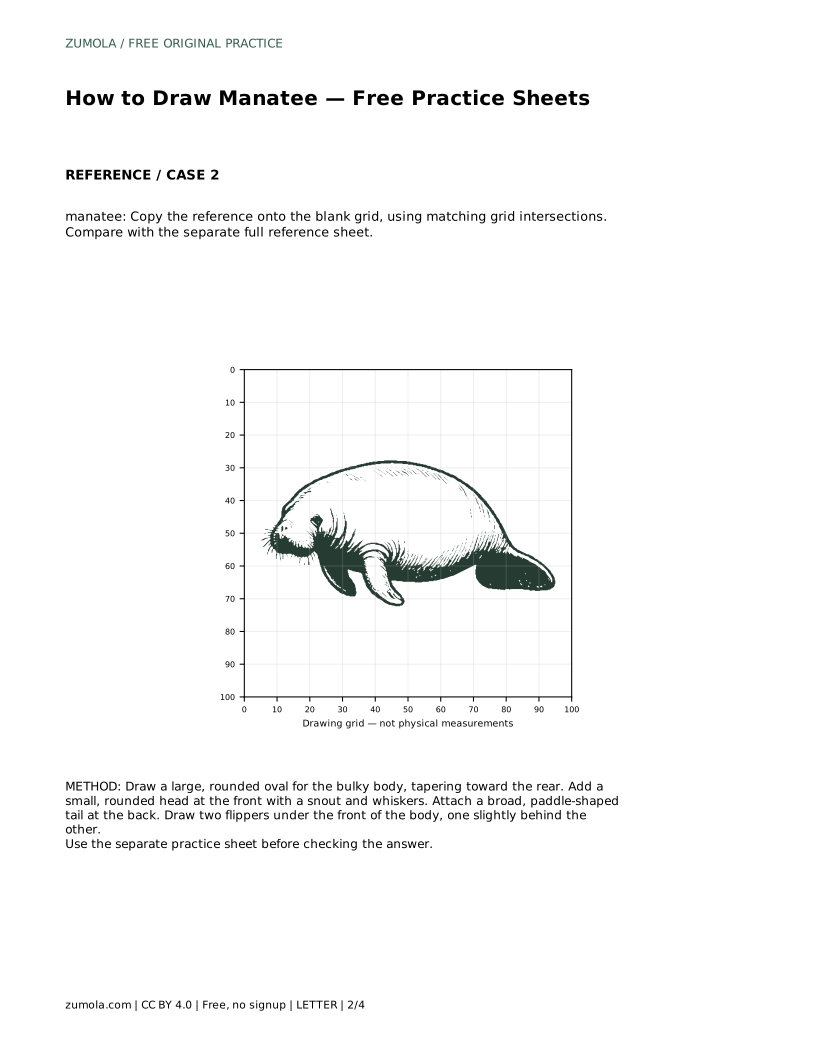
Tracing the reference outline helps you feel the contour: the long back curve, the dip behind the head, and the wide tail. Trace once slowly, then put the tracing aside and draw the contour independently on blank paper. Compare your freehand contour with the separate full reference sheet, not with your traced copy, so you are checking the original shape rather than repeating your own line.
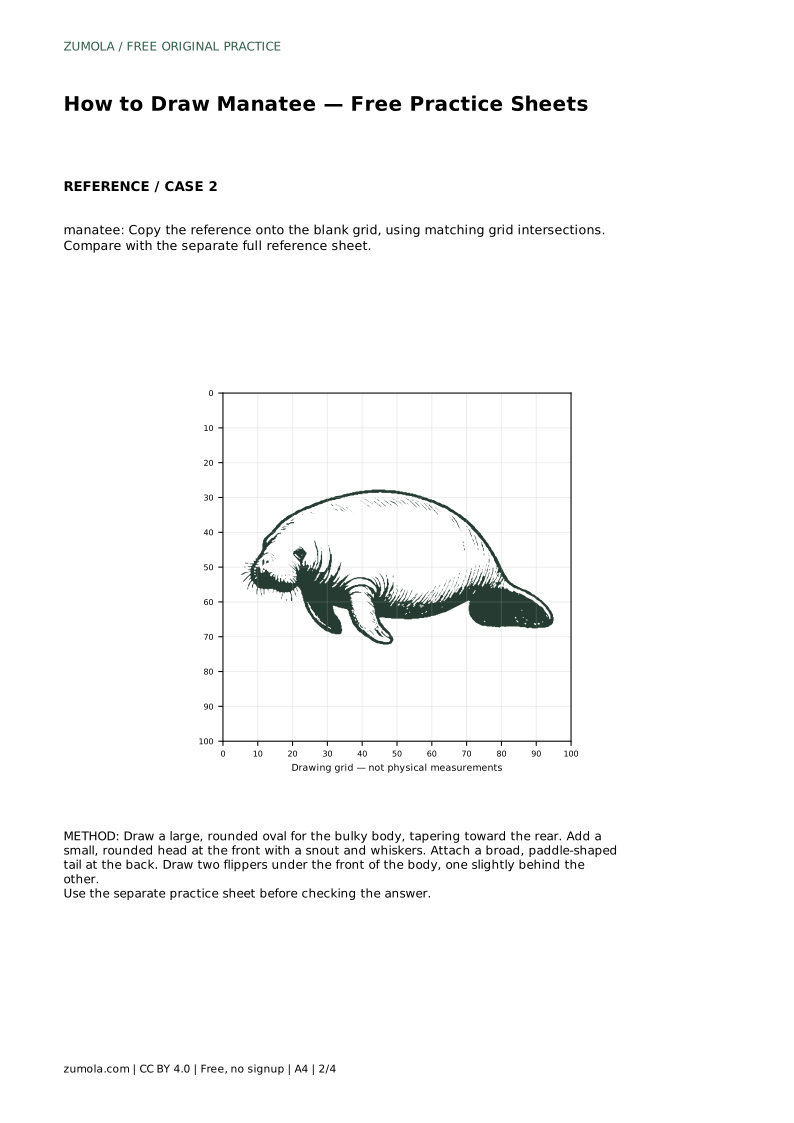
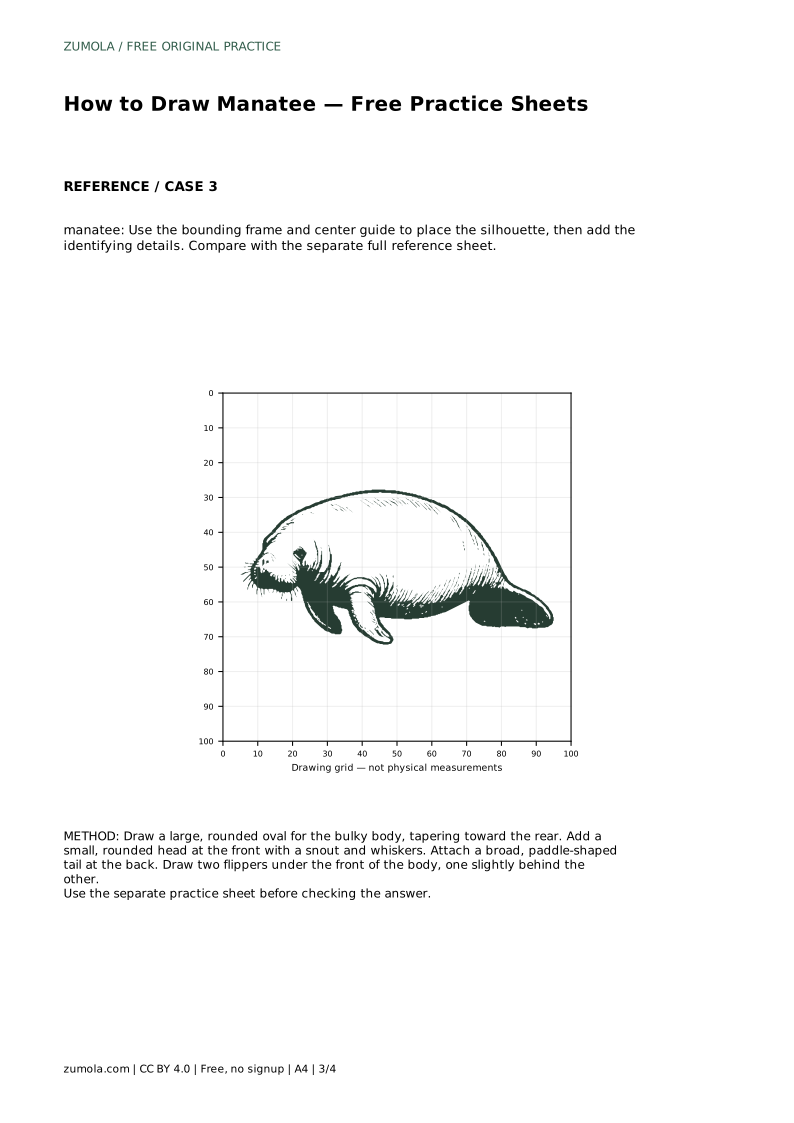
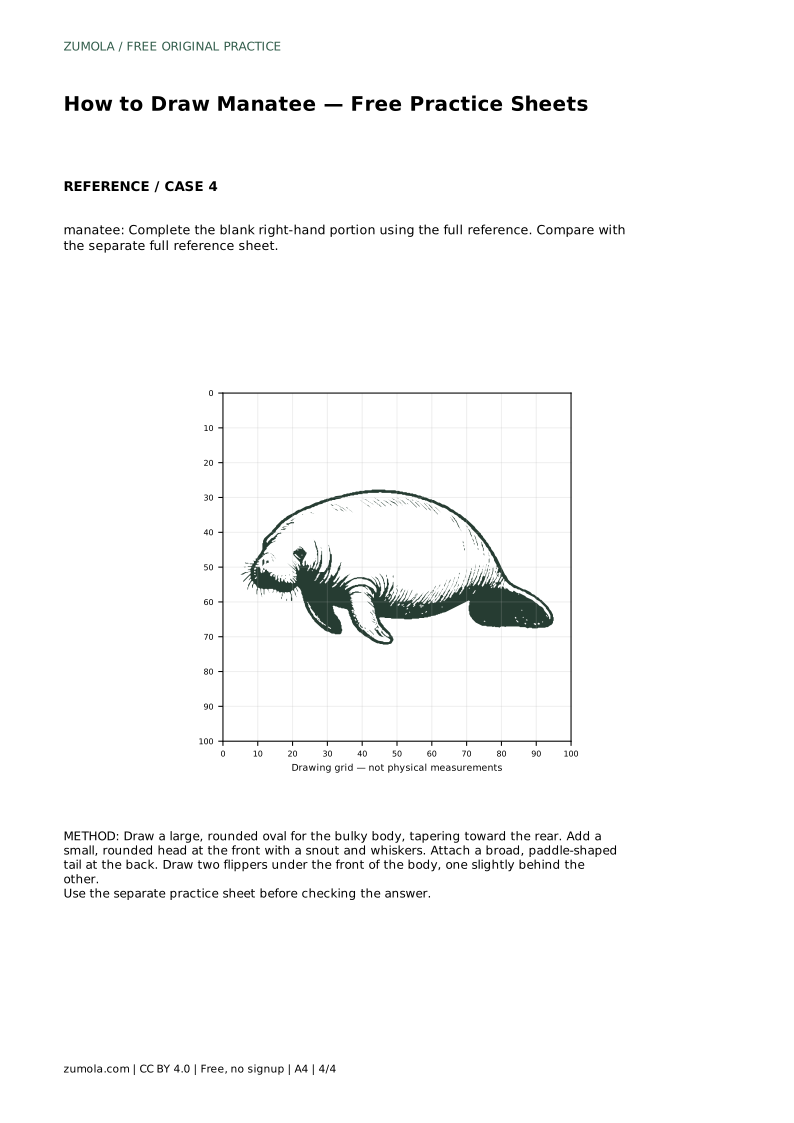
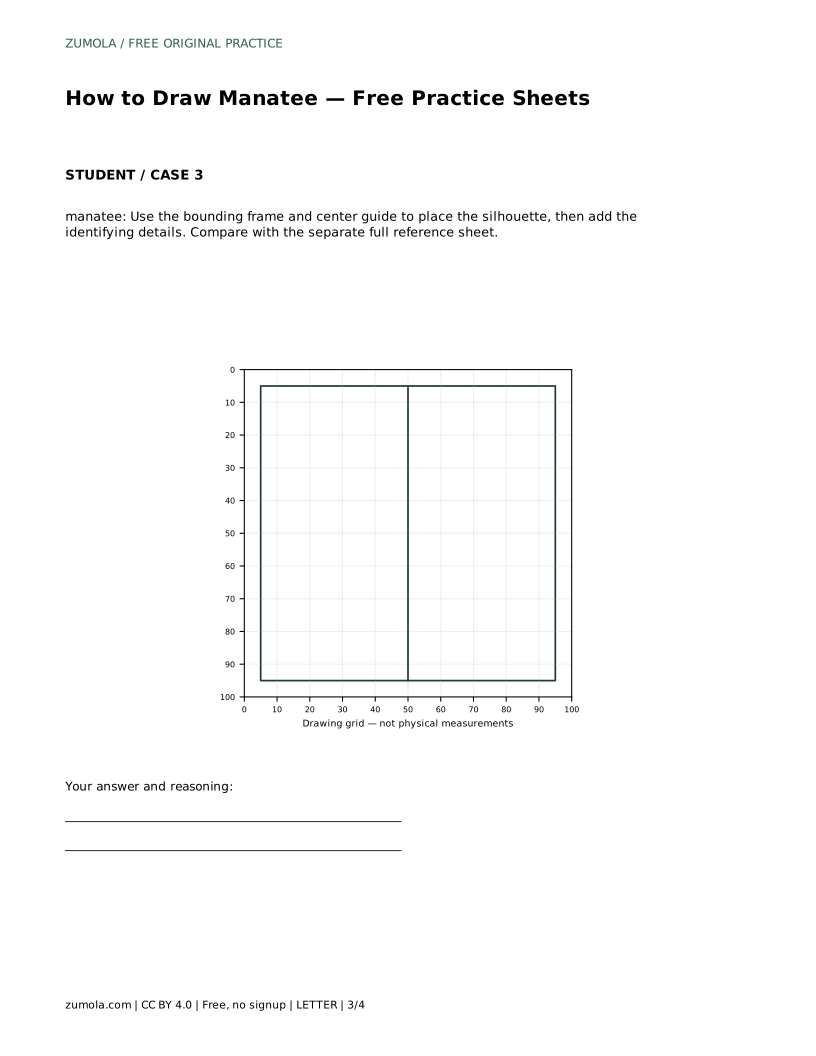
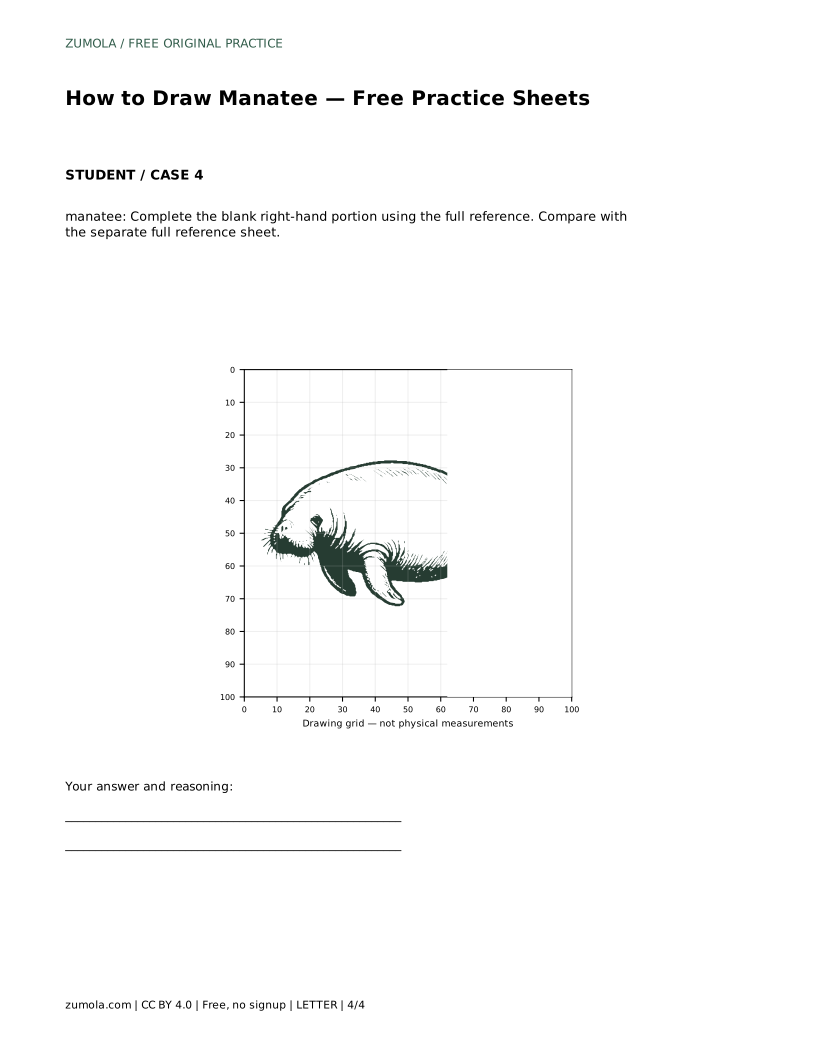
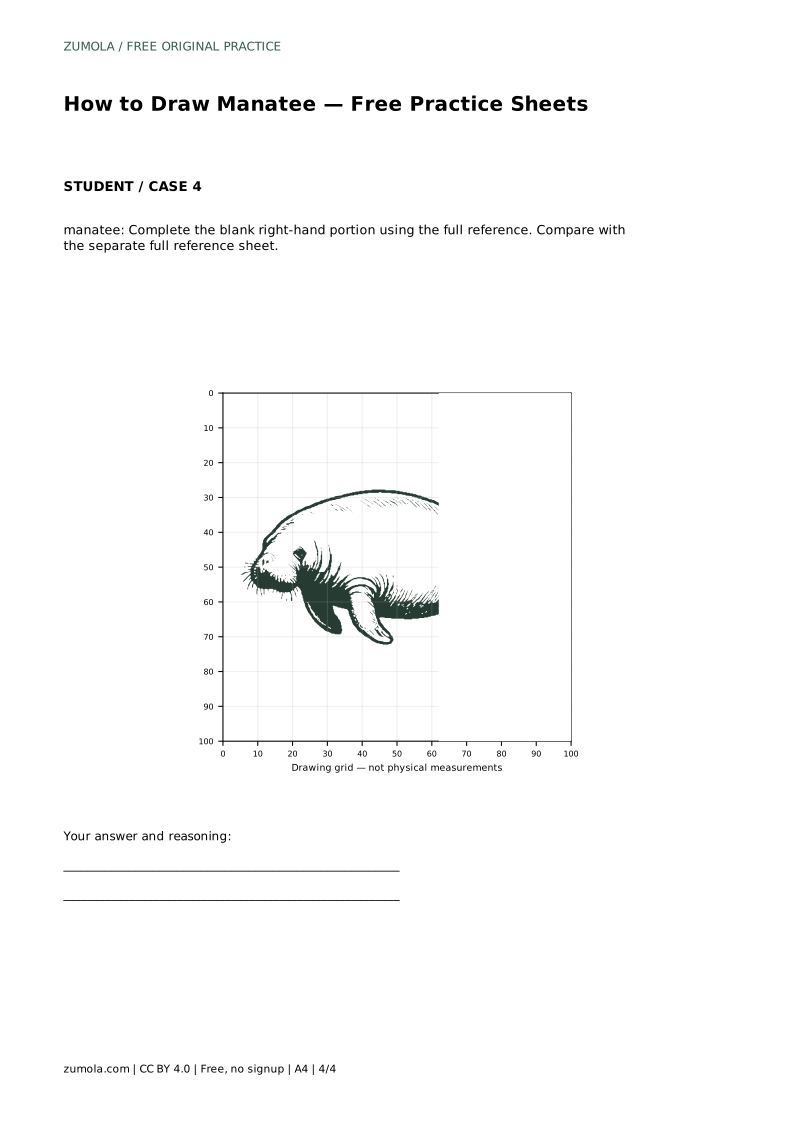
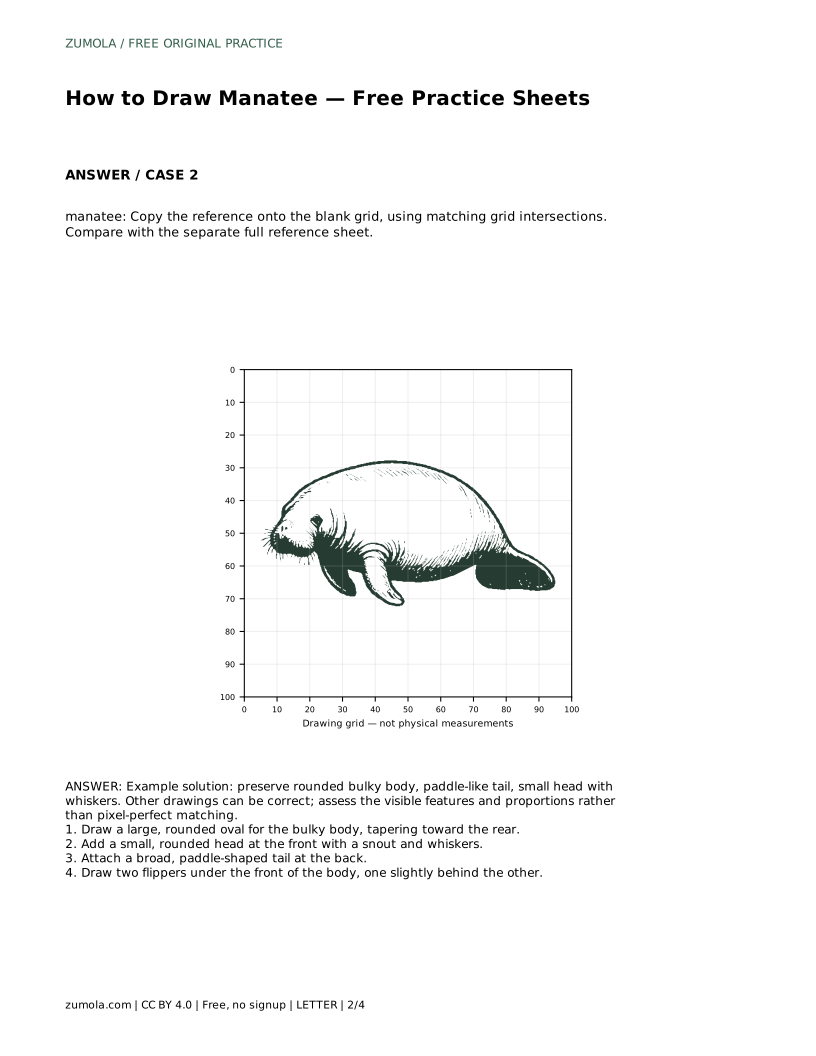
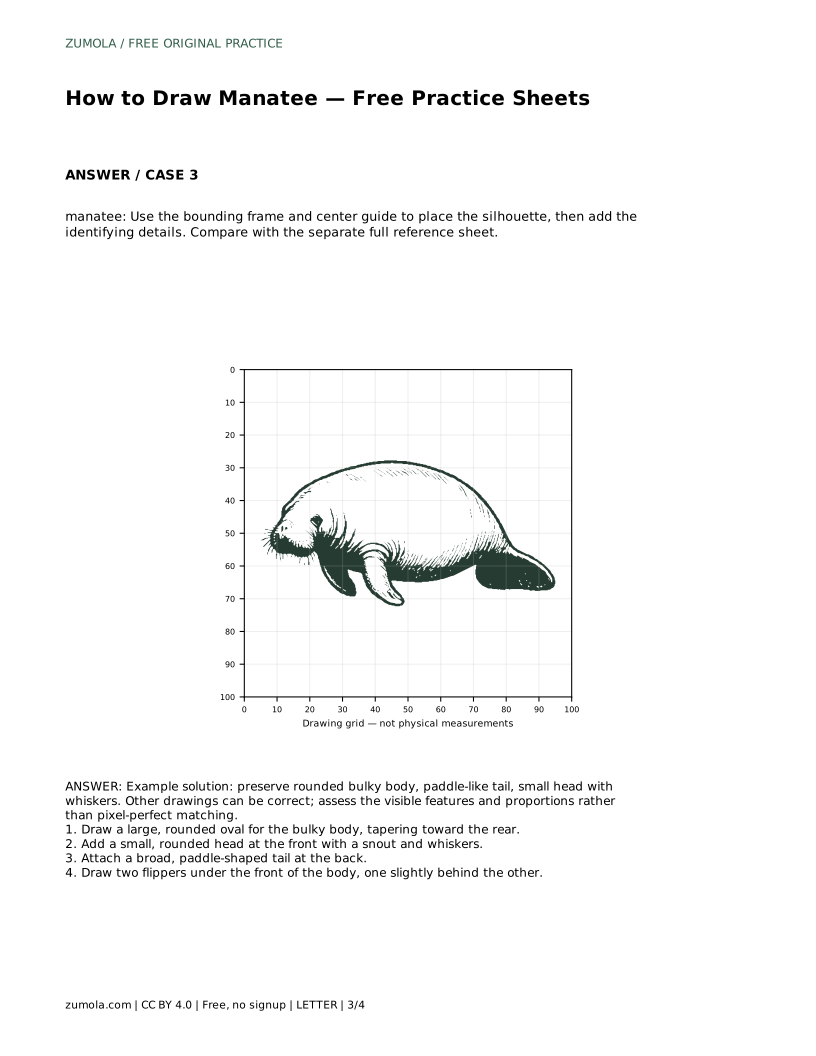
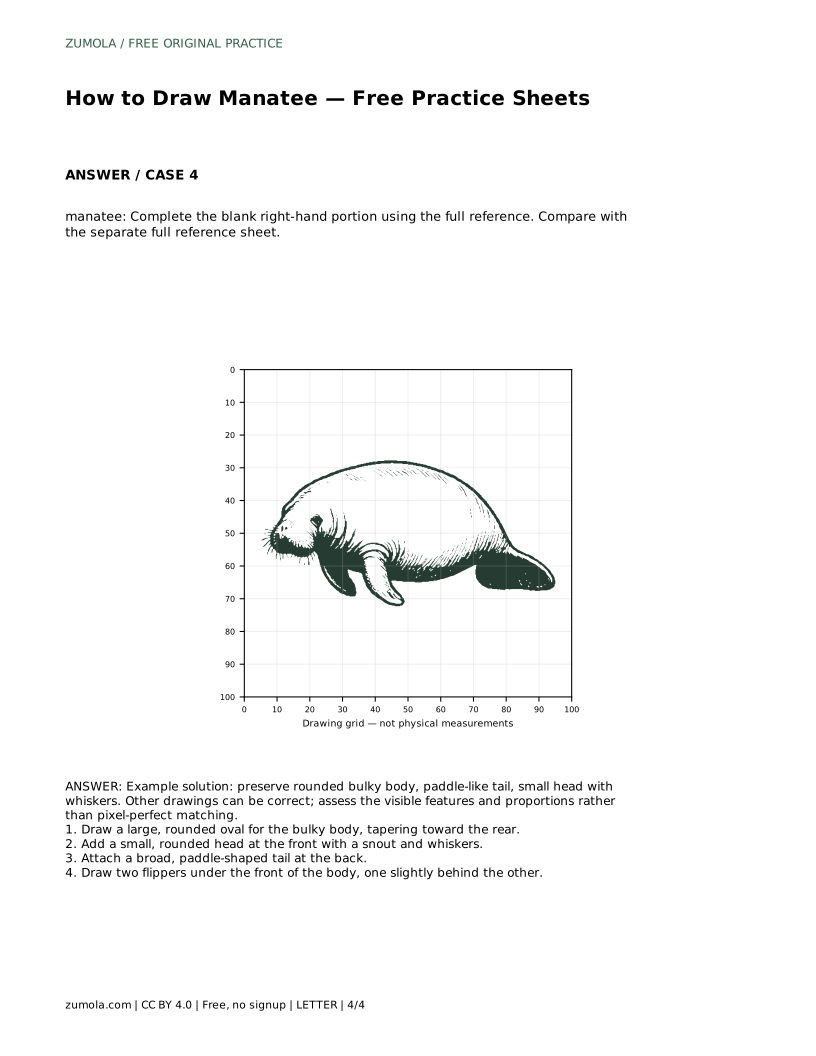
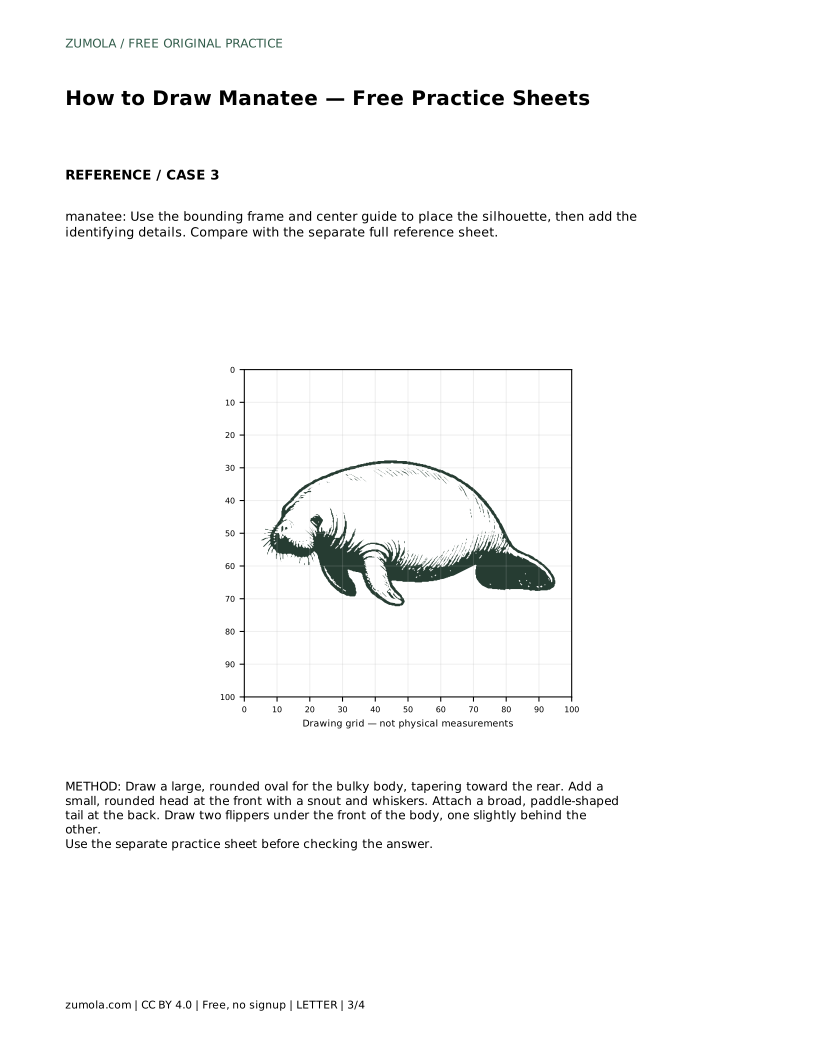
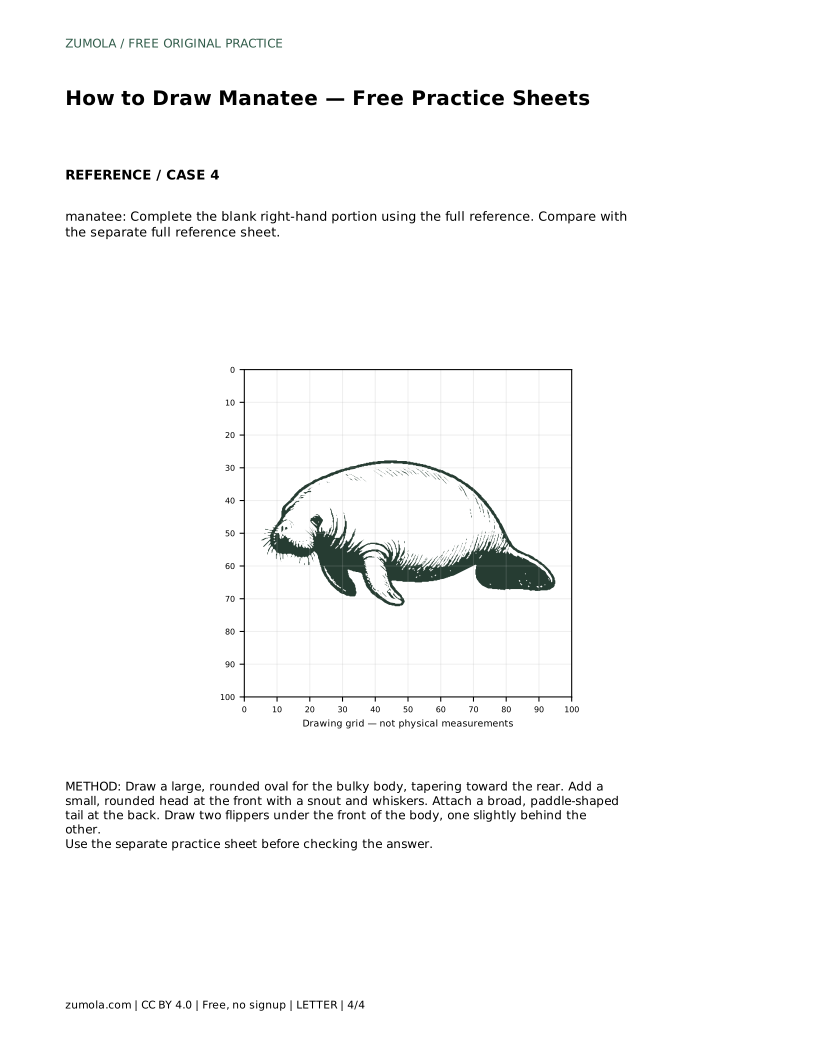
Grid copying trains placement. Match the reference to the blank grid intersection by intersection, noting where the body crosses each line and how much space the tail occupies. The bounding frame and center guide sheet works differently: use the frame to set the overall size and the center guide to balance the head and tail on either side of the middle. The partial-reference sheet asks you to complete the blank right-hand portion, which tests whether you understand the whole form rather than copying visible lines.
There is no single correct manatee drawing. A finished sketch can be correct with a slightly longer body or a rounder tail, provided the identifying features remain clear and the proportions stay believable. Use the rubric below as a checklist, and compare your drawing with the separate full reference sheet only after you have assessed it yourself.
Pay particular attention to relative size. If the head looks large enough to belong to a different animal, shrink it. If the tail looks like a thin fin, widen it into a paddle. If the flippers sit too far back, move them under the chest area. Small corrections to these relationships usually improve the drawing more than adding surface detail.
Most beginner manatee drawings fail in one of three places: the body becomes too narrow, the tail becomes a fish tail, or the head grows too large. Each fix is a proportion adjustment, not a redraw. Work from the largest shape outward, and leave whiskers and other fine marks until the silhouette is settled.
manatee: Trace the reference outline, then practise the contour independently. Compare with the separate full reference sheet.
Example solution: preserve rounded bulky body, paddle-like tail, small head with whiskers. Other drawings can be correct; assess the visible features and proportions rather than pixel-perfect matching. Draw a large, rounded oval for the bulky body, tapering toward the rear. Add a small, rounded head at the front with a snout and whiskers. Attach a broad, paddle-shaped tail at the back. Draw two flippers under the front of the body, one slightly behind the other.
No. Preserve the rounded bulky body, paddle-like tail, and small head with whiskers. Other drawings can be correct, so assess visible features and proportions rather than pixel-perfect matching.
Check the body-to-head ratio and the tail shape first, since those two relationships carry most of the manatee's identity.
Study the full reference sheet first, then complete the blank right-hand portion from that understanding rather than guessing line by line.
All drawing practice · Free coordinate paper
Original resources · CC BY 4.0 · Free for personal and classroom use with attribution.