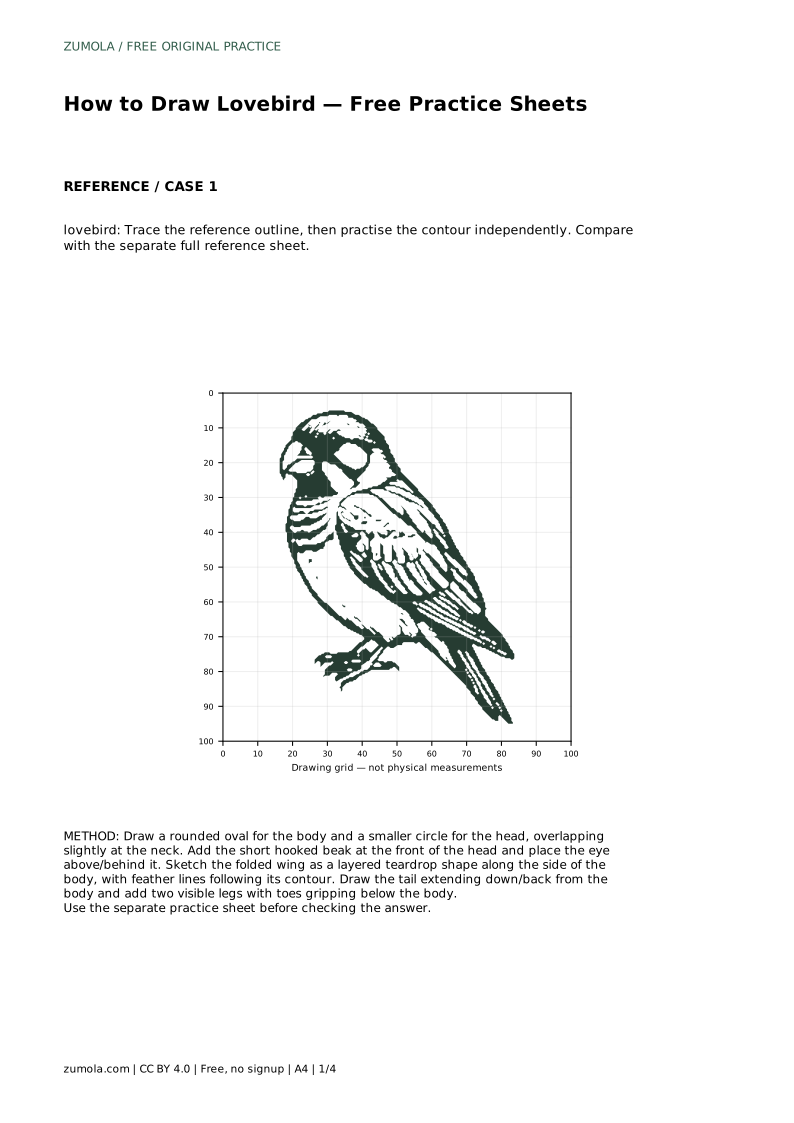
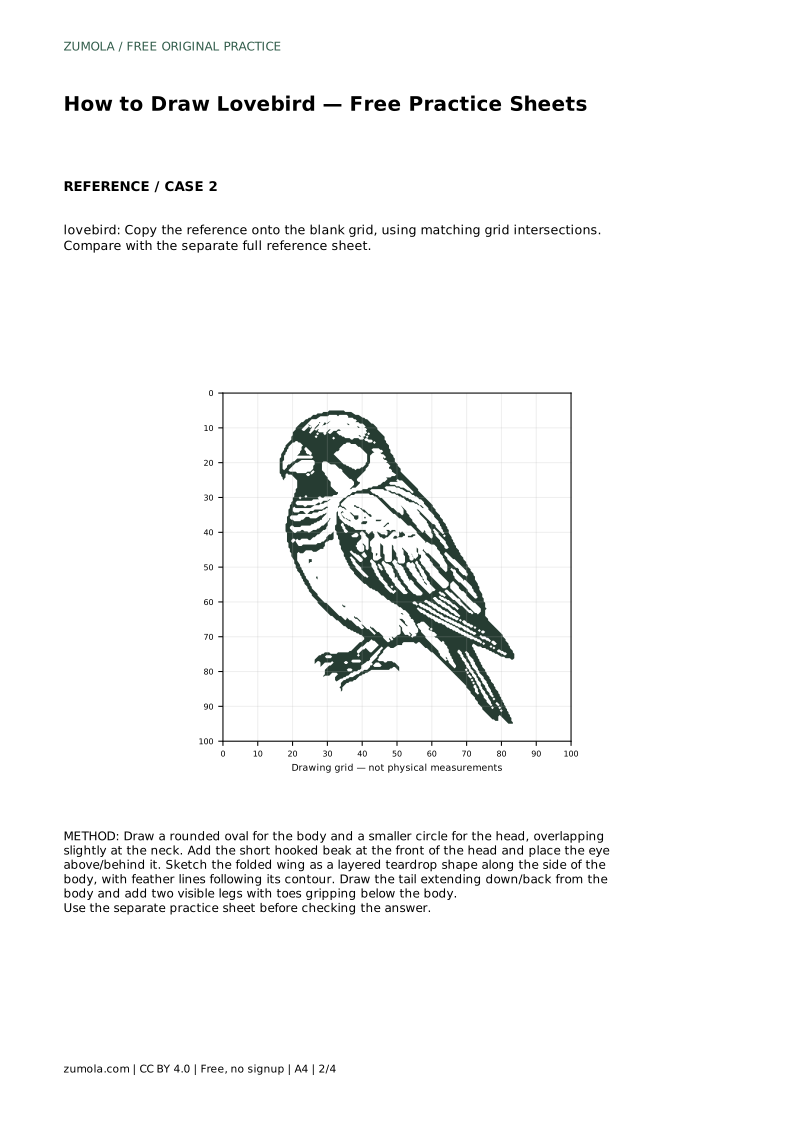
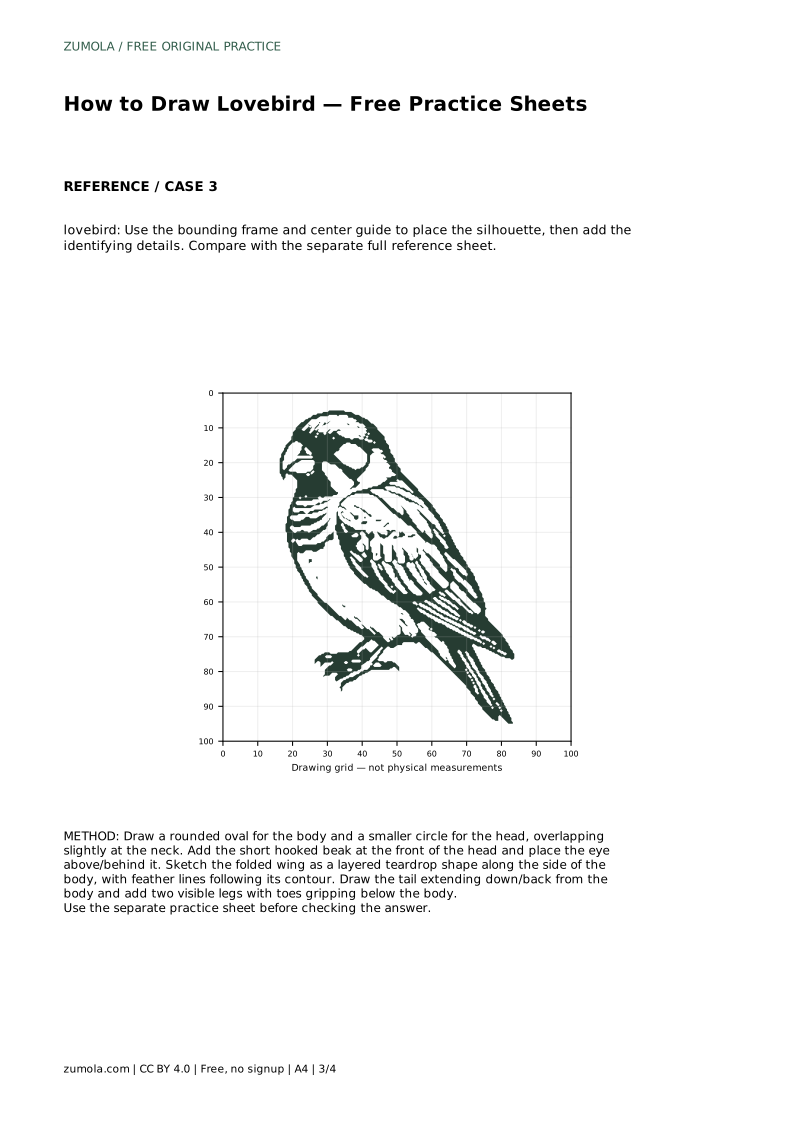
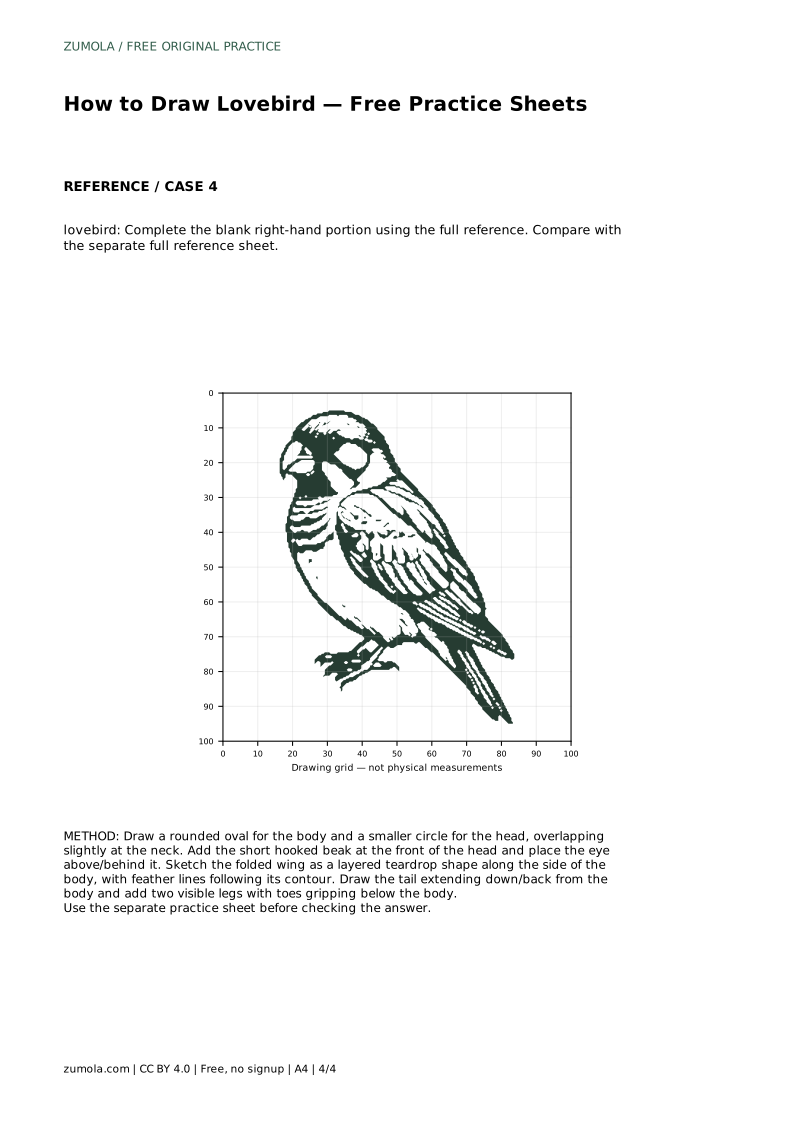
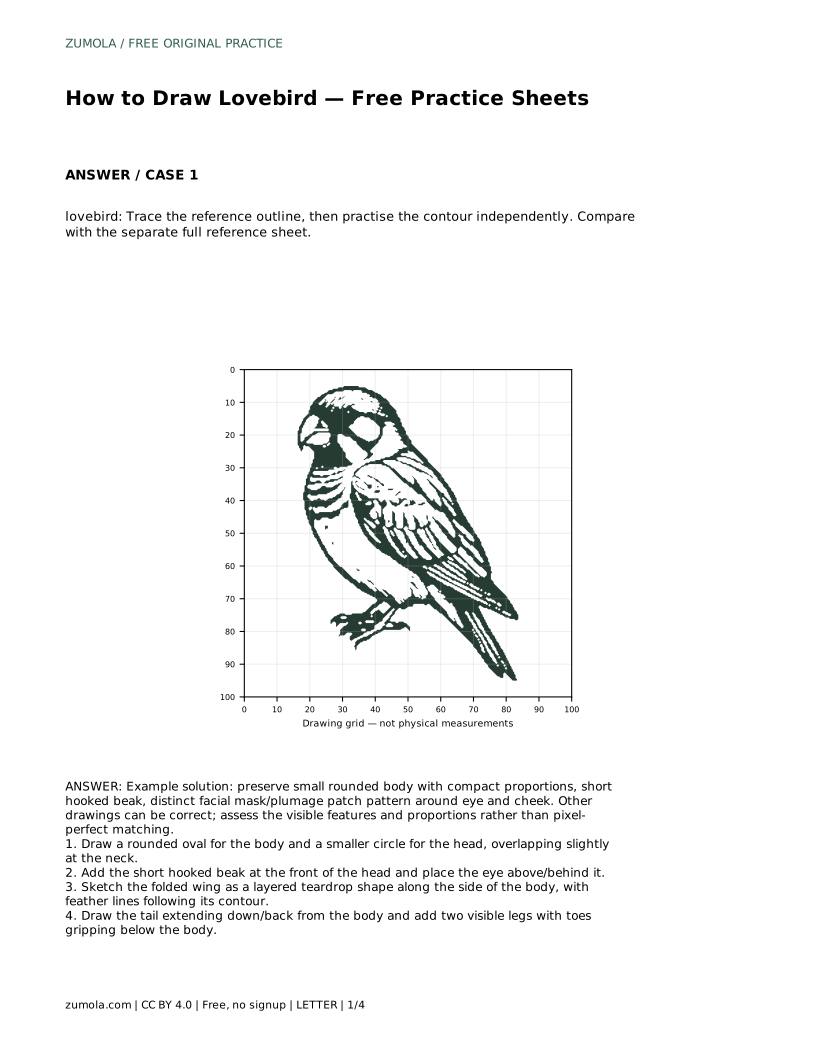
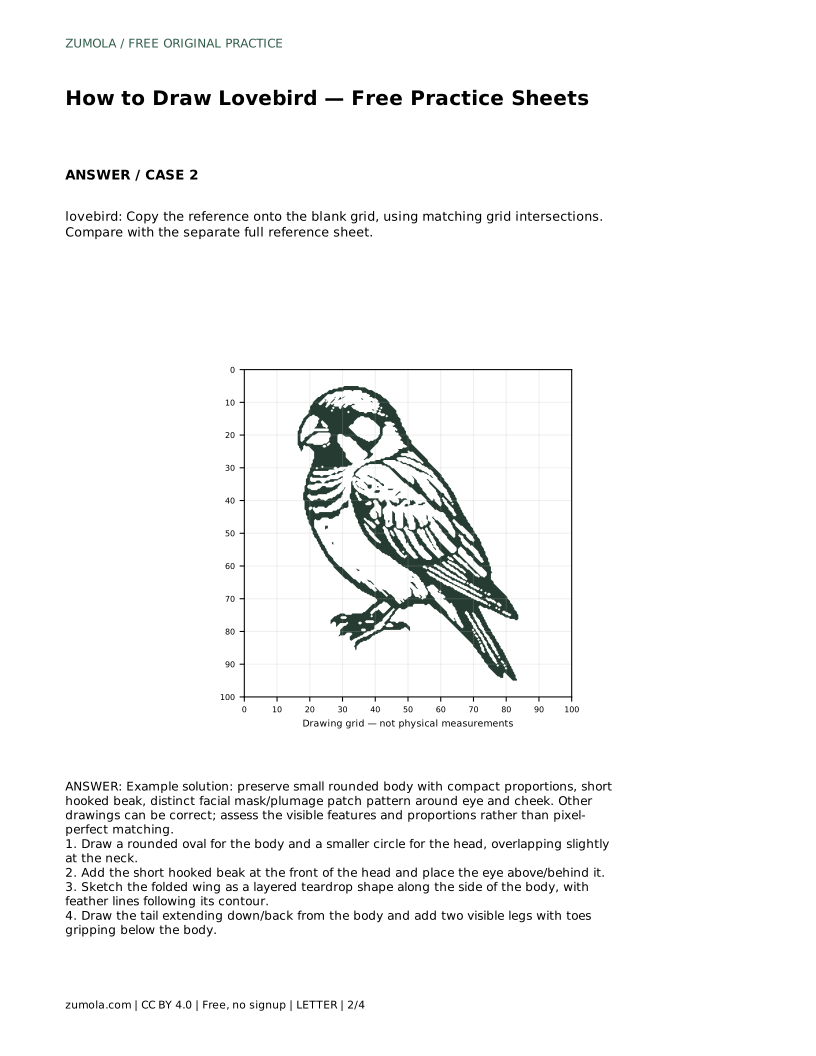
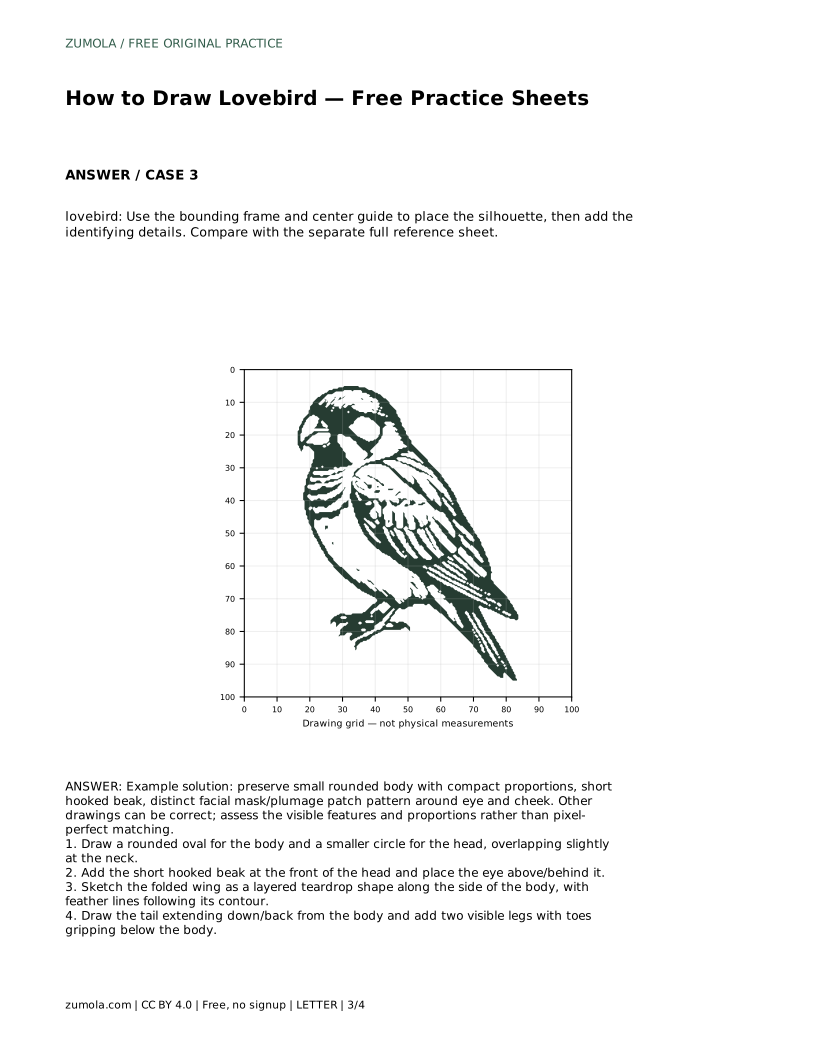
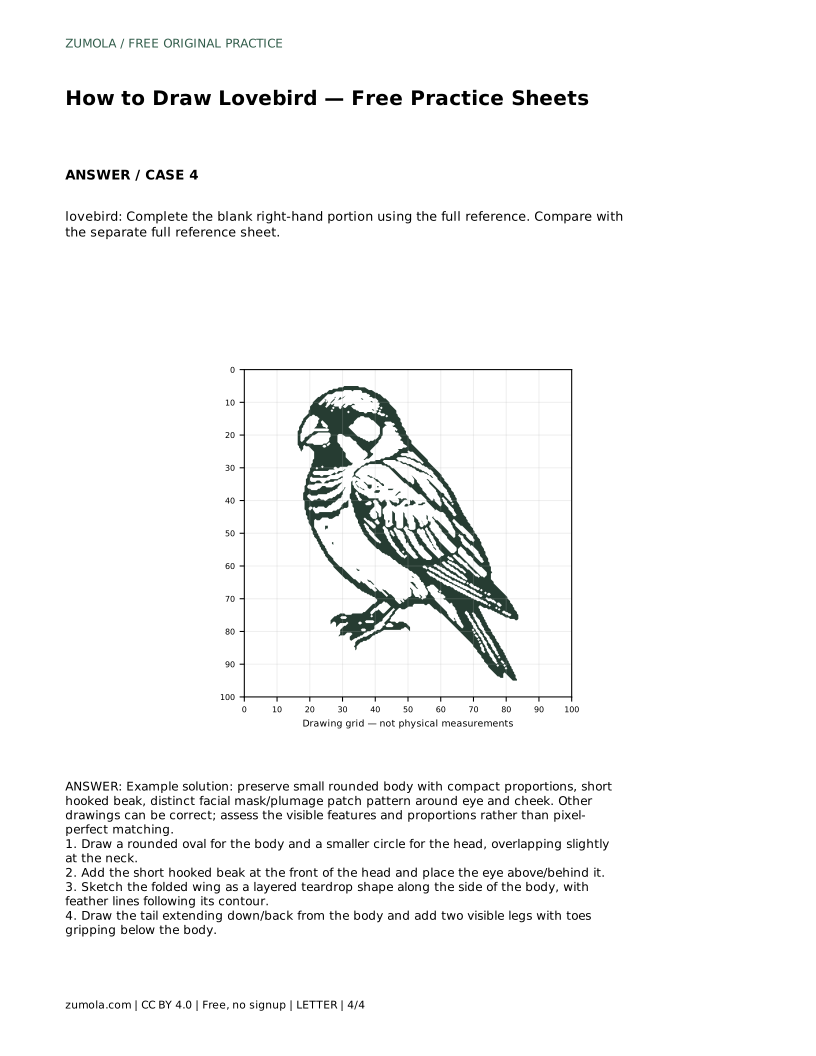
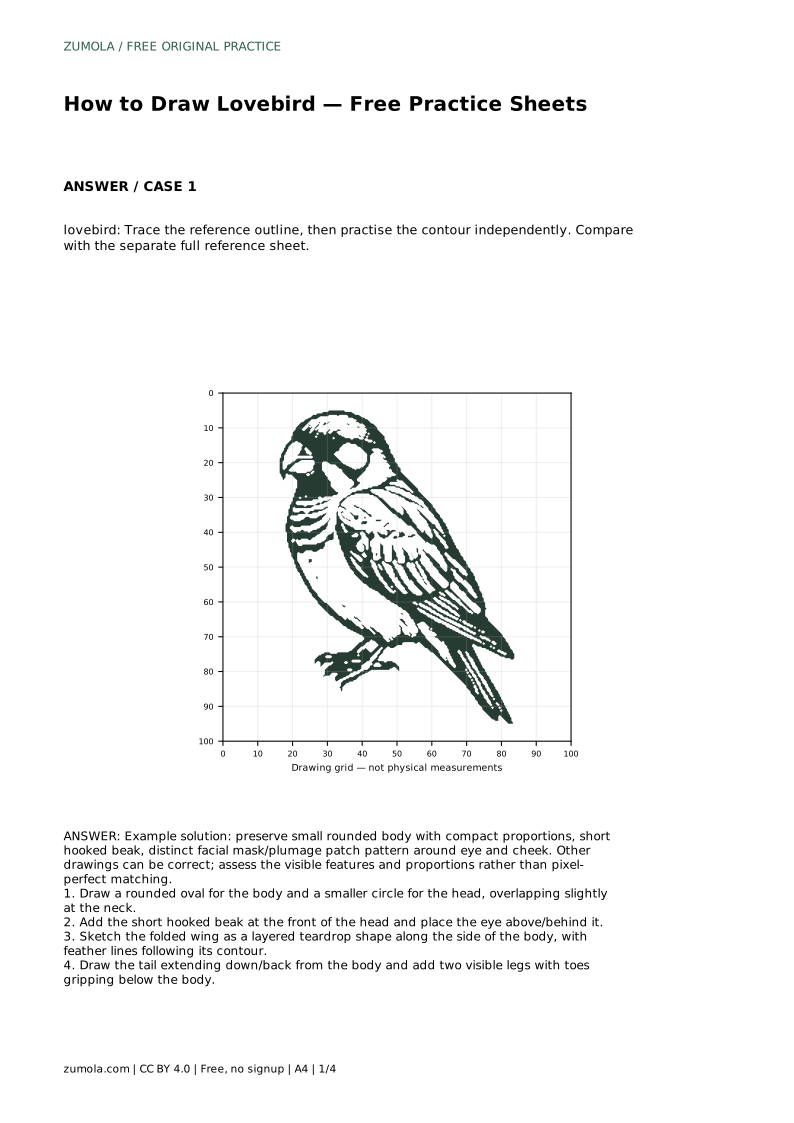
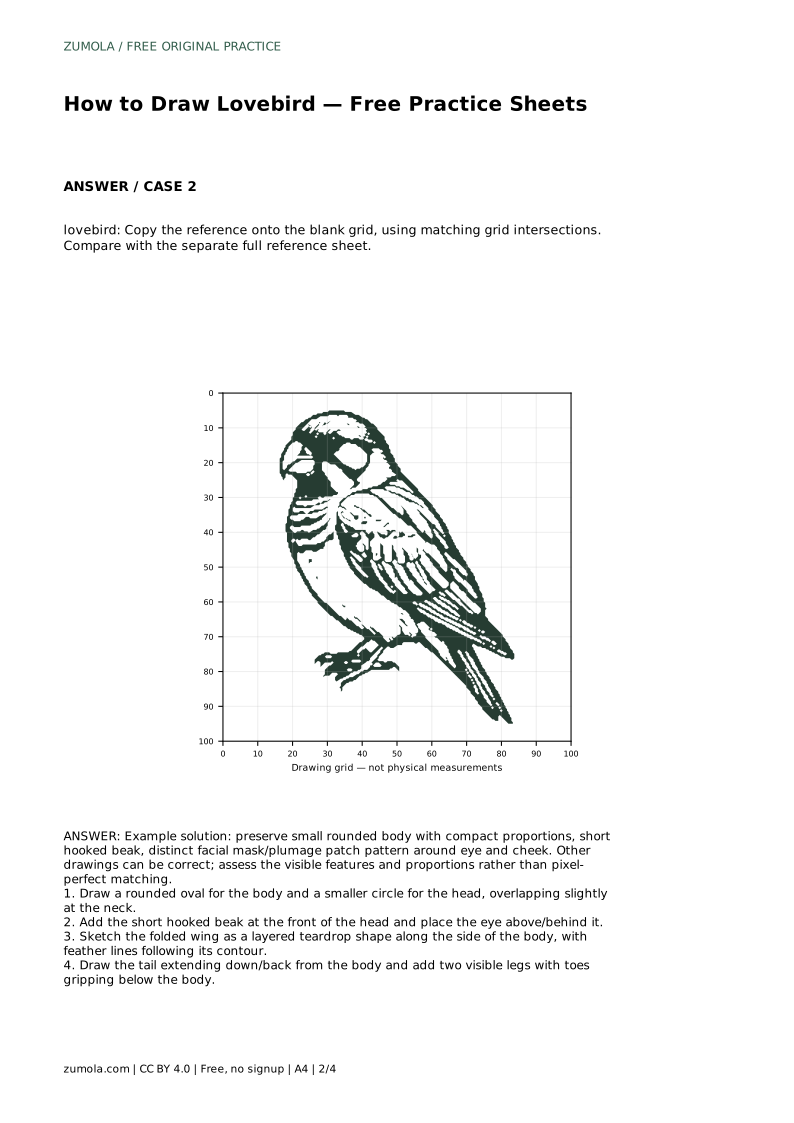
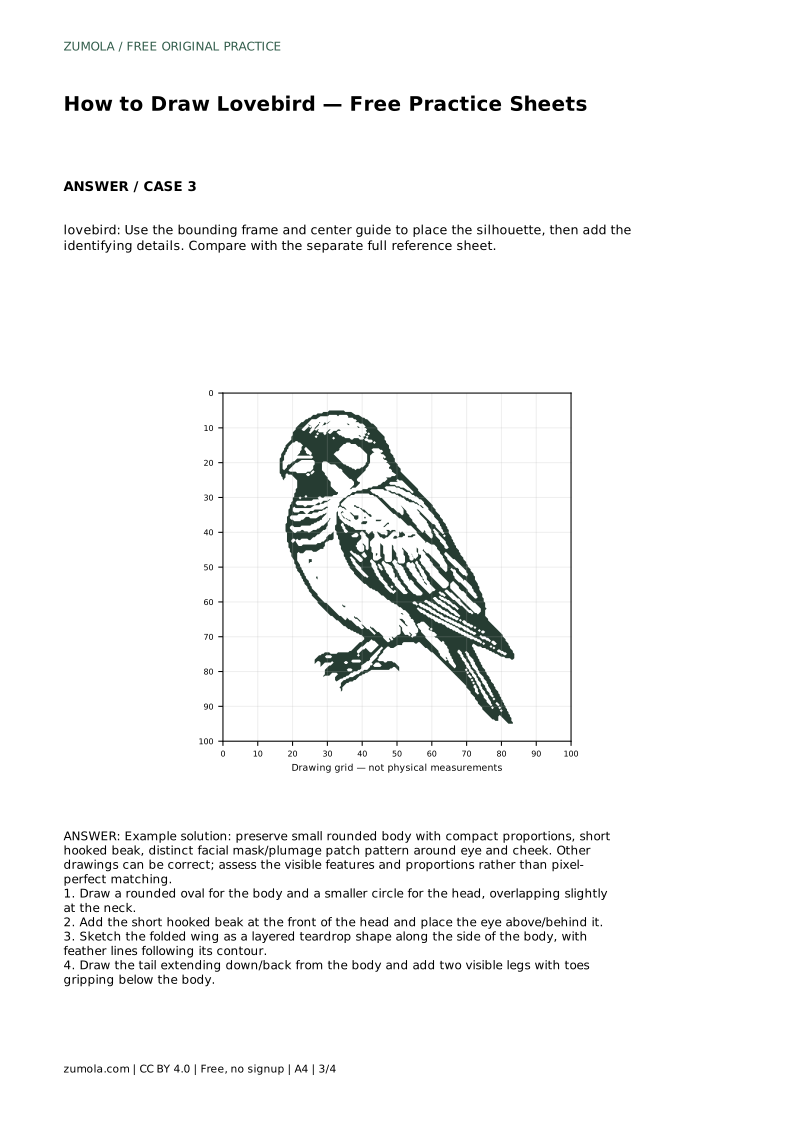
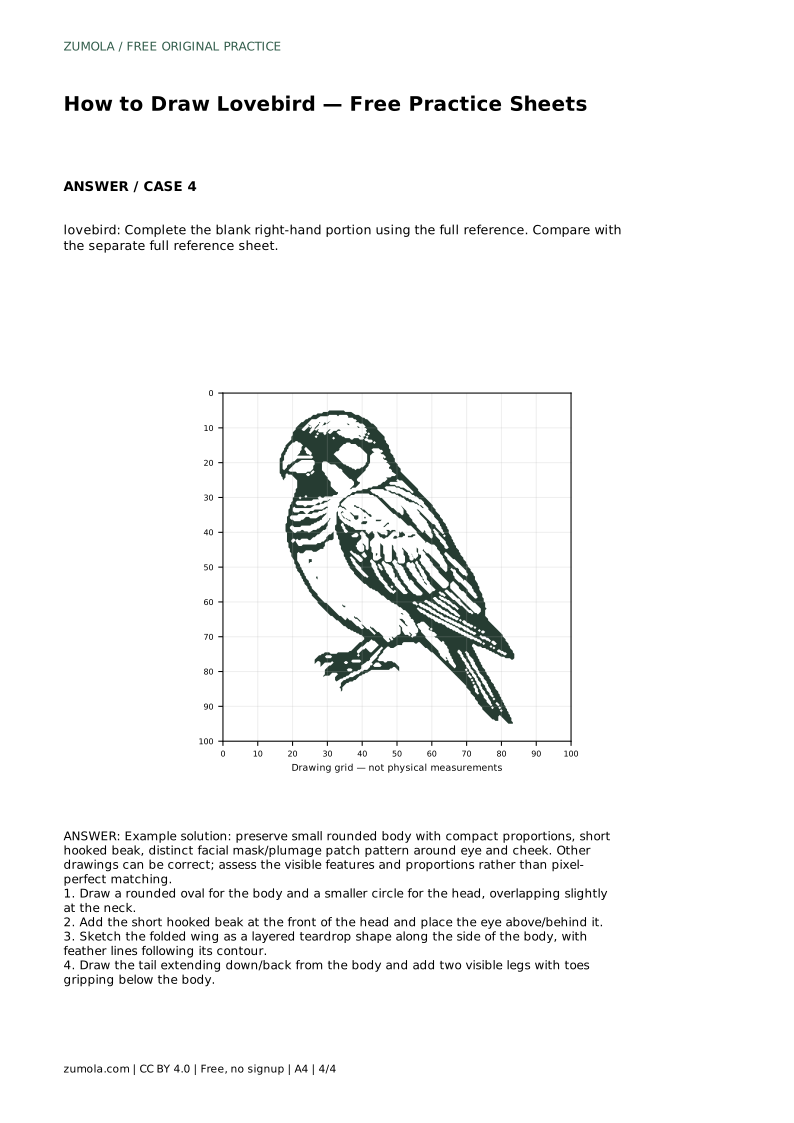
Reference diagrams
LETTER · Download PDF
A4 · Download PDF
Free original resources
Learn to draw a lovebird by tracing its outline, copying onto a grid, and completing a partial reference. Focus on compact proportions, the hooked beak, and facial markings.
Four original cases, with reference diagrams, practice sheets and worked answers. Everything is free; no signup required.
LETTER · Download PDF
A4 · Download PDF
LETTER · Download PDF
A4 · Download PDF
LETTER · Download PDF
A4 · Download PDF
Use A4 or US Letter to match your printer. Use the stated values and conditions to solve each exercise; diagrams are not physical measuring rulers.
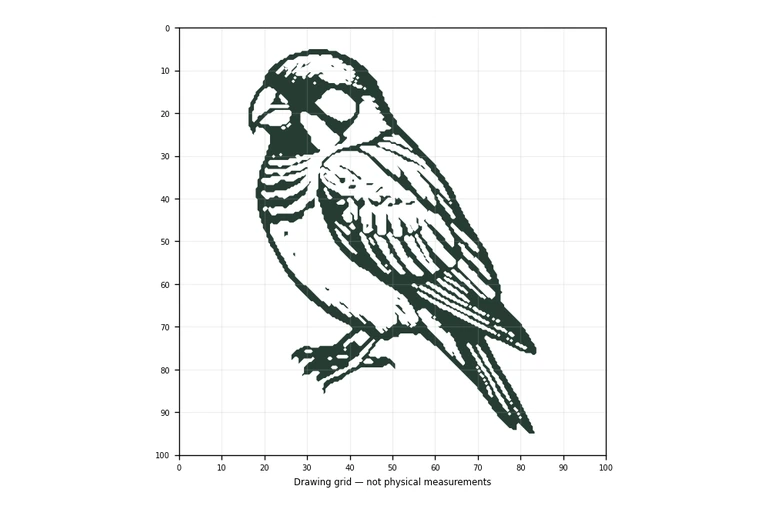
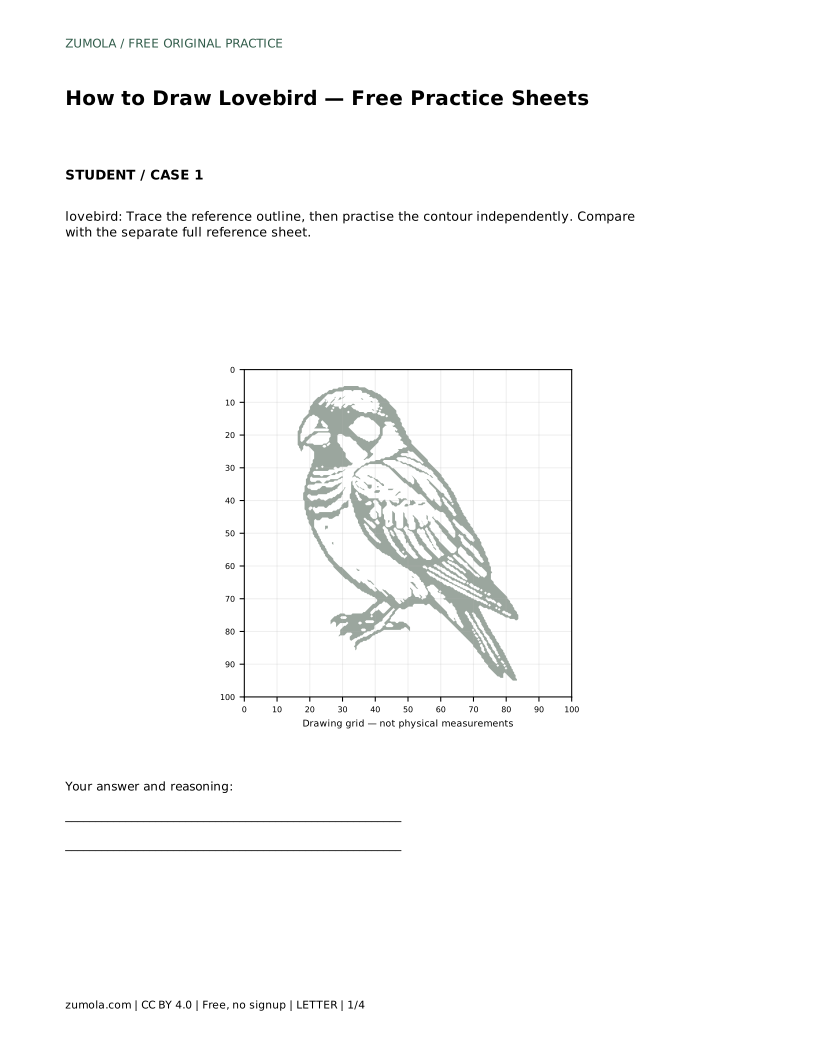
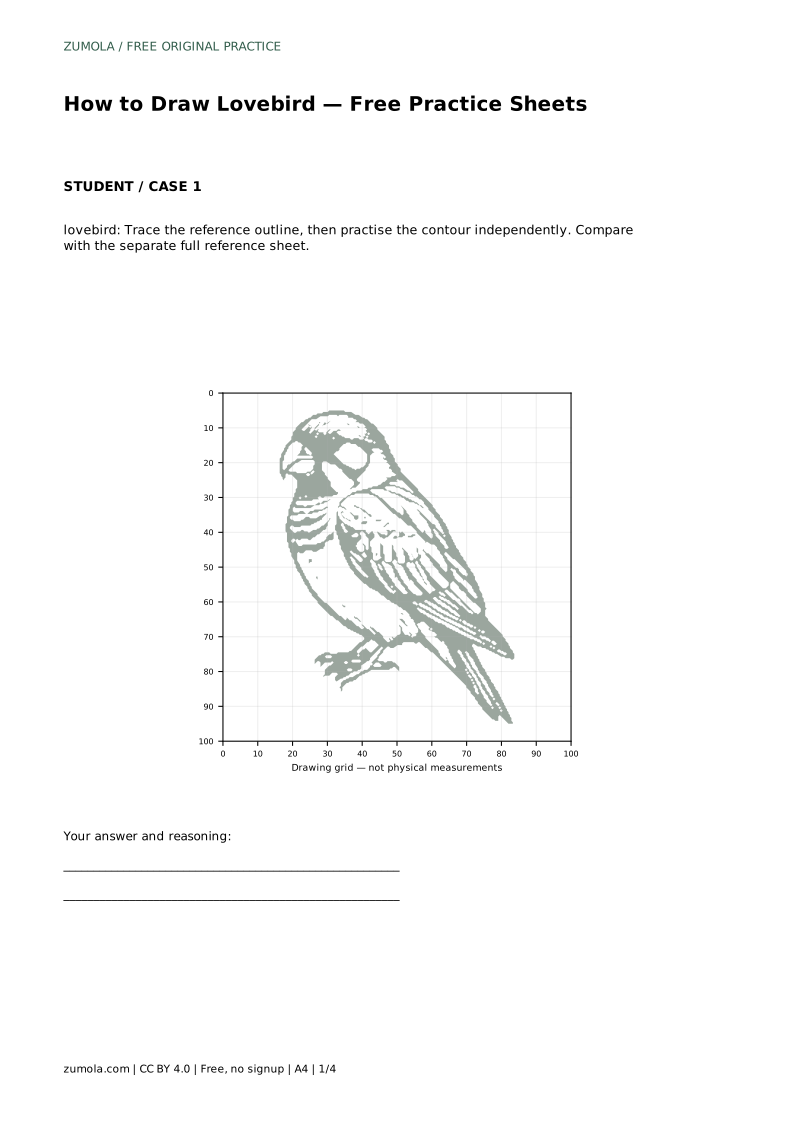
Lovebirds are small parrots with compact, rounded bodies and short tails, so their proportions matter more than fine feather detail. This page guides you through tracing a reference outline, then drawing the contour independently, and comparing your work with a separate full reference sheet. You will practise placing the head, beak, eye, folded wing, tail, and feet in a believable arrangement. Because drawings can vary, judge your result by visible features and proportions rather than an exact match.
Begin by drawing a rounded oval for the body and a smaller circle for the head, overlapping slightly at the neck. The overlap keeps the head connected to the body instead of floating above it. Keep the body compact; a lovebird should not look long or stretched.
Place the short hooked beak at the front of the head, then put the eye above and slightly behind the beak. The beak is a key identifying feature, so keep it short and curved rather than pointed like a songbird's. Check that the head is not larger than the body oval.
Sketch the folded wing as a layered teardrop shape along the side of the body. Feather lines should follow the wing's contour rather than crossing it at random. The tail extends down and back from the body; keep it short and proportionate to the compact body.
Add two visible legs with toes gripping below the body. The feet should sit under the body's weight, not off to one side. If you are tracing, follow the reference outline first, then try the same contour on a blank sheet without tracing. Compare both attempts with the separate full reference sheet.
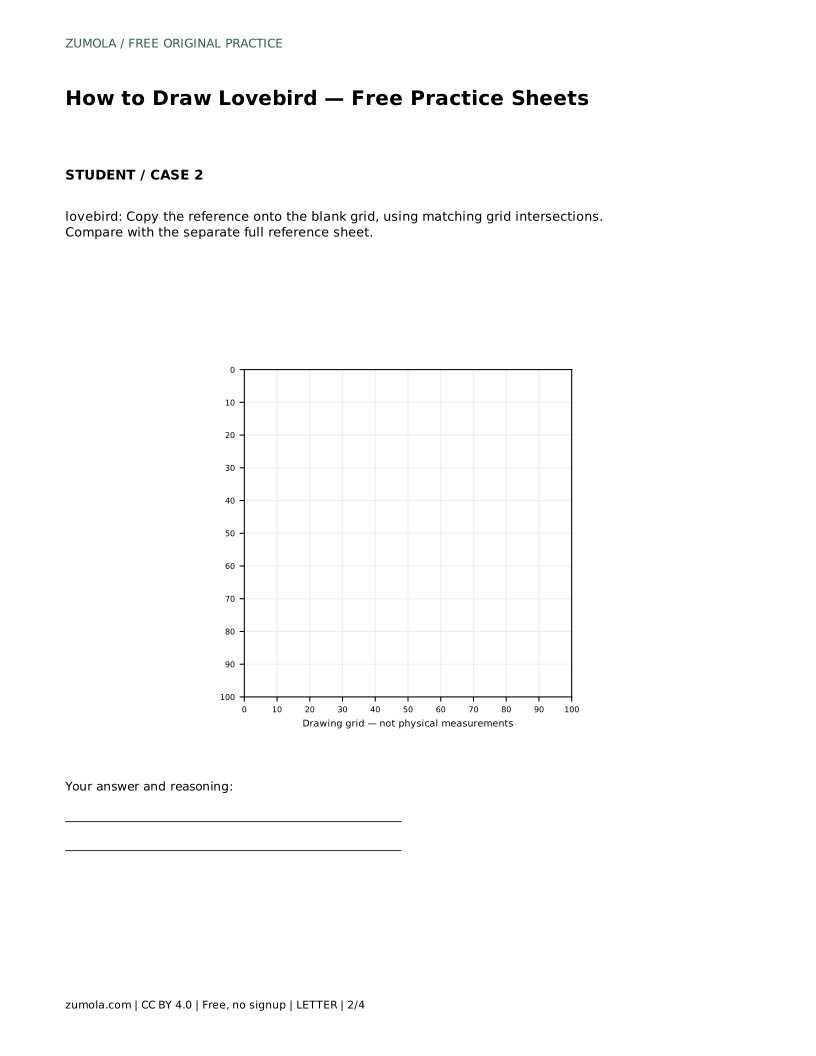
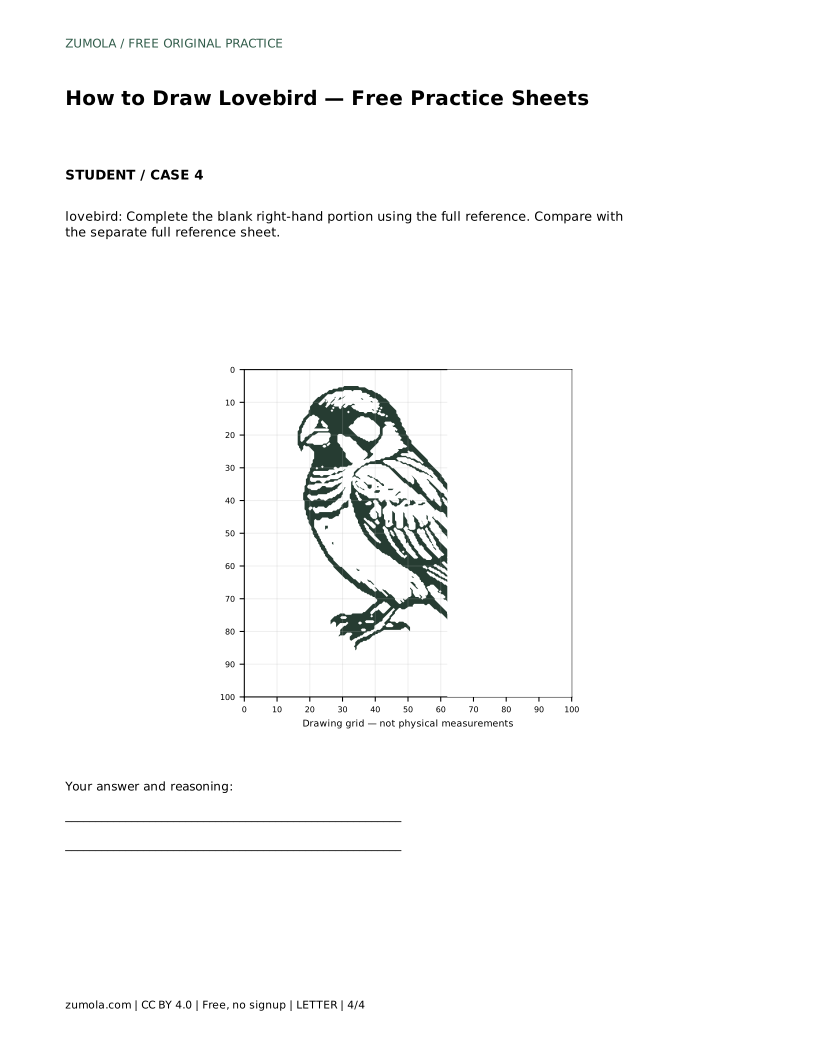
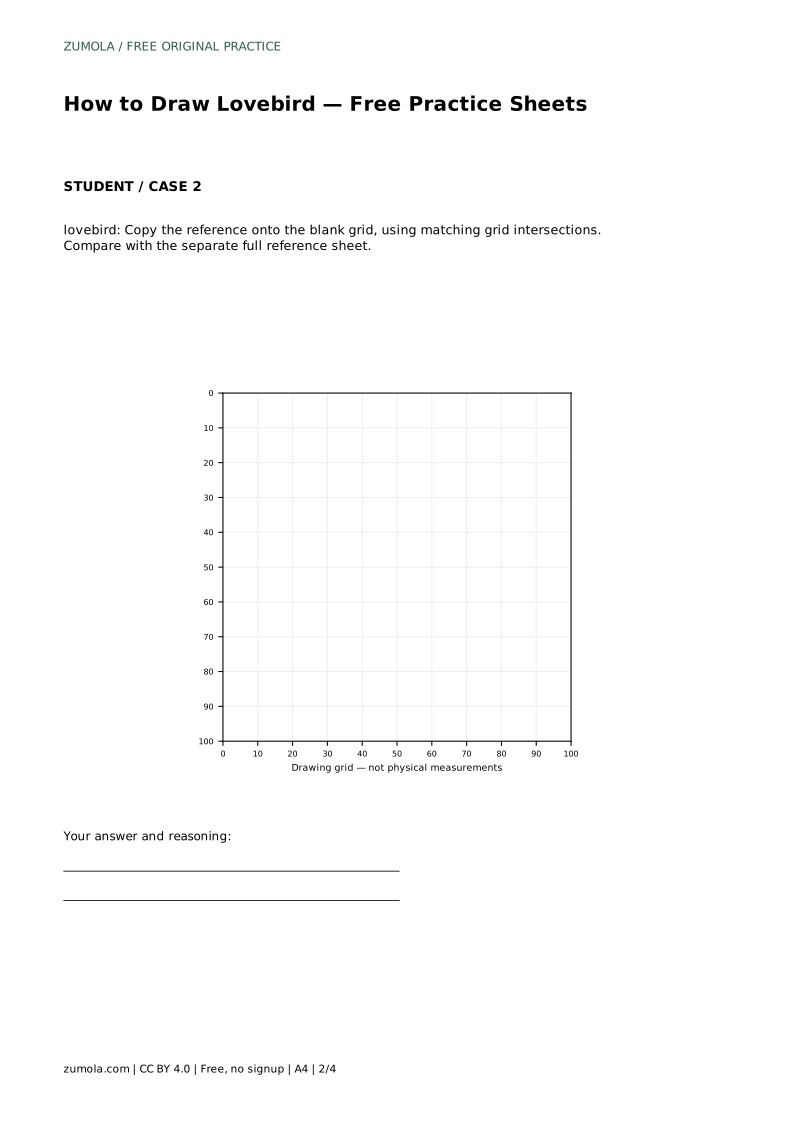
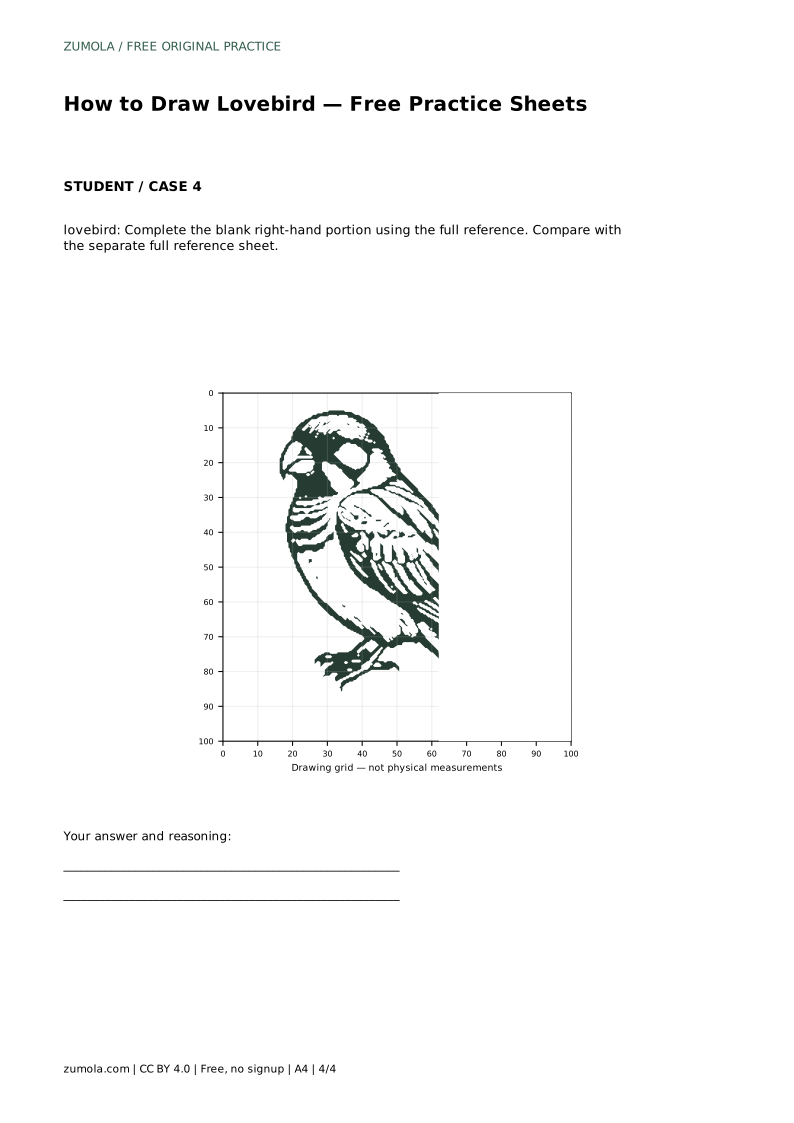
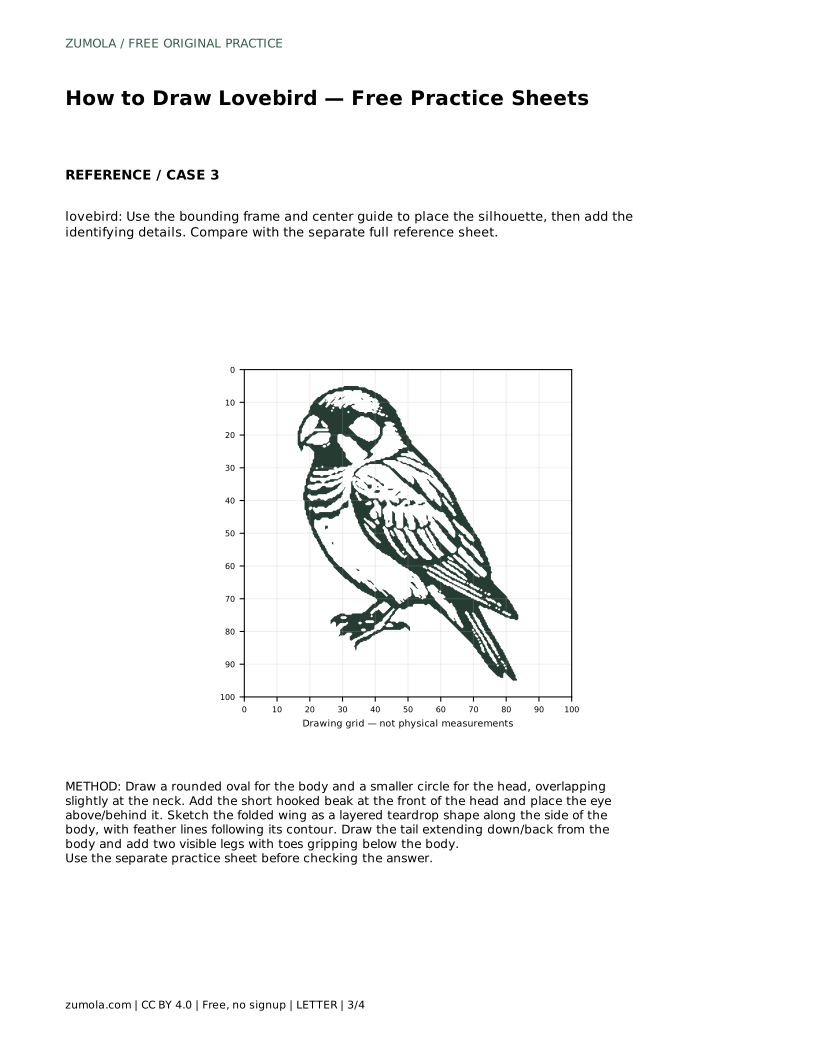
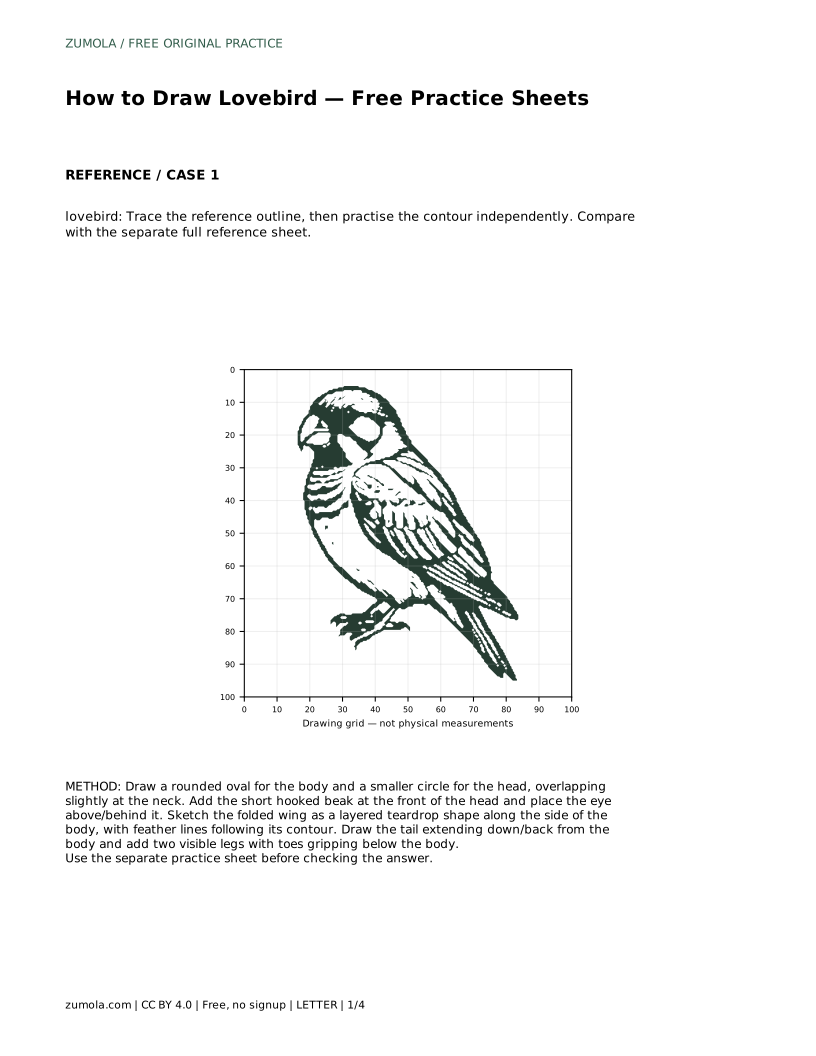
When copying onto a blank grid, match the reference at grid intersections rather than guessing the whole shape at once. This helps you keep the head, beak, and wing in the same relative positions. For a partial reference, complete the blank right-hand portion by continuing the visible contours and checking the full reference sheet afterward.
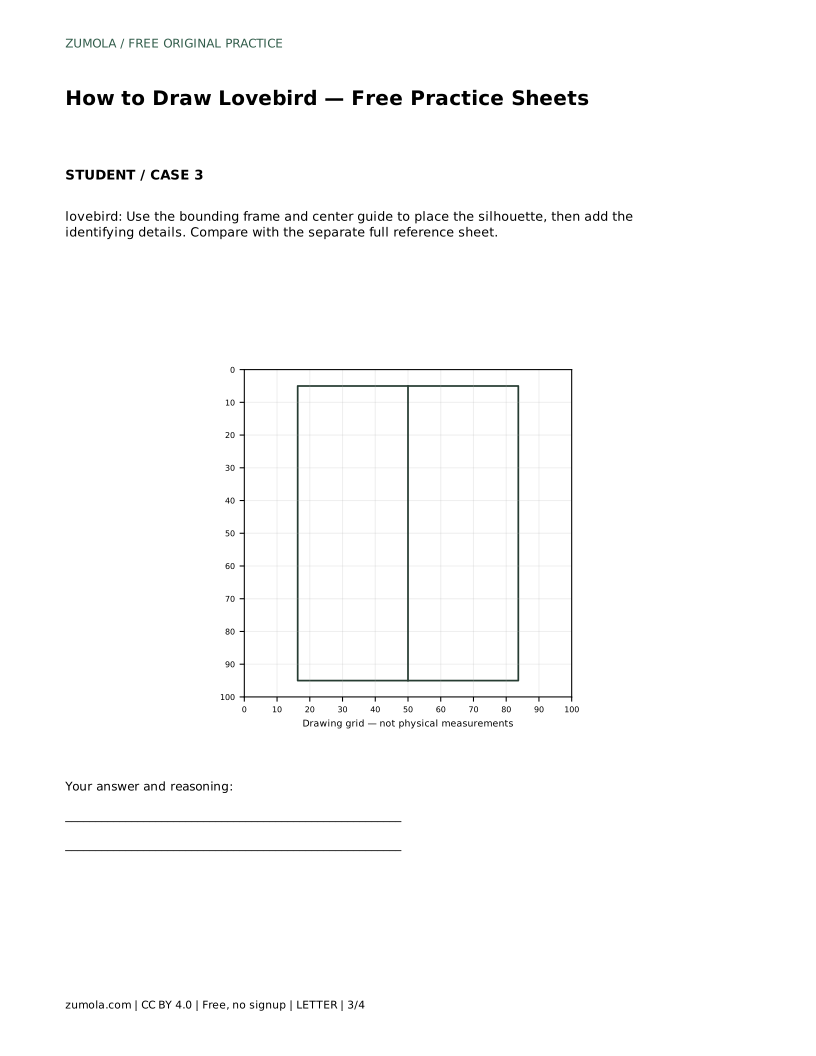
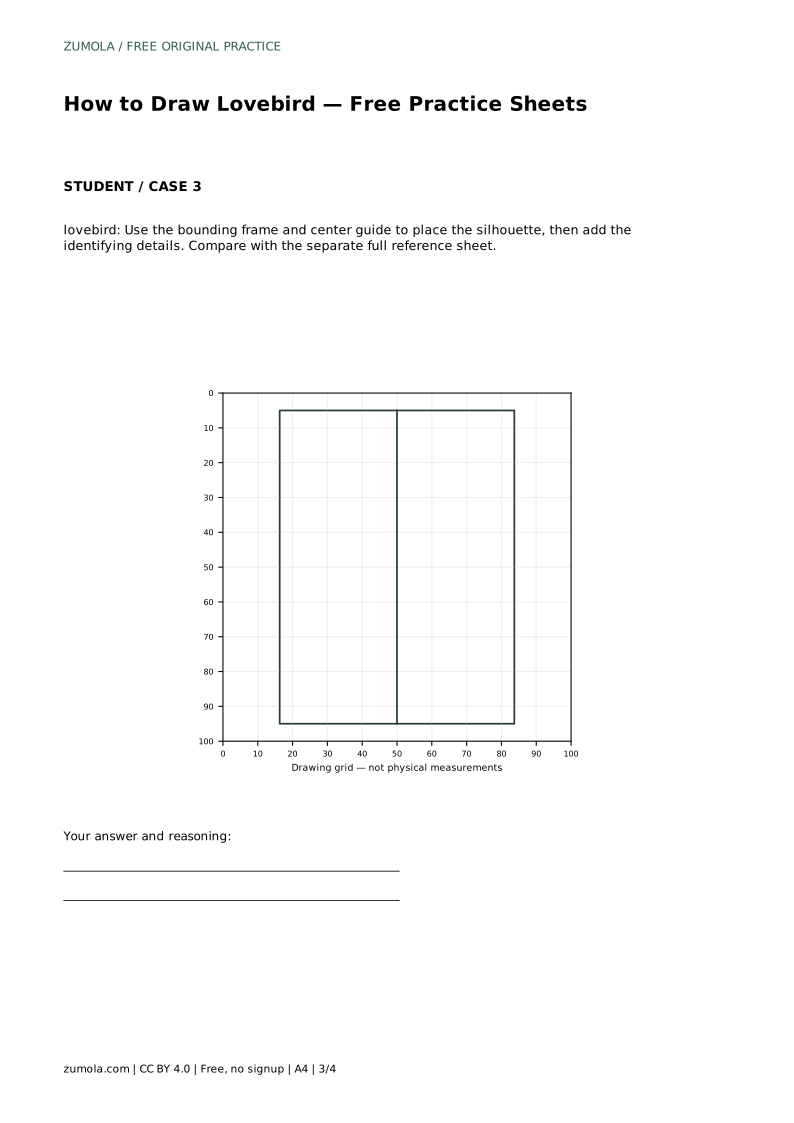
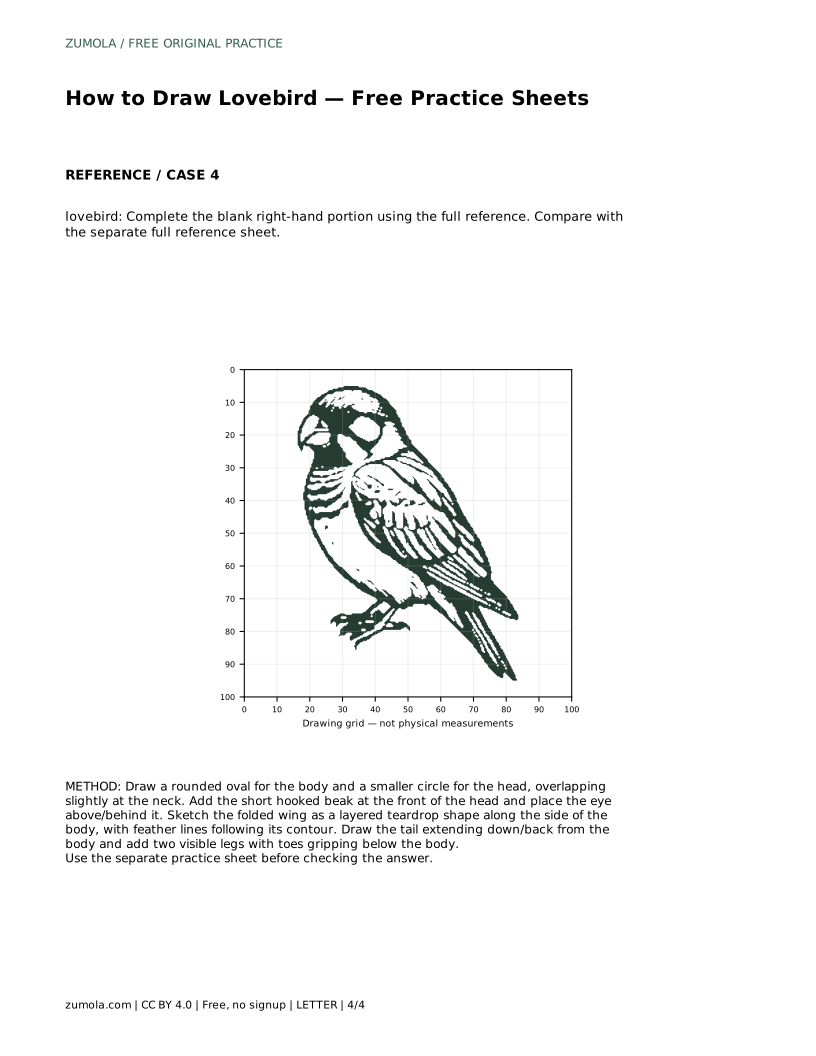
A bounding frame and center guide can help you place the silhouette before adding identifying details. Use the frame to check overall size and the center guide to balance the head and body. These guides support placement; they do not guarantee a perfect copy.
A convincing lovebird keeps a small rounded body with compact proportions, a short hooked beak, and a distinct facial mask or plumage patch pattern around the eye and cheek. These features matter more than pixel-perfect matching. Other drawings can be correct, so assess what is visible rather than chasing an exact copy.
Look for the facial pattern around the eye and cheek, and make sure the wing and tail read as separate shapes. If the body looks too long or the beak too pointed, adjust those proportions first. Then compare your drawing with the separate full reference sheet and note one change to make next time.
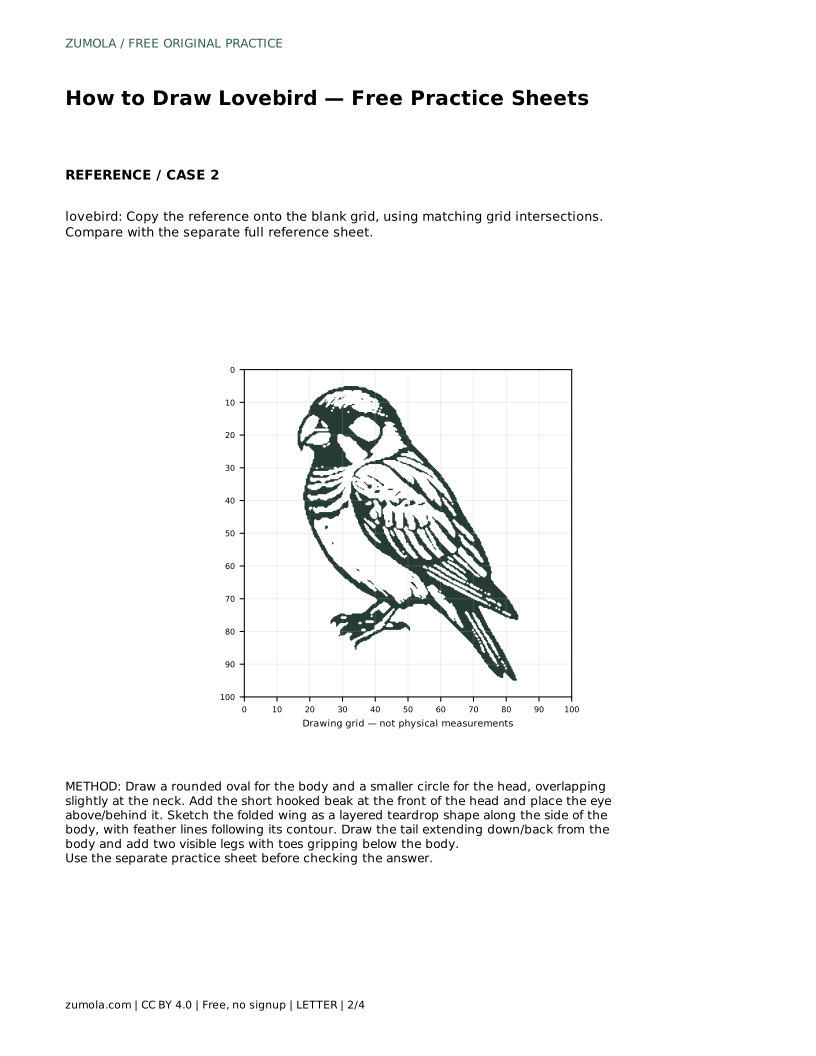
lovebird: Trace the reference outline, then practise the contour independently. Compare with the separate full reference sheet.
Example solution: preserve small rounded body with compact proportions, short hooked beak, distinct facial mask/plumage patch pattern around eye and cheek. Other drawings can be correct; assess the visible features and proportions rather than pixel-perfect matching. Draw a rounded oval for the body and a smaller circle for the head, overlapping slightly at the neck. Add the short hooked beak at the front of the head and place the eye above/behind it. Sketch the folded wing as a layered teardrop shape along the side of the body, with feather lines following its contour. Draw the tail extending down/back from the body and add two visible legs with toes gripping below the body.
No. Other drawings can be correct. Assess the visible features and proportions, such as the compact body, short hooked beak, and facial pattern, rather than pixel-perfect matching.
Check the body and head proportions first, then the beak shape, then the facial pattern around the eye and cheek.
Match the reference at grid intersections before drawing curves. This keeps the head, beak, and wing in the same relative positions.
All drawing practice · Free coordinate paper
Original resources · CC BY 4.0 · Free for personal and classroom use with attribution.