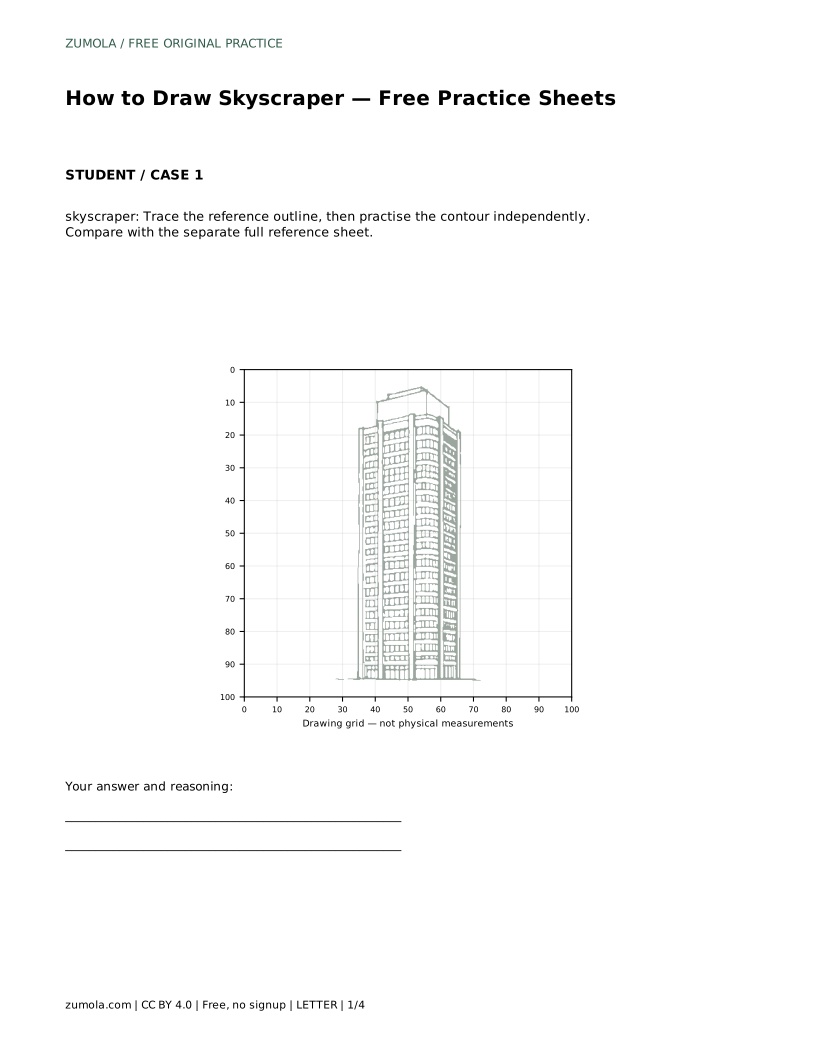
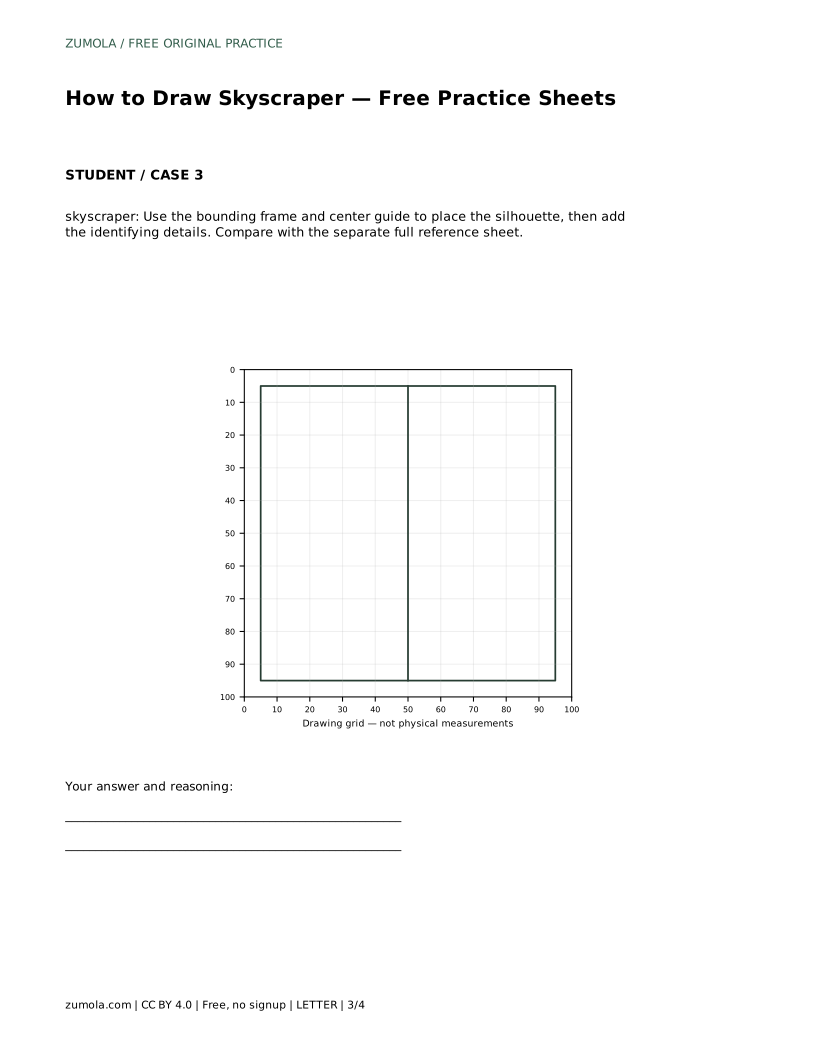
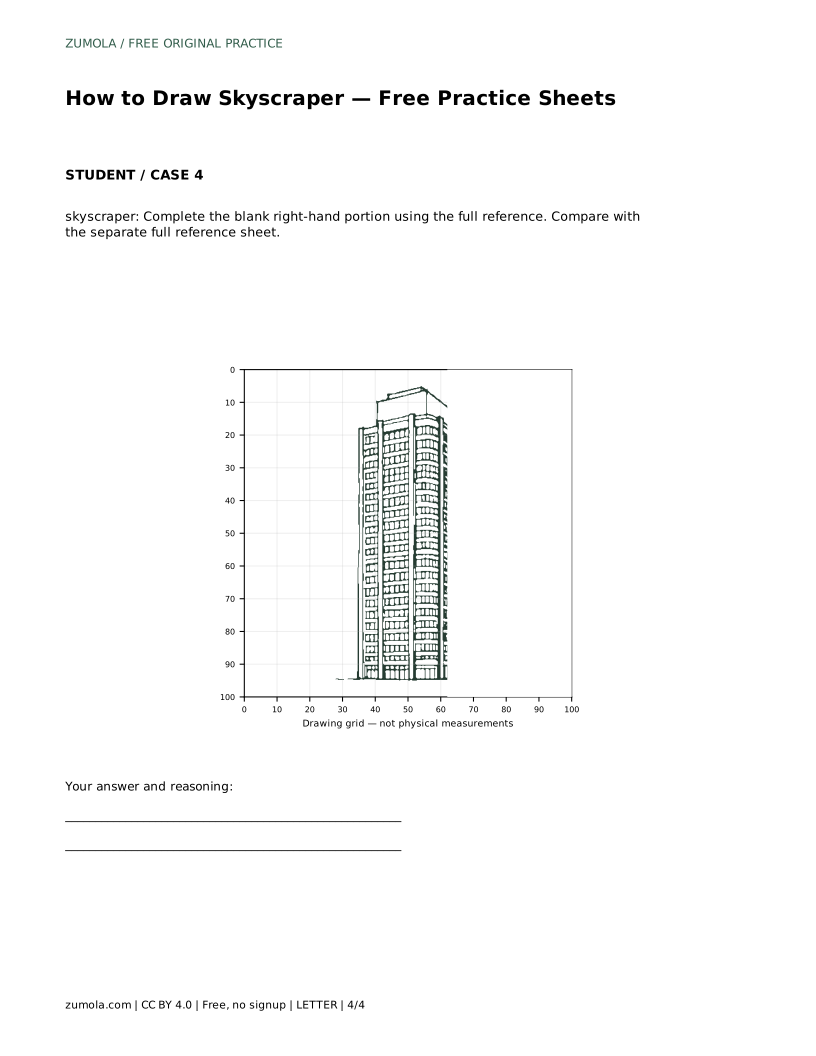
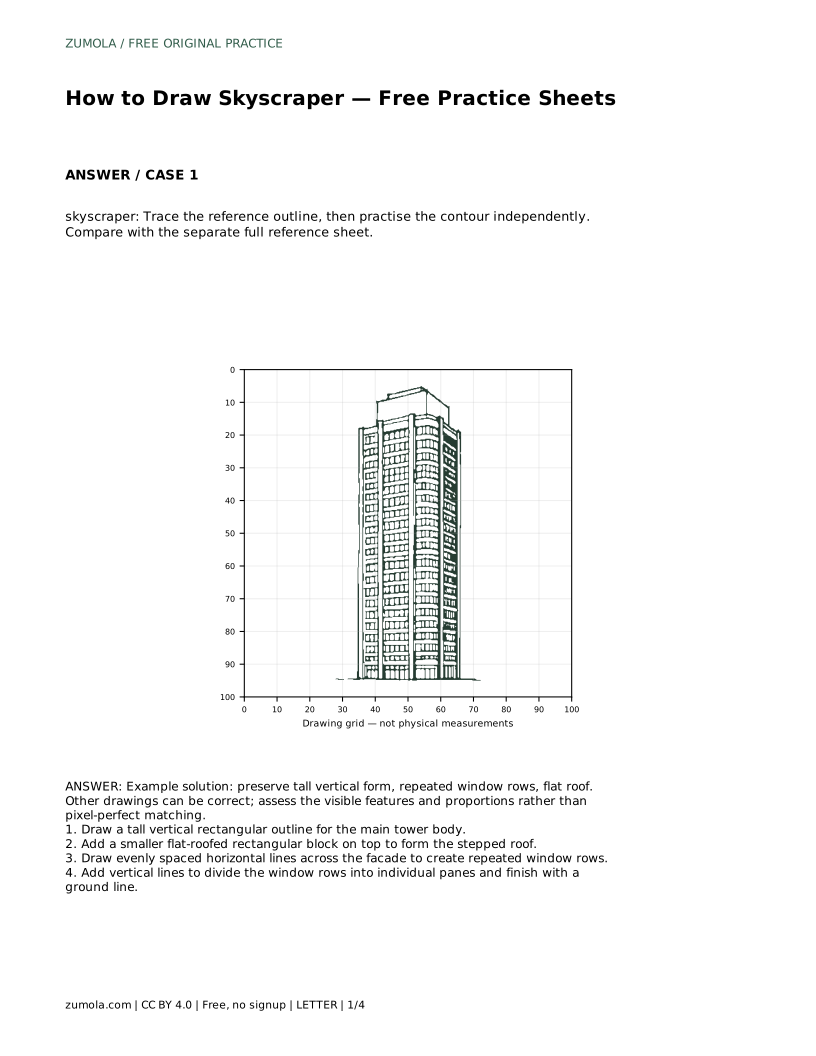
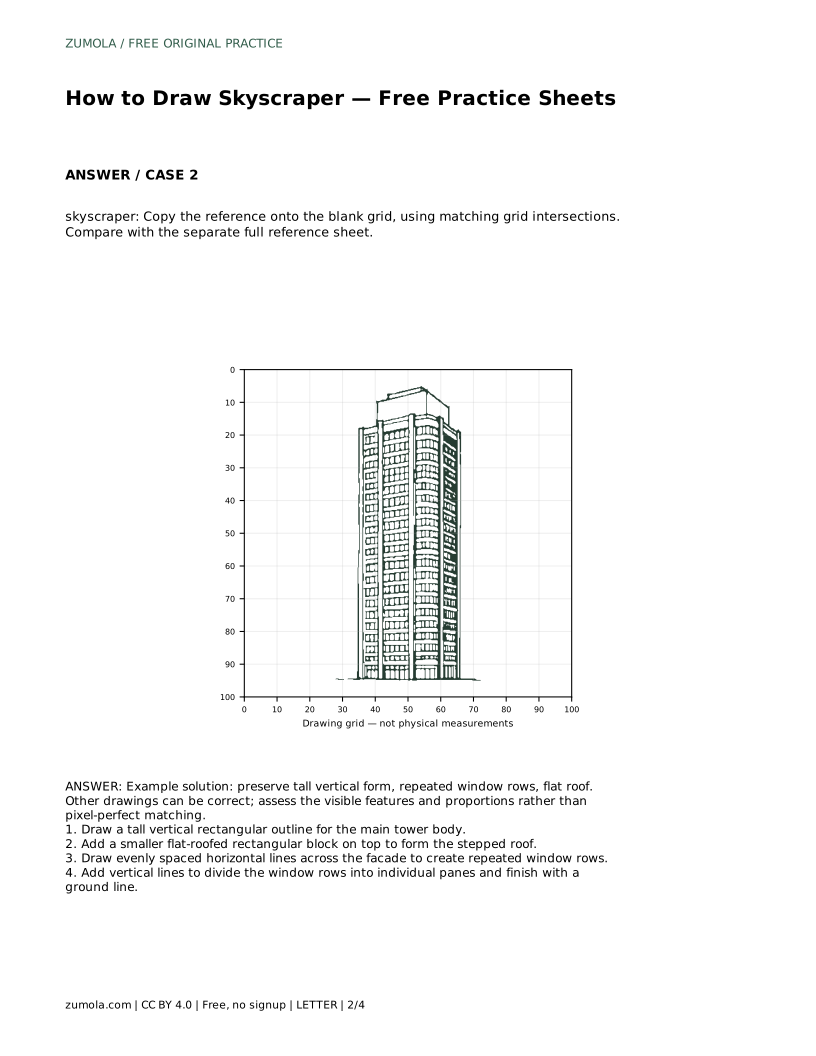
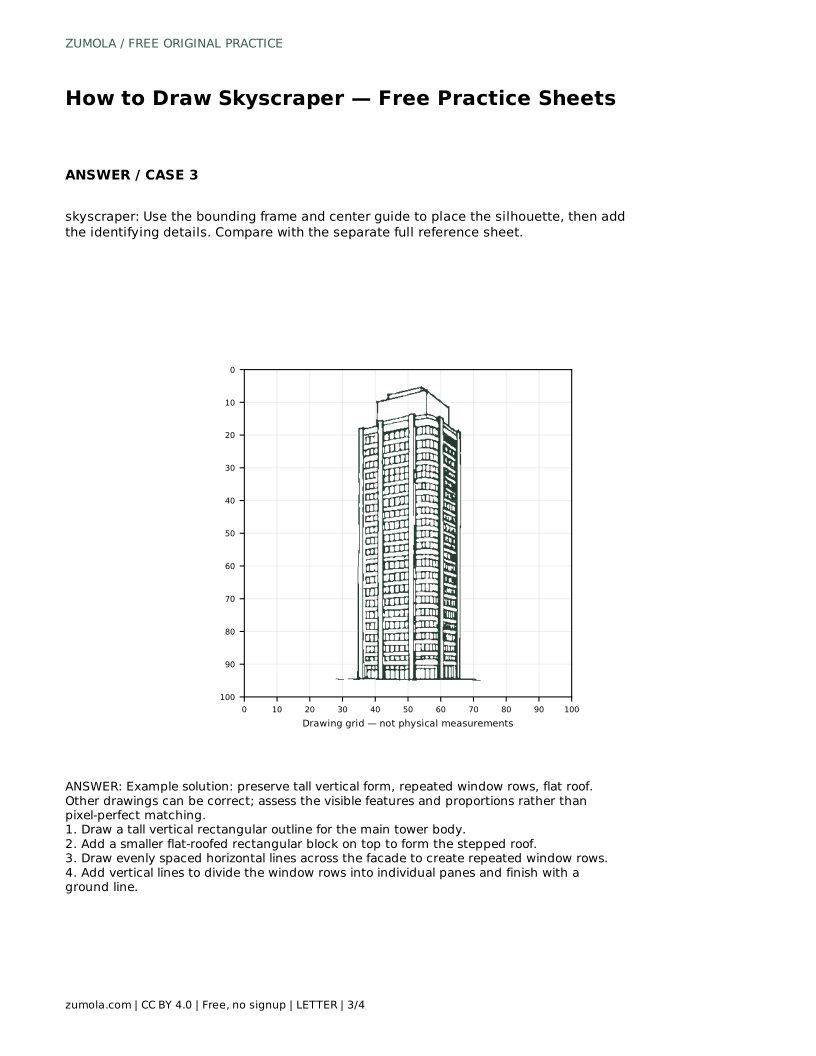
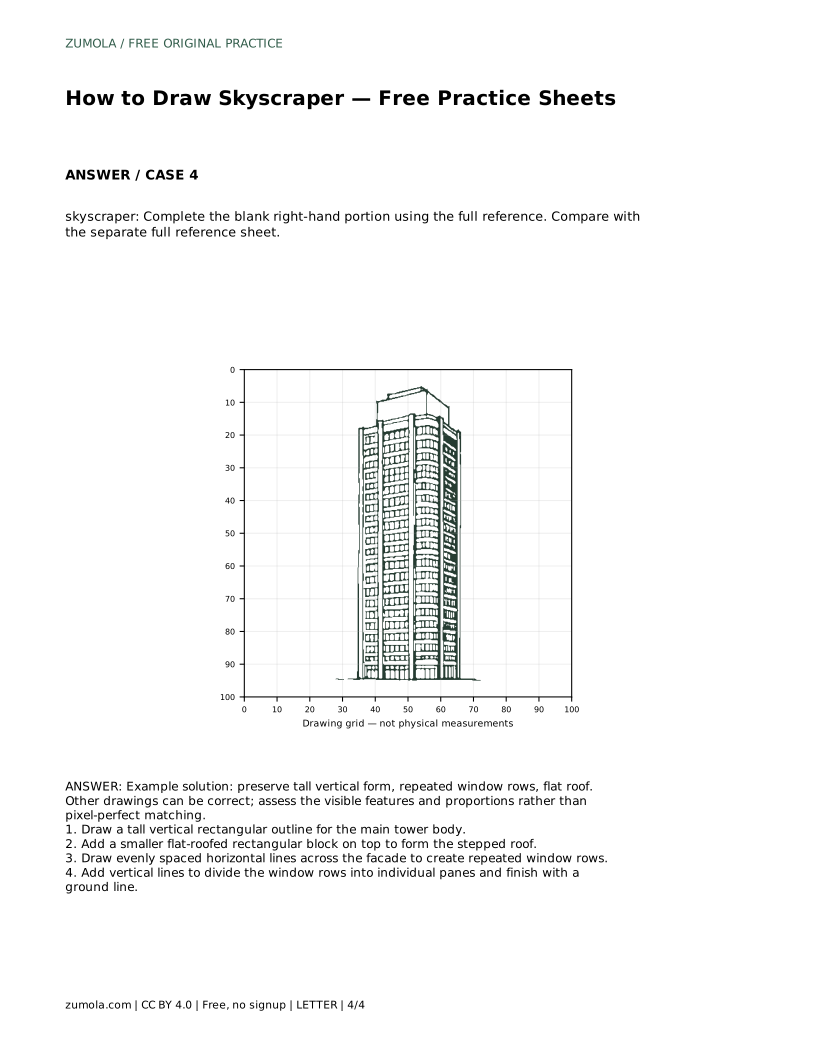
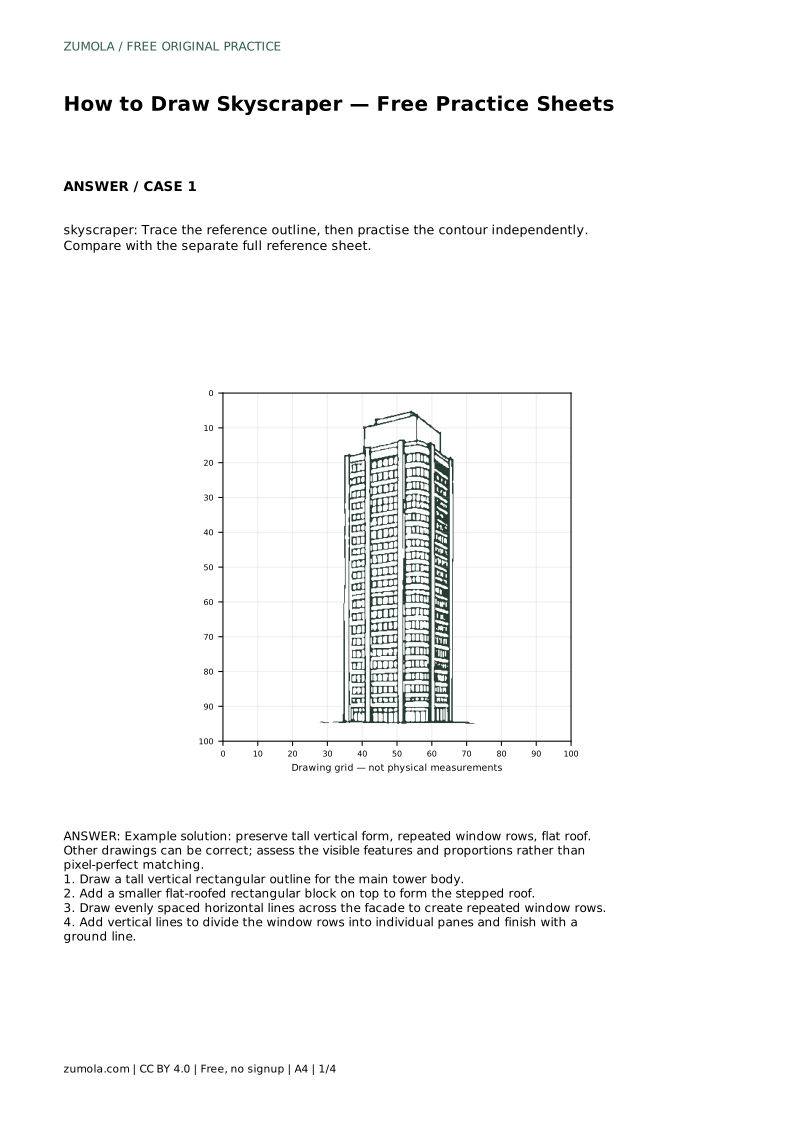
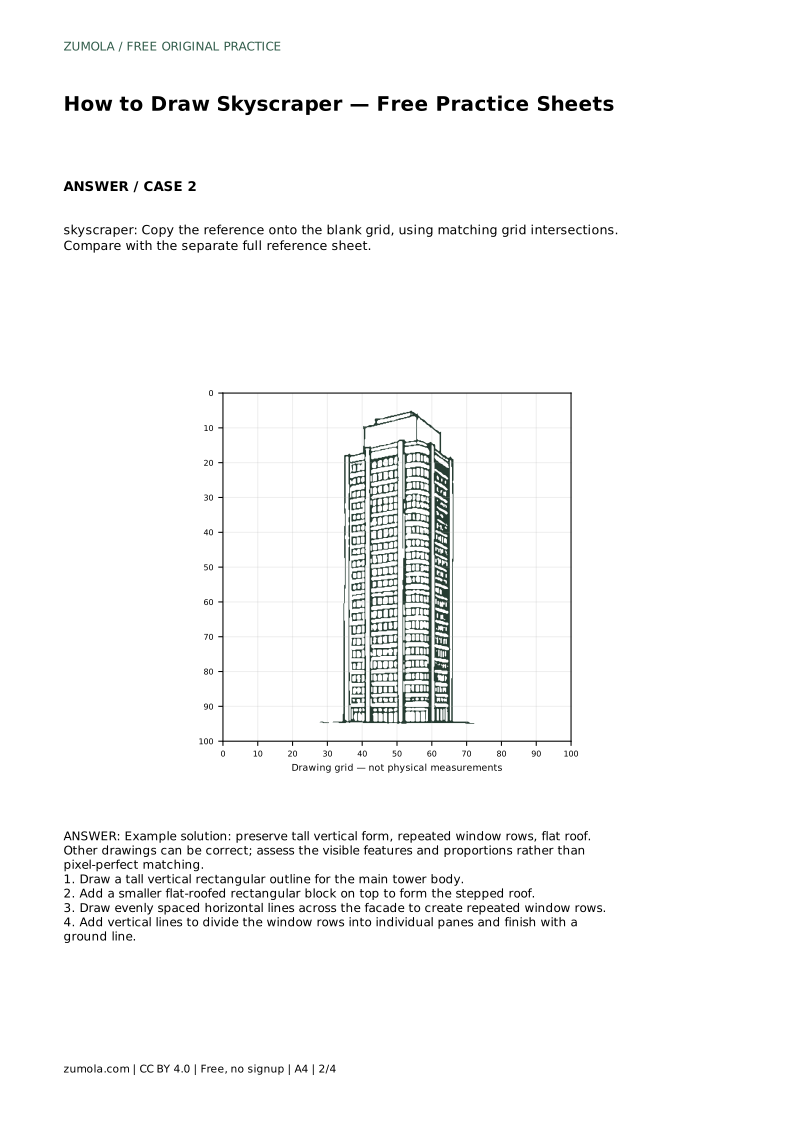
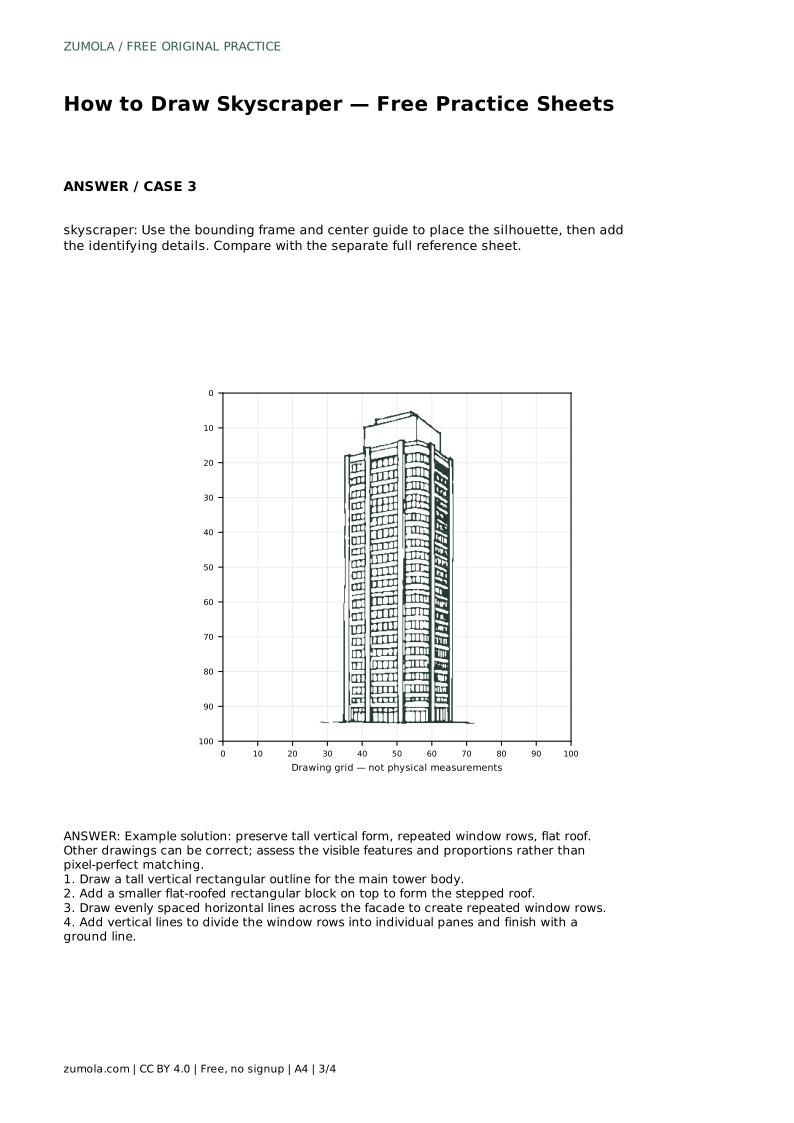
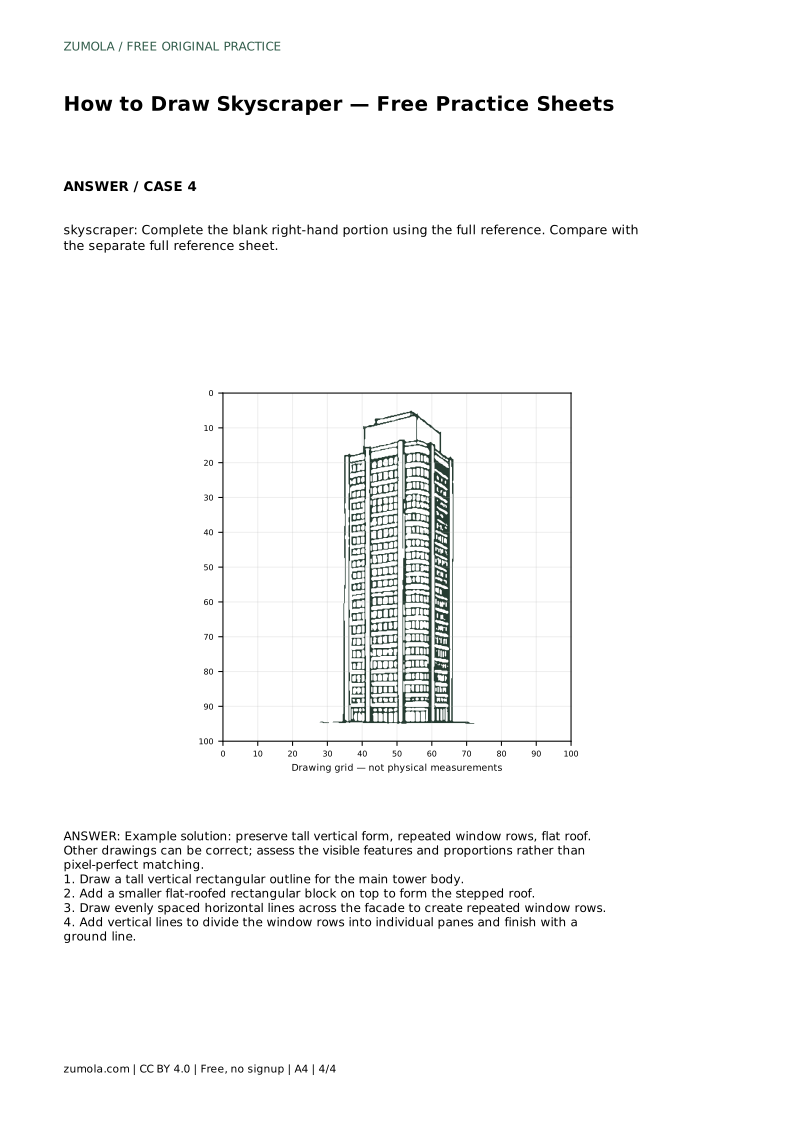
Reference diagrams
LETTER · Download PDF
A4 · Download PDF
Free original resources
Learn to draw a skyscraper by building a tall tower body, adding a stepped flat roof, and dividing the facade into even window rows and panes.
Four original cases, with reference diagrams, practice sheets and worked answers. Everything is free; no signup required.
LETTER · Download PDF
A4 · Download PDF
LETTER · Download PDF
A4 · Download PDF
LETTER · Download PDF
A4 · Download PDF
Use A4 or US Letter to match your printer. Use the stated values and conditions to solve each exercise; diagrams are not physical measuring rulers.
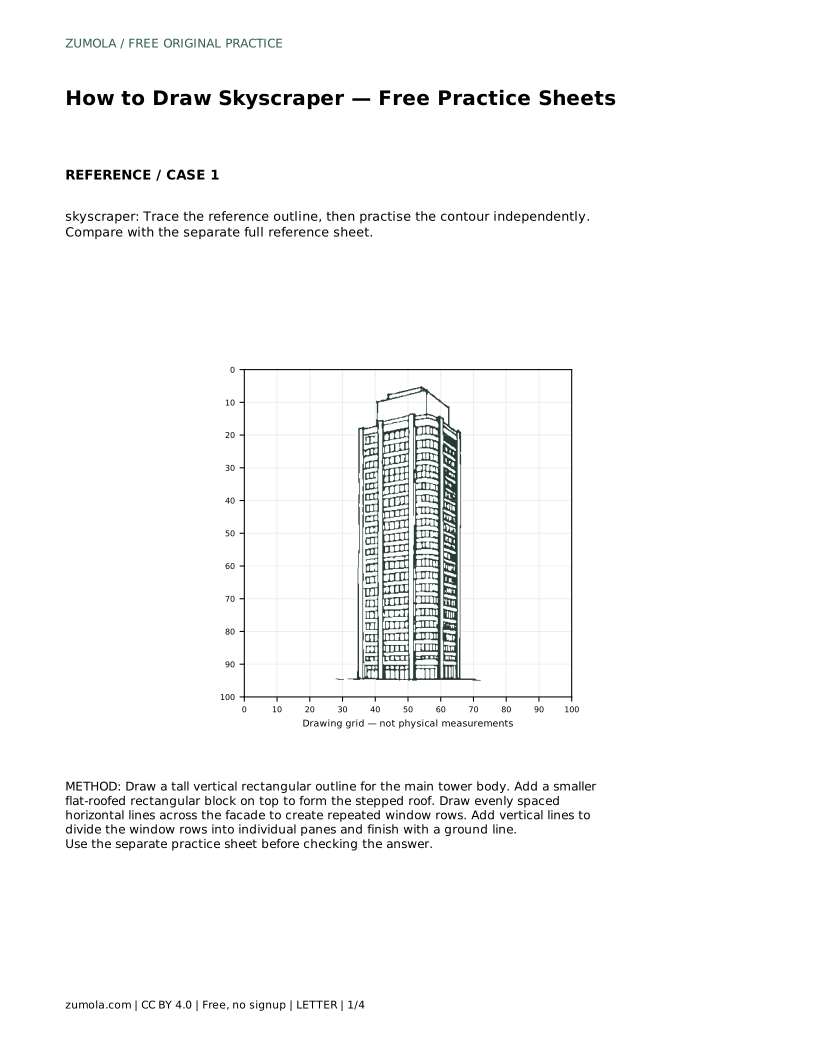
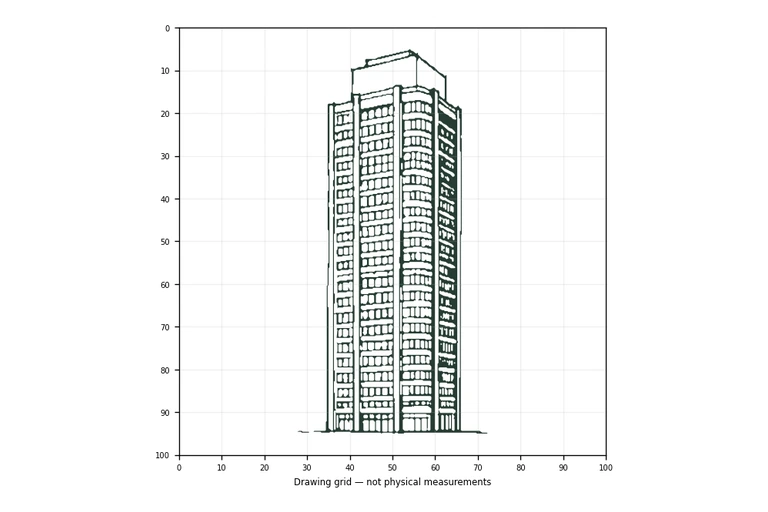
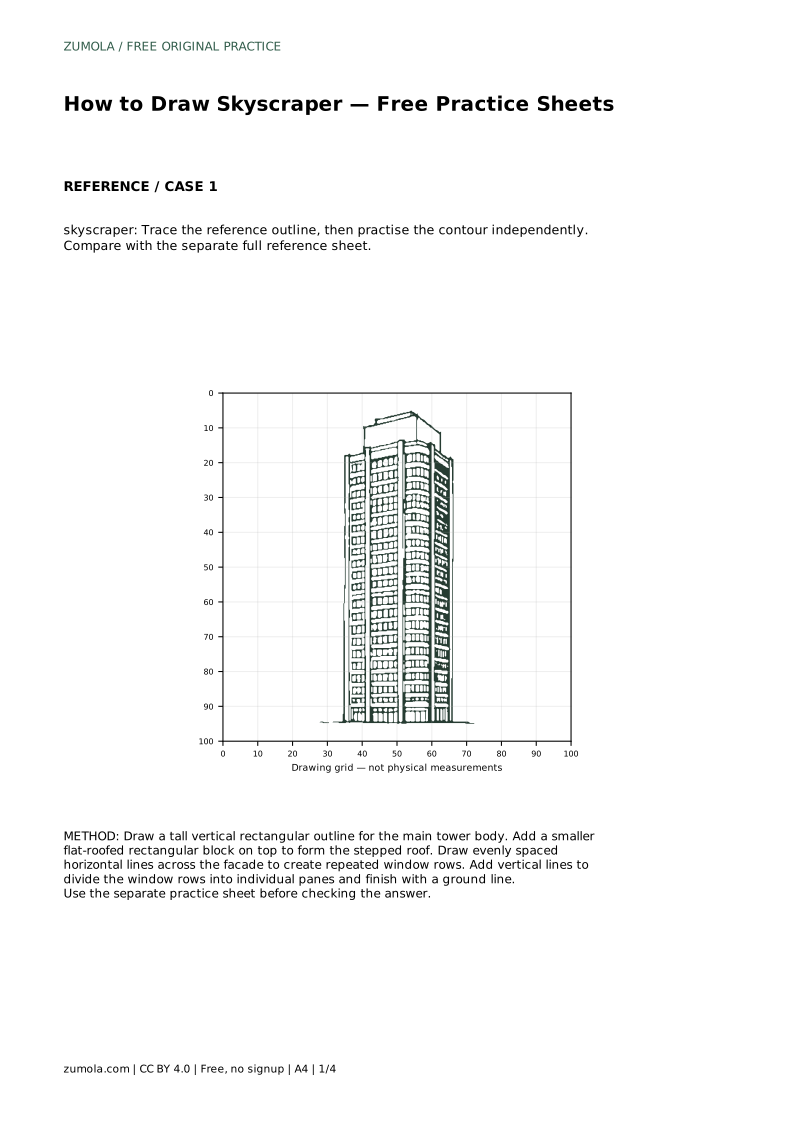
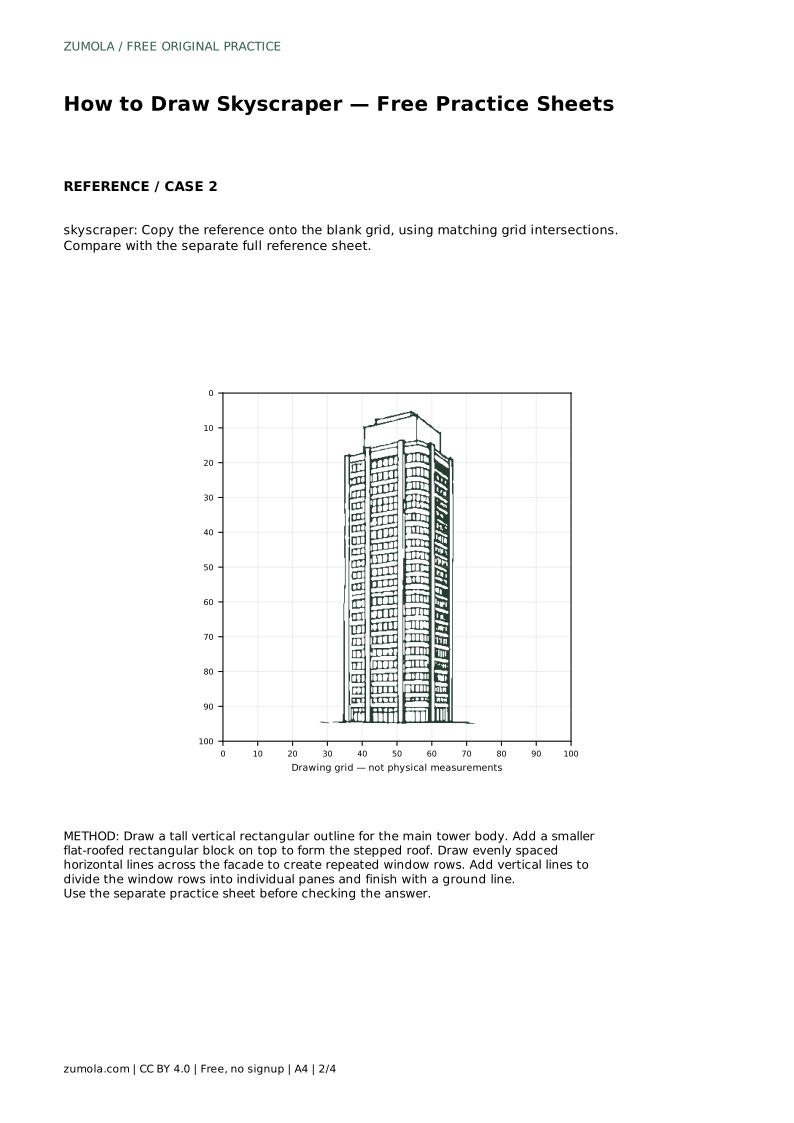
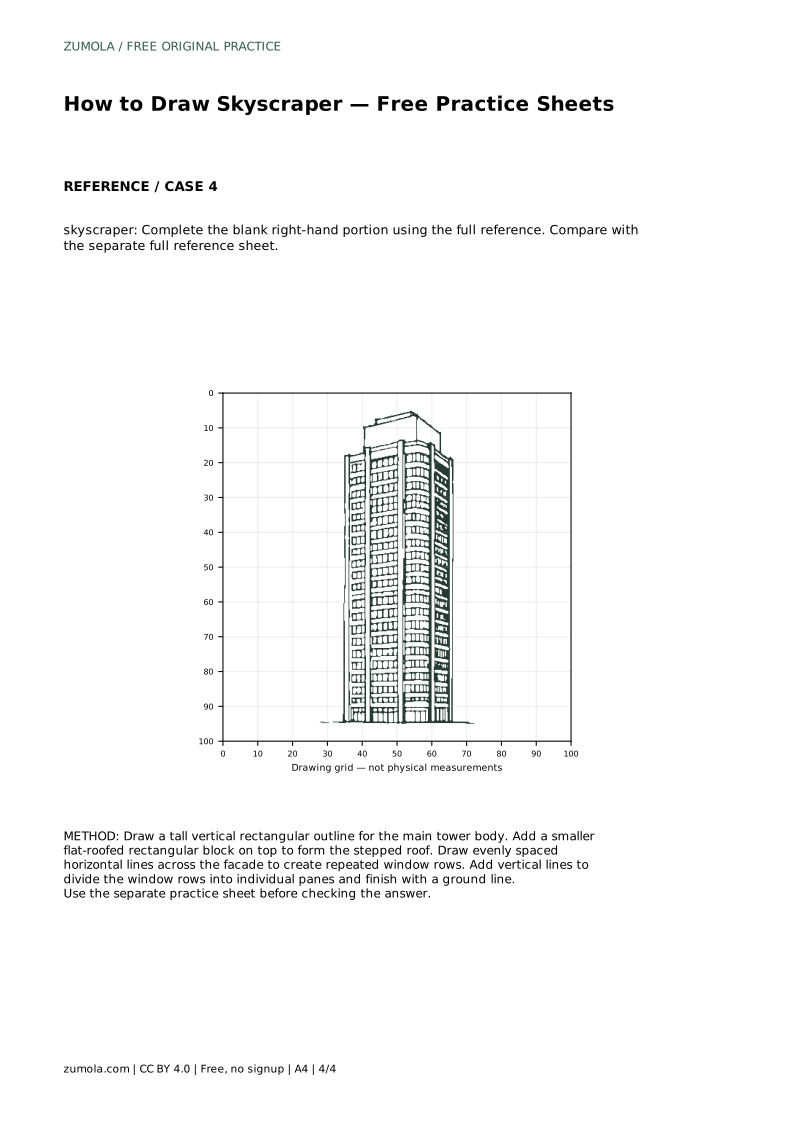
A skyscraper drawing depends on a few clear decisions: how tall the tower is, how wide it stands, where the roof steps back, and how the windows repeat across the facade. This page walks through those choices in order, from the main outline to the final ground line. The practice sheets let you trace, copy, or complete a reference, but the goal is understanding the structure, not matching every pixel.
Begin with the largest shape: a tall vertical rectangle for the main tower body. Decide its height-to-width ratio before drawing. A ratio of about three to one gives a clearly tall building without becoming a thin strip. Keep the left and right sides parallel and vertical, since a straight-on view treats the tower as a flat facade.
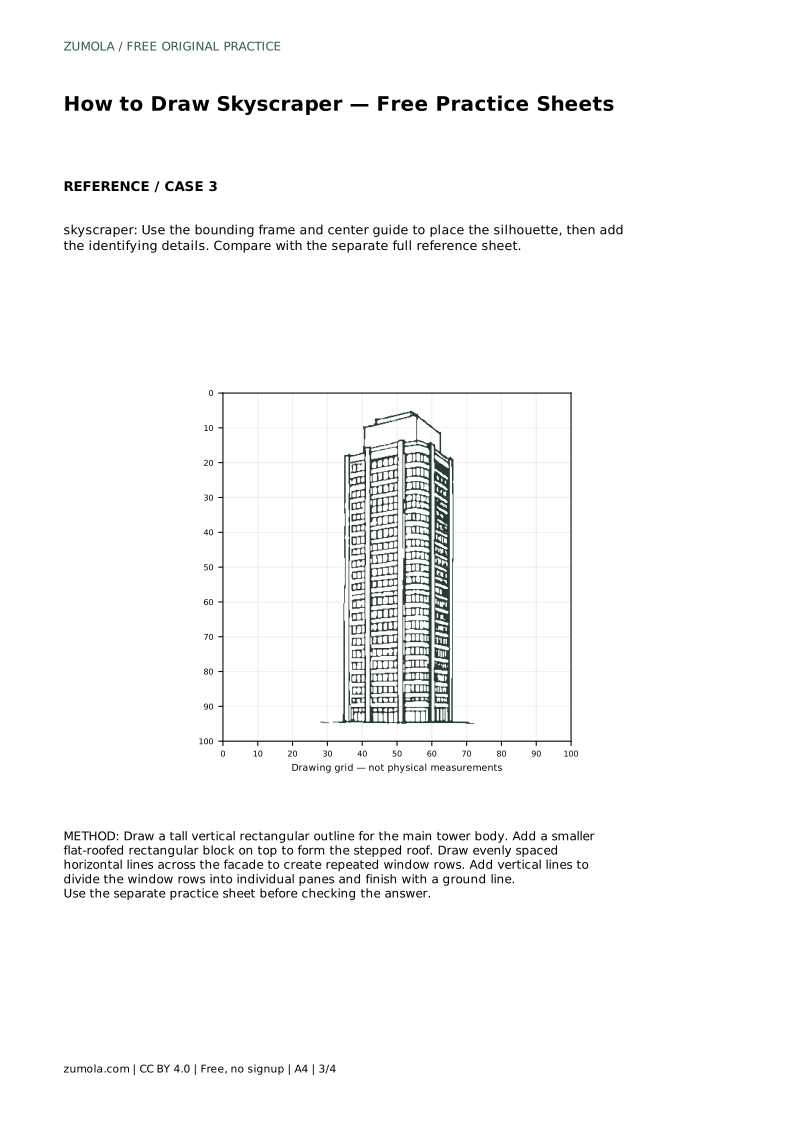
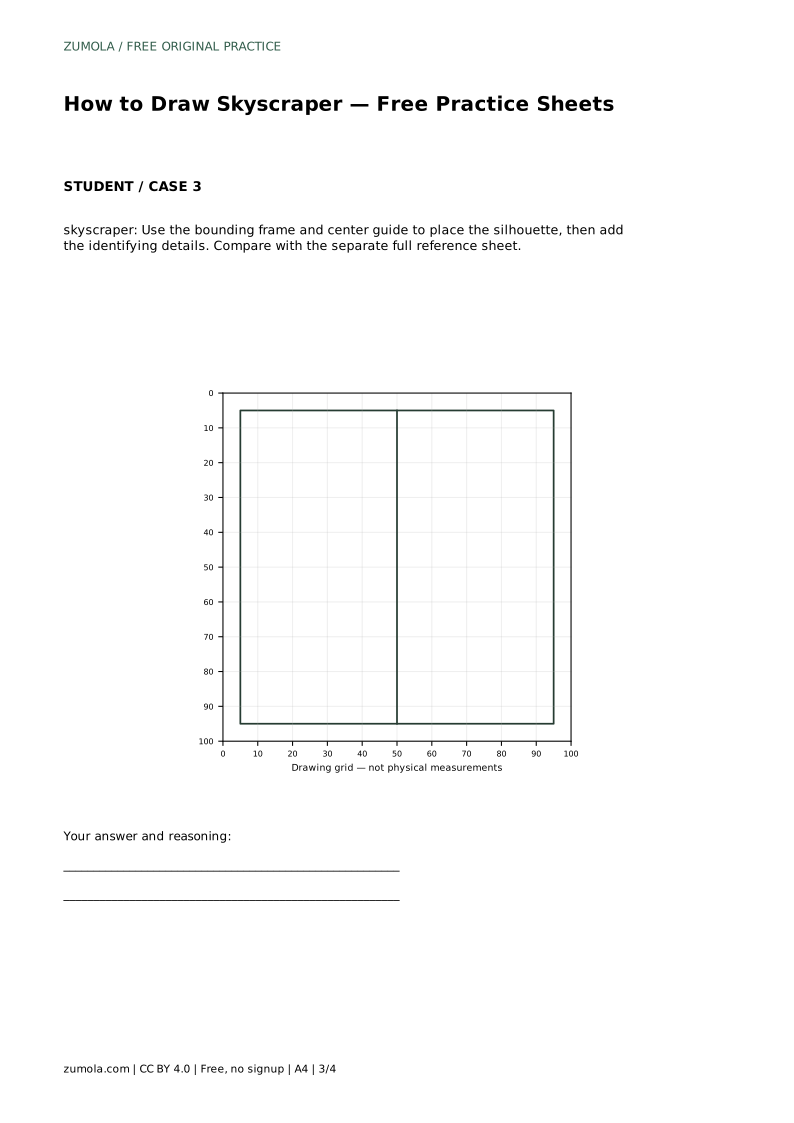
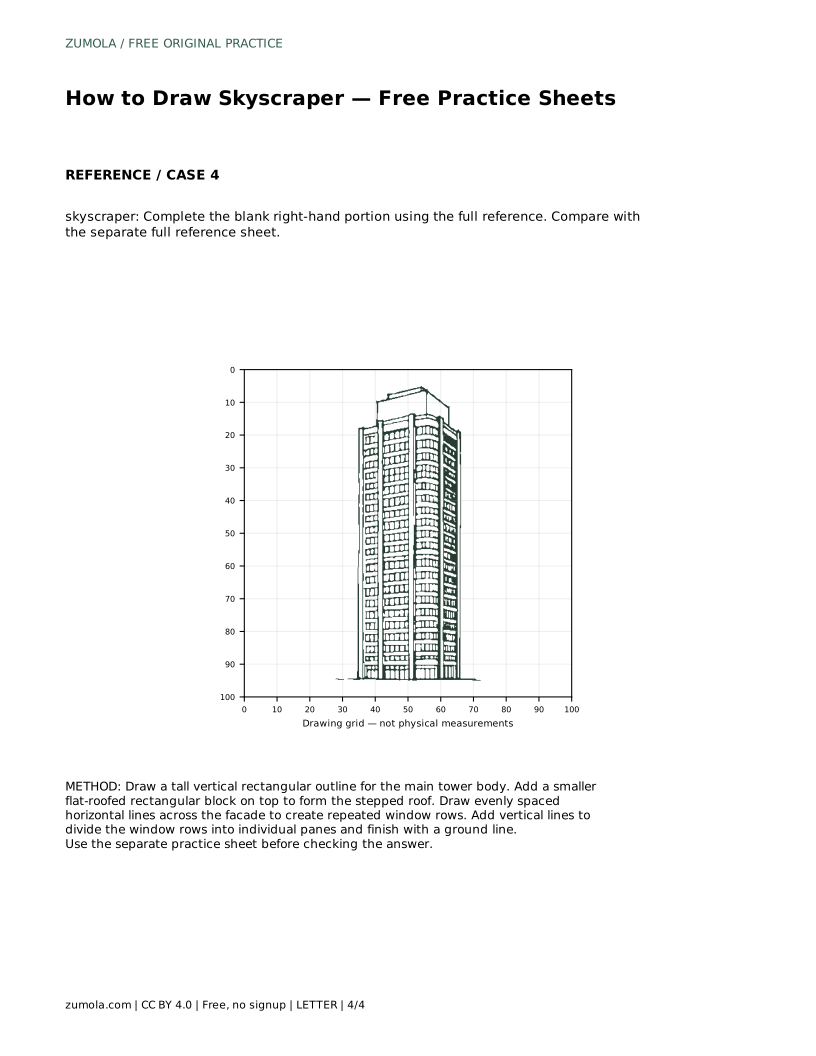
Place the rectangle so there is room above it for the roof block and below it for the ground line. Light construction lines help here: a vertical center guide keeps the tower balanced, and a bounding frame marks the outer limits of the drawing. These guides are placement aids, not part of the finished building.
On top of the main body, add a smaller flat-roofed rectangular block. Center it on the tower so the roof reads as a deliberate step rather than a tilted cap. The block should be narrower than the tower body and clearly shorter than it, so the main mass still dominates.
Keep the top edge of the roof block horizontal. A flat roof is one of the identifying features of this drawing, so avoid domes, spires, or slanted caps unless you are deliberately drawing a different building. If you want a second step, repeat the same logic: each block narrower than the one below, each top edge level.
Divide the facade with evenly spaced horizontal lines to create repeated window rows. Measure the spacing rather than guessing: if the tower body is 12 units tall and you want six rows, place lines every 2 units. Keep the spacing consistent from the bottom to the top so the repetition reads as intentional.
Next, add vertical lines to divide each row into individual panes. Use the same spacing across every row so the columns align. Stop the window lines short of the tower edges to leave a visible margin, which keeps the facade from looking like a grid pasted onto the outline. Finish with a ground line beneath the building.
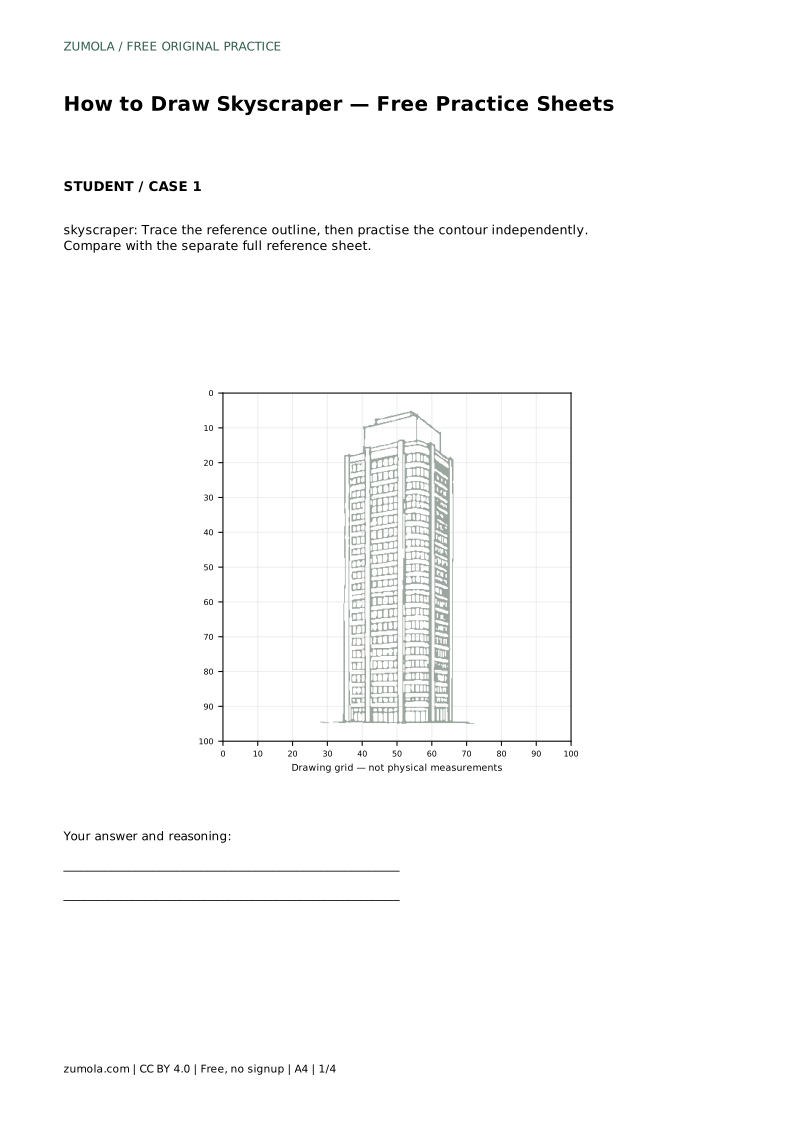
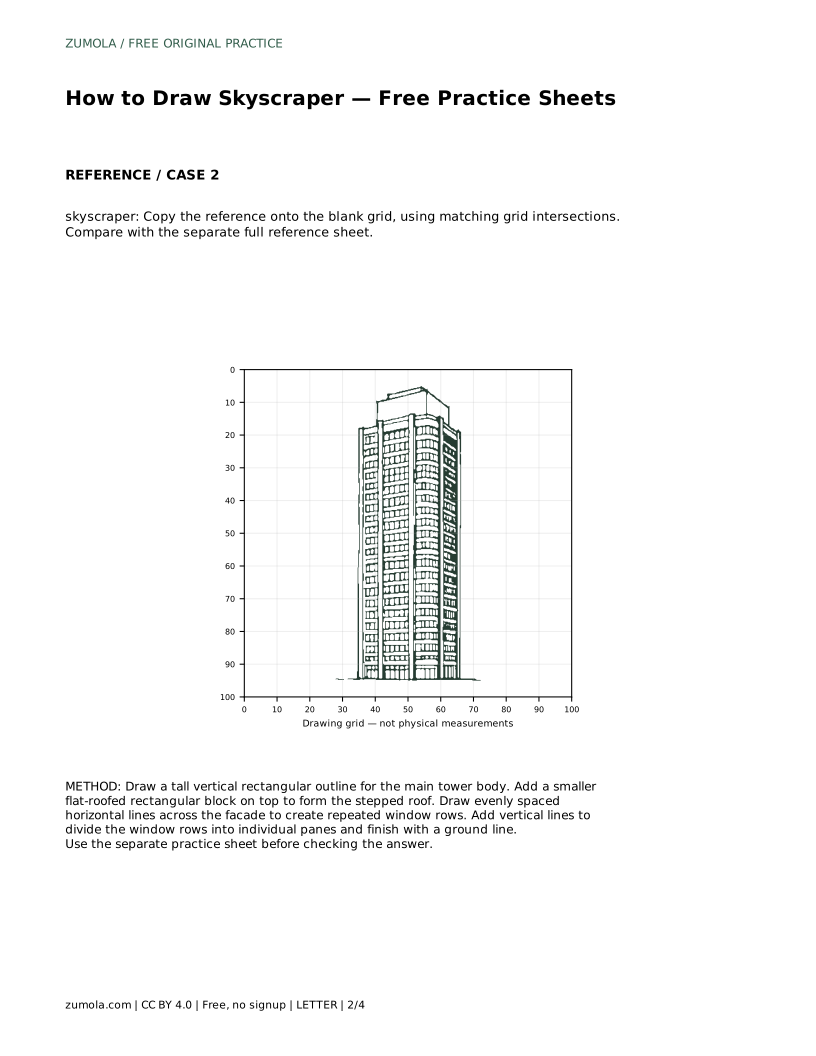
skyscraper: Trace the reference outline, then practise the contour independently. Compare with the separate full reference sheet.
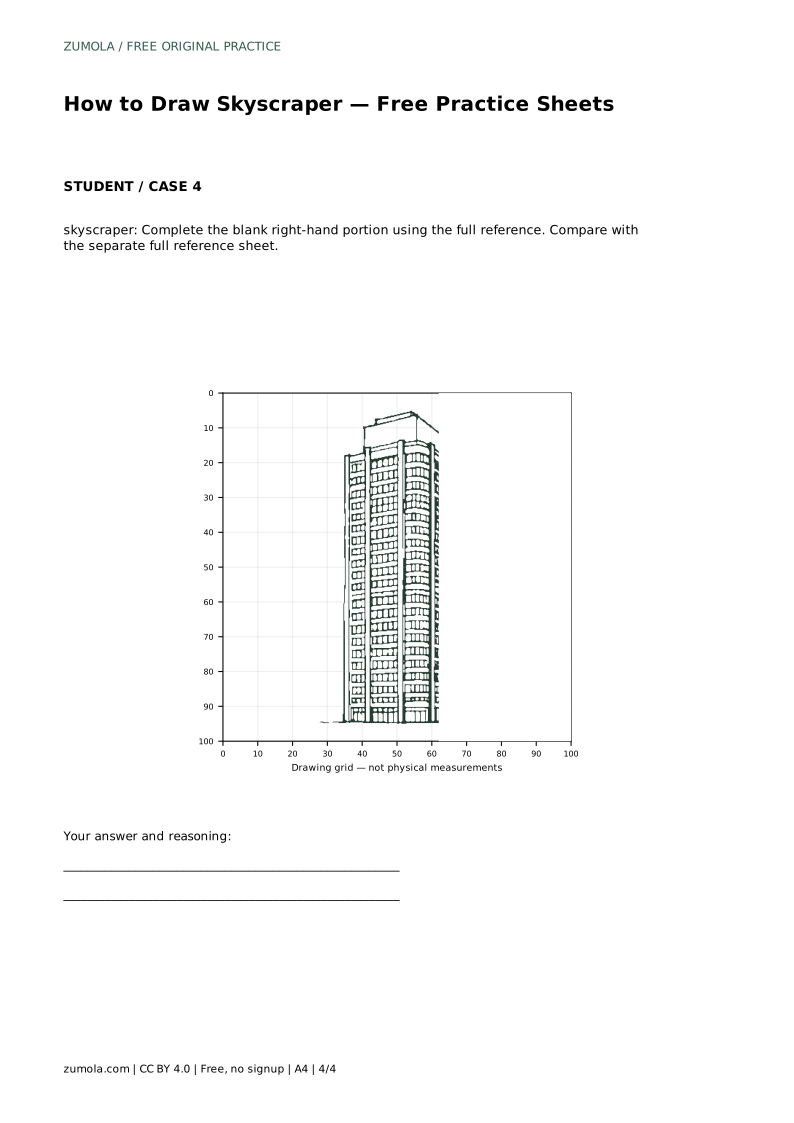
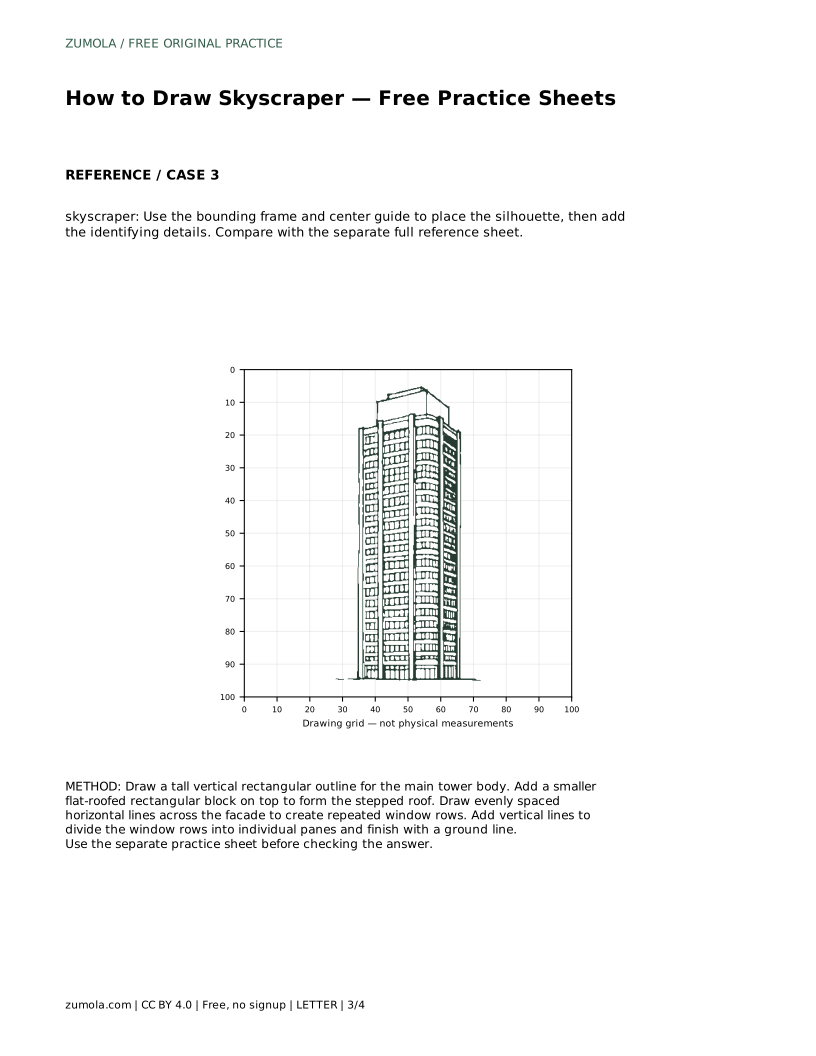
Example solution: preserve tall vertical form, repeated window rows, flat roof. Other drawings can be correct; assess the visible features and proportions rather than pixel-perfect matching. Draw a tall vertical rectangular outline for the main tower body. Add a smaller flat-roofed rectangular block on top to form the stepped roof. Draw evenly spaced horizontal lines across the facade to create repeated window rows. Add vertical lines to divide the window rows into individual panes and finish with a ground line.
No. Preserve the tall vertical form, repeated window rows, and flat roof. Other drawings can be correct; assess the visible features and proportions rather than pixel-perfect matching.
There is no fixed number. Choose a count that divides the tower height evenly, such as six rows on a 12-unit facade, so the spacing stays consistent.
You can, but it changes the building type. This exercise uses a flat, stepped roof as the identifying feature, so keep the top edge horizontal unless you intend a different design.
All drawing practice · Free coordinate paper
Original resources · CC BY 4.0 · Free for personal and classroom use with attribution.