Free original resources
Pythagorean Theorem on a Grid: Area Reasoning and Length Checks
Use grid squares and area reasoning to explain the Pythagorean relationship, then check right-triangle side lengths with simple coordinate examples.
Free resources
Letter & A4
PDF & SVG
Letter & A4
PDF & SVG
Make it yours.
Free · no signup · calculated in your browser
Your free printable kit.
Original reference, student practice and separate worked answers. No account or payment.
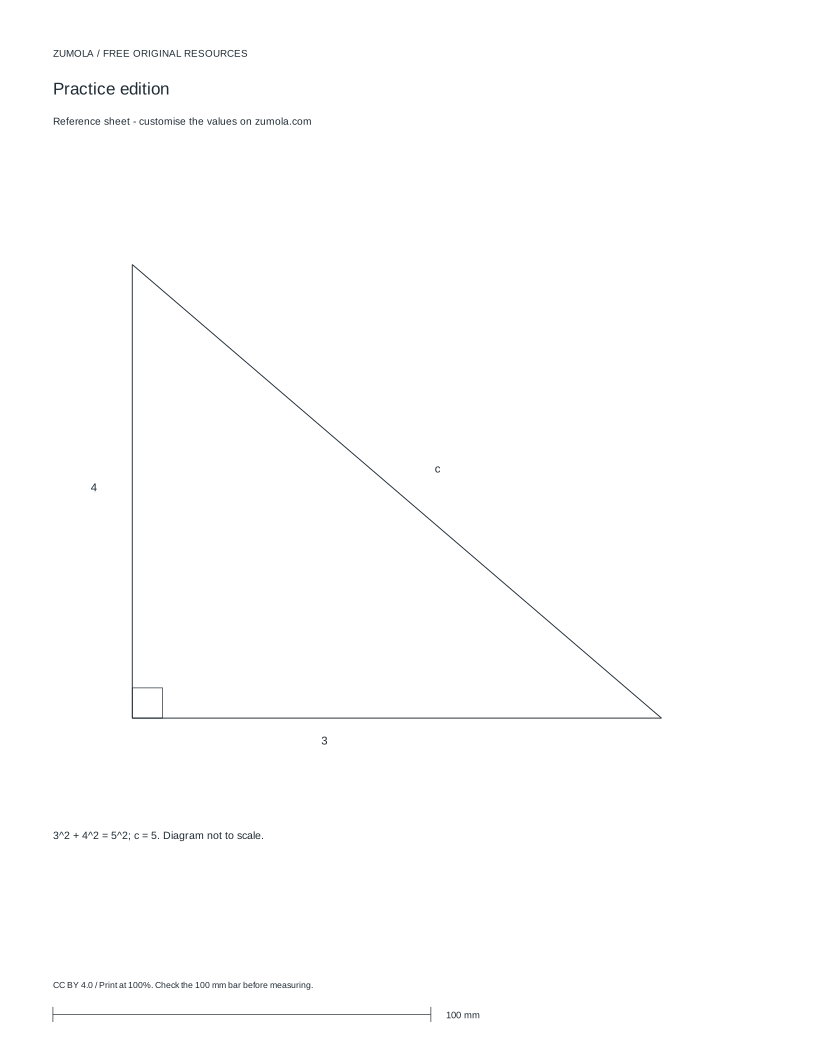
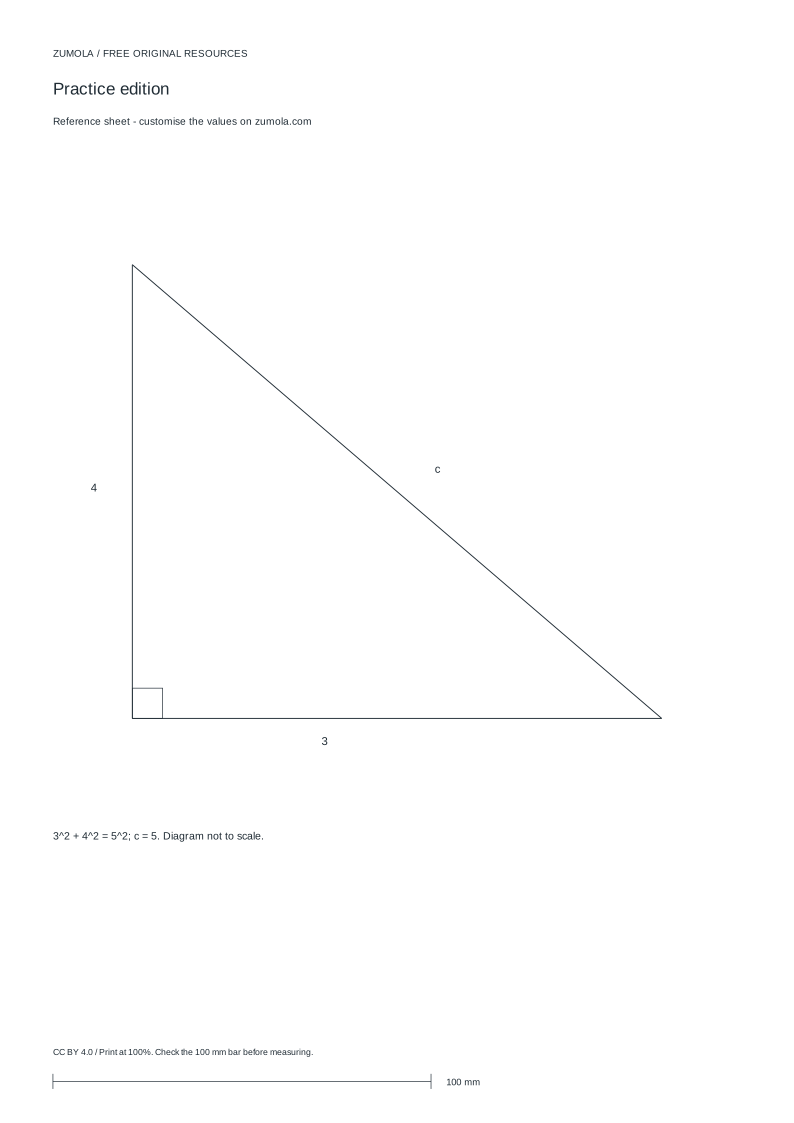
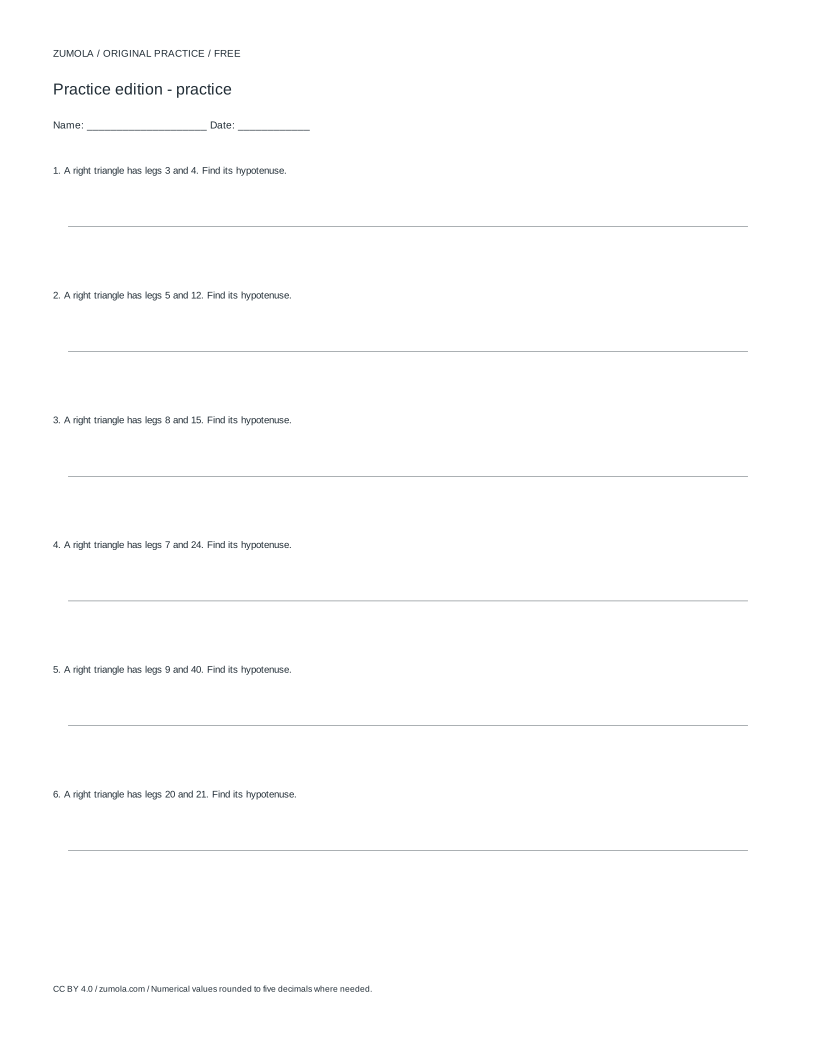
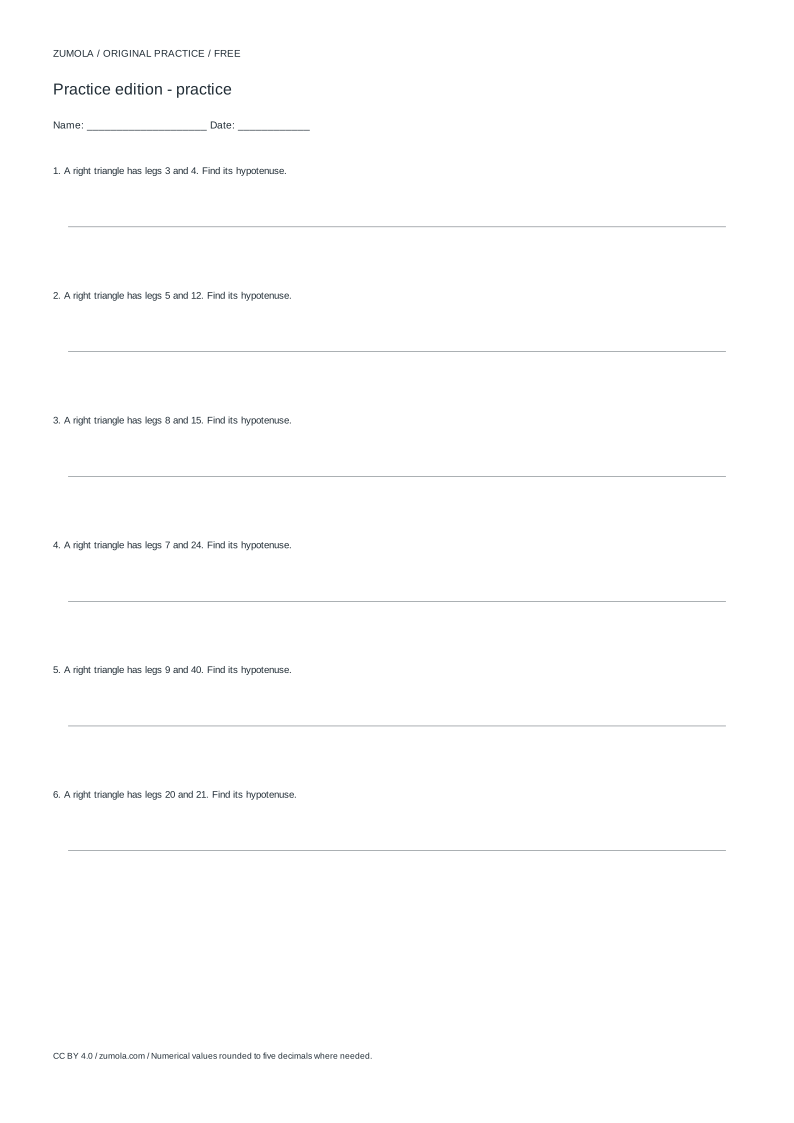
Practice worksheet
Worked answers / rubric
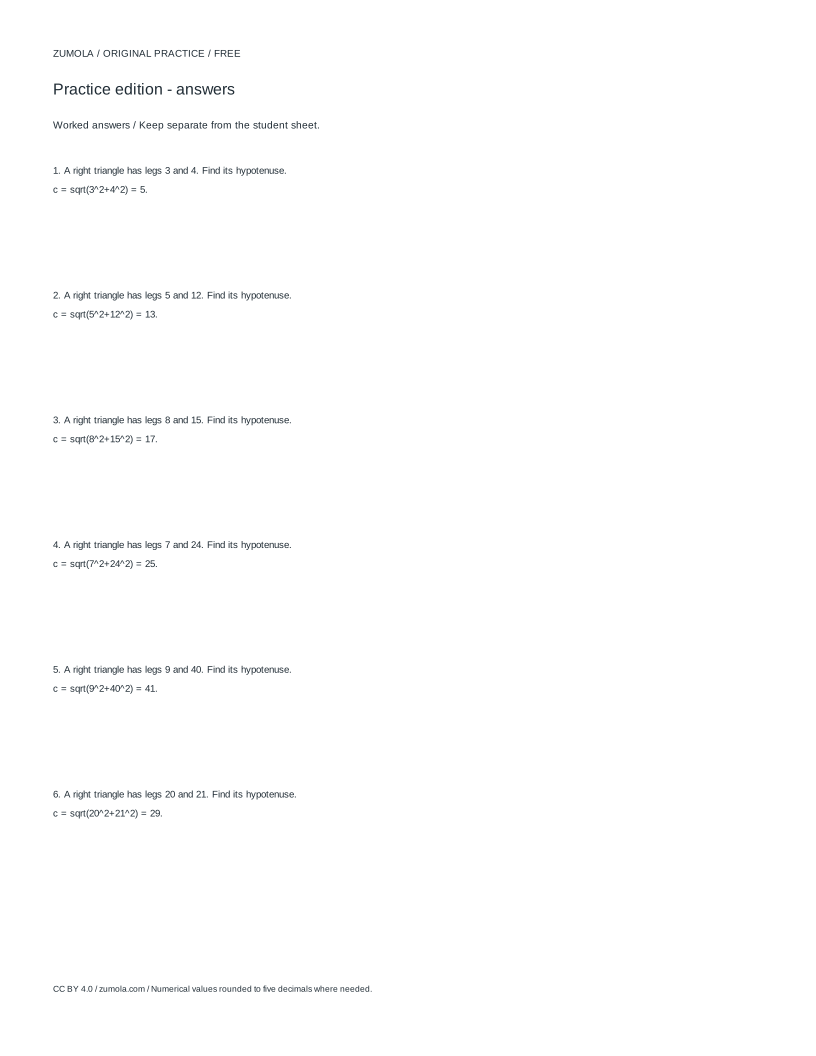
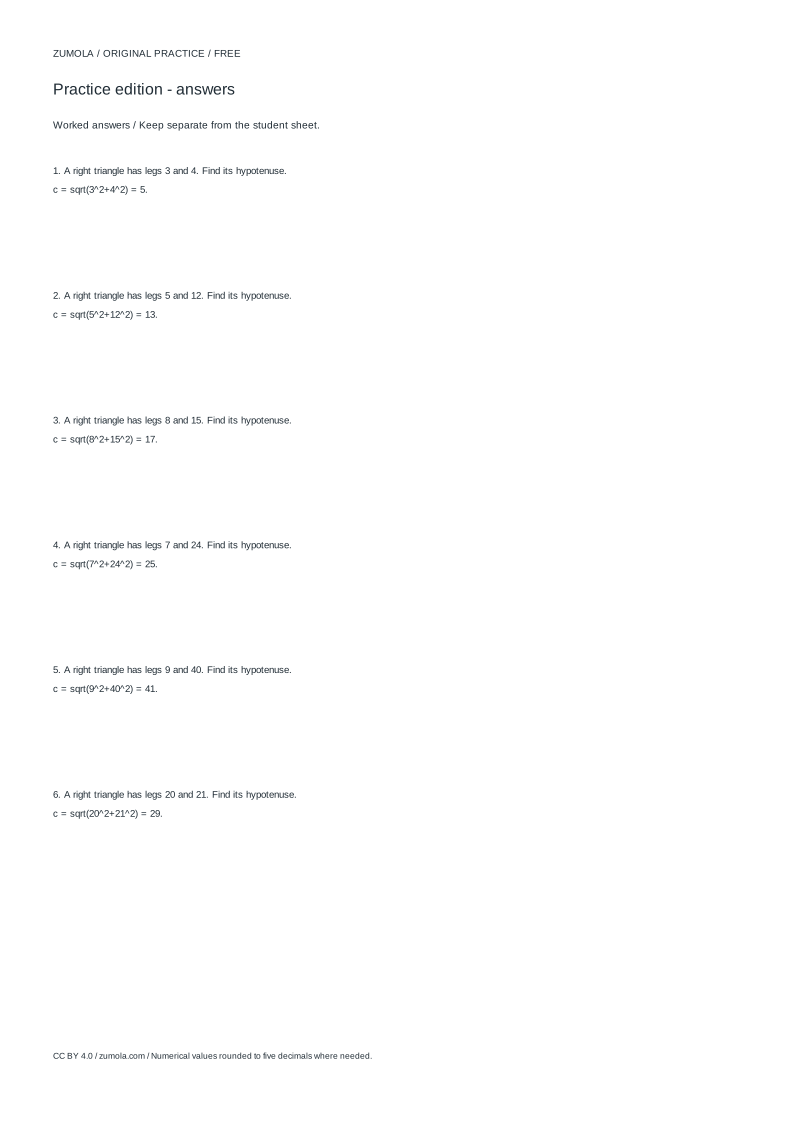
Print at Actual size / 100%. Check the calibration bar before using physical dimensions.
A grid turns the Pythagorean theorem into something you can see: a right triangle sits inside squares, and the areas of the two smaller squares add to the area of the largest. This worksheet page focuses on that area reasoning and on checking lengths from grid coordinates. You will draw triangles on square paper, count or compute square areas, and compare the result with the square of the hypotenuse. Units matter: grid squares are abstract coordinate units unless a scale is stated.
Why grid squares make the relationship visible
On square grid paper, every grid square has the same side length, so its area is one square unit. If a right triangle has legs of 3 and 4 grid units, build a square on each leg: one is 3 by 3, area 9; the other is 4 by 4, area 16. Together they cover 25 square units. The square built on the hypotenuse must therefore have area 25, so its side is 5 units. The key idea is that the theorem is a statement about areas of squares attached to the sides, not just a formula to memorize.
The same reasoning works in reverse. If you know the hypotenuse square's area and one leg square's area, subtract to find the other leg square's area, then take the square root. Keep the distinction clear: area is measured in square units, length in linear units. Mixing them is the most common source of confusion when students record answers from grid work.
- Draw a right angle along grid lines, with legs of 3 and 4 grid units.
- Build a square outward on each leg and label areas 9 and 16 square units.
- Build a square on the hypotenuse and confirm its area is 25 square units.
- State the side length of the hypotenuse square as 5 linear units.
Checking lengths from coordinates
When a segment runs between two grid points, the horizontal and vertical gaps give the legs of a right triangle. For points (1, 2) and (4, 6), the horizontal gap is 3 and the vertical gap is 4, so the distance is 5 units. This coordinate check is independent of the area drawing: it uses differences in x and differences in y, squares them, adds, and takes the square root. Doing both checks catches counting errors.
Angles and areas need their own units. A distance answer is in linear units; an area answer is in square units. If a drawing is scaled, for example one grid square equals 2 centimetres, convert lengths after the grid calculation, and remember areas scale by the square of that factor.
- Subtract x-coordinates to get the horizontal leg; subtract y-coordinates to get the vertical leg.
- Square each leg, add the two squares, and take the square root for the distance.
- Compare the coordinate result with the grid-square area result.
- Convert to physical units only if a scale is explicitly given.
Separating drawing, judging, and calculating
Grid tasks can ask you to draw a figure, decide whether a triangle is right-angled, compute an area, or combine transformations. These are different jobs. A drawing task is judged on construction accuracy and labeling; a property task asks for a justified yes or no; an area task asks for square units; a transformation task asks where points move. Read the prompt and name the task before starting.
For a right-angle check, compare the squares of the two shorter sides with the square of the longest side. If they match, the triangle is right-angled. If not, it is not, and the difference tells you how far off it is. Do not force a match by rounding intermediate values.
- Identify whether the task is draw, judge, calculate, or transform.
- For a judgment, square all three side lengths and compare the two smaller squares with the largest.
- Record the conclusion with the comparison shown, not just a word.
- Keep units attached to every final value.
Printing and scale notes
Grid paper only supports reliable measurement if it prints at true size. Before trusting any measured length, print a calibration bar and check it with a ruler; if it is off, adjust print scaling and re-check. Treat printed grid squares as a drawing aid, and treat coordinate numbers as abstract units unless the sheet states a scale.
Art and construction tasks on grids have many valid outcomes. Use a rubric that rewards accurate right angles, correct square construction, clear labels, and consistent units rather than expecting one exact picture.
- Print a calibration bar and measure it before using grid lengths.
- Confirm whether the sheet states a scale; if not, use abstract units.
- Label every square with its area and every side with its length.
Try this example
A right triangle on grid paper has legs of 6 and 8 grid units. Find the hypotenuse length and the area of the square built on it.
Show the worked explanation
Square the legs: 6 squared is 36 and 8 squared is 64. Add: 36 + 64 = 100 square units, which is the area of the square on the hypotenuse. The hypotenuse length is the square root of 100, which is 10 grid units. Check with coordinates: from (0, 0) to (6, 8), the horizontal gap is 6 and the vertical gap is 8, giving the same 10 units.
Common mistakes
- Adding side lengths instead of square areas. Square each leg first, add the squares, then take the square root of the total.
- Writing an area answer in linear units or a length answer in square units. Attach square units to areas and linear units to lengths, and check each label before finishing.
- Rounding intermediate square roots and then comparing, which hides a mismatch. Compare exact squares of the sides; round only the final reported length.
Check your work
- Right angle is constructed along grid lines and marked clearly.
- Squares are built on each side with areas labeled in square units.
- Side lengths are labeled in linear units and match the grid count.
- The area comparison is shown as two smaller squares equaling the largest square.
- Coordinate check uses correct x and y differences and agrees with the area result.
- Any stated scale is applied correctly to lengths and to areas.
Questions before you start
Do I need to draw the squares to use the theorem?
No. Drawing squares explains why the relationship holds, but the calculation only needs the two leg lengths squared and added. The drawing is a reasoning aid and a check.
What if the triangle is not right-angled?
The relationship applies only to right triangles. For other triangles, comparing the squares of the sides shows whether the angle is right, acute, or obtuse, but you cannot use the theorem directly to find a missing side.
How do I handle a scale on the grid?
Do the grid calculation in grid units first, then convert lengths by the scale factor. Convert areas by the square of the scale factor, since area grows with two dimensions.