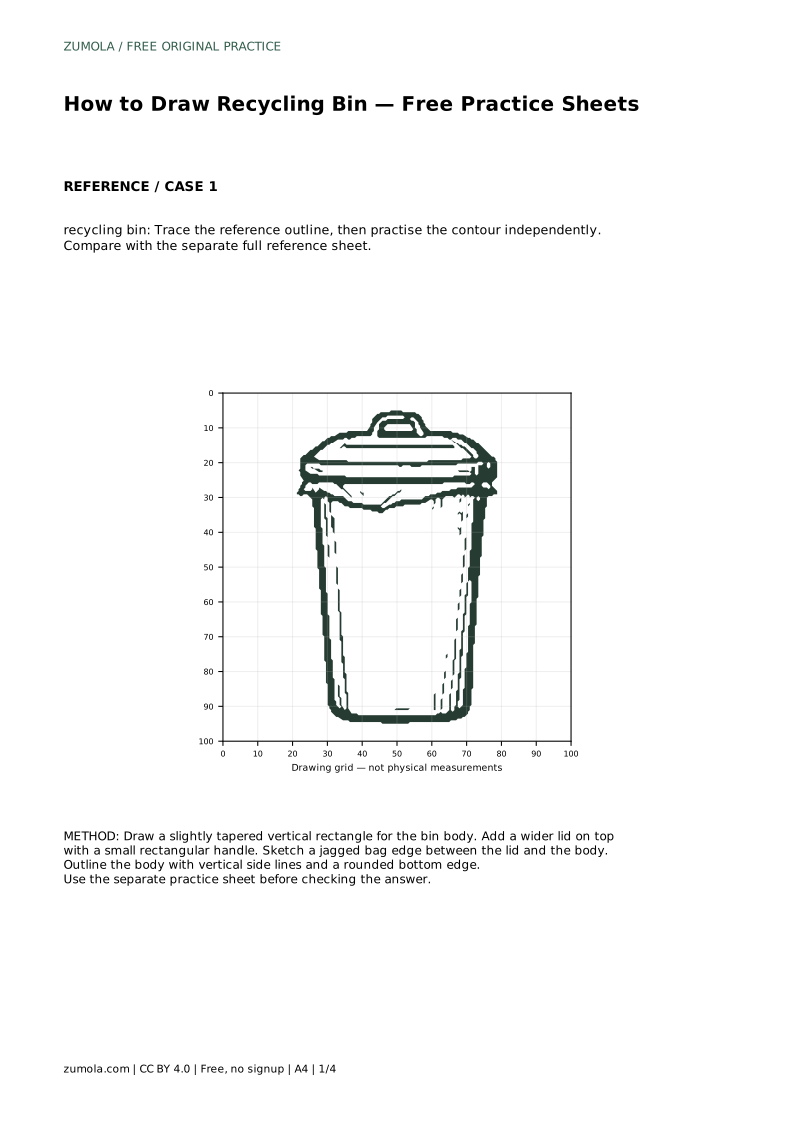
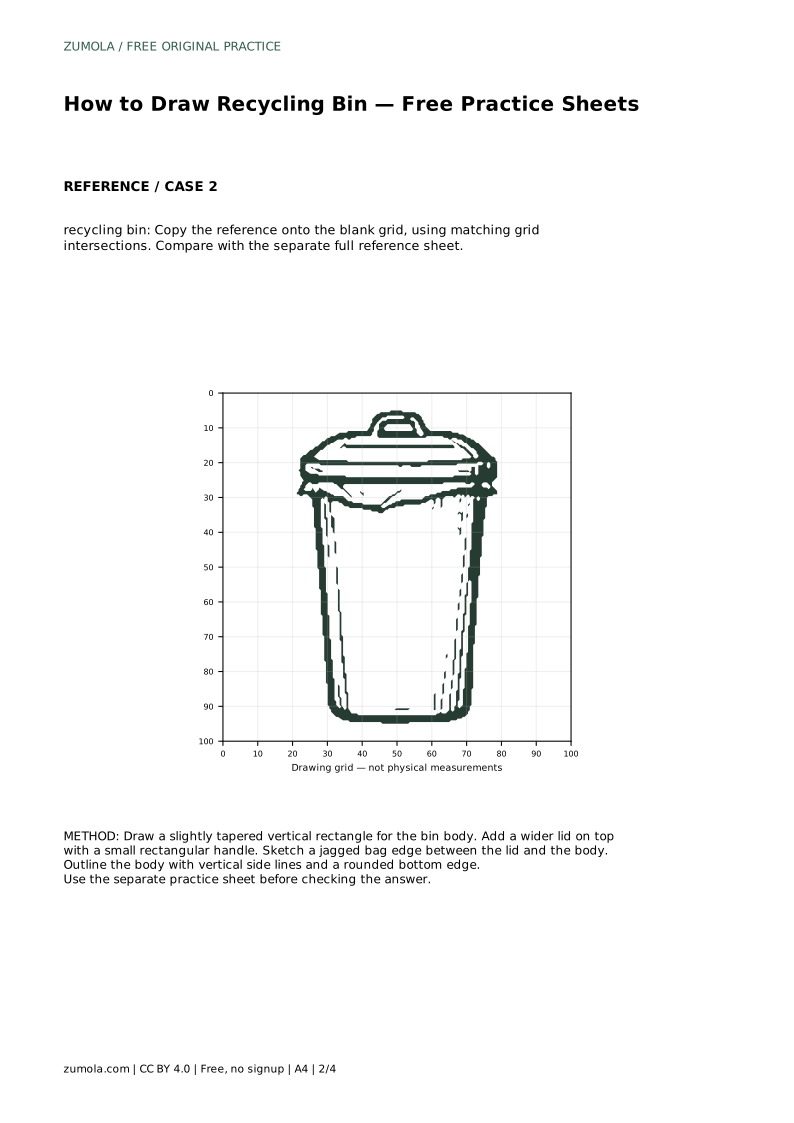
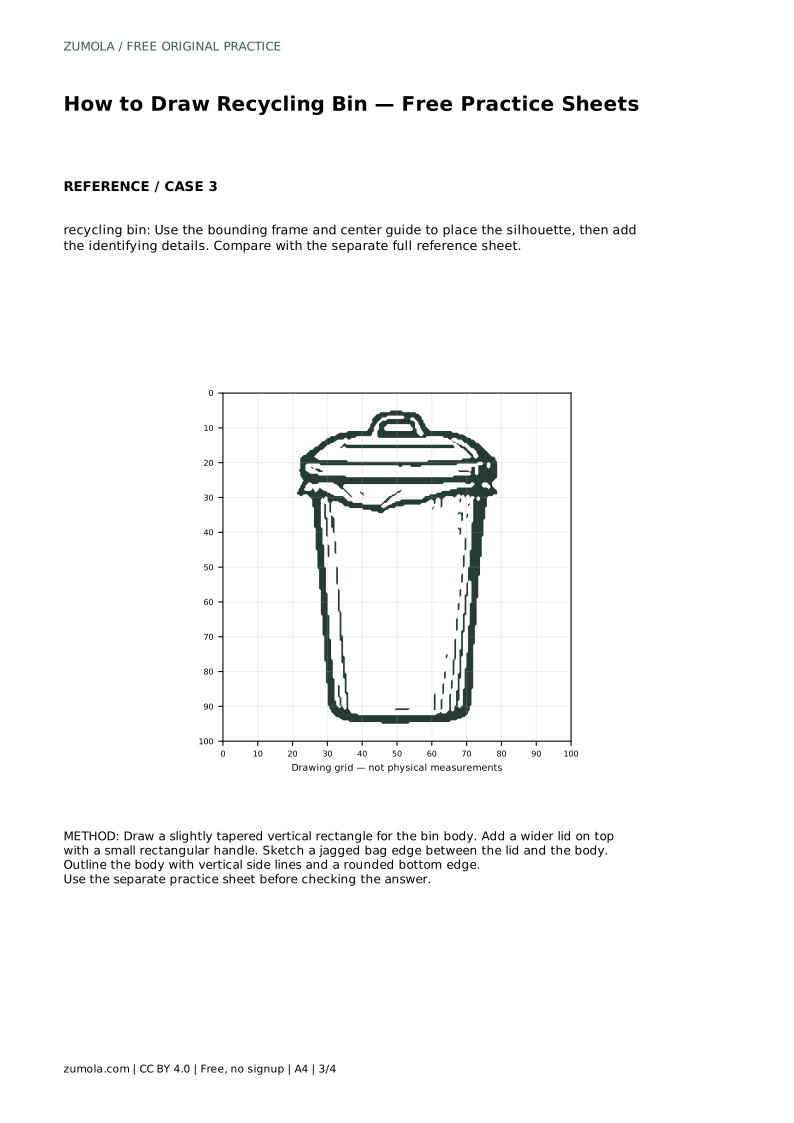
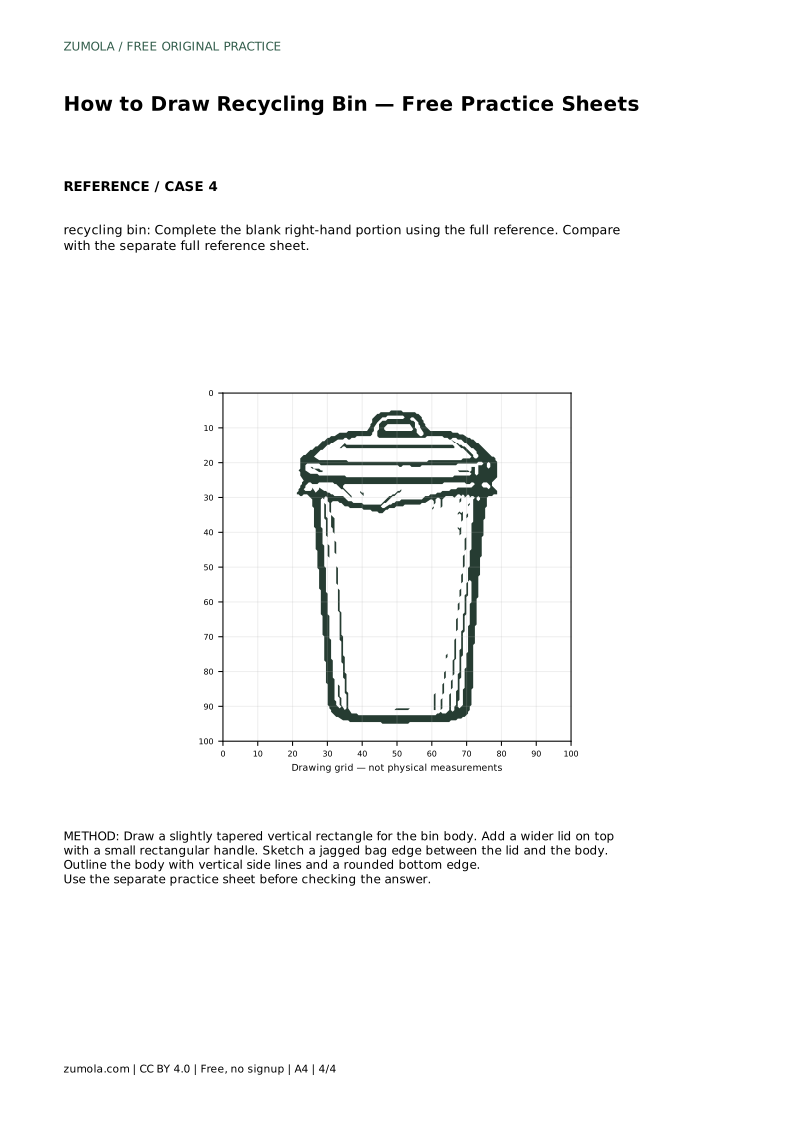
Reference diagrams
LETTER · Download PDF
A4 · Download PDF
Free original resources
Learn to draw a recycling bin with a tapered body, overhanging lid, top handle, and bag liner. Four practice sheet formats build contour and placement skills.
Four original cases, with reference diagrams, practice sheets and worked answers. Everything is free; no signup required.
LETTER · Download PDF
A4 · Download PDF
LETTER · Download PDF
A4 · Download PDF
LETTER · Download PDF
A4 · Download PDF
Use A4 or US Letter to match your printer. Use the stated values and conditions to solve each exercise; diagrams are not physical measuring rulers.
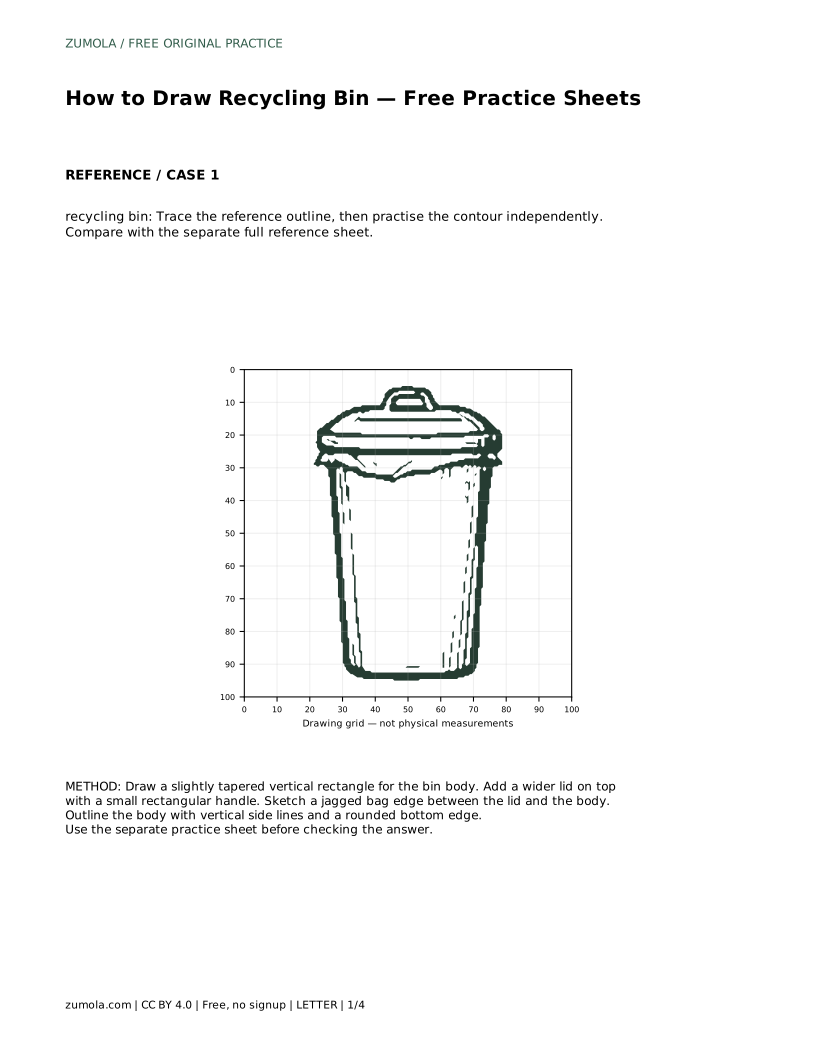
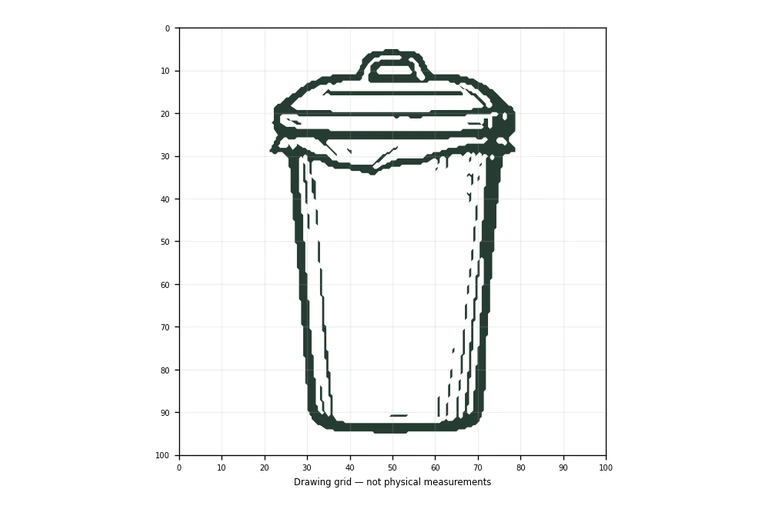
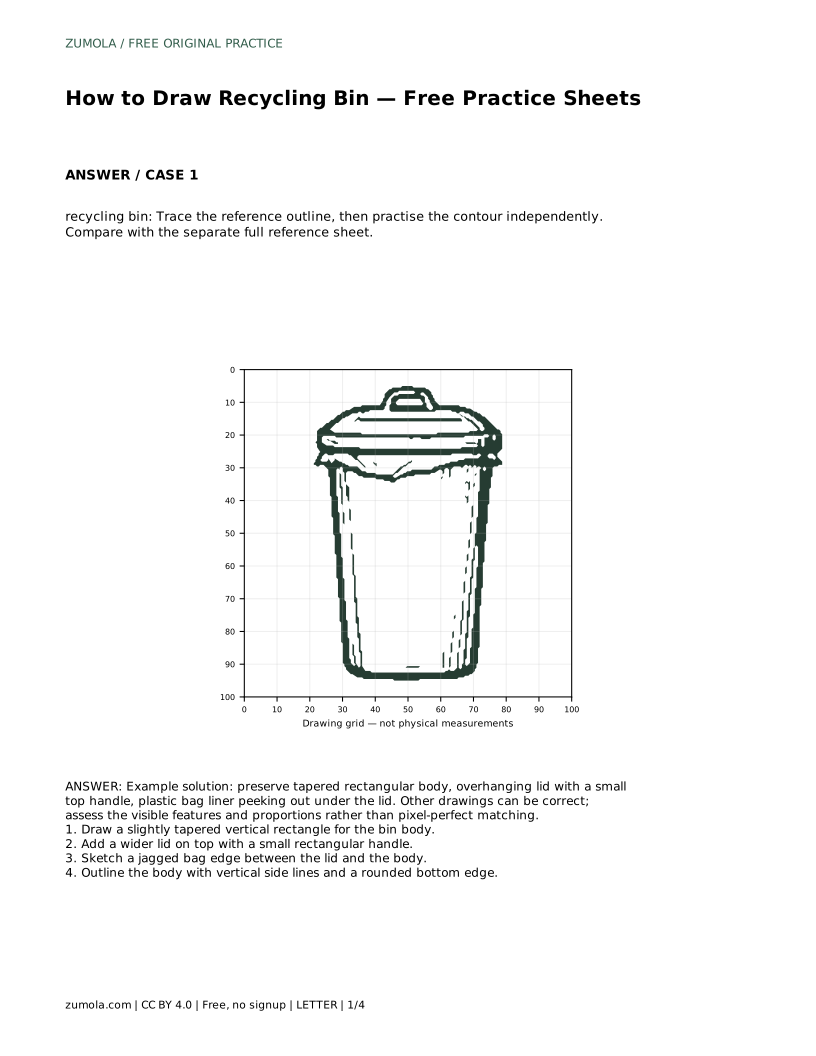
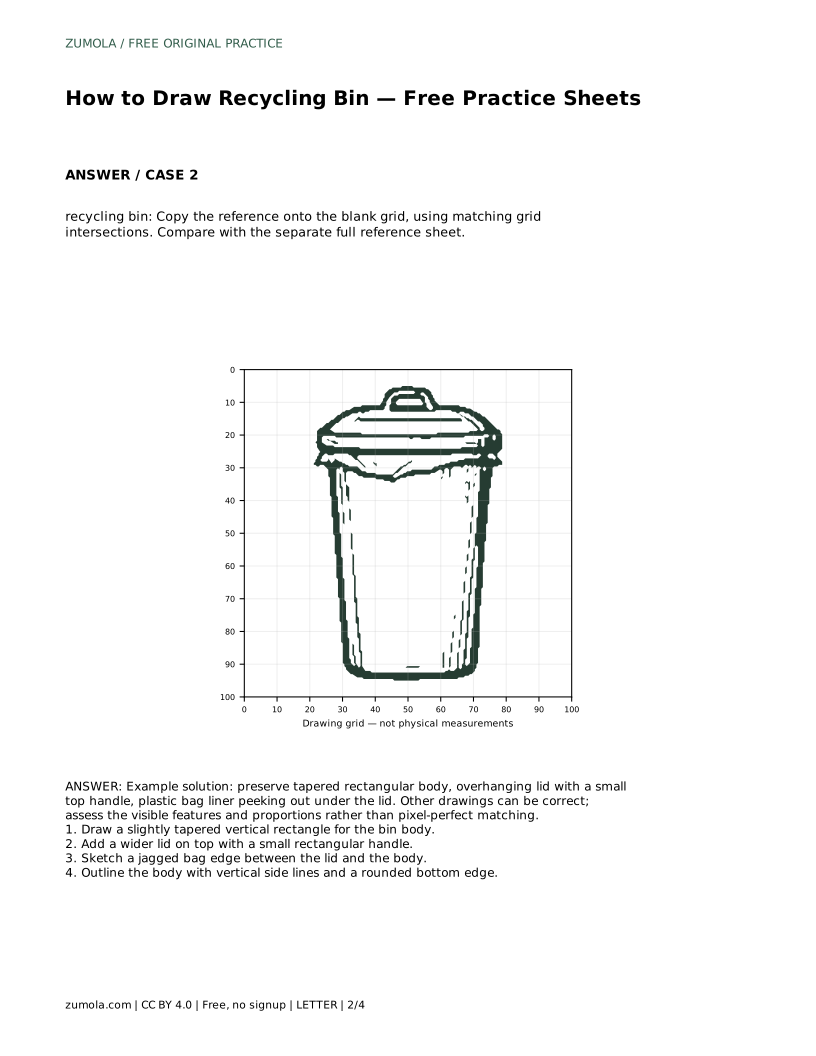
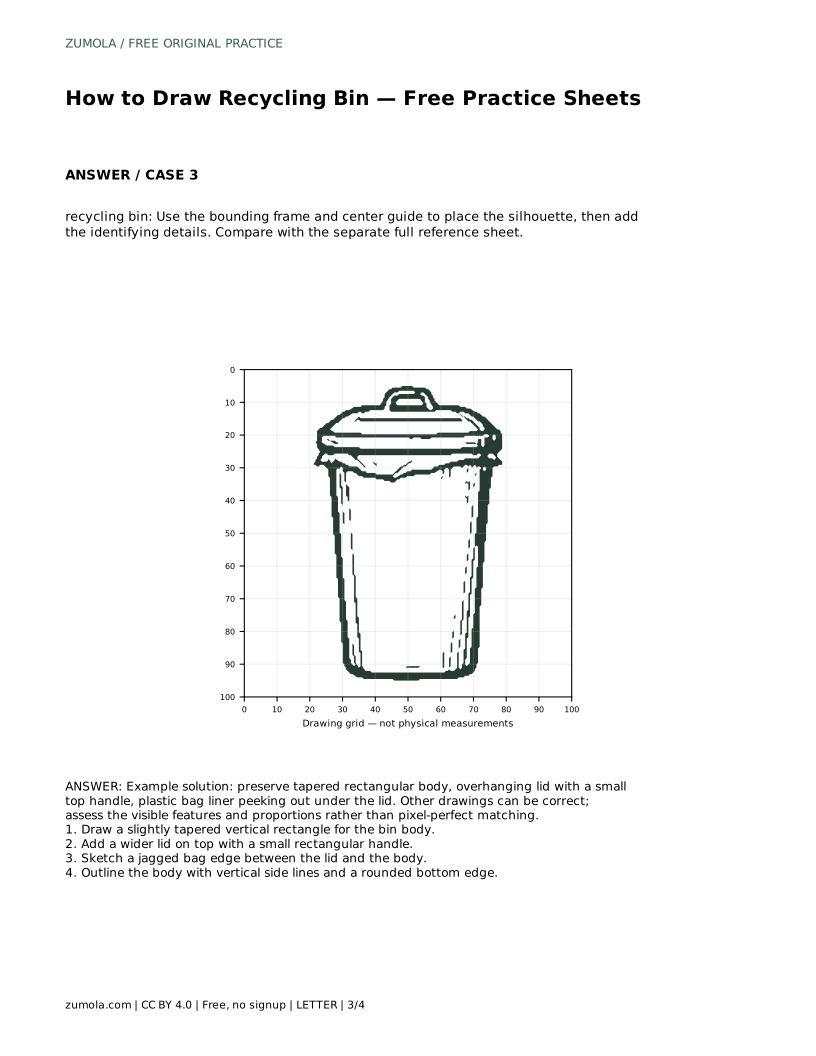
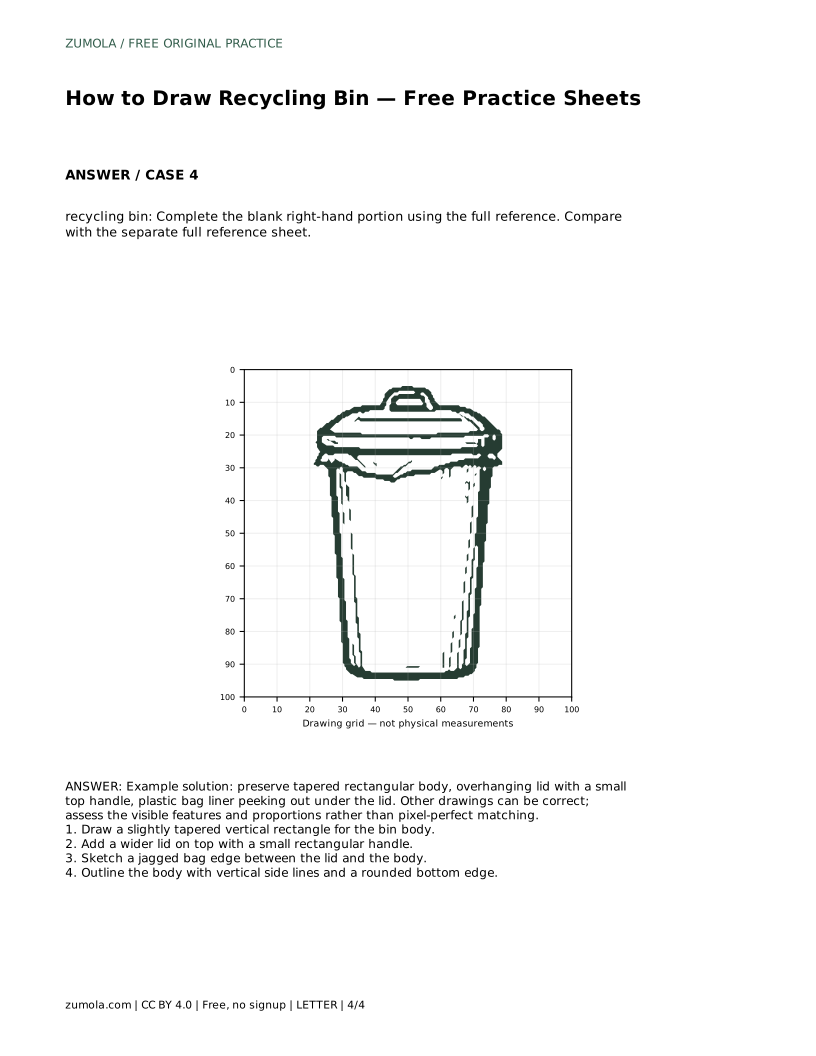
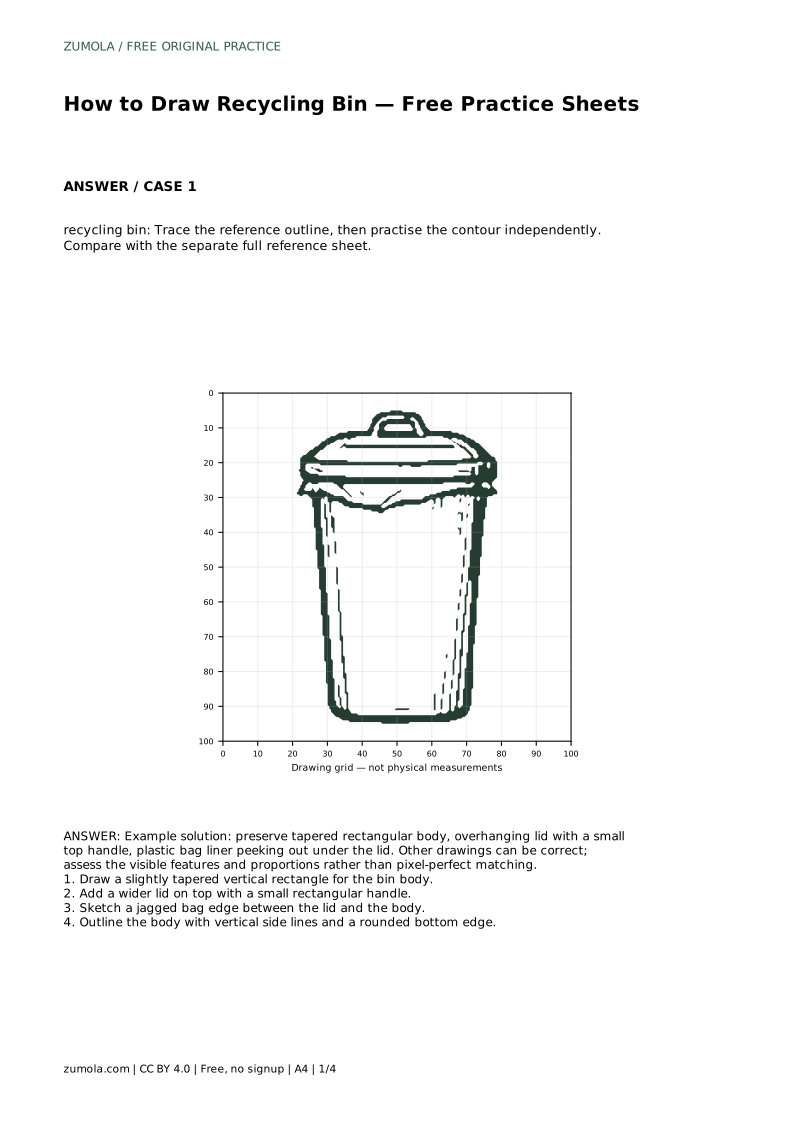
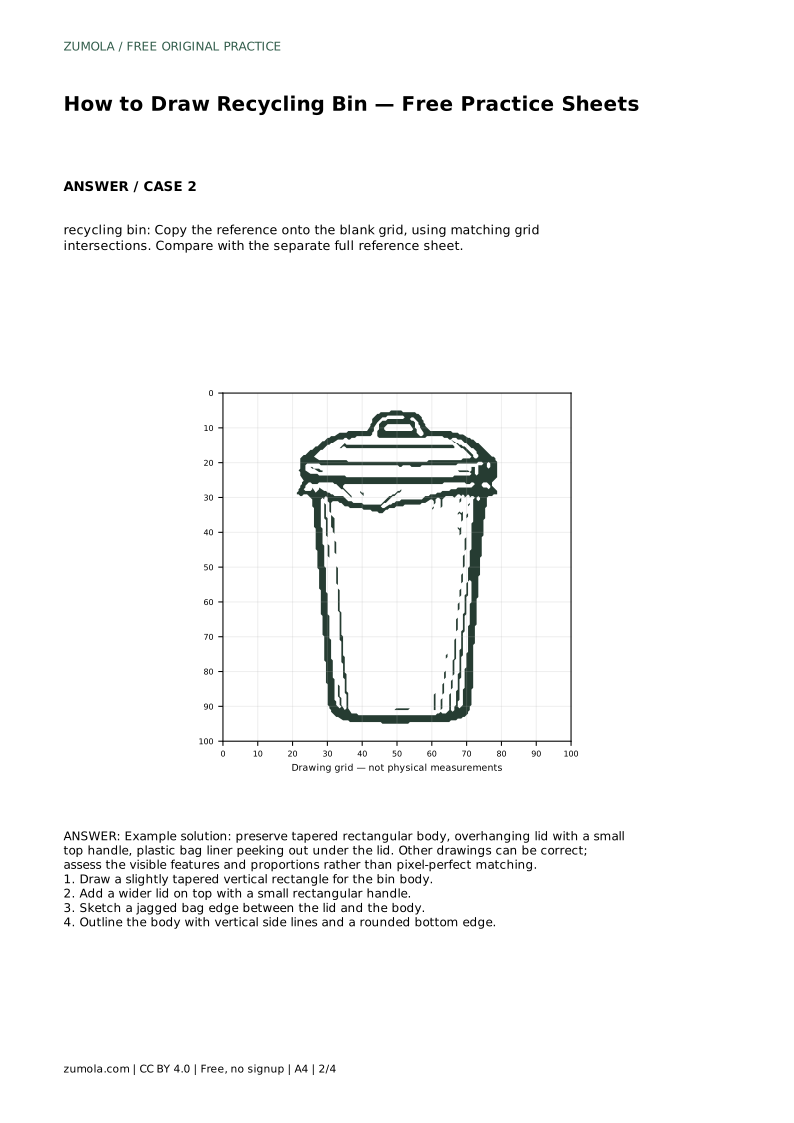
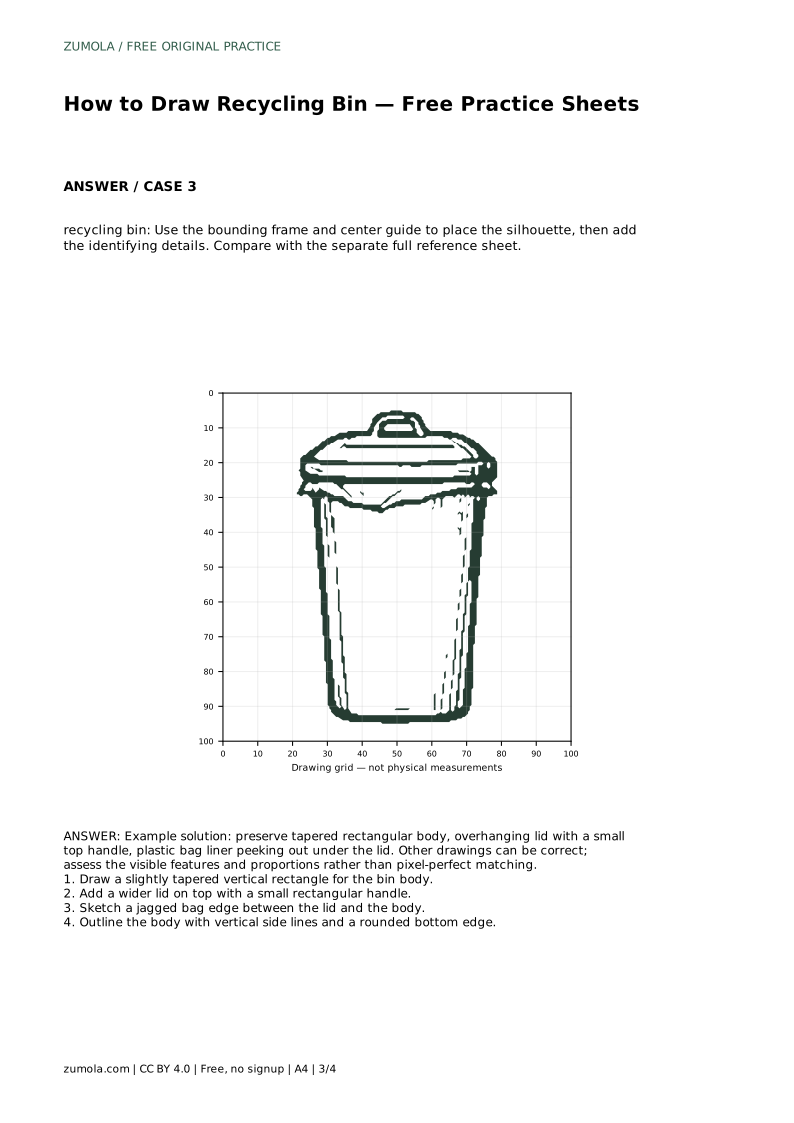
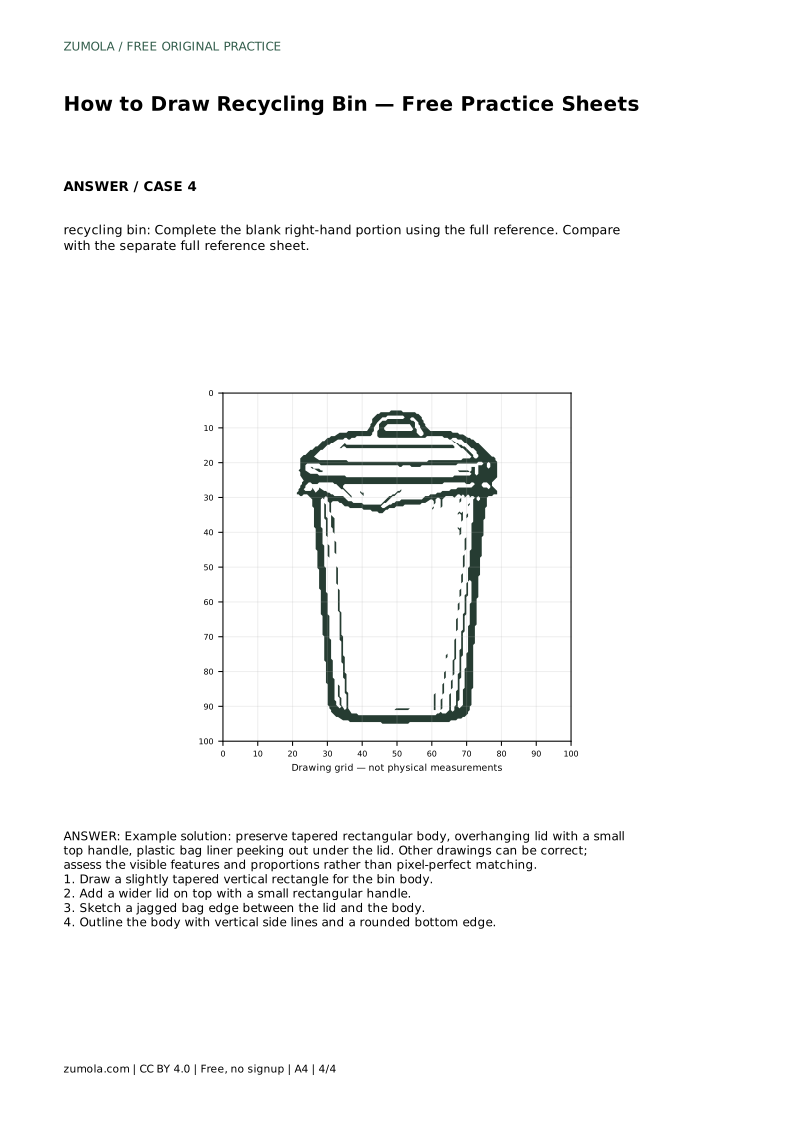
A recycling bin is a forgiving subject for drawing practice because its shape is built from a few clear parts: a slightly tapered body, a wider lid that overhangs the sides, a small handle on top, and often a plastic bag edge showing beneath the lid. This page explains how to construct that silhouette step by step, then how to use four different practice sheet formats to strengthen your control. Each format trains a slightly different skill, and any drawing that keeps the identifying features and sensible proportions can be correct.
Start with the body, not the details. A recycling bin body is close to a vertical rectangle, but its sides usually narrow slightly toward the bottom so the bin looks stable and reads as a container rather than a box. Draw that tapered rectangle first, lightly, so you can adjust it. The taper should be gentle: if the bottom is much narrower than the top, the bin looks unstable; if the sides are perfectly parallel, it can look like a plain crate.
Next, place the lid. The lid is wider than the body at the top, so it overhangs on both sides. Treat it as a shallow horizontal shape sitting across the body's upper edge, with a small rectangular handle rising from its center. The handle is a detail, so keep it modest in size; a handle as wide as the lid changes the character of the object.
Finally, add the bag liner. A plastic bag often peeks out between the lid and the body, and its irregular, jagged edge is one of the features that makes a recycling bin recognizable. Sketch a few uneven points along that gap rather than a smooth line. Then firm up the body outline with vertical side lines and a rounded bottom edge, which suggests the molded base of a typical bin.
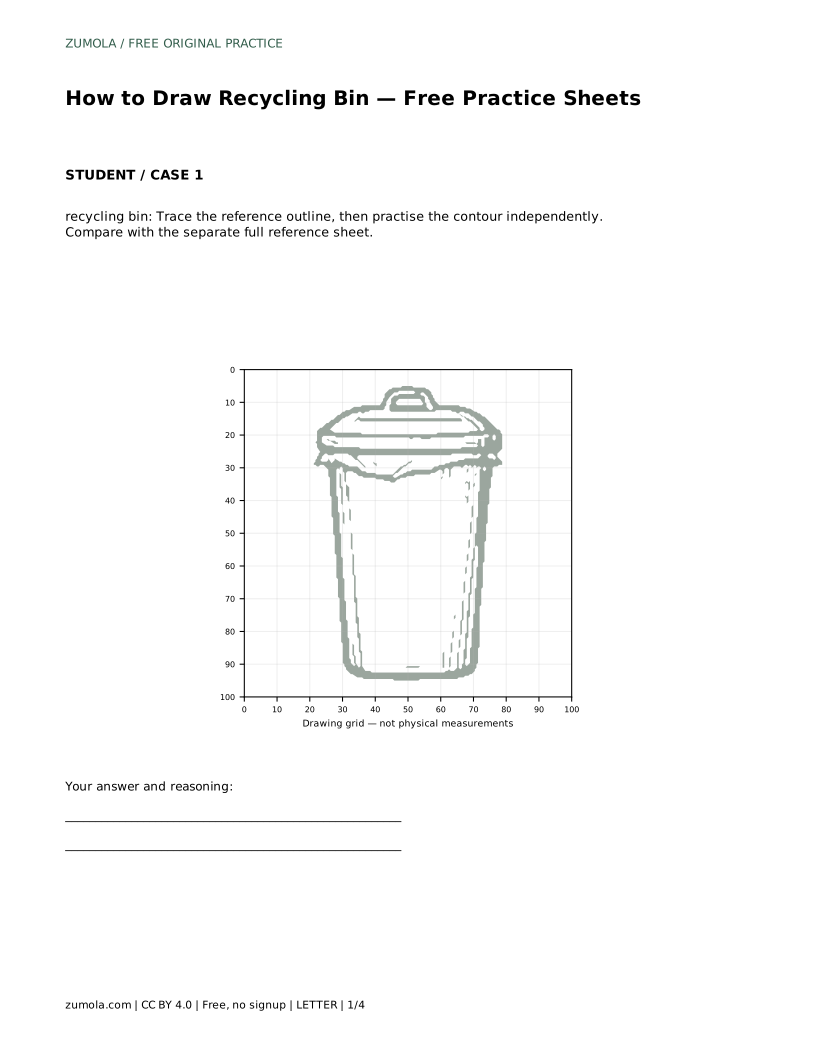
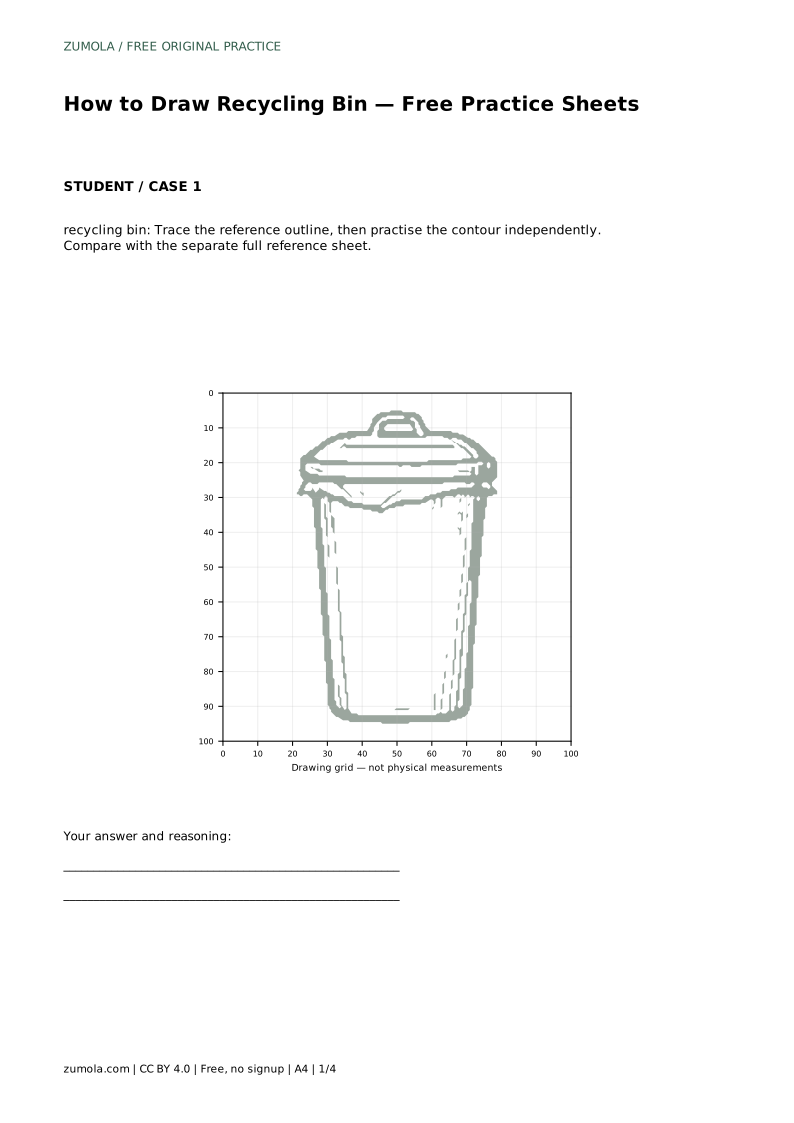
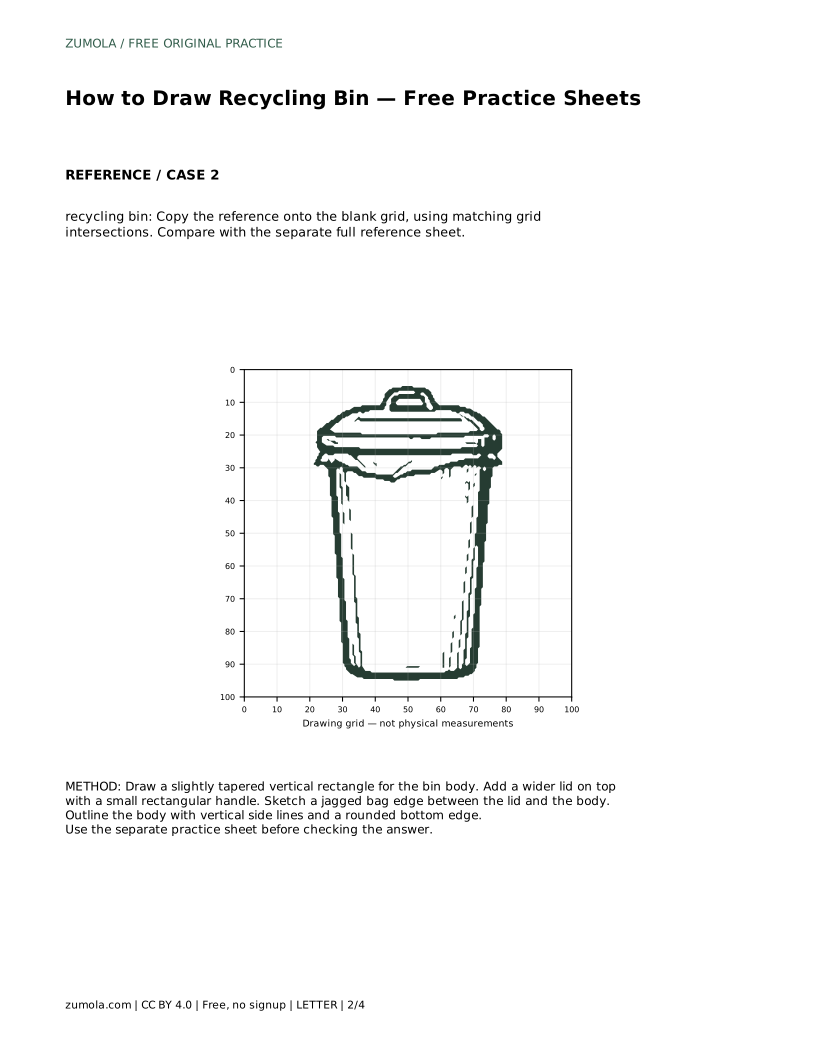
The tracing sheet asks you to follow the reference outline first, then repeat the contour on your own. Tracing builds familiarity with the shape; the independent repeat is where the learning happens, so slow down and check the taper and lid overhang as you go. Compare your result with the separate full reference sheet afterward.
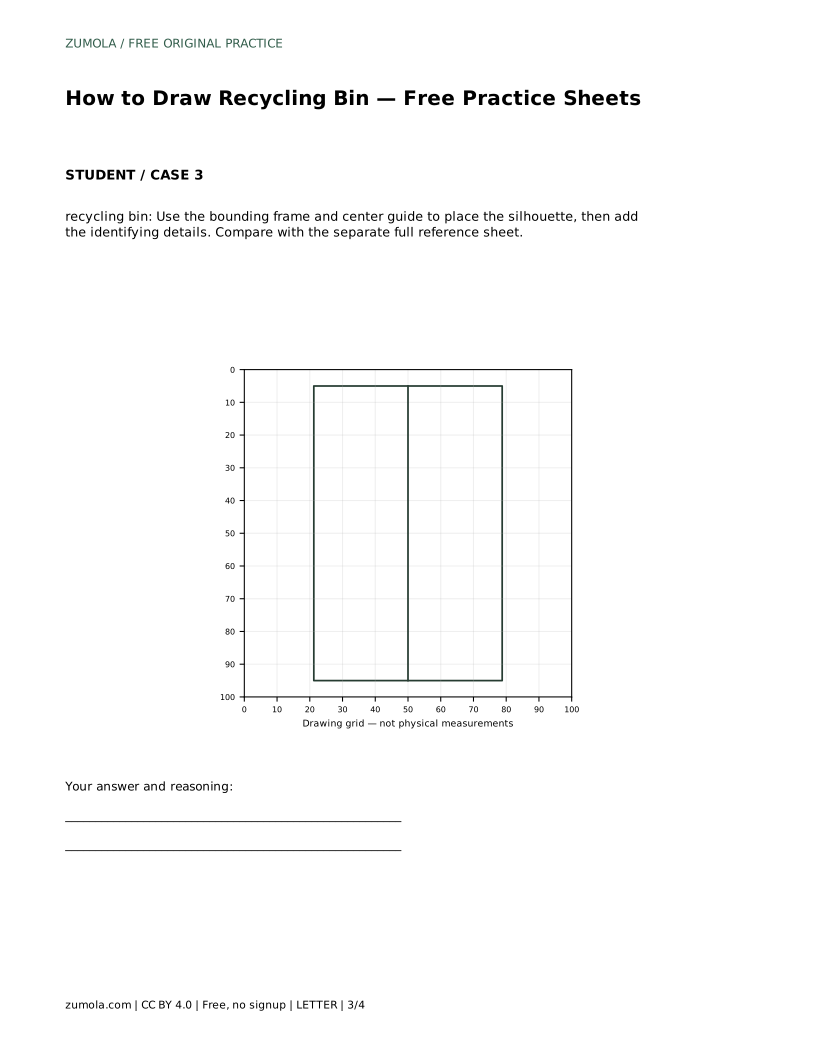
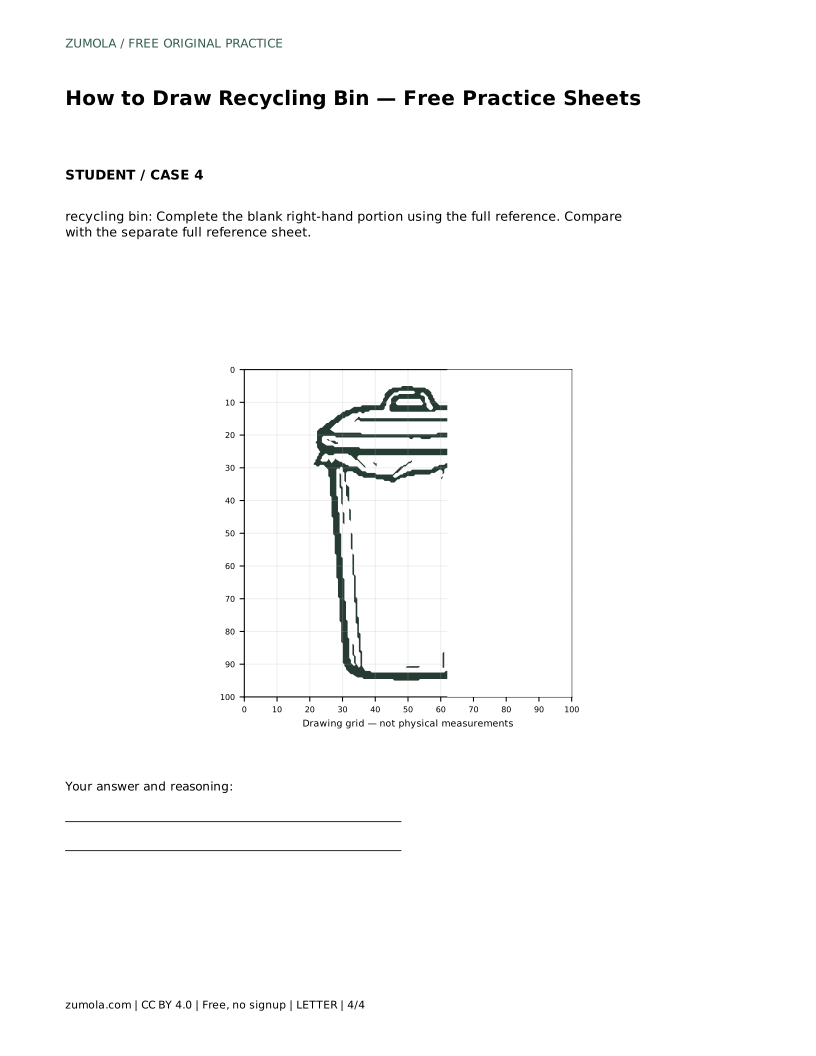
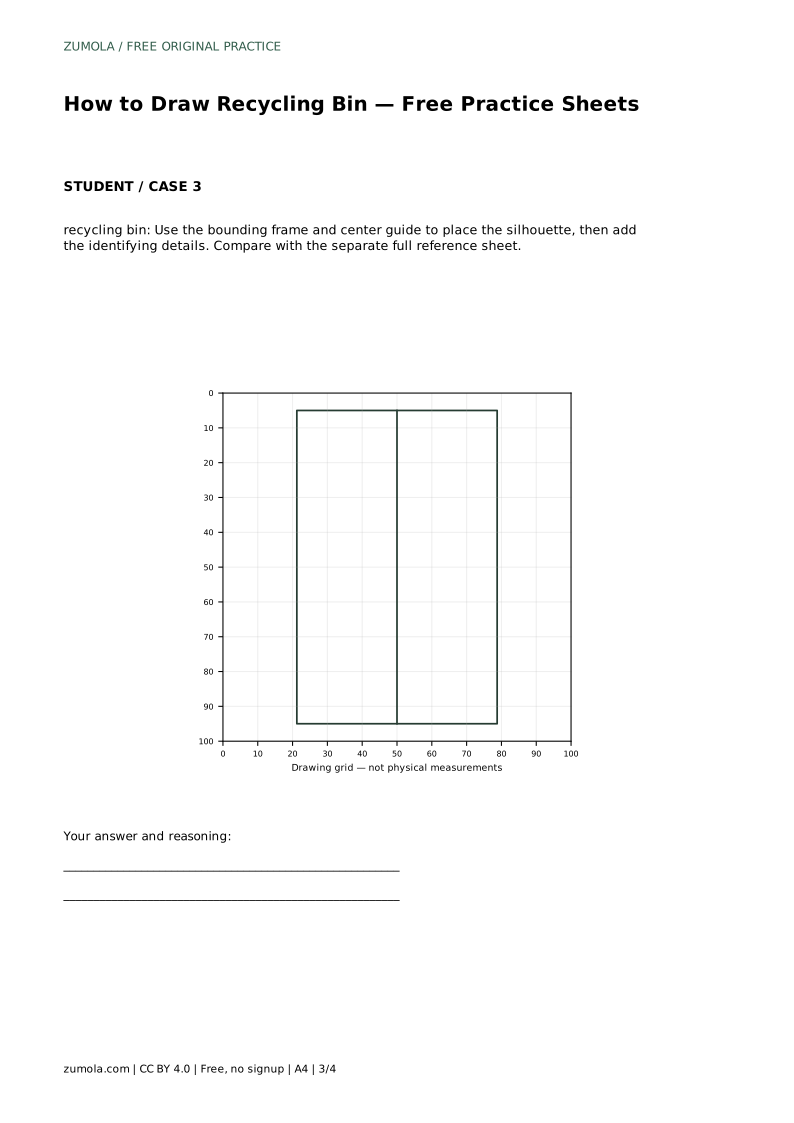
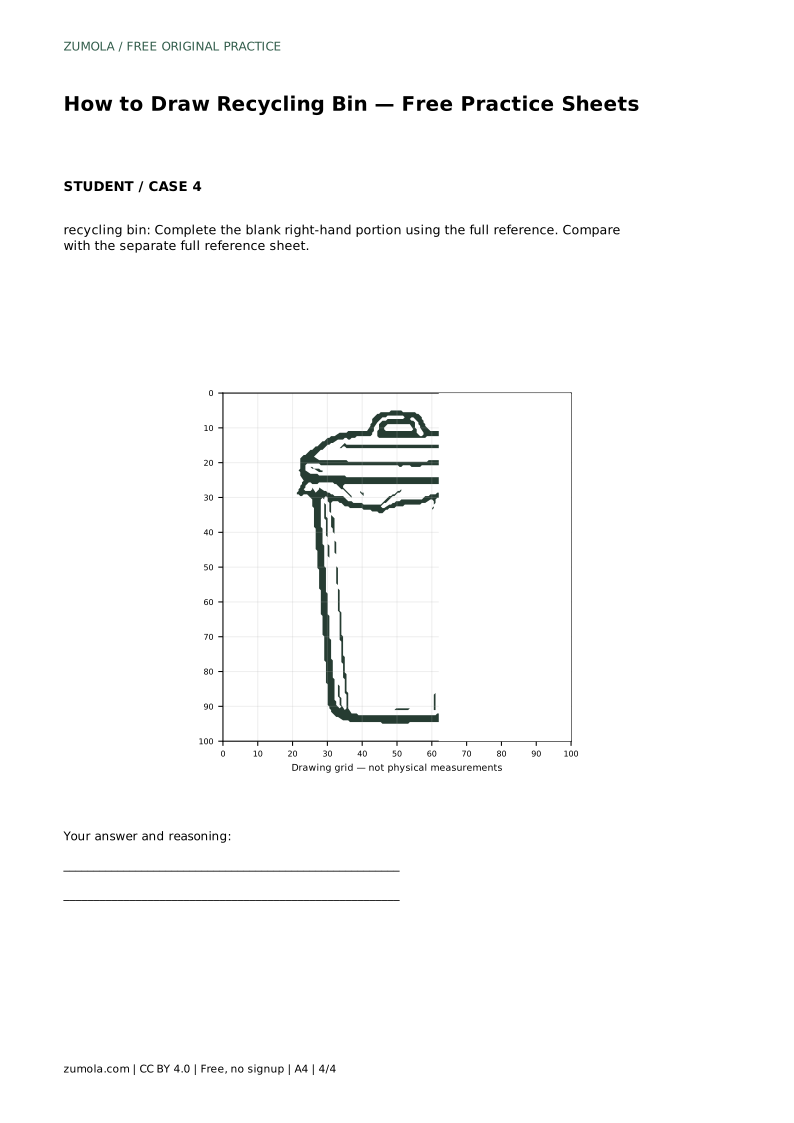
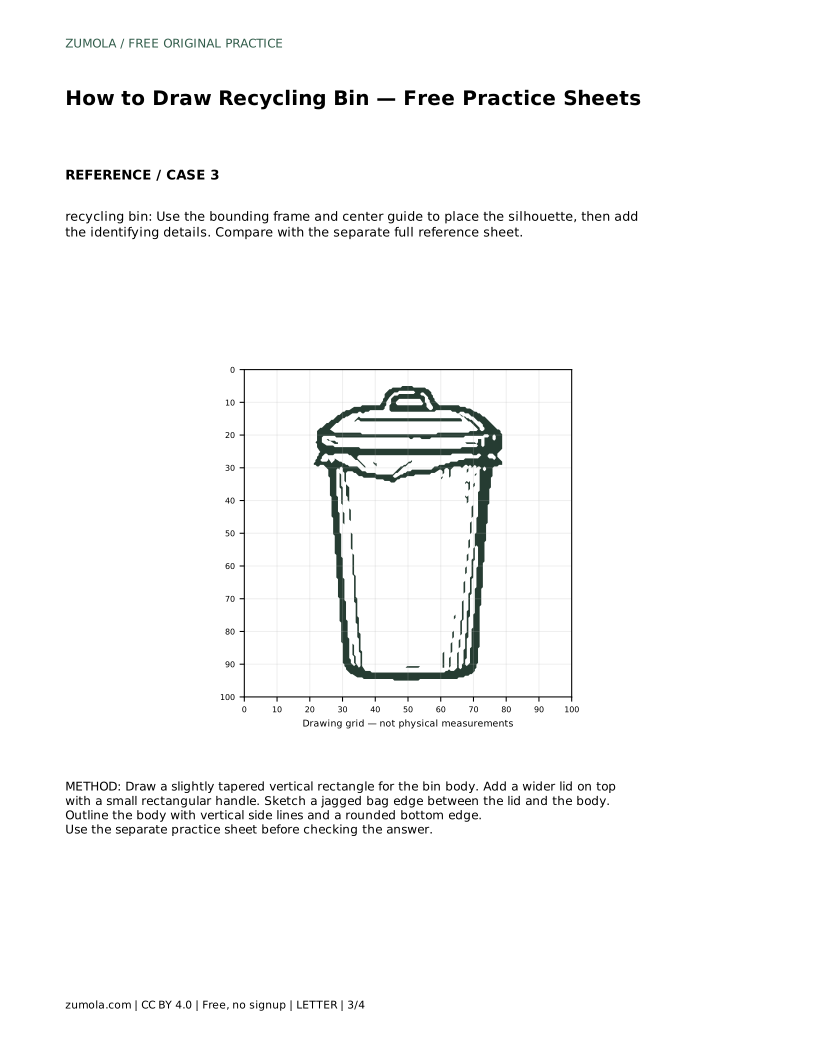
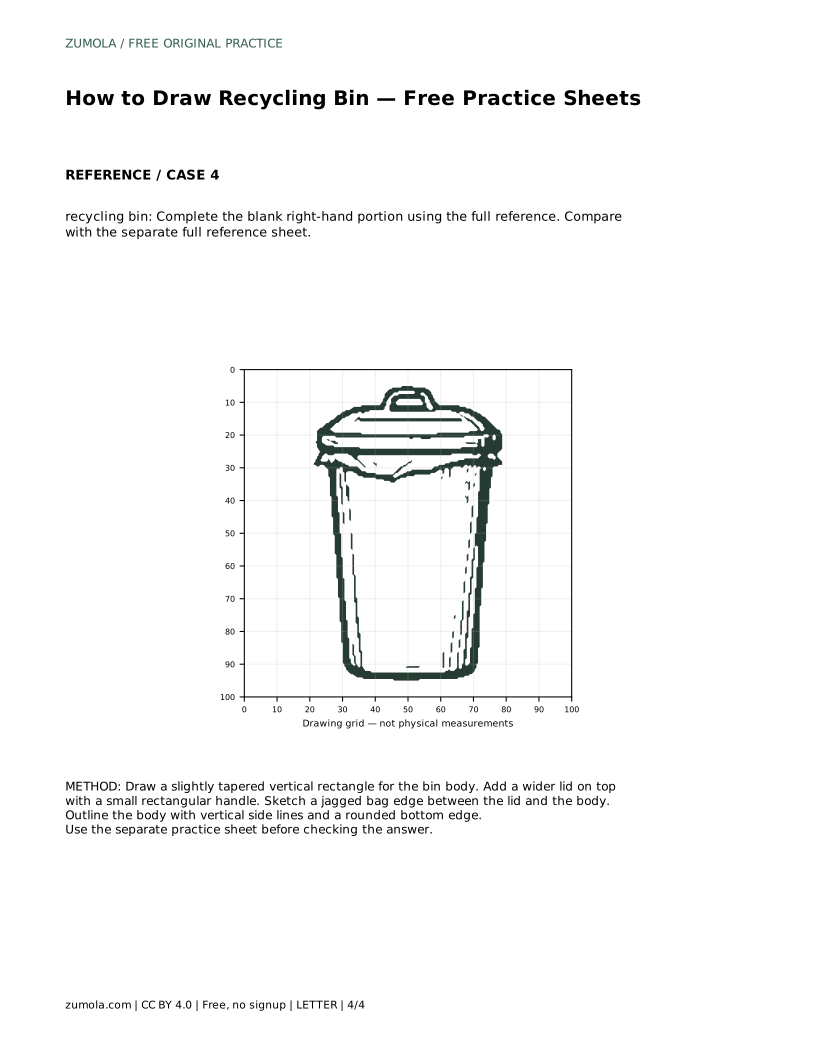
The grid sheet asks you to copy the reference onto a blank grid using matching grid intersections. This trains placement: note where the lid corners, handle, and bag edge fall relative to grid lines, then reproduce those positions rather than guessing. The bounding-frame sheet works similarly but with a center guide, so you place the silhouette inside the frame before adding identifying details. The partial sheet gives you the left portion of the drawing and asks you to complete the blank right-hand side from the full reference, which tests whether you can continue a contour and keep proportions consistent across the join.
Because drawing has many valid outcomes, judge your work by visible features and proportions rather than an exact match. Ask whether the body tapers, whether the lid overhangs, whether the handle sits centered on the lid, and whether the bag edge reads as jagged and sits between lid and body. A drawing with slightly different proportions can still be correct if those features are clear and consistent.
Keep geometric assumptions explicit as you check. The body is a tapered vertical rectangle; the lid is wider than the body's top edge; the handle is small and centered; the bag edge occupies the gap under the lid; the bottom edge is rounded. If one of these relationships is off, adjust that part rather than redrawing everything.
Most problems with this drawing come from drawing details before the large shapes are settled. Light construction lines let you correct the taper and lid width early. If the bin looks like a box, increase the taper slightly; if it looks unstable, reduce it. If the lid disappears into the body, widen the overhang. Keep the bag edge irregular but contained within the gap, and keep the handle small so it does not dominate the lid.
recycling bin: Trace the reference outline, then practise the contour independently. Compare with the separate full reference sheet.
Example solution: preserve tapered rectangular body, overhanging lid with a small top handle, plastic bag liner peeking out under the lid. Other drawings can be correct; assess the visible features and proportions rather than pixel-perfect matching. Draw a slightly tapered vertical rectangle for the bin body. Add a wider lid on top with a small rectangular handle. Sketch a jagged bag edge between the lid and the body. Outline the body with vertical side lines and a rounded bottom edge.
No. Art has multiple valid outcomes. Preserve the tapered body, overhanging lid, small top handle, bag liner edge, and rounded bottom, and judge proportions by those features rather than pixel-perfect matching.
Start with the tracing sheet to learn the contour, then move to the grid or bounding-frame sheet to practice placement, and finish with the partial sheet to test continuation.
Between the lid and the body, in the gap under the overhanging lid. Keep its jagged points within that gap so the lid and body outlines stay clear.
All drawing practice · Free coordinate paper
Original resources · CC BY 4.0 · Free for personal and classroom use with attribution.