Reference diagrams
LETTER · Download PDF
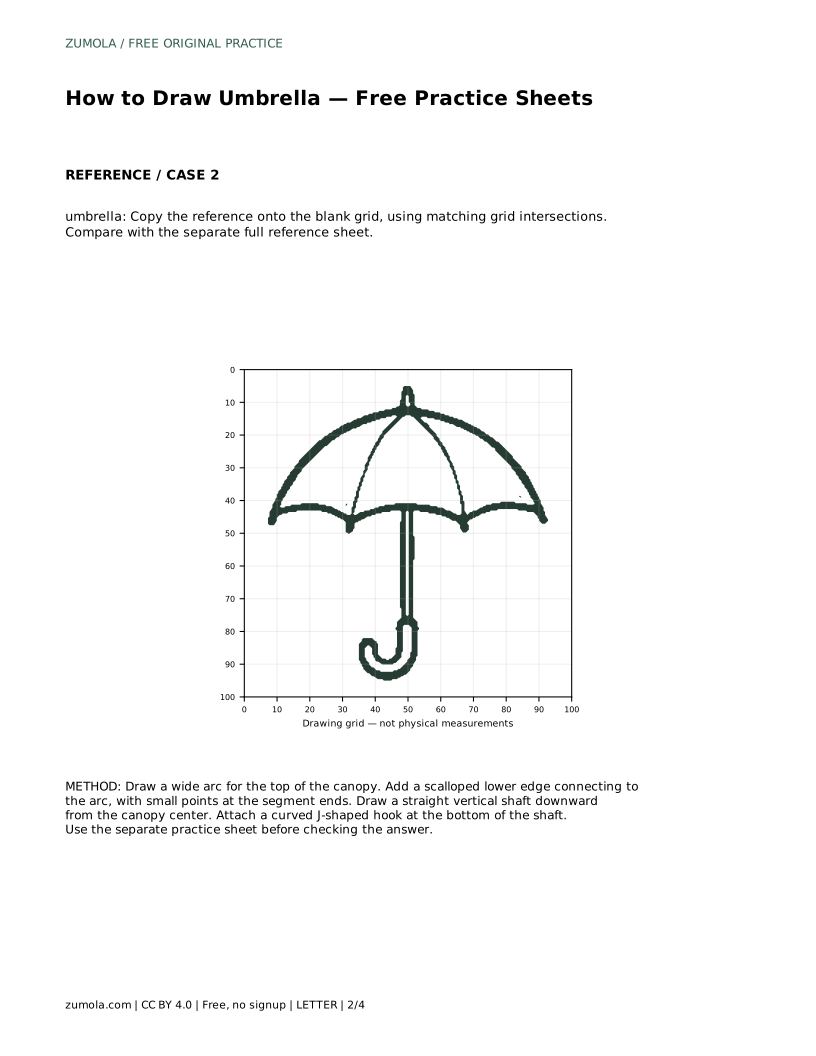
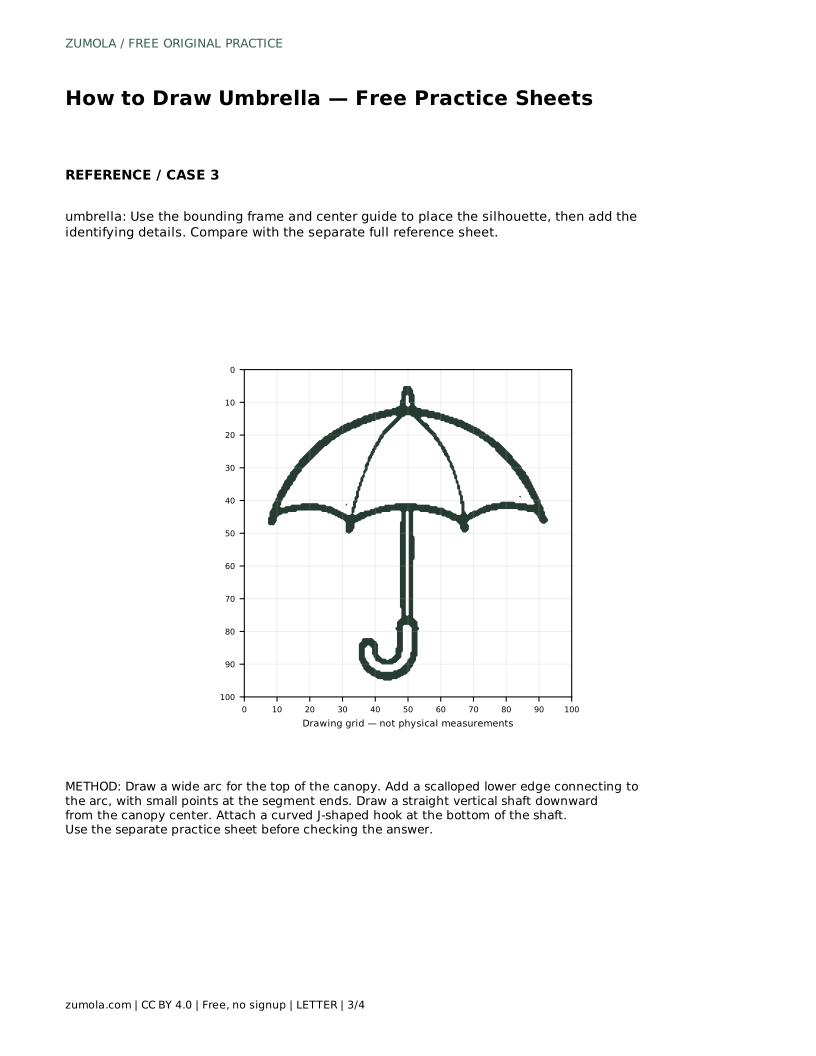
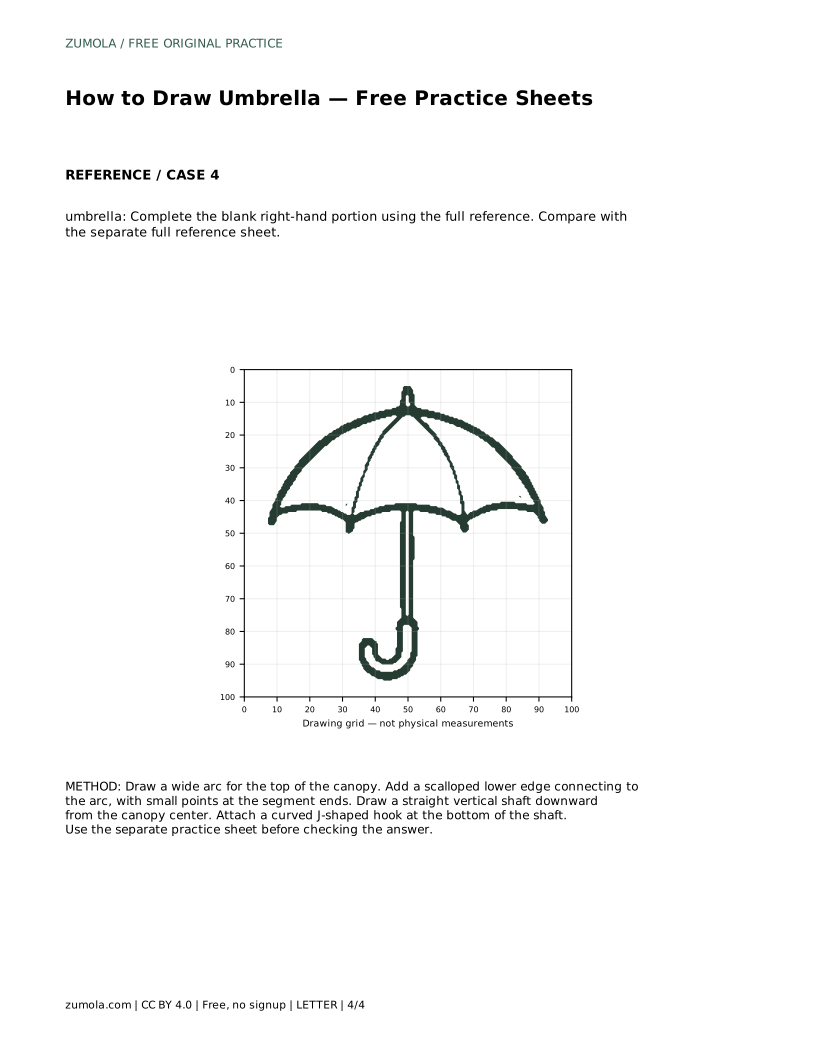
A4 · Download PDF
Free original resources
Learn to draw an umbrella by building a curved canopy, scalloped lower edge, straight shaft, and J-shaped hook. Practice with tracing, grid, and frame sheets.
Four original cases, with reference diagrams, practice sheets and worked answers. Everything is free; no signup required.
LETTER · Download PDF
A4 · Download PDF
LETTER · Download PDF
A4 · Download PDF
LETTER · Download PDF
A4 · Download PDF
Use A4 or US Letter to match your printer. Use the stated values and conditions to solve each exercise; diagrams are not physical measuring rulers.
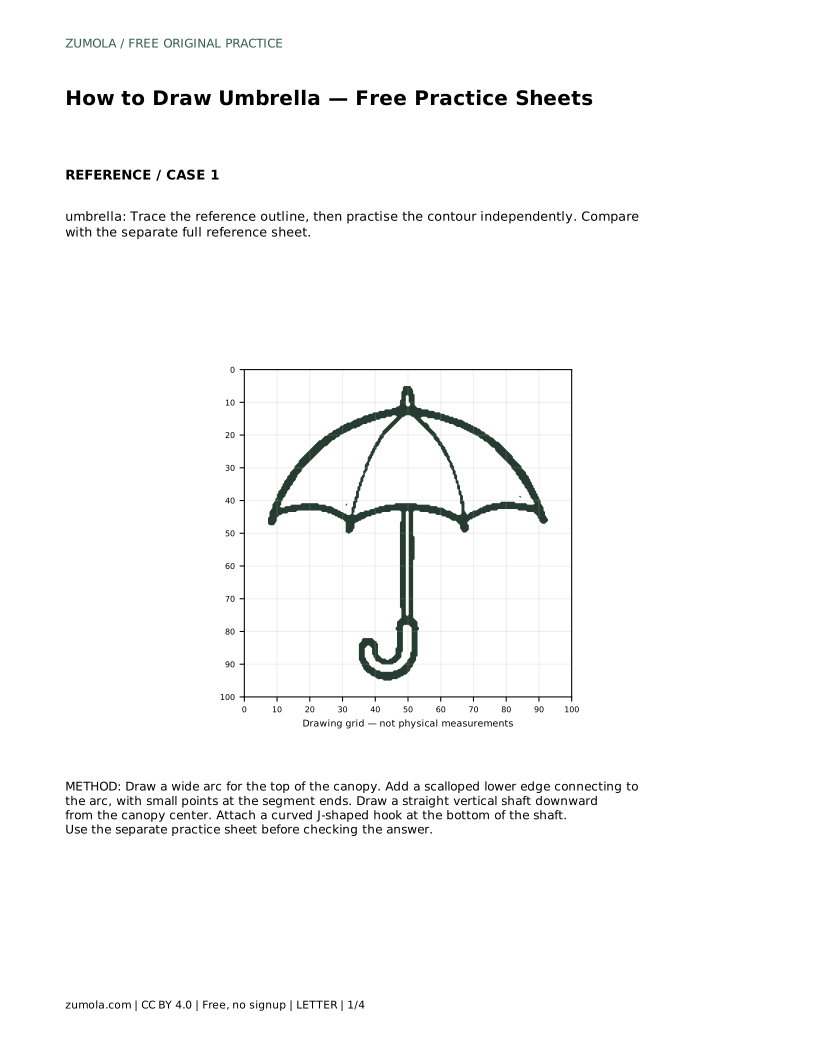
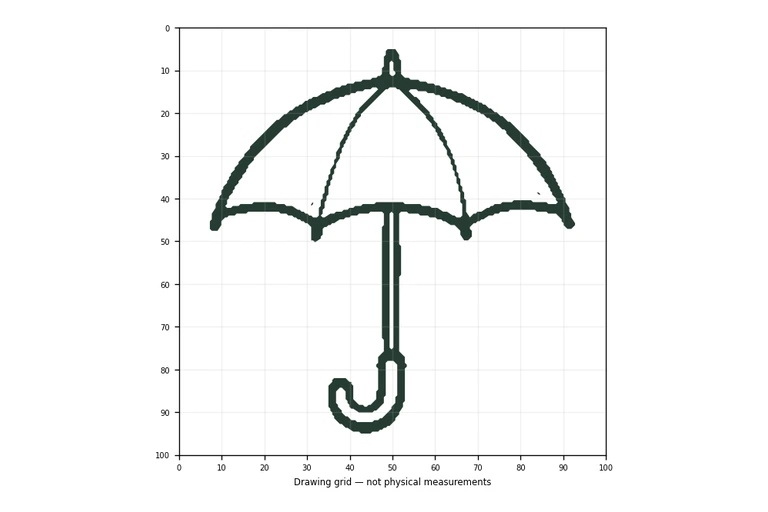
An umbrella is mostly a set of simple shapes arranged with care: a wide curved canopy, a scalloped lower edge, a straight central shaft, and a hooked handle. This page explains how to build those parts in order so the drawing reads clearly at any size. The practice sheets let you trace a reference outline, copy it onto a grid, place the silhouette inside a bounding frame, or complete a partially blank drawing.
Start with the largest shape, because it controls the overall width and the visual weight of the drawing. The canopy is a wide arc, not a flat line, and its lower edge is scalloped: a series of small curves that meet at points. Those points suggest where the fabric panels meet. Keep the arc and the scalloped edge related; if the arc is shallow, the scallops should be shallow too.
After the canopy, draw the shaft. It runs straight down from the center of the canopy, so check that it starts near the middle of the arc rather than off to one side. The handle is a J-shaped hook at the bottom of the shaft. The hook curves to one side and then back up slightly, which makes the umbrella look usable rather than like a stick with a bend.
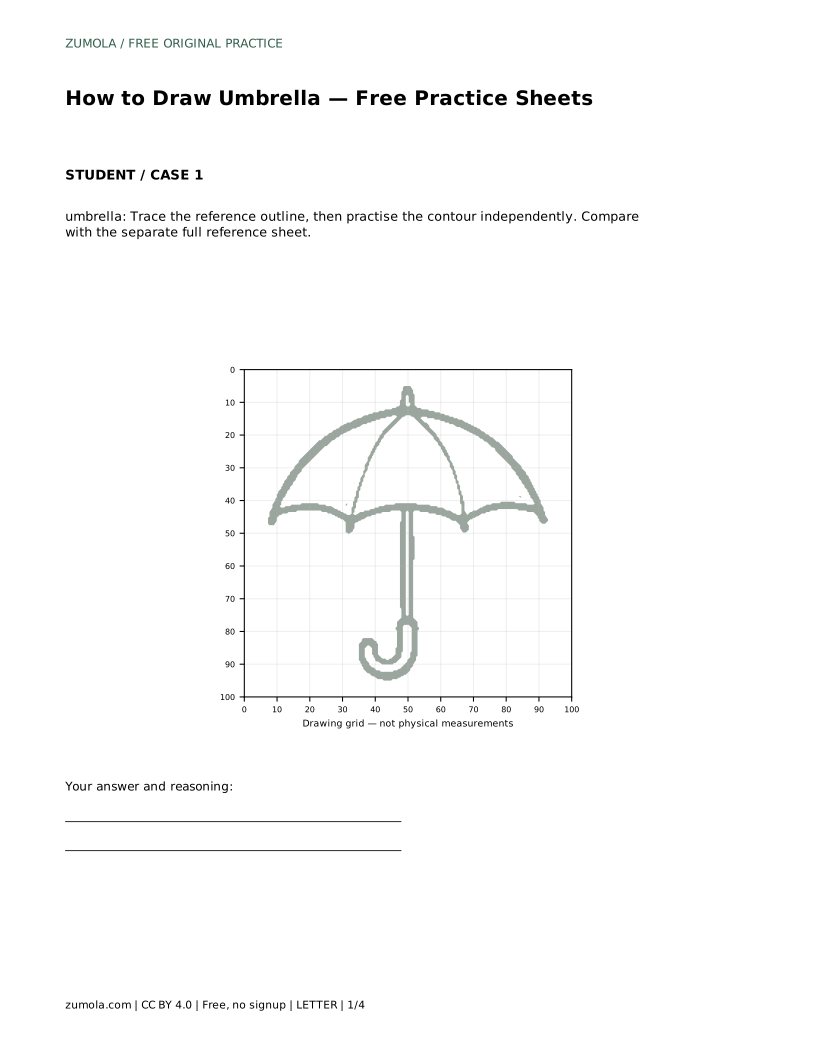
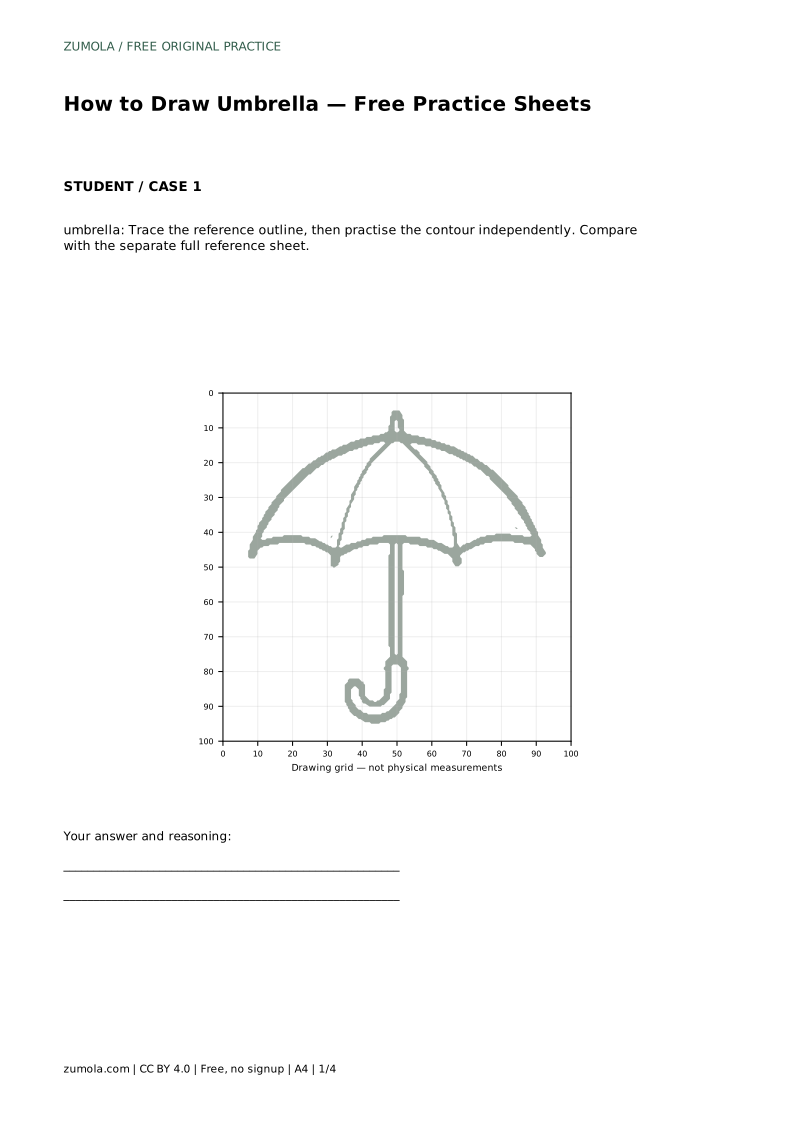
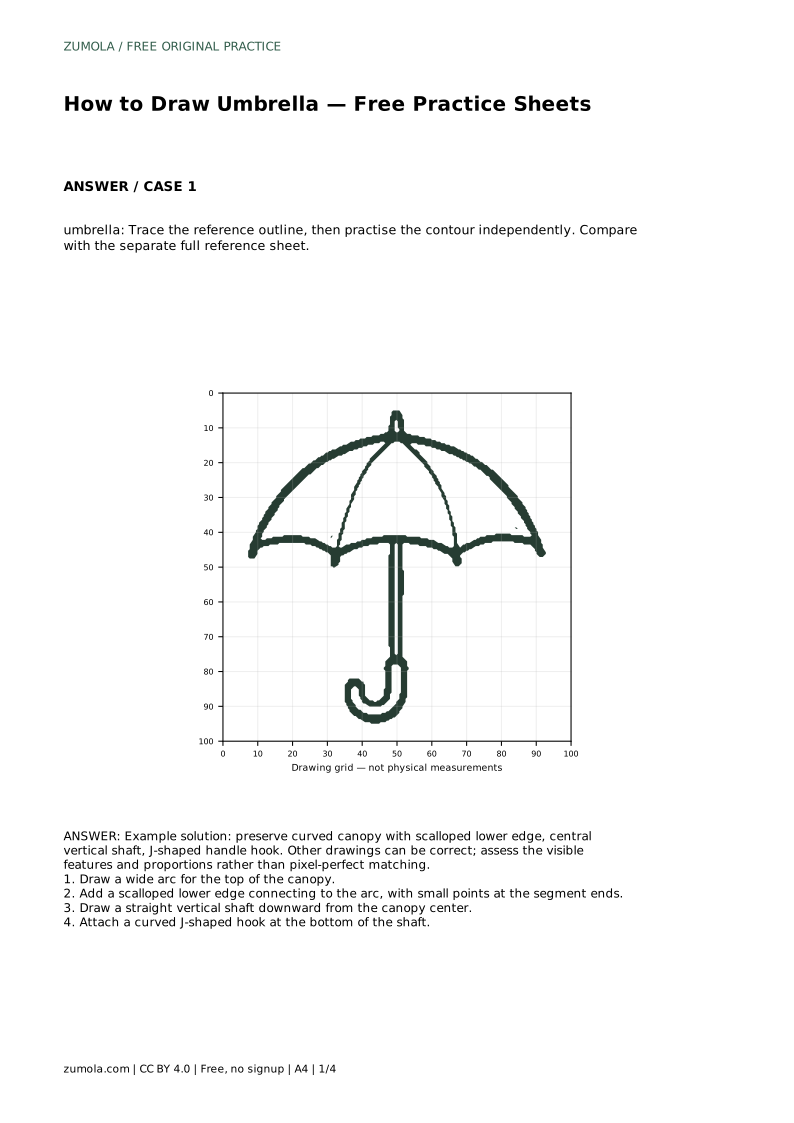
The tracing sheet asks you to follow the reference outline first, then draw the contour independently on the open space. Compare your free drawing with the separate full reference sheet, not with your traced line, so you can see where your proportions drifted.
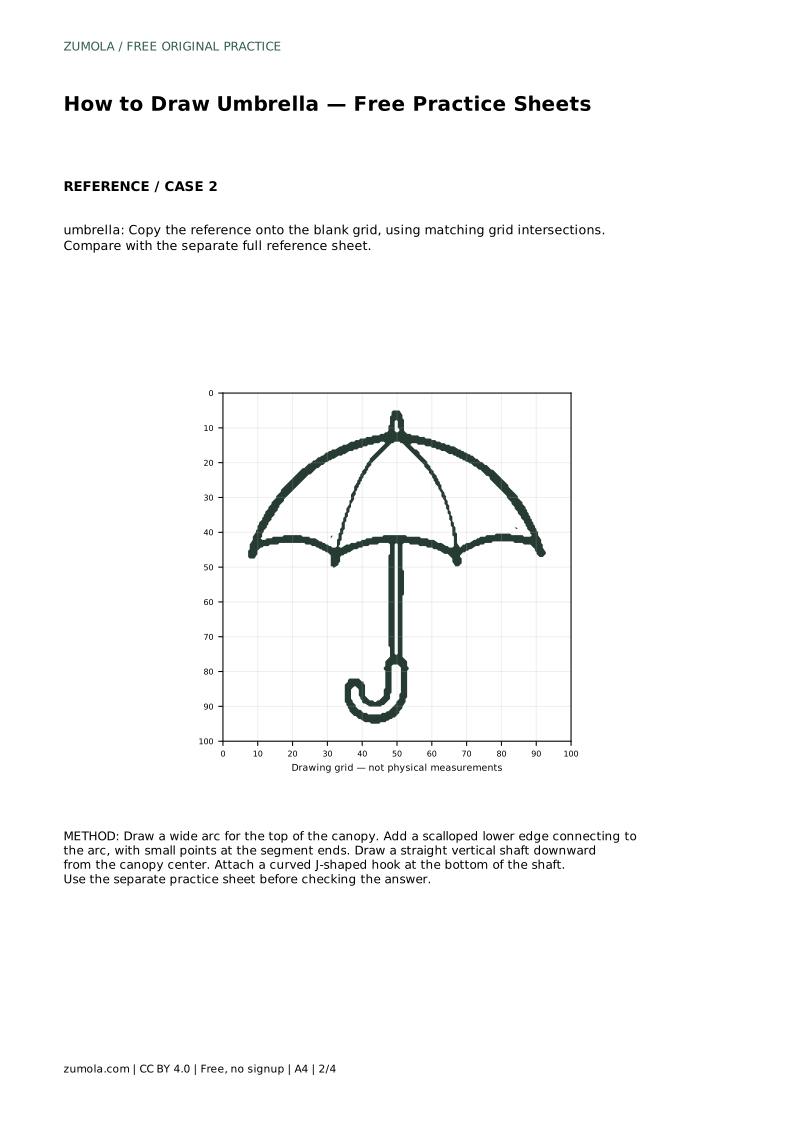
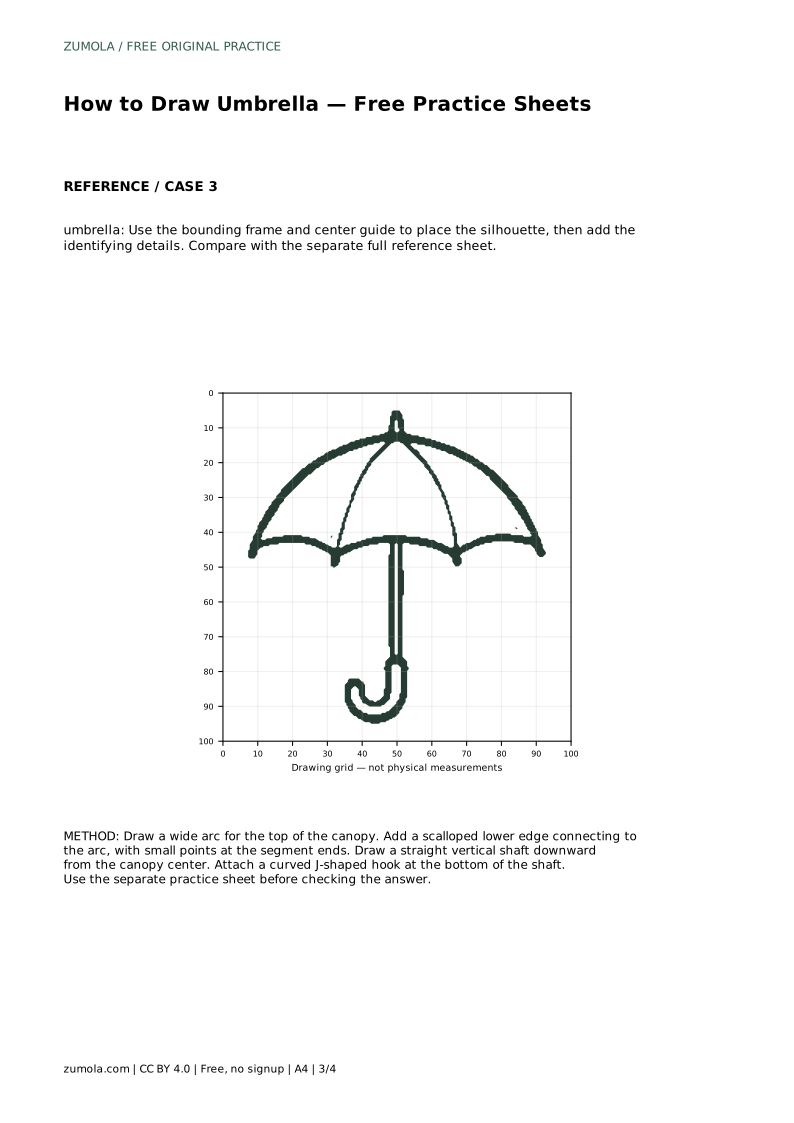
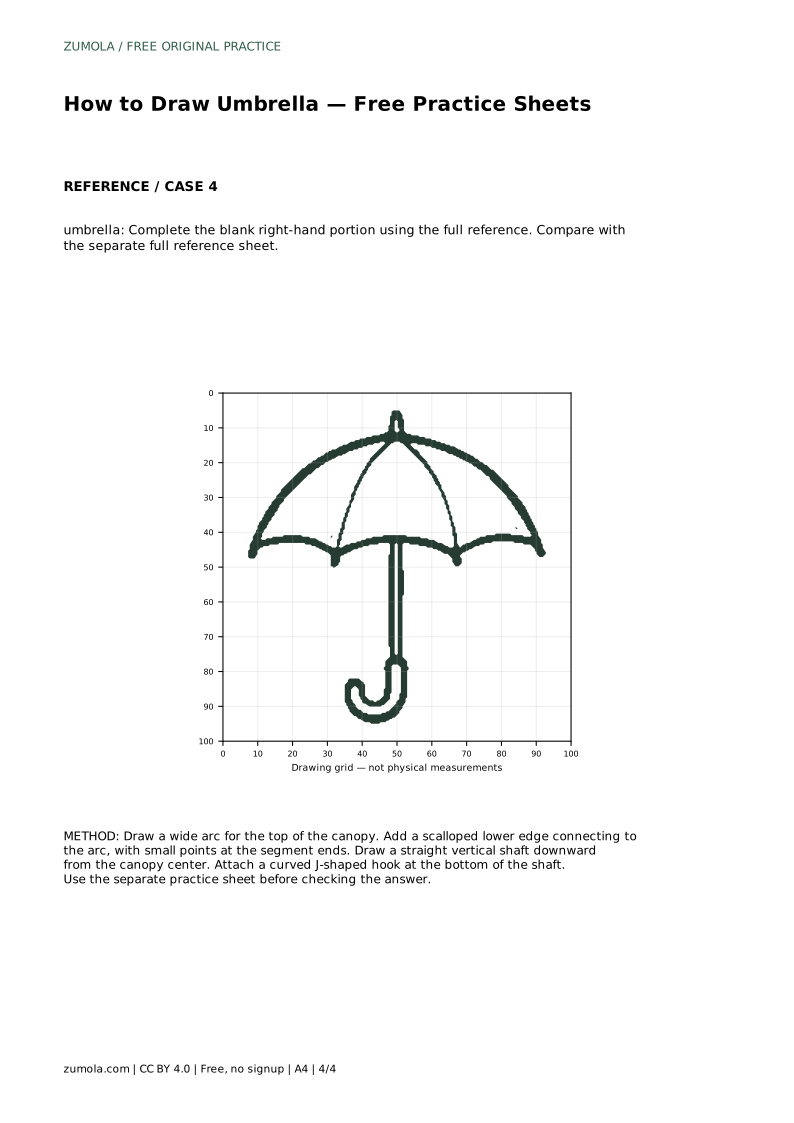
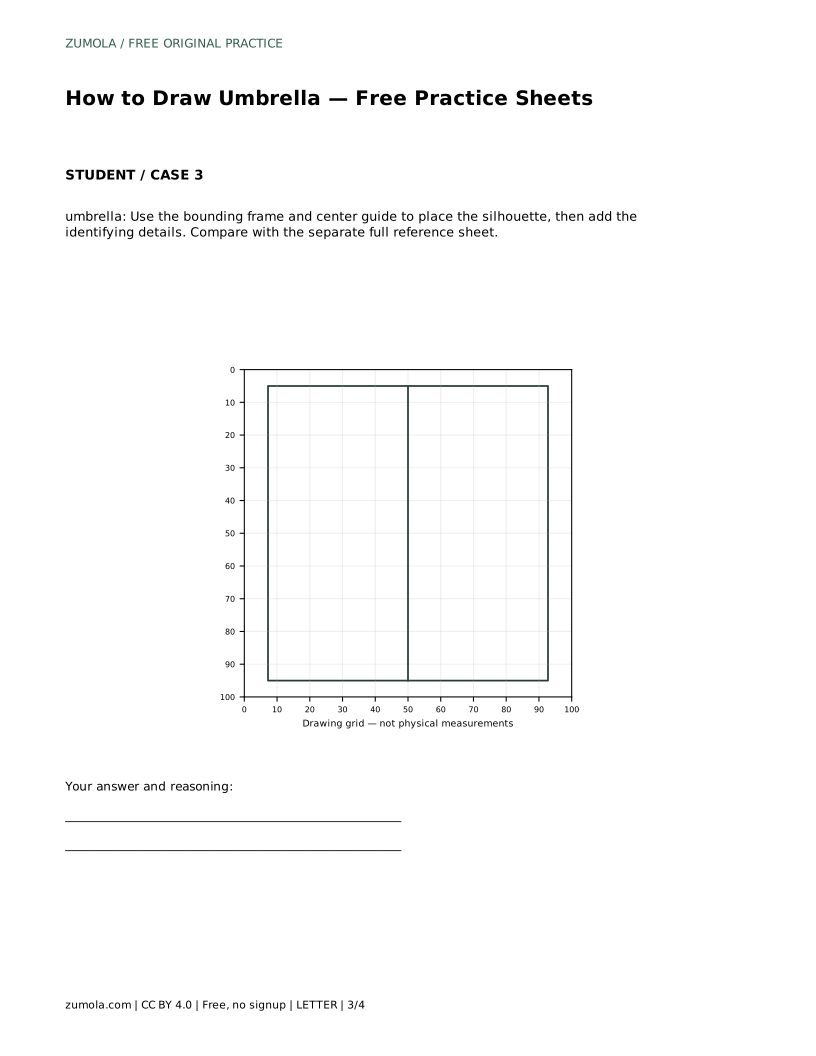
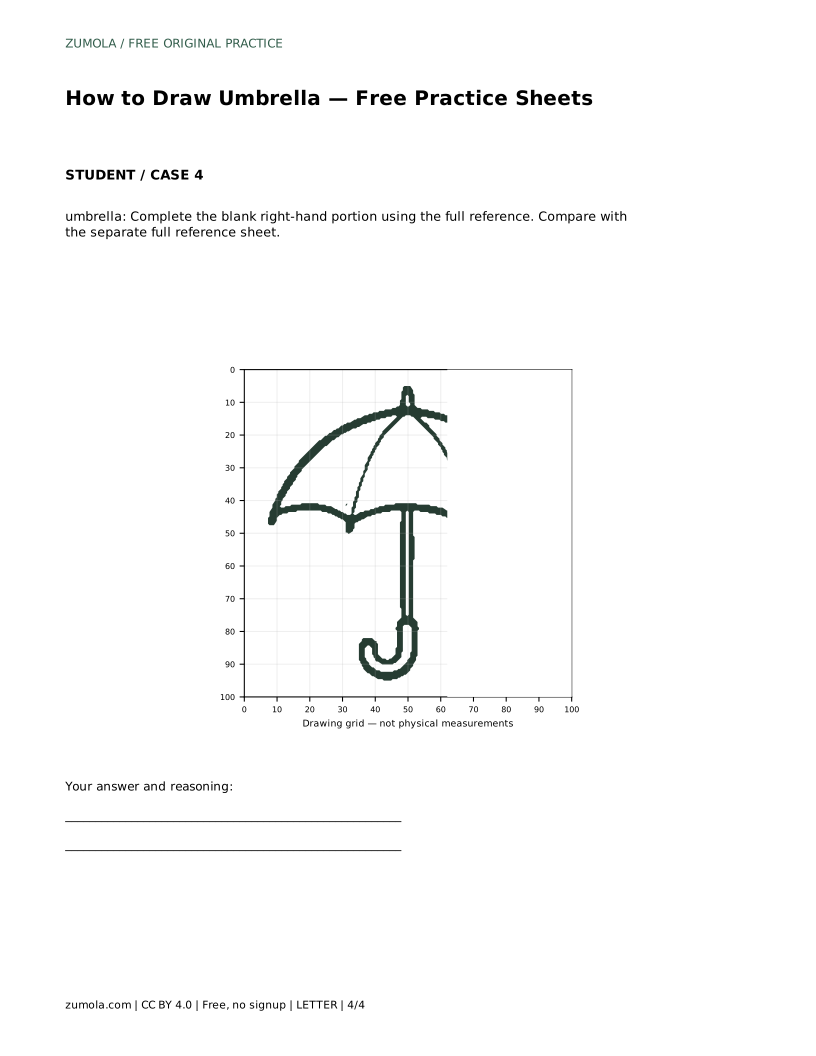
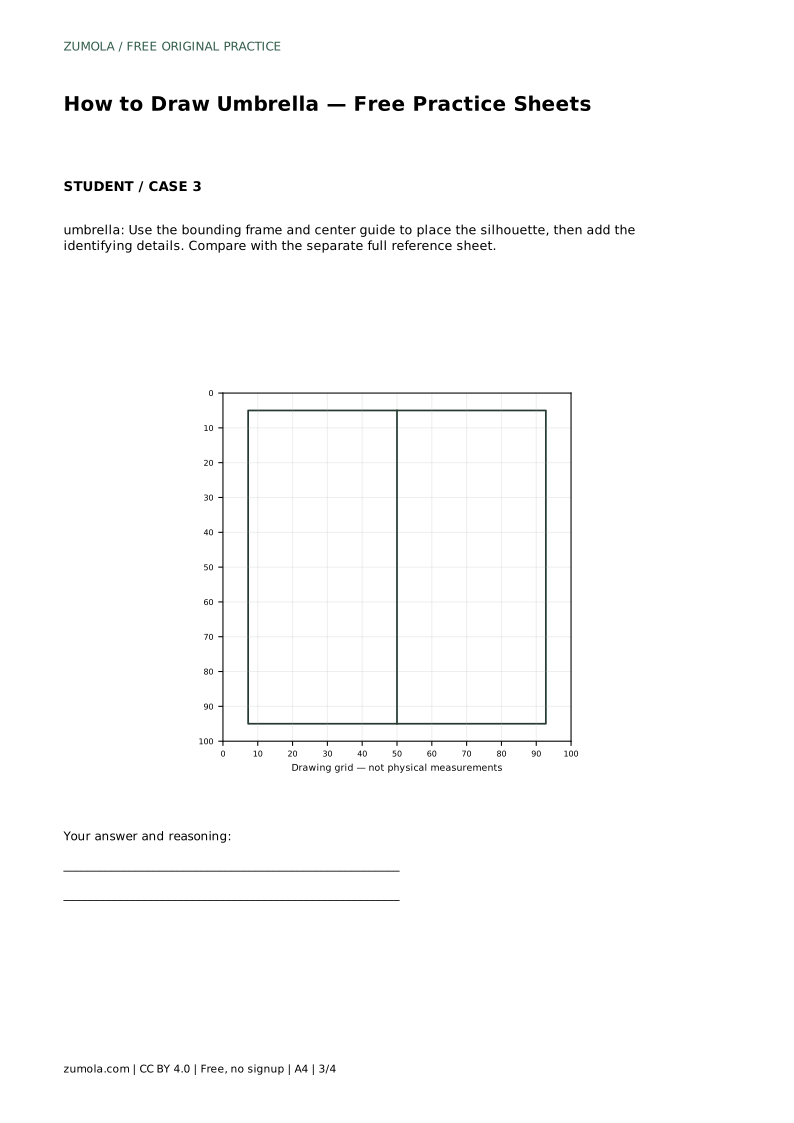
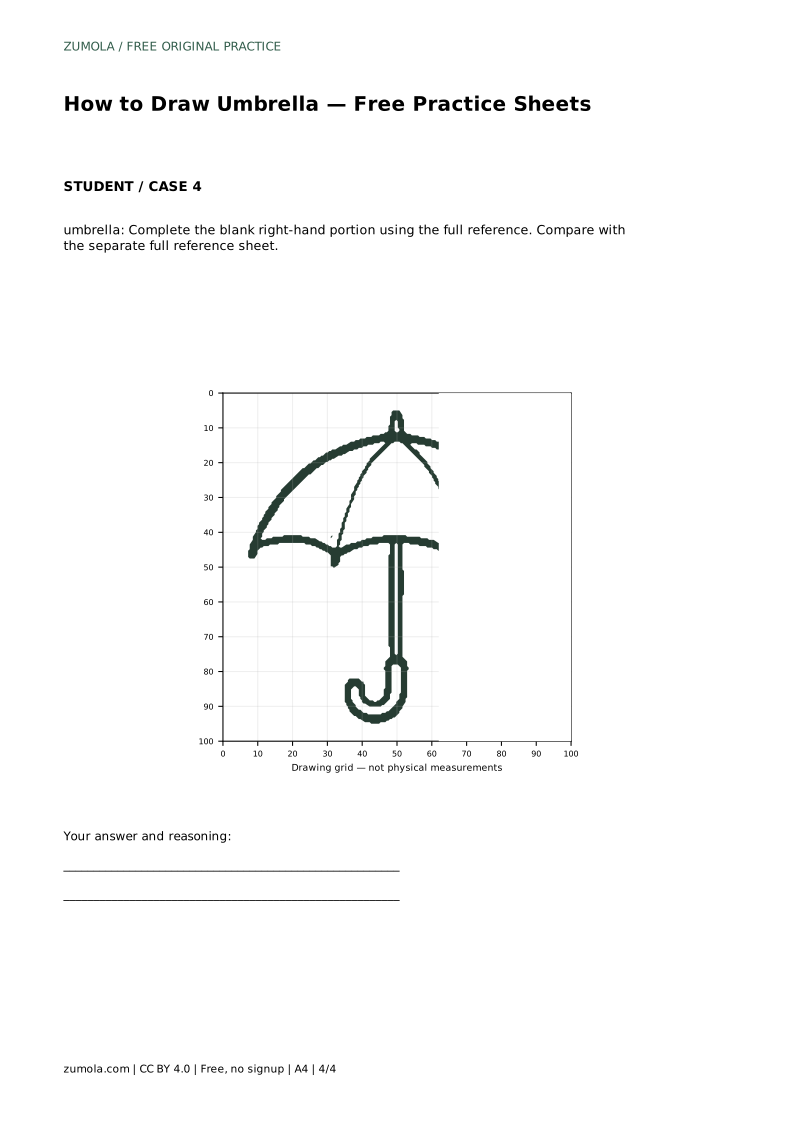
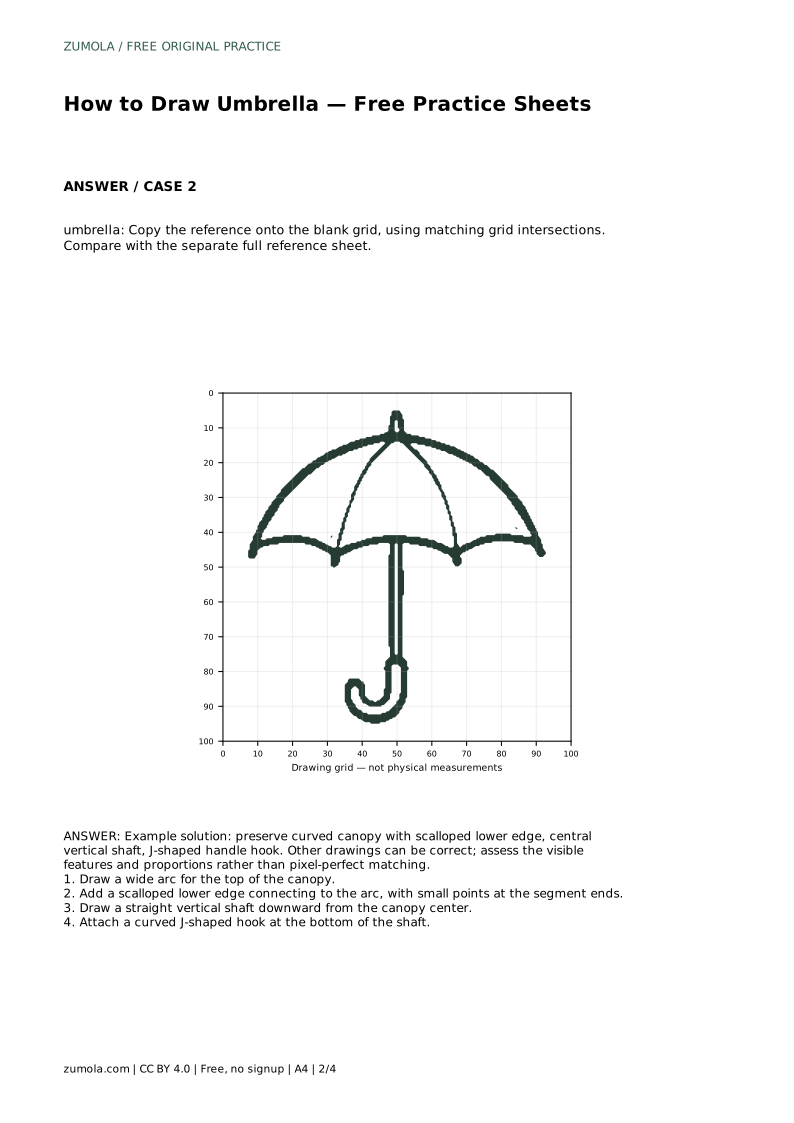
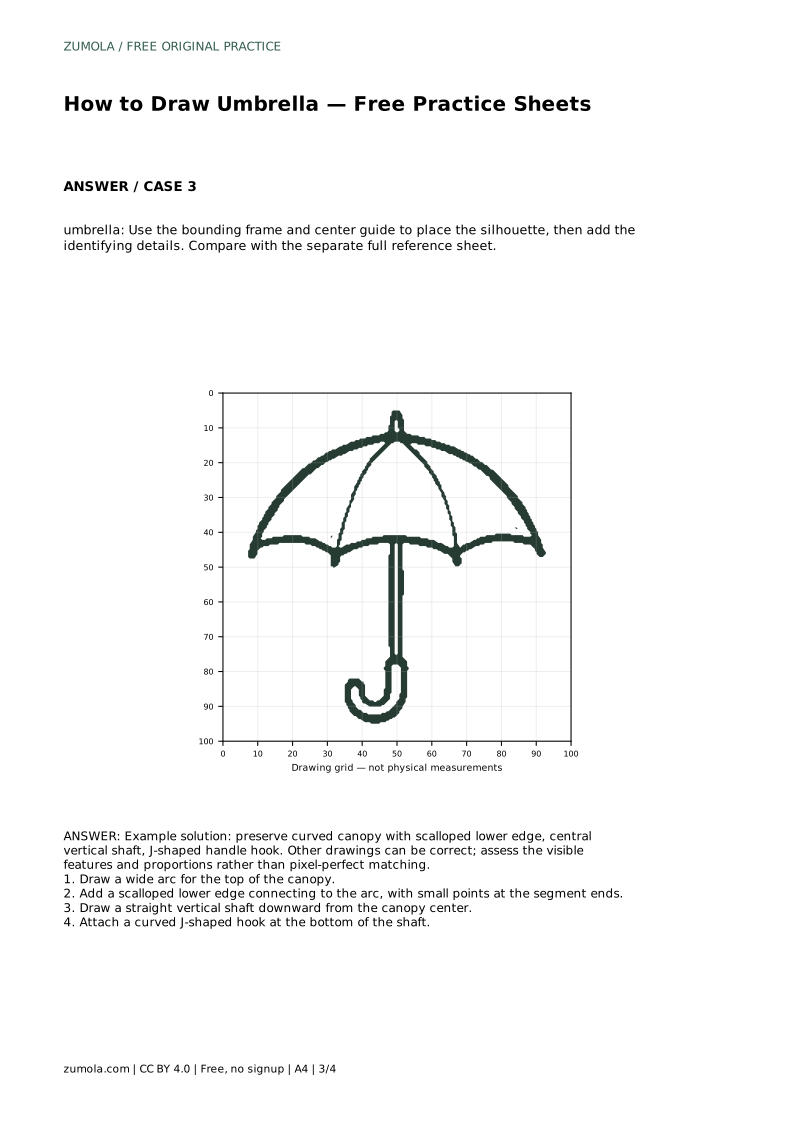
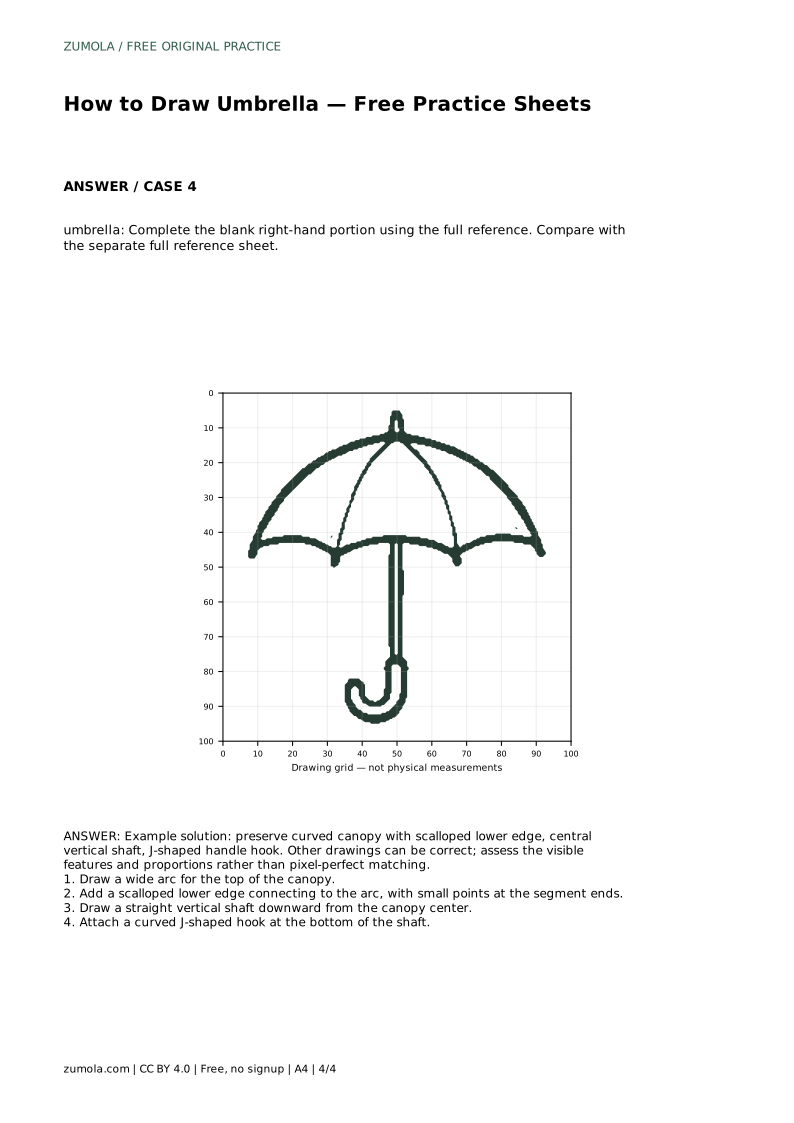
The grid sheet asks you to copy the reference onto a blank grid using matching grid intersections. Treat each intersection as a landmark: where the arc crosses a line, where a scallop point sits, where the shaft meets the canopy. The bounding-frame sheet gives you a center guide, so place the silhouette first and add the identifying details afterward. The partial sheet gives you the left side and asks you to complete the right side from the full reference.
There is no single correct umbrella drawing. A wider canopy, a longer shaft, or a hook that curves more tightly can all be valid. What matters is that the identifying features are present and that the proportions hold together: the canopy is wider than the shaft is long in most simple drawings, the shaft is vertical, and the hook is clearly a hook rather than a straight end.
Use the rubric below to assess your own sheet. Compare your drawing with the separate full reference sheet and note one feature to adjust next time, such as the depth of the arc or the size of the scallops.
Most problems come from drawing the parts in the wrong order or from letting the canopy and shaft drift apart. Drawing the shaft first often makes the canopy lopsided, because the arc gets fitted to the line instead of the line being centered under the arc. Drawing the scallops before the arc can make the lower edge too deep or too shallow for the canopy above it.
If the hook looks like a question mark, check that it curves back toward the shaft rather than continuing away from it. If the umbrella looks top-heavy, compare the canopy width with the shaft length on the reference sheet and adjust one of them.
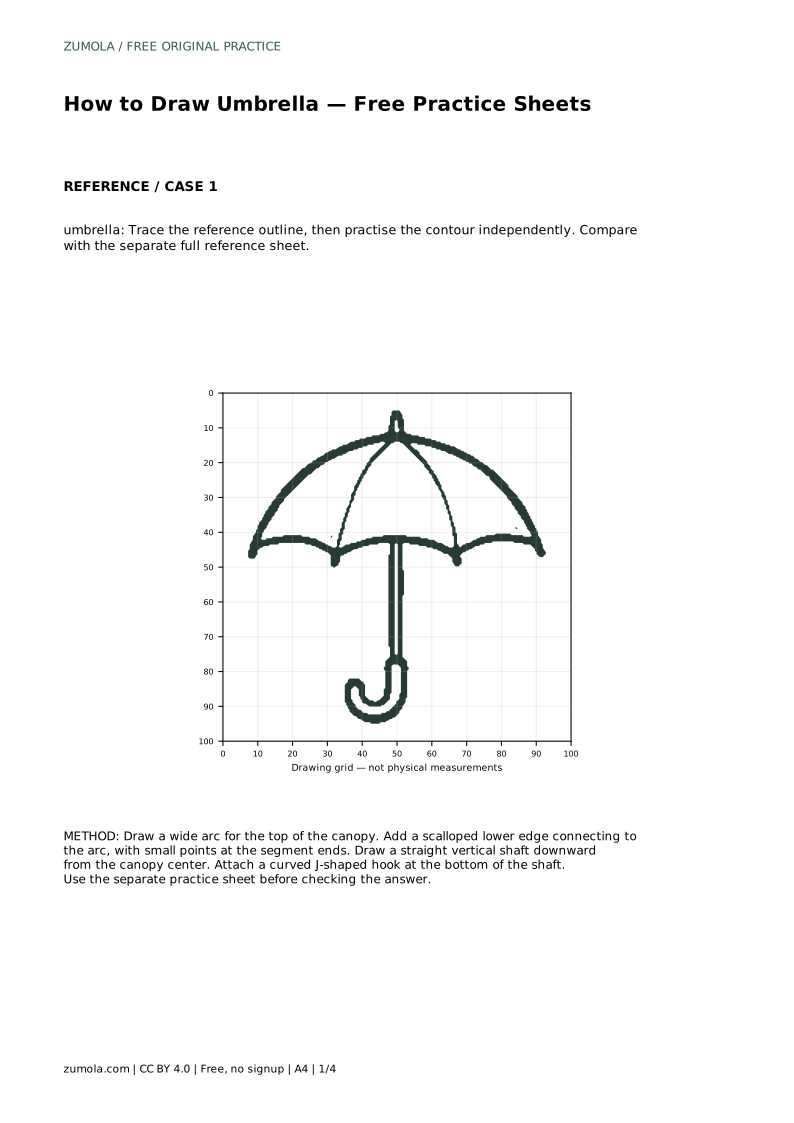
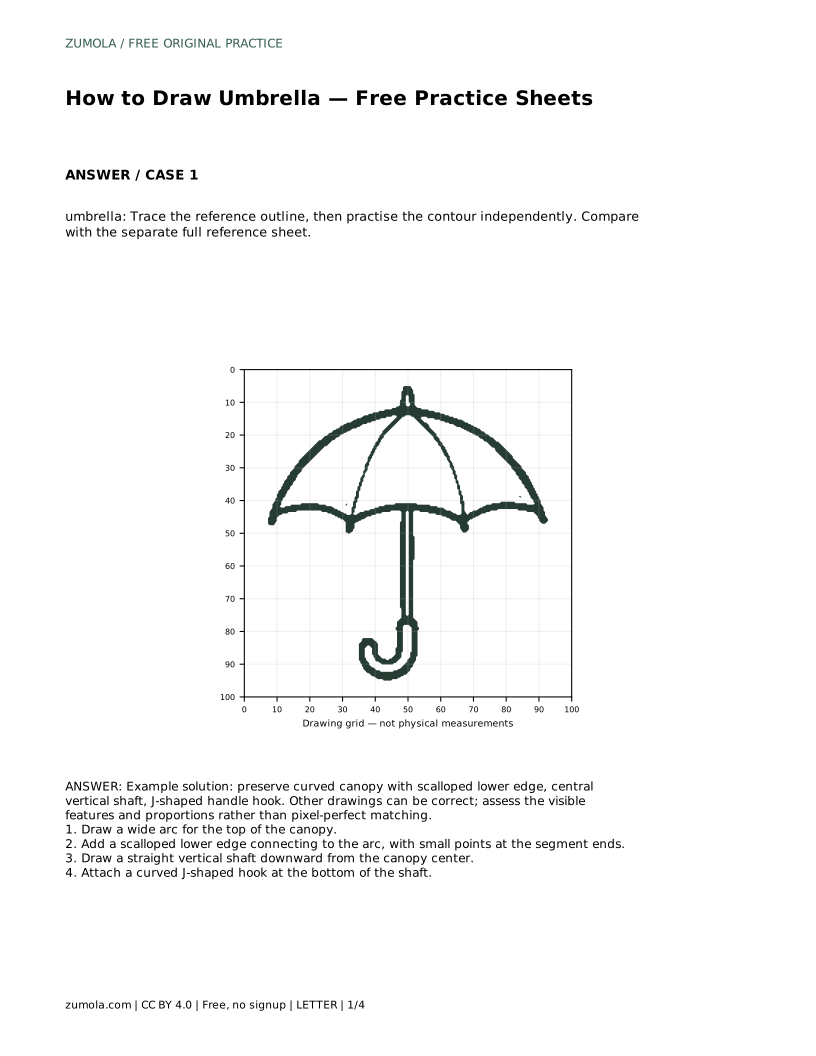
umbrella: Trace the reference outline, then practise the contour independently. Compare with the separate full reference sheet.
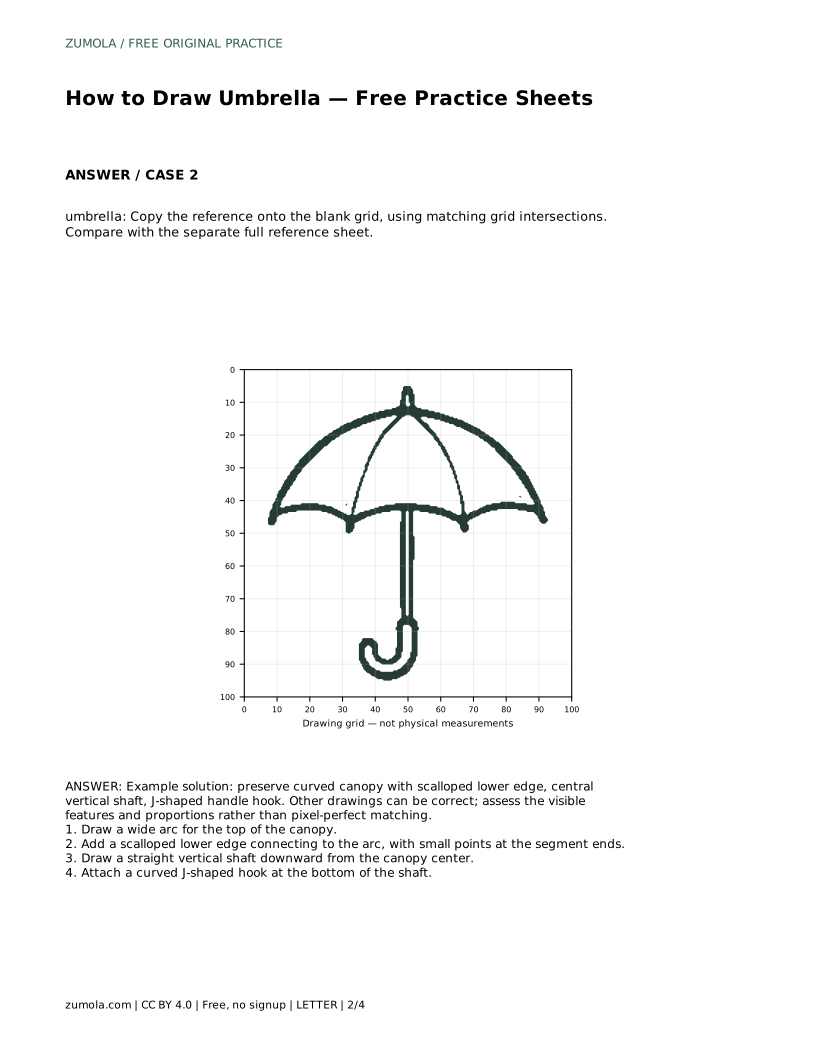
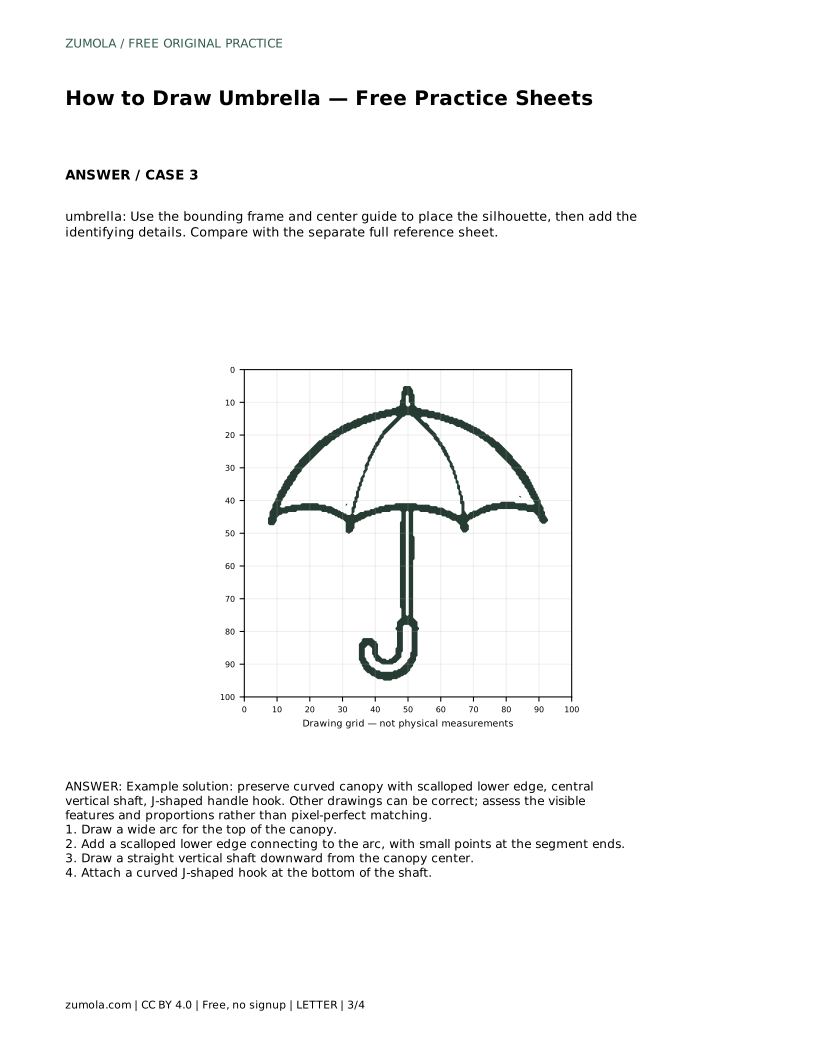
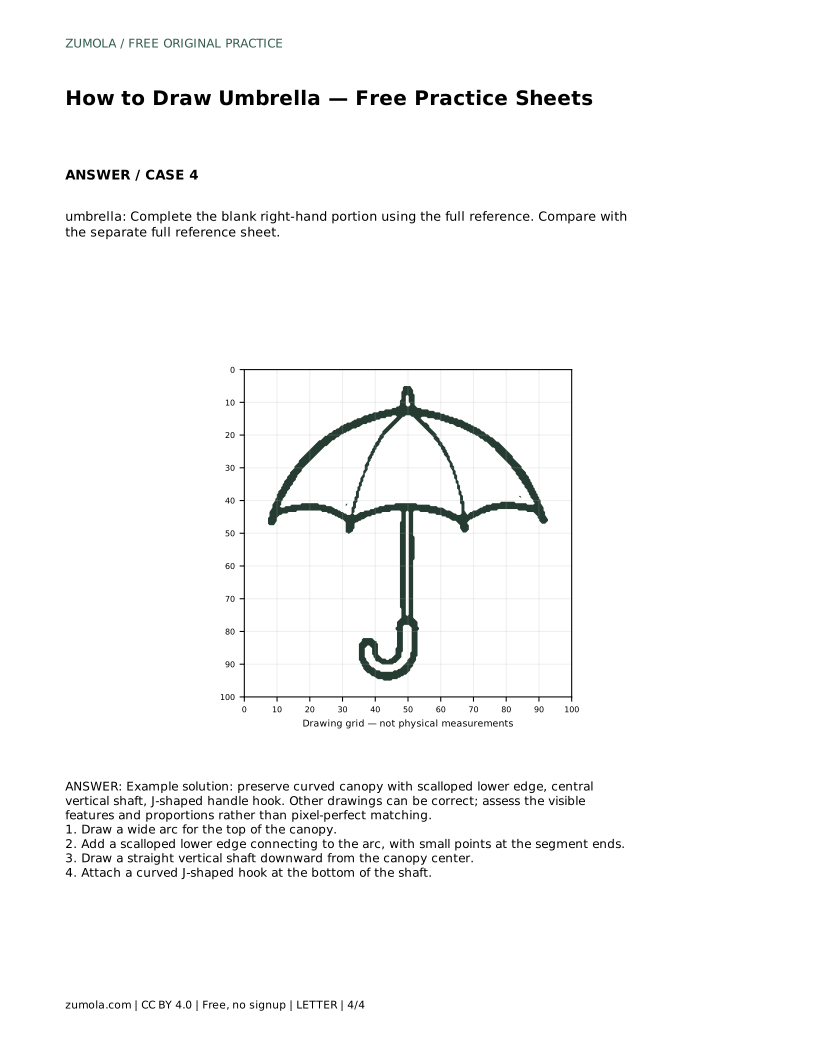
Example solution: preserve curved canopy with scalloped lower edge, central vertical shaft, J-shaped handle hook. Other drawings can be correct; assess the visible features and proportions rather than pixel-perfect matching. Draw a wide arc for the top of the canopy. Add a scalloped lower edge connecting to the arc, with small points at the segment ends. Draw a straight vertical shaft downward from the canopy center. Attach a curved J-shaped hook at the bottom of the shaft.
No. Other drawings can be correct. Assess the visible features and proportions rather than pixel-perfect matching.
Start with the tracing sheet to learn the contour, then move to the grid or frame sheet to practice placement without tracing.
Check the four identifying features: curved canopy, scalloped lower edge, straight centered shaft, and J-shaped hook.
All drawing practice · Free coordinate paper
Original resources · CC BY 4.0 · Free for personal and classroom use with attribution.